EP1580301A1 - Sulfur based corrosion inhibitors - Google Patents
Sulfur based corrosion inhibitors Download PDFInfo
- Publication number
- EP1580301A1 EP1580301A1 EP05005222A EP05005222A EP1580301A1 EP 1580301 A1 EP1580301 A1 EP 1580301A1 EP 05005222 A EP05005222 A EP 05005222A EP 05005222 A EP05005222 A EP 05005222A EP 1580301 A1 EP1580301 A1 EP 1580301A1
- Authority
- EP
- European Patent Office
- Prior art keywords
- corrosion
- inhibitor
- solution
- cci
- compound
- Prior art date
- Legal status (The legal status is an assumption and is not a legal conclusion. Google has not performed a legal analysis and makes no representation as to the accuracy of the status listed.)
- Withdrawn
Links
- 0 SC(*CCNC(S)=S)=S Chemical compound SC(*CCNC(S)=S)=S 0.000 description 3
Images







Classifications
-
- C—CHEMISTRY; METALLURGY
- C23—COATING METALLIC MATERIAL; COATING MATERIAL WITH METALLIC MATERIAL; CHEMICAL SURFACE TREATMENT; DIFFUSION TREATMENT OF METALLIC MATERIAL; COATING BY VACUUM EVAPORATION, BY SPUTTERING, BY ION IMPLANTATION OR BY CHEMICAL VAPOUR DEPOSITION, IN GENERAL; INHIBITING CORROSION OF METALLIC MATERIAL OR INCRUSTATION IN GENERAL
- C23F—NON-MECHANICAL REMOVAL OF METALLIC MATERIAL FROM SURFACE; INHIBITING CORROSION OF METALLIC MATERIAL OR INCRUSTATION IN GENERAL; MULTI-STEP PROCESSES FOR SURFACE TREATMENT OF METALLIC MATERIAL INVOLVING AT LEAST ONE PROCESS PROVIDED FOR IN CLASS C23 AND AT LEAST ONE PROCESS COVERED BY SUBCLASS C21D OR C22F OR CLASS C25
- C23F11/00—Inhibiting corrosion of metallic material by applying inhibitors to the surface in danger of corrosion or adding them to the corrosive agent
- C23F11/08—Inhibiting corrosion of metallic material by applying inhibitors to the surface in danger of corrosion or adding them to the corrosive agent in other liquids
- C23F11/10—Inhibiting corrosion of metallic material by applying inhibitors to the surface in danger of corrosion or adding them to the corrosive agent in other liquids using organic inhibitors
- C23F11/16—Sulfur-containing compounds
-
- C—CHEMISTRY; METALLURGY
- C23—COATING METALLIC MATERIAL; COATING MATERIAL WITH METALLIC MATERIAL; CHEMICAL SURFACE TREATMENT; DIFFUSION TREATMENT OF METALLIC MATERIAL; COATING BY VACUUM EVAPORATION, BY SPUTTERING, BY ION IMPLANTATION OR BY CHEMICAL VAPOUR DEPOSITION, IN GENERAL; INHIBITING CORROSION OF METALLIC MATERIAL OR INCRUSTATION IN GENERAL
- C23F—NON-MECHANICAL REMOVAL OF METALLIC MATERIAL FROM SURFACE; INHIBITING CORROSION OF METALLIC MATERIAL OR INCRUSTATION IN GENERAL; MULTI-STEP PROCESSES FOR SURFACE TREATMENT OF METALLIC MATERIAL INVOLVING AT LEAST ONE PROCESS PROVIDED FOR IN CLASS C23 AND AT LEAST ONE PROCESS COVERED BY SUBCLASS C21D OR C22F OR CLASS C25
- C23F11/00—Inhibiting corrosion of metallic material by applying inhibitors to the surface in danger of corrosion or adding them to the corrosive agent
- C23F11/08—Inhibiting corrosion of metallic material by applying inhibitors to the surface in danger of corrosion or adding them to the corrosive agent in other liquids
- C23F11/10—Inhibiting corrosion of metallic material by applying inhibitors to the surface in danger of corrosion or adding them to the corrosive agent in other liquids using organic inhibitors
- C23F11/16—Sulfur-containing compounds
- C23F11/162—Thioaldehydes; Thioketones
Definitions
- the present invention is directed towards corrosion inhibitors. More specifically, the present invention is directed towards sulfur based corrosion inhibitors for use in metal corrosion inhibition, particularly yellow metal.
- Copper corrosion inhibitors are widely considered a staple ingredient in most water treatment formulations. These inhibitors are designed to protect against the corrosion of the copper alloy surfaces found within industrial cooling systems, especially at the heat exchange surface. The accelerated corrosion of these surfaces and resulting galvanic deposition of copper onto existing ferrous metal surfaces can have detrimental effects on the structural integrity and operation of the cooling system. As a result, copper corrosion inhibitors have always been a staple ingredient in most water treatment formulations.
- benzotriazole ('BTA') and its derivatives have dominated industrial yellow metal corrosion inhibitors. Its derivatives include tolyltriazole ('TTA') and 2-mercapto benzotriazole ('MBT'). Their structures are illustrated as follows - By far, the most popular of these has been 4-5 methyl benzotriazole, or TTA. It has become the industry standard and is usually the only copper corrosion inhibitor considered by water treatment experts. Triazole inhibitors are typically dosed into cooling towers at a range of 2.0 to 5.0 mg/L. In closed loop recirculating systems, their dosages can reach as high as 25 to 50 mg/L.
- TTA triazoles' dominance
- tests have shown that chlorine added as a biocide can penetrate the thin tolyltriazole film causing accelerated corrosion rates.
- the tenacious, hydrophobic film formed with tolyltriazole makes it very resistant to breakdown in aqueous environments.
- both chlorine and bromine have been found to attack and breakdown the formed film, causing corrosion inhibition failure. Therefore, a user must assure that there is residual inhibitor present in these situations to repair the damage.
- Both BTA and TTA are believed to utilize the triazole functional group as their binding site to the metal, resulting in a protective film on the copper surface.
- Spectroscopic analyses have shown that the film formed is a 1:1 molar complex of Cu(I) and triazole. This complex is thought to stabilize Cu(I), preventing the copper from oxidizing further, thereby preventing the anodic reactions.
- the retardation of the cathodic reaction is believed to be accomplished by the hydrophobic backbone of the formed film, which inhibits the transport of hydrated, electronically active species to the metal surface.
- the film formed by TTA has been found to be more resistant to breakdown in aqueous environments.
- TTA's thin film is not as forgiving as BTA should breakdown occurs.
- BTA film is much thicker, consisting of many layers. Although it is more easily penetrated than the TTA film, its extra thickness helps act_as a buffer against complete breakdown.
- the present invention provides alternative inhibitors that offer an improvement over tolyltriazole in a number of areas.
- the present invention is directed towards sulfur based corrosion inhibitors that associate with metals, particularly copper, strongly enough to form a protective barrier or film.
- the inhibitors of the present invention are able to maintain corrosion protection over an extended period of time, e.g., for several weeks, without the presence of any inhibitor in solution. Examples of such inhibitors include dithiocarbamate acids and their salts.
- the corrosion inhibitors of the present invention provide improved film durability over commercially available inhibitors such as the triazoles. Films formed from the corrosion inhibitors of the present invention provide superior resistance to low level halogenation as compared to commercial inhibitors.
- the inhibitors of the present invention have the added benefit in that the use of residual inhibitors becomes optional. Additionally, the inhibitors of the present invention provide corrosion protection for a variety of copper alloys, as well as the additional protection of mild steel surfaces.
- the corrosion inhibitors of the present invention offer as its primary binding site to the metal a different functional moiety, or 'hook', from the common triazole functional group. Further, it has been learned that varying the compound's aliphatic or aromatic substituents has a significant impact on the performance of the inhibitors' filming abilities. By optimizing the balance between the hydrophobicity and steric properties of these substituent 'shields', an improved corrosion inhibitor is provided.
- the present invention uses structurally enhanced dithiocarbamate salts or mixtures of such salts for efficiently inhibiting the corrosion of copper and its alloys under a wide range of aqueous conditions encountered in the water treatment industry.
- the salts are illustrated herein due to the inherent instability of the acids. However, it should be understood that these species can exist in either their basic or acidic form for application.
- the sulfur based corrosion inhibitors of the present invention provide at least equal and sustained corrosion protection when compared to industry standards. Further, the copper corrosion inhibitors of the present invention can be more easily formulated over a wide range of conditions. The copper corrosion inhibitors of the present invention can provide resistance to common oxidants found in water treatment formulations.
- the present invention includes compounds or molecules having the following general structure - wherein M + represents an alkali or alkaline earth metal cation such as Na + or Ca ++ .
- X can be either nitrogen ('N') or sulfur ('S').
- R 2 does not exist and R 1 can be H, C 1 -C 12 alkyl, aryl or polyaryl, C 1 -C 12 alkaryl, C 1 -C 12 cycloalkly, C 1 -C 12 alkoxy, C 1 -C 12 polyalkoxy, hydroxyl or polyhydroxy, C 1 -C 12 alkylcarboxy, C 1 -C 12 alkylamino, C 1 -C 12 haloalkyl, haloaryl, alkoxyaryl, hydroxyaryl, aminoaryl, carboxyaryl, and combinations or further functionalized variants of the above.
- R 1 can be H, C 1 -C 12 alkyl, aryl or polyaryl, C 1 -C 12 alkaryl, C 1 -C 12 cycloalkly, C 1 -C 12 alkoxy, C 1 -C 12 polyalkoxy, hydroxyl or polyhydroxy, C 1 -C 12 alkylcarboxy, C 1 -C 12 alkylamino, C 1 -C 12 haloalkyl, haloaryl, alkoxyaryl, hydroxyaryl, aminoaryl, carboxyaryl, or combinations or further functionalized variants of the above; and R 2 can be H, C 1 -C 12 alkyl, aryl or polyaryl, C 1 -C 12 alkaryl, C 1 -C 12 cycloalkly, C 1 -C 12 alkoxy, C 1 -C 12 polyalkoxy, hydroxyl or polyhydroxy,
- the invention can include multiple repeating units called functionalized multi-amines or functionalized polyamines.
- the functionalities would consist of dithiocarbamate groups, R 1 substituents, and R 2 substituents as defined above.
- the present invention is an aqueous solution having one or more sulfur based corrosion inhibitors.
- the sulfur based corrosion inhibitors of the present invention are one or more dithiocarbamate salts.
- the present invention is an aqueous solution having one or more dithiocarbamate salts with the solution being about 10% to about 50% active.
- the present invention is an aqueous solution having one or more dithiocarbamate salts with the solution having a pH that stabilizes the one or more dithiocarbamate salts.
- the solution has a pH of at least about 10 or greater for stabilizing the one or more dithiocarbamate salts.
- the present invention is an aqueous solution having one or more dithiocarbamate salts with the solution having a pH of about 11 to about 13 for stabilizing the one or more dithiocarbamate salts.
- the aqueous solution further includes an organic co-solvent for maintaining one or more dithiocarbamate salts in solution.
- the organic co-solvent is isopropyl alcohol.
- the organic co-solvent also includes 10% diethyl hydroxylamine, added for stability of the product.
- the yellow metal corrosion inhibitors of the present invention are further useful in inhibiting mild steel corrosion.
- 'Mild' steel is understood to refer to carbon and low alloy steels.
- the yellow metal corrosion inhibitors of the present invention are further useful in inhibiting metal alloy corrosion.
- metal alloys include, e.g ., galvanized steel, stainless steel, cast iron, nickel and combinations thereof.
- the present invention is also directed towards a method of inhibiting yellow metal corrosion wherein an effective amount of one or more of the above described compounds or molecules is added to an aqueous system such as a cooling water tower.
- an aqueous system such as a cooling water tower.
- the aqueous system can be dosed with about 0.1 mg/L to about 100 mg/L of the above described compounds or molecules.
- the aqueous system is dosed with about 4.0 mg/L to about 5.0 mg/L of one or more of the above described compounds or molecules.
- the present invention is directed towards a method of inhibiting yellow metal corrosion wherein an effective amount of one or more of the above described compounds or molecules is added or coated directly to the metal surface and rinsed, such as dipping the metal into the inhibitor, spraying or painting the inhibitor onto the metal surface and so forth.
- the method further includes coating a metal surface with a formulation or product formed from one or more active inhibitors and at least one co-solvent in an amount effective for maintaining the solubility of the active inhibitor(s).
- azoles require maintaining residual inhibitor in aqueous systems for repairing damage to the azole film.
- the inhibitor of the present invention does not require the presence of a residual inhibitor to prevent corrosion.
- the durability of films formed from the present inhibitor allows a user to completely alter the method of treating the aqueous system.
- This method includes slug-dosing the inhibitor of the present invention into the aqueous system without a constant feed of inhibitor to maintain a residual level in the water.
- Such a method of treatment can offer several advantages to the end user, including reduced costs, less monitoring, and so forth. Further, this type of treatment cannot be conducted successfully by azoles, as azoles require the addition of the residual inhibitor.
- compositions are detectable by oxidation/reduction potential (ORP) monitoring.
- ORP oxidation/reduction potential
- the compositions cause a significant drop in ORP readings when added to the system.
- at least one of the molecules has ORP readings that drop like other molecules, but then rise quickly back to the initial reading prior to treatment. This indicates interaction of the molecule with the metal surface and formation of the film. This behavior offers a unique way of knowing when enough inhibitor is added to protect the metal surface that is valuable to the end user.
- At least one of the compounds or molecules is able to be detected in cooling water by UV absorption. It is believed that this is due to an aromatic group in the molecule, which is not present in all of the molecules described above. Dibenzyl dithiocarbamate is an example of such a compound. However, any of the compounds described above having aromatic substituents should be detectable by UV absorption.
- the present invention provides a method of treating an aqueous system wherein at least one of the compounds or molecules of the present invention is detected, measured, and dosage controlled utilizing UV spectroscopy and/or oxidation-reduction potential measurement.
- the method further includes utilizing UV spectroscopy to detect, measure, and control dosage of other additives such as polymers containing aromatic monomers.
- the sulfur based copper corrosion inhibitors (CCIs) of the present invention include both aliphatic and aromatic substituents combined with a common functional moiety.
- the present invention shows that variations on CCIs' hydrophobic substituents have significant impact on the performance of the inhibitor's filming abilities.
- the sulfur-based CCIs substituents tested included those with di-methyl, di-ethyl, di-propyl, di-isopropyl, di-butyl, di-isobutyl, di-pentyl, and di-benzyl groups.
- Each molecule's performances were compared to that of tolyltriazole under identical conditions in common corrosion testing systems, using both electrochemical corrosion cells and pilot cooling rigs, with various water conditions.
- the present invention is directed towards sulfur based compounds that associate with metals such as copper strongly enough to form a noticeable barrier.
- metals such as copper strongly enough to form a noticeable barrier.
- Both aliphatic and aromatic molecules having the general structure described above were evaluated for their copper corrosion inhibitive properties. These included, for example, sodium dimethyl dithiocarbamate ('SDDC'), di-sodium trithiocarbonate ('TTC'), ethylene bis-dithiocarbamate ('EBDC') and sodium di-ethyl dithiocarbamate ('SDEDC'), illustrated as - Other examples included polymeric dithio compounds such as - and alkyl trithiocarbonates such as -
- the compounds' performances were compared to that of TTA under identical conditions. These comparative tests were conducted in common corrosion testing systems, using both electrochemical corrosion cells and pilot cooling rigs, using various water conditions.
- the test methods included electrochemical studies, such as linear polarization resistance, open circuit potential versus time, Tafel and cyclic polarization.
- Electrochemical testing provides a method for determining the corrosion rate of a metal before any weight loss can be detected. For copper, where corrosion rates are usually less than 2.0 mils per year ('mpy'), electrochemical testing is even more valuable since weight loss would take significant time to detect. When evaluating corrosion inhibitors, this feature allows for quick assessment of inhibitor performance, including general corrosion rate and film durability. The tests are performed by applying a potential to an electrode in an electrolyte and measuring the electrical current produced. When the current is divided by electrode surface area ('Amps/cm 2, ), it can be easily converted to a standard corrosion rate in mpy.
- a measured electrode potential taken in the absence of an applied potential is referred to as the open circuit potential ('OCP').
- the degree of potential applied to an electrode is always centered around the OCP and is referred to as the overpotential, whether it is a decrease or increase in potential from OCP.
- the overpotential When am overpotential is applied that is >50mV from OCP, the cathodic current becomes minute and the electrode essentially becomes an anode.
- an overpotential is applied that is ⁇ 50mV from OCP, the electrode becomes a cathode.
- the ability to independently control each half reaction allows for the measurement of the external currents they produce. The larger this overpotential is, the more information that can be obtained about the corrosion of the metal in question.
- Lower overpotential ranges up to 500mV can provide information about general corrosion, while overpotential ranges of 1000mV to 2250mV can provide information about pitting and/or crevice corrosion.
- Linear Polarization Resistance provides quick estimations of general corrosion rates. Because of their small overpotential range of -20mV to +20mV from OCP, the test method does not damage the metal surface. This allows for unlimited monitoring of corrosion rates within a system over time. As a result, this method is most useful as a screening method in the corrosion cells and as the primary corrosion monitor in longer term pilot tests where non-destructive test are required.
- Tafel polarizations provide the most detailed information on general corrosion.
- the cathodic and anodic branches are generated by applying a potential that is approximately -250mV from OCP and then increased stepwise until the potential is approximately +250mV from OCP.
- the potential-current data are plotted as applied potential versus log values of current density.
- the corrosion rates are determined from Tafel plots by extrapolating lines from where the anodic and cathodic branches become linear to where they would intersect at OCP.
- Tafel extrapolation is a means of estimating the actual corrosion rate of the metal, at its open circuit potential. This corrosion rate cannot be measured directly because the non-polarized metal will measure a current density of zero even though metal may be being lost. The point on the x-axis at which this intersection occurs gives the current density (i corr ) for the metal in question. This current density can then be converted into a corrosion rate in mils per year.
- the Tafel method can provide information on the mechanistic inhibition properties of inhibitors by observing the slopes of the cathodic and anodic lines along with the overall suppressions. Increased slopes indicate that the current density undergoes less change per overpotential dosage. The ability to resist this change is an indication of the effectiveness of the inhibitor to impede corrosion as conditions worsen.
- Overall suppression is defined as an overall shift to smaller current densities in the anodic and cathodic lines. When plotted with the potential on the y-axis and current density on the x-axis, this means a shift to the left, along the x-axis.
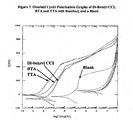
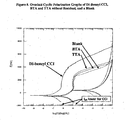
- Cyclic Polarizations provide the most information about the properties of an inhibitive film.
- the cathodic and anodic branches are generated by applying a potential that is approximately -250mV from OCP and then increased, step wise, until the potential is approximately +1000mV from OCP or current density reaches a pre-set magnitude. At this point, the potential is reversed and decreased back to a current density of zero.
- Key points on a cyclic polarization curve are the primary passivation potential (E pp ), breakdown potential (E bd ), and re-passivation potential (E rp ). Through the location of these key points on the graph, detailed information can be gained about the film's durability, reparability, and pitting tendency.
- This water contained 1000 mg/L NaCl and 1000 mg/L M Alkalinity.
- the pH of the water was 9.5.
- the chosen water chemistry provided higher corrosion rates with an untreated system, which in turn provided a larger window for differentiating between inhibitors.
- This water contained 300 mg/L Ca and 100 mg/L Mg (both as CaCO 3 ), 297 mg/L chloride, 475 mg/L M Alkalinity, 455 mg/L Na, and 10 mg/L calcium carbonate control polymer.
- the pH of the water was controlled at 8.75-8.85. All inhibitor dosages were 5.0 mg/L active inhibitor.
- the electrolyte test water chosen was one that resembled typical cooling water conditions. This water contained 400 mg/L Ca and 160 mg/L Mg (both as CaCO 3 ), 396 mg/L chloride; 400 mg/L M Alkalinity, 400 mg/L sulfate (as CaCO 3 ), and 383 mg/L Na.
- a typical water treatment formulation was added to achieve 3 mg/L PBTC, 10 mg/L calcium carbonate control polymer, 7.5 mg/L orthophosphate, and 10 mg/L calcium phosphate control polymer. The pH of the water was 8.95-9.05. Air was bubbled into the system to saturate the water with oxygen.
- Pilot systems provide a more realistic system for evaluation of inhibitors.
- Each unit is a 25L non-evaporatory cooling system, with heat exchange rack, corrosion rack, and chilled condenser.
- the supplied heat flux to the heat exchangers can be adjusted via supplied wattage.
- the system contains a treatment, hardness, and alkalinity feed along with blow-down capabilities that allows for increasing cycles of concentration.
- the operating parameters chosen for this testing were a flow velocity of 0.9 m/sec, bulk water temperature of 40°C, and heat flux of 16,000 BTU/ft 2 /hr.
- Heat exchange rods were constructed of CDA122 and admiralty brass copper alloys. These heat exchange surfaces were closely monitored, visibly, throughout all testing for signs of both general and localized corrosion.
- a linear polarization resistance probe with CDA110 copper electrodes, was used as the method for estimating general corrosion rates on inhibitors throughout all pilot testing. Once a stable corrosion rate was obtained for each untreated solution, the inhibitor was then dosed into the system. As with the corrosion cell testing, two different test waters were used, depending on the stage of testing.
- the copper surface binding energies of these configurations were computed using DMol, a high quality quantum mechanics computer program (available from Accelrys, San Diego, California). These calculations employed an ab initio, local density functional (LDF) method with a double numeric polarization (DNP) basis set and a Becke-Perdew (BP) functional.
- LDF local density functional
- DNP double numeric polarization
- BP Becke-Perdew
- the modeling determined each molecule's most favorable interaction with the metal surface by considering binding sites, geometry and distance. The modeling also considered the lateral interaction between inhibitor molecules as they approached the metal surface.
- the modeling studies calculated total adsorption energy for each molecule using lowest energy configurations and optimized coverage. The total adsorption energies for substituted versions of BTA were compared to the total adsorption energies of CCIs according to the present invention. Table 1 provides a summary of the total adsorption energy for BTA derivatives and CCIs -
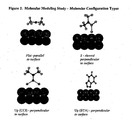
- Three angles of approach, or configuration types, for the inhibitor were also selected: Flat where the plane of the molecule is parallel to the copper surface; Up where the molecule is perpendicular to the copper surface with the primary binding functionalities pointing down; and S where the molecule is perpendicular to the copper surface with only one of the binding functionalities pointing down toward the surface.
- the angles of approach relative to the copper surface are illustrated in Figure 2.
- the UP-2 configuration of BTA and TTA refer to a perpendicular orientation with two nitrogen atoms pointing down as illustrated in Figure 3.
- the much larger, bulky substituents weaken adsorption energies by slowing the rate of molecular packing onto the metal surface. This weakening is most noticeable for di-propyl CCI and t-butyl benzotriazole.
- the t-butyl benzotriazole is widely claimed to form a more durable film than TTA, due to its more hydrophobic backbone.
- t-butyl benzotriazole takes a longer amount of time to form its film on the metal surface than TTA or BTA. It appears that the weaker adsorbances calculated for the inhibitors with larger substituents may be a better indicator of the time needed for film formation than the actual ability of the film to eventually prevent corrosion.
- the molecular modeling studies served as a useful prelude to electrochemical testing.
- the studies indicate that the CCI functionality offers a drastic improvement over triazoles by providing a better "hook” for attaching the molecule to the metal surface.
- the "shield" of the inhibitor can be modified to provide the best yellow metal corrosion inhibitor possible.
- Tafel Polarizations with Residual Inhibitor Initial testing was performed in the primary screening water with 5.0 mg/L residual inhibitor.
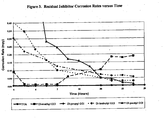
- the working copper electrodes were first placed into the corrosion cell, filled with the cooling tower matrix, and allowed to sit undisturbed for approximately one hour. At that time, a 5.0 mg/L dosage of active inhibitor was added to the water. The electrodes sat undisturbed overnight to allow for complete formation of the protective films and electrode stabilization. The electrodes were then polarized in their existing corrosion cell the following day. The filmed electrodes were then allowed to sit one hour to allow the OCP to stabilize before polarizations were performed. Differences were found in the time required to reach optimum inhibitor performance for the various hydrophobic substituents. The resulting Tafel extrapolated corrosion rates are plotted in Figure 3.
- di-methyl CCI reached its lowest corrosion rates within a few hours.
- the larger substituents reached their lowest corrosion rates the following day.
- TTA provided low corrosion rates immediately and maintained them throughout testing.
- the corrosion rates for the larger substituents were generally tenfold lower than the smaller substituents by the following day and compared well to the performance of TTA.
- the inhibitors of the present invention suppress both the anodic and cathodic corrosion reactions overall. This suppression was even more pronounced for the larger substituents tested.
- the CCI compounds of the present invention also increased the slope of the anodic line ( ⁇ a ), indicating further suppression of the anodic currents. This increase was most pronounced for di-benzyl, di-isobutyl, and di-pentyl CCI. These results also indicate that the CCI molecules of the present invention were helpful in suppressing both corrosion reactions. Overall, the various hydrophobic substituents of those compounds seemed to have a greater effect on the suppression of the anodic reaction than the cathodic reaction.
- Tafel Polarizations without Residual Inhibitor This procedure was identical to the test with residual inhibitor.
- the working copper electrode was allowed to form the inhibitor film overnight in the presence of 5.0 mg/L active inhibitor dosed into the primary screening water. The next day the electrode was removed and rinsed with DI water and placed in a separate corrosion cell, filled with the primary screening water without any residual inhibitor. After one hour, Tafel polarizations were made. This method allowed for the full evaluation of the film only, without any residual inhibitor present for repair.
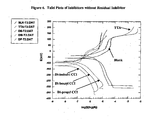
- Figure 6 shows the Tafel plots of the leading inhibitors, along with tolyltriazole (TTA) and an untreated "blank” solution.
- TTA tolyltriazole
- the plots indicate a similar suppression of the anodic current between three inhibitors: di-benzyl, di-isobutyl, and di-propyl CCI.
- di-benzyl, di-isobutyl, and di-propyl CCI there was greater separation between the cathodic curves, with di-isobutyl CCI displaying slightly better suppression of the cathodic reaction, followed by di-benzyl CCI and finally di-propyl CCI.
- Cyclic Polarizations with Residual Inhibitor Initial testing was performed in the primary screening water with 5.0 mg/L residual inhibitor. The working copper electrodes were first placed into the corrosion cell, filled with the cooling tower matrix, and allowed to sit undisturbed for approximately one hour. At that time, a 5.0 mg/L dosage of active inhibitor was added to the water. Inhibitors chosen for evaluation were di-benzyl CCI, BTA and TTA. The electrodes sat undisturbed overnight to allow for complete formation of the protective films and electrode stabilization. The electrodes were then polarized in their existing corrosion cell the following day. The filmed electrodes were then allowed to sit one hour to allow the OCP to stabilize before polarizations were performed.
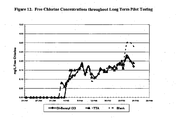
- the hypochlorite feeds were stopped to allow free chlorine levels to degrade to less than 0.1 mg/L.
- the purpose of this was to determine if corrosion rates would drop back to the levels prior to hypochlorite addition, which would indicate the remaining intactness of the protective film.
- the TTA film continued to maintain an unacceptable corrosion rate of 0.4 mpy with less than 0.1 mg/L free chlorine. This indicated potential breakdown of the film instead of penetration attack.
- the CCI film's corrosion rates dropped to 0.1 mpy with less than 0.1 mg/L free chlorine, indicating that the film produced using the CCI composition according to the present invention remained more intact.
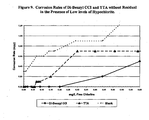
- Figure 10 depicts the resulting corrosion rates over time as measured by Tafel extrapolation.
- all of the CCI inhibitors of the present invention performed approximately tenfold better than TTA.
- the extrapolations illustrate that TTA cannot sustain a protective barrier by itself and must rely on its residual inhibitor to repair damaged film.
- the CCI inhibitors of the present invention provide films that maintain corrosion protection without the added residual inhibitor.
- Figure 11 further supports this.
- Figure 11 shows pictures of the electrodes after testing. As seen in Figure 11, severe localized corrosion occurred on the TTA filmed electrode, while the di-propyl CCI filmed electrode remained undamaged.
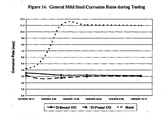
- FIG 13 shows that the TTA treated system reached a higher corrosion rate of 0.30 mpy more quickly than the untreated system.
- the di-benzyl CCI treated system maintained lower corrosion rates throughout testing, never reaching higher than 0.10 mpy.
- the differences in corrosion rates were further supported by ICP analysis of the cooling water for soluble copper concentrations. These concentrations can be seen in Figure 14. From Figure 14 it is seen that the di-benzyl CCI treated system maintained lower soluble copper concentrations throughout testing, indicating that its more impeded copper corrosion reactions were resulting in less soluble copper in the cooling water.
- TTA forms a very unstable film.
- TTA has the ability to quickly repair its film when damaged; however, the survival of the TTA film relies completely on the presence of residual inhibitor for repair. With no residual inhibitor present, the TTA film fails.
- the CCI compounds of the present invention form a durable film on metal surfaces, particularly yellow metal surfaces.
- These CCI molecules tend to be slower than the triazoles in film formation, which is believed due to their more bulky substituents.
- these more bulky CCI substituents provided a more hydrophobic barrier for corrosion protection than the triazole films.
- films formed from the CCI molecules do not require an ever-present residual inhibitor in order to provide effective corrosion protection.
- a clean, dry, four-neck 500 mL flask was charged with 59.6 g of city water, 39.0 g (0.52 mol) of 60% aqueous dimethyl amine, and a large stir bar. Stirring was initiated and the flask was fitted with a condenser, thermocouple, and heating mantle.
- a 25 mL addition funnel was charged with 38.0 g (0.50 mol) of carbon disulfide and attached to the reaction flask.
- a 50 mL addition funnel was charged with 40.0 g (0.50 mol) of 50% sodium hydroxide and attached to the reaction flask. The reaction was then heated to 30°C with stirring.
- the carbon disulfide feed was started at a slow drop-wise rate. After five minutes the sodium hydroxide feed was also started at a slow drop-wise rate. The feeds were regulated such that the reaction temperature did not exceed 45°C, and both additions were complete after approximately one hour. The reaction was then allowed to cook for thirty minutes at 40°C, after which the sodium dimethyl dithiocarbamate solution was a clear yellow-green solution.
- the pH was 12.0-14.0 and the activity was 40-41% by acid decomposition analysis.
- a clean, dry, four-neck 500 mL flask was charged with 113 g of city water, 19.0 g (0.26 mol) diethyl amine, and a large stir bar. Stirring was initiated and the flask was fitted with a condenser, thermocouple, and heating mantle.
- a 25 mL addition funnel was charged with 19.0 g (0.25 mol) of carbon disulfide and attached to the reaction flask.
- a 50 mL addition funnel was charged with 20.0 g (0.25 mol) of 50% sodium hydroxide and attached to the reaction flask. The reaction was then heated to 30°C with stirring.
- the carbon disulfide feed was started at a slow drop-wise rate. After five minutes the sodium hydroxide feed was also started at a slow drop-wise rate. The feeds were regulated such that the reaction temperature did not exceed 45°C, and both additions were complete after approximately one hour. The reaction was then allowed to cook for one hour at 40°C, after which the sodium diethyl dithiocarbamate solution was a clear yellow-green solution.
- the pH was 12.0-14.0 and the activity was 24-26% by acid decomposition analysis.
- a clean, dry, four-neck 500 mL flask was charged with 189 g of city water, 36.9 g (0.365 mol) dipropyl amine (Aldrich, 99%), and a large stir bar. Stirring was initiated and the flask was fitted with a condenser, thermocouple, and heating mantle.
- a 25 mL addition funnel was charged with 26.6 g (0.35 mol) of carbon disulfide and attached to the reaction flask.
- a 50 mL addition funnel was charged with 28.0 g (0.35 mol) of 50% sodium hydroxide and attached to the reaction flask. The reaction was then heated to 30°C with stirring.
- the carbon disulfide feed was started at a slow drop-wise rate. After five minutes the sodium hydroxide feed was also started at a slow drop-wise rate. The feeds were regulated such that the reaction temperature did not exceed 45°C, and both additions were complete after approximately one hour. The reaction was then allowed to cook for one hour at 40°C, after which the sodium dipropyl dithiocarbamate solution was a deep yellow clear solution. The pH was 12.0-14.0 and the activity was 24-26% by acid decomposition.
- a clean, dry, four-neck 500 mL flask was charged with 133.4 g of city water, 50.0 g methanol, 26.3 g (0.26 mol) diisopropyl amine (Aldrich), and a large stir bar. Stirring was initiated and the flask was fitted with a condenser, thermocouple, and heating mantle.
- a 25 mL addition funnel was charged with 19.0 g (0.25 mol) of carbon disulfide and attached to the reaction flask.
- a 50 mL addition funnel was charged with 20.0 g (0.25 mol) of 50% sodium hydroxide and attached to the reaction flask. The reaction was then heated to 30°C with stirring.
- the carbon disulfide feed was started at a slow drop-wise rate. After five minutes the sodium hydroxide feed was also started at a slow drop-wise rate. The feeds were regulated such that the reaction temperature did not exceed 45°C, and both additions were complete after approximately one hour. The reaction was then allowed to cook for one hour at 40°C, after which the sodium diisopropyl dithiocarbamate solution was a bright yellow clear solution.
- the pH was 12.0-14.0 and the activity was 19-21 % by calculation.
- a clean, dry, four-neck 500 mL flask was charged with 154.5 g of city water, 33.5 g (0.26 mol) dibutyl amine (Aldrich), and a large stir bar. Stirring was initiated and the flask was fitted with a condenser, thermocouple, and heating mantle.
- a 25 mL addition funnel was charged with 19.0 g (0.25 mol) of carbon disulfide and attached to the reaction flask.
- a 50 mL addition funnel was charged with 20.0 g (0.25 mol) of 50% sodium hydroxide and attached to the reaction flask. The reaction was then heated to 30°C with stirring.
- the carbon disulfide feed was started at a slow drop-wise rate. After five minutes the sodium hydroxide feed was also started at a slow drop-wise rate. The feeds were regulated such that the reaction temperature did not exceed 45°C, and both additions were complete after approximately one hour. The reaction was then allowed to cook for one hour at 40°C, after which the sodium dibutyl dithiocarbamate solution was a pale yellow clear solution. The pH was 12.0-14.0 and the activity was 24-26% by calculation.
- a clean, dry, four-neck 500 mL flask was charged with 73.0 g of city water, 16.0 g (0.124 mol) diisobutyl amine (Aldrich), and a large stir bar. Stirring was initiated and the flask was fitted with a condenser, thermocouple, and heating mantle.
- a 25 mL addition funnel was charged with 9.0 g (0.118 mol) of carbon disulfide and attached to the reaction flask.
- a 50 mL addition funnel was charged with 9.5 g (0.118 mol) of 50% sodium hydroxide and attached to the reaction flask. The reaction was then heated to 30°C with stirring.
- the carbon disulfide feed was started at a slow drop-wise rate. After five minutes the sodium hydroxide feed was also started at a slow drop-wise rate. The feeds were regulated such that the reaction temperature did not exceed 45°C, and both additions were complete after approximately thirty minutes. The reaction was then allowed to cook for one hour at 40°C, after which the sodium diisobutyl dithiocarbamate solution was a pale yellow clear solution.
- the pH was 12.0-14.0 and the activity was 24-26% by acid decomposition.
- a clean, dry, four-neck 500 mL flask was charged with 175.0 g of city water, 40.8 g (0.26 mol) dipentyl amine (Aldrich), and a large stir bar. Stirring was initiated and the flask was fitted with a condenser, thermocouple, and heating mantle.
- a 25 mL addition funnel was charged with 19.0 g (0.25 mol) of carbon disulfide and attached to the reaction flask.
- a 50 mL addition funnel was charged with 20.0 g (0.25 mol) of 50% sodium hydroxide and attached to the reaction flask. The reaction was then heated to 30°C with stirring.
- the carbon disulfide feed was started at a slow drop-wise rate. After five minutes the sodium hydroxide feed was also started at a slow drop-wise rate. The feeds were regulated such that the reaction temperature did not exceed 45°C, and both additions were complete after approximately one hour. The reaction was then allowed to cook for one hour at 40°C, after which the sodium dipentyl dithiocarbamate product was a yellow clear solution.
- the pH was 12.0-14.0 and the activity was 24-26% by calculation.
- a clean, dry, four-neck 500 mL flask was charged with 176.0 g of city water, 29.0 g of isopropyl alcohol, 51.2 g (0.26 mol) dibenzyl amine (Aldrich), and a large stir bar. Stirring was initiated and the flask was fitted with a condenser, thermocouple, and heating mantle. The reaction is an opaque colorless suspension at this point.
- a 25 mL addition funnel was charged with 19.0 g (0.25 mol) of carbon disulfide and attached to the reaction flask.
- a 50 mL addition funnel was charged with 20.0 g (0.25 mol) of 50% sodium hydroxide and attached to the reaction flask. The reaction was then heated to 30°C with stirring.
- the carbon disulfide feed was started at a slow drop-wise rate. After five minutes the sodium hydroxide feed was also started at a slow drop-wise rate. The feeds were regulated such that the reaction temperature did not exceed 45°C, and both additions were complete after approximately one hour. The reaction was then allowed to cook for one hour at 40°C, after which the sodium dibenzyl dithiocarbamate solution was a dark yellow clear solution. The pH was 12.0-14.0 and the activity was 24-26% by calculation.
- a clean, dry, four-neck 500 mL flask was charged with 130.0 g of city water, 37.4 g (0.26 mol) 4-(3-aminopropyl)morpholine (Aldrich), and a large stir bar. Stirring was initiated and the flask was fitted with a condenser, thermocouple, and heating mantle.
- a 25 mL addition funnel was charged with 19.0 g (0.25 mol) of carbon disulfide and attached to the reaction flask.
- a 50 mL addition funnel was charged with 20.0 g (0.25 mol) of 50% sodium hydroxide and attached to the reaction flask. The reaction was then heated to 30°C with stirring.
- the carbon disulfide feed was started at a slow drop-wise rate. After five minutes the sodium hydroxide feed was also started at a slow drop-wise rate. The feeds were regulated such that the reaction temperature did not exceed 45°C, and both additions were complete after approximately forty-five minutes. The reaction was then allowed to cook for one hour at 40°C, after which the 4-(3-aminopropyl)morpholine dithiocarbamate solution was a clear orange solution. The pH was 12.0-14.0 and the activity was 28-30% by calculation.
- a clean, dry, four-neck 500 mL flask was charged with 93.0 g of city water, 22.6 g (0.26 mol) morpholine (99%, Aldrich), and a large stir bar. Stirring was initiated and the flask was fitted with a condenser, thermocouple, and heating mantle.
- a 25 mL addition funnel was charged with 19.0 g (0.25 mol) of carbon disulfide and attached to the reaction flask.
- a 50 mL addition funnel was charged with 20.0 g (0.25 mol) of 50% sodium hydroxide and attached to the reaction flask. The reaction was then heated to 30°C with stirring.
- the carbon disulfide feed was started at a slow drop-wise rate. After five minutes the sodium hydroxide feed was also started at a slow drop-wise rate. The feeds were regulated such that the reaction temperature did not exceed 45°C, and both additions were complete after approximately thirty minutes. The reaction was then allowed to cook for one hour at 40°C, after which the sodium morpholine dithiocarbamate solution was a clear yellow-green solution. The pH was 12.0-14.0 and the activity was 28-30% by calculation.
- a clean, dry, four-neck 500 mL flask was charged with 189.0 g of city water, 44.3 g (0.26 mol) isophorone diamine, and a large stir bar. Stirring was initiated and the flask was fitted with a condenser, thermocouple, and heating mantle.
- a 25 mL addition funnel was charged with 38.0 g (0.50 mol) of carbon disulfide and attached to the reaction flask.
- a 50 mL addition funnel was charged with 40.0 g (0.50 mol) of 50% sodium hydroxide and attached to the reaction flask. The reaction was then heated to 30°C with stirring.
- the carbon disulfide feed was started at a slow drop-wise rate. After five minutes the sodium hydroxide feed was also started at a slow drop-wise rate. The feeds were regulated such that the reaction temperature did not exceed 45°C, and both additions were complete after approximately one hour. The reaction was then allowed to cook for one hour at 40°C, after which the sodium diethyl dithiocarbamate solution was a clear orange solution.
- the pH was 12.0-14.0 and the activity was 24-26% by acid decomposition analysis.
- an effective amount of an organic co-solvent for maintaining the solubility of the compounds or molecules can also be added during the synthesis of CCI inhibitors according to the present invention.
- the amount of co-solvent can range from 1-100%. In one aspect, the co-solvent amount ranges from about 20 to about 60%. In another aspect, the co-solvent amount ranges from about 35 to about 45%.
- the co-solvent in a formulation or product containing 25% active (the above described compounds or molecules), can be present in the product in an amount of from about 1 to about 50% per weight of active inhibitor.
- a product having 25% dibenzyl dithiocarbamate as the active inhibitor.
- 10% by weight of the product of a co-solvent such as an alcohol or hydroxylamine, e.g ., isopropyl alcohol and/or diethyl hydroxylamine, can be added, equating to 40% of the active component weight.
- the inhibition method described supra also includes dosing an aqueous system with an effective amount as described above of a co-solvent and active inhibitor formulation.
Landscapes
- Chemical & Material Sciences (AREA)
- Engineering & Computer Science (AREA)
- Materials Engineering (AREA)
- Mechanical Engineering (AREA)
- Metallurgy (AREA)
- Organic Chemistry (AREA)
- Preventing Corrosion Or Incrustation Of Metals (AREA)
- Organic Low-Molecular-Weight Compounds And Preparation Thereof (AREA)
Applications Claiming Priority (4)
| Application Number | Priority Date | Filing Date | Title |
|---|---|---|---|
| US55685104P | 2004-03-26 | 2004-03-26 | |
| US556851P | 2004-03-26 | ||
| US65505 | 2005-02-24 | ||
| US11/065,505 US8123982B2 (en) | 2004-03-26 | 2005-02-24 | Sulfur based corrosion inhibitors |
Publications (1)
| Publication Number | Publication Date |
|---|---|
| EP1580301A1 true EP1580301A1 (en) | 2005-09-28 |
Family
ID=34864119
Family Applications (1)
| Application Number | Title | Priority Date | Filing Date |
|---|---|---|---|
| EP05005222A Withdrawn EP1580301A1 (en) | 2004-03-26 | 2005-03-10 | Sulfur based corrosion inhibitors |
Country Status (5)
| Country | Link |
|---|---|
| US (1) | US8123982B2 (https=) |
| EP (1) | EP1580301A1 (https=) |
| JP (1) | JP2005325442A (https=) |
| CN (1) | CN1683592A (https=) |
| CA (1) | CA2502255A1 (https=) |
Cited By (4)
| Publication number | Priority date | Publication date | Assignee | Title |
|---|---|---|---|---|
| WO2009156618A1 (fr) * | 2008-06-27 | 2009-12-30 | Ifp | Solution absorbante contenant un inhibiteur de dégradation à fonction thiocarbonyle et méthode pour limiter la dégradation d'une solution absorbante |
| EP2191041A4 (en) * | 2007-09-06 | 2013-07-17 | Ekc Technology Inc | COMPOSITIONS AND PROCESS FOR TREATING COPPER SURFACE |
| KR101353545B1 (ko) * | 2012-02-14 | 2014-01-23 | 재단법인 국방기술품질원 | 합금강의 부식억제방법 |
| EP3075883B1 (en) * | 2015-03-31 | 2023-09-20 | Mitsubishi Electric Corporation | Method for corrosion inhibition |
Families Citing this family (7)
| Publication number | Priority date | Publication date | Assignee | Title |
|---|---|---|---|---|
| US10767268B2 (en) * | 2005-05-06 | 2020-09-08 | Swimc Llc | Articles having improved corrosion resistance |
| US7686980B2 (en) * | 2005-09-30 | 2010-03-30 | Teledyne Scientific & Imaging, Llc | Corrosion inhibitors, methods of production and uses thereof |
| US20110259476A1 (en) * | 2006-09-26 | 2011-10-27 | Corrxan Chemicals Ltd. | Methods for corrosion control of steel in aqueous environment using passive iron-sulphur layers |
| US7849641B2 (en) * | 2007-07-12 | 2010-12-14 | Thor Global Enterprises Ltd. | Undercarriage for a telescopic frame |
| US10323185B2 (en) | 2014-07-02 | 2019-06-18 | United Technologies Corporation | Chemical synthesis of hybrid inorganic-organic nanostructured corrosion inhibitive pigments and methods |
| JP6589349B2 (ja) * | 2015-04-15 | 2019-10-16 | 栗田工業株式会社 | 緑青阻止剤及び緑青阻止方法 |
| KR102164614B1 (ko) | 2017-11-24 | 2020-10-12 | 주식회사 엘지화학 | 포토레지스트 조성물 및 이를 이용한 포토레지스트 필름 |
Citations (8)
| Publication number | Priority date | Publication date | Assignee | Title |
|---|---|---|---|---|
| US2574576A (en) * | 1949-10-12 | 1951-11-13 | Pure Oil Co | Prevention of corrosion of steel by brine containing dissolved oxygen |
| FR1520287A (fr) * | 1966-04-25 | 1968-04-05 | Reckitt & Sons Ltd | Nouveaux dithiocarbamates métalliques et leurs applications |
| FR2174950A1 (en) * | 1972-03-03 | 1973-10-19 | Lacy Gordon | Ball point pen inks - contg soluble oxidn and corrosion inhibitors to prevent deposits and blockages |
| US4180469A (en) * | 1977-12-30 | 1979-12-25 | Amchem Products, Inc. | Dithiocarbamate sulfonium salt inhibitor composition |
| US4826625A (en) * | 1984-08-30 | 1989-05-02 | Petrolite Corporation | Methods for treating hydrocarbon recovery operations and industrial waters |
| US5089227A (en) * | 1984-08-30 | 1992-02-18 | Petrolite Corporation | Methods for treating hydrocarbon recovery operations and industrial waters |
| US5549832A (en) * | 1994-12-22 | 1996-08-27 | Century Manufacturing Company | Vehicle coolant recycling |
| US20030213553A1 (en) * | 2002-05-10 | 2003-11-20 | Bernards Roger F. | Composition and method for preparing chemically-resistant roughened copper surfaces for bonding to substrates |
Family Cites Families (25)
| Publication number | Priority date | Publication date | Assignee | Title |
|---|---|---|---|---|
| US2945781A (en) * | 1958-12-12 | 1960-07-19 | Monsanto Chemicals | Method of controlling nematodes employing alkali metal salt of n-(n-propyl) dithiocarbamate |
| US3898042A (en) * | 1974-01-02 | 1975-08-05 | Dow Chemical Co | Method and apparatus for continuously determining total copper in an aqueous stream |
| JPS585988B2 (ja) * | 1975-05-26 | 1983-02-02 | カブシキガイシヤ カタヤマカガクコウギヨウケンキユウシヨ | 海水系付着生物防除と銅の腐食防止作用併有組成物 |
| JPS5538913A (en) | 1978-09-07 | 1980-03-18 | Japan Organo Co Ltd | Preventing method for corrosion of metal immersed in water |
| JPS5538914A (en) | 1978-09-07 | 1980-03-18 | Japan Organo Co Ltd | Preventing method for corrosion of metal immersed in water |
| JPS5983780A (ja) | 1982-11-04 | 1984-05-15 | Mitsubishi Heavy Ind Ltd | アルミニウム又はアルミニウム合金タンクの防食方法 |
| JPS60217274A (ja) | 1984-04-11 | 1985-10-30 | Mitsubishi Heavy Ind Ltd | 藻類防除、防食処理法 |
| US5089619A (en) | 1984-08-30 | 1992-02-18 | Petrolite Corporation | Methods for treating hydrocarbon recovery operations and industrial waters |
| US4864075A (en) | 1984-08-30 | 1989-09-05 | Petrolite Corporation | Dithiocarbamates for treating hydrocarbon recovery operations and industrial waters |
| US4650568A (en) * | 1985-03-22 | 1987-03-17 | Phillips Petroleum Company | Trithiocarbonates as depressants in ore flotation |
| JPS63121680A (ja) * | 1986-11-11 | 1988-05-25 | Katayama Chem Works Co Ltd | 銅系金属の防食方法 |
| JP2507743B2 (ja) * | 1987-06-10 | 1996-06-19 | 古河電気工業株式会社 | フレキシブルプリント用銅合金 |
| US5128065A (en) | 1990-10-03 | 1992-07-07 | Betz Laboratories, Inc. | Method for the inhibition of corrosion of copper-bearing metallurgies |
| US5244600A (en) * | 1992-03-02 | 1993-09-14 | W. R. Grace & Co.-Conn. | Method of scavenging oxygen in aqueous systems |
| US5278074A (en) * | 1992-04-22 | 1994-01-11 | Nalco Chemical Company | Method of monitoring and controlling corrosion inhibitor dosage in aqueous systems |
| US5415805A (en) * | 1994-02-25 | 1995-05-16 | Betz Laboratories, Inc. | Corrosion inhibitor composition and method of use |
| US5435969A (en) * | 1994-03-29 | 1995-07-25 | Nalco Chemical Company | Monitoring water treatment agent in-system concentration and regulating dosage |
| US5407597A (en) | 1994-04-22 | 1995-04-18 | Fremont Industries, Inc. | Galvanized metal corrosion inhibitor |
| US5654198A (en) * | 1995-06-05 | 1997-08-05 | National Starch And Chemical Investment Holding Corporation | Detectable water-treatment polymers and methods for monitoring the concentration thereof |
| JP3912812B2 (ja) * | 1995-12-28 | 2007-05-09 | 日本曹達株式会社 | ジチオカルバミン酸金属塩水溶液からなるキレート剤およびその製法。 |
| US6139610A (en) | 1996-01-05 | 2000-10-31 | Wayne Pigment Corp. | Hybrid pigment grade corrosion inhibitor compositions and procedures |
| JPH11106428A (ja) * | 1997-10-02 | 1999-04-20 | Kurita Water Ind Ltd | 水処理用ポリマー及び水処理方法 |
| JPH11286794A (ja) * | 1998-02-05 | 1999-10-19 | Mitsubishi Electric Corp | 銅または銅合金材料の表面処理方法 |
| US6153110A (en) * | 1999-05-17 | 2000-11-28 | Chemtreat, Inc. | Method for controlling treatment chemicals in aqueous systems |
| WO2003027215A2 (en) | 2001-09-21 | 2003-04-03 | R.T. Vanderbilt Company, Inc. | Improved antioxydant additive compositions and lubricating compositions containing the same |
-
2005
- 2005-02-24 US US11/065,505 patent/US8123982B2/en not_active Expired - Fee Related
- 2005-03-10 EP EP05005222A patent/EP1580301A1/en not_active Withdrawn
- 2005-03-24 CA CA002502255A patent/CA2502255A1/en not_active Abandoned
- 2005-03-25 JP JP2005090014A patent/JP2005325442A/ja active Pending
- 2005-03-25 CN CN200510062757.4A patent/CN1683592A/zh active Pending
Patent Citations (8)
| Publication number | Priority date | Publication date | Assignee | Title |
|---|---|---|---|---|
| US2574576A (en) * | 1949-10-12 | 1951-11-13 | Pure Oil Co | Prevention of corrosion of steel by brine containing dissolved oxygen |
| FR1520287A (fr) * | 1966-04-25 | 1968-04-05 | Reckitt & Sons Ltd | Nouveaux dithiocarbamates métalliques et leurs applications |
| FR2174950A1 (en) * | 1972-03-03 | 1973-10-19 | Lacy Gordon | Ball point pen inks - contg soluble oxidn and corrosion inhibitors to prevent deposits and blockages |
| US4180469A (en) * | 1977-12-30 | 1979-12-25 | Amchem Products, Inc. | Dithiocarbamate sulfonium salt inhibitor composition |
| US4826625A (en) * | 1984-08-30 | 1989-05-02 | Petrolite Corporation | Methods for treating hydrocarbon recovery operations and industrial waters |
| US5089227A (en) * | 1984-08-30 | 1992-02-18 | Petrolite Corporation | Methods for treating hydrocarbon recovery operations and industrial waters |
| US5549832A (en) * | 1994-12-22 | 1996-08-27 | Century Manufacturing Company | Vehicle coolant recycling |
| US20030213553A1 (en) * | 2002-05-10 | 2003-11-20 | Bernards Roger F. | Composition and method for preparing chemically-resistant roughened copper surfaces for bonding to substrates |
Non-Patent Citations (2)
| Title |
|---|
| LATHA G.; RAJESWARI S.: "Diethyldithiocarbamate as a corrosion inhibitor for copper and brass in sea water", ANTI-CORROSION METHODS AND MATERIALS, vol. 43, no. 1, 1 January 1996 (1996-01-01) - 28 February 1996 (1996-02-28), MCB UNIV PRESS LTD, MADRAS, pages 13 - 16, XP008107139 * |
| PANDIT RAO V.; GANORKAR M.C.; SREENIVASA RAO T.A.: "DITHIOCARBAMATES AS CORROSION INHIBITORS FOR COPPER", MATERIALS AND CORROSION, vol. 47, no. 10, 1 October 1996 (1996-10-01), WEINHEIM, DE, pages R122 - R122, XP000636526 * |
Cited By (5)
| Publication number | Priority date | Publication date | Assignee | Title |
|---|---|---|---|---|
| EP2191041A4 (en) * | 2007-09-06 | 2013-07-17 | Ekc Technology Inc | COMPOSITIONS AND PROCESS FOR TREATING COPPER SURFACE |
| WO2009156618A1 (fr) * | 2008-06-27 | 2009-12-30 | Ifp | Solution absorbante contenant un inhibiteur de dégradation à fonction thiocarbonyle et méthode pour limiter la dégradation d'une solution absorbante |
| FR2933001A1 (fr) * | 2008-06-27 | 2010-01-01 | Inst Francais Du Petrole | Solution absorbante contenant un inhibiteur de degradation a fonction thiocarbonyle et methode pour limiter la degradation d'une solution absorbante |
| KR101353545B1 (ko) * | 2012-02-14 | 2014-01-23 | 재단법인 국방기술품질원 | 합금강의 부식억제방법 |
| EP3075883B1 (en) * | 2015-03-31 | 2023-09-20 | Mitsubishi Electric Corporation | Method for corrosion inhibition |
Also Published As
| Publication number | Publication date |
|---|---|
| JP2005325442A (ja) | 2005-11-24 |
| US20050211957A1 (en) | 2005-09-29 |
| CA2502255A1 (en) | 2005-09-26 |
| US8123982B2 (en) | 2012-02-28 |
| CN1683592A (zh) | 2005-10-19 |
Similar Documents
| Publication | Publication Date | Title |
|---|---|---|
| Onyeachu et al. | Benzotriazole derivative as an effective corrosion inhibitor for low carbon steel in 1 M HCl and 1 M HCl+ 3.5 wt% NaCl solutions | |
| Shamsa et al. | Impact of corrosion products on performance of imidazoline corrosion inhibitor on X65 carbon steel in CO2 environments | |
| Blin et al. | Corrosion mitigation of mild steel by new rare earth cinnamate compounds | |
| US8470238B2 (en) | Composition and method for controlling copper discharge and erosion of copper alloys in industrial systems | |
| US8123982B2 (en) | Sulfur based corrosion inhibitors | |
| Sanders et al. | Assessment of combined scale/corrosion inhibitors–A combined jar test/bubble cell | |
| US6814930B1 (en) | Galvanized metal corrosion inhibitor | |
| EP1208248B1 (en) | Corrosion inhibition method suitable for use in potable water | |
| Popoola et al. | Corrosion inhibition: synergistic influence of gluconates on mild steel in different corrosive environments. Synergetic interactions of corrosion inhibition tendency of two different gluconates on mild steel in different corrosive environments | |
| Barman et al. | Deep understanding of corrosion inhibition mechanism based on first-principle calculations | |
| KR100693259B1 (ko) | 내할로겐성 부식 억제제 | |
| Florence et al. | Corrosion inhibition of carbon steel by adipic acid-Zn2+ system | |
| CN1306517A (zh) | 采用氯-甲基苯并三唑的异构体抑制腐蚀的方法 | |
| KR970001009B1 (ko) | 냉각탑수에서 전체적 및 점 부식에 대한 부식 방지 방법 및 조성물 | |
| KR100315438B1 (ko) | 밀폐순환냉각시스템의부식및스케일억제수처리제조성물및그방법 | |
| Dalbouha et al. | Metal Corrosion: In-depth Analysis, Economic Impacts and Inhibition Strategies for Enhanced Infrastructure Durability | |
| US7264707B1 (en) | Corrosion inhibitor materials for use in combination with cathodic protectors in metallic structures | |
| Mosayebi et al. | Effect of phosphonate based corrosion inhibitors in a cooling water system | |
| CA2431455A1 (en) | Corrosion inhibition method suitable for use in potable water | |
| KR100310166B1 (ko) | 금속의부식방지및수중이온의스케일형성을억제하기위한수처리프로그램및수처리방법 | |
| Riveros Ramos et al. | Evaluation of Nicotinic Acid As a Corrosion Inhibitor of Galvanized Steel in Sodium Chloride Solution | |
| Akanji et al. | Electrochemical Assessment of Ammonium Benzoate as Corrosion Inhibitor of Mild Steel in 0.5 M HCl Solution: Solanum Tuberosum Extract as Surfactant | |
| KR101190519B1 (ko) | 개방 순환 냉각시스템의 전처리용 수처리제 조성물 및수처리 방법 | |
| Itodoh et al. | Durational and Thermal Behaviour of Sodium carboxymethyl Cellulose and its Mixtures with Potassium Iodide and Polyethylene Glycol in Mitigating Acid Corrosion of Aluminum | |
| Ward et al. | Looking for an Alternative Yellow Metal Corrosion Inhibitor |
Legal Events
| Date | Code | Title | Description |
|---|---|---|---|
| PUAI | Public reference made under article 153(3) epc to a published international application that has entered the european phase |
Free format text: ORIGINAL CODE: 0009012 |
|
| AK | Designated contracting states |
Kind code of ref document: A1 Designated state(s): AT BE BG CH CY CZ DE DK EE ES FI FR GB GR HU IE IS IT LI LT LU MC NL PL PT RO SE SI SK TR |
|
| AX | Request for extension of the european patent |
Extension state: AL BA HR LV MK YU |
|
| 17P | Request for examination filed |
Effective date: 20051019 |
|
| AKX | Designation fees paid |
Designated state(s): AT BE BG CH CY CZ DE DK EE ES FI FR GB GR HU IE IS IT LI LT LU MC NL PL PT RO SE SI SK TR |
|
| 17Q | First examination report despatched |
Effective date: 20060731 |
|
| RAP1 | Party data changed (applicant data changed or rights of an application transferred) |
Owner name: AKZO NOBEL N.V. |
|
| STAA | Information on the status of an ep patent application or granted ep patent |
Free format text: STATUS: THE APPLICATION HAS BEEN WITHDRAWN |
|
| 18W | Application withdrawn |
Effective date: 20120110 |