EP1580277A1 - Verfahren zur herstellung von aminosäure oder ihres salzes mittels säulenverfahren und herstellungsvorrichtung dafür - Google Patents
Verfahren zur herstellung von aminosäure oder ihres salzes mittels säulenverfahren und herstellungsvorrichtung dafür Download PDFInfo
- Publication number
- EP1580277A1 EP1580277A1 EP03786290A EP03786290A EP1580277A1 EP 1580277 A1 EP1580277 A1 EP 1580277A1 EP 03786290 A EP03786290 A EP 03786290A EP 03786290 A EP03786290 A EP 03786290A EP 1580277 A1 EP1580277 A1 EP 1580277A1
- Authority
- EP
- European Patent Office
- Prior art keywords
- amino acid
- liquid
- solution
- pressure
- aqueous
- Prior art date
- Legal status (The legal status is an assumption and is not a legal conclusion. Google has not performed a legal analysis and makes no representation as to the accuracy of the status listed.)
- Withdrawn
Links
Images

Classifications
-
- B—PERFORMING OPERATIONS; TRANSPORTING
- B01—PHYSICAL OR CHEMICAL PROCESSES OR APPARATUS IN GENERAL
- B01D—SEPARATION
- B01D15/00—Separating processes involving the treatment of liquids with solid sorbents; Apparatus therefor
- B01D15/08—Selective adsorption, e.g. chromatography
- B01D15/26—Selective adsorption, e.g. chromatography characterised by the separation mechanism
- B01D15/36—Selective adsorption, e.g. chromatography characterised by the separation mechanism involving ionic interaction, e.g. ion-exchange, ion-pair, ion-suppression or ion-exclusion
- B01D15/361—Ion-exchange
- B01D15/363—Anion-exchange
-
- B—PERFORMING OPERATIONS; TRANSPORTING
- B01—PHYSICAL OR CHEMICAL PROCESSES OR APPARATUS IN GENERAL
- B01D—SEPARATION
- B01D15/00—Separating processes involving the treatment of liquids with solid sorbents; Apparatus therefor
- B01D15/08—Selective adsorption, e.g. chromatography
- B01D15/10—Selective adsorption, e.g. chromatography characterised by constructional or operational features
- B01D15/16—Selective adsorption, e.g. chromatography characterised by constructional or operational features relating to the conditioning of the fluid carrier
- B01D15/163—Pressure or speed conditioning
-
- B—PERFORMING OPERATIONS; TRANSPORTING
- B01—PHYSICAL OR CHEMICAL PROCESSES OR APPARATUS IN GENERAL
- B01J—CHEMICAL OR PHYSICAL PROCESSES, e.g. CATALYSIS OR COLLOID CHEMISTRY; THEIR RELEVANT APPARATUS
- B01J41/00—Anion exchange; Use of material as anion exchangers; Treatment of material for improving the anion exchange properties
- B01J41/04—Processes using organic exchangers
- B01J41/05—Processes using organic exchangers in the strongly basic form
-
- C—CHEMISTRY; METALLURGY
- C07—ORGANIC CHEMISTRY
- C07C—ACYCLIC OR CARBOCYCLIC COMPOUNDS
- C07C227/00—Preparation of compounds containing amino and carboxyl groups bound to the same carbon skeleton
- C07C227/38—Separation; Purification; Stabilisation; Use of additives
- C07C227/40—Separation; Purification
Definitions
- the present invention relates to a process for producing an amino acid or an amino acid salt from an amino acid-containing aqueous solution using a carbonate-type anion exchange resin, and a system of reducing the amount of by-products generated from an adsorption step and an elution step and recovering an eluent from a breakthrough liquid and an eluate for recycling.
- a purification method using an ion exchange resin is one of the most classical and representative unit operating methods. Since amino acids are amphoteric electrolytes, it is possible to use any of a cation exchange resin and an anion exchange resin for the purification thereof. In general, a strongly acidic cation exchange resin is most frequently employed. In this case, it is a general method that a fermentation liquid controlled to an appropriate hydrogen ion concentration is passed though a resin column and an adsorbed amino acid is eluted and recovered with an ammonium aqueous solution.
- a representative example is purification of L-lysine, which is one of amino acids for feedstuff, with a cation exchange resin.
- the ion exchange resin process has merits that the energy cost is smaller than a crystallization process or an electrodialysis process, and the facility cost is small in comparison with a membrane separation process.
- the ion exchange resin process is roughly separated into an adsorption step and an elution step.
- the adsorption step is an adsorption step of adsorbing an amino acid (AA) on a resin (Resin) (the following formula (1))
- the elution step is a step of eluting the amino acid adsorbed on the resin using a predetermined eluent liquid (E) (the following formula (2)).
- a liquid which is discharged from the adsorption step and contains substances not adsorbed on the ion exchange resin is called a breakthrough liquid
- a liquid which is discharged from the elution step and contains the amino acid is called an eluate.
- the problems of the ion exchange resin process are as follows. First, since the eluate contains not only the amino acid which is an objective substance but also the eluent, it is necessary to separate them. Since the ion exchange reaction is an equilibrium reaction, an excessive eluent relative to the amount of the amino acid in terms of mol ratio is necessarily required to elute the amino acid from the ion exchange resin. It can be represented by the following formula (3). Resin-AA + nE ⁇ Resin-E + AA + (n-1)E (wherein n>1)
- the excess eluent ((n-1)E in the formula (3)) is mixed into the eluate, it is necessary to separate the amino acid from the eluent after the elution step.
- the eluent is a volatile substance such as an ammonium component, it is easy to remove the excessive eluent by conducting mere concentration.
- a nonvolatile salt or the like it is difficult to separate the salt and thereby the whole process becomes complex and the increase in a production cost is unavoidable.
- the second problem relates to the separation of the eluent which is also present in the breakthrough liquid.
- the eluent is eluted from the ion exchange resin by adsorbing the amino acid on the ion exchange resin, as shown by E in the right side of the formula (1).
- This eluent is usually converted into a by-product by forming a salt with a non-adsorbed substance in the fermentation liquid or the like.
- a lysine fermentation liquid is purified with a cation exchange resin using an ammonium component as an eluent
- the sulfate ion in the fermentation liquid and the ammonium component in the eluent are combined to form ammonium sulfate.
- the amino acid is an acidic amino acid
- the acidic amino acid since the acidic amino acid is in the form of an anion, the amino acid once eluted from the resin is immediately re-adsorbed on the resin.
- Usual ion exchange reaction proceeds microscopically with repeating the elution and re-adsorption.
- an aqueous carbonic acid solution wherein carbon dioxide gas is dissolved in water is used as an eluent liquid
- the carbonate ion concentration in the eluent liquid is low and the carbonate ion necessary for re-elution of the re-adsorbed amino acid is not necessarily sufficient.
- a sufficient elution cannot be achieved in the case of an acidic amino acid.
- JP-A-55-139815 discloses a method of obtaining carbon dioxide in a remaining liquid phase as gaseous carbon dioxide after fractional distillation of an ammonium component contained in an aqueous solution.
- the present invention relates to a process for producing an amino acid or a salt thereof, which comprises:
- the second of the present invention is the process for producing an amino acid or a salt thereof according to the first of the present invention, wherein the amino acid contained in the amino acid-containing aqueous solution is an acidic amino acid, a neutral amino acid, or a basic amino acid.
- the third of the present invention is the process for producing an amino acid or a salt thereof according to the first or the second of the present invention, wherein the neutral amino acid is cystine, phenylalanine, threonine, tyrosine, serine, tryptophan, citrulline, isoleucine, leucine, valine, alanine, proline, glutamine, methionine, or glycine; the acidic amino acid is glutamic acid or aspartic acid; and the basic amino acid is lysine, ornithine, arginine, or histidine.
- the neutral amino acid is cystine, phenylalanine, threonine, tyrosine, serine, tryptophan, citrulline, isoleucine, leucine, valine, alanine, proline, glutamine, methionine, or glycine
- the acidic amino acid is glutamic acid or aspartic acid
- the basic amino acid is lysine,
- the fourth of the present invention is the process for producing an amino acid or a salt thereof according to any one of the first to third of the present invention, wherein the elevated pressure is at least 0.1 Mpa.
- the fifth of the present invention is the process for producing an amino acid or a salt thereof according to any one of the first to fourth of the present invention, wherein the eluent liquid is an aqueous carbonic acid and hydrogen carbonate solution, an aqueous ammonium carbonate solution or an aqueous ammonium hydrogen carbonate solution for the neutral amino acid; an aqueous ammonium carbonate solution or an aqueous ammonium hydrogen carbonate solution for the acidic amino acid; and an aqueous ammonium carbonate solution or an aqueous ammonium hydrogen carbonate solution for the basic amino acid.
- the eluent liquid is an aqueous carbonic acid and hydrogen carbonate solution, an aqueous ammonium carbonate solution or an aqueous ammonium hydrogen carbonate solution for the neutral amino acid; an aqueous ammonium carbonate solution or an aqueous ammonium hydrogen carbonate solution for the acidic amino acid; and an aqueous ammonium carbonate solution or an aqueous ammoni
- the sixth of the present invention is an apparatus for producing an amino acid or a salt thereof, which conducts an adsorption step of adsorbing the amino acid in an amino acid-containing aqueous solution on an anion exchange resin and an elution step of eluting said adsorbed amino acid from the anion exchange resin, said apparatus comprising at least a pressure tight column (A), a reservoir tank (B), and a transfer pipe (C) connecting therewith, wherein the pressure tight column (A) comprises a valve which controls a discharge of a breakthrough liquid, an eluent liquid, or the like and is disposed in the vicinity of a bottom outlet, and a valve which controls an inner pressure at the upper portion thereof, the reservoir tank (B) comprises a line comprising a pressurizing equipment by means of air and/or an inert gas and carbon dioxide gas and a valve which feeds and controls the amino acid-containing aqueous solution, an eluent liquid or water and an eluent, reserves a gas or a
- the seventh of the present invention is the apparatus for producing an amino acid or a salt thereof according to the sixth of the present invention, wherein the amino acid contained in the amino acid-containing aqueous solution is an acidic amino acid, a neutral amino acid, or a basic amino acid.
- the eighth of the present invention is the apparatus for producing an amino acid or a salt thereof according to the sixth or seventh of the present invention, wherein the neutral amino acid is cystine, phenylalanine, threonine, tyrosine, serine, tryptophan, citrulline, isoleucine, leucine, valine, alanine, proline, glutamine, methionine, or glycine; the acidic amino acid is glutamic acid or aspartic acid; and the basic amino acid is lysine, ornithine, arginine, or histidine.
- the neutral amino acid is cystine, phenylalanine, threonine, tyrosine, serine, tryptophan, citrulline, isoleucine, leucine, valine, alanine, proline, glutamine, methionine, or glycine
- the acidic amino acid is glutamic acid or aspartic acid
- the basic amino acid is lysine, or
- the ninth of the present invention is the apparatus for producing an amino acid or a salt thereof according to any one of the sixth to eighth of the present invention, wherein the eluent liquid is an aqueous carbonic acid and hydrogen carbonate solution, an aqueous ammonium carbonate solution, or an aqueous ammonium hydrogen carbonate solution for the neutral amino acid; an aqueous ammonium carbonate solution or an aqueous ammonium hydrogen carbonate solution for the acidic amino acid; and an aqueous ammonium carbonate solution or an aqueous ammonium hydrogen carbonate solution for the basic amino acid.
- the eluent liquid is an aqueous carbonic acid and hydrogen carbonate solution, an aqueous ammonium carbonate solution, or an aqueous ammonium hydrogen carbonate solution for the neutral amino acid; an aqueous ammonium carbonate solution or an aqueous ammonium hydrogen carbonate solution for the acidic amino acid; and an aqueous ammonium carbonate solution or an aqueous
- the tenth of the present invention is a process for producing sodium acidic amino acid or potassium acidic amino acid from an acidic amino acid-containing aqueous solution, which comprises:
- the eleventh of the present invention is a process for producing a basic amino acid salt from a basic amino acid-containing aqueous solution, which comprises:
- the twelfth of the present invention is a method for recovering an eluent, which comprises heating or optionally heating under reduced pressure, a breakthrough liquid which is discharged from a pressure tight column through an adsorption step of adsorbing a free amino acid contained in an amino acid-containing aqueous solution on the pressure tight column while the solution passes through the pressure tight column packed with a carbonate-type anion exchange column under elevated pressure, and/or an eluate which is discharged from the pressure tight column through an elution step comprising injecting an eluent liquid containing a hydrogen carbonate ion and/or a carbonate ion under pressure into the pressure tight column under elevated pressure, eluting the amino acid adsorbed on the anion exchange resin, and simultaneously regenerating the anion exchange resin into the carbonate-type and from which the amino acid or a salt thereof is removed, to vaporize a carbonate ion, an acidic carbonate ion, or an ammonium ion to thereby recover the
- the present invention includes an adsorption step of the various kinds of amino acids on a carbonate-type anion exchange resin, an elution step of adsorbed amino acids with an eluent liquid, and simultaneous regeneration of the anion exchange resin to the carbonate-type. Furthermore, it includes an elution step of obtaining an eluate containing the amino acids and a production step of obtaining the amino acids or salts thereof by subjecting the eluate to concentration, purification, and the like.
- an amino acid-containing aqueous solution whose hydrogen ion concentration is optionally controlled is fed to a pressure tight column, and, while the solution passes through the pressure tight column, the free amino acids contained therein are adsorbed on the carbonate-type anion exchange resin packed in the pressure tight column.
- an eluent liquid containing a hydrogen carbonate ion and/or a carbonate ion is injected into the pressure tight column in a pressurized state, the amino acids adsorbed on the anion exchange resin are eluted, and simultaneously the anion exchange resin is regenerated into the carbonate-type.
- the adsorption step is carried out in a pressure tight column under pressure.
- a pressurizing apparatus which is capable of direct pressurization with a gas
- the pressure tight column is pressurized to a pressure of 0.1 MPa or higher using a gas which is almost insoluble in water, such as air, helium, nitrogen, or argon.
- it may be pressurized directly to 0.1 MPa or higher by utilizing water pressure of a reservoir tank without using the pressurizing apparatus with a gas. Necessary water pressure can be maintained by placing the reservoir tank at an elevated place or pressurizing the reservoir tank with a gas.
- the amino acid-containing aqueous solution is fed to adsorb a free amino acid on the anion exchange resin.
- a carbonate ion is eluted from the anion exchange resin into a feed liquid, but carbon dioxide gas does not foam since the inside of the pressure tight column is pressurized. Therefore, the channeling of the liquid caused by bubbles in the anion exchange resin column, which is induced at normal pressure, does not occur and the ion exchange reaction smoothly proceeds.
- It is necessary to set the hydrogen ion concentration of the feed liquid should at the range where the ionic form of the amino acid is anion.
- ammonia which is easily recovered from the breakthrough liquid, is employed as mentioned below.
- the control of the hydrogen ion concentration varies depending on the kinds of the amino acids, i.e., acidic, neutral, or basic ones.
- an acidic amino acid since the acidic amino acid itself is charged negatively even when an aqueous solution thereof is neutral, i.e., at around pH 7, the acidic amino acid can be adsorbed on the anion exchange resin without controlling the hydrogen ion concentration.
- the hydrogen ion concentration may be further controlled with an ammonium component, if necessary.
- a neutral amino acid when an aqueous solution thereof is in the state of pH 7, the neutral amino acid is not charged negatively. Therefore, the neutral amino acid cannot be adsorbed on the anion exchange resin as it is.
- an alkali is added in order to charge the neutral amino acid negatively.
- an aqueous solution such as an aqueous sodium hydroxide solution, an aqueous potassium hydroxide solution, or an aqueous ammonium solution can be used, but it is preferable to use an aqueous ammonium solution or liquid ammonia in view of the reduction of the by-products salts in the breakthrough liquid and the recovery and the recycle of the eluent, which are purposes of the present invention.
- a basic amino acid when an aqueous solution thereof is in the state of pH 7, the basic amino acid is not charged negatively.
- an alkali is added until the hydrogen ion concentration reaches to a point where the amino acid is charged negatively, as in the case of the neutral amino acid.
- the alkali it is preferable to use an aqueous ammonium solution or liquid ammonia.
- amino acid-containing aqueous solution to be used in the present invention not only a pre-purified aqueous solution containing no solidifying salt but also an amino acid fermentation liquid in an unpurified state can be treated similarly.
- An aqueous solution which is obtained by subjecting a fermentation liquid to predetermined pre-treatments such as bacteria elimination, decoloration, and control of hydrogen ion concentration and an amino acid fermentation liquid itself which is obtained by aerobic fermentation of a predetermined producing bacteria using sugar source such as molasses or corn starch, nutrient, and inorganic matter as fermentation materials are also included.
- predetermined pre-treatments such as bacteria elimination, decoloration, and control of hydrogen ion concentration
- an amino acid fermentation liquid itself which is obtained by aerobic fermentation of a predetermined producing bacteria using sugar source such as molasses or corn starch, nutrient, and inorganic matter as fermentation materials are also included.
- it is preferable to subject the liquid to a predetermined pre-treatment such as removal of bacteria body by membrane separation, centrifuge, or
- the pressure tight column to be used in the present invention is a pressure tight column packed with an anion exchange resin, which is made of glass or stainless steel, has a withstanding pressure of at least 0.1 MPa, and is preferably fitted with a temperature controlling apparatus such as a jacket in order to be able to control the temperature of a process liquid.
- the pressure tight column may possess a pressurizing apparatus with a gas almost insoluble in water, such as air, helium, nitrogen, or argon, in order to maintain the pressurized state.
- the neutral amino acid is cystine, phenylalanine, threonine, tyrosine, serine, tryptophan, citrulline, isoleucine, leucine, valine, alanine, proline, glutamine, methionine, glycine, or the like
- the acidic amino acid is glutamic acid, aspartic acid, or the like
- the basic amino acid is lysine, arginine, ornithine, histidine, or the like.
- These amino acids may be any of L-form, D-form, and racemic form.
- the preparation of the eluent liquid is carried out by injecting a carbon dioxide gas into a reservoir tank filled with water and applying predetermined pressure.
- the eluent liquid is an aqueous ammonium carbonate solution, it is carried out by injecting carbon dioxide gas and ammonia gas into a reservoir tank filled with water and applying predetermined pressure, or by injecting carbon dioxide gas into an aqueous ammonium solution and applying predetermined pressure.
- the eluent liquid is obtained by feeding water or an aqueous ammonium solution into a reservoir tank and then carbon dioxide gas is injected thereinto to achieve a stationary state, while the pressure of the reservoir tank at the stationary state is 0.1 MPa or higher.
- the reservoir tank In order to achieve a homogeneous concentration in the reservoir tank quickly, it is preferable for the reservoir tank to possess a stirrer or a self-circulating pump.
- the temperature is preferably a low temperature in order to increase the solubility of carbon dioxide gas, but attention should be paid in the case of an amino acid having a low solubility.
- the chemical reactions in these cases are as shown in formulae (7) to (10).
- the aqueous carbonic acid solution or the aqueous ammonium carbonate solution thus prepared under pressure is fed to a pressure tight column.
- an aqueous carbonic acid solution, an aqueous hydrogen carbonate solution, an aqueous ammonium carbonate solution, or an aqueous ammonium hydrogen carbonate solution is used for the neutral amino acid
- an aqueous ammonium carbonate solution or an aqueous ammonium hydrogen carbonate solution is used for the acidic amino acid
- an aqueous ammonium carbonate solution or an aqueous ammonium hydrogen carbonate solution is used for the basic amino acid.
- the amino acids adsorbed on the anion exchange resin are eluted from the anion exchange resin.
- the pressure of the pressure tight column is made 0.1 MPa or higher using carbon dioxide gas, but preferably, the pressure is higher than that in the reservoir tank for storing an eluate even when the pressure difference is small, in order to inhibit the bubble formation of the carbon dioxide gas in the pressure tight column.
- the ions contributing the ion exchange are anions such as carbonate ion (CO 3 2- ) and hydrogen carbonate ion (HCO 3 - ) generated according to the formulae (7) to (10).
- the eluent liquid is an aqueous ammonium hydrogen carbonate solution
- Resin-AAA - + NH 4 + + HCO 3 - ⁇ Resin-HCO 3 - + AAA-NH 4 wherein AAA is an acidic amino acid residue and AAA-NH 4 is an acidic amino acid ammonium salt
- 2Resin-AAA - + 2NH 4 + + CO 3 2- ⁇ Resin 2 -CO 3 2- + 2AAA-NH 4 (wherein AAA is an acidic amino acid residue and AAA-NH 4 is an acidic amino acid ammonium salt)
- Resin-AAN - + NH 4 + + HCO 3 - ⁇ Resin-HCO 3 - + AAA-NH 4 wherein AAN is a neutral amino acid residue and AAA-NH 4 is a neutral amino acid ammonium salt
- the ionic form of the amino acid at the elution is a mixture of ⁇ and +.
- the basic amino acid (monovalent) carbonate salt is a mixture of AAB-H and AAB-HCO 3 .
- the anion exchange resin As shown in the above formulae (11) to (18), a carbonate ion or a hydrogen carbonate ion contained in the eluent liquid is adsorbed instead of the amino acid after the amino acid is liberated. Therefore, the regenerated carbonate-type anion exchange resins can be recycled as a resin for the next adsorption step without further treatment.
- an acidic amino acid which is difficult to elute with the aqueous carbonic acid solution
- an aqueous carbonic acid solution, an aqueous hydrogen carbonate solution, an aqueous ammonium hydrogen carbonate solution, or an aqueous ammonium carbonate solution is used, and an aqueous ammonium carbonate solution or an aqueous ammonium hydrogen carbonate solution is used for the purification of a basic amino acid.
- the amino acid-containing aqueous solution When a large amount of the amino acid-containing aqueous solution is treated within a short period of time, by sequentially carrying out a plurality of these steps simultaneously and in parallel, the adsorption step and the elution step can be carried out efficiently. Further, the amino acid can be produced similarly by using a batch which is capable of being pressurized, instead of using the pressure tight column.
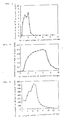
- the elution curve of eluting glutamic acid (GH) from the resin with an eluent liquid is shown in FIG. 3, the elution curve of eluting phenylalanine (Phe) from the resin with an eluent liquid is shown in FIG. 4, and the elution curve of eluting lysine (Lys) from the resin with an eluent liquid is shown in FIG. 5, respectively.
- the liquid volume of eluate per the resin volume (RV) has a maximum value and the tailing is relatively small. Therefore, a phenomenon that the amino acid adsorbed on the resin remains adsorbed indefinitely and does not eluted can be avoided, and hence this process is a sufficiently valuable process in practical.
- the thus obtained eluate contains a carbonate ion, a hydrogen carbonate ion, and an ammonium ion which are eluents, but the eluents can be vaporized and removed as shown in formulae (19) to (22) by releasing the eluate to normal pressure and, if necessary, conducting a heating and/or a concentration. They can be recycled and reused as eluents and fermentation materials.
- the purity of the amino acid and the salt thereof is increased by carrying out these steps, and hence the case is preferable.
- an eluate contains an aqueous carbonic acid solution HCO 3 - ⁇ OH - + CO 2 ⁇ H 2 O + CO 3 2- ⁇ 2OH - + CO 2 ⁇
- an eluate contains an aqueous ammonium carbonate solution NH 4 HCO 3 ⁇ NH 3 ⁇ + CO 2 ⁇ + H 2 O (NH 4 ) 2 CO 3 ⁇ 2NH 3 ⁇ + CO 2 ⁇ + H 2 O
- the amino acid is especially glutamic acid
- ammonium glutamate (GluNH4) is present in the eluate, by adding sodium hydroxide to the liquid from which excessive eluent is removed, the following reaction occurs and sodium glutamate (GluNa) can be obtained.
- sodium hydroxide to be added may be in an amount equimolar to the glutamic acid.
- a sodium glutamate solution having a high purity can be obtained in the eluate.
- potassium hydroxide is used instead of sodium hydroxide, a potassium salt is obtained.
- the amino acid is aspartic acid
- sodium aspartate or potassium aspartate is obtained by a similar treatment with an aqueous alkali solution.
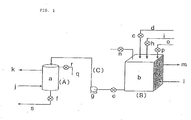
- an acidic amino acid is exemplified in detail with reference to Drawings.
- the acidic amino acid-containing aqueous solution obtained by removing fermentation bacteria body from an L-glutamic acid fermentation liquid is controlled to around neutral pH and then stored in a reservoir tank b.
- Compressed air is fed from an air line d to pressurize the inner pressure of the reservoir tank b to about 0.2 to 1 MPa.
- a pressure tight column a and the reservoir tank b are preferably kept at a constant temperature by circulating water having a temperature of 20°C in a jacket through cooling water lines 1, m, j, and k. Then, by working a pump g, transfer of the L-glutamic acid fermentation liquid to the pressure tight column is started.
- Air bubbles accumulated at the top of the column is sufficiently removed and the inside of the pressure tight column a is filled with the liquid.
- a valve f is opened and the liquid is started to drain and the ion exchange reaction is initiated.
- the graduations of the pump and the opening degree of a pressure-reducing valve are controlled so that the inner pressure of the pressure tight column is made higher than normal pressure, i.e., from 0.1 to 1 MPa and a flow rate of the liquid transfer is from 0.1 to 2 L/hr.
- the time for the liquid transfer varies depending on the volume of the pressure tight column.
- the acidic amino acid is adsorbed on the carbonate-type anion exchange resin. During the adsorption reaction, no bubble formation of carbon dioxide gas in the pressure tight column occurs.
- the liquid in the reservoir tank b is discharged to emptiness and then pure water is fed to the reservoir tank from a feed inlet o.
- the inner pressure is adjusted to 0.1 to 2 MPa with air, the remaining acidic amino acid-containing aqueous solution in the pressure tight column a is washed out.
- aqueous ammonium solution having a pH of 10 to 13 is placed in the reservoir tank b. Carbon dioxide gas is also injected thereinto to prepare an aqueous ammonium carbonate solution.
- Cold water is circulated in jackets of the pressure tight column a and the reservoir tank b to keep the temperature constant, and the aqueous ammonium carbonate solution is transferred to the pressure tight column a.
- the inner pressure of the pressure tight column a is from 0.1 to 2 MPa and the flow rate of the liquid transfer is from 0.1 to 1 L/hr.
- the liquid is neutralized by adding an aqueous sodium hydroxide solution so that the amount of the sodium hydroxide is equimolar to L-glutamic acid in the liquid. If necessary, the liquid is concentrated by heating under vacuum, and then an acidic amino acid salt can be obtained.
- the production of a neutral amino acid and the constitution of the production apparatus can be performed in accordance with the method described in the production method of the acidic amino acid. The following will describe the different points.
- a neutral amino acid-containing aqueous solution to pH 8 to 13, preferably pH 10 to pH 11, to thereby charge the ammonium ion co-existing in the fermentation liquid negatively and facilitate the adsorption of the neutral amino acid on the anion exchange resin.
- an aqueous carbonic acid solution, an aqueous hydrogen carbonate solution, an aqueous ammonium carbonate solution, or an aqueous ammonium hydrogen carbonate solution can be used.
- the apparatus for the purification and the production of the neutral amino acid the aforementioned apparatus as shown in FIG. 1 can be used as it is. In the case of the neutral amino acid, since it is neutral in an eluate, no salt is formed.
- the amino acid is lysine
- an aqueous ammonium carbonate solution or an aqueous ammonium hydrogen carbonate solution is used as the eluent liquid.
- lysine hydrochloride is obtained by adding hydrochloric acid to the liquid from which excessive eluent is removed. Lys+ + HCl ⁇ LysHCl
- the hydrochloric acid to be added may be in an amount equimolar to the lysine.
- an aqueous lysine hydrochloride solution having a high purity can be obtained in the eluate.
- the following will describe a step of recovering an eluent and effective components from a breakthrough liquid.
- the breakthrough liquid discharged from the adsorption step carbonate ion and hydrogen carbonate ion released from the anion exchange resin and an ammonium component used for controlling the hydrogen ion concentration in pH control, fermentation, and purification before the treatment with the ion exchange resin are present.
- the carbonate ion Upon release to normal pressure, the carbonate ion is converted into a gas to form bubbles and the ammonium component also vaporizes, so that these components almost disappear in the breakthrough liquid.
- the carbonate ion and the hydrogen carbonate ion and also simultaneously the ammonium ion can be further removed from the liquid since the solubility of carbon dioxide gas derived from the carbonate ion decreases as the temperature elevates.
- the eluent and the ammonium ion in the breakthrough liquid can be reduced to almost nil, the amount of by-products can be diminished to a large extent.
- the carbon dioxide gas and the ammonia gas are co-existed at the same time, it is possible to utilize them in their entirety without separation.
- the ammonia gas component can be distilled and separated by the method disclosed in JP-B-55-139815, for example.
- the vaporized carbon dioxide gas can be recovered and recycled as an eluent and the vaporized ammonia can be recovered and recycled in the fermentation and purification before the treatment with the ion exchange resin, their recovery results in the effective utilization and the recycle of the resources or the reduction of production cost.
- an aqueous ammonium carbonate solution or an aqueous ammonium hydrogen carbonate solution is used for an acidic amino acid
- an aqueous carbonic acid solution, an aqueous hydrogen carbonate solution, an aqueous ammonium carbonate solution, or an aqueous ammonium hydrogen carbonate solution is used for a neutral amino acid
- an aqueous ammonium carbonate solution or an aqueous ammonium hydrogen carbonate solution is used for a basic amino acid.
- the amino acid adsorbed on the anion exchange resin is eluted from the anion exchange resin with the eluent liquid, and simultaneously the anion exchange resin is converted into the carbonate-type by adsorbing carbonate ion or hydrogen carbonate ion present in the eluent liquid, whereby the anion exchange resin is regenerated.
- Part of unexchanged carbonate ion and ammonium ion are not adsorbed on the anion exchange resin and directly passed through the anion exchange resin column. Therefore, carbonate ion, hydrogen carbonate ion, and ammonium ion are present as the eluent components in the eluate, and hence they can be recovered and recycled in the present invention.
- a pressure tight column a packed with an anion exchange resin for adsorbing the amino acid, a reservoir tank b for feeding an amino acid-containing aqueous solution thereto, and a pump g for transferring a fermentation liquid and an eluate from the reservoir tank b are provided and they are connected with a pipe line.
- the pressure tight column a possesses a drainage line s for draining a breakthrough liquid, eluate or washing liquid, a pressure-controlling valve f in the vicinity of outlet of the pressure tight column a disposed on the lines, a line q for gas drainage and a valve r for control thereof at the upper portion of the pressure tight column a, and circulating cooling water lines k and j.
- the reservoir tank b is constituted by a feed inlet o for feeding the fermentation liquid, aqueous ammonium solution or eluate, an air line d for pressurization, a line i for feeding an eluent, valves c, h, n, and p for controlling the feed of substances from these lines, a valve e for controlling pressure in the reservoir tank and discharging amount existing at outlet of the reservoir tank, and cooling water lines 1 and m.
- L-phenylalanine concentration L-glutamic acid concentration, L-proline concentration, and L-lysine concentration
- the concentration was measured by a laboratory TOC-TN measuring apparatus model TNC-6000 manufactured by Toray Engineering Co., Ltd.
- the inorganic substance carbon concentration obtained by the analysis was regarded as a carbonate concentration.
- the concentration was measured by a distillation method using a keltech autosampler system model 1035/38 manufactured by Japan General K.K..
- a strongly basic anion exchange resin SA-10A manufactured by Mitsubishi Chemical Corporation was used as an anion exchange resin.
- 4 L of a 0.75 mol/L aqueous sodium hydrogen carbonate solution was passed through 0.4 L of the chlorine-type anion exchange resin at 1 L/h for 4 hours to convert the ion exchange resin into a carbonate-type.
- the resin was thoroughly washed with pure water.
- FIG. 1 is referred to in the following explanation.
- an L-glutamic acid-containing aqueous solution bacteria body-treated fermentation liquid
- pH 7 having an L-glutamic acid content of 122 g/L, from which fermented bacteria body had been removed using a microfiltration membrane
- the valve p was opened and compressed air was fed from the air line d to pressurize the inner pressure of the reservoir tank to 0.4 MPa.
- the pressure tight column and the reservoir tank were kept at a constant temperature by circulating water having a temperature of 20°C in jackets through the cooling water lines j, k, 1, and m. Then, the valves e and r were opened and further, by working the pump g, transfer of the L-glutamic acid fermentation liquid to the pressure tight column was started. For an initial few minutes, air bubbles accumulated at the top of the column was sufficiently removed from the upper portion of the column through the valve r using the liquid drainage line q to fill the inside of the pressure tight column with the liquid. Thereafter, by closing the valve r and opening the valve f, the liquid was started to drain from the bottom of the column and the ion exchange reaction was initiated.
- the graduations of the pump and the opening degree of the pressure-reducing valve were controlled so as to be an inner pressure of the pressure tight column of 0.5 MPa and a flow rate of the liquid transfer of 0.6 L/hr.
- the liquid transfer was continued for 4 hours and L-glutamic acid was adsorbed on the carbonate-type anion exchange resin.
- no bubble formation of carbon dioxide gas in the pressure tight column occurred and a satisfactory adsorption was achieved. Thereby, a breakthrough liquid of 2.4 L/hr was obtained.
- the graduations of the pump and the opening degree of the pressure-reducing valve were controlled so as to be an inner pressure of the pressure tight column of 0.5 MPa and a flow rate of the liquid transfer of 0.8 L/hr.
- the liquid transfer was continued for 4 hours and the L-glutamic acid fermentation liquid remained in the anion exchange resin layer was washed out.
- the pump g was stopped and the pressure-reducing valve f and the valve e were closed.
- the valve p was opened and an aqueous ammonium solution having a hydrogen ion concentration of 11 was fed to the reservoir tank from the liquid feed inlet o.
- the valves p and n were closed and the valve h was opened.
- feed of carbon dioxide gas was started from the carbon dioxide gas line 1 to initiate the dissolution of carbon dioxide gas into an aqueous ammonium solution.
- cold water having a temperature of 5°C was circulated in jackets of the pressure tight column and the reservoir tank to keep the temperature constant.
- the eluate was transferred to a deaerating apparatus da and the dissolved carbon dioxide and ammonia were separated through vaporization by concentrating the eluate under reduced pressure to a volume of 0.62 L.
- the concentration of L-glutamic acid was 35.8 g/L and the concentration of ammonia was 1.9 g/L.
- the remaining ammonium ion was present as a counter ion of L-glutamic acid.
- the separated carbon dioxide gas and ammonia were transferred to a separation-recovery apparatus sp and recovered.
- the carbon dioxide gas can be recycled as an eluent, and the ammonia as a fermentation starting material, a pH controlling liquid, or an eluent.
- Example 1 As an anion exchange resin, 0.4 L of a carbonate-type strongly acidic anion exchange resin SA-10A manufactured by Mitsubishi Chemical Corporation was used as in Example 1. First, an adsorption operation of L-phenylalanine onto the anion exchange resin was carried out in accordance with Example 1. At that time, as a fermentation liquid, a liquid obtained by removing bacteria body with a microfiltration membrane and converting the ionic form of L-phenylalanine into an anion form by controlling the pH to 10 using an aqueous ammonium solution was used. The concentration of L-phenylalanine was 29.7 g/L. The feed flow rate to the pressure tight column was 0.6 L/hr and the liquid-transferring time was 2.67 hours.
- the pressure of the reservoir tank was 0.4 MPa
- the pressure of the pressure tight column was 0.5 MPa
- the temperature was 20°C.
- the resin was washed in the same manner as in Example 1. Pure water was used as a washing water and the flow rate was 0.8 L/hr, the liquid-transferring time was 4 hours, the pressure of the reservoir tank was 0.4 MPa, the pressure of the pressure tight column was 0.5 MPa, and the temperature was 20°C.
- the eluate was transferred to a deaerating apparatus da and the dissolved carbon dioxide and ammonia were separated as gases by reducing the pressure into a volume of 1.8 L.
- the concentration of L-phenylalanine was 14.1 g/L.
- the separated carbon dioxide gas and ammonia were transferred to a separation-recovery apparatus sp and recovered.
- the carbon dioxide gas can be recycled as an eluent, and the ammonia as a fermentation starting material, a pH controlling liquid, or an eluent.
- Example 1 As an anion exchange resin, 0.4 L of a carbonate-type strongly acidic anion exchange resin SA-10A manufactured by Mitsubishi Chemical Corporation was used as in Example 1. First, an adsorption operation of L-proline onto the anion exchange resin was carried out in accordance with Example 1. A liquid obtained by converting the ionic form of L-proline into an anion form by controlling the pH to 10 using an aqueous ammonium solution was used. The concentration of L-proline was 106 g/L. The feed flow rate to the pressure tight column was 0.6 L/hr and the liquid-transferring time was 2.67 hours. Moreover, the pressure of the reservoir tank was 0.4 MPa, the pressure of the pressure tight column was 0.5 MPa, and the temperature was 20°C. During the adsorption reaction, no bubble formation of carbon dioxide gas occurred. Thereby, a breakthrough liquid of 1.6 L/hr was obtained.
- the resin was washed in the same manner as in Example 1. Pure water was used as a washing water and the flow rate was 0.8 L/hr, the liquid-transferring time was 4 hours, the pressure of the reservoir tank was 0.4 MPa, the pressure of the pressure tight column was 0.5 MPa, and the temperature was 20°C.
- L-proline was eluted from the anion exchange resin to obtain 4.8 L of an eluate.
- concentration of L-proline at this moment was 8.0 g/L.
- the eluate was transferred to a deaerating apparatus da and the dissolved carbon dioxide and ammonia were separated as gases by concentration under reduced pressure into a volume of 2.4 L.
- the concentration of L-proline was 38.3 g/L.
- the separated carbon dioxide gas and ammonia were transferred to a separation-recovery apparatus sp and recovered.
- the carbon dioxide gas can be recycled as an eluent, and the ammonia as a fermentation starting material, a pH controlling liquid, or an eluent.
- Example shows an example wherein the invention is applied to an aqueous solution containing L-lysine, which is one of basic amino acids.
- an anion exchange resin 0.4 L of a carbonate-type strongly acidic anion exchange resin SA-10A manufactured by Mitsubishi Chemical Corporation was used as in Example 1.
- An adsorption operation of L-lysine onto the anion exchange resin was carried out in accordance with Example 1.
- a liquid obtained by converting the ionic form of L-lysine into an anion form by controlling the pH to 12 using an aqueous ammonium solution was employed.
- the concentration of L-lysine was 16.7 g/L.
- the feed flow rate to the pressure tight column was 0.6 L/hr and the liquid-transferring time was 3.0 hours.
- the pressure of the reservoir tank was 0.4 MPa
- the pressure of the pressure tight column was 0.5 MPa
- the temperature was 20°C.
- the resin was washed in the same manner as in Example 1. Pure water was used as a washing water and the flow rate was 0.8 L/hr, the liquid-transferring time was 4 hours, the pressure of the reservoir tank was 0.4 MPa, the pressure of the pressure tight column was 0.5 MPa, and the temperature was 20°C.
- the eluate was transferred to a deaerating apparatus da and the dissolved carbon dioxide and ammonia were separated as gases by concentration under reduced pressure into a volume of 1.1 L.
- the concentration of L-lysine was 14.4 g/L
- the concentration of carbonate ion was 1.4 g/L.
- the remaining carbon dioxide is present as a carbonate ion, and served as the counter ion of L-lysine.
- the separated carbon dioxide gas and ammonia were transferred to a separation-recovery apparatus sp and recovered.
- the carbon dioxide gas can be recycled as an eluent, and the ammonia as a fermentation starting material, a pH controlling liquid, or an eluent.
- Example 1 To 0.62 L of the concentrated eluate (concentration of L-glutamic acid: 35.8 g/L, concentration of ammonium ion: 7.9 g/L) obtained in Example 1 was added an aqueous sodium hydroxide solution so that the amount of sodium hydroxide became equimolar to L-glutamic acid in the liquid, whereby neutralization was achieved. As a result, the volume of the eluate became 0.99 L.
- ammonia was separated as a gas and an aqueous sodium L-glutamate solution having a composition of concentration of L-glutamic acid: 73.0 g/L, concentration of carbonate ion: not detected, concentration of ammonium ion: not detected, and sodium: 5.6 g/L was obtained.
- the separated ammonia gas was transferred to a separation-recovery apparatus sp and recovered.
- Example 4 To 1.01 L of the concentrated eluate (concentration of L-lysine: 14.4 g/L, concentration of ammonium ion: 1.4 g/L) obtained in Example 4 was added hydrochloric acid so that the amount of hydrochloric acid became equimolar to L-lysine in the liquid, whereby neutralization was achieved. As a result, the volume of the eluate became 1.11 L.
- the breakthrough liquids obtained in the adsorption step in Example 1 0.4 L of the breakthrough liquid (concentration of carbonate ion: 85.4 g/L, concentration of ammonium ion: 12.6 g/L) obtained until 0.67 hours had passed after the start of the adsorption was transferred to a deaerating apparatus da in FIG. 2 and concentrated under heating at a temperature of 80°C under vacuum to obtain 0.08 L of a concentrated liquid and 0.32 L of a mixed gas.
- the concentration of carbonate ion was 1.0 g/L and the concentration of ammonium ion was 8.5 g/L.
- the mixed gas was transferred to a separation apparatus sp and 4.4 g of ammonia and 24.6 g of carbon dioxide gas were separated and recovered.
- the amount of ammonium ion W NH4 (%) in the breakthrough liquid was 13.5% based on the formula (24).
- the amount of carbonate ion W CO3 (%) in the breakthrough liquid was 0.2% based on the formula (24). Therefore, 86.5% of ammonium ion was recovered from the breakthrough liquid based on the formula (23).
- 99.8% of carbonate ion eluted from the anion exchange resin could be recovered.
- ammonium ion and carbonate ion could be recovered in 99.8% and 99.0%, respectively.
- the removal of the impurities from the breakthrough liquid, which is a waste water, by the present invention was preferable as an environmental measure but also the impurities diminished were recycled as eluents and fermentation additives.
- the mixed gas was transferred to a separation apparatus sp and 2.6 g of ammonia and 24.5 g of carbon dioxide gas were separated and recovered.
- the amount of ammonium ion W NH4 (%) in the breakthrough liquid was 4.0% based on the formula (24).
- the amount of carbonate ion W CO3 (%) in the breakthrough liquid was 0.4% based on the formula (24). Therefore, 96.0% of ammonium ion was recovered from the breakthrough liquid based on the formula (23).
- 99.6% of carbonate ion eluted from the anion exchange resin could be recovered.
- carbonate ion could be recovered in 99.9%.
- the removal of the impurities from the breakthrough liquid which is a waste water
- the present invention was preferable as an environmental measure but also the impurities diminished were recycled as eluents and fermentation additives.
- the mixed gas was transferred to a separation apparatus sp and 133.3 g of ammonia and 23.9 g of carbon dioxide gas were separated and recovered.
- the amount of ammonium ion W NH4 (%) in the breakthrough liquid was 0.2% based on the formula (24).
- the amount of carbonate ion W CO3 (%) in the breakthrough liquid was 2.8% based on the formula (24). Therefore, 99.8% of ammonium ion was recovered from the breakthrough liquid based on the formula (23).
- 97.2% of carbonate ion eluted from the anion exchange resin could be recovered.
- ammonium ion and carbonate ion could be recovered in 99.8% and 99.2%, respectively.
- the removal of the impurities from the breakthrough liquid, which is a waste water, by the present invention was preferable as an environmental measure but also the impurities diminished were recycled as eluents and fermentation additives.
- the invention relates to a process for producing an amino acid or an amino acid salt from an amino acid-containing aqueous solution using a carbonate-type anion exchange resin, and a system of reducing the amount of by-products generated from an adsorption step and recovering an eluent from a breakthrough liquid and/or an eluate for recycling.
Landscapes
- Chemical & Material Sciences (AREA)
- Organic Chemistry (AREA)
- Chemical Kinetics & Catalysis (AREA)
- Analytical Chemistry (AREA)
- Organic Low-Molecular-Weight Compounds And Preparation Thereof (AREA)
- Preparation Of Compounds By Using Micro-Organisms (AREA)
- Treatment Of Liquids With Adsorbents In General (AREA)
Applications Claiming Priority (3)
| Application Number | Priority Date | Filing Date | Title |
|---|---|---|---|
| JP2002381470 | 2002-12-27 | ||
| JP2002381470 | 2002-12-27 | ||
| PCT/JP2003/016636 WO2004061114A1 (ja) | 2002-12-27 | 2003-12-24 | カラム法によるアミノ酸又はその塩の製造方法及びその製造装置 |
Publications (2)
| Publication Number | Publication Date |
|---|---|
| EP1580277A1 true EP1580277A1 (de) | 2005-09-28 |
| EP1580277A4 EP1580277A4 (de) | 2007-04-18 |
Family
ID=32708495
Family Applications (1)
| Application Number | Title | Priority Date | Filing Date |
|---|---|---|---|
| EP03786290A Withdrawn EP1580277A4 (de) | 2002-12-27 | 2003-12-24 | Verfahren zur herstellung von aminosäure oder ihres salzes mittels säulenverfahren und herstellungsvorrichtung dafür |
Country Status (7)
| Country | Link |
|---|---|
| US (2) | US7311836B2 (de) |
| EP (1) | EP1580277A4 (de) |
| JP (1) | JP4400459B2 (de) |
| CN (1) | CN100475970C (de) |
| AU (1) | AU2003296099A1 (de) |
| BR (1) | BR0317778B1 (de) |
| WO (1) | WO2004061114A1 (de) |
Cited By (1)
| Publication number | Priority date | Publication date | Assignee | Title |
|---|---|---|---|---|
| CN104211610A (zh) * | 2014-07-31 | 2014-12-17 | 新疆阜丰生物科技有限公司 | 一种谷氨酸钠提取新工艺 |
Families Citing this family (15)
| Publication number | Priority date | Publication date | Assignee | Title |
|---|---|---|---|---|
| US9266051B2 (en) | 2005-07-28 | 2016-02-23 | Carbon Sink, Inc. | Removal of carbon dioxide from air |
| RU2008139902A (ru) | 2006-03-08 | 2010-04-20 | ГЛОБАЛ РИСЕРЧ ТЕКНОЛОДЖИЗ, ЭлЭлСи (US) | Воздухозаборное устройство с функционализированной ионообменной мембраной для улавливания co2 из внешней среды |
| NZ575870A (en) * | 2006-10-02 | 2012-02-24 | Global Res Technologies Llc | Method and apparatus for extracting carbon dioxide from ambient air |
| US8715393B2 (en) | 2007-04-17 | 2014-05-06 | Kilimanjaro Energy, Inc. | Capture of carbon dioxide (CO2) from air |
| CN102775321A (zh) * | 2012-07-05 | 2012-11-14 | 广东肇庆星湖生物科技股份有限公司 | 一种l-鸟氨酸盐酸盐的提纯方法 |
| CN104520266B (zh) * | 2012-08-03 | 2016-06-29 | 味之素株式会社 | 生成碱性氨基酸或碱性氨基酸盐的方法 |
| CN103357389B (zh) * | 2013-07-03 | 2015-04-08 | 中国科学院广州地球化学研究所 | 一种bpha萃淋树脂及利用其分离与富集环境与地质样品中钼的方法 |
| CN104474740B (zh) * | 2014-12-01 | 2016-08-24 | 江苏远洋药业股份有限公司 | 一种氨基酸的提纯装置 |
| CN105646256B (zh) * | 2016-03-20 | 2017-11-10 | 内蒙古阜丰生物科技有限公司 | 一种谷氨酸提取结晶工艺 |
| CN106083674B (zh) * | 2016-06-03 | 2018-11-06 | 宁夏紫光天化蛋氨酸有限责任公司 | 一种减少蛋氨酸皂化液中碳酸根的生产方法 |
| CN106699586B (zh) * | 2016-12-08 | 2019-01-25 | 陕西天宇制药有限公司 | 门冬氨酸鸟氨酸的制备方法 |
| WO2019161114A1 (en) | 2018-02-16 | 2019-08-22 | Carbon Sink, Inc. | Fluidized bed extractors for capture of co2 from ambient air |
| CN110642734A (zh) * | 2019-10-09 | 2020-01-03 | 福州三合元生物科技有限公司 | 一种从泔料中提取氨基酸的方法 |
| CN114082222B (zh) * | 2021-10-25 | 2023-03-17 | 青海大学 | 狭果茶藨子游离氨基酸纯化方法 |
| CN115178074B (zh) * | 2022-07-11 | 2023-08-22 | 沈阳理工大学 | 催化提取污泥氨基酸碳捕集功能肥释放柱及其制法和使法 |
Family Cites Families (5)
| Publication number | Priority date | Publication date | Assignee | Title |
|---|---|---|---|---|
| BE468493A (de) * | 1945-10-27 | |||
| US4256471A (en) * | 1979-04-16 | 1981-03-17 | Stamicarbon, B.V. | Process for the separation of ammonia and carbon dioxide from mixtures containing ammonia, carbon dioxide and water |
| US5017480A (en) * | 1987-08-10 | 1991-05-21 | Ajimomoto Co., Inc. | Process for recovering L-amino acid from fermentation liquors |
| US5071560A (en) * | 1989-07-17 | 1991-12-10 | Uop | Process for purifying phenylalanine |
| US6001255A (en) * | 1993-07-12 | 1999-12-14 | Eyal; Aharon | Process for the production of water-soluble salts of carboxylic and amino acids |
-
2003
- 2003-12-24 EP EP03786290A patent/EP1580277A4/de not_active Withdrawn
- 2003-12-24 CN CNB2003801099777A patent/CN100475970C/zh not_active Expired - Fee Related
- 2003-12-24 AU AU2003296099A patent/AU2003296099A1/en not_active Abandoned
- 2003-12-24 WO PCT/JP2003/016636 patent/WO2004061114A1/ja not_active Ceased
- 2003-12-24 JP JP2004564510A patent/JP4400459B2/ja not_active Expired - Fee Related
- 2003-12-24 BR BRPI0317778-5A patent/BR0317778B1/pt not_active IP Right Cessation
-
2005
- 2005-06-27 US US11/166,755 patent/US7311836B2/en not_active Expired - Fee Related
-
2007
- 2007-08-24 US US11/844,904 patent/US7850852B2/en not_active Expired - Fee Related
Cited By (1)
| Publication number | Priority date | Publication date | Assignee | Title |
|---|---|---|---|---|
| CN104211610A (zh) * | 2014-07-31 | 2014-12-17 | 新疆阜丰生物科技有限公司 | 一种谷氨酸钠提取新工艺 |
Also Published As
| Publication number | Publication date |
|---|---|
| CN1753999A (zh) | 2006-03-29 |
| CN100475970C (zh) | 2009-04-08 |
| US7311836B2 (en) | 2007-12-25 |
| EP1580277A4 (de) | 2007-04-18 |
| BR0317778B1 (pt) | 2014-09-02 |
| BR0317778A (pt) | 2005-11-22 |
| US7850852B2 (en) | 2010-12-14 |
| WO2004061114A1 (ja) | 2004-07-22 |
| US20050284813A1 (en) | 2005-12-29 |
| JPWO2004061114A1 (ja) | 2006-05-11 |
| JP4400459B2 (ja) | 2010-01-20 |
| US20080039647A1 (en) | 2008-02-14 |
| AU2003296099A1 (en) | 2004-07-29 |
Similar Documents
| Publication | Publication Date | Title |
|---|---|---|
| US7850852B2 (en) | Process for producing amino acid or salt thereof by column technique and production apparatus thereof | |
| US6838069B2 (en) | Apparatus and method for ammonia removal from waste streams | |
| EP1734033B1 (de) | Verfahren zur aufreinigung von aminosäuren | |
| US9617202B2 (en) | Method for producing 1,5-pentanediamine | |
| EP2881382B1 (de) | Verfahren zur herstellung von basischen aminosäuren oder basischen aminosäuresalzen | |
| US4835309A (en) | Ion exchange recovery of L-lysine | |
| EP4079721A1 (de) | Verfahren für die isolieung von aminen | |
| Pickering et al. | Clean‐up to Chirality—Liquid Membranes as a Facilitating Technology? | |
| US10576467B2 (en) | Materials and methods for the selective recovery of multivalent products | |
| EP0820431B1 (de) | Verfahren zur herstellung von monosodiumglutamat | |
| CZ293928B6 (cs) | Způsob deionizace a zařízení k provádění způsobu | |
| JP2002088036A (ja) | アミノ酸の回収方法 | |
| CA2159183C (en) | Resin regeneration process | |
| JPS61249961A (ja) | トリプトフアンの精製法 | |
| Dominguez et al. | Uptake of hydrophobic amino acids and sodium chloride by a strong cation exchanger: Application to desalting and separation by preparative liquid chromatography | |
| JP3076485B2 (ja) | 蛋白質分解液からの酸除去方法 |
Legal Events
| Date | Code | Title | Description |
|---|---|---|---|
| PUAI | Public reference made under article 153(3) epc to a published international application that has entered the european phase |
Free format text: ORIGINAL CODE: 0009012 |
|
| 17P | Request for examination filed |
Effective date: 20050722 |
|
| AK | Designated contracting states |
Kind code of ref document: A1 Designated state(s): AT BE BG CH CY CZ DE DK EE ES FI FR GB GR HU IE IT LI LU MC NL PT RO SE SI SK TR |
|
| AX | Request for extension of the european patent |
Extension state: AL LT LV MK |
|
| DAX | Request for extension of the european patent (deleted) | ||
| A4 | Supplementary search report drawn up and despatched |
Effective date: 20070321 |
|
| 17Q | First examination report despatched |
Effective date: 20110914 |
|
| STAA | Information on the status of an ep patent application or granted ep patent |
Free format text: STATUS: EXAMINATION IS IN PROGRESS |
|
| RIC1 | Information provided on ipc code assigned before grant |
Ipc: B01D 15/00 20060101ALI20171222BHEP Ipc: C07C 229/36 20060101ALI20171222BHEP Ipc: B01J 47/14 20170101ALI20171222BHEP Ipc: B01D 15/04 20060101ALI20171222BHEP Ipc: B01J 47/02 20170101ALI20171222BHEP Ipc: B01J 20/34 20060101ALI20171222BHEP Ipc: C07C 227/40 20060101ALI20171222BHEP Ipc: B01J 20/26 20060101ALI20171222BHEP Ipc: B01J 49/00 20170101ALI20171222BHEP Ipc: C07C 229/24 20060101ALI20171222BHEP Ipc: C12P 13/04 20060101AFI20171222BHEP |
|
| GRAP | Despatch of communication of intention to grant a patent |
Free format text: ORIGINAL CODE: EPIDOSNIGR1 |
|
| STAA | Information on the status of an ep patent application or granted ep patent |
Free format text: STATUS: GRANT OF PATENT IS INTENDED |
|
| RIC1 | Information provided on ipc code assigned before grant |
Ipc: B01D 15/16 20060101AFI20180122BHEP Ipc: B01J 41/05 20170101ALI20180122BHEP Ipc: B01D 15/36 20060101ALI20180122BHEP Ipc: C07C 227/40 20060101ALI20180122BHEP |
|
| INTG | Intention to grant announced |
Effective date: 20180209 |
|
| RIN1 | Information on inventor provided before grant (corrected) |
Inventor name: KUSUNOSE, YASUHIRO Inventor name: TAKAHASHI, KENJI |
|
| STAA | Information on the status of an ep patent application or granted ep patent |
Free format text: STATUS: THE APPLICATION IS DEEMED TO BE WITHDRAWN |
|
| 18D | Application deemed to be withdrawn |
Effective date: 20180620 |
|
| RIC1 | Information provided on ipc code assigned before grant |
Ipc: B01D 15/16 20060101AFI20180122BHEP Ipc: B01J 41/05 20170101ALI20180122BHEP Ipc: B01D 15/36 20060101ALI20180122BHEP Ipc: C07C 227/40 20060101ALI20180122BHEP |