EP1580170A1 - Method for producing synthetic quartz glass and synthetic quartz glass article - Google Patents
Method for producing synthetic quartz glass and synthetic quartz glass article Download PDFInfo
- Publication number
- EP1580170A1 EP1580170A1 EP03775963A EP03775963A EP1580170A1 EP 1580170 A1 EP1580170 A1 EP 1580170A1 EP 03775963 A EP03775963 A EP 03775963A EP 03775963 A EP03775963 A EP 03775963A EP 1580170 A1 EP1580170 A1 EP 1580170A1
- Authority
- EP
- European Patent Office
- Prior art keywords
- quartz glass
- synthetic quartz
- glass body
- ppm
- treatment
- Prior art date
- Legal status (The legal status is an assumption and is not a legal conclusion. Google has not performed a legal analysis and makes no representation as to the accuracy of the status listed.)
- Granted
Links
Images


Classifications
-
- C—CHEMISTRY; METALLURGY
- C03—GLASS; MINERAL OR SLAG WOOL
- C03C—CHEMICAL COMPOSITION OF GLASSES, GLAZES OR VITREOUS ENAMELS; SURFACE TREATMENT OF GLASS; SURFACE TREATMENT OF FIBRES OR FILAMENTS MADE FROM GLASS, MINERALS OR SLAGS; JOINING GLASS TO GLASS OR OTHER MATERIALS
- C03C3/00—Glass compositions
- C03C3/04—Glass compositions containing silica
- C03C3/06—Glass compositions containing silica with more than 90% silica by weight, e.g. quartz
-
- C—CHEMISTRY; METALLURGY
- C03—GLASS; MINERAL OR SLAG WOOL
- C03B—MANUFACTURE, SHAPING, OR SUPPLEMENTARY PROCESSES
- C03B20/00—Processes specially adapted for the production of quartz or fused silica articles, not otherwise provided for
-
- C—CHEMISTRY; METALLURGY
- C03—GLASS; MINERAL OR SLAG WOOL
- C03B—MANUFACTURE, SHAPING, OR SUPPLEMENTARY PROCESSES
- C03B19/00—Other methods of shaping glass
- C03B19/14—Other methods of shaping glass by gas- or vapour- phase reaction processes
-
- C—CHEMISTRY; METALLURGY
- C03—GLASS; MINERAL OR SLAG WOOL
- C03B—MANUFACTURE, SHAPING, OR SUPPLEMENTARY PROCESSES
- C03B19/00—Other methods of shaping glass
- C03B19/14—Other methods of shaping glass by gas- or vapour- phase reaction processes
- C03B19/1453—Thermal after-treatment of the shaped article, e.g. dehydrating, consolidating, sintering
-
- C—CHEMISTRY; METALLURGY
- C03—GLASS; MINERAL OR SLAG WOOL
- C03B—MANUFACTURE, SHAPING, OR SUPPLEMENTARY PROCESSES
- C03B2201/00—Type of glass produced
- C03B2201/02—Pure silica glass, e.g. pure fused quartz
- C03B2201/03—Impurity concentration specified
-
- C—CHEMISTRY; METALLURGY
- C03—GLASS; MINERAL OR SLAG WOOL
- C03B—MANUFACTURE, SHAPING, OR SUPPLEMENTARY PROCESSES
- C03B2201/00—Type of glass produced
- C03B2201/02—Pure silica glass, e.g. pure fused quartz
- C03B2201/03—Impurity concentration specified
- C03B2201/04—Hydroxyl ion (OH)
-
- C—CHEMISTRY; METALLURGY
- C03—GLASS; MINERAL OR SLAG WOOL
- C03B—MANUFACTURE, SHAPING, OR SUPPLEMENTARY PROCESSES
- C03B2201/00—Type of glass produced
- C03B2201/06—Doped silica-based glasses
- C03B2201/07—Impurity concentration specified
-
- C—CHEMISTRY; METALLURGY
- C03—GLASS; MINERAL OR SLAG WOOL
- C03B—MANUFACTURE, SHAPING, OR SUPPLEMENTARY PROCESSES
- C03B2201/00—Type of glass produced
- C03B2201/06—Doped silica-based glasses
- C03B2201/07—Impurity concentration specified
- C03B2201/075—Hydroxyl ion (OH)
-
- C—CHEMISTRY; METALLURGY
- C03—GLASS; MINERAL OR SLAG WOOL
- C03B—MANUFACTURE, SHAPING, OR SUPPLEMENTARY PROCESSES
- C03B2201/00—Type of glass produced
- C03B2201/06—Doped silica-based glasses
- C03B2201/20—Doped silica-based glasses doped with non-metals other than boron or fluorine
-
- C—CHEMISTRY; METALLURGY
- C03—GLASS; MINERAL OR SLAG WOOL
- C03B—MANUFACTURE, SHAPING, OR SUPPLEMENTARY PROCESSES
- C03B2201/00—Type of glass produced
- C03B2201/06—Doped silica-based glasses
- C03B2201/20—Doped silica-based glasses doped with non-metals other than boron or fluorine
- C03B2201/24—Doped silica-based glasses doped with non-metals other than boron or fluorine doped with nitrogen, e.g. silicon oxy-nitride glasses
-
- C—CHEMISTRY; METALLURGY
- C03—GLASS; MINERAL OR SLAG WOOL
- C03C—CHEMICAL COMPOSITION OF GLASSES, GLAZES OR VITREOUS ENAMELS; SURFACE TREATMENT OF GLASS; SURFACE TREATMENT OF FIBRES OR FILAMENTS MADE FROM GLASS, MINERALS OR SLAGS; JOINING GLASS TO GLASS OR OTHER MATERIALS
- C03C2201/00—Glass compositions
- C03C2201/02—Pure silica glass, e.g. pure fused quartz
-
- C—CHEMISTRY; METALLURGY
- C03—GLASS; MINERAL OR SLAG WOOL
- C03C—CHEMICAL COMPOSITION OF GLASSES, GLAZES OR VITREOUS ENAMELS; SURFACE TREATMENT OF GLASS; SURFACE TREATMENT OF FIBRES OR FILAMENTS MADE FROM GLASS, MINERALS OR SLAGS; JOINING GLASS TO GLASS OR OTHER MATERIALS
- C03C2201/00—Glass compositions
- C03C2201/06—Doped silica-based glasses
- C03C2201/08—Doped silica-based glasses containing boron or halide
- C03C2201/11—Doped silica-based glasses containing boron or halide containing chlorine
-
- C—CHEMISTRY; METALLURGY
- C03—GLASS; MINERAL OR SLAG WOOL
- C03C—CHEMICAL COMPOSITION OF GLASSES, GLAZES OR VITREOUS ENAMELS; SURFACE TREATMENT OF GLASS; SURFACE TREATMENT OF FIBRES OR FILAMENTS MADE FROM GLASS, MINERALS OR SLAGS; JOINING GLASS TO GLASS OR OTHER MATERIALS
- C03C2201/00—Glass compositions
- C03C2201/06—Doped silica-based glasses
- C03C2201/20—Doped silica-based glasses containing non-metals other than boron or halide
- C03C2201/23—Doped silica-based glasses containing non-metals other than boron or halide containing hydroxyl groups
-
- C—CHEMISTRY; METALLURGY
- C03—GLASS; MINERAL OR SLAG WOOL
- C03C—CHEMICAL COMPOSITION OF GLASSES, GLAZES OR VITREOUS ENAMELS; SURFACE TREATMENT OF GLASS; SURFACE TREATMENT OF FIBRES OR FILAMENTS MADE FROM GLASS, MINERALS OR SLAGS; JOINING GLASS TO GLASS OR OTHER MATERIALS
- C03C2201/00—Glass compositions
- C03C2201/06—Doped silica-based glasses
- C03C2201/20—Doped silica-based glasses containing non-metals other than boron or halide
- C03C2201/24—Doped silica-based glasses containing non-metals other than boron or halide containing nitrogen, e.g. silicon oxy-nitride glasses
-
- C—CHEMISTRY; METALLURGY
- C03—GLASS; MINERAL OR SLAG WOOL
- C03C—CHEMICAL COMPOSITION OF GLASSES, GLAZES OR VITREOUS ENAMELS; SURFACE TREATMENT OF GLASS; SURFACE TREATMENT OF FIBRES OR FILAMENTS MADE FROM GLASS, MINERALS OR SLAGS; JOINING GLASS TO GLASS OR OTHER MATERIALS
- C03C2201/00—Glass compositions
- C03C2201/06—Doped silica-based glasses
- C03C2201/20—Doped silica-based glasses containing non-metals other than boron or halide
- C03C2201/26—Doped silica-based glasses containing non-metals other than boron or halide containing carbon
Definitions
- the present invention relates to a production process of a synthetic quartz glass obtained by heat treating a porous synthetic glass body and to a highly heat resistant synthetic quartz glass body.
- a synthetic quartz glass For the production of a synthetic quartz glass, there is well known a process of producing it by densifying a silica porous body mainly obtained by flame hydrolysis of a silicon halide at high temperatures. Since the thus obtained synthetic quartz glass body has passed through the flame hydrolysis step, it contains a large amount of an OH group in the silica porous body. If a large amount of an OH group is present in the synthetic quartz glass, the viscosity of the synthetic quartz glass is lowered, whereby the heat resistance is lowered. Accordingly, the subject synthetic quartz glass causes deformation and is not preferable for applications of quartz glass jigs for the semiconductor industry to be used at 1,000°C or higher.
- JP-A-54-127914 discloses the preparation of an anhydrous glass matrix by thermally oxidizing or hydrolyzing a glass forming raw material to deposit a glass forming substance containing silicon dioxide (SiO 2 ) as the major component on the end faces of a supporting rod, thereby preparing a porous glass and exposing this porous glass sintered body to a glass forming raw material gas containing a halogen element at from 800 to 1,000°C, followed by transparent vitrification.
- SiCl 4 , SiBr 4 , GeCl 4 , BBr 3 , POCl 3 , PCl 3 , and the like are exemplified.
- the synthetic quartz glass obtained by the foregoing process contains less impurity, it has been expected as a substitute for a quartz glass raw material made of a natural quartz crystal as the raw material in the semiconductor manufacturing steps, but deformation in the high-temperature manufacturing steps has been recognized as a remarkable drawback.
- the viscosity of the synthetic quartz glass (poise being used as a unit of the viscosity in the present invention) is 11.4 for the undehydrated article, 11.6 for the dehydrated article, and 11.9 or more for the natural quartz glass, respectively in terms of a value of log ⁇ at 1,280°C.
- JP-A-3-83833 discloses a method of containing Al.
- impurities such as metal impurities are contained.
- ammonia or an ammonia based gas can be used in place of the halogen based gas such as chlorine.
- the halogen based gas such as chlorine
- JP-A-7-300324 proposes a method in which a nitrogen-doped porous body obtained by a heating treatment in an ammonia-containing atmosphere is baked by heating in a non-oxidative atmosphere, and the subject baked body is subjected to a high-temperature heating treatment under a high pressure of 500 kg/cm 2 or more in the temperature range of from 1,400°C to 2,000°C.
- a high pressure 500 kg/cm 2 or more in the temperature range of from 1,400°C to 2,000°C.
- the quartz glass jig irregularly reflects infrared rays, and the temperature in a furnace becomes non-uniform. There were thus caused problems such as the matter that the material quality of a silicon wafer becomes instable.
- an alkali metal such as Na, K, and Li is an element to bring about a defect on a device.
- a quartz tube and a quartz boat for setting the silicon wafer play a role to prevent the contamination.
- electrically fusible low-OH natural quartz or chlorine-free synthetic quartz-made quartz glass raw materials the foregoing effect for preventing the foregoing contamination was low.
- the present invention is aimed to provide a production process of a synthetic quartz glass which has less impurity, has a high-temperature viscosity characteristic equal to or more than that of a natural quartz glass, and hardly deforms even in a high-temperature environment, and especially a production process of a highly heat resistant synthetic quartz glass which is free from the generation of bubbles and is dense.
- the present invention is aimed to provide a highly heat resistant synthetic quartz glass body which is easily obtained by the production process of the present invention, and especially a transparent or black quartz glass body which is free from the generation of bubbles, is dense, has high infrared absorption rate and emission rate, and has an extremely high effect for preventing diffusion of alkali metal.
- the present inventors have found that the chlorine remaining in the porous body is one factor to lower the viscosity of the quartz glass which has been densified by a heat treatment at high temperatures. Further, it has been found that in order to increase the viscosity at high temperature, not only dehydration may be completely carried out during a period of time of from the dehydration treatment in the porous body to entry in the densifying step, but also the concentration of the residual chlorine may be lowered to a level at which no influence is given to the viscosity.
- the present inventors have found that transparent and black quartz glass bodies can be easily obtained depending upon the reaction temperature in a reduction treatment of the silica porous glass or a molar ratio of the hydroxyl group in the silica porous body to a reducing gas.
- the production process of a synthetic quartz glass of the present invention is a process of producing a quartz glass having an absorption coefficient at 245 nm of 0.05 cm -1 or more, which is characterized by subjecting a silica porous body to a reduction treatment and a baking treatment to form a dense glass body.
- the foregoing silica porous body may or may not contain a hydroxyl group.
- the baking treatment may be carried out after carrying out the reduction treatment, or the reduction treatment and the baking treatment may be carried out at the same time.
- the foregoing reduction treatment is not particularly limited but is suitably a treatment in which the foregoing silica porous body is reacted in vacuo or reacted with the reducing gas in an atmosphere containing the subject gas in a prescribed temperature range.
- the foregoing baking treatment is carried out at a reaction temperature of 1,300°C or higher and 1,900°C or lower, and preferably 1,300°C or higher and 1,750°C or lower, thereby obtaining a dense glass body. Also, in the case of carrying out the reduction treatment and the baking treatment at the same time, it is possible to employ a reaction temperature of 100°C or higher and 1,900°C or lower. In the production process of a synthetic quartz glass of the present invention, it is preferable that the foregoing baking treatment is carried out under a reduced pressure.
- reaction gas a gas containing at least one kind of nitrogen, carbon and chlorine is preferable.
- reaction gas include ammonia (NH 3 ), hydrazine (N 2 H 4 ), ethanol (C 2 H 5 OH), carbon monoxide (CO), and chlorine (Cl 2 ).
- volatile silicon compounds especially volatile silicon compounds containing at least one kind of nitrogen, carbon and chlorine are more preferable.
- volatile silicon compounds especially volatile silicon compounds containing at least one kind of nitrogen, carbon and chlorine are more preferable.
- Specific examples thereof include silicon tetrachloride (SiCl 4 ), hexamethyldisilazane ([(CH 3 ) 3 Si] 2 NH), and trichloromethylsilane ((CH 2 Cl) 3 SiH).
- volatile silicon compounds containing nitrogen and/or carbon are especially preferable.
- the foregoing reducing gas can be used singly or in admixture of two or more kinds thereof.
- a mixture of two or more kinds thereof its combination is not particularly limited, and for example, a mixture of a volatile silicon compound containing nitrogen and/or carbon and ammonia can be used.
- At least one kind of compound selected from the group consisting of a silazane, an organosilazane, an organohalogen silane, a siloxane, an organosiloxane, an alkoxysilane, an aroxysilane, a silane, an organosilane, and an organopolysilane is preferable; and hexamethyldisilazane and hexamethyldisiloxane are more preferable.
- a transparent glass body In the production process of a synthetic quartz glass of the present invention, it is possible to obtain a transparent glass body by carrying out the foregoing reduction treatment at a reaction temperature of 100°C or higher and 800°C or lower and then carrying out baking at 1,300°C or higher and 1,900°C or lower preferably under a reduced pressure.
- a densified black glass body by carrying out the reduction treatment in which the foregoing silica porous body is reacted with a carbon-containing gas at 400°C or higher and 1,300°C or lower and then carrying out baking at 1,300°C or higher and 1,900°C or lower preferably under a reduced pressure.
- the foregoing method including a hydrogen treatment
- the foregoing reduction treatment is carried out in an atmosphere containing the foregoing reducing gas (for example, the foregoing volatile silicon compounds containing nitrogen and/or carbon, ammonia, and mixtures thereof) and hydrogen.
- the foregoing reducing gas for example, the foregoing volatile silicon compounds containing nitrogen and/or carbon, ammonia, and mixtures thereof
- the foregoing baking treatment is carried out in a hydrogen-containing atmosphere.
- the foregoing baking treatment is carried out in the temperature range of from 1,000°C to 1,900°C.
- a hydrogen treatment there is enumerated a method in which the silica porous body is reacted with a reducing gas in a hydrogen-containing atmosphere, thereby carrying out reduction treatment and a baking treatment at the same time.
- the foregoing reduction treatment and baking treatment are carried out at a reaction temperature in the range of from 100°C to 1,900°C.
- a heating treatment (ammonia treatment) is carried out in an ammonia-containing atmosphere, followed by baking to form a dense glass body. It is suitable that this heating treatment in an ammonia-containing atmosphere is carried out in the temperature range of from 100°C to 1,300°C.
- the foregoing hydrogen treatment and the foregoing ammonia treatment can be employed in combination.
- the order is not particularly limited, but any one of them may be first carried out, or the both treatments may be carried out at the same time, that is, a heating treatment may be carried out in an atmosphere containing hydrogen and ammonia.
- a synthetic quartz glass of the present invention by further heat treating a dense glass body obtained by the foregoing baking treatment in a non-oxidative atmosphere under a pressure exceeding the atmospheric pressure in the temperature range of from 1,200°C to 1,900°C, a highly heat resistant synthetic quartz glass which is free from the generation of bubbles and is dense is obtained.
- the foregoing reduction treatment is carried out in an atmosphere containing the foregoing volatile silicon compound containing nitrogen and/or carbon in at a reaction temperature of from 100°C to 1,300°C; baking is then carried out at from 1,300°C to 1,750°C under a reduced pressure to form a dense quartz glass body; and thereafter, the dense quartz glass body is heat treated in an inert gas atmosphere under a pressure of from a pressure exceeding the atmospheric pressure to 10,000 kg/cm 2 in the temperature range of from 1,200°C to 1,900°C.
- a first embodiment of the synthetic quartz glass body of the present invention is a quartz glass body produced by the production process of a synthetic quartz glass of the present invention.
- a second embodiment of the synthetic quartz glass body of the present invention is a highly heat resistant synthetic quartz glass body which is characterized by having an absorption coefficient at 245 nm of 0.05 cm -1 or more and having a carbon concentration, a nitrogen concentration and a chlorine concentration to be contained of 10,000 ppm or less, respectively.
- a third embodiment of the synthetic quartz glass body of the present invention is a transparent quartz glass body produced by the production process of a synthetic quartz glass of the present invention, which is characterized by having a nitrogen concentration to be contained of 100 ppm or less and a carbon concentration to be contained of 100 ppm or less.
- the foregoing transparent quartz glass body of the present invention by controlling the nitrogen concentration and the carbon concentration to be contained at 50 ppm or less, and more preferably 20 ppm or less, respectively, a highly heat resistant synthetic quartz glass body which is free from the generation of bubbles and does not form bubbles in not only the electrical heating step and the flame heating processing step is obtained.
- the molar number of the foregoing reducing gas to be thrown is controlled at from 0.1 to 3.0 times the molar number of the OH group contained in the foregoing silica porous body.
- a fourth embodiment of the synthetic quartz glass body of the present invention is a black quartz glass body produced by the production process of a synthetic quartz glass of the present invention, which is characterized by having a carbon concentration to be contained exceeding 100 ppm and 10,000 ppm or less.
- a carbon-containing gas preferably a carbon-containing volatile silicon compound is used as the reducing gas, and the molar number of the subject carbon-containing gas to be thrown is controlled at from 2 to 10 times the molar number of the OH group in the silica porous body. In this way, sufficient carbon remains, whereby an entirely uniform black quartz glass raw material is baked. By using it, black quartz glass blocks, cylinders, plates and tubes and jigs such as quartz boats are produced.
- quartz glass members have high infrared absorption rate and emission rate, form an entirely uniform isothermal region, and are extremely suitable for the heating treatment of silicon wafers and the like.
- the heating means is carried out by electrical melt heating.
- flame heat melting carbon in the black portion reacts with a flame gas, thereby likely causing the generation of bubbles.
- electrical melt heating since heat transfer by infrared radiation is the main current, by employing an inert gas or a vacuum atmosphere, it is possible to prevent the reaction with the gas from occurring.
- electrical melt heating general carbon heating furnaces, ohmic-resistance heating furnaces, induction heating furnaces, and the like are employed.
- a quartz jig for example, a member having a complicated shape such as a boat using the foregoing black quartz glass body as a raw material
- a part is skived out by grinding (for example, NC grinding and GC grinding) and assembled to form a final shape.
- grinding for example, NC grinding and GC grinding
- a fifth embodiment of the synthetic quartz glass body of the present invention is a dense quartz glass body produced by the production process of a synthetic quartz glass of the present invention, which is characterized in that the subject quartz glass body has a transparent portion having a nitrogen concentration and a carbon concentration of 50 ppm or less, respectively in its surface site and has a black portion having a carbon concentration in the range of from 100 to 10,000 ppm in its inside.
- the foregoing reduction treatment is a treatment in which a hydroxyl group-containing silica porous body is reacted with a carbon-containing gas, preferably a carbon-containing volatile silicon compound.
- a carbon-containing gas preferably a carbon-containing volatile silicon compound.
- Quartz glass blocks, cylinders, plates and tubes and jigs such as quartz boats, which are produced from a quartz glass body having a transparent portion having a nitrogen concentration and a carbon concentration of 50 ppm or less, respectively in its surface site (surface thickness: from 1 mm to 20 mm) and a black portion having a carbon concentration in the range of from 100 to 10,000 ppm in its inside, are a uniformly infrared absorbing member and have a transparent low-carbon portion as a non-reactive portion in the surface portion thereof. Therefore, they can be subjected to usual flame heating processing and become a raw material which is extremely useful and rich in processing functionality.
- the OH group concentration to be contained is preferably 30 ppm or less, and more preferably 10 ppm or less.
- a sixth embodiment of the synthetic quartz glass body of the present invention is a dense quartz glass produced by the production process of a synthetic quartz glass of the present invention, which is characterized in that the subject quartz glass body has a portion having an OH group concentration of 10 ppm or less in its surface site (surface thickness: from 1 mm to 20 mm) and a portion having an OH group concentration in the range of from 10 ppm to 300 ppm in its inside.
- the foregoing reduction treatment is a treatment in which a hydroxyl group-containing silica porous body is reacted with a volatile silicon compound containing carbon and/or nitrogen and containing a halogen element, preferably trichloromethylsilane, and the halogen element concentration in the foregoing surface site is preferably from 100 to 5,000 ppm. Also, it is preferable that the foregoing surface site has a nitrogen concentration of 50 ppm or less and/or a carbon concentration of 50 ppm or less.
- the foregoing reducing gas in a molar number of from 0.1 to 3.0 times the molar number of the hydroxyl group contained in the foregoing silica porous body.
- the surface site of the dense quartz glass body obtained by baking has a halogen element concentration of from 100 to 5,000 ppm and an OH group concentration of 10 ppm or less.
- the reaction is ended before the foregoing volatile silicon compound has been thoroughly diffused into the inside of the silica porous body, the reaction is not thoroughly achieved in the subject inside, whereby from 10 ppm to 300 ppm of the OH group remains.
- Plates and tubes and jigs such as quartz boats made of the thus obtained quartz glass body having an OH group in its inside as the raw material become a highly functional quartz jig having an extremely high effect for preventing diffusion of an alkali metal from occurring.
- Fig. 1 is a flow chart showing an outline of the procedures of the first embodiment in the production process of a synthetic quartz glass body of the present invention.
- a dense, highly heat resistant synthetic quartz glass body can be obtained by preparing a silica porous body, preferably a hydroxyl group-containing silica porous body (step 100); carrying out a reduction treatment (step 102); and then carrying out a baking treatment (step 106).
- silica porous body a porous body obtained by flame hydrolysis of a silicon halide and a porous body obtained by a sol-gel process can be used.
- the subject silica porous body Prior to subjecting the foregoing silica porous body to a reduction treatment (step 102), it is preferable that the subject silica porous body is preheated in a reduced pressure atmosphere in the vicinity of the reaction temperature.
- the foregoing reduction treatment is not particularly limited, but a treatment in which the silica porous body is reacted in vacuo at high temperatures or a treatment in which the silica porous body is reacted with a reducing gas in an atmosphere containing the subject gas is suitable.
- the foregoing step 102 is preferably kept in the temperature range of from 100°C to 1,300°C, and more preferably 500°C or higher and 1,000°C or lower for 30 minutes or more.
- reducing gases containing carbon, nitrogen, chlorine, etc. are preferably enumerated; gases containing nitrogen and/or carbon are more preferably enumerated; and volatile silicon compounds containing nitrogen and/or carbon are especially preferably enumerated.
- a hydroxyl group-containing silica porous body is prepared in the foregoing step 100.
- An amount of the hydroxyl group to be contained in the foregoing silica porous body is sufficiently from 50 to 1,000 ppm.
- the foregoing volatile silicon compound containing nitrogen and/or carbon is not particularly limited.
- Preferred examples thereof include silicon compounds containing an Si-N bond, such as silazanes and organosilazanes; silicon compounds containing an Si-O bond, such as siloxanes, organosiloxanes, alkoxysilanes, and aroxysilanes; silanes; organohalogen silanes; organosilanes; organopolysilanes; and silicone compounds.
- Organosilazanes such as hexamethyldisilazane and organosiloxanes such as hexamethyldisiloxane are more preferable.
- a reaction with an organosilazane such as hexamethyldisilazane is suitable because it mostly easily constitutes an Si-N bond and is effective for increasing the viscosity.
- volatile silicon compound which is used in the present invention include silazanes (for example, disilazane and trisilazane), organosilazanes (for example, hexamethyldisilazane, hexaethyldisilazane, hexaphenylsilazane, triethylsilazane, tripropylsilazane, triphenylsilazane, hexamethylcyclotrisilazane, octamethylcyclotetrasilazane, hexaethylcyclotrisilazane, octaethylcyclotetrasilazane, and hexaphenylcyclotrisilazane), organohalogen silanes (for example, fluorotrimethylsilane, chlorotrimethylsilane, trichloromethylsilane, bromotrimethylsilane, iodotrisila
- the reaction is carried out in a mixed gas atmosphere comprising an atmosphere containing the foregoing volatile silicon compound having ammonia added thereto.
- the porous body is transferred into a reduced pressure atmosphere or an inert gas or reducing gas atmosphere, kept in the temperature range of from 1,300°C to 1,900°C for 30 minutes or more, and subjected to a baking treatment (step 106), thereby obtaining a dense quartz glass body.
- step 103 by carrying out a vapor phase reaction in an ammonia-containing atmosphere (step 103) and then carrying out a baking treatment (step 106), it is possible to obtain a dense, highly heat resistant synthetic quartz glass body.
- step 102 it is preferred to use a volatile silicon compound containing nitrogen and/or carbon as the reaction gas likewise the case as described previously.
- a volatile silicon compound containing nitrogen and/or carbon as the reaction gas likewise the case as described previously.
- step 103 is kept in the temperature range of from 100°C to 1,300°C for 30 minutes or more.
- step 102 and the step 106 may be carried out at the same time.
- the reduction treatment and the baking treatment are carried out at a reaction temperature of 100°C or higher and 1,900°C or lower, thereby forming a dense glass body.
- log ⁇ 11.7 or more at 1,280°C
- the absorption coefficient k at 245 nm (5.0 eV) is a value determined according to the following expression (1), which is said to be caused due to an Si-Si bond as an oxygen deficiency in the quartz glass.
- T e -kd [In the foregoing expression (1), T represents an internal transmittance; and d represents a thickness (cm).]
- the highly heat resistant synthetic quartz glass body of the present invention having an absorption coefficient at 245 nm of 0.05 cm -1 or more and having a carbon concentration, a nitrogen concentration and a chlorine concentration to be contained of 10,000 ppm or less, respectively.
- the OH group concentration in the foregoing synthetic quartz glass body is preferably 30 ppm or less, and more preferably 10 ppm or less.
- silica porous body is set in a quartz glass-made furnace core tube provided in an electric furnace, and the temperature is raised to a prescribed temperature. At this time, it is preferred to remove moisture adsorbed on the silica porous body by keeping the silica porous body in the vicinity of the reaction temperature for a certain period of time.
- the quartz glass starts viscous flow in the temperature region of 900°C or higher, and its viscosity is rapidly lowered as compared with that at the ambient temperature.
- the foregoing three kinds of products do not cause viscous flow and become a stopper in the quartz glass, thereby inhibiting the viscous flow of the quartz glass main body and preventing a lowering of the viscosity from occurring.
- the viscosity at high temperature and the absorption coefficient at 245 nm an amount of a so-called Si-Si bond
- the viscosity has a weak positive correlation with the absorption coefficient at 215 nm.
- the porous body after completion of the reaction is transferred into a reduced pressure atmosphere of 1 ⁇ 10 -3 mmHg or lower and heated for baking at 1,300°C or higher and 1,900°C or lower, thereby obtaining a dense, highly heat resistant synthetic quartz glass body.
- a transparent quartz glass body and a black quartz glass body are obtained depending upon the reaction temperature with the reaction gas or the amount of the reaction gas.
- the H 2 N-Si-(CH 3 ) 3 remaining in the porous body partly forms Si-N or Si-C, thereby contributing to an increase of the viscosity.
- the porous body after completion of the reaction is transferred into a reduced pressure atmosphere of 1 ⁇ 10 -3 mmHg or lower and heated for baking at 1,300°C or higher and 1,900°C or lower, thereby obtaining a dense, highly heat resistant synthetic quartz glass body.
- a transparent quartz glass body and a black quartz glass body are obtained depending upon the reaction temperature with the reaction gas or the amount of the reaction gas.
- the [(CH 3 ) 3 Si] 2 remaining in the porous body partly forms Si-C, thereby contributing to an increase of the viscosity.
- the foregoing reduction treatment is carried out at a reaction temperature of from 100°C to 800°C, and after completion of the reaction, the porous body is subjected to evacuation under a reduced pressure in this temperature range and subsequently densified at a temperature of from 1,300 to 1,900°C, thereby obtaining a transparent quartz glass body having a nitrogen concentration to be contained of 100 ppm or less and a carbon concentration to be contained of 100 ppm or less.
- the reaction gas for example, a silazane gas and a siloxane gas
- the reaction gas remaining in the porous body is decomposed, thereby generating a large amount of liberated carbon, the liberated carbon still remains in the glass body in the subsequent heating under a reduced pressure, and the resulting quartz glass is colored black, thereby obtaining a black quartz glass body having a carbon concentration to be contained exceeding 100 ppm and 10,000 ppm or less.
- blackening depends upon not only the reaction temperature of the reduction treatment but also the concentration of the reaction gas, and the amount of the reaction gas and the reaction temperature may be properly chosen according to a desired transparency.
- the OH group concentration in the foregoing transparent quartz glass body and black quartz glass body is preferably 30 ppm or less, and more preferably 10 ppm or less. Also, it is preferred to control the chlorine concentration in the quartz glass body at less than 30 ppm.
- a synthetic quartz glass body of the present invention by carrying out a heating treatment (hydrogen treatment) in a hydrogen-containing atmosphere, it is possible to obtain a synthetic quartz glass body having a very excellent high-temperature viscosity characteristic.
- Fig. 2 is a flow chart showing an outline of the procedures of the second embodiment in the production process of a highly heat resistant synthetic quartz glass body of the present invention.
- Fig. 3 is a flow chart showing an outline of the procedures of the third embodiment in the production process of a highly heat resistant synthetic quartz glass body of the present invention.
- Fig. 4 is a flow chart showing an outline of the procedures of the fourth embodiment in the production process of a highly heat resistant synthetic quartz glass body of the present invention.
- Fig. 5 is a flow chart showing an outline of the procedures of the fifth embodiment in the production process of a highly heat resistant synthetic quartz glass body of the present invention.
- a dense, highly heat resistant synthetic quartz glass body can be obtained by carrying out the step 100 and the step 102 in the same manners as described previously; carrying out a heating treatment in a hydrogen-containing atmosphere (step 104); and then carrying out a baking treatment (step 106).
- the foregoing volatile silicon compound (with proviso that a halogenated silane is excluded) containing nitrogen and/or carbon as the reaction gas and subjecting the subject silicon compound to a vapor phase reaction with the hydroxyl group-containing silica porous body.
- the reduction treatment is carried out in a halogenated silane-containing atmosphere, the residual halogen reacts with a hydrogen gas to form, for example, HCl or HF, whereby a hydroxyl group is formed in compensation therefor.
- a hydrogen gas for example, HCl or HF
- the hydroxyl group remains, thereby lowering the viscosity of the quartz glass at the time of high temperature.
- the foregoing step 102 is kept in the temperature range of from 100°C to 1,000°C for 30 minutes or more.
- the step 104 is kept at the heating temperature in the range of 100°C or higher, and more preferably 500°C or higher and 1,300°C or lower for 30 minutes or more.
- the porous body is transferred into a reduced pressure atmosphere or an inert gas or reducing gas atmosphere and kept in the temperature range of from 1,300°C to 1,900°C for 30 minutes or more to carry out a baking treatment (step 106), thereby obtaining a dense quartz glass body.
- a dense, highly heat resistant synthetic quartz glass body can be obtained by carrying out the step 100 and the step 102 in the same manners as described previously and then carrying out a baking treatment simultaneously by a heating treatment in the foregoing hydrogen-containing atmosphere (step 105). It is preferable that the step 105 is kept at the heating temperature in the temperature range of from 1,000°C to 1,900°C for 30 minutes or more.
- a dense, highly heat resistant synthetic quartz glass body can be obtained by carrying out the step 100 in the same manner as described previously; carrying out a vapor reaction with the foregoing reducing gas in the foregoing hydrogen-containing atmosphere (step 101); and then carrying out a baking treatment (step 106).
- the foregoing step 101 is carried out at from 100°C to 1,300°C for 30 minutes or more in a mixed gas atmosphere of the foregoing hydrogen-containing atmospheric gas to which the foregoing reducing gas, preferably a volatile silicon compound (with proviso that a halogenated silane is excluded) containing nitrogen and/or carbon has been added.
- the step 106 may be carried out in the same manner as described previously and is preferably carried out at from 1,300°C to 1,900°C.
- a dense, highly heat resistant synthetic quartz glass body can be obtained by carrying out the step 100 in the same manner as described previously and then carrying out a baking treatment simultaneously by a heating treatment in a mixed gas atmosphere of the foregoing hydrogen-containing atmospheric gas to which the foregoing reducing gas, preferably a volatile silicon compound (with proviso that a halogenated silane is excluded) containing nitrogen and/or carbon has been added (step 107). It is preferable that the step 107 is kept at the heating temperature in the temperature range of from 100°C to 1,900°C for 30 minutes or more.
- the porous body after completion of the reaction is transferred into a hydrogen-containing atmosphere and heated.
- this heating treatment in the case where the heating temperature is kept in the temperature range of from 100 to 1,300°C for 30 minutes or more, after completion of the heating treatment, the porous body is transferred into a reduced pressure atmosphere or the like and kept in the temperature range of from 1,300 to 1,900°C for 30 minutes or more to carry out baking, thereby obtaining a dense quartz glass body.
- the hydroxyl group concentration in the foregoing synthetic quartz glass body is preferably 30 ppm or less, and more preferably 10 ppm or less; and the chlorine concentration is suitably less than 30 ppm.
- the heating temperature in the case where the heating temperature is kept in the temperature range of from 1,000°C to 1,900°C for 30 minutes or more, it is also possible to carry out baking simultaneously by the subject heating treatment.
- H 2 N-Si-(CH 3 ) 3 remaining in the porous body efficiently forms a large quantity of Si-N, Si-C or Si-Si by carrying out an H 2 treatment and contributes to an increase of the viscosity.
- a dense, highly heat resistant synthetic quartz glass body which is free from the generation of bubbles and does not form bubbles in the electrical heating step is obtained.
- the following process is suitably employed.
- Fig. 6 is a flow chart showing an outline of the procedures of the sixth embodiment in the production process of a synthetic quartz glass body of the present invention.
- a highly heat resistant synthetic quartz glass body which is free from the generation of bubbles can be obtained by carrying out the step 100, the step 102 and the step 106 in the same manners as described previously to form a dense quartz glass body and then further carrying out a heating treatment in a non-oxidative atmosphere under a pressure exceeding the atmospheric pressure in the temperature range of from 1,200°C to 1,900°C (step 108).
- step 106 is kept under a reduced pressure in the temperature range of from 1,300°C to 1,750°C for 30 minutes or more.
- the nitrogen and carbon to be contained in the reaction gas as enumerated above form Si-N and Si-C after the reaction and simultaneously make liberated nitrogen and liberated carbon remain to form a gaseous oxide at the time of forming a glass body, thereby generating bubbles.
- This generation of bubbles is remarkable in the case of heating at 1,750°C or higher.
- the liberated nitrogen or liberated carbon reacts with the flame gas or oxygen in air on the surface of the glass body, thereby similarly generating bubbles.
- the quartz glass body after baking is further heat treated in a non-oxidative atmosphere under a pressure exceeding the atmospheric pressure in the temperature range of from 1,200 to 1,900°C (step 108).
- the non-oxidative atmosphere is preferably an inert gas, and especially, Ar is preferable because it has the highest convenience.
- the pressure is most preferably from 500 kg/cm 2 to 10,000 kg/cm 2 with respect to the effect. However, a pressure exceeding the atmospheric pressure and up to 10 kg/cm 2 is actually desired because the effect is confirmed and the production is the easiest.
- the treatment time may be properly chosen depending upon the pressure and temperature conditions and so on. Concretely, it is preferable that the step is kept in the foregoing temperature and pressure ranges for 30 minutes or more.
- the porous body after completion of the reaction is transferred into a reduced pressure atmosphere of 1 ⁇ 10 -3 mmHg or lower and heated at a reaction temperature of from 1,300°C to 1,750°C, for example, 1,600°C.
- the foregoing product is partly decomposed in the temperature region of 800°C or higher to generate liberated nitrogen or liberated carbon, which further reacts with SiO 2 in the glass body at from approximately 1,200°C to convert into NO 2 or CO 2 , thereby forming fine air bubbles.
- the obtained glass body is pressurized at a pressure exceeding the atmospheric pressure and up to 10,000 kg/cm 2 in an inert atmosphere in the temperature range of from 1,200°C to 1,900°C, thereby smashing the bubbles at the stage of fine bubbles.
- the smashed bubbles do not again expand.
- a highly heat resistant synthetic quartz glass which contains SiC or SiN contributing to an increase of the viscosity and which does not form bubbles and is free from the generation of bubbles in the temperature region of 1,750°C or higher is obtained.
- a synthetic quartz glass body having a nitrogen concentration to be contained of 10,000 ppm or less and a carbon concentration to be contained of 10,000 ppm or less is produced.
- the hydroxyl group concentration in the foregoing synthetic quartz glass body is preferably 30 ppm or less, and more preferably 10 ppm or less; and the chlorine concentration is suitably less than 30 ppm.
- the dense quartz glass body produced by the production process of a synthetic quartz glass of the present invention by controlling the nitrogen concentration and the carbon concentration on the surface in the subject quartz glass body in the range of 50 ppm or less, and more preferably 20 ppm or less, respectively, it is possible to provide a quartz glass body which is free from the generation of bubbles even by carrying out not only electrical melt heating but also a flame melt heating step.
- the amount of the silazane to be thrown is insufficient, the silazane is consumed in the surface portion, and the OH group remains in the inside.
- the amount is proper as in the foregoing example (specifically, the volatile silicon compound in a molar number of from 0.1 to 3 times the molar number of the hydroxyl group contained in the silica porous body)
- a transparent quartz glass body in which no OH group is present in the whole of the quartz glass after sintering and the nitrogen concentration and the carbon concentration are 50 ppm or less, respectively is obtained.
- the amount is large, the unreacted silazane remains as a carbon compound in the inside of the porous body, and the inside of the subject quartz glass body is blackened.
- a quartz glass body having a transparent portion having concentrations of nitrogen and carbon in the range of 50 ppm or less, respectively and a black portion having a concentration of carbon in the range of from 100 to 10,000 ppm is obtained.
- a black portion is skived out from the resulting quartz glass body to obtain a black quartz glass body.
- blackening depends upon the reaction temperature, and the amount of the volatile silicon compound and the reaction temperature may be properly chosen according to a desired transparency.
- a synthetic quartz glass having an OH group-containing portion or a black portion in the inside is obtained.
- a porous synthetic quartz glass body (OH group content: about 300 ppm) in a column form having a diameter of 100 mm as obtained by flame hydrolysis of tetrachlorosilane was set in a quartz glass-made furnace core tube (diameter: 200 mm) installed in an electric furnace. Next, the inside of the furnace core tube was evacuated, heated at 500°C, and preheated at that temperature for 60 minutes.
- the temperature was raised to the reaction temperature, and a hexamethyldisilazane vapor was fed as a reaction gas while diluting with an N 2 gas, thereby reacting with the OH group in the porous synthetic quartz glass body.
- the heating was carried out at the reaction temperature shown in Table 1 while keeping that temperature for a reaction time as expressed therein.
- the supplying rate shown in the following table is shown in terms of a flow rate of the N 2 gas containing the reaction gas.
- the treated porous synthetic quartz glass body was transferred into a vacuum furnace, the temperature was raised to 800°C, and the pressure was reduced to 1 ⁇ 10 -3 mmHg or lower. After keeping for one hour, the temperature was further raised to 1,600°C, thereby obtaining a densified synthetic quartz glass.
- Example 1-1 Hexamethyldisilazane 500 1.0 3
- Example 1-2 Hexamethyldisilazane 500 0.5 3
- Example 1-3 Trichloromethylsilane 500 1.0 3
- Example 1-4 Ammonia 500 1.0 3
- Example 1-5 Ethanol 500 1.0 3
- Example 1-6 Chlorine 500 0.5 3
- Experimental Example 1-1 Chlorine 700 1.0 3
- Experimental Example 1-2 Hexamethyldisilazane 1100 3.0 3
- Example 1-1 An experiment was carried out in the same manner as in Example 1-1, except for changing the reaction between a porous body and a reaction gas as shown in Table 1, thereby obtaining densified synthetic quartz glasses.
- Experimental Example 1-1 a dehydration reaction was carried out using a conventional chlorine gas as the reaction gas.
- Experimental Example 1-2 a dehydration reaction was carried out at a high temperature and at a high concentration using hexamethyldisilazane.
- Experimental Example 1-3 is one in which baking of the porous synthetic quartz glass body was carried out in a nitrogen atmosphere. Other treatment conditions are the same as in Experimental Example 1-1 and shown in Table 1.
- Experimental Example 1-4 is one in which a natural quartz crystal was converted into a quartz glass upon melting by an oxyhydrogen flame.
- the synthetic quartz glass obtained in Experimental Example 1-1 had an absorption coefficient at 245 nm of 0.100, it had a chlorine concentration of 2,300 ppm and exhibited a low value of the viscosity at the time of high temperature.
- the synthetic quartz glass obtained in Experimental Example 1-3 exhibited an explicitly low value of the viscosity at the time of high temperature as compared with the natural quartz glass and had an absorption coefficient at 245 nm of substantially zero.
- Example 2 An experiment was carried out in the same manner as in Example 1-1, except for changing the reaction between a porous body and a reaction gas as shown in Table 3, thereby obtaining densified synthetic quartz glasses.
- Example 2-1 Hexamethyldisilazane 300 1.0 3
- Example 2-2 Hexamethyldisilazane 500 1.1 3
- Example 2-3 Hexamethyldisilazane 700 0.9 3
- Example 2-4 Hexamethyldisilazane 1000 1.1 3
- Experimental Example 2-1 Chlorine 700 1.0 3
- Experimental Example 2-2 Trichloromethylsilane 500 1.0 3
- Experimental Example 2-1 a dehydration reaction was carried out using a conventional chlorine gas as the reaction gas.
- Experimental Example 2-2 a dehydration reaction was carried out using trichloromethylsilane as the reaction gas.
- Experimental Example 2-3 is one in which baking of the porous body was carried out in an N 2 atmosphere without using the reaction gas. Densified quartz glasses were obtained under the same treatment conditions as in Examples 2-1 to 2-4, except for changing the reaction between the porous body and the reaction gas as shown in Table 3.
- the viscosities at the time of high temperature of the quartz glasses obtained in Experimental Examples 2-1 to 2-3 exhibited a value approximately the same as or lower than that of the natural quartz. Also, as shown in Table 4, transparent quartz glass bodies were obtained at a reaction temperature of 300°C (Example 2-1), 500°C (Example 2-2) and 700°C (Example 2-3), respectively; and a black quartz glass body was obtained at a reaction temperature of 1,000°C (Example 2-4). Also, in Examples 2-1 to 2-6, the absorption coefficient at 245 nm was measured in the same manner as in Example 1-1. As a result, in all of these Examples, an absorption coefficient of 0.05 cm -1 or more was obtained.
- Example 3-1 Hexamethyldisiloxane 300 1.0 3
- Example 3-2 Hexamethyldisiloxane 500 1.1 3
- Example 3-3 Hexamethyldisiloxane 700 0.9 3
- Example 3-4 Hexamethyldisiloxane 1000 1.1 3
- Example 3-5 Tetramethoxysilane 700 1.1 3
- Example 3-6 Trimethoxymethylsilane 700 1.1 3
- Example 3-7 Trimethylpropylsilane 700 1.1 3
- Example 3-8 Trimethylsilylbutyric acid 700 1.1 3
- Example 3-9 Hexamethyldisilmethylene 700 1.1 3
- Example 3-10 Triethylsilane 700 1.1 3
- Example 3-11 Hexamethyldisilane 700 1.1 3
- Experimental Example 3-1 Chlorine 700
- Experimental Example 3-1 a dehydration reaction was carried out using a conventional chlorine gas as the reaction gas.
- Experimental Example 3-2 a dehydration reaction was carried out using an ammonia gas as the reaction gas.
- Experimental Example 3-3 is one in which baking of the porous body was carried out in an N 2 gas atmosphere without using the reaction gas. Densified quartz glass bodies were obtained under the same treatment conditions as in Examples 3-1 to 3-11, except for changing the reaction between the porous body and the reaction gas as shown in Table 5.
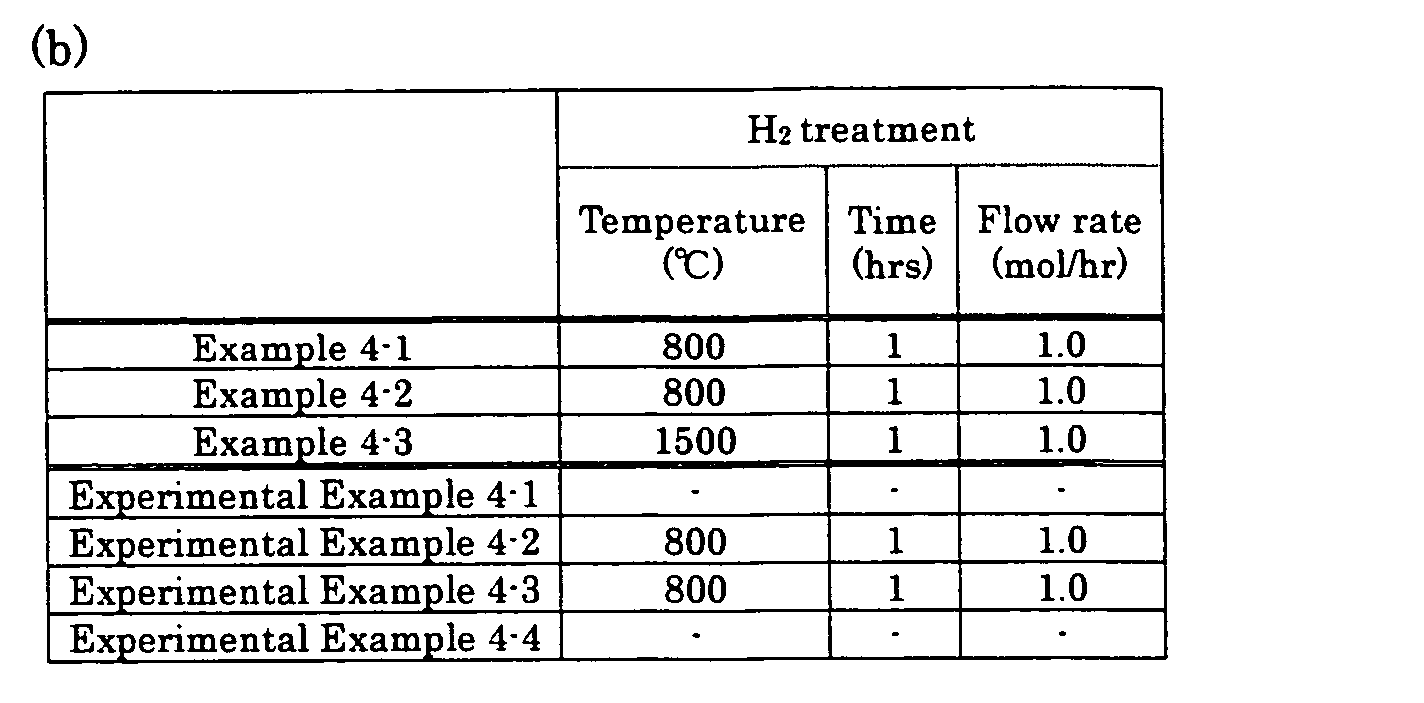
- Example 1-1 An experiment was carried out in the same manner as in Example 1-1, except for changing the reaction between a porous body and a reaction gas as shown in Table 7(a), thereby achieving the reaction of the porous body and the reaction gas. Thereafter, the treated porous body was transferred into a heating furnace, and the temperature was raised to 800°C and kept for one hour while flowing 1 mole/hr of an H 2 gas. Thereafter, the pressure was reduced to 1 ⁇ 10 -3 mmHg or lower, and the temperature was raised to 1,500°C and kept for one hour, followed by cooling to room temperature. There was thus obtained a densified transparent quartz glass.
- Example 7 As shown in Table 7, the experiment was carried out in the same manner as in Example 4-1, except for using hexamethyldisiloxane as the reaction gas in place of the hexamethyldisilazane vapor, thereby obtaining a densified transparent quartz glass.
- a porous body was reacted with a hexamethyldisilazane vapor in the same procedures as in Example 4-1, and the treated porous body was transferred into a heating furnace. The temperature was raised to 1,500°C and kept for one hour while flowing 1 mole/hr of an H 2 gas, followed by cooling to room temperature. There was thus obtained a densified transparent quartz glass.
- Example 4-1 a dehydration reaction was carried out using a conventional chlorine gas as the reaction gas.
- a quartz glass body was obtained under the same treatment conditions as in Example 4-1, except that the reaction between the porous body and the reaction gas was carried out as shown in Table 7 and that the treatment with an H 2 gas was not carried out.
- Experimental Example 4-2 is one in which a dehydration reaction was carried out using a trichloromethylsilane gas as the reaction gas.
- a quartz glass body was obtained under the same treatment conditions as in Example 4-1, except for carrying out the reaction between the porous body and the reaction gas as shown in Table 7.
- Experimental Example 4-3 is one in which baking of the porous body was carried out in a nitrogen atmosphere without using the reaction gas.
- Other treatment conditions are the same as in Example 4-1 and are shown in Table 7.
- the treated porous body was transferred into a vacuum furnace, and the temperature was raised to 800°C. Thereafter, the pressure was reduced to 1 ⁇ 10 -3 mmHg or lower, and the temperature was further raised to 1,500°C and kept for one hour, followed by cooling to room temperature. There was thus obtained a densified transparent quartz glass.
- Experimental Example 4-2 135 ⁇ 30 10 6 11.6
- Experimental Example 4-3 100 ⁇ 30 30 4 11.6
- Experimental Example 4-5 Natural article 170 ⁇ 30 10 10 11.9
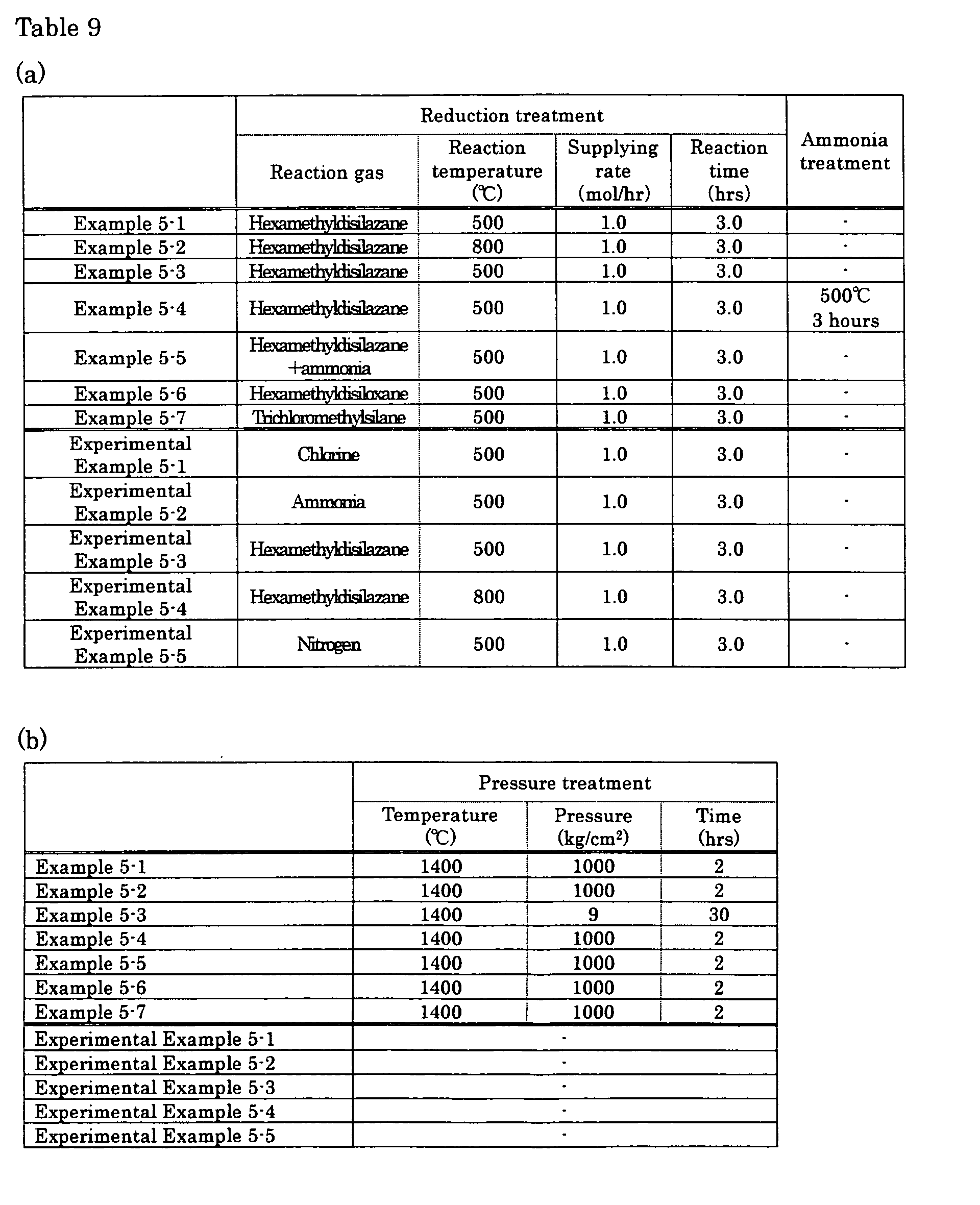
- Example 1-1 An experiment was carried out in the same manner as in Example 1-1, except for changing the reaction between a porous body and a reaction gas as shown in Table 9, thereby obtaining a densified synthetic quartz glass. Thereafter, the quartz glass body was transferred into a pressure furnace. In an Ar atmosphere, the temperature was raised to 1,400°C at 100°C/hr, and at the same time, the pressure was raised to 1,000 kg/cm 2 . After keeping for 2 hours, the system was cooled to room temperature and simultaneously returned to the atmospheric pressure, and the quartz glass body was taken out. The resulting quartz glass body was provided for the measurements.
- Example 5-1 An experiment was carried out in the same manner as in Example 5-1, except for changing the pressurizing treatment condition against the densified quartz glass body as shown in Table 9, thereby obtaining a densified quartz glass body.
- Example 5-1 An experiment was carried out in the same manner as in Example 5-1, except that a hexamethyldisiloxane gas was used as the reaction gas in place of the hexamethyldisilazane vapor as shown in Table 9, thereby obtaining a densified quartz glass body.
- Experimental Example 5-1 a dehydration reaction was carried out using a conventional chlorine gas as the reaction gas.
- Experimental Example 5-2 a dehydration reaction was carried out using ammonia as the reaction gas.
- Experimental Examples 5-3 and 5-4 a dehydration reaction was carried out using hexamethyldisilazane as the reaction gas.
- Experimental Example 5-5 is one in which baking of the porous body was carried out without using the reaction gas. Densified quartz glasses were obtained under the same treatment conditions as in Example 5-1, except that the reaction between the porous body and the reaction gas was carried out as shown in Table 9 and that after baking, the pressurizing treatment was not carried out.
- the resulting quartz glass body was measured for the hydroxyl group concentration, chlorine concentration, carbon concentration and nitrogen concentration remaining in the subject quartz glass and the viscosity at 1,280°C in the same manners as in Example 1-1.
- a bubble generation test (VAC) was carried out by treating a sample at 1,800°C for one hour in vacuo and visually confirming bubbles as newly generated in the inside of the sample after the test. The results obtained are shown in Table 10. Incidentally, in Table 10, the viscosity was shown in terms of its logarithmic value (log ⁇ ).
- the temperature was raised to the reaction temperature, and 1.9 g of a hexamethyldisilazane vapor was fed as a reaction gas while diluting with an N 2 gas, thereby reacting with the OH group in the porous body.
- the heating was carried out at the reaction temperature as shown in Table 11 while keeping that temperature for 3 hours.
- a flow rate of the N 2 gas is 1 mole/hr.
- the treated porous body was transferred into a vacuum furnace, the temperature was raised to 800°C, and the pressure was reduced to 1 ⁇ 10 -3 mmHg or lower. After keeping for one hour, the temperature was further raised to 1,600°C at 10°C/min, thereby obtaining a densified quartz glass.
- Example 6-1 Hexamethyldisilazane 500 1.9 Flame melting ⁇ No bubble generation
- Example 6-2 Hexamethyldisilazane 500 15.0 Electrical melting ⁇ No bubble generation Flame melting ⁇ Bubble generation
- Example 6-3 Hexamethyldisilazane 500 15.0 Flame melting ⁇ No bubble generation
- Example 6-4 Trichloromethylsilane 500 0.5 Flame melting ⁇ No bubble generation
- Example 6-5 Hexamethyldisiloxane 500 1.9 Flame melting ⁇ No bubble generation Experimental Example 6-1 Chlorine 500 100 Flame melting ⁇ No bubble generation Experimental Example 6-2 Hexamethyldisilazane 500 6.0 Flame melting ⁇ Bubble generation Experimental Example 6-3 Nitrogen 500 - Flame melting ⁇ No bubble generation
- Example 11 As shown in Table 11, a hexamethyldisilazane vapor or a trichloromethylsilane gas or hexamethyldisiloxane was used as the reaction gas in a throwing amount as shown in Table 11. Also, especially in Example 6-3, in order to make 5 mm of the surface as a transparent layer, an experiment was carried out in the same manner as in Example 6-1, except for raising the temperature from 800°C to 1,600°C at 20°C/min at the time of vacuum sintering, thereby obtaining a densified quartz glass body.
- Experimental Example 6-1 a dehydration reaction was carried out using a conventional chlorine gas as the reaction gas.
- Experimental Example 6-2 a dehydration reaction was carried out using hexamethyldisilazane as the reaction gas in a throwing amount as shown in Table 11.
- Experimental Example 6-3 is one in which baking of the porous body was carried out without using the reaction gas. The reaction between the porous body and the reaction gas was carried out under the condition as shown in Table 11, and after baking, densified quartz glasses were obtained under the same treatment conditions as in Example 6-1.
- Example 6-2 With respect to each of the resulting quartz glass bodies, the surface site (surface depth: from 1 mm to 20 mm) and the internal site were respectively collected and measured for the hydroxyl group concentration, chlorine concentration, carbon concentration and nitrogen concentration remaining in the subject quartz glass and the viscosity at 1,280°C were measured in the same manners as in Example 1-1. With respect to Example 6-2, a black portion was skived out from the resulting quartz glass body and measured for the surface site and the internal site of the black quartz glass body. Further, the color of the quartz glass body was visually discriminated. The results obtained are shown in Table 12. In Table 12, the viscosity was shown in terms of its logarithmic value (log ⁇ ).
- a processing heating test by flame melting is one in which a glass body sample is irradiated with a flame by an acetylene gas burner, thereby confirming the generation of bubbles in the glass body; and a processing heating test by electrical melting is one carried out in vacuo in a carbon heater heating furnace. The results obtained are shown in Table 11.
- Example 6-1 Surface Transparent ⁇ 1 ⁇ 30 10 10 12.1 Internal Transparent ⁇ 1 ⁇ 30 10 10 12.1
- Example 6-2 Surface Black ⁇ 1 ⁇ 30 500 20 12.2 Internal Black ⁇ 1 ⁇ 30 500 20 12.2
- Example 6-3 Surface Transparent ⁇ 1 ⁇ 30 10 10 12.2 Internal Black ⁇ 1 ⁇ 30 500 20 12.2
- Example 6-4 Surface Transparent ⁇ 1 500 10 2 11.9 Internal Transparent 80 ⁇ 30 10 2 11.5
- Example 6-5 Surface Transparent ⁇ 1 ⁇ 30 10 2 12.1 Internal Transparent ⁇ 1 ⁇ 30 10 2 12.1
- Experimental Example 6-1 Surface Transparent ⁇ 1 1900 10 2 11.5 Internal Transparent ⁇ 1 1900 10 2 11.5
- Experimental Example 6-2 Surface Transparent ⁇ 1 ⁇ 30 40 20 12.2 Internal Transparent ⁇ 1 ⁇ 30 50 20 12.2
- Experimental Example 6-3 Surface Transparent 120 ⁇ 30 2 1 1
- a synthetic quartz glass of the present invention it is possible to easily and efficiently produce a synthetic quartz glass which has less impurity, has a high-temperature viscosity characteristic equal to or more than that of a natural quartz glass, and hardly deforms even in a high-temperature environment, and especially a highly heat resistant synthetic quartz glass which is free from the generation of bubbles and is dense.
- the synthetic quartz glass body of the present invention it is possible to provide a transparent and black synthetic quartz glass which has less impurity, has a high-temperature viscosity characteristic equal to or more than that of a natural quartz glass, and hardly deforms even in a high-temperature environment, and especially a quartz glass body which is free from the generation of bubbles, is dense, has high infrared absorption rate and emission rate, and has an extremely high effect for preventing diffusion of alkali metal.
- the present invention is useful for a quartz glass jig to be used in the production steps for carrying out a heating treatment of a silicon wafer or forming a CVD film on the surface, and especially, in recent years, since a synthetic quartz which is lowered in metal impurities and suited for a high-temperature treatment is desired as a raw material, the present invention complies with an expectation of the industrial field to a great extent.
Landscapes
- Chemical & Material Sciences (AREA)
- Engineering & Computer Science (AREA)
- Organic Chemistry (AREA)
- Materials Engineering (AREA)
- Chemical Kinetics & Catalysis (AREA)
- Manufacturing & Machinery (AREA)
- Life Sciences & Earth Sciences (AREA)
- General Chemical & Material Sciences (AREA)
- Geochemistry & Mineralogy (AREA)
- Physics & Mathematics (AREA)
- Thermal Sciences (AREA)
- Glass Compositions (AREA)
- Glass Melting And Manufacturing (AREA)
Abstract
Description
| Reaction gas | Reaction temperature (°C) | Supplying rate (mol/hr) | Reaction time (hrs) | |
| Example 1-1 | Hexamethyldisilazane | 500 | 1.0 | 3 |
| Example 1-2 | Hexamethyldisilazane | 500 | 0.5 | 3 |
| Example 1-3 | Trichloromethylsilane | 500 | 1.0 | 3 |
| Example 1-4 | Ammonia | 500 | 1.0 | 3 |
| Example 1-5 | Ethanol | 500 | 1.0 | 3 |
| Example 1-6 | Chlorine | 500 | 0.5 | 3 |
| Experimental Example 1-1 | Chlorine | 700 | 1.0 | 3 |
| Experimental Example 1-2 | Hexamethyldisilazane | 1100 | 3.0 | 3 |
| Experimental Example 1-3 | Nitrogen | 500 | 1.0 | 3 |
| Hydroxyl group concentration (ppm) | Chlorine concentration (ppm) | Carbon concentration (ppm) | Nitrogen concentration (ppm) | Viscosity at 1280°C (log η) | Absorption coefficient (245nm) | |
| Example 1-1 | <1 | <30 | 100 | 80 | 12.4 | 2.510 |
| Example 1-2 | <1 | <30 | 100 | 100 | 11.8 | 0.500 |
| Example 1-3 | <1 | 400 | 400 | 10 | 11.9 | 1.000 |
| Example 1-4 | <1 | <30 | 10 | 520 | 12.0 | 1.500 |
| Example 1-5 | <1 | <30 | 1000 | 10 | 11.8 | 0.440 |
| Example 1-6 | <1 | 1000 | 60 | 10 | 11.7 | 0.090 |
| Experimental Example 1-1 | <1 | 2300 | 10 | 10 | 11.6 | 0.100 |
| Experimental Example 1-2 | <1 | <30 | 2800 | 3000 | 11.7 | 2.480 |
| Experimental Example 1-3 | 250 | <30 | 10 | 10 | 11.5 | 0.000 |
| Experimental Example 1-4 (Natural article) | 170 | <30 | 10 | 10 | 11.9 | 0.000 |
| Reaction gas | Reaction temperature (°C) | Supplying rate (mol/hr) | Reaction time (hrs) | |
| Example 2-1 | Hexamethyldisilazane | 300 | 1.0 | 3 |
| Example 2-2 | Hexamethyldisilazane | 500 | 1.1 | 3 |
| Example 2-3 | Hexamethyldisilazane | 700 | 0.9 | 3 |
| Example 2-4 | Hexamethyldisilazane | 1000 | 1.1 | 3 |
| Experimental Example 2-1 | Chlorine | 700 | 1.0 | 3 |
| Experimental Example 2-2 | Trichloromethylsilane | 500 | 1.0 | 3 |
| Experimental Example 2-3 | Nitrogen | 500 | 1.0 | 3 |
| Hydroxyl group concentration (ppm) | Chlorine concentration (ppm) | Carbon concentration (ppm) | Nitrogen concentration (ppm) | Viscosity at 1280°C (log η) | Color | |
| Example 2-1 | < 1 | <30 | 40 | 50 | 12.1 | Transparent |
| Example 2-2 | < 1 | <30 | 100 | 80 | 12.4 | Transparent |
| Example 2-3 | < 1 | <30 | 200 | 100 | 12.3 | Transparent |
| Example 2-4 | < 1 | <30 | 1500 | 220 | 12.3 | Black |
| Experimental Example 2-1 | < 1 | 2300 | 10 | 10 | 11.6 | Transparent |
| Experimental Example 2-2 | < 1 | 500 | 40 | 10 | 11.9 | Transparent |
| Experimental Example 2-3 | 250 | <30 | 10 | 10 | 11.5 | Transparent |
| Natural article | 170 | <30 | 10 | 10 | 11.9 | Transparent |
| Reaction gas | Reaction temperature (°C) | Feed rate (mol/hr) | Reaction time (hrs) | |
| Example 3-1 | Hexamethyldisiloxane | 300 | 1.0 | 3 |
| Example 3-2 | Hexamethyldisiloxane | 500 | 1.1 | 3 |
| Example 3-3 | Hexamethyldisiloxane | 700 | 0.9 | 3 |
| Example 3-4 | Hexamethyldisiloxane | 1000 | 1.1 | 3 |
| Example 3-5 | Tetramethoxysilane | 700 | 1.1 | 3 |
| Example 3-6 | Trimethoxymethylsilane | 700 | 1.1 | 3 |
| Example 3-7 | Trimethylpropylsilane | 700 | 1.1 | 3 |
| Example 3-8 | Trimethylsilylbutyric acid | 700 | 1.1 | 3 |
| Example 3-9 | Hexamethyldisilmethylene | 700 | 1.1 | 3 |
| Example 3-10 | Triethylsilane | 700 | 1.1 | 3 |
| Example 3-11 | Hexamethyldisilane | 700 | 1.1 | 3 |
| Experimental Example 3-1 | Chlorine | 700 | 1.0 | 3 |
| Experimental Example 3-2 | Ammonia | 700 | 1.0 | 3 |
| Experimental Example 3-3 | Nitrogen | 700 | 1.0 | 3 |
| Hydroxyl group concentration (ppm) | Chlorine concentration (ppm) | Carbon concentration (ppm) | Nitrogen concentration (ppm) | Viscosity at 1280°C (log η) | Color | |
| Example 3-1 | <1 | <30 | 40 | 50 | 121 | Transparent |
| Example 3-2 | <1 | <30 | 100 | 80 | 122 | Transparent |
| Example 3-3 | <1 | <30 | 200 | 100 | 123 | Transparent |
| Example 3-4 | <1 | <30 | 1500 | 220 | 123 | Black |
| Example 3-5 | <1 | <30 | 200 | 100 | 123 | Transparent |
| Example 3-6 | <1 | <30 | 200 | 100 | 123 | Transparent |
| Example 3-7 | <1 | <30 | 200 | 100 | 123 | Transparent |
| Example 3-8 | <1 | <30 | 200 | 100 | 123 | Transparent |
| Example 3-9 | <1 | <30 | 200 | 100 | 123 | Transparent |
| Example 3-10 | <1 | <30 | 200 | 100 | 123 | Transparent |
| Example 3-11 | <1 | <30 | 200 | 100 | 123 | Transparent |
| Experimental Example 3-1 | <1 | 2300 | 10 | 10 | 116 | Transparent |
| Experimental Example 3-2 | <1 | <30 | 10 | 1000 | 120 | Transparent |
| Experimental Example 3-3 | 100 | <30 | 10 | 10 | 115 | Transparent |
| Natural article | 170 | <30 | 10 | 10 | 119 | Transparent |

| Hydroxyl group concentration (ppm) | Chlorine concentration (ppm) | Carbon concentration (ppm) | Nitrogen concentration (ppm) | Viscosity at 1280°C (log η) | |
| Example 4-1 | <1 | <30 | 20 | 8 | 12.6 |
| Example 4-2 | <1 | <30 | 30 | 1 | 12.6 |
| Example 4-3 | <1 | <30 | 10 | 7 | 12.6 |
| Experimental Example 4-1 | < 1 | 2300 | 10 | 10 | 11.6 |
| Experimental Example 4-2 | 135 | <30 | 10 | 6 | 11.6 |
| Experimental Example 4-3 | 100 | <30 | 30 | 4 | 11.6 |
| Experimental Example 4-4 | <1 | <30 | 100 | 80 | 12.4 |
| Experimental Example 4-5 (Natural article) | 170 | <30 | 10 | 10 | 11.9 |
| Hydroxyl group concentration (ppm) | Chlorine concentration (ppm) | Carbon concentration (ppm) | Nitrogen concentration (ppm) | Viscosity at 1280°C (log η) | Bubble generation test VAC | |
| Example 5-1 | <1 | <30 | 10 | 10 | 12.1 | No bubble |
| Example 5-2 | <1 | <30 | 1000 | 400 | 12.2 | No bubble |
| Example 5-3 | <1 | <30 | 10 | 10 | 12.2 | No bubble |
| Example 5-4 | <1 | <30 | 10 | 400 | 12.2 | No bubble |
| Example 5-5 | <1 | <30 | 10 | 400 | 12.2 | No bubble |
| Example 5-6 | <1 | <30 | 10 | 10 | 12.1 | No bubble |
| Example 5-7 | <1 | 1500 | 10 | 10 | 11.9 | No bubble |
| Experimental Example 5-1 | <1 | 1900 | 10 | 10 | 11.5 | No bubble |
| Experimental Example 5-2 | <1 | <30 | 10 | 520 | 12.0 | Vigorous bubble |
| Experimental Example 5-3 | <1 | <30 | 100 | 80 | 12.3 | Bubble generation |
| Experimental Example 5-4 | <1 | <30 | 1000 | 400 | 12.3 | Vigorous bubble generation |
| Experimental Example 5-5 | 100 | <30 | 10 | 10 | 11.6 | No bubble |
| Natural article | 170 | <30 | 10 | 10 | 11.9 | No bubble |
| Reaction with volatile silicon compounds | Processing heating test | |||
| Reaction gas | Reaction temperature (°C) | Throwing amount (g) | ||
| Example 6-1 | Hexamethyldisilazane | 500 | 1.9 | Flame melting→ No bubble generation |
| Example 6-2 | Hexamethyldisilazane | 500 | 15.0 | Electrical melting→ No bubble generation Flame melting→ Bubble generation |
| Example 6-3 | Hexamethyldisilazane | 500 | 15.0 | Flame melting→ No bubble generation |
| Example 6-4 | Trichloromethylsilane | 500 | 0.5 | Flame melting→ No bubble generation |
| Example 6-5 | Hexamethyldisiloxane | 500 | 1.9 | Flame melting→ No bubble generation |
| Experimental Example 6-1 | Chlorine | 500 | 100 | Flame melting→ No bubble generation |
| Experimental Example 6-2 | Hexamethyldisilazane | 500 | 6.0 | Flame melting→ Bubble generation |
| Experimental Example 6-3 | Nitrogen | 500 | - | Flame melting→ No bubble generation |
| Site | Color | Hydroxyl group concentration (ppm) | Chlorine concentration (ppm) | Carbon concentration (ppm) | Nitrogen concentration (ppm) | Viscosity at 1280°C (log η) | |
| Example 6-1 | Surface | Transparent | <1 | <30 | 10 | 10 | 12.1 |
| Internal | Transparent | <1 | <30 | 10 | 10 | 12.1 | |
| Example 6-2 | Surface | Black | <1 | <30 | 500 | 20 | 12.2 |
| Internal | Black | <1 | <30 | 500 | 20 | 12.2 | |
| Example 6-3 | Surface | Transparent | <1 | <30 | 10 | 10 | 12.2 |
| Internal | Black | <1 | <30 | 500 | 20 | 12.2 | |
| Example 6-4 | Surface | Transparent | <1 | 500 | 10 | 2 | 11.9 |
| Internal | Transparent | 80 | <30 | 10 | 2 | 11.5 | |
| Example 6-5 | Surface | Transparent | <1 | <30 | 10 | 2 | 12.1 |
| Internal | Transparent | < 1 | <30 | 10 | 2 | 12.1 | |
| Experimental Example 6-1 | Surface | Transparent | <1 | 1900 | 10 | 2 | 11.5 |
| Internal | Transparent | <1 | 1900 | 10 | 2 | 11.5 | |
| Experimental Example 6-2 | Surface | Transparent | <1 | <30 | 40 | 20 | 12.2 |
| Internal | Transparent | <1 | <30 | 50 | 20 | 12.2 | |
| Experimental Example 6-3 | Surface | Transparent | 120 | <30 | 2 | 2 | 11.5 |
| Internal | Transparent | 120 | <30 | 2 | 2 | 11.5 | |
| Experimental Example 6-4 (Natural article) | Whole | Transparent | 170 | <30 | 10 | 10 | 11.9 |
Claims (25)
- A production process of a synthetic quartz glass which is a process of producing a quartz glass body having an absorption coefficient at 245 nm of 0.05 cm-1 or more, which is characterized by subjecting a silica porous body to a reduction treatment and a baking treatment to form a dense glass body.
- The production process of a synthetic quartz glass according to claim 1, which is characterized in that the reduction treatment is carried out at a reaction temperature of 100°C or higher and 1,300°C or lower, and the baking treatment is then carried out at a reaction temperature of 1,300°C or higher and 1,900°C or lower, thereby obtaining a dense glass body.
- The production process of a synthetic quartz glass according to claim 1, which is characterized in that the reduction treatment and the baking treatment are carried out at the same time at a reaction temperature of 100°C or higher and 1,900°C or lower.
- The production process of a synthetic quartz glass according to any one of claims 1 to 3, which is characterized in that the reduction treatment is a treatment for reacting the silica porous body with a reducing gas in an atmosphere containing said gas in a prescribed temperature range.
- The production process of a synthetic quartz glass according to claim 4, which is characterized in that the reducing gas is a volatile silicon compound containing nitrogen and/or carbon.
- The production process of a synthetic quartz glass according to claim 5, which is characterized in that the volatile silicon compound is at least one kind of compound selected from the group consisting of a silazane, an organosilazane, an organohalogen silane, a siloxane, an organosiloxane, an alkoxysilane, an aroxysilane, a silane, an organosilane, and an organopolysilane.
- The production process of a synthetic quartz glass according to claim 6, which is characterized in that the volatile silicon compound is hexamethyldisilazane.
- The production process of a synthetic quartz glass according to claim 6, which is characterized in that the volatile silicon compound is hexamethyldisiloxane.
- The production process of a synthetic quartz glass according to any one of claims 1 to 8, which is characterized in that the reduction treatment is carried out at a reaction temperature of 100°C or higher and 800°C or lower, followed by baking at 1,300°C or higher and 1,900°C or lower, thereby obtaining a transparent glass body.
- The production process of a synthetic quartz glass according to any one of claims 1 to 8, which is characterized in that the silica porous body is subjected to a reduction treatment by reacting with a carbon-containing gas at 400°C or higher and 1,300°C or lower, followed by baking at 1,300°C or higher and 1,900°C or lower, thereby obtaining a densified black glass body.
- The production process of a synthetic quartz glass according to any one of claims 1 to 10, which is characterized in that after the reduction treatment, a heating treatment is carried out in an atmosphere containing hydrogen, followed by subjecting to a baking treatment, thereby obtaining a dense glass body.
- The production process of a synthetic quartz glass according to any one of claims 1 to 11, which is characterized in that the dense glass body is further subjected to a heating treatment in a non-oxidative atmosphere under a pressure exceeding the atmospheric pressure in the temperature range of from 1,200°C to 1,900°C.
- The production process of a synthetic quartz glass according to claim 12, which is characterized in that the dense glass body is subjected to a heating treatment in an inert gas atmosphere under a pressure exceeding the atmospheric pressure and up to 10,000 kg/cm2 in the temperature range of from 1,200°C to 1,900°C.
- A synthetic quartz glass body produced by the process according to any one of claims 1 to 13.
- A highly heat resistant synthetic quartz glass body, which is characterized by having an absorption coefficient at 245 nm of 0.05 cm-1 or more and having a carbon concentration, a nitrogen concentration and a chlorine concentration to be contained of 10,000 ppm or less, respectively.
- A synthetic quartz glass body which is a transparent quartz glass body produced by the process according to any one of claims 1 to 9 and 11 to 13, which is characterized in that a nitrogen concentration to be contained is 100 ppm or less, and a carbon concentration to be contained is 100 ppm or less.
- The synthetic quartz glass body according to claim 16, which is characterized in that the nitrogen concentration and the carbon concentration to be contained are 50 ppm or less, respectively.
- A synthetic quartz glass body which is a black quartz glass body produced by the process according to any one of claims 1 to 8 and 10 to 13, which is characterized in that a carbon concentration to be contained exceeds 100 ppm and 10,000 ppm or less.
- A synthetic quartz glass body which is a dense quartz glass body produced by the process according to any one of claims 1 to 8 and 10 to 13, which is characterized in that the quartz glass body has a transparent portion having a nitrogen concentration and a carbon concentration of 50 ppm or less, respectively in its surface site and a black portion having a carbon concentration in the range of from 100 to 10,000 ppm in its inside.
- A synthetic quartz glass body which is a dense quartz glass body produced by the process according to any one of claims 1 to 13, which is characterized in that the quartz glass body has a portion having an OH group concentration of 10 ppm or less in its surface site and a portion having an OH group concentration in the range of from 10 ppm to 300 ppm in its inside.
- The synthetic quartz glass body according to claim 20, which is characterized in that the reduction treatment is a treatment by reacting a hydroxyl group-containing silica porous body with a volatile silicon compound containing nitrogen and/or carbon and containing a halogen element, and the halogen element concentration of the surface site is from 100 to 5,000 ppm.
- The synthetic quartz glass body according to claim 21, which is characterized in that the volatile silicon compound is trichloromethylsilane.
- The synthetic quartz glass body according to any one of claims 20 to 22, which is characterized in that the surface site has a nitrogen concentration of 50 ppm or less and/or a carbon concentration of 50 ppm or less.
- The synthetic quartz glass body according to any one of claims 16, 17 and 20 to 23, which is characterized in that in the reduction treatment, the reducing gas is used in a molar number of from 0.1 to 3.0 times the molar number of the hydroxyl group contained in the silica porous body.
- The synthetic quartz glass body according to claim 18 or 19, which is characterized in that the reduction treatment is a treatment by reacting a hydroxyl group-containing silica porous body with a carbon-containing gas, and the carbon-containing gas is used in a molar number of from 2 to 10 times the molar number of the hydroxyl group contained in the silica porous body.
Applications Claiming Priority (11)
| Application Number | Priority Date | Filing Date | Title |
|---|---|---|---|
| JP2002348163 | 2002-11-29 | ||
| JP2002348163 | 2002-11-29 | ||
| JP2003115795 | 2003-04-21 | ||
| JP2003115795 | 2003-04-21 | ||
| JP2003179211 | 2003-06-24 | ||
| JP2003179211 | 2003-06-24 | ||
| JP2003272570 | 2003-07-09 | ||
| JP2003272570 | 2003-07-09 | ||
| JP2003388051 | 2003-11-18 | ||
| JP2003388051 | 2003-11-18 | ||
| PCT/JP2003/015272 WO2004050570A1 (en) | 2002-11-29 | 2003-11-28 | Method for producing synthetic quartz glass and synthetic quartz glass article |
Publications (3)
| Publication Number | Publication Date |
|---|---|
| EP1580170A1 true EP1580170A1 (en) | 2005-09-28 |
| EP1580170A4 EP1580170A4 (en) | 2011-12-28 |
| EP1580170B1 EP1580170B1 (en) | 2019-01-16 |
Family
ID=32475804
Family Applications (1)
| Application Number | Title | Priority Date | Filing Date |
|---|---|---|---|
| EP03775963.6A Expired - Lifetime EP1580170B1 (en) | 2002-11-29 | 2003-11-28 | Method for producing synthetic quartz glass and synthetic quartz glass article |
Country Status (8)
| Country | Link |
|---|---|
| US (1) | US7841211B2 (en) |
| EP (1) | EP1580170B1 (en) |
| JP (1) | JP4403082B2 (en) |
| KR (1) | KR100653861B1 (en) |
| CN (1) | CN100509669C (en) |
| AU (1) | AU2003284494A1 (en) |
| TW (1) | TW200422273A (en) |
| WO (1) | WO2004050570A1 (en) |
Cited By (7)
| Publication number | Priority date | Publication date | Assignee | Title |
|---|---|---|---|---|
| EP2048121A1 (en) * | 2007-10-11 | 2009-04-15 | Heraeus Quarzglas GmbH & Co. KG | A black synthetic quartz glass with a transparent layer |
| EP1921672A3 (en) * | 2006-11-10 | 2009-07-22 | Shin-Etsu Chemical Co., Ltd. | Method for manufacturing SOQ substrate |
| WO2013010896A2 (en) | 2011-07-19 | 2013-01-24 | Heraeus Quarzglas Gmbh & Co. Kg | Laser system, comprising a laser medium comprising a host material composed of quartz glass |
| WO2013087678A1 (en) * | 2011-12-15 | 2013-06-20 | Heraeus Quarzglas Gmbh & Co. Kg | Method for producing synthetic quartz glass, and quartz glass for use as a sheath material for an optical fibre |
| WO2015067688A1 (en) | 2013-11-11 | 2015-05-14 | Heraeus Quarzglas Gmbh & Co. Kg | Composite material, heat-absorbing component, and method for producing the composite material |
| EP4030204A1 (en) | 2021-01-19 | 2022-07-20 | Heraeus Quarzglas GmbH & Co. KG | Microstructured optical fibre and preform for same |
| EP4530255A4 (en) * | 2023-08-07 | 2025-10-01 | Anhui Estone Material Tech Co Ltd | PROCESS FOR THE PRODUCTION OF HIGH-PURITY CRISTOBALITE |
Families Citing this family (41)
| Publication number | Priority date | Publication date | Assignee | Title |
|---|---|---|---|---|
| JP2006012938A (en) * | 2004-06-23 | 2006-01-12 | Mitsubishi Gas Chem Co Inc | Carbon material for electric double layer capacitor electrode and manufacturing method thereof |
| JP5013573B2 (en) * | 2005-09-30 | 2012-08-29 | 信越石英株式会社 | Method for producing high heat-resistant quartz glass powder, high heat-resistant quartz glass powder and glass body |
| JP4640292B2 (en) * | 2006-08-24 | 2011-03-02 | 住友電気工業株式会社 | Quartz glass body manufacturing method |
| JP4640293B2 (en) * | 2006-08-24 | 2011-03-02 | 住友電気工業株式会社 | Quartz glass body manufacturing method |
| DE102006043738B4 (en) * | 2006-09-13 | 2008-10-16 | Heraeus Quarzglas Gmbh & Co. Kg | Quartz glass component for use in semiconductor fabrication and method of making the same |
| JP5076432B2 (en) * | 2006-10-05 | 2012-11-21 | 住友電気工業株式会社 | Optical fiber preform manufacturing method |
| JP5312313B2 (en) * | 2007-02-27 | 2013-10-09 | 信越石英株式会社 | Black synthetic quartz glass and manufacturing method thereof |
| US8062986B2 (en) * | 2007-07-27 | 2011-11-22 | Corning Incorporated | Fused silica having low OH, OD levels and method of making |
| WO2009106134A1 (en) * | 2008-02-27 | 2009-09-03 | Heraeus Quarzglas Gmbh & Co. Kg | Method for producing an optical component of quartz glass |
| JP5284702B2 (en) * | 2008-07-10 | 2013-09-11 | 信越石英株式会社 | Ultraviolet and infrared absorbing synthetic silica glass and method for producing the same |
| DE102008033945B4 (en) * | 2008-07-19 | 2012-03-08 | Heraeus Quarzglas Gmbh & Co. Kg | Process for the preparation of quartz glass doped with nitrogen and quartz glass grains suitable for carrying out the process, process for producing a quartz glass strand and method for producing a quartz glass crucible |
| JP5368935B2 (en) * | 2009-10-23 | 2013-12-18 | 信越石英株式会社 | Synthetic silica glass for fiber |
| WO2011140668A1 (en) * | 2010-05-12 | 2011-11-17 | Eth Zurich | 3d nanocrystals and manufacturing methods |
| GB201011582D0 (en) * | 2010-07-09 | 2010-08-25 | Heraeus Quartz Uk Ltd | High purity synthetic silica and items such as semiconductor jigs manufactured therefrom |
| GB201106015D0 (en) | 2011-04-08 | 2011-05-25 | Heraeus Quartz Uk Ltd | Production of silica soot bodies |
| JP5770022B2 (en) * | 2011-06-09 | 2015-08-26 | 信越石英株式会社 | Silica glass UV sensor using delayed fluorescence |
| JP2013107784A (en) * | 2011-11-18 | 2013-06-06 | Shinetsu Quartz Prod Co Ltd | Non-doped white fluorescent synthetic silica glass |
| JP2013253912A (en) * | 2012-06-08 | 2013-12-19 | Shinetsu Quartz Prod Co Ltd | Non-doped quartz glass sensor for radiation detection, and radiation leak detection system |
| US9051203B2 (en) * | 2012-09-13 | 2015-06-09 | Shin-Etsu Quartz Products Co., Ltd. | Black synthetic quartz glass with transparent layer and method for producing the same |
| US9296641B2 (en) * | 2012-11-01 | 2016-03-29 | Owens-Brockway Glass Container Inc. | Inspectable black glass containers |
| CN105210173A (en) * | 2013-05-23 | 2015-12-30 | 应用材料公司 | Coated liner assemblies for semiconductor processing chambers |
| WO2015022966A1 (en) * | 2013-08-15 | 2015-02-19 | 旭硝子株式会社 | Low scattering silica glass, and method for thermally treating silica glass |
| CN104457125B (en) * | 2014-12-09 | 2017-01-04 | 常熟市久昇电器有限公司 | The glass interlayer board that a kind of refrigerator is special |
| JP5913690B2 (en) * | 2015-05-28 | 2016-04-27 | 信越石英株式会社 | Silica glass generating delayed fluorescence |
| EP3390303B1 (en) | 2015-12-18 | 2024-02-07 | Heraeus Quarzglas GmbH & Co. KG | Production of quartz glass bodies with dewpoint control in a melting furnace |
| EP3390304B1 (en) | 2015-12-18 | 2023-09-13 | Heraeus Quarzglas GmbH & Co. KG | Spray granulation of silicon dioxide in the production of quartz glass |
| JP6981710B2 (en) | 2015-12-18 | 2021-12-17 | ヘレウス クワルツグラス ゲーエムベーハー ウント コンパニー カーゲー | Preparation of Fused Quartz from Silicon Dioxide Granules |
| WO2017103153A1 (en) | 2015-12-18 | 2017-06-22 | Heraeus Quarzglas Gmbh & Co. Kg | Glass fibers and preforms made of quartz glass having low oh, cl, and al content |
| CN108698880B (en) | 2015-12-18 | 2023-05-02 | 贺利氏石英玻璃有限两合公司 | Preparation of opaque quartz glass bodies |
| TWI840318B (en) | 2015-12-18 | 2024-05-01 | 德商何瑞斯廓格拉斯公司 | Quartz glass body, light guide, illuminant, formed body, and process for preparing the same, and use of silicon component |
| CN109153593A (en) | 2015-12-18 | 2019-01-04 | 贺利氏石英玻璃有限两合公司 | Preparation of Synthetic Quartz Glass Particles |
| US11339076B2 (en) | 2015-12-18 | 2022-05-24 | Heraeus Quarzglas Gmbh & Co. Kg | Preparation of carbon-doped silicon dioxide granulate as an intermediate in the preparation of quartz glass |
| KR20180095618A (en) | 2015-12-18 | 2018-08-27 | 헤래우스 크바르츠글라스 게엠베하 & 컴파니 케이지 | Preparation of silica glass bodies in multi-chamber furnaces |
| JP6940235B2 (en) | 2015-12-18 | 2021-09-22 | ヘレウス クワルツグラス ゲーエムベーハー ウント コンパニー カーゲー | Preparation of quartz glass in a melting crucible of refractory metal |
| CN110214046A (en) * | 2017-02-03 | 2019-09-06 | 应用材料公司 | The plasma abatement of nitrous oxide from semiconductor technology effluent |
| JP6769893B2 (en) * | 2017-02-24 | 2020-10-14 | 東ソ−・エスジ−エム株式会社 | Quartz glass material with OH group diffusion inhibitory ability and its manufacturing method |
| CN107629209B (en) * | 2017-05-05 | 2021-09-21 | 北京航空航天大学 | Dendronized organosilicon polymer containing silicon-oxygen six-membered ring, crosslinked body and preparation method |
| JP7680917B2 (en) * | 2020-10-01 | 2025-05-21 | 東ソ-・エスジ-エム株式会社 | Black quartz glass and its manufacturing method |
| WO2022070930A1 (en) * | 2020-10-01 | 2022-04-07 | 東ソ-・エスジ-エム株式会社 | Black quartz glass and method for manufacturing same |
| JP7722875B2 (en) * | 2020-10-07 | 2025-08-13 | 東ソ-・エスジ-エム株式会社 | Black quartz glass and its manufacturing method |
| KR20230079076A (en) * | 2020-10-07 | 2023-06-05 | 토소 에스지엠 가부시키가이샤 | Black quartz glass and manufacturing method thereof |
Family Cites Families (33)
| Publication number | Priority date | Publication date | Assignee | Title |
|---|---|---|---|---|
| JPS54127914A (en) | 1978-03-29 | 1979-10-04 | Nippon Telegraph & Telephone | Production of anhydrous glass material for optical fibers |
| US4789389A (en) * | 1987-05-20 | 1988-12-06 | Corning Glass Works | Method for producing ultra-high purity, optical quality, glass articles |
| JPH07115880B2 (en) | 1989-08-29 | 1995-12-13 | 信越石英株式会社 | Synthetic quartz glass member with excellent heat resistance |
| US5043002A (en) * | 1990-08-16 | 1991-08-27 | Corning Incorporated | Method of making fused silica by decomposing siloxanes |
| JP3092675B2 (en) * | 1990-09-28 | 2000-09-25 | 東ソー株式会社 | Oxynitride glass and method for producing the same |
| JPH04254433A (en) | 1991-01-31 | 1992-09-09 | Shinetsu Quartz Prod Co Ltd | Manufacturing method of black quartz glass |
| US5364433A (en) * | 1991-06-29 | 1994-11-15 | Shin-Etsu Quartz Products Company Limited | Optical member of synthetic quartz glass for excimer lasers and method for producing same |
| US6012304A (en) * | 1991-09-30 | 2000-01-11 | Loxley; Ted A. | Sintered quartz glass products and methods for making same |
| JP3187510B2 (en) * | 1992-03-12 | 2001-07-11 | 東芝セラミックス株式会社 | Method of manufacturing member for heat treatment of semiconductor wafer |
| JPH05279049A (en) * | 1992-03-30 | 1993-10-26 | Sumitomo Metal Ind Ltd | Production of synthetic quartz glass |
| JPH06122533A (en) * | 1992-10-14 | 1994-05-06 | Tosoh Corp | Silica glass containing silicon carbide and method for producing the same |
| JP3578357B2 (en) * | 1994-04-28 | 2004-10-20 | 信越石英株式会社 | Method for producing heat-resistant synthetic quartz glass |
| JP3368547B2 (en) * | 1994-04-28 | 2003-01-20 | 信越石英株式会社 | Opaque quartz glass and method for producing the same |
| US5707908A (en) * | 1995-01-06 | 1998-01-13 | Nikon Corporation | Silica glass |
| DE69601749T3 (en) * | 1995-06-07 | 2004-04-29 | Corning Inc. | Process for the thermal treatment and consolidation of silicon dioxide preforms to reduce laser-induced optical defects |
| JP3818603B2 (en) | 1996-05-21 | 2006-09-06 | 信越石英株式会社 | Method for producing quartz glass |
| DE69806672T2 (en) * | 1997-04-08 | 2003-03-20 | Shin-Etsu Chemical Co., Ltd. | Optical synthetic quartz glass, manufacturing method thereof, and optical element for excimer laser with the synthetic quartz glass |
| DE69816758T2 (en) * | 1997-05-20 | 2004-06-03 | Heraeus Quarzglas Gmbh & Co. Kg | SYNTHETIC QUARTZ GLASS FOR USE IN UV RADIATION AND METHOD FOR THE PRODUCTION THEREOF |
| US6044664A (en) * | 1997-09-29 | 2000-04-04 | Nikon Corporation | Synthetic silica glass manufacturing apparatus |
| US8402786B2 (en) * | 1998-01-30 | 2013-03-26 | Asahi Glass Company, Limited | Synthetic silica glass optical component and process for its production |
| JPH11310423A (en) | 1998-02-27 | 1999-11-09 | Toshiba Ceramics Co Ltd | Synthetic quartz glass and its production |
| JP2000143257A (en) * | 1998-11-06 | 2000-05-23 | Sumitomo Electric Ind Ltd | Method for manufacturing glass articles |
| JP3574577B2 (en) | 1998-11-30 | 2004-10-06 | 東芝セラミックス株式会社 | High viscosity synthetic quartz glass and method for producing the same |
| JP2000239025A (en) * | 1999-02-22 | 2000-09-05 | Sumitomo Electric Ind Ltd | Glass manufacturing method for optical parts |
| JP2000302458A (en) * | 1999-04-20 | 2000-10-31 | Sumitomo Electric Ind Ltd | Method for producing glass article for optical parts |
| JP2001048571A (en) * | 1999-06-04 | 2001-02-20 | Sumitomo Metal Ind Ltd | Quartz glass excellent in short-wavelength light transmission and method for producing the same |
| DE19962451C1 (en) * | 1999-12-22 | 2001-08-30 | Heraeus Quarzglas | Process for the production of opaque quartz glass and suitable Si0¶2¶ granulate for carrying out the process |
| JP4164984B2 (en) * | 2000-03-27 | 2008-10-15 | ソニー株式会社 | Optical recording medium |
| DE60123878T2 (en) * | 2000-06-28 | 2007-05-24 | Japan Super Quartz Corp. | Synthetic quartz powder, method of manufacture and synthetic quartz crucible |
| JP3865039B2 (en) * | 2000-08-18 | 2007-01-10 | 信越化学工業株式会社 | Method for producing synthetic quartz glass, synthetic quartz glass and synthetic quartz glass substrate |
| JP2003012331A (en) | 2001-06-27 | 2003-01-15 | Watanabe Shoko:Kk | High purity synthetic quartz glass particles |
| KR100418928B1 (en) | 2001-10-24 | 2004-02-14 | 주식회사 하이닉스반도체 | Method for fabricating of Merged DRAM with Logic semiconductor device |
| DE10159959A1 (en) * | 2001-12-06 | 2003-06-26 | Heraeus Quarzglas | Quartz glass blank used for an optical component for transferring ultraviolet radiation in microlithography e.g. for the production of highly integrated circuits has a glass structure without oxygen defect sites |
-
2003
- 2003-11-28 JP JP2004570726A patent/JP4403082B2/en not_active Expired - Fee Related
- 2003-11-28 KR KR1020057007709A patent/KR100653861B1/en not_active Expired - Lifetime
- 2003-11-28 EP EP03775963.6A patent/EP1580170B1/en not_active Expired - Lifetime
- 2003-11-28 US US10/535,935 patent/US7841211B2/en active Active
- 2003-11-28 CN CNB2003801037446A patent/CN100509669C/en not_active Expired - Lifetime
- 2003-11-28 TW TW092133600A patent/TW200422273A/en not_active IP Right Cessation
- 2003-11-28 AU AU2003284494A patent/AU2003284494A1/en not_active Abandoned
- 2003-11-28 WO PCT/JP2003/015272 patent/WO2004050570A1/en not_active Ceased
Cited By (13)
| Publication number | Priority date | Publication date | Assignee | Title |
|---|---|---|---|---|
| EP1921672A3 (en) * | 2006-11-10 | 2009-07-22 | Shin-Etsu Chemical Co., Ltd. | Method for manufacturing SOQ substrate |
| US7732867B2 (en) | 2006-11-10 | 2010-06-08 | Shin-Etsu Chemical Co., Ltd. | Method for manufacturing SOQ substrate |
| EP2048121A1 (en) * | 2007-10-11 | 2009-04-15 | Heraeus Quarzglas GmbH & Co. KG | A black synthetic quartz glass with a transparent layer |
| WO2013010896A2 (en) | 2011-07-19 | 2013-01-24 | Heraeus Quarzglas Gmbh & Co. Kg | Laser system, comprising a laser medium comprising a host material composed of quartz glass |
| DE102011107917A1 (en) | 2011-07-19 | 2013-01-24 | Heraeus Quarzglas Gmbh & Co. Kg | A laser system comprising a laser medium with a host material of quartz glass |
| US9272942B2 (en) | 2011-12-15 | 2016-03-01 | Heraeus Quarzglas Gmbh & Co. Kg | Method for producing synthetic quartz glass and quartz glass for use as cladding material of an optical fiber |
| WO2013087678A1 (en) * | 2011-12-15 | 2013-06-20 | Heraeus Quarzglas Gmbh & Co. Kg | Method for producing synthetic quartz glass, and quartz glass for use as a sheath material for an optical fibre |
| WO2015067688A1 (en) | 2013-11-11 | 2015-05-14 | Heraeus Quarzglas Gmbh & Co. Kg | Composite material, heat-absorbing component, and method for producing the composite material |
| US9957431B2 (en) | 2013-11-11 | 2018-05-01 | Heraeus Quarzglas Gmbh & Co. Kg | Composite material, heat-absorbing component, and method for producing the composite material |
| EP4030204A1 (en) | 2021-01-19 | 2022-07-20 | Heraeus Quarzglas GmbH & Co. KG | Microstructured optical fibre and preform for same |
| WO2022156956A1 (en) | 2021-01-19 | 2022-07-28 | Heraeus Quarzglas Gmbh & Co. Kg | Microstructured optical fiber and preform for same |
| US12560755B2 (en) | 2021-01-19 | 2026-02-24 | Heraeus Quarzglas Gmbh & Co. Kg | Microstructured optical fiber and preform for same having specific oxygen deficiency center and chlorine concentrations |
| EP4530255A4 (en) * | 2023-08-07 | 2025-10-01 | Anhui Estone Material Tech Co Ltd | PROCESS FOR THE PRODUCTION OF HIGH-PURITY CRISTOBALITE |
Also Published As
| Publication number | Publication date |
|---|---|
| KR100653861B1 (en) | 2006-12-05 |
| CN1714053A (en) | 2005-12-28 |
| TWI320780B (en) | 2010-02-21 |
| EP1580170A4 (en) | 2011-12-28 |
| JP4403082B2 (en) | 2010-01-20 |
| WO2004050570A1 (en) | 2004-06-17 |
| US7841211B2 (en) | 2010-11-30 |
| JPWO2004050570A1 (en) | 2006-03-30 |
| AU2003284494A1 (en) | 2004-06-23 |
| CN100509669C (en) | 2009-07-08 |
| US20060059948A1 (en) | 2006-03-23 |
| KR20050062784A (en) | 2005-06-27 |
| TW200422273A (en) | 2004-11-01 |
| EP1580170B1 (en) | 2019-01-16 |
Similar Documents
| Publication | Publication Date | Title |
|---|---|---|
| US7841211B2 (en) | Production process of synthetic quartz glass | |
| JP5048445B2 (en) | Black synthetic quartz glass with transparent layer | |
| JP5394734B2 (en) | Cage made of quartz glass for processing semiconductor wafers and method of manufacturing the cage | |
| EP2377826B1 (en) | OPTICAL MEMBER COMPRISING SILICA GLASS CONTAINING TiO2 | |
| EP3901106B1 (en) | Method for fabrication of low-hydroxyl high-purity silica glass | |
| US9051203B2 (en) | Black synthetic quartz glass with transparent layer and method for producing the same | |
| US7975507B2 (en) | Process for producing synthetic quartz glass and synthetic quartz glass for optical member | |
| JPH07300324A (en) | Method for producing heat-resistant synthetic quartz glass | |
| JP5312313B2 (en) | Black synthetic quartz glass and manufacturing method thereof | |
| JP3818603B2 (en) | Method for producing quartz glass | |
| JP5583082B2 (en) | Method for producing black synthetic quartz glass with transparent layer | |
| JP4437745B2 (en) | Manufacturing method of high heat-resistant synthetic quartz glass | |
| EP1112973B1 (en) | Process for producing a quartz glass product and the product so produced | |
| US9593034B2 (en) | Method for producing iron-doped silica glass | |
| JP4204398B2 (en) | Method for producing quartz glass | |
| US6326325B1 (en) | Method for fabricating silicon oxynitride | |
| JP4781409B2 (en) | Synthetic quartz glass body | |
| JP2007091558A (en) | Method for producing high heat-resistant quartz glass powder, high heat-resistant quartz glass powder and glass body | |
| JP6769893B2 (en) | Quartz glass material with OH group diffusion inhibitory ability and its manufacturing method | |
| JPH05279049A (en) | Production of synthetic quartz glass | |
| AU731687B2 (en) | Method for fabricating silicon oxynitride | |
| JPH11180730A (en) | Refractory for heat treatment furnace, method for producing the same, and heat treatment furnace using the same | |
| JP2002154827A (en) | Manufacturing method of synthetic quartz glass | |
| JP2019069883A (en) | Silica glass member |
Legal Events
| Date | Code | Title | Description |
|---|---|---|---|
| PUAI | Public reference made under article 153(3) epc to a published international application that has entered the european phase |
Free format text: ORIGINAL CODE: 0009012 |
|
| 17P | Request for examination filed |
Effective date: 20050518 |
|
| AK | Designated contracting states |
Kind code of ref document: A1 Designated state(s): AT BE BG CH CY CZ DE DK EE ES FI FR GB GR HU IE IT LI LU MC NL PT RO SE SI SK TR |
|
| AX | Request for extension of the european patent |
Extension state: AL LT LV MK |
|
| DAX | Request for extension of the european patent (deleted) | ||
| RBV | Designated contracting states (corrected) |
Designated state(s): DE FR GB |
|
| A4 | Supplementary search report drawn up and despatched |
Effective date: 20111129 |
|
| RIC1 | Information provided on ipc code assigned before grant |
Ipc: C03C 3/06 20060101AFI20111123BHEP Ipc: C03B 19/14 20060101ALI20111123BHEP |
|
| RAP1 | Party data changed (applicant data changed or rights of an application transferred) |
Owner name: HERAEUS QUARZGLAS GMBH & CO. KG |
|
| 17Q | First examination report despatched |
Effective date: 20120710 |
|
| GRAP | Despatch of communication of intention to grant a patent |
Free format text: ORIGINAL CODE: EPIDOSNIGR1 |
|
| INTG | Intention to grant announced |
Effective date: 20180814 |
|
| GRAS | Grant fee paid |
Free format text: ORIGINAL CODE: EPIDOSNIGR3 |
|
| GRAA | (expected) grant |
Free format text: ORIGINAL CODE: 0009210 |
|
| REG | Reference to a national code |
Ref country code: DE Ref legal event code: R081 Ref document number: 60351776 Country of ref document: DE Owner name: HERAEUS QUARZGLAS GMBH & CO. KG, DE Free format text: FORMER OWNER: SHIN-ETSU QUARTZ PRODUCTS CO., LTD., TOKIO/TOKYO, JP |
|
| AK | Designated contracting states |
Kind code of ref document: B1 Designated state(s): DE FR GB |
|
| REG | Reference to a national code |
Ref country code: GB Ref legal event code: FG4D |
|
| RIC2 | Information provided on ipc code assigned after grant |
Ipc: C03C 3/06 20060101AFI20111123BHEP Ipc: C03B 19/14 20060101ALI20111123BHEP |
|
| REG | Reference to a national code |
Ref country code: DE Ref legal event code: R096 Ref document number: 60351776 Country of ref document: DE |
|
| REG | Reference to a national code |
Ref country code: DE Ref legal event code: R082 Ref document number: 60351776 Country of ref document: DE Representative=s name: EULER, MATTHIAS, DR., DE Ref country code: DE Ref legal event code: R082 Ref document number: 60351776 Country of ref document: DE Representative=s name: BRAND, NORMEN, DIPL.-CHEM. UNIV. DR. RER. NAT., DE |
|
| REG | Reference to a national code |
Ref country code: DE Ref legal event code: R097 Ref document number: 60351776 Country of ref document: DE |
|
| REG | Reference to a national code |
Ref country code: DE Ref legal event code: R082 Ref document number: 60351776 Country of ref document: DE Representative=s name: BRAND, NORMEN, DR. RER. NAT., DE Ref country code: DE Ref legal event code: R082 Ref document number: 60351776 Country of ref document: DE Representative=s name: BRAND, NORMEN, DIPL.-CHEM. UNIV. DR. RER. NAT., DE |
|
| PLBE | No opposition filed within time limit |
Free format text: ORIGINAL CODE: 0009261 |
|
| STAA | Information on the status of an ep patent application or granted ep patent |
Free format text: STATUS: NO OPPOSITION FILED WITHIN TIME LIMIT |
|
| 26N | No opposition filed |
Effective date: 20191017 |
|
| PG25 | Lapsed in a contracting state [announced via postgrant information from national office to epo] |
Ref country code: FR Free format text: LAPSE BECAUSE OF NON-PAYMENT OF DUE FEES Effective date: 20191130 |
|
| PGFP | Annual fee paid to national office [announced via postgrant information from national office to epo] |
Ref country code: GB Payment date: 20221125 Year of fee payment: 20 Ref country code: DE Payment date: 20221123 Year of fee payment: 20 |
|
| REG | Reference to a national code |
Ref country code: DE Ref legal event code: R071 Ref document number: 60351776 Country of ref document: DE |
|
| REG | Reference to a national code |
Ref country code: GB Ref legal event code: PE20 Expiry date: 20231127 |
|
| PG25 | Lapsed in a contracting state [announced via postgrant information from national office to epo] |
Ref country code: GB Free format text: LAPSE BECAUSE OF EXPIRATION OF PROTECTION Effective date: 20231127 |
|
| PG25 | Lapsed in a contracting state [announced via postgrant information from national office to epo] |
Ref country code: GB Free format text: LAPSE BECAUSE OF EXPIRATION OF PROTECTION Effective date: 20231127 |