EP1578977B1 - Verfahren zur veränderung des gehalts von speicherstoffen in pflanzen - Google Patents
Verfahren zur veränderung des gehalts von speicherstoffen in pflanzen Download PDFInfo
- Publication number
- EP1578977B1 EP1578977B1 EP03813908A EP03813908A EP1578977B1 EP 1578977 B1 EP1578977 B1 EP 1578977B1 EP 03813908 A EP03813908 A EP 03813908A EP 03813908 A EP03813908 A EP 03813908A EP 1578977 B1 EP1578977 B1 EP 1578977B1
- Authority
- EP
- European Patent Office
- Prior art keywords
- plants
- leghemoglobin
- hemoglobin
- transformed
- plant
- Prior art date
- Legal status (The legal status is an assumption and is not a legal conclusion. Google has not performed a legal analysis and makes no representation as to the accuracy of the status listed.)
- Expired - Lifetime
Links
Classifications
-
- C—CHEMISTRY; METALLURGY
- C12—BIOCHEMISTRY; BEER; SPIRITS; WINE; VINEGAR; MICROBIOLOGY; ENZYMOLOGY; MUTATION OR GENETIC ENGINEERING
- C12N—MICROORGANISMS OR ENZYMES; COMPOSITIONS THEREOF; PROPAGATING, PRESERVING, OR MAINTAINING MICROORGANISMS; MUTATION OR GENETIC ENGINEERING; CULTURE MEDIA
- C12N15/00—Mutation or genetic engineering; DNA or RNA concerning genetic engineering, vectors, e.g. plasmids, or their isolation, preparation or purification; Use of hosts therefor
- C12N15/09—Recombinant DNA-technology
- C12N15/63—Introduction of foreign genetic material using vectors; Vectors; Use of hosts therefor; Regulation of expression
- C12N15/79—Vectors or expression systems specially adapted for eukaryotic hosts
- C12N15/82—Vectors or expression systems specially adapted for eukaryotic hosts for plant cells, e.g. plant artificial chromosomes (PACs)
- C12N15/8241—Phenotypically and genetically modified plants via recombinant DNA technology
- C12N15/8242—Phenotypically and genetically modified plants via recombinant DNA technology with non-agronomic quality (output) traits, e.g. for industrial processing; Value added, non-agronomic traits
- C12N15/8243—Phenotypically and genetically modified plants via recombinant DNA technology with non-agronomic quality (output) traits, e.g. for industrial processing; Value added, non-agronomic traits involving biosynthetic or metabolic pathways, i.e. metabolic engineering, e.g. nicotine, caffeine
- C12N15/8247—Phenotypically and genetically modified plants via recombinant DNA technology with non-agronomic quality (output) traits, e.g. for industrial processing; Value added, non-agronomic traits involving biosynthetic or metabolic pathways, i.e. metabolic engineering, e.g. nicotine, caffeine involving modified lipid metabolism, e.g. seed oil composition
-
- C—CHEMISTRY; METALLURGY
- C07—ORGANIC CHEMISTRY
- C07K—PEPTIDES
- C07K14/00—Peptides having more than 20 amino acids; Gastrins; Somatostatins; Melanotropins; Derivatives thereof
- C07K14/795—Porphyrin- or corrin-ring-containing peptides
- C07K14/805—Haemoglobins; Myoglobins
-
- C—CHEMISTRY; METALLURGY
- C12—BIOCHEMISTRY; BEER; SPIRITS; WINE; VINEGAR; MICROBIOLOGY; ENZYMOLOGY; MUTATION OR GENETIC ENGINEERING
- C12N—MICROORGANISMS OR ENZYMES; COMPOSITIONS THEREOF; PROPAGATING, PRESERVING, OR MAINTAINING MICROORGANISMS; MUTATION OR GENETIC ENGINEERING; CULTURE MEDIA
- C12N15/00—Mutation or genetic engineering; DNA or RNA concerning genetic engineering, vectors, e.g. plasmids, or their isolation, preparation or purification; Use of hosts therefor
- C12N15/09—Recombinant DNA-technology
- C12N15/63—Introduction of foreign genetic material using vectors; Vectors; Use of hosts therefor; Regulation of expression
- C12N15/79—Vectors or expression systems specially adapted for eukaryotic hosts
- C12N15/82—Vectors or expression systems specially adapted for eukaryotic hosts for plant cells, e.g. plant artificial chromosomes (PACs)
- C12N15/8241—Phenotypically and genetically modified plants via recombinant DNA technology
- C12N15/8242—Phenotypically and genetically modified plants via recombinant DNA technology with non-agronomic quality (output) traits, e.g. for industrial processing; Value added, non-agronomic traits
- C12N15/8243—Phenotypically and genetically modified plants via recombinant DNA technology with non-agronomic quality (output) traits, e.g. for industrial processing; Value added, non-agronomic traits involving biosynthetic or metabolic pathways, i.e. metabolic engineering, e.g. nicotine, caffeine
- C12N15/8245—Phenotypically and genetically modified plants via recombinant DNA technology with non-agronomic quality (output) traits, e.g. for industrial processing; Value added, non-agronomic traits involving biosynthetic or metabolic pathways, i.e. metabolic engineering, e.g. nicotine, caffeine involving modified carbohydrate or sugar alcohol metabolism, e.g. starch biosynthesis
Definitions
- the invention relates to a method for changing the content of storage substances in plants by using leghemoglobin and / or hemoglobin-expressing transformed plants, corresponding plants and their use.
- Storage substances in plants serve as reserve substances and are formed by plant tissues and deposited intracellularly.
- As storage materials serve z.
- polysaccharides carbohydrates such as lichenin, starch, glycogen, polyfructosans
- proteins proteins
- fats polyphosphates
- polyhydroxyalkanoates If required, the storage materials can be reintroduced into the metabolism and energy exchange, for example in the case of a lack of food, the germination of seeds, growth and other energy-consuming processes.
- Storage materials are valuable raw materials for the diet (grains, nuts, fruits, fruit, spices, etc.) and form the basis of many human foods and can also serve as suppliers of technical fats and oils. Other storage materials are used medicinally because of their pharmacologically active ingredients. ( Source: CD Römpp Chemie Lexikon - Version 1.0, Stuttgart / New York: Georg Thieme Verlag 1995 ).
- the storage materials are increasingly used as renewable and ecologically compatible raw materials for industry, as z. B. by the use of starch for the production of packaging materials or z. B. of vegetable oils as fuels, such as biodiesel or lubricants is possible.
- sucrose is the primary source of carbon and energy which is transported by the leaves into the developing seeds or storage organs.
- the sucrose in the leaves is formed by the starch obtained from photosynthesis.
- the sucrose, which is transported into the developing seeds, serves in addition to the synthesis of fatty acids for the storage lipids also for the synthesis of storage proteins and storage strength.
- z For example, seeds have three different forms of storage: storage lipids, storage proteins, and starch. Depending on the plants, the ratios of the three storage materials vary. To contain rapeseed z. For example, about 48% storage lipids, 19% starch and 21% storage proteins, while soybean contains 22% lipids, 12% starch and 37% proteins ( Biochemistry & Molecular Biology of the Plant ed. Buchanan, Gruissem, Jones 2000, American Society of Plant Physiologists ) Based on their dry matter.
- the fatty acids obtainable from vegetable oils are of particular interest. They are used, for example, as raw materials for plasticizers, lubricants, surfactants, cosmetics, etc., or are used in the food and animal feed industry as valuable raw materials. For example, the provision of rapeseed oils with Fatty acids of medium chain length of particular interest, since these are particularly sought after for surfactant production.
- Starch as a storage material can be stored not only in seeds, but also in other storage organs. Important storage organs for starch are hypocotyl and roots. By proliferation and enlargement of the cells of the bark parenchyma root tubers, such as. B. potato tubers or thickening of the root neck root beets such. Sugar beet or yams.
- So strength is z.
- the potato dry substance. In addition to its use as food, the potato is therefore also used as feed and as raw material for the production of starch and alcohol.
- 269.7 million tonnes of potatoes were harvested. ( Source: CD Römpp Chemie Lexikon - Version 1.0, Stuttgart / New York: Georg Thieme Verlag 1995 ).
- the object of the present invention was therefore to increase the content of storage substances in storage organs of plants, in order to thus achieve a better utilization of cultivated areas, fertilizers, etc. and a better yield (or yield) by means of the plants.
- the production of oil should be improved or made possible.
- This object is achieved in that transformed plants expressing leghemoglobin are used in the method according to the invention for changing the content of storage substances in plants.
- the object is also achieved by the use of leghemoglobin expressing transformed plants.
- leghemoglobin storage-containing transformed plants which allow due to their (higher) content of storage materials better use of crops, fertilizers, etc. and therefore allow a better yield of storage materials, especially oil.
- an economically interesting use of the plants of the invention is possible.
- Leghemoglobin belongs to the family of hemoglobin proteins whose function is reversible oxygen binding and supply. It is from Root nodules of legumes (legumes) and is an isolable red substance that resembles the vertebrate myoglobin. Due to the reversible binding of O 2 , leghemoglobin can ensure the high oxygen demand during nitrogen fixation by the nodule bacteria.
- the apoprotein is formed by the plant cells and the heme by the bacteria ( Source: CD Römpp Chemie Lexikon - Version 1.0, Stuttgart / New York: Georg Thieme Verlag 1995 ).
- hemoglobin or leghemoglobin and hemoglobin-expressing transformed plants are used in the method according to the invention for changing the content of storage substances in plants. Accordingly, the invention also relates to the use of leghemoglobin and / or hemoglobin expressing transformed plants.
- hemoglobin is understood as meaning iron-II complexes of protoporphyrin.
- Expression in the present application means the transfer of genetic information starting from DNA or RNA into a gene product (polypeptide or protein, here leghemoglobin or hemoglobin) and is also intended to include the term overexpression, meaning increased expression, so that the Foreign protein or the naturally occurring protein can be produced amplified or make up a large part of the total protein content of the host cell.
- Transformation is understood to mean the transfer of genetic information into an organism, in particular a plant. Including all known to the expert options for the introduction of information fall, z. Microinjection, electroporation, particle bombardment, agrobacteria or chemicals mediated uptake (eg, polyethylene glycol mediated DNA uptake or via the silica carbonate fiber technique).
- the genetic information can be z.
- a transformed plant is therefore a genetically modified plant.
- Storage substances are understood to be polysaccharides, preferably carbohydrates, proteins, fats, polyphosphates and polyhydroxyalkanoates, particularly preferably lichenin, starch, glycogen, polyfructosans.
- carbohydrates and fats are most preferred.
- Highly preferred as storage materials are starch and oil.
- oil comprises neutral and / or polar lipids and mixtures thereof.
- TAG Triacylglycerol
- DAG Diacylglycerol
- MAG Monoacylglycerol
- MGDG Monogalactosyldiacylglycerol
- DGDG Digalactosyldiacylglycerol
- PG Phosphatidylglycerol
- PC Phosphatidylethanolamine
- PE Phosphatidylinositol
- PI Phosphatidylserine
- PS Sulfoquinovosyldiacylglycerol
- Neutral lipids preferably means triacylglycerides. Both neutral and polar lipids can contain a wide range of different fatty acids. By way of example, but not by way of limitation, the fatty acids listed in Table 2 should be mentioned. Table 2: Overview of different fatty acids (selection) ⁇ sup> 1 ⁇ / sup> Chain length: Number of double bonds * not naturally occurring in plants Nomenclature' Surname 16: 0 palmitic 16: 1 palmitoleic 16: 3 Roughaninklare 18: 0 stearic acid 18: 1 oleic acid 18: 2 linoleic acid 18: 3 linolenic ⁇ -18: 3 Gamma-linolenic acid * 20: 0 arachidic 22: 6 Docosahexanoic acid (DHA) * 20: 2 Eicosadienonklare 20: 4 Arachidonic acid (AA) * 20: 5 Eicosapentaenoic Acid (EPA) * 22: 1 er
- Plant includes all annual and perennial, monocotyledonous and dicotyledonous plants, and includes, but not limited to, examples of the genera Cucurbita, Rosa, Vitis, Juglans, Fragaria, Lotus, Medicago, Onobrychis, Trifolium, Trigonella, Vigna, Citrus, Linum, Geranium.
- Preferred plants of the following plant families are: Amaranthaceae, Asteraceae, Brassicacea, Carophyllaceae, Chenopodiaceae, Compositae, Cruciferae, Cucurbitaceae, Labiatae, Leguminosae, Papilionoideae, Liliaceae, Linaceae, Malvaceae, Rosaceae, Rubiaceae, Saxifragaceae, Scrophulariaceae, Solanacea, Sterculiaceae, Tetragoniacea, Theaceae, Umbelliferae.
- angiosperms such as Hepaticae (liverwort) and Musci (mosses); Pteridophytes such as ferns, horsetail and lycopene; Gymnosperms such as Conifers, Cycads, Ginkgo and Gnetalen, Rosaceae families such as Rose, Ericaceae such as Rhododendrons and Azaleas, Euphorbiaceae such as notedsteme and Croton, Caryophyllaceae such as Cloves, Solanaceae such as Petunia, Gesneriaceae such as African Violet, Balsaminaceae such as Springwort, Orchidaceae such as Orchids Iridaceae such as gladioli, iris, freesia and crocus, compounds such as marigold, geraniaceae such as geranium
- Vegetable organisms according to the invention are furthermore further photosynthetically active organisms capable of being activated, such as, for example, algae, cyanobacteria and mosses.
- Preferred algae are green algae, such as algae of the genus Haematococcus, Phaedactylum tricornatum, Volvox or Dunaliella. Especially preferred is Synechocystis.
- Oil plants ie plants that are naturally high in oil content and / or used for industrial recovery of oils. These plants may have a high oil content and / or a particular, industrially interesting fatty acid composition. Preference is given to plants which have a lipid content of at least 1% by weight.
- Oil plants include, by way of example: Bovago oficinalis (borage); Brassica species such as B. campestris , B. napus , B.
- rapa (mustard or rapeseed); Cannabis sativa (hemp); Curthamus tinctorius (Dyer's Thistle); Cocos nucifera (coconut); Crambe abyssinica (Krambe); Cuphea species (Cuphea species provide fatty acids of medium chain length, especially for industrial applications); Elaeis guinensis (African oil palm); Ekeis oleiferu (American oil palm); Glycine max (soybean); Gossypium hirisfum (American cotton); Gossypium barbadense (Egyptian cotton); Gossypium herbaceum (Asian Cotton Cotton); Helianthus annus (sunflower); Linum usitatissimum (flax or flax); Oenethem biennis (Evening primrose); Ozea europea (olive); Oryza sativa (Rice); Ricinus communis (Castor); Sesamum in
- the plants used are those belonging to the genus of legumes (legumes) plants, so falls under the invention, the expression of foreign proteins (Leghemoglobinen, hemoglobin), d. H. non-symbiotic naturally occurring leghemoglobins and / or hemoglobins, or altering the plants such that they overexpress the naturally occurring leghemoglobin.
- the abovementioned plants are a leghemoglobin and / or hemoglobin selected from the group consisting of leghemoglobin and / or hemoglobin from the plants Lupinus luteus (LGB1_LUPLU, LGB2_LUPLU), Glycine max (LGBA_SOYBN, LGB2_SOYBN, LGB3_SOYBN), Medicago sativa (LGB1 -4_MEDSA), Medicago trunculata (LGB1_MEDTR), Phaseolus vulgaris (LGB1_PHAVU, LGB2_PHAVU), Vicia faba (LGB1_VICFA, LGB2_VICFA), Pisum sativum (LGB1_PEA, LGB2_PEA), Vigna unguiculata (LGB1_VIGUN), Lotus japonicus (LGB_LOTJA), Psophocarpus tetragonolobus (LGB_PSOTE ), Sesb
- Particularly advantageous plants are those which have the sequence No. 1 coding for leghemoglobin and / or the sequences No. 3 and / or 5 coding for hemoglobin. Leghemoglobin and / or hemoglobin from Lotus japonicus are preferably used. Then the transformed plants produce increased levels of storage. Described are plants which express a leghemoglobin according to sequence no. 1 and / or a hemoglobin according to sequences no. 3 and 5 for the production of storage substances.
- plants expressing the leghemoglobin and / or hemoglobin memory organ specific are plants expressing the leghemoglobin and / or hemoglobin memory organ specific.
- the mentioned plants usually store the storage substances in certain organs. These are z. As bulbs, tubers, seeds, grains, nuts, leaves, etc. Under storage organs in the context of the invention are to be understood as fruits. Fruits are the collective name for the organs of the plants surrounding the seeds as nutrient tissue. Not only edible fruits, especially fruits, but also legumes, cereals, nuts, spices should be considered, as well as officially used drugs (see Fructus, Semen). Of course, a storage of the storage materials in the entire plant can take place.
- leghemoglobin and / or hemoglobin is expressed in a tuber specific or seed specific manner.
- potatoes Arabidopsis thaliana, rapeseed, soybeans, peanuts, corn, cassava, yams, rice, sunflowers, rye, barley, hops, oats, hard and common wheat, lupins, peas, clover, beets, cabbage, vines, etc., as they are z.
- tuber-producing plants in particular potato plants or seed-producing plants, in particular Arabidopsis thaliana, oilseed rape or soybean.
- the tissue-specific expression can, for. B. be achieved by using a tissue-specific promoter.
- a tissue-specific expression is known, for example from the US 6,372,961 B1 Column 11, lines 44 ff.
- nucleotide sequence according to sequence no. 1 coding for leghemoglobin for use in a plant and a corresponding gene structure or vector as well as their use for transforming a plant with the invention.
- the invention also encompasses the use of a nucleotide sequence which codes for the sequence No. 1 with approximately 70%, preferably 80%, particularly preferably 85%, 90%, in particular 91%, 92%, 93%, 94%, of leghemoglobin. , 95%, 96%, 97%, 98% or 99% is identical.
- nucleotide sequences according to Nos. 3 and 5 coding for hemoglobin for use in a plant and a corresponding gene structure or vector and their use for transforming a plant.
- the invention also encompasses the use of hemoglobin-encoding nucleotide sequences which, with sequences 3 and 5, have about 70%, preferably 80%, particularly preferably 85%, 90%, in particular 91%, 92%, 93%, 94%. , 95%, 96%, 97%, 98% or 99% are identical.
- Nucleotide sequence is understood to mean all nucleotide sequences which (i) correspond exactly to the sequences shown; or (ii) at least one nucleotide sequence corresponding within the range of the degeneracy of the genetic code to the depicted sequences; or (iii) at least one nucleotide sequence which hybridizes to a nucleotide sequence complementary to nucleotide sequence (i) or (ii), and optionally (iiii) comprises functionally neutral sense mutations in (i).
- the term "functionally neutral sense mutations" means the replacement of chemically similar amino acids, such. Glycine by alanine or serine by threonine.
- sequence regions are included in the coding regions (structural genes) preceding (5 'or upstream) and / or subsequent (3' or downstream) sequence regions.
- this includes sequence regions with regulatory function. They can influence transcription, RNA stability or RNA processing as well as translation. Examples of regulatory sequences are u. a. Promoters, enhancers, operators, terminators or translation enhancers.
- the respective proteins also include isoforms, which are understood as proteins having the same or similar action, but which have a different primary structure.
- Modified forms are proteins in which there are changes in the sequence, for example at the N- and / or C-terminus of the polypeptide or in the region of conserved amino acids, but without impairing the function of the protein. These Changes can be made in the form of amino acid substitutions by known methods.
- Potato and Arabidopsis thaliana were used as model organisms for the experiments. Both plant species represent one member of the higher plants (seed plants). Due to the high degree of homology of their DNA sequences or polypeptide sequences, they can be used as model plants for other plant species.
- Arabidopsis plants were grown on either Murashige-Skoog medium with 0.5% sucrose ( Ogas et al., 1997 Science 277: 91-94 ) or pulled to earth ( Focks & Benning, 1998 Plant Physiology 118: 91-101 ). To achieve uniform germination and flowering times, seeds were stratified for 2 days at 4 ° C after plating or spreading on soil. After flowering, the pods were marked. According to the markings, pods were then harvested at the age of 6-20 days after flowering. Potato plants were after Dietze et al., 1995 (Gene Transfer to Plants, Ed. Potrykus and Spangenberg, Springer Lab Manual, Berlin, Heidelberg, 24-29 ) dressed.
- RNA or polyA + RNA is isolated.
- RNA was isolated from pods of Arabidopis or tubers of potato or roots of lotus japonicus according to the following procedure: Plant material at the age of 6 to 40 days was harvested and shock-frozen in liquid nitrogen. The material was stored at -80 ° C before further use. 75 mg of the material was ground to a fine powder in the chilled mortar and added with 200 ⁇ L of the Lysis buffer from the Ambion RNAqueos kit. The isolation of the total RNA was then carried out according to the manufacturer's instructions.
- RNA was eluted with 50 ⁇ L elution buffer (Ambion) and the concentration determined by absorption of a 1,100 diluted solution on the photometer (Eppendorf) at 260 nm. 40 ⁇ g / ml RNA corresponds to an absorbance of 1.
- the RNA solutions were adjusted with RNAse-free water to a concentration of 1 ⁇ g / ⁇ L. The concentrations were checked by agarose gel electrophoresis.
- RNA or polyA + RNA was stored at -70 ° C.
- RNAse H RNAse H cleavage at 12 ° C (2 hrs), 16 ° C (1 hr), and 22 ° C (1 hr). The reaction was monitored by incubation at 65 ° C (10 min). stopped and then transferred to ice. Double-stranded DNA molecules were blunt-ended with T4 DNA polymerase (Roche, Mannheim) at 37 ° C (30 min).
- the nucleotides were removed by phenol / chloroform extraction and Sephadex G50 centrifugation columns. EcoRI / Notl adapters (Pharmacia, Freiburg, Germany) were ligated to the cDNA ends by T4 DNA ligase (Roche, 12 ° C, overnight), post-cut with NotI and incubated with polynucleotide kinase (Roche, 37 ° C , 30 min) phosphorylated. This mixture was subjected to separation on a low-melting agarose gel.
- DNA molecules over 200 base pairs were eluted from the gel, phenol extracted, concentrated on Elutip D columns (Schleicher and Schuell, Dassel, Germany) and ligated into the cloning vector pSPORT1 (Invitrogen, Düsseldorf) using material from the manufacturer and his instructions were followed.
- cDNA libraries as described under item 2 were used for standard sequencing DNA sequencing, particularly by the chain termination method using the ABI PRISM Big Dye Terminator Cycle Sequencing Ready Reaction Kit (Perkin-Elmer, Rothstadt, Germany). Sequencing of random, isolated clones was performed following preparative plasmid recovery from cDNA libraries via in vivo mass excision and retransformation of DH5 ⁇ to agar plates (details on material and protocol from Stratagene, Amsterdam, The Netherlands). Plasmid DNA was prepared from overnight grown E.
- leghemoglobin gene Lljlb was cut from the vector pSportl with NotI and KpnI, the NotI site being filled in by incubation with Klenow enzyme. For the ligation into the vector pART33 this was digested with BamHI, then the interface filled by incubation with Klenow enzyme and then digested with Kpnl.
- pART33 already contains the B33 promoter (1459 bp; Liu XJ, Prat S, Willmitzer L, Frommer WB (1990) cis regulatory elements directing tuber-specific and sucrose-inducible expression of a chimeric class I patatin promoter / GUS gene fusion. Mol Gen Genet. 223 (3): 401-6 ) and the OCS terminator (766 bp) for tuber-specific expression. The entire construct was cut with pART33 from NotL and cloned into the vector for plant transformation pART27.
- leghemoglobin gene Lljlb was recloned from the vector pART33 into the vector pBINUSP.
- the construct pART33-LegHb was first digested with Asp718I and the overhangs with Klenow fragment refilled. Subsequently, the linearized construct was digested with XbaI and the gene thus obtained was ligated overnight at 4 ° C in the XbaI / Smal cut pBINUSP.
- the hemoglobin gene AtHb1 was recloned from the vector pART33 into the vector pBINUSP.
- the construct pART33-AtHb1 was first digested with Asp7181 and filled the overhangs with Klenow fragment. Subsequently, the linearized construct was digested with XbaI and the gene thus obtained was ligated overnight at 4 ° C in the XbaI / Smal cut pBINUSP.
- the hemoglobin gene AtHb2 was recloned from the vector pART33 into the vector pBINUSP.
- the construct pART33-AtHb2 was first digested with Asp718I and the overhangs filled with Klenow fragment. Subsequently, the linearized construct was digested with XbaI and the gene thus obtained was ligated overnight at 4 ° C in the XbaI / Smal cut pBINUSP.
- binary vectors such as pBIN can be used ( Bevan, M., Nucleic Acids Res. 12 (1984), 8711-8721 ).
- the construction of the binary vectors can be done by ligation of the cDNA in sense or antisense orientation into T-DNA. 5 'of the cDNA, a plant promoter activates the transcription of the cDNA.
- a polyadenylation sequence is 3 'to the cDNA.
- the tissue-specific expression can be achieved using a tissue-specific promoter.
- seed-specific expression can be achieved by cloning in the napin or LeB4 or the USP promoter 5 'of the cDNA. Any other seed-specific promoter element can also be used.
- the CaMV 35S promoter can be used to constitutive expression throughout the plant.
- Agrobacterium-mediated plant transformation can be performed, for example, using the GV3101 (pMP90) ( Koncz and Schell, Mol. Gen. Genet. 204 (1986) 383-396 ) or LBA4404 (Clontech) Agrobacterium tumefaciens strain.
- the transformation of the bacterium can be carried out by standard transformation techniques known to the person skilled in the art ( Deblaere et al., Nucl. Acids. Tes. 13 (1984), 4777-4788 ).
- the Agrobacterium -mediated plant transformation itself can be carried out using standard transformation and regeneration techniques also known to those skilled in the art ( Gelvin, Stanton B., Schilperooft, Robert A., Plant Molecular Biology Manual, 2nd Ed., Dordrecht: Kluwer Academic Publ., 1995, in Sect., Ringbuc Central Signature: BT11-P ISBN 0-7923-2731-4 ; Glick, Bernard R., Thompson, John E., Methods in Plant Molecular Biology and Biotechnology, Boca Raton: CRC Press, 1993, 360 p., ISBN 0-8493-5164-2 ).
- Arabidopsis thaliana Col0 seeds were seeded on humidified soil, stratified for 2 days at 4 ° C and grown for 4-6 weeks under short day conditions (8 h light, 21 ° C). The plants were then used for flowering induction in long-day conditions (16 h light, 21 ° C) transferred. After about 10 days, the inflorescence (inflorescence) is large enough for immersion. The influorescence is dipped in an Agrobacterium suspension with 1 ⁇ 2 MS solution (Murashige and Skoog, see below) pH 5.7, 5% sucrose, 44 ⁇ M benzylaminopurine (Sigma) and 0.03% Silwet L-77 (Lehle Seeds, USA).
- the optical density of the Agrobacterium suspension at 600 nm should be 0.8.
- the bacteria are previously grown in YEB medium (0.5% Bactotryptone, 0.5% Bactopeptone, 0.1% Yeast Extract, 0.5% sucrose and 2 mM MgCl 2 ).
- the Agrobacterium solution is over the Leaf pieces are distributed and the plates are incubated for two days in the dark at 22-24 ° C. After two days, the leaf pieces are transferred to CIM medium (MS medium with 1.5% glucose, 5 mg / l NAA, 0.1 mg / l BAP, 250 mg / l claforin and 50 mg / l kanamycin or hygromycin) and 7 Incubated for days. The leaf pieces are then transferred to SIM medium (MS medium with 2 mg / l zeatin, 0.02 mg / l NAA, 0.02 mg / l GA3, 250 mg / l claforin and 50 mg / l kanamycin or hygromycin).
- CIM medium MS medium with 1.5% glucose, 5 mg / l NAA, 0.1 mg / l BAP, 250 mg / l claforin and 50 mg / l kanamycin or hygromycin
- the resulting transgenic shoots (1 to 1.5 cm in length) can then be cut off and reacted on RIM medium (MS medium with 250 mg / l of claforin). After 3 - 4 weeks, the sprouts have formed leaves and root and the plants can be pikiert on soil.
- leghemoglobin The activity of leghemoglobin in the transformed plants was measured at the transcriptional level.
- a suitable method for determining the amount of transcription of the gene is the performance of a Northern blot as explained below (see for reference Ausubel et al. (1988) Current Protocols in Molecular Biology, Wiley: New York or the example part mentioned above), wherein a primer designed to bind to the leghemoglobin is labeled with a detectable label (usually radioactive or chemiluminescent) such that when the total RNA extracts a culture of the organism , separated on a gel, transferred to a stable matrix and incubated with this probe, the binding and extent of binding of the probe indicates the presence as well as the amount of mRNA for this gene (leghemoglobin or hemoglobin).
- a detectable label usually radioactive or chemiluminescent
- Total cellular RNA may be derived from cells, tissues or organs by a variety of methods, all known in the art, such as that of U.S. Pat Bormann, ER, et al. (1992) Mol. Microbiol. 6: 317-326 described, be prepared.
- RNA hybridization 20 ⁇ g of total RNA or 1 ⁇ g of poly (A) + RNA was purified by gel electrophoresis in 1.25% strength agarose gels using formaldehyde as described in US Pat Amasino (1986, Anal Biochem 152, 304 ), transferred by capillary attraction using 10 x SSC to positively charged nylon membranes (Hybond N +, Amersham, Braunschweig), immobilized by UV light and incubated for 3 hours at 68 ° C using hybridization buffer (10% dextran sulfate w / v. , 1 M NaCl, 1% SDS, 100 mg herring sperm DNA).
- the labeling of the DNA probe with the High Prime DNA Labeling Kit was performed (Amersham Pharmacia, Braunschweig, Germany) during the prehybridization step, using alpha- 32 P-dCTP. Hybridization became overnight after addition of the labeled DNA probe in the same buffer at 68 ° C carried out.
- the washes were performed twice for 15 minutes using 2X SSC and twice for 30 minutes using 1X SSC, 1% SDS, at 68 ° C.
- the exposure of the sealed filters was carried out at -70 ° C for a period of 1 to 14 days.
- the effect of genetic modification in plants, fungi, algae, ciliates or on the production of a desired compound may be determined by cultivating the modified microorganism or modified plant under suitable conditions (such as those described above), and Medium and / or the cellular components on the increased production of the desired product (ie of lipids or carbohydrates) is examined.
- suitable conditions such as those described above
- analytical techniques include spectroscopy, thin layer chromatography, staining methods of various types, enzymatic and microbiological methods, and analytical chromatography such as high performance liquid chromatography (see, for example, U.S. Pat Ullman, Encyclopedia of Industrial Chemistry, Vol. A2, pp. 89-90 and pp.
- the analytical methods include measurements of nutrient levels in the medium (eg, sugars, hydrocarbons, nitrogen sources, phosphate and other ions), measurements of biomass composition and growth, analysis of production of common biosynthetic pathway metabolites, and measurements of gases generated during fermentation. Standard methods for these measurements are in Applied Microbial Physiology; A Practical Approach, PM Rhodes and PF Stanbury, Eds., IRL Press, pp. 103-129; 131-163 and 165-192 (ISBN: 0199635773 ) and references cited therein.
- FAME fatty acid methyl ester
- GC-MS gas-liquid chromatography-mass spectrometry
- TAG triacylglycerol
- TLC thin layer chromatography
- the material to be analyzed may be broken up by sonication, milling in the glass mill, liquid nitrogen and milling or other applicable methods.
- the material must be centrifuged after rupture.
- the sediment is distilled in aqua. re-suspended, heated at 100 ° C for 10 min, cooled on ice and recentrifuged, followed by extraction into 0.5 M sulfuric acid in methanol with 2% dimethoxypropane for 1 h at 90 ° C resulting in hydrolyzed oil and lipid compounds. which give transmethylated lipids.
- fatty acid methyl esters are extracted into petroleum ether and finally subjected to GC analysis using a capillary column (Chrompack, WCOT Fused silica, CP-Wax-52 CB, 25 microm, 0.32 mm) at a temperature gradient between 170 ° C and 240 ° C 20 min and 5 min at 240 ° C subjected.
- Chropack Chrompack, WCOT Fused silica, CP-Wax-52 CB, 25 microm, 0.32 mm
- the identity of the resulting fatty acid methyl esters must be defined using standards available from commercial sources (ie Sigma).
- Northern blot analyzes were carried out to check the expression of transgenic hemoglobin 1 or hemoglobin 2 from Arabidopsis thaliana (AtHb1 or AtHb2) as well as leghemoglobin from lotus japonicus (LjLegHb). For this purpose, total RNA from maturing seeds of transgenic and wild-type plants was isolated, electrophoretically separated and the transcripts detected with the corresponding digoxigenin-labeled probes. For each line, 2-4 independent analyzes were performed.
- Figure 1 exemplifies the results of expression analyzes with maturing T2 seeds of transgenic Arabidopsis lines expressing either lotus hemoglobin (LjLegHb), Arabidopsis hemoglobin1 (AtHb1) or arabidosis hemoglobin2 (AtHb2).
- LjLegHb lotus hemoglobin
- Arabidopsis hemoglobin1 Arabidopsis hemoglobin1
- AtHb2 arabidosis hemoglobin2
- These fatty acid methyl esters are extracted into petroleum ether and finally analyzed by gas chromatography using a capillary column (Chrompack, WCOT Fused Silica, CP-Wax-52, 25 microm, 0.32 mm).
- the total fatty acids are quantified by comparing the signal areas of the fatty acid methyl esters with the signal area of the internal standard of known concentration.
- Another indicator of the oil content in Arabidopsis thaliana is the amount of fatty acid eicosenoic acid (20: 1 ⁇ 11 ), which occurs almost exclusively in the storage lipids.
- transgenic lines are selected for antibiotic resistance.
- T1 seeds of transformed Arabidopsis plants were germinated from hygromycin-containing selection plates.
- T2 seeds of 4 independent transgenic lines were analyzed for the quantitative determination of oil contents.
- 5-9 independent individual measurements were carried out and the corresponding mean values were formed.
- the results of the determination of oil levels in mature T2 seeds of transgenic plants expressing lotus leghemoglobin are shown by way of example in Table 3 and in Figure 2. According to the invention leads the Expression of lotus leghemoglobin in lines 4 and 5 significantly increased the oil content by 17.14% and 17.54%, respectively.
- the plants were grown both in the greenhouse and in the foil greenhouse.
- the different cultivations serve to reproduce the observed effect under different climatic conditions.
- Potato tubers of different sizes were used for the measurements in order to reproduce the observed effect in all tuber sizes.
- Table 6 shows, by way of example, the values of a transgenic line compared to control plants, both cultivated in the greenhouse. 6 measurements of different tubers of one line and the resulting mean values and standard deviations are listed. In this case, according to the invention, a significant increase of the starch content in the transgenic line can be detected by 40.77%. For other lines, similar values are achieved.
- Figure 5 shows the average starch contents of four independent transgenic lines compared to control plants, all of which were cultivated in the foil greenhouse in Golm from May 2003 to September 2003. Average readings are based on 334 tubers (line 13), 358 tubers (line 57), 380 tubers (line 45), 384 tubers (line 54) and 151 tubers (wild type). According to the invention, a significant increase in the starch content in the tubers of leghemoglobin-expressing transformed plants could also be observed under the climatic conditions prevailing in the foil greenhouse, so that the results from the greenhouse could be confirmed. The temperature conditions prevailing in the foil greenhouse during cultivation are shown in Figure 6. ⁇ b> Table 3.
Landscapes
- Health & Medical Sciences (AREA)
- Life Sciences & Earth Sciences (AREA)
- Genetics & Genomics (AREA)
- Chemical & Material Sciences (AREA)
- Engineering & Computer Science (AREA)
- Biotechnology (AREA)
- Organic Chemistry (AREA)
- Molecular Biology (AREA)
- General Engineering & Computer Science (AREA)
- Zoology (AREA)
- Wood Science & Technology (AREA)
- Biomedical Technology (AREA)
- Bioinformatics & Cheminformatics (AREA)
- Nutrition Science (AREA)
- Biochemistry (AREA)
- Biophysics (AREA)
- General Health & Medical Sciences (AREA)
- Physics & Mathematics (AREA)
- Cell Biology (AREA)
- Plant Pathology (AREA)
- Microbiology (AREA)
- Oil, Petroleum & Natural Gas (AREA)
- Gastroenterology & Hepatology (AREA)
- Medicinal Chemistry (AREA)
- Proteomics, Peptides & Aminoacids (AREA)
- Breeding Of Plants And Reproduction By Means Of Culturing (AREA)
- Medicines Containing Plant Substances (AREA)
Description
- Die Erfindung betrifft ein Verfahren zur Veränderung des Gehalts von Speicherstoffen in Pflanzen durch Einsatz von Leghemoglobin und/oder Hemoglobin exprimierender transformierter Pflanzen, entsprechende Pflanzen sowie deren Verwendung.
- Speicherstoffe in Pflanzen dienen als Reservestoffe und werden von pflanzlichen Geweben gebildet und intrazellulär abgelagert. Als Speicherstoffe dienen z. B. Polysaccharide (Kohlenhydrate wie Lichenin, Stärke, Glykogen, Polyfructosane), Proteine, Fette, auch Polyphosphate und Polyhydroxyalkanoate. Die Speicherstoffe können bei Bedarf wieder in den Stoff- und Energiewechsel eingeschleust werden, beispielsweise bei Nahrungsmangel, der Keimung von Samen, dem Wachstum und sonstigen energieverbrauchenden Vorgängen.
- Speicherstoffe sind wertvolle Rohstoffe für die Ernährung (Getreide, Nüsse, Früchte, Obst, Gewürze etc.) und bilden die Basis vieler menschlicher Nahrungsmittel und können auch als Lieferanten für technische Fette und Öle dienen. Andere Speicherstoffe werden wegen ihrer pharmakologisch wirksamen Inhaltsstoffe arzneilich genutzt. (Quelle: CD Römpp Chemie Lexikon - Version 1.0, Stuttgart/New York: Georg Thieme Verlag 1995).
- Auch werden in zunehmendem Maße die Speicherstoffe als nachwachsende und ökologisch verträgliche Rohstoffe für die Industrie angewendet, wie dies z. B. durch die Verwendung von Stärke zur Herstellung von Verpackungsmaterialien oder z. B. von Pflanzenölen als Kraftstoffe, wie Biodiesel oder Schmierstoffe möglich ist.
- Die sogenannten sekundären Stoffwechselprodukte (sek. Metaboliten, vgl. a. Stoffwechsel) von Pflanzen (z. B. Farbstoffe, Gifte, etherische Öle, Alkaloide, Fruchtsäuren) werden im allg. nicht zu den Speicherstoffen gezählt (Quelle: Römpp Lexikon Chemie - Version 2.0, Stuttgart/New York: Georg Thieme Verlag 1999 "Reservestoffe").
- In Pflanzen werden die Speicherstoffe in Samen oder Speicherorganen von Kohlenhydrat-Vorstufen gebildet. Dabei ist Saccharose die Primärquelle von Kohlenstoff und Energie, welche von den Blättern in die sich entwickelnden Samen bzw. in Speicherorgane transportiert wird. Die Saccharose in den Blättern wird dabei durch die aus der Photosynthese gewonnene Stärke gebildet. Die Saccharose, die in die sich entwickelnden Samen transportiert wird, dient neben der Synthese von Fettsäuren für die Speicherlipide auch zur Synthese von Speicherproteinen und Speicherstärke.
- Insgesamt enthalten z. B. Samen drei verschiedene Formen an Speicherstoffen: Speicherlipide, Speicherproteine und Stärke. Je nach Pflanzen variieren dabei die Verhältnisse der drei Speicherstoffe zueinander. So enthalten Rapssorten z. B. etwa 48 % Speicherlipide, 19 % Stärke und 21 % Speicherproteine, während Sojabohne 22 % Lipide, 12 % Stärke und 37 % Proteine enthält (Biochemistry & Molecular Biology of the Plant ed. Buchanan, Gruissem, Jones 2000, American Society of Plant Physiologists) bezogen auf ihre Trockenmasse.
- Die aus den pflanzlichen Ölen (Lipide) erhältlichen Fettsäuren sind von besonderem Interesse. Sie kommen beispielsweise als Grundstoffe für Weichmacher, Schmierstoffe, Tenside, Kosmetika usw. zum Einsatz oder werden in der Lebens- und Futtermittelindustrie als wertvolle Grundstoffe eingesetzt. So ist beispielsweise die Bereitstellung von Rapsölen mit Fettsäuren mittlerer Kettenlänge von besonderem Interesse, da diese besonders für die Tensidherstellung begehrt sind.
- Durch die gezielte Modulation pflanzlicher Stoffwechselwege mittels gentechnischer Verfahren kann der pflanzliche Metabolismus in einer Weise vorteilhaft verändert werden, die durch klassische Züchtungsmethoden nur über langwierige Schritte bzw. überhaupt nicht zu erreichen wären. So werden z. B. ungewöhnliche Fettsäuren, beispielsweise bestimmte mehrfach ungesättigte Fettsäuren, nur in bestimmten Pflanzen bzw. überhaupt nicht in Pflanzen synthetisiert und können deshalb nur durch Expression des entsprechenden Enzyms in transgenen Pflanzen gezielt hergestellt werden (z. B. Millar et al. (2000) Trends Plant Sci 5:95-101).
- Stärke als Speicherstoff kann nicht nur in Samen eingelagert werden, sondern auch in anderen Speicherorganen. Wichtige Speicherorgane für Stärke sind dabei Hypokotyl und Wurzeln. Durch Vermehrung und Vergrößerung der Zellen des Rindenparenchyms entstehen Wurzelknollen, wie z. B. Kartoffelknollen oder bei Verdickung des Wurzelhalses Wurzelrüben, wie z. B. Zuckerrübe oder Yams.
- So ist Stärke z. B. der Hauptbestandteil der Kartoffel-Trockensubstanz. Neben der Verwendung als Lebensmittel dient die Kartoffel daher auch als Futtermittel und als Rohstoff zur Gewinnung von Stärke und Alkohol. Weltweit wurden 1988 269,7 Mio. t Kartoffeln geerntet. (Quelle: CD Römpp Chemie Lexikon - Version 1.0, Stuttgart/New York: Georg Thieme Verlag 1995).
- Die Patente
US 6,372,961 ,WO98/12913 WO00/00597 WO98/12913 - Aufgabe der vorliegenden Erfindung war es daher, den Gehalt von Speicherstoffen in Speicherorganen von Pflanzen zu erhöhen, um somit eine bessere Nutzung von Anbauflächen, Dünger usw. und eine bessere Ausbeute (oder Ertrag) mittels der Pflanzen zu erwirtschaften. Insbesondere soll die Produktion von Öl verbessert bzw. ermöglicht werden.
- Diese Aufgabe wird dadurch gelöst, daß im erfindungsgemäßen Verfahren zur Veränderung des Gehalts von Speicherstoffen in Pflanzen Leghemoglobin exprimierende transformierte Pflanzen eingesetzt werden. Die Aufgabe wird ebenfalls durch die Verwendung von Leghemoglobin exprimierende transformierte Pflanzen gelöst.
- Überraschenderweise konnte festgestellt werden, dass durch Expression eines Leghemoglobins Speicherstoff-haltige transformierte Pflanzen produziert werden, die auf Grund ihres (höheren) Gehalts von Speicherstoffen eine bessere Nutzung von Anbauflächen, Dünger usw. erlauben und daher einen besseren Ertrag der Speicherstoffe, insbesondere Öl erlauben. Somit ist eine wirtschaftlich interessante Verwendung der erfindungsgemäßen Pflanzen möglich.
- Das Leghemoglobin gehört zur Familie der Hemoglobin-Proteine, deren Funktion die reversible Sauerstoffbindung und Versorgung ist. Es stammt aus Wurzelknöllchen von Hülsenfrüchten (Leguminosen) und ist eine isolierbare rote Substanz, die dem Myoglobin der Wirbeltiere ähnelt. Durch die reversible Bindung von O2 kann Leghemoglobin den hohen Sauerstoff-Bedarf bei der Stickstoff-Fixierung durch die Knöllchenbakterien gewährleisten. Das Apoprotein wird von den Pflanzenzellen und das Häm von den Bakterien gebildet (Quelle: CD Römpp Chemie Lexikon - Version 1.0, Stuttgart/New York: Georg Thieme Verlag 1995).
- In einer weiteren bevorzugten Variante der Erfindung werden in dem erfindungsgemäßen Verfahren zur Veränderung des Gehalts von Speicherstoffen in Pflanzen Hemoglobin oder Leghemoglobin und Hemoglobin exprimierende transformierte Pflanzen eingesetzt. Demgemäß ist Gegenstand der Erfindung auch noch die Verwendung von Leghemoglobin und/oder Hemoglobin exprimierende transformierte Pflanzen.
- Unter Hemoglobin werden erfindungsgemäß Eisen-II-Komplexe des Protoporphyrins verstanden.
- Unter Expression wird in der vorliegenden Anmeldung die Übertragung einer genetischen Information ausgehend von DNA oder RNA in ein Genprodukt (Polypeptid oder Protein, hier Leghemoglobin oder Hemoglobin) verstanden und soll auch den Begriff der Überexpression beinhalten, womit eine verstärkte Expression gemeint ist, so dass das Fremdprotein oder das natürlich vorkommende Protein verstärkt produziert werden oder einen großen Teil des gesamten Protein-Gehaltes der Wirtszelle ausmachen.
- Unter Transformation wird die Übertragung einer genetischen Information in einen Organismus, insbesondere Pflanze verstanden. Darunter sollen alle dem Fachmann bekannten Möglichkeiten zur Einschleusung der Information fallen, z. B. Mikroinjektion, Elektroporation, Teilchenbeschuss (Partikelbombardement), Agrobakterien oder Chemikalien vermittelte Aufnahme (z. B. Polyethylenglycol-vermittelter DNA-Aufnahme oder über die Siliziumcarbonatfaser-Technik). Die genetische Information kann z. B. als DNA, RNA, Plasmid und auf sonstige Weise in die Zellen eingebracht und entweder durch Rekombination ins Wirtsgenom eingebaut, in freier Form oder unabhängig als Plasmid vorliegen. Eine transformierte Pflanze ist also eine gentechnisch veränderte Pflanze.
- Unter Speicherstoffe werden Polysaccharide, vorzugsweise Kohlenhydrate, Proteine, Fette, Polyphosphate und Polyhydroxyalkanoate, besonders bevorzugt Lichenin, Stärke, Glykogen, Polyfructosane verstanden.
- Unter den aufgezählten Verbindungen werden Kohlenhydrate und Fette ganz besonders bevorzugt. Höchst bevorzugt als Speicherstoffe sind Stärke und Öl.
- Stärke ist dem Fachmann bekannt und es wird für weitere Informationen auf das Römpp Chemie Lexikon - CD Version 2.0, Stuttgart/New York: Georg Thieme Verlag 1999, verwiesen.
- "Öl" umfasst im Sinne der Erfindung neutrale und/oder polare Lipide und Mischungen derselben. Beispielhaft jedoch nicht einschränkend seien die in Tabelle 1 aufgeführten zu nennen.
Tabelle 1: Pflanzliche Lipidklassen Neutrale Lipide Triacylglycerol (TAG) Diacylglycerol (DAG) Monoacylglycerol (MAG) Polare Lipide Monogalactosyldiacylglycerol (MGDG) Digalactosyldiacylglycerol (DGDG) Phosphatidylglycerol (PG) Phosphatidylcholin (PC) Phosphatidylethanolamin (PE) Phosphatidylinositol (PI) Phosphatidylserin (PS) Sulfoquinovosyldiacylglycerol - Neutrale Lipide meint bevorzugt Triacylglyceride. Sowohl die neutralen als auch die polaren Lipide können ein breites Spektrum an verschiedenen Fettsäuren enthalten. Beispielhaft jedoch nicht einschränkend seien die in Tabelle 2 aufgeführten Fettsäuren zu nennen.
Tabelle 2: Übersicht über verschiedene Fettsäuren (Auswahl) 1 Kettenlänge:Anzahl der Doppelbindungen * nicht natürlicherweise in Pflanzen vorkommend Nomenklatur' Name 16:0 Palmitinsäure 16:1 Palmitoleinsäure 16:3 Roughaninsäure 18:0 Stearinsäure 18:1 Ölsäure 18:2 Linolsäure 18:3 Linolensäure γ-18:3 Gamma-Linolensäure* 20:0 Arachidinsäure 22:6 Docosahexanonsäure (DHA) * 20:2 Eicosadienonsäure 20:4 Arachidonsäure (AA) * 20:5 Eicosapentaenosäure (EPA) * 22:1 Erucasäure - Für weitergehende Informationen wird ebenfalls auf das Römpp Chemie Lexikon - CD Version 2.0, Stuttgart/New York: Georg Thieme Verlag 1999 verwiesen.
- Erfindungsgemäß eignen sich alle Pflanzen zur Durchführung des erfindungsgemäßen Verfahrens.
- "Pflanze" umfasst alle einjährigen und mehrjährige, monokotyledonen und dikotyledonen Pflanzen und schließt beispielhaft jedoch nicht einschränkend solche der Gattungen Cucurbita, Rosa, Vitis, Juglans, Fragaria, Lotus, Medicago, Onobrychis, Trifolium, Trigonella, Vigna, Citrus, Linum, Geranium, Manihot, Daucus, Arabidopsis, Brassica, Raphanus, Sinapis, Atropa, Capsicum, Datura, Hyoscyamus, Lycopersicon, Nicotiana, Solarium, Petunia, Digitalis, Majorana, Ciahorium, Helianthus, Lactuca, Bromus, Asparagus, Antirrhinum, Heterocallis, Nemesis, Pelargonium, Panieum, Pennisetum, Ranunculus, Senecio, Salpiglossis, Cucumis, Browaalia, Glycine, Pisum, Phaseolus, Lolium, Oryza, Zea, Avena, Hordeum, Secale, Triticum, Sorghum, Picea und Populus ein.
- Bevorzugt sind Pflanzen nachfolgender Pflanzenfamilien: Amaranthaceae, Asteraceae, Brassicacea, Carophyllaceae, Chenopodiaceae, Compositae, Cruciferae, Cucurbitaceae, Labiatae, Leguminosae, Papilionoideae, Liliaceae, Linaceae, Malvaceae, Rosaceae, Rubiaceae, Saxifragaceae, Scrophulariaceae, Solanacea, Sterculiaceae, Tetragoniacea, Theaceae, Umbelliferae.
- Bevorzugte monokotyle Pflanzen sind insbesondere ausgewählt aus den monokotylen Kulturpflanzen, wie zum Beispiel der Familie der Gramineae wie Reis, Mais, Weizen oder andere Getreidearten wie Gerste, Hirse, Roggen, Triticale oder Hafer sowie dem Zuckerrohr sowie alle Arten von Gräsern. Die Erfindung wird ganz besonders bevorzugt aus dikotyledone pflanzliche Organismen angewendet. Bevorzugte dikotyle Pflanzen sind insbesondere ausgewählt aus den dikotylen Kulturpflanzen, wie zum Beispiel
- Asteraceae wie Sonnenblume, Tagetes oder Calendula und andere mehr,
- Compositae, besonders die Gattung Lactuca, ganz besonders die Art sativa (Salat) und andere mehr,
- Cruciferae, besonders die Gattung Brassica, ganz besonders die Arten napus (Raps), campestris (Rübe), oleracea cv Tastie (Kohl), oleracea cv Snowball Y (Blumenkohl) und oleracea cv Emperor (Broccoli) und weitere Kohlarten; und der Gattung Arabidopsis, ganz besonders die Art thaliana sowie Kresse oder Canola und andere mehr,
- Cucurbitaceae wie Melone, Kürbis oder Zucchini und andere mehr,
- Leguminosae besonders die Gattung Glycine, ganz besonders die Art max (Sojabohne) Soja sowie Alfalfa, Erbse, Bohnengewächsen oder Erdnuss und andere mehr
- Rubiaceae, bevorzugt der Unterklasse Lamiidae wie beispielsweise Coffea arabica oder Coffea liberica (Kaffeestrauch) und andere mehr,
- Solanaceae besonders die Gattung Lycopersicon, ganz besonders die Art esculentum (Tomate) und die Gattung Solanum, ganz besonders die Art tuberosum (Kartoffel) und melongena (Aubergine) sowie Tabak oder Paprika und andere mehr,
- Sterculiaceae, bevorzugt der Unterklasse Dilleniidae wie beispielsweise Theobroma cacao (Kakaostrauch) und andere mehr,
- Theaceae, bevorzugt der Unterklasse Dilleniidae wie beispielsweise Camellia sinensis oder Thea sinensis (Teestrauch) und andere mehr,
- Umbelliferae, besonders die Gattung Daucus (ganz besonders die Art carota (Karrotte)) und Apium (ganz besonders die Art graveolens dulce (Selarie)) und andere mehr; und die Gattung Capsicum, ganz besonders die Art annum (Pfeffer) und andere mehr,
- Umfasst sind ferner Schmuckpflanzen, Nutz- oder Zierbäume, Blumen, Schnittblumen, Sträucher oder Rasen. Beispielhaft aber nicht einschränkend seien zu nennen Angiospermen, Bryophyten wie zum Beispiel Hepaticae (Leberblümchen) und Musci (Moose); Pteridophyten wie Farne, Schachtelhalm und Lycopoden; Gymnospermen wie Koniferen, Cycaden, Ginkgo und Gnetalen, die Familien der Rosaceae wie Rose, Ericaceae wie Rhododendrons und Azaleen, Euphorbiaceae wie Weihnachtssteme und Kroton, Caryophyllaceae wie Nelken, Solanaceae wie Petunien, Gesneriaceae wie das Usambaraveilchen, Balsaminaceae wie das Springkraut, Orchidaceae wie Orchideen, Iridaceae wie Gladiolen, Iris, Freesie und Krokus, Compositae wie Ringelblume, Geraniaceae wie Geranien, Liliaceae wie der Drachenbaum, Moraceae wie Ficus, Araceae wie Philodendron und andere mehr.
- Pflanzliche Organismen im Sinne der Erfindung sind weiterhin weitere photosynthetisch aktive befähigte Organismen, wie zum Beispiel Algen, Cyanobakterien sowie Moose. Bevorzugte Algen sind Grünalgen, wie beispielsweise Algen der Gattung Haematococcus, Phaedactylum tricornatum, Volvox oder Dunaliella. Insbesondere bevorzugt ist Synechocystis.
- Am meisten bevorzugt sind Ölpflanzen, d.h. Pflanzen, die bereits natürlicherweise einen hohen Ölgehalt aufweisen und/oder zu industriellen Gewinnung von Ölen verwendet werden. Diese Pflanzen können einen hohen Ölgehaltr und/oder aber eine besondere, industriell interessante Fettsäurezusammensetzung aufweisen. Bevorzugt sind Pflanzen, die einen Lipidanteil von mindestens 1 Gew.% aufweisen. Ölpflanzen umfassen beispielhaft: Bovago oficinalis (Borretsch); Brassica Arten wie B. campestris, B. napus, B. rapa (Senf oder Raps); Cannabis sativa (Hanf); Curthamus tinctorius (Färberdiestel); Cocos nucifera (Kokusnuss); Crambe abyssinica (Krambe); Cuphea Arten (Cuphea Arten liefern fettsäuren von mittlerer Kettenlänge insbesondere für industrielle Anwendungen); Elaeis guinensis (Afrikanische Ölpalme); Ekeis oleiferu (Amerikanische Ölpalme); Glycine max (Sojabohne); Gossypium hirisfum (Amerikanische Baumwolle); Gossypium barbadense (Ägyptische Baumwolle); Gossypium herbaceum (Asiatische Baumwolle Cotton ); Helianthus annus (Sonnenblume); Linum usitatissimum (Lein oder Flachs); Oenethem biennis (Evening primrose); Ozea europea (Olive); Oryza sativa (Rice); Ricinus communis (Castor); Sesamum indicum (Sesam); Glycine max (Sojabohne); Triticum Arten (Weizen); Zea maize (Mais) sowie verschiedene Nussarten wie beispielsweise Walnuss oder Mandel.
- Wenn es sich bei den verwendeten Pflanzen um solche zur Gattung der Leguminosen (Hülsenfrüchte) gehörenden Pflanzen handelt, so fällt unter die Erfindung die Expression von Fremdproteinen (Leghemoglobinen, Hemoglobin), d. h. in der Natur nicht-symbiontisch vorkommenden Leghemoglobinen und/oder Hemoglobinen oder die Veränderung der Pflanzen derart, dass sie das natürlich vorkommende Leghemoglobin überexprimieren.
- Höchst bevorzugt sind Kartoffeln, Arabidopsis thaliana und Raps.
- Vorteilhaft ist es, wenn die vorgenannten Pflanzen ein Leghemoglobin und/oder Hemoglobin ausgewählt aus der Gruppe bestehend aus Leghemoglobin und/oder Hemoglobin aus den Pflanzen Lupinus luteus (LGB1_LUPLU, LGB2_LUPLU), Glycine max (LGBA_SOYBN, LGB2_SOYBN, LGB3_SOYBN), Medicago sativa (LGB1-4_MEDSA), Medicago trunculata (LGB1_MEDTR), Phaseolus vulgaris (LGB1_PHAVU, LGB2_PHAVU), Vicia faba (LGB1_VICFA, LGB2_VICFA), Pisum sativum (LGB1_PEA, LGB2_PEA), Vigna unguiculata (LGB1_VIGUN), Lotus japonicus (LGB_LOTJA), Psophocarpus tetragonolobus (LGB_PSOTE), Sesbania rostrata (LGB1_SESRO), Casuarina glauca (HBPA_CASGL) und Canvalaria lineata (HBP_CANLI) Physcomitrella patens (HBL0_PHYPA), Arabidopsis thaliana (HBL1_ARATH, HBL2_ARATH), Gossypium hirsutum (HBL1-GOSHI, HBL2_GOSHI), Medicago sativa (HBL1_MEDSA), Oryza sativa (HBL1_ORYSA, HBL2_ORYSA, HBL3_ORYSA, HBL4_ORYSA), Brassica napus (HBL2_BRANA), Lycopersicon esculentum (HBL2_LYCES), Hordeum vulgare (HBL_HORVU), Zea mays (HBL_MAIZE), Trema tomentosa (HBL_TRETO), Casuarina glauca (HBP1_CASGL, HBP2_CASGL, HBPA_CASGL), Parasponia rigida (HBPL_PARAD) exprimieren. In Klammern sind die jeweiligen Swiss-Prot Datenbankeinträge vermerkt.
- Besonders vorteilhaft sind Pflanzen, die die Sequenz Nr. 1 codierend für Leghemoglobin und/oder die Sequenzen Nr. 3 und/oder 5 codierend für Hemoglobin aufweisen. Bevorzugterweise wird Leghemoglobin und/oder Hemoglobin aus Lotus japonicus eingesetzt. Dann produzieren die transformierten Pflanzen Speicherstoffe in erhöhtem Ausmaß. Beschrieben werden Pflanzen, die zur Produktion von Speicherstoffen ein Leghemoglobin, gemäß Sequenz Nr. 1 und/oder ein Hemoglobin gemäß Sequenzen Nr. 3 und 5 exprimieren.
- In einer bevorzugten Variante der Erfindung handelt es sich um Pflanzen, die das Leghemoglobin und/oder Hemoglobin speicherorganspezifisch exprimieren.
- Die genannten Pflanzen lagern die Speicherstoffe in der Regel in bestimmten Organen ab. Dies sind z. B. Zwiebeln, Knollen, Samen, Körner, Nüsse, Blätter usw. Unter Speicherorgane im Sinne der Erfindung sind auch Früchte zu verstehen. Früchte sind die Sammelbezeichnung für die den Samen als Nährgewebe umhüllenden Organe der Pflanzen. Dabei ist nicht nur an die eßbaren Früchte, insbesondere an das Obst, aber auch an Hülsenfrüchte, Getreide, Nüsse, Gewürze zu denken, sondern auch an offiziell genutzte Drogen (s. Fructus, Semen). Natürlich kann auch eine Speicherung der Speicherstoffe in der gesamten Pflanze stattfinden.
- Bevorzugterweise wird das Leghemoglobin und/oder Hemoglobin knollenspezifisch oder samenspezifisch exprimiert.
- Als Pflanzen kommen alle zuvor genannten in Betracht. Bevorzugt werden Kartoffeln, Arabidopsis thaliana, Raps, Sojabohnen, Erdnüsse, Mais, Maniok, Yams, Reis, Sonnenblumen, Roggen, Gerste, Hopfen, Hafer, Hart und Weichweizen, Lupinen, Erbsen, Klee, Rüben, Kohl, Reben usw. wie sie z. B. aus der Verordnung über das Artenverzeichnis zum Saatgutverkehrsgesetz (Blatt für PMZ 1986 S. 3, zuletzt geändert Blatt für PMZ 2002 S. 68) entnehmbar sind, eingesetzt.
- Es ist besonders bevorzugt, wenn es sich um knollenproduzierende Pflanzen, insbesondere Kartoffel-Pflanzen oder um samenproduzierende Pflanzen, insbesondere Arabidopsis thaliana, Raps oder Soja handelt.
- Die gewebespezifische Expression kann z. B. durch Verwendung eines gewebespezifischen Promotors erreicht werden. Eine solche gewebespezifische Expression ist beispielsweise bekannt aus der
US 6,372,961 B1 Spalte 11, Zeilen 44 ff. - Ferner wird eine Nukleotidsequenz gemäß Sequenz Nr. 1 codierend für Leghemoglobin zur Verwendung in einer Pflanze und eine entsprechende Genstruktur oder Vektor sowie deren Verwendung zur Transformierung einer Pflanze mit der Erfindung beschrieben.
- Insbesondere fällt unter die Erfindung auch die Verwendung einer Leghemoglobin codierenden Nukleotidsequenz, die mit der Sequenz Nr. 1 zu ca. 70 %, bevorzugt 80%, besonders bevorzugt 85%, 90%, insbesondere 91%, 92%, 93%, 94%, 95%, 96%, 97%, 98% oder 99% identisch ist.
- Offenbart sind außerdem Nukleotidsequenzen gemäß Nr. 3 und 5 kodierend für Hemoglobin zur Verwendung in einer Pflanze und eine entsprechende Genstruktur oder -vektor sowie deren Verwendung zur Transformierung einer Pflanze. Insbesondere fallen unter die Erfindung auch die Verwendung von Hemoglobin kodierenden Nukleotidsequenzen, die mit den Sequenzen 3 und 5 zu ca. 70%, bevorzugt 80%, besonders bevorzugt 85%, 90%, insbesondere 91%, 92%, 93%, 94%, 95%, 96%, 97%, 98% oder 99% identisch sind.
- Unter Nukleotidsequenz werden alle Nukleotidsequenzen verstanden, die (i) exakt den dargestellten Sequenzen entsprechen; oder (ii) mindestens eine Nukleotidsequenz umfaßen, die innerhalb des Bereichs der Degeneration des genetischen Codes den dargestellten Sequenzen entspricht; oder (iii) mindestens eine Nukleotidsequenz umfasst, die mit einer zur Nukleotidsequenz (i) oder (ii) komplementären Nukleotidsequenz hybridisiert, und gegebenenfalls (iiii) funktionsneutrale Sinnmutationen in (i) umfasst. Dabei bedeutet der Begriff "funktionsneutrale Sinnmutationen" den Austausch chemisch ähnlicher Aminosäuren, wie z. B. Glycin durch Alanin oder Serin durch Threonin.
- Auch die den kodierenden Bereichen (Strukturgenen) vorausgehenden (5'-oder upstream) und/oder nachfolgenden (3'-oder downstream) Sequenzbereiche sind eingeschlossen. Insbesondere sind hierin Sequenzbereiche mit regulatorischer Funktion inbegriffen. Sie können die Transkription, die RNA-Stabilität oder das RNA Processing sowie die Translation beeinflussen. Beispiele für regulatorische Sequenzen sind u. a. Promotoren, Enhancer, Operatoren, Teminatoren oder Translationsverstärker.
- Unter die jeweiligen Proteine (Leghemoglobine und/oder Hemoglobine) fallen auch Isoformen, die als Proteine mit gleicher oder vergleichbarer Wirkung verstanden werden, die jedoch eine unterschiedliche Primärstruktur aufweisen.
- Unter modifizierten Formen sind Proteine zu verstehen, bei denen Änderungen in der Sequenz, beispielsweise am N- und/oder C-Teminus des Polypeptids oder im Bereich konservierter Aminosäuren vorliegen, ohne jedoch die Funktion des Proteins zu beeinträchtigen. Diese Veränderungen können in Form von Aminosäureaustauschen nach bekannten Methoden vorgenommen werden.
- Die Erfindung wird unter Bezugnahme auf die folgenden Versuche beispielhaft beschrieben.
- Als Modellorganismen für die Experimente wurden Kartoffel und Arabidopsis thaliana eingesetzt. Beide Pflanzenarten repräsentieren ein Mitglied der höheren Pflanzen (Samenpflanzen). Sie können aufgrund des hohen Grades an Homologie ihrer DNA-Sequenzen bzw. Polypeptidsequenzen als Modellpflanzen für andere Pflanzenarten eingesetzt werden.
- Arabidopsis Pflanzen wurden entweder auf Murashige-Skoog Medium mit 0,5 % Saccharose (Ogas et al., 1997 Science 277:91-94) oder auf Erde gezogen (Focks & Benning, 1998 Plant Physiology 118:91-101). Um einheitliche Keimungs- und Blühzeiten zu erreichen, wurden die Samen nach Ausplattieren bzw. Ausstreuen auf Erde zwei Tage bei 4 °C stratifiziert. Nach der Blüte wurden die Schoten markiert. Entsprechend der Markierungen wurden dann Schoten mit einem Alter von 6-20 Tagen nach der Blüte geerntet. Kartoffelpflanzen wurden nach Dietze et al., 1995 (Gene Transfer to Plants, ed. Potrykus und Spangenberg, Springer Lab Manual, Berlin, Heidelberg, 24-29) angezogen.
- Für die Herstellung von Expressionskonstrukten wird RNA bzw. polyA+ RNA isoliert. RNA wurde aus Schoten von Arabidopis oder aus Knollen von Kartoffel bzw. Wurzeln von Lotus japonicus nach folgender Vorschrift isoliert: Pflanzenmaterial im Alter von 6 - 40 Tage wurde geerntet und in flüssigem Stickstoff schockgefroren. Das Material wurde vor der weiteren Verwendung bei -80 °C gelagert. 75 mg des Materials wurden im gekühlten Mörser zu einem feinen Pulver gemahlen und mit 200 µL des Lysis-Puffers aus dem Ambion RNAqueos-Kit versetzt. Die Isolierung der totalen RNA wurde dann nach Herstellerangaben durchgeführt. Die RNA wurde mit 50 µL Elutionspuffer (Ambion) eluiert und die Konzentration durch Absorption einer 1.100 verdünnten Lösung am Photometer (Eppendorf) bei 260 nm bestimmt. 40ug/ml RNA entspricht dabei einer Absorption von 1. Die RNA-Lösungen wurden mit RNAse freiem Wasser auf eine Konzentration von 1 µg/µL eingestellt. Die Konzentrationen wurden durch Agarosegelelektrophorese überprüft.
- Zur Isolierung von polyA+ RNA wurde oligo(dT)-Zellulose von Amersham Pharmacia nach Herstellerangaben verwendet. RNA bzw. polyA+ RNA wurde bei -70 °C gelagert.
- Zur Konstruktion der cDNA-Bank aus Lotus japonicus- bzw. Arabidopsis thaliana-RNA wurde die Erststrangsynthese unter Verwendung von Reverser Transkriptase aus Maus-Leukämie-Virus (Clontech) und Oligo-d(T)-Primern, die Zweitstrangsynthese durch Inkubation mit DNA-Polymerase I, Klenow-Enzym und RNAse H-Spaltung bei 12 °C (2 Std.), 16 °C (1 Std.) und 22 °C (1 Std.) erzielt. Die Reaktion wurde durch Inkubation bei 65 °C (10 min) gestoppt und anschließend auf Eis überführt. Doppelsträngige DNA-Moleküle wurde mit T4-DNA-Polymerase (Roche, Mannheim) bei 37 °C (30 min) mit glatten Enden versehen. Die Nukleotide wurden durch Phenol/Chloroform-Extraktion und Sephadex-G50-Zentrifugiersäulen entfernt. EcoRI/Notl-Adapter (Pharmacia, Freiburg, Deutschland) wurden mittels T4-DNA-Ligase (Roche, 12°C, über Nacht) an die cDNA-Enden ligiert, mit Notl nachgeschnitten und durch Inkubation mit Polynukleotidkinase (Roche, 37 °C, 30 min) phosphoryliert. Dieses Gemisch wurde der Trennung auf einem Low-Melting-Agarose-Gel unterworfen. DNA-Moleküle über 200 Basenpaaren wurden aus dem Gel eluiert, Phenol-extrahiert, auf Elutip-D-Säulen (Schleicher und Schüll, Dassel, Deutschland) konzentriert und in den Klonierungsvektor pSPORT1 (Invitrogen, Karlsruhe) ligiert, wobei Material des Herstellers verwendet und seine Anweisungen befolgt wurden.
- cDNA-Banken, wie unter Punkt 2 beschrieben, wurden zur DNA-Sequenzierung nach Standardverfahren, insbesondere durch das Kettenterminationsverfahren unter Verwendung des ABI PRISM Big Dye Terminator Cycle Sequencing Ready Reaction-Kit (Perkin-Elmer, Weiterstadt, Deutschland), verwendet. Die Sequenzierung zufälliger, vereinzelter Klone wurde anschließend an die präparative Plasmidgewinnung aus cDNA-Banken über in vivo-Massenexcision und Retransformation von DH5α auf Agarplatten durchgeführt (Einzelheiten zu Material und Protokoll von Stratagene, Amsterdam, Niederlande). Plasmid-DNA wurde aus über Nacht gezüchteten E. coli-Kulturen, die in Luria-Brühe mit Ampicillin (siehe Sambrook et al. (1989) (Cold Spring Harbor Laboratory Press: ISBN 0-87969-309-6)) gezüchtet worden waren, an einem Qiagen-DNA-Präparations-Roboter (Qiagen, Hilden) nach den Protokollen des Herstellers präpariert. Die Sequenzen wurden unter Verwendung des Standard-Softwarepakets EST-MAX, das kommerziell von Bio-Max (München, Deutschland) geliefert wird, prozessiert und annotiert. Durch Nutzung von Vergleichsalgorithmen und unter Verwendung einer Suchsequenz wurde mithilfe des BLAST-Programms nach homologen Genen gesucht (Altschul et al. (1997) "Gapped BLAST and PSI-BLAST: a new generation of protein database search programs", Nucleic Acids Res. 25:3389-3402).
- Das Leghemoglobin-Gen Lljlb wurde aus dem Vektor pSportl mit Notl und Kpnl geschnitten, wobei die Notl Schnittstelle durch Inkubation mit Klenow-Enzym aufgefüllt wurde. Für die Ligation in den Vektor pART33 wurde dieser mit BamHI verdaut, dann die Schnittstelle durch Inkubation mit Klenow-Enzym aufgefüllt und anschliessend mit Kpnl verdaut. pART33 enthält bereits den B33-Promoter (1459 bp; Liu XJ, Prat S, Willmitzer L, Frommer WB (1990) cis regulatory elements directing tuber-specific and sucrose-inducible expression of a chimeric class I patatin promoter/GUS-gene fusion. Mol Gen Genet. 223(3):401-6) sowie den OCS-Terminator (766 bp) für die knollenspezifische Expression. Das gesamte Konstrukt wurde mit Notl aus pART33 geschnitten und in den Vektor für die Pflanzentransformation pART27 einkloniert.
- Das Leghemoglobin-Gen Lljlb wurde aus dem Vektor pART33 in den Vektor pBINUSP umkloniert. Zu diesem Zweck wurde das Konstrukt pART33-LegHb zunächst mit Asp718I verdaut und die Überhänge mit Klenow-Fragment aufgefüllt. Anschließend wurde das linearisierte Konstrukt mit Xbal-verdaut und das so gewonnene Gen über Nacht bei 4 °C in den Xbal/Smalgeschnittenen pBINUSP ligiert.
- Das Hemoglobin-Gen1 AtHb1 wurde aus dem Vektor pART33 in den Vektor pBINUSP umkloniert. Zu diesem Zweck wurde das Konstrukt pART33-AtHb1 zunächst mit Asp7181 verdaut und die Überhänge mit Klenow-Fragment aufgefüllt. Anschließend wurde das linearisierte Konstrukt mit Xbal-verdaut und das so gewonnene Gen über Nacht bei 4 °C in den Xbal/Smalgeschnittenen pBINUSP ligiert.
- Das Hemoglobin-Gen2 AtHb2 wurde aus dem Vektor pART33 in den Vektor pBINUSP umkloniert. Zu diesem Zweck wurde das Konstrukt pART33-AtHb2 zunächst mit Asp718I verdaut und die Überhänge mit Klenow-Fragment aufgefüllt. Anschließend wurde das linearisierte Konstrukt mit Xbal-verdaut und das so gewonnene Gen über Nacht bei 4 °C in den Xbal/Smalgeschnittenen pBINUSP ligiert.
- Zur Pflanzentransformation können binäre Vektoren, wie pBIN verwendet werden (Bevan, M., Nucleic Acids Res. 12 (1984), 8711-8721). Die Konstruktion der binären Vektoren kann durch Ligation der cDNA in Sense-oder Antisense-Orientierung in T-DNA erfolgen. 5' der cDNA aktiviert ein Pflanzenpromotor die Transkription der cDNA. Eine Polyadenylierungssequenz befindet sich 3' von der cDNA.
- Die gewebespezifische Expression läßt sich unter Verwendung eines gewebespezifischen Promotors erzielen. Beispielsweise kann die samenspezifische Expression erreicht werden, indem der Napin- oder der LeB4- oder der USP-Promotor 5' der cDNA einkloniert wird. Auch jedes andere samenspezifische Promotorelement kann verwendet werden. Zur konstitutiven Expression in der ganzen Pflanzen läßt sich der CaMV-35S-Promotor verwenden.
- Die Agrobacterium-vermittelte Pflanzentransformation kann zum Beispiel unter Verwendung des GV3101- (pMP90-) (Koncz und Schell, Mol. Gen. Genet. 204 (1986) 383-396) oder LBA4404- (Clontech) Agrobacterium tumefaciens-Stamms durchgeführt werden. Die Transformation des Bakteriums kann durch dem Fachmann bekannte Standard-Transformationstechniken durchgeführt werden (Deblaere et al., Nucl. Acids. Tes. 13 (1984), 4777-4788).
- Die Agrobacterium-vermittelte Pflanzentransformation selbst kann unter Verwendung von dem Fachmann ebenfalls bekannte Standard-Transformations- und Regenerationstechniken durchgeführt werden (Gelvin, Stanton B., Schilperooft, Robert A., Plant Molecular Biology Manual, 2. Aufl., Dordrecht: Kluwer Academic Publ., 1995, in Sect., Ringbuc Zentrale Signatur: BT11-P ISBN 0-7923-2731-4; Glick, Bernard R., Thompson, John E., Methods in Plant Molecular Biology and Biotechnology, Boca Raton: CRC Press, 1993, 360 S., ISBN 0-8493-5164-2).
- Die Transformation mittels Agrobacterium von Arabisopsis thaliana wurde nach der Methode von Bechthold et al., 1993 (C.R. Acad. Sci. Ser. III Sci. Vie., 316, 1194-1199) durchgeführt. Die Methode wurde dahingegen modifiziert, dass auf die Vakuuminfiltration verzichtet wurde.
- Für die Transformation wurden Arabidopsis thaliana Col0 Samen auf befeuchteter Erde ausgesät, zwei Tage bei 4 °C stratifiziert und 4-6 Wochen unter Kurztagbedingungen (8 h Licht, 21 °C) angezogen. Die Pflanzen wurden dann zur Blühinduktion in Langtagbedingungen (16 h Licht, 21 °C) überführt. Nach etwa 10 Tagen ist die Infloreszenz (Blütenstand) gross genug für das Eintauchen. Die Influoreszenz wird in eine Agrobacterium Suspension mit ½ MS Lösung (Murashige und Skoog, s.u.) pH 5,7, 5 % Saccharose, 44 µM Benzylaminopurin (Sigma) und 0,03 % Silwet L-77 (Lehle Seeds, USA) getaucht. Die optische Dichte der Agrobacterium Suspension bei 600 nm sollte 0,8 betragen. Die Bakterien werden zuvor im YEB Medium (0,5 % Bactotrypton, 0,5 % Bactopeptone, 0,1 % Hefeextrakt, 0,5 % Saccharose und 2mM MgCl2) angezogen.
- Nach Eintauchen der Pflanzen wurden diese für etwa drei Wochen weiter befeuchtet. Dann wurde die Bewässerung eingestellt und die Pflanzen trockneten für die Samengewinnung ab. Die erhaltenen Samen wurden auf Platten mit ½ MS Lösung, pH 5,7, 50 µg Kanamycin, 250 µg Timenten und 0,8 % Agar ausgelegt. Resistente Keimlinge wurden vereinzelt und auf Erde pikiert.
- Die Transformation von Kartoffel (Solanum tuberosum L.) erfolgte nach der Methode von Dietze et al. in Gene transfer to plants (eds. I. Potrykus and G. Spangenberg, Springer Lab Manual, 1995, S. 24-29). Als Ausgangsmaterial wurde die Sorte Desiree verwendet.
- Zur Transformation wurden fünf bis sechs Blätter einer sterilen Sprossen-Kultur der Kartoffelvarietät Desiree vorsichtig in 10 ml einer 2 MS Lösung (Standard MS Medium nach Murashige and Skoog (1962) A revised medium for rapid growth and bioassays with tobacco tissue cultures. Physiol. Plant., 15, 473-497.) mit zusätzlich 2 % Saccharose equilibriert. Aus den Blättern werden vertikal zur Mittelrippe 1 - 2 mm lange Stücke herausgeschnitten und in frisches 2 MS Medium gegeben. Zu dem frischen Medium werden 50 µl einer Agrobacterium-Lösung zugegeben, die mit dem T-Plasmid pART27-JpLeg transformiert wurden. Die Agrobacterium-Lösung wird über die Blattstücke verteilt und die Platten werden für zwei Tage im Dunkeln bei 22 - 24 °C inkubiert. Nach zwei Tagen werden die Blattstücke auf CIM Medium (MS Medium mit 1,5 % Glucose, 5 mg/l NAA, 0,1 mg/l BAP, 250 mg/l Claforin und 50 mg/l Kanamycin oder Hygromycin) umgesetzt und 7 Tage inkubiert. Dann werden die Blattstücke auf SIM Medium (MS Medium mit 2 mg/l Zeatin, 0,02 mg/l NAA, 0,02 mg/l GA3, 250 mg/l Claforin und 50 mg/l Kanamycin oder Hygromycin) umgesetzt. Nach 1 - 2 Wochen können dann die entstandenen transgenen Sprosse (1 - 1,5 cm lang) abgeschnitten und auf RIM Medium (MS Medium mit 250 mg/l Claforin) umgesetzt werden. Nach 3 - 4 Wochen haben die Sprossen Blätter und Wurzel ausgebildet und die Pflanzen können auf Erde pikiert werden.
- Entsprechend dieser Methode können 2 - 3 unabhängige transgene Linien pro eingesetztes Blatt erhalten werden.
- Die alternativ mögliche Pflanzentransformation unter Verwendung von Teilchenbeschuß, Polyethylenglycol-vermittelter DNA-Aufnahme oder über die Siliziumcarbonatfaser-Technik ist beispielsweise beschrieben von Freeling und Walbot "The maize handbook" (1993) ISBN 3-540-97826-7, Springer Verlag New York).
- Die Aktivität des Leghemoglobins in den transformierten Pflanzen wurde auf der Transkriptionsebene gemessen.
- Ein geeignetes Verfahren zur Bestimmung der Menge an Transkription des Gens (ein Hinweis auf die Menge an RNA, die für die Translation des Genproduktes zur Verfügung steht) ist die Durchführung eines Northern-Blots wie unten ausgeführt (als Bezugsstelle siehe Ausubel et al. (1988) Current Protocols in Molecular Biology, Wiley: New York, oder den oben erwähnten Beispielteil), wobei ein Primer, der so gestaltet ist, daß er an das Leghemoglobin bindet, mit einer nachweisbaren Markierung (gewöhnlich radioaktiv oder chemilumineszent) markiert wird, so daß, wenn die Gesamt-RNA einer Kultur des Organismus extrahiert, auf einem Gel aufgetrennt, auf eine stabile Matrix transferiert und mit dieser Sonde inkubiert wird, die Bindung und das Ausmaß der Bindung der Sonde das Vorliegen und auch die Menge der mRNA für dieses Gen (Leghemoglobin bzw. Hemoglobin) anzeigt. Diese Information zeigt den Grad der Transkription des transformierten Gens an. Zelluläre Gesamt-RNA kann aus Zellen, Geweben oder Organen mit mehreren Verfahren, die alle im Fachgebiet bekannt sind, wie zum Beispiel das von Bormann, E. R., et al. (1992) Mol. Microbiol. 6:317-326 beschriebene, präpariert werden.
- Für die RNA-Hybridisierung wurden 20 µg Gesamt-RNA oder 1 µg poly(A)+-RNA mittels Gelelektrophorese in Agarosegelen mit einer Stärke von 1,25 % unter Verwendung von Formaldehyd, wie beschrieben in Amasino (1986, Anal. Biochem. 152, 304) aufgetrennt, mittels Kapillaranziehung unter Verwendung von 10 x SSC auf positiv geladene Nylonmembranen (Hybond N+, Amersham, Braunschweig) übertragen, mittels UV-Licht immobilisiert und 3 Stunden bei 68 °C unter Verwendung von Hybridisierungspuffer (10 % Dextransulfat Gew./Vol., 1 M NaCl, 1 % SDS, 100 mg Heringssperma-DNA) vorhybridisiert. Die Markierung der DNA-Sonde mit dem Highprime DNA Labeling-Kit (Roche, Mannheim, Deutschland) erfolgte während der Vorhybridisierung unter Verwendung von alpha-32P-dCTP (Amersham Pharmacia, Braunschweig, Deutschland). Die Hybridisierung wurde nach Zugabe der markierten DNA-Sonde im gleichen Puffer bei 68 °C über Nacht durchgeführt. Die Waschschritte wurden zweimal für 15 min unter Verwendung von 2 X SSC und zweimal für 30 min unter Verwendung von 1 X SSC, 1 % SDS, bei 68 °C durchgeführt. Die Exposition der verschlossenen Filter wurde bei -70 °C für einen Zeitraum von 1 bis 14 Tagen durchgeführt.
- Die Auswirkung der genetischen Modifikation in Pflanzen, Pilzen, Algen, Ciliaten oder auf die Produktion einer gewünschten Verbindung (wie einer Fettsäure) kann bestimmt werden, indem die modifizierten Mikroorganismen oder die modifizierte Pflanze unter geeigneten Bedingungen (wie den vorstehend beschriebenen) gezüchtet werden und das Medium und/oder die zellulären Komponenten auf die erhöhte Produktion des gewünschten Produktes (d.h. von Lipiden oder Kohlenhydrate) untersucht wird. Diese Analysetechniken sind dem Fachmann bekannt und umfassen Spektroskopie, Dünnschichtchromatographie, Färbeverfahren verschiedener Art, enzymatische und mikrobiologische Verfahren sowie analytische Chromatographie, wie Hochleistungs-Flüssigkeitschromatographie (siehe beispielsweise Ullman, Encyclopedia of Industrial Chemistry, Bd. A2, S. 89-90 und S. 443-613, VCH: Weinheim (1985); Fallon, A., et al., (1987) "Applications of HPLC in Biochemistry" in: Laboratory Techniques in Biochemistry and Molecular Biology, Bd. 17; Rehm et al. (1993) Biotechnology, Bd. 3, Kapitel III: "Product recovery and purification", S. 469-714, VCH: Weinheim; Belter, P.A., et al. (1988) Bioseparations: downstream processing for Biotechnology, John Wiley and Sons; Kennedy, J.F., und Cabral, J.M.S. (1992) Recovery processes for biological Materials, John Wiley and Sons; Shaeiwitz, J.A., und Henry, J.D. (1988) Biochemical Separations, in: Ullmann's Encyclopedia of Industrial Chemistry, Bd. B3; Kapitel 11, S. 1-27, VCH: Weinheim; und Dechow, F.J. (1989) Separation and purification techniques in biotechnology, Noyes Publications).
- Neben den oben erwähnten Verfahren werden Pflanzenlipide aus Pflanzenmaterial wie von Cahoon et al. (1999) Proc. Natl. Acad. Sci. USA 96 (22):12935-12940, und Browse et al. (1986) Analytic Biochemistry 152:141-145, beschrieben extrahiert. Die qualitative und quantitative Lipid- oder Fettsäureanalyse ist beschrieben bei Christie, William W., Advances in Lipid Methodology, Ayr/Scotland: Oily Press (Oily Press Lipid Library; 2); Christie, William W., Gas Chromatography and Lipids. A Practical Guide - Ayr, Scotland: Oily Press, 1989, Repr. 1992, IX, 307 S. (Oily Press Lipid Library; 1); "Progress in Lipid Research, Oxford: Pergamon Press, 1 (1952) - 16 (1977) u.d.T.: Progress in the Chemistry of Fats and Other Lipids CODEN.
- Zusätzlich zur Messung des Endproduktes der Fermentation ist es auch möglich, andere Komponenten der Stoffwechselwege zu analysieren, die zur Produktion der gewünschten Verbindung verwendet werden, wie Zwischen-und Nebenprodukte, um die Gesamteffizienz der Produktion der Verbindung zu bestimmen. Die Analyseverfahren umfassen Messungen der Nährstoffmengen im Medium (z.B. Zucker, Kohlenwasserstoffe, Stickstoffquellen, Phosphat und andere Ionen), Messungen der Biomassezusammensetzung und des Wachstums, Analyse der Produktion üblicher Metabolite von Biosynthesewegen und Messungen von Gasen, die während der Fermentation erzeugt werden. Standardverfahren für diese Messungen sind in Applied Microbial Physiology; A Practical Approach, P.M. Rhodes und P.F. Stanbury, Hrsgb., IRL Press, S. 103-129; 131-163 und 165-192 (ISBN: 0199635773) und darin angegebenen Literaturstellen beschrieben.
- Ein Beispiel ist die Analyse von Fettsäuren (Abkürzungen: FAME, Fettsäuremethylester; GC-MS, Gas-Flüssigkeitschromatographie-Massenspektrometrie; TAG, Triacylglycerin; TLC, Dünnschichtchromatographie).
- Der unzweideutige Nachweis für das Vorliegen von Fettsäureprodukten kann mittels Analyse rekombinanter Organismen nach Standard-Analyseverfahren erhalten werden: GC, GC-MS oder TLC, wie verschiedentlich beschrieben von Christie und den Literaturstellen darin (1997, in: Advances on Lipid Methodology, Vierte Aufl.: Christie, Oily Press, Dundee, 119-169; 1998, Gaschromatographie-Massenspektrometrie-Verfahren, Lipide 33:343-353).
- Das zu analysierende Material kann durch Ultraschallbehandlung, Mahlen in der Glasmühle, flüssigen Stickstoff und Mahlen oder über andere anwendbare Verfahren aufgebrochen werden. Das Material muss nach dem Aufbrechen zentrifugiert werden. Das Sediment wird in Aqua dest. resuspendiert, 10 min bei 100 °C erhitzt, auf Eis abgekühlt und erneut zentrifugiert, gefolgt von Extraktion in 0,5 M Schwefelsäure in Methanol mit 2 % Dimethoxypropan für 1 Std. bei 90 °C, was zu hydrolysierten Öl- und Lipidverbindungen führt, die transmethylierte Lipide ergeben. Diese Fettsäuremethylester werden in Petrolether extrahiert und schließlich einer GC-Analyse unter Verwendung einer Kapillarsäule (Chrompack, WCOT Fused Silica, CP-Wax-52 CB, 25 mikrom, 0,32 mm) bei einem Temperaturgradienten zwischen 170 °C und 240 °C für 20 min und 5 min bei 240 °C unterworfen. Die Identität der erhaltenen Fettsäuremethylester muss unter Verwendung von Standards, die aus kommerziellen Quellen erhältlich sind (d.h. Sigma), definiert werden.
- Zur Überprüfung der Expression der Transgene Hemoglobin1 bzw. Hemoglobin 2 aus Arabidopsis thaliana (AtHb1 bzw. AtHb2) sowie Leghemoglobin aus Lotus japonicus (LjLegHb) wurden Northern Blot-Analysen durchgeführt. Hierzu wurde gesamt RNA aus reifenden Samen transgener und Wildtyp-Pflanzen isoliert, elektrophoretisch aufgetrennt und die Transkripte mit den entsprechenden Digoxigenin-markierten Sonden detektiert. Für jede Linie wurden 2-4 unabhängige Analysen durchgeführt. Abbildung 1 zeigt beispielhaft die Ergebnisse der Expressionsanalysen mit reifenden T2 Samen transgener Arabidopsis-Linien, die entweder Lotus-Hemoglobin (LjLegHb), Arabidopsis-Hemoglobin1 (AtHb1) oder Arabidosis-Hemoglobin2 (AtHb2) exprimieren. In fast allen analysierten Linien wird das transformierte Gen transkribiert, da die entsprechende mRNA nachgewiesen werden kann. In den Kontrollen kann hingegen kein Transkript nachgewiesen werden.
- Die Bestimmung der Ölgehalte in den Samen transgener Arabidopsis-Pflanzen, die Lotus-Leghemoglobin, Arabidopsis-Hemoglobin1 oder Arabidopsis Hemoglobin2 exprimieren, erfolgt indirekt über die Quantifizierung der Gesamtfettsäuren. Hierzu wurde folgendes Protokoll angewendet:
- Die Extraktion der Lipide aus den Samen erfolgt nach der Methode von Blight & Dyer, 1959 Can. J. Biochem. Physiol. 37:911. Für jede Messung werden hierzu 5-10 Samen in 1,2 ml Qiagen-Microtubes (Qiagen, Hilden) überführt, in einer Retsch Schwingmühle (MM300, Firma Retsch (Haan) pulverisiert und die Gesamtlipide durch Zugabe von 500 µl Chloroform/Methanol (2:1, enthält Pentadecansäure (C15) als internen Standard) extrahiert. Nach Zugabe von 500 µl 50 mM Kaliumphosphatpuffer pH 7,5 erfolgt die Phasentrennung. Die organische Phase wird in ein Pyrrex-Röhrchen überführt und bis zur Trockene eingengt. Anschließend erfolgt die Derivatisierung der Gesamtfettsäuren zu Fettsäuremethylestern nach der Methode von Benning & Sommerville, 1992 J. Bacteriol. 174: 6479-6487 durch Zugabe von 1N H2SO4 in Methanol und 2 % (v/v) Dimethoxypropane für 1 h bei 80 °C. Diese Fettsäuremethylester werden in Petrolether extrahiert und schließlich gaschromatographisch unter Verwendung einer Kapillarsäule (Chrompack, WCOT Fused Silica, CP-Wax-52, 25 mikom, 0,32 mm) analysiert. Die Quantifizierung der Gesamtfettsäuren erfolgt durch Vergleich der Signalflächen der Fettsäuremethylester mit der Signalfläche des internen Standards bekannter Konzentration. Ein weiterer Indikator für den Ölgehalt in Arabidopsis thaliana ist die Menge der Fettsäure Eicosensäure (20:1Δ11), welche fast ausschließlich in den Speicherlipiden vorkommt.
- Nach der Transformation von Arabidopsis thaliana werden transgene Linien über Antibiotikaresistenz selektioniert. Hierzu wurden T1 Samen transformierter Arabidopsis-Pflanzen aus Hygromycin-haltigen Selektionsplatten ausgekeimt. Für die quantitative Bestimmung der Ölgehalte wurden T2 Samen von jeweils 4 unabhängigen transgenen Linien analysiert. Für die einzelnen Linien wurden hierbei 5-9 unabhängige Einzelmessungen durchgeführt und die entsprechenden Mittelwerte gebildet. Die Ergebnisse der Bestimmung der Ölgehalte in reifen T2 Samen transgener Pflanzen, die Lotus-Leghemoglobin exprimieren, sind beispielhaft in der Tabelle 3 und in der Abbildung 2 gezeigt. Gemäß der Erfindung führt die Expression des Lotus-Leghemoglobins in den Linien 4 und 5 zu einer signifikanten Erhöhung des Ölgehaltes um 17,14 % bzw. 17,54 %.
- Die Ergebnisse der Bestimmung der Ölgehalte in reifen T2 Samen transgener Pflanzen, die Arabidopis-Hemoglobin1 exprimieren, sind beispielhaft in der Tabelle 4 und in der Abbildung 3 gezeigt. Gemäß der Erfindung führt die Expression des Arabidopsis-Hemoglobins1 in den Linien 35, 13 und 39 zu einer signifikanten Erhöhung des Ölgehaltes um 9,78 %, 12,22 % bzw. 51,16 %.
- Die Ergebnisse der Bestimmung der Ölgehalte in reifen T2 Samen transgener Pflanzen, die Arabidopis-Hemoglobin2 exprimieren, sind beispielhaft in der Tabelle 5 und in der Abbildung 4 gezeigt. Gemäß der Erfindung führt die Expression des Arabidopsis-Hemoglobins 2 in den Linien 2, 10 und 11 zu einer signifikanten Erhöhung des Ölgehaltes um 16,25 %, 21,86 % bzw. 23,80 %.
- Zur Bestimmung des Stärkegehaltes von Knollen der Kartoffelpflanzen wird die Dichtemessung nach Schéele C. von, Svensson, G. and Rasmusson J., Die Bestimmung des Stärkegehalts und der Trockensubstanz der Kartoffel mit Hilfe des spezifischen Gewichts. Landw. Vers Sta. 127: 67-96, 1937 eingesetzt. Anhand der Dichtemessung kann dann durch Umrechnung auf den Stärkegehalt geschlossen werden. Zur Umrechnung wurde folgende Formel angewendet:
- Die spezifische Dichte wurde durch Wiegen der Knollen sowohl in der Luft als auch in Wasser bestimmt, wobei x die Masse in Luft und y die Masse in Wasser ist. Die spezifische Dichte ergibt sich dann aus x/(x-y). Desweiteren wurden folgende Beziehungen aus 560 gemessenen Proben gemittelt (Burton W.G. (1989) The Potato. Longman, New York):


- Für die Messungen der Leghemoglobin exprimierenden Pflanzen und der Kontrollpflanzen zu Vergleichszwecken wurden unterschiedlich große Kartoffelknollen verschiedener transgenen Linien sowie der Kontrollpflanzen eingesetzt. Die unterschiedlichen Größen dienen dazu, den beobachteten Effekt in allen Knollengrößen zu reproduzieren.
- Die Aufarbeitung bzw. Gewinnung von Stärke aus den Leghemoglobin-exprimierenden Kartoffeln kann nach dem Fachmann bekannten üblichen verfahren z. B. gemäss den Angaben der
US Patentanmeldung 2001/0041199 A1 , Seite 4, Beispiel 1, ertolgen. - Für die Messung des Stärkegehaltes in den Knollen der Leghemoglobin exprimierenden Pflanzen sowie der Kontrollpflanzen zu Vergleichszwecken wurden die Pflanzen sowohl im Gewächshaus als auch im Foliengewächshaus angezogen. Die verschiedenen Kultivierungen dienen dazu, den beobachteten Effekt unter verschiedenen Klimabedingungen zu reproduzieren. Für die Messungen wurden unterschiedlich große Kartoffelknollen eingesetzt, um den beobachteten Effekt in allen Knollengrößen zu reproduzieren.
- In Tabelle 6 sind beispielhaft die Werte einer transgenen Linie im Vergleich zu Kontrollpflanzen gezeigt, die beide im Gewächshaus kultiviert wurden. Aufgeführt sind jeweils 6 Messungen verschiedener Knollen einer Linie und die resultierenden Mittelwerte und Standardabweichungen. Dabei kann gemäß der Erfindung eine signifikante Erhöhung des Stärkegehalts in der transgenen Linie um 40,77 % nachgewiesen werden. Für weitere Linien werden ähnliche Werte erreicht.
- In Abbildung 5 sind die durchschnittlichen Stärkegehalte von vier unabhängigen transgenen Linien im Vergleich zu Kontrollpflanzen gezeigt, die alle Im Zeitraum vom Mai 2003 bis September 2003 im Foliengewächshaus in Golm kultiviert wurden. Die durchschnittlichen Messwerte basieren hierbei auf 334 Knollen (Linie 13), 358 Knollen (Linie 57), 380 Knollen (Linie 45), 384 Knollen (Linie 54) und 151 Knollen (Wildtyp). Gemäß der Erfindung konnte auch unter den im Foliengewächshaus vorherrschenden Klimabedingungen eine signifikante Erhöhung des Stärkegehaltes in den Knollen der Leghemoglobin-exprimierenden transformierten Pflanzen beobachtet werden, so dass die Ergebnisse aus dem Gewächshaus bestätigt werden konnten. Die im Foliengewächshaus während der Anzucht vorherrschenden Temperaturbedingungen sind der Abbildung 6 zu entnehmen.
Tabelle 3. Ölgehalte in T2 Samen transgener Arabidopsis-Linien, die LjLegHb exprimieren, im Vergleich zur Kontrolle. Die Einzelmessungen wurden mit jeweils 5-10 Samen durchgeführt und die entsprechenden Ölgehalte sind als µg Fettsäuren pro Samen angegeben. Linie WT Linie 1.1.9 Linie 3 Linie 5 Linie 4 6,39 9,86 6,46 8,43 8,64 9,38 9,79 6,87 9,04 8,99 9,38 8,98 7,89 8,91 9,18 7,48 9,72 9,45 8,77 8,43 9,38 7,78 8,16 6,57 6,87 7,54 8,30 10,74 8,44 7,59 6,97 6,03 4,31 3,93 Mittelwert 7,48 8,20 7,73 8,79 8,76 Standardabweichung 1,77 1,74 0,96 0,23 1,23 relative Ölzunahme 9,61 3,34 17,54 17,14 Tabelle 4. Ölgehalte in T2 Samen transgener Arabidopsis-Linien, die AtHb1 exprimieren, im Vergleich zur Kontrolle. Die Einzelmessungen wurden mit jeweils 5-10 Samen durchgeführt und die entsprechenden Ölgehalte sind als µg Fettsäuren pro Samen Linie WT Linie 39 Linie 35 Linie 17 Linie 13 6,39 12,17 8,13 7,96 8,02 9,38 11,02 7,48 6,73 9,04 9,38 10,54 7,82 7,45 8,16 7,48 10,13 7,89 6,05 8,09 9,38 9,93 9,72 8,64 6, 87 13,40 8,44 11,36 6,03 11,22 3, 93 11,97 Mittelwert 7,48 11,30 8,21 7,05 8,39 Standardabweichung 1,77 1,03 0,79 0,72 0,39 relative Ölzunahme 51,16 9,78 -5,77 12,22 Tabelle 5. Ölgehalte in T2 Samen transgener Arabidopsis-Linien, die AtHb2 exprimieren, im Vergleich zur Kontrolle. Die Einzelmessungen wurden mit jeweils 5-10 Samen durchgeführt und die entsprechenden Ölgehalte sind als µg Fettsäuren pro Samen angegeben. Linie WT Linie 10 Linie 9 Linie 11 Linie 2 6,39 8,36 9,79 8,26 8,73 9,38 8,53 8,50 9,66 8,36 9,38 9,83 9,79 8,23 9,11 7,48 9,72 9,93 8,98 8,57 9,38 6,69 11,16 6,87 3,06 8,44 7,54 6,03 3,93 Mittelwert 7,48 9,11 7,90 9,26 8,69 Standardabweichung 1,77 0,67 2,29 1,09 0,27 relative Ölzunahme 21,86 5,64 23,80 16,25 Tabelle 6: Bestimmung der spezifischen Dichte einer transgenen Linie im Vergleich zu einer Kontrollpflanze. Wildtyp LegHb Luft Wasser Wasser/Luft Dichte Luft Wasser Wasser/Luft Dichte Knolle1 5,4500 0,2700 0,0500 1,0521 13,990 1,0000 0,0710 1,0770 Knolle2 8,9900 0,3300 0,0370 1,0381 15,530 1,1000 0,0710 1,0762 Knolle3 25,7900 1,4700 0,0570 1,0604 30,280 2,2000 0,0730 1,0783 Knolle4 30,7000 1,9300 0,0630 1,0671 50,740 3,2300 0,0640 1,0680 Knolle5 37,4500 1,9900 0,0530 1,0561 59,430 4,0600 0,0680 1,0733 Knolle6 80,9300 4,5000 0,0560 1,0589 67,120 4,3600 0,0650 1,0695 Mittelwe rt 1,0555 1,0737 STD 0,0090 0,0039 % Stärke 8,9181 12,554 Erhöhung in % 40,77 
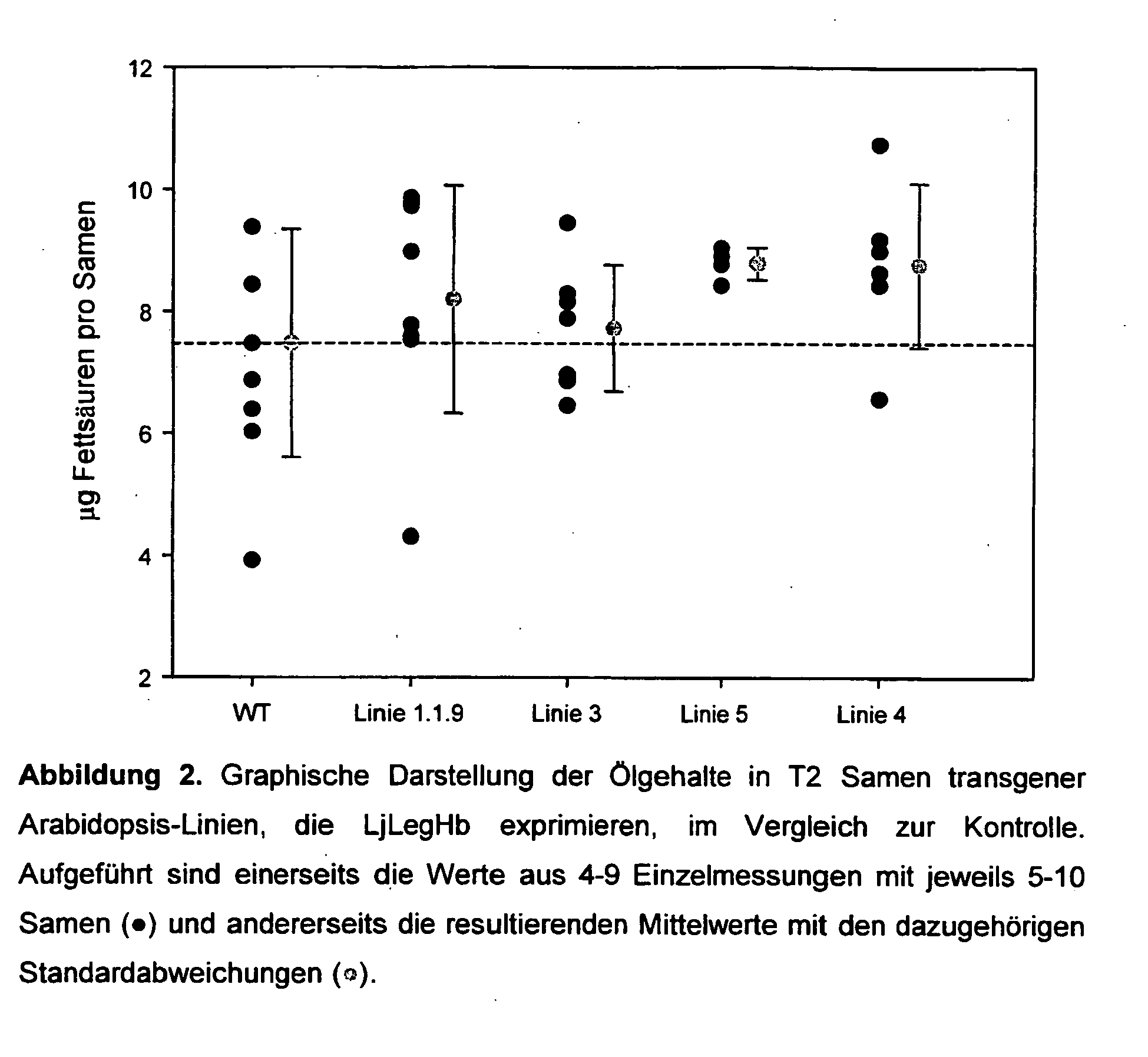

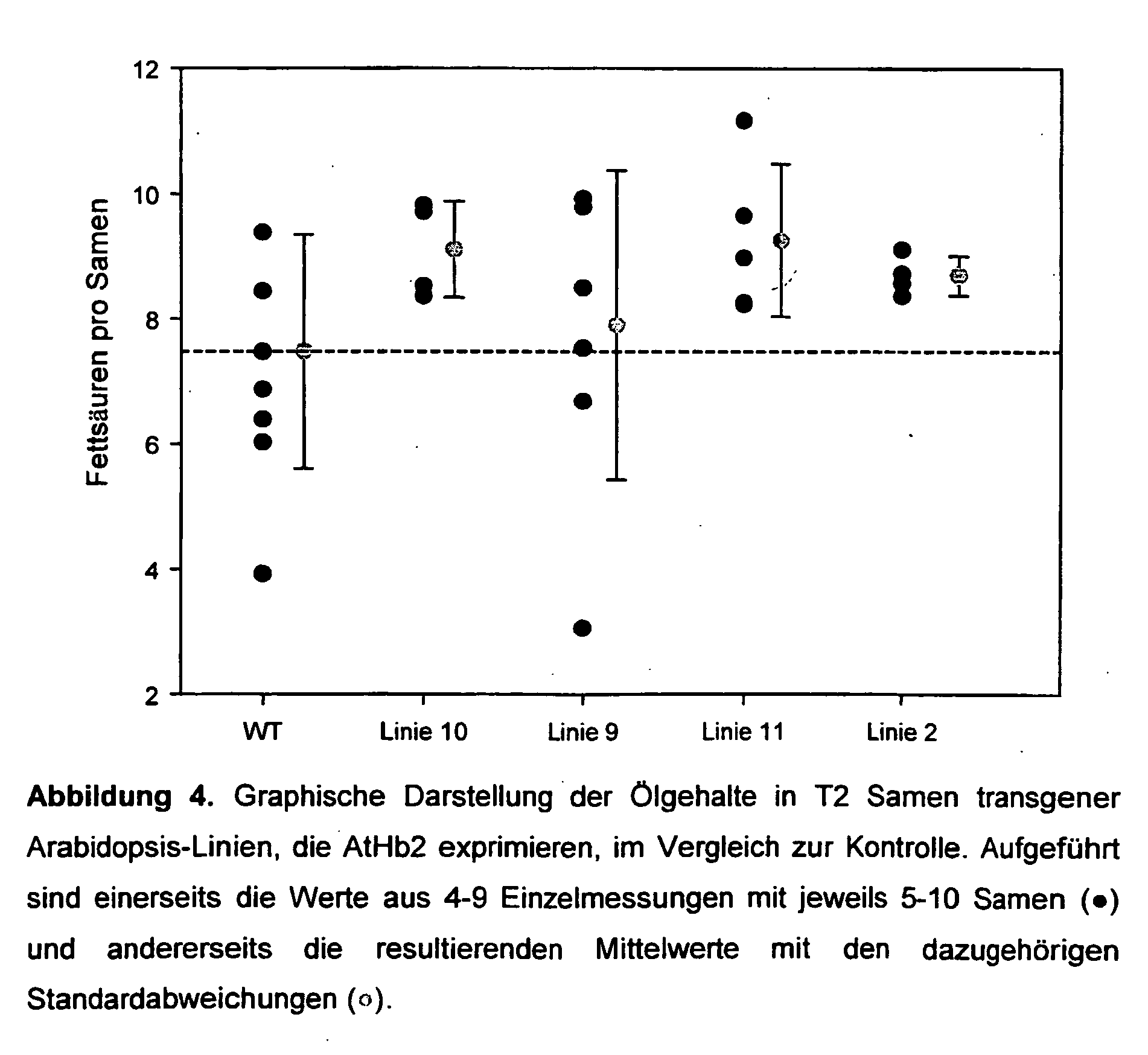

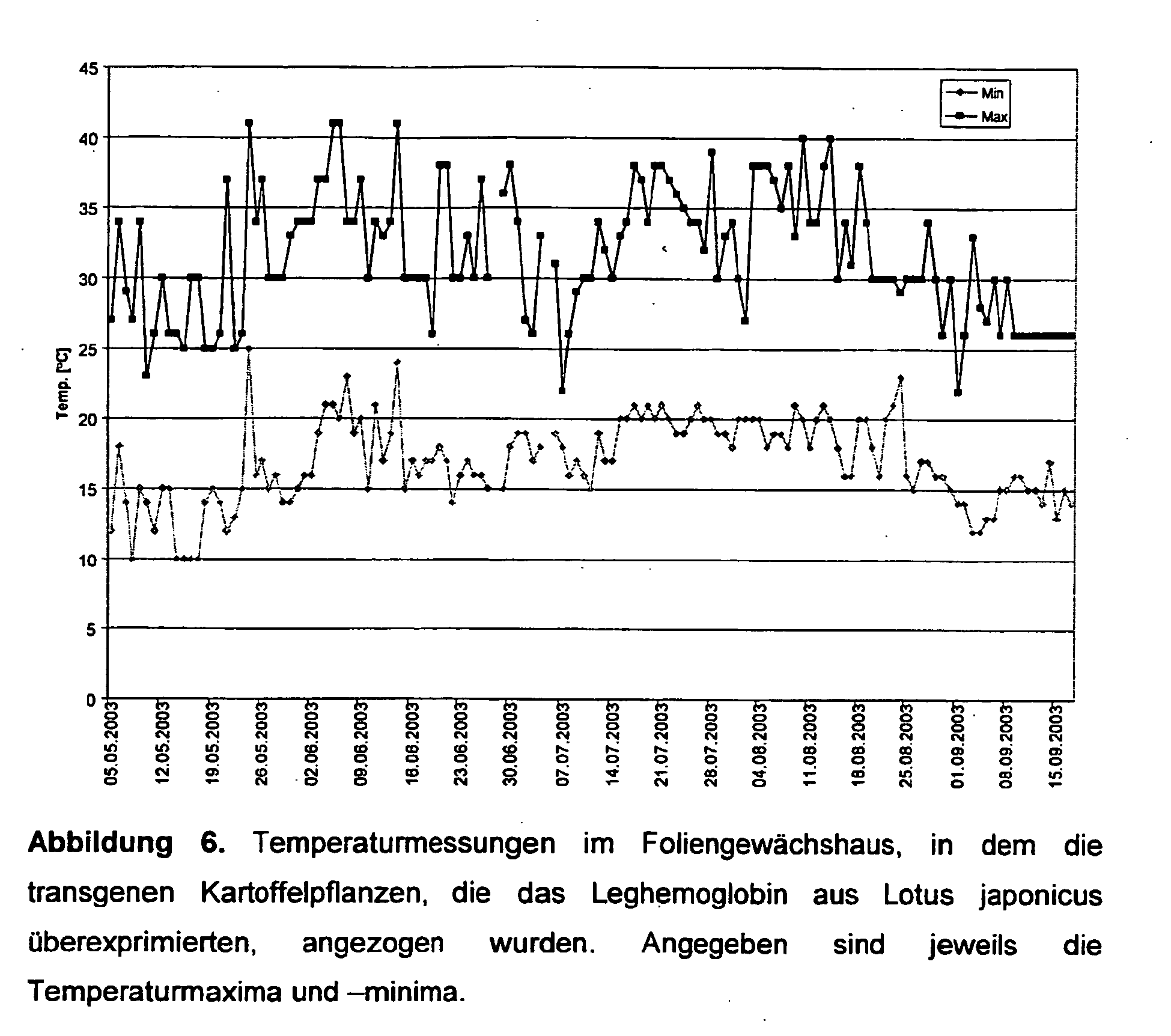
-
- <110> Max-Planck-Gesellschaft
- <120> Verfahren zur Veränderung des Gehalts von Speicherstoffen in
Pflanzen - <130> NAE 737/02 PCT
- <150>
DE 10260707.9
<151> 2002-12-23 - <160> 6
- <170> PatentIn version 3.2
- <210> 1
<211> 444
<212> DNA
<213> Lotus japonicus - <220>
<221> CDS
<222> (1)..(444) - <400> 1

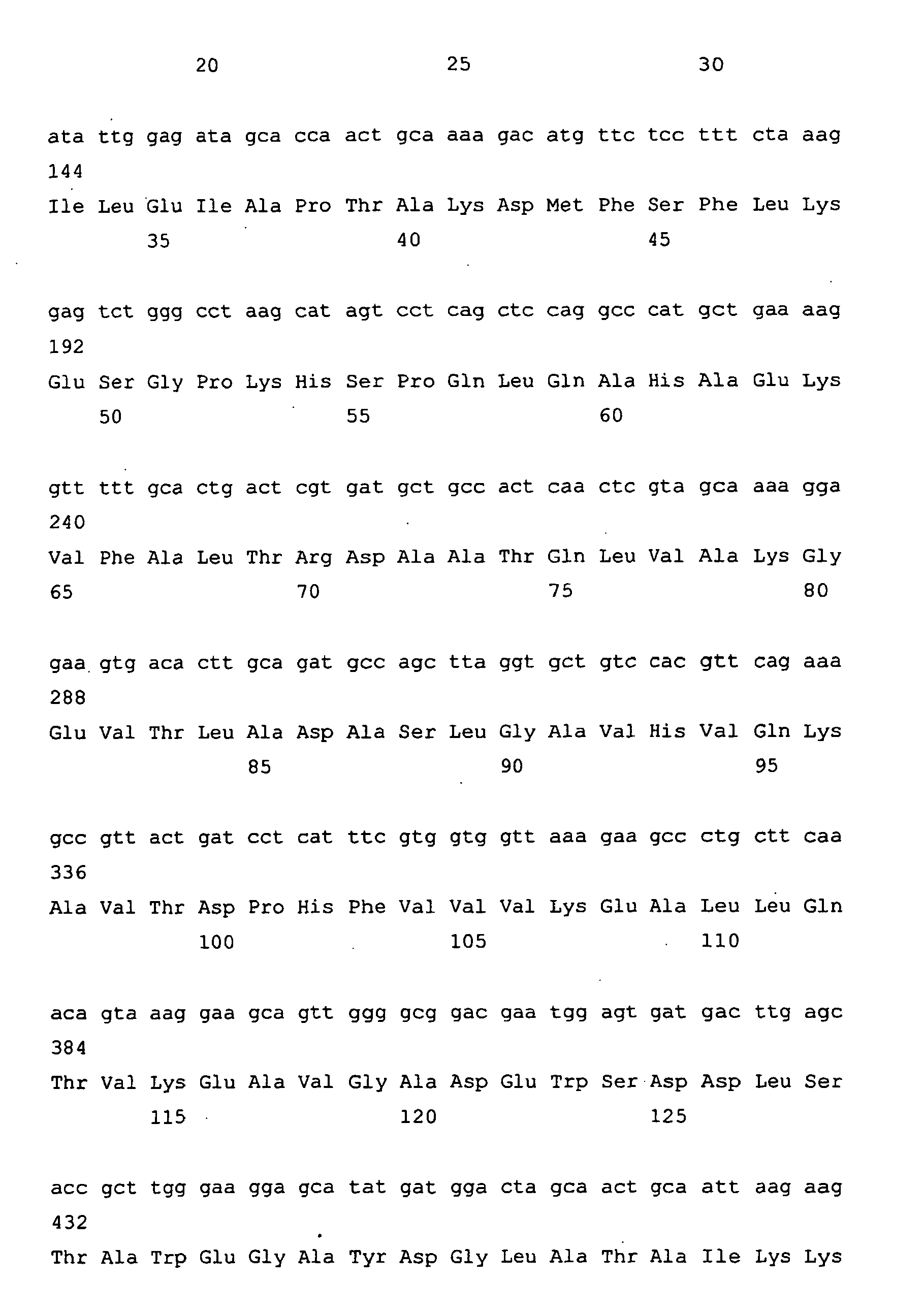
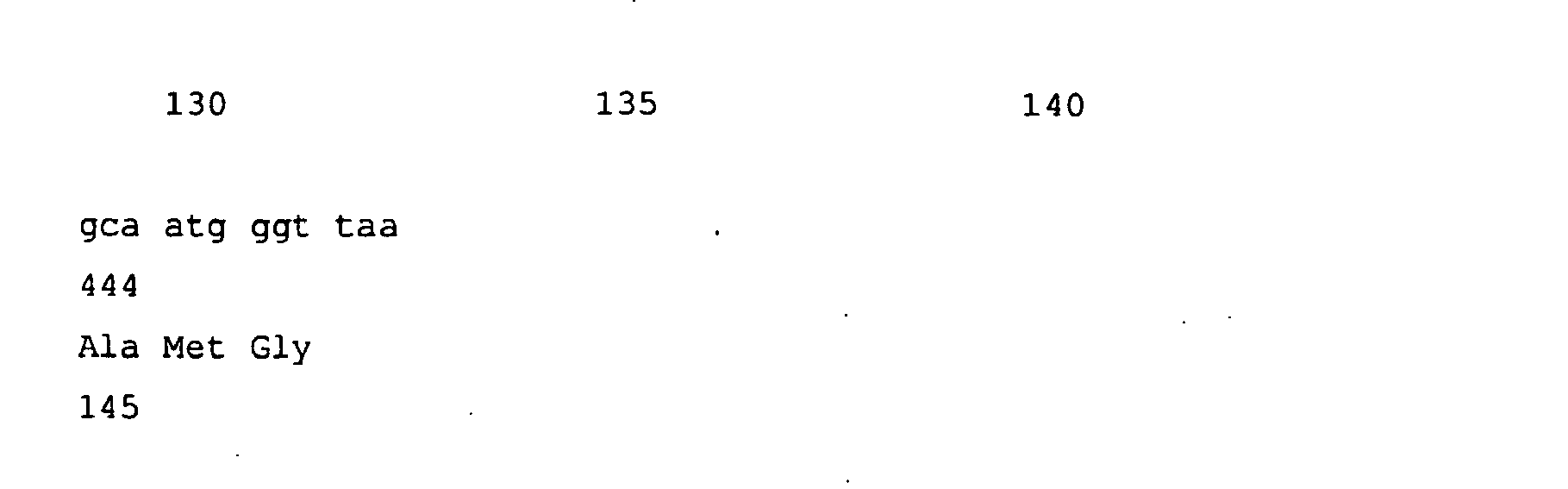
- <210> 2
<211> 147
<212> PRT
<213> Lotus japonicus - <400> 2

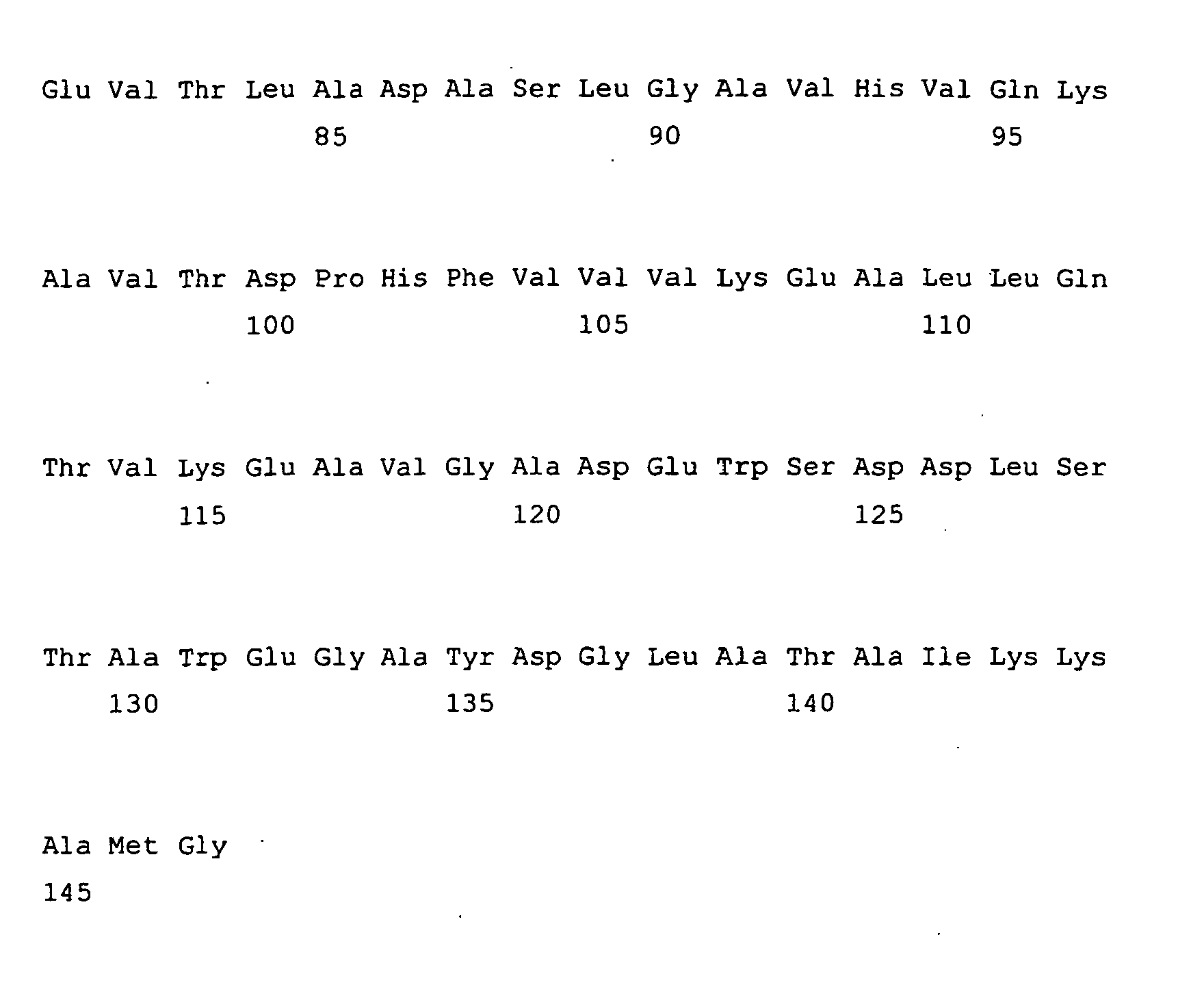
- <210> 3
<211> 483
<212> DNA
<213> Arabidopsis thaliana - <220>
<221> CDS
<222> (1)..(483) - <400> 3



- <210> 4
<211> 160
<212> PRT
<213> Arabidopsis thaliana - <400> 4
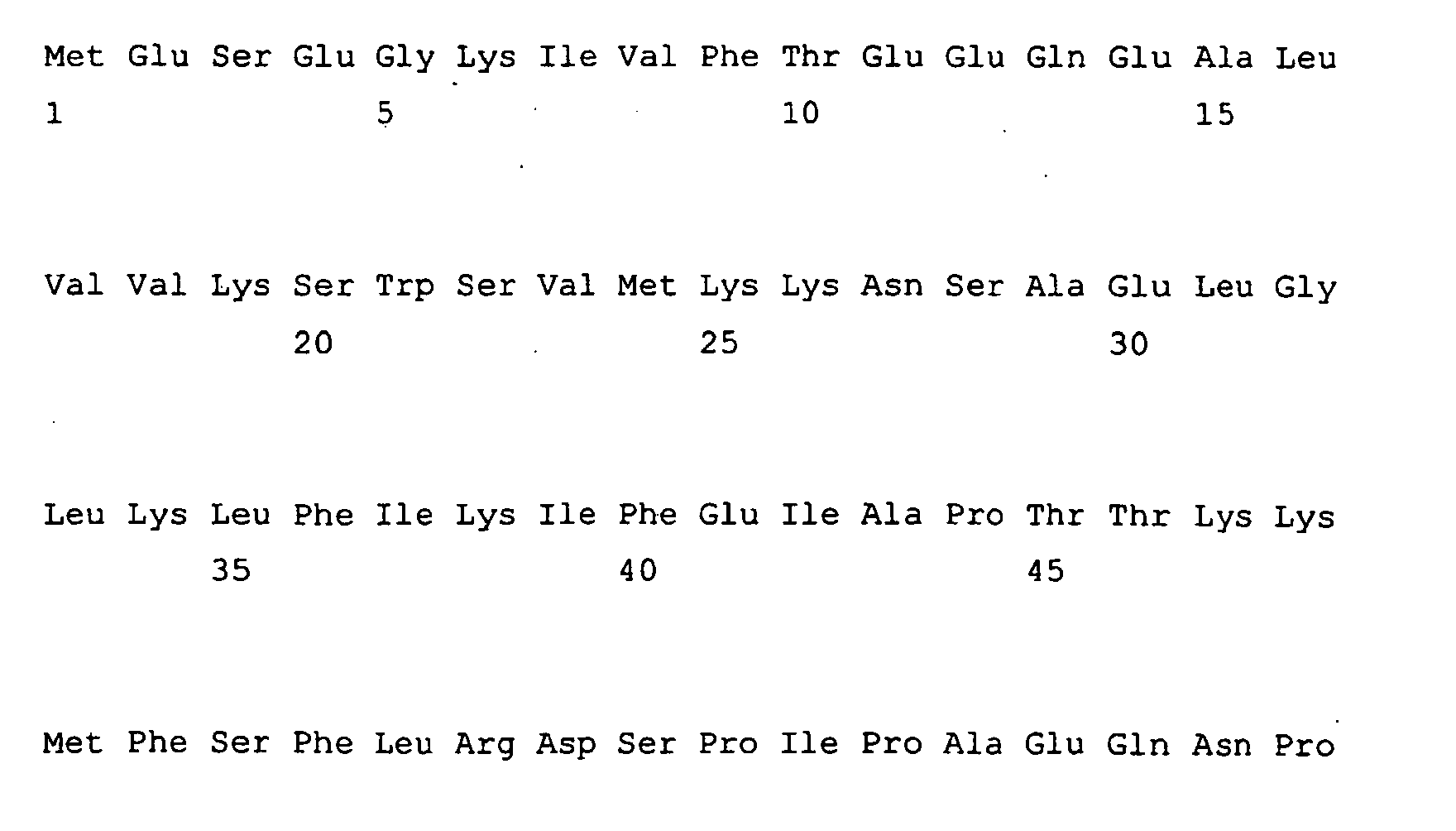

- <210> 5
<211> 477
<212> DNA
<213> Arabidopsis thaliana - <220>
<221> CDS
<222> (1)..(477) - <400> 5


- <210> 6
<211> 158
<212> PRT
<213> Arabidopsis thaliana - <400> 6


Claims (7)
- Verfahren zur Erhöhung des Öl-Gehalts in Pflanzen, dadurch gekennzeichnet, dass Pflanzen mit einem Vektor enthaltend ein Leghemoglobin -oder Hemoglobin-Gen und einen gewebespezifischen Promotor transformiert werden und das eingebrachte Leghemoglobin oder Hemoglobin samenspezifisch überexprimiert wird.
- Verfahren nach Anspruch 1, dadurch gekennzeichnet, dass die Pflanzen transformiert werden mit einem Vektor enthaltend eine Nukleotidsequenz Nr. 1 codierend für ein Leghemoglobin oder eine Nukleotidsequenz Nr. 3 und/oder 5 codierend für Hemoglobin oder eine Leghemoglobin- oder Hemoglobin kodierende Nukleotidsequenzen, die mit einer der Sequenzen Nr. 1, 3 und/oder 5 zu 70 % identisch sind.
- Verfahren nach einem der Ansprüche 1 bis 2, dadurch gekennzeichnet, dass das Leghemoglobin und Hemoglobin aus Pflanzen aus der Gruppe bestehend aus Arabidopsis thaliana, Lupinus luteus, Glycine max, Medicago sativa, Medicago trunculata, Phaseolus vulgaris, Vicia faba, Pisum sativum, Vigna unguiculata, Lotus japonicus, Psophocarpus tetragonolobus, Sesbania rostrata, Casuarina glauca und Canvalaria lineata ausgewählt wird.
- Verfahren nach einem der Ansprüche 1 bis 2, dadurch gekennzeichnet, dass monokotyle Kulturpflanzen, insbesondere der Art Gramineae transformiert werden.
- Verfahren nach einem der vorhergehenden Ansprüche 1 bis 4, dadurch gekennzeichnet, dass dikotyledone Kulturpflanzen, insbesondere der Familie Asteraceae, Brassicacea, Compositae, Cruciferae, Cucurbitaceae, Leguminosae, Rubiaceae, Solanaceae, Sterculiaceae, Theaceae oder Umbelliferae transformiert werden.
- Verfahren nach einem der vorhergehenden Ansprüche 1 bis 5, dadurch gekennzeichnet, dass Arabidopsis thaliana, Soja oder Raps transformiert werden.
- Verwendung einer Pflanze mit samenspezifischer Überexpression von Leghemoglobin oder Hemoglobin aufgrund einer Transformation mit einem Vektor enthaltend ein Leghemoglobin -oder Hemoglobin-Gen und einen gewebespezifischen Promotor zur Produktion von Öl.
Applications Claiming Priority (3)
| Application Number | Priority Date | Filing Date | Title |
|---|---|---|---|
| DE10260707 | 2002-12-23 | ||
| DE10260707 | 2002-12-23 | ||
| PCT/EP2003/014774 WO2004057946A2 (de) | 2002-12-23 | 2003-12-23 | Verfahren zur veränderung des gehalts von speicherstoffen in pflanzen |
Publications (2)
| Publication Number | Publication Date |
|---|---|
| EP1578977A2 EP1578977A2 (de) | 2005-09-28 |
| EP1578977B1 true EP1578977B1 (de) | 2011-08-17 |
Family
ID=32667535
Family Applications (1)
| Application Number | Title | Priority Date | Filing Date |
|---|---|---|---|
| EP03813908A Expired - Lifetime EP1578977B1 (de) | 2002-12-23 | 2003-12-23 | Verfahren zur veränderung des gehalts von speicherstoffen in pflanzen |
Country Status (9)
| Country | Link |
|---|---|
| US (1) | US7807870B2 (de) |
| EP (1) | EP1578977B1 (de) |
| JP (1) | JP2006514547A (de) |
| CN (1) | CN100543142C (de) |
| AT (1) | ATE520781T1 (de) |
| AU (1) | AU2003296714A1 (de) |
| BR (1) | BR0317650A (de) |
| CA (1) | CA2511186A1 (de) |
| WO (1) | WO2004057946A2 (de) |
Families Citing this family (24)
| Publication number | Priority date | Publication date | Assignee | Title |
|---|---|---|---|---|
| EP2204384A1 (de) | 2003-04-01 | 2010-07-07 | CropDesign N.V. | Pflanzenhämoglobin |
| EP1709183B1 (de) * | 2003-12-12 | 2010-05-12 | University of Manitoba | Verfahren zum modifizieren pflanzlicher phänotypen mit nichtsymbiotischem hämoglobin |
| CA2548887C (en) | 2003-12-12 | 2011-07-05 | University Of Manitoba | Method of modifying plant phenotypes with nonsymbiotic hemoglobin |
| BRPI0706227A8 (pt) * | 2006-01-12 | 2019-01-02 | Devgen Nv | métodos baseados em plantas trangênicas para pragas de plantas utilizando rnai |
| WO2007118751A2 (de) * | 2006-04-13 | 2007-10-25 | Max Planck Institut Für Molekulare Pflanzenphysiologie | Verfahren zur veränderung des atp-adp-verhältnisses in zellen |
| EP2049247A2 (de) * | 2006-07-17 | 2009-04-22 | BIOeCON International Holding N.V. | Elektromagnetische behandlung einer modifizierten biomasse |
| US8344205B2 (en) * | 2006-10-13 | 2013-01-01 | Basf Plant Science Gmbh | Plants with increased yield |
| US8148120B2 (en) * | 2007-03-28 | 2012-04-03 | Clemson University Research Foundation | Concentration and separation of lipids from renewable resources |
| JP2010538642A (ja) | 2007-09-12 | 2010-12-16 | マーテック バイオサイエンシーズ コーポレーション | 生物油ならびにその生産および使用 |
| JP5833827B2 (ja) * | 2011-03-10 | 2015-12-16 | トヨタ自動車株式会社 | 植物の油脂生産性を増大させる遺伝子及びその利用方法 |
| US10039306B2 (en) | 2012-03-16 | 2018-08-07 | Impossible Foods Inc. | Methods and compositions for consumables |
| KR102724112B1 (ko) | 2011-07-12 | 2024-10-31 | 임파서블 푸즈 인크. | 소비재를 위한 방법 및 조성물 |
| US20140220217A1 (en) | 2011-07-12 | 2014-08-07 | Maraxi, Inc. | Method and compositions for consumables |
| BR112014000681B1 (pt) | 2011-07-12 | 2020-03-10 | Maraxi, Inc. | Réplica de queijo contendo proteínas de origem vegetal e gorduras derivadas de nozes, leguminosas ou sementes, bactéria, fungo ou alga |
| SI2943072T1 (en) | 2013-01-11 | 2018-07-31 | Impossible Foods Inc. | Methods and compositions for affecting the flavor and aroma profile of consumables |
| BR112015016651A2 (pt) | 2013-01-11 | 2017-07-11 | Impossible Foods Inc | réplica de queijo não láctea compreendendo um coacervado |
| PT3044320T (pt) * | 2013-09-11 | 2020-04-13 | Impossible Foods Inc | Secreção de polipéptidos contendo heme |
| JP6759103B2 (ja) | 2014-03-31 | 2020-09-23 | インポッシブル フーズ インコーポレイテッド | ひき肉レプリカ |
| CN104502475B (zh) * | 2014-12-12 | 2018-12-14 | 山东省花生研究所 | 一种提取和测定花生脂肪酸的简便方法 |
| CN107614516A (zh) | 2015-05-11 | 2018-01-19 | 非凡食品有限公司 | 用于基因工程改造甲基营养型酵母的表达构建体和方法 |
| US10499584B2 (en) | 2016-05-27 | 2019-12-10 | New West Genetics | Industrial hemp Cannabis cultivars and seeds with stable cannabinoid profiles |
| KR20220004090A (ko) | 2019-04-25 | 2022-01-11 | 임파서블 푸즈 인크. | 헴-함유 단백질의 생산을 위한 균주 및 방법 |
| US20220127631A1 (en) | 2020-10-28 | 2022-04-28 | Pioneer Hi-Bred International, Inc. | Leghemoglobin in soybean |
| CN114316031B (zh) * | 2022-01-17 | 2024-04-19 | 杭州瑞丰生物科技有限公司 | 一种生产血红素结合蛋白的方法 |
Family Cites Families (12)
| Publication number | Priority date | Publication date | Assignee | Title |
|---|---|---|---|---|
| US6174724B1 (en) * | 1983-01-17 | 2001-01-16 | Monsanto Company | Chimeric genes suitable for expression in plant cells |
| CN1062018C (zh) * | 1992-04-14 | 2001-02-14 | 复旦大学 | 人血红蛋白(珠蛋白)α1基因和α2基因的检测技术 |
| US5925805A (en) * | 1994-05-24 | 1999-07-20 | Board Of Trustees Operating Michigan State University | Methods of increasing oil content of seeds |
| GB9510927D0 (en) * | 1995-05-31 | 1995-07-26 | Ca Nat Research Council | Plant and seed oil modification |
| US6395964B1 (en) * | 1995-10-24 | 2002-05-28 | The Texas A&M University System | Oral immunization with transgenic plants |
| US5959187A (en) * | 1996-09-26 | 1999-09-28 | Bailey; James E. | Expression of oxygen-binding proteins in plants |
| AUPO776697A0 (en) * | 1997-07-08 | 1997-07-31 | Commonwealth Scientific And Industrial Research Organisation | Method of increasing the iron content of plant cells |
| US6372961B1 (en) * | 1998-08-20 | 2002-04-16 | Pioneer Hi-Bred International, Inc. | Hemoglobin genes and their use |
| US6232526B1 (en) * | 1999-05-14 | 2001-05-15 | Dekalb Genetics Corp. | Maize A3 promoter and methods for use thereof |
| US6552250B1 (en) * | 2000-06-14 | 2003-04-22 | Her Majesty The Queen In Right Of Canada As Represented By The Minister Of Agriculture And Agri-Food | Diacylglycerol O-acyltransferase |
| CA2420555C (en) * | 2000-08-24 | 2012-10-23 | The Scripps Research Institute | Stress-regulated genes of plants, transgenic plants containing same, and methods of use |
| EP2204384A1 (de) | 2003-04-01 | 2010-07-07 | CropDesign N.V. | Pflanzenhämoglobin |
-
2003
- 2003-12-23 BR BR0317650-9A patent/BR0317650A/pt not_active Application Discontinuation
- 2003-12-23 CA CA002511186A patent/CA2511186A1/en not_active Abandoned
- 2003-12-23 CN CNB2003801073527A patent/CN100543142C/zh not_active Expired - Fee Related
- 2003-12-23 AT AT03813908T patent/ATE520781T1/de active
- 2003-12-23 WO PCT/EP2003/014774 patent/WO2004057946A2/de not_active Ceased
- 2003-12-23 AU AU2003296714A patent/AU2003296714A1/en not_active Abandoned
- 2003-12-23 US US10/540,063 patent/US7807870B2/en not_active Expired - Fee Related
- 2003-12-23 EP EP03813908A patent/EP1578977B1/de not_active Expired - Lifetime
- 2003-12-23 JP JP2004562824A patent/JP2006514547A/ja not_active Withdrawn
Also Published As
| Publication number | Publication date |
|---|---|
| JP2006514547A (ja) | 2006-05-11 |
| WO2004057946A3 (de) | 2004-09-02 |
| EP1578977A2 (de) | 2005-09-28 |
| BR0317650A (pt) | 2005-12-06 |
| CA2511186A1 (en) | 2004-07-15 |
| WO2004057946A2 (de) | 2004-07-15 |
| CN100543142C (zh) | 2009-09-23 |
| US20060053515A1 (en) | 2006-03-09 |
| ATE520781T1 (de) | 2011-09-15 |
| CN1732265A (zh) | 2006-02-08 |
| US7807870B2 (en) | 2010-10-05 |
| AU2003296714A1 (en) | 2004-07-22 |
Similar Documents
| Publication | Publication Date | Title |
|---|---|---|
| EP1506289B1 (de) | Verfahren zum erhöhen des ölgehaltes in pflanzen | |
| EP1578977A2 (de) | Verfahren zur veränderung des gehalts von speicherstoffen in pflanzen | |
| EP1487979B1 (de) | Konstrukte und verfahren zur regulation der genexpression | |
| EP2007894A2 (de) | Verfahren zur veränderung des atp-adp-verhältnisses in zellen | |
| AU2003246361B2 (en) | Use of a gene for increasing the oil content in plants | |
| WO1999004021A1 (de) | Dna-sequenz codierend für eine hydroxyphenylpyruvatdioxygenase und deren überproduktion in pflanzen | |
| CN103403169A (zh) | 改变植物中生物化学成分的材料和方法 | |
| EP1212439B1 (de) | Pflanzen mit verändertem aminosäuregehalt und verfahren zu deren herstellung | |
| WO2007051642A1 (de) | Verfahren zur erhöhung des gesamtölgelhaltes in ölpflanzen | |
| WO1998006831A1 (de) | TRANSGENE PFLANZENZELLEN UND PFLANZEN MIT VERÄNDERTER ACETYL-CoA-BILDUNG | |
| WO2003077643A2 (de) | Verfahren zum erhöhen des ölgehaltes in pflanzen indem die menge eines oder mehrerer speicherproteine verringert wird | |
| EP0846180A1 (de) | Transgene pflanzenzellen und pflanzen mit gesteigerter glykolyserate | |
| EP1492872B1 (de) | Expression von phospholipid:diacylglycerin-acyltransferase (pdat) zur herstellung von pflanzlichen speicherlipiden enthaltend mehrfach ungesättigte fettsäuren | |
| DE19632121C2 (de) | Transgene Pflanzenzellen und Pflanzen mit veränderter Acetyl-CoA-Bildung | |
| DE10220753A1 (de) | Verfahren zum Erhöhen des Ölgehaltes in Pflanzen | |
| DE10226413A1 (de) | Verfahren zum Erhöhen des Ölgehaltes in Pflanzen | |
| Tao et al. | Cloning and Functional Analysis of Wri1 Gene in Camellia Oleifera | |
| WO2002103021A2 (de) | Verfahren zur erhöhung des carotinoid-gehalts in transgenen pflanzen | |
| DE10231587A1 (de) | Transgene Expressionskonstrukte und Verfahren zum Erhöhen des Vitamin E-Gehaltes in pflanzlichen Organismen | |
| DE10232483A1 (de) | Transgene Expressionskonstrukte und Verfahren zum Erhöhen des Vitamin E-Gehaltes in pflanzlichen Organismen | |
| EP1135499A1 (de) | Dna-sequenzen kodierend einen glukose-translokator, plasmide, bakterien, hefen und pflanzen enthaltend diesen transporter | |
| DE10231588A1 (de) | Transgene Expressionskonstrukte und Verfahren zum Erhöhen des Vitamin E-Gehaltes in pflanzlichen Organismen |
Legal Events
| Date | Code | Title | Description |
|---|---|---|---|
| PUAI | Public reference made under article 153(3) epc to a published international application that has entered the european phase |
Free format text: ORIGINAL CODE: 0009012 |
|
| 17P | Request for examination filed |
Effective date: 20050725 |
|
| AK | Designated contracting states |
Kind code of ref document: A2 Designated state(s): AT BE BG CH CY CZ DE DK EE ES FI FR GB GR HU IE IT LI LU MC NL PT RO SE SI SK TR |
|
| AX | Request for extension of the european patent |
Extension state: AL LT LV MK |
|
| DAX | Request for extension of the european patent (deleted) | ||
| RAP3 | Party data changed (applicant data changed or rights of an application transferred) |
Owner name: MAX-PLANCK-GESELLSCHAFT ZUR FOERDERUNG DER WISSENS |
|
| GRAP | Despatch of communication of intention to grant a patent |
Free format text: ORIGINAL CODE: EPIDOSNIGR1 |
|
| GRAS | Grant fee paid |
Free format text: ORIGINAL CODE: EPIDOSNIGR3 |
|
| GRAA | (expected) grant |
Free format text: ORIGINAL CODE: 0009210 |
|
| AK | Designated contracting states |
Kind code of ref document: B1 Designated state(s): AT BE BG CH CY CZ DE DK EE ES FI FR GB GR HU IE IT LI LU MC NL PT RO SE SI SK TR |
|
| REG | Reference to a national code |
Ref country code: GB Ref legal event code: FG4D Free format text: NOT ENGLISH |
|
| REG | Reference to a national code |
Ref country code: CH Ref legal event code: EP |
|
| REG | Reference to a national code |
Ref country code: IE Ref legal event code: FG4D Free format text: LANGUAGE OF EP DOCUMENT: GERMAN |
|
| REG | Reference to a national code |
Ref country code: DE Ref legal event code: R096 Ref document number: 50313912 Country of ref document: DE Effective date: 20111020 |
|
| REG | Reference to a national code |
Ref country code: NL Ref legal event code: VDEP Effective date: 20110817 |
|
| PG25 | Lapsed in a contracting state [announced via postgrant information from national office to epo] |
Ref country code: FI Free format text: LAPSE BECAUSE OF FAILURE TO SUBMIT A TRANSLATION OF THE DESCRIPTION OR TO PAY THE FEE WITHIN THE PRESCRIBED TIME-LIMIT Effective date: 20110817 Ref country code: SE Free format text: LAPSE BECAUSE OF FAILURE TO SUBMIT A TRANSLATION OF THE DESCRIPTION OR TO PAY THE FEE WITHIN THE PRESCRIBED TIME-LIMIT Effective date: 20110817 Ref country code: PT Free format text: LAPSE BECAUSE OF FAILURE TO SUBMIT A TRANSLATION OF THE DESCRIPTION OR TO PAY THE FEE WITHIN THE PRESCRIBED TIME-LIMIT Effective date: 20111219 Ref country code: NL Free format text: LAPSE BECAUSE OF FAILURE TO SUBMIT A TRANSLATION OF THE DESCRIPTION OR TO PAY THE FEE WITHIN THE PRESCRIBED TIME-LIMIT Effective date: 20110817 |
|
| PG25 | Lapsed in a contracting state [announced via postgrant information from national office to epo] |
Ref country code: GR Free format text: LAPSE BECAUSE OF FAILURE TO SUBMIT A TRANSLATION OF THE DESCRIPTION OR TO PAY THE FEE WITHIN THE PRESCRIBED TIME-LIMIT Effective date: 20111118 Ref country code: CY Free format text: LAPSE BECAUSE OF FAILURE TO SUBMIT A TRANSLATION OF THE DESCRIPTION OR TO PAY THE FEE WITHIN THE PRESCRIBED TIME-LIMIT Effective date: 20110817 Ref country code: SI Free format text: LAPSE BECAUSE OF FAILURE TO SUBMIT A TRANSLATION OF THE DESCRIPTION OR TO PAY THE FEE WITHIN THE PRESCRIBED TIME-LIMIT Effective date: 20110817 |
|
| REG | Reference to a national code |
Ref country code: IE Ref legal event code: FD4D |
|
| PG25 | Lapsed in a contracting state [announced via postgrant information from national office to epo] |
Ref country code: SK Free format text: LAPSE BECAUSE OF FAILURE TO SUBMIT A TRANSLATION OF THE DESCRIPTION OR TO PAY THE FEE WITHIN THE PRESCRIBED TIME-LIMIT Effective date: 20110817 Ref country code: IE Free format text: LAPSE BECAUSE OF FAILURE TO SUBMIT A TRANSLATION OF THE DESCRIPTION OR TO PAY THE FEE WITHIN THE PRESCRIBED TIME-LIMIT Effective date: 20110817 Ref country code: CZ Free format text: LAPSE BECAUSE OF FAILURE TO SUBMIT A TRANSLATION OF THE DESCRIPTION OR TO PAY THE FEE WITHIN THE PRESCRIBED TIME-LIMIT Effective date: 20110817 |
|
| PG25 | Lapsed in a contracting state [announced via postgrant information from national office to epo] |
Ref country code: IT Free format text: LAPSE BECAUSE OF FAILURE TO SUBMIT A TRANSLATION OF THE DESCRIPTION OR TO PAY THE FEE WITHIN THE PRESCRIBED TIME-LIMIT Effective date: 20110817 Ref country code: EE Free format text: LAPSE BECAUSE OF FAILURE TO SUBMIT A TRANSLATION OF THE DESCRIPTION OR TO PAY THE FEE WITHIN THE PRESCRIBED TIME-LIMIT Effective date: 20110817 Ref country code: RO Free format text: LAPSE BECAUSE OF FAILURE TO SUBMIT A TRANSLATION OF THE DESCRIPTION OR TO PAY THE FEE WITHIN THE PRESCRIBED TIME-LIMIT Effective date: 20110817 |
|
| PLBE | No opposition filed within time limit |
Free format text: ORIGINAL CODE: 0009261 |
|
| STAA | Information on the status of an ep patent application or granted ep patent |
Free format text: STATUS: NO OPPOSITION FILED WITHIN TIME LIMIT |
|
| PG25 | Lapsed in a contracting state [announced via postgrant information from national office to epo] |
Ref country code: DK Free format text: LAPSE BECAUSE OF FAILURE TO SUBMIT A TRANSLATION OF THE DESCRIPTION OR TO PAY THE FEE WITHIN THE PRESCRIBED TIME-LIMIT Effective date: 20110817 |
|
| 26N | No opposition filed |
Effective date: 20120521 |
|
| PG25 | Lapsed in a contracting state [announced via postgrant information from national office to epo] |
Ref country code: MC Free format text: LAPSE BECAUSE OF NON-PAYMENT OF DUE FEES Effective date: 20111231 |
|
| GBPC | Gb: european patent ceased through non-payment of renewal fee |
Effective date: 20111223 |
|
| REG | Reference to a national code |
Ref country code: DE Ref legal event code: R097 Ref document number: 50313912 Country of ref document: DE Effective date: 20120521 |
|
| PG25 | Lapsed in a contracting state [announced via postgrant information from national office to epo] |
Ref country code: GB Free format text: LAPSE BECAUSE OF NON-PAYMENT OF DUE FEES Effective date: 20111223 |
|
| REG | Reference to a national code |
Ref country code: AT Ref legal event code: MM01 Ref document number: 520781 Country of ref document: AT Kind code of ref document: T Effective date: 20111223 |
|
| PG25 | Lapsed in a contracting state [announced via postgrant information from national office to epo] |
Ref country code: ES Free format text: LAPSE BECAUSE OF FAILURE TO SUBMIT A TRANSLATION OF THE DESCRIPTION OR TO PAY THE FEE WITHIN THE PRESCRIBED TIME-LIMIT Effective date: 20111128 |
|
| PGFP | Annual fee paid to national office [announced via postgrant information from national office to epo] |
Ref country code: FR Payment date: 20130124 Year of fee payment: 10 Ref country code: CH Payment date: 20130103 Year of fee payment: 10 Ref country code: DE Payment date: 20130228 Year of fee payment: 10 |
|
| PG25 | Lapsed in a contracting state [announced via postgrant information from national office to epo] |
Ref country code: LU Free format text: LAPSE BECAUSE OF NON-PAYMENT OF DUE FEES Effective date: 20111223 |
|
| PGFP | Annual fee paid to national office [announced via postgrant information from national office to epo] |
Ref country code: BE Payment date: 20130130 Year of fee payment: 10 |
|
| PG25 | Lapsed in a contracting state [announced via postgrant information from national office to epo] |
Ref country code: AT Free format text: LAPSE BECAUSE OF NON-PAYMENT OF DUE FEES Effective date: 20111223 Ref country code: BG Free format text: LAPSE BECAUSE OF FAILURE TO SUBMIT A TRANSLATION OF THE DESCRIPTION OR TO PAY THE FEE WITHIN THE PRESCRIBED TIME-LIMIT Effective date: 20111117 |
|
| PG25 | Lapsed in a contracting state [announced via postgrant information from national office to epo] |
Ref country code: TR Free format text: LAPSE BECAUSE OF FAILURE TO SUBMIT A TRANSLATION OF THE DESCRIPTION OR TO PAY THE FEE WITHIN THE PRESCRIBED TIME-LIMIT Effective date: 20110817 |
|
| PG25 | Lapsed in a contracting state [announced via postgrant information from national office to epo] |
Ref country code: HU Free format text: LAPSE BECAUSE OF FAILURE TO SUBMIT A TRANSLATION OF THE DESCRIPTION OR TO PAY THE FEE WITHIN THE PRESCRIBED TIME-LIMIT Effective date: 20110817 |
|
| BERE | Be: lapsed |
Owner name: MAX-PLANCK-GESELLSCHAFT ZUR FORDERUNG DER WISSENS Effective date: 20131231 |
|
| REG | Reference to a national code |
Ref country code: DE Ref legal event code: R119 Ref document number: 50313912 Country of ref document: DE |
|
| REG | Reference to a national code |
Ref country code: CH Ref legal event code: PL |
|
| REG | Reference to a national code |
Ref country code: DE Ref legal event code: R119 Ref document number: 50313912 Country of ref document: DE Effective date: 20140701 |
|
| REG | Reference to a national code |
Ref country code: FR Ref legal event code: ST Effective date: 20140829 |
|
| PG25 | Lapsed in a contracting state [announced via postgrant information from national office to epo] |
Ref country code: BE Free format text: LAPSE BECAUSE OF NON-PAYMENT OF DUE FEES Effective date: 20131231 Ref country code: DE Free format text: LAPSE BECAUSE OF NON-PAYMENT OF DUE FEES Effective date: 20140701 Ref country code: CH Free format text: LAPSE BECAUSE OF NON-PAYMENT OF DUE FEES Effective date: 20131231 Ref country code: LI Free format text: LAPSE BECAUSE OF NON-PAYMENT OF DUE FEES Effective date: 20131231 |
|
| PG25 | Lapsed in a contracting state [announced via postgrant information from national office to epo] |
Ref country code: FR Free format text: LAPSE BECAUSE OF NON-PAYMENT OF DUE FEES Effective date: 20131231 |