EP1577271A2 - Schubvorrichtung zur Überführung von Glasartikeln von einer Station einer IS-Glasmaschine auf ein Fördermittel - Google Patents
Schubvorrichtung zur Überführung von Glasartikeln von einer Station einer IS-Glasmaschine auf ein Fördermittel Download PDFInfo
- Publication number
- EP1577271A2 EP1577271A2 EP05000216A EP05000216A EP1577271A2 EP 1577271 A2 EP1577271 A2 EP 1577271A2 EP 05000216 A EP05000216 A EP 05000216A EP 05000216 A EP05000216 A EP 05000216A EP 1577271 A2 EP1577271 A2 EP 1577271A2
- Authority
- EP
- European Patent Office
- Prior art keywords
- drive
- drive stage
- electric motor
- pusher
- pusher according
- Prior art date
- Legal status (The legal status is an assumption and is not a legal conclusion. Google has not performed a legal analysis and makes no representation as to the accuracy of the status listed.)
- Granted
Links
- 239000011521 glass Substances 0.000 title claims abstract description 42
- 238000006073 displacement reaction Methods 0.000 claims description 10
- 230000006978 adaptation Effects 0.000 description 1
- 230000007257 malfunction Effects 0.000 description 1
- 238000004519 manufacturing process Methods 0.000 description 1
- 238000000034 method Methods 0.000 description 1
- 230000001360 synchronised effect Effects 0.000 description 1
- 230000007704 transition Effects 0.000 description 1
- 238000011144 upstream manufacturing Methods 0.000 description 1
Images


Classifications
-
- C—CHEMISTRY; METALLURGY
- C03—GLASS; MINERAL OR SLAG WOOL
- C03B—MANUFACTURE, SHAPING, OR SUPPLEMENTARY PROCESSES
- C03B9/00—Blowing glass; Production of hollow glass articles
- C03B9/30—Details of blowing glass; Use of materials for the moulds
- C03B9/44—Means for discharging combined with glass-blowing machines, e.g. take-outs
- C03B9/453—Means for pushing newly formed glass articles onto a conveyor, e.g. sweep-out mechanisms; Dead-plate mechanisms
Definitions
- the invention relates to a pushing device for Transfer of glass articles from a station of an IS glass machine on a grant, with a shift member, that can be brought into contact with the glassware to be transferred and by means of which the glass articles from the station onto the conveyor are adjustable, adjusting directly with the Displacement member are connected, and a drive device, by means of the sliding member on the actuators is drivable.
- the glass articles having a temperature of 600 up to 700 degrees C, it comes due to lack of synchronization between the movement of the pusher and the movement of the glass article receiving conveyor comparatively often causes the glassware to be damaged become. This will undesirably the In addition, due to possibly destroyed Glassware malfunctions occur in the operation can.
- the invention is based on the object, a pusher for the transfer of glass articles from a station of a IS glass machine on a conveyor of the initially described Way of creating, their movement more or less is synchronous with respect to the funding and thus one safe transport of glassware from the station concerned the IS glass machine ensures the conveyor.
- the Drive device a first drive stage, by means of which directly connected to the shift member actuators are drivable, and has a second drive stage, the is arranged next to the first drive stage and by means of one directly connected to the scroll member Operating parts holding carrier is driven.
- Operation of the both the drive device of the thrust device according to the invention forming drive stages can thus be coordinated Be that sliding movement of the glassware is realized on the funding in a manner in which the glass article already in its transition to the funding more or less with the speed of the conveyor moves. Damage of several at the same time on the conveyor belt shifted glass articles can in the case the thrust device according to the invention as far as possible excluded become. This is a trouble-free operation the IS glass machine and the upstream and downstream systems allows.
- the gearless with a drive member the directly associated with the displacement member Control parts is connected. This can ensure that the drive power of the electric motor exactly in the Movement of the displacement member is implemented.
- the second drive stage advantageously a Have electric motor, the gearless with a drive member the carrier is connected, with analogous advantages result.
- Pusher are held on the carrier Control parts of the displacement member by means of the first drive stage during the transfer of a glass article from the station to the conveyor continuously in one direction rotatable and is the carrier by means of the second drive stage during the transfer of a glass article from the station to the funding in a first phase of movement in one Direction and in a second phase of movement into the other, opposite direction rotatable or pivotable, the Rotation of the controls and the rotation or pivoting of the Carrier during the two phases of movement of each other overlap.
- An output shaft of the electric motor of the first drive stage is expediently coaxial in one by means of the electric motor the second drive stage driven hollow shaft arranged rotatable with respect to this hollow shaft and it stands at the electric motor remote end face through this before, wherein they rotatably at their so-protruding end with a the Drive member of directly connected to the sliding member Operating parts forming drive gear is connected.
- the carrier may advantageously be a housing for the drive gear the first drive stage, the timing belt and the at least train two output gears.
- An output shaft of the electric motor of the second drive stage is expediently correspondingly rotationally fixed with a drive gear connected by means of a toothed belt in drive connection with a non-rotatably seated on the hollow shaft Output gear is.
- the hollow shaft in turn is advantageous eccentric and rotatably connected to the carrier, said means of the Hollow shaft according to the direction of rotation of the output shaft of Electric motor of the second drive stage in one or the other direction is pivotable.
- the two drive stages are common to them Housing arranged, both drive stages both in their axial as well as in their radial direction the same Dimensions may have.
- the thrust device according to the invention is available on existing IS glass machines universally mountable, both as left (LH) as well as right (RH) embodiment shapable is.
- the control unit of the pusher according to the invention is advantageously directly into a control device of the IS glass machine integrable such that speed or clock changes of the IS glass machine directly and automatically in corresponding adjustments and changes of the Movement of the pusher result, the Adaptation or change of the movement through appropriate Intervention in the control of the first and the second Drive stage of the drive device can be realized.
- the pusher an electronic torque limit for the first and / or the second drive stage.
- control unit of inventive push device as input elements touch screens exhibit.
- a pushing device 1 serves glass articles, which are 600 to 700 degrees C hot, out of a station an IS glass machine to a conveyor, e.g. a conveyor belt, by which the glassware of the relevant station of the IS glass machine are removed.
- To the pusher 1 includes a sliding member 2 with Thrust fingers 3, which, as best seen in FIG. 1, bent and split can be trained to better To gain access to the glassware to be moved can.
- Thrust fingers 3 which, as best seen in FIG. 1, bent and split can be trained to better To gain access to the glassware to be moved can.
- adjustable fixing 4 By means of adjustable fixing 4, the Displacement member 2 having different dimensions, be adapted to be moved glass articles.
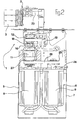
- the two drive stages 5, 6 are common to them Housing 7 arranged side by side.
- the dimensions of the Both drive stages 5, 6 and the two as servomotors trained electric motors 8, 9 of the two drive stages 5, 6 correspond to each other in the radial and axial directions.
- the servomotor 8 of the first drive stage 5, which is shown in FIG. 2 is arranged left in the housing 7, has an output shaft 10, one with the second drive stage 6 in drive connection located hollow shaft 11 in the axial direction at the The distal end is surmounted and rotatable in relation to the hollow shaft 11 is arranged.
- a drive gear 12 which in the embodiment shown in Figures 1 to 3 the pushing device 1 via a toothed belt 13 with output gears 14 and 15 in drive connection stands.
- Each of the two driven gears 14, 15 is non-rotatable with a shaft journal 17 and 18 connected.
- Each of the two Shaft 17, 18 has a crank arm 19 and 20, respectively the rotation of the shaft journal 17, 18 a pouring movement performs.
- the two crank arms 19, 20 are at their shaft journal distal ends provided with pivots 21, the rotatably support corresponding bearing sleeves 22 of actuating arms 23, firmly with the sliding member 2 and thus the push fingers 3 are connected.
- the second drive stage 6 of the drive device 5 To generate the pivoting movement of the carrier 16 is the second drive stage 6 of the drive device 5, 6.
- An output shaft 24 of the electric motor 9 of the second drive stage 6 carries at its free end a drive gear 25, the over a toothed belt 26 with a driven gear 27 in drive connection stands, rotatably on the of the output shaft 10 of the electric motor 8 of the first drive stage penetrated Hollow shaft 11 is seated.
- the hollow shaft 11 is thus by means of second drive stage 6 can be acted upon by a rotational movement.
- the hollow shaft 11 At its end opposite to the output gear 27 end is the hollow shaft 11 rotatably connected to the carrier 16.
- the Hollow shaft 11 is arranged eccentrically with respect to the carrier 16, so that by means of a rotation of the hollow shaft 11 in the a direction of the carrier 16 in a corresponding direction is pivotable, wherein a rotation of the hollow shaft 11 in the another direction, a pivoting of the carrier 16 in the corresponding has opposite direction result.
- the carrier 16 is by means of the second drive stage of the drive device first about 90 degrees in one direction pivoted, and then 90 degrees in the other direction swiveled until it returns to its original position.
- the pivoting of the carrier 16 in one direction begins about the moment when the thrust fingers 3 of the Sliding member 2 in contact with the glass articles to be moved devices.
- the pivotal movement of the carrier 16 in the other, opposite direction takes place when the shear fingers of the sliding member 2 after moving the glassware on the conveyor belt out of contact with the glassware are.
- the above-described pusher 1 is present on IS glass machines universally mountable.
- the pusher can be used for all modes of production (SG, DG, TG) and all Center distances (4.25 “, 5", 5.5 “, 6", 6.25 ") used become.
- the same pusher 1 is for LH and RH versions used.
- the pusher 1 includes a control unit directly integrated into a control device of the IS glass machine is. This makes it possible that on the IS glass machine made speed or clock changes immediately and automatically in appropriate adjustments and changes in the movement of the pusher 1 or the operation of the two drive stages 5, 6 thereof be implemented. For reasons of operational safety is the Control unit of the pusher 1 with an electronic Torque limiting for the drive means 5, 6 provided.
- the control unit is further assigned a touch screen, by means of a user-friendly operation of the control unit is possible.
Landscapes
- Engineering & Computer Science (AREA)
- Chemical & Material Sciences (AREA)
- Manufacturing & Machinery (AREA)
- Materials Engineering (AREA)
- Organic Chemistry (AREA)
- Special Conveying (AREA)
Abstract
Description
- Figur 1
- eine perspektivische Darstellung einer Ausführungsform der erfindungsgemäßen Schubvorrichtung zur Überführung von Glasartikeln von einer Station einer IS-Glasmaschine auf ein Fördermittel;
- Figur 2
- einen Längsschnitt durch die in Figur 1 gezeigte Ausführungsform der erfindungsgemäßen Schubvorrichtung; und
- Figur 3
- einen Querschnitt durch die in Figur 1 gezeigte Ausführungsform der erfindungsgemäßen Schubvorrichtung.
Claims (17)
- Schubvorrichtung zur Überführung von Glasartikeln von einer Station einer IS-Glasmaschine auf ein Fördermittel, mit einem Verschiebeglied (2), das in Anlage an die zu überführenden Glasartikel bringbar und mittels dem die Glasartikel von der Station auf das Fördermittel stellbar sind, Stellteilen (17 bis 23), die unmittelbar mit dem Verschiebeglied (2) verbunden sind, und einer Antriebsvorrichtung (5, 6), mittels der das Verschiebeglied (2) über die Stellteile (17 bis 23) antreibbar ist, dadurch gekennzeichnet, dass die Antriebsvorrichtung (5, 6) eine erste Antriebsstufe (5), mittels der die unmittelbar mit dem Verschiebeglied (2) verbundenen Stellteile (17 bis 23) antreibbar sind, und eine zweite Antriebsstufe (6) aufweist, die neben der ersten Antriebstufe (5) angeordnet ist und mittels der ein die unmittelbar mit dem Verschiebeglied (2) verbundenen Stellteile (17 bis 23) halternder Träger (16) antreibbar ist.
- Schubvorrichtung nach Anspruch 1, deren erste Antriebsstufe (5) einen Elektromotor (8) aufweist, der getriebelos mit einem Antriebsglied (12) der unmittelbar mit dem Verschiebeglied (2) verbundenen Stellteile (17 bis 23) verbunden ist.
- Schubvorrichtung nach Anspruch 1 oder 2, deren zweite Antriebsstufe (6) einen Elektromotor (9) aufweist, der getriebelos mit einem Antriebsglied (25) des Trägers (16) verbunden ist.
- Schubvorrichtung nach Anspruch 2 oder 3, bei der der Elektromotor (8) der ersten Antriebsstufe (5) und/oder der Elektromotor (9) der zweiten Antriebsstufe (6) als Servomotor bzw. -motoren (8, 9) ausgebildet ist bzw. sind.
- Schubvorrichtung nach einem der Ansprüche 1 bis 4, bei der die am Träger (16) gehalterten Stellteile (17 bis 23) des Verschiebeglieds (2) mittels der ersten Antriebsstufe (5) während der Überführung eines Glasartikels von der Station zum Fördermittel kontinuierlich in eine Richtung drehbar sind und der Träger (16) mittels der zweiten Antriebsstufe (6) während der Überführung eines Glasartikels von der Station zum Fördermittel in einer ersten Bewegungsphase in die eine Richtung und in einer zweiten Bewegungsphase in die andere, entgegengesetzte Richtung dreh- bzw. schwenkbar ist, wobei die Drehung der Stellteile (17 bis 23) und die Drehung des Trägers (16) während der beiden Bewegungsphasen desselben einander überlagern.
- Schubvorrichtung nach einem der Ansprüche 3 bis 5, bei der eine Abgangswelle (10) des Elektromotors (8) der ersten Antriebsstufe (5) koaxial in einer mittels des Elektromotors (9) der zweiten Antriebsstufe (6) angetriebenen Hohlwelle (11) angeordnet ist, in Bezug auf die Hohlwelle (11) rotierbar ist, an deren elektromotorfernen Stirnseite durch diese vorsteht und drehfest mit einem das Antriebsglied (12) der unmittelbar mit dem Verschiebeglied (2) verbundenen Stellteile (17 bis 23) bildenden Antriebszahnrad (12) verbunden ist.
- Schubvorrichtung nach Anspruch 6, bei der das drehfest mit der Abgangswelle (10) des Elektromotors (8) der ersten Antriebsstufe (5) verbundene Antriebszahnrad (12) mittels eines Zahnriemens (13) zumindest zwei Abtriebszahnräder (14, 15) antreibt, von denen jedes drehfest mit einem mittels eines Kurbelarms (19, 20) mit dem Verschiebeglied (2) verbundenen Wellenzapfen (17, 18) verbunden ist.
- Schubvorrichtung nach Anspruch 7, bei der der Träger (16) ein Gehäuse für das Antriebszahnrad (12) der ersten Antriebsstufe (5), den Zahnriemen (13) und die zumindest zwei Abtriebszahnräder (14, 15) ausbildet.
- Schubvorrichtung nach einem der Ansprüche 6 bis 8, bei der eine Abgangswelle (24) des Elektromotors (9) der zweiten Antriebsstufe (6) drehfest ein Antriebszahnrad (25) trägt, das mittels eines Zahnriemens (26) in Antriebsverbindung mit einem drehfest auf der Hohlwelle (11) sitzenden Abtriebszahnrad (27) ist.
- Schubvorrichtung nach einem der Ansprüche 6 bis 9, bei der die Hohlwelle (11) exzentrisch und drehfest mit dem Träger (16) verbunden und dieser mittels der Hohlwelle (11) entsprechend der Drehrichtung der Abgangswelle (24) des Elektromotors (9) der zweiten Antriebsstufe (6) in die eine bzw. die andere Richtung schwenkbar ist.
- Schubvorrichtung nach einem der Ansprüche 1 bis 10, deren beide Antriebsstufen (5, 6) in einem ihnen gemeinsamen Gehäuse (7) angeordnet sind.
- Schubvorrichtung nach einem der Ansprüche 1 bis 11, deren beide Antriebsstufen (5, 6) in ihrer Axial- und/oder Radialrichtung dieselben Abmessungen aufweisen.
- Schubvorrichtung nach einem der Ansprüche 1 bis 12, die an vorhandene IS-Glasmaschinen universell montierbar ist.
- Schubvorrichtung nach einem der Ansprüche 1 bis 13, die als linke und rechte Ausführungsform gestaltbar ist.
- Schubvorrichtung nach einem der Ansprüche 1 bis 14, deren Steuereinheit direkt in eine Steuerungsvorrichtung der IS-Glasmaschine integrierbar ist, derart, dass Geschwindigkeits- bzw. Taktänderungen der IS-Glasmaschine unmittelbar und automatisch in dementsprechende Anpassungen und Änderungen des Bewegungsablaufs der Schubvorrichtung (1) resultieren.
- Schubvorrichtung nach einem der Ansprüche 1 bis 15, die eine elektronische Drehkraftbegrenzung für die erste (5) und/oder die zweite Antriebsstufe (6) aufweist.
- Schubvorrichtung nach einem der Ansprüche 1 bis 16, deren Steuereinheit als Eingabeelemente Touch-Screens aufweist.
Applications Claiming Priority (2)
| Application Number | Priority Date | Filing Date | Title |
|---|---|---|---|
| DE200410013518 DE102004013518B4 (de) | 2004-03-19 | 2004-03-19 | Schubvorrichtung zur Überführung von Glasartikeln von einer Station einer IS-Glasmaschine auf ein Fördermittel |
| DE102004013518 | 2004-03-19 |
Publications (3)
| Publication Number | Publication Date |
|---|---|
| EP1577271A2 true EP1577271A2 (de) | 2005-09-21 |
| EP1577271A3 EP1577271A3 (de) | 2006-01-11 |
| EP1577271B1 EP1577271B1 (de) | 2013-04-10 |
Family
ID=34833193
Family Applications (1)
| Application Number | Title | Priority Date | Filing Date |
|---|---|---|---|
| EP20050000216 Expired - Lifetime EP1577271B1 (de) | 2004-03-19 | 2005-01-07 | Schubvorrichtung zur Überführung von Glasartikeln von einer Station einer IS-Glasmaschine auf ein Fördermittel |
Country Status (2)
| Country | Link |
|---|---|
| EP (1) | EP1577271B1 (de) |
| DE (1) | DE102004013518B4 (de) |
Cited By (4)
| Publication number | Priority date | Publication date | Assignee | Title |
|---|---|---|---|---|
| EP1627859A1 (de) * | 2004-08-18 | 2006-02-22 | BOTTERO S.p.A. | Vorschubvorrichtung zum Vorschieben von Glaswaren |
| EP1627858A1 (de) * | 2004-08-18 | 2006-02-22 | BOTTERO S.p.A. | Vorschubvorrichtung zum Vorschieben von Glaswaren |
| RU2435737C2 (ru) * | 2006-02-10 | 2011-12-10 | Эмхарт Гласс С.А. | Выталкивающий механизм для машины с отдельными секциями |
| GB2637293A (en) * | 2023-12-21 | 2025-07-23 | Anglo Carbon & Contacts Ltd | Article handling apparatus |
Citations (3)
| Publication number | Priority date | Publication date | Assignee | Title |
|---|---|---|---|---|
| CZ304796A3 (cs) | 1996-10-17 | 1998-06-17 | Sklostroj-Sklářské Strojírny Turnov S. R. O. | Mechanizmus odstávky sklářského tvarovacího stroje |
| US20050193773A1 (en) | 2004-03-03 | 2005-09-08 | Heye International Gmbh | Process and device for pushing hollow glass objects from a glass forming machine onto a conveyor belt |
| US20050199011A1 (en) | 2004-03-12 | 2005-09-15 | Heye International Gmbh | Device for transferring hollow glass objects from a glass-forming machine onto a conveyor belt |
Family Cites Families (8)
| Publication number | Priority date | Publication date | Assignee | Title |
|---|---|---|---|---|
| JPS63139022A (ja) * | 1986-11-29 | 1988-06-10 | Nippon Taisanbin Kogyo Kk | 製壜機のプツシヤ−装置 |
| GB9023103D0 (en) * | 1990-10-24 | 1990-12-05 | Emhart Ind | Push out device for a glassware forming machine |
| DE4231454C2 (de) * | 1992-09-19 | 1995-06-22 | Gps Glasprod Serv Gmbh | Abgabestation für eine IS-Glasformmaschine |
| ES2097687B1 (es) * | 1993-07-05 | 1998-03-16 | Avacon Sa | Sacador de botellas perfeccionado para maquinas de moldeo de vidrio hueco. |
| DE19500787C1 (de) * | 1995-01-13 | 1995-11-23 | Heye Hermann Fa | Glasformmaschine |
| US5818190A (en) * | 1997-05-16 | 1998-10-06 | Emhart Glass Machinery Investments Inc. | Programmable electronic clutch for I.S. machine |
| DE29902149U1 (de) * | 1999-02-06 | 1999-08-05 | Fa. Hermann Heye, 31683 Obernkirchen | Vorrichtung zum Überschieben hohler Glasgegenstände auf ein Transportband |
| CZ296596B6 (cs) * | 2004-03-02 | 2006-04-12 | Sklostroj Turnov Cz, S. R. O. | Mechanizmus odstávky sklárského tvarovacího stroje |
-
2004
- 2004-03-19 DE DE200410013518 patent/DE102004013518B4/de not_active Expired - Fee Related
-
2005
- 2005-01-07 EP EP20050000216 patent/EP1577271B1/de not_active Expired - Lifetime
Patent Citations (3)
| Publication number | Priority date | Publication date | Assignee | Title |
|---|---|---|---|---|
| CZ304796A3 (cs) | 1996-10-17 | 1998-06-17 | Sklostroj-Sklářské Strojírny Turnov S. R. O. | Mechanizmus odstávky sklářského tvarovacího stroje |
| US20050193773A1 (en) | 2004-03-03 | 2005-09-08 | Heye International Gmbh | Process and device for pushing hollow glass objects from a glass forming machine onto a conveyor belt |
| US20050199011A1 (en) | 2004-03-12 | 2005-09-15 | Heye International Gmbh | Device for transferring hollow glass objects from a glass-forming machine onto a conveyor belt |
Cited By (6)
| Publication number | Priority date | Publication date | Assignee | Title |
|---|---|---|---|---|
| EP1627859A1 (de) * | 2004-08-18 | 2006-02-22 | BOTTERO S.p.A. | Vorschubvorrichtung zum Vorschieben von Glaswaren |
| EP1627858A1 (de) * | 2004-08-18 | 2006-02-22 | BOTTERO S.p.A. | Vorschubvorrichtung zum Vorschieben von Glaswaren |
| US7264108B2 (en) | 2004-08-18 | 2007-09-04 | Bottero S.P.A. | Transfer unit for transferring glass articles |
| US7325668B2 (en) | 2004-08-18 | 2008-02-05 | Bottero S.P.A. | Transfer unit for transferring glass articles |
| RU2435737C2 (ru) * | 2006-02-10 | 2011-12-10 | Эмхарт Гласс С.А. | Выталкивающий механизм для машины с отдельными секциями |
| GB2637293A (en) * | 2023-12-21 | 2025-07-23 | Anglo Carbon & Contacts Ltd | Article handling apparatus |
Also Published As
| Publication number | Publication date |
|---|---|
| DE102004013518A1 (de) | 2005-10-13 |
| EP1577271B1 (de) | 2013-04-10 |
| DE102004013518B4 (de) | 2006-06-14 |
| EP1577271A3 (de) | 2006-01-11 |
Similar Documents
| Publication | Publication Date | Title |
|---|---|---|
| DE2727101C3 (de) | Vorrichtung zum synchronen Verschwenken von Paneelen für insbesondere Solarzellen | |
| DE602005000347T2 (de) | Kraftübertragungsvorrichtung und diese enthaltendes Zufuhrgerät für plattenförmiges Material | |
| DE2526599A1 (de) | Verfahren und vorrichtung zum positionieren mehrerer werkzeugkoepfe o.dgl. | |
| DE3831412A1 (de) | Vorrichtung zum falten eines pappbogens oder dergleichen | |
| DE3526846C2 (de) | ||
| EP1577271B1 (de) | Schubvorrichtung zur Überführung von Glasartikeln von einer Station einer IS-Glasmaschine auf ein Fördermittel | |
| DE102009006044B4 (de) | Handhabungsmodule | |
| DE102004013519B4 (de) | Schubvorrichtung zur Überführung von Glasartikeln von einer Station einer IS-Glasmaschine auf ein Fördermittel | |
| EP1099501A1 (de) | Hochgeschwindigkeitsschere zum Querteilen von Walzband | |
| EP1002596B1 (de) | Vorrichtung zum schrittweisen Vorschieben eines bandförmigen Werkstückes | |
| EP0015311B1 (de) | Vorrichtung zum Falten von Faltgutstücken | |
| EP1767475B1 (de) | Vorrichtung zum Überschieben von Gegenständen von einem Förderband auf ein anderes Förderband | |
| DE19750643A1 (de) | Anschlußeinsetzmaschine mit verbessertem Schermechanismus | |
| EP1068040A1 (de) | Hochgeschwindigkeitsschere zum querteilen von walzband | |
| DE10315822A1 (de) | Drehbare Signaturenübergabevorrichtung | |
| DD301692A9 (de) | Automatische verpackungsmaschine insbesondere fuer die herstellung von verpackungen fuer blumenpack-muster | |
| EP0188648B1 (de) | Transferpresse | |
| DE102004011978A1 (de) | Sammelhefter mit zwei Arbeitswellen | |
| DE4033437A1 (de) | Dreimesserschneidemaschine | |
| EP1720785B1 (de) | Falzapparate zum falzen von druckerzeugnissen | |
| DE102013213303A1 (de) | Elektrischer Schalter mit Umwandlung einer Drehbewegung in eine oszillierende Bewegung einer Schalterkomponente | |
| DE1952938C3 (de) | Verfahren zum Prägen eines flachen Gegenstandes sowie Vorrichtung zur Durchführung dieses Verfahrens | |
| DE10233884A1 (de) | Werkzeugwechselsystem | |
| EP1818300A1 (de) | Querfalzeinrichtung eines Falzapparats einer Druckmaschine | |
| DE60104427T2 (de) | Gehäuseverschwenkende Nockenvorrichtung und Einrichtung zum Aufnehmen und Ablegen von Werkstücken mit einer solchen Vorrichtung |
Legal Events
| Date | Code | Title | Description |
|---|---|---|---|
| PUAI | Public reference made under article 153(3) epc to a published international application that has entered the european phase |
Free format text: ORIGINAL CODE: 0009012 |
|
| AK | Designated contracting states |
Kind code of ref document: A2 Designated state(s): AT BE BG CH CY CZ DE DK EE ES FI FR GB GR HU IE IS IT LI LT LU MC NL PL PT RO SE SI SK TR |
|
| AX | Request for extension of the european patent |
Extension state: AL BA HR LV MK YU |
|
| PUAL | Search report despatched |
Free format text: ORIGINAL CODE: 0009013 |
|
| AK | Designated contracting states |
Kind code of ref document: A3 Designated state(s): AT BE BG CH CY CZ DE DK EE ES FI FR GB GR HU IE IS IT LI LT LU MC NL PL PT RO SE SI SK TR |
|
| AX | Request for extension of the european patent |
Extension state: AL BA HR LV MK YU |
|
| 17P | Request for examination filed |
Effective date: 20060127 |
|
| 17Q | First examination report despatched |
Effective date: 20060626 |
|
| AKX | Designation fees paid |
Designated state(s): AT BE BG CH CY CZ DE DK EE ES FI FR GB GR HU IE IS IT LI LT LU MC NL PL PT RO SE SI SK TR |
|
| GRAP | Despatch of communication of intention to grant a patent |
Free format text: ORIGINAL CODE: EPIDOSNIGR1 |
|
| GRAS | Grant fee paid |
Free format text: ORIGINAL CODE: EPIDOSNIGR3 |
|
| GRAA | (expected) grant |
Free format text: ORIGINAL CODE: 0009210 |
|
| AK | Designated contracting states |
Kind code of ref document: B1 Designated state(s): AT BE BG CH CY CZ DE DK EE ES FI FR GB GR HU IE IS IT LI LT LU MC NL PL PT RO SE SI SK TR |
|
| REG | Reference to a national code |
Ref country code: GB Ref legal event code: FG4D Free format text: NOT ENGLISH Ref country code: DE Ref legal event code: R081 Ref document number: 502005013612 Country of ref document: DE Owner name: ROLF THEMANN & PARTNER SA, LU Free format text: FORMER OWNER: GPS GLASPRODUKTIONS-SERVICE GMBH, 45329 ESSEN, DE |
|
| REG | Reference to a national code |
Ref country code: AT Ref legal event code: REF Ref document number: 605900 Country of ref document: AT Kind code of ref document: T Effective date: 20130415 Ref country code: CH Ref legal event code: EP |
|
| REG | Reference to a national code |
Ref country code: IE Ref legal event code: FG4D Free format text: LANGUAGE OF EP DOCUMENT: GERMAN |
|
| REG | Reference to a national code |
Ref country code: DE Ref legal event code: R096 Ref document number: 502005013612 Country of ref document: DE Effective date: 20130606 |
|
| REG | Reference to a national code |
Ref country code: SE Ref legal event code: TRGR |
|
| PG25 | Lapsed in a contracting state [announced via postgrant information from national office to epo] |
Ref country code: SI Free format text: LAPSE BECAUSE OF FAILURE TO SUBMIT A TRANSLATION OF THE DESCRIPTION OR TO PAY THE FEE WITHIN THE PRESCRIBED TIME-LIMIT Effective date: 20130410 |
|
| REG | Reference to a national code |
Ref country code: LT Ref legal event code: MG4D Ref country code: NL Ref legal event code: VDEP Effective date: 20130410 |
|
| PG25 | Lapsed in a contracting state [announced via postgrant information from national office to epo] |
Ref country code: PT Free format text: LAPSE BECAUSE OF FAILURE TO SUBMIT A TRANSLATION OF THE DESCRIPTION OR TO PAY THE FEE WITHIN THE PRESCRIBED TIME-LIMIT Effective date: 20130812 Ref country code: NL Free format text: LAPSE BECAUSE OF FAILURE TO SUBMIT A TRANSLATION OF THE DESCRIPTION OR TO PAY THE FEE WITHIN THE PRESCRIBED TIME-LIMIT Effective date: 20130410 Ref country code: IS Free format text: LAPSE BECAUSE OF FAILURE TO SUBMIT A TRANSLATION OF THE DESCRIPTION OR TO PAY THE FEE WITHIN THE PRESCRIBED TIME-LIMIT Effective date: 20130810 Ref country code: GR Free format text: LAPSE BECAUSE OF FAILURE TO SUBMIT A TRANSLATION OF THE DESCRIPTION OR TO PAY THE FEE WITHIN THE PRESCRIBED TIME-LIMIT Effective date: 20130711 Ref country code: FI Free format text: LAPSE BECAUSE OF FAILURE TO SUBMIT A TRANSLATION OF THE DESCRIPTION OR TO PAY THE FEE WITHIN THE PRESCRIBED TIME-LIMIT Effective date: 20130410 Ref country code: ES Free format text: LAPSE BECAUSE OF FAILURE TO SUBMIT A TRANSLATION OF THE DESCRIPTION OR TO PAY THE FEE WITHIN THE PRESCRIBED TIME-LIMIT Effective date: 20130721 Ref country code: LT Free format text: LAPSE BECAUSE OF FAILURE TO SUBMIT A TRANSLATION OF THE DESCRIPTION OR TO PAY THE FEE WITHIN THE PRESCRIBED TIME-LIMIT Effective date: 20130410 |
|
| PG25 | Lapsed in a contracting state [announced via postgrant information from national office to epo] |
Ref country code: CY Free format text: LAPSE BECAUSE OF FAILURE TO SUBMIT A TRANSLATION OF THE DESCRIPTION OR TO PAY THE FEE WITHIN THE PRESCRIBED TIME-LIMIT Effective date: 20130410 Ref country code: BG Free format text: LAPSE BECAUSE OF FAILURE TO SUBMIT A TRANSLATION OF THE DESCRIPTION OR TO PAY THE FEE WITHIN THE PRESCRIBED TIME-LIMIT Effective date: 20130710 Ref country code: PL Free format text: LAPSE BECAUSE OF FAILURE TO SUBMIT A TRANSLATION OF THE DESCRIPTION OR TO PAY THE FEE WITHIN THE PRESCRIBED TIME-LIMIT Effective date: 20130410 |
|
| PG25 | Lapsed in a contracting state [announced via postgrant information from national office to epo] |
Ref country code: SK Free format text: LAPSE BECAUSE OF FAILURE TO SUBMIT A TRANSLATION OF THE DESCRIPTION OR TO PAY THE FEE WITHIN THE PRESCRIBED TIME-LIMIT Effective date: 20130410 Ref country code: DK Free format text: LAPSE BECAUSE OF FAILURE TO SUBMIT A TRANSLATION OF THE DESCRIPTION OR TO PAY THE FEE WITHIN THE PRESCRIBED TIME-LIMIT Effective date: 20130410 Ref country code: EE Free format text: LAPSE BECAUSE OF FAILURE TO SUBMIT A TRANSLATION OF THE DESCRIPTION OR TO PAY THE FEE WITHIN THE PRESCRIBED TIME-LIMIT Effective date: 20130410 |
|
| PLBE | No opposition filed within time limit |
Free format text: ORIGINAL CODE: 0009261 |
|
| STAA | Information on the status of an ep patent application or granted ep patent |
Free format text: STATUS: NO OPPOSITION FILED WITHIN TIME LIMIT |
|
| PG25 | Lapsed in a contracting state [announced via postgrant information from national office to epo] |
Ref country code: RO Free format text: LAPSE BECAUSE OF FAILURE TO SUBMIT A TRANSLATION OF THE DESCRIPTION OR TO PAY THE FEE WITHIN THE PRESCRIBED TIME-LIMIT Effective date: 20130410 |
|
| 26N | No opposition filed |
Effective date: 20140113 |
|
| REG | Reference to a national code |
Ref country code: DE Ref legal event code: R097 Ref document number: 502005013612 Country of ref document: DE Effective date: 20140113 |
|
| BERE | Be: lapsed |
Owner name: GPS GLASPRODUKTIONS-SERVICE G.M.B.H. Effective date: 20140131 |
|
| PG25 | Lapsed in a contracting state [announced via postgrant information from national office to epo] |
Ref country code: MC Free format text: LAPSE BECAUSE OF FAILURE TO SUBMIT A TRANSLATION OF THE DESCRIPTION OR TO PAY THE FEE WITHIN THE PRESCRIBED TIME-LIMIT Effective date: 20130410 Ref country code: LU Free format text: LAPSE BECAUSE OF FAILURE TO SUBMIT A TRANSLATION OF THE DESCRIPTION OR TO PAY THE FEE WITHIN THE PRESCRIBED TIME-LIMIT Effective date: 20140107 |
|
| GBPC | Gb: european patent ceased through non-payment of renewal fee |
Effective date: 20140107 |
|
| REG | Reference to a national code |
Ref country code: IE Ref legal event code: MM4A |
|
| PG25 | Lapsed in a contracting state [announced via postgrant information from national office to epo] |
Ref country code: GB Free format text: LAPSE BECAUSE OF NON-PAYMENT OF DUE FEES Effective date: 20140107 |
|
| PG25 | Lapsed in a contracting state [announced via postgrant information from national office to epo] |
Ref country code: BE Free format text: LAPSE BECAUSE OF NON-PAYMENT OF DUE FEES Effective date: 20140131 Ref country code: IE Free format text: LAPSE BECAUSE OF NON-PAYMENT OF DUE FEES Effective date: 20140107 |
|
| REG | Reference to a national code |
Ref country code: AT Ref legal event code: MM01 Ref document number: 605900 Country of ref document: AT Kind code of ref document: T Effective date: 20140107 |
|
| PG25 | Lapsed in a contracting state [announced via postgrant information from national office to epo] |
Ref country code: AT Free format text: LAPSE BECAUSE OF NON-PAYMENT OF DUE FEES Effective date: 20140107 |
|
| REG | Reference to a national code |
Ref country code: FR Ref legal event code: PLFP Year of fee payment: 12 |
|
| REG | Reference to a national code |
Ref country code: DE Ref legal event code: R082 Ref document number: 502005013612 Country of ref document: DE Representative=s name: PATENTANWAELTE SPALTHOFF UND LELGEMANN, DE Ref country code: DE Ref legal event code: R081 Ref document number: 502005013612 Country of ref document: DE Owner name: ROLF THEMANN & PARTNER SA, LU Free format text: FORMER OWNER: GPS GLASPRODUKTIONS-SERVICE GMBH, 45329 ESSEN, DE |
|
| PG25 | Lapsed in a contracting state [announced via postgrant information from national office to epo] |
Ref country code: HU Free format text: LAPSE BECAUSE OF FAILURE TO SUBMIT A TRANSLATION OF THE DESCRIPTION OR TO PAY THE FEE WITHIN THE PRESCRIBED TIME-LIMIT; INVALID AB INITIO Effective date: 20050107 Ref country code: TR Free format text: LAPSE BECAUSE OF FAILURE TO SUBMIT A TRANSLATION OF THE DESCRIPTION OR TO PAY THE FEE WITHIN THE PRESCRIBED TIME-LIMIT Effective date: 20130410 |
|
| REG | Reference to a national code |
Ref country code: FR Ref legal event code: PLFP Year of fee payment: 13 |
|
| REG | Reference to a national code |
Ref country code: FR Ref legal event code: PLFP Year of fee payment: 14 |
|
| PGFP | Annual fee paid to national office [announced via postgrant information from national office to epo] |
Ref country code: SE Payment date: 20190124 Year of fee payment: 15 |
|
| REG | Reference to a national code |
Ref country code: SE Ref legal event code: EUG |
|
| REG | Reference to a national code |
Ref country code: SE Ref legal event code: EUG |
|
| PG25 | Lapsed in a contracting state [announced via postgrant information from national office to epo] |
Ref country code: SE Free format text: LAPSE BECAUSE OF NON-PAYMENT OF DUE FEES Effective date: 20200108 |
|
| PGFP | Annual fee paid to national office [announced via postgrant information from national office to epo] |
Ref country code: DE Payment date: 20220318 Year of fee payment: 18 |
|
| PGFP | Annual fee paid to national office [announced via postgrant information from national office to epo] |
Ref country code: CZ Payment date: 20221228 Year of fee payment: 19 |
|
| PGFP | Annual fee paid to national office [announced via postgrant information from national office to epo] |
Ref country code: FR Payment date: 20230123 Year of fee payment: 19 Ref country code: CH Payment date: 20230130 Year of fee payment: 19 |
|
| PGFP | Annual fee paid to national office [announced via postgrant information from national office to epo] |
Ref country code: IT Payment date: 20230131 Year of fee payment: 19 |
|
| REG | Reference to a national code |
Ref country code: DE Ref legal event code: R119 Ref document number: 502005013612 Country of ref document: DE |
|
| PG25 | Lapsed in a contracting state [announced via postgrant information from national office to epo] |
Ref country code: DE Free format text: LAPSE BECAUSE OF NON-PAYMENT OF DUE FEES Effective date: 20230801 |
|
| PG25 | Lapsed in a contracting state [announced via postgrant information from national office to epo] |
Ref country code: CZ Free format text: LAPSE BECAUSE OF NON-PAYMENT OF DUE FEES Effective date: 20240107 |
|
| PG25 | Lapsed in a contracting state [announced via postgrant information from national office to epo] |
Ref country code: CZ Free format text: LAPSE BECAUSE OF NON-PAYMENT OF DUE FEES Effective date: 20240107 |
|
| REG | Reference to a national code |
Ref country code: CH Ref legal event code: PL |
|
| PG25 | Lapsed in a contracting state [announced via postgrant information from national office to epo] |
Ref country code: FR Free format text: LAPSE BECAUSE OF NON-PAYMENT OF DUE FEES Effective date: 20240131 |
|
| PG25 | Lapsed in a contracting state [announced via postgrant information from national office to epo] |
Ref country code: CH Free format text: LAPSE BECAUSE OF NON-PAYMENT OF DUE FEES Effective date: 20240131 |
|
| PG25 | Lapsed in a contracting state [announced via postgrant information from national office to epo] |
Ref country code: FR Free format text: LAPSE BECAUSE OF NON-PAYMENT OF DUE FEES Effective date: 20240131 Ref country code: CH Free format text: LAPSE BECAUSE OF NON-PAYMENT OF DUE FEES Effective date: 20240131 |
|
| PG25 | Lapsed in a contracting state [announced via postgrant information from national office to epo] |
Ref country code: IT Free format text: LAPSE BECAUSE OF NON-PAYMENT OF DUE FEES Effective date: 20240107 |