EP1575713B1 - Vorrichtung zur Reinigung von Rohrleitungen - Google Patents
Vorrichtung zur Reinigung von Rohrleitungen Download PDFInfo
- Publication number
- EP1575713B1 EP1575713B1 EP03782014A EP03782014A EP1575713B1 EP 1575713 B1 EP1575713 B1 EP 1575713B1 EP 03782014 A EP03782014 A EP 03782014A EP 03782014 A EP03782014 A EP 03782014A EP 1575713 B1 EP1575713 B1 EP 1575713B1
- Authority
- EP
- European Patent Office
- Prior art keywords
- cutting
- collapsible
- drive
- pipe
- cutting head
- Prior art date
- Legal status (The legal status is an assumption and is not a legal conclusion. Google has not performed a legal analysis and makes no representation as to the accuracy of the status listed.)
- Expired - Lifetime
Links
- 238000004140 cleaning Methods 0.000 title claims abstract description 31
- 239000007788 liquid Substances 0.000 claims abstract description 36
- 230000001965 increasing effect Effects 0.000 claims abstract description 24
- 238000003491 array Methods 0.000 claims abstract description 14
- 239000000463 material Substances 0.000 claims abstract description 11
- 239000010865 sewage Substances 0.000 description 3
- 238000005452 bending Methods 0.000 description 2
- 230000002035 prolonged effect Effects 0.000 description 2
- 238000010276 construction Methods 0.000 description 1
- 230000002708 enhancing effect Effects 0.000 description 1
- XLYOFNOQVPJJNP-UHFFFAOYSA-N water Substances O XLYOFNOQVPJJNP-UHFFFAOYSA-N 0.000 description 1
Images
Classifications
-
- E—FIXED CONSTRUCTIONS
- E03—WATER SUPPLY; SEWERAGE
- E03F—SEWERS; CESSPOOLS
- E03F9/00—Arrangements or fixed installations methods or devices for cleaning or clearing sewer pipes, e.g. by flushing
- E03F9/002—Cleaning sewer pipes by mechanical means
-
- B—PERFORMING OPERATIONS; TRANSPORTING
- B08—CLEANING
- B08B—CLEANING IN GENERAL; PREVENTION OF FOULING IN GENERAL
- B08B9/00—Cleaning hollow articles by methods or apparatus specially adapted thereto
- B08B9/02—Cleaning pipes or tubes or systems of pipes or tubes
- B08B9/027—Cleaning the internal surfaces; Removal of blockages
- B08B9/04—Cleaning the internal surfaces; Removal of blockages using cleaning devices introduced into and moved along the pipes
- B08B9/043—Cleaning the internal surfaces; Removal of blockages using cleaning devices introduced into and moved along the pipes moved by externally powered mechanical linkage, e.g. pushed or drawn through the pipes
- B08B9/0436—Cleaning the internal surfaces; Removal of blockages using cleaning devices introduced into and moved along the pipes moved by externally powered mechanical linkage, e.g. pushed or drawn through the pipes provided with mechanical cleaning tools, e.g. scrapers, with or without additional fluid jets
-
- B—PERFORMING OPERATIONS; TRANSPORTING
- B08—CLEANING
- B08B—CLEANING IN GENERAL; PREVENTION OF FOULING IN GENERAL
- B08B9/00—Cleaning hollow articles by methods or apparatus specially adapted thereto
- B08B9/02—Cleaning pipes or tubes or systems of pipes or tubes
- B08B9/027—Cleaning the internal surfaces; Removal of blockages
- B08B9/04—Cleaning the internal surfaces; Removal of blockages using cleaning devices introduced into and moved along the pipes
- B08B9/043—Cleaning the internal surfaces; Removal of blockages using cleaning devices introduced into and moved along the pipes moved by externally powered mechanical linkage, e.g. pushed or drawn through the pipes
- B08B9/047—Cleaning the internal surfaces; Removal of blockages using cleaning devices introduced into and moved along the pipes moved by externally powered mechanical linkage, e.g. pushed or drawn through the pipes the cleaning devices having internal motors, e.g. turbines for powering cleaning tools
-
- B—PERFORMING OPERATIONS; TRANSPORTING
- B08—CLEANING
- B08B—CLEANING IN GENERAL; PREVENTION OF FOULING IN GENERAL
- B08B9/00—Cleaning hollow articles by methods or apparatus specially adapted thereto
- B08B9/02—Cleaning pipes or tubes or systems of pipes or tubes
- B08B9/027—Cleaning the internal surfaces; Removal of blockages
- B08B9/04—Cleaning the internal surfaces; Removal of blockages using cleaning devices introduced into and moved along the pipes
- B08B9/049—Cleaning the internal surfaces; Removal of blockages using cleaning devices introduced into and moved along the pipes having self-contained propelling means for moving the cleaning devices along the pipes, i.e. self-propelled
- B08B9/051—Cleaning the internal surfaces; Removal of blockages using cleaning devices introduced into and moved along the pipes having self-contained propelling means for moving the cleaning devices along the pipes, i.e. self-propelled the cleaning devices having internal motors, e.g. turbines for powering cleaning tools
Definitions
- the present invention relates to a pipe-cleaning device comprising a rotatable cutting head for cutting away material on the interior of a pipe, such as for example tree roots on the interior of a sewage pipe.
- the invention further relates to a cutting head mountable on a pipe-cleaning device and a drive for driving the cutting head of a pipe-cleaning device.
- a pipe-cleaning device which comprises a cutting head for cutting away material on the interior of a pipe, and a body on which the cutting head is rotatably mounted.
- document US-A-5713093 discloses drive means using a pressurised liquid for driving the rotation of the cutting head with respect to the body.
- the cutting head is made up of rigid cutting elements extending throughout the diameter of the device and the body is circumferentially provided with rigid guide runners means for supporting the body on the interior of the pipe to be cleaned.
- the pipe-cleaning device known from US-A-5,713,093 has the disadvantage that it cannot be moved past certain obstructions which may occur in the interior of pipes.
- An example of such an obstruction is a subsidence of one pipe section with respect to an adjacent pipe section, which is for example common in sewage pipes.
- the pipe-cleaning device known from US-A-5,713,093 further has the disadvantage that the cutting head is unsuitable for cutting away large obstructions.
- This aim is achieved according to a third aspect of the invention with the drive showing the technical features of the characterising part of claim 12.
- the pipe-cleaning device comprises a cutting head with collapsible cutting elements and a body with collapsible support elements.
- the collapsible cutting elements extend in radial direction of the cutting head and are inwardly collapsible with respect to the circumference of the body on which the cutting head is mounted.
- the collapsible support elements are provided in a plurality of arrays on the body, each array extending over substantially the entire length of the body.
- the collapsible support elements are inwardly collapsible with respect to the circumference of the body against the action of a resilient member.
- the pipe-cleaning device of the invention is capable of passing obstructions like for example subsided pipe sections by the collapsibility of the cutting elements on the head and the support elements over the whole length of the body. In this way, the diameter of the pipe-cleaning device is variable over its entire length.
- the supporting function of one support element is for a short while taken over by the other support elements of the array.
- the pipe-cleaning device of the first aspect of the invention preferably comprises at least three arrays of at least three collapsible support elements, the arrays being located at regular locations on the circumference of the body.
- the device may however also be provided with any other number of arrays having any other number of supporting elements as deemed suitable by the person skilled in the art.
- the collapsible support elements preferably comprise a wheel which is rotatably mounted on a collapsible arm, which is in turn pivotally mounted on the body.
- the rotation axis of the wheel is offset from the pivot axis in longitudinal direction of the body, so that the collapsibility of the wheel is enhanced and it can be further ensured that the pipe-cleaning device does not come to a standstill at large obstructions.
- the resilient member is preferably a pull spring.
- the pull spring preferably extends in line with the collapsible arm in unloaded state. In this way, the pull force, which occurs when the wheel engages an obstruction and collapses and which pulls the arm and the wheel back to their original positions, is small initially and increases as the wheel collapses further. This helps to ensure that the wheel can collapse and is quickly returned to its original position afterwards.
- the collapsible support elements at the front end of the device i.e. at the cutting head collapse in rearward direction whereas the collapsible support elements at the rear end collapse in forward direction.
- the cutting head comprises at least one first collapsible cutting element which extends radially from a rigid central part.
- Each of these first collapsible cutting elements ends in a first cutting block and is provided with at least one mass increasing element at an intermediate location between the central part and the first cutting block.
- mass increasing element is meant that the mass of the collapsible cutting element at the intermediate location is higher than in between the intermediate location and the central part of the cutting head, or in between the intermediate location and the outer cutting block.
- Each collapsible cutting element may be provided with one or more mass increasing elements, but for the sake of clarity only one mass increasing element is used for the explanation below.
- the kinetic energy of the chain during rotation is increased.
- This has the advantage that, when the outer cutting block strikes an object, the cutting element will have less tendency to bend or to collapse at the central part.
- the inertia of the cutting element at the mass increasing element is increased, so that the bending will occur at the mass increasing element.
- the inner part of the collapsible cutting element between the central part and the mass increasing element will be disturbed to a lesser extent than the outer part between the mass increasing element and the outer cutting block.
- the cutting element can return more quickly to its desired fully extended position as a result of centrifugal forces, for again striking the object to be removed. This shows that with the cutting head of the second aspect of the invention an improved cutting action can be achieved.
- the mass increasing elements form second cutting blocks, so that they have a double function: avoiding undesired collapsing of the cutting element and providing cutting action at a shorter diameter from the outer cutting blocks. This can further enhance the cutting action.
- the first collapsible cutting elements preferably comprise a first chain part extending from the first, outer cutting block to the mass increasing element or second cutting block, and a second chain part extending from the mass increasing element to the central part of the cutting head.
- the weight of the first, outer chain part including the first, outer cutting block is preferably smaller than or equal to the weight of the second, inner chain part including the mass increasing element. In this way, the disturbance of the inner chain part when the outer cutting block strikes an object is reduced to a minimum.
- the cutting head preferably comprises at least one second collapsible cutting element of shorter length at its front. More particularly, the length of the second collapsible cutting elements, which also comprise a chain part ending in a cutting block, is preferably substantially equal to that of the inner chain part of the first collapsible cutting elements. Providing these shorter collapsible cutting elements at the front has the advantage that the load on of the first collapsible cutting elements is reduced, so that their bending towards the back can be reduced. This can further improve the cutting action of the cutting head.
- any of the cutting blocks may be provided with a cutting protrusion, which extends towards the front of the cutting head, for providing additional cutting action.
- the drive which is provided in the pipe-cleaning device for driving its cutting head, comprises a stator and a rotor rotatably mounted on the stator.
- the stator has at least one nozzle connected to a supply duct, via which a pressurised liquid is supplied, for directing a liquid stream successively onto a plurality of drive elements of the rotor.
- the nozzles extend substantially within a plane perpendicular to the rotation axis of the rotor and is located inwardly from the rotor.
- the rotor Since the one or more nozzles of the stator of the drive of the invention are provided within the plane in which the rotor rotates, more particularly on its interior, the rotor is driven by forces which are located substantially perpendicular to its rotation axis. As a result, the driving forces are directed in the direction in which the drive elements of the rotor move during rotation. As a result, the torque which is developed by the rotor can be maximised.
- the drive elements on the rotor can be positioned as far as possible towards its circumference, so that the torque arm is prolonged and the torque can be further enhanced.
- each drive element of the rotor is preferably directed such that it receives the liquid stream in a substantially perpendicular direction. This means that the drive elements are oriented in such a way on the rotor, that the liquid streams hit them in a substantially perpendicular direction and as much force as possible is transferred to the drive elements. In this way, the torque can be further enhanced.
- the drive planes are preferably directed in an angle ⁇ of 20-70°, more preferably 30-60°, most preferably 40-50°, with respect to the circular path along which they travel during operation.
- the nozzles are preferably directed in an angle ⁇ of 45-90°, more preferably 60-80° with respect to this circular path.
- the angles ⁇ and ⁇ may however also be wider or narrower.
- Each drive element of the rotor has a leading edge which is rotated first into the liquid stream of the nozzle during operation.
- This leading edge is preferably bevelled in a direction towards the drive plane of the in rotation direction previous drive element of the rotor.
- the distance x between the nozzle and the leading edge of the drive elements is kept as low as possible.
- the distance x is preferably between 1-5 mm, but may also be shorter or longer.
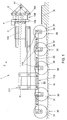
- the pipe-cleaning device 1 shown in figures is provided for cutting away undesired material from the interior of a sewage pipe.
- the device 1 comprises a cutting head 2, which is rotatably mounted on a body 111 about a rotation axis 9.
- the cutting head comprises a rigid central part 11 and collapsible cutting elements 21 for removing the undesired material.
- the collapsible cutting elements 21 are only partly shown.
- the device 1 is moved through a pipe, of which the wall W is partly shown, in a forwards direction Z.
- the device 1 is provided with a drive for rotating the cutting head 2.
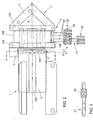
- the drive comprises a stator 3 and a rotor 4.
- De stator comprises a supply duct 100 which can be coupled to a supply hose (not shown) for supplying a pressurised drive liquid to the device.
- the supply duct 100 ends in two branches 101 which extend in opposite directions and end in nozzles 7 at the circumference of the stator 3.
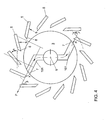
- the rotor 4 comprises a plurality of drive elements 5 or rotor blades, which are movable along a circular path around the circumference of the stator 3.
- Each of these drive elements 5 is provided with a drive plane 6 facing the stator 3.
- the nozzles 7 of the stator 3 are directed such that during operation the liquid, which is supplied via the duct 100 and branches 101 to the nozzles 7, forms liquid streams which drive the rotor 4.
- the direction of these liquid streams is shown by the arrows P.
- the drive elements 5 catch each of the liquid streams successively, so that the rotor 4 is forced to rotate. It is remarked that the liquid streams themselves are not shown; only the liquid flow is shown by arrows in the figures.
- the rotor 4 is driven on its interior, namely by liquid streams which are generated substantially within its rotation plane V.
- the liquid streams are in an optimal direction for driving the rotor 4 and the drive elements 5 of the rotor are located further from the rotation axis and as far as possible towards the pipe wall W, so that a high torque can be obtained.
- the device 1 is provided with such a number of drive elements 5, that each of the liquid streams substantially continuously contacts a drive element 5.
- the liquid streams apply a substantially continuous driving force to the rotor 4.
- the drive elements 5 are furthermore directed in such a way with respect to each other, that the liquid which is diverted by the drive planes 6 can easily flow between them.
- the leading edges 8 of the drive elements are bevelled towards the respective previous drive element 5, so that the channel which is defined by one drive plane 6 and a bevelled leading edge 8 has substantially parallel walls.
- the flow of the liquid from the rotor 4 is further improved in that the nozzles 7 are directed slightly towards the rear end of the device 1, more particularly such that the direction P of the liquid streams forms an angle y of 1-20°, more particularly 2-10° with the rotation plane V of the rotor 4.
- the nozzles 7 are provided for directing the liquid streams in such directions P onto the drive elements 5, that they contact the drive planes 6 in a substantially perpendicular direction.
- the nozzles 7 enclose an angle ⁇ of 45-90°, more particularly 60-80° with the circular path along which the drive elements 5 rotate during operation.
- the drive planes 6 enclose an angle ⁇ of 20-70°, more particularly 30-60° or 40-50° with this circular path.
- the distance x between the leading edges 8 and the nozzles 7 is kept as short as possible for avoiding losses as a result of pressure drop when the liquid leaves the nozzles 7. To this end, the distance x is below 1 cm and preferably 1-5 mm.
- the operational pressure of the liquid supplied to the device 1 of figures 1 and 2 is 50 -100 bar, but may also be higher or lower.
- the flow rate of the liquid is at least 50 l/min.
- the pressure and the flow rate are evidently chosen in function of the desired torque and rotation speed of the cutting head 2, which is preferably on the order of 5000 rpm.
- the rigid central part 11 of the cutting head 2 of figures 1 and 2 is wedge-shaped, for obtaining a cutting action when rotated at high speed.
- This central part 11 may however also have any other shape known to the person skilled in the art.
- the central part 11 may also be removably mounted on the cutting head 2, so that it is interchangeable with other central cutting parts.
- one or more collapsible cutting elements 21 are mounted on the central part 11.
- one collapsible cutting element 21 is shown, but there may also be less or more collapsible cutting elements 21.
- the collapsible cutting element 21 is a chain which is swung out by the rotor 4 during operation, so that it extends radially and undesired material which is located in the pipe can be removed by the cutting blocks 22 on the chain.
- These cutting blocks 22 can be provided with a cutting protrusion for enhancing the cutting action. This cutting protrusion extends forwardly from the cutting block 22 and may be carved or bevelled for avoiding a resistance build-up, which can be caused by cut material piling up at the cutting head 2.
- the chain 21 comprises a plurality of cutting blocks 22, one at its end and at least one at an intermediate location between its and the pivot shaft 106 by which it is fixed to the cutting head 2.
- the cutting blocks 22 at the intermediate locations form mass increasing elements, which have a higher weight relative to the chain links interconnecting the cutting blocks 22. In this way, the intermediate cutting blocks 22 increase the inertia of the chain 21, so that when the outer cutting block 22 strikes an object, the chain 21 less disturbed and sooner returns to its fully extended length.
- the chain parts are preferably constructed such that the mass of the chain increased towards the central part 11 of the cutting head.
- the chain part including the outer cutting block preferably has a weight below or equal to that of an inner chain part including the intermediate cutting block.
- the chain 21 may comprise a frontal cutting element of a shorter length, which may be fixed to the chain or not.
- This shorter frontal cutting element has the advantage that the rearward deflection of the chain 21 is reduced.
- the chain 21 is coupled to the cutting head 2 by means of pivot links, pivotally mounted on a pivot shaft 106 of the central part 11 of the cutting head 2.
- the central part 11 has a circumferential sleeve 108 in which the chain 21 can be rolled up.
- the sleeve 108 extends between two circumferential flanges 104, 109, which are of such height that the chain 21 can be fully accommodated in the sleeve 108 in between them.
- the chain 21 is a collapsible cutting element, which can collapse into the sleeve 108 for being moved past obstacles Q on the interior wall W of the pipe which is cleaned. Such an obstacle may for example result from a level difference between subsequent pipe sections.
- the chain 21 is again extended from the sleeve 108 as a result of centrifugal forces.
- the body 111 of the device 1 comprises support means 112 for supporting the body 111 carrying the cutting head 2 on the pipe wall W.
- These support means are formed by arrays 112 of collapsible support elements 30.
- the device 1 of figure 1 comprises three such arrays 112, of which one is shown. The three arrays are provided at regular distances from each other around the circumference of the body.
- Each array 112 comprises five collapsible support elements 30.
- the body may however also comprise any other number of arrays 112 with any number of collapsible support elements 30 deemed suitable by the person skilled in the art.
- Each collapsible support element 30 comprises a wheel 31, an L-shaped arm 34 and a pull spring 33.
- the wheels 31 are mounted in a plane extending through the central axis H of the device 1, so substantially perpendicular to the pipe wall W.
- Each wheel 31 is rotatably mounted on its arm 34.
- the arm 34 is pivotally mounted on the body 111 and has a pivot axis 113 which is offset from the rotation axis of the wheel 31 in longitudinal direction of the device. This offset ensures that the support element 30 can collapse, by rotating the wheel 31 away from the pipe wall W when encountering an obstruction Q.
- the offset is backwards, i.e. the rotation axis of the wheel 31 is behind the pivot axis 113.
- the offset is forwards. In this way, the movability of the device 1 in both forwards and backwards direction can be ensured.
- the pull spring 33 which extends in line with the L-shaped arm on the opposite end of the pivot axis 113 with respect to the end on which the wheel 31 is mounted, is provided for pressing the wheel 31 back onto the pipe wall W past the obstruction Q.
- the device 1 can easily be moved past a narrower part in the pipe, without losing the support on the pipe wall W: when one support element 30 collapses, its supporting function is temporarily taken over by the other support elements 30 of the array 112.
- the resiliency of the springs 33 is predetermined, for achieving that the supporting capacity of the whole array is sufficient for still supporting the body if at least one support element 30 is collapsed.
- the body 111 may further be adjustable, so that the distance between the arrays 112 of collapsible support elements can be adjusted and the device 1 can be adjusted to the diameter of the pipe which is to be cleaned.
- the pressurised liquid which is used for driving the rotation of the rotor 4 and for propelling the device 1 in forwards direction Z through the pipe is preferably water.
- the device 1 is propelled forwards by means of the reaction forces of one or more propulsion jets (not shown).
- the forwards propulsion can be achieved with any other propulsion means known to the person skilled in the art.
Landscapes
- Engineering & Computer Science (AREA)
- Mechanical Engineering (AREA)
- Health & Medical Sciences (AREA)
- Life Sciences & Earth Sciences (AREA)
- Hydrology & Water Resources (AREA)
- Public Health (AREA)
- Water Supply & Treatment (AREA)
- Cleaning By Liquid Or Steam (AREA)
- Cleaning In General (AREA)
- Washing And Drying Of Tableware (AREA)
- Electrical Discharge Machining, Electrochemical Machining, And Combined Machining (AREA)
Claims (18)
- Rohrreinigungsgerät (1), umfassend einen Schneidkopf (2) zum Wegschneiden von Material auf der Innenseite des Rohrs, einen Körper (111), auf dem der Schneidkopf drehbar angebracht ist, und Antriebsmittel(3, 4) zum Antreiben der Drehung des Schneidkopfs (2) bezüglich des Körpers (111), wobei der Körper (111) einen Umfang aufweist, an dem Stützmittel (112) zum Stützen des Körpers (111) an der Innenseite (W) eines Rohrs angebracht sind, wobei die Stützmittel (112) über im Wesentlichen die gesamte Länge des Körpers (111) hinweg vorgesehen sind, dadurch gekennzeichnet, dass der Schneidkopf (2) mit einem oder mehr klappbaren Schneidelementen (21) versehen ist, die in radialer Richtung von dem Schneidkopf (2) verlaufen und bezüglich des Umfangs des Köpers (111) einwärts klappbar sind, und dass die Stützmittel (112) durch mehrere Gruppierungen von klappbaren Stützelementen (30) ausgebildet sind, die in Längsrichtung des Körpers (111) verlaufen, wobei die klappbaren Stützelemente (30) bezüglich des Umfangs des Körpers gegen die Wirkung eines elastischen Glieds (33) einwärts klappbar sind.
- Rohrreinigungsgerät nach Anspruch 1, dadurch gekennzeichnet, dass jedes klappbare Stützelement (30) ein Rad (31) umfasst, das drehbar um eine Drehachse an einem klappbaren Arm (34) angebracht ist, wobei der Arm schwenkbar um eine Schwenkachse (113) an dem Körper (111) angebracht ist, wobei die Drehachse in Längsrichtung des Körpers (111) von der Schwenkachse versetzt ist.
- Rohrreinigungsgerät nach Anspruch 2, dadurch gekennzeichnet, dass das elastische Glied (33) eine Zugfeder ist, die im unbelasteten Zustand auf einer Linie mit dem klappbaren Arm (34) verläuft.
- Rohrreinigungsgerät nach einem der Ansprüche 1 bis 3, dadurch gekennzeichnet, dass der Körper (111) ein Vorderende, an dem der Schneidkopf (2) angebracht ist, und ein Rückende gegenüber dem Vorderende aufweist, wobei die klappbaren Stützelemente (30) am Vorderende zum Rückende hin klappbar sind und die klappbaren Stützelemente (30) am Rückende zum Vorderende hin klappbar sind.
- Rohrreinigungsgerät nach einem der Ansprüche 1 bis 4, dadurch gekennzeichnet, dass die Stützmittel (112) durch zumindest drei Gruppierungen von zumindest drei klappbaren Stützelementen (30) ausgebildet sind, wobei die Gruppierungen an regelmäßigen Positionen auf dem Umfang des Körpers (111) angeordnet sind.
- Schneidkopf (2), der drehbar an einem Rohrreinigungsgerät (1) zum Wegschneiden von Material auf der Innenseite eines Rohrs anbringbar ist, dadurch gekennzeichnet, dass der Schneidkopf (2) zumindest ein erstes klappbares Schneidelement (21) umfasst, das radial von einem starren Mittelteil (11) verläuft, wobei jedes Schneidelement (21) in einem ersten Schneidblock (22) endet und mit zumindest einem Massezuwachselement (22) an einer Zwischenposition zwischen dem Mittelteil (11) und dem ersten Schneidblock (22) versehen ist.
- Schneidkopf nach Anspruch 6, dadurch gekennzeichnet, dass jedes Massezuwachselement (22) durch einen zweiten Schneidblock ausgebildet ist.
- Schneidkopf nach einem der Ansprüche 6 oder 7, dadurch gekennzeichnet, dass das erste klappbare Schneidelement (21) ein erstes Kettenteil von dem ersten Schneidblock zu dem Massenzuwachselement und ein zweites Kettenteil von dem Massenzuwachselement zu dem Mittelteil (11) umfasst, wobei das erste Kettenteil ein Gewicht aufweist, das kleiner als das oder gleich dem des zweiten Kettenteils ist.
- Schneidkopf nach einem der Ansprüche 6 bis 8, dadurch gekennzeichnet, dass der Schneidkopf (2) ferner zumindest ein zweites klappbares Schneidelement vor dem zumindest einen ersten klappbaren Schneidelement umfasst, wobei jedes zweite klappbare Schneidelement genauso lang wie oder kürzer als jedes erste klappbare Schneidelement ist.
- Schneidkopf nach Anspruch 9, dadurch gekennzeichnet, dass jedes zweite klappbare Schneidelement ein drittes Kettenteil umfasst, das in einem dritten Schneidblock endet, wobei das dritte Kettenteil im Wesentlichen die gleiche Länge wie das zweite Kettenteil der ersten klappbaren Schneidelemente aufweist.
- Schneidkopf nach einem der Ansprüche 6 bis 10, dadurch gekennzeichnet, dass zumindest einer der ersten, zweiten und/oder dritten Schneidblöcke (22) mit einem Schneidvorsprung (23) versehen ist, der von dem Schneidblock in Vorwärtsrichtung verläuft.
- Antrieb (3, 4) zum Antreiben eines drehbaren Schneidkopfs (2) eines Rohrreinigungsgeräts (1) zum Wegschneiden von Material auf der Innenseite eines Rohrs, der Antrieb umfassend einen Stator (3) und einen Rotor (4), der an dem Stator (3) um eine Drehachse (9) drehbar angebracht ist, wobei der Stator zumindest eine Düse (7), die mit einer Zuleitung (100) verbunden ist, zum Richten eines Flüssigkeitsstroms einer unter Druck stehenden Flüssigkeit, die über die Zuleitung zugeführt ist, nacheinander auf mehrere Antriebselemente (5) des Rotors (4) umfasst, dadurch gekennzeichnet, dass die zumindest eine Düse (7) im Wesentlichen innerhalb einer Ebene (V) senkrecht zu der Drehachse (9) des Rotors verläuft, und dass die zumindest eine Düse (7) von dem Rotor (4) einwärts angeordnet ist.
- Antrieb nach Anspruch 12, dadurch gekennzeichnet, dass jedes Antriebselement (5) des Rotors (4) eine Antriebsebene (6) zum periodischen Empfangen des Flüssigkeitsstroms aufweist, wobei die Antriebsebene (6) derart gerichtet ist, dass der Flüssigkeitsstrom in einer im Wesentlichen senkrechten Richtung (P) empfangen ist.
- Antrieb nach Anspruch 13, dadurch gekennzeichnet, dass die Antriebselemente (5) im Betrieb einen Kreisweg entlang wandern, und dass jede Antriebsebene (6) in einem Winkel α von 20 bis 70° bezüglich dieses Kreiswegs gerichtet ist.
- Antrieb nach Anspruch 14, dadurch gekennzeichnet, dass jede Düse (7) in einem Winkel β von 45 bis 90° bezüglich des Kreiswegs der Antriebselemente (5) gerichtet ist.
- Antrieb nach einem der Ansprüche 13 bis 15, dadurch gekennzeichnet, dass jedes Antriebselement (5) eine Vorderkante (8) aufweist, die im Betrieb zuerst in den Flüssigkeitsstrom der Düse (7) gedreht ist, wobei die Vorderkante (8) in einer Richtung zu der Antriebsebene (6) des in Drehrichtung vorhergehenden Antriebselements (5) des Rotors (4) hin abgeschrägt ist.
- Antrieb nach Anspruch 16, dadurch gekennzeichnet, dass der Abstand (x) zwischen der Düse (7) und der Vorderkante (8) der Antriebselemente innerhalb des Bereichs von 1 bis 5 mm liegt.
- Rohrreinigungsgerät (1) nach einem der Ansprüche 1 bis 5 mit einem Schneidkopf (2) nach einem der Ansprüche 6 bis 11 und/oder einem Antrieb (3, 4) nach einem der Ansprüche 12 bis 17.
Applications Claiming Priority (3)
| Application Number | Priority Date | Filing Date | Title |
|---|---|---|---|
| NL1022126A NL1022126C1 (nl) | 2002-12-10 | 2002-12-10 | Inrichting voor het verwijderen van objecten uit een buis. |
| NL1022126 | 2002-12-10 | ||
| PCT/BE2003/000216 WO2004052565A1 (en) | 2002-12-10 | 2003-12-10 | Pipe-cleaning device |
Publications (2)
| Publication Number | Publication Date |
|---|---|
| EP1575713A1 EP1575713A1 (de) | 2005-09-21 |
| EP1575713B1 true EP1575713B1 (de) | 2012-04-18 |
Family
ID=32501536
Family Applications (1)
| Application Number | Title | Priority Date | Filing Date |
|---|---|---|---|
| EP03782014A Expired - Lifetime EP1575713B1 (de) | 2002-12-10 | 2003-12-10 | Vorrichtung zur Reinigung von Rohrleitungen |
Country Status (7)
| Country | Link |
|---|---|
| US (1) | US7707675B2 (de) |
| EP (1) | EP1575713B1 (de) |
| AT (1) | ATE554241T1 (de) |
| AU (1) | AU2003289767A1 (de) |
| CA (1) | CA2509592A1 (de) |
| NL (1) | NL1022126C1 (de) |
| WO (1) | WO2004052565A1 (de) |
Families Citing this family (3)
| Publication number | Priority date | Publication date | Assignee | Title |
|---|---|---|---|---|
| US8650696B1 (en) * | 2010-02-17 | 2014-02-18 | Nathaniel Morales | Sewer cleaning apparatus |
| CN108951835A (zh) * | 2018-04-16 | 2018-12-07 | 东莞市朝立建筑工程有限公司 | 一种排污管道自动清洗设备 |
| CN119237405B (zh) * | 2024-12-04 | 2025-03-21 | 山东恒驰矿业装备科技有限公司 | 一种煤矿充填管内壁清洁装置 |
Family Cites Families (11)
| Publication number | Priority date | Publication date | Assignee | Title |
|---|---|---|---|---|
| US1717986A (en) * | 1923-03-27 | 1929-06-18 | Liebau Gustav Otto Andreas | Apparatus for cleaning sewers and pipes |
| GB524184A (en) * | 1939-01-24 | 1940-07-31 | Nilsson Sandin | Pipe cleaner |
| CH290404A (de) | 1951-04-05 | 1953-04-30 | P Von Arx & Co Ag | Maschine zur Behandlung der Innenfläche von Rohrleitungen. |
| GB750592A (en) * | 1954-05-21 | 1956-06-20 | Nat Water Main Cleaning Compan | Improvements relating to pipe-cleaning devices |
| GB851847A (en) | 1959-04-22 | 1960-10-19 | Alberto Johann Reinhart | Apparatus for descaling pipes |
| CH490900A (de) * | 1967-06-28 | 1970-05-31 | Arx Paul Von | Vorrichtung, mit deren Hilfe die Innenwand eines Rohres gereinigt und/oder mit einem Schutzanstrich versehen werden kann |
| CH553597A (de) * | 1972-05-24 | 1974-09-13 | Arx Paul Von | Verfahren zum anbringen einer beschichtung auf der innenwand eines rohres. |
| US4249475A (en) * | 1978-10-10 | 1981-02-10 | Mustang Services Company | Pipeline treatment apparatus |
| DE9308552U1 (de) * | 1993-06-08 | 1993-09-16 | Burkl, Thomas, 82140 Olching | Vorrichtung zum Prüfen und Reinigen von Rohrsystemen |
| US5903946A (en) * | 1996-05-31 | 1999-05-18 | Shell Oil Company | Pipe cleaning device |
| US6966950B2 (en) * | 1998-03-25 | 2005-11-22 | Winiewicz Anthony E | Method and apparatus for treating underground pipeline |
-
2002
- 2002-12-10 NL NL1022126A patent/NL1022126C1/nl active
-
2003
- 2003-12-10 US US10/537,024 patent/US7707675B2/en not_active Expired - Fee Related
- 2003-12-10 AT AT03782014T patent/ATE554241T1/de active
- 2003-12-10 AU AU2003289767A patent/AU2003289767A1/en not_active Abandoned
- 2003-12-10 EP EP03782014A patent/EP1575713B1/de not_active Expired - Lifetime
- 2003-12-10 WO PCT/BE2003/000216 patent/WO2004052565A1/en not_active Ceased
- 2003-12-10 CA CA002509592A patent/CA2509592A1/en not_active Abandoned
Also Published As
| Publication number | Publication date |
|---|---|
| ATE554241T1 (de) | 2012-05-15 |
| EP1575713A1 (de) | 2005-09-21 |
| NL1022126C1 (nl) | 2004-06-11 |
| AU2003289767A1 (en) | 2004-06-30 |
| US7707675B2 (en) | 2010-05-04 |
| WO2004052565A1 (en) | 2004-06-24 |
| US20060042032A1 (en) | 2006-03-02 |
| CA2509592A1 (en) | 2004-06-24 |
Similar Documents
| Publication | Publication Date | Title |
|---|---|---|
| US5560065A (en) | Broom assisted pick-up head | |
| JP3237851B2 (ja) | パイプ清掃工具 | |
| US4326893A (en) | Implement and method for cleaning tubular drains | |
| US6470602B2 (en) | Snowthrower having impeller assist propulsion | |
| CA2302565C (en) | The device for pipeline interior cleaning | |
| US5437073A (en) | Tube cleaner | |
| EP0044080B1 (de) | Gerät für die Kanalreinigung | |
| US9624632B2 (en) | Snowblower impeller | |
| US7707675B2 (en) | Pipe-cleaning device | |
| KR100730374B1 (ko) | 관로의 세척장치 | |
| AU620418B2 (en) | Apparatus for mowing, chipping & blowing | |
| US4920600A (en) | Pipe cleaner | |
| US20230278047A1 (en) | High pressure fluid orbital spray nozzle | |
| US4367603A (en) | Snow caster having ring gear and spur gear drive means | |
| US5713093A (en) | Pipe-cleaning device with cutting head | |
| US4385457A (en) | Snow caster | |
| US20200332486A1 (en) | Endless screw rotor system, snowblower provided with such a system, kit for assembling the same, and corresponding methods of manufacturing, assembling and operating associated thereto | |
| JPH10339502A (ja) | ダクト清掃装置 | |
| JPH06277640A (ja) | 管内清掃装置 | |
| US3429060A (en) | Snow removal apparatus | |
| US1163624A (en) | Sewer-cleaner. | |
| AU9735401A (en) | Improvements to travelling irrigations for water and effluent applications | |
| EP4424145A1 (de) | Drehbares teil einer beschneidevorrichtung und beschneidevorrichtung zum schneiden und entfernen von gras und anderer vegetation neben einem sprinklerkopf eines bewässerungssystems | |
| CN121970594A (zh) | 一种秸秆还田一体设备及其使用方法 | |
| RU2177377C1 (ru) | Устройство для очистки внутренней поверхности труб |
Legal Events
| Date | Code | Title | Description |
|---|---|---|---|
| PUAI | Public reference made under article 153(3) epc to a published international application that has entered the european phase |
Free format text: ORIGINAL CODE: 0009012 |
|
| 17P | Request for examination filed |
Effective date: 20050519 |
|
| AK | Designated contracting states |
Kind code of ref document: A1 Designated state(s): AT BE BG CH CY CZ DE DK EE ES FI FR GB GR HU IE IT LI LU MC NL PT RO SE SI SK TR |
|
| AX | Request for extension of the european patent |
Extension state: AL LT LV MK |
|
| DAX | Request for extension of the european patent (deleted) | ||
| REG | Reference to a national code |
Ref country code: DE Ref legal event code: R079 Ref document number: 60340677 Country of ref document: DE Free format text: PREVIOUS MAIN CLASS: B08B0009020000 Ipc: E03F0009000000 |
|
| RIC1 | Information provided on ipc code assigned before grant |
Ipc: B08B 9/051 20060101ALI20110819BHEP Ipc: E03F 9/00 20060101AFI20110819BHEP Ipc: B08B 9/047 20060101ALI20110819BHEP Ipc: B08B 9/043 20060101ALI20110819BHEP |
|
| GRAP | Despatch of communication of intention to grant a patent |
Free format text: ORIGINAL CODE: EPIDOSNIGR1 |
|
| RTI1 | Title (correction) |
Free format text: PIPE-CLEANING DEVICE |
|
| GRAS | Grant fee paid |
Free format text: ORIGINAL CODE: EPIDOSNIGR3 |
|
| GRAA | (expected) grant |
Free format text: ORIGINAL CODE: 0009210 |
|
| AK | Designated contracting states |
Kind code of ref document: B1 Designated state(s): AT BE BG CH CY CZ DE DK EE ES FI FR GB GR HU IE IT LI LU MC NL PT RO SE SI SK TR |
|
| REG | Reference to a national code |
Ref country code: GB Ref legal event code: FG4D |
|
| REG | Reference to a national code |
Ref country code: CH Ref legal event code: EP |
|
| REG | Reference to a national code |
Ref country code: IE Ref legal event code: FG4D |
|
| REG | Reference to a national code |
Ref country code: AT Ref legal event code: REF Ref document number: 554241 Country of ref document: AT Kind code of ref document: T Effective date: 20120515 |
|
| REG | Reference to a national code |
Ref country code: DE Ref legal event code: R096 Ref document number: 60340677 Country of ref document: DE Effective date: 20120614 |
|
| REG | Reference to a national code |
Ref country code: NL Ref legal event code: T3 |
|
| REG | Reference to a national code |
Ref country code: AT Ref legal event code: MK05 Ref document number: 554241 Country of ref document: AT Kind code of ref document: T Effective date: 20120418 |
|
| PG25 | Lapsed in a contracting state [announced via postgrant information from national office to epo] |
Ref country code: FI Free format text: LAPSE BECAUSE OF FAILURE TO SUBMIT A TRANSLATION OF THE DESCRIPTION OR TO PAY THE FEE WITHIN THE PRESCRIBED TIME-LIMIT Effective date: 20120418 Ref country code: SE Free format text: LAPSE BECAUSE OF FAILURE TO SUBMIT A TRANSLATION OF THE DESCRIPTION OR TO PAY THE FEE WITHIN THE PRESCRIBED TIME-LIMIT Effective date: 20120418 Ref country code: CY Free format text: LAPSE BECAUSE OF FAILURE TO SUBMIT A TRANSLATION OF THE DESCRIPTION OR TO PAY THE FEE WITHIN THE PRESCRIBED TIME-LIMIT Effective date: 20120418 |
|
| PG25 | Lapsed in a contracting state [announced via postgrant information from national office to epo] |
Ref country code: SI Free format text: LAPSE BECAUSE OF FAILURE TO SUBMIT A TRANSLATION OF THE DESCRIPTION OR TO PAY THE FEE WITHIN THE PRESCRIBED TIME-LIMIT Effective date: 20120418 Ref country code: GR Free format text: LAPSE BECAUSE OF FAILURE TO SUBMIT A TRANSLATION OF THE DESCRIPTION OR TO PAY THE FEE WITHIN THE PRESCRIBED TIME-LIMIT Effective date: 20120719 Ref country code: PT Free format text: LAPSE BECAUSE OF FAILURE TO SUBMIT A TRANSLATION OF THE DESCRIPTION OR TO PAY THE FEE WITHIN THE PRESCRIBED TIME-LIMIT Effective date: 20120820 |
|
| PG25 | Lapsed in a contracting state [announced via postgrant information from national office to epo] |
Ref country code: AT Free format text: LAPSE BECAUSE OF FAILURE TO SUBMIT A TRANSLATION OF THE DESCRIPTION OR TO PAY THE FEE WITHIN THE PRESCRIBED TIME-LIMIT Effective date: 20120418 Ref country code: RO Free format text: LAPSE BECAUSE OF FAILURE TO SUBMIT A TRANSLATION OF THE DESCRIPTION OR TO PAY THE FEE WITHIN THE PRESCRIBED TIME-LIMIT Effective date: 20120418 Ref country code: SK Free format text: LAPSE BECAUSE OF FAILURE TO SUBMIT A TRANSLATION OF THE DESCRIPTION OR TO PAY THE FEE WITHIN THE PRESCRIBED TIME-LIMIT Effective date: 20120418 Ref country code: DK Free format text: LAPSE BECAUSE OF FAILURE TO SUBMIT A TRANSLATION OF THE DESCRIPTION OR TO PAY THE FEE WITHIN THE PRESCRIBED TIME-LIMIT Effective date: 20120418 Ref country code: CZ Free format text: LAPSE BECAUSE OF FAILURE TO SUBMIT A TRANSLATION OF THE DESCRIPTION OR TO PAY THE FEE WITHIN THE PRESCRIBED TIME-LIMIT Effective date: 20120418 Ref country code: EE Free format text: LAPSE BECAUSE OF FAILURE TO SUBMIT A TRANSLATION OF THE DESCRIPTION OR TO PAY THE FEE WITHIN THE PRESCRIBED TIME-LIMIT Effective date: 20120418 |
|
| PLBE | No opposition filed within time limit |
Free format text: ORIGINAL CODE: 0009261 |
|
| STAA | Information on the status of an ep patent application or granted ep patent |
Free format text: STATUS: NO OPPOSITION FILED WITHIN TIME LIMIT |
|
| PG25 | Lapsed in a contracting state [announced via postgrant information from national office to epo] |
Ref country code: IT Free format text: LAPSE BECAUSE OF FAILURE TO SUBMIT A TRANSLATION OF THE DESCRIPTION OR TO PAY THE FEE WITHIN THE PRESCRIBED TIME-LIMIT Effective date: 20120418 |
|
| 26N | No opposition filed |
Effective date: 20130121 |
|
| PG25 | Lapsed in a contracting state [announced via postgrant information from national office to epo] |
Ref country code: ES Free format text: LAPSE BECAUSE OF FAILURE TO SUBMIT A TRANSLATION OF THE DESCRIPTION OR TO PAY THE FEE WITHIN THE PRESCRIBED TIME-LIMIT Effective date: 20120729 |
|
| REG | Reference to a national code |
Ref country code: DE Ref legal event code: R097 Ref document number: 60340677 Country of ref document: DE Effective date: 20130121 |
|
| PG25 | Lapsed in a contracting state [announced via postgrant information from national office to epo] |
Ref country code: BG Free format text: LAPSE BECAUSE OF FAILURE TO SUBMIT A TRANSLATION OF THE DESCRIPTION OR TO PAY THE FEE WITHIN THE PRESCRIBED TIME-LIMIT Effective date: 20120718 Ref country code: MC Free format text: LAPSE BECAUSE OF NON-PAYMENT OF DUE FEES Effective date: 20121231 |
|
| REG | Reference to a national code |
Ref country code: CH Ref legal event code: PL |
|
| GBPC | Gb: european patent ceased through non-payment of renewal fee |
Effective date: 20121210 |
|
| REG | Reference to a national code |
Ref country code: IE Ref legal event code: MM4A |
|
| REG | Reference to a national code |
Ref country code: FR Ref legal event code: ST Effective date: 20130830 |
|
| REG | Reference to a national code |
Ref country code: DE Ref legal event code: R119 Ref document number: 60340677 Country of ref document: DE Effective date: 20130702 |
|
| PG25 | Lapsed in a contracting state [announced via postgrant information from national office to epo] |
Ref country code: CH Free format text: LAPSE BECAUSE OF NON-PAYMENT OF DUE FEES Effective date: 20121231 Ref country code: IE Free format text: LAPSE BECAUSE OF NON-PAYMENT OF DUE FEES Effective date: 20121210 Ref country code: LI Free format text: LAPSE BECAUSE OF NON-PAYMENT OF DUE FEES Effective date: 20121231 Ref country code: DE Free format text: LAPSE BECAUSE OF NON-PAYMENT OF DUE FEES Effective date: 20130702 |
|
| PG25 | Lapsed in a contracting state [announced via postgrant information from national office to epo] |
Ref country code: GB Free format text: LAPSE BECAUSE OF NON-PAYMENT OF DUE FEES Effective date: 20121210 Ref country code: FR Free format text: LAPSE BECAUSE OF NON-PAYMENT OF DUE FEES Effective date: 20130102 |
|
| PG25 | Lapsed in a contracting state [announced via postgrant information from national office to epo] |
Ref country code: TR Free format text: LAPSE BECAUSE OF FAILURE TO SUBMIT A TRANSLATION OF THE DESCRIPTION OR TO PAY THE FEE WITHIN THE PRESCRIBED TIME-LIMIT Effective date: 20120418 |
|
| PG25 | Lapsed in a contracting state [announced via postgrant information from national office to epo] |
Ref country code: HU Free format text: LAPSE BECAUSE OF FAILURE TO SUBMIT A TRANSLATION OF THE DESCRIPTION OR TO PAY THE FEE WITHIN THE PRESCRIBED TIME-LIMIT Effective date: 20031210 |
|
| PG25 | Lapsed in a contracting state [announced via postgrant information from national office to epo] |
Ref country code: BE Free format text: LAPSE BECAUSE OF NON-PAYMENT OF DUE FEES Effective date: 20151231 |
|
| PGRI | Patent reinstated in contracting state [announced from national office to epo] |
Ref country code: BE Effective date: 20160525 |
|
| PGFP | Annual fee paid to national office [announced via postgrant information from national office to epo] |
Ref country code: NL Payment date: 20211124 Year of fee payment: 19 Ref country code: LU Payment date: 20211227 Year of fee payment: 19 |
|
| PGFP | Annual fee paid to national office [announced via postgrant information from national office to epo] |
Ref country code: BE Payment date: 20211124 Year of fee payment: 19 |
|
| REG | Reference to a national code |
Ref country code: NL Ref legal event code: MM Effective date: 20230101 |
|
| REG | Reference to a national code |
Ref country code: BE Ref legal event code: MM Effective date: 20221231 |
|
| PG25 | Lapsed in a contracting state [announced via postgrant information from national office to epo] |
Ref country code: LU Free format text: LAPSE BECAUSE OF NON-PAYMENT OF DUE FEES Effective date: 20221210 |
|
| PG25 | Lapsed in a contracting state [announced via postgrant information from national office to epo] |
Ref country code: NL Free format text: LAPSE BECAUSE OF NON-PAYMENT OF DUE FEES Effective date: 20230101 |
|
| PG25 | Lapsed in a contracting state [announced via postgrant information from national office to epo] |
Ref country code: BE Free format text: LAPSE BECAUSE OF NON-PAYMENT OF DUE FEES Effective date: 20221231 |