EP1574361B1 - Vollgummireifen und Verfahren zu dessen Herstellung - Google Patents
Vollgummireifen und Verfahren zu dessen Herstellung Download PDFInfo
- Publication number
- EP1574361B1 EP1574361B1 EP05250967A EP05250967A EP1574361B1 EP 1574361 B1 EP1574361 B1 EP 1574361B1 EP 05250967 A EP05250967 A EP 05250967A EP 05250967 A EP05250967 A EP 05250967A EP 1574361 B1 EP1574361 B1 EP 1574361B1
- Authority
- EP
- European Patent Office
- Prior art keywords
- tire
- rubber
- layer
- rubber layer
- circumferential surface
- Prior art date
- Legal status (The legal status is an assumption and is not a legal conclusion. Google has not performed a legal analysis and makes no representation as to the accuracy of the status listed.)
- Expired - Lifetime
Links
Images

Classifications
-
- B—PERFORMING OPERATIONS; TRANSPORTING
- B29—WORKING OF PLASTICS; WORKING OF SUBSTANCES IN A PLASTIC STATE IN GENERAL
- B29D—PRODUCING PARTICULAR ARTICLES FROM PLASTICS OR FROM SUBSTANCES IN A PLASTIC STATE
- B29D30/00—Producing pneumatic or solid tyres or parts thereof
- B29D30/02—Solid tyres ; Moulds therefor
-
- B—PERFORMING OPERATIONS; TRANSPORTING
- B29—WORKING OF PLASTICS; WORKING OF SUBSTANCES IN A PLASTIC STATE IN GENERAL
- B29D—PRODUCING PARTICULAR ARTICLES FROM PLASTICS OR FROM SUBSTANCES IN A PLASTIC STATE
- B29D30/00—Producing pneumatic or solid tyres or parts thereof
- B29D30/06—Pneumatic tyres or parts thereof (e.g. produced by casting, moulding, compression moulding, injection moulding, centrifugal casting)
-
- B—PERFORMING OPERATIONS; TRANSPORTING
- B29—WORKING OF PLASTICS; WORKING OF SUBSTANCES IN A PLASTIC STATE IN GENERAL
- B29D—PRODUCING PARTICULAR ARTICLES FROM PLASTICS OR FROM SUBSTANCES IN A PLASTIC STATE
- B29D30/00—Producing pneumatic or solid tyres or parts thereof
- B29D30/06—Pneumatic tyres or parts thereof (e.g. produced by casting, moulding, compression moulding, injection moulding, centrifugal casting)
- B29D30/52—Unvulcanised treads, e.g. on used tyres; Retreading
- B29D30/54—Retreading
-
- B—PERFORMING OPERATIONS; TRANSPORTING
- B60—VEHICLES IN GENERAL
- B60C—VEHICLE TYRES; TYRE INFLATION; TYRE CHANGING; CONNECTING VALVES TO INFLATABLE ELASTIC BODIES IN GENERAL; DEVICES OR ARRANGEMENTS RELATED TO TYRES
- B60C11/00—Tyre tread bands; Tread patterns; Anti-skid inserts
- B60C11/02—Replaceable treads
-
- B—PERFORMING OPERATIONS; TRANSPORTING
- B60—VEHICLES IN GENERAL
- B60C—VEHICLE TYRES; TYRE INFLATION; TYRE CHANGING; CONNECTING VALVES TO INFLATABLE ELASTIC BODIES IN GENERAL; DEVICES OR ARRANGEMENTS RELATED TO TYRES
- B60C7/00—Non-inflatable or solid tyres
-
- B—PERFORMING OPERATIONS; TRANSPORTING
- B60—VEHICLES IN GENERAL
- B60C—VEHICLE TYRES; TYRE INFLATION; TYRE CHANGING; CONNECTING VALVES TO INFLATABLE ELASTIC BODIES IN GENERAL; DEVICES OR ARRANGEMENTS RELATED TO TYRES
- B60C7/00—Non-inflatable or solid tyres
- B60C2007/005—Non-inflatable or solid tyres made by casting, e.g. of polyurethane
-
- Y—GENERAL TAGGING OF NEW TECHNOLOGICAL DEVELOPMENTS; GENERAL TAGGING OF CROSS-SECTIONAL TECHNOLOGIES SPANNING OVER SEVERAL SECTIONS OF THE IPC; TECHNICAL SUBJECTS COVERED BY FORMER USPC CROSS-REFERENCE ART COLLECTIONS [XRACs] AND DIGESTS
- Y10—TECHNICAL SUBJECTS COVERED BY FORMER USPC
- Y10T—TECHNICAL SUBJECTS COVERED BY FORMER US CLASSIFICATION
- Y10T152/00—Resilient tires and wheels
- Y10T152/10—Tires, resilient
- Y10T152/10279—Cushion
- Y10T152/10288—Sectional
- Y10T152/10297—Annular
- Y10T152/10306—Superimposed
Definitions
- the present invention relates to a composite solid tire and a method of producing the same, and particularly to advantageous techniques for renewing worn solid rubber tires.
- a tire that supports, in a vehicle such as an automotive vehicle or an industrial vehicle, a load and has the function of smoothly transmitting forces between the vehicle and road surface there have conventionally been known two sorts of tires, i.e., a pneumatic tire having a hollow structure in which air is charged, and a solid tire having a solid structure constituted by a rubber-based annular body.
- the solid tire enjoys, as tire's functions, a load supporting property, a cushioning property, and a rubber elasticity, and is widely used in low-speed and high-load vehicles such as a forklift truck, an industrial tractor, a battery carrier, or a trailer.
- a tire that is constituted by a single tread rubber and is directly bonded to a wheel a tire that is constituted by a rubber adhered, by vulcanization, to a base band and is press-fitted onto a wheel, and a tire that is constituted by an annular tread rubber and is fitted on an outer circumferential portion of a wheel.
- the solid tire is known as a solid rubber tire that is constituted by a tread rubber formed of, e.g., NR or SBR. Since the solid rubber tire contacts the road surface and produces a frictional force to allow movement of the vehicle, a surface of contact of the tire with the road surface is worn little by little as the tire is used for a long time and, if a life expectancy of the tire is fulfilled, the tire should be disposed of. Recently, however, the disposal of waste tires has become a serious social problem. In particular, since the solid rubber tires are heavier than pneumatic tires used in, e.g., passenger cars, the solid rubber tires are more difficult to handle. In addition, the solid rubber tires are hard to burn or find other applications. Thus, the solid rubber tires are very difficult to dispose of.
- Patent Document 1 Japanese Patent Application Publication No. 5-31822 .
- a pneumatic-type solid tire having a structure in which a surface of a tread portion of a worn tire is subjected to buffing as a sort of polishing and a renewing tread rubber is adhered to the thus polished tread portion.
- worn tires that have conventionally been difficult to dispose of can be effectively utilized, tire materials can be saved, and times needed to produce tires can be reduced.
- the renewing tread rubber may be adhered to the tread portion of the worn tire, so as to produce a renewed tire, the tread portion of the renewed tire is easily worn again as it is used. Thus, the durability of the tread portion of the renewed tire is not satisfactorily improved.
- rubber materials used to form the renewed tread rubber contain carbon black as a reinforcing agent and accordingly have a black color, black marks of the tire are left on the road surface because frictions are produced between the tread rubber and the road surface.
- the black tire marks left on the road surface may damage an aesthetic appearance of the road surface and, in a work field where a forklift truck or an industrial tractor is used, not only the black tire marks but also black rubber powder resulting from wearing of tires may damage a work environment.
- Patent Document 2 Japanese Patent Application Publication No. 2002-144442 discloses a wheel renewing method in which urethane rubber is used. More specifically described, this document discloses a renewed wheel obtaining technique in which, after a rubber portion is removed from a base band of a waste tire, an ether-based urethane rubber layer is formed on an outer circumferential surface of the base band.
- the urethane rubber layer contacts road surface.
- the urethane rubber has a higher wear resistance than that of a common tread rubber formed of, e.g., NR or SBR.
- the renewed wheel can enjoy a significantly improved durability or life expectancy.
- the renewed wheel suffers a lower cushioning property than that of a wheel having the common tread rubber. Therefore, when an operator operates a vehicle, such as a forklift truck or an industrial tractor, in which the renewed wheel is used, uncomfortable shocks may be transmitted to the operator.
- the cushioning property of the renewed wheel might be improved by forming the urethane rubber layer to have a foamed structure or largely lowering the hardness (or increasing the softness) of the urethane rubber layer. In this case, however, the urethane elastomer may lose its proper wear resistance and accordingly its durability.
- a composite solid tire wherein an inner layer of the solid tire is formed of a rubber layer, and an outer layer of the solid tire is formed of a thermo-setting polyurethane elastomer layer.
- the rubber layer is formed of a worn solid rubber tire, wherein the remaining rubber layer of the worn solid rubber tire has a pre-determined thickness.
- the rubber layer is formed of at least one material, which is softer than the thermo-setting polyurethane elastomer.
- a method of producing a composite solid tire comprising the steps of providing a rubber layer to be the inner layer of said tire; applying a primer and an adhesive to an outer circumferential surface of the rubber layer; and forming an outer layer by causing raw materials of a thermo-setting polyurethane elastomer to react and cure by die-casting.
- a method of producing a composite solid tire comprising the steps of cutting an outer circumferential surface of a remaining rubber layer of a worn solid rubber tire; applying an adhesive to the cut outer circumferential surface of the rubber layer; and providing, on the outer circumferential surface of the rubber layer, a thermo-setting polyurethane elastomer layer by causing raw materials of a thermo-setting polyurethane to react and cure.
- the composite solid tire producing method is embodied by introducing the raw materials of the thermo-setting polyurethane elastomer into a space in a die-casting device, wherein the space is formed between an inner circumferential surface of an outer die and an outer circumferential surface of the rubber layer, and the inner circumferential surface and the outer circumferential surface are heated in a way that a temperature of the outer circumferential surface is higher than that of the inner circumferential surface.
- the polyurethane elastomer layer as the outer layer of the tread portion of the renewed solid tire does not contain, unlike common rubber layers, any amounts of carbon black. Therefore, unlike conventional solid rubber tires, no black marks of the renewed solid tire (i.e., the tread rubber) are left on the road surface the tire contacts. Thus, the renewed solid tire is freed of the problems that the black marks may damage the aesthetic appearance of the road surface and that scattering of black rubber powder resulting from wearing of tires may damage a work environment.
- the rubber layer as the remaining portion of the worn solid rubber tire is utilized, substantially as it is, as the inner layer of the tread portion of the renewed solid tire.
- an amount of consumption of the raw materials of the polyurethane elastomer can be significantly reduced as compared with the case where an entirety of the tread portion is constituted by a polyurethane elastomer layer only. This advantageously prevents or restrains the cost of the manufacture of the composite solid tire, which has the above-mentioned excellent features, from increasing.
- the rubber layer as the remaining portion of the worn solid rubber tire is utilized, substantially as it is, as the inner layer of the tread portion of the renewed solid tire. Therefore, an amount of consumption of the raw materials of the polyurethane elastomer can be significantly reduced as compared with the case where an entirety of the tread portion is constituted by a polyurethane elastomer layer only. This leads to largely saving the amount of materials used to renew the worn tread portion of the solid tire.
- worn solid rubber tires can be utilized again as renewed solid tires, the worn solid rubber tires need not be disposed of, so that the present invention contributes to overcome the social problem with the disposal of waste tires.
- an annular tread portion to be attached to an outer circumferential portion of a wheel is constituted by the rubber layer that is a remaining portion of the worn solid rubber tire and has an appropriate thickness, and the room temperature-setting polyurethane elastomer layer that is integrally formed on the rubber layer. Therefore, impacts exerted from road surface to the tread portion can be effectively absorbed or damped by the rubber layer as an inner layer of the tread portion, and the outer polyurethane elastomer layer that provides a contact surface of the tread portion that contacts the road surface enjoys a proper excellent wear resistance of the polyurethane elastomer, and accordingly a significantly improved durability Thus, the renewed solid tire can enjoy a significantly increased life expectancy.
- the inner layer formed of the rubber layer and the outer layer formed of the thermo-setting polyurethane elastomer layer are effectively integrated with each other.
- the worn solid rubber tire can be advantageously utilized. It is also assured that the thermo-setting polyurethane elastomer layer and the rubber layer can be more effectively formed into an integral structure.
- the raw materials of the thermo-setting polyurethane elastomer which are introduced into the die-casting device, react and cure from a side of the rubber layer, whose temperature is higher than that of the other side of the rubber layer. Therefore, the feature, in which the thermo-setting polyurethane elastomer layer formed on the rubber layer is further firmly integrated with the rubber layer, is exhibited.
- Fig. 1 is a side elevation view of a portion of a solid rubber tire 10 that is attached to a vehicle, not shown, and has not been worn, and a side elevation view of a portion of the same solid rubber tire 10 whose tread portion 14 has been used and worn.
- Fig. 1 shows the worn solid tire, which provides an annular rubber layer, and which is suitably used for the present invention. More specifically described, the solid rubber tire 10 is formed, as known in the art, of a single sort of rubber, or a blend of two or more sorts of rubbers, that is or are selected from NR, IR, SBR, BR, EPM, EPDM, IIR, and the like.
- the solid rubber tire 10 is formed of a blend of rubbers including NR or IR as a main component, and is vulcanized.
- the solid rubber tire 10 is commercially available as a so-called solid tire.
- the solid rubber tire 10 has a generally annular shape, and an outer circumferential surface of a wheel 18 fixed to an axle shaft of the vehicle is attached to an inner circumferential portion of the tire 10, by a well known method, such as bonding, press-fitting, or fitting.
- the solid rubber tire 10 has, on a side surface thereof, a tread wear indicator (or a tire wear indicator) 12 that indicates a limit of use of the tire 10.
- the tread wear indicator 12 has, e.g., a triangular shape and is formed by indent or relief.
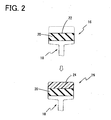
- the worn solid rubber tire 16 whose life expectancy has been fulfilled is used to advantage. More specifically described, as shown in Fig. 1 , the worn solid rubber tire 16 has, as a remaining portion of the solid rubber tire 10, a worn rubber layer 20 that remains along the entire circumference of the wheel 18 and has a pre-determined thickness corresponding to the tread wear indicator 12. As shown in Fig. 2 , on an outer circumferential surface of the worn rubber layer 20, a thermo-curing or -setting polyurethane elastomer layer 24 is integrally formed to have a pre-determined thickness and thereby provide a new tread portion 14. Thus, the worn solid rubber tire 16 is renovated into a renewed solid tire (composite solid rubber tire) 26 that can be used again with the vehicle.
- a renewed solid tire composite solid rubber tire
- the above-indicated polyurethane elastomer layer 24 is integrally formed on the outer circumferential surface of the worn rubber layer 20, by casting, into the die-casting device, conventionally known raw materials of a thermo-curing or -setting polyurethane, so that the renewed solid rubber tire 26 may have a desired thickness.
- the raw materials of the thermo-setting polyurethane contain, as a polyisocyanate component, a tolylene diisocyanate (TDI), a diphenylmethane diisocyanate (MDI), and a naphthalene diisocyanate (NDI) or the like, and additionally contain, as a polyol component, a poly(oxybutylene)glycol, polyester polyol, polyethylene adipate glycol or the like.
- the raw materials additionally contain a diamine, a diol or the like, as a catalyst that causes the polyisocyanate component and the polyol component to react with each other, and cure, while the raw materials are heated.
- the catalyst can be selected, as needed, from various commercially available products, such as the ones available under commercial name "Adiprene", "Vibrathane”, “Multrathane", “Vulkollan”, Hiprene", or the like.
- the polyurethane elastomer, which forms the layer 24, has an excellent wear resistance property, as clearly shown in the following TABLE 1.
- TABLE 1 compares the comparison of the physical properties of "Vulkollan", which is an example of the commercially available elastomers suitable for the present invention, with a commercially available room temperature-setting polyurethane.
- a polyurethane elastomer, whose characteristic value according to Taber Abrasion Test (DIN 53516) is 90 mm 3 or less, preferably 70mm 3 or less, more preferably 50mm 3 or less, is advantageously used.
- NDI elastomer As the polyurethane elastomer, which has the excellent wear resistance and is used for the polyurethane elastomer layer 24, NDI elastomer is advantageously used. More specifically described, naphthalene-1,5-diisocyanate (NDI) is used as a polyisocyanate component, and polyester polyol or the like is used as a polyol component. After the two components are reacted with each other, in advance, so as to form an NDI/ester prepolymer, a glycol cross-linking agent, etc. are mixed with the prepolymer, and the resultant mixture is heated, so as to form a desired solid NDI-based elastomer.
- NDI naphthalene-1,5-diisocyanate
- polyester polyol or the like is used as a polyol component.
- the desired layer 24 is formed by a die-casting method in which the polyurethane raw materials are cast into the die-casting device.
- the raw materials of the polyurethane elastomer having an excellent wear resistance are commercially available; for example, polyurethane raw materials available under commercial name "VULKOLLAN” from Bayer AG, Germany, are advantageously used.
- the materials of the heat-curing polyurethane elastomer used to form the polyurethane elastomer layer 24 be reacted, and cured, at a low heating temperature of, e.g., from 70 °C to 115 °C.
- a low heating temperature e.g., from 70 °C to 115 °C.
- the composite solid rubber tire 26 in which the polyurethane elastomer layer 24 is integrally formed on the rubber layer 20 can advantageously exhibit, against shocks or impacts exerted thereto, the cushioning property of the rubber layer 20.
- the durability of the rubber layer 20 and accordingly the life expectancy of the renewed solid rubber tire 26 as a whole can be advantageously improved.
- an outer circumferential surface of the polyurethane elastomer layer 24 provides a contact surface that contacts the road surface. Therefore, the polyurethane elastomer can exhibit its proper wear resistance, and accordingly the renewed solid rubber tire 26 can enjoy a significantly improved life expectancy.
- the rubber layer 20 since the rubber layer 20 is present under the polyurethane elastomer layer 24 having the excellent wear resistance, the rubber layer 20 can effectively absorb or damp the impacts transmitted from the road surface to the vehicle, even if a hardness of the rubber layer 24 may be such a level of Shore hardness 80A or over, while an ordinary rubber layer has a Shore hardness less than 70A and an ordinary room temperature-setting elastomer has a Shore hardness less than 80A.
- the rubber layer 20 largely contributes to improving, e.g., a driving comfort of the vehicle.
- a percentage of a thickness of the polyurethane elastomer layer 24 relative to a whole thickness of the renewed solid rubber tire 26 in a radial direction thereof be not more than 40 %, more preferably, not more than 30 %, and that a percentage of a thickness of the rubber layer 20 relative to the whole thickness of the renewed solid rubber tire 26 be not less than 60%.
- the polyurethane elastomer layer 24 does not contain, unlike the rubber layer 20, any amounts of carbon black as a reinforcing material. Therefore, although the renewed solid rubber tire 26 is rolled and moved on the road surface, no black marks of the tire 26 are left on the road surface. Thus, the polyurethane elastomer layer 24 contributes to keeping the environment clean. In addition, the elastomer layer 24 has no possibilities of damaging a work environment where the renewed solid rubber tires 26 are produced.
- the renewed solid rubber tire 26 constructed as described above according to the present invention is produced by a composite solid tire producing method also according to the present invention.
- the composite solid tire producing method is based on a known method, e.g., a die-casting method.
- the outer circumferential surface 22 of the rubber layer 20 of the worn solid rubber tire 16 is worked, i.e., cut or machined using, e.g., a lathe so as to remove, from the rubber layer 20, a superficial portion thereof having a pro-determined thickness.
- a primer layer is formed using a known primer to improve a degree of bonding of the outer surface 22, and additionally an adhesive layer is formed, on the primer layer, using a known adhesive suitable for polyurethanes. Since the primer layer and the adhesive layer are formed on the outer surface 22 of the rubber layer 20, the polyurethane elastomer layer 24 can be more firmly bonded to the rubber layer 20.
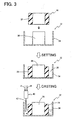
- the worn solid rubber tire 16 including the worn rubber layer 20 is set in an appropriate die-casting device 32. Subsequently, as shown in Fig. 3 , raw materials of a thermo-setting polyurethane are cast in the die-casting device 32.
- the die-casting device 32 includes an outer die 34 having a cylindrical shape and including a bottom wall, and a core-like inner die 36 that is provided in an inner space of the outer die 34 such that the inner die 36 is concentric with the outer die 34.
- the worn solid rubber tire 16 is set in the die-casting device 32 such that the inner die 36 fits in an inner bore of the tire 16. It is desirable that at least the outer die 34 is pre-heated in a suitable furnace at a pre-determined temperature, for example, at about 100 to 110 °C. In this case, it is desirable that the rubber layer 20 of the solid rubber tire 16 is also pre-heated at a temperature higher than that of the pre-heated outer die 34.
- the temperature of the pre-heated solid rubber tire 16 is at least about 5 °C higher than that of the pre-heated outer die 34.
- Adaptation of the above-mentioned relationship between the temperature of the outer layer die 34 and that of the lubber layer 20 effectively causes the raw materials of the thermo-setting polyurethane elastomer to react and cure from the side of the rubber layer 20.
- thus formed polyurethane elastomer layer 24 and the rubber 20 are fixed to each other, much firmer than layers obtained without the adaptation of the above-mentioned relationship. Therefore, the solid tire of the present invention has an advantageously integrated structure.
- a known material casting device 40 casts raw materials 42 of a room temperature-setting polyurethane, into an annular space (i.e., a molding space) 38 located between the outer circumferential surface of the rubber layer 20 of the worn solid rubber tire 16 and the inner circumferential surface of the outer die 34, till the annular space 38 is filled with the raw materials.
- the material casting device 40 may be one that has a well known construction; such as a mixing head or a gun-type injector.
- the material casting device 40 is supplied with the polyisocynate component: A, and the polyol component: B, mixed with the curing agent (i.e., the catalyst) and, after the two components are mixed uniformly using an appropriate dynamic or static mixer, the mixture is cast in the die-casting device 32.
- the polyisocynate component: A and the polyol component: B may be previously reacted to form a pre-polymer before being supplied to the material casting device 40.
- the material casting device 40 is supplied with the pre-polymer and the curing agent, and after the two components are mixed, the mixture is cast in the die-casting device 32.
- the polyurethane raw materials 42 cast in the die-casting device 32 react and cure, while they are heated.
- the polyurethane elastomer layer 24 is integrally formed on the outer surface of the rubber layer 20.
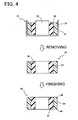
- an integral mold product 44 including the rubber layer 20 and the polyurethane elastomer layer 24 is removed from the die-casting device 32, and is subjected to a finishing operation. More specifically described, widthwise opposite ends of an outer circumferential surface of the polyurethane elastomer layer 24 are rounded to provide rounded portions 46, and are thereby prevented from being chipped off in use. Thus, a desired renewed solid tire 48 is produced.
- the polyurethane raw materials 42 are just cast in the die-casting device 32, so as to integrally form the polyurethane elastomer layer 24 on the outer circumferential surface of the rubber layer 20.
- the composite solid tire 48 can be very easily produced.
- not all portions of the composite solid tire 48 are formed of the polyurethane elastomer, but just the polyurethane elastomer layer 24 is integrally formed on the outer surface of the worn rubber layer 20 remaining with the pre-determined thickness along the entire circumference of the wheel 18.
- the present composite solid tire producing method is economical since the amount of use of the polyurethane raw materials 42 is considerably small.
- the composite solid tire 48 produced by the method shown in Figs. 3 and 4 is attached to the wheel 18, and is used with the vehicle, such that the wheel 18 is fixed to the inner bore of the tire 48 by a conventionally known method such as bonding, press-fitting, or fitting.
- a conventionally known method such as bonding, press-fitting, or fitting.
- the renewed solid tire in accordance with the present invention can enjoy a significantly improved life expectancy, and can exhibit a significantly improved shock absorbing or damping effect against shocks exerted from road surface to a body of a vehicle.
- no black marks of the tire are left on the road surface, which largely contributes to keeping an aesthetic appearance of the environment and improving a work environment.
- worn solid rubber tires can be utilized again as renewed solid tires, the worn solid rubber tires need not be disposed of, and the social problem with the disposal of waste tires can be overcome. While the present invention has been described in its preferred embodiments, it is to be understood that the present invention is by no means limited to the details of those embodiments but may be otherwise embodied.
- the worn solid tires 16 employed according to the present invention may be waste solid tires obtained by recovery of so-called solid rubber tires, i.e., common rubber-based solid tires that are widely used in forklift trucks, industrial tractors, battery carriers, trailers, or the like.
- the worn solid tires 16 may be solid tires that are formed of a common solid rubber and are used as, e.g., wheels of a cart or casters of a baggage.
- the worn solid tires 16 may be pneumatic-type solid tires or cylindrical-base-type solid tires, and the present invention is applicable to the respective solid-rubber portions of those tires.
- the worn solid rubber tire 16 is detached from the wheel 18, and subsequently is set in the die-casting device 32, and then the polyurethane elastomer layer 24 is integrally formed on the outer circumferential surface of the rubber layer 20 of the tire 16.
- the die-casting device 32 it is possible to set, in the die-casting device 32, the worn solid rubber tire 16 that is not detached from the wheel 18 but remains attached to the wheel 18, and integrally form the polyurethane elastomer layer 24 on the outer surface of the rubber layer 20 of the tire 16.
- the polyurethane raw materials 42 used to form the polyurethane elastomer layer 24 do not contain any amounts of carbon black as a reinforcing material, but may contain one or more known additives such as a coloring agent to add a desired color to the elastomer layer 24; an antibacterial agent to give an antibacterial activity to the layer 24; a photocatalyst; or an ultraviolet-ray absorbing agent.
- the worn solid tire to which the present invention is applicable, is used to produce the renewed solid tire.
- the present invention is by no means limited to the details of those embodiments but may be otherwise embodied.
- the rubber-layer of the above-mentioned composite solid tire in which the thermo-setting polyurethane elastomer layer is formed on the outer circumferential surface of the rubber layer, is formed of at least one material, which is softer than the thermo-setting polyurethane elastomer.
- the rubber layer is formed of a rubber, whose hardness (Shore A hardness) is 70A or lower. It is also possible to employ a composite rubber structure, wherein a core is formed of a relatively soft rubber, and the core is covered by another rubber layer, which is harder than the core.
Landscapes
- Engineering & Computer Science (AREA)
- Mechanical Engineering (AREA)
- Tyre Moulding (AREA)
- Tires In General (AREA)
Claims (8)
- Verbund-Vollgummireifen (26, 48), umfassend:eine Innenschicht aus einer Gummischicht (20) undeine Außenschicht aus einem wärmehärtbaren Polyurethanelastomer (24), die auf einer Außenumfangsoberfläche (22) der Gummischicht bereitgestellt ist,worin die Gummischicht (20) aus einem abgenutzten Vollgummireifen (16) gebildet ist und die Gummischicht eine vorbestimmte Dicke aufweist,dadurch gekennzeichnet, dass:die Außenschicht (24) eine Schicht ist, die durch das Umsetzen und Härten von Naphthalendiisocyanat (NDI) und zumindest einer aus Poly(oxybutylen)glykol, Polyesterpolyol und Polyethylenadipatglykol ausgewählten Polyolkomponente gebildet ist.
- Verbund-Vollgummireifen nach Anspruch 1, worin die Gummischicht (20) aus zumindest einem Gummimaterial gebildet wird, das weicher ist als das wärmehärtbare Polyurethanelastomer der Außenschicht.
- Verbund-Vollgummireifen nach Anspruch 1 oder 2, worin der typische Wert des wärmehärtbaren Polyurethanelastomers gemäß dem Taber-Abriebtest 90 mm3 oder weniger beträgt.
- Verbund-Vollgummireifen nach einem der Ansprüche 1 bis 3, worin der prozentuelle Anteil der Dicke der Außenschicht (24) relativ zur Gesamtdicke des Verbund-Vollgummireifens in seiner radialen Richtung nicht mehr als 40 % beträgt.
- Verbund-Vollgummireifen nach einem der Ansprüche 1 bis 4, worin zumindest eine Polyisocyanatkomponente und die zumindest eine Polyolkomponente umgesetzt und bei einer Temperatur von 70 °C bis 115 °C gehärtet werden.
- Verfahren zur Herstellung eines Verbund-Vollgummireifen (48), wobei das Verfahren folgende Schritte umfasst:Abtrennen einer Außenumfangsoberfläche (22) von einer verbleibenden Gummischicht (20) eines abgenutzten Vollgummireifens (16);Aufbringen eines Primers und eines Haftmittels auf die abgetrennte Außenumfangsoberfläche der Gummischicht (20) undAusbilden einer Außenschicht (24), die dadurch ausgebildet wird, dass auf Rohmaterialien eines wärmehärtbaren Polyurethanelastomers so eingewirkt wird, dass sie durch Spritzgießen umgesetzt und gehärtet werden,wobei das Spritzgießen durch das Einbringen des Rohmaterials des wärmehärtbaren Polyurethanelastomers in einen Raum in einer Spritzgussvorrichtung (32) erfolgt, wobei der Raum zwischen einer Innenumfangsoberfläche einer Außenform (34) und einer Außenumfangsoberfläche der Gummischicht (20) ausgebildet ist, und wobei die Innenumfangsoberfläche der Außenform und die Außenumfangsfläche der Gummischicht so erwärmt werden, dass die Temperatur der Außenumfangsoberfläche höher ist als die der Innenumfangsoberfläche.
- Verfahren nach Anspruch 6, worin zumindest die Außenform (34) auf 100 bis 110 °C erwärmt wird.
- Verfahren nach Anspruch 6 oder 7, worin die Gummischicht (20) des Reifens (16) auf eine Temperatur vorerwärmt wird, die zumindest um 5 °C höher ist als die der vorerwärmten Außenform.
Applications Claiming Priority (2)
| Application Number | Priority Date | Filing Date | Title |
|---|---|---|---|
| JP2004066104 | 2004-03-09 | ||
| JP2004066104A JP4391274B2 (ja) | 2004-03-09 | 2004-03-09 | 複合ソリッドタイヤの製造法 |
Publications (2)
| Publication Number | Publication Date |
|---|---|
| EP1574361A1 EP1574361A1 (de) | 2005-09-14 |
| EP1574361B1 true EP1574361B1 (de) | 2008-06-04 |
Family
ID=34824560
Family Applications (1)
| Application Number | Title | Priority Date | Filing Date |
|---|---|---|---|
| EP05250967A Expired - Lifetime EP1574361B1 (de) | 2004-03-09 | 2005-02-21 | Vollgummireifen und Verfahren zu dessen Herstellung |
Country Status (6)
| Country | Link |
|---|---|
| US (2) | US20050199327A1 (de) |
| EP (1) | EP1574361B1 (de) |
| JP (1) | JP4391274B2 (de) |
| CN (1) | CN1666860A (de) |
| DE (1) | DE602005007283D1 (de) |
| ES (1) | ES2308394T3 (de) |
Families Citing this family (26)
| Publication number | Priority date | Publication date | Assignee | Title |
|---|---|---|---|---|
| EP1721758A1 (de) * | 2005-05-13 | 2006-11-15 | JohnsonDiversey, Inc. | Gleitschutzrad |
| CN100400314C (zh) * | 2006-01-27 | 2008-07-09 | 华南理工大学 | 一种聚氨酯实心轮胎及其制造方法 |
| JP2008094175A (ja) * | 2006-10-10 | 2008-04-24 | Yachiyo Industry Co Ltd | シール部材を介在するガラスサンルーフパネル |
| US7878600B2 (en) * | 2007-06-05 | 2011-02-01 | Stellana U.S. Inc. | Mechanical fastener for polyurethane wheels |
| JP5294943B2 (ja) * | 2009-03-30 | 2013-09-18 | シーシーアイ株式会社 | ソリッドタイヤの荷重判定方法 |
| JP2011168111A (ja) | 2010-02-17 | 2011-09-01 | Maeda Sheru Service:Kk | 複合ソリッドタイヤ |
| US8662122B2 (en) * | 2010-05-14 | 2014-03-04 | The Goodyear Tire & Rubber Company | System for non-pneumatic support of a vehicle |
| CN102003457A (zh) * | 2010-11-24 | 2011-04-06 | 上海凯众聚氨酯有限公司 | 双硬度聚氨酯胶轮及其制备工艺 |
| WO2012171055A1 (en) * | 2011-06-15 | 2012-12-20 | Vr Tek Wheels Pty Ltd | Non-pneumatic composite integrated tyre and wheel and method of fabrication thereof |
| DE102012011312A1 (de) * | 2012-06-07 | 2013-12-12 | Emmaljunga Barnvagnsfabrik Ab | Reifen für einen Kinderwagen |
| ITRM20120408A1 (it) * | 2012-08-13 | 2014-02-14 | Trelleborg Wheel Sys Italia Spa | Gomma superelastica dotata di mezzi di segnalazione visiva dello stato di eccessiva usura. |
| US20160193876A1 (en) * | 2013-11-12 | 2016-07-07 | Bridgestone Corporation | Non-pneumatic tire |
| US20150343840A1 (en) * | 2014-06-03 | 2015-12-03 | Caterpillar Inc. | Core of non-pneumatic tire and method of forming core |
| US20160001619A1 (en) * | 2014-07-02 | 2016-01-07 | The Goodyear Tire & Rubber Company | Tire comprised of rubber tread interlocked with polyurethane carcass |
| JP6689029B2 (ja) * | 2015-03-24 | 2020-04-28 | 株式会社ブリヂストン | 非空気入りタイヤ |
| EP3318418A4 (de) * | 2015-07-03 | 2018-07-25 | Bridgestone Corporation | Reifen |
| DE102016000298A1 (de) * | 2016-01-15 | 2017-07-20 | Continental Reifen Deutschland Gmbh | Verfahren zur Herstellung eines Vollgummireifens, nach dem Verfahren hergestellter Vollgummireifen und Grundkörper für einen Vollgummireifen |
| DE102016211332A1 (de) * | 2016-06-24 | 2017-12-28 | Continental Reifen Deutschland Gmbh | Verfahren zur Herstellung eines Vollgummireifens und nach dem Verfahren hergestellter Vollgummireifen |
| PL3478485T3 (pl) * | 2016-06-30 | 2020-11-30 | Artic Investments S.A. | Sposób wytwarzania opony |
| EP3490794B1 (de) | 2016-07-28 | 2021-09-08 | Bridgestone Americas Tire Operations, LLC | Carbamatharz für polyurethanhaftung |
| WO2019092756A1 (en) * | 2017-11-09 | 2019-05-16 | Trelleborg Wheel Systems Italia S.P.A. | Solid tyre provided with visual indication means of excessive tread wear and related production method |
| WO2019134925A1 (en) * | 2018-01-05 | 2019-07-11 | Covestro Deutschland Ag | Non-pneumatic tire and method for preparing the same and use thereof |
| CN108501420B (zh) * | 2018-03-15 | 2019-12-17 | 青岛振华车辆制造有限公司 | 一种实心轮胎注塑胶工艺 |
| CN108909373A (zh) * | 2018-07-20 | 2018-11-30 | 滁州市玉林聚氨酯有限公司 | 一种耐磨聚氨酯轮胎及其制备方法 |
| CN112606628A (zh) * | 2021-01-21 | 2021-04-06 | 广东云韬新材料科技有限公司 | 一种双色注塑tpe可塑性弹性体免充气轮胎及制作工艺 |
| CN115093800A (zh) * | 2022-06-20 | 2022-09-23 | 苏州翎慧材料科技有限公司 | 一种带橡胶强化膜的tpu双面胶带及其制备方法 |
Family Cites Families (20)
| Publication number | Priority date | Publication date | Assignee | Title |
|---|---|---|---|---|
| US1394928A (en) * | 1921-10-25 | Chusetts | ||
| US3815200A (en) * | 1971-10-14 | 1974-06-11 | Motor Wheel Corp | Method of making mold |
| US3986802A (en) * | 1974-02-28 | 1976-10-19 | H & H Rubber Company, Inc. | Means for curing and molding solid rubber tires |
| US4164251A (en) * | 1975-04-21 | 1979-08-14 | The Goodyear Tire & Rubber Company | Polyurethane tire and wheel assembly |
| DE2755111A1 (de) | 1977-12-10 | 1979-06-13 | Lothar Lafloer | Pannensicherer reifen |
| US4669517A (en) * | 1984-03-07 | 1987-06-02 | The Goodyear Tire & Rubber Company | Polyurethane bonded to cured rubber containing a diene polyol |
| EP0157717B1 (de) | 1984-03-07 | 1990-06-13 | The Goodyear Tire & Rubber Company | An vulkanisierten Kautschuk gebundene Polyurethane |
| DE3711038A1 (de) | 1986-04-02 | 1987-10-08 | Linde Ag | Fahrzeug mit einem elastischen reifen aus vollmaterial |
| JPH0531822A (ja) | 1991-07-26 | 1993-02-09 | Sumitomo Rubber Ind Ltd | ニユーマチツク型ソリツドタイヤの再生方法 |
| US5216372A (en) * | 1991-07-29 | 1993-06-01 | Colorado State University Research Foundation | Microwave steel belt location sensor for tires |
| US5254405A (en) * | 1991-10-02 | 1993-10-19 | Urethane Technologies, Incorporated | Non-cellular polyurethane composite |
| CA2076215A1 (en) * | 1992-02-28 | 1993-08-29 | Thomas E. Duncan | A method of adhering cured rubber to uncured or cured urethane and the resulting product |
| GB9500233D0 (en) * | 1995-01-06 | 1995-03-01 | Flexello Ltd | A wheel |
| US5855832A (en) * | 1996-06-27 | 1999-01-05 | Clausi; Robert N. | Method of molding powdered plant fiber into high density materials |
| US6303060B1 (en) * | 1997-10-20 | 2001-10-16 | Pacific Circle Technologies, Inc. | Method of making non-deflatable tire and wheel assembly |
| US6267084B1 (en) * | 2000-05-01 | 2001-07-31 | Michelin Recherche Et Technique S.A. | Apparatus for curing retread tire assemblies |
| DE10066000A1 (de) | 2000-05-09 | 2001-11-22 | Agfa Gevaert Ag | Fotografische Funktionseinheit und fotografische Kamera sowie Verfahren und deren Zusammenbau |
| FR2823215B1 (fr) * | 2001-04-10 | 2005-04-08 | Michelin Soc Tech | Pneumatique et bande de roulement de pneumatique comportant a titre d'agent de couplage un tetrasulfure de bis-alkoxysilane |
| GB2376003A (en) * | 2001-05-31 | 2002-12-04 | Colson Castors Ltd | Elastomeric wheel |
| US6872271B2 (en) * | 2002-03-22 | 2005-03-29 | Renu Industrial Tire, Inc. | Process for retreading solid tires |
-
2004
- 2004-03-09 JP JP2004066104A patent/JP4391274B2/ja not_active Expired - Fee Related
-
2005
- 2005-02-17 US US11/060,133 patent/US20050199327A1/en not_active Abandoned
- 2005-02-21 ES ES05250967T patent/ES2308394T3/es not_active Expired - Lifetime
- 2005-02-21 DE DE602005007283T patent/DE602005007283D1/de not_active Expired - Lifetime
- 2005-02-21 EP EP05250967A patent/EP1574361B1/de not_active Expired - Lifetime
- 2005-03-08 CN CNA2005100535553A patent/CN1666860A/zh active Pending
-
2007
- 2007-01-22 US US11/625,370 patent/US8034267B2/en not_active Expired - Fee Related
Also Published As
| Publication number | Publication date |
|---|---|
| CN1666860A (zh) | 2005-09-14 |
| JP4391274B2 (ja) | 2009-12-24 |
| US20070114688A1 (en) | 2007-05-24 |
| JP2005254870A (ja) | 2005-09-22 |
| DE602005007283D1 (de) | 2008-07-17 |
| ES2308394T3 (es) | 2008-12-01 |
| US20050199327A1 (en) | 2005-09-15 |
| HK1082232A1 (en) | 2006-06-02 |
| EP1574361A1 (de) | 2005-09-14 |
| US8034267B2 (en) | 2011-10-11 |
Similar Documents
| Publication | Publication Date | Title |
|---|---|---|
| US8034267B2 (en) | Composite solid tire and method of producing same | |
| US7231948B2 (en) | Non-pneumatic tire | |
| EP0561222B1 (de) | Gummifederreifen mit einer Füllung die das Fahrverhältnis verbessert | |
| JP2589399B2 (ja) | 台形断面を有する非空気充填タイヤ | |
| EP1283151B1 (de) | Endlose Gummiraupenkette mit Laufflächen auf Polyurethenbasis und Karkasse aus Gummi und Fahrzeug mit dieser Raupenkette | |
| US20060118223A1 (en) | Renewed solid tire and method of producing same | |
| EP3566886A1 (de) | Rad-/reifenanordnung | |
| EP1669215B1 (de) | Runderneuerter Vollreifen und Methode dessen Herstellung | |
| US20110198007A1 (en) | Composite solid tire | |
| EP3480035A1 (de) | Rad-/reifenanordnung | |
| KR101222693B1 (ko) | 운반차량용 우레탄 솔리드타이어 및 그 제조방법 | |
| JP7076299B2 (ja) | 非空気圧タイヤ | |
| JP4370152B2 (ja) | 雪道用再生ソリッドタイヤ及びその製造方法 | |
| HK1082232B (en) | Composite solid tire and method of producing same | |
| EP3842259B1 (de) | Luftreifen | |
| HK1090007A1 (en) | Retreaded solid tire and method of producing same | |
| HK1090007B (en) | Retreaded solid tire and method of producing same | |
| JP3144992U (ja) | 再生ソリッドタイヤ及びその製造法 | |
| JP6586989B2 (ja) | タイヤ/ホイール組立体 | |
| JP2004359219A (ja) | 再生ソリッドタイヤ及びその製造法 | |
| JP2005111780A (ja) | 再生ソリッドタイヤの製造方法 | |
| JP2005112111A (ja) | 再生ソリッドタイヤ | |
| CN100519230C (zh) | 翻新实心轮胎及其制造方法 | |
| JP2007237903A (ja) | ランフラットタイヤ支持体及びその製造方法 |
Legal Events
| Date | Code | Title | Description |
|---|---|---|---|
| PUAI | Public reference made under article 153(3) epc to a published international application that has entered the european phase |
Free format text: ORIGINAL CODE: 0009012 |
|
| AK | Designated contracting states |
Kind code of ref document: A1 Designated state(s): AT BE BG CH CY CZ DE DK EE ES FI FR GB GR HU IE IS IT LI LT LU MC NL PL PT RO SE SI SK TR |
|
| AX | Request for extension of the european patent |
Extension state: AL BA HR LV MK YU |
|
| 17P | Request for examination filed |
Effective date: 20051021 |
|
| AKX | Designation fees paid |
Designated state(s): DE ES GB |
|
| REG | Reference to a national code |
Ref country code: HK Ref legal event code: DE Ref document number: 1082232 Country of ref document: HK |
|
| 17Q | First examination report despatched |
Effective date: 20070124 |
|
| GRAP | Despatch of communication of intention to grant a patent |
Free format text: ORIGINAL CODE: EPIDOSNIGR1 |
|
| GRAS | Grant fee paid |
Free format text: ORIGINAL CODE: EPIDOSNIGR3 |
|
| GRAA | (expected) grant |
Free format text: ORIGINAL CODE: 0009210 |
|
| AK | Designated contracting states |
Kind code of ref document: B1 Designated state(s): DE ES GB |
|
| REG | Reference to a national code |
Ref country code: GB Ref legal event code: FG4D |
|
| REF | Corresponds to: |
Ref document number: 602005007283 Country of ref document: DE Date of ref document: 20080717 Kind code of ref document: P |
|
| REG | Reference to a national code |
Ref country code: HK Ref legal event code: GR Ref document number: 1082232 Country of ref document: HK |
|
| REG | Reference to a national code |
Ref country code: ES Ref legal event code: FG2A Ref document number: 2308394 Country of ref document: ES Kind code of ref document: T3 |
|
| PLBE | No opposition filed within time limit |
Free format text: ORIGINAL CODE: 0009261 |
|
| STAA | Information on the status of an ep patent application or granted ep patent |
Free format text: STATUS: NO OPPOSITION FILED WITHIN TIME LIMIT |
|
| 26N | No opposition filed |
Effective date: 20090305 |
|
| PGFP | Annual fee paid to national office [announced via postgrant information from national office to epo] |
Ref country code: ES Payment date: 20120224 Year of fee payment: 8 |
|
| PGFP | Annual fee paid to national office [announced via postgrant information from national office to epo] |
Ref country code: GB Payment date: 20131220 Year of fee payment: 10 |
|
| REG | Reference to a national code |
Ref country code: ES Ref legal event code: FD2A Effective date: 20140409 |
|
| PGFP | Annual fee paid to national office [announced via postgrant information from national office to epo] |
Ref country code: DE Payment date: 20131220 Year of fee payment: 10 |
|
| PG25 | Lapsed in a contracting state [announced via postgrant information from national office to epo] |
Ref country code: ES Free format text: LAPSE BECAUSE OF NON-PAYMENT OF DUE FEES Effective date: 20130222 |
|
| REG | Reference to a national code |
Ref country code: DE Ref legal event code: R119 Ref document number: 602005007283 Country of ref document: DE |
|
| GBPC | Gb: european patent ceased through non-payment of renewal fee |
Effective date: 20150221 |
|
| PG25 | Lapsed in a contracting state [announced via postgrant information from national office to epo] |
Ref country code: DE Free format text: LAPSE BECAUSE OF NON-PAYMENT OF DUE FEES Effective date: 20150901 Ref country code: GB Free format text: LAPSE BECAUSE OF NON-PAYMENT OF DUE FEES Effective date: 20150221 |