EP1572765B1 - Derivatisierung hochmolekularer polymethacrylimide - Google Patents
Derivatisierung hochmolekularer polymethacrylimide Download PDFInfo
- Publication number
- EP1572765B1 EP1572765B1 EP03816984A EP03816984A EP1572765B1 EP 1572765 B1 EP1572765 B1 EP 1572765B1 EP 03816984 A EP03816984 A EP 03816984A EP 03816984 A EP03816984 A EP 03816984A EP 1572765 B1 EP1572765 B1 EP 1572765B1
- Authority
- EP
- European Patent Office
- Prior art keywords
- group
- molar parts
- function
- weights
- total
- Prior art date
- Legal status (The legal status is an assumption and is not a legal conclusion. Google has not performed a legal analysis and makes no representation as to the accuracy of the status listed.)
- Expired - Lifetime
Links
- 238000001212 derivatisation Methods 0.000 title description 2
- 239000000203 mixture Substances 0.000 claims abstract description 48
- GYCMBHHDWRMZGG-UHFFFAOYSA-N Methylacrylonitrile Chemical compound CC(=C)C#N GYCMBHHDWRMZGG-UHFFFAOYSA-N 0.000 claims abstract description 35
- CERQOIWHTDAKMF-UHFFFAOYSA-N Methacrylic acid Chemical compound CC(=C)C(O)=O CERQOIWHTDAKMF-UHFFFAOYSA-N 0.000 claims abstract description 29
- 239000000178 monomer Substances 0.000 claims abstract description 27
- 239000006260 foam Substances 0.000 claims abstract description 26
- DCUFMVPCXCSVNP-UHFFFAOYSA-N methacrylic anhydride Chemical compound CC(=C)C(=O)OC(=O)C(C)=C DCUFMVPCXCSVNP-UHFFFAOYSA-N 0.000 claims abstract description 25
- 238000000034 method Methods 0.000 claims abstract description 17
- 239000003505 polymerization initiator Substances 0.000 claims abstract description 12
- 230000008569 process Effects 0.000 claims abstract description 9
- 229920007790 polymethacrylimide foam Polymers 0.000 claims abstract description 8
- 125000000217 alkyl group Chemical group 0.000 claims abstract description 7
- NINIDFKCEFEMDL-UHFFFAOYSA-N Sulfur Chemical compound [S] NINIDFKCEFEMDL-UHFFFAOYSA-N 0.000 claims abstract description 4
- 125000000391 vinyl group Chemical group [H]C([*])=C([H])[H] 0.000 claims abstract 7
- 229920002554 vinyl polymer Polymers 0.000 claims abstract 7
- ZHNUHDYFZUAESO-UHFFFAOYSA-N Formamide Chemical compound NC=O ZHNUHDYFZUAESO-UHFFFAOYSA-N 0.000 claims description 18
- 229920000642 polymer Polymers 0.000 claims description 18
- XLYOFNOQVPJJNP-UHFFFAOYSA-N water Substances O XLYOFNOQVPJJNP-UHFFFAOYSA-N 0.000 claims description 17
- 150000003141 primary amines Chemical class 0.000 claims description 13
- 150000002148 esters Chemical group 0.000 claims description 12
- 239000004604 Blowing Agent Substances 0.000 claims description 11
- 125000004432 carbon atom Chemical group C* 0.000 claims description 9
- 125000000999 tert-butyl group Chemical group [H]C([H])([H])C(*)(C([H])([H])[H])C([H])([H])[H] 0.000 claims description 8
- -1 2-ethylhexyl group Chemical group 0.000 claims description 7
- 239000000654 additive Substances 0.000 claims description 7
- 239000002253 acid Chemical group 0.000 claims description 6
- 150000001408 amides Chemical group 0.000 claims description 6
- 150000005840 aryl radicals Chemical class 0.000 claims description 6
- 125000004433 nitrogen atom Chemical group N* 0.000 claims description 6
- DNIAPMSPPWPWGF-GSVOUGTGSA-N (R)-(-)-Propylene glycol Chemical group C[C@@H](O)CO DNIAPMSPPWPWGF-GSVOUGTGSA-N 0.000 claims description 3
- ZCYVEMRRCGMTRW-UHFFFAOYSA-N 7553-56-2 Chemical compound [I] ZCYVEMRRCGMTRW-UHFFFAOYSA-N 0.000 claims description 3
- ZOXJGFHDIHLPTG-UHFFFAOYSA-N Boron Chemical group [B] ZOXJGFHDIHLPTG-UHFFFAOYSA-N 0.000 claims description 3
- WKBOTKDWSSQWDR-UHFFFAOYSA-N Bromine atom Chemical compound [Br] WKBOTKDWSSQWDR-UHFFFAOYSA-N 0.000 claims description 3
- ZAMOUSCENKQFHK-UHFFFAOYSA-N Chlorine atom Chemical compound [Cl] ZAMOUSCENKQFHK-UHFFFAOYSA-N 0.000 claims description 3
- PXGOKWXKJXAPGV-UHFFFAOYSA-N Fluorine Chemical compound FF PXGOKWXKJXAPGV-UHFFFAOYSA-N 0.000 claims description 3
- XUIMIQQOPSSXEZ-UHFFFAOYSA-N Silicon Chemical group [Si] XUIMIQQOPSSXEZ-UHFFFAOYSA-N 0.000 claims description 3
- GDTBXPJZTBHREO-UHFFFAOYSA-N bromine Substances BrBr GDTBXPJZTBHREO-UHFFFAOYSA-N 0.000 claims description 3
- 229910052794 bromium Inorganic materials 0.000 claims description 3
- 239000000460 chlorine Substances 0.000 claims description 3
- 229910052801 chlorine Inorganic materials 0.000 claims description 3
- 229910052731 fluorine Inorganic materials 0.000 claims description 3
- 239000011737 fluorine Substances 0.000 claims description 3
- 229910052736 halogen Inorganic materials 0.000 claims description 3
- 150000002367 halogens Chemical class 0.000 claims description 3
- 125000004051 hexyl group Chemical group [H]C([H])([H])C([H])([H])C([H])([H])C([H])([H])C([H])([H])C([H])([H])* 0.000 claims description 3
- 239000011630 iodine Substances 0.000 claims description 3
- 229910052740 iodine Inorganic materials 0.000 claims description 3
- 125000002496 methyl group Chemical group [H]C([H])([H])* 0.000 claims description 3
- ABLZXFCXXLZCGV-UHFFFAOYSA-N phosphonic acid group Chemical group P(O)(O)=O ABLZXFCXXLZCGV-UHFFFAOYSA-N 0.000 claims description 3
- 125000004437 phosphorous atom Chemical group 0.000 claims description 3
- 125000004917 3-methyl-2-butyl group Chemical group CC(C(C)*)C 0.000 claims 2
- MGJKQDOBUOMPEZ-UHFFFAOYSA-N N,N'-dimethylurea Chemical compound CNC(=O)NC MGJKQDOBUOMPEZ-UHFFFAOYSA-N 0.000 claims 2
- XGEGHDBEHXKFPX-UHFFFAOYSA-N N-methyl urea Chemical group CNC(N)=O XGEGHDBEHXKFPX-UHFFFAOYSA-N 0.000 claims 2
- XSQUKJJJFZCRTK-UHFFFAOYSA-N Urea Chemical compound NC(N)=O XSQUKJJJFZCRTK-UHFFFAOYSA-N 0.000 claims 2
- 125000003158 alcohol group Chemical group 0.000 claims 2
- 125000006177 alkyl benzyl group Chemical group 0.000 claims 2
- 125000005037 alkyl phenyl group Chemical group 0.000 claims 2
- AZDRQVAHHNSJOQ-UHFFFAOYSA-N alumane Chemical group [AlH3] AZDRQVAHHNSJOQ-UHFFFAOYSA-N 0.000 claims 2
- 125000001797 benzyl group Chemical group [H]C1=C([H])C([H])=C(C([H])=C1[H])C([H])([H])* 0.000 claims 2
- 239000004202 carbamide Substances 0.000 claims 2
- 125000003438 dodecyl group Chemical group [H]C([H])([H])C([H])([H])C([H])([H])C([H])([H])C([H])([H])C([H])([H])C([H])([H])C([H])([H])C([H])([H])C([H])([H])C([H])([H])C([H])([H])* 0.000 claims 2
- 125000001033 ether group Chemical group 0.000 claims 2
- 125000001495 ethyl group Chemical group [H]C([H])([H])C([H])([H])* 0.000 claims 2
- 125000003187 heptyl group Chemical group [H]C([*])([H])C([H])([H])C([H])([H])C([H])([H])C([H])([H])C([H])([H])C([H])([H])[H] 0.000 claims 2
- 125000005462 imide group Chemical group 0.000 claims 2
- 125000001449 isopropyl group Chemical group [H]C([H])([H])C([H])(*)C([H])([H])[H] 0.000 claims 2
- 125000004108 n-butyl group Chemical group [H]C([H])([H])C([H])([H])C([H])([H])C([H])([H])* 0.000 claims 2
- 125000004123 n-propyl group Chemical group [H]C([H])([H])C([H])([H])C([H])([H])* 0.000 claims 2
- 125000002347 octyl group Chemical group [H]C([*])([H])C([H])([H])C([H])([H])C([H])([H])C([H])([H])C([H])([H])C([H])([H])C([H])([H])[H] 0.000 claims 2
- 125000004430 oxygen atom Chemical group O* 0.000 claims 2
- 125000001997 phenyl group Chemical group [H]C1=C([H])C([H])=C(*)C([H])=C1[H] 0.000 claims 2
- ACVYVLVWPXVTIT-UHFFFAOYSA-N phosphinic acid Chemical group O[PH2]=O ACVYVLVWPXVTIT-UHFFFAOYSA-N 0.000 claims 2
- 125000001436 propyl group Chemical group [H]C([*])([H])C([H])([H])C([H])([H])[H] 0.000 claims 2
- 125000002914 sec-butyl group Chemical group [H]C([H])([H])C([H])([H])C([H])(*)C([H])([H])[H] 0.000 claims 2
- 125000004079 stearyl group Chemical group [H]C([*])([H])C([H])([H])C([H])([H])C([H])([H])C([H])([H])C([H])([H])C([H])([H])C([H])([H])C([H])([H])C([H])([H])C([H])([H])C([H])([H])C([H])([H])C([H])([H])C([H])([H])C([H])([H])C([H])([H])C([H])([H])[H] 0.000 claims 2
- BDHFUVZGWQCTTF-UHFFFAOYSA-N sulfonic acid Chemical group OS(=O)=O BDHFUVZGWQCTTF-UHFFFAOYSA-N 0.000 claims 2
- 238000006116 polymerization reaction Methods 0.000 abstract description 15
- 238000005187 foaming Methods 0.000 abstract description 9
- 229910052757 nitrogen Inorganic materials 0.000 abstract description 6
- 238000010438 heat treatment Methods 0.000 abstract description 5
- IJGRMHOSHXDMSA-UHFFFAOYSA-N Atomic nitrogen Chemical compound N#N IJGRMHOSHXDMSA-UHFFFAOYSA-N 0.000 abstract description 4
- 239000003380 propellant Substances 0.000 abstract description 3
- QVGXLLKOCUKJST-UHFFFAOYSA-N atomic oxygen Chemical compound [O] QVGXLLKOCUKJST-UHFFFAOYSA-N 0.000 abstract description 2
- 229910052760 oxygen Inorganic materials 0.000 abstract description 2
- 239000001301 oxygen Substances 0.000 abstract description 2
- 229910052717 sulfur Inorganic materials 0.000 abstract description 2
- 239000011593 sulfur Substances 0.000 abstract description 2
- 238000004519 manufacturing process Methods 0.000 abstract 2
- 125000003118 aryl group Chemical group 0.000 abstract 1
- BHEPBYXIRTUNPN-UHFFFAOYSA-N hydridophosphorus(.) (triplet) Chemical compound [PH] BHEPBYXIRTUNPN-UHFFFAOYSA-N 0.000 abstract 1
- 125000002924 primary amino group Chemical class [H]N([H])* 0.000 abstract 1
- 238000006467 substitution reaction Methods 0.000 description 38
- 238000007363 ring formation reaction Methods 0.000 description 10
- DKGAVHZHDRPRBM-UHFFFAOYSA-N Tert-Butanol Chemical compound CC(C)(C)O DKGAVHZHDRPRBM-UHFFFAOYSA-N 0.000 description 8
- 150000001412 amines Chemical class 0.000 description 8
- 238000006243 chemical reaction Methods 0.000 description 7
- 239000011521 glass Substances 0.000 description 7
- FQPSGWSUVKBHSU-UHFFFAOYSA-N methacrylamide Chemical compound CC(=C)C(N)=O FQPSGWSUVKBHSU-UHFFFAOYSA-N 0.000 description 7
- 239000000243 solution Substances 0.000 description 7
- KFZMGEQAYNKOFK-UHFFFAOYSA-N Isopropanol Chemical compound CC(C)O KFZMGEQAYNKOFK-UHFFFAOYSA-N 0.000 description 6
- REYJJPSVUYRZGE-UHFFFAOYSA-N Octadecylamine Chemical compound CCCCCCCCCCCCCCCCCCN REYJJPSVUYRZGE-UHFFFAOYSA-N 0.000 description 6
- 239000003795 chemical substances by application Substances 0.000 description 6
- 238000003756 stirring Methods 0.000 description 6
- OPQYOFWUFGEMRZ-UHFFFAOYSA-N tert-butyl 2,2-dimethylpropaneperoxoate Chemical compound CC(C)(C)OOC(=O)C(C)(C)C OPQYOFWUFGEMRZ-UHFFFAOYSA-N 0.000 description 6
- GJBRNHKUVLOCEB-UHFFFAOYSA-N tert-butyl benzenecarboperoxoate Chemical compound CC(C)(C)OOC(=O)C1=CC=CC=C1 GJBRNHKUVLOCEB-UHFFFAOYSA-N 0.000 description 6
- 229920006934 PMI Polymers 0.000 description 5
- 230000015572 biosynthetic process Effects 0.000 description 5
- NWVVVBRKAWDGAB-UHFFFAOYSA-N p-methoxyphenol Chemical compound COC1=CC=C(O)C=C1 NWVVVBRKAWDGAB-UHFFFAOYSA-N 0.000 description 5
- 238000003786 synthesis reaction Methods 0.000 description 5
- 238000001816 cooling Methods 0.000 description 4
- 229920001577 copolymer Polymers 0.000 description 4
- 125000004435 hydrogen atom Chemical group [H]* 0.000 description 4
- 239000000463 material Substances 0.000 description 4
- 229920003229 poly(methyl methacrylate) Polymers 0.000 description 4
- 239000004926 polymethyl methacrylate Substances 0.000 description 4
- WGYKZJWCGVVSQN-UHFFFAOYSA-N propylamine Chemical compound CCCN WGYKZJWCGVVSQN-UHFFFAOYSA-N 0.000 description 4
- 239000011877 solvent mixture Substances 0.000 description 4
- RNFJDJUURJAICM-UHFFFAOYSA-N 2,2,4,4,6,6-hexaphenoxy-1,3,5-triaza-2$l^{5},4$l^{5},6$l^{5}-triphosphacyclohexa-1,3,5-triene Chemical group N=1P(OC=2C=CC=CC=2)(OC=2C=CC=CC=2)=NP(OC=2C=CC=CC=2)(OC=2C=CC=CC=2)=NP=1(OC=1C=CC=CC=1)OC1=CC=CC=C1 RNFJDJUURJAICM-UHFFFAOYSA-N 0.000 description 3
- ZLCQPNTYJJEQND-UHFFFAOYSA-N 2-methylprop-2-enenitrile;2-methylprop-2-enoic acid Chemical compound CC(=C)C#N.CC(=C)C(O)=O ZLCQPNTYJJEQND-UHFFFAOYSA-N 0.000 description 3
- RTZKZFJDLAIYFH-UHFFFAOYSA-N Diethyl ether Chemical compound CCOCC RTZKZFJDLAIYFH-UHFFFAOYSA-N 0.000 description 3
- 230000008901 benefit Effects 0.000 description 3
- JRBPAEWTRLWTQC-UHFFFAOYSA-N dodecylamine Chemical compound CCCCCCCCCCCCN JRBPAEWTRLWTQC-UHFFFAOYSA-N 0.000 description 3
- 229910052739 hydrogen Inorganic materials 0.000 description 3
- 239000001257 hydrogen Substances 0.000 description 3
- 150000002978 peroxides Chemical class 0.000 description 3
- 239000002904 solvent Substances 0.000 description 3
- 238000010626 work up procedure Methods 0.000 description 3
- HQOVXPHOJANJBR-UHFFFAOYSA-N 2,2-bis(tert-butylperoxy)butane Chemical compound CC(C)(C)OOC(C)(CC)OOC(C)(C)C HQOVXPHOJANJBR-UHFFFAOYSA-N 0.000 description 2
- PAYRUJLWNCNPSJ-UHFFFAOYSA-N Aniline Chemical compound NC1=CC=CC=C1 PAYRUJLWNCNPSJ-UHFFFAOYSA-N 0.000 description 2
- QUSNBJAOOMFDIB-UHFFFAOYSA-N Ethylamine Chemical compound CCN QUSNBJAOOMFDIB-UHFFFAOYSA-N 0.000 description 2
- YIVJZNGAASQVEM-UHFFFAOYSA-N Lauroyl peroxide Chemical compound CCCCCCCCCCCC(=O)OOC(=O)CCCCCCCCCCC YIVJZNGAASQVEM-UHFFFAOYSA-N 0.000 description 2
- BAVYZALUXZFZLV-UHFFFAOYSA-N Methylamine Chemical compound NC BAVYZALUXZFZLV-UHFFFAOYSA-N 0.000 description 2
- LRHPLDYGYMQRHN-UHFFFAOYSA-N N-Butanol Chemical compound CCCCO LRHPLDYGYMQRHN-UHFFFAOYSA-N 0.000 description 2
- PPBRXRYQALVLMV-UHFFFAOYSA-N Styrene Chemical compound C=CC1=CC=CC=C1 PPBRXRYQALVLMV-UHFFFAOYSA-N 0.000 description 2
- WGQKYBSKWIADBV-UHFFFAOYSA-N benzylamine Chemical compound NCC1=CC=CC=C1 WGQKYBSKWIADBV-UHFFFAOYSA-N 0.000 description 2
- 230000000052 comparative effect Effects 0.000 description 2
- 238000007334 copolymerization reaction Methods 0.000 description 2
- ATLPLEZDTSBZQG-UHFFFAOYSA-L dioxido-oxo-propan-2-yl-$l^{5}-phosphane Chemical compound CC(C)P([O-])([O-])=O ATLPLEZDTSBZQG-UHFFFAOYSA-L 0.000 description 2
- 230000008030 elimination Effects 0.000 description 2
- 238000003379 elimination reaction Methods 0.000 description 2
- 238000005516 engineering process Methods 0.000 description 2
- 239000003063 flame retardant Substances 0.000 description 2
- 238000000265 homogenisation Methods 0.000 description 2
- 238000011065 in-situ storage Methods 0.000 description 2
- 238000010348 incorporation Methods 0.000 description 2
- 239000003999 initiator Substances 0.000 description 2
- 239000007788 liquid Substances 0.000 description 2
- 125000005395 methacrylic acid group Chemical group 0.000 description 2
- 150000003008 phosphonic acid esters Chemical class 0.000 description 2
- 239000004014 plasticizer Substances 0.000 description 2
- 239000011541 reaction mixture Substances 0.000 description 2
- 230000009467 reduction Effects 0.000 description 2
- 239000000126 substance Substances 0.000 description 2
- HCUOEKSZWPGJIM-IYNMRSRQSA-N (e,2z)-2-hydroxyimino-6-methoxy-4-methyl-5-nitrohex-3-enamide Chemical compound COCC([N+]([O-])=O)\C(C)=C\C(=N\O)\C(N)=O HCUOEKSZWPGJIM-IYNMRSRQSA-N 0.000 description 1
- OZAIFHULBGXAKX-UHFFFAOYSA-N 2-(2-cyanopropan-2-yldiazenyl)-2-methylpropanenitrile Chemical compound N#CC(C)(C)N=NC(C)(C)C#N OZAIFHULBGXAKX-UHFFFAOYSA-N 0.000 description 1
- WYGWHHGCAGTUCH-UHFFFAOYSA-N 2-[(2-cyano-4-methylpentan-2-yl)diazenyl]-2,4-dimethylpentanenitrile Chemical compound CC(C)CC(C)(C#N)N=NC(C)(C#N)CC(C)C WYGWHHGCAGTUCH-UHFFFAOYSA-N 0.000 description 1
- SBYMUDUGTIKLCR-UHFFFAOYSA-N 2-chloroethenylbenzene Chemical compound ClC=CC1=CC=CC=C1 SBYMUDUGTIKLCR-UHFFFAOYSA-N 0.000 description 1
- LTHNHFOGQMKPOV-UHFFFAOYSA-N 2-ethylhexan-1-amine Chemical compound CCCCC(CC)CN LTHNHFOGQMKPOV-UHFFFAOYSA-N 0.000 description 1
- CUKVGYQSIHWKAV-UHFFFAOYSA-N 2-methylprop-2-enamide;2-methylprop-2-enoic acid Chemical compound CC(=C)C(N)=O.CC(=C)C(O)=O CUKVGYQSIHWKAV-UHFFFAOYSA-N 0.000 description 1
- JOZZAIIGWFLONA-UHFFFAOYSA-N 3-methylbutan-2-amine Chemical compound CC(C)C(C)N JOZZAIIGWFLONA-UHFFFAOYSA-N 0.000 description 1
- JLBJTVDPSNHSKJ-UHFFFAOYSA-N 4-Methylstyrene Chemical compound CC1=CC=C(C=C)C=C1 JLBJTVDPSNHSKJ-UHFFFAOYSA-N 0.000 description 1
- OMPJBNCRMGITSC-UHFFFAOYSA-N Benzoylperoxide Chemical compound C=1C=CC=CC=1C(=O)OOC(=O)C1=CC=CC=C1 OMPJBNCRMGITSC-UHFFFAOYSA-N 0.000 description 1
- LSNNMFCWUKXFEE-UHFFFAOYSA-M Bisulfite Chemical compound OS([O-])=O LSNNMFCWUKXFEE-UHFFFAOYSA-M 0.000 description 1
- LCGLNKUTAGEVQW-UHFFFAOYSA-N Dimethyl ether Chemical compound COC LCGLNKUTAGEVQW-UHFFFAOYSA-N 0.000 description 1
- LFQSCWFLJHTTHZ-UHFFFAOYSA-N Ethanol Chemical compound CCO LFQSCWFLJHTTHZ-UHFFFAOYSA-N 0.000 description 1
- WJYIASZWHGOTOU-UHFFFAOYSA-N Heptylamine Chemical compound CCCCCCCN WJYIASZWHGOTOU-UHFFFAOYSA-N 0.000 description 1
- SECXISVLQFMRJM-UHFFFAOYSA-N N-Methylpyrrolidone Chemical compound CN1CCCC1=O SECXISVLQFMRJM-UHFFFAOYSA-N 0.000 description 1
- 238000010521 absorption reaction Methods 0.000 description 1
- NIXOWILDQLNWCW-UHFFFAOYSA-N acrylic acid group Chemical group C(C=C)(=O)O NIXOWILDQLNWCW-UHFFFAOYSA-N 0.000 description 1
- 125000001931 aliphatic group Chemical group 0.000 description 1
- XAGFODPZIPBFFR-UHFFFAOYSA-N aluminium Chemical compound [Al] XAGFODPZIPBFFR-UHFFFAOYSA-N 0.000 description 1
- 229910052782 aluminium Inorganic materials 0.000 description 1
- 238000007098 aminolysis reaction Methods 0.000 description 1
- 150000008064 anhydrides Chemical class 0.000 description 1
- 238000000137 annealing Methods 0.000 description 1
- 150000001558 benzoic acid derivatives Chemical class 0.000 description 1
- 235000019400 benzoyl peroxide Nutrition 0.000 description 1
- 238000009835 boiling Methods 0.000 description 1
- HQABUPZFAYXKJW-UHFFFAOYSA-N butan-1-amine Chemical compound CCCCN HQABUPZFAYXKJW-UHFFFAOYSA-N 0.000 description 1
- 230000008859 change Effects 0.000 description 1
- 150000001875 compounds Chemical class 0.000 description 1
- BLCKNMAZFRMCJJ-UHFFFAOYSA-N cyclohexyl cyclohexyloxycarbonyloxy carbonate Chemical compound C1CCCCC1OC(=O)OOC(=O)OC1CCCCC1 BLCKNMAZFRMCJJ-UHFFFAOYSA-N 0.000 description 1
- 230000007423 decrease Effects 0.000 description 1
- 230000018044 dehydration Effects 0.000 description 1
- 238000006297 dehydration reaction Methods 0.000 description 1
- 230000009477 glass transition Effects 0.000 description 1
- 150000003949 imides Chemical class 0.000 description 1
- 230000006872 improvement Effects 0.000 description 1
- 238000010952 in-situ formation Methods 0.000 description 1
- 238000001746 injection moulding Methods 0.000 description 1
- 238000003402 intramolecular cyclocondensation reaction Methods 0.000 description 1
- JJWLVOIRVHMVIS-UHFFFAOYSA-N isopropylamine Chemical compound CC(C)N JJWLVOIRVHMVIS-UHFFFAOYSA-N 0.000 description 1
- 230000005012 migration Effects 0.000 description 1
- 238000013508 migration Methods 0.000 description 1
- 238000000465 moulding Methods 0.000 description 1
- IOQPZZOEVPZRBK-UHFFFAOYSA-N octan-1-amine Chemical compound CCCCCCCCN IOQPZZOEVPZRBK-UHFFFAOYSA-N 0.000 description 1
- 238000005457 optimization Methods 0.000 description 1
- 150000003009 phosphonic acids Chemical class 0.000 description 1
- 239000002243 precursor Substances 0.000 description 1
- 238000002360 preparation method Methods 0.000 description 1
- 238000000746 purification Methods 0.000 description 1
- 150000003254 radicals Chemical class 0.000 description 1
- 238000001226 reprecipitation Methods 0.000 description 1
- 239000011347 resin Substances 0.000 description 1
- 229920005989 resin Polymers 0.000 description 1
- 238000007789 sealing Methods 0.000 description 1
- BHRZNVHARXXAHW-UHFFFAOYSA-N sec-butylamine Chemical compound CCC(C)N BHRZNVHARXXAHW-UHFFFAOYSA-N 0.000 description 1
- 229910052710 silicon Inorganic materials 0.000 description 1
- 239000010703 silicon Substances 0.000 description 1
- 239000007858 starting material Substances 0.000 description 1
- 150000003440 styrenes Chemical class 0.000 description 1
- BUUPQKDIAURBJP-UHFFFAOYSA-N sulfinic acid Chemical compound OS=O BUUPQKDIAURBJP-UHFFFAOYSA-N 0.000 description 1
- 150000003453 sulfinic acid esters Chemical class 0.000 description 1
- 150000003459 sulfonic acid esters Chemical class 0.000 description 1
- VSJBBIJIXZVVLQ-UHFFFAOYSA-N tert-butyl 3,5,5-trimethylhexaneperoxoate Chemical compound CC(C)(C)CC(C)CC(=O)OOC(C)(C)C VSJBBIJIXZVVLQ-UHFFFAOYSA-N 0.000 description 1
- BWSZXUOMATYHHI-UHFFFAOYSA-N tert-butyl octaneperoxoate Chemical compound CCCCCCCC(=O)OOC(C)(C)C BWSZXUOMATYHHI-UHFFFAOYSA-N 0.000 description 1
- YBRBMKDOPFTVDT-UHFFFAOYSA-N tert-butylamine Chemical compound CC(C)(C)N YBRBMKDOPFTVDT-UHFFFAOYSA-N 0.000 description 1
- 150000003512 tertiary amines Chemical class 0.000 description 1
- 150000004992 toluidines Chemical class 0.000 description 1
Images



Classifications
-
- C—CHEMISTRY; METALLURGY
- C08—ORGANIC MACROMOLECULAR COMPOUNDS; THEIR PREPARATION OR CHEMICAL WORKING-UP; COMPOSITIONS BASED THEREON
- C08J—WORKING-UP; GENERAL PROCESSES OF COMPOUNDING; AFTER-TREATMENT NOT COVERED BY SUBCLASSES C08B, C08C, C08F, C08G or C08H
- C08J9/00—Working-up of macromolecular substances to porous or cellular articles or materials; After-treatment thereof
-
- C—CHEMISTRY; METALLURGY
- C08—ORGANIC MACROMOLECULAR COMPOUNDS; THEIR PREPARATION OR CHEMICAL WORKING-UP; COMPOSITIONS BASED THEREON
- C08F—MACROMOLECULAR COMPOUNDS OBTAINED BY REACTIONS ONLY INVOLVING CARBON-TO-CARBON UNSATURATED BONDS
- C08F20/00—Homopolymers and copolymers of compounds having one or more unsaturated aliphatic radicals, each having only one carbon-to-carbon double bond, and only one being terminated by only one carboxyl radical or a salt, anhydride, ester, amide, imide or nitrile thereof
- C08F20/02—Monocarboxylic acids having less than ten carbon atoms, Derivatives thereof
- C08F20/08—Anhydrides
-
- C—CHEMISTRY; METALLURGY
- C08—ORGANIC MACROMOLECULAR COMPOUNDS; THEIR PREPARATION OR CHEMICAL WORKING-UP; COMPOSITIONS BASED THEREON
- C08J—WORKING-UP; GENERAL PROCESSES OF COMPOUNDING; AFTER-TREATMENT NOT COVERED BY SUBCLASSES C08B, C08C, C08F, C08G or C08H
- C08J2333/00—Characterised by the use of homopolymers or copolymers of compounds having one or more unsaturated aliphatic radicals, each having only one carbon-to-carbon double bond, and only one being terminated by only one carboxyl radical, or of salts, anhydrides, esters, amides, imides, or nitriles thereof; Derivatives of such polymers
- C08J2333/24—Homopolymers or copolymers of amides or imides
Definitions
- Polymethacrylimides have been known for a long time.
- the main chain has a high chain rigidity due to the ring structure of the monomer unit on the two methyl groups (see FIG. 5), which is why the polymethacrylimides have high glass transition temperatures which extend above 200 ° C.
- the word "polymethacrylimide” is to be abbreviated to "PMI”.
- PMI structures are accessible via multiple synthetic routes. It is possible, for example, an aminolysis of PMMA with a primary amine in a suitable, high-boiling solvent (eg N-methylpyrrolidone)
- a suitable, high-boiling solvent eg N-methylpyrrolidone
- the polymers obtained must be purified by reprecipitation, so that this method has proven only on a laboratory scale, where the flexibility of this method of Advantage is.
- High molecular weight, non-meltable PMI materials which have molecular weights of, for example, 1,000,000 g / mol and / or higher, were hitherto only possible by reacting methacrylic acid and methacrylonitrile in substance.
- a copolymer is produced, which is converted in a second step by heating in a PMI structure.
- the resulting intramolecular cyclization forces a hydrogen substitution on the nitrogen atom, which is why this route can only provide this one derivative.
- the polymerization is carried out in a chamber, which consists for example of two plane-parallel glass plates, which are held with a sealing cord at a distance.
- the reaction mixture usually consisting of methacrylic acid, methacrylonitrile, initiator and optionally further additives, filled and polymerized by heating. Heating can be done for example by water or air.
- the chamber is opened and the copolymer prepared in this way taken.
- the copolymer is converted into the polymethacrylimide.
- the copolymer can be foamed during the cyclization.
- the invention described herein was therefore based on the object to find a way to produce high molecular weight, substituted polymethacrylimides.
- This object can be achieved by reacting a primary amine with methacrylic anhydride, which leads to methacrylic acid and the corresponding methacrylamide.
- the resulting amide is then present in solution in addition to methacrylic acid.
- suitable solvents are mixtures of methacrylic acid and methacrylonitrile. Since these two monomers are the starting compounds for an unsubstituted polymethacrylimide, purification of the methacrylamide-methacrylic acid mixture may optionally be omitted. (See Figures 1 and 2, where n ⁇ 0.)
- methacrylamide to be used for the substitution does not have to be prepared in situ, but is available for synthesis, it can be reacted directly with methacrylic acid or methacrylic anhydride.
- the degree of substitution here means the percentage of the number of polymethacrylimide monomer units which are not substituted with a hydrogen atom on the nitrogen atom. All other polymethacrylimide monomer units are then hydrogen substituted. This also applies to all other specified degrees of substitution.
- the methacrylamide corresponding to the amine used must be reacted with the methacrylic acid formed.
- a disadvantage in this case is that the above-described reaction of a primary amine with methacrylic anhydride is only possible if the amine is soluble in the anhydride and the product mixture is liquid. Otherwise, work must be carried out with solvent, which must be removed before the polymerization again.
- R 1 represents an alkyl or aryl radical having up to 36 carbon atoms, which additionally oxygen, nitrogen, sulfur, and phosphorus atoms in the form of typical, organic functionalities, such as an ether, alcohol, acid, ester, amide, imide, phosphonic acid, phosphonic acid ester, phosic acid, phosphinic acid ester, sulfonic acid, sulfonic acid ester, sulfinic acid, sulfinic acid ester, silicon, aluminum and boron atoms or even halogens such as fluorine, chlorine, bromine or iodine can.
- R 1 represents an alkyl or aryl radical having up to 36 carbon atoms, which additionally oxygen, nitrogen, sulfur, and phosphorus atoms in the form of typical, organic functionalities, such as an ether, alcohol, acid, ester, amide, imide, phosphonic acid, phosphonic acid ester, phosic acid, phosphinic acid ester, s
- Hexyl, heptylamine the isomers of octylamine, such as 2-ethylhexylamine, laurylamine, stearylamine, aniline, benzylamine, toluidine, alkylanilines, alkylbenzylamines, ether amines, amines of the formula H 2 NR 3 -OR 3 , ester amines, amines of the formula H. 2 NR 3 -PO (OR 3 ) 2 or H 2 NR 3 -CO 2 -OR 3 , where R 3 is an alkyl or aryl radical having up to 20 C atoms.
- octylamine such as 2-ethylhexylamine, laurylamine, stearylamine, aniline, benzylamine, toluidine, alkylanilines, alkylbenzylamines, ether amines, amines of the formula H 2 NR 3 -OR 3 , ester amine
- Partial substitution > 0% to ⁇ 100% degree of substitution: The procedure is as described under Case 1. However, the reaction of the primary amine with methacrylic anhydride is carried out in a solution of methacrylic acid and methacrylonitrile, wherein the amount of the solvent mixture must be less than or equal to the amount of monomers needed for the desired degree of substitution, so that a work-up step can be omitted. The resulting mixture is polymerized in a chamber as described above. Depending on the desired degree of substitution, the amount of water split off during the subsequent cyclization decreases. See also FIG. 1 for n> 0, where R 1 is to be understood as previously described.
- Partial Substitution > 0% to 50% degree of substitution:
- vinylically unsaturated monomers for example, styrene or styrene derivatives, such as methylstyrene or chlorostyrene
- polymerization initiators are: azo compounds such as 2,2'-azobis (isobutyronitrile) or 2,2'-azobis (2,4-dimethylvaleronitrile), redox systems, such as the combination of tertiary amines with peroxides or preferably peroxides (cf. See, for example, H. Rauch-Puntigam, Th. Völker, "Acrylic and Methacrylic Compounds", Springer, Heidelberg, 1967 or Kirk-Othmer, Encyclopedia of Chemical Technology, Vol. 1, p.
- peroxide polymerization initiators Dilauroyl peroxide, tert-butyl peroctoate, tert-butyl perisononanoate, dicyclohexyl peroxydicarbonate, dibenzoyl peroxide or 2,2-bis (tert-butylperoxy) butane. It is also possible with preference to carry out the polymerization with a mixture of different polymerization initiators having a different half-life, for example dilauroyl peroxide and 2,2-bis (tert-butylperoxy) butane, in order to keep the radical stream constant during the polymerization and at different polymerization temperatures.
- the amounts of polymerization initiator used are generally from 0.01 to 2 wt .-% based on the monomer mixture.
- As blowing agent for foaming in addition to water, for example, formamide or an aliphatic alcohol having 3 to 8 carbon atoms, such as 2-propanol or tert. Butanol can be used.
- the reduction in water absorption is of technical benefit if nonpolar side chains are attached to the polymer by the method according to the invention.
- This can be realized, for example, with stearylamine or laurylamine, but without being limited thereto.
- the polarity of the material can be adjusted, for example, by incorporating side chains with different polarities and / or by varying the degree of substitution. This can be used, for example, to improve the adhesion to a particular resin. The latter plays a major role in the sandwich technology.
- nonpolar aliphatic chains act as intrinsic plasticizers, ie, the plasticizer is covalently bonded and can not migrate. In this way, for example, the elongation at break can be influenced. Also polar softening chains are possible.
- liquid-crystalline side chains or liquid-crystalline precursors i. Side chains, which are not liquid crystalline in the unbound state themselves, but attached to the polymer form a liquid-crystalline phase.
- the dielectric properties are decisively influenced by the liquid-crystalline phase.
- the aid of the liquid-crystalline phase for example, it is possible to influence the thermal expansion of the polymer and also its mechanical behavior, for example the impact strength.
- the tree of macromolecular side chains allows the incorporation of soft phases.
- the mixture was stirred until homogenized and then polymerized for 19 h at 38 ° C in a chamber formed from two glass plates of size 50x50cm and a 1.85 cm thick edge seal. Subsequently, the polymer was subjected to the final polymerization for 17.25 hours to a tempering program ranging from 40 ° C to 115 ° C. The subsequent foaming was 2h at 170 ° C. The resulting foam had a density of 27 kg / m 3 . The degree of substitution of the foam was about 50%.
- the foam produced in this way was flameproofed by the covalently bonded, and thus molecularly distributed, phosphonic acid ester and accordingly self-extinguishing.
- the mixture was stirred until homogenization and then polymerized for 20 h at 38.5 ° C in a chamber formed from two glass plates of size 50x50cm and a 1.85 cm thick edge seal. Subsequently, the polymer was subjected to the final polymerization for 17.25 hours to a tempering program ranging from 40 ° C to 115 ° C. The subsequent foaming was carried out at 230 ° C for 2 hours. The resulting foam had a density of 80 kg / m 3 . The degree of substitution of the foam was 10%.
- the mixture was stirred until homogenized and then polymerized for 19 h at 39 ° C in a chamber formed from two glass plates of size 50x50cm and a 1.85 cm thick edge seal. Subsequently, the polymer was subjected to the final polymerization for 17.25 hours to a tempering program ranging from 40 ° C to 115 ° C. The subsequent foaming took place at 190 ° C. for 2 hours. The resulting foam had a density of 134 kg / m 3 . The degree of substitution of the foam was 15%.
- the mixture was stirred until homogenization and then polymerized for 19 h at 38.7 ° C in a chamber formed from two glass plates of size 50x50cm and a 1.85 cm thick edge seal. Subsequently, the polymer was subjected to the final polymerization for 17.25 hours to a tempering program ranging from 40 ° C to 115 ° C. The subsequent foaming was carried out at 210 ° C for 2 hours. The resulting foam had a density of 99 kg / m 3 . The degree of substitution of the foam was 3.5%.
- the mixture was stirred until homogenized and then polymerized for 21 h at 39.5 ° C in a chamber formed from two glass plates of size 50x50cm and a 1.85 cm thick edge seal. Subsequently, the polymer was subjected to the final polymerization for 17.25 hours to a tempering program ranging from 40 ° C to 115 ° C. The subsequent foaming was carried out at 210 ° C for 2 hours. The resulting foam had a density of 70 kg / m 3 . The degree of substitution of the foam was 8%.
- An unsubstituted foam having a density of 71 kg / m 3 was prepared according to DE 33 46 060.
- 140 g of formamide and 135 g of water as blowing agent were added to a mixture of equal mol parts of 5620 g of methacrylic acid and 4380 g of methacrylonitrile.
- 10.0 g of tert-butyl perbenzoate, 4.0 g of tert-butyl perpivalate, 3.0 g of tert-butyl per-2-ethylhexanoate and 10.0 g of cumylperneodecanoate as initiators were added to the mixture.
- DMMP dimethyl methanephosphonate
- This mixture was polymerized for 92 h at 40 ° C in a chamber formed from two glass plates of size 50x50cm and a 2.2cm thick edge seal. Subsequently, the polymer was subjected to the final polymerization for 17.25 h to a tempering program ranging from 40 ° C to 115 ° C. The subsequent foaming was 2 hours at 215 ° C. The resulting foam had a density of 71 kg / m 3 .
Landscapes
- Chemical & Material Sciences (AREA)
- Health & Medical Sciences (AREA)
- Chemical Kinetics & Catalysis (AREA)
- Medicinal Chemistry (AREA)
- Polymers & Plastics (AREA)
- Organic Chemistry (AREA)
- Engineering & Computer Science (AREA)
- Materials Engineering (AREA)
- Addition Polymer Or Copolymer, Post-Treatments, Or Chemical Modifications (AREA)
- Manufacture Of Porous Articles, And Recovery And Treatment Of Waste Products (AREA)
- Compositions Of Macromolecular Compounds (AREA)
- Macromolecular Compounds Obtained By Forming Nitrogen-Containing Linkages In General (AREA)
Description
- Verfahren zur Herstellung von derivatisierten und auch teilderivatisierten Polymethacrylimiden, insbesondere hochmolekularen, die sich dadurch auszeichnen, dass der Derivatisierungsgrad einstellbar ist.
- Polymethacrylimide sind seit langer Zeit bekannt. Die Hauptkette besitzt durch die Ringstruktur der Monomereinheit an den beiden Methylgruppen eine hohe Kettensteifigkeit (siehe Figur 5), weshalb die Polymethacrylimide hohe Glasübergangstemperaturen besitzen, die bis über 200°C reichen. Im Folgenden soll das Wort "Polymethacrylimid" mit "PMI" abgekürzt werden.
- PMI-Strukturen sind über mehrere synthetische Routen zugänglich. Möglich ist beispielsweise eine Aminolyse von PMMA mit dem einem primären Amin in einem geeigneten, hochsiedenden Lösungsmittel (z.B. N-Methylpyrrolidon) Die erhaltenen Polymere müssen durch Umfällen gereinigt werden, so dass sich diese Methode nur im Labormaßstab bewährt hat, wo die Flexibilität dieser Methode von Vorteil ist.
- Weiterhin bekannt und auch in großtechnischer Anwendung ist die lösungsmittelfreie, polymeranaloge Umsetzung von Polymethylmethacrylat, im Folgenden als PMMA abgekürzt, mit einem primären Amin. Vorteilhaft bei dieser Syntheseroute, die technisch in einem Extruder bewerkstelligt wird, ist die Möglichkeit der Variation der Struktur durch den Einsatz verschiedenartiger Amine. Prinzipiell sind auch Mischungen denkbar, um etwaige Eigenschaften einzustellen. Technisch durchgesetzt hat sich zum Zeitpunkt dieser Veröffentlichung das methylsubstituierte Poly-N-methylmethacrylimid (PMMI).
- Durch die Menge des eingesetzten Amins lässt sich die PMMA Kette auch nur teilweise polymeranalog umsetzen, weshalb mehrere kommerzielle Produkte existieren. Diese unterscheiden sich auf Grund des unterschiedlichen Anteils an PMI-Strukturen beispielsweise in der Wärmeformbeständigkeit und der Verarbeitung. Mit diesen Produkten kann eine Wärmeformbeständigkeit von ~170°C erreicht werden. Nachteilig ist diese Syntheseroute im Hinblick auf den Polymerisationsgrad. Alle eingesetztem PMMA Formassen müssen schmelzbar sein, um im Extruder aufgeschmolzen und umgesetzt werden zu können, weshalb sie Molekulargewichte bis rund 200.000 g/mol besitzen. Die Hauptanwendungsbereiche dieser Produkte liegen im Spritzgussbereich und werden unter dem Namen PLEXIMID® vertrieben (siehe hierzu auch Die Makromolekulare Chemie, 96, 227(1966)).
- Hochmolekulare, nicht schmelzbare PMI-Werkstoffe, die Molekulargewichte von beispielsweise 1.000.000 g/mol und oder auch höher besitzen, waren bisher nur durch eine Umsetzung von Methacrylsäure und Methacrylnitril in Substanz möglich. Hierbei wird in einem ersten Schritt ein Copolymer erzeugt, welches in einem zweiten Schritt durch Erhitzen in eine PMI-Struktur überführt wird. Die dabei auftretende, intramolekulare Zyklisierung erzwingt eine Wasserstoffsubstitution am Stickstoffatom, weshalb diese Route nur dieses eine Derivat liefern kann.
- Verfahrenstechnisch wird die Polymerisation in einer Kammer durchgeführt, die beispielsweise aus zwei planparallelen Glasplatten besteht, die mit einer Dichtschnur auf Abstand gehalten werden. In diese Kammer wird das Reaktionsgemisch, in der Regel bestehend aus Methacrylsäure, Methacrylnitril, Initiator und gegebenenfalls weiterer Additive, eingefüllt und durch Erwärmen polymerisiert. Eine Erwärmung kann beispielsweise durch Wasser oder Luft erfolgen. Nach der Polymerisation wird die Kammer geöffnet und die auf diese Weise hergestellte Copolymerisattafel entnommen.
- Durch einen weiteren Temperschritt bei erhöhter Temperatur wird das Copolymerisat in das Polymethacrylimid überführt. Durch Zusatz von Treibmitteln in das Reaktionsgemisch lässt sich das Copolymerisat während der Zyklisierung aufschäumen.
- Diese hochmolekularen PMI-Schäume werden kommerziell unter dem Handelsnamen ROHACELL® vertrieben und besitzen eine hervorragende Wärmeformbeständigkeit, die bis zu 240°C reicht. Anwendung finden diese Hartschäume in Sandwichstrukturen, die durch ihr geringes Gewicht im Transportwesen immer mehr an Bedeutung gewinnen. Nachteilig ist bei dieser Syntheseroute, dass eine Veränderung der Monomereinheit nicht möglich ist und damit wesentliche Freiheitsgrade bei der Beeinflussung der Eigenschaften verloren gehen.
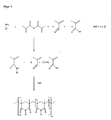
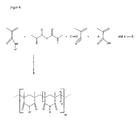
- Der hier beschriebenen Erfindung lag daher die Aufgabe zugrunde, eine Möglichkeit zu finden, hochmolekulare, substituierte Polymethacrylimide herzustellen. Gelöst werden kann diese Aufgabe durch Umsetzung eines primären Amins mit Methacrylsäureanhydrid, was zu Methacrylsäure und dem korrespondierenden Methacrylamid führt. Das hierbei entstehende Amid liegt dann in Lösung neben Methacrylsäure vor. Als geeignete Lösungsmittel bieten sich beispielsweise Gemische aus Methacrylsäure und Methacrylnitril an. Da diese beiden Monomere die Ausgangsverbindungen für ein unsubstituiertes Polymethacrylimid sind, kann gegebenenfalls eine Aufreinigung des Methacrylamid - Methacrylsäure - Gemisches entfallen. (Siehe Figur 1 und 2, wobei n≥0 ist.)
- Muss das für die Substitution zu verwendende Methacrylamid nicht in situ hergestellt werden, sondern steht zur Synthese zur Verfügung, so kann es mit Methacrylsäure oder Methacrylsäureanhydrid direkt umgesetzt werden.
- Durch Copolymerisation und anschließende Zyklisierung zum Polymethacrylimid ist eine Substitution auf diese Weise ebenfalls möglich. (Siehe Figur 3, wobei 0≤n≤1 ist, und Figur 4, wobei n≥0 ist.)
- Es lassen sich die folgenden Fälle unterscheiden:
- Vollsubstitution: 100% Substitutionsgrad: Als Substitutionsgrad ist hierbei der prozentuale Anteil der Anzahl der Polymethacrylimidmonomereinheiten gemeint, die am Stickstoffatom nicht mit einem Wasserstoffatom substituiert sind. Alle anderen Polymethacrylimidmonomereinheiten sind dann wasserstoffsubstitutiert. Dies gilt auch für alle weiteren angegebenen Substitutionsgrade. Um eine 100% Substitution am Stickstoffatom zu erreichen, muss das dem eingesetzten Amin korrespondierende Methacrylamid mit der gebildeten Methacrylsäure umgesetzt werden. Nachteilig ist in diesem Fall, dass die oben beschriebene Umsetzung eines primären Amins mit Methacrylsäureanhydrid nur möglich ist, wenn das Amin im Anhydrid löslich ist und das Produktgemisch flüssig. Andernfalls muss mit Lösungsmittel gearbeitet werden, welches vor der Polymerisation wieder entfernt werden muss. Zudem wird während der Zyklisierungsreaktion ein Wassermolekül abgespalten, so dass eine große Menge Wasser im System enthalten ist, die das Polymethacrylimid aufschäumt. Daher ist eine vollständige Substitution auf diesem Wege zwar möglich, aber mit Nachteilen verbunden. Siehe hierzu auch Figur 1 für n=0, wobei R1 einen Alkyl- oder Arylrest mit bis zu 36 C-Atomen darstellt, der zusätzlich Sauerstoff-, Stickstoff-, Schwefel-, und Phosphoratome in Form von typischen, organischen Funktionalitäten, wie beispielsweise eine Ether-, Alkohol- Säure-, Ester-, Amid-, Imid-, Phosphonsäure-, Phosphonsäureester, Phoshinsäure-, Phosphinsäureester-, Sulfonsäure-, Sulfonsäureester-, Sulfinsäure-, Sulfinsäureesterfunktion, Silicium-, Aluminium- und Boratome oder auch Halogene wie Fluor, Chlor, Brom oder Jod enthalten kann. Namentlich erwähnt, jedoch ohne hierauf beschränkt zu sein, sollen hier sein Methylamin, Ethylamin, n-Propylamin, 2-Propylamin, n-Butylamin, 2-Butylamin, 3-Methyl-2-Butylamin, tert.Butylamin, die Isomeren des Propyl-, Hexyl-, Heptylamins, die Isomeren des Octylamins, wie beispielsweise 2-Ethylhexylamin, Laurylamin, Stearylamin, Anilin, Benzylamin, Toluidin, Alkylaniline, Alkylbenzylamine, Etheramine, Amine der Formel H2NR3-O-R3, Esteramine, Amine der Formel H2NR3-PO(OR3)2 oder H2NR3-CO2-OR3, wobei R3 einen Alkyl- oder Arylrest mit bis zu 20 C-Atomen darstellt.
- Teilsubstitution: >0% bis <100% Substitutionsgrad: Es wird verfahren wie unter Fall 1 beschrieben. Allerdings wird die Umsetzung des primären Amins mit Methacrylsäureanhydrid in einer Lösung aus Methacrylsäure und Methacrylnitril durchgeführt, wobei die Menge des Lösungsmittelgemisches kleiner oder gleich der Menge an Monomeren sein muss, die man für den gewünschten Substitutionsgrad benötigt, damit ein Aufarbeitungsschritt entfallen kann. Das erhaltene Gemisch wird wie oben beschrieben in einer Kammer polymerisiert. Je nach gewünschtem Substitutionsgrad sinkt die Menge des während der anschließend durchgeführten Zyklisierung abgespaltenen Wassers. Siehe hierzu auch Figur 1 für n>0, wobei R1 wie vorher beschrieben zu verstehen ist. Zur Vereinfachung der Darstellung wurde in Figur 1 als Lösungsmittelgemisch eine stöchiometrische Zusammensetzung an Methacrylsäure und Methacrylnitril wiedergegeben, ohne jedoch hierauf beschränkt zu sein. D.h. eine Verschiebung der Monomerverhältnisse ist möglich (Vergleiche DE 2822885, DE 3346060, DE 3826469, DE 19717483)
- Teilsubstitution: >0% bis 33,3% Substitutionsgrad: Um die Wasserabspaltung in Fall 1 und 2 zu vermeiden, und die damit verbundenen Probleme zu umgehen, besteht die Möglichkeit, das bei der Zyklisierung von Amid und Methacrylsäure zum Imid entstehende Wasseräquivalent mit einem weiteren Äquivalent Methacrylsäureanhydrid abzufangen. Insgesamt entstehen daher zwei Äquivalente Methacrylsäure, die mit zwei Äquivalenten Methacrylnitril abgefangen werden können. Der maximal erreichbare Substitutionsgrad liegt dann bei 33,3%, was bedeutet, dass ein Drittel aller Monomereinheiten keine Wasserstoff- sondern eine davon verschiedene Substitution am Stickstoffatom aufweisen. Vorteilhaft ist in diesem Fall, dass zum einen keine Wasserabspaltung während der Zyklisierung auftritt und man zum anderen die Umsetzung des primären Amins mit einem Überschuss Methacrylsäureanhydrid in zwei Äquivalenten Methacrylnitril durchführen kann, ohne dass eine Aufarbeitung erfolgen muss. Dies hilft im Falle schwer löslicher Amine und reduziert die Wärmetönung der exothermen Reaktion. Analog zu Fall 2 kann man auch für Fall 3 die Umsetzung des primären Amins mit Methacrylsäureanhydrid in einer zusätzlichen Lösung aus Methacrylsäure und Methacrylnitril durchführen, wobei die Menge des Lösungsmittelgemisches kleiner oder gleich der Menge an Monomeren sein muss, die man für den gewünschten Substitutionsgrad benötigt, damit ein Aufarbeitungsschritt entfallen kann. Zu berücksichtigen ist hierbei, dass zwei Äquivalente Methacrylnitril durch die beiden erzeugte Äquivalente Methacrylsäure verbraucht werden. Siehe hierzu auch Figur 2 für n≥0, wobei R1 wie vorher beschrieben zu verstehen ist. Die Vorgehensweise wird in Figur 2 am Beispiel des Stearylamins demonstriert, ohne jedoch darauf beschränkt zu sein. Zur Vereinfachung der Darstellung wurde in Figur 2 ferner als Lösungsmittelgemisch eine stöchiometrische Zusammensetzung an Methacrylsäure und Methacrylnitril wiedergegeben, ohne jedoch hierauf beschränkt zu sein. D.h. eine Verschiebung der Monomerverhältnisse ist möglich.
- Vollsubstitution: 100% Substitutionsgrad: Die oben beschriebenen Fälle 1-3 beziehen sich auf die Vorgehensweise, wenn das zu verwendende Methacrylamid in situ hergestellt werden muss. Steht dieses Methacrylamid aber zur Synthese in Reinform zur Verfügung, so kann die Vorgehensweise geändert werden. Durch Umsetzung des N-Methacrylamidderivats mit einem Äquivalent Methacrylsäureanhydrid entsteht formal in situ ein halbes Äquivalent des korrespondierenden Methacrylimids. Durch Copolymerisation und anschließendes Zyklisieren zum Polymethacrylimid unter Abspaltung eines halben Äquivalentes Wasser kann das Endpolymer erhalten werden (Siehe Figur 3 für n=1).
- 50% bis <100 Substitutionsgrad: Es wird verfahren, wie für Fall 4 beschrieben. Zusätzlich wird dem Monomergemisch Methacrylnitril zugegeben, welches mit einem Teil der gebildeten Methacrylsäure reagiert (Siehe Figur 3 für 0<n≤1). Dies hilft insbesondere, wenn Löslichkeitsprobleme den Fall 4 für eine bestimmte Substitution nicht möglich machen. Auf diese Weise ist eine Teilsubstitution immer noch realisierbar. Es ist zwar auch denkbar ein Methacrylsäure - Methacrylnitril - Gemisch für eine Reduktion des Substitutionsgrades zu verwenden, jedoch ist es sinnvoller, entsprechend mehr Methacrylsäureanhydrid zu verwenden, um die Menge des während der Zyklisierung abgespaltenen Wassers zu minimieren. Die Verwendung eines Methacrylsäure- Methacrylnitril- Gemischs ist aber unter Umständen geeignet, um Löslichkeitsprobleme zu umgehen.
- Teilsubstitution: >0% bis 50% Substitutionsgrad: Der hierbei dargestellte Substitutionsgrad von 50% stellt den in Fall 5 bzw. Figur 3 beschriebenen Grenzfall für n=0 dar. In diesem Grenzfall wird das während der Zyklisierung abgespaltene Wasser vollständig abgefangen. Übertragen auf Figur 4, entspricht dies ebenfalls dem Fall n=0. Wird einem solchen Gemisch aus substituiertem Methacrylamid, Methacrylsäureanhydrid und Methacrylnitril ein Methacrylsäure - Methacrylnitril - Gemisch hinzugefügt, so lässt sich der Substitutionsgrad weiter vermindern und gleichzeitig das während der Zyklisierung gebildete Wasser vollständig abgefangen.
- Es besteht darüber hinaus die Möglichkeit, die oben beschriebenen Fälle zu kombinieren, wodurch die Anzahl der Möglichkeiten und des damit verbundenen Optimierungspotentials für ein bestimmtes Material noch höher wird. Denkbar ist hierbei beispielweise die Kombination eines Amids und Amins mit Methacrylsäureanhydrid, Methacrylsäure und Methacrylnitril. Eine Kombination lässt sich formal wieder in die oben genannten Fälle zerlegen, weshalb hier auf eine nähere Beschreibung verzichtet werden kann.
- Die erfindungsgemäßen Schäume erhält man, wenn man eine Mischung bestehend aus
- (A) 0 - 2,6 mol-Teilen eines oder mehrerer primärer Amine H2NR1, wobei R1 wie vorher beschrieben zu verstehen ist,
0 - 5,2 mol-Teilen eines oder mehrerer N-Methacrylamide C4H6NOR1 gemäß Figur 6, wobei R1 wie vorher beschrieben zu verstehen ist,
>0 - 6,5 mol-Teilen Methacrylsäureanhydrid,
0 - 3,9 mol-Teilen Methacrylnitril und
0 - 1,3 mol-Teilen Methacrylsäure; - (B) 0,3 - 2,0 mol-Teilen Methacrylnitril,
0,7 - 2,5 mol-Teilen Methacrylsäure und
0 - 0,2 mol-Teilen weitere vinylisch ungesättigte Monomere, wobei das Verhältnis der Summen der mol-Teile aus (B) und (A) bei (B)/(A)=0 bis 1 Million liegt; - (C) 0,5 - 15 Gewichtsprozent, bezogen auf die Summe der Gewichte der Komponenten (A) und (B), eines Treibmittels;
- (D) 0,01 bis 0,5 Gewichtsprozent, bezogen auf die Summe der Gewichte der Komponenten (A) und (B), eines oder mehrerer Polymerisationsinitiatoren;
- (E) 0 - 200 Gewichtsprozent, bezogen auf die Summe der Gewichte der Komponenten (A) und (B), üblichen Zusatzstoffen
- Als weitere, vinylisch ungesättigte Monomeren können beispielsweise Styrol oder Styrolderivate, wie Methylstyrol oder Chlorstyrol eingesetzt werden. Beispielhaft für Polymerisationsinitiatoren seien genannt: Azoverbindungen wie 2,2'-Azobis-(isobutyronitril) oder 2,2'-Azobis(2,4-dimethylvaleronitril), RedoxSysteme, wie beispielsweise die Kombination von tertiären Aminen mit Peroxiden oder bevorzugt Peroxide (vgl. hierzu beispielsweise H. Rauch-Puntigam, Th. Völker, "Acryl- und Methacrylverbindungen", Springer, Heidelberg, 1967 oder Kirk-Othmer, Encyclopedia of Chemical Technology, Vol. 1, Seiten 386ff, J. Wiley, New York, 1978). Beispiele geeigneter Peroxid-Polymerisationsinitiatoren sind Dilauroylperoxid, tert.-Butylperoctoat, tert.-Butylperisononanoat, Dicyclohexylperoxidicarbonat, Dibenzoylperoxid oder 2,2-Bis-(tert.-butylperoxy)-butan. Man kann auch bevorzugt die Polymerisation mit einem Gemisch verschiedener Polymerisationsinitiatoren unterschiedlicher Halbwertzeit durchführen, beispielsweise Dilauroylperoxid und 2,2-Bis-(tert.-butylperoxy)-butan, um den Radikalstrom im Verlauf der Polymerisation sowie bei verschiedenen Polymerisationstemperaturen konstant zu halten. Die eingesetzten Mengen an Polymerisationsinitiator liegen im allgemeinen bei 0,01 bis 2 Gew.-% bezogen auf das Monomerengemisch. Als Treibmittel zur Schäumung kann neben Wasser auch beispielsweise Formamid oder auch ein aliphatischer Alkohol mit 3 bis 8 Kohlenstoffatomen, wie beispielsweise 2-Propanol oder tert. -Butanol, eingesetzt werden.
- Von technischen Nutzen ist beispielsweise die Verminderung der Wasseraufnahme, wenn unpolare Seitenketten mit der erfindungsgemäßen Methode an das Polymer angebunden werden. Dies lässt sich beispielsweise mit Stearylamin oder Laurylamin realisieren, ohne jedoch hierauf beschränkt zu sein.
- Weiterhin lässt sich beispielsweise durch den Einbau von Seitenketten mit verschiedenen Polaritäten und/oder durch Variation des Substitutionsgrades die Polarität des Materials einstellen. Dies kann beispielsweise dazu benutzt werden, um die Haftung zu einem bestimmten Harz zu verbessern. Letzteres spielt in der Sandwichtechnologie eine große Rolle.
- Unpolare, aliphatische Ketten wirken zudem als intrinsische Weichmacher, d.h. der Weichmacher ist kovalent gebunden und kann nicht migrieren. Auf diese Weise lässt sich beispielsweise die Reißdehnung beeinflussen. Auch polare weichmachende Ketten sind möglich.
- Möglich ist auch die kovalente Anbindung von flammgeschützten Seitenketten, wie beispielsweise Phosphonsäuren und deren Ester, ohne dabei hierauf beschränkt zu sein. Vorteilhaft ist dabei, das zum einen keine Migrationsverluste des Flammschutzmittels auftreten können und das es auf molekularer Ebene verteilt ist, was dessen Wirksamkeit erhöht.
- Denkbar ist auch die Beeinflussung der dielektrischen Eigenschaften durch den Einbau von Aromaten mit bestimmter Substitutionsstruktur, beispielsweise Benzoesäureester. Die Polarisierbarkeiten und Dipolmomente der Aromaten wirken sich dabei auf die makroskopischen Eigenschaften aus.
- Vorteilhaft ist auch der Einbau von flüssigkristallinen Seitenketten oder flüssigkristallinen Precursorn, d.h. Seitenketten, die im ungebundenen Zustand selbst zwar nicht flüssigkristallin sind, angebunden an das Polymer aber eine flüssigkristalline Phase ausbilden. Derartige Phänome sind dem Fachmann allgemein bekannt und in der Literatur beschrieben. Auch in diesem Fall werden beispielsweise die dielektrischen Eigenschaften entscheidend von der flüssigkristallinen Phase beeinflusst. Zudem kann man mit Hilfe der flüssigkristallinen Phase beispielsweise die Wärmeausdehnung des Polymers und auch dessen mechanisches Verhalten, beispielsweise die Schlagzähigkeit, beeinflussen.
- Der Einbaum von makromolekularen Seitenketten erlaubt beispielsweise den Einbau von Weichphasen.
- Zu einem Gemisch aus 3360 g Methacrylsäureanhydrid, 1460 g Methacrylnitril, 690g 2-Propanol, 294 g Formamid wurden 5180 g Methacryl-amidomethanphosphonsäure-butylester langsam unter Rühren zugesetzt.
- Desweiteren wurden nach einstündigem Rühren der Mischung 3 g tert.-Butylperpivalat, 2 g tert.-Butylper-2-ethyl-hexanoat, 7 g tert.-Butylperbenzoat, 7 g Cumylperneodecanoat, 0,5 g Hydrochinonmonomethylether und 17,0 g PAT 1037 (Vertrieb: E. und P. Würtz GmbH & Co. KG, Industriegebiet, In der Weide 13+18, 55411 Bingen, Sponsheim.) als Trennmittel hinzugefügt.
- Das Gemisch wurde bis zur Homogenisierung gerührt und anschließend 19 h bei 38°C in einer aus zwei Glasplatten der Größe 50x50cm und einer 1,85 cm dicken Randabdichtung gebildeten Kammer polymerisiert. Anschließend wurde das Polymerisat zur Endpolymerisation 17,25 h einem von 40°C bis 115°C reichenden Temperprogramm unterworfen. Die darauffolgende Schäumung erfolgte 2h bei 170°C. Der so erhaltene Schaumstoff wies ein Raumgewicht von 27 kg/m3 auf. Der Substitutionsgrad des Schaums betrug etwa 50%.
- Der so hergestellte Schaum war durch den kovalent gebundenen, und somit molekular verteilten Phosphonsäureester flammgeschützt ausgerüstet und dem gemäß selbstverlöschend.
- Zu einem Gemisch aus 3734 g Methacrylsäure, 3741 g Methacrylnitril und 1911 g Methacrylsäureanhydrid wurden 1149 g Stearylamin unter Rühren langsam zugetropft. Nach Abkühlen der Lösung auf Raumtemperatur wurden dem Gemisch des weiteren 295 g tert.-Butanol, 126 g Formamid, 4 g tert.-Butylperpivalat, 3,5 g tert.-Butylper-2-ethyl-hexanoat, 10 g tert.-Butylperbenzoat, 10,3 g Cumylperneodecanoat, 0,5 g Hydrochinonmonomethylether und 16 g PAT 1037 als Trennmittel hinzugefügt.
- Das Gemisch wurde bis zur Homogenisierung gerührt und anschließend 20 h bei 38,5°C in einer aus zwei Glasplatten der Größe 50x50cm und einer 1,85 cm dicken Randabdichtung gebildeten Kammer polymerisiert. Anschließend wurde das Polymerisat zur Endpolymerisation 17,25 h einem von 40°C bis 115°C reichenden Temperprogramm unterworfen. Die darauffolgende Schäumung erfolgte 2h bei 230°C. Der so erhaltene Schaumstoff wies ein Raumgewicht von 80 kg/m3 auf. Der Substitutionsgrad des Schaums betrug 10%.
- Zu einem Gemisch aus 2653 g Methacrylsäure, 3196 g Methacrylnitril und 2592 g Methacrylsäureanhydrid wurden 1558 g Stearylamin unter Rühren langsam zugetropft. Nach Abkühlen der Lösung auf Raumtemperatur wurden dem Gemisch des weiteren 295 g tert.-Butanol, 126 g Formamid, 3,8 g tert.-Butylperpivalat, 3,4 g tert.-Butylper-2-ethyl-hexanoat, 9,4 g tert.-Butylperbenzoat, 9,7 g Cumylperneodecanoat, 0,5 g Hydrochinonmonomethylether und 16 g PAT 1037 als Trennmittel hinzugefügt.
- Das Gemisch wurde bis zur Homogenisierung gerührt und anschließend 19 h bei 39°C in einer aus zwei Glasplatten der Größe 50x50cm und einer 1,85 cm dicken Randabdichtung gebildeten Kammer polymerisiert. Anschließend wurde das Polymerisat zur Endpolymerisation 17,25 h einem von 40°C bis 115°C reichenden Temperprogramm unterworfen. Die darauffolgende Schäumung erfolgte 2h bei 190°C. Der so erhaltene Schaumstoff wies ein Raumgewicht von 134 kg/m3 auf. Der Substitutionsgrad des Schaums betrug 15%.
- Zu einem Gemisch aus 4844 g Methacrylsäure, 4070 g Methacrylnitril und 679 g Methacrylsäureanhydrid wurden 408 g Stearylamin unter Rühren langsam zugetropft. Nach Abkühlen der Lösung auf Raumtemperatur wurden dem Gemisch des weiteren 295 g tert.-Butanol, 126 g Formamid, 3,8 g tert.-Butylperpivalat, 3,4 g tert.-Butylper-2-ethyl-hexanoat, 9,5 g tert.-Butylperbenzoat, 9,8 g Cumylperneodecanoat, 0,5 g Hydrochinonmonomethylether und 16 g PAT 1037 als Trennmittel hinzugefügt.
- Das Gemisch wurde bis zur Homogenisierung gerührt und anschließend 19 h bei 38,7°C in einer aus zwei Glasplatten der Größe 50x50cm und einer 1,85 cm dicken Randabdichtung gebildeten Kammer polymerisiert. Anschließend wurde das Polymerisat zur Endpolymerisation 17,25 h einem von 40°C bis 115°C reichenden Temperprogramm unterworfen. Die darauffolgende Schäumung erfolgte 2h bei 210°C. Der so erhaltene Schaumstoff wies ein Raumgewicht von 99 kg/m3 auf. Der Substitutionsgrad des Schaums betrug 3,5%.
- Die Wasseraufnahme des Schaums betrug nach 28 bei 70°C und 95% relativer Luftfeuchte 8%, was eine Verbesserung um 10% gegenüber der entsprechenden unsubstituierten Probe bedeutet. Eine zu Beispiel 4 hergestellte Vergleichsprobe mit einem Substitutionsgrad von 0% nimmt unter diesen Bedingungen 9% Wasser auf. Hieraus wird deutlich, das die Beeinflussung der Materialeigenschaften schon bei kleinen Substitutionsgraden erheblich ist.
- Zu einem Gemisch aus 3802 g Methacrylsäure, 3587 g Methacrylnitril und 1434 g Methacrylsäureanhydrid wurden 862 g Laurylamin unter Rühren langsam zugetropft. Nach Abkühlen der Lösung auf Raumtemperatur wurden dem Gemisch des weiteren 295 g tert.-Butanol, 126 g Formamid, 4 g tert.-Butylperpivalat, 3,5 g tert.-Butylper-2-ethyl-hexanoat, 10 g tert.-Butylperbenzoat, 10,3 g Cumylperneodecanoat, 0,5 g Hydrochinonmonomethylether und 16 g PAT 1037 als Trennmittel hinzugefügt.
- Das Gemisch wurde bis zur Homogenisierung gerührt und anschließend 21 h bei 39,5°C in einer aus zwei Glasplatten der Größe 50x50cm und einer 1,85 cm dicken Randabdichtung gebildeten Kammer polymerisiert. Anschließend wurde das Polymerisat zur Endpolymerisation 17,25 h einem von 40°C bis 115°C reichenden Temperprogramm unterworfen. Die darauffolgende Schäumung erfolgte 2h bei 210°C. Der so erhaltene Schaumstoff wies ein Raumgewicht von 70 kg/m3 auf. Der Substitutionsgrad des Schaums betrug 8%.
- Ein nicht substituierter Schaumstoff mit einem Raumgewicht von 71 kg/m3 wurde gemäß DE 33 46 060 hergestellt. Hierzu wurden einer Mischung aus gleichen mol-Teilen an 5620g Methacrylsäure und 4380g Methacrylnitril 140g Formamid und 135g Wasser als Treibmittel zugesetzt. Des weiteren wurden der Mischung 10,0g tert.-Butylperbenzoat, 4,0g tert.-Butylperpivalat, 3,0g tert.-Butylper-2-ethylhexanoat und 10,0g Cumylperneodecanoat als Initiatoren beigefügt. Darüber hinaus wurden dem Gemisch 1000g Dimethylmethanphosphonat (DMMP) als Flammschutzmittel zugefügt. Schließlich enthielt die Mischung 20g Trennmittel (MoldWiz), 70g ZnO und 0,5g Hydochinonmonomethylether.
- Diese Mischung wurde 92h bei 40°C in einer aus zwei Glasplatten der Größe 50x50cm und einer 2,2cm dicken Randabdichtung gebildeten Kammer polymerisiert. Anschließend wurde das Polymerisat zur Endpolymerisation 17,25h einem von 40°C bis 115°C reichenden Temperprogramm unterworfen. Die darauffolgende Schäumung erfolgte 2h bei 215°C. Der so erhaltene Schaumstoff wies ein Raumgewicht von 71 kg/m3 auf.
Claims (14)
- Verwendung einer Zusammensetzung zur Herstellung von Poly(meth)acrylimiden und Poly(meth)acrylimid-Schaumstoffen,
dadurch gekennzeichnet,
daß der Zusammensetzung ein oder mehrere voneinander verschiedene N-Methacrylamide C4H6NOR1 und/oder ein oder mehrere voneinander verschiedene primäre Amine H2NR2 und/oder Methacrylsäureanhydrid zugegeben werden, wobei R1 oder R2 gleich oder verschieden sein können und einen Alkyl- oder Arylrest mit bis zu 36 C-Atomen darstellen, der zusätzlich Sauerstoff-, Stickstoff-, Schwefel-, und Phosphoratome in Form von organischen Funktionalitäten, wie eine Ether-, Alkohol- Säure-, Ester-, Amid- , Imid-, Phosphonsäure-, Phosphonsäureester, Phoshinsäure-, Phosphinsäureester-, Sulfonsäure-, Sulfonsäureester-, Sulfinsäure-, Sulfinsäureesterfunktion, Silicium-, Aluminium- und Boratome oder Halogene wie Fluor, Chlor, Brom oder Jod enthalten kann, die Bedeutung von R1 und R2 kann ferner sein die Methylgruppe, die Ethylgruppe, die n-Propylgruppe, 2-Propylgruppe, n-Butylgruppe, 2-Butylgruppe, 3-Methyl-2-Butylgruppe, tert.Butylgruppe, die Isomeren der Propyl-, Hexyl-, Heptylgruppe, die Isomeren der Octylgruppe, die 2-Ethylhexylgruppe, die Laurylgruppe, Stearylgruppe, die Phenylgruppe, Benzylgruppe, Alkylphenylgruppe, Alkylbenzylgruppe, R3-PO(OR3)2-Gruppe, wobei R3 einen Alkyl- oder Arylrest mit bis zu 20 C-Atomen darstellt. - Zusammensetzung zur Herstellung von Poly(meth)acrylimiden und Poly(meth)acrylimid-Schaumstoffen,
dadurch gekennzeichnet,
daß der Zusammensetzung ein oder mehrere voneinander verschiedene N-Methacrylamide C4H6NOR1 und/oder ein oder mehrere voneinander verschiedene primäre Amine H2NR2 und/oder Methacrylsäureanhydrid zugegeben werden, wobei R1 oder R2 gleich oder verschieden sein können und einen Alkyl- oder Arylrest mit bis zu 36 C-Atomen darstellen, der zusätzlich Sauerstoff-, Stickstoff-, Schwefel-, und Phosphoratome in Form von organischen Funktionalitäten, wie eine Ether-, Alkohol- Säure-, Ester-, Amid- , Imid-, Phosphonsäure-, Phosphonsäureester, Phoshinsäure-, Phosphinsäureester-, Sulfonsäure-, Sulfonsäureester-, Sulfinsäure-, Sulfinsäureesterfunktion, Silicium-, Aluminium- und Boratome oder Halogene wie Fluor, Chlor, Brom oder Jod enthalten kann, die Bedeutung von R1 und R2 kann ferner sein die Methylgruppe, die Ethylgruppe, die n-Propylgruppe, 2-Propylgruppe, n-Butylgruppe, 2-Butylgruppe, 3-Methyl-2-Butylgruppe, tert.Butylgruppe, die Isomeren der Propyl-, Hexyl-, Heptylgruppe, die Isomeren der Octylgruppe, die 2-Ethylhexylgruppe, die Laurylgruppe, Stearylgruppe, die Phenylgruppe, Benzylgruppe, Alkylphenylgruppe, Alkylbenzylgruppe, R3-PO(OR3)2-Gruppe, wobei R3 einen Alkyl- oder Arylrest mit bis zu 20 C-Atomen darstellt und dass die Zusammensetzung ein Treibmittel enthält. - Zusammensetzung gemäß Anspruch 2,
dadurch gekennzeichnet,
dass es sich bei dem Treibmittel um einen aliphatischen Alkohol mit 3 bis 8 Kohlenstoffatomen, Harnstoff, Monomethyl- und/oder N,N'-Dimethylharnstoff und/oder Formamid und/oder Wasser handelt. - Verfahren zur Herstellung eines Polymethacrylimid-Schaumstoffes,
dadurch gekennzeichnet,
dass man eine Mischung bestehend aus(A) 0,7 - 1,3 mol-Teilen eines oder mehrerer primärer Amine H2NR2, wobei R2 wie vorher beschrieben zu verstehen ist,
0,7 - 1,3 mol-Teilen Methacrylsäureanhydrid;(B) 0,3 - 2,0 mol-Teilen Methacrylnitril,
0,7 - 2,5 mol-Teilen Methacrylsäure und
0 - 0,2 mol-Teilen weitere vinylisch ungesättigte Monomere, wobei der molare Anteil der Monomere aus (A) bei mindestens 0,0001 mol% der Gesamtmonomermenge aus (A) und (B) liegt;(C) 0,5 - 15 Gewichtsprozent, bezogen auf die Summe der Gewichte der Komponenten (A) und (B), Treibmittel;(D) 0,01 bis 0,5 Gewichtsprozent, bezogen auf die Summe der Gewichte der Komponenten (A) und (B), Polymerisationsinitiatoren;(E) 0 - 200 Gewichtsprozent, bezogen auf die Summe der Gewichte der Komponenten (A) und (B), übliche Zusatzstoffezu einer Platte polymerisiert und anschließend diese Polymerisatplatte bei Temperaturen von 150 bis 250 °C schäumt. - Verfahren zur Herstellung eines Polymethacrylimid-Schaumstoffes,
dadurch gekennzeichnet,
dass man eine Mischung bestehend aus(A) 0,7 - 1,3 mol-Teilen eines oder mehrerer primärer Amine H2NR2, wobei R2 wie vorher beschrieben zu verstehen ist,
1,4 - 2,6 mol-Teilen Methacrylsäureanhydrid,
1,4 - 2,6 mol-Teilen Methacrylnitril;(B) 0,3 - 2,0 mol-Teilen Methacrylnitril,
0,7 - 2,5 mol-Teilen Methacrylsäure und
0 - 0,2 mol-Teilen weitere vinylisch ungesättigte Monomere, wobei der molare Anteil der Monomere aus (A) bei mindestens 0,0001 mol% der Gesamtmonomermenge aus (A) und (B) liegt;(C) 0,5 - 15 Gewichtsprozent, bezogen auf die Summe der Gewichte der Komponenten (A) und (B), eine Treibmittel;(D) 0,01 bis 0,5 Gewichtsprozent, bezogen auf die Summe der Gewichte der Komponenten (A) und (B), eines oder mehrerer Polymerisationsinitiatoren;(E) 0 - 200 Gewichtsprozent, bezogen auf die Summe der Gewichte der Komponenten (A) und (B), üblichen Zusatzstoffenzu einer Platte polymerisiert und anschließend diese Polymerisatplatte bei Temperaturen von 150 bis 250°C schäumt. - Verfahren zur Herstellung eines Polymethacrylimid-Schaumstoffes,
dadurch gekennzeichnet,
dass man eine Mischung bestehend aus(A) 10-7 - 1,3 mol-Teilen eines oder mehrerer N-Methacrylamide H2C=CCH3CONR1, wobei R1 wie vorher beschrieben zu verstehen ist,
0,7 - 1,3 mol-Teilen Methacrylsäureanhydrid,
10-7 - 1,3 mol-Teilen Methacrylnitril, wobei die Summe der mol-Teile aus Methacrylnitril und dem N-Methacrylamid zwischen 0,7 und 1,3 mol-Teilen liegt;(B) 0 - 0,2 mol-Teilen weiteren vinylisch ungesättigten Monomeren,(C) 0,5 - 15 Gewichtsprozent, bezogen auf die Summe der Gewichte der Komponenten (A) und (B), Treibmittel;(D) 0,01 bis 0,5 Gewichtsprozent, bezogen auf die Summe der Gewichte der Komponenten (A) und (B), eines oder mehrerer Polymerisationsinitiatoren;(E) 0 - 200 Gewichtsprozent, bezogen auf die Summe der Gewichte der Komponenten (A) und (B), üblichen Zusatzstoffenzu einer Platte polymerisiert und anschließend diese Polymerisatplatte bei Temperaturen von 150 bis 250 °C schäumt. - Verfahren zur Herstellung eines Polymethacrylimid-Schaumstoffes,
dadurch gekennzeichnet,
dass man eine Mischung bestehend aus(A) 0,7 - 1,3 mol-Teilen eines oder mehrerer N-Methacrylamide H2C=CCH3CONR1, wobei R1 wie vorher beschrieben zu verstehen ist,
0,7 - 1,3 mol-Teilen Methacrylsäureanhydrid,
0,7 - 1,3 mol-Teilen Methacrylnitril;(B) 0,3 - 2,0 mol-Teilen Methacrylnitril,
0,7 - 2,5 mol-Teilen Methacrylsäure und
0 - 0,2 mol-Teilen weiteren vinylisch ungesättigten Monomeren;(C) 0,5 - 15 Gewichtsprozent, bezogen auf die Summe der Gewichte der Komponenten (A) und (B), eines Treibmittels;(D) 0,01 bis 0,5 Gewichtsprozent, bezogen auf die Summe der Gewichte der Komponenten (A) und (B), eines oder mehrerer Polymerisationsinitiatoren;(E) 0 - 200 Gewichtsprozent, bezogen auf die Summe der Gewichte der Komponenten (A) und (B), üblichen Zusatzstoffenzu einer Platte polymerisiert und anschließend diese Polymerisatplatte bei Temperaturen von 150 bis 250 °C schäumt. - Verfahren zur Herstellung eines Polymethacrylimid-Schaumstoffes,
dadurch gekennzeichnet,
dass man eine Mischung bestehend aus(A) 0 - 2,6 mol-Teilen eines oder mehrerer primärer Amine H2NR2, wobei R2 wie vorher beschrieben zu verstehen ist,
0 - 5,2 mol-Teilen eines oder mehrerer N-Methacrylamide H2C=CCH3CONR1, wobei R1 wie vorher beschrieben zu verstehen ist,
0 - 6,5 mol-Teilen Methacrylsäureanhydrid,
0 - 3,9 mol-Teilen Methacrylnitril und
0 - 1,3 mol-Teilen Methacrylsäure;(B) 0,3 - 2,0 mol-Teilen Methacrylnitril,
0,7 - 2,5 mol-Teilen Methacrylsäure und
0 - 0,2 mol-Teilen weitere vinylisch ungesättigte Monomere, wobei der molare Anteil der Monomere aus (A) bei mindestens 0,0001 mol% der Gesamtmonomermenge aus (A) und (B) liegt;(C) 0,5 - 15 Gewichtsprozent, bezogen auf die Summe der Gewichte der Komponenten (A) und (B), Treibmittel;(D) 0,01 bis 0,5 Gewichtsprozent, bezogen auf die Summe der Gewichte der Komponenten (A) und (B), eines oder mehrerer Polymerisationsinitiatoren;(E) 0 - 200 Gewichtsprozent, bezogen auf die Summe der Gewichte der Komponenten (A) und (B), üblichen Zusatzstoffenzu einer Platte polymerisiert und anschließend diese Polymerisatplatte bei Temperaturen von 150 bis 250°C schäumt. - Verfahren gemäß einem der Ansprüche 3-8,
dadurch gekennzeichnet,
dass als Treibmittel ein aliphatischer Alkohol mit 3 bis 8 Kohlenstoffatomen, Harnstoff, Monomethyl- und/oder N,N'-Dimethylharnstoff und/oder Formamid und/oder Wasser eingesetzt wird. - Schichtwerkstoff, enthaltend eine Schicht eines Poly(meth)acrylimid-Schaumstoffes gemäß Anspruch 1-9.
- Automobil,
dadurch gekennzeichnet,
dass es ganz oder teilweise aus einem Poly(meth)acrylimid-Schaumstoff gemäß mindestens einem der vorstehenden Ansprüche besteht. - Schienenfahrzeug,
dadurch gekennzeichnet,
dass es ganz oder teilweise aus einem Poly(meth)acrylimid-Schaumstoff gemäß mindestens einem der vorstehenden Ansprüche besteht. - Wasserfahrzeug,
dadurch gekennzeichnet,
dass es ganz oder teilweise aus einem Poly(meth)acrylimid-Schaumstoff gemäß mindestens einem der vorstehenden Ansprüche besteht. - Rotor,
dadurch gekennzeichnet,
dass er ganz oder teilweise aus einem Poly(meth)acrylimid-Schaumstoff gemäß mindestens einem der vorstehenden Ansprüche besteht.
Applications Claiming Priority (3)
| Application Number | Priority Date | Filing Date | Title |
|---|---|---|---|
| DE10259674 | 2002-12-18 | ||
| DE10259674A DE10259674A1 (de) | 2002-12-18 | 2002-12-18 | Derivatisierung hochmolekularer Polymethacrylimide |
| PCT/EP2003/011542 WO2004111100A1 (de) | 2002-12-18 | 2003-10-18 | Derivatisierung hochmolekularer polymethacrylimide |
Publications (2)
| Publication Number | Publication Date |
|---|---|
| EP1572765A1 EP1572765A1 (de) | 2005-09-14 |
| EP1572765B1 true EP1572765B1 (de) | 2007-05-30 |
Family
ID=32519139
Family Applications (1)
| Application Number | Title | Priority Date | Filing Date |
|---|---|---|---|
| EP03816984A Expired - Lifetime EP1572765B1 (de) | 2002-12-18 | 2003-10-18 | Derivatisierung hochmolekularer polymethacrylimide |
Country Status (9)
| Country | Link |
|---|---|
| US (1) | US20060035992A1 (de) |
| EP (1) | EP1572765B1 (de) |
| CN (1) | CN1729216A (de) |
| AT (1) | ATE363496T1 (de) |
| AU (1) | AU2003304206A1 (de) |
| CA (1) | CA2509596A1 (de) |
| DE (2) | DE10259674A1 (de) |
| TW (1) | TW200422306A (de) |
| WO (1) | WO2004111100A1 (de) |
Families Citing this family (7)
| Publication number | Priority date | Publication date | Assignee | Title |
|---|---|---|---|---|
| US20100143432A1 (en) * | 2007-05-22 | 2010-06-10 | Basf Se | Method for Protecting Wood Stacks from Infestation by Wood Pests |
| US8653004B2 (en) | 2007-08-02 | 2014-02-18 | Basf Se | Actives-comprising polymer networks, processes for producing them, and their use |
| CN101381427B (zh) * | 2007-09-04 | 2013-06-26 | 赢创罗姆有限公司 | 制备块状聚(甲基)丙烯酰亚胺泡沫材料的方法 |
| DE102008001695A1 (de) | 2008-05-09 | 2009-11-12 | Evonik Röhm Gmbh | Poly(meth)acrylimide mit verbesserten optischen und Farbeigenschaften, insbesondere bei thermischer Belastung |
| CN102127225A (zh) * | 2010-12-08 | 2011-07-20 | 北京市射线应用研究中心 | 一种硬质聚酰亚胺泡沫结构材料及其制备方法 |
| CN114380941A (zh) * | 2022-01-17 | 2022-04-22 | 山东天复新材料有限公司 | 低吸湿率聚甲基丙烯酰亚胺泡沫及其制备方法 |
| CN114874483B (zh) * | 2022-05-30 | 2023-08-29 | 湖南博翔新材料有限公司 | 一种pmi泡沫材料及其制备方法和应用 |
Family Cites Families (4)
| Publication number | Priority date | Publication date | Assignee | Title |
|---|---|---|---|---|
| DE19717483C2 (de) * | 1997-04-25 | 2000-05-04 | Roehm Gmbh | Polymethacrylimid-Schaumstoffe, Verfahren zu ihrer Herstellung und ihre Verwendung |
| DE10052239A1 (de) * | 2000-10-21 | 2002-05-02 | Roehm Gmbh | Zusammensetzungen zur Herstellung von Poly(meth)arylimid-Schaumstoffen mit verminderter Entflammbarkeit, Poly(meth)acrylimid-Formmassen, Poly(meth)acrylimid-Schaumstoffe sowie Verfahren zur Herstellung |
| DE10141757A1 (de) * | 2001-08-29 | 2003-03-27 | Roehm Gmbh | Verbessertes Verfahren zur Herstellung von PMI-Schäumen |
| WO2003072647A1 (de) * | 2002-02-28 | 2003-09-04 | Röhm GmbH & Co. KG | Polymethacrylimid-schaumstoffe mit verminderter entflammbarkeit sowie verfahren zur herstellung |
-
2002
- 2002-12-18 DE DE10259674A patent/DE10259674A1/de not_active Withdrawn
-
2003
- 2003-10-18 EP EP03816984A patent/EP1572765B1/de not_active Expired - Lifetime
- 2003-10-18 WO PCT/EP2003/011542 patent/WO2004111100A1/de not_active Ceased
- 2003-10-18 CA CA002509596A patent/CA2509596A1/en not_active Abandoned
- 2003-10-18 CN CNA2003801067314A patent/CN1729216A/zh active Pending
- 2003-10-18 DE DE50307395T patent/DE50307395D1/de not_active Expired - Fee Related
- 2003-10-18 AU AU2003304206A patent/AU2003304206A1/en not_active Abandoned
- 2003-10-18 US US10/539,417 patent/US20060035992A1/en not_active Abandoned
- 2003-10-18 AT AT03816984T patent/ATE363496T1/de not_active IP Right Cessation
- 2003-12-16 TW TW092135530A patent/TW200422306A/zh unknown
Non-Patent Citations (1)
| Title |
|---|
| None * |
Also Published As
| Publication number | Publication date |
|---|---|
| AU2003304206A1 (en) | 2005-01-04 |
| WO2004111100A9 (de) | 2005-09-29 |
| EP1572765A1 (de) | 2005-09-14 |
| TW200422306A (en) | 2004-11-01 |
| WO2004111100A1 (de) | 2004-12-23 |
| US20060035992A1 (en) | 2006-02-16 |
| CN1729216A (zh) | 2006-02-01 |
| CA2509596A1 (en) | 2004-12-23 |
| DE50307395D1 (de) | 2007-07-12 |
| ATE363496T1 (de) | 2007-06-15 |
| DE10259674A1 (de) | 2004-07-15 |
Similar Documents
| Publication | Publication Date | Title |
|---|---|---|
| DE69518423T2 (de) | Kontinuierliches Verfahren zur Herstellung von sehr stabilen, feinstteiligen, niedrig viskösen Polymerpolyolen mit niedriger durchmittlicher Teilchengrösse | |
| DE2656600C3 (de) | Verfahren zur Herstellung eines gegebenenfalls zelligen Polymerisats | |
| EP3688080B1 (de) | Polyetherblockamid-poly(meth)acrylat-schäume | |
| DE1152537B (de) | Verfahren zur Herstellung von homogenen, Urethangruppen aufweisenden Kunststoffen | |
| EP1664136A2 (de) | Hydrogel | |
| EP3356453B1 (de) | Thermisch expandierbare zusammensetzungen mit harnstoff-derivaten | |
| EP0656374B1 (de) | Polymethacrylat-Formmasse mit hoher Wärmeformbeständigkeit und hoher Stabilität gegen thermischen Abbau | |
| DE2559255C2 (de) | Verfahren zur Herstellung anorganisch-organischer Kunststoffe | |
| EP3075769A1 (de) | Herstellung eines PMMA-Schaumstoffs unter Verwendung von Vernetzern, Reglern und Treibmitteln | |
| DE60117866T2 (de) | Zweikomponentige chemische befestigungssysteme | |
| US20120029104A1 (en) | Composition comprising stable polyol mixtures | |
| DE10259674A1 (de) | Derivatisierung hochmolekularer Polymethacrylimide | |
| DE2741196A1 (de) | Verfahren zur herstellung von perlpolymeren | |
| DE60120773T2 (de) | Peroxidzusammensetzungen mit reaktiven verdünnungsmitteln | |
| DE2440026A1 (de) | Praeparat zur herstellung expandierter cellularer polymerisate und verfahren zu ihrer herstellung | |
| EP1698666B1 (de) | Stabilisierte ungesättigte Polyesterharzmischungen | |
| DE2829572A1 (de) | Gehaertete oder ungehaertete lineare aromatische polyestermasse und verfahren zu deren anwendung | |
| DE68915824T2 (de) | Cyclische Monoperoxyketale. | |
| DE60107984T2 (de) | Verfahren zur herstellung von vernetzten polyolefinen | |
| DE112005002037T5 (de) | Verfahren zur Herstellung von Kunstharzen auf Polyisocyanat/Polykieselsäurebasis mit innerhalb eines weiten Bereiches regelbarer Verarbeitungs- und Abbindezeit | |
| DE60010210T2 (de) | Polymer und makromolekularer Festkörperelektrolyt enthaltend solches Polymer | |
| DE3004532C2 (de) | Peroxyderivate von &alpha;, &omega; - bis (Carboxy- bzw. Hydroxymethylen)-3,3'-azo-bis (3-cyan)-butyl und Verfahren zu ihrer Herstellung | |
| WO2012150249A1 (de) | Wärmeformbeständiger und flammgeschützter extrusionsschaumstoff aus styrolcopolymeren | |
| DE69205450T2 (de) | Organisch nicht-lineares optisches Material. | |
| HK1087132A (en) | Derivatisation of polymethacrylimides with a high molecular weight |
Legal Events
| Date | Code | Title | Description |
|---|---|---|---|
| PUAI | Public reference made under article 153(3) epc to a published international application that has entered the european phase |
Free format text: ORIGINAL CODE: 0009012 |
|
| 17P | Request for examination filed |
Effective date: 20050511 |
|
| AK | Designated contracting states |
Kind code of ref document: A1 Designated state(s): AT BE BG CH CY CZ DE DK EE ES FI FR GB GR HU IE IT LI LU MC NL PT RO SE SI SK TR |
|
| AX | Request for extension of the european patent |
Extension state: AL LT LV MK |
|
| DAX | Request for extension of the european patent (deleted) | ||
| RAP1 | Party data changed (applicant data changed or rights of an application transferred) |
Owner name: ROEHM GMBH |
|
| 17Q | First examination report despatched |
Effective date: 20051115 |
|
| GRAP | Despatch of communication of intention to grant a patent |
Free format text: ORIGINAL CODE: EPIDOSNIGR1 |
|
| GRAS | Grant fee paid |
Free format text: ORIGINAL CODE: EPIDOSNIGR3 |
|
| GRAA | (expected) grant |
Free format text: ORIGINAL CODE: 0009210 |
|
| AK | Designated contracting states |
Kind code of ref document: B1 Designated state(s): AT BE BG CH CY CZ DE DK EE ES FI FR GB GR HU IE IT LI LU MC NL PT RO SE SI SK TR |
|
| PG25 | Lapsed in a contracting state [announced via postgrant information from national office to epo] |
Ref country code: FI Free format text: LAPSE BECAUSE OF FAILURE TO SUBMIT A TRANSLATION OF THE DESCRIPTION OR TO PAY THE FEE WITHIN THE PRESCRIBED TIME-LIMIT Effective date: 20070530 |
|
| REG | Reference to a national code |
Ref country code: GB Ref legal event code: FG4D Free format text: NOT ENGLISH |
|
| REG | Reference to a national code |
Ref country code: CH Ref legal event code: EP |
|
| REG | Reference to a national code |
Ref country code: IE Ref legal event code: FG4D Free format text: LANGUAGE OF EP DOCUMENT: GERMAN |
|
| REF | Corresponds to: |
Ref document number: 50307395 Country of ref document: DE Date of ref document: 20070712 Kind code of ref document: P |
|
| PG25 | Lapsed in a contracting state [announced via postgrant information from national office to epo] |
Ref country code: SE Free format text: LAPSE BECAUSE OF FAILURE TO SUBMIT A TRANSLATION OF THE DESCRIPTION OR TO PAY THE FEE WITHIN THE PRESCRIBED TIME-LIMIT Effective date: 20070830 |
|
| PG25 | Lapsed in a contracting state [announced via postgrant information from national office to epo] |
Ref country code: ES Free format text: LAPSE BECAUSE OF FAILURE TO SUBMIT A TRANSLATION OF THE DESCRIPTION OR TO PAY THE FEE WITHIN THE PRESCRIBED TIME-LIMIT Effective date: 20070910 |
|
| RAP2 | Party data changed (patent owner data changed or rights of a patent transferred) |
Owner name: EVONIK ROEHM GMBH |
|
| NLV1 | Nl: lapsed or annulled due to failure to fulfill the requirements of art. 29p and 29m of the patents act | ||
| GBV | Gb: ep patent (uk) treated as always having been void in accordance with gb section 77(7)/1977 [no translation filed] |
Effective date: 20070530 |
|
| REG | Reference to a national code |
Ref country code: IE Ref legal event code: FD4D |
|
| PG25 | Lapsed in a contracting state [announced via postgrant information from national office to epo] |
Ref country code: NL Free format text: LAPSE BECAUSE OF FAILURE TO SUBMIT A TRANSLATION OF THE DESCRIPTION OR TO PAY THE FEE WITHIN THE PRESCRIBED TIME-LIMIT Effective date: 20070530 Ref country code: IE Free format text: LAPSE BECAUSE OF FAILURE TO SUBMIT A TRANSLATION OF THE DESCRIPTION OR TO PAY THE FEE WITHIN THE PRESCRIBED TIME-LIMIT Effective date: 20070530 Ref country code: BG Free format text: LAPSE BECAUSE OF FAILURE TO SUBMIT A TRANSLATION OF THE DESCRIPTION OR TO PAY THE FEE WITHIN THE PRESCRIBED TIME-LIMIT Effective date: 20070830 Ref country code: SI Free format text: LAPSE BECAUSE OF FAILURE TO SUBMIT A TRANSLATION OF THE DESCRIPTION OR TO PAY THE FEE WITHIN THE PRESCRIBED TIME-LIMIT Effective date: 20070530 Ref country code: PT Free format text: LAPSE BECAUSE OF FAILURE TO SUBMIT A TRANSLATION OF THE DESCRIPTION OR TO PAY THE FEE WITHIN THE PRESCRIBED TIME-LIMIT Effective date: 20071030 Ref country code: CZ Free format text: LAPSE BECAUSE OF FAILURE TO SUBMIT A TRANSLATION OF THE DESCRIPTION OR TO PAY THE FEE WITHIN THE PRESCRIBED TIME-LIMIT Effective date: 20070530 Ref country code: DK Free format text: LAPSE BECAUSE OF FAILURE TO SUBMIT A TRANSLATION OF THE DESCRIPTION OR TO PAY THE FEE WITHIN THE PRESCRIBED TIME-LIMIT Effective date: 20070530 |
|
| PG25 | Lapsed in a contracting state [announced via postgrant information from national office to epo] |
Ref country code: SK Free format text: LAPSE BECAUSE OF FAILURE TO SUBMIT A TRANSLATION OF THE DESCRIPTION OR TO PAY THE FEE WITHIN THE PRESCRIBED TIME-LIMIT Effective date: 20070530 |
|
| PLBE | No opposition filed within time limit |
Free format text: ORIGINAL CODE: 0009261 |
|
| STAA | Information on the status of an ep patent application or granted ep patent |
Free format text: STATUS: NO OPPOSITION FILED WITHIN TIME LIMIT |
|
| BERE | Be: lapsed |
Owner name: ROHM G.M.B.H. Effective date: 20071031 |
|
| PG25 | Lapsed in a contracting state [announced via postgrant information from national office to epo] |
Ref country code: IT Free format text: LAPSE BECAUSE OF FAILURE TO SUBMIT A TRANSLATION OF THE DESCRIPTION OR TO PAY THE FEE WITHIN THE PRESCRIBED TIME-LIMIT Effective date: 20070530 Ref country code: GB Free format text: LAPSE BECAUSE OF FAILURE TO SUBMIT A TRANSLATION OF THE DESCRIPTION OR TO PAY THE FEE WITHIN THE PRESCRIBED TIME-LIMIT Effective date: 20070530 Ref country code: GR Free format text: LAPSE BECAUSE OF FAILURE TO SUBMIT A TRANSLATION OF THE DESCRIPTION OR TO PAY THE FEE WITHIN THE PRESCRIBED TIME-LIMIT Effective date: 20070831 |
|
| 26N | No opposition filed |
Effective date: 20080303 |
|
| PG25 | Lapsed in a contracting state [announced via postgrant information from national office to epo] |
Ref country code: RO Free format text: LAPSE BECAUSE OF FAILURE TO SUBMIT A TRANSLATION OF THE DESCRIPTION OR TO PAY THE FEE WITHIN THE PRESCRIBED TIME-LIMIT Effective date: 20070530 Ref country code: MC Free format text: LAPSE BECAUSE OF NON-PAYMENT OF DUE FEES Effective date: 20071031 |
|
| REG | Reference to a national code |
Ref country code: CH Ref legal event code: PL |
|
| PG25 | Lapsed in a contracting state [announced via postgrant information from national office to epo] |
Ref country code: LI Free format text: LAPSE BECAUSE OF NON-PAYMENT OF DUE FEES Effective date: 20071031 Ref country code: DE Free format text: LAPSE BECAUSE OF NON-PAYMENT OF DUE FEES Effective date: 20080501 Ref country code: CH Free format text: LAPSE BECAUSE OF NON-PAYMENT OF DUE FEES Effective date: 20071031 Ref country code: FR Free format text: LAPSE BECAUSE OF FAILURE TO SUBMIT A TRANSLATION OF THE DESCRIPTION OR TO PAY THE FEE WITHIN THE PRESCRIBED TIME-LIMIT Effective date: 20080125 |
|
| PG25 | Lapsed in a contracting state [announced via postgrant information from national office to epo] |
Ref country code: BE Free format text: LAPSE BECAUSE OF NON-PAYMENT OF DUE FEES Effective date: 20071031 |
|
| PG25 | Lapsed in a contracting state [announced via postgrant information from national office to epo] |
Ref country code: EE Free format text: LAPSE BECAUSE OF FAILURE TO SUBMIT A TRANSLATION OF THE DESCRIPTION OR TO PAY THE FEE WITHIN THE PRESCRIBED TIME-LIMIT Effective date: 20070530 |
|
| PG25 | Lapsed in a contracting state [announced via postgrant information from national office to epo] |
Ref country code: AT Free format text: LAPSE BECAUSE OF NON-PAYMENT OF DUE FEES Effective date: 20071018 |
|
| PG25 | Lapsed in a contracting state [announced via postgrant information from national office to epo] |
Ref country code: CY Free format text: LAPSE BECAUSE OF FAILURE TO SUBMIT A TRANSLATION OF THE DESCRIPTION OR TO PAY THE FEE WITHIN THE PRESCRIBED TIME-LIMIT Effective date: 20070530 |
|
| PG25 | Lapsed in a contracting state [announced via postgrant information from national office to epo] |
Ref country code: LU Free format text: LAPSE BECAUSE OF NON-PAYMENT OF DUE FEES Effective date: 20071018 |
|
| PG25 | Lapsed in a contracting state [announced via postgrant information from national office to epo] |
Ref country code: TR Free format text: LAPSE BECAUSE OF FAILURE TO SUBMIT A TRANSLATION OF THE DESCRIPTION OR TO PAY THE FEE WITHIN THE PRESCRIBED TIME-LIMIT Effective date: 20070530 Ref country code: HU Free format text: LAPSE BECAUSE OF FAILURE TO SUBMIT A TRANSLATION OF THE DESCRIPTION OR TO PAY THE FEE WITHIN THE PRESCRIBED TIME-LIMIT Effective date: 20071201 |