EP1569578B1 - Endoprothese et procede de fabrication correspondant - Google Patents
Endoprothese et procede de fabrication correspondant Download PDFInfo
- Publication number
- EP1569578B1 EP1569578B1 EP03773355A EP03773355A EP1569578B1 EP 1569578 B1 EP1569578 B1 EP 1569578B1 EP 03773355 A EP03773355 A EP 03773355A EP 03773355 A EP03773355 A EP 03773355A EP 1569578 B1 EP1569578 B1 EP 1569578B1
- Authority
- EP
- European Patent Office
- Prior art keywords
- membrane
- endoprosthesis
- stent
- endoprosthesis according
- cellulose
- Prior art date
- Legal status (The legal status is an assumption and is not a legal conclusion. Google has not performed a legal analysis and makes no representation as to the accuracy of the status listed.)
- Expired - Lifetime
Links
- 238000000034 method Methods 0.000 title claims abstract description 39
- 230000008569 process Effects 0.000 title claims description 24
- 239000012528 membrane Substances 0.000 claims abstract description 74
- 229920002678 cellulose Polymers 0.000 claims abstract description 31
- 239000001913 cellulose Substances 0.000 claims abstract description 31
- 230000001851 biosynthetic effect Effects 0.000 claims abstract description 21
- 239000000463 material Substances 0.000 claims abstract description 14
- 239000001963 growth medium Substances 0.000 claims abstract description 10
- 244000005700 microbiome Species 0.000 claims abstract description 9
- 239000007788 liquid Substances 0.000 claims abstract description 8
- 239000007789 gas Substances 0.000 claims abstract description 7
- 235000002837 Acetobacter xylinum Nutrition 0.000 claims abstract description 5
- 241001136169 Komagataeibacter xylinus Species 0.000 claims abstract 3
- 229910052751 metal Inorganic materials 0.000 claims description 13
- 239000002184 metal Substances 0.000 claims description 13
- HEMHJVSKTPXQMS-UHFFFAOYSA-M Sodium hydroxide Chemical compound [OH-].[Na+] HEMHJVSKTPXQMS-UHFFFAOYSA-M 0.000 claims description 12
- 241000894006 Bacteria Species 0.000 claims description 9
- 229910001220 stainless steel Inorganic materials 0.000 claims description 7
- 239000000126 substance Substances 0.000 claims description 7
- 238000000855 fermentation Methods 0.000 claims description 6
- 230000004151 fermentation Effects 0.000 claims description 6
- 230000014759 maintenance of location Effects 0.000 claims description 6
- 229910052710 silicon Inorganic materials 0.000 claims description 6
- 239000010703 silicon Substances 0.000 claims description 6
- 230000006835 compression Effects 0.000 claims description 5
- 238000007906 compression Methods 0.000 claims description 5
- DBMJMQXJHONAFJ-UHFFFAOYSA-M Sodium laurylsulphate Chemical compound [Na+].CCCCCCCCCCCCOS([O-])(=O)=O DBMJMQXJHONAFJ-UHFFFAOYSA-M 0.000 claims description 4
- 238000004519 manufacturing process Methods 0.000 claims description 4
- 230000001225 therapeutic effect Effects 0.000 claims description 4
- 235000019333 sodium laurylsulphate Nutrition 0.000 claims description 3
- 241000589220 Acetobacter Species 0.000 claims description 2
- 230000002194 synthesizing effect Effects 0.000 claims 2
- 239000003814 drug Substances 0.000 abstract description 8
- 239000000560 biocompatible material Substances 0.000 abstract description 3
- 230000015572 biosynthetic process Effects 0.000 abstract description 3
- 206010060965 Arterial stenosis Diseases 0.000 abstract description 2
- 229940124597 therapeutic agent Drugs 0.000 abstract 1
- 208000037803 restenosis Diseases 0.000 description 12
- 238000002399 angioplasty Methods 0.000 description 7
- 239000012634 fragment Substances 0.000 description 7
- 239000008280 blood Substances 0.000 description 6
- 210000004369 blood Anatomy 0.000 description 6
- 229940079593 drug Drugs 0.000 description 6
- 241000282414 Homo sapiens Species 0.000 description 5
- XUIMIQQOPSSXEZ-UHFFFAOYSA-N Silicon Chemical compound [Si] XUIMIQQOPSSXEZ-UHFFFAOYSA-N 0.000 description 5
- 230000008901 benefit Effects 0.000 description 5
- 210000003038 endothelium Anatomy 0.000 description 5
- 230000005012 migration Effects 0.000 description 5
- 238000013508 migration Methods 0.000 description 5
- 230000002792 vascular Effects 0.000 description 5
- 229920001340 Microbial cellulose Polymers 0.000 description 4
- 210000001367 artery Anatomy 0.000 description 4
- 238000001035 drying Methods 0.000 description 4
- 230000035755 proliferation Effects 0.000 description 4
- 230000002829 reductive effect Effects 0.000 description 4
- 244000235858 Acetobacter xylinum Species 0.000 description 3
- 238000006243 chemical reaction Methods 0.000 description 3
- KRKNYBCHXYNGOX-UHFFFAOYSA-N citric acid Chemical compound OC(=O)CC(O)(C(O)=O)CC(O)=O KRKNYBCHXYNGOX-UHFFFAOYSA-N 0.000 description 3
- 230000007246 mechanism Effects 0.000 description 3
- 239000002609 medium Substances 0.000 description 3
- 210000000329 smooth muscle myocyte Anatomy 0.000 description 3
- 239000010935 stainless steel Substances 0.000 description 3
- 210000001519 tissue Anatomy 0.000 description 3
- XLYOFNOQVPJJNP-UHFFFAOYSA-N water Chemical compound O XLYOFNOQVPJJNP-UHFFFAOYSA-N 0.000 description 3
- 241000589212 Acetobacter pasteurianus Species 0.000 description 2
- 208000034827 Neointima Diseases 0.000 description 2
- 230000001028 anti-proliverative effect Effects 0.000 description 2
- 210000004204 blood vessel Anatomy 0.000 description 2
- 210000004027 cell Anatomy 0.000 description 2
- 230000004087 circulation Effects 0.000 description 2
- 239000012153 distilled water Substances 0.000 description 2
- 238000002483 medication Methods 0.000 description 2
- 239000002245 particle Substances 0.000 description 2
- 229920001343 polytetrafluoroethylene Polymers 0.000 description 2
- 239000004810 polytetrafluoroethylene Substances 0.000 description 2
- 230000009885 systemic effect Effects 0.000 description 2
- 102000009123 Fibrin Human genes 0.000 description 1
- 108010073385 Fibrin Proteins 0.000 description 1
- BWGVNKXGVNDBDI-UHFFFAOYSA-N Fibrin monomer Chemical compound CNC(=O)CNC(=O)CN BWGVNKXGVNDBDI-UHFFFAOYSA-N 0.000 description 1
- WQZGKKKJIJFFOK-GASJEMHNSA-N Glucose Natural products OC[C@H]1OC(O)[C@H](O)[C@@H](O)[C@@H]1O WQZGKKKJIJFFOK-GASJEMHNSA-N 0.000 description 1
- 206010024769 Local reaction Diseases 0.000 description 1
- 239000001888 Peptone Substances 0.000 description 1
- 108010080698 Peptones Proteins 0.000 description 1
- 239000004809 Teflon Substances 0.000 description 1
- 229920006362 Teflon® Polymers 0.000 description 1
- 208000007536 Thrombosis Diseases 0.000 description 1
- 230000004913 activation Effects 0.000 description 1
- 238000013019 agitation Methods 0.000 description 1
- 210000000709 aorta Anatomy 0.000 description 1
- 230000001580 bacterial effect Effects 0.000 description 1
- 230000004888 barrier function Effects 0.000 description 1
- 210000000013 bile duct Anatomy 0.000 description 1
- 230000017531 blood circulation Effects 0.000 description 1
- 210000000621 bronchi Anatomy 0.000 description 1
- 239000003795 chemical substances by application Substances 0.000 description 1
- 239000002131 composite material Substances 0.000 description 1
- 238000010276 construction Methods 0.000 description 1
- 238000011109 contamination Methods 0.000 description 1
- 238000007887 coronary angioplasty Methods 0.000 description 1
- 208000029078 coronary artery disease Diseases 0.000 description 1
- 238000012258 culturing Methods 0.000 description 1
- 230000003247 decreasing effect Effects 0.000 description 1
- 230000001079 digestive effect Effects 0.000 description 1
- 229910000397 disodium phosphate Inorganic materials 0.000 description 1
- 230000000694 effects Effects 0.000 description 1
- 239000000835 fiber Substances 0.000 description 1
- 229950003499 fibrin Drugs 0.000 description 1
- 239000008103 glucose Substances 0.000 description 1
- 206010020718 hyperplasia Diseases 0.000 description 1
- 238000007654 immersion Methods 0.000 description 1
- 230000001506 immunosuppresive effect Effects 0.000 description 1
- 230000002401 inhibitory effect Effects 0.000 description 1
- 230000007774 longterm Effects 0.000 description 1
- 230000007576 microinfarct Effects 0.000 description 1
- 239000000203 mixture Substances 0.000 description 1
- 230000004048 modification Effects 0.000 description 1
- 238000012986 modification Methods 0.000 description 1
- -1 nother Species 0.000 description 1
- 230000000414 obstructive effect Effects 0.000 description 1
- 210000003101 oviduct Anatomy 0.000 description 1
- 230000036961 partial effect Effects 0.000 description 1
- 235000019319 peptone Nutrition 0.000 description 1
- 229920000642 polymer Polymers 0.000 description 1
- 108090000623 proteins and genes Proteins 0.000 description 1
- 102000004169 proteins and genes Human genes 0.000 description 1
- ZAHRKKWIAAJSAO-UHFFFAOYSA-N rapamycin Natural products COCC(O)C(=C/C(C)C(=O)CC(OC(=O)C1CCCCN1C(=O)C(=O)C2(O)OC(CC(OC)C(=CC=CC=CC(C)CC(C)C(=O)C)C)CCC2C)C(C)CC3CCC(O)C(C3)OC)C ZAHRKKWIAAJSAO-UHFFFAOYSA-N 0.000 description 1
- QFJCIRLUMZQUOT-HPLJOQBZSA-N sirolimus Chemical compound C1C[C@@H](O)[C@H](OC)C[C@@H]1C[C@@H](C)[C@H]1OC(=O)[C@@H]2CCCCN2C(=O)C(=O)[C@](O)(O2)[C@H](C)CC[C@H]2C[C@H](OC)/C(C)=C/C=C/C=C/[C@@H](C)C[C@@H](C)C(=O)[C@H](OC)[C@H](O)/C(C)=C/[C@@H](C)C(=O)C1 QFJCIRLUMZQUOT-HPLJOQBZSA-N 0.000 description 1
- 229960002930 sirolimus Drugs 0.000 description 1
- 210000002460 smooth muscle Anatomy 0.000 description 1
- 239000007787 solid Substances 0.000 description 1
- 239000000725 suspension Substances 0.000 description 1
- 238000007910 systemic administration Methods 0.000 description 1
- 210000003437 trachea Anatomy 0.000 description 1
- 210000000626 ureter Anatomy 0.000 description 1
- 210000003708 urethra Anatomy 0.000 description 1
- 239000012138 yeast extract Substances 0.000 description 1
Images


Classifications
-
- A—HUMAN NECESSITIES
- A61—MEDICAL OR VETERINARY SCIENCE; HYGIENE
- A61L—METHODS OR APPARATUS FOR STERILISING MATERIALS OR OBJECTS IN GENERAL; DISINFECTION, STERILISATION OR DEODORISATION OF AIR; CHEMICAL ASPECTS OF BANDAGES, DRESSINGS, ABSORBENT PADS OR SURGICAL ARTICLES; MATERIALS FOR BANDAGES, DRESSINGS, ABSORBENT PADS OR SURGICAL ARTICLES
- A61L27/00—Materials for grafts or prostheses or for coating grafts or prostheses
- A61L27/28—Materials for coating prostheses
- A61L27/34—Macromolecular materials
-
- A—HUMAN NECESSITIES
- A61—MEDICAL OR VETERINARY SCIENCE; HYGIENE
- A61F—FILTERS IMPLANTABLE INTO BLOOD VESSELS; PROSTHESES; DEVICES PROVIDING PATENCY TO, OR PREVENTING COLLAPSING OF, TUBULAR STRUCTURES OF THE BODY, e.g. STENTS; ORTHOPAEDIC, NURSING OR CONTRACEPTIVE DEVICES; FOMENTATION; TREATMENT OR PROTECTION OF EYES OR EARS; BANDAGES, DRESSINGS OR ABSORBENT PADS; FIRST-AID KITS
- A61F2/00—Filters implantable into blood vessels; Prostheses, i.e. artificial substitutes or replacements for parts of the body; Appliances for connecting them with the body; Devices providing patency to, or preventing collapsing of, tubular structures of the body, e.g. stents
- A61F2/02—Prostheses implantable into the body
- A61F2/04—Hollow or tubular parts of organs, e.g. bladders, tracheae, bronchi or bile ducts
- A61F2/06—Blood vessels
- A61F2/07—Stent-grafts
-
- A—HUMAN NECESSITIES
- A61—MEDICAL OR VETERINARY SCIENCE; HYGIENE
- A61L—METHODS OR APPARATUS FOR STERILISING MATERIALS OR OBJECTS IN GENERAL; DISINFECTION, STERILISATION OR DEODORISATION OF AIR; CHEMICAL ASPECTS OF BANDAGES, DRESSINGS, ABSORBENT PADS OR SURGICAL ARTICLES; MATERIALS FOR BANDAGES, DRESSINGS, ABSORBENT PADS OR SURGICAL ARTICLES
- A61L31/00—Materials for other surgical articles, e.g. stents, stent-grafts, shunts, surgical drapes, guide wires, materials for adhesion prevention, occluding devices, surgical gloves, tissue fixation devices
- A61L31/08—Materials for coatings
- A61L31/10—Macromolecular materials
-
- A—HUMAN NECESSITIES
- A61—MEDICAL OR VETERINARY SCIENCE; HYGIENE
- A61F—FILTERS IMPLANTABLE INTO BLOOD VESSELS; PROSTHESES; DEVICES PROVIDING PATENCY TO, OR PREVENTING COLLAPSING OF, TUBULAR STRUCTURES OF THE BODY, e.g. STENTS; ORTHOPAEDIC, NURSING OR CONTRACEPTIVE DEVICES; FOMENTATION; TREATMENT OR PROTECTION OF EYES OR EARS; BANDAGES, DRESSINGS OR ABSORBENT PADS; FIRST-AID KITS
- A61F2/00—Filters implantable into blood vessels; Prostheses, i.e. artificial substitutes or replacements for parts of the body; Appliances for connecting them with the body; Devices providing patency to, or preventing collapsing of, tubular structures of the body, e.g. stents
- A61F2/82—Devices providing patency to, or preventing collapsing of, tubular structures of the body, e.g. stents
- A61F2/86—Stents in a form characterised by the wire-like elements; Stents in the form characterised by a net-like or mesh-like structure
- A61F2/90—Stents in a form characterised by the wire-like elements; Stents in the form characterised by a net-like or mesh-like structure characterised by a net-like or mesh-like structure
-
- A—HUMAN NECESSITIES
- A61—MEDICAL OR VETERINARY SCIENCE; HYGIENE
- A61F—FILTERS IMPLANTABLE INTO BLOOD VESSELS; PROSTHESES; DEVICES PROVIDING PATENCY TO, OR PREVENTING COLLAPSING OF, TUBULAR STRUCTURES OF THE BODY, e.g. STENTS; ORTHOPAEDIC, NURSING OR CONTRACEPTIVE DEVICES; FOMENTATION; TREATMENT OR PROTECTION OF EYES OR EARS; BANDAGES, DRESSINGS OR ABSORBENT PADS; FIRST-AID KITS
- A61F2/00—Filters implantable into blood vessels; Prostheses, i.e. artificial substitutes or replacements for parts of the body; Appliances for connecting them with the body; Devices providing patency to, or preventing collapsing of, tubular structures of the body, e.g. stents
- A61F2/02—Prostheses implantable into the body
- A61F2/04—Hollow or tubular parts of organs, e.g. bladders, tracheae, bronchi or bile ducts
- A61F2/06—Blood vessels
- A61F2/07—Stent-grafts
- A61F2002/075—Stent-grafts the stent being loosely attached to the graft material, e.g. by stitching
-
- A—HUMAN NECESSITIES
- A61—MEDICAL OR VETERINARY SCIENCE; HYGIENE
- A61F—FILTERS IMPLANTABLE INTO BLOOD VESSELS; PROSTHESES; DEVICES PROVIDING PATENCY TO, OR PREVENTING COLLAPSING OF, TUBULAR STRUCTURES OF THE BODY, e.g. STENTS; ORTHOPAEDIC, NURSING OR CONTRACEPTIVE DEVICES; FOMENTATION; TREATMENT OR PROTECTION OF EYES OR EARS; BANDAGES, DRESSINGS OR ABSORBENT PADS; FIRST-AID KITS
- A61F2210/00—Particular material properties of prostheses classified in groups A61F2/00 - A61F2/26 or A61F2/82 or A61F9/00 or A61F11/00 or subgroups thereof
- A61F2210/0004—Particular material properties of prostheses classified in groups A61F2/00 - A61F2/26 or A61F2/82 or A61F9/00 or A61F11/00 or subgroups thereof bioabsorbable
-
- A—HUMAN NECESSITIES
- A61—MEDICAL OR VETERINARY SCIENCE; HYGIENE
- A61F—FILTERS IMPLANTABLE INTO BLOOD VESSELS; PROSTHESES; DEVICES PROVIDING PATENCY TO, OR PREVENTING COLLAPSING OF, TUBULAR STRUCTURES OF THE BODY, e.g. STENTS; ORTHOPAEDIC, NURSING OR CONTRACEPTIVE DEVICES; FOMENTATION; TREATMENT OR PROTECTION OF EYES OR EARS; BANDAGES, DRESSINGS OR ABSORBENT PADS; FIRST-AID KITS
- A61F2230/00—Geometry of prostheses classified in groups A61F2/00 - A61F2/26 or A61F2/82 or A61F9/00 or A61F11/00 or subgroups thereof
- A61F2230/0002—Two-dimensional shapes, e.g. cross-sections
- A61F2230/0028—Shapes in the form of latin or greek characters
- A61F2230/0054—V-shaped
-
- A—HUMAN NECESSITIES
- A61—MEDICAL OR VETERINARY SCIENCE; HYGIENE
- A61F—FILTERS IMPLANTABLE INTO BLOOD VESSELS; PROSTHESES; DEVICES PROVIDING PATENCY TO, OR PREVENTING COLLAPSING OF, TUBULAR STRUCTURES OF THE BODY, e.g. STENTS; ORTHOPAEDIC, NURSING OR CONTRACEPTIVE DEVICES; FOMENTATION; TREATMENT OR PROTECTION OF EYES OR EARS; BANDAGES, DRESSINGS OR ABSORBENT PADS; FIRST-AID KITS
- A61F2250/00—Special features of prostheses classified in groups A61F2/00 - A61F2/26 or A61F2/82 or A61F9/00 or A61F11/00 or subgroups thereof
- A61F2250/0058—Additional features; Implant or prostheses properties not otherwise provided for
- A61F2250/006—Additional features; Implant or prostheses properties not otherwise provided for modular
- A61F2250/0063—Nested prosthetic parts
-
- A—HUMAN NECESSITIES
- A61—MEDICAL OR VETERINARY SCIENCE; HYGIENE
- A61F—FILTERS IMPLANTABLE INTO BLOOD VESSELS; PROSTHESES; DEVICES PROVIDING PATENCY TO, OR PREVENTING COLLAPSING OF, TUBULAR STRUCTURES OF THE BODY, e.g. STENTS; ORTHOPAEDIC, NURSING OR CONTRACEPTIVE DEVICES; FOMENTATION; TREATMENT OR PROTECTION OF EYES OR EARS; BANDAGES, DRESSINGS OR ABSORBENT PADS; FIRST-AID KITS
- A61F2250/00—Special features of prostheses classified in groups A61F2/00 - A61F2/26 or A61F2/82 or A61F9/00 or A61F11/00 or subgroups thereof
- A61F2250/0058—Additional features; Implant or prostheses properties not otherwise provided for
- A61F2250/0067—Means for introducing or releasing pharmaceutical products into the body
Definitions
- the present invention relates to an endoprosthesis covered with biosynthetic cellulosic membrane (ECBCM), consisting of a prosthesis that comprises wire mesh structures covered with biocompatible material and, particularly, to a substantially cylindrical expandable endoprosthesis for the treatment of arterial stenosis, as well as the methods (not part of the invention) used to mount and deploy it.
- EBCCM biosynthetic cellulosic membrane
- Coronary angioplasty, and arterial angioplasty in general, in human beings, is an effective procedure in reducing the severity of obstructive coronary artery disease.
- Conventional stents are cylindrical meshes made of metal wires elastically deformable so as to be able to collapse while being introduced in the affected vessel.
- the stent After having been driven to the affected area by a catheter, using a balloon, the stent is released and expands against the inner walls of the artery, so as to stop the vessel from retracting.
- intra-stent restenosis mechanism is entirely caused by intimal hyperplasia, that is, proliferation and subsequent migration through the mesh interstices, towards their lumen, of the arterial wall smooth muscle cells. Intra-stent restenosis treatment is difficult, and all available devices are ineffective in reducing its incidence.
- Another problem associated with the use of conventional stents is the fact that they cannot prevent endothelium fragments resulting from the compression of the stent against the vessel wall to be released into the blood stream. These fragments act as microemboli that obstruct capillary vessels causing microinfarcts of the tissues they irrigate.
- EP-A-396 344 relates to a hollow microbial cellulose comprising a cellulose produced by a microorganism.
- the microbial cellulose may be in the form of a composite comprising the microbial cellulose which is either integrated with another substance or adheres mainly to one or both of the inner and outer surface of a hollow carrier.
- the microbial cellulose is prepared by culturing a cellulose-producing microorganism on one or both of the inner surface and outer surface of an oxygen-permeable hollow carrier; or impregnating a cellulose produced by a microorganism with a medium, curing the cellulose if necessary, and cutting the cellulose.
- the first object of the invention is to provide a process to obtain a stent furnished with means to prevent or drastically reduce restenosis.
- a second object consists in providing a device that is biocompatible with human tissues.
- a further object of the invention is to provide a device furnished with means to administer medications locally.
- Another object (not part of the invention) consists in providing a device that prevents endothelium fragments resulting from the compression of the stent against the vessel wall to be released into the blood stream.
- Yet another object is to provide a method to mount the stent on an expandable balloon and deploy it in tube-shaped structures of the human body, such as blood vessels, among others.
- ECBCM that renders proper anchorage for the cellulosic membrane, adequate fixation of the device to the vessel wall where it is installed, and that reduces local reactions resulting from the presence of a foreign body in contact with the vessel wall.
- the invention (a) through a process that provides the production of a cellulosic membrane in the form of an uneven surface, (b) through the biosynthesis of the cellulose on the inner surface of a mold, resulting from the fermentation of a culture of microorganisms with which said mold is filled.
- the biosynthetic cellulosic membrane is obtained from a culture of the bacteria Acetobacter xylinum, or another suitable cellulose-producing microorganism, in a liquid medium.
- said culture medium is placed in a mold made of a liquidproof material that is nevertheless permeable to gases.
- the membrane is formed on the inner surface of such mold.
- such membrane resembles in every detail the inner surface of said mold.
- said membrane is in the shape of a tube that involves a cylindrical stainless steel wire mesh.
- said cellulosic membrane is impregnated with a therapeutic substance.
- means of anchorage are applied externally to the device.
- said means of anchorage consists of a second stent placed externally to the cellulosic membrane, compressing it against the first internal stent, in such a way as to form a three-layer structure, where the two outer layers are made up of the stainless steel wire meshes of the first and second stents and the inner layer is made up of the cellulosic membrane.
- such means consists in clinching the front and back borders of the first, inner, stent so as to incarcerate the corresponding borders of the cellulosic membrane.
- such means consists in applying two expandable rings made of inert biocompatible material, placed on the front and back ends of the cellulosic membrane, in such a way as to compress it against the corresponding ends of the first, inner, stent, during the introduction and maneuvering stages.
- FIG. 1 A closer look at Figure 1 will reveal the traditional stent consisting of a substantially cylindrical body (10) with walls made of a wire mesh of stainless steel, preferably 316LVM, or any other metal with biocompatible features.
- the inner surface is polished so as to render it as smooth as possible, in order to avoid the adherence of fibrin particles, plaques, etc.
- the outer surface is rough so as to promote a better anchorage of the biosynthetic cellulosic membrane.
- FIG. 1 The process used to obtain the membrane is shown schematically in Figure 2.
- a stainless steel stent (10) is inserted in a tubular mold (11) of a slightly larger diameter filled with a culture medium inoculated with the bacteria Acetobacter xylinum.
- the culture medium used presents the following composition:
- the invention is based on the fact that the material used in making the mold is impermeable to liquids but permeable to gases. This property can be found in several polymers such as silicon and Teflon. In this case, silicon is used to make the mold. As demonstrated by Borzani and Souza ( Borzani, W e Souza, S.J. - "Mechanism of Film Thickness Increase During the Production of Cellulose on Non-Agitated Liquid Media" - Biotechnology Letters, 1995, vol. 17, pp. 1271-1272 ), it is in the liquid/air interface that the biosynthetic cellulosic membrane is formed.
- the width of said membrane will depend on conditions such as temperature - kept between 15 and 32°C (degrees centigrade)- and the time of fermentation, which varies from 48 to 240 hours.
- the ends of the silicon tube are opened and the culture medium and the cellulosic tubular membrane, as well as the stent covered with it, are removed.
- the cellulose-covered stent is removed from the silicon mold, it is submitted to a chemical treatment so as to free it from proteins and cells and other elements resulting from bacterial activity.
- this treatment comprises immersion in sodium lauryl sulfate at 0.5-5% for a period that may vary from 2 to 24 hours.
- the covered stent is then rinsed by agitation with distilled water, changed 5 to 10 times, until the sodium lauryl sulfate residues are totally eliminated. It is then treated with a sodium hydroxide solution at 0.5-5% for 2 to 24 hours. After that the sodium hydroxide solution is neutralized by rinsing the covered stent with distilled water, changed 5 to 15 times. Controlling the rinse water Ph will guarantee the procedure.
- the covered stent goes through a drying process, in a drying chamber with filtered air so as to prevent contamination and the presence of solid particles in suspension in the air.
- a drying process there is a retraction of the cellulosic fibers of the membrane that covers the stent, which results in better adjustment and adherence of the membrane to the structure of the stent.
- restenosis is due to the migration of neointima tissue through the stent interstices towards the arterial lumen.
- the biosynthetic cellulose membrane involving the stent externally, sets up a barrier to the migration of the smooth muscle cells of the artery medium layer towards the arterial lumen.
- the endoprosthesis neo-endothelization will be extremely fast, thus reducing the risk of subacute thrombosis.
- both the vessel wall and the blood elements will be in contact with a material that is 100% biocompatible, enabling its normal flow.
- Another advantage of the cover obtained by the process described consists in the fact that it provides a vehicle for the topic application of post-angioplasty restenosis inhibiting drugs, so that the medicine is available for release during a few weeks. Till these days, the most consistent and encouraging results were obtained with bare wire (not involved with any kind of membrane) stents impregnated with rapamycin, an immunosuppressive anti-proliferating agent.
- FIG. 3 illustrates the stent covered with the biosynthetic cellulosic membrane 13 (ECBCM) according to the invention.
- ECBCM biosynthetic cellulosic membrane 13
- An alternate covered stent of a more immediate application and lower cost, may be obtained by the inclusion of a step when the cellulose-stent ensemble is rehydrated before it is crimped on the balloon, as will be described herein, upon presentation of the method (not part of the invention) used to mount and release the stent.
- the cellulose-stent prototype Since during the drying process there is a slight natural tendency of the cellulose to invaginate between the stent wires towards the lumen (to the inside) as if there was a suction from the inside of the stent-cellulose ensemble lumen, when the cellulose-stent prototype is rehydrated and crimped on the balloon, the cellulose accommodates between the stent wires, as if it had a memory, filling the spaces between the wires (as when an umbrella is closed).
- the cellulose is thus tightly held between the stent wires in a rather safe manner.
- the cellulose must be firmly fastened to the stent because one has to make sure that the stent-cellulose ensemble (upon its introduction into the blood circulation, up to the place where it is released) will guarantee that the cellulose won't be detached from the stent on the way to deployment.
- stents described in this patent is not limited to the vascular system, but can be extended to any and all tubular structures in the human body, such as the digestive tube, trachea, bronchi, bile ducts, urethra, ureter and Fallopian tubes.
- bacteria of the genus Acetobacter subspecies xylinum for the production of cellulose
- other bacteria such as Acetobacter pasteurianus, Acetobacter rancens, Bacterium xylinoides, may be employed, for they are also capable of producing cellulose.
- the risks resulting from restenosis after the stent is deployed are eliminated by covering such stent with a tubular membrane of biosynthetic cellulose that may be powered by the release of local anti-proliferating drugs.
- the cover in the process used to obtain ECBCM, is obtained through the fermentation of a culture medium inoculated with cellulose-producing bacteria inside a mold made of material that is impermeable to liquids and permeable to gases.
- the material of the mold is silicon.
- the mold in the process used to obtain ECBCM, is tube shaped with a diameter slightly larger than that of the metal wire stent inserted in it.
- the spaces between the wires that form the stent mesh are totally closed by the biosynthetic cellulosic membrane that covers such mesh.
- the biosynthetic cellulosic membrane that involves the stent blocks the migration of smooth muscles cells towards the artery lumen after angioplasty.
- the release of endothelium fragments (that are a result of the stent being compressed against the vessel wall) into the blood stream is hampered because such fragments are incarcerated between the vessel wall and the cellulosic membrane.
- the ECBCM With the method used to mount and deploy the ECBCM, it is rehydrated and mounted through its compression on an expandable balloon, of the type that is routinely used in inside procedures.
- the expandable balloon deflated together with the compressed ECBCM, significantly reduces the diameter of the ensemble that may be reduced to one millimeter, for a 3.0 mm coronary, for example.
- the ECBCM can navigate from the great circulation (aorta) to vessels and tubular structures as small as 1.5 mm in diameter.
- the balloon against which the ECBCM is compressed is inflated, and this procedure will release and compress the endoprosthesis against the vessel wall or any other tubular structure in the body.
- the expandable balloon is deflated and withdrawn from the body, and the ECBCM remains firmly in place.
- the ECBCM may be self-expanding, dispensing with the balloon for its release on the inside of the vessel. This is possible if one uses a metal with a memory of its previously conceived diameter, which can be compressed and is able to go back to its predefined diameter (as with a spring).
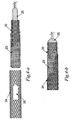
- the ensemble formed by the first mesh (20), the cellulose membrane (23) and the angioplasty balloon (25) is inserted into the second mesh (24), the diameter of which must be larger than that of the first mesh, as illustrated in Figure 4-a.
- the balloon (25) is then insufflated so as to expand the mesh (20) (first stent) and the cellulosic membrane until it is juxtaposed internally to the second mesh (24) (second stent)-, as shown in Figure 4-b.
- This operation causes the cellulosic membrane to be held by the mutual compression of both stents, so as not to move while the device navigates through the vascular system.
- a deflated angioplasty balloon is introduced inside the ensemble and this is compressed from without so that both stents - with the cellulosic membrane imprisoned between them - are reduced in diameter.
- the external diameter of the ensemble is less than 1.0 mm, so as to allow for safe maneuvering inside the blood vessels.
- the angioplasty balloon When it reaches the point of deployment, the angioplasty balloon is insufflated with a pressure of 8 atmospheres, causing the expansion of the inner and the outer stents as well as the cellulosic membrane. The balloon is then deflated and withdrawn.
- the radial force exerted on the vessel walls result from the addition of the individual forces of the first (inner) stent (20) and of the second (outer) stent (24), each corresponding substantially to 50% of the total force.
- the alternate structure proposed comprising a cellulosic membrane interposed between two meshes of inert material - such as stainless steel - presents a better performance after deployment than its PTFE similar, because the biocompatibility of the cellulose stimulates a faster neo-endothelization as compared with PTFE structures.
- the stent mesh (20) has extensions (26 and 27) in both extremities that stretch beyond the ends (28 and 29) of the cellulosic membrane (23), as seen in Figure 5-a. These extensions are then expanded outward, as with (26') in Figure 5-b, and clinched as the arrows (31) indicate.
- annular channels are formed encircling both ends of the stent mesh, as exemplified by channel (27'). Note that this channel involves the end (29) of the cellulosic membrane (23) imprisoning it and preventing it from sliding along the stent while it is introduced into the vascular system.
- a second alternative manner of providing the retention of said membrane (23) consists in providing the radial constriction of its extremities against the inner stent (20) using external expansile rings (32), as shown in Figure 6. These rings should be set in such a way as to compress the membrane when the ensemble is collapsed for introduction into the vascular system, expanding together with the stent when the fixation occurs by insufflation of the angioplasty balloon.
Landscapes
- Health & Medical Sciences (AREA)
- Life Sciences & Earth Sciences (AREA)
- Veterinary Medicine (AREA)
- Public Health (AREA)
- General Health & Medical Sciences (AREA)
- Animal Behavior & Ethology (AREA)
- Transplantation (AREA)
- Heart & Thoracic Surgery (AREA)
- Oral & Maxillofacial Surgery (AREA)
- Epidemiology (AREA)
- Vascular Medicine (AREA)
- Gastroenterology & Hepatology (AREA)
- Chemical & Material Sciences (AREA)
- Surgery (AREA)
- Dermatology (AREA)
- Medicinal Chemistry (AREA)
- Pulmonology (AREA)
- Cardiology (AREA)
- Engineering & Computer Science (AREA)
- Biomedical Technology (AREA)
- Prostheses (AREA)
- Materials For Medical Uses (AREA)
- Diaphragms For Electromechanical Transducers (AREA)
Claims (23)
- Processus visant à obtenir une endoprothèse, dans lequel l'endoprothèse recouverte d'une membrane cellulosique biosynthétique (13) conçue sous la forme d'une membrane inégale qui est produite in loco par une culture de microorganismes qui synthétisent de la cellulose.
- Processus visant à obtenir une endoprothèse selon la revendication 1, dans lequel la membrane (13) est formée à l'aide d'un moule (11) composé d'un matériau qui est imperméable aux liquides et perméables aux gaz, et dans lequel ledit moule (11) est rempli d'un milieu de culture (12) inoculé avec des bactéries produisant de la cellulose.
- Processus visant à obtenir une endoprothèse selon la revendication 2 comprenant les étapes consistant à :introduire dans le moule (11) une structure de treillis métallique (10) avec une forme qui est essentiellement égale à la forme de l'endoprothèse ;remplir le moule (11) d'un milieu de culture (12) qui a été précédemment inoculé avec des bactéries produisant de la cellulose biosynthétique ;fermer le moule (11) et former la membrane cellulosique (13) par fermentation sous une température contrôlée pour une certaine période de temps ;retirer l'ensemble formé par la maille recouverte d'une membrane cellulosique et le traiter avec une solution d'hydroxyde de sodium suivi de procédures de rinçage, le traiter avec une solution de laurylsulfate de sodium suivi de procédures de rinçage.L'ensemble est séché en utilisant de l'air filtré.
- Processus visant à obtenir une endoprothèse selon la revendication 3, dans lequel le matériau dans ledit moule (11) est de la silicone.
- Processus visant à obtenir une endoprothèse selon la revendication 3, dans lequel la température est maintenue entre 3 et 40°C (degrés centigrade) tandis que la membrane (13) est formée par fermentation.
- Processus visant à obtenir une endoprothèse selon la revendication 3, dans lequel le temps nécessaire pour former la membrane (13) par fermentation varie entre 16 et 240 heures.
- Processus visant à obtenir une endoprothèse selon la revendication 3, dans lequel l'ensemble est traité avec une solution de laurylsulfate de sodium à une concentration comprise entre 0,5 % et 5 % pendant une période de 2 à 24 heures.
- Processus visant à obtenir une endoprothèse selon la revendication 3, dans lequel l'ensemble est traité avec une solution d'hydroxyde de sodium à une concentration comprise entre 0,5 % et 5 % pendant une période de 2 à 24 heures
- Processus visant à obtenir une endoprothèse selon la revendication 2 ou 3, dans lequel les bactéries produisant de la cellulose sont des bactéries du groupe qui comprend les sous-espèces du genre Acetobacter xylinum, pasteurianus, rancens, ainsi que les Bacterium xylinoides.
- Processus visant à obtenir une endoprothèse selon la revendication 9, dans lequel le milieu de culture (12) est inoculé avec la bactérie Acetobacter xylinum.
- Processus visant à obtenir une endoprothèse selon la revendication 9 ou 10, dans lequel le milieu de culture (12) est approprié pour la production de cellulose biosynthétisée.
- Endoprothèse, dans laquelle celle-ci est recouverte d'une membrane cellulosique biosynthétique (13) composée d'une structure de treillis métallique (10), avec une forme qui est essentiellement égale à la forme de l'endoprothèse, recouverte à l'extérieur d'une membrane cellulosique biosynthétique (13).
- Endoprothèse selon la revendication 12, dans laquelle ladite structure (10) se compose d'un corps de treillis métallique en acier inoxydable qui possède une forme essentiellement cylindrique et est recouvert à l'extérieur d'une membrane (13) de cellulose biosynthétique.
- Endoprothèse selon la revendication 13, dans laquelle ladite structure présente une face interne fortement polie et une surface externe brute.
- Endoprothèse selon les revendications 12, 13 ou 14, dans laquelle ladite membrane (13) est imprégnée d'une substance thérapeutique.
- Endoprothèse selon la revendication 12, dans laquelle ladite structure se compose d'un métal auto-expansible avec mémoire de son diamètre préconçu.
- Endoprothèse selon les revendications 12 à 14, dans laquelle sont prévus des moyens externes de rétention (24, 26', 27',32) destinés à maintenir en place une membrane(23) de ce type.
- Endoprothèse selon la revendication 17, dans laquelle des moyens externes de rétention de ce type consistent en une seconde maille expansible de forme (24) essentiellement cylindrique composée d'un matériau inerte flexible qui est juxtaposée à une membrane de ce type (23).
- Endoprothèse selon la revendication 18, dans laquelle la proportion de matériau par rapport aux espaces vides dans la première (20) et la seconde (24) mailles, après expansion, est comprise entre 6 % et 8 %.
- Endoprothèse selon la revendication 17, dans laquelle lesdits moyens externes de rétention se composent de canaux annulaires (27') au niveau des deux extrémités de la maille de stent (20), impliquant et emprisonnant les extrémités (28, 29) de la membrane cellulosique (23).
- Endoprothèse selon la revendication 17, dans laquelle desdits moyens externes de rétention de ce type résulte d'une constriction radiale fournie par des bagues expansibles (32) placées sur les deux extrémités de la membrane cellulosique (23).
- Processus visant à obtenir une endoprothèse selon la revendication 1, dans lequel l'endoprothèse est recouverte d'une membrane cellulosique biosynthétique (23) qui se compose d'une première maille expansible de forme (20) essentiellement cylindrique qui est composée d'un matériau inerte flexible, recouverte à l'extérieur par une membrane inégale (23) de forme essentiellement cylindrique, produite in loco par une culture de microorganismes synthétisant de la cellulose, comprenant les étapes consistant à :insérer l'ensemble formé par une telle première structure (premier stent) (20) et ladite membrane (23), comprenant à l'intérieur un ballonnet dégonflé (25), dans une seconde structure (second stent) (24) de diamètre supérieur à celui de la première structure(20) ;gonfler ledit ballonnet (25) et à dilater la première structure (premier stent) (20) et ladite membrane cellulosique (23), jusqu'à ce qu'il soit juxtaposé à l'intérieur à ladite seconde structure (24) (second stent), fournissant la rétention par la compression de ladite membrane cellulosique (23).
- Processus visant à obtenir une endoprothèse selon la revendication 1, dans lequel l'endoprothèse est recouverte d'une membrane cellulosique biosynthétique (23) qui se compose d'une première maille expansible de forme (20) essentiellement cylindrique qui est composée d'un matériau inerte flexible, recouverte à l'extérieur par une membrane inégale (23) de forme essentiellement cylindrique, produite in loco par une culture de microorganismes synthétisant de la cellulose, comprenant les étapes consistant à river (31) les extrémités (26, 27) de ladite maille qui s'étend au-delà des extrémités (28, 29) de ladite membrane cellulosique (23) formant des canaux annulaires (27') qui encerclent les deux extrémités de ladite maille et entourent les extrémités (28, 29) de ladite membrane (24).
Applications Claiming Priority (3)
| Application Number | Priority Date | Filing Date | Title |
|---|---|---|---|
| BR0205047-1A BR0205047C1 (pt) | 2002-11-21 | 2002-11-21 | Endoprótese revestida com membrana de celulose biossintética |
| BR0205047 | 2003-06-27 | ||
| PCT/BR2003/000168 WO2004045458A1 (fr) | 2002-11-21 | 2003-11-17 | Endoprothese, procede de fabrication correspondant et procedes d'utilisation associes |
Publications (3)
| Publication Number | Publication Date |
|---|---|
| EP1569578A1 EP1569578A1 (fr) | 2005-09-07 |
| EP1569578B1 true EP1569578B1 (fr) | 2007-11-14 |
| EP1569578B8 EP1569578B8 (fr) | 2008-02-20 |
Family
ID=36640743
Family Applications (1)
| Application Number | Title | Priority Date | Filing Date |
|---|---|---|---|
| EP03773355A Expired - Lifetime EP1569578B8 (fr) | 2002-11-21 | 2003-11-17 | Endoprothese et procede de fabrication correspondant |
Country Status (9)
| Country | Link |
|---|---|
| US (1) | US20060147612A1 (fr) |
| EP (1) | EP1569578B8 (fr) |
| AT (1) | ATE378028T1 (fr) |
| AU (1) | AU2003283082A1 (fr) |
| BR (1) | BR0205047C1 (fr) |
| CA (1) | CA2506691C (fr) |
| DE (1) | DE60317559T2 (fr) |
| MX (1) | MXPA05005494A (fr) |
| WO (1) | WO2004045458A1 (fr) |
Cited By (2)
| Publication number | Priority date | Publication date | Assignee | Title |
|---|---|---|---|---|
| US20100041148A1 (en) * | 2007-02-12 | 2010-02-18 | bioregeneraton GmbH | Process and support structure for the cultivation of living cells |
| US10709820B2 (en) | 2014-11-24 | 2020-07-14 | Biotronik Ag | Method for producing a storable molded body made of bacterial cellulose |
Families Citing this family (19)
| Publication number | Priority date | Publication date | Assignee | Title |
|---|---|---|---|---|
| WO2006065665A1 (fr) * | 2004-12-13 | 2006-06-22 | Robert Hunt Carpenter, Dvm, Pc | Dispositif multiparois expansible pouvant acheminer des medicaments |
| DE102006007412B4 (de) | 2006-02-19 | 2008-08-21 | Bioregeneration Gmbh | Verfahren zur Herstellung eines langgestreckten Cellulosehohlkörpers |
| PL381388A1 (pl) * | 2006-12-24 | 2008-07-07 | Politechnika Łódzka | Biomateriał z mikrobiologicznej celulozy do użytku wewnętrznego, sposób wytwarzania biomateriału oraz zastosowanie biomateriału z mikrobiologicznej celulozy w chirurgii tkanek miękkich |
| DE102007006844B4 (de) | 2007-02-12 | 2014-06-12 | Bioregeneration Gmbh | Langgestreckter Hohlkörper zum Ersatz eines venösen Blutgefäßes sowie Verfahren und Hohlform zur Herstellung eines kristalline Cellulose umfassenden langgestreckten Hohlkörpers |
| CA3010828A1 (fr) * | 2008-01-17 | 2009-07-23 | Boston Scientific Scimed, Inc. | Endoprothese vasculaire avec caracteristique antimigratoire |
| US20090270971A1 (en) * | 2008-04-24 | 2009-10-29 | Medtronic Vascular, Inc. | Prosthesis Fixation Apparatus and Methods |
| EP2346540B1 (fr) * | 2008-11-07 | 2013-04-03 | Sofradim Production | Dispositif médical comprenant de la cellulose bactérienne avec renfort utilisant des matériaux de renfort résorbables |
| AU2009312480B2 (en) * | 2008-11-07 | 2015-03-19 | Sofradim Production | Composite mesh including a 3D mesh and a non porous film of oxidized cellulose from bacterial cellulose origin |
| KR101602389B1 (ko) * | 2014-05-13 | 2016-03-10 | 주식회사 엠아이텍 | 스텐트와 그 제조방법 |
| WO2015181372A1 (fr) | 2014-05-30 | 2015-12-03 | Sofradim Production | Implant comprenant de la cellulose oxydée et procédé de préparation d'un tel implant |
| EP3127561A1 (fr) | 2015-08-05 | 2017-02-08 | Jenpolymer Materials UG & Co. KG | Implant médical basé sur une nanocellulose |
| WO2017199242A1 (fr) * | 2016-05-15 | 2017-11-23 | Mazor Robotics Ltd. | Dilatateur à ballonnet |
| KR101821746B1 (ko) * | 2016-08-24 | 2018-01-24 | 주식회사 엠아이텍 | 약물방출형 생분해성 스텐트 |
| WO2020150557A1 (fr) | 2019-01-18 | 2020-07-23 | W. L. Gore & Associates, Inc. | Dispositifs médicaux bioabsorbables |
| CN109745160B (zh) * | 2019-03-22 | 2021-01-22 | 福州京东方光电科技有限公司 | 一种血管扩张设备 |
| CN110559103B (zh) * | 2019-08-05 | 2021-08-31 | 华东交通大学 | 一种贯膜支架及其制备方法 |
| WO2021245324A1 (fr) * | 2020-06-01 | 2021-12-09 | Aalto-Korkeakoulusäätiö Sr | Structure auxétique, structure de support, procédé de préparation d'une structure auxétique et utilisation d'une matière cellulosique |
| US11744702B1 (en) * | 2020-07-01 | 2023-09-05 | Aortic Innovations, Llc | Transcatheter aortic valve repair and replacement |
| CN115153956A (zh) * | 2022-07-22 | 2022-10-11 | 上海拓脉医疗科技有限公司 | 支架植入物及其制备方法 |
Family Cites Families (25)
| Publication number | Priority date | Publication date | Assignee | Title |
|---|---|---|---|---|
| US3860490A (en) * | 1972-02-11 | 1975-01-14 | Nat Patent Dev Corp | Process of subjecting a microorganism susceptible material to a microorganism |
| BR8404937A (pt) * | 1984-10-01 | 1986-05-06 | Bio Fill Ind E Comercio De Pro | Processo para preparacao de pelicula de celulose,pelicula de celulose obtida pelo mesmo,implante de pele artificial,processo de tratamento de lesoes empregando a referida pelicula de celulose e utilizacao |
| NZ214417A (en) * | 1984-12-21 | 1988-06-30 | Univ Texas | Microbially produced cellulose |
| EP0200409B1 (fr) * | 1985-04-16 | 1994-06-29 | Agency Of Industrial Science And Technology | Matériel moulu comprenant de la cellulose préparée par des bactéries |
| US5628781A (en) * | 1985-06-06 | 1997-05-13 | Thomas Jefferson University | Implant materials, methods of treating the surface of implants with microvascular endothelial cells, and the treated implants themselves |
| US5289831A (en) * | 1989-03-09 | 1994-03-01 | Vance Products Incorporated | Surface-treated stent, catheter, cannula, and the like |
| EP0396344A3 (fr) * | 1989-04-28 | 1991-04-03 | Ajinomoto Co., Inc. | Cellulose microbienne creuse, procédé de préparation et vaisseau sanguin artificiel formé à partir de cette cellulose |
| CA2045222A1 (fr) * | 1990-07-12 | 1992-01-13 | Norman R. Weldon | Greffon biosynthetique composite |
| US5336615A (en) * | 1992-01-06 | 1994-08-09 | Yale University | Genetically engineered endothelial cells exhibiting enhanced migration and plasminogen activator activity |
| US5336518A (en) * | 1992-12-11 | 1994-08-09 | Cordis Corporation | Treatment of metallic surfaces using radiofrequency plasma deposition and chemical attachment of bioactive agents |
| US5637113A (en) * | 1994-12-13 | 1997-06-10 | Advanced Cardiovascular Systems, Inc. | Polymer film for wrapping a stent structure |
| KR19990037728A (ko) * | 1996-06-21 | 1999-05-25 | 가부시키가이샤 바이오 폴리머 리서치 | 박테리아 셀룰로스의 처리 방법 |
| AU1709599A (en) * | 1998-12-04 | 2000-06-26 | Bio-Vascular, Inc. | Stent cover |
| US7560274B1 (en) * | 1999-05-28 | 2009-07-14 | Cellon S.A. | Culture chamber |
| AU1939801A (en) * | 1999-12-01 | 2001-06-12 | Selective Genetics, Inc. | In situ bioreactors and methods of use thereof |
| US6521451B2 (en) * | 1999-12-09 | 2003-02-18 | California Institute Of Technology | Sealed culture chamber |
| US20030013163A1 (en) * | 2000-02-17 | 2003-01-16 | Dieter Klemm | Method and device for producing shaped microbial cellulose for use as a biomaterial, especially for microsurgery |
| WO2001087192A1 (fr) * | 2000-04-28 | 2001-11-22 | Children's Medical Center Corporation | Tuteurs mis au point par genie tissulaire |
| US6599518B2 (en) * | 2000-11-21 | 2003-07-29 | Xylos Corporation | Solvent dehydrated microbially-derived cellulose for in vivo implantation |
| AU2002364558A1 (en) * | 2001-12-11 | 2003-06-23 | Cytograft Tissue Engineering, Inc. | Tissue engineered cellular sheets, methods of making and use thereof |
| US20060134758A1 (en) * | 2002-12-05 | 2006-06-22 | Levy Nelson L F | Process for obtaining a ccellulosic wet sheet and a membrane, the equipment used to obtain the membrane and the membrane obtained |
| US20040126405A1 (en) * | 2002-12-30 | 2004-07-01 | Scimed Life Systems, Inc. | Engineered scaffolds for promoting growth of cells |
| JP4753874B2 (ja) * | 2004-07-01 | 2011-08-24 | 旭化成株式会社 | セルロース不織布 |
| EP2426211A1 (fr) * | 2006-10-02 | 2012-03-07 | Arterion AB | Tubes à cellulose bactérienne |
| AU2007318210B2 (en) * | 2006-10-06 | 2014-02-20 | Celularity Inc. | Native (telopeptide) placental collagen compositions |
-
2002
- 2002-11-21 BR BR0205047-1A patent/BR0205047C1/pt not_active Application Discontinuation
-
2003
- 2003-11-17 DE DE60317559T patent/DE60317559T2/de not_active Expired - Lifetime
- 2003-11-17 WO PCT/BR2003/000168 patent/WO2004045458A1/fr not_active Ceased
- 2003-11-17 AT AT03773355T patent/ATE378028T1/de not_active IP Right Cessation
- 2003-11-17 MX MXPA05005494A patent/MXPA05005494A/es active IP Right Grant
- 2003-11-17 US US10/535,924 patent/US20060147612A1/en not_active Abandoned
- 2003-11-17 EP EP03773355A patent/EP1569578B8/fr not_active Expired - Lifetime
- 2003-11-17 AU AU2003283082A patent/AU2003283082A1/en not_active Abandoned
- 2003-11-17 CA CA2506691A patent/CA2506691C/fr not_active Expired - Fee Related
Cited By (3)
| Publication number | Priority date | Publication date | Assignee | Title |
|---|---|---|---|---|
| US20100041148A1 (en) * | 2007-02-12 | 2010-02-18 | bioregeneraton GmbH | Process and support structure for the cultivation of living cells |
| US8993324B2 (en) * | 2007-02-12 | 2015-03-31 | Bioregeneration Gmbh | Process and support structure for the cultivation of living cells |
| US10709820B2 (en) | 2014-11-24 | 2020-07-14 | Biotronik Ag | Method for producing a storable molded body made of bacterial cellulose |
Also Published As
| Publication number | Publication date |
|---|---|
| EP1569578A1 (fr) | 2005-09-07 |
| WO2004045458A1 (fr) | 2004-06-03 |
| EP1569578B8 (fr) | 2008-02-20 |
| AU2003283082A1 (en) | 2004-06-15 |
| BR0205047A (pt) | 2003-04-08 |
| ATE378028T1 (de) | 2007-11-15 |
| CA2506691C (fr) | 2012-01-10 |
| BR0205047C1 (pt) | 2003-11-04 |
| DE60317559D1 (de) | 2007-12-27 |
| US20060147612A1 (en) | 2006-07-06 |
| CA2506691A1 (fr) | 2004-06-03 |
| MXPA05005494A (es) | 2006-02-22 |
| DE60317559T2 (de) | 2008-09-18 |
Similar Documents
| Publication | Publication Date | Title |
|---|---|---|
| CA2506691C (fr) | Endoprothese, procede de fabrication correspondant et procedes d'utilisation associes | |
| US6423089B1 (en) | Vascular endoprosthesis and method | |
| US4905367A (en) | Manufacture of stretchable porous sutures | |
| CN108430387B (zh) | 具有外部支撑的支架移植物 | |
| JP3361212B2 (ja) | 二元安定性内腔移植補綴材 | |
| EP1460972B1 (fr) | Greffe-prothese endovasculaire en couches et ses methodes de fabrication | |
| US8882822B2 (en) | Non-thrombogenic stent jacket | |
| EP1550477B1 (fr) | Endoprothese et procede de production associe | |
| US6193746B1 (en) | Endoprosthesis that can be percutaneously implanted in the patient's body | |
| CN101442958B (zh) | 心脏瓣膜替换设备 | |
| US5330500A (en) | Self-expanding endovascular stent with silicone coating | |
| US20020151958A1 (en) | Large vessel stents and occluders | |
| US5575818A (en) | Endovascular stent with locking ring | |
| US20070213838A1 (en) | Tubular Graft | |
| JPH11508152A (ja) | 二重に支持された管腔内移植体 | |
| JPH04215768A (ja) | 膨張式ステント | |
| CN102341062A (zh) | 血管内装置及相关系统和方法 | |
| JP2000342693A (ja) | 半径方向拡張可能ステント | |
| JP2009240796A (ja) | ステント | |
| WO2000018446A1 (fr) | Manchon multicouche pour dispositif intravasculaire expansible | |
| JP2001501506A (ja) | ステントのライニング | |
| DE69831608D1 (de) | Prothese im inneren eines gefässes | |
| JP2022161996A (ja) | 生物学的部分の保持のためのインプラント可能な装置 | |
| US20060036308A1 (en) | Stent with extruded covering | |
| JP2003325655A (ja) | 血管内治療用ステントおよびステントグラフト |
Legal Events
| Date | Code | Title | Description |
|---|---|---|---|
| PUAI | Public reference made under article 153(3) epc to a published international application that has entered the european phase |
Free format text: ORIGINAL CODE: 0009012 |
|
| 17P | Request for examination filed |
Effective date: 20050520 |
|
| AK | Designated contracting states |
Kind code of ref document: A1 Designated state(s): AT BE BG CH CY CZ DE DK EE ES FI FR GB GR HU IE IT LI LU MC NL PT RO SE SI SK TR |
|
| AX | Request for extension of the european patent |
Extension state: AL LT LV MK |
|
| DAX | Request for extension of the european patent (deleted) | ||
| RTI1 | Title (correction) |
Free format text: ENDOPROSTHESIS AND PROCESS TO OBTAIN |
|
| RIC1 | Information provided on ipc code assigned before grant |
Ipc: A61F 2/86 20060101AFI20070119BHEP Ipc: A61L 27/36 20060101ALI20070119BHEP |
|
| GRAP | Despatch of communication of intention to grant a patent |
Free format text: ORIGINAL CODE: EPIDOSNIGR1 |
|
| GRAS | Grant fee paid |
Free format text: ORIGINAL CODE: EPIDOSNIGR3 |
|
| GRAA | (expected) grant |
Free format text: ORIGINAL CODE: 0009210 |
|
| AK | Designated contracting states |
Kind code of ref document: B1 Designated state(s): AT BE BG CH CY CZ DE DK EE ES FI FR GB GR HU IE IT LI LU MC NL PT RO SE SI SK TR |
|
| REG | Reference to a national code |
Ref country code: GB Ref legal event code: FG4D |
|
| REG | Reference to a national code |
Ref country code: CH Ref legal event code: EP |
|
| RAP2 | Party data changed (patent owner data changed or rights of a patent transferred) |
Owner name: BIOSTENT PRODUTOS BIOTECNOLOGICOS LTDA. |
|
| REG | Reference to a national code |
Ref country code: IE Ref legal event code: FG4D |
|
| RIN2 | Information on inventor provided after grant (corrected) |
Inventor name: BUENO, RONALDO DA ROCHA LOURES DR. |
|
| REF | Corresponds to: |
Ref document number: 60317559 Country of ref document: DE Date of ref document: 20071227 Kind code of ref document: P |
|
| PGFP | Annual fee paid to national office [announced via postgrant information from national office to epo] |
Ref country code: DK Payment date: 20071129 Year of fee payment: 5 Ref country code: ES Payment date: 20071130 Year of fee payment: 5 Ref country code: LU Payment date: 20071211 Year of fee payment: 5 Ref country code: MC Payment date: 20071128 Year of fee payment: 5 |
|
| NLT2 | Nl: modifications (of names), taken from the european patent patent bulletin |
Owner name: BIOSTENT PRODUTOS BIOTECNOLOEGICOS LTDA. Effective date: 20071212 |
|
| PGFP | Annual fee paid to national office [announced via postgrant information from national office to epo] |
Ref country code: FI Payment date: 20071129 Year of fee payment: 5 Ref country code: AT Payment date: 20071128 Year of fee payment: 5 |
|
| REG | Reference to a national code |
Ref country code: CH Ref legal event code: NV Representative=s name: ZIMMERLI, WAGNER & PARTNER AG |
|
| PG25 | Lapsed in a contracting state [announced via postgrant information from national office to epo] |
Ref country code: SE Free format text: LAPSE BECAUSE OF FAILURE TO SUBMIT A TRANSLATION OF THE DESCRIPTION OR TO PAY THE FEE WITHIN THE PRESCRIBED TIME-LIMIT Effective date: 20080214 Ref country code: ES Free format text: LAPSE BECAUSE OF FAILURE TO SUBMIT A TRANSLATION OF THE DESCRIPTION OR TO PAY THE FEE WITHIN THE PRESCRIBED TIME-LIMIT Effective date: 20080225 |
|
| PG25 | Lapsed in a contracting state [announced via postgrant information from national office to epo] |
Ref country code: BG Free format text: LAPSE BECAUSE OF FAILURE TO SUBMIT A TRANSLATION OF THE DESCRIPTION OR TO PAY THE FEE WITHIN THE PRESCRIBED TIME-LIMIT Effective date: 20080214 Ref country code: FI Free format text: LAPSE BECAUSE OF FAILURE TO SUBMIT A TRANSLATION OF THE DESCRIPTION OR TO PAY THE FEE WITHIN THE PRESCRIBED TIME-LIMIT Effective date: 20071114 Ref country code: SI Free format text: LAPSE BECAUSE OF FAILURE TO SUBMIT A TRANSLATION OF THE DESCRIPTION OR TO PAY THE FEE WITHIN THE PRESCRIBED TIME-LIMIT Effective date: 20071114 |
|
| PGFP | Annual fee paid to national office [announced via postgrant information from national office to epo] |
Ref country code: GR Payment date: 20071128 Year of fee payment: 5 |
|
| PG25 | Lapsed in a contracting state [announced via postgrant information from national office to epo] |
Ref country code: DK Free format text: LAPSE BECAUSE OF NON-PAYMENT OF DUE FEES Effective date: 20071114 Ref country code: AT Free format text: LAPSE BECAUSE OF FAILURE TO SUBMIT A TRANSLATION OF THE DESCRIPTION OR TO PAY THE FEE WITHIN THE PRESCRIBED TIME-LIMIT Effective date: 20071114 |
|
| PG25 | Lapsed in a contracting state [announced via postgrant information from national office to epo] |
Ref country code: CZ Free format text: LAPSE BECAUSE OF FAILURE TO SUBMIT A TRANSLATION OF THE DESCRIPTION OR TO PAY THE FEE WITHIN THE PRESCRIBED TIME-LIMIT Effective date: 20071114 |
|
| ET | Fr: translation filed | ||
| PG25 | Lapsed in a contracting state [announced via postgrant information from national office to epo] |
Ref country code: BE Free format text: LAPSE BECAUSE OF FAILURE TO SUBMIT A TRANSLATION OF THE DESCRIPTION OR TO PAY THE FEE WITHIN THE PRESCRIBED TIME-LIMIT Effective date: 20071114 Ref country code: RO Free format text: LAPSE BECAUSE OF FAILURE TO SUBMIT A TRANSLATION OF THE DESCRIPTION OR TO PAY THE FEE WITHIN THE PRESCRIBED TIME-LIMIT Effective date: 20071114 Ref country code: SK Free format text: LAPSE BECAUSE OF FAILURE TO SUBMIT A TRANSLATION OF THE DESCRIPTION OR TO PAY THE FEE WITHIN THE PRESCRIBED TIME-LIMIT Effective date: 20071114 |
|
| PGFP | Annual fee paid to national office [announced via postgrant information from national office to epo] |
Ref country code: BE Payment date: 20071130 Year of fee payment: 5 |
|
| PLBE | No opposition filed within time limit |
Free format text: ORIGINAL CODE: 0009261 |
|
| STAA | Information on the status of an ep patent application or granted ep patent |
Free format text: STATUS: NO OPPOSITION FILED WITHIN TIME LIMIT |
|
| PG25 | Lapsed in a contracting state [announced via postgrant information from national office to epo] |
Ref country code: PT Free format text: LAPSE BECAUSE OF FAILURE TO SUBMIT A TRANSLATION OF THE DESCRIPTION OR TO PAY THE FEE WITHIN THE PRESCRIBED TIME-LIMIT Effective date: 20080414 |
|
| 26N | No opposition filed |
Effective date: 20080815 |
|
| PG25 | Lapsed in a contracting state [announced via postgrant information from national office to epo] |
Ref country code: GR Free format text: LAPSE BECAUSE OF FAILURE TO SUBMIT A TRANSLATION OF THE DESCRIPTION OR TO PAY THE FEE WITHIN THE PRESCRIBED TIME-LIMIT Effective date: 20080215 Ref country code: EE Free format text: LAPSE BECAUSE OF FAILURE TO SUBMIT A TRANSLATION OF THE DESCRIPTION OR TO PAY THE FEE WITHIN THE PRESCRIBED TIME-LIMIT Effective date: 20071114 |
|
| PG25 | Lapsed in a contracting state [announced via postgrant information from national office to epo] |
Ref country code: MC Free format text: LAPSE BECAUSE OF NON-PAYMENT OF DUE FEES Effective date: 20081130 |
|
| PG25 | Lapsed in a contracting state [announced via postgrant information from national office to epo] |
Ref country code: CY Free format text: LAPSE BECAUSE OF FAILURE TO SUBMIT A TRANSLATION OF THE DESCRIPTION OR TO PAY THE FEE WITHIN THE PRESCRIBED TIME-LIMIT Effective date: 20071114 |
|
| PGFP | Annual fee paid to national office [announced via postgrant information from national office to epo] |
Ref country code: IE Payment date: 20071128 Year of fee payment: 5 |
|
| PG25 | Lapsed in a contracting state [announced via postgrant information from national office to epo] |
Ref country code: TR Free format text: LAPSE BECAUSE OF FAILURE TO SUBMIT A TRANSLATION OF THE DESCRIPTION OR TO PAY THE FEE WITHIN THE PRESCRIBED TIME-LIMIT Effective date: 20071114 Ref country code: HU Free format text: LAPSE BECAUSE OF FAILURE TO SUBMIT A TRANSLATION OF THE DESCRIPTION OR TO PAY THE FEE WITHIN THE PRESCRIBED TIME-LIMIT Effective date: 20080515 |
|
| PG25 | Lapsed in a contracting state [announced via postgrant information from national office to epo] |
Ref country code: IE Free format text: LAPSE BECAUSE OF NON-PAYMENT OF DUE FEES Effective date: 20081117 |
|
| REG | Reference to a national code |
Ref country code: CH Ref legal event code: PFA Owner name: BIOSTENT PRODUTOS BIOTECNOLOGICOS LTDA. Free format text: BIOSTENT PRODUTOS BIOTECNOLOGICOS LTDA.#RUA MARIA CAROLINA, 680, SALA A JARDIM PAULISTA#01445-000 SAO PAULO, SP (BR) -TRANSFER TO- BIOSTENT PRODUTOS BIOTECNOLOGICOS LTDA.#RUA MARIA CAROLINA, 680, SALA A JARDIM PAULISTA#01445-000 SAO PAULO, SP (BR) |
|
| PG25 | Lapsed in a contracting state [announced via postgrant information from national office to epo] |
Ref country code: LU Free format text: LAPSE BECAUSE OF NON-PAYMENT OF DUE FEES Effective date: 20081117 |
|
| PGFP | Annual fee paid to national office [announced via postgrant information from national office to epo] |
Ref country code: FR Payment date: 20121203 Year of fee payment: 10 Ref country code: CH Payment date: 20121121 Year of fee payment: 10 Ref country code: DE Payment date: 20121130 Year of fee payment: 10 |
|
| PGFP | Annual fee paid to national office [announced via postgrant information from national office to epo] |
Ref country code: IT Payment date: 20121128 Year of fee payment: 10 Ref country code: GB Payment date: 20121114 Year of fee payment: 10 |
|
| PGFP | Annual fee paid to national office [announced via postgrant information from national office to epo] |
Ref country code: NL Payment date: 20121130 Year of fee payment: 10 |
|
| REG | Reference to a national code |
Ref country code: CH Ref legal event code: NV Representative=s name: WAGNER PATENT AG, CH |
|
| REG | Reference to a national code |
Ref country code: NL Ref legal event code: V1 Effective date: 20140601 |
|
| REG | Reference to a national code |
Ref country code: CH Ref legal event code: PL |
|
| GBPC | Gb: european patent ceased through non-payment of renewal fee |
Effective date: 20131117 |
|
| PG25 | Lapsed in a contracting state [announced via postgrant information from national office to epo] |
Ref country code: CH Free format text: LAPSE BECAUSE OF NON-PAYMENT OF DUE FEES Effective date: 20131130 Ref country code: LI Free format text: LAPSE BECAUSE OF NON-PAYMENT OF DUE FEES Effective date: 20131130 |
|
| REG | Reference to a national code |
Ref country code: FR Ref legal event code: ST Effective date: 20140731 |
|
| REG | Reference to a national code |
Ref country code: DE Ref legal event code: R119 Ref document number: 60317559 Country of ref document: DE Effective date: 20140603 |
|
| PG25 | Lapsed in a contracting state [announced via postgrant information from national office to epo] |
Ref country code: NL Free format text: LAPSE BECAUSE OF NON-PAYMENT OF DUE FEES Effective date: 20140601 Ref country code: IT Free format text: LAPSE BECAUSE OF NON-PAYMENT OF DUE FEES Effective date: 20131117 Ref country code: DE Free format text: LAPSE BECAUSE OF NON-PAYMENT OF DUE FEES Effective date: 20140603 |
|
| PG25 | Lapsed in a contracting state [announced via postgrant information from national office to epo] |
Ref country code: GB Free format text: LAPSE BECAUSE OF NON-PAYMENT OF DUE FEES Effective date: 20131117 Ref country code: FR Free format text: LAPSE BECAUSE OF NON-PAYMENT OF DUE FEES Effective date: 20131202 |