EP1567482B1 - Procede de preparation de dinitriles d'acide phenylmalonique - Google Patents
Procede de preparation de dinitriles d'acide phenylmalonique Download PDFInfo
- Publication number
- EP1567482B1 EP1567482B1 EP03767741A EP03767741A EP1567482B1 EP 1567482 B1 EP1567482 B1 EP 1567482B1 EP 03767741 A EP03767741 A EP 03767741A EP 03767741 A EP03767741 A EP 03767741A EP 1567482 B1 EP1567482 B1 EP 1567482B1
- Authority
- EP
- European Patent Office
- Prior art keywords
- alkyl
- alkoxy
- alkenyl
- alkynyl
- palladium
- Prior art date
- Legal status (The legal status is an assumption and is not a legal conclusion. Google has not performed a legal analysis and makes no representation as to the accuracy of the status listed.)
- Expired - Lifetime
Links
- 0 CC1(*)C(*)=C(CC#N)C(I)=CC(*)=C1 Chemical compound CC1(*)C(*)=C(CC#N)C(I)=CC(*)=C1 0.000 description 4
Classifications
-
- C—CHEMISTRY; METALLURGY
- C07—ORGANIC CHEMISTRY
- C07C—ACYCLIC OR CARBOCYCLIC COMPOUNDS
- C07C253/00—Preparation of carboxylic acid nitriles
- C07C253/30—Preparation of carboxylic acid nitriles by reactions not involving the formation of cyano groups
-
- C—CHEMISTRY; METALLURGY
- C07—ORGANIC CHEMISTRY
- C07C—ACYCLIC OR CARBOCYCLIC COMPOUNDS
- C07C253/00—Preparation of carboxylic acid nitriles
- C07C253/32—Separation; Purification; Stabilisation; Use of additives
-
- C—CHEMISTRY; METALLURGY
- C07—ORGANIC CHEMISTRY
- C07C—ACYCLIC OR CARBOCYCLIC COMPOUNDS
- C07C255/00—Carboxylic acid nitriles
- C07C255/01—Carboxylic acid nitriles having cyano groups bound to acyclic carbon atoms
- C07C255/32—Carboxylic acid nitriles having cyano groups bound to acyclic carbon atoms having cyano groups bound to acyclic carbon atoms of a carbon skeleton containing at least one six-membered aromatic ring
- C07C255/33—Carboxylic acid nitriles having cyano groups bound to acyclic carbon atoms having cyano groups bound to acyclic carbon atoms of a carbon skeleton containing at least one six-membered aromatic ring with cyano groups linked to the six-membered aromatic ring, or to the condensed ring system containing that ring, by saturated carbon chains
Definitions
- the present invention relates to a process for the preparation of phenylmalonic acid dinitriles.
- JP 2000 281 636 refers to the reaction of an active methylene compound with an aryl halide in the presence of a base and [1,1-bis(diphenylphosphino)ferrocene]palladium(II)chloride as the catalyst.
- the present invention accordingly relates to a process for the preparation of compounds of formula I wherein each R 0 , independently of any other(s), is halogen, C 1 -C 6 alkyl, C 2 -C 6 alkenyl, C 2 -C 6 alkynyl, C 1 -C 6 haloalkyl, cyano-C 1 -C 6 alkyl, C 2 -C 6 haloalkenyl, cyano-C 2 -C 6 alkenyl, C 2 -C 6 haloalkynyl, cyano-C 2 -C 6 alkynyl, hydroxy, hydroxy-C 1 -C 6 alkyl, C 1 -C 6 alkoxy, nitro, amino, C 1 -C 6 alkylamino, di(C 1 -C 6 alkyl)amino, C 1 -C 6 alkylcarbonylamino, C 1 -C 6 alkylsulfonylamino, C 1 -
- the present process is distinguished by:
- the present preparation process is accordingly suitable especially for the large-scale preparation of arylmalonic acid dinitrile derivatives of formula I.
- halogen is to be understood as fluorine, chlorine, bromine or iodine, preferably fluorine, chlorine or bromine.
- the alkyl groups in the substituent definitions are, for example, methyl, ethyl, n-propyl, isopropyl, n-butyl, sec-butyl, isobutyl or tert-butyl, and the pentyl, hexyl, heptyl, octyl, nonyl, decyl, undecyl and dodecyl isomers.
- Haloalkyl groups preferably have a chain length of from 1 to 6 carbon atoms.
- Haloalkyl is, for example, fluoromethyl, difluoromethyl, difluorochloromethyl, trifluoromethyl, chloromethyl, dichloromethyl, dichlorofluoromethyl, trichloromethyl, 2,2,2-trifluoroethyl, 2-fluoroethyl, 2-chloroethyl, 2,2-difluoroethyl, 2,2-dichloroethyl, 2,2,2-trichloroethyl or pentafluoroethyl, preferably trichloromethyl, difluorochloromethyl, difluoromethyl, trifluoromethyl or dichlorofluoromethyl.
- Alkoxy groups preferably have a chain length of from 1 to 6 carbon atoms.
- Alkoxy is, for example, methoxy, ethoxy, n-propoxy, isopropoxy, n-butoxy, isobutoxy, sec-butoxy, tert-butoxy, or the pentyloxy and hexyloxy isomers; preferably methoxy, ethoxy or n-propoxy.
- Haloalkoxy is, for example, fluoromethoxy, difluoromethoxy, trifluoromethoxy, 2,2,2-trifluoroethoxy, 1,1,2,2-tetrafluoroethoxy, 2-fluoroethoxy, 2-chloroethoxy or 2,2,2-trichloroethoxy.
- alkenyl examples include vinyl, allyl, methallyl, 1-methylvinyl, but-2-en-1-yl, pentenyl and 2-hexenyl, with preference being given to alkenyl radicals having a chain length of from 3 to 6 carbon atoms.
- alkynyl examples include ethynyl, propargyl, 1-methylpropargyl, 3-butynyl, but-2-yn-1-yl, 2-methylbut-3-yn-2-yl, but-3-yn-2-yl, 1-pentynyl, pent-4-yn-1-yl and 2-hexynyl, with preference being given to alkynyl radicals having a chain length of from 3 to 6 carbon atoms.
- haloalkenyl there come into consideration alkenyl groups substituted one or more times by halogen, halogen being in particular bromine or iodine and especially fluorine or chlorine, for example 2- and 3-fluoropropenyl, 2- and 3-chloropropenyl, 2- and 3-bromopropenyl, 2,2-difluoro-1-methylvinyl, 2,3,3-trifluoropropenyl, 3,3,3-trifluoropropenyl, 2,3,3-trichloropropenyl, 4,4,4-trifluoro-but-2-en-1-yl and 4,4,4-trichloro-but-2-en-1-yl.
- alkenyl radicals mono-, di- or tri-substituted by halogen, preference is given to those having a chain length of from 3 to 6 carbon atoms.
- the alkenyl groups may be substituted by halogen at saturated or unsaturated carbon atoms.
- Alkoxyalkyl groups preferably have from 1 to 6 carbon atoms.
- Alkoxyalkyl is, for example, methoxymethyl, methoxyethyl, ethoxymethyl, ethoxyethyl, n-propoxymethyl, n-propoxyethyl, isopropoxymethyl or isopropoxyethyl.
- Haloalkoxy is, for example, fluoromethoxy, difluoromethoxy, trifluoromethoxy, 2,2,2-trifluoroethoxy, 1,1,2,2-tetrafluoroethoxy, 2-fluoroethoxy, 2-chloroethoxy or 2,2,2-trichloroethoxy.
- Alkenyloxy is, for example, allyloxy, methallyloxy or but-2-en-1-yloxy.
- haloalkenyloxy there come into consideration alkenyloxy groups substituted one or more times by halogen, halogen being in particular bromine or iodine and especially fluorine or chlorine, for example 2- and 3-fluoropropenyloxy, 2- and 3-chloropropenyloxy, 2- and 3-bromopropenyloxy, 2,3,3-trifluoropropenyloxy, 2,3,3-trichloropropenyloxy, 4,4,4-trifluorobut-2-en-1-yloxy and 4,4,4-trichloro-but-2-en-1-yloxy.
- Alkynyloxy is, for example, propargyloxy or 1-methylpropargyloxy.
- Suitable cycloalkyl substituents contain from 3 to 8 carbon atoms and are, for example, cyclopropyl, cyclobutyl, cyclopentyl, cyclohexyl, cycloheptyl or cyclooctyl, each of which may be substituted one or more times by halogen, preferably fluorine, chlorine or bromine.
- Alkylcarbonyl is especially acetyl or propionyl.
- Alkoxycarbonyl is, for example, methoxycarbonyl, ethoxycarbonyl, n-propoxycarbonyl, isopropoxycarbonyl or the isomers of butoxycarbonyl, pentyloxycarbonyl and hexyloxycarbonyl; preferably methoxycarbonyl or ethoxycarbonyl.
- Alkylthio groups preferably have a chain length of from 1 to 6 carbon atoms.
- Alkylthio is, for example, methylthio, ethylthio, propylthio, butylthio, pentylthio or hexylthio, or the branched isomers thereof; preferably methylthio or ethylthio.
- Haloalkylthio is, for example, 2,2,2-trifluoroethylthio or 2,2,2-trichloroethylthio.
- Alkylsulfinyl is, for example, methylsulfinyl, ethylsulfinyl, n-propylsulfinyl, isopropylsulfinyl, n-butylsulfinyl, isobutylsulfinyl, sec-butylsulfinyl or tert-butylsulfinyl; preferably methylsulfinyl or ethylsulfinyl.
- Alkylsulfonyl is, for example, methylsulfonyl, ethylsulfonyl, n-propylsulfonyl, isopropylsulfonyl, n-butylsulfonyl, isobutylsulfonyl, sec-butylsulfonyl or tert-butylsulfonyl; preferably methylsulfonyl or ethylsulfonyl.
- Alkylamino is, for example, methylamino, ethylamino, n-propylamino, isopropylamino or the butyl-, pentyl- and hexyl-amino isomers.
- Dialkylamino is, for example, dimethylamino, methylethylamino, diethylamino, n-propylmethylamino, dibutylamino or diisopropylamino.
- Alkylthioalkyl is, for example, methylthiomethyl, methylthioethyl, ethylthiomethyl, ethylthioethyl, n-propylthiomethyl, n-propylthioethyl, isopropylthiomethyl or isopropylthioethyl.
- Phenyl and naphthyl in the definition of R 2 and phenoxy in the definiton of R 1 , R 2 and R 3 may be in substituted form.
- the substituents may in that case be in the ortho-, meta- and/or para-positions, as desired, and additionally in the 5-, 6-, 7- and/or 8-positions of the naphthyl ring.
- Suitable 5- or 6-membered aromatic rings that contain 1 or 2 hetero atoms selected from the group nitrogen, oxygen and sulfur in the definition of R 0 and R 2 are pyrrolidyl, pyridyl, pyrimidyl, triazinyl, thiazolyl, triazolyl, thiadiazolyl, imidazolyl, oxazolyl, isoxazolyl, pyrazinyl, furyl, thienyl, pyrazolyl, benzoxazolyl, benzothiazolyl, quinoxalyl, indolyl and quinolyl. These heteroaromatic rings may additionally be substituted.
- the carbonyl carbon atom is not included in the lower and upper limits of the number of carbon atoms given in each particular case.
- each R 0 independently of any other(s), is halogen, C 1 -C 6 alkyl, C 1 -C 6 haloalkyl, hydroxy, C 1 -C 6 alkoxy, nitro, amino, C 1 -C 6 alkylamino, di(C 1 -C 6 alkyl)amino, C 1 -C 6 alkylcarbonylamino, C 1 -C 6 alkylsulfonylamino, C 1 -C 6 alkylaminosulfonyl, C 1 -C 4 alkylcarbonyl, C 1 -C 6 alkoxycarbonyl or carboxy; and R 1 , R 2 and R 3 are each independently of the others hydrogen, halogen, C 1 -C 6 alkyl, C 2 -C 6 alkenyl, C 2 -C 6 alkynyl, C 3 -C 6 cycloalkyl, C 1
- R 1 , R 2 and R 3 are each independently of the others hydrogen, halogen, C 1 -C 4 alkyl, C 1 -C 4 haloalkyl, C 2 -C 4 alkenyl, C 2 -C 4 haloalkenyl, C 2 -C 4 alkynyl, C 3 -C 6 cycloalkyl, C 1 -C 4 alkylcarbonyl, C 1 -C 6 alkoxycarbonyl, hydroxy, C 1 -C 4 alkoxy, C 3 - or C 4 -alkenyloxy, C 3 - or C 4 -alkynyloxy, C 1 -C 4 haloalkoxy, nitro or amino.
- the compounds of formula I are obtained from malonic acid dinitrile by reacting the latter in a first reaction step, in a suitable diluent, with a base at a temperature of from 0 to 250°C, preferably at a temperature of from 20 to 100°C, depending on the diluent.
- the C-C linking reaction is carried out by adding compounds of formula II and a palladium catalyst at a temperature of from 0 to 250°C, preferably from 90 to 150°C, depending on the diluent.
- the leaving groups X for the C-C linking reaction of the compound of formula II with malonic acid dinitrile in the presence of palladium catalysts are chlorine, bromine and iodine.
- the palladium catalysts that come into consideration for the C-C linking reaction of the compound of formula II with the malonic acid dinitrile anion are palladium(II) dihalide, palladium(II) acetate, palladium(II) sulfate, bis(triphenylphosphine)palladium(II) dichloride, bis(tricyclopentylphosphine)palladium(II) dichloride, bis(tricyclohexylphosphine)palladium(II) dichloride, bis(dibenzylideneacetone)palladium(0) or tetrakis(triphenylphosphine)palladium(0).
- the palladium catalyst can also be prepared in situ from palladium(II) or palladium(0) compounds by complexing with the desired ligands, for example by placing the palladium(II) salt that is to be complexed, for example palladium(II) dichloride (PdCl 2 ) or palladium(II) acetate (Pd(OAc) 2 ), together with the desired ligand, for example triphenylphosphine (PPh 3 ) or tricyclohexylphosphine (PCy 3 ), together with the selected diluent, malonic acid dinitrile and base.
- the palladium(II) salt that is to be complexed for example palladium(II) dichloride (PdCl 2 ) or palladium(II) acetate (Pd(OAc) 2
- PdCl 2 palladium(II) acetate
- Pd(OAc) 2 palladium(OAc) 2
- Palladium(II) dichloride can be used as an inexpensive palladium salt also in the form of a 20% PdCl 2 solution in concentrated hydrochloric acid.
- the desired ligand is advantageously added to the reaction medium in an excess of up to 10 mol in relation to the palladium salt.
- ligands suitable for palladium(II) and palladium(0) complexes are trimethylphosphine, triethylphosphine, tris(tert-butyl)phosphine, tricyclopentylphosphine, tricyclohexylphosphine (PCy 3 ), tri(methylcyclohexyl)phosphine, methyl(tetramethylene)phosphine, tert-butyl(pentamethylene)phosphine, triphenylphosphine (PPh 3 ), tri(methylphenyl)-phosphine, 1,2-diphenylphosphinecyclohexane, 1,2-diphenylphosphinecyclopentane, 2,2'-(diphenylphosphine)-biphenyl, 1,2-bis(diphenylphosphine)ethane, 1,3-bis(diphenylphosphine)propane, 1,4-bis(diphenyl
- Such palladium catalysts are used in an amount of from 0.001 to 100 mol%, especially in an amount of from 0.01 to 10 mol%, and more especially in an amount of from 0.1 to 1 mol%, based on the compound of formula II.
- Diluents suitable for the formation of the malonic acid dinitrile anion (Step 1) in Reaction Scheme 1) and also for the palladium-catalysed C-C linking reaction with the compound of formula II (Step 2) in Reaction Scheme 1) are aliphatic, cycloaliphatic and aromatic hydrocarbons, for example pentane, hexane, petroleum ether, cyclohexane, methylcyclohexane, benzene, toluene or xylenes, aliphatic halohydrocarbons, for example methylene chloride, chloroform or di- or tetra-chloroethane, nitriles, for example acetonitrile, propionitrile or benzonitrile, ethers, for example diethyl ether, dibutyl ether, tert-butyl methyl ether, ethylene glycol dimethyl ether, ethylene glycol diethyl ether, diethylene glycol dimethyl ether
- aromatic hydrocarbons ethers, sulfoxides, N-substituted lactams, amides and acyclic ureas.
- N-methylpyrrolidone is more especially preferred.
- water is also suitable as a diluent, where appropriate in admixture with one of the above-mentioned diluents.
- the hydroxides of alkali metals or mixtures of hydroxides of alkali metals preferably sodium and potassium hydroxide and mixtures of those hydroxides, especially sodium hydroxide.
- the base is used preferably in equivalent amounts or in an excess of from 2 to 10 equivalents in relation to malonic acid dinitrile.
- the formation of the malonic acid dinitrile anion and reaction thereof with the compound of formula II in the presence of the palladium catalyst is advantageously carried out at reaction temperatures of from 0° to 250°C, preferably at temperatures of from 50° to 200°C, depending on the reaction medium used and the reaction pressure.
- the C-C coupling reaction of the malonic acid dinitrile anion with a compound of formula II can be carried out at elevated pressure, preferably at from 1.1 to 10 bar.
- elevated pressure preferably at from 1.1 to 10 bar.
- Such a procedure, carried out in a closed system under elevated pressure, is suitable especially for reactions at temperatures that are above the boiling temperature of the solvent employed, for example at a temperature of 140°C in the case of toluene.
- the catalyst is advantageously metered into the reaction mixture under an inert gas atmosphere and at the very end of the addition sequence of reagents (Step 2) in Reaction Scheme 1).
- substituted anilines of formula VIII are either known or can be prepared according to known methods, as described, for example, in EP-A-0 362 667 , by the alkylation of anilines using olefins.
- substituted aryl dinitriles of formula I are used especially as intermediates in the preparation of substituted 3-hydroxy-4-aryl-5-oxopyrazoline derivatives, which are known, for example, as herbicides from WO 99/47525 .
- Hyflo (Celite) are added thereto, and the mixture is stirred for 30 minutes at 40°C before being filtered.
- the filter cake is washed with 114 g of water.
- hydrochloric acid to the filtrate (a pH value of less than 5 is then established)
- the precipitated solid is filtered off and washed with 120 g of water. After drying, 42.8 g (content 97.3%, yield 98.0%) of 2-(2,6-diethyl-4-methylphenyl)malonic acid dinitrile having a melting point of from 79 to 82°C are obtained.
- the reaction mixture is stirred vigorously for 10 minutes and then clarified by filtration over Hyflo.
- the filter is subsequently washed with 120 ml of water (divided into 3 portions).
- the combined aqueous phases are adjusted to a pH ⁇ 3 using concentrated hydrochloric acid and then extracted with tert-butyl methyl ether (2 x 200 ml).
- the organic phases are washed once with water (80 ml), dried over sodium sulfate and concentrated. 27.6 g (95%) of 2-phenylmalonic acid dinitrile, an oil, are obtained, which crystallises out after leaving to stand for some time; m.p. 66-68°C.
- the reaction mixture is stirred for from 2 to 3 hours at from 125 to 140°C, nitrogen being introduced below the surface.
- a further 165 g of solvent are distilled off at from 20 to 60 mbar.
- 2.3 g of Hyflo and 150 ml of water are added to the residue which has been cooled to 50°C.
- the reaction mixture is stirred vigorously for 10 minutes and then clarified by filtration over Hyflo.
- the filter is subsequently washed with 55 ml of water.
- the combined aqueous phases are extracted once with 91 g of toluene.
- the organic phase is separated off and discarded.
- 30 g of toluene/water are distilled off from the aqueous phase at from 20 to 70°C and from 200 to 250 mbar.
- the reaction mixture is stirred vigorously for 10 minutes and then clarified by filtration over Hyflo.
- the filter is then washed with 50 ml of water.
- 23.3 g of 32% hydrochloric acid are added to the filtrate in the course of from 60 to 80 minutes, at from 20 to 25°C, during the course of which the product crystallises out and the pH value falls to from 4.0 to 4.5.
- Suction filtration is carried out, followed by washing with 100 ml of water (divided into 2 portions).
- the product is dried in a vacuum drying cabinet for 16 hours at from 100 to 250 mbar. 20.6 g (content 97.9%; yield 95.1 %) of 2-(2,6-diethyl-4-methylphenyl)malonic acid dinitrile are obtained.
- reaction mixture is stirred vigorously for 10 minutes and then clarified by filtration over Hyflo.
- the filter is then washed with 50 ml of water.
- the combined aqueous phases are extracted once with 91 g of toluene.
- the organic phase is separated off and discarded.
- 30 g of toluene/water are distilled off from the aqueous phases at from 20 to 70°C and from 200 to 250 mbar.
- 41.3 g of 32% hydrochloric acid are added in the course of from 60 to 80 minutes, at from 20 to 25°C, to the distillation sump, during the course of which the product crystallises out and the pH value falls to from 4.0 to 4.5.
- reaction mixture is stirred vigorously for 10 minutes and then clarified by filtration over Hyflo.
- the filter is then washed with 50 ml of water.
- the combined aqueous phases are extracted once with 91 g of toluene.
- the organic phase is separated off and discarded.
- 30 g of toluene/water are distilled off from the aqueous phase at from 20 to 70°C and from 200 to 250 mbar.
- 42.9 g of 32% hydrochloric acid are added in the course of from 60 to 80 minutes, at from 20 to 25°C, to the distillation sump, during the course of which the product crystallises out and the pH value falls to from 4.0 to 4.5.
- reaction mixture is then heated to 120°C with stirring, At that temperature, a mixture of 0.26 g of triphenylphosphine, 0.2 g of a commercially available palladium(II) chloride solution in concentrated hydrochloric acid (20% Pd content corresponding to 0.071 g of palladium(II) chloride and 0.142 g of concentrated hydrochloric acid) and 19.5 g of 1-methyl-2-pyrrolidone is added.
- the reaction mixture is then heated to from 125 to 130°C and a mixture of 0.065 g of triphenylphosphine, 0.4 g of a commercially available palladium(II) chloride solution in concentrated hydrochloric acid (20% Pd content corresponding to 0.018 g of palladium(II) chloride in 0.035 g of concentrated hydrochloric acid) and 4.8 g of 1-methyl-2-pyrrolidone is added. The reaction mixture is then stirred for 75 minutes at from 120 to 130°C.
- the reaction mixture is then stirred for 3 hours at from 120 to 130°C. After cooling the mixture to room temperature, 1.3 g of water are added. 100 ml of solvent are then distilled off at reduced pressure (from 20 to 25 mbar) at from 70 to 110°C. 95 g of water and 100 ml of toluene are added to the residue.
- a gas chromatogram of a sample (1 ml of reaction mixture partitioned between 2 ml of 1 N hydrochloric acid and 2 ml of tert-butyl methyl ether) shows that the product (2-(2,6-diethyl-4-methylphenyl)malonic acid dinitrile) has not formed.
- a gas chromatogram of a sample (1 ml of reaction mixture partitioned between 2 ml of 1 N hydrochloric acid and 2 ml of tert-butyl methyl ether) shows that the product (2-(2,6-diethyl-4-methylphenyl)malonic acid dinitrile) has not formed.
Landscapes
- Chemical & Material Sciences (AREA)
- Organic Chemistry (AREA)
- Chemical Kinetics & Catalysis (AREA)
- Organic Low-Molecular-Weight Compounds And Preparation Thereof (AREA)
- Low-Molecular Organic Synthesis Reactions Using Catalysts (AREA)
Abstract
Claims (11)
- Procédé de préparation d'un composé de formule I
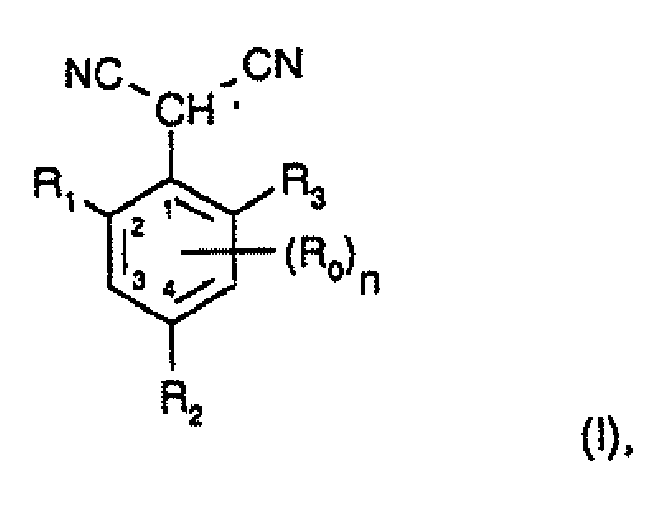
chaque R0, indépendamment de tout autre(s), est halogène, C1-C6alkyle, C2-C6alcényle, C2-C6alcynyle, C1-C6halogénoalkyle, cyano-C1-C6alkyle, C2-C6halogénoalcényle, cyano-C2-C6alcényle, C2-C6halogénoalcynyle, cyano-C2-C6alcynyle, hydroxy, hydroxy-C1-C6alkyle, C1-C6alcoxy, nitro, amino, C1-C6alkylamino, di (C1-C6alkyl) amino, C1-C6alkylcarbonylamino, C1-C6alkylsulfonylamino, C1-C6alkylaminosulfonyle, C1-C6alkylcarbonyle, C1-C6alkylcarbonyl-C1-C6alkyle, C1-C6alcoxycarbonyl-C1-C6alkyle, C1-C6alkylcarbonyl-C2-C6alcényle, C1-C6alcoxycarbonyle, C1-C6alcoxycarbonyl-C2-C6alcényle, C1-C6alkylcarbonyl-C2-C6alcynyle, C1-C6alcoxycarbonyl-C2-C6alcynyle, cyano, carboxy, phényle ou un cycle aromatique contenant 1 ou 2 hétéroatomes choisis dans le groupe azote, oxygène et soufre, les deux derniers cycles aromatiques pouvant être substitués par C1-C3alkyle, C1-C3halogénoalkyle, C1-C3alcoxy, C1-C3halogénoalcoxy, halogène, cyano ou par nitro ; ou
R0, ensemble avec les substituants adjacents R1, R2 et R3, forme un pont C3-C6hydrocarbure saturé ou insaturé qui peut être interrompu par 1 ou 2 hétéroatomes choisis dans le groupe azote, oxygène et soufre et/ou substitués par C1-C4alkyle;
R1, R2 et R3 sont chacun indépendamment des autres hydrogène, halogène, C1-C6alkyle, C2-C6alcényle, C2-C6alcynyle, C3-C6cycloalkyle, C1-C6halogénoalkyle, C2-C6halogénoalcényle, C1-C6alcoxycarbonyl-C2-C6alcényle, C1-C6alkylcarbonyl-C2-C6alcényle, cyano-C2-C6alcényle, nitro-C2-C6alcényle, C2-C6halogénoalcynyle, C1-C6alcoxycarbonyl-C2-C6alcynyle, C1-C6alkylcarbonyl-C2-C6alcynyle, cyano-C2-C6alcynyle, nitro-C2-C6alcynyle, C3-C6halogénocycloalkyle, hydroxy-C1-C6alkyle, C1-C6alcpxy-C1-C6alkyle, C1-C6alkylthio-C1-C6alkyle, cyano, C1-C4alkylcarbonyle, C1-C6alcoxycarbonyle, hydroxy, C1-C10alcoxy, C3-C6alcényloxy, C3-C6alcynyloxy, C1-C6halogénoalcoxy, C3-C6halogénoalcényloxy, C1-C6alcoxy-C1-C6alcoxy, mercapto, C1-C6alkylthio, C1-C6halogénoalkylthio, C1-C6alkylsulfinyle, C1-C6alkylsulfonyle, nitro, amino, C1-C6alkylamino, di (C1-C6alkyl) amino ou phénoxy, le cycle phényle pouvant être substitué par C1-C3alkyle, C1-C3halogénoalkyle, C1-C3alcoxy, C1-C3halogénoalcoxy, halogène, cyano ou par nitro ;
R2 peut en outre être phényle, naphtyle ou un cycle aromatique à 5 ou 6 chaînons qui peut contenir 1 ou 2 hétéroatomes choisis dans le groupe azote, oxygène et soufre, le cycle phényle, le cycle naphtyle et le cycle aromatique à 5 ou 6 chaînons pouvant être substitués par halogène, C3-C8cycloalkyle, hydroxy, mercapto, amino, cyano, nitro ou par formyle ; et/ou
le cycle phényle, le cycle naphtyle et le cycle aromatique à 5 ou 6 chaînons peuvent être substitués par C1-C6alkyle, C1-C6alcoxy, hydroxy-C1-C6alkyle, C1-C6alcoxy-C1-C6alkyle, C1-C6alcoxy-C1-C6alcoxy, C1-C6alkylcarbonyle, C1-C6alkylthio, C1-C6alkylsulfinyle, C1-C6alkylsulfonyle, mono-C1-C6alkylamino, di-C1-C6alkylamino, C1-C6alkylcarbonylamino, C1-C6alkylcarbonyl(C1-C6alkyl)amino, C2-C6alcényle, C3-C6alcényloxy, hydroxy-C3-C6alcényle, C1-C6alcoxy-C2-C6alcényle, C1-C6alcoxy-C3-C6alcényloxy, C2-C6alcénylcarbonyle, C2-C6alcénylthio, C2-C6alcénylsulfinyle, C2-C6alcénylsulfonyle, mono- ou di-C2-C6alcénylamino, C1-C6alkyl(C3-C6alcényl)amino, C2-C6alcénylcarbonylamino, C2-C6alcénylcarbonyl(C1-C6alkyl)amino, C2-C6alcynyle, C3-C6alcynyloxy, hydroxy-C3-C6alcynyle, C1-C6alcoxy-C3-C6alcynyle, C1-C6alcoxy-C4-C6alcynyloxy, C2-C6alcynylcarbonyle, C2-C6alcynylthio, C2-C6alcynylsulfinyle, C2-C6alcynylsulfonyle, mono- ou di-C3-C6alcynylamino, C1-C6alkyl(C3-C6alcynyl)amino, C2-C6alcynylc arbonylamino ou par C2-C6alcynylcarbonyl(C1-C6alkyl)amino ; et/ou
le cycle phényle, le cycle naphtyle et le cycle aromatique à 5 ou 6 chaînons peuvent être substitués par un groupement halogéno-substitué C1-C6alkyle, C1-C6alcoxy, hydroxy-C1-C6alkyle, C1-C6alcoxy-C1-C6alkyle, C1-C6alcoxy-C1-C6alcoxy, C1-C6alkylcarbonyle, C1-C6alkylthio, C1-C6alkylsulfinyle, C1-C6alkylsulfonyle, mono-C1-C6alkylamino, di-C1-C6alkylamino, C1-C6alkylcarbonylamino, C1-C6alkylcarbonyl (C1-C6alkyl) amino, C2-C6alcényle, C3-C6alcényloxy, hydroxy-C3-C6alcényle, C1-C6alcoxy-C2-C6alcényle, C1-C6alcoxy-C3-C6alcényloxy, C2-C6alcénylcarbonyle, C2-C6alcénylthio, C2-C6alcénylsulfinyle, C2-C6alcénylsulfonyle, mono- ou di-C2-C6alcénylamino, C1-C6alkyl(C3-C6alcényl)amino, C2-C6alcénylcarbonylamino, C2-C6alcénylcarbonyl (C1-C6alkyl)amino, C2-C6alcynyle, C3-C6alcynyloxy, hydroxy-C3-C6alcynyle, C1-C6alcoxy-C3-C6alcynyle, C1-C6alcoxy-C4-C6alcynyloxy, C2-C6alcynylcarbonyle, C2-C6alcynylthio, C2-C6alcynylsulfinyle, C2-C6alcynylsulfonyle, mono- ou di-C3-C6alcynylamino, C1-C6alkyl(C3-C6alcynyl))amino, C2-C6alcynylcarbonylamino ou par C2-C6alcynylcarbonyl(C1-C6alkyl)amino ; et/ou
le cycle phényle, le cycle naphtyle et le cycle aromatique à 5 ou 6 chaînons peuvent être substitués par un radical de formule COOR50, CONR51, SO2NR53R54 ou SO2OR55, où R50, R51, R52, R53, R54 et R55 sont chacun indépendamment des autres C1-C6alkyle, C2-C6alcényle ou C3-C6alcynyle ou C1-C6alkyle, C2-C6alcényle ou C3-C6alcynyle halogéno-, hydroxy-, alcoxy-, mercapto-, amino-, cyano-, nitro-, alkylthio-, alkylsulfinyl- ou alkylsulfonyl-substitué ; et n est 0, 1 ou 2,
par réaction d'un composé de formule II
R0, R1, R2, R3 et n sont tels que définis et X est chlore, brome ou iode, avec du dinitrile d'acide malonique dans un diluant inerte en présence d'un catalyseur au palladium et d'une base, lequel procédé comprend l'utilisation en tant que base d'un hydroxyde d'un métal alcalin ou un mélange d'hydroxydes de métaux alcalins, et l'utilisation en tant que catalyseur au palladium d'un dihalogénure de palladium(II), l'acétate de palladium(II), le sulfate de palladium(II), le dichlorure de bis(triphénylphosphine)palladium(II), le dichlorure de bis (tricyclopentylphosphine) palladium (II), le dichlorure de bis(tricyclohexylphosphine)palladium(II), le bis(dibenzylidèneacétone)palladium(0) ou le tétrakis(triphénylphosphine)palladium(0). - Procédé selon la revendication 1, caractérisé en ce que le catalyseur au palladium est préparé in situ à partir de composés de palladium(II) ou de palladium(0) par complexation avec des ligands de phosphine.
- Procédé selon la revendication 1, caractérisé en ce que le catalyseur au palladium est utilisé dans une quantité de 0,001 à 100 % en moles sur la base du composé de formule II.
- Procédé selon la revendication 1, caractérisé en ce qu'à titre de diluant, on utilise un hydrocarbure aliphatique, cycloaliphatique ou aromatique, un halogénohydrocarbure aliphatique, un nitrile, un éther, un alcool, une cétone, un ester ou une lactone, un lactame N-substitué, un amide, une urée acyclique, un sulfoxyde, l'eau ou un mélange de ces diluants.
- Procédé selon la revendication 4, caractérisé en ce qu'à titre d'hydrocarbure aromatique, on utilise un éther, un lactame N-substitué, un amide, une urée acyclique ou un sulfoxyde.
- Procédé selon la revendication 5, caractérisé en ce qu'on utilise la N-méthylpyrrolidone.
- Procédé selon la revendication 1, caractérisé en ce qu'à titre de base, on utilise l'hydroxyde de sodium ou l'hydroxyde de potassium ou un mélange d'hydroxyde de sodium et d'hydroxyde de potassium.
- Procédé selon la revendication 7, caractérisé en ce que l'hydroxyde de sodium est utilisé comme base.
- Procédé selon la revendication 7, caractérisé en ce que la base est utilisée dans une quantité équivalente ou dans un excès de 2 à 10 équivalents par rapport au dinitrile d'acide malonique.
- Procédé selon la revendication 1, caractérisé en ce que la réaction est effectuée à une température de 0° à 250°C.
- Procédé selon la revendication 1, caractérisé en ce que la réaction du dinitrile d'acide malonique avec un composé de formule II est effectuée à une pression élevée.
Applications Claiming Priority (3)
| Application Number | Priority Date | Filing Date | Title |
|---|---|---|---|
| CH20572002 | 2002-12-05 | ||
| CH205702 | 2002-12-05 | ||
| PCT/EP2003/013716 WO2004050607A1 (fr) | 2002-12-05 | 2003-12-04 | Procede de preparation de dinitriles d'acide phenylmalonique |
Publications (2)
| Publication Number | Publication Date |
|---|---|
| EP1567482A1 EP1567482A1 (fr) | 2005-08-31 |
| EP1567482B1 true EP1567482B1 (fr) | 2010-02-17 |
Family
ID=32399979
Family Applications (1)
| Application Number | Title | Priority Date | Filing Date |
|---|---|---|---|
| EP03767741A Expired - Lifetime EP1567482B1 (fr) | 2002-12-05 | 2003-12-04 | Procede de preparation de dinitriles d'acide phenylmalonique |
Country Status (22)
| Country | Link |
|---|---|
| US (1) | US7268247B2 (fr) |
| EP (1) | EP1567482B1 (fr) |
| JP (1) | JP4170986B2 (fr) |
| KR (1) | KR100726112B1 (fr) |
| CN (1) | CN1329370C (fr) |
| AR (1) | AR042282A1 (fr) |
| AT (1) | ATE457974T1 (fr) |
| AU (1) | AU2003292186B2 (fr) |
| BR (2) | BR0310115B1 (fr) |
| CA (1) | CA2503558C (fr) |
| DE (1) | DE60331346D1 (fr) |
| DK (1) | DK1567482T3 (fr) |
| ES (1) | ES2339652T3 (fr) |
| IL (1) | IL168698A (fr) |
| MX (1) | MXPA05005698A (fr) |
| PL (1) | PL208742B1 (fr) |
| PT (1) | PT1567482E (fr) |
| RU (1) | RU2324678C2 (fr) |
| TW (1) | TWI313676B (fr) |
| UA (1) | UA80847C2 (fr) |
| WO (1) | WO2004050607A1 (fr) |
| ZA (1) | ZA200502907B (fr) |
Families Citing this family (20)
| Publication number | Priority date | Publication date | Assignee | Title |
|---|---|---|---|---|
| US7983720B2 (en) * | 2004-12-22 | 2011-07-19 | Broadcom Corporation | Wireless telephone with adaptive microphone array |
| US20060147063A1 (en) * | 2004-12-22 | 2006-07-06 | Broadcom Corporation | Echo cancellation in telephones with multiple microphones |
| US20070116300A1 (en) * | 2004-12-22 | 2007-05-24 | Broadcom Corporation | Channel decoding for wireless telephones with multiple microphones and multiple description transmission |
| US20060133621A1 (en) * | 2004-12-22 | 2006-06-22 | Broadcom Corporation | Wireless telephone having multiple microphones |
| US8509703B2 (en) * | 2004-12-22 | 2013-08-13 | Broadcom Corporation | Wireless telephone with multiple microphones and multiple description transmission |
| WO2006084663A1 (fr) | 2005-02-09 | 2006-08-17 | Syngenta Participations Ag | Procede pour la fabrication d’intermediaires |
| US8716507B2 (en) * | 2008-10-31 | 2014-05-06 | The Governing Council Of University Of Toronto | Iron(II) catalysts containing diimino-diphosphine tetradentate ligands and their synthesis |
| DK2406205T3 (en) | 2009-03-12 | 2017-02-27 | Bayer Ip Gmbh | PROCEDURE FOR MANUFACTURING CHLOR AND BROMAROMATS |
| CN102977151B (zh) * | 2012-11-21 | 2015-10-21 | 北京格林凯默科技有限公司 | 双(三环己基膦)二氯化钯的制备方法 |
| MX2019000753A (es) | 2016-07-22 | 2019-06-03 | Syngenta Participations Ag | Proceso para preparacion de dinitrilos del acido fenilmalonico. |
| CN108264450B (zh) * | 2016-12-30 | 2021-04-30 | 浙江省诸暨合力化学对外贸易有限公司 | 一种多取代苯酚的制备方法 |
| CN108264449B (zh) * | 2016-12-30 | 2022-04-26 | 浙江省诸暨合力化学对外贸易有限公司 | 一种2,6-二乙基-4-甲基苯酚的制备方法 |
| CN106928253A (zh) * | 2017-03-09 | 2017-07-07 | 武汉工程大学 | 一种唑啉草酯的制备方法 |
| EP3608324B1 (fr) | 2017-04-07 | 2021-08-11 | Oriental (Luzhou) Agrochemicals. Co., Ltd. | Procédé de préparation de 2-arylmalonamide et applications de celui-ci |
| WO2018210616A1 (fr) | 2017-05-15 | 2018-11-22 | Bayer Cropscience Aktiengesellschaft | Procédé pour la préparation de (4-halogéno-2,6-dialkylphényl)malononitriles |
| CA3084563A1 (fr) | 2017-12-05 | 2019-06-13 | Syngenta Participations Ag | Procede chimique pour la synthese de composes de pyrazolidinedione herbicides |
| KR102706151B1 (ko) | 2018-04-10 | 2024-09-13 | 바이엘 악티엔게젤샤프트 | 2,6-디알킬페닐아세트산을 제조하는 방법 |
| CN109320435B (zh) * | 2018-11-30 | 2021-11-23 | 江苏富鼎化学有限公司 | 2-(2,6-二乙基-4-甲基苯)丙二腈的合成方法 |
| CN109627184A (zh) * | 2019-01-04 | 2019-04-16 | 浙江中山化工集团股份有限公司 | 一种2,6-二乙基-4-甲基苯基丙二腈的制备方法 |
| AU2019439692B2 (en) | 2019-04-01 | 2023-01-12 | Oriental (Luzhou) Agrochemicals Co., Ltd. | Method for preparing 2-arylmalonic acid derivative, intermediate, and application thereof |
Family Cites Families (12)
| Publication number | Priority date | Publication date | Assignee | Title |
|---|---|---|---|---|
| JPS60197650A (ja) * | 1984-03-16 | 1985-10-07 | Nitto Kasei Kk | アリ−ル置換マロンニトリルの製造法 |
| JPS60204753A (ja) * | 1984-03-29 | 1985-10-16 | Nitto Kasei Kk | アリ−ル置換マロンニトリルの製造方法 |
| US5358924A (en) * | 1991-03-21 | 1994-10-25 | Bayer Aktiengesellschaft | 3-hydroxy-4-aryl-5-oxo-pyrozoline derivatives, compositions and use |
| DE4109208A1 (de) * | 1991-03-21 | 1992-09-24 | Bayer Ag | 3-hydroxy-4-aryl-5-oxo-pyrazolin-derivate |
| WO1995001971A1 (fr) | 1993-07-05 | 1995-01-19 | Bayer Aktiengesellschaft | Heterocycles aryl-cetoenoliques substitues |
| PL319092A1 (en) | 1994-10-17 | 1997-07-21 | Ciba Geigy Ag | Herbicidal composition |
| WO1996021652A1 (fr) | 1995-01-13 | 1996-07-18 | Novartis Ag | Derives 4-aryl- et 4-heteroaryl-5-oxo-pyrazoline possedant des proprietes pesticides |
| TR199701740T1 (xx) | 1995-06-30 | 1998-04-21 | Bayer Ag. | Herbisitler ve pestisitler olarak kullan�lmak �zere dialkil fenil halit ikameli ketoenoller. |
| JP3652986B2 (ja) * | 1998-03-13 | 2005-05-25 | シンジェンタ パーティシペーションズ アクチェンゲゼルシャフト | 殺草活性な3−ヒドロキシ−4−アリール−5−オキソピラゾリン誘導体 |
| IN188424B (fr) * | 1998-03-19 | 2002-09-21 | Laonza A G | |
| JP4049233B2 (ja) * | 1999-03-25 | 2008-02-20 | 富士フイルム株式会社 | 活性メチレン置換アレーン誘導体の製造方法 |
| CA2368827A1 (fr) * | 1999-06-16 | 2000-12-28 | Syngenta Participations Ag | Dinitriles d'acide arylmalonique substitue comme intermediaires de preparation d'herbicides |
-
2003
- 2003-12-03 AR ARP030104455A patent/AR042282A1/es active IP Right Grant
- 2003-12-03 TW TW092133992A patent/TWI313676B/zh not_active IP Right Cessation
- 2003-12-04 KR KR1020057010171A patent/KR100726112B1/ko not_active Expired - Fee Related
- 2003-12-04 AU AU2003292186A patent/AU2003292186B2/en not_active Expired
- 2003-12-04 DE DE60331346T patent/DE60331346D1/de not_active Expired - Lifetime
- 2003-12-04 WO PCT/EP2003/013716 patent/WO2004050607A1/fr not_active Ceased
- 2003-12-04 PL PL377360A patent/PL208742B1/pl unknown
- 2003-12-04 AT AT03767741T patent/ATE457974T1/de active
- 2003-12-04 BR BRPI0310115-0A patent/BR0310115B1/pt active IP Right Grant
- 2003-12-04 CA CA2503558A patent/CA2503558C/fr not_active Expired - Lifetime
- 2003-12-04 MX MXPA05005698A patent/MXPA05005698A/es active IP Right Grant
- 2003-12-04 US US10/537,408 patent/US7268247B2/en not_active Expired - Lifetime
- 2003-12-04 RU RU2005121120/04A patent/RU2324678C2/ru active
- 2003-12-04 JP JP2004556295A patent/JP4170986B2/ja not_active Expired - Lifetime
- 2003-12-04 ES ES03767741T patent/ES2339652T3/es not_active Expired - Lifetime
- 2003-12-04 UA UAA200506560A patent/UA80847C2/xx unknown
- 2003-12-04 PT PT03767741T patent/PT1567482E/pt unknown
- 2003-12-04 CN CNB2003801050046A patent/CN1329370C/zh not_active Expired - Lifetime
- 2003-12-04 EP EP03767741A patent/EP1567482B1/fr not_active Expired - Lifetime
- 2003-12-04 BR BR0317002-0A patent/BR0317002A/pt unknown
- 2003-12-04 DK DK03767741.6T patent/DK1567482T3/da active
-
2005
- 2005-04-11 ZA ZA2005/02907A patent/ZA200502907B/en unknown
- 2005-05-19 IL IL168698A patent/IL168698A/en unknown
Also Published As
| Publication number | Publication date |
|---|---|
| TW200417535A (en) | 2004-09-16 |
| BR0317002A (pt) | 2005-10-25 |
| AU2003292186B2 (en) | 2010-03-11 |
| PL208742B1 (pl) | 2011-06-30 |
| KR20050088102A (ko) | 2005-09-01 |
| US7268247B2 (en) | 2007-09-11 |
| BR0310115B1 (pt) | 2013-04-30 |
| AR042282A1 (es) | 2005-06-15 |
| CA2503558A1 (fr) | 2004-06-17 |
| RU2005121120A (ru) | 2006-01-20 |
| MXPA05005698A (es) | 2005-07-26 |
| CN1720221A (zh) | 2006-01-11 |
| JP2006509006A (ja) | 2006-03-16 |
| ATE457974T1 (de) | 2010-03-15 |
| ZA200502907B (en) | 2005-12-28 |
| ES2339652T3 (es) | 2010-05-24 |
| DK1567482T3 (da) | 2010-05-17 |
| US20060135805A1 (en) | 2006-06-22 |
| DE60331346D1 (de) | 2010-04-01 |
| PL377360A1 (pl) | 2006-02-06 |
| CA2503558C (fr) | 2012-07-17 |
| UA80847C2 (en) | 2007-11-12 |
| JP4170986B2 (ja) | 2008-10-22 |
| WO2004050607A1 (fr) | 2004-06-17 |
| PT1567482E (pt) | 2010-04-15 |
| TWI313676B (en) | 2009-08-21 |
| IL168698A (en) | 2010-11-30 |
| KR100726112B1 (ko) | 2007-06-12 |
| RU2324678C2 (ru) | 2008-05-20 |
| CN1329370C (zh) | 2007-08-01 |
| EP1567482A1 (fr) | 2005-08-31 |
| AU2003292186A1 (en) | 2004-06-23 |
Similar Documents
| Publication | Publication Date | Title |
|---|---|---|
| US7268247B2 (en) | Process for the preparation of phenylmalonic acid dinitriles | |
| AU5682200A (en) | Substituted arylmalonic acid dinitriles as intermediates for the preparation of herbicides | |
| EP3487837B1 (fr) | Procede de preparation d'herbicides a base de pyrrolidine dione spiroheterocyclique a l'aide du compose intermediaire acide 2-(4-chloro-2,6-dimethyl-phenyle)acetique | |
| US6258982B1 (en) | Process for the preparation of substituted aromatic amino compounds | |
| AU2006212397B2 (en) | Process for the preparation of intermediates | |
| EP3099658A1 (fr) | Procédé de production de 2,3,6-triméthylphénol | |
| US9169198B2 (en) | Method for the production of 2-amino-5-cyano-N,3-dimethylbenzamide | |
| PL189843B1 (pl) | Sposób wytwarzania aryloamidów heteroaromatycznych kwasów karboksylowych | |
| JP5770503B2 (ja) | ビフェニル類の製造方法 | |
| JP2018140985A (ja) | 芳香族化合物の製造方法 | |
| JPWO2007091658A1 (ja) | 光学活性アリル化合物の製造法 |
Legal Events
| Date | Code | Title | Description |
|---|---|---|---|
| PUAI | Public reference made under article 153(3) epc to a published international application that has entered the european phase |
Free format text: ORIGINAL CODE: 0009012 |
|
| 17P | Request for examination filed |
Effective date: 20050418 |
|
| AK | Designated contracting states |
Kind code of ref document: A1 Designated state(s): AT BE BG CH CY CZ DE DK EE ES FI FR GB GR HU IE IT LI LU MC NL PT RO SE SI SK TR |
|
| AX | Request for extension of the european patent |
Extension state: AL LT LV MK |
|
| DAX | Request for extension of the european patent (deleted) | ||
| 17Q | First examination report despatched |
Effective date: 20080701 |
|
| GRAP | Despatch of communication of intention to grant a patent |
Free format text: ORIGINAL CODE: EPIDOSNIGR1 |
|
| GRAS | Grant fee paid |
Free format text: ORIGINAL CODE: EPIDOSNIGR3 |
|
| GRAA | (expected) grant |
Free format text: ORIGINAL CODE: 0009210 |
|
| AK | Designated contracting states |
Kind code of ref document: B1 Designated state(s): AT BE BG CH CY CZ DE DK EE ES FI FR GB GR HU IE IT LI LU MC NL PT RO SE SI SK TR |
|
| REG | Reference to a national code |
Ref country code: GB Ref legal event code: FG4D |
|
| REG | Reference to a national code |
Ref country code: CH Ref legal event code: EP |
|
| REG | Reference to a national code |
Ref country code: IE Ref legal event code: FG4D |
|
| REF | Corresponds to: |
Ref document number: 60331346 Country of ref document: DE Date of ref document: 20100401 Kind code of ref document: P |
|
| REG | Reference to a national code |
Ref country code: RO Ref legal event code: EPE |
|
| REG | Reference to a national code |
Ref country code: PT Ref legal event code: SC4A Free format text: AVAILABILITY OF NATIONAL TRANSLATION Effective date: 20100407 |
|
| REG | Reference to a national code |
Ref country code: NL Ref legal event code: T3 |
|
| REG | Reference to a national code |
Ref country code: SE Ref legal event code: TRGR |
|
| REG | Reference to a national code |
Ref country code: DK Ref legal event code: T3 |
|
| REG | Reference to a national code |
Ref country code: ES Ref legal event code: FG2A Ref document number: 2339652 Country of ref document: ES Kind code of ref document: T3 |
|
| REG | Reference to a national code |
Ref country code: GR Ref legal event code: EP Ref document number: 20100401121 Country of ref document: GR |
|
| PG25 | Lapsed in a contracting state [announced via postgrant information from national office to epo] |
Ref country code: SI Free format text: LAPSE BECAUSE OF FAILURE TO SUBMIT A TRANSLATION OF THE DESCRIPTION OR TO PAY THE FEE WITHIN THE PRESCRIBED TIME-LIMIT Effective date: 20100217 |
|
| PG25 | Lapsed in a contracting state [announced via postgrant information from national office to epo] |
Ref country code: EE Free format text: LAPSE BECAUSE OF FAILURE TO SUBMIT A TRANSLATION OF THE DESCRIPTION OR TO PAY THE FEE WITHIN THE PRESCRIBED TIME-LIMIT Effective date: 20100217 Ref country code: CY Free format text: LAPSE BECAUSE OF FAILURE TO SUBMIT A TRANSLATION OF THE DESCRIPTION OR TO PAY THE FEE WITHIN THE PRESCRIBED TIME-LIMIT Effective date: 20100217 |
|
| PG25 | Lapsed in a contracting state [announced via postgrant information from national office to epo] |
Ref country code: SK Free format text: LAPSE BECAUSE OF FAILURE TO SUBMIT A TRANSLATION OF THE DESCRIPTION OR TO PAY THE FEE WITHIN THE PRESCRIBED TIME-LIMIT Effective date: 20100217 Ref country code: BG Free format text: LAPSE BECAUSE OF FAILURE TO SUBMIT A TRANSLATION OF THE DESCRIPTION OR TO PAY THE FEE WITHIN THE PRESCRIBED TIME-LIMIT Effective date: 20100517 Ref country code: CZ Free format text: LAPSE BECAUSE OF FAILURE TO SUBMIT A TRANSLATION OF THE DESCRIPTION OR TO PAY THE FEE WITHIN THE PRESCRIBED TIME-LIMIT Effective date: 20100217 |
|
| PLBE | No opposition filed within time limit |
Free format text: ORIGINAL CODE: 0009261 |
|
| STAA | Information on the status of an ep patent application or granted ep patent |
Free format text: STATUS: NO OPPOSITION FILED WITHIN TIME LIMIT |
|
| REG | Reference to a national code |
Ref country code: HU Ref legal event code: AG4A Ref document number: E008011 Country of ref document: HU |
|
| 26N | No opposition filed |
Effective date: 20101118 |
|
| PG25 | Lapsed in a contracting state [announced via postgrant information from national office to epo] |
Ref country code: MC Free format text: LAPSE BECAUSE OF NON-PAYMENT OF DUE FEES Effective date: 20101231 |
|
| PG25 | Lapsed in a contracting state [announced via postgrant information from national office to epo] |
Ref country code: LU Free format text: LAPSE BECAUSE OF NON-PAYMENT OF DUE FEES Effective date: 20101204 |
|
| PG25 | Lapsed in a contracting state [announced via postgrant information from national office to epo] |
Ref country code: TR Free format text: LAPSE BECAUSE OF FAILURE TO SUBMIT A TRANSLATION OF THE DESCRIPTION OR TO PAY THE FEE WITHIN THE PRESCRIBED TIME-LIMIT Effective date: 20100217 |
|
| REG | Reference to a national code |
Ref country code: AT Ref legal event code: PC Ref document number: 457974 Country of ref document: AT Kind code of ref document: T Owner name: ONGAME SERVICES AB, SE Effective date: 20121018 |
|
| REG | Reference to a national code |
Ref country code: FR Ref legal event code: PLFP Year of fee payment: 13 |
|
| REG | Reference to a national code |
Ref country code: GB Ref legal event code: 732E Free format text: REGISTERED BETWEEN 20160915 AND 20160921 |
|
| REG | Reference to a national code |
Ref country code: FR Ref legal event code: PLFP Year of fee payment: 14 |
|
| REG | Reference to a national code |
Ref country code: FR Ref legal event code: PLFP Year of fee payment: 15 |
|
| PGFP | Annual fee paid to national office [announced via postgrant information from national office to epo] |
Ref country code: SE Payment date: 20221208 Year of fee payment: 20 Ref country code: RO Payment date: 20221128 Year of fee payment: 20 Ref country code: PT Payment date: 20221125 Year of fee payment: 20 Ref country code: NL Payment date: 20221114 Year of fee payment: 20 Ref country code: IE Payment date: 20221125 Year of fee payment: 20 Ref country code: GB Payment date: 20221109 Year of fee payment: 20 Ref country code: FR Payment date: 20221110 Year of fee payment: 20 Ref country code: FI Payment date: 20221128 Year of fee payment: 20 Ref country code: DK Payment date: 20221129 Year of fee payment: 20 Ref country code: DE Payment date: 20220627 Year of fee payment: 20 Ref country code: AT Payment date: 20221125 Year of fee payment: 20 |
|
| PGFP | Annual fee paid to national office [announced via postgrant information from national office to epo] |
Ref country code: HU Payment date: 20221203 Year of fee payment: 20 Ref country code: GR Payment date: 20221125 Year of fee payment: 20 Ref country code: BE Payment date: 20221110 Year of fee payment: 20 |
|
| PGFP | Annual fee paid to national office [announced via postgrant information from national office to epo] |
Ref country code: ES Payment date: 20230109 Year of fee payment: 20 Ref country code: CH Payment date: 20230101 Year of fee payment: 20 |
|
| PGFP | Annual fee paid to national office [announced via postgrant information from national office to epo] |
Ref country code: IT Payment date: 20221214 Year of fee payment: 20 |
|
| REG | Reference to a national code |
Ref country code: DE Ref legal event code: R071 Ref document number: 60331346 Country of ref document: DE |
|
| REG | Reference to a national code |
Ref country code: NL Ref legal event code: MK Effective date: 20231203 |
|
| REG | Reference to a national code |
Ref country code: DK Ref legal event code: EUP Expiry date: 20231204 |
|
| REG | Reference to a national code |
Ref country code: CH Ref legal event code: PL |
|
| REG | Reference to a national code |
Ref country code: GB Ref legal event code: PE20 Expiry date: 20231203 Ref country code: ES Ref legal event code: FD2A Effective date: 20231227 |
|
| REG | Reference to a national code |
Ref country code: BE Ref legal event code: MK Effective date: 20231204 |
|
| REG | Reference to a national code |
Ref country code: AT Ref legal event code: MK07 Ref document number: 457974 Country of ref document: AT Kind code of ref document: T Effective date: 20231204 |
|
| PG25 | Lapsed in a contracting state [announced via postgrant information from national office to epo] |
Ref country code: GB Free format text: LAPSE BECAUSE OF EXPIRATION OF PROTECTION Effective date: 20231203 |
|
| PG25 | Lapsed in a contracting state [announced via postgrant information from national office to epo] |
Ref country code: ES Free format text: LAPSE BECAUSE OF EXPIRATION OF PROTECTION Effective date: 20231205 |
|
| REG | Reference to a national code |
Ref country code: SE Ref legal event code: EUG |
|
| PG25 | Lapsed in a contracting state [announced via postgrant information from national office to epo] |
Ref country code: PT Free format text: LAPSE BECAUSE OF EXPIRATION OF PROTECTION Effective date: 20231214 Ref country code: GB Free format text: LAPSE BECAUSE OF EXPIRATION OF PROTECTION Effective date: 20231203 Ref country code: ES Free format text: LAPSE BECAUSE OF EXPIRATION OF PROTECTION Effective date: 20231205 |
|
| REG | Reference to a national code |
Ref country code: IE Ref legal event code: MK9A |
|
| PG25 | Lapsed in a contracting state [announced via postgrant information from national office to epo] |
Ref country code: IE Free format text: LAPSE BECAUSE OF EXPIRATION OF PROTECTION Effective date: 20231204 |
|
| PG25 | Lapsed in a contracting state [announced via postgrant information from national office to epo] |
Ref country code: IE Free format text: LAPSE BECAUSE OF EXPIRATION OF PROTECTION Effective date: 20231204 |