EP1565529B1 - Curable emulsions and abrasive articles therefrom - Google Patents
Curable emulsions and abrasive articles therefrom Download PDFInfo
- Publication number
- EP1565529B1 EP1565529B1 EP20030770405 EP03770405A EP1565529B1 EP 1565529 B1 EP1565529 B1 EP 1565529B1 EP 20030770405 EP20030770405 EP 20030770405 EP 03770405 A EP03770405 A EP 03770405A EP 1565529 B1 EP1565529 B1 EP 1565529B1
- Authority
- EP
- European Patent Office
- Prior art keywords
- abrasive
- abrasive article
- coat
- weight
- curable
- Prior art date
- Legal status (The legal status is an assumption and is not a legal conclusion. Google has not performed a legal analysis and makes no representation as to the accuracy of the status listed.)
- Expired - Lifetime
Links
Images

Classifications
-
- C—CHEMISTRY; METALLURGY
- C09—DYES; PAINTS; POLISHES; NATURAL RESINS; ADHESIVES; COMPOSITIONS NOT OTHERWISE PROVIDED FOR; APPLICATIONS OF MATERIALS NOT OTHERWISE PROVIDED FOR
- C09D—COATING COMPOSITIONS, e.g. PAINTS, VARNISHES OR LACQUERS; FILLING PASTES; CHEMICAL PAINT OR INK REMOVERS; INKS; CORRECTING FLUIDS; WOODSTAINS; PASTES OR SOLIDS FOR COLOURING OR PRINTING; USE OF MATERIALS THEREFOR
- C09D175/00—Coating compositions based on polyureas or polyurethanes; Coating compositions based on derivatives of such polymers
- C09D175/04—Polyurethanes
-
- B—PERFORMING OPERATIONS; TRANSPORTING
- B24—GRINDING; POLISHING
- B24D—TOOLS FOR GRINDING, BUFFING OR SHARPENING
- B24D13/00—Wheels having flexibly-acting working parts, e.g. buffing wheels; Mountings therefor
- B24D13/02—Wheels having flexibly-acting working parts, e.g. buffing wheels; Mountings therefor acting by their periphery
- B24D13/06—Wheels having flexibly-acting working parts, e.g. buffing wheels; Mountings therefor acting by their periphery the flaps or strips being individually attached
-
- B—PERFORMING OPERATIONS; TRANSPORTING
- B24—GRINDING; POLISHING
- B24D—TOOLS FOR GRINDING, BUFFING OR SHARPENING
- B24D3/00—Physical features of abrasive bodies, or sheets, e.g. abrasive surfaces of special nature; Abrasive bodies or sheets characterised by their constituents
- B24D3/001—Physical features of abrasive bodies, or sheets, e.g. abrasive surfaces of special nature; Abrasive bodies or sheets characterised by their constituents the constituent being used as supporting member
- B24D3/002—Flexible supporting members, e.g. paper, woven, plastic materials
- B24D3/004—Flexible supporting members, e.g. paper, woven, plastic materials with special coatings
-
- C—CHEMISTRY; METALLURGY
- C08—ORGANIC MACROMOLECULAR COMPOUNDS; THEIR PREPARATION OR CHEMICAL WORKING-UP; COMPOSITIONS BASED THEREON
- C08G—MACROMOLECULAR COMPOUNDS OBTAINED OTHERWISE THAN BY REACTIONS ONLY INVOLVING UNSATURATED CARBON-TO-CARBON BONDS
- C08G18/00—Polymeric products of isocyanates or isothiocyanates
- C08G18/06—Polymeric products of isocyanates or isothiocyanates with compounds having active hydrogen
- C08G18/08—Processes
- C08G18/0804—Manufacture of polymers containing ionic or ionogenic groups
- C08G18/0819—Manufacture of polymers containing ionic or ionogenic groups containing anionic or anionogenic groups
- C08G18/0823—Manufacture of polymers containing ionic or ionogenic groups containing anionic or anionogenic groups containing carboxylate salt groups or groups forming them
-
- C—CHEMISTRY; METALLURGY
- C08—ORGANIC MACROMOLECULAR COMPOUNDS; THEIR PREPARATION OR CHEMICAL WORKING-UP; COMPOSITIONS BASED THEREON
- C08G—MACROMOLECULAR COMPOUNDS OBTAINED OTHERWISE THAN BY REACTIONS ONLY INVOLVING UNSATURATED CARBON-TO-CARBON BONDS
- C08G18/00—Polymeric products of isocyanates or isothiocyanates
- C08G18/06—Polymeric products of isocyanates or isothiocyanates with compounds having active hydrogen
- C08G18/08—Processes
- C08G18/10—Prepolymer processes involving reaction of isocyanates or isothiocyanates with compounds having active hydrogen in a first reaction step
-
- C—CHEMISTRY; METALLURGY
- C08—ORGANIC MACROMOLECULAR COMPOUNDS; THEIR PREPARATION OR CHEMICAL WORKING-UP; COMPOSITIONS BASED THEREON
- C08G—MACROMOLECULAR COMPOUNDS OBTAINED OTHERWISE THAN BY REACTIONS ONLY INVOLVING UNSATURATED CARBON-TO-CARBON BONDS
- C08G18/00—Polymeric products of isocyanates or isothiocyanates
- C08G18/06—Polymeric products of isocyanates or isothiocyanates with compounds having active hydrogen
- C08G18/28—Polymeric products of isocyanates or isothiocyanates with compounds having active hydrogen characterised by the compounds used containing active hydrogen
- C08G18/2805—Compounds having only one group containing active hydrogen
- C08G18/285—Nitrogen containing compounds
- C08G18/286—Oximes
-
- C—CHEMISTRY; METALLURGY
- C08—ORGANIC MACROMOLECULAR COMPOUNDS; THEIR PREPARATION OR CHEMICAL WORKING-UP; COMPOSITIONS BASED THEREON
- C08G—MACROMOLECULAR COMPOUNDS OBTAINED OTHERWISE THAN BY REACTIONS ONLY INVOLVING UNSATURATED CARBON-TO-CARBON BONDS
- C08G18/00—Polymeric products of isocyanates or isothiocyanates
- C08G18/06—Polymeric products of isocyanates or isothiocyanates with compounds having active hydrogen
- C08G18/28—Polymeric products of isocyanates or isothiocyanates with compounds having active hydrogen characterised by the compounds used containing active hydrogen
- C08G18/30—Low-molecular-weight compounds
- C08G18/32—Polyhydroxy compounds; Polyamines; Hydroxyamines
- C08G18/3225—Polyamines
- C08G18/3237—Polyamines aromatic
- C08G18/324—Polyamines aromatic containing only one aromatic ring
-
- C—CHEMISTRY; METALLURGY
- C08—ORGANIC MACROMOLECULAR COMPOUNDS; THEIR PREPARATION OR CHEMICAL WORKING-UP; COMPOSITIONS BASED THEREON
- C08G—MACROMOLECULAR COMPOUNDS OBTAINED OTHERWISE THAN BY REACTIONS ONLY INVOLVING UNSATURATED CARBON-TO-CARBON BONDS
- C08G18/00—Polymeric products of isocyanates or isothiocyanates
- C08G18/06—Polymeric products of isocyanates or isothiocyanates with compounds having active hydrogen
- C08G18/28—Polymeric products of isocyanates or isothiocyanates with compounds having active hydrogen characterised by the compounds used containing active hydrogen
- C08G18/40—High-molecular-weight compounds
- C08G18/48—Polyethers
- C08G18/4854—Polyethers containing oxyalkylene groups having four carbon atoms in the alkylene group
-
- C—CHEMISTRY; METALLURGY
- C08—ORGANIC MACROMOLECULAR COMPOUNDS; THEIR PREPARATION OR CHEMICAL WORKING-UP; COMPOSITIONS BASED THEREON
- C08G—MACROMOLECULAR COMPOUNDS OBTAINED OTHERWISE THAN BY REACTIONS ONLY INVOLVING UNSATURATED CARBON-TO-CARBON BONDS
- C08G18/00—Polymeric products of isocyanates or isothiocyanates
- C08G18/06—Polymeric products of isocyanates or isothiocyanates with compounds having active hydrogen
- C08G18/28—Polymeric products of isocyanates or isothiocyanates with compounds having active hydrogen characterised by the compounds used containing active hydrogen
- C08G18/40—High-molecular-weight compounds
- C08G18/62—Polymers of compounds having carbon-to-carbon double bonds
-
- C—CHEMISTRY; METALLURGY
- C08—ORGANIC MACROMOLECULAR COMPOUNDS; THEIR PREPARATION OR CHEMICAL WORKING-UP; COMPOSITIONS BASED THEREON
- C08L—COMPOSITIONS OF MACROMOLECULAR COMPOUNDS
- C08L75/00—Compositions of polyureas or polyurethanes; Compositions of derivatives of such polymers
- C08L75/04—Polyurethanes
-
- Y—GENERAL TAGGING OF NEW TECHNOLOGICAL DEVELOPMENTS; GENERAL TAGGING OF CROSS-SECTIONAL TECHNOLOGIES SPANNING OVER SEVERAL SECTIONS OF THE IPC; TECHNICAL SUBJECTS COVERED BY FORMER USPC CROSS-REFERENCE ART COLLECTIONS [XRACs] AND DIGESTS
- Y10—TECHNICAL SUBJECTS COVERED BY FORMER USPC
- Y10T—TECHNICAL SUBJECTS COVERED BY FORMER US CLASSIFICATION
- Y10T428/00—Stock material or miscellaneous articles
- Y10T428/24—Structurally defined web or sheet [e.g., overall dimension, etc.]
- Y10T428/24802—Discontinuous or differential coating, impregnation or bond [e.g., artwork, printing, retouched photograph, etc.]
- Y10T428/24893—Discontinuous or differential coating, impregnation or bond [e.g., artwork, printing, retouched photograph, etc.] including particulate material
-
- Y—GENERAL TAGGING OF NEW TECHNOLOGICAL DEVELOPMENTS; GENERAL TAGGING OF CROSS-SECTIONAL TECHNOLOGIES SPANNING OVER SEVERAL SECTIONS OF THE IPC; TECHNICAL SUBJECTS COVERED BY FORMER USPC CROSS-REFERENCE ART COLLECTIONS [XRACs] AND DIGESTS
- Y10—TECHNICAL SUBJECTS COVERED BY FORMER USPC
- Y10T—TECHNICAL SUBJECTS COVERED BY FORMER US CLASSIFICATION
- Y10T428/00—Stock material or miscellaneous articles
- Y10T428/31504—Composite [nonstructural laminate]
- Y10T428/31551—Of polyamidoester [polyurethane, polyisocyanate, polycarbamate, etc.]
-
- Y—GENERAL TAGGING OF NEW TECHNOLOGICAL DEVELOPMENTS; GENERAL TAGGING OF CROSS-SECTIONAL TECHNOLOGIES SPANNING OVER SEVERAL SECTIONS OF THE IPC; TECHNICAL SUBJECTS COVERED BY FORMER USPC CROSS-REFERENCE ART COLLECTIONS [XRACs] AND DIGESTS
- Y10—TECHNICAL SUBJECTS COVERED BY FORMER USPC
- Y10T—TECHNICAL SUBJECTS COVERED BY FORMER US CLASSIFICATION
- Y10T428/00—Stock material or miscellaneous articles
- Y10T428/31504—Composite [nonstructural laminate]
- Y10T428/31855—Of addition polymer from unsaturated monomers
- Y10T428/31935—Ester, halide or nitrile of addition polymer
Definitions
- the present invention relates an abrasive article comprising the reaction product of a curable emulsion.
- EP-A-0626401 relates to an aqueous binder composition, containing A) 70 to 30% by weight of one or more water-dilutable oligomeric or polymeric polyol compounds with a hydroxyl number of 30 to 250, an acid number of 0 to 50 mg KOH/g or an amine number of 0 to 50 mg KOH/g and a number average molecular weight (Mn) of 500 to 10000, B) 30 to 70% by weight of one or more polyisocyanates as crosslinking agents, with an average NCO functionality of 1.8 to 3.5 and an average content of hydrophobic groups of 0.1 to 1, C) 0 to 20% by weight of one or more aminoplast resins and/or phenoplast resins, and D) 0 to 40% by weight of one or more capped polyisocyanates, wherein the sum of the percentages by weight of components A), B), C) and D) adds up to 100% by weight, as well as water and optionally one or more organic solvents.
- Mn number average mole
- WO 00/15390 relates to a seamless backing having a length, a width, a first and second generally parallel side edge, a first major exterior surface, and a second major interior surface, said backing comprising: a backing binder comprising an interpenetrating polymer network formed by the polymerization of a backing binder precursor, the backing binder precursor comprising: (i) an aromatic polyisocyanate prepolymer; (ii) a polyol curative; (iii) an acrylated urethane; and (iv) at least one polymerization agent; and at least one fibrous reinforcing material engulfed within the backing binder.
- Curable emulsions in which an oil phase containing a curable material is dispersed in an aqueous phase, are widely used in the manufacture of articles that include a binder material.
- a common problem of curable emulsions is their tendency to settle out over time, which may cause handling problems and/or reduce shelf life of the curable emulsion.
- One approach to addressing the settling issue involves the addition of a relatively large quantity (for example, approximately 10 percent by weight or more) of emulsifier to the oil phase. Although this approach may provide some relief from settling, on drying and curing the emulsion, the presence of a high amount of emulsifier typically degrades one or more properties (for example, reduced tensile strength and/or elongation at break) of the resultant cured material (that is, a material that is polymerized and/or crosslinked to a degree sufficient to impart useful physical properties).
- Polyurethanes that is, polymers containing urethane and/or urea linkages in the backbone chain
- binder materials for many applications due to their physical properties (for example, strength, elongation, and/or toughness).
- curable emulsions containing materials that are stable for a long time, and that may be dried and cured to provide polyurethanes with good physical properties.
- the present invention provides an abrasive article comprising abrasive particles and the reaction product of a curable emulsion wherein thea curable emulsion comprises:
- the curable emulsion can be made by:
- the present invention provides a method of abrading a workpiece comprising:
- Curable emulsions useful in the present invention typically have good resistance to settling, and typically may be cured to form binders having good physical properties.
- Useful abrasive articles that may be made with curable emulsions include, for example, coated abrasive articles, nonwoven abrasive articles, bonded abrasive articles, and unitary brushes.
- the above described emulsions advantageously contain low levels of volatile organic solvents.
- Curable emulsions useful in the present invention comprise an oil phase and an aqueous phase.
- the curable emulsions have a continuous aqueous phase and a discontinuous oil phase, although either or both of the oil phase and/or the aqueous phase may be continuous or discontinuous.
- the oil phase comprises blocked polyisocyanate, curative,
- the aqueous phase comprises water and as specific at least partially neutralized crosslinked copolymer of monomers comprising at least one free-radically polymerizable carboxylic acid and at least one specific alkyl or alkaryl (meth)acrylate.
- the pH of the aqueous phase is in a range from 4 to 10.
- a certain amount of nonionic surfactant is present in the curable emulsion
- blocked polyisocyanate refers to either a single blocked polyisocyanate or a mixture of two or more blocked polyisocyanates
- curative refers to either a single curative or a mixture of two or more curatives
- nonionic surfactant refers to either a single nonionic surfactant or a mixture of two or more nonionic surfactants
- neutralized crosslinked copolymer refers to either a single neutralized crosslinked copolymer or a mixture of two or more neutralized crosslinked copolymers.
- (meth)acryl encompasses “acryl” and/or “methacryl” (for example, “(meth)acrylate” encompasses acrylate and/or methacrylate). Further, numerical ranges recited herein are inclusive of their endpoints, unless otherwise specified.
- Useful blocked polyisocyanates include polyisocyanates (sometimes referred to in the art as "urethane prepolymers") wherein at least some (for example, substantially all) of the isocyanate groups have been reacted (that is, blocked) with a compound (that is, blocking agent) that forms an adduct with isocyanate groups.
- the adduct is substantially unreactive to isocyanate reactive compounds (for example, amines, alcohols, thiols, etc.) under ambient conditions (for example, temperatures in a range of from 20 °C to 25 °C), but upon application of sufficient thermal energy in the presence of curative, the adduct typically reacts with the curative to form a covalent bond.
- Exemplary blocking agents include ketoximes (for example, 2-butanone oxime); lactams (for example, epsilon-caprolactam); malonic esters (for example, dimethyl malonate and diethyl malonate); pyrazoles (for example, 3,5-dimethylpyrazole); alcohols including tertiary alcohols (for example, t-butanol or 2,2-dimethylpentanol), phenols (for example, alkylated phenols), and mixtures of alcohols as described, for example in U.S. Pat. No. 6,288,176 B1 (Hsieh et al. ), the disclosure of which is incorporated herein by reference.
- ketoximes for example, 2-butanone oxime
- lactams for example, epsilon-caprolactam
- malonic esters for example, dimethyl malonate and diethyl malonate
- pyrazoles for example, 3,5-dimethylpyrazole
- Useful polyisocyanates include, for example, aliphatic polyisocyanates (for example, hexamethylene diisocyanate or trimethylhexamethylene diisocyanate); alicyclic polyisocyanates (for example, hydrogenated xylylene diisocyanate or isophorone diisocyanate); aromatic polyisocyanates (for example, tolylene diisocyanate or 4,4'-diphenylmethane diisocyanate); adducts of any of the foregoing polyisocyanates with a polyhydric alcohol (for example, a diol, low molecular weight hydroxyl group-containing polyester resin, water, etc.); adducts of the foregoing polyisocyanates (for example, isocyanurates, biurets); and mixtures thereof.
- aliphatic polyisocyanates for example, hexamethylene diisocyanate or trimethylhexamethylene diisocyanate
- polyisocyanates include, for example, those available under the trade designation "ADIPRENE” from Uniroyal Chemical Company, Middlebury, Connecticut (for example, “ADIPRENE L 0311 “, “ADIPRENE L 100”, “ADIPRENE L 167", “ADIPRENE L 213", “ADIPRENE L 315", “ADIPRENE L 680”, “ADIPRENE LF 1800A”, “ADIPRENE LF 600D”, “ADIPRENE LFP 1950A”, “ADIPRENE LFP 2950A”, “ADIPRENE LFP 590D”, “ADIPRENE LW 520", and “ADIPRENE PP 1095”); polyisocyanates available under the trade designation "MONDUR” from Bayer Corporation, Pittsburgh, Pennsylvania (for example, “MONDUR 1437”, “MONDUR MP-095", or “MONDUR 448”); and polyisocyanates available under the trade designations "AIRTHANE” and “VERSATHANE” from Air Products and Chemicals, Allentown, Pennsylvania (for example, ""AIRTHANE A
- Exemplary useful commercially available blocked polyisocyanates include those marketed by Uniroyal Chemical Company under the trade designations "ADIPRENE BL 11", “ADIPRENE BL 16", “ADIPRENE BL 31 ", “ADIPRENE BL 40", “ADIPRENE BL 45", “ADIPRENE BL 46", “ADIPRENE BLM 500", “ADIPRENE BLP 60”, or “ADIPRENE BLP 65”, and blocked polyisocyanates marketed by Baxenden Chemicals, Ltd., Accrington, England available under the trade designation “TRIXENE” (for example, “TRIXENE BI 7986”, “TRIXENE BI 7985”, “TRIXENE BI 7951 “, “TRIXENE BI 7950”, “TRIXENE BI 7960”, or “TRIXENE BI 7770").
- TRIXENE blocked polyisocyanates
- the blocked polyisocyanate may have the formula: wherein n is an integer greater than or equal to 1, for example, n may be in a range of from 7 to 25, although higher and lower values of n may also be useful.
- Blocked polyisocyanates described by this formula include, for example, those marketed under the trade designation "ADIPRENE BL 11 ", "ADIPRENE BL 16", “ADIPRENE BL 31” by Uniroyal Chemical Company.
- the amount of blocked polyisocyanate in the oil phase is in a range of from 5 percent by weight to 60 percent by weight, based on the total weight of the oil phase, although other amounts may be used.
- blocked polyisocyanate may be present in an amount in a range of from 10 percent by weight to 50 percent by weight, and/or in a range of from 20 percent by weight to 40 percent by weight, based on the total weight of the oil phase.
- a curative is a substance containing a plurality of active hydrogen sites, .
- Useful curatives are polyamines (for example, 4,4'-methylenedianiline, 3-aminomethyl-3,5,5-trimethylcyclohexylamine (that is, isophoronediamine), trimethylene glycol di-p-aminobenzoate, bis(o-aminophenylthio)ethane, and 4,4'-methylenebis(dimethyl anthranilate)), and polyols (for example, 1,4-butanediol, 1,6-hexanediol, pentaerythritol). Mixtures of polyamines, polyols, and/or mixtures of polyamines with polyols may be useful, for example, to modify reaction rates as required by the intended use.
- the curative may comprise an aromatic diamine such as for example bis(4-amino-3-ethylphenyl)methane (marketed under the trade designation "KAYAHARD AA” by Nippon Kayaku Company, Ltd., Tokyo, Japan) or bis(4-amino-3,5-diethylphenyl)methane (marketed under the trade designation "LONZACURE M-DEA” by Lonza, Ltd., Basel, Switzerland).
- aromatic diamine such as for example bis(4-amino-3-ethylphenyl)methane (marketed under the trade designation "KAYAHARD AA” by Nippon Kayaku Company, Ltd., Tokyo, Japan) or bis(4-amino-3,5-diethylphenyl)methane (marketed under the trade designation "LONZACURE M-DEA” by Lonza, Ltd., Basel, Switzerland).
- the curative should be present in an amount effective (that is, an effective amount) to cure the blocked polyisocyanate to the degree required by the intended application; for example, in a stoichiometric ratio of curative to blocked polyisocyanate in a range of from 0.75 to 1.25 and/or in a range of from 0.85 to 1.15, although stoichiometric ratios outside this range may also be used.
- Curable emulsions contain nonionic surfactant.
- Nonionic surfactant (which may be a single nonionic surfactant or a mixture of nonionic surfactants) typically assists in dispersing the oil phase in the aqueous phase.
- Nonionic surfactant may be present in either or both of the oil phase and the aqueous phase.
- nonionic surfactant may be added to the oil phase prior to dispersal in the aqueous phase, yet may be present in both the oil phase and the aqueous phase of the curable emulsion.
- nonionic surfactants include condensation products of an organic aliphatic or alkylaryl hydrophobic compound and an alkylene oxide such as ethylene oxide, which is hydrophilic.
- an alkylene oxide such as ethylene oxide
- hydrophilic Typically, almost any hydrophobic compound having a carboxyl, hydroxyl, amido, or amino group with a reactive hydrogen may be condensed with ethylene oxide to form a nonionic surfactant.
- the length of the ethylene oxide chain of the condensation product may be adjusted to achieve the preferred balance between the hydrophobic and hydrophilic elements (commonly referred to as the Hydrophilic-Lipophilic Balance or HLB value).
- the HLB value of a surfactant is an expression of the balance of the size and strength of the hydrophilic and the lipophilic groups of the surfactant. HLB values may be determined, for example, according to the method disclosed by Becher et al. in "The Journal of the American Oil Chemists' Society” (1964), volume 41, pages 169-173 , the disclosure of which is incorporated herein by reference. A useful compilation of measured HLB values for a wide variety of nonionic surfactants may be found in, for example, " 2001 McCutcheon's Vol. 1: Emulsifiers and Detergents, International Edition” (2001), MC Publishing Company, Glen Rock, New Jersey, pages 223-232 .
- the weight average HLB value of nonionic surfactant utilized in practice of the present invention is in a range of from 10 to 16, although other values may also be used, if they are effective for providing curable emulsions. If more than one nonionic surfactant is used, the individual surfactants may have HLB values lower than 10 or higher than 16; however, the weighted average HLB value of individual nonionic surfactants, taken collectively, is typically in a range of from 10 to 16, for example, in a range of from 12 to 14.
- the weighted average HLB value is calculated by summing, for each nonionic surfactant utilized, the HLB value of that nonionic surfactant divided by the weight fraction of that nonionic surfactant to the total nonionic surfactant utilized. Thus, if a single nonionic surfactant is utilized, the weight average HLB value is simply the HLB value of that surfactant.
- nonionic surfactants examples include condensation products of a higher aliphatic alcohol with 3 equivalents to 100 equivalents of ethylene oxide (for example, those marketed by Dow Chemical Company, Midland, Michigan under the trade designation "TERGITOL 15-S” such as for example, “TERGITOL 15-S-20”; and those marketed by ICI Americas, Bridgewater, New Jersey under the trade designation “BRIJ” such as, for example, "BRIJ 56" and “BRIJ 76"); polyethylene oxide condensates of an alkyl phenol with 3 equivalents to 100 equivalents of ethylene oxide (for example, those marketed by Rhodia, Cranbury, New Jersey under the trade designations "IGEPAL CO” and “IGEPAL CA”); block copolymers of ethylene oxide and propylene oxide or butylene oxide (for example, those marketed by BASF Corporation, Mount Olive, New Jersey under the trade designations "PLURONIC” and "TETRONIC”); sorbitan fatty acid esters, polyoxyethylene sorbionate,
- Nonionic surfactant is present in an amount in a range of from 0.7 percent by weight to 2 percent by weight, or a range of from 0.8 percent by weight to 1.5 percent by weight, based on the total weight of the oil phase.
- the aqueous phase comprises water and at least partially neutralized crosslinked copolymer of monomers comprising at least one free-radically polymerizable carboxylic acid and at least one of an alkyl or alkaryl (meth)acrylate, wherein the at least one alkyl or alkaryl (meth)acrylate has from 11 carbon atoms to 34 carbon atoms, and optionally additional co-monomers.
- carboxylic acid encompasses the corresponding conjugate base (that is, carboxylate).
- Useful free-radically polymerizable carboxylic acids have at least one carboxyl group covalently bonded to a polymerizable carbon-carbon double bond.
- Exemplary free-radically polymerizable carboxylic acids include itaconic acid, (meth)acrylic acid, maleic acid, fumaric acid, salts of the foregoing, and mixtures thereof.
- copolymer of monomers comprising refers to the structure of the copolymer rather than any particular method of preparing the copolymer.
- the copolymer may be prepared using a monomer (for example, maleic anhydride) that on hydrolysis (before or after copolymerization) results in a free-radically polymerizable carboxylic acid.
- the acid content typically falls in a range of from 40 percent to 90 percent by weight (for example, in a range of from 50 to 70 percent by weight) of the crosslinked copolymer, although acid content values outside this range may also by used.
- Useful alkyl and alkaryl (meth)acrylates have from 11 carbon atoms to 34 carbon atoms, and may be linear or branched.
- Examples of useful alkyl and alkaryl (meth)acrylates include octyl (meth)acrylate, isooctyl (meth)acrylate, octadecyl (meth)acrylate, tridecyl (meth)acrylate, and nonylphenyl acrylate.
- additional co-monomers for example, (meth)acrylamide, butyl (meth)acrylate
- co-monomers for example, (meth)acrylamide, butyl (meth)acrylate
- Crosslinking is typically accomplished by inclusion of a monomer having multiple free-radically polymerizable groups (that is, a polyfunctional monomer) in the monomer mixture prior to copolymerization, although other methods may be used.
- a polyfunctional monomer for example, vinyl ethers (for example, pentaerythritol trivinyl ether, pentaerythritol tetravinyl ether, ethylene glycol divinyl ether), allyl ethers (for example, pentaerythritol triallyl ether, pentaerythritol tetraallyl ether, ethylene glycol diallyl ether), and acrylates (for example, 1,6-hexanediol diacrylate), and mixtures thereof.
- vinyl ethers for example, pentaerythritol trivinyl ether, pentaerythritol tetravinyl ether, ethylene glycol divinyl ether
- the amount of crosslinking desired typically determines the amount of polyfunctional monomer used.
- the crosslink density should typically be kept at low level; for example, the value of M c (that is, the average molecular weight of segments between crosslinks) may be greater than 1000 g/mole, greater than 2000 g/mole, and/or greater than 3000 g/mole.
- Examples of useful commercially available crosslinked copolymers include, for example, those marketed by Noveon, Cleveland, Ohio under the trade designations "CARBOPOL” and “PEMULEN” (for example, “CARBOPOL 674 POLYMER”, “CARBOPOL 676 POLYMER”, “CARBOPOL 934 POLYMER”, “CARBOPOL 940 POLYMER”, “CARBOPOL 941 POLYMER”, “CARBOPOL 980 POLYMER “, “CARBOPOL 981 POLYMER ", “CARBOPOL 1342 POLYMER”, “CARBOPOL 1610 POLYMER”, “PEMULEN 1621 RESIN “, “PEMULEN 1622 RESIN”, “CARBOPOL 1623 POLYMER”, “CARBOPOL 2984 POLYMER”, and “CARBOPOL 5984 POLYMER”).
- the crosslinked copolymer should be provided in a form (for example, as particles) that is readily dispersible and water-swellable. These criteria are typically achieved by crosslinked copolymers having an average dry (that is, non-swelled) particle size in a range of from 0.1 micrometer to 10 micrometers, or in a range of from 2 micrometers to 7 micrometers, although larger and smaller particles may also be used.
- the crosslinked copolymer is present in the aqueous phase in an amount in a range of from about 0.01 percent by weight to about 1 percent by weight, based on the total weight of the emulsion, although higher and lower amounts may also be used.
- the crosslinked copolymer may be present in an amount in a range of from 0.1 percent by weight to 0.6 percent by weight, and/or in a range of from 0.2 percent by weight to 0.4 percent by weight, based on the total weight of the curable emulsion.
- Methods for preparing the aqueous phase include, for example, addition (for example, by sifting) of finely powdered crosslinked copolymer to water with agitation, or dilution of a concentrated solution of the crosslinked copolymer in water.
- Agitation may typically be accomplished, for example, using a motorized mixer having a conventional open blade impeller (pitched marine or saw tooth propeller) and operating at a speed of in a range of 800 revolutions per minute to 1200 revolutions per minute.
- Extremely high-shear mixers such as blenders or rotor-stator homogenizers may shear the opened (hydrated) crosslinked copolymer resulting in permanent viscosity loss and are preferably not used as the means of agitation.
- the crosslinked copolymer may typically be dispersed in water at concentrations of up to 4 percent by weight using an eductor or flocculant disperser.
- the pH of the aqueous phase is adjusted by addition of a neutralizing agent to achieve a value in a range of from the 4 to 10, in a range of from 4 to 7, or in a range of from 6.5 to 7.
- Suitable neutralizing agents are well known and include, for example, inorganic bases (for example, an alkali metal hydroxide, ammonium hydroxide) and organic basic compounds (for example, an amine).
- the neutralizing agent comprises an amine.
- Exemplary amines include N,N-dimethyl-2-aminoethanol, and triethanolamine.
- the neutralizing agent is preferably added after complete hydration of the crosslinked copolymer, although partial or complete adjustment of the pH may be done prior to addition of the crosslinked copolymer.
- At least one of the aqueous and/or the oil phase may further comprise at least one organic solvent and/or volatile organic compound.
- a volatile organic compound that is, a compound having a vapor pressure of greater than 2 torr (0.27 kPa) at 25 °C.
- exemplary classes of organic solvents and/or volatile organic compounds include alkanes, alcohols, ketones, esters, and ethers.
- curable emulsions may be substantially free (that is, contain less than 10 percent by weight) of at least one organic solvent and/or volatile organic compound.
- curable emulsions may have less than 1 percent by weight of at least one organic solvent and/or volatile organic compound.
- the weight ratio of oil phase to aqueous phase is in a range of from 1:10 to 7:3, although weight ratios outside this range may also be used.
- the weight ratio of oil phase to aqueous phase may be in a range of from 40:60 to 65:35, and/or in a range of from 60:40 to 55:45.
- Curable emulsions may optionally include (typically within the oil phase) at least one, optionally curable, additional polymer or polymer precursor.
- additional polymers and/or polymer precursors include phenolic resins, urea-formaldehyde resins, melamine-formaldehyde resins, urethane resins, acrylate resins, polyester resins, aminoplast resins having pendant alpha,beta-unsaturated carbonyl groups, epoxy resins, acrylated urethanes, acrylated epoxies, and combinations thereof.
- curable emulsions may also be mixed with and/or include one or more additives in either or both of the aqueous and/or oil phases.
- additives include fillers, coupling agents, plasticizers, lubricants, colorants (for example, pigments), bactericides, fungicides, grinding aids, and antistatic agents.
- curable emulsions are free of added filler and/or grinding aid.
- Such curable emulsions may be useful, for example, for preparing abrasive articles that exhibit abrasive properties comparable to commercially available abrasive articles with binders that include fillers and/or grinding aids.
- the term "free of added filler and/or grinding aid" means that such materials are either wholly absent or present in sufficiently small amounts that they do not exhibit a change of more than five percent in mechanical or abrasive properties of the cured emulsion.
- Curable emulsions may be prepared, for example, by heating, individually or as any combination thereof, blocked polyisocyanate, curative, and nonionic surfactant to a temperature in a range of from 50 °C to 70 °C, and combining them to form a premix.
- the exact temperature is not critical as long as the combination of blocked oolyisocyanate, curative and nonionic surfactant forms a reasonably uniform mixture. If using low viscosity components, the curable emulsion may be prepared without heating, although heating may be used.
- the aqueous phase may be prepared, for example, by sequentially dispersing the crosslinked copolymer in cold water (for example, in a range of from 15 °C to 25 °C), and then heating the dispersion to a temperature in a range of from 50 °C to 70 °C, and then adding sufficient neutralizing agent to achieve the intended pH as described above.
- the premix may then be added to the neutralized aqueous phase with stirring, typically forming an oil-in-water emulsion with blocked polyisocyanate, curative, and nonionic surfactant contained within, or associated with, the oil phase.
- abrasive particles and/or optional additive(s) may be added to the premix, the aqueous phase, or to the curable emulsion.
- Curable emulsions may be applied to a substrate by any method known for applying an emulsion including spraying, roll coating, gravure coating, dip coating, curtain coating, die coating, and the like.
- the curable emulsions are typically at least partially dried to remove water and optional organic solvent and coalesce the oil phase. Drying may be accomplished, for example, by evaporation, preferably at elevated temperature (that is, above ambient temperature, for example, in a range of from 50 °C to 120 °C). After sufficient water and optional organic solvent has been removed to coalesce the oil phase, preferably substantially all of the water and optional organic solvent, the remaining components are typically at least partially cured by application of thermal energy (for example, at a temperature greater than 120 °C, although other curing temperatures may be utilized). Typically, drying and curing may be performed sequentially, or as a single process step. Exemplary useful sources of thermal energy includes ovens, heated rolls, and/or infrared lamps. If desired, further application of thermal energy (for example, by heating to a higher temperature) may also be desirable to improve binder properties.
- thermal energy for example, at a temperature greater than 120 °C, although other curing temperatures may be utilized.
- Curable emulsions may be used to prepare protective coatings, binders (for example, for nonwoven articles), and the like. Further, curable emulsions may be used to prepare abrasive articles according to the present invention such as, for example, coated abrasive articles, nonwoven abrasive articles, bonded abrasive articles, and/or abrasive brushes.
- coated abrasive articles have abrasive particles secured to a backing. More typically, coated abrasive articles comprise a backing having two major opposed surfaces and an abrasive coat secured to a major surface.
- the abrasive coat is typically comprised of abrasive particles and a binder, wherein the binder serves to secure the abrasive particles to the backing.
- Suitable abrasive particles include any abrasive particles known in the abrasive art.
- Exemplary useful abrasive particles include fused aluminum oxide based materials such as aluminum oxide, ceramic aluminum oxide (which may include one or more metal oxide modifiers and/or seeding or nucleating agents), and heat-treated aluminum oxide, silicon carbide, co-fused alumina-zirconia, diamond, ceria, titanium diboride, cubic boron nitride, boron carbide, garnet, flint, emery, sol-gel derived abrasive particles, and blends thereof.
- the abrasive particles comprise fused aluminum oxide, heat-treated aluminum oxide, ceramic aluminum oxide, silicon carbide, alumina zirconia, garnet, diamond, cubic boron nitride, sol-gel derived abrasive particles, or mixtures thereof.
- the abrasive particles may be in the form of, for example, individual, particles, abrasive composite particles, agglomerates (including erodible agglomerates), and mixtures thereof (for example, having the same or different size and/or composition).
- the abrasive particles typically have an average diameter of from 0.1 micrometer to 2000 micrometers" more preferably from about 1 micrometer to 1300 micrometers, although other particles having other diameters can be used.
- Coating weights for the abrasive particles may depend on, for example, the type of abrasive article (for example, coated abrasive article or nonwoven abrasive article), the process for applying the abrasive particles, and the size of the abrasive particles, but typically range from 5 grams per square meter (g/m 2 ) to 1350 g/m 2 .
- the abrasive coat may comprise a make coat, a size coat, and abrasive particles.
- an exemplary coated abrasive article 100 has backing 120 and abrasive coat 130 .
- Abrasive coat 130 includes abrasive particles 140 secured to major surface 170 of backing 120 by make coat 150 and size coat 160.
- a make coat comprising a first binder precursor is applied to a major surface of the backing.
- Abrasive particles are then at least partially embedded into the make coat (for example, by electrostatic coating), and the first binder precursor is at least partially cured to secure the particles to the make coat.
- a size coat comprising a second binder precursor (which may be the same or different from the first binder precursor) is then applied over the make coat and abrasive particles, followed by curing the binder precursors.
- coated abrasive articles may further comprise, for example, a backsize (that is, a coating on the major surface of the backing opposite the major surface having the abrasive coat), a presize or a tie layer (that is, a coating between the abrasive coat and the major surface to which the abrasive coat is secured), and/or a saturant which coats both major surfaces of the backing.
- Coated abrasive articles may further comprise a supersize covering at least a portion of the abrasive coat. If present, the supersize typically includes grinding aids and/or anti-loading materials.
- the abrasive coat may comprise a cured slurry of a binder precursor and abrasive particles.
- exemplary coated abrasive article 200 has backing 220 and abrasive coat 230.
- Abrasive coat 230 in turn, includes abrasive particles 240 and binder 245 .
- a slurry comprising a first binder precursor and abrasive particles is typically applied to a major surface of the backing, and the binder precursor is then at least partially cured.
- Curable emulsions may be included in binder precursors used to prepare one or more of the abovementioned layers and coatings of coated abrasive articles.
- Coated abrasive articles according to the present invention may be converted, for example, into belts, rolls, discs (including perforated discs), and/or sheets.
- two free ends of the abrasive sheet may be joined together using known methods to form a spliced belt.
- Nonwoven abrasive articles typically include a porous (for example, a lofty open porous) polymer filament structure having abrasive particles bonded thereto by a binder.
- a porous (for example, a lofty open porous) polymer filament structure having abrasive particles bonded thereto by a binder.
- An exemplary embodiment of a nonwoven abrasive article according to the present invention is shown in FIGS. 3a and 3b , wherein lofty open low-density fibrous web 300 is formed of entangled filaments 310 impregnated with binder 320 according to the present invention.
- Abrasive particles 340 are dispersed throughout fibrous web 300 on exposed surfaces of filaments 310.
- Binder resin 320 uniformly coats portions of filaments 310 and forms globules 350 which may encircle individual filaments or bundles of filaments, adhere to the surface of the filament and/or collect at the intersection of contacting filaments, providing abrasive sites throughout the nonwoven abrasive article.
- the fiber web may comprise continuous filaments (for example, a spunbond fiber web) and/or staple fibers that may be crimped and/or entangled with one another.
- exemplary fibers include polyester fibers, polyamide fibers, and polyaramid fibers.
- the fiber web may, optionally, be affixed (that is, secured) to a backing, for example, by needletacking, stitchbonding, and/or adhesive bonding (for example, using glue or a hot melt adhesive).
- Binders and binder precursors including curable emulsions according to the present invention
- backings including curable emulsions according to the present invention
- abrasive particles including curable emulsions according to the present invention
- optional additives including additives, and optional layers set forth hereinabove for inclusion in coated abrasive articles
- optional layers set forth hereinabove for inclusion in coated abrasive articles may also be utilized in nonwoven abrasive articles according to the present invention.
- Nonwoven abrasive articles according to the invention may be converted to a variety of useful forms including, for example, sheets, discs, belts, rolls, wheels, hand pads, cleaning brushes, and bocks.
- Bonded abrasive articles typically include a shaped mass of abrasive particles held together by a binder.
- an exemplary embodiment of a bonded abrasive article according to the present invention has the form of grinding wheel 400 , wherein abrasive particles 440 are held together by binder 420 to form a shaped mass mounted on hub 430 .
- bonded-abrasive articles may be formed by preparing a mixture of abrasive particles in a binder precursor, shaping the mixture (for example, using a mold), and curing the binder precursor to form a binder.
- the binder may be subsequently removed by pyrolysis.
- Bonded abrasive articles according to the present invention may have any form useful as an abrasive article such as, for example, a wheel (for example, grinding wheel, polishing wheel, cutoff wheel), a honing stone, a belt, mounted points, or other conventional bonded abrasive shape.
- a wheel for example, grinding wheel, polishing wheel, cutoff wheel
- honing stone for example, a honing stone
- belt for example, mounted points, or other conventional bonded abrasive shape.
- Curable emulsions are also useful as binder precursors for the preparation of abrasive brushes such as flap brushes as described, for example, in U.S. Pat. No. 5,554,068 (Carr et al. ), and unitary brushes as described, for example, in U. S. Pat. Publication 2002/0065031A1 (Chou et al.), published May 30, 2002 .
- cup brush 500 has base 526 and bristles 528 attached at a right angle to base 526 .
- Abrasive particles 530 are adhered to bristles 528 via binder 532 according to the present invention.
- Base 526 has hole 534 in the center thereof, which is threaded, for example, to allow for easy attachment to a rotary hand tool.
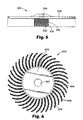
- FIG. 6 Another exemplary embodiment of a unitary brush according to the present invention is illustrated in FIG. 6 .
- radial brush 600 has central hub base 603 having bristles 604 extending outwardly therefrom.
- Central hub 603 has hole 607 in the center thereof.
- Bristles 604 have abrasive particles 606 adhered thereto via binder 608 .
- Radial brushes according to the present invention may be used individually or ganged together.
- binders that are in contact with bristles may have a flexural modulus, as measured according to ASTM Test Method D790-02 "Standard Test Methods for Flexural Properties of Unreinforced and Reinforced Plastics and Electrical Insulating Materials” (2002), that is similar to (for example, within 20 percent of) the flexural modulus of the bristles.
- Curable emulsions may be foamed and used to prepare foraminous abrasive articles as described in, for example, U.S. Pat. No. 6,007,590 (Sanders ).
- Abrasive articles according to the present invention are useful for abrading a workpiece.
- Methods for abrading with abrasive articles according to the present invention range from snagging (that is, high pressure high stock removal) to polishing (for example, polishing medical implants with coated abrasive belts), wherein the latter is typically done with finer grades (for example, less ANSI 220 and finer) of abrasive particles.
- One such method includes the step of frictionally contacting an abrasive article (for example, a coated abrasive article, a nonwoven abrasive article, or a bonded abrasive article) with a surface of the workpiece, and moving at least one of the abrasive article or the workpiece relative to the other to abrade at least a portion of the surface.
- an abrasive article for example, a coated abrasive article, a nonwoven abrasive article, or a bonded abrasive article
- workpiece materials include metal, metal alloys, exotic metal alloys, ceramics, glass, wood, wood-like materials, composites, painted surfaces, plastics, reinforced plastics, stone, and/or combinations thereof.
- the workpiece may be flat or have a shape or contour associated with it.
- Exemplary workpieces include metal components, plastic components, particleboard, camshafts, crankshafts, furniture, and turbine blades.
- the applied force during abrading typically ranges from 1 kilogram to 100 kilograms.
- Abrasive articles according to the present invention may be used by hand and/or used in combination with a machine. At least one of the abrasive article and the workpiece is moved relative to the other when abrading.
- Abrading may be conducted under wet or dry conditions.
- Exemplary liquids for wet abrading include water, water containing conventional rust inhibiting compounds, lubricant, oil, soap, and cutting fluid.
- the liquid may also contain defoamers, degreasers, and/or the like.
- Emulsions were prepared by combining the specified amounts of components in the following order:
- the workpiece to be abraded was a screen coupon of a 1.5 mm thick cold rolled steel sheet having a hexagonal close packed array of 4 mm diameter holes spaced 5.5 mm apart (center to center) obtained from Harrington & King Perforating Company, Chicago, Illinois (Part Number FX001308).
- the disc stack was rotated on a rotating shaft at a rate of 2,300 rpm with a loading of 9.08 kg between it and the workpiece for duration of two minutes.
- the workpiece was oscillated 13.9 cm in a vertical direction in 12-second cycles.
- the workpiece was replaced after each minute.
- the total weight of each workpiece and the abrasive discs was measured before, and after, abrading the coupon.
- the amount of material removed from the workpiece was recorded as "Cut” and the combined weight loss of the three abrasive discs was recorded as "Wear". The entire test was repeated two additional times and the average values reported.
- Each dumbbell was clamped into a constant rate of extension tensile testing machine having the trade designation "SINTECH 2" and equipped with a 200-pound (91 kg) load cell available from MTS Systems Corporation, Cary, North Carolina. Data acquisition, tensile property calculations, and machine control was performed using software available from MTS Systems Corporation, Cary, North Carolina under the trade designation "TESTWORKS VERSION 2.1 ".
- the gage length was 1.0 inch (2.54 cm), the strain rate was set to 1.0 inch/minute (2.54 cm/min), and the specimen gripping surface was serrated and 2 inches (5 cm) wide x 1.5 inches (3.8 cm) long. Test results reported are the statistical average of 10 measurements of a single film.
- Coefficients of friction were determined using a Thwing-Albert Friction/Peel Tester Model No. 225-1 (Thwing-Albert Instrument Company, Philadelphia, Pennsylvania) that was equipped with a 2000-gram load cell and a variable temperature platen cooled to 15 °C). Measurements were made by pulling a steel bar weighing 500 grams (g) and having a 2 inches x 2 inches (5.1 cm x 5.1 cm) sliding contact face across a film specimen at 2.1 inches/minute (5.6 cm/min). Three measurements each of coefficient of static friction and coefficient of kinetic friction were made for each specimen and reported as an average value.
- Film specimens for subsequent tensile testing were prepared via a spin-casting procedure. Twenty-five mL of the formulation to be cast was delivered onto the interior surface of a 3.0 inches (7.6 cm) inner diameter x 3.0 inches (7.6 cm) long poly(tetrafluoroethylene)-lined aluminum cylinder provided with a detachable annular 2.5 inches (6.4 cm) inner diameter x 3.0 inches (7.6 cm) outer diameter lip. The cylinder was then rotated axially at 3600 rpm via an attached electric motor.
- Heated air from a hot air gun was directed at the rotating cylinder to maintain the surface of the resin at 250-260 °F (121-127 °C) as measured by an optical pyrometer (obtained under the trade designation "IR 750" from 3M Company, Saint Paul, Minnesota) for four hours.
- the rotation and heating were then stopped and the resulting cylindrical film allowed to cool while in place in the apparatus.
- the lip was then removed and the cast cylindrical film specimen was removed from the apparatus.
- the cylindrical film specimen was then cut lengthwise to provide a 9.4 cm x 7.6 cm rectangular sheet. Typical film thickness was 0.025 - 0.030 inch (0.64 - 0.76 mm).
- the rectangular sheet was placed in a forced air oven and post-cured in a forced air convection oven set at 250 °F (121 °C) for 18 hours. Upon cooling to ambient conditions, the film was prepared for testing.
- Films for subsequent friction testing were prepared on steel plates (phosphate coated, 4 inches x 12 inches x 0.030 inch (10.1 x 30.5 cm x 0.76 mm)). Each film was prepared by knife coating the specified composition at a wet thickness of 0.010 inch (0.25 mm), allowing it to air dry for 2 hours, and then placing it in a convection oven at 250 °F (121 °C) for 18 hours. Each film was then allowed to cool to room temperature prior to friction measurements at various temperatures.
- Comparative Examples A - D were prepared by combining components in the amounts indicated in Table 1.
- the urethane resin, curative, and additional solvent (if used) were combined with stirring until completely dissolved, then nonionic surfactant, if used, was added with stirring.
- Examples 1 - 3 were prepared according to the General Method of Emulsion Preparation.
- the oil phase was prepared by combining components in the amounts indicated in Table 1 (below).
- the PU1 and melted C2 were combined with stirring until completely dissolved, and then nonionic surfactant (if used) was added with stirring.
- the aqueous phase was prepared by combining 170 parts water, 30 parts of a 2 percent by weight solution of polyacrylic acid in water, and 1 part of NH 4 OH.
- the oil phase and aqueous phase were combined yielding an emulsion.
- Example is a reference example.
- Emulsions of compositions shown in Table 3 were prepared according to the General Method of Emulsion Preparation. TABLE 3 EXAMPLE NUMBER COMPONENT, parts PU1 C2, melted S1 LiSt Water PAA 1, 4 percent by weight in water PAA 2, 4 percent by weight in water NH 4 OH 4 267.1 50.7 3.2 0 300.2 28.8 0 0.9 5 252.0 47.9 6.0 15.1 300.2 28.8 0 0.9 6 267.1 50.7 3.2 0 300.2 28.8 0 0.9 7 267.1 50.7 3.2 0 300.2 0 28.8 0.9 8 350.0 66.5 0 0 321.0 28.8 0 0.9
- Example 8 is a reference example.
- a continuous filament nonwoven web was made according to the procedure of Example 1 of U. S. Pat. No. 4,227,350 (Fitzer ).
- Polycaprolactam available commercially under the trade designation "ULTRAMID B3" from BASF Corporation, Polymers Division, Mount Olive, New Jersey
- ULTRAMID B3 trade designation "ULTRAMID B3” from BASF Corporation, Polymers Division, Mount Olive, New Jersey
- the spinneret was heated to about 248 °C and positioned 12 inches (30 cm) above the surface of a quench bath, which was continuously filled and flushed with tap water at the rate of 0.5 gallon per minute (2 liters/min). Filaments extruded from the spinneret were permitted to fall into the quench bath, where they undulated and coiled between two 4-inch (10 cm) diameter by 60-inch (1.5 m) long smooth-surfaced rolls. Both rolls were positioned in the bath with their axes of rotation about 2 inches (5 cm) below the surface of the bath, and the rolls were rotated in opposite directions at a rate of about 9 ft/min (2.7 m/min) surface speed.
- the rolls were spaced to lightly compress the surfaces of the resultant extruded web, providing a flattened surface on both sides.
- the polycaprolactam was extruded at a rate of about 700 pounds per hour (320 kg/hr), producing a web that was 59 inches (1.5 m) wide x 0.66 inch (17 mm) thick.
- the web had eight rows of coiled, undulated filaments.
- the resulting coiled web had a basis weight of 14.2 grams/24 square inches (0.875 kg/m 2 ), and had a void volume of 92.6 percent by volume.
- the filament diameter averaged about 15 mils (0.38 8 mm).
- the web was carried from the quench bath around one of the rolls and excess water was removed from the web by drying at room temperature (that is, 20 °C to 24 °C) using forced air.
- the nonwoven web prepared above was used to make Examples 9 - 16 and Comparative Example E by sequentially applying a make coat, mineral coat, and size coat, as described below.
- the indicated make coat was applied at a dry add-on weight of 6.5 g/24 in 2 (0.420 kg/m 2 ).
- Grade 36 SiC abrasive granules (2.6 kg/m 2 ) were then applied to the coated web via a drop coater.
- the web was agitated to encourage penetration of the granules into the interstitial spaces of the web.
- the particle-coated web was then heated by passing it through a 90 ft (27 m) long oven.
- a size coat having the composition indicated in Table 5 was then sprayed on the upper side of the web, which was then heated in an oven.
- the web was inverted and the other side was sprayed with an identical amount of the size coating and heated in an oven under the same conditions.
- the final size coat dry add-on was 7.78 g/24 in 2 (0.503 kg/m 2 ).
- Discs ((10-inch (25.4 mm) outer diameter, 2-inch (5.1 mm) inner diameter) were cut from the resulting nonwoven abrasive articles and were tested according to the Wear Test. Curing conditions used for the make and size coatings, and Wear Test results are reported in Table 6 (below).
- An injection molded radial bristle brush having forty 2.2 cm long integral bristles, a 3.8 cm hub, a 7.6 cm diameter, and a weight of 1.65 g was molded from polyamide 11 (obtained under the trade designation "BESNO P40TL” from Elf Atochem, Arlington Heights, Illinois).
- a single-cavity mold was employed.
- the injection-molding machine used was a 220-ton (200,000 kg) clamping force machine from Cincinnati Milacron, Batavia, Ohio, which employed a single shot extruder with a general purpose screw.
- Molding parameters were: nozzle temperature 232 °C, temperature at the front of the barrel (proximate the nozzle) 216 °C, temperature at the rear of the barrel (proximate the hopper) 232 °C, screw rotation 75 percent of maximum, 2760-3450 kPa injection pressure, and a 2.3 cm length.
- the brushes were mounted on an electrically driven mandrel with 3.8 cm wide and 1.3 cm thick polytetrafluoroethylene spacers between each brush, rotated at about 15 rpm, submerged in the adhesive composition for about 10 seconds while the rotation continued, removed from the adhesive composition, and rotated at about 300 rpm for about 10 seconds to remove excess adhesive.
- the resultant coating was applied at a targeted dry add-on weight of from 0.5 to 0.6 g per brush.
- abrasive particles (marketed under the trade designation "CUBITRON 222 GRADE 100" by 3M Company) were applied via a spray gun to the wet first coating on each brush.
- the abrasive particles were applied to both sides of eleven of the brushes until no additional abrasive particles would adhere to the wet first coatings, which was in the range from to 5 g per brush.
- the abrasive coated brushes were then heated to 130 °C for 45 minutes to harden the first coating and secure the abrasive particles to the injection molded brushes.
- a brush without abrasive particles was also heated under the same conditions (to aid in the calculation of the first coating dry weight).
- a second coating (having the same composition as that of the first coating) was applied to all the brushes. This second coating served to further secure the abrasive particles to the brushes.
- the second coating was applied in an identical manner to that of the first coating, with the exception that the rotation period at 300 rpm was extended to about 15 seconds.
- the resultant second coating had a dry weight of from 0.4 g to 0.5 g per brush.
- the brushes were subsequently heated in an oven set at 130 °C for 45 minutes to harden the second coating. Following removal from the mandrel, two of the cured abrasive coated brushes were stacked one upon another and secured with a metal adaptor to make a larger radial abrasive article for testing.
- Comparative Examples F - G and Example 17 were evaluated for cut and wear according to the following procedure.
- Abrasive articles prepared as described above were mounted on an electric drill (Black & Decker, "Professional 1046 Holgun Drill Type 101", 1 ⁇ 4" VSR, 120V, 5.0A, 2500 RPM) via a mandrel and rotated at about 2500 rpm against the face of an 11 inches (28 cm) x 24 inches (61cm) x 5/8 inch (1.6 cm) thick particle board workpiece.
- the rotating coated brush was oriented with its radial direction perpendicular to the workpiece.
- the contact pressure between the brush and particle board was provided by the weight of the drill.
- the coated brush was allowed to dig into the surface of the particle board.
- the test duration was one hour.
Landscapes
- Chemical & Material Sciences (AREA)
- Organic Chemistry (AREA)
- Health & Medical Sciences (AREA)
- Chemical Kinetics & Catalysis (AREA)
- Medicinal Chemistry (AREA)
- Polymers & Plastics (AREA)
- Engineering & Computer Science (AREA)
- Mechanical Engineering (AREA)
- Life Sciences & Earth Sciences (AREA)
- Materials Engineering (AREA)
- Wood Science & Technology (AREA)
- Manufacturing & Machinery (AREA)
- Polyurethanes Or Polyureas (AREA)
- Polishing Bodies And Polishing Tools (AREA)
- Manufacture Of Macromolecular Shaped Articles (AREA)
- Compositions Of Macromolecular Compounds (AREA)
Applications Claiming Priority (3)
| Application Number | Priority Date | Filing Date | Title |
|---|---|---|---|
| US303554 | 2002-11-25 | ||
| US10/303,554 US7169199B2 (en) | 2002-11-25 | 2002-11-25 | Curable emulsions and abrasive articles therefrom |
| PCT/US2003/030065 WO2004048473A1 (en) | 2002-11-25 | 2003-09-24 | Curable emulsions and abrasive articles therefrom |
Publications (2)
| Publication Number | Publication Date |
|---|---|
| EP1565529A1 EP1565529A1 (en) | 2005-08-24 |
| EP1565529B1 true EP1565529B1 (en) | 2012-01-11 |
Family
ID=32325034
Family Applications (1)
| Application Number | Title | Priority Date | Filing Date |
|---|---|---|---|
| EP20030770405 Expired - Lifetime EP1565529B1 (en) | 2002-11-25 | 2003-09-24 | Curable emulsions and abrasive articles therefrom |
Country Status (8)
| Country | Link |
|---|---|
| US (1) | US7169199B2 (enExample) |
| EP (1) | EP1565529B1 (enExample) |
| JP (1) | JP4451787B2 (enExample) |
| KR (1) | KR100996802B1 (enExample) |
| CN (1) | CN1320058C (enExample) |
| AT (1) | ATE541010T1 (enExample) |
| AU (1) | AU2003278890A1 (enExample) |
| WO (1) | WO2004048473A1 (enExample) |
Families Citing this family (30)
| Publication number | Priority date | Publication date | Assignee | Title |
|---|---|---|---|---|
| US6979713B2 (en) * | 2002-11-25 | 2005-12-27 | 3M Innovative Properties Company | Curable compositions and abrasive articles therefrom |
| US7232364B2 (en) * | 2005-02-04 | 2007-06-19 | 3M Innovative Properties Company | Abrasive cleaning article and method of making |
| WO2006127564A2 (en) * | 2005-05-23 | 2006-11-30 | Ashland Licensing And Intellectual Property Llc | Two-step process for rapid structure repair |
| JP5319132B2 (ja) * | 2008-02-06 | 2013-10-16 | 太陽ホールディングス株式会社 | 光硬化性・熱硬化性樹脂組成物及びその硬化物 |
| US20090233528A1 (en) * | 2008-03-07 | 2009-09-17 | Saint-Gobain Abrasives, Inc. | Floor sanding sponge pads |
| CN102046751B (zh) * | 2008-04-18 | 2013-08-28 | 圣戈班磨料磨具有限公司 | 高孔隙率磨料物品及其制造方法 |
| TW201024034A (en) * | 2008-12-30 | 2010-07-01 | Saint Gobain Abrasives Inc | Bonded abrasive tool and method of forming |
| WO2012068082A1 (en) * | 2010-11-18 | 2012-05-24 | 3M Innovative Properties Company | Convolute abrasive wheel and method of making |
| DE102010062066A1 (de) * | 2010-11-26 | 2012-05-31 | Robert Bosch Gmbh | Schneidelementzusammensetzung mit integriertem Schmiermittel |
| US9908214B2 (en) * | 2010-12-14 | 2018-03-06 | 3M Innovative Properties Company | Self-contained fibrous buffing article |
| JP5620831B2 (ja) * | 2011-01-12 | 2014-11-05 | 日華化学株式会社 | 硬化性水性樹脂組成物、水性コーティング剤および水性接着剤 |
| JP5851124B2 (ja) * | 2011-06-13 | 2016-02-03 | スリーエム イノベイティブ プロパティズ カンパニー | 研磨用構造体 |
| WO2013003650A2 (en) | 2011-06-30 | 2013-01-03 | Saint-Gobain Abrasives, Inc. | Non-woven abrasive article with extended life |
| KR101762455B1 (ko) * | 2012-02-06 | 2017-07-27 | 주식회사 엘지화학 | 광전지 모듈용 수지 조성물, 다층 필름 및 이를 포함하는 광전지 모듈 |
| JP5708899B2 (ja) * | 2013-02-05 | 2015-04-30 | 新東工業株式会社 | ブラシユニットおよびこのブラシユニットを備えたブラシ研磨装置、ブラシ研磨システム、およびブラシ研磨方法 |
| MX378491B (es) | 2013-03-29 | 2025-03-11 | Saint Gobain Abrasives Inc | Particulas abrasivas con formas particulares y metodos para elaborar las particulas. |
| CN104002252B (zh) * | 2014-05-21 | 2016-06-01 | 华侨大学 | 超细磨料生物高分子柔性抛光膜及其制备方法 |
| CN104723228A (zh) * | 2015-04-10 | 2015-06-24 | 淄博理研泰山涂附磨具有限公司 | 一种涂附泡沫磨具及其制备方法 |
| US9849563B2 (en) | 2015-11-05 | 2017-12-26 | 3M Innovative Properties Company | Abrasive article and method of making the same |
| CN108368222A (zh) * | 2015-12-18 | 2018-08-03 | Sika技术股份公司 | 具有高生胶强度的单部分聚氨酯粘合剂 |
| CN105602372A (zh) * | 2016-02-18 | 2016-05-25 | 重庆大学 | 镁合金表面防护的高硬度耐腐蚀复合涂料及其制备方法 |
| CN106808377A (zh) * | 2017-01-23 | 2017-06-09 | 山东圣泉新材料股份有限公司 | 用于树脂结合剂磨具的组合物、用途及混料漏粉解决方法 |
| US11746183B2 (en) * | 2018-09-11 | 2023-09-05 | United States Of America As Represented By The Administrator Of Nasa | Durable contamination resistant coatings |
| US20210379731A1 (en) * | 2018-10-15 | 2021-12-09 | 3M Innovative Properties Company | Abrasive articles having improved performance |
| CN109810485B (zh) * | 2019-01-29 | 2022-04-15 | 天津佐源新材料科技有限公司 | 石墨/弹性树脂复粒、其制法及在制作抛光轮中的应用 |
| US12296436B2 (en) | 2019-02-11 | 2025-05-13 | 3M Innovative Properties Company | Abrasive articles and methods of making and using the same |
| CN110744465A (zh) * | 2019-10-17 | 2020-02-04 | 江苏吉星新材料有限公司 | 一种蓝宝石研磨盘的制备方法 |
| CN113234420A (zh) * | 2021-06-22 | 2021-08-10 | 金顺浩研磨材料(南通)有限公司 | 一种抛光研磨材料及其制备方法 |
| KR102777914B1 (ko) * | 2024-05-31 | 2025-03-12 | 주식회사 보아아이 | 내구성이 우수한 기능성 안경테 제조방법 및 이에 의해 제조된 안경테 |
| CN120623853A (zh) * | 2025-07-04 | 2025-09-12 | 深圳市鼎晟丰科技有限公司 | 一种水颜料、油颜料与自发光材料结合的涂料工艺 |
Family Cites Families (113)
| Publication number | Priority date | Publication date | Assignee | Title |
|---|---|---|---|---|
| DE1694594C3 (de) * | 1960-01-11 | 1975-05-28 | Minnesota Mining And Manufacturing Co., Saint Paul, Minn. (V.St.A.) | Reinigungs- und Polierkörper |
| US3225916A (en) * | 1963-01-09 | 1965-12-28 | Dayton Abrasive Products Inc | Assemblage of abrasive elements |
| US3971745A (en) * | 1973-12-21 | 1976-07-27 | Minnesota Mining And Manufacturing Company | Amino terminated ionic polyurethane emulsion with polyepoxide emulsion |
| US4018575A (en) * | 1974-03-18 | 1977-04-19 | Minnesota Mining And Manufacturing Company | Low density abrasive article |
| JPS5439039B2 (enExample) | 1975-01-25 | 1979-11-26 | ||
| JPS5333251A (en) | 1976-09-09 | 1978-03-29 | Nippon Synthetic Chem Ind Co Ltd:The | Crosslinkable composition |
| JPS5373294A (en) * | 1976-12-13 | 1978-06-29 | Kao Corp | Cationic polyurethane emulsion coposition |
| US4227350A (en) * | 1977-11-02 | 1980-10-14 | Minnesota Mining And Manufacturing Company | Low-density abrasive product and method of making the same |
| US4314827A (en) * | 1979-06-29 | 1982-02-09 | Minnesota Mining And Manufacturing Company | Non-fused aluminum oxide-based abrasive mineral |
| US4518397A (en) * | 1979-06-29 | 1985-05-21 | Minnesota Mining And Manufacturing Company | Articles containing non-fused aluminum oxide-based abrasive mineral |
| DE2930410A1 (de) * | 1979-07-26 | 1981-02-12 | Bayer Ag | Verfahren zur herstellung von stabilen waessrigen dispersionen von oligo- oder polyurethanen, sowie ihre verwendung als beschichtungsmittel fuer flexible oder nicht- flexible substrate |
| US4331453A (en) * | 1979-11-01 | 1982-05-25 | Minnesota Mining And Manufacturing Company | Abrasive article |
| JPS5674144A (en) | 1979-11-21 | 1981-06-19 | Takeda Chem Ind Ltd | Preparation of polyurethane emulsion |
| JPS5856580B2 (ja) * | 1980-04-25 | 1983-12-15 | 第一工業製薬株式会社 | 熱反応性ポリウレタンエマルジヨンの製造方法 |
| US4355489A (en) * | 1980-09-15 | 1982-10-26 | Minnesota Mining And Manufacturing Company | Abrasive article comprising abrasive agglomerates supported in a fibrous matrix |
| US4486200A (en) * | 1980-09-15 | 1984-12-04 | Minnesota Mining And Manufacturing Company | Method of making an abrasive article comprising abrasive agglomerates supported in a fibrous matrix |
| US4588419A (en) * | 1980-10-08 | 1986-05-13 | Carborundum Abrasives Company | Resin systems for high energy electron curable resin coated webs |
| JPS5834878A (ja) * | 1981-08-25 | 1983-03-01 | Sanyo Chem Ind Ltd | 熱溶融型感圧接着剤 |
| US4800685A (en) * | 1984-05-31 | 1989-01-31 | Minnesota Mining And Manufacturing Company | Alumina bonded abrasive for cast iron |
| US4522851A (en) * | 1982-09-30 | 1985-06-11 | Mobay Chemical Corporation | Process for coating aqueous dispersion of epoxy resin and blocked polyisocyanate containing chemically incorporated anionic hydrophilic groups |
| US4623364A (en) * | 1984-03-23 | 1986-11-18 | Norton Company | Abrasive material and method for preparing the same |
| CA1266569A (en) * | 1984-05-09 | 1990-03-13 | Minnesota Mining And Manufacturing Company | Coated abrasive product incorporating selective mineral substitution |
| CA1266568A (en) * | 1984-05-09 | 1990-03-13 | Minnesota Mining And Manufacturing Company | Coated abrasive product incorporating selective mineral substitution |
| US5227104A (en) * | 1984-06-14 | 1993-07-13 | Norton Company | High solids content gels and a process for producing them |
| US4609380A (en) * | 1985-02-11 | 1986-09-02 | Minnesota Mining And Manufacturing Company | Abrasive wheels |
| CA1254238A (en) * | 1985-04-30 | 1989-05-16 | Alvin P. Gerk | Process for durable sol-gel produced alumina-based ceramics, abrasive grain and abrasive products |
| US4652275A (en) * | 1985-08-07 | 1987-03-24 | Minnesota Mining And Manufacturing Company | Erodable agglomerates and abrasive products containing the same |
| US4770671A (en) * | 1985-12-30 | 1988-09-13 | Minnesota Mining And Manufacturing Company | Abrasive grits formed of ceramic containing oxides of aluminum and yttrium, method of making and using the same and products made therewith |
| ZA8763B (en) * | 1986-01-21 | 1987-09-30 | Alusuisse | Composite panel that is difficult to combust and produces little smoke,and process for manufacturing same |
| JPS62151419U (enExample) | 1986-03-19 | 1987-09-25 | ||
| US4799939A (en) * | 1987-02-26 | 1989-01-24 | Minnesota Mining And Manufacturing Company | Erodable agglomerates and abrasive products containing the same |
| US4826894A (en) * | 1987-05-19 | 1989-05-02 | Mobay Corporation | Aqueous polyurethane-ureas dispersions and their use for the production of coatings having improved humidity resistance |
| US4881951A (en) * | 1987-05-27 | 1989-11-21 | Minnesota Mining And Manufacturing Co. | Abrasive grits formed of ceramic containing oxides of aluminum and rare earth metal, method of making and products made therewith |
| US4842619A (en) * | 1987-12-11 | 1989-06-27 | Minnesota Mining And Manufacturing Company | Glass polishing article |
| DE3800389A1 (de) | 1988-01-09 | 1989-07-20 | Bayer Ag | Wasserverduennbare bindemittel, ein verfahren zu ihrer herstellung und ihre verwendung |
| US4835210A (en) * | 1988-05-27 | 1989-05-30 | Uniroyal Chemical Company, Inc. | Water emulsified ketoxime blocked polyurethane |
| US4898597A (en) * | 1988-08-25 | 1990-02-06 | Norton Company | Frit bonded abrasive wheel |
| US4927431A (en) * | 1988-09-08 | 1990-05-22 | Minnesota Mining And Manufacturing Company | Binder for coated abrasives |
| US4991362A (en) * | 1988-09-13 | 1991-02-12 | Minnesota Mining And Manufacturing Company | Hand scouring pad |
| US5011508A (en) * | 1988-10-14 | 1991-04-30 | Minnesota Mining And Manufacturing Company | Shelling-resistant abrasive grain, a method of making the same, and abrasive products |
| US4933373A (en) * | 1989-04-06 | 1990-06-12 | Minnesota Mining And Manufacturing Company | Abrasive wheels |
| US5108463B1 (en) * | 1989-08-21 | 1996-08-13 | Minnesota Mining & Mfg | Conductive coated abrasives |
| US5342888A (en) * | 1989-11-30 | 1994-08-30 | Nippon Paint Co., Ltd. | Coating composition |
| CA2036247A1 (en) * | 1990-03-29 | 1991-09-30 | Jeffrey L. Berger | Nonwoven surface finishing articles reinforced with a polymer backing layer and method of making same |
| US5139978A (en) * | 1990-07-16 | 1992-08-18 | Minnesota Mining And Manufacturing Company | Impregnation method for transformation of transition alumina to a alpha alumina |
| US5137542A (en) * | 1990-08-08 | 1992-08-11 | Minnesota Mining And Manufacturing Company | Abrasive printed with an electrically conductive ink |
| US5078753A (en) * | 1990-10-09 | 1992-01-07 | Minnesota Mining And Manufacturing Company | Coated abrasive containing erodable agglomerates |
| CA2054554A1 (en) * | 1990-11-14 | 1992-05-15 | Chong Soo Lee | Coated abrasive having an overcoating of an epoxy resin coatable from water and a grinding aid |
| US5090968A (en) * | 1991-01-08 | 1992-02-25 | Norton Company | Process for the manufacture of filamentary abrasive particles |
| US5378251A (en) * | 1991-02-06 | 1995-01-03 | Minnesota Mining And Manufacturing Company | Abrasive articles and methods of making and using same |
| US5152917B1 (en) * | 1991-02-06 | 1998-01-13 | Minnesota Mining & Mfg | Structured abrasive article |
| US5273558A (en) * | 1991-08-30 | 1993-12-28 | Minnesota Mining And Manufacturing Company | Abrasive composition and articles incorporating same |
| DE4132430A1 (de) * | 1991-09-28 | 1993-04-01 | Basf Lacke & Farben | Waessrige lacke und verfahren zur herstellung von automobildecklackierungen |
| US5316812A (en) * | 1991-12-20 | 1994-05-31 | Minnesota Mining And Manufacturing Company | Coated abrasive backing |
| EP0619769B1 (en) * | 1991-12-20 | 1999-02-24 | Minnesota Mining And Manufacturing Company | A coated abrasive belt with an endless, seamless backing and method of preparation |
| EP0630310A1 (en) * | 1992-02-12 | 1994-12-28 | Minnesota Mining And Manufacturing Company | A coated abrasive article containing an electrically conductive backing |
| US5282875A (en) * | 1992-03-18 | 1994-02-01 | Cincinnati Milacron Inc. | High density sol-gel alumina-based abrasive vitreous bonded grinding wheel |
| US5203884A (en) * | 1992-06-04 | 1993-04-20 | Minnesota Mining And Manufacturing Company | Abrasive article having vanadium oxide incorporated therein |
| DE4223183C1 (en) | 1992-07-15 | 1993-07-15 | Herberts Gmbh, 5600 Wuppertal, De | Emulsifier-free thermo-curable coating as aq. emulsion - comprises self-emulsifying ester-based copolymers, polyester oligomers, water-(in)soluble amine resin crosslinking agents and capped poly:isocyanate(s) |
| CZ138993A3 (en) * | 1992-07-15 | 1994-02-16 | Herberts & Co Gmbh | Aqueous, thermosetting coating composition, process of its preparation and use |
| US5366523A (en) * | 1992-07-23 | 1994-11-22 | Minnesota Mining And Manufacturing Company | Abrasive article containing shaped abrasive particles |
| US5201916A (en) * | 1992-07-23 | 1993-04-13 | Minnesota Mining And Manufacturing Company | Shaped abrasive particles and method of making same |
| US5328716A (en) * | 1992-08-11 | 1994-07-12 | Minnesota Mining And Manufacturing Company | Method of making a coated abrasive article containing a conductive backing |
| US5344688A (en) * | 1992-08-19 | 1994-09-06 | Minnesota Mining And Manufacturing Company | Coated abrasive article and a method of making same |
| WO1994007970A1 (en) * | 1992-09-25 | 1994-04-14 | Minnesota Mining And Manufacturing Company | Method of making abrasive grain containing alumina and ceria |
| EP0662110B1 (en) * | 1992-09-25 | 1999-11-24 | Minnesota Mining And Manufacturing Company | Abrasive grain including rare earth oxide therein |
| WO1994007809A1 (en) * | 1992-09-25 | 1994-04-14 | Minnesota Mining And Manufacturing Company | Abrasive grain containing alumina and zirconia |
| US5290903A (en) * | 1992-11-09 | 1994-03-01 | Norton Company | Composite abrasive wheels |
| CA2115889A1 (en) * | 1993-03-18 | 1994-09-19 | David E. Broberg | Coated abrasive article having diluent particles and shaped abrasive particles |
| US5436063A (en) * | 1993-04-15 | 1995-07-25 | Minnesota Mining And Manufacturing Company | Coated abrasive article incorporating an energy cured hot melt make coat |
| US5441549A (en) * | 1993-04-19 | 1995-08-15 | Minnesota Mining And Manufacturing Company | Abrasive articles comprising a grinding aid dispersed in a polymeric blend binder |
| DE69422513T2 (de) | 1993-05-12 | 2000-08-10 | Minnesota Mining And Mfg. Co., Saint Paul | Gegenstaende zur oberflaechenbehandlung und verfahren zu deren herstellung |
| US5306319A (en) * | 1993-05-12 | 1994-04-26 | Minnesota Mining And Manufacturing Company | Surface treating articles and methods of making same |
| DE4317791A1 (de) | 1993-05-28 | 1994-12-01 | Herberts Gmbh | Wäßrige Bindemittelzusammensetzung, diese enthaltende Überzugsmittel und deren Verwendung |
| US5681612A (en) * | 1993-06-17 | 1997-10-28 | Minnesota Mining And Manufacturing Company | Coated abrasives and methods of preparation |
| US5549962A (en) * | 1993-06-30 | 1996-08-27 | Minnesota Mining And Manufacturing Company | Precisely shaped particles and method of making the same |
| US5378252A (en) * | 1993-09-03 | 1995-01-03 | Minnesota Mining And Manufacturing Company | Abrasive articles |
| EP0653468A3 (de) | 1993-11-12 | 1995-12-13 | Herberts & Co Gmbh | Überzugsmittel für transparente Decklackschichten und deren Verwendung bei Verfahren zur Herstellung von Mehrschichtüberzügen. |
| US5505747A (en) * | 1994-01-13 | 1996-04-09 | Minnesota Mining And Manufacturing Company | Method of making an abrasive article |
| WO1995022438A1 (en) * | 1994-02-22 | 1995-08-24 | Minnesota Mining And Manufacturing Company | Method for making an endless coated abrasive article and the product thereof |
| DE4416282A1 (de) * | 1994-05-07 | 1995-11-09 | Herberts Gmbh | Bindemittelzusammensetzung, diese enthaltende Überzugsmittel, deren Herstellung und Verwendung |
| US5858140A (en) * | 1994-07-22 | 1999-01-12 | Minnesota Mining And Manufacturing Company | Nonwoven surface finishing articles reinforced with a polymer backing layer and method of making same |
| US5591239A (en) * | 1994-08-30 | 1997-01-07 | Minnesota Mining And Manufacturing Company | Nonwoven abrasive article and method of making same |
| JPH10506579A (ja) * | 1994-09-30 | 1998-06-30 | ミネソタ・マイニング・アンド・マニュファクチュアリング・カンパニー | 被覆研磨物品、その製造法及び使用方法 |
| US5554068A (en) * | 1994-12-13 | 1996-09-10 | Minnesota Mining And Manufacturing Company | Abrasive flap brush and method and apparatus for making same |
| US5562794A (en) * | 1995-03-08 | 1996-10-08 | Basf Corporation | Low solvent, thermoplastic polyurethane containing solvent cement |
| US5578096A (en) * | 1995-08-10 | 1996-11-26 | Minnesota Mining And Manufacturing Company | Method for making a spliceless coated abrasive belt and the product thereof |
| US6207246B1 (en) | 1995-08-30 | 2001-03-27 | 3M Innovative Properties Company | Nonwoven abrasive material roll |
| US5712210A (en) * | 1995-08-30 | 1998-01-27 | Minnesota Mining And Manufacturing Company | Nonwoven abrasive material roll |
| KR19990064304A (ko) * | 1995-10-20 | 1999-07-26 | 스프레이그 로버트 월터 | 무기 금속 오르토포스페이트를 함유한 연마 용품 |
| JP3543460B2 (ja) * | 1995-12-08 | 2004-07-14 | Nok株式会社 | オイルフィルターガスケット成形用活性ハロゲン含有アクリルゴム組成物 |
| US5681361A (en) * | 1996-01-11 | 1997-10-28 | Minnesota Mining And Manufacturing Company | Method of making an abrasive article and abrasive article produced thereby |
| US5700302A (en) | 1996-03-15 | 1997-12-23 | Minnesota Mining And Manufacturing Company | Radiation curable abrasive article with tie coat and method |
| AU5853396A (en) * | 1996-05-03 | 1997-11-26 | Minnesota Mining And Manufacturing Company | Nonwoven abrasive articles |
| JP4150078B2 (ja) | 1996-05-03 | 2008-09-17 | スリーエム カンパニー | 多孔質研磨用製品の製造方法 |
| EP0912295A1 (en) * | 1996-05-08 | 1999-05-06 | Minnesota Mining And Manufacturing Company | Abrasive article comprising an antiloading component |
| US6117931A (en) | 1996-07-01 | 2000-09-12 | Basf Corporation | Curable coating compositions having improved effect pigment orientation and a method of using the same |
| US5766277A (en) * | 1996-09-20 | 1998-06-16 | Minnesota Mining And Manufacturing Company | Coated abrasive article and method of making same |
| US5919549A (en) * | 1996-11-27 | 1999-07-06 | Minnesota Mining And Manufacturing Company | Abrasive articles and method for the manufacture of same |
| US5928070A (en) * | 1997-05-30 | 1999-07-27 | Minnesota Mining & Manufacturing Company | Abrasive article comprising mullite |
| US5942015A (en) * | 1997-09-16 | 1999-08-24 | 3M Innovative Properties Company | Abrasive slurries and abrasive articles comprising multiple abrasive particle grades |
| US6210840B1 (en) * | 1997-12-02 | 2001-04-03 | Denso Corporation | Flame-retardant electrolytic solution and nonaqueous secondary battery containing the same |
| JP4080583B2 (ja) | 1998-01-20 | 2008-04-23 | 株式会社きもと | 研磨フィルム |
| DE19816626C2 (de) * | 1998-04-15 | 2002-07-18 | Basf Coatings Ag | Mittel zum Blockieren von Polyisocyanaten, hiermit blockierte Polyisocyanate und Beschichtungsmittel, welche diese blockierten Polyisocyanate enthalten |
| US6261682B1 (en) * | 1998-06-30 | 2001-07-17 | 3M Innovative Properties | Abrasive articles including an antiloading composition |
| US6059850A (en) * | 1998-07-15 | 2000-05-09 | 3M Innovative Properties Company | Resilient abrasive article with hard anti-loading size coating |
| US6465076B2 (en) | 1998-09-15 | 2002-10-15 | 3M Innovative Properties Company | Abrasive article with seamless backing |
| CA2356970C (en) | 1998-12-24 | 2009-09-01 | Akzo Nobel N.V. | Aqueous coating composition and a polyol for such a composition |
| US6302930B1 (en) * | 1999-01-15 | 2001-10-16 | 3M Innovative Properties Company | Durable nonwoven abrasive product |
| US6635314B1 (en) * | 1999-03-17 | 2003-10-21 | E. I. Du Pont De Nemours And Company | High solids clear coating composition |
| US6328773B1 (en) | 1999-10-20 | 2001-12-11 | 3M Innovative Properties Company | Flexible abrasive article |
| US20020065031A1 (en) * | 2000-10-17 | 2002-05-30 | 3M Innovative Properties Company | Unitary brush having abrasive coated bristles and method of making the same |
| US6773474B2 (en) * | 2002-04-19 | 2004-08-10 | 3M Innovative Properties Company | Coated abrasive article |
-
2002
- 2002-11-25 US US10/303,554 patent/US7169199B2/en not_active Expired - Fee Related
-
2003
- 2003-09-24 CN CNB038253372A patent/CN1320058C/zh not_active Expired - Fee Related
- 2003-09-24 EP EP20030770405 patent/EP1565529B1/en not_active Expired - Lifetime
- 2003-09-24 KR KR1020057009322A patent/KR100996802B1/ko not_active Expired - Fee Related
- 2003-09-24 AU AU2003278890A patent/AU2003278890A1/en not_active Abandoned
- 2003-09-24 JP JP2004555299A patent/JP4451787B2/ja not_active Expired - Fee Related
- 2003-09-24 WO PCT/US2003/030065 patent/WO2004048473A1/en not_active Ceased
- 2003-09-24 AT AT03770405T patent/ATE541010T1/de active
Also Published As
| Publication number | Publication date |
|---|---|
| AU2003278890A1 (en) | 2004-06-18 |
| KR100996802B1 (ko) | 2010-11-25 |
| JP4451787B2 (ja) | 2010-04-14 |
| CN1320058C (zh) | 2007-06-06 |
| US20040102574A1 (en) | 2004-05-27 |
| EP1565529A1 (en) | 2005-08-24 |
| WO2004048473A1 (en) | 2004-06-10 |
| US7169199B2 (en) | 2007-01-30 |
| ATE541010T1 (de) | 2012-01-15 |
| KR20050084690A (ko) | 2005-08-26 |
| JP2006507390A (ja) | 2006-03-02 |
| CN1701096A (zh) | 2005-11-23 |
Similar Documents
| Publication | Publication Date | Title |
|---|---|---|
| US7169199B2 (en) | Curable emulsions and abrasive articles therefrom | |
| US6979713B2 (en) | Curable compositions and abrasive articles therefrom | |
| US5492550A (en) | Surface treating articles and methods of making same | |
| US5250085A (en) | Flexible bonded abrasive articles, methods of production and use | |
| AU655094B2 (en) | Coatable, thermally curable binder precursor solutions modified with a reactive diluent | |
| EP0638392B1 (en) | Coated abrasives comprising a moisture cured polyurethane hot melt make coating | |
| EP1664150B1 (en) | Composition, treated backing, and coated abrasive articles containing the same | |
| EP1904577B1 (en) | Composition, treated backing, and abrasive articles containing the same | |
| US5914299A (en) | Abrasive articles including a polymeric additive | |
| EP0697937B1 (en) | Surface treating articles and methods of making same | |
| JP2004513218A (ja) | 複合研磨剤粒子および製造方法 | |
| AU657640B2 (en) | Composite abrasive wheels | |
| WO1999005192A1 (en) | Aqueous sulfopolyurea colloidal dispersions | |
| US6521005B1 (en) | Surface conditioning articles and method of making same | |
| US7811342B1 (en) | Coated abrasive tools from non-blocked urethane prepolymer | |
| JP5072257B2 (ja) | 耐熱性不織布研磨材 | |
| WO1997019786A1 (en) | Surface conditioning articles and methods of making same | |
| JP6489465B2 (ja) | ポリ尿素複合研磨材及びその製造方法 | |
| JP4409758B2 (ja) | 研磨シートの製造方法 | |
| MXPA00000952A (en) | Aqueous sulfopolyurea colloidal dispersions |
Legal Events
| Date | Code | Title | Description |
|---|---|---|---|
| PUAI | Public reference made under article 153(3) epc to a published international application that has entered the european phase |
Free format text: ORIGINAL CODE: 0009012 |
|
| 17P | Request for examination filed |
Effective date: 20050525 |
|
| AK | Designated contracting states |
Kind code of ref document: A1 Designated state(s): AT BE BG CH CY CZ DE DK EE ES FI FR GB GR HU IE IT LI LU MC NL PT RO SE SI SK TR |
|
| AX | Request for extension of the european patent |
Extension state: AL LT LV MK |
|
| DAX | Request for extension of the european patent (deleted) | ||
| 17Q | First examination report despatched |
Effective date: 20070216 |
|
| GRAP | Despatch of communication of intention to grant a patent |
Free format text: ORIGINAL CODE: EPIDOSNIGR1 |
|
| GRAS | Grant fee paid |
Free format text: ORIGINAL CODE: EPIDOSNIGR3 |
|
| GRAA | (expected) grant |
Free format text: ORIGINAL CODE: 0009210 |
|
| AK | Designated contracting states |
Kind code of ref document: B1 Designated state(s): AT BE BG CH CY CZ DE DK EE ES FI FR GB GR HU IE IT LI LU MC NL PT RO SE SI SK TR |
|
| REG | Reference to a national code |
Ref country code: GB Ref legal event code: FG4D |
|
| REG | Reference to a national code |
Ref country code: CH Ref legal event code: EP |
|
| REG | Reference to a national code |
Ref country code: AT Ref legal event code: REF Ref document number: 541010 Country of ref document: AT Kind code of ref document: T Effective date: 20120115 |
|
| REG | Reference to a national code |
Ref country code: IE Ref legal event code: FG4D |
|
| REG | Reference to a national code |
Ref country code: DE Ref legal event code: R096 Ref document number: 60339691 Country of ref document: DE Effective date: 20120308 |
|
| REG | Reference to a national code |
Ref country code: NL Ref legal event code: VDEP Effective date: 20120111 |
|
| PG25 | Lapsed in a contracting state [announced via postgrant information from national office to epo] |
Ref country code: SI Free format text: LAPSE BECAUSE OF FAILURE TO SUBMIT A TRANSLATION OF THE DESCRIPTION OR TO PAY THE FEE WITHIN THE PRESCRIBED TIME-LIMIT Effective date: 20120111 |
|
| PG25 | Lapsed in a contracting state [announced via postgrant information from national office to epo] |
Ref country code: NL Free format text: LAPSE BECAUSE OF FAILURE TO SUBMIT A TRANSLATION OF THE DESCRIPTION OR TO PAY THE FEE WITHIN THE PRESCRIBED TIME-LIMIT Effective date: 20120111 Ref country code: BG Free format text: LAPSE BECAUSE OF FAILURE TO SUBMIT A TRANSLATION OF THE DESCRIPTION OR TO PAY THE FEE WITHIN THE PRESCRIBED TIME-LIMIT Effective date: 20120411 Ref country code: BE Free format text: LAPSE BECAUSE OF FAILURE TO SUBMIT A TRANSLATION OF THE DESCRIPTION OR TO PAY THE FEE WITHIN THE PRESCRIBED TIME-LIMIT Effective date: 20120111 |
|
| PG25 | Lapsed in a contracting state [announced via postgrant information from national office to epo] |
Ref country code: FI Free format text: LAPSE BECAUSE OF FAILURE TO SUBMIT A TRANSLATION OF THE DESCRIPTION OR TO PAY THE FEE WITHIN THE PRESCRIBED TIME-LIMIT Effective date: 20120111 Ref country code: PT Free format text: LAPSE BECAUSE OF FAILURE TO SUBMIT A TRANSLATION OF THE DESCRIPTION OR TO PAY THE FEE WITHIN THE PRESCRIBED TIME-LIMIT Effective date: 20120511 Ref country code: GR Free format text: LAPSE BECAUSE OF FAILURE TO SUBMIT A TRANSLATION OF THE DESCRIPTION OR TO PAY THE FEE WITHIN THE PRESCRIBED TIME-LIMIT Effective date: 20120412 |
|
| REG | Reference to a national code |
Ref country code: AT Ref legal event code: MK05 Ref document number: 541010 Country of ref document: AT Kind code of ref document: T Effective date: 20120111 |
|
| PG25 | Lapsed in a contracting state [announced via postgrant information from national office to epo] |
Ref country code: CY Free format text: LAPSE BECAUSE OF FAILURE TO SUBMIT A TRANSLATION OF THE DESCRIPTION OR TO PAY THE FEE WITHIN THE PRESCRIBED TIME-LIMIT Effective date: 20120111 |
|
| PG25 | Lapsed in a contracting state [announced via postgrant information from national office to epo] |
Ref country code: RO Free format text: LAPSE BECAUSE OF FAILURE TO SUBMIT A TRANSLATION OF THE DESCRIPTION OR TO PAY THE FEE WITHIN THE PRESCRIBED TIME-LIMIT Effective date: 20120111 Ref country code: CZ Free format text: LAPSE BECAUSE OF FAILURE TO SUBMIT A TRANSLATION OF THE DESCRIPTION OR TO PAY THE FEE WITHIN THE PRESCRIBED TIME-LIMIT Effective date: 20120111 Ref country code: DK Free format text: LAPSE BECAUSE OF FAILURE TO SUBMIT A TRANSLATION OF THE DESCRIPTION OR TO PAY THE FEE WITHIN THE PRESCRIBED TIME-LIMIT Effective date: 20120111 Ref country code: SE Free format text: LAPSE BECAUSE OF FAILURE TO SUBMIT A TRANSLATION OF THE DESCRIPTION OR TO PAY THE FEE WITHIN THE PRESCRIBED TIME-LIMIT Effective date: 20120111 Ref country code: EE Free format text: LAPSE BECAUSE OF FAILURE TO SUBMIT A TRANSLATION OF THE DESCRIPTION OR TO PAY THE FEE WITHIN THE PRESCRIBED TIME-LIMIT Effective date: 20120111 |
|
| PLBE | No opposition filed within time limit |
Free format text: ORIGINAL CODE: 0009261 |
|
| STAA | Information on the status of an ep patent application or granted ep patent |
Free format text: STATUS: NO OPPOSITION FILED WITHIN TIME LIMIT |
|
| PG25 | Lapsed in a contracting state [announced via postgrant information from national office to epo] |
Ref country code: SK Free format text: LAPSE BECAUSE OF FAILURE TO SUBMIT A TRANSLATION OF THE DESCRIPTION OR TO PAY THE FEE WITHIN THE PRESCRIBED TIME-LIMIT Effective date: 20120111 Ref country code: IT Free format text: LAPSE BECAUSE OF FAILURE TO SUBMIT A TRANSLATION OF THE DESCRIPTION OR TO PAY THE FEE WITHIN THE PRESCRIBED TIME-LIMIT Effective date: 20120111 |
|
| 26N | No opposition filed |
Effective date: 20121012 |
|
| PG25 | Lapsed in a contracting state [announced via postgrant information from national office to epo] |
Ref country code: AT Free format text: LAPSE BECAUSE OF FAILURE TO SUBMIT A TRANSLATION OF THE DESCRIPTION OR TO PAY THE FEE WITHIN THE PRESCRIBED TIME-LIMIT Effective date: 20120111 |
|
| REG | Reference to a national code |
Ref country code: DE Ref legal event code: R097 Ref document number: 60339691 Country of ref document: DE Effective date: 20121012 |
|
| PG25 | Lapsed in a contracting state [announced via postgrant information from national office to epo] |
Ref country code: ES Free format text: LAPSE BECAUSE OF FAILURE TO SUBMIT A TRANSLATION OF THE DESCRIPTION OR TO PAY THE FEE WITHIN THE PRESCRIBED TIME-LIMIT Effective date: 20120422 Ref country code: MC Free format text: LAPSE BECAUSE OF NON-PAYMENT OF DUE FEES Effective date: 20120930 |
|
| REG | Reference to a national code |
Ref country code: CH Ref legal event code: PL |
|
| GBPC | Gb: european patent ceased through non-payment of renewal fee |
Effective date: 20120924 |
|
| REG | Reference to a national code |
Ref country code: IE Ref legal event code: MM4A |
|
| REG | Reference to a national code |
Ref country code: FR Ref legal event code: ST Effective date: 20130531 |
|
| PG25 | Lapsed in a contracting state [announced via postgrant information from national office to epo] |
Ref country code: LI Free format text: LAPSE BECAUSE OF NON-PAYMENT OF DUE FEES Effective date: 20120930 Ref country code: GB Free format text: LAPSE BECAUSE OF NON-PAYMENT OF DUE FEES Effective date: 20120924 Ref country code: CH Free format text: LAPSE BECAUSE OF NON-PAYMENT OF DUE FEES Effective date: 20120930 Ref country code: IE Free format text: LAPSE BECAUSE OF NON-PAYMENT OF DUE FEES Effective date: 20120924 |
|
| PG25 | Lapsed in a contracting state [announced via postgrant information from national office to epo] |
Ref country code: FR Free format text: LAPSE BECAUSE OF NON-PAYMENT OF DUE FEES Effective date: 20121001 |
|
| PG25 | Lapsed in a contracting state [announced via postgrant information from national office to epo] |
Ref country code: TR Free format text: LAPSE BECAUSE OF FAILURE TO SUBMIT A TRANSLATION OF THE DESCRIPTION OR TO PAY THE FEE WITHIN THE PRESCRIBED TIME-LIMIT Effective date: 20120111 |
|
| PG25 | Lapsed in a contracting state [announced via postgrant information from national office to epo] |
Ref country code: LU Free format text: LAPSE BECAUSE OF NON-PAYMENT OF DUE FEES Effective date: 20120924 |
|
| PG25 | Lapsed in a contracting state [announced via postgrant information from national office to epo] |
Ref country code: HU Free format text: LAPSE BECAUSE OF FAILURE TO SUBMIT A TRANSLATION OF THE DESCRIPTION OR TO PAY THE FEE WITHIN THE PRESCRIBED TIME-LIMIT Effective date: 20030924 |
|
| PGFP | Annual fee paid to national office [announced via postgrant information from national office to epo] |
Ref country code: DE Payment date: 20160920 Year of fee payment: 14 |
|
| REG | Reference to a national code |
Ref country code: DE Ref legal event code: R119 Ref document number: 60339691 Country of ref document: DE |
|
| PG25 | Lapsed in a contracting state [announced via postgrant information from national office to epo] |
Ref country code: DE Free format text: LAPSE BECAUSE OF NON-PAYMENT OF DUE FEES Effective date: 20180404 |