EP1561745A2 - Herstellung von Di- und Polyisocyanaten der Diphenylmethanreihe mit definierter Acidität - Google Patents
Herstellung von Di- und Polyisocyanaten der Diphenylmethanreihe mit definierter Acidität Download PDFInfo
- Publication number
- EP1561745A2 EP1561745A2 EP05001280A EP05001280A EP1561745A2 EP 1561745 A2 EP1561745 A2 EP 1561745A2 EP 05001280 A EP05001280 A EP 05001280A EP 05001280 A EP05001280 A EP 05001280A EP 1561745 A2 EP1561745 A2 EP 1561745A2
- Authority
- EP
- European Patent Office
- Prior art keywords
- mdi
- und
- core
- fraction containing
- nuclear
- Prior art date
- Legal status (The legal status is an assumption and is not a legal conclusion. Google has not performed a legal analysis and makes no representation as to the accuracy of the status listed.)
- Granted
Links
Classifications
-
- A—HUMAN NECESSITIES
- A01—AGRICULTURE; FORESTRY; ANIMAL HUSBANDRY; HUNTING; TRAPPING; FISHING
- A01C—PLANTING; SOWING; FERTILISING
- A01C1/00—Apparatus, or methods of use thereof, for testing or treating seed, roots, or the like, prior to sowing or planting
- A01C1/04—Arranging seed on carriers, e.g. on tapes, on cords ; Carrier compositions
- A01C1/042—Tapes, bands or cords
-
- C—CHEMISTRY; METALLURGY
- C07—ORGANIC CHEMISTRY
- C07C—ACYCLIC OR CARBOCYCLIC COMPOUNDS
- C07C263/00—Preparation of derivatives of isocyanic acid
- C07C263/10—Preparation of derivatives of isocyanic acid by reaction of amines with carbonyl halides, e.g. with phosgene
-
- C—CHEMISTRY; METALLURGY
- C07—ORGANIC CHEMISTRY
- C07C—ACYCLIC OR CARBOCYCLIC COMPOUNDS
- C07C263/00—Preparation of derivatives of isocyanic acid
- C07C263/18—Separation; Purification; Stabilisation; Use of additives
- C07C263/20—Separation; Purification
-
- C—CHEMISTRY; METALLURGY
- C08—ORGANIC MACROMOLECULAR COMPOUNDS; THEIR PREPARATION OR CHEMICAL WORKING-UP; COMPOSITIONS BASED THEREON
- C08G—MACROMOLECULAR COMPOUNDS OBTAINED OTHERWISE THAN BY REACTIONS ONLY INVOLVING UNSATURATED CARBON-TO-CARBON BONDS
- C08G18/00—Polymeric products of isocyanates or isothiocyanates
- C08G18/06—Polymeric products of isocyanates or isothiocyanates with compounds having active hydrogen
- C08G18/70—Polymeric products of isocyanates or isothiocyanates with compounds having active hydrogen characterised by the isocyanates or isothiocyanates used
- C08G18/72—Polyisocyanates or polyisothiocyanates
- C08G18/74—Polyisocyanates or polyisothiocyanates cyclic
- C08G18/76—Polyisocyanates or polyisothiocyanates cyclic aromatic
- C08G18/7657—Polyisocyanates or polyisothiocyanates cyclic aromatic containing two or more aromatic rings
- C08G18/7664—Polyisocyanates or polyisothiocyanates cyclic aromatic containing two or more aromatic rings containing alkylene polyphenyl groups
Definitions
- the present invention relates to a process for the preparation of diisocyanates and polyisocyanates of Diphenylmethane series and mixtures thereof and their use for the production of polyurethanes.
- Aromatic isocyanates are very important raw materials for the production of polyurethane materials.
- the di- and polyisocyanates of the diphenylmethane series (MDI) play in terms of quantity biggest role.
- Polyisocyanates of the diphenylmethane series are understood as meaning isocyanates and isocyanate mixtures of the following type: where n stands for a natural number> 0.
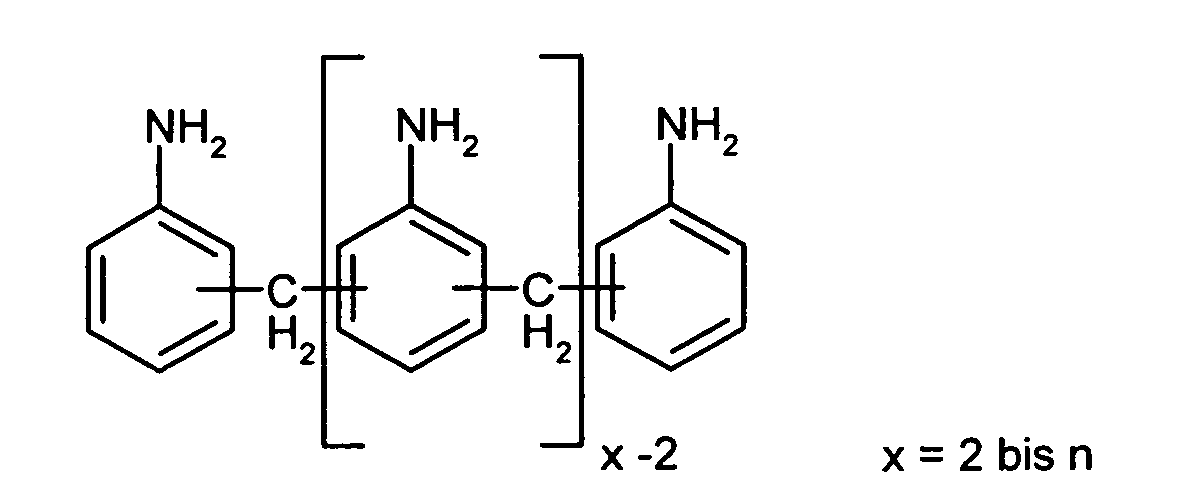
- polyamines of the diphenylmethane series are understood as meaning compounds and mixtures of the following types:
- di- and polyisocyanates of the diphenylmethane series (MDI) by phosgenation the corresponding di- and polyamines of the diphenylmethane series (MDA) are produced.
- MDI diphenylmethane series
- MDA diphenylmethane series
- the Di- and polyamines of the diphenylmethane series itself are obtained by condensation of aniline and Formaldehyde produced.
- Phosgenation of the diamines of the diphenylmethane series is obtained the corresponding diisocyanates 2,2'-MDI, 2,4'-MDI and 4,4'-MDI, which are known in the art as 2-core MDI (diisocyanates of the diphenylmethane series) are described.
- the acidity in the MDI as acidity in the polymeric MDI (PMDI) and / or monomeric MDI (MMDI) or expressed as hydrolyzable chlorine in the MMDI.
- This Acidity value is in practice by reaction of MDI with lower alcohols, e.g. Methanol (see, e.g., ASTM D5523-94 for monomeric MDI or ASTM 5629-99, respectively). 6099-03 for polymeric MDI).
- the acidity in the MDI becomes, according to the current state of the art, through the process process parameters in the preparation of the MDA bases by the formation of minor components in the MDA, which depends on the respective MDA process parameters, and in the phosgenation and the subsequent workup determined. Due to the multi-stage reaction chain and the fluctuations and changes in the throughput and the process parameters during the In practice, this leads to unavoidable fluctuations in the acidity in practice.
- the object of the present invention is therefore to provide a simple process for the production of Di- and polyisocyanates of the diphenylmethane series and mixtures thereof with defined and provide constant levels of acidity (acidity, hydrolyzable chlorine content), with which a constant MDI product quality can be guaranteed reliably.
- the fractions produced in step e) are preferably filled into containers and are then available as Isocyanatkomponente with exactly adjusted acidity for the production of modified isocyanates, mixed products with other isocyanate fractions, prepolymers and Polyurethanes available.
- step e By adding the acidic organic or inorganic compounds as an additive to the MDI In step e), it is achieved that the specified values of the MDI are independent of the manufacturing process can be set exactly and reproducibly.
- the invention thus relates to a process for the preparation of MDI and mixtures thereof, in the acidity and the value of hydrolyzable chlorine of the MDI or mixtures thereof Addition of acidic, especially halogen-containing and especially chlorine-containing compounds according to the Distillative separation of the crude MDI mixture in the isomers or isomer mixtures targeted is set. This is done by the targeted adjustment of the acidity and the value for hydrolyzable chlorine ensures a constant reactivity of the MDI, without the existing ones Violate product specifications.
- the polyamine or polyamine mixture of the diphenylmethane series used in the process according to the invention is obtained in step a) by condensation of aniline and formaldehyde in the presence of an acid catalyst (HJ Twitchett, Chem. Soc., Rev. 3 (2), 209 (1974); in:.... Kirk-Othmer encycl Chem Technol, 3 rd Ed, New York, 2, 338-348 (1978)).
- an acid catalyst HJ Twitchett, Chem. Soc., Rev. 3 (2), 209 (1974); in:.... Kirk-Othmer encycl Chem Technol, 3 rd Ed, New York, 2, 338-348 (1978)
- Suitable polyamine mixtures of the diphenylmethane series are usually obtained by condensation of aniline and formaldehyde in a molar ratio of 20 to 1.6, preferably 10 to 1.8 and a molar ratio of aniline and acid catalyst of 20 to 1, preferably 10 up to 2.
- Formaldehyde is technically usually used as an aqueous solution.
- the Water content vary from 1 to 95%. Preference is given to an aqueous solution with 50 to 80% Used water.
- other methylene group-providing compounds such as e.g. Polyoxymethylene glycol, para-formaldehyde or trioxane can be used.
- Acid catalysts are strong organic and preferably inorganic acids proven. Suitable acids are, for example, hydrochloric acid, sulfuric acid, phosphoric acid, and Methane sulfonic acid. Preference is given to using hydrochloric acid.
- aniline and acid catalyst initially mixed.
- This mixture is, if necessary, after removal of heat, in a further step with formaldehyde at temperatures between 20 ° C and 100 ° C, preferably at 30 ° C to 70 ° C in suitably mixed and then in a suitable residence time of a To undergo pre-reaction.
- the pre-reaction takes place at temperatures between 20 ° C to 100 ° C, preferably in the temperature range 30 ° C to 80 ° C.
- the temperature of the reaction mixture in stages or continuously and possibly under Overpressure to a temperature of 100 ° C to 250 ° C, preferably to 100 ° C to 180 ° C, especially preferably brought to a temperature of 100 ° C to 160 ° C.
- aniline and Formaldehyde first in the absence of the acid catalyst in the temperature range from 5 ° C to 130 ° C, preferably from 40 ° C to 100 ° C, more preferably from 60 ° C to 90 ° C, to mix and to react.
- Aminal condensation products of aniline and formaldehyde
- the condensation product is then in another Process step mixed with the acidic catalyst in a suitable manner and in one Residence apparatus at 20 ° C to 100 ° C, preferably 30 ° C to 80 ° C subjected to a pre-reaction.
- the temperature of the reaction mixture in stages or continuously and if necessary under overpressure to a temperature of 100 ° C to 250 ° C, preferably to 100 ° C to 180 ° C, particularly preferably brought to a temperature of 100 ° C to 160 ° C.
- the reaction mixture For working up the acidic reaction mixture, the reaction mixture according to the state of Technique neutralized with a base. According to the prior art, the neutralization takes place usually at temperatures of for example 90-100 ° C (H.J. Twitchett, Chem. Soc. Rev. 3 (2), 223 (1974)).
- Suitable bases are, for example, the hydroxides of the alkali and alkaline earth elements.
- aqueous NaOH is used.
- the organic from the aqueous phase by suitable methods (e.g., phase separation in a separating flask).
- phase separation of organic and aqueous phase can take place at the same temperature, in which the neutralization of the acid rearrangement mixture was carried out.
- the after separation The product-containing organic phase remaining in the aqueous phase is after the Prior art for the separation of salts and excess base subjected to a wash.
- the purified organic phase of excess aniline and other im Mixture of existing substances e.g., other solvents
- appropriate physical Separation methods such as e.g. Distillation, extraction or crystallization freed.
- step b) The resulting polyamine of the diphenylmethane series (crude MDA) from step a) is reacted in step b) according to the known methods with phosgene in an inert organic solvent to give the corresponding isocyanates.
- the molar ratio of crude MDA to phosgene is expediently such that 1 to 10 moles, preferably 1.3 to 4 moles of phosgene are present in the reaction mixture per mole of NH 2 group.
- Suitable inert solvents are chlorinated, aromatic hydrocarbons such as monochlorobenzene, dichlorobenzenes, trichlorobenzenes, the corresponding toluenes and xylenes and chloroethylbenzene have proven.
- inert organic solvents monochlorobenzene, dichlorobenzene or mixtures of these chlorobenzenes.
- the amount of solvent is preferably such that the reaction mixture has an isocyanate content of from 2 to 40% by weight, preferably between 5 and 20% by weight, based on the total weight of the reaction mixture.
- the reaction of crude MDA with phosgene is carried out here at temperatures of 50 to 250 ° C and at pressures from ambient pressure up to 50 bar. Preference is given to working at 70 to 180 ° C and 2 to 20 bar.
- the excess phosgene, the inert organic solvents, the HCl formed or mixtures thereof by suitable Process (e.g., distillation).
- suitable Process e.g., distillation
- the pressure gradually into the vacuum reduced and the remaining phosgene excess and the HCl formed evaporated and separated.
- the solvent is gradually reduced below further reduction of the absolute pressure up to 1 mbar, preferably up to 5 mbar.
- the temperature is increased until the solvent is almost complete less than 0.1%.
- a crude di- and Polyisocyanate (crude MDI mixture).
- the separation can be carried out by distillation under vacuum or by crystallization. Here is also a combination of both processes possible.
- step c) from the crude di- and polyisocyanate by distillation at least one fraction containing at least 5% by weight of 3-nuclear and higher-nuclear MDI and at least one fraction containing at least 95 wt .-% 2-core MDI separated.
- the fraction containing at least 5% by weight of 3-nuclear and higher-nuclear MDI has preferably has an acidity of 5 to 500 ppm (calculated as HCl).
- Containing the fraction At least 95% by weight of 2-core MDI preferably has an acidity of 0.1 to 50 ppm (calculated as HCl).
- the indicated values for the acidity are those in Example 1 given for the determination of acidity.
- the acidities of the fraction produced in step c) are at least 5 % By weight of 3-nuclear and higher-nuclear MDI and / or of the fraction containing at least 95% by weight 2-core MDI analytically determined. This can be done according to the rules of ASTM D5523-94 for monomeric MDI or ASTM 5629-99 or 6099-03 for polymeric MDI or after in Example 1 method for monomeric or polymeric MDI done. For monomeric MDI However, the determination of acidity is usually used as a determination of the value for hydrolyzable chlorine. This determination can be carried out according to the method given in Example 2 respectively.
- the case of the MMDI is represented with an approximate acidity of e.g. 10 ppm with Fluctuations of up to 100%.
- the acidic compound as acidity-active additive added to the MMDI.
- step e) the fraction obtained in step c) containing at least 5% by weight of 3-nucleus and higher nuclear MDI and / or the fraction containing at least 95 wt .-% 2-core MDI with an acidic compound is added so that the desired acidity is achieved.
- gaseous HCl can be used. Since handling HCl as a gas in the dosage is expensive equipment, are preferably liquid or solid organic compounds which increases the acidity value, e.g. Benzotrichloride, benzoyl chloride, phthaloyl chloride, Terephthalic acid dichloride, isophthalic acid dichlorides, p-toluenesulfonyl chloride, or other organic acid chlorides. Also suitable are organic acids which are the acidity value increase, e.g. Chloropropionic acid, preference is given to using organic compounds, which dissolve well in MDI and at the same time have a low vapor pressure and the do not change the other properties of the desired isocyanate addition products in the finished part.
- organic acids which are the acidity value increase, e.g. Chloropropionic acid, preference is given to using organic compounds, which dissolve well in MDI and at the same time have a low vapor pressure and the do not change the other properties of the desired isocyanate addition products in
- Suitable inorganic acidic compounds are anhydrous mineral acids such as e.g. HCl gas or other hydrogen halides, phosphoric acid or other phosphorus-containing anhydrous acids, Sulfuric acid, and other mineral acids.
- Inorganic anhydrous Lewis acids e.g. Aluminum trichloride, boron trifluoride, boron trichloride are also suitable.
- Suitable organic acid compounds which increase the acidity value are aliphatic or cycloaliphatic carboxylic acid halides such as, for example, acetic acid chloride, trichloroacetic acid chloride or N-chloroacetamide or N-bromosuccinimide, aromatic carboxylic acid halides such as benzoyl chloride, phthalic acid chloride, terephthalic acid dichloride, isophthalic acid dichloride, aromatic, aliphatic or cycloaliphatic carbamic acid chlorides such as N-phenylcarbamyl chloride, tert-butylcarbamyl chloride, acidic chlorine-silane compounds such as for example, trimethylsilyl chloride, trimethylsilyl trifluoromethanesulfonate, sulfonic acid halides such as tosyl chloride, or other carboxylic acid derivatives such as Anhydrides or mixtures thereof.
- aromatic carboxylic acid halides such as benzoyl chloride
- aromatic or aliphatic acid chlorides or carbamoyl chlorides used.
- Aromatic or aliphatic acid chlorides or carbamoyl chlorides are preferred used, which do not interfere with the production of polyurethanes and a low Have vapor pressure.
- Benzoyl chloride, terephthalic acid dichloride are preferably used, Isophthalic acid dichloride, phenylcarbamyl chloride, tert. Butylcarbamyl chloride.
- the introduction of the acidic compound can be done directly in the desired MDI or in shape a higher concentration stock solution, preferably with the appropriate MDI that does not change the specification of the desired MDI.
- the MDI obtained has a defined Acidity or a defined content of hydrolyzable chlorine, and therefore a gives constant and defined reaction behavior towards H-active compounds. This has a positive effect on trouble-free processing during series production produced Polyadditions finished parts.
- inert transition metal compounds in particular transition metal compounds of VIII.
- Subgroup preferably iron compounds in the form of inorganic or organic Iron salts or iron complexes are added which control the reaction of the isocyanate groups with the Accelerate H-acidic compound during later polyurethane production.
- the PMDI and the MMDI can due to the manufacturing process, due to corrosion and erosion of Plant parts containing small trace amounts of iron, which can scatter strongly and then to lead to fluctuating reactivities.
- the variations in reactivity can be compensated be that a constant iron trace content by adding appropriate trace amounts is adjusted to suitable iron compounds.
- Suitable iron compounds for adjusting a constant iron trace content are inorganic or organic iron salts of mineral acids, of aliphatic, alicyclic and aromatic carboxylic acids and alkoxides or iron complex compounds.
- the added Iron compounds must be anhydrous.
- Suitable iron salts are, for example, Fe (III) chloride, Fe (II) acetate, Fe (III) bromide, Fe (II) fluoride, Fe (II) iodide, Fe (II) fumarate, Fe (III) tribenzoate, Fe (III) trisalicylate, Fe (III) trilaurate, Fe (III) tripalmitate, Fe (III) tristearate, Fe (III) trioleate, Fe naphthenates, Fe (II) 2-ethylhexanoate, Fe (II) tris (4-cyclohexyl butyrate), Fe (III) ethoxide, Fe (III) -i-propoxide.
- Suitable iron complex compounds are, for example, Fe (III) acetylacetonate, Fe (III) benzoylacetonate, Fe (II) phthalocyanine, ferrocene, Fe (III) trifluoroacetylacetonate. Preference is given to using Fe (III) chloride and Fe (III) acetylacetonate.
- metal catalysts such for example, zinc chloride, dibutyltin dilaurate (DBTDL), tin octoate or other organic Tin compounds are added to define the reactivity for specific applications to be able to adjust. The addition takes place to the extent that the specified storage stability from i.d.R. 6 months can continue to be guaranteed.
- the MDI products of defined value for The acidity may be with one or more mixtures containing aromatic isocyanates be mixed.
- preferred mixtures used containing di- and / or polyisocyanates of the diphenylmethane series preferred also mixtures containing tolylene diisocyanate (for example 2,4-TDI, 2,6-TDI) or Mixtures containing naphthalene diisocyanate (for example 1,5-NDI) or mixtures of these Isocyanates are used.
- tolylene diisocyanate for example 2,4-TDI, 2,6-TDI
- Mixtures containing naphthalene diisocyanate for example 1,5-NDI
- the MDI products of defined acidity values prepared by the process of the present invention can be used in the usual modification reactions of isocyanates, such as carbodiimidization by increasing the temperature or addition of phospholene oxides and forming uretonimines on the carbodiimides, or preparing prepolymers OH-functional polyesters, C 2 / C 3 / C 4 polyethers, uretdiones, allophanates, biurets or urea derivatives.
- isocyanates such as carbodiimidization by increasing the temperature or addition of phospholene oxides and forming uretonimines on the carbodiimides, or preparing prepolymers OH-functional polyesters, C 2 / C 3 / C 4 polyethers, uretdiones, allophanates, biurets or urea derivatives.
- step d) the acidity of the individual lots is determined analytically.
- the determination of Acidity is carried out according to the following method:
- the MDI polymer sample was packed to a minimum of 0.01 g in a 250 ml beaker weighed. Then 60 ml of chlorobenzene was added and the MDI sample added in the Amount of chlorobenzene dissolved. The solution was then treated with 100 ml of methanol, the Beaker covered and the mixture on a magnetic stirrer for 30 min at room temperature touched. Finally, the mixture was mixed with a standard methanolic potassium hydroxide solution with a molar concentration of about 0.01 mol / l acidimetrisch under potentiometric Endpoint display titrated.
- step e) the 11 parts of the polymeric MDI are adjusted with hydrogen chloride gas to an acidity of 100 mg / kg (calculated as H + , normalized values).
- H + hydrogen chloride gas
- the quantity of hydrogen chloride gas required to adjust the acidity of 100 mg H + / kg is metered in for each individual batch.
- the scattering of the acidity values is significantly lower (100 + / - 3.5 mg H + / kg, relative standard deviation 3.5%).
- the acidity of the MDI is determined to be the value of hydrolyzable chlorine.
- step d) the value of hydrolyzable chlorine is determined.
- the determination of the value for hydrolyzable chlorine is carried out by the following method:
- the analysis shows that the individual lots contain hydrolyzable chlorine which scatters strongly for the individual lots.
- the content of hydrolyzable chlorine is for the 85 lots, 27.4 +/- 5.3 mg HCl / kg with a relative standard deviation of 19.3%.
- step e) the 85 parts of the monomeric MDI by adding isophthalic acid dichloride to a content of hydrolyzable chlorine of 100 mg / kg (calculated as HCl, normalized values). This is for each batch for the setting on a value for hydrolyzable chlorine of 100 mg HCl / kg required amount of isophthalic acid dichloride added.
- the addition of the Isophthal Acidichlorids takes place as a masterbatch, dissolved in a mixture of 45% 4,4'-MDI and 55% 2, 4'-MDI. After the setting is the Scattering of the levels of hydrolyzable chlorine significantly lower (100 +/- 3.3 mg HCl / kg; relative standard deviation 3.3%).
Landscapes
- Chemical & Material Sciences (AREA)
- Organic Chemistry (AREA)
- Chemical Kinetics & Catalysis (AREA)
- Health & Medical Sciences (AREA)
- Medicinal Chemistry (AREA)
- Polymers & Plastics (AREA)
- Life Sciences & Earth Sciences (AREA)
- Soil Sciences (AREA)
- Environmental Sciences (AREA)
- Organic Low-Molecular-Weight Compounds And Preparation Thereof (AREA)
- Polyurethanes Or Polyureas (AREA)
- Low-Molecular Organic Synthesis Reactions Using Catalysts (AREA)
Abstract
Description

- Hartschaumstoffe für die Isolier und Kühlgeräteindustrie
- Verpackungsschaum
- Weichschaum und Weichformschaum für Möbel und Autoindustrie
- Anwendungen im Spektrum der CASE-Anwendungen (Coatings, Adhesives, Sealants, Elastomers)
- Halbharte PU-Schaumstoffe
Claims (9)
- Verfahren zur Herstellung von Di- und Polyisocyanaten der Diphenylmethanreihe und Gemischen daraus, bei dem mana) Anilin und Formaldehyd in Gegenwart eines sauren Katalysators zu Di- und Polyaminen der Diphenylmethanreihe umsetzt, undb) die Di- und Polyamine der Diphenylmethanreihe gegebenenfalls in Gegenwart eines Lösungsmittels phosgeniert, wobei man ein rohes Di- und Polyisocyanat erhält, undc) aus dem rohen Di- und Polyisocyanat destillativ wenigstens eine Fraktion enthaltend mindestens 5 Gew.-% 3-Kern- und höherkerniges MDI sowie wenigstens eine Fraktion enthaltend mindestens 95 Gew.-% 2-Kern-MDI abtrennt, undd) die Aciditäten der Fraktion enthaltend mindestens 5 Gew.-% 3-Kern- und höherkerniges MDI und/oder der Fraktion enthaltend mindestens 95 Gew.-% 2-Kern-MDI analytisch bestimmt, unde) die Fraktion enthaltend mindestens 5 Gew.-% 3-Kern- und höherkerniges MDI und/oder die Fraktion enthaltend mindestens 95 Gew.-% 2-Kern-MDI mit einer sauren Verbindung versetzt, so dass die gewünschte Acidität erreicht wird.
- Verfahren nach Anspruch 1, bei dem man als saure Verbindung in Schritt e) aliphatische und/oder aromatische und/oder cycloaliphatische Carbonsäurehalogenide einsetzt.
- Verfahren nach einem der Ansprüche 1 oder 2, bei dem man als saure Verbindung in Schritt e) aliphatische und/oder aromatische und/oder cycloaliphatische Carbaminsäurehalogenide einsetzt.
- Verfahren nach einem der Ansprüche 1 bis 3, bei dem man als saure Verbindung in Schritt e) ein oder mehrere saure Chlor-Silanverbindungen einsetzt.
- Verfahren nach einem der Ansprüche 1 bis 4, bei dem man als saure Verbindung in Schritt e) ein oder mehrere Sulfonsäurehalogenide einsetzt.
- Verfahren nach einem der Ansprüche 1 bis 5, bei dem man als saure Verbindung in Schritt e) ein oder mehrere Carbonsäureanhydride einsetzt.
- Verfahren nach einem der Ansprüche 1 bis 6, bei dem man in Schritt e) zusätzlich eine inerte Übergangsmetallverbindung zusetzt.
- Verfahren nach Anspruch 7, bei dem die inerte Übergangsmetallverbindung ein Metall der VIII. Nebengruppe des Periodensystems, bevorzugt Eisen, enthält.
- Verfahren nach Anspruch 7, bei dem die inerte Übergangsmetallverbindung Eisenacetylacetonat, ein Halogenid eins Metalls der VIII. Nebengruppe des Periodensystems oder Zinkchlorid ist.
Priority Applications (1)
| Application Number | Priority Date | Filing Date | Title |
|---|---|---|---|
| EP17154943.9A EP3181548B1 (de) | 2004-02-04 | 2005-01-22 | Herstellung von di- und polyisocyanaten der diphenylmethan-reihe mit definiertem gehalt an hydrolysierbarem chlor |
Applications Claiming Priority (2)
| Application Number | Priority Date | Filing Date | Title |
|---|---|---|---|
| DE102004005320 | 2004-02-04 | ||
| DE102004005320A DE102004005320A1 (de) | 2004-02-04 | 2004-02-04 | Herstellung von Di- und Polysocyanaten der Diphenylmethanreihe mit definierter Acidität |
Related Child Applications (1)
| Application Number | Title | Priority Date | Filing Date |
|---|---|---|---|
| EP17154943.9A Division EP3181548B1 (de) | 2004-02-04 | 2005-01-22 | Herstellung von di- und polyisocyanaten der diphenylmethan-reihe mit definiertem gehalt an hydrolysierbarem chlor |
Publications (3)
| Publication Number | Publication Date |
|---|---|
| EP1561745A2 true EP1561745A2 (de) | 2005-08-10 |
| EP1561745A3 EP1561745A3 (de) | 2006-03-08 |
| EP1561745B1 EP1561745B1 (de) | 2017-03-01 |
Family
ID=34673134
Family Applications (2)
| Application Number | Title | Priority Date | Filing Date |
|---|---|---|---|
| EP17154943.9A Expired - Lifetime EP3181548B1 (de) | 2004-02-04 | 2005-01-22 | Herstellung von di- und polyisocyanaten der diphenylmethan-reihe mit definiertem gehalt an hydrolysierbarem chlor |
| EP05001280.6A Expired - Lifetime EP1561745B1 (de) | 2004-02-04 | 2005-01-22 | Herstellung von Di- und Polyisocyanaten der Diphenylmethanreihe mit definierter Acidität |
Family Applications Before (1)
| Application Number | Title | Priority Date | Filing Date |
|---|---|---|---|
| EP17154943.9A Expired - Lifetime EP3181548B1 (de) | 2004-02-04 | 2005-01-22 | Herstellung von di- und polyisocyanaten der diphenylmethan-reihe mit definiertem gehalt an hydrolysierbarem chlor |
Country Status (12)
| Country | Link |
|---|---|
| US (1) | US7205430B2 (de) |
| EP (2) | EP3181548B1 (de) |
| JP (1) | JP5162083B2 (de) |
| KR (1) | KR101142576B1 (de) |
| CN (1) | CN100591663C (de) |
| BR (1) | BRPI0500300B1 (de) |
| DE (1) | DE102004005320A1 (de) |
| HK (1) | HK1079767A1 (de) |
| HU (2) | HUE052018T2 (de) |
| PT (2) | PT3181548T (de) |
| SG (1) | SG113610A1 (de) |
| TW (1) | TW200607792A (de) |
Cited By (1)
| Publication number | Priority date | Publication date | Assignee | Title |
|---|---|---|---|---|
| CN112300030A (zh) * | 2019-08-02 | 2021-02-02 | 万华化学集团股份有限公司 | 一种稳定单体异氰酸酯活性的方法 |
Families Citing this family (14)
| Publication number | Priority date | Publication date | Assignee | Title |
|---|---|---|---|---|
| DE102004032416A1 (de) * | 2004-07-05 | 2006-02-02 | Bayer Materialscience Ag | Verfahren zur Herstellung von Polyaminen der Diphenylmethanreihe bei niedriger Protonierung |
| DE102005055189A1 (de) * | 2005-11-19 | 2007-05-24 | Bayer Materialscience Ag | Verfahren zur Herstellung von 4,4'-Diphenylmethandiisocyanat |
| CN101415671A (zh) * | 2006-03-30 | 2009-04-22 | 日本聚氨酯工业株式会社 | 二苯基甲烷系异氰酸酯组合物 |
| RU2444536C9 (ru) * | 2006-04-12 | 2013-07-10 | Басф Се | Способ получения полиуретанов |
| KR100969016B1 (ko) * | 2007-12-13 | 2010-07-09 | 현대자동차주식회사 | 내 가수분해성이 향상된 스티어링휠용 폴리우레탄 발포체 |
| US8691005B2 (en) * | 2011-07-20 | 2014-04-08 | Huntsman International Llc | Binder composition for use in cellulosic composites and methods related thereto |
| CN105837472A (zh) * | 2016-03-31 | 2016-08-10 | 常州大学 | 一种4-(3-氰苄基)苯基乙酰亚胺的合成方法 |
| JP7590806B2 (ja) * | 2017-07-24 | 2024-11-27 | 旭化成株式会社 | イソシアネート組成物、塗料組成物、塗膜及び塗装物品 |
| CN109704992A (zh) * | 2018-12-18 | 2019-05-03 | 甘肃银光聚银化工有限公司 | 一种降低甲苯二异氰酸酯酸度的方法 |
| CN110396057B (zh) * | 2019-07-16 | 2022-02-18 | 万华化学集团股份有限公司 | 一种制备低氯含量的异氰酸酯的方法 |
| CN111646927A (zh) * | 2020-06-12 | 2020-09-11 | 万华节能科技集团股份有限公司 | 阻燃二苯基甲烷二异氰酸酯的衍生物及其合成方法 |
| CN115989258B (zh) | 2020-09-03 | 2025-10-21 | 爱思开核心聚氨酯有限公司 | 苯二亚甲基二异氰酸酯组合物和包括其的光学聚合性组合物 |
| CN113980238B (zh) * | 2021-10-27 | 2024-02-27 | 万华化学集团股份有限公司 | 一种苯二亚甲基二异氰酸酯组合物及其制备方法、应用 |
| CN118290699A (zh) * | 2023-01-05 | 2024-07-05 | 万华化学(宁波)有限公司 | 一种活性稳定、浅色的聚异氰酸酯及其制备方法与应用 |
Family Cites Families (13)
| Publication number | Priority date | Publication date | Assignee | Title |
|---|---|---|---|---|
| DE1138040B (de) * | 1960-03-30 | 1962-10-18 | Mobay Chemical Corp | Entfernung von hydrolysierbarem Chlor und Verringerung der Aziditaet aus/bzw. von organischen Isocyanaten |
| US3155699A (en) * | 1960-03-30 | 1964-11-03 | Mobay Chemical Corp | Purification of isocyanates by reduction of the hydrolyzable chlorine and acid content |
| GB1229181A (de) * | 1968-08-01 | 1971-04-21 | ||
| GB1438637A (en) * | 1972-10-02 | 1976-06-09 | Ici Ltd | Isocyanates |
| US3912600A (en) * | 1974-05-09 | 1975-10-14 | Upjohn Co | Recovery of polymethylene polyphenyl polyisocyanate from a phoshenosed polyamine feed |
| GB1483957A (en) * | 1975-05-19 | 1977-08-24 | Ici Ltd | Diphenylmethane diisocyanate compositions |
| DE3145010A1 (de) * | 1981-11-12 | 1983-05-19 | Bayer Ag, 5090 Leverkusen | Verfahren zur herstellung von 4,4'-diisocyanatodiphenylmethan |
| JP2988755B2 (ja) * | 1991-09-09 | 1999-12-13 | 住友バイエルウレタン株式会社 | 芳香族イソシアネート化合物の着色防止法 |
| US5726240A (en) * | 1996-11-25 | 1998-03-10 | Bayer Corporation | Reactivity stabilization of polymethylene poly(phenylisocyanates) |
| DE19817691A1 (de) * | 1998-04-21 | 1999-10-28 | Basf Ag | Verfahren zur Herstellung von Mischungen aus Diphenylmehandiisocyanaten und Polyphenylen-polymethylen-polyisocyanaten mit vermindertem Gehalt an chlorierten Nebenprodukten und verminderter Jodfarbzahl |
| AU754087B2 (en) * | 1998-04-22 | 2002-11-07 | Ciba Specialty Chemicals Holding Inc. | Preparation of alkylthio- and/or arylthio-substituted diketo-diaryl-pyrrolopyrroles |
| DE10111337A1 (de) * | 2001-03-08 | 2002-09-12 | Basf Ag | Verfahren zur Herstellung von MDI, insbesondere von 2.4'-MDI |
| DE10211021A1 (de) * | 2002-03-13 | 2003-09-25 | Bayer Ag | Verfahren zur Herstellung von Polyisocyanaten der Diphenylmethanreihe mit vermindertem Farbwert |
-
2004
- 2004-02-04 DE DE102004005320A patent/DE102004005320A1/de not_active Withdrawn
-
2005
- 2005-01-22 HU HUE17154943A patent/HUE052018T2/hu unknown
- 2005-01-22 EP EP17154943.9A patent/EP3181548B1/de not_active Expired - Lifetime
- 2005-01-22 HU HUE05001280A patent/HUE033588T2/en unknown
- 2005-01-22 PT PT171549439T patent/PT3181548T/pt unknown
- 2005-01-22 EP EP05001280.6A patent/EP1561745B1/de not_active Expired - Lifetime
- 2005-01-22 PT PT50012806T patent/PT1561745T/pt unknown
- 2005-01-31 BR BRPI0500300-8A patent/BRPI0500300B1/pt not_active IP Right Cessation
- 2005-02-01 US US11/048,667 patent/US7205430B2/en not_active Expired - Lifetime
- 2005-02-03 SG SG200500631A patent/SG113610A1/en unknown
- 2005-02-03 KR KR1020050009931A patent/KR101142576B1/ko not_active Expired - Fee Related
- 2005-02-03 TW TW94103285A patent/TW200607792A/zh unknown
- 2005-02-04 CN CN200510009151A patent/CN100591663C/zh not_active Expired - Fee Related
- 2005-02-04 JP JP2005029443A patent/JP5162083B2/ja not_active Expired - Fee Related
- 2005-12-30 HK HK05112173.9A patent/HK1079767A1/zh unknown
Cited By (2)
| Publication number | Priority date | Publication date | Assignee | Title |
|---|---|---|---|---|
| CN112300030A (zh) * | 2019-08-02 | 2021-02-02 | 万华化学集团股份有限公司 | 一种稳定单体异氰酸酯活性的方法 |
| CN112300030B (zh) * | 2019-08-02 | 2023-03-31 | 万华化学集团股份有限公司 | 一种稳定单体异氰酸酯活性的方法 |
Also Published As
| Publication number | Publication date |
|---|---|
| US7205430B2 (en) | 2007-04-17 |
| BRPI0500300A (pt) | 2005-12-06 |
| CN1680299A (zh) | 2005-10-12 |
| TW200607792A (en) | 2006-03-01 |
| HK1079767A1 (zh) | 2006-04-13 |
| SG113610A1 (en) | 2005-08-29 |
| HUE052018T2 (hu) | 2021-04-28 |
| EP1561745A3 (de) | 2006-03-08 |
| BRPI0500300B1 (pt) | 2014-03-18 |
| DE102004005320A1 (de) | 2005-08-25 |
| KR101142576B1 (ko) | 2012-05-03 |
| CN100591663C (zh) | 2010-02-24 |
| KR20060041636A (ko) | 2006-05-12 |
| PT1561745T (pt) | 2017-05-26 |
| HUE033588T2 (en) | 2017-12-28 |
| PT3181548T (pt) | 2021-01-12 |
| EP1561745B1 (de) | 2017-03-01 |
| JP2005220137A (ja) | 2005-08-18 |
| US20050240054A1 (en) | 2005-10-27 |
| EP3181548B1 (de) | 2020-10-21 |
| JP5162083B2 (ja) | 2013-03-13 |
| EP3181548A1 (de) | 2017-06-21 |
Similar Documents
| Publication | Publication Date | Title |
|---|---|---|
| EP1561745B1 (de) | Herstellung von Di- und Polyisocyanaten der Diphenylmethanreihe mit definierter Acidität | |
| EP1073628B1 (de) | Verfahren zur herstellung von mischungen aus diphenylmethandiisocyanaten und polyphenylen-polymethylen-polyisocyanaten mit vermindertem gehalt an chlorierten nebenprodukten und verminderter jodfarbzahl | |
| EP1506957B1 (de) | Herstellung von Mischungen von Di-und Polyisocyanaten der Diphenylmethanreihe mit hohen Gehalten an4,4'-Methylendiphenyldiisocyanat und 2,4'-Methylendiphenyldiisocyanat | |
| EP1820796B1 (de) | Verfahren zur Herstellung flüssiger, lagerstabiler Cardbodiimid, und/oder Uretonimingruppen aufweisender organischer Isocyanate | |
| EP1379569B1 (de) | Verfahren zur herstellung von mdi, insbesondere von 2,4'-mdi | |
| DE4238046A1 (de) | Neue Bis-(4-substituierte-2,6-diisopropyl-phenyl)-carbodiimide, ein Verfahren zu ihrer Herstellung und ihre Verwendung sowie die zu ihrer Herstellung verwendbaren 4-substituierten 2,6-Diisopropyl-phenylisocyanate | |
| EP0809663B1 (de) | Verfahren zur herstellung von biuretgruppen-haltigen polyisocyanaten | |
| DE69107212T2 (de) | Verfahren zur Herstellung von polymerischen Methylen-dyphenylen-diisocyanaten mit verminderter Farbe und Chloridgehalt. | |
| EP1671988B1 (de) | Verfahren zur Herstellung flüssiger, lagerstabiler Carbodiimid- und/oder Uretonimingruppen aufweisender organischer Isocyanate mit niedriger Farbzahl | |
| DE102006000833A1 (de) | Verfahren zur Herstellung flüssiger, lagerstabiler Carbodiimid- und/oder Uretonimingruppen aufweisender organischer Isocyanate | |
| EP3262091B1 (de) | Verfahren zur herstellung einer polycarbodiimide umfassenden zusammensetzung mit verbesserter lagerstabilität | |
| EP1971623B1 (de) | Verfahren zur herstellung flüssiger, lagerstabiler carbodiimid- und/oder uretonimingruppen aufweisender organischer isocyanate | |
| DE102006000825A1 (de) | Verfahren zur Herstellung flüssiger, lagerstabiler Carbodiimidgruppen aufweisender organischer Isocyanate | |
| DE1803723C3 (de) | Gemische auf Basis aromatischer Polyisocyanate, Verfahren zu ihrer Herstellung und Verwendung zur Herstellung von Polyurethanschaumstoffen | |
| DE102004053661A1 (de) | Verfahren zur Herstellung von Polyisocyanaten | |
| EP1151991B1 (de) | Verfahren zur Herstellung organischer Monoisocyanate | |
| EP3750868A1 (de) | Verfahren zur herstellung einer amin-hydrochlorid-suspension | |
| DE102004040220A1 (de) | Verbessertes Verfahren zur Herstellung organischer Monoisocyanate | |
| DE4215761A1 (de) | Verfahren zur Herstellung von Mischungen aus Diphenylmethandiisocyanaten und Polyphenyl-polymethylen-polyisocyanaten mit einer verminderten Iodfarbzahl | |
| DE1931055A1 (de) | Verfahren zur Herstellung von Polyisocyanaten mit Biuretstruktur | |
| DD227698B1 (de) | Verfahren zur herstellung von isocyanaten der diisocyanatodiphenylmethanreihe |
Legal Events
| Date | Code | Title | Description |
|---|---|---|---|
| PUAI | Public reference made under article 153(3) epc to a published international application that has entered the european phase |
Free format text: ORIGINAL CODE: 0009012 |
|
| AK | Designated contracting states |
Kind code of ref document: A2 Designated state(s): AT BE BG CH CY CZ DE DK EE ES FI FR GB GR HU IE IS IT LI LT LU MC NL PL PT RO SE SI SK TR |
|
| AX | Request for extension of the european patent |
Extension state: AL BA HR LV MK YU |
|
| PUAL | Search report despatched |
Free format text: ORIGINAL CODE: 0009013 |
|
| AK | Designated contracting states |
Kind code of ref document: A3 Designated state(s): AT BE BG CH CY CZ DE DK EE ES FI FR GB GR HU IE IS IT LI LT LU MC NL PL PT RO SE SI SK TR |
|
| AX | Request for extension of the european patent |
Extension state: AL BA HR LV MK YU |
|
| 17P | Request for examination filed |
Effective date: 20060908 |
|
| AKX | Designation fees paid |
Designated state(s): AT BE BG CH CY CZ DE DK EE ES FI FR GB GR HU IE IS IT LI LT LU MC NL PL PT RO SE SI SK TR |
|
| 17Q | First examination report despatched |
Effective date: 20090309 |
|
| RAP1 | Party data changed (applicant data changed or rights of an application transferred) |
Owner name: COVESTRO DEUTSCHLAND AG |
|
| GRAP | Despatch of communication of intention to grant a patent |
Free format text: ORIGINAL CODE: EPIDOSNIGR1 |
|
| RIC1 | Information provided on ipc code assigned before grant |
Ipc: C07C 263/10 20060101AFI20160908BHEP Ipc: C07C 265/14 20060101ALI20160908BHEP Ipc: C07C 263/20 20060101ALI20160908BHEP Ipc: C08G 18/76 20060101ALI20160908BHEP |
|
| INTG | Intention to grant announced |
Effective date: 20160922 |
|
| GRAS | Grant fee paid |
Free format text: ORIGINAL CODE: EPIDOSNIGR3 |
|
| GRAA | (expected) grant |
Free format text: ORIGINAL CODE: 0009210 |
|
| AK | Designated contracting states |
Kind code of ref document: B1 Designated state(s): AT BE BG CH CY CZ DE DK EE ES FI FR GB GR HU IE IS IT LI LT LU MC NL PL PT RO SE SI SK TR |
|
| REG | Reference to a national code |
Ref country code: GB Ref legal event code: FG4D Free format text: NOT ENGLISH |
|
| REG | Reference to a national code |
Ref country code: CH Ref legal event code: EP Ref country code: AT Ref legal event code: REF Ref document number: 871120 Country of ref document: AT Kind code of ref document: T Effective date: 20170315 |
|
| REG | Reference to a national code |
Ref country code: IE Ref legal event code: FG4D Free format text: LANGUAGE OF EP DOCUMENT: GERMAN |
|
| REG | Reference to a national code |
Ref country code: DE Ref legal event code: R096 Ref document number: 502005015518 Country of ref document: DE |
|
| REG | Reference to a national code |
Ref country code: NL Ref legal event code: FP |
|
| REG | Reference to a national code |
Ref country code: PT Ref legal event code: SC4A Ref document number: 1561745 Country of ref document: PT Date of ref document: 20170526 Kind code of ref document: T Free format text: AVAILABILITY OF NATIONAL TRANSLATION Effective date: 20170516 |
|
| REG | Reference to a national code |
Ref country code: LT Ref legal event code: MG4D |
|
| PG25 | Lapsed in a contracting state [announced via postgrant information from national office to epo] |
Ref country code: LT Free format text: LAPSE BECAUSE OF FAILURE TO SUBMIT A TRANSLATION OF THE DESCRIPTION OR TO PAY THE FEE WITHIN THE PRESCRIBED TIME-LIMIT Effective date: 20170301 Ref country code: FI Free format text: LAPSE BECAUSE OF FAILURE TO SUBMIT A TRANSLATION OF THE DESCRIPTION OR TO PAY THE FEE WITHIN THE PRESCRIBED TIME-LIMIT Effective date: 20170301 Ref country code: GR Free format text: LAPSE BECAUSE OF FAILURE TO SUBMIT A TRANSLATION OF THE DESCRIPTION OR TO PAY THE FEE WITHIN THE PRESCRIBED TIME-LIMIT Effective date: 20170602 |
|
| PG25 | Lapsed in a contracting state [announced via postgrant information from national office to epo] |
Ref country code: BG Free format text: LAPSE BECAUSE OF FAILURE TO SUBMIT A TRANSLATION OF THE DESCRIPTION OR TO PAY THE FEE WITHIN THE PRESCRIBED TIME-LIMIT Effective date: 20170601 Ref country code: ES Free format text: LAPSE BECAUSE OF FAILURE TO SUBMIT A TRANSLATION OF THE DESCRIPTION OR TO PAY THE FEE WITHIN THE PRESCRIBED TIME-LIMIT Effective date: 20170301 Ref country code: SE Free format text: LAPSE BECAUSE OF FAILURE TO SUBMIT A TRANSLATION OF THE DESCRIPTION OR TO PAY THE FEE WITHIN THE PRESCRIBED TIME-LIMIT Effective date: 20170301 |
|
| PG25 | Lapsed in a contracting state [announced via postgrant information from national office to epo] |
Ref country code: EE Free format text: LAPSE BECAUSE OF FAILURE TO SUBMIT A TRANSLATION OF THE DESCRIPTION OR TO PAY THE FEE WITHIN THE PRESCRIBED TIME-LIMIT Effective date: 20170301 Ref country code: RO Free format text: LAPSE BECAUSE OF FAILURE TO SUBMIT A TRANSLATION OF THE DESCRIPTION OR TO PAY THE FEE WITHIN THE PRESCRIBED TIME-LIMIT Effective date: 20170301 Ref country code: SK Free format text: LAPSE BECAUSE OF FAILURE TO SUBMIT A TRANSLATION OF THE DESCRIPTION OR TO PAY THE FEE WITHIN THE PRESCRIBED TIME-LIMIT Effective date: 20170301 Ref country code: CZ Free format text: LAPSE BECAUSE OF FAILURE TO SUBMIT A TRANSLATION OF THE DESCRIPTION OR TO PAY THE FEE WITHIN THE PRESCRIBED TIME-LIMIT Effective date: 20170301 |
|
| PG25 | Lapsed in a contracting state [announced via postgrant information from national office to epo] |
Ref country code: PL Free format text: LAPSE BECAUSE OF FAILURE TO SUBMIT A TRANSLATION OF THE DESCRIPTION OR TO PAY THE FEE WITHIN THE PRESCRIBED TIME-LIMIT Effective date: 20170301 Ref country code: IS Free format text: LAPSE BECAUSE OF FAILURE TO SUBMIT A TRANSLATION OF THE DESCRIPTION OR TO PAY THE FEE WITHIN THE PRESCRIBED TIME-LIMIT Effective date: 20170701 |
|
| REG | Reference to a national code |
Ref country code: DE Ref legal event code: R097 Ref document number: 502005015518 Country of ref document: DE |
|
| REG | Reference to a national code |
Ref country code: HU Ref legal event code: AG4A Ref document number: E033588 Country of ref document: HU |
|
| PLBE | No opposition filed within time limit |
Free format text: ORIGINAL CODE: 0009261 |
|
| STAA | Information on the status of an ep patent application or granted ep patent |
Free format text: STATUS: NO OPPOSITION FILED WITHIN TIME LIMIT |
|
| PG25 | Lapsed in a contracting state [announced via postgrant information from national office to epo] |
Ref country code: DK Free format text: LAPSE BECAUSE OF FAILURE TO SUBMIT A TRANSLATION OF THE DESCRIPTION OR TO PAY THE FEE WITHIN THE PRESCRIBED TIME-LIMIT Effective date: 20170301 |
|
| 26N | No opposition filed |
Effective date: 20171204 |
|
| PG25 | Lapsed in a contracting state [announced via postgrant information from national office to epo] |
Ref country code: SI Free format text: LAPSE BECAUSE OF FAILURE TO SUBMIT A TRANSLATION OF THE DESCRIPTION OR TO PAY THE FEE WITHIN THE PRESCRIBED TIME-LIMIT Effective date: 20170301 Ref country code: IT Free format text: LAPSE BECAUSE OF FAILURE TO SUBMIT A TRANSLATION OF THE DESCRIPTION OR TO PAY THE FEE WITHIN THE PRESCRIBED TIME-LIMIT Effective date: 20170301 |
|
| REG | Reference to a national code |
Ref country code: CH Ref legal event code: PL |
|
| GBPC | Gb: european patent ceased through non-payment of renewal fee |
Effective date: 20180122 |
|
| PG25 | Lapsed in a contracting state [announced via postgrant information from national office to epo] |
Ref country code: FR Free format text: LAPSE BECAUSE OF NON-PAYMENT OF DUE FEES Effective date: 20180131 Ref country code: LU Free format text: LAPSE BECAUSE OF NON-PAYMENT OF DUE FEES Effective date: 20180122 |
|
| REG | Reference to a national code |
Ref country code: IE Ref legal event code: MM4A |
|
| REG | Reference to a national code |
Ref country code: FR Ref legal event code: ST Effective date: 20180928 |
|
| PG25 | Lapsed in a contracting state [announced via postgrant information from national office to epo] |
Ref country code: LI Free format text: LAPSE BECAUSE OF NON-PAYMENT OF DUE FEES Effective date: 20180131 Ref country code: GB Free format text: LAPSE BECAUSE OF NON-PAYMENT OF DUE FEES Effective date: 20180122 Ref country code: CH Free format text: LAPSE BECAUSE OF NON-PAYMENT OF DUE FEES Effective date: 20180131 |
|
| PG25 | Lapsed in a contracting state [announced via postgrant information from national office to epo] |
Ref country code: IE Free format text: LAPSE BECAUSE OF NON-PAYMENT OF DUE FEES Effective date: 20180122 |
|
| REG | Reference to a national code |
Ref country code: AT Ref legal event code: MM01 Ref document number: 871120 Country of ref document: AT Kind code of ref document: T Effective date: 20180122 |
|
| PG25 | Lapsed in a contracting state [announced via postgrant information from national office to epo] |
Ref country code: AT Free format text: LAPSE BECAUSE OF NON-PAYMENT OF DUE FEES Effective date: 20180122 |
|
| PG25 | Lapsed in a contracting state [announced via postgrant information from national office to epo] |
Ref country code: MC Free format text: LAPSE BECAUSE OF FAILURE TO SUBMIT A TRANSLATION OF THE DESCRIPTION OR TO PAY THE FEE WITHIN THE PRESCRIBED TIME-LIMIT Effective date: 20170301 |
|
| PG25 | Lapsed in a contracting state [announced via postgrant information from national office to epo] |
Ref country code: TR Free format text: LAPSE BECAUSE OF FAILURE TO SUBMIT A TRANSLATION OF THE DESCRIPTION OR TO PAY THE FEE WITHIN THE PRESCRIBED TIME-LIMIT Effective date: 20170301 |
|
| PG25 | Lapsed in a contracting state [announced via postgrant information from national office to epo] |
Ref country code: CY Free format text: LAPSE BECAUSE OF FAILURE TO SUBMIT A TRANSLATION OF THE DESCRIPTION OR TO PAY THE FEE WITHIN THE PRESCRIBED TIME-LIMIT Effective date: 20170301 |
|
| PGFP | Annual fee paid to national office [announced via postgrant information from national office to epo] |
Ref country code: NL Payment date: 20211228 Year of fee payment: 18 |
|
| PGFP | Annual fee paid to national office [announced via postgrant information from national office to epo] |
Ref country code: HU Payment date: 20220109 Year of fee payment: 18 |
|
| PGFP | Annual fee paid to national office [announced via postgrant information from national office to epo] |
Ref country code: PT Payment date: 20220121 Year of fee payment: 18 |
|
| PGFP | Annual fee paid to national office [announced via postgrant information from national office to epo] |
Ref country code: BE Payment date: 20221226 Year of fee payment: 19 |
|
| PGFP | Annual fee paid to national office [announced via postgrant information from national office to epo] |
Ref country code: DE Payment date: 20221220 Year of fee payment: 19 |
|
| REG | Reference to a national code |
Ref country code: NL Ref legal event code: MM Effective date: 20230201 |
|
| PG25 | Lapsed in a contracting state [announced via postgrant information from national office to epo] |
Ref country code: PT Free format text: LAPSE BECAUSE OF NON-PAYMENT OF DUE FEES Effective date: 20230724 Ref country code: NL Free format text: LAPSE BECAUSE OF NON-PAYMENT OF DUE FEES Effective date: 20230201 |
|
| PG25 | Lapsed in a contracting state [announced via postgrant information from national office to epo] |
Ref country code: HU Free format text: LAPSE BECAUSE OF NON-PAYMENT OF DUE FEES Effective date: 20230123 |
|
| REG | Reference to a national code |
Ref country code: DE Ref legal event code: R119 Ref document number: 502005015518 Country of ref document: DE |
|
| PG25 | Lapsed in a contracting state [announced via postgrant information from national office to epo] |
Ref country code: DE Free format text: LAPSE BECAUSE OF NON-PAYMENT OF DUE FEES Effective date: 20240801 |
|
| PG25 | Lapsed in a contracting state [announced via postgrant information from national office to epo] |
Ref country code: BE Free format text: LAPSE BECAUSE OF NON-PAYMENT OF DUE FEES Effective date: 20240131 |
|
| PG25 | Lapsed in a contracting state [announced via postgrant information from national office to epo] |
Ref country code: DE Free format text: LAPSE BECAUSE OF NON-PAYMENT OF DUE FEES Effective date: 20240801 Ref country code: BE Free format text: LAPSE BECAUSE OF NON-PAYMENT OF DUE FEES Effective date: 20240131 |
|
| REG | Reference to a national code |
Ref country code: BE Ref legal event code: MM Effective date: 20240131 |