EP1560823B1 - 4-substituierte 1-aminocyclohexan-derivate zur verwendung als orl1-rezeptor- und mu-opiat-rezeptor-liganden - Google Patents
4-substituierte 1-aminocyclohexan-derivate zur verwendung als orl1-rezeptor- und mu-opiat-rezeptor-liganden Download PDFInfo
- Publication number
- EP1560823B1 EP1560823B1 EP03779845A EP03779845A EP1560823B1 EP 1560823 B1 EP1560823 B1 EP 1560823B1 EP 03779845 A EP03779845 A EP 03779845A EP 03779845 A EP03779845 A EP 03779845A EP 1560823 B1 EP1560823 B1 EP 1560823B1
- Authority
- EP
- European Patent Office
- Prior art keywords
- indol
- dimethylamino
- polar
- piperidine
- diastereoisomer
- Prior art date
- Legal status (The legal status is an assumption and is not a legal conclusion. Google has not performed a legal analysis and makes no representation as to the accuracy of the status listed.)
- Expired - Lifetime
Links
- 0 CN(C)C1(CCC(**C(CC(CC2)CCC2c2c[n]c(cc3)c2cc3F)=O)CC1)c1ccccc1 Chemical compound CN(C)C1(CCC(**C(CC(CC2)CCC2c2c[n]c(cc3)c2cc3F)=O)CC1)c1ccccc1 0.000 description 4
- XEYZKRFOVRIHPR-UHFFFAOYSA-N CC(C)C1(CCC(CSC(C(CCC2)CC2c2c[s]c3c2cccc3)=O)CC1)c1ccccc1 Chemical compound CC(C)C1(CCC(CSC(C(CCC2)CC2c2c[s]c3c2cccc3)=O)CC1)c1ccccc1 XEYZKRFOVRIHPR-UHFFFAOYSA-N 0.000 description 1
Classifications
-
- C—CHEMISTRY; METALLURGY
- C07—ORGANIC CHEMISTRY
- C07D—HETEROCYCLIC COMPOUNDS
- C07D401/00—Heterocyclic compounds containing two or more hetero rings, having nitrogen atoms as the only ring hetero atoms, at least one ring being a six-membered ring with only one nitrogen atom
- C07D401/02—Heterocyclic compounds containing two or more hetero rings, having nitrogen atoms as the only ring hetero atoms, at least one ring being a six-membered ring with only one nitrogen atom containing two hetero rings
- C07D401/04—Heterocyclic compounds containing two or more hetero rings, having nitrogen atoms as the only ring hetero atoms, at least one ring being a six-membered ring with only one nitrogen atom containing two hetero rings directly linked by a ring-member-to-ring-member bond
-
- A—HUMAN NECESSITIES
- A61—MEDICAL OR VETERINARY SCIENCE; HYGIENE
- A61P—SPECIFIC THERAPEUTIC ACTIVITY OF CHEMICAL COMPOUNDS OR MEDICINAL PREPARATIONS
- A61P25/00—Drugs for disorders of the nervous system
-
- A—HUMAN NECESSITIES
- A61—MEDICAL OR VETERINARY SCIENCE; HYGIENE
- A61P—SPECIFIC THERAPEUTIC ACTIVITY OF CHEMICAL COMPOUNDS OR MEDICINAL PREPARATIONS
- A61P29/00—Non-central analgesic, antipyretic or antiinflammatory agents, e.g. antirheumatic agents; Non-steroidal antiinflammatory drugs [NSAID]
-
- C—CHEMISTRY; METALLURGY
- C07—ORGANIC CHEMISTRY
- C07D—HETEROCYCLIC COMPOUNDS
- C07D403/00—Heterocyclic compounds containing two or more hetero rings, having nitrogen atoms as the only ring hetero atoms, not provided for by group C07D401/00
- C07D403/02—Heterocyclic compounds containing two or more hetero rings, having nitrogen atoms as the only ring hetero atoms, not provided for by group C07D401/00 containing two hetero rings
- C07D403/04—Heterocyclic compounds containing two or more hetero rings, having nitrogen atoms as the only ring hetero atoms, not provided for by group C07D401/00 containing two hetero rings directly linked by a ring-member-to-ring-member bond
Definitions
- the present invention relates to 4-substituted 1-aminocyclohexane derivatives, processes for their preparation, medicaments containing these compounds and the use of 4-substituted 1-aminocyclohexane derivatives for the preparation of medicaments.
- the heptadekapeptide nociceptin is an endogenous ligand of the ORL1 (opioid receptor-like) receptor ( Meunier et al., Nature 377, 1995, pp. 532-535 ), which belongs to the family of opioid receptors and is found in many regions of the brain and spinal cord and has a high affinity for the ORL1 receptor.
- the ORL1 receptor is homologous to the ⁇ , ⁇ and ⁇ opioid receptors and the amino acid sequence of the nociceptin peptide is very similar to those of the known opioid peptides.
- the activation of the receptor induced by the nociceptin leads to an inhibition of the adenylate cyclase via the coupling with G i / o proteins ( Meunier et al., Nature 377, 1995, pp. 532-535 ).
- the nociceptin peptide exhibits pronociceptive and hyperalgesic activity in various animal models after intercerebroventular administration ( Reinscheid et al., Science 270, 1995, pp. 792-794 ). These findings can be explained as an inhibition of stress-induced analgesia ( Mogil et al., Neuroscience 75, 1996, pp. 333-337 ). An anxiolytic activity of nociceptin was also demonstrated in this context ( Jenck et al., Proc. Natl. Acad. Sci. USA 94, 1997, 14854-14858 ).
- nociceptin has an antinociceptive effect in various pain models, for example in the mouse tail flick test ( King et al., Neurosci. Lett., 223, 1997, 113-116 .
- an antinociceptive effect of nociceptin was also demonstrated, which is particularly interesting in that the efficacy of nociceptin increases after axillary spinal nerve repair. This is in contrast to the classical opioids, whose effectiveness decreases under these conditions ( Abdulla and Smith, J. Neurosci., 18, 1998, pp. 9685-9694 ).
- the ORL1 receptor is also involved in the regulation of other physiological and pathophysiological processes. These include, inter alia, learning and memory formation ( Manabe et al., Nature, 394, 1997, pp. 577-581 ), Hearing ( Nishi et al., EMBO J., 16, 1997, pp. 1858-1864 ) as well as numerous other processes.
- learning and memory formation Manabe et al., Nature, 394, 1997, pp. 577-581
- Hearing Nishi et al., EMBO J., 16, 1997, pp. 1858-1864
- numerous other processes include, inter alia, learning and memory formation ( Manabe et al., Nature, 394, 1997, pp. 577-581 ), Hearing ( Nishi et al., EMBO J., 16, 1997, pp. 1858-1864 ) as well as numerous other processes.
- Calo et al. (Br. J. Pharmacol., 129, 2000, 1261-1283
- analgesia stimulation and regulation of food intake, influence on ⁇ -agonists such as morphine, treatment of withdrawal symptoms, reduction of the addictive potential of opioids, anxiolysis, modulation of locomotor activity, memory disorders, epilepsy; Modulation of neurotransmitter release, in particular of glutamate, serotonin and dopamine, and thus neurodegenerative diseases; Influence of the cardiovascular system, induction of an erection, diuresis, antinatriuresis, electrolyte balance, arterial blood pressure, water retention diseases, intestinal motility (diarrhea), respiratory relaxant effects, micturition reflex (urinary incontinence). Furthermore, the use of agonists and antagonists as anoretic agents, analgesics (also in co-administration with opioids) or nootropics is discussed.
- opioid receptors such as the ⁇ receptor and other subtypes play a major role, especially in the field of pain therapy, but also in other indications mentioned above. Accordingly, it is favorable if the compound also show activity on these opioid receptors.
- the object of the present invention was to provide medicaments which act on the nociceptin / ORL1 receptor system and / or the ⁇ -opiate receptor and thus on drugs, in particular for the treatment of the different with this system according to the prior art related diseases or for use in the indications mentioned there are suitable.
- alkyl or cycloalkyl radicals saturated and unsaturated (but not aromatic), branched, unbranched and cyclic hydrocarbons which may be unsubstituted or mono- or polysubstituted.
- C 1-2 alkyl is for C1 or C2 alkyl
- C 1-4 -alkyl represents C1-, C2-, C3- or C4 Alkyl, C 1-5 -alkyl for C 1 , C 2, C 3, C 4 or C 5 -alkyl, C 1-6 -alkyl for C 1 , C 2, C 3, C 4, C 5 or C 6 Alkyl, C 1-7 -alkyl for C 1, C 2, C 3, C 4, C 5, C 6 or C 7 -alkyl, C 1-8 -alkyl for C 1 -, C 2 -, C 3 -, C 4 -, C5, C6, C7 or C8 alkyl, C1-10 alkyl for C1, C2, C3, C4, C5, C6, C7, C8, - C9- or C10-alkyl and C 1-18 -alkyl for C 1, C 2, C 3, C 4, C 5, C 6, C 7,
- C 3-4 cycloalkyl for C3- or C4-cycloalkyl C 3-5 cycloalkyl for C3, C4 or C5 cycloalkyl, C3-6 cycloalkyl for C3, C4, C5 or C6 Cycloalkyl, C 3-7 -cycloalkyl for C 3, C 4, C 5, C 6 or C 7 -cycloalkyl, C 3-8 -cycloalkyl for C 3, C 4, C 5, C 6, C 7 or C 8 -cycloalkyl Cycloalkyl, C 4-5 cycloalkyl for C 4 or C 5 cycloalkyl, C 4-6 cycloalkyl for C 4 , C 5 or C 6 cycloalkyl, C 4-7 cycloalkyl for C 4 , C 5 , C 6 or C 7 cycloalkyl, C 5-6 cycloalkyl for C5 or C6 cycloalkyl, and C 5-7 cycloalkyl for C5-,
- cycloalkyl also includes saturated cycloalkyls in which one or two carbon atoms are replaced by a heteroatom, S, N or O.
- cycloalkyl also includes, in particular, mono- or polysubstituted, preferably monounsaturated, unsaturated cycloalkyls without a heteroatom in the ring, as long as the cycloalkyl is not an aromatic system.
- alkyl or cycloalkyl radicals are preferably methyl, ethyl, vinyl (ethenyl), propyl, allyl (2-propenyl), 1-propynyl, methylethyl, butyl, 1-methylpropyl, 2-methylpropyl, 1,1-dimethylethyl, Pentyl, 1,1-dimethylpropyl, 1,2-dimethylpropyl, 2,2-dimethylpropyl, hexyl, 1-methylpentyl, cyclopropyl, 2-methylcyclopropyl, cyclopropylmethyl, cyclobutyl, cyclopentyl, cyclopentylmethyl, cyclohexyl, cycloheptyl, cyclooctyl, but also adamantyl, CHF 2 , CF 3 or CH 2 OH and pyrazolinone, oxopyrazolinone, [1,4] dioxane or di
- Particularly preferred substituents here are F, Cl and OH.
- the hydrogen radical may also be substituted by C 1-3 -alkyl or C 1-3 -alkyl (each mono- or polysubstituted or unsubstituted), in particular methyl; Ethyl, n-propyl, i-propyl, CF 3 , methoxy or ethoxy.
- (CH 2 ) 3-6 is -CH 2 -CH 2 -CH 2 -, -CH 2 -CH 2 -CH 2 -, -CH 2 -CH 2 -CH 2 -CH 2 - and CH 2 -CH 2 -CH 2 -CH 2 -CH 2 - to understand under (CH 2 ) 1-4 is -CH 2 -, - CH 2 -CH 2 -, -CH 2 - CH 2 -CH 2 - and -CH 2 -CH 2 -CH 2 -CH 2 - to be understood as (CH 2) 4-5 is-CH 2 -CH 2 -CH 2 -CH 2 - and -CH 2 - CH 2 -CH 2 -CH 2 -CH 2 - to understand, etc.
- aryl radical is understood as meaning ring systems having at least one aromatic ring but without heteroatoms in even only one of the rings. Examples are phenyl, naphthyl, fluoranthenyl, fluorenyl, tetralinyl or indanyl, in particular 9H-fluorenyl or anthracenyl radicals, which may be unsubstituted or monosubstituted or polysubstituted.
- a heteroaryl radical is understood as meaning heterocyclic ring systems having at least one unsaturated ring which contain one or more heteroatoms from the group consisting of nitrogen, oxygen and / or sulfur and may also be monosubstituted or polysubstituted.
- substitution of the aryl or heteroaryl with R 22 , OR 22 is a halogen, preferably F and / or Cl, a CF 3 , a CN, a NO 2 , a NR 23 R 24 , being substituted by aryl and heteroaryl.
- the radical R 22 is H, a C 1-10 -alkyl, preferably a C 1-6 -alkyl, an aryl or heteroaryl or a C 1-3 alkyl, saturated or unsaturated, bonded Aryl or heteroaryl radical, where these aryl and heteroaryl radicals may not themselves be substituted by aryl or heteroaryl radicals
- R 23 and R 24 are H, C 1-10 alkyl, preferably C 1-6 alkyl, aryl, heteroaryl or C 1-3 alkyl , saturated or unsaturated, bonded aryl or heteroaryl radical, where these aryl and heteroaryl radicals may not themselves be substituted by aryl or heteroaryl radicals, or the radicals R 23 and R 24 together are CH 2 CH 2 OCH 2 CH 2 , CH 2 CH 2 NR 25 CH 2 CH 2 or (CH 2 ) 3-6 , and the radical R 25 is H, a C 1-10 -alkyl, preferably a C 1-6 -alkyl,
- salt means any form of the active ingredient according to the invention in which it assumes an ionic form or is charged and is coupled with a counterion (a cation or anion) or is in solution.
- a counterion a cation or anion
- salts of the active ingredient with other molecules and ions in particular complexes that are complexed via ionic interactions.
- they include (and this is also a preferred embodiment of this invention) physiologically acceptable salts, especially physiologically acceptable salts with cations or bases and physiologically acceptable salts with anions or acids or else a salt formed with a physiologically acceptable acid or a physiologically acceptable cation ,
- physiologically acceptable salt with anions or acids is understood as meaning salts of at least one of the compounds according to the invention-usually protonated, for example, on nitrogen. as a cation having at least one anion, which are physiologically - especially when used in humans and / or mammals - ve coursework.
- physiologically acceptable acid namely salts of the respective active ingredient with inorganic or organic acids, which are physiologically compatible - in particular when used in humans and / or mammals.
- physiologically tolerated salts of certain acids are salts of: hydrochloric, hydrobromic, sulfuric, methanesulfonic, formic, acetic, oxalic, succinic, malic, tartaric, mandelic, fumaric, lactic, citric, glutamic, 1,1-dioxo-1,2 -dihydro1b6-benzo [d] isothiazol-3-one (saccharic acid), monomethyl sebacic acid, 5-oxoproline, hexane-1-sulfonic acid, nicotinic acid, 2-, 3- or 4-aminobenzoic acid, 2,4,6-trimethyl- benzoic acid, ⁇ -lipoic acid, acetylglycine, acetylsalicylic acid, hippuric acid and / or aspartic acid.
- Particularly preferred is the hydrochloride salt and the citrate salt.
- salt formed with a physiologically acceptable acid means salts of the respective active ingredient with inorganic or organic acids which are physiologically compatible, in particular when used in humans and / or mammals.
- Particularly preferred is the hydrochloride or citrate.
- physiologically acceptable acids are: hydrochloric, hydrobromic, sulfuric, methanesulfonic, formic, acetic, oxalic, succinic, tartaric, mandelic, fumaric, lactic, citric, glutamic, 1,1-dioxo-1,2-dihydro1 ⁇ 6 -benzo [ d ] isothiazol-3-one (saccharic acid), monomethyl sebacic acid, 5-oxoproline, hexane-1-sulfonic acid, nicotinic acid, 2-, 3- or 4-aminobenzoic acid, 2,4,6-trimethylbenzoic acid, ⁇ -lipoic acid , Acetylglycine, acetylsalicylic acid, hippuric acid and / or aspartic acid.
- physiologically compatible salt with cations or bases refers to salts of at least one of the compounds according to the invention-usually a (deprotonated) acid-as an anion having at least one, preferably inorganic, cation which is physiologically-in particular when used in humans and / or mammalian.
- salts of the alkali and alkaline earth metals but also with NH 4 + , but especially (mono-) or (di) sodium, (mono-) or (di) potassium, magnesium or calcium salts.
- the term salt formed with a physiologically compatible cation means salts of at least one of the respective compounds as anion with at least one inorganic cation which is physiologically acceptable, in particular when used in humans and / or mammals.
- the salts of the alkali metals and alkaline earth metals are also particularly preferably NH 4 + , but in particular (mono-) or (di) sodium, (mono-) or (di) potassium, magnesium or calcium salts.
- R 3 is C 3-8 -cycloalkyl, aryl or heteroaryl, in each case unsubstituted or monosubstituted or polysubstituted; aryl, C 3-8 -cycloalkyl or heteroaryl bonded via a saturated or unsaturated, unbranched, substituted or unsubstituted C 1-2 -alkyl group, each unsubstituted or monosubstituted or polysubstituted; preferably R 3 is cyclopentyl, cyclohexyl, phenyl, benzyl, naphthyl, anthracenyl, thiophenyl, benzothiophenyl, furyl, benzofuranyl, benzodioxolanyl, indolyl, indanyl, benzodioxanyl, pyrrolyl,
- R 3 is phenyl, thiophenyl, pyridyl or benzyl, each substituted or unsubstituted, more preferably phenyl.
- 4-substituted 1-aminocyclohexane derivatives from the group ⁇ 4- [3- (1 H-indol-3-yl) -pyrrolidin-1-yl] -1-phenyl-cyclohexyl ⁇ -dimethylamine; dihydrochloride (nonpolar diastereoisomer) ⁇ 4- [3- (1 H -indol-3-yl) -pyrrolidin-1-yl] -1-phenyl-cyclohexyl ⁇ -dimethylamine; dihydrochloride (mixture of diastereoisomers) ⁇ 4- [4- (5-chloro-1 H-indol-3-yl) -piperidin-1-yl] -1-phenyl-cyclohexyl ⁇ -dimethylamine; dihydrochloride (nonpolar diastereoisomer) ⁇ 4- [4- (5-chloro-1H-in
- the substances according to the invention act, for example, on the ORL1 receptor relevant in connection with various diseases, so that they are suitable as pharmaceutical active substance in a pharmaceutical.
- Another object of the invention are therefore medicaments containing at least one 4-substituted 1-aminocyclohexane derivative.
- the medicaments according to the invention contain, in addition to at least one 4-substituted 1-aminocyclohexane derivative according to the invention, optionally suitable additives and / or adjuvants, such as carrier materials, fillers, solvents, diluents, dyes and / or binders and can be used as liquid dosage forms in the form of injection solutions. Drops or juices, as semi-solid dosage forms in the form of granules, tablets, pellets, patches, capsules, patches or aerosols. The choice of excipients etc.
- the amounts to be used depend on whether the drug is administered orally, perorally, parenterally, intravenously, intraperitoneally, intradermally, intramuscularly, intranasally, buccally, rectally or locally, for example on the skin, mucous membranes or in the mouth the eyes, to be applied.
- preparations in the form of tablets, dragees, capsules, granules, drops, juices and syrups are suitable, for parenteral, topical and inhalative administration solutions, suspensions, readily reconstitutable dry preparations and sprays.
- 4-Substituted 1-aminocyclohexane derivatives according to the invention in a depot, in dissolved form or in a plaster, optionally with the addition of skin penetration-promoting agents, are suitable percutaneous administration preparations. Orally or percutaneously applicable preparation forms can release the 4-substituted 1-aminocyclohexane derivatives according to the invention with a delay.
- other active compounds known to the person skilled in the art may be added to the medicaments according to the invention.
- the amount of drug to be administered to the patient varies depending on the weight of the patient, the mode of administration, the indication and the severity of the disease. Usually, 0.005 to 1000 mg / kg, preferably 0.05 to 5 mg / kg of at least one 4-substituted 1-aminocyclohexane derivative according to the invention are applied.
- the medicament contains, in addition to at least one 4-substituted 1-aminocyclohexane derivative, another active substance, in particular an opioid, preferably a strong opioid, in particular morphine, or an anesthetic, preferably hexobarbital or Halothane, contains.
- an opioid preferably a strong opioid, in particular morphine
- an anesthetic preferably hexobarbital or Halothane
- a contained 4-substituted 1-aminocyclohexane derivative according to the invention is present as pure diastereomer and / or enantiomer, as racemate or as non-equimolar or equimolar mixture of the diastereomers and / or enantiomers.
- 4-substituted 1-aminocyclohexane derivatives of the invention can be used for the preparation of a medicament for the treatment of pain, in particular of acute, neuropathic or chronic pain.
- Another object of the invention is therefore the use of a 4-substituted-1-aminocyclohexane derivative according to the invention for the manufacture of a medicament for the treatment of pain, in particular of acute, visceral, neuropathic or chronic pain.
- Another object of the invention is therefore the use of a 4-substituted 1-aminocyclohexane derivative according to the invention for the manufacture of a medicament for the treatment of anxiety, stress and stress associated syndromes, depression, epilepsy, Alzheimer's disease, senile dementia, general cognitive dysfunctions, Learning and memory disorders (as nootropic agents), withdrawal symptoms, alcohol and / or drug and / or drug abuse and / or dependence, sexual dysfunctions, cardiovascular diseases, hypotension, hypertension, tinnitus, pruritus, migraine, deafness, lack of intestinal motility , disturbed food intake, anorexia, obesity, locomotory disorders, diarrhea, cachexia, urinary incontinence or as muscle relaxant, anticonvulsant or anesthetic or for co-administration when treated with an opioid analgesic or with an anesthetic, for diuresis or antinatriuresis, anxiolysis, for modulatio movement activity, modulation of neurotransmitter release and treatment of associated neurodegenerative
- a used 4-substituted 1-aminocyclohexane derivative may be present as a pure diastereomer and / or enantiomer, as a racemate or as a non-equimolar or equimolar mixture of the diastereomers and / or enantiomers.
- the invention further provides processes for the preparation of the 4-substituted 1-aminocyclohexane derivatives according to the invention as described in the following description and examples.
- the following processes are particularly suitable for the preparation of 4-substituted 1-aminocyclohexane derivatives according to the invention with the following steps, where R 1 , R 2 , R 3 , R 4 , R 5 have the meaning given for compounds according to the invention of formula I, and R 01 and R 02 are independently of one another a protective group or have the meaning given for compounds according to the invention of formula I for R 1 and R 2 and "Bn" is the benzyl protective group:
- 3-Substituted piperidines are prepared analogously from 3-piperidone.
- the resulting pyrrolidine or piperidine derivative is treated with a suitable 4-aminocyclohexanone derivative under conditions known to those skilled in the art for reductive amination, for example with hydrides such as sodium or lithium borohydride, sodium cyanoborohydride, sodium triacetoxyborohydride, diisobutylaluminum hydride, lithium tri (sec.-butyl ) borohydride (L-Selectride ®) or lithium aluminum hydride, to give the novel 4-substituted 1-aminocyclohexane derivatives.
- hydrides such as sodium or lithium borohydride, sodium cyanoborohydride, sodium triacetoxyborohydride, diisobutylaluminum hydride, lithium tri (sec.-butyl ) borohydride (L-Selectride ®) or lithium aluminum hydride
- 4-aminocyclohexanone derivatives a) are reacted with methoxytriphosphonium chloride and a base, for example sodium hydride, and then with aqueous acid, for example HCl, to give the corresponding aldehydes.
- aqueous acid for example HCl
- an oxidizing agent for example potassium permanganate
- the corresponding carboxylic acids are obtained.
- 4-aminocyclohexanone derivatives can also be reacted with trimethylsilyl phosphonoacetate and a base, for example sodium hydride, to form cyclohexylideneacetic acid derivatives.
- the double bond is also hydrogenated, for example with H 2 / Pd.
- the carboxylic acid derivatives obtained in this way are reacted with the piperidine, pyrrolidine and tetrahydropyridine derivatives described above using coupling reagents known to the person skilled in the art of peptide chemistry or after conversion of the carboxylic acids to an acid chloride or an active ester, for example a 4-nitrophenyl ester or an N-hydroxysuccinimide ester reacted.
- Process III 4-aminocyclohexanone derivatives or the cyclohexanecarbaldehydes described in Process II are reacted with hydroxylamine to form the oxime, which is then reduced to the amine with a reducing agent, for example lithium aluminum hydride.
- a reducing agent for example lithium aluminum hydride.
- the products with the piperidine, pyrrolidine and tetrahydropyridene derivatives described in Process I at a temperature between 50 and 130 ° C to ureas according to the invention.
- 4-aminocyclohexanecarbaldehydes can also be reacted with piperidine, pyrrolidine and tetrahydropyridene derivatives under conditions known to those skilled in the art for the purpose of reductive amination, for example with hydrides such as sodium or lithium borohydride, sodium cyanoborohydride, sodium triacetoxyborohydride, Diisobutylaluminum hydride, lithium tri (sec-butyl) borohydride (L-Selectride ®) or lithium aluminum hydride, to form amines according to the invention.
- hydrides such as sodium or lithium borohydride, sodium cyanoborohydride, sodium triacetoxyborohydride, Diisobutylaluminum hydride, lithium tri (sec-butyl) borohydride (L-Selectride ®) or lithium aluminum hydride, to form amines according to the invention.
- ether means diethyl ether
- EE means ethyl acetate
- DCM dichloromethane
- equivalents means equivalent molar amounts, "m.p.” means melting point or melting range, “Zers.”
- Decomposition, "RT” means room temperature, “abs.” absolute (anhydrous),, “rac.” racemic, “conc.” Concentrated, “min” minutes, “h” hours, “d” days, “vol.%” , Volume percent, “m%” mass percent and “M” is a concentration in mol / l.
- the stationary phase used for the column chromatography was silica gel 60 (0.040-0.063 mm) from E. Merck, Darmstadt.
- Lithium aluminum hydride (2.86 g, 75.6 mmol) was suspended in dry THF (50 mL) with exclusion of atmospheric moisture. The suspension was cooled by means of an ice-salt bath to an internal temperature of about 0 ° C. Subsequently, 3- (1 H -indol-3-yl) pyrrolidine-2,5-dione (3.24 g, 15.12 mmol) was added portionwise over 15 min. After about 1 h, the reaction mixture had reached RT and was then heated to reflux for 32 h.
- the reaction was adjusted to pH 11 with 5M NaOH and extracted with EA (3 ⁇ 20 ml). The organic phase was dried with Na 2 SO 4 and evaporated. The product was a mixture of two diastereoisomeric compounds which could be separated by chromatography with methanol. The less polar diastereoisomer was obtained as a colorless oil in a yield of 210 mg (48%), the more polar diastereoisomer as a colorless oil in a yield of 80 mg (18%).
- the organic phase was dried with Na 2 SO 4 and evaporated.
- the product was a mixture of two diastereoisomeric compounds which could be separated by chromatography with methanol.
- the less polar diastereoisomer was obtained as a colorless oil in a yield of 590 mg (68%), the more polar diastereoisomer as a colorless oil in a yield of 170 mg (20%).
- the organic phase was dried with Na 2 SO 4 and evaporated.
- the product was a mixture of two diastereoisomeric compounds which could be separated by chromatography with methanol.
- the less polar diastereoisomer was obtained as a colorless oil in a yield of 208 mg (45%), the more polar diastereoisomer as a colorless oil in a yield of 50 mg (11%).
- the work up of the batch was carried out by separating the precipitated urea and introducing the filtrate into a mixture of saturated NaCl solution (40 ml) and saturated NaHCO 3 solution (10 ml). It fell out even more urea, which was separated.
- the aqueous phase was diluted with water (300 ml), combined with 5M sodium hydroxide solution (7 ml, 35 mmol) and stored at 5 ° C. for 3 days.
- aqueous ammonia (75: 1) was separated into the two diastereoisomers.
- the non-polar diastereoisomer of ⁇ 1- (4-fluorophenyl) -4- (3- (1 H-indol-3-yl) pyrrolidin-1-yl] cyclohexyl ⁇ -dimethylamine was so obtained as a colorless solid of mp. 248-250 ° C in an overall yield of 0.682 g (57%) and the more polar also as a colorless solid (0.331 g, 27%, mp 201-205 ° C) diastereoisomerically pure.
- the solid was part of the more polar diastereomer of 4- (5-methoxy-1H-indol-3-yl) -3,6-dihydro-2H-pyridine-1-carboxylic acid (4-dimethylamino-4-phenylcyclohexylmethyl) - amide (99 mg, mp 120-125 ° C, 14%).
- the reaction solution (filtrate and washing phases) was concentrated. The residue contained phenol as well as the more nonpolar and the remainder of the more polar product. Flash chromatography on silica gel (75 g) separated and purified the diastereoisomers.
- the eluent was methanol (900 ml).
- Nonpolar Diastereoisomer of 4- (5-methoxy-1H-indol-3-yl) -3,6-dihydro-2H-pyridine-1-carboxylic acid (4-dimethylamino-4-phenylcyclohexylmethyl) -amide (234 mg, Mp 98-104 ° C, 32%) and another portion of the more polar diastereoisomer (120 mg, m.p. 108-111 ° C, 16%) were thus recovered in pure form.
- the Nonpolar Diastereoisomer of 4- (5-methoxy-1H-indol-3-yl) -3,6-dihydro-2H-pyridine-1-carboxylic acid (4-dimethylamino-4-pheriyl-cyclohexylmethyl) -amide 230 mg, 0.47 mmol was dissolved in abs. Dissolved ethanol (8 ml). While stirring, the citric acid (91 mg, 0.47 mmol) dissolved in hot ethanol (1 ml) was added dropwise at RT. After stirring at RT for 1 hour, only a small amount of precipitate had precipitated. The reaction mixture was treated with 25 ml of diethyl ether and stirred again for about 1 h at RT.
- the residue contained the two diastereoisomers of 4- (1 H -indol-3-yl) piperidine-1-carboxylic acid (4-dimethylamino-4-phenylcyclohexylmethyl) -amide in addition to phenol. Flash chromatography on silica gel (75 g) separated and purified the diastereoisomers.
- the eluent used was methanol / EA (1: 1, 800 ml) and methanol (500 ml).
- the non-polar diastereoisomer (281 mg, mp.
- the residue contained the two diastereoisomers of 4- (5-chloro-1 H-indol-3-yl) piperidine-1-carboxylic acid (4-dimethylamino-4-phenylcyclohexylmethyl) -amide in addition to phenol. Flash chromatography on silica gel (75 g) separated and purified the diastereoisomers.
- the eluent used was methanol / EA (1: 1, 900 ml). The less polar diastereoisomer (335 mg, m.p.
- (4-dimethylamino-4-phenylcyclohexylmethyl) carbamic acid phenyl ester (4-dimethylamino-4-phenylcyclohexylmethyl) -carbamic acid 4-nitrophenyl ester could also be used for the synthesis of the ureas from the piperidine and pyrrolidine derivatives. This was prepared analogously from (4-aminomethyl-1-phenylcyclohexyl) -dimethylamine and 4-nitrophenyl chloroformate in DCM / pyridine.
- the non-polar diastereoisomer of 4- (5-fluoro-1 H-indol-3-yl) piperidine-1-carboxylic acid (4-dimethylamino-4-phenylcyclohexylmethyl) -amide (150 mg, 0.314 mmol) was dissolved in abs. Ethanol (11 ml) and DCM (2 ml). With stirring, the citric acid (61.1 mg, 0.318 mmol) was added in one portion at about 40 ° C. After 10 minutes, a colorless precipitate was precipitated. After stirring at RT for 5 hours, the suspension was cooled in the refrigerator overnight.
- the reaction mixture was stirred for 7 d at RT, gradually precipitating the dicyclohexylurea.
- the work up of the batch was carried out by separating the precipitated urea and introducing the filtrate into a mixture of saturated NaCl solution (40 ml) and saturated NaHCO 3 solution (10 ml). It fell out even more urea, which was separated.
- the aqueous phase was diluted with water (300 ml), combined with 5M sodium hydroxide solution (7 ml, 35 mmol) and stored at 5 ° C. for 16 h.
- the work up of the batch was carried out by separating the precipitated urea and introducing the filtrate into a mixture of saturated NaCl solution (40 ml) and saturated NaHCO 3 solution (10 ml). This oily products precipitated, which could not be separated by filtration.
- the reaction mixture was extracted with DCM (3 x 70 mL), the extracts combined and the organic phase washed with water (2 x 50 mL). After drying, the organic phase was concentrated, giving as a brown, oily. Crude 2- (4-dimethylamino-4-phenylcyclohexyllden) -1- [4- (1 H-indol-3-yl) -piperidin-1-yl] ethanone was obtained.
- the reaction mixture was stirred for 7 d at RT, gradually precipitating the dicyclohexylurea.
- the work up of the batch was carried out by separating the precipitated urea and introducing the filtrate into a mixture of saturated NaCl solution (40 ml) and saturated NaHCO 3 solution (10 ml). This oily products precipitated, which could not be separated by filtration.
- the reaction mixture was extracted with DCM (3 ⁇ 50 ml), water (300 ml) and 5M sodium hydroxide solution (7 ml, 35 mmol) added to the aqueous phase and kept at 5 ° C. for 16 h.
- the reaction mixture was stirred for 4 d at RT, gradually, the dicyclohexylurea together with 2- (4-dimethylamino-4-phenytcyclohexyliden) -1- [4- (5-methoxy-1 H-indol-3-yl) -3 , 6-dihydro-2H-pyridin-1-yl] ethanone precipitated.
- the work-up of the batch was carried out by separating the precipitated reaction products (605 mg) by filtration and introducing the filtrate into a mixture of saturated NaCl solution (40 ml) and saturated NaHCO 3 solution (10 ml). It fell out even more urea, which was separated.
- the aqueous phase was diluted with water (400 ml), treated with 5M sodium hydroxide solution (7 ml, 35 mmol) and stored at 5 ° C for 16 h.
- further 2- [4- (5-methoxy-1 H-indol-3-yl) -3,6-dihydro-2 H -pyridin-1-yl] was (4-dimethylamino-4-phenylcyclohexyliden) -1- ethane as a yellow solid crude product of (283 mg).
- the work up of the batch was carried out by separating the precipitated urea and introducing the filtrate into a mixture of saturated NaCl solution (40 ml) and saturated NaHCO 3 solution (10 ml). It fell out even more urea, which was separated.
- the aqueous phase was diluted with water (300 ml), combined with 5M sodium hydroxide solution (7 ml, 35 mmol) and stored at 5 ° C. for 3 days.
- the crude product of 2- (4-dimethylamino-4-phenylcyclohexyl) -1- [3- (1 H-indol-3-yl) pyrrole-lidin-1-yl] ethanone was isolated as a beige-colored solid (1.11g ).
- the non-polar diastereoisomer of 4- (5-fluoro-1 H-indol-3-yl) -3,6-dihydro-2 H -pyridine-1-carboxylic acid (4-dimethylamino-4-phenylcyclohexylmethyl) -amide (300 mg, light yellow, mp. 105-109 ° C, 32%) and the polar diastereoisomer of 4- (5-fluoro-1 H-indol-3-yl) -3,6-dihydro-2 H -pyridine-1-carboxylic acid (4-dimethylamino-4-phenylcyclohexylmethyl) amide (142 mg, 15%) was thus recovered in pure form.
- Diastereoisomervon 3- (1 H -indol-3-yl) piperidine-1-carboxylic acid (4-dimethylamino-4-phenylcyclohexylmethyl) -amide 142 mg, mp. 95-99 ° C, 31%) were so pure Form won.
- the non-polar diastereoisomer of 3- (5-fluoro-1 H-indol-3-yl) piperidine-1-carboxylic acid (4-dimethylamino-4-phenylcyclohexylmethyl) -amide (140 mg, 0.294 mmol) was dissolved in abs. Dissolved ethanol (2 ml). With stirring, the citric acid (57.1 mg, 0.297 mmol) was added in one portion at about 40 ° C. At RT no precipitation occurred. The reaction solution was added slowly with diethyl ether (50 ml). The resulting suspension was stirred at RT for 1 h.
- the work up of the batch was carried out by separating the precipitated urea and introducing the filtrate into a mixture of saturated NaCl solution (40 ml) and saturated NaHCO 3 solution (10 ml). Still further urea thereby coincided with 2- (4-dimethylamino-4-phenylcyclohexyliden) -1- [3- (1 H-indol-3-yl) -piperidin-1-yl] ethanone from (1.5 g).
- the aqueous phase was diluted with water (300 ml), combined with 5M sodium hydroxide solution (7 ml, 35 mmol) and stored at 5 ° C. for 16 h.
- the organic phase was dried with Na 2 SO 4 and evaporated.
- the product was a mixture of two diastereoisomeric compounds which could not be separated by chromatography.
- the diastereoisomeric mixture was obtained as a colorless solid in a yield of 320 mg (80%).
- the reaction was adjusted to pH 11 with 5M NaOH and extracted with EA (4 ⁇ 20 ml). The organic phase was dried with Na 2 SO 4 and evaporated. The product was a mixture of two diastereoisomeric compounds. The diastereoisomeric mixture was obtained as a colorless solid in a yield of 343 mg (80%).
- the solid was the polar diastereoisomer of 4- (5-chloro-1 H-indol-3-yl) -3,6-dihydro-2 H -pyridine-1-carboxylic acid (4-dimethylamino-4-phenyl-cyclohexylmethyl) amide (259 mg, mp 120-130 ° C, 26%).
- the reaction solution (filtrate and washing phases) was concentrated, and the residue was added with water (10 ml).
- the reaction was adjusted to pH 11 with 5M NaOH and extracted with EA (3 ⁇ 20 ml).
- the combined EA extracts were washed with 1 M NaOH (1 x 5 mL) and dried with Na 2 SO 4 .
- the solvent was distilled off in vacuo.
- the residue contained phenol and mainly the non-polar diastereoisomer of 4- (5-chloro-1 H-indol-3-yl) -3,6-dihydro-2 H -pyridine-1-carboxylic acid (4-dimethylamino-4-phenyl cyclohexylmethyl) amide. Flash chromatography on silica gel (80 g) separated and purified the diastereoisomers. The eluant used was ethanol (1000 ml).
- the non-polar diastereoisomer of 4- (5-chloro-1 H-indol-3-yl) -3,6-dihydro-2 H -pyridine-1-carboxylic acid (4-dimethylamino-4-phenyl-cyclohexylmethyl) (amide 304 mg, mp. 216-22 ° C, 31%) and a further part of the polar diastereoisomer of 4- (5-chloro-1 H-indol-3-yl) -3,6-dihydro-2 H -pyridine-1 Carboxylic acid (4-dimethylamino-4-phenylcyclohexylmethyl) amide (85 mg, m.p. 108-111 ° C, 9%) was thus isolated.
- reaction solution was reduced to 2 ml in vacuo and slowly added with diethyl ether (50 ml). Thereafter, vigorous stirring was carried out at RT for 2 h. It formed an orange precipitate. The solid was filtered off, washed with diethyl ether (3 x 3 ml) and dried in vacuo.
- the reaction mixture was stirred for 5 days at room temperature, gradually precipitating the dicyclohexylurea.
- the work-up of the batch was carried out by separating the precipitated urea and introducing the filtrate into a mixture of saturated NaCl solution (40 ml) and saturated NaHCO 3 solution (10 ml). It fell out even more urea, which was separated.
- the filtrate was diluted with water (300 ml) and 5M sodium hydroxide solution (7 ml, 35 mmol) was added.
- Dimethyl (1-phenyl-4-piperidin-1-ylcyclohexyl) -amine could be purified by chromatography with ethanol.
- the less polar diastereoisomer (15 mg) still contained impurities which could not be removed by further purification experiments.
- the polar diastereoisomer was obtained as a colorless oil with a yield of 92 mg (16%).
- Example no. structure salt form Comments 1 dihydrochloride Nonpolar diastereoisomer 2 dihydrochloride mixture 3 dihydrochloride Nonpolar diastereoisomer 4 dihydrochloride Polarer diastereoisomer 5 dihydrochloride Polarer diastereoisomer 6 dihydrochloride Nonpolar diastereoisomer 7 dihydrochloride Nonpolar diastereoisomer 8th dihydrochloride Polarer diastereoisomer 9 dihydrochloride Nonpolar diastereoisomer 10 dihydrochloride Polarer diastereoisomer 11 hydrochloride diastereoisomer mixture 12 dihydrochloride Polarer diastereoisomer 13 dihydrochloride Nonpolar diastereoisomer 14 citrate Nonpolar diastereoisomer 15 citrate Polarer diastereoisomer 16 hemicitrate Nonpolar diastereoisomer 17 citrate Nonpolar diastereoisomer 18 citrate Polarer diastereoi
- the cyclohexane derivatives of the general formula I were investigated in a receptor binding assay with 3 H-nociceptin / orphanin FQ with membranes from recombinant CHO-ORL1 cells.
- This test system was tested according to the Ardati et al. (Mol. Pharmacol., 51, 1997, pp. 816-824 ) method.
- the concentration of 3 H-nociceptin / orphanin FQ was 0.5 nM in these experiments.
- the binding assays were carried out with 20 ⁇ g of membrane protein per 200 ⁇ l batch in 50 mM Hepes, pH 7.4, 10 mM MgCl 2 and 1 mM EDTA.
- the binding to the ORL1 receptor was determined using 1 mg WGA-SPA beads (Amersham-Pharmacia, Freiburg), by incubation of the mixture at RT for one hour and subsequent measurement in the scintillation counter Trilux (Wallac, Finland).
- the receptor affinity for the human ⁇ -opiate receptor was determined in a homogeneous batch in microtiter plates. For this purpose, dilution series of each substituted substituted spirocyclic cyclohexane derivative to be tested with a receptor membrane preparation (15-40 micrograms of protein per 250 ul incubation approach) of CHO-K1 cells expressing the human ⁇ -opiate receptor (RB-HOM receptor membrane preparation of the company NEN, Zaventem, Belgium) in the presence of 1 nmol / l of the radioactive ligand [ 3 H] -aloxone (NET719, NEN, Zaventem, Belgium) and 1 mg of WGA-SPA beads (Wheat germ agglutinin SPA beads from Amersham / Pharmacia, Freiburg, Germany) in a total volume of 250 ⁇ l for 90 minutes at room temperature.
- a receptor membrane preparation 15-40 micrograms of protein per 250 ul incubation approach
- the incubation buffer used was 50 mmol / l Tris-HCl supplemented with 0.05% by weight sodium azide and with 0.06% by weight bovine serum albumin. To determine the unspecific binding an additional 25 .mu.mol / l naloxone was added. After the ninety-minute incubation period, the microtiter plates were centrifuged for 20 minutes at 1000 g and the radioactivity in a ⁇ -counter (Microbeta-Trilux, PerkinElmer Wallac, Freiburg, Germany) measured.
- the percentage displacement of the radioactive ligand from its binding to the human ⁇ -opiate receptor at a concentration of the test substances of 1 .mu.mol / l was determined and expressed as a percentage inhibition (% inhibition) of the specific binding.
- IC 50 inhibitory concentrations were calculated, which cause a 50% displacement of the radioactive ligand.
- Ki values were obtained for the test substances.
- measurements were made against [D-Ala2, MePhe4, Gly-ol5] enkephalin ("DAMGO”) instead of naloxone.
- mice were individually placed in a test cage and the tail base exposed to the focused heat beam of an electric lamp (Tall Flick Type 50/08 / 1.bc, Labtec, Dr. Hess).
- the lamp intensity was adjusted so that the time from switching on the lamp to the sudden wince of the tail (Pain latency) in untreated mice was 3 to 5 seconds.
- the mice were pretested twice within five minutes and the mean value of these measurements was calculated as the pretest mean value.
- the solutions of the compound of general formula I according to the invention and the comparative solutions were then administered intravenously.
- the pain measurement was carried out in each case 10, 20, 40 and 60 minutes after the intravenous application.
- the analgesic effect was determined as an increase in pain latency (% of the maximum possible antinociceptive effect) according to the following formula: T 1 - T 0 / T 2 - T 0 ⁇ 100
- the time T 0 is the latency before the application
- the time T 1 is the latency after the application of the active substance combination
- the time T 2 is the maximum exposure duration (12 seconds).
- Table 2 ⁇ / b> Example no. ORL1 Ki [ ⁇ M] or ⁇ Ki [ ⁇ M] Or TaU Flick (mouse, iv) % Inhibition [1 ⁇ M] % Inhibition [1 ⁇ M] % Inhibition (dose [mg / kg]) 1 0.0038 0.0028 2 0,012 0.0025 3 0.032 0.019 4 0.054 53% 5 0,069 36% 6 0.047 0.1 7 0,065 0,039 8th 54% 0.54 9 0.0029 0,013 10 0.1 61% 11 0.02 0.0008 12 10% 66% 13 0.087 0,022 14 63% 52% (DA) 15 0.1 0.03 (DA) 16 57% 0.027 17 0.21 0.0685 18 0,068 0.024 19 0,075 0,021 20 46%
Landscapes
- Chemical & Material Sciences (AREA)
- Organic Chemistry (AREA)
- Health & Medical Sciences (AREA)
- General Health & Medical Sciences (AREA)
- Pharmacology & Pharmacy (AREA)
- Veterinary Medicine (AREA)
- Public Health (AREA)
- Chemical Kinetics & Catalysis (AREA)
- General Chemical & Material Sciences (AREA)
- Medicinal Chemistry (AREA)
- Nuclear Medicine, Radiotherapy & Molecular Imaging (AREA)
- Animal Behavior & Ethology (AREA)
- Life Sciences & Earth Sciences (AREA)
- Neurology (AREA)
- Bioinformatics & Cheminformatics (AREA)
- Engineering & Computer Science (AREA)
- Biomedical Technology (AREA)
- Neurosurgery (AREA)
- Pain & Pain Management (AREA)
- Rheumatology (AREA)
- Pharmaceuticals Containing Other Organic And Inorganic Compounds (AREA)
- Acyclic And Carbocyclic Compounds In Medicinal Compositions (AREA)
- Organic Low-Molecular-Weight Compounds And Preparation Thereof (AREA)
Abstract
Description
- Die vorliegende Erfindung betrifft 4-substituierte 1-Aminocyclohexan-Derivate, Verfahren zu deren Herstellung, Arzneimittel enthaltend diese Verbindungen und die Verwendung von 4-substituierte 1-Aminocyclohexan-Derivaten zur Herstellung von Arzneimitteln.
- Das Heptadekapeptid Nociceptin ist ein endogener Ligand des ORL1(Opioid-Receptor-Like)-Rezeptors (Meunier et al., Nature 377, 1995, S. 532-535), der zu der Familie der Opioid Rezeptoren gehört und in vielen Regionen des Gehirns und des Rückenmarks zu finden ist und eine hohe Affinität für den ORL1-Rezeptor aufweist. Der ORL1-Rezeptor ist homolog zu den µ, κ und δ Opioid-Rezeptoren und die Aminosäuresequenz des Nociceptin-Peptids weist eine starke Ähnlichkeit mit denen der bekannten Opioidpeptide auf. Die durch das Nociceptin induzierte Aktivierung des Rezeptors führt über die Kopplung mit Gi/o-Proteinen zu einer Inhibierung der Adenylatcyclase (Meunier et al., Nature 377, 1995, S. 532-535).
- Das Nociceptin-Peptid zeigt nach intercerebroventicularer Applikation eine pronociceptive und hyperalgetische Aktivität in verschiedenen Tiermodellen (Reinscheid et al., Science 270, 1995, S. 792-794). Diese Befunde können als Hemmung der stressinduzierten Analgesie erklärt werden (Mogil et al., Neuroscience 75, 1996, S. 333-337). In diesem Zusammenhang konnte auch eine anxiolytische Aktivität des Nociceptin nachgewiesen werden (Jenck et al., Proc. Natl. Acad. Sci. USA 94, 1997, 14854-14858).
- Auf der anderen Seite konnte in verschiedenen Tiermodellen, insbesondere nach intrathekaler Applikation, auch ein antinociceptiver Effekt von Nociceptin gezeigt werden. Nociceptin wirkt antinociceptiv in verschiedenen Schmerzmodellen, beispielsweise im Tail Flick-Test in der Maus (King et al., Neurosci. Lett., 223, 1997, 113-116. In Modellen für neuropathische Schmerzen konnte ebenfalls eine antinociceptive Wirkung von Nociceptin nachgewiesen, die insofern besonders interessant ist, als dass die Wirksamkeit von Nociceptin nach Axotomie von Spinalnerven zunimmt. Dies steht im Gegensatz zu den klassischen Opioiden, deren Wirksamkeit unter diesen Bedingungen abnimmt (Abdulla und Smith, J. Neurosci., 18, 1998, S. 9685-9694).
- Der ORL1-Rezeptor ist außerdem noch an der Regulation weiterer physiologischer und pathophysiologischer Prozesse beteiligt. Hierzu gehören unter anderem Lernen und Gedächtnisbildung (Manabe et al., Nature, 394, 1997, S. 577-581), Hörvermögen (Nishi et al., EMBO J., 16, 1997, S. 1858-1864) sowie zahlreiche weitere Prozesse. In einem Übersichtsartikel von Calo et al. (Br.J. Pharmacol., 129, 2000, 1261-1283) wird ein Überblick über die Indikationen oder biologischen Vorgänge gegeben, in denen der ORL1-Rezeptor eine Rolle spielt oder mit hoher Wahrscheinlichkeit spielen könnte. Genannt werden u.a.: Analgesie, Stimulation und Regulation der Nahrungsaufnahme, Einfluß auf µ-Agonisten wie Morphin, Behandlung von Entzugserscheinungen, Reduzierung des Suchtpotentials von Opioiden, Anxiolyse, Modulation der Bewegungsaktivität, Gedächtnis-Störungen, Epilepsie; Modulation der Neurotransmitter-Ausschüttung, insbesondere von Glutamat, Serotonin und Dopamin, und damit neurodegenerative Erkrankungen; Beeinflußung des cardiovaskulären Systems, Auslösung einer Erektion, Diurese, Antinatriurese, Elektrolyt-Haushalt, arterieller Blutdruck, Wasserspeicher-Krankheiten, intestinale Motilität (Diarrhoe), relaxierende Effekte auf die Atemwege, Mikturations Reflex (Harninkontinenz). Weiter wird die Verwendung von Agonisten und Antagonisten als Anoretika, Analgetika (auch in Coadministration mit Opioiden) oder Nootropika diskutiert.
- Entsprechend vielfältig sind die Anwendungsmöglichkeiten von Verbindungen, die an den ORL1-Rezeptor binden und diesen aktivieren oder inhibieren. Neben diesem spielen gerade im Bereich der Schmerztherapie, aber auch bei anderen der genannten Indikationen, Opioidrezeptoren wie der µ-Rezeptor und andere Subtypen eine große Rolle. Entsprechend ist es günstig, wenn die Verbindung auch Wirkung an diesen Opioidrezeptoren zeigen.
- Dokument
WO01/87838 US4113866 beschreiben Verbindungen, die zur Behandlung von Schmerz geeignet sind. - Aufgabe der vorliegenden Erfindung war es, Arzneimittel zur Verfügung zu stellen, die auf das Nociceptin/ORL1-Rezeptor-System und/oder den µ-Opiat-Rezeptor wirken und damit für Arzneimittel insbesondere zur Behandlung der verschiedenen mit diesem System nach dem Stand der Technik in Verbindung stehenden Krankeiten bzw. zum Einsatz in den dort genannten Indikationen geeignet sind.
- Gegenstand der Erfindung sind daher 4-substituierte 1-Aminocyclohexan-Derivate der allgemeinen Formel I,

- n = 0 oder 1,
- X = eine Bindung, oder C(O), C(O)NH, C(O)CH2, C(O)CH= oder C(O)NHCH2,
- R1 und R2 unabhängig voneinander für H; Methyl oder Ethyl stehen oder die Reste R1 und R2 zusammen einen Ring bilden und (CH2)5 bedeuten;
- R3 für C1-8-Alkyl oder C3-8-Cycloalkyl, jeweils gesättigt oder ungesättigt, verzweigt oder unverzweigt, einfach oder mehrfach substituiert oder unsubstituiert; Aryl, Heteroaryl, jeweils unsubstituiert oder einfach oder mehrfach substituiert; über eine gesättigte oder ungesättigte, verzweigte oder unverzweigte, substituierte oder unsubstituierte C1-4-Alkyl-Gruppe gebundenem Aryl, C3-8-Cycloalkyl oder Heteroaryl, jeweils unsubstituiert oder einfach oder mehrfach substituiert, steht;
- R4 und R5 unabhängig voneinander für H; oder (CH2)mR7, stehen
wobei m = 0-6 und R7H; C3-8-Cycloalkyl, Aryl oder Heteroaryl, jeweils unsubstituiert oder einfach oder mehrfach substituiert, bedeutet, wobei nur einer der Reste R4 und R5 H sein kann,
mit der Maßgabe, dass wenn n = 1, einer der Reste R1 oder R2 CH3 und der andere Rest R1 oder R2 H bedeutet, R3 Phenyl und R5 H bedeutet, der Rest R4 nicht 4-Fluorphenyl bedeutet, - Alle diese erfindungsgemäßen Verbindungen zeigen eine gute Bindung an den ORL1-Rezeptor, aber auch an andere Opiatrezeptoren, insbesondere an den µ-Opiat-Rezeptor.
- Im Sinne dieser Erfindung versteht man unter Alkyl- bzw. Cykloalkyl-Resten gesättigte und ungesättigte (aber nicht aromatische), verzweigte, unverzweigte und cyclische Kohlenwasserstoffe, die unsubstituiert oder ein- oder mehrfach substituiert sein können. Dabei steht C1-2-Alkyl für C1- oder C2-Alkyl, C1-3-Alkyl für C1-, C2- oder C3-Alkyl, C1-4-Alkyl für C1-, C2-, C3- oder C4-Alkyl, C1-5-Alkyl für C1-, C2-, C3-, C4-oder C5-Alkyl, C1-6-Alkyl für C1-, C2-, C3-, C4-, C5- oder C6-Alkyl, C1-7-Alkyl für C1-, C2-, C3-, C4-, C5-, C6- oder C7-Alkyl, C1-8-Alkyl für C1-, C2-, C3-, C4-, C5-, C6-, C7-oder C8-Alkyl, C1-10-Alkyl für C1-, C2-, C3-, C4-, C5-, C6-, C7-, C8,- C9- oder C10-Alkyl und C1-18-Alkyl für C1-, C2-, C3-, C4-, C5-, C6-, C7-, C8,- C9-, C10-, C11-, C12-, C13-, C14-, C15-, C16-, C17- oder C18-Alkyl. Weiter steht C3-4-Cycloalkyl für C3- oder C4-Cycloalkyl, C3-5-Cycloalkyl für C3-, C4- oder C5-Cycloalkyl, C3-6-Cycloalkyl für C3-, C4-, C5- oder C6-Cycloalkyl, C3-7-Cycloalkyl für C3-, C4-, C5-, C6- oder C7-Cycloalkyl, C3-8-Cycloalkyl für C3-, C4-, C5-, C6-, C7- oder C8-Cycloalkyl, C4-5-Cycloalkyl für C4- oder C5-Cycloalkyl, C4-6-Cycloalkyl für C4-, C5- oder C6-Cycloalkyl, C4-7-Cycloalkyl für C4-, C5-, C6- oder C7-Cycloalkyl, C5-6-Cycloalkyl für C5- oder C6-Cycloalkyl und C5-7-Cycloalkyl für C5-, C6- oder C7-Cycloalkyl. In Bezug auf Cycloalkyl umfaßt der Begriff auch gesättigte Cycloalkyle, in denen ein oder 2 Kohlenstoffatome durch ein Heteroatom, S, N oder O ersetzt sind. Unter den Begriff Cycloalkyl fallen aber insbesondere auch ein- oder mehrfach, vorzugsweise einfach, ungesättigte Cycloalkyle ohne Heteroatom im Ring, solange das Cycloalkyl kein aromatisches System darstellt. Vorzugsweise sind die Alkyl- bzw. Cykloalkyl-Reste Methyl, Ethyl, Vinyl (Ethenyl), Propyl, Allyl (2-Propenyl), 1-Propinyl, Methylethyl, Butyl, 1-Methylpropyl, 2-Methylpropyl, 1,1-Dimethylethyl, Pentyl, 1,1-Dimethylpropyl, 1,2-Dimethylpropyl, 2,2-Dimethylpropyl, Hexyl, 1-Methylpentyl, Cyclopropyl, 2-Methylcyclopropyl, Cyclopropylmethyl, Cyclobutyl, Cyclopentyl, Cyclopentylmethyl, Cyclohexyl, Cycloheptyl, Cyclooctyl, aber auch Adamantyl, CHF2, CF3 oder CH2OH sowie Pyrazolinon, Oxopyrazolinon, [1,4]Dioxan oder Dioxolan.
- Dabei versteht man im Zusammenhang mit Alkyl und Cycloalkyl - solange dies nicht ausdrücklich anders definiert ist - unter dem Begriff substituiert im Sinne dieser Erfindung die Substitution mindestens eines (gegebenenfalls auch mehrerer) Wasserstoffreste(s) durch F, Cl, Br, I, NH2, SH oder OH, wobei unter "mehrfach substituiert" bzw. "substituiert" bei mehrfacher Substitution zu verstehen ist, daß die Substitution sowohl an verschiedenen als auch an gleichen Atomen mehrfach mit den gleichen oder verschiedenen Substituenten erfolgt, beispielsweise dreifach am gleichen C-Atom wie im Falle von CF3 oder an verschiedenen Stellen wie im Falle von -CH(OH)-CH=CH-CHCl2. Besonders bevorzugte Substituenten sind hier F, Cl und OH. In Bezug auf Cycloalkyl kann der Wasserstoffrest auch durch OC1-3-Alkyl oder C1-3-Alkyl (jeweils ein- oder mehrfach substituiert oder unsubstituiert), insbesondere Methyl; Ethyl, n-Propyl, i-Propyl, CF3, Methoxy oder Ethoxy, ersetzt sein.
- Unter dem Begriff (CH2)3-6 ist -CH2-CH2-CH2-, -CH2-CH2-CH2-CH2-, -CH2-CH2-CH2-CH2-CH2- und CH2-CH2-CH2-CH2-CH2-CH2- zu verstehen, unter (CH2)1-4 ist -CH2-,-CH2-CH2-, -CH2-CH2-CH2- und -CH2-CH2-CH2-CH2- zu verstehen, unter (CH2)4-5 ist-CH2-CH2-CH2-CH2- und -CH2-CH2-CH2-CH2-CH2- zu verstehen, etc.
- Unter einem Aryl-Rest werden Ringsysteme mit mindestens einem aromatischen Ring aber ohne Heteroatome in auch nur einem der Ringe verstanden. Beispiele sind Phenyl-, Naphthyl-, Fluoranthenyl-, Fluorenyl-, Tetralinyl- oder Indanyl, insbesondere 9H-Fluorenyl- oder Anthracenyl-Reste, die unsubstituiert oder einfach oder mehrfach substituiert sein können.
- Unter einem Heteroaryl-Rest werden heterocyclische Ringsysteme mit mindestens einem ungesättigten Ring verstanden, die ein oder mehrere Heteroatome aus der Gruppe Stickstoff, Sauerstoff und/oder Schwefel enthalten und auch einfach oder mehrfach substituiert sein können. Beispielhaft seien aus der Gruppe der Heteroaryle Furan, Benzofuran, Thiophen, Benzothiophen, Pyrrol, Pyridin, Pyrimidin, Pyrazin, Chinolin, Isochinolin, Phthalazin, Benzo[1,2,5]thiadiazol, Benzothiazol, Indol, Benzotriazol, Benzodioxolan, Benzodioxan, Carbazol, Indol und Chinazolin aufgeführt.
- Dabei versteht man im Zusammenhang mit Aryl und Heteroaryl unter substituiert die Substitution des Aryls oder Heteroaryls mit R22, OR22 einem Halogen, vorzugsweise F und/oder Cl, einem CF3, einem CN, einem NO2, einem NR23R24, einem C1-6-Alkyl (gesättigt), einem C1-6-Alkoxy, einem C3-8-Cycloalkoxy, einem C3-8-Cycloalkyl oder einem C2-6-Alkylen.
- Dabei steht der Rest R22 für H, einen C1-10-Alkyl-, vorzugsweise einen C1-6-Alkyl-, einen Aryl- oder Heteroaryl- oder für einen über C1-3-Alkyl, gesättigt oder ungesättigt, gebundenen Aryl- oder Heteroaryl-Rest, wobei diese Aryl und Heteroarylreste nicht selbst mit Aryl- oder Heteroaryl-Resten substituiert sein dürfen,
die Reste R23 und R24, gleich oder verschieden, für H, einen C1-10-Alkyl-, vorzugsweise einen C1-6-Alkyl-, einen Aryl-, einen Heteroaryl- oder einen über C1-3-Alkyl, gesättigt oder ungesättigt, gebundenen Aryl- oder Heteroaryl-Rest bedeuten, wobei diese Aryl und Heteroarylreste nicht selbst mit Aryl- oder Heteroaryl-Resten substituiert sein dürfen,
oder die Reste R23 und R24 bedeuten zusammen CH2CH2OCH2CH2, CH2CH2NR25CH2CH2 oder (CH2)3-6, und
der Rest R25 für H, einen C1-10-Alkyl-, vorzugsweise einen C1-6-Alkyl-, einen Aryl-, oder Heteroaryl- Rest oder für einen über C1-3-Alkyl, gesättigt oder ungesättigt, gebundenen Aryl- oder Heteroaryl-Rest, wobei diese Aryl und Heteroarylreste nicht selbst mit Aryl- oder Heteroaryl-Resten substituiert sein dürfen. - Unter dem Begriff Salz ist jegliche Form des erfindungsgemäßen Wirkstoffes zu verstehen, in dem dieser eine ionische Form annimmt bzw. geladen ist und mit einem Gegenion (einem Kation oder Anion) gekoppelt ist bzw. sich in Lösung befindet. Darunter sind auch Komplexe des Wirkstoffes mit anderen Molekülen und Ionen zu verstehen, insbesondere Komplexe, die über ionische Wechselwirkungen komplexiert sind. Insbesondere versteht man darunter (und dies ist auch eine bevorzugte Ausführungsform dieser Erfindung) physiologisch verträgliche Salze, insbesondere physiologisch verträgliche Salze mit Kationen oder Basen und physiologisch verträgliche Salze mit Anionen oder Säuren oder auch ein mit einer physiologisch verträglichen Säure oder einem physiologisch verträglichen Kation gebildetes Salz.
- Unter dem Begriff des physiologisch verträglichen Salzes mit Anionen oder Säuren versteht man im Sinne dieser Erfindung Salze mindestens einer der erfindungsgemäßen Verbindungen - meist, beispielsweise am Stickstoff, protoniert - als Kation mit mindestens einem Anion, die physiologisch - insbesondere bei Anwendung im Menschen und/oder Säugetier - veträglich sind. Insbesondere versteht man darunter im Sinne dieser Erfindung das mit einer physiologisch verträglichen Säure gebildete Salz, nämlich Salze des jeweiligen Wirkstoffes mit anorganischen bzw. organischen Säuren, die physiologisch - insbesondere bei Anwendung im Menschen und/oder Säugetier - verträglich sind. Beispiele für physiologisch verträgliche Salze bestimmter Säuren sind Salze der: Salzsäure, Bromwasserstoffsäure, Schwefelsäure, Methansulfonsäure, Ameisensäure, Essigsäure, Oxalsäure, Bernsteinsäure, Apfelsäure, Weinsäure, Mandelsäure, Fumarsäure, Milchsäure, Zitronensäure, Glutaminsäure, 1,1-Dioxo-1,2-dihydro1b6-benzo[d]isothiazol-3-on (Saccharinsäure), Monomethylsebacinsäure, 5-Oxo-prolin, Hexan-1-sulfonsäure, Nicotinsäure, 2-, 3- oder 4-Aminobenzoesäure, 2,4,6-Trimethyl-benzoesäure, a-Liponsäure, Acetylglycin, Acetylsalicylsäure, Hippursäure und/oder Asparaginsäure. Besonders bevorzugt ist das Hydrochlorid-Salz und das Citrat-Salz.
- Unter dem Begriff des mit einer physiologisch verträglichen Säure gebildeten Salzes versteht man im Sinne dieser Erfindung Salze des jeweiligen Wirkstoffes mit anorganischen bzw. organischen Säuren, die physiologisch - insbesondere bei Anwendung im Menschen und/oder Säugetier - verträglich sind. Besonders bevorzugt ist das Hydrochlorid oder Citrat. Beispiele für physiologisch verträgliche Säuren sind: Salzsäure, Bromwasserstoffsäure, Schwefelsäure, Methansulfonsäure, Ameisensäure, Essigsäure, Oxalsäure, Bernsteinsäure, Weinsäure, Mandelsäure, Fumarsäure, Milchsäure, Zitronensäure, Glutaminsäure, 1,1-Dioxo-1,2-dihydro1λ6-benzo[d]isothiazol-3-on (Saccharinsäure), Monomethylsebacinsäure, 5-Oxo-prolin, Hexan-1-sulfonsäure, Nicotinsäure, 2-, 3- oder 4-Aminobenzoesäure, 2,4,6-Trimethyl-benzoesäure, α-Liponsäure, Acetylglycin, Acetylsalicylsäure, Hippursäure und/oder Asparaginsäure.
- Unter dem Begriff des physiologisch verträglichen Salzes mit Kationen oder Basen versteht man im Sinne dieser Erfindung Salze mindestens einer der erfindungsgemäßen Verbindungen - meist einer (deprotonierten) Säure - als Anion mit mindestens einem, vorzugsweise anorganischen, Kation, die physiologisch - insbesondere bei Anwendung im Menschen und/oder Säugetier - verträglich sind.
- Besonders bevorzugt sind die Salze der Alkali- und Erdalkalimetalle aber auch mit NH4 +, insbesondere aber (Mono-) oder (Di-) Natrium-, (Mono-) oder (Di-) Kalium-, Magnesium- oder Calzium-Salze.
- Unter dem Begriff des mit einem physiologisch verträglichen Kation gebildeten Salzes versteht man im Sinne dieser Erfindung Salze mindestens einer der jeweiligen Verbindungen als Anion mit mindestens einem anorganischen Kation, das physiologisch - insbesondere bei Anwendung im Menschen und/oder Säugetier - veträglich ist. Besonders bevorzugt sind die Salze der Alkali- und Erdalkalimetalle aber auch NH4 +, insbesondere aber (Mono-) oder (Di-) Natrium-, (Mono-) oder (Di-) Kalium-, Magnesium- oder Calzium-Salze.
- Für eine bevorzugte Ausführungsform der erfindungsgemäßen 4-substituierte 1-Aminocyclohexan-Derivate gilt, dass
- Besonders bevorzugt sind 4-substituierte 1-Aminocyclohexan-Derivate, worin R1 und R2 unabhängig voneinander für CH3 oder H stehen, wobei R1 und R2 nicht gleichzeitig H bedeuten.
- Bevorzugt im Sinne dieser Erfindung sind auch 4-substituierte 1-Aminocyclohexan-Derivate, worin
R3 für C3-8-Cycloalkyl, Aryl oder Heteroaryl, jeweils unsubstituiert oder einfach oder mehrfach substituiert; über eine gesättigte oder ungesättigte, unverzweigte, substituierte oder unsubstituierte C1-2-Alkyl-Gruppe gebundenen Aryl, C3-8-Cycloalkyl oder Heteroaryl, jeweils unsubstituiert oder einfach oder mehrfach substituiert, steht;
vorzugsweise
R3 Cyclopentyl, Cyclohexyl, Phenyl, Benzyl, Naphthyl, Anthracenyl, Thiophenyl, Benzothiophenyl, Furyl, Benzofuranyl, Benzodioxolanyl, Indolyl, Indanyl, Benzodioxanyl, Pyrrolyl, Pyridyl, Pyrimidyl oder Pyrazinyl, jeweils unsubstituiert oder einfach oder mehrfach substituiert; über eine gesättigte, unverzweigte C1-2-Alkyl-Gruppe gebundenen C5-6-Cycloalkyl, Phenyl, Naphthyl, Anthracenyl, Thiophenyl, Benzothiophenyl, Pyridyl, Furyl, Benzofuranyl, Benzodioxolanyl, Indolyl, Indanyl, Benzodioxanyl, Pyrrolyl, Pyrimidyl oder Pyrazinyl, jeweils unsubstituiert oder einfach oder mehrfach substituiert, bedeutet;
insbesondere
R3 Phenyl, Furyl, Thiophenyl, Naphthyl, Benzyl, Benzofuranyl, Indolyl, Indanyl, Benzodioxanyl, Benzodioxolanyl, Pyridyl, Pyrimidyl, Pyrazinyl oder Benzothiophenyl, jeweils unsubstituiert oder einfach oder mehrfach substituiert; über eine gesättigte, unverzweigte C1-2-Alkyl-Gruppe gebundenen Phenyl, Furyl oder Thiophenyl, jeweils unsubstituiert oder einfach oder mehrfach substituiert, bedeutet. - Besonders bevorzugt sind 4-substituierte 1-Aminocyclohexan -Derivate, worin R3 für Phenyl, Thiophenyl, Pyridyl oder Benzyl, jeweils substituiert oder unsubstituiert, steht, besonders bevorzugt für Phenyl.
- Weiterhin bevorzugt sind 4-substituierte 1-Aminocyclohexan-Derivate, worin
R7 H; Cyclopentyl, Cyclohexyl, Cycloheptyl, Cyclooctyl, Indolyl, Naphthyl, Benzofuranyl, Benzothiophenyl, Indanyl, Acenaphthyl, Phenyl, Thiophenyl, Furyl, Pyridyl, Pyrrolyl, Pyrazinyl oder Pyrimidyl, jeweils unsubstituiert oder einfach oder mehrfach substituiert, bedeutet. - Ganz besonders bevorzugt sind 4-substituierte 1-Aminocyclohexan-Derivate, worin R7 für Indolyl, unsubstituiert oder einfach oder mehrfach substituiert, steht.
- Darüber hinaus sind ganz besonders bevorzugt 4-substituierte 1-Aminocyclohexan-Derivate aus der Gruppe
{4-[3-(1H-indol-3-yl)-pyrrolidin-1-yl]-1-phenyl-cyclohexyl}-dimethylamin; dihydrochlorid (unpolareres Diastereoisomer)
{4-[3-(1H-Indol-3-yl)-pyrrolidin-1-yl]-1-phenyl-cyclohexyl}-dimethylamin; dihydrochlorid (Diastereoisomerengemisch)
{4-[4-(5-Chlor-1H-indol-3-yl)-piperidin-1-yl]-1-phenyl-cyclohexyl}-dimethylamin; dihydrochlorid (unpolareres Diastereoisomer)
{4-[4-(5-Chlor-1H-indol-3-yl)-piperidin-1-yl]-1-phenyl-cyclohexyl}-dimethylamin; dihydrochlorid (polareres Diastereoisomer)
{4-[4-(1H-Indol-3-yl)-piperidin-1-yl]-1-phenyl-cyclohexyl}-dimethylamin; dihydrochlorid (polareres Diastereoisomer)
{4-[4-(1H-Indol-3-yl)piperidin-1-yl]-1-phenylcyclohexyl}-dimethylamin; dihydrochlorid (unpolareres Diastereoisomer)
{4-[4-(5-Methoxy-1H-indol-3-yl)-piperidin-1-yl]-1-phenyl-cyclohexyl}-dimethylamin; dihydrochlorid (unpolareres Diastereoisomer)
{4-[4-(5-Methoxy-1H-indo)-3-yl)piperidin-1-yl]-1-phenylcyclohexyl}-dimethylamin; dihydrochlorid (polareres Diastereoisomer)
{4-[3-(1H-Indol-3-yl)-piperidin-1-yl]-1-phenyl-cyclohexyl}-dimethylamin; dihydrochlorid (unpolareres Diastereoisomer)
{4-[3-(1H-Indol-3-yl)piperidin-1-yl]-1-phenylcyclohexyl}-dimethylamin; dihydrochlorid (polareres Diastereoisomer)
2-(4-Dimethylamino-4-phenylcyclohexyliden)-1-[3-(1H-indol-3-yl)pyrrolidin-1-yl]ethanon; hydrochlorid (Diastereoisomerengemisch)
{1-(4-Fluorphenyl)-4-[3-(1H-indol-3-yl)pyrrolidin-1-yl]cyclohexyl}-dimethylamin; dihydrochlorid (polareres und unpolareres Diastereoisomer)
4-(5-Methoxy-1H-indol-3-yl)-3,6-dihydro-2H-pyridin-1-carbonsäure-(4-dimethylamino-4-phenylcyclohexylmethyl)-amid; citrat (polareres und unpolareres Diastereoisomer)
4-(1H-Indol-3-yl)piperidin-1-carbonsäure-(4-dimethylamino-4-phenylcyclohexylmethyl)-amid; hemicitrat bzw. -citrat (polareres und unpolareres Diastereoisomer)
4-(5-Chlor-1H-indol-3-yl)piperidin-1-carbonsäure-(4-dimethylamino-4-phenylcyclohexylmethyl)-amid; citrat (polareres Diastereoisomer) bzw. -hemicitrat (unpolareres Diastereoisomer)
4-(1H-Indol-3-yl)-3,6-dihydro-2H-pyridin-1-carbonsäure-(4-dimethylamino-4-phenylcyclohexylmethyl)-amid; citrat (polareres und unpolareres Diastereoisomer)
4-(5-Fluor-1H-indol-3-yl)piperidin-1-carbonsäure-(4-dimethylamino-4-phenylcyclohexylmethyl)-amid; hemicitrat bzw. -citrat (polareres und unpolareres Diastereoisomer)
2-(4-Dimethylamino-4-phenylcyclohexyliden)-1-[4-(1H-indol-3-yl)-3,6-dihydro-2H-pyridin-1-yl]ethanon; Hydrochlorid
2-(4-Dimpethylamino-4-phenylcyclohexyliden)-1-[4-(1H-indol-3-yl)-piperidin-1-yl]ethanon; Hydrochlorid
1-[4-(5-Chlor-1H-indol-3-yl)piperidin-1-yl]-2-(4-dimethylamino-4-phenylcyclohexyliden)ethanon; Hydrochlorid
2-(4-Dimethylamino-4-phenylcyclohexyliden)-1-[4-(5-methoxy-1H-indol-3-yl)-3,6-dihydro-2H-pyridin-1-yl]ethanon; Hydrochlorid
4-(1H-Indol-3-yl)piperidin-1-carbonsäure-(4-dimethylamino-4-phenylcyclohexyl)-amid; Hydrochlorid (polareres und unpolareres Diastereoisomer)
4-(5-Chlor-1H-indol-3-yl)piperidin-1-carbonsäure-(4-dimethylamino-4-phenylcyclohexyl)-amid; Hydrochlorid (unpolareres Diastereoisomer)
4-(5-Methoxy-1H-indol-3-yl)piperidin-1-carbonsäure-(4-dimethylamino-4-phenylcyclohexyl)-amid; Hydrochlorid (unpolareres Diastereoisomer)
4-(5-Fluor-1H-indol-3-yl)piperidin-1-carbonsäure-(4-dimethylamino-4-phenylcyclohexyl)-amid; Hydrochlorid (polareres und unpolareres Diastereoisomer)
3-(5-Chlor-1H-indol-3-yl)piperidin-1-carbonsäure-(4-dimethylamino-4-phenylcyclohexyl)-amid; Hydrochlorid (polareres und unpolareres Diastereoisomer)
3-(5-Methoxy-1H-indol-3-yl)piperidin-1-carbonsäure-(4-dimethylamino-4-phenylcyclohexyl)-amid; Hydrochlorid (polareres und unpolareres Diastereoisomer)
2-(4-Dimethylamino-4-phenylcyclohexyl)-1-[3-(1H-indol-3-yl)pyrrolidin-1-yl]-ethanon; Hydrochlorid
2-[4-Dimethylamino-4-(4-fluorphenyl)cyclohexyl]-1-[3-(1H-indol-3-yl)pyrrolidin-1-yl]-ethanon; Hydrochlorid (polareres und unpolareres Diastereoisomer)
3-(5-Fluor-1H-Indol-3-yl)piperidin-1-carbonsäure-(4-dimethylamino-4-phenylcyclohexyl)-amid; Hydrochlorid (polareres Diastereoisomer)
4-(5-Fluor-1H-indol-3-yl)-3,6-dihydro-2H-pyridin-1-carbonsäure-(4-dimethylamino-4-phenylcyclohexylmethyl)-amid; citrat (polareres und unpolareres Diastereoisomer)
4-(5-Methoxy-1H-indol-3-yl)piperidin-1-carbonsäure-(4-dimethylamino-4-phenylcyclohexylmethyl)-amid; citrat (polareres und unpolareres Diastereoisomer)
3-(1H-Indol-3-yl)piperidin-1-carbonsäure-(4-dimethylamino-4-phenylcyclohexylmethyl)-amid; citrat (polareres und unpolareres Diastereoisomer)
3-(5-Fluor-1H-indol-3-yl)piperidin-1-carbonsäure-(4-dimethylamino-4-phenylcyclohexylmethyl)-amid; citrat (polareres und unpolareres Diastereoisomer)
3-(1H-Indol-3-yl)pyrrolidin-1-carbonsäure-(4-dimethylamino-4-phenylcyclohexylmethyl)-amid; citrat (polareres und unpolareres Diastereoisomer)
2-(4-Dimethylamino-4-phenylcyclohexyl)-1-[3-(1H-indol-3-yl)piperidin-1-yl]-ethanon; Hydrochlorid (Diastereoisomerengemisch)
2-(4-Dimethylamino-4-phenylcyclohexyliden)-1-[3-(1H-indol-3-yl)-piperidin-1-yl]-ethanon; Hydrochlorid (Diastereoisomerengemisch)
4-[4-(5-Chlor-1H-indol-3-yl)-3,6-dihydro-2H-pyridin-1-yl]-1-phenylcyclohexyldimethylamin; dihydrochlorid (Diastereoisomerengemisch)
{4-[4-(1H-Indol-3-yl)-3,6-dihydro-2H-pyridin-1-yl]-1-phenylcyclohexyl}-dimethylamin; dihydrochlorid (Diastereoisomerengemisch)
{4-[4-(5-Methoxy-1H-indol-3-yl)-3,6-dihydro-2H-pyridin-1-yl]-1-phenylcyclohexyl}-dimethylamin; dihydrochlorid (Diastereoisomerengemisch)
4-(5-Chlor-1H-indol-3-yl)-3,6-dihydro-2H-pyridin-1-carbonsäure-(4-dimethylamino-4-phenyl-cyclohexylmethyl)-amid; Hydrochlorid (unpolareres und polareres Diastereoisomer)
2-(4-Dimethylamino-4-(4-fluorphenyl)cyclohexyliden)-1-[3-(1H-indol-3-yl)pyrrolidin-1-yl]-ethanon; Hydrochlorid (Diastereoisomerengemisch)
Dimethyl-(1-phenyl-4-piperidin-1-ylcyclohexyl)amin; dihydrochlorid (polareres Diastereoisomer) - Die erfindungsgemäßen Substanzen wirken beispielsweise auf den im Zusammenhang mit verschiedenen Erkrankungen relevanten ORL1-Rezeptor, sodass sie sich als pharmazeutischer Wirkstoff in einem Arzneimittel eignen.
Ein weiterer Gegenstand der Erfindung sind daher Arzneimittel enthaltend wenigstens ein 4-substituierte 1-Aminocyclohexan-Derivat. - Die erfindungsgemäßen Arzneimittel enthalten neben mindestens einem erfindungsgemäßen 4-substituierte 1-Aminocyclohexan-Derivat gegebenenfalls geeignete Zusatz- und/oder Hilfsstoffe, so auch Trägermaterialien, Füllstoffe, Lösungsmittel, Verdünnungsmittel, Farbstoffe und/oder Bindemittel und können als flüssige Arzneiformen in Form von Injektionslösungen, Tropfen oder Säfte, als halbfeste Arzneiformen in Form von Granulaten, Tabletten, Pellets, Patches, Kapseln, Pflaster oder Aerosolen verabreicht werden. Die Auswahl der Hilfsstoffe etc. sowie die einzusetzenden Mengen derselben hängen davon ab, ob das Arzneimittel oral, peroral, parenteral, intravenös, intraperitoneal, intradermal, intramuskulär, intranasal, buccal, rektal oder örtlich, zum Beispiel auf die Haut, die Schleimhäute oder in die Augen, appliziert werden soll. Für die orale Applikation eignen sich Zubereitungen in Form von Tabletten, Dragees, Kapseln, Granulaten, Tropfen, Säften und Sirupen, für die parenterale, topische und inhalative Applikation Lösungen, Suspensionen, leicht rekonstituierbare Trockenzubereitungen sowie Sprays. Erfindungsgemäße 4-substituierte 1-Aminocyclohexan-Derivate in einem Depot, in gelöster Form oder in einem Pflaster, gegebenenfalls unter Zusatz von die Hautpenetration fördernden Mitteln, sind geeignete perkutane Applikationszubereitungen. Oral oder perkutan anwendbare Zubereitungsformen können die erfindungsgemäßen 4-substituierte 1-Aminocyclohexan-Derivate verzögert freisetzen. Prinzipiell können den erfindungsgemäßen Arzneimitteln andere dem Fachmann bekannte weitere Wirkstoffe zugesetzt werden.
- Die an den Patienten zu verabreichende Wirkstoffmenge variiert in Abhängigkeit vom Gewicht des Patienten, von der Applikationsart, der Indikation und dem Schweregrad der Erkrankung. Üblicherweise werden 0,005 bis 1000 mg/kg, bevorzugt 0,05 bis 5 mg/kg wenigstens eines erfindungsgemäßen 4-substituierte 1-Aminocyclohexan-Derivats appliziert.
- Für alle vorstehenden Formen der erfindungsgemäßen Arzneimittel ist es besonders bevorzugt, wenn das Arzneimittel neben wenigstens einem 4-substituierte 1-Aminocyclohexan-Derivat noch einen weiteren Wirkstoff, insbesondere ein Opioid, vorzugsweise ein starkes Opioid, insbesondere Morphin, oder ein Anesthetikum, vorzugsweise Hexobarbital oder Halothan, enthält.
- In einer bevorzugten Form des Arzneimittel liegt ein enthaltenes erfindungsgemäßes 4-substituierte 1-Aminocyclohexan-Derivat als reines Diastereomer und/oder Enantiomer, als Razemat oder als nicht-äquimolare oder äquimolare Mischung der Diastereomere und/oder Enantiomere vor.
- Wie in der Einleitung am Stand der Technik abzulesen, wurde der ORL1-Rezeptor insbesondere im Schmerzgeschehen identifiziert. Entsprechend können erfindungsgemäße 4-substituierte 1-Aminocyclohexan-Derivate zur Herstellung eines Arzneimittels zur Behandlung von Schmerz, insbesondere von akutem, neuropathischem oder chronischem Schmerz, verwendet werden.
- Ein weiterer Gegenstand der Erfindung ist daher die Verwendung eines erfindungsgemäßen 4-substituierte 1-Aminocyclohexan-Derivats zur Herstellung eines Arzneimittels zur Behandlung von Schmerz, insbesondere von akutem, viszeralem, neuropathischem oder chronischem Schmerz.
- Ein weiterer Gegenstand der Erfindung ist daher die Verwendung eines erfindungsgemäßen 4-substituierte 1-Aminocyclohexan-Derivats zur Herstellung eines Arzneimittels zur Behandlung von Angstzuständen, von Stress und mit Stress verbundenen Syndromen, Depressionen, Epilepsie, Alzheimer Erkrankung, seniler Demenz, allgemeinen kognitiven Dysfunktionen, Lern- und Gedächtnis-Störungen (als Nootropikum), Entzugserscheinungen, Alkohol- und/oder Drogen- und/oder Medikamentenmißbrauch und/oder -abhängigkeit, sexuellen Dysfunktionen, cardiovaskulären Erkrankungen, Hypotension, Hypertension, Tinitus, Pruritus, Migräne, Schwerhörigkeit, mangelnder Darmmotilität, gestörter Nahrungsaufnahme, Anorexie, Fettsucht, lokomotorischen Störungen, Diarrhoe, Kachexie, Harninkontinenz bzw. als Muskelrelaxanz, Antikonvulsivum oder Anesthetikum bzw. zur Coadministration bei Behandlung mit einem opioiden Analgetikum oder mit einem Anesthetikum, zur Diurese oder Antinatriurese, Anxiolyse, zur Modulation der Bewegungsaktivität, zur Modulation der Neurotransmitter-Ausschüttung und Behandlung damit verbundener neurodegenerativer Erkrankungen, zur Behandlung von Entzugserscheinungen und/oder zur Reduzierung des Suchtpotentials von Opioiden.
- Dabei kann es in einer der vorstehenden Verwendungen bevorzugt sein, wenn ein verwendetes 4-substituierte 1-Aminocyclohexan-Derivat als reines Diastereomer und/oder Enantiomer, als Razemat oder als nicht-äquimolare oder äquimolare Mischung der Diastereomere und/oder Enantiomere vorliegt.
- Ein weiterer Gegenstand der Erfindung sind Verfahren zur Herstellung der erfindungsgemäßen 4-substituierten 1-Aminocyclohexan-Derivate wie in der folgenden Beschreibung und Beispielen ausgeführt. Insbesondere geeignet sind dabei folgende Verfahren zur Herstellung erfindungsgemäßer 4-substituierte 1-Aminocyclohexan-Derivate mit folgenden Schritten,
wobei R1, R2, R3, R4, R5 die für erfindungsgemäße Verbindungen gemäß Formel I angegebene Bedeutung haben,
und
R01 und R02 unabhängig voneinander für eine Schutzgruppe stehen oder die für erfindungsgemäße Verbindungen gemäß Formel I für R1 und R2 angegebene Bedeutung haben und "Bn" für die Benzyl-Schutzgruppe steht:

- 3-Substituierte Piperidine werden analog aus 3-Piperidon hergestellt.
- In Verfahren I zur Herstellung von 4-substituierten 1-Aminocyclohexan-Derivaten der allgemeine Formel I, bei denen n 0 bedeutet, wird Maleinimid oder sein N-Methyl-Derivat mit R4H unter Zugabe von Säure, beispielsweise Essigsäure, oder R4M, wobei M für Li oder MgX (X = Cl, Br) steht, umgesetzt. Das erhaltene Produkt wird gegebenenfalls durch Zugabe von Base, beispielsweise NaOH und anschließender Zugabe einer NH4 +-Quelle, beispielsweise NH4OAc, demethyliert und danach mit Lithiumaluminiumhydrid zum entsprechenden Pyrrolidin-Derivat reduziert.
- Zur Herstellung von 4-substituierten 1-Aminocyclohexan-Derivaten der allgemeine Formel I, bei denen n 1 bedeutet, wird 4-Piperidon oder 3-Piperidon bzw. die entsprechenden N-Benzyl-Derivate mit R4H unter Zugabe von Säure, beispielsweise Essigsäure, oder R4M, wobei M für Li oder Mg steht, und Zugabe von Säure, umgesetzt. Das erhaltene Tetrahydropyridin wird gegebenenfalls zu dem entsprechenden Piperidin reduziert, beispielsweise mit H2/Pd.
- Das erhaltene Pyrrolidin- oder Piperidin-Derivat wird mit einem geeigneten 4-Aminocyclohexanon-Derivat unter dem Fachmann bekannten Bedingungen zur reduktiven Aminierung, beispielweise mit Hydriden wie Natrium- oder Lithiumborhydrid, Natriumcyanoborhydrid, Natriumtriacetoxyborhydrid, Diisobutylaluminiumhydrid, Lithium-tri-(sec.-butyl)borhydrid (L-Selectride®) oder Lithiumaluminiumhydrid, zu den erfindungsgemäßen 4-substituierten 1-Aminocyclohexan-Derivaten umgesetzt.
- Die Herstellung geeigneter 4-Aminocyclohexanone ist aus der Literatur bekannt (Lednicer et al., J. Med. Chem., 23, 1980, 424-430;
WO 0290317 - Die Isolierung der erfindungsgemäßen Verbindungen durch Säulenchromatographie mit Kieselgel als stationärer Phase und Ethylacetat, Methanol, Gemischen aus Ethylacetat und Methanol oder Gemischen aus Ethylacetat und Diethylether als Laufmittel führt zu einer Auftrennung der unterschiedlich polaren Diastereoisomeren. Diese wurden aufgrund ihrer Laufzeit bei der Trennung als "unpolarstes Diastereoisomer" (kürzeste Laufzeit) bis "polarstes Diastereoisomer" (längste Laufzeit) charakterisiert.


- In Verfahren II zur Herstellung von 4-substituierten 1-Aminocyclohexan-Derivaten der allgemeinen Formel I werden 4-Aminocyclohexanon-Derivate a) mit Methoxytriphosphoniumchlorid und einer Base, beispielsweise Natriumhydrid, und anschließend mit wäßriger Säure, beispielsweise HCl, zu den entsprechenden Aldehyden umgesetzt. Durch Zugabe eines Oxidationsmittels, beispielsweise Kaliumpermanganat, werden die entsprechenden Carbonsäuren erhalten. b) 4-Aminocyclohexanon-Derivate können auch mit Phosphonoessigsäuretrimethylsilylester und einer Base, beispielsweise Natriumhydrid, zu Cyclohexylidenessigsäurederivaten umgesetzt werden. Gegebenenfalls wird die Doppelbindung auch hydriert, beispielsweise mit H2/Pd.
- Die so erhaltenen Carbonsäurederivate werden mit den zuvor beschriebenen Piperidin-, Pyrrolidin-und Tetrahydropyridin-Derivaten unter Einsatz von Kupplungsreagenzien, die dem Fachmann aus der Peptidchemie bekannt sind, oder nach Überführung der Carbonsäuren in ein Säurechlorid oder einen Aktivester, beispielsweise einen 4-Nitrophenylester oder einen N-Hydroxysuccinimidester, umgesetzt. '


- In Verfahren III werden 4-Aminocyclohexanon-Derivate bzw. die in Verfahren II beschriebenen Cyclohexancarbaldehyde mit Hydroxylamin zum Oxim umgesetzt, das dann zum Amin mit einem Reduktionsmittel, beispielsweise Lithiumaluminiumhydrid, reduziert wird. Nach Umsetzung des Amins mit Chlorameisensäureph'enylester werden die Produkte mit den in Verfahren I beschriebenen Piperidin-, Pyrrolidin- und Tetrahydropyriden-Derivaten bei einer Temperatur zwischen 50 und 130°C zu erfindungsgemäßen Harnstoffen. 4-Aminocyclohexancarbaldehyde können auch mit Piperidin-, Pyrrolidin- und Tetrahydropyriden-Derivaten unter dem Fachmann bekannten Bedingungen zur reduktiven Aminierung, beispielweise mit Hydriden wie Natrium- oder Lithiumborhydrid, Natriumcyanoborhydrid, Natriumtriacetoxyborhydrid, Diisobutylaluminiumhydrid, Lithium-tri-(sec.-butyl)borhydrid (L-Selectride®) oder Lithiumaluminiumhydrid, zu erfindungsgemäßen Aminen umgesetzt.
- Die Isolierung der erfindungsgemäßen Verbindungen durch Säulenchromatographie mit Kieselgel als stationärer Phase führt zu einer Auftrennung der unterschiedlich polaren Diastereoisomeren. Diese wurden aufgrund ihrer Laufzeit bei der Trennung als "unpolarstes Diastereoisomer" (kürzeste Laufzeit) bis "polarstes Diastereoisomer" (längste Laufzeit) charakterisiert.
- Die folgenden Beispiele dienen zur näheren Erläuterung der Erfindung, schränken aber den allgemeinen Erfindungsgedanken nicht ein.
- Die Ausbeuten der hergestellten Verbindungen sind nicht optimiert.
- Alle Temperaturen sind unkorrigiert.
- Die Angabe "Ether" bedeutet Diethylether, "EE" bedeutet Ethylacetat und "DCM" bedeutet Dichlormethan. Die Angabe "Äquivalente" bedeutet Stoffmengenäquivalente, "Smp." bedeutet Schmelzpunkt bzw. Schmelzbereich, "Zers." Zersetzung, "RT" bedeutet Raumtemperatur, "abs." absolut (wasserfrei), ,"rac." racemisch, "konz." Konzentriert, "min" Minuten, "h" Stunden, "d" Tage, "Vol.%", Volumenprozent, "m%" Massenprozent und "M" ist eine Konzentrationsangabe in mol/l.
- Als stationäre Phase für die Säulenchromatographie wurde Kieselgel 60 (0.040 - 0.063 mm) der Firma E. Merck, Darmstadt, eingesetzt.
- Die dünnschicht-chromatographischen Untersuchungen wurden mit HPTLC-Fertigplatten, Kieselgel 60 F 254, der Firma E. Merck, Darmstadt, durchgeführt.
- Die Mischungsverhältnisse von Laufmitteln für chromatographische Untersuchungen sind stets in Volumen/Volumen angegeben.
- Die im folgenden eingesetzten Verbindungen waren entweder kommerziell erhältlich, oder ihre Herstellung ist aus dem Stand der Technik bekannt oder in für den Fachmann offensichtlicher Weise aus dem Stand der Technik abgeleitet worden.
- Indol (4,38g, 40 mmol) und Maleinimid (7,84g, 80 mmol) wurden in konzentrierter Essigsäure (35 ml) gelöst und 36 h unter Rückfluss gerührt. Nach Abkühlen des Ansatzes wurde langsam Wasser (10 ml) zugetropft. Anschließend wurde die Lösung 24 h in den Kühlschrank gestellt. Der dabei entstandene Feststoff wurde abfiltriert. 3-(1H-Indol-3-yl)pyrrolidin-2,5-dion wurde so in einer Ausbeute von 3,24 g (38 %) als brauner Feststoff erhalten.
- Lithiumaluminiumhydrid (2,86 g, 75,6 mmol) wurde unter Ausschluss von Luftfeuchtigkeit in trockenem THF (50 ml) suspendiert. Die Suspension wurde mittels eines Eis-Kochsalzbades auf eine Innentemperatur von ca. 0 °C gekühlt. Anschließend wurde 3-(1H-Indol-3-yl)pyrrolidin-2,5-dion (3,24g, 15,12 mmol) innerhalb von 15 min portionsweise zugegeben. Nach ca. 1 h hatte das Reaktionsgemisch RT erreicht und wurde dann 32 h unter Rückfluss zum Sieden erhitzt. Nach Abkühlung wurde das Reaktionsgemisch zunächst vorsichtig mit feuchtem THF (5 ml Wasser in 25 ml THF), dann mit 5M Natronlauge (3 ml) und schließlich mit Wasser (3 ml) versetzt. Der Ansatz wurde 20 min gerührt und über Kieselgur filtriert. Das nach mehrmaligem Waschen des Filterkuchens mit Methanol erhaltene Lösungsmittelgemisch wurde zur Trockne eingeengt. Der erhaltene ölige Rückstand wurde an Kieselgel mit Methanol/30-proz. wässrigem Ammoniak (20 : 1) säulenchromatographisch gereinigt. Das Produkt wurde noch einmal über Kieselgur filtriert. Die nach mehrmaligem Waschen des Kieselgurs mit Chloroform erhaltene Lösung wurde zur Trockne eingeengt. Das gewünschte Produkt konnte so in einer Ausbeute von 670 mg (24 %) als viskoses Öl erhalten werden.
- 4-Dimethylamino-4-phenyl-cyclohexanon (217 mg, 1 mmol) und 3-Pyrrolidin-3-yl-1H-indol (186 mg, 1 mmol) wurden in einem Gemisch aus trockenem 1,2-Dichlorethan (5 ml) und Tetrahydrofuran (15 ml) gelöst. Zu diesem Gemisch wurde Eisessig (57 µl, 1 mmol) und Natriumsulfat (500 mg) hinzugefügt. Nach einer Reaktionszeit von 15 min wurde die Reaktionsmischung mit Natriumtriacetoxyborhydrid (318 mg, 1,5 mmol) versetzt und 4 d bei RT gerührt. Zur Aufarbeitung wurde das Lösungsmittel abdestilliert und der Ansatz mit gesättigter Natriumhydrogencarbonatlösung (20 ml) und Wasser (20 ml) versetzt. Diese wässrige Phase wurde mit DCM (3 × 30 ml) extrahiert. Die organische Phase wurde mit Na2SO4 getrocknet und eingeengt. Die chromatographische Reinigung des Substanzgemisches an Kieselgel erfolgte mit Methanol/30-proz. wässrigem Ammoniak (500 : 1). Beim Lösen des Substanzgemisches im Laufmittel fiel ein farbloser Feststoff aus, der abfiltriert wurde. Durch NMR-spektroskopische Analytik konnte dieser als das unpolarere Diastereoisomer von {4-[3-(1H-Indol-3-yl)pyrrolidin-1-yl]-1-phenylcyclohexyl}dimethylamin identifiziert werden. Das unpolarere Diastereoisomer wurde in einer Ausbeute von 79 mg (20 %) erhalten. Das restliche Substanzgemisch wurde durch Flash-Chromatographie gereinigt. Das Diastereoisomerengemisch konnte in einer Ausbeute von 136 mg (35 %) erhalten werden.
- Zur Herstellung des Dihydrochlorids wurde das unpolarere Diastereoisomer von {4-[3-(1H-Indol-3-yl)pyrrolidin-1-yl]-1-phenylcyclohexyl}dimethylamin (79 mg, 0,2 mmol) in Ethylmethylketon (5 ml) gelöst, mit Me3SiCl (65 µl, 0,5 mmol) versetzt und bei RT 2h gerührt. Der dabei entstandene Feststoff wurde abfiltriert. Das Dihydrochlorid der unpolareren Base konnte so in einer Ausbeute von 77 mg (82 %) als farbloser Feststoff mit einem Smp. von 181-209 °C erhalten werden (Beispiel 1).
- Zur Herstellung des Dihydrochlorids von {4-[3-(1H-Indol-3-yl)pyrrolidin-1-yl]-1-phenylcyclohexyl}dimethylamin wurde das Diastereoisomerengemisch (136 mg, 0,35 mmol) in Ethylmethylketon (5 ml) gelöst, mit Me3SiCl (111 µl, 0,87 mmol) versetzt und bei RT 1 h gerührt. Der entstandene Feststoff wurde abfiltriert. Das Produkt konnte so in einer Ausbeute von 145 mg (90 %) als farbloser Feststoff mit einem Smp. von 182-206 °C erhalten werden.
- 5-Chlor-3-(1,2,3,6-tetrahydropyridin-4-yl)-1H-indol (2 g, 9,25 mmol) wurde unter Argon in Methanol (50 ml) gelöst. Pd/Kohle (100 mg, 5 %) wurde zugegeben und das Reaktionsgemisch 8 h bei 2 bar hydriert. Zur Aufarbeitung wurde die Lösung über Kieselgel abfiltriert und mit Methanol (10 × 20 ml) gewaschen. Das Filtrat wurde eingeengt und getrocknet. 5-Chlor-3-piperidin-4-yl-1H-indol konnte in einer Ausbeute von 2 g (100 %) mit einem Smp. von 156-158 °C erhalten werden.
- 5-Chlor-3-(1,2,3,6-tetrahydropyridin-4-yl)-1H-indol (218 mg, 1 mmol) und 4-Dimethylamino-4-phenylcyclohexan (217 mg, 1 mmol) wurden in trockenem 1,2-Dichlorethan (20 ml) gelöst. Diesem Gemisch wurde Eisessig (1 mmol) und Natriumtriacetoxyborhydrid (300 mg, 1,4 mmol) zugefügt. Anschließend wurde 24 h bei RT gerührt. Zur Aufarbeitung wurde 1,2-Dichlorethan abdestilliert und der Ansatz mit Wasser (10 ml) verdünnt. Der Ansatz wurde mit 5M NaOH auf pH 11 eingestellt und mit EE (3 × 20 ml) extrahiert. Die organische Phase wurde mit Na2SO4 getrocknet und eingedampft. Das Produkt war ein Gemisch aus zwei diastereoisomeren Verbindungen, die durch Chromatographie mit Methanol getrennt werden konnten. Das unpolarere Diastereoisomer wurde als farbloses Öl in einer Ausbeute von 210 mg (48 %) erhalten, das polarere Diastereoisomer als farbloses Öl in einer Ausbeute von 80 mg (18 %).
- Zur Herstellung des Dihydrochlorids wurde das unpolarere Diastereoisomer von {4-[4-(5-Chlor-1H-indol-3-yl)piperidin-1-yl]-1-phenylcyclohexyl}dimethylamin (210 mg, 0,48 mmol) in Ethylmethylketon (5 ml) gelöst und mit Chlortrimethylsilan (155 µl, 1,2 mmol) versetzt. Der dabei entstandene Feststoff wurde abfiltriert und getrocknet. Das Dihydrochlorid des unpolareren Amins wurde so in einer Ausbeute von 180 mg (73 %) als farbloser Feststoff mit einem Smp. von 249-251 °C gewonnen (Beispiel 3).
- Zur Herstellung des polareren Dihydrochlorids wurde das polarere Diastereoisomer von {4-[4-(5-Chlor-1H-indol-3-yl)piperidin-1-yl]-1-phenylcyclohexyl}dimethylamin (80 mg, 0,18 mmol) in Ethylmethylketon (3 ml) gelöst und mit Chlortrimethylsilan (60 µl, 0,45 mmol) versetzt. Der dabei entstandene Feststoff wurde abfiltriert und getrocknet. Das Dihydrochlorid des polareren Amins wurde so in einer Ausbeute von 80 mg (86 %) als farbloser Feststoff mit einem Smp. von 198-200 °C gewonnen (Beispiel 4).
- 3-(1,2,3,6-tetrahydropyridin-4-yl)-1H-indol (3 g, 16,5 mmol) wurde unter Argon in Methanol (50 ml) gelöst. Pd/Kohle (150 mg, 5 %) wurde zugegeben und das Reaktionsgemisch 8 h bei 2 bar hydriert. Zur Aufarbeitung wurde die Lösung über Kieselgel abfiltriert und mit Methanol (10 × 20 ml) gewaschen. Das Filtrat wurde eingeengt und getrocknet. 3-Piperidin-4-yl-1H-indol konnte in einer Ausbeute von 3,3 g (100 %) mit einem Smp. von 190-192 °C erhalten werden.
- 3-Piperidin-4-yl-1H-indol (200 mg, 1 mmol) und 4-Dimethylamino-4-phenylcyclohexanon (217 mg, 1 mmol) wurden in trockenem 1,2-Dichlorethan (20 ml) gelöst. Diesem Gemisch wurde Eisessig (1 mmol) und Natriumtriacetoxyborhydrid (300 mg, 1,4 mmol) zugefügt. Anschließend wurde 24 h bei RT gerührt. Zur Aufarbeitung wurde 1,2-Dichlorethan abdestilliert und der Ansatz mit Wasser (10 ml) verdünnt. Der Ansatz wurde mit 5M NaOH auf pH 11 eingestellt und mit EE (3 × 20 ml) extrahiert. Die organische Phase wurde mit Na2SO4 getrocknet und eingedampft. Das Produkt war ein Gemisch aus zwei diastereoisomeren Verbindungen, die durch Chromatographie mit Methanol getrennt werden konnten. Das polarere und das unpolarere Diastereoisomer wurden jeweils als farblose Öle in einer Ausbeute von 90 mg (22 %) erhalten.
- Zur Herstellung des polareren Hydrochlorids wurde das polarere Diastereoisomer von {4-[4-(1H-Indol-3-yl)piperidin-1-yl]-1-phenylcyclohexyl}dimethylamin (90 mg, 0,22 mmol) in Ethylmethylketon (3 ml) gelöst und mit Chlortrimethylsilan (70 µl, 0,55 mmol) versetzt. Der dabei entstandene Feststoff wurde abfiltriert und getrocknet.
Das Hydrochlorid des polareren Amins wurde so in einer Ausbeute von 106 mg (100 %) als farbloser Feststoff mit einem Smp. von 247-249 °C gewonnen (Beispiel 5). - Zur Herstellung des unpolareren Dihydrochlorids wurde das unpolarere Diastereoisomer von {4-[4-(1H-Indol-3-yl)piperidin-1-yl]-1-phenylcyclohexyl}dimethylamin (90 mg, 0,22 mmol) in Ethylmethylketon (3 ml) gelöst und mit Chlortrimethylsilan (70 µl, 0,55 mmol) versetzt. Der dabei entstandene Feststoff wurde abfiltriert und getrocknet. Das Dihydrochlorid des unpolareren Amins wurde so in einer Ausbeute von 106 mg (100 %) als farbloser Feststoff mit einem Smp. von 263-265 °C gewonnen (Beispiel 6).
- 5-Methoxy-3-(1,2,3,6-tetrahydropyridin-4-yl)-1H-indol (2 g, 9,44 mmol) wurde unter Argon in Methanol (50 ml) gelöst. Pd/Kohle (100 mg, 5 %) wurde zugegeben und das Reaktionsgemisch 8 h bei 2 bar hydriert. Zur Aufarbeitung wurde die Lösung über Kieselgel abfiltriert und mit Methanol (10 × 20 ml) gewaschen. Das Filtrat wurde eingeengt und getrocknet. 5-Methoxy-3-piperidin-4-yl-1H-indol konnte in einer Ausbeute von 1,9 g (88 %) mit einem Smp. von 160-162 °C erhalten werden.
- 5-Methoxy-3-piperidin-4-yl-1H-indol (461 mg, 2 mmol) und 4-Dimethylamino-4-phenylcyclohexan (435 mg, 2 mmol) wurden in trockenem 1,2-Dichlorethan (40 ml) gelöst. Diesem Gemisch wurde Eisessig (2 mmol) und Natriumtriacetoxyborhydrid (600 mg, 2,8 mmol) zugefügt. Anschließend wurde 24 h bei RT gerührt. Zur Aufarbeitung wurde 1,2-Dichlorethan abdestilliert und der Ansatz mit Wasser (20 ml) verdünnt. Der Ansatz wurde mit 5M NaOH auf pH 11 eingestellt und mit EE (3 × 20 ml) extrahiert. Die organische Phase wurde mit Na2SO4 getrocknet und eingedampft. Das Produkt war ein Gemisch aus zwei diastereoisomeren Verbindungen, die durch Chromatographie mit Methanol getrennt werden konnten. Das unpolarere Diastereoisomer wurde als farbloses Öl in einer Ausbeute von 590 mg (68 %) erhalten, das polarere Diastereoisomer als farbloses Öl in einer Ausbeute von 170 mg (20 %).
- Zur Herstellung des Dihydrochlorids wurde das unpolarere Diastereoisomer von {4-[4-(5-Methoxy-1H-indol-3-yl)piperidin-1-yl]-1-phenylcyclohexyl}dimethylamin (590 mg, 1,37 mmol) in Ethylmethylketon (7 ml) gelöst und mit Chlortrimethylsilan (435 µl, 3,4 mmol) versetzt. Der dabei entstandene Feststoff wurde abfiltriert und getrocknet.
Das unpolarere {4-[4-(5-Methoxy-1H-indol-3-yl)piperidin-1-yl]-1-phenylcyclohexyl}dimethylamin-dihydrochlorid wurde so in einer Ausbeute von 690 mg (100 %) als farbloser Feststoff mit einem Smp. von 224-226 °C gewonnen (Beispiel 7). - Zur Herstellung des Dihydrochlorids wurde das polarere Diastereoisomer von {4-[4-(5-Methoxy-1H-indol-3-yl)piperidin-1-yl]-1-phenylcyclohexyl}dimethylamin (170 mg, 0,4 mmol) in Ethylmethylketon (5 ml) gelöst und mit Chlortrimethylsilan (125 µl, 1,0 mmol) versetzt. Der dabei entstandene Feststoff wurde abfiltriert und getrocknet.
Das polarere {4-[4-(5-Methoxy-1H-indol-3-yl)piperidin-1-yl]-1-phenylcyclohexyl}dimethylamin-dihydrochlorid wurde so in einer Ausbeute von 200 mg (100 %) als farbloser Feststoff mit einem Smp. von 201-203 °C gewonnen (Beispiel 8). - KOH (2,12 g, 37,8 mmol), Indol (1,0 g, 8,54 mmol) und 1-Benzyl-3-piperidon-hydrochlorid (4,82 g, 21,34 mmol) wurden in Methanol (20 ml) suspendiert und unter Argon 8 h auf 65 °C erhitzt. Bei RT wurde dem Gemisch während einer Zeit von 40 min tropfenweise Wasser (40 ml) zugesetzt. Methanol wurde abdestilliert und die wässrige Phase mit EE (3 × 20 ml) extrahiert. Die organische Phase wurde mit Na2SO4 getrocknet und eingedampft. 3-(1-Benzyl-1,2,5,6-tetrahydro-pyridin-3-yl)-1H-indol konnte durch Chromatographie mit Cyclohexan/EE (1 : 1) gereinigt werden. Es wurde als gelber Feststoff in einer Ausbeute von 860 mg (35 %) und einem Smp. von 105-107 °C erhalten.
- 3-(1-Benzyl-1,2,5,6-tetrahydro-pyridin-3-yl)-1H-indol (430 mg, 1,48 mmol) wurde unter Argon in Methanol (30 ml) gelöst. Pd/Kohle (43 mg, 10 %) wurde zugegeben und das Reaktionsgemisch 16 h bei 2 bar hydriert. Zur Aufarbeitung wurde die Lösung über Kieselgel abfiltriert und mit Methanol (10 × 10 ml) gewaschen. Das Filtrat wurde eingeengt und getrocknet. 3-Piperidin-3-yl-1H-indol konnte in einer Ausbeute von 233 mg (79 %) als gelbes Öl erhalten werden.
- 3-Piperidin-3-yl-1H-indol (233 mg, 1,16 mmol) und 4-Dimethylamino-4-phenylcyclohexanon (253 mg, 1,16 mmol) wurden in trockenem 1,2-Dichlorethan (20 ml) gelöst. Diesem Gemisch wurde Eisessig (1,16 mmol) und Natriumtriacetoxyborhydrid (350 mg, 1,63 mmol) zugefügt. Anschließend wurde 24 h bei RT gerührt. Zur Aufarbeitung wurde 1,2-Dichlorethan abdestilliert und der Ansatz mit Wasser (20 ml) verdünnt. Der Ansatz wurde mit 5M NaOH auf pH 11 eingestellt und mit EE (3 × 20 ml) extrahiert. Die organische Phase wurde mit Na2SO4 getrocknet und eingedampft. Das Produkt war ein Gemisch aus zwei diastereoisomeren Verbindungen, die durch Chromatographie mit Methanol getrennt werden konnten. Das unpolarere Diastereoisomer wurde als farbloses Öl in einer Ausbeute von 208 mg (45 %) erhalten, das polarere Diastereoisomer als farbloses Öl in einer Ausbeute von 50 mg (11%).
- Zur Herstellung des Dihydrochlorids wurde das unpolarere Diastereoisomer von {4-[3-(1H-Indol-3-yl)piperidin-1-yl]-1-phenylcyclohexyl}dimethylamin (208 mg, 0,52 mmol) in Ethylmethylketon (5 ml) gelöst und mit Chlortrimethylsilan, (165 µl, 1,3 mmol) versetzt. Der dabei entstandene Feststoff wurde abfiltriert und getrocknet. Das unpolarere {4-[3-(1H-Indol-3-yl)piperidin-1-yl]-1-phenylcyclohexyl}dimethylamin-dihydrochlorid wurde so in einer Ausbeute von 245 mg (100 %) als farbloser Feststoff mit einem Smp. von 188-190 °C gewonnen (Beispiel 9).
- Zur Herstellung des polareren Dihydrochlorids wurde das polarere Diastereoisomer von {4-[3-(1H-Indol-3-yl)piperidin-1-yl]-1-phenylcyclohexyl}dimethylamin (50 mg, 0,12 mmol) in Ethylmethylketon (3 ml) gelöst und mit Chlortrimethylsilan (40 µl, 0,3 mmol) versetzt. Der dabei entstandene Feststoff wurde abfiltriert und getrocknet. Das polarere {4-[3-(1H-Indol-3-yl)piperidin-1-yl]-1-phenylcyclohexyl}dimethylamin-dihydrochlorid wurde so in einer Ausbeute von 59 mg (100 %) als farbloser Feststoff mit einem Smp. von 186-188 °C gewonnen (Beispiel 10).
- Zu einer Lösung von 4-Dimethylamino-4-phenylcyclohexyliden-essigsäure (891 mg, 3,0 mmol) in trockenem Dimethylformamid (15 ml) wurden unter Argon nacheinander 1-Hydroxybenzotriazol (810 mg, 6,0 mmol), 3-Pyrrolidin-3-yl-1H-indol (558 mg, 3,0 mmol) und N-Methylmorpholin (0,666 ml, 6,0 mmol) gegeben. Die Lösung wurde im Eisbad gekühlt und mit Dicyclohexylcarbodiimid (1,2 g, 6,0 mmol) versetzt. Die Reaktionsmischung wurde 4 d bei RT gerührt, wobei nach und nach der Dicyclohexylharnstoff ausfiel. Die Aufarbeitung des Ansatzes erfolgte durch Abtrennen des ausgefallenen Harnstoffes und das Eintragen des Filtrats in eine Mischung aus gesättigter NaCl-Lösung (40 ml) und gesättigter NaHCO3-Lösung (10 ml). Dabei fiel noch weiterer Harnstoff aus, der abgetrennt wurde. Die wässrige Phase wurde mit Wasser (300 ml) verdünnt, mit 5M Natronlauge (7 ml, 35 mmol) versetzt und 3 d bei 5 °C aufbewahrt. Dabei fiel das Rohprodukt des Amids als beigefarbener Feststoff aus (994 mg). Nach chromatographischer Trennung an Kieselgel (80 g) mit EE/Methanol (1 : 1) wurde 2-(4-Dimethylamino-4-phenylcyclohexyliden)-1-[3-(1H-indol-3-yl)pyrrolidin-1-yl]ethanon in einer Ausbeute von 46 % (585 mg) mit einem Smp. von 94-97 °C als farbloser Feststoff isoliert. - Die Verbindung wurde als Diastereoisomerengemisch erhalten.
- 2-(4-Dimethylamino-4-phenylcyclohexyliden)-1-[3-(1H-indol-3-yl)pyrrolidin-1-yl]ethanon (200 mg, 0,47 mmol) wurde in Ethylmethylketon (10 ml) gelöst und mit Chlortrimethylsilan (0,09 ml, 0,7 mmol) versetzt. Nach 1,5 h wurde das Hydrochlorid als farblose Verbindung mit einem Smp. von 220-223 °C in einer Ausbeute von 96 % (210 mg) als Diastereoisomerengemisch erhalten (Beispiel 11).
- 4-Dimethylamino-4-(4-fluorphenyl)cyclohexanon (0,701 g, 2,98 mmol) wurde unter Argon in einer Mischung aus 1,2-Dichlorethan (20 ml) und Tetrahydrofuran (15 ml) gelöst, mit 3-Pyrrolidin-3-yl-1H-indol (0,554 g, 2,98 mmol) und Essigsäure (0,164 ml, 2,98 mmol) versetzt. Die klare hellbraune Lösung wurde 15 min bei RT gerührt und dann mit Natriumtriacetoxyborhydrid (0,9 g, 4,2 mmol) versetzt. Nach 3 d Rühren bei RT wurde das Reaktionsgemisch eingeengt und der feste farblose Rückstand mit 1M NaOH (50 ml) und EE (40 ml) 20 min bei RT gerührt. Dabei löste sich ein Teil des Feststoffes nicht. Er wurde abfiltriert und mit EE (10 ml) gewaschen. Es wurde so das unpolarere Diastereoisomer als farbloser Feststoff (629 mg) erhalten. Vom Filtrat wurden die Phasen getrennt und die wässrige mit EE (2 × 40 ml) extrahiert. Die vereinigten organischen Extrakte wurden mit Wasser (20 ml) gewaschen, über Natriumsulfat getrocknet und eingeengt. Es wurde ein fester hellbrauner Rückstand (0,558 g) erhalten, der säulenchromatographisch mit Methanol/30-proz. wässrigem Ammoniak (75 : 1) in die beiden Diastereoisomere getrennt wurde. Das unpolarere Diastereoisomer von {1-(4-Fluorphenyl)-4-(3-(1H-indol-3-yl)pyrrolidin-1-yl]cyclohexyl}dimethylamin konnte so als farbloser Feststoff mit einem Smp. von 248-250 °C in einer Gesamtausbeute von 0,682 g (57 %) und das polarere ebenfalls als farbloser Feststoff (0,331 g, 27 %, Fp. 201-205 °C) diastereoisomerenrein erhalten werden.
- Das sehr schwer lösliche unpolarere Diastereoisomer von {1-(4-Fluorphenyl)-4-[3-(1H-indol-3-yl)pyrrolidin-1-yl]cyclohexyl}dimethylamin (300 mg, 0,74 mmol) wurde in einer Mischung aus Methanol (80 ml), Ethylmethylketon (30 ml) und Chloroform (20 ml) unter Erwärmen gelöst und mit 5,5M isopropanolischer Salzsäure (0,4 ml, 2,22 mmol) versetzt. Die vorher trübe Lösung wurde sofort klar. Nach 2 h wurde auf ca. 5 ml eingeengt. Nach Zugabe von Ether (10 ml) wurde über Nacht gerührt. Nach 18 h konnte das unpolarere Dihydrochlorid (Beispiel 13) abfiltriert werden. Es wurde als farblose, kristalline Substanz mit einem Smp. von 208-210 °C in einer Ausbeute von 96 % (338,8 mg) isoliert.
- Zu einer Lösung des polareren Diastereoisomers von {1-(4-Fluorphenyl)-4-[3-(1H-indol-3-yl)pyrrolidin-1-yl]cyclohexyl}dimethylamin (330 mg, 0,81 mmol) in Ethylmethylketon (25 ml) und Methanol (5 ml) wurde 5,5M isopropanolische Salzsäure (0,44 ml, 2,43 mmol) gegeben. Nach einer Reaktionszeit von 2 h konnte das polarere Dihydrochlorid (Beispiel 12) in einer Ausbeute von 92 % (358 mg) mit einem Smp. von 223-230 °C abfiltriert werden.
- Zu einer Lösung von 5-Methoxy-3-(1,2,3,6-tetrahydro-pyridin-4-yl)-1H-indol (317,9 mg, 1,5 mmol) in Dioxan (10 ml) wurde (4-Dimethylamino-4-phenylcyclohexylmethyl)-carbaminsäure phenylester (528,7 mg, 1,5 mmol) gegeben. Anschließend wurde 20 h unter Rückfluss gekocht. Die Reaktionsmischung war bei RT eine Suspension. Der Feststoff wurde abfiltriert, mit kaltem Dioxan (3 × 1 ml) gewaschen und getrocknet. Der Feststoff war ein Teil des polareren Diastereomers von 4-(5-Methoxy-1H-indol-3-yl)-3,6-dihydro-2H-pyridine-1-carbonsäure (4-dimethylamino-4-phenyl-cyclohexylmethyl)-amid (99 mg, Fp. 120-125 °C, 14 %). Die Reaktionslösung (Filtrat und Waschphasen) wurde eingeengt. Der Rückstand enthielt Phenol sowie das unpolarere und den Rest des polareren Produktes. Durch Flash-Chromatographie an Kieselgel (75 g) wurden die Diastereoisomeren getrennt und gereinigt. Als Eluent wurde Methanol (900 ml) eingesetzt. Das unpolarere Diastereoisomer von 4-(5-Methoxy-1H-indol-3-yl)-3,6-dihydro-2H-pyridine-1-carbonsäure (4-dimethylamino-4-phenyl-cyclohexylmethyl)-amid (234 mg, Fp. 98-104 °C, 32 %) und ein weiterer Teil des polareren Diastereoisomers (120 mg, Fp. 108-111 °C, 16 %) wurden so in reiner Form gewonnen.
- Das unpolarere Diastereoisomer von 4-(5-Methoxy-1H-indol-3-yl)-3,6-dihydro-2H-pyridine-1-carbonsäure (4-dimethylamino-4-pheriyl-cyclohexylmethyl)-amid (230 mg, 0,47 mmol) wurde in abs. Ethanol (8 ml) gelöst. Unter Rühren wurde bei RT die in heißem Ethanol (1 ml) gelöste Zitronensäure (91 mg, 0,47 mmol) tropfenweise zugegeben. Nach einstündigem Rühren bei RT war nur wenig Niederschlag ausgefallen. Die Reaktionsmischung wurde mit 25 ml Diethylether versetzt und erneut ca. 1h bei RT gerührt. Der Niederschlag wurde abfiltriert, mit Diethylether (3 × 2 ml) gewaschen und im Vakuum getrocknet. Das unpolarere Diastereoisomer von 4-(5-Methoxy-1H-indol-3-yl)-3,6-dihydro-2H-pyridin-1-carbonsäure-(4-dimethylamino-4-phenylcyclohexylmethyl)amid-citrat (237 mg, Fp. 142-145°C, 74 %, Beispiel 14) war ein hellgelber Feststoff.
- Das polarere Diastereoisomer von 4-(5-Methoxy-1H-indol-3-yl)-3,6-dihydro-2H-pyridin-1-carbonsäure-(4-dimethylamino-4-phenylcyclohexylmethyl)amid-citrat (186 mg, 0,38 mmol) wurde in abs. Ethanol (10 ml) gelöst. Unter Rühren wurde bei RT die in heißem Ethanol (1 ml) gelöste Zitronensäure (73,4 mg, 0.38 mmol) tropfenweise zugegeben. Es fiel spontan ein kräftig oranger Niederschlag aus. Der Niederschlag wurde nach 1 h abfiltriert, mit Et2O (4 × 2 ml) gewaschen und im Vakuum getrocknet. Das polarere Diastereoisomer von 4-(5-Methoxy-1H-indol-3-yl)-3,6-dihydro-2H-pyridin-1-carbonsäure-(4-dimethylamino-4-phenylcyclohexylmethyl)amid-citrat (190 mg, Fp. 110-130 °C, 73 %, Beispiel 15) war ein oranger Feststoff.
- Zu einer Lösung von 3-Piperidin-4-yl-1H-indol (340,5 mg, 1,7 mmol) in Dioxan (12 ml) wurde das Diastereomerengemisch von (4-Dimethylamino-4-phenylcyclohexylmethyl)-carbaminsäure-phenylester (599 mg, 1,7 mmol) gegeben. Das Reaktionsgemisch war ab 40 °C eine klare Lösung. Diese wurde 24 h unter Rückfluss gekocht. Auch bei RT zeigte sich kein Niederschlag. Das Lösungsmittel wurde im Vakuum abdestilliert. Der Rückstand enthielt neben Phenol die beiden Diastereoisomeren von 4-(1H-Indol-3-yl)piperidin-1-carbonsäure-(4-dimethylamino-4-phenylcyclohexylmethyl)amid. Durch Flash-Chromatographie an Kieselgel (75 g) wurden die Diastereoisomeren getrennt und gereinigt. Als Eluent wurden Methanol/EE (1 : 1; 800 ml) und Methanol (500 ml) eingesetzt. Das unpolarere Diastereoisomer (281 mg, Fp. 89-93 °C, 36 %) und das polarere Diastereoisomer von 4-(1H-Indol-3-yl)piperidin-1-carbonsäure-(4-dimethylamino-4-phenylcyclohexylmethyl)amid (262 mg, Fp. 104-107 °C, 34 %) wurden so in reiner Form gewonnen.
- Das unpolarere Diastereoisomer von 4-(1H-Indol-3-yl)piperidin-1-carbonsäure-(4-dimethylamino-4-phenylcyclohexylmethyl)amid (280 mg, 0,61 mmol) wurde in abs. Ethanol (16 m!) und DCM (6 ml) gelöst. Unter Rühren wurde bei ca. 40 °C Zitronensäure (118 mg, 0,616 mmol) in einer Portion zugegeben. Nach 20 min begann ein farbloser Niederschlag auszufallen. Die Suspension wurde bei RT 24 h gerührt. Danach wurde der Niederschlag abfiltriert, mit kaltem Ethanol (2 × 1 ml) und Diethylether (4 × 2 ml) gewaschen. Man erhielt das unpolarere Diastereoisomer von 4-(1H-Indol-3-yl)piperidin-1-carbonsäure-(4-dimethylamino-4-phenylcyclohexylmethyl)amid-hemicitrat (241 mg, Fp. 165-168 °C, 61 %, Beispiel 16) als farblosen Feststoff.
Das Filtrat wurde auf 3 ml Lösung eingeengt und portionsweise mit Diethylether (12 ml) versetzt. Der entstandene Niederschlag wurde abfiltriert, mit Diethylether (3 × 2 ml) gewaschen und getrocknet. Es handelte sich um das unpolarere Diastereoisomer von 4-(1H-Indol-3-yl)piperidin-1-carbonsäure-(4-dimethylamino-4-phenylcyclohexylmethyl)amid-citrat (78 mg, Fp. 120-128 °C, 20 %, Beispiel 17) als ein grauweißer Feststoff.
Das polarere Diastereoisomer von 4-(1H-Indol-3-yl)piperidin-1-carbonsäure-(4-dimethylamino-4-phenylcyclohexylmethyl)amid (262 mg, 0,57 mmol) wurde in abs. Ethanol (7 ml) und DCM (2 ml) gelöst. Unter Rühren wurde bei ca. 40°C Zitronensäure (111 mg, 0,575 mmol) in einer Portion zugegeben. Nach mehrstündigem Rühren bei RT war kein Niederschlag ausgefallen. Das Lösungsmittel wurde im Vakuum bis auf ca. 2 ml abdestilliert. Durch Zugabe von Diethylether (15 ml) fiel ein Niederschlag aus. Dieser wurde abfiltriert, mit Diethylether (3 × 2 ml) gewaschen und getrocknet. Der cremefarbene Feststoff war das polarere Diastereoisomer von 4-(1H-Indol-3-yl)piperidin-1-carbonsäure-(4-dimethylamino-4-phenylcyclohexylmethyl)amid-citrat (348 mg, 94 %, Beispiel 18). - Zur Suspension von 5-Chlor-3-piperidin-4-yl-1H-indol (516 mg, 2,2 mmol) in Dioxan (20 ml) wurde das Diastereomerengemisch von (4-Dimethylamino-4-phenylcyclohexylmethyl)-carbaminsäure-phenylester (774 mg, 2,2 mmol) gegeben. Das Reaktionsgemisch war auch bei 100 °C eine Suspension. Diese wurde 40 h unter Rückfluss gekocht. Zur Aufarbeitung wurde der vorhandene Niederschlag abfiltriert, mit Dioxan (1 × 1 ml) und Diethylether (3 × 2 ml) gewaschen und im Vakuum getrocknet. Der isolierte Feststoff (183 mg, 17 %, Fp. 145-150 °C) war ein noch verunreinigter Teil des polareren Diastereoisomers von 4-(5-Chlor-1H-indol-3-yl)piperidin-1-carbonsäure-(4-dimethylamino-4-phenylcyclohexylmethyl)amid, das durch Flash-Chromatographie an Kieselgel [20 g, Eluent: Methanol (500 ml)] gereinigt wurde. Die Mutterlauge und die Waschphasen wurden im Vakuum eingeengt. Der Rückstand enthielt neben Phenol auch die beiden Diastereoisomere von 4-(5-Chlor-1H-indol-3-yl)piperidin-1-carbonsäure-(4-dimethylamino-4-phenylcyclohexylmethyl)amid. Durch Flash-Chromatographie an Kieselgel (75 g) wurden die Diastereoisomere getrennt und gereinigt. Als Eluent wurde Methanol/EE (1:1; 900 ml) eingesetzt. Das unpolarere Diastereoisomer (335 mg, Fp. 205-207 °C, 31 %) und das polarere Diastereoisomer von 4-(5-Chlor-1H indol-3-yl)piperidin-1-carbonsäure-(4-dimethylamino-4-phenylcyclohexylmethyl)amid (115 mg, Fp. 140-143°C, 11 %) wurden so als hellgelbe Feststoffe gewonnen.
- Das unpolarere Diastereoisomer von 4-(5-Chlor 1H-indol-3-yl)piperidin-1-carbonsäure-(4-dimethylamino-4-phenylcyclohexylmethyl)amid (327 mg, 0,66 mmol) wurde in abs. Ethanol (10 ml) und DCM (4 ml) gelöst. Unter Rühren wurde bei ca. 40 °C die Zitronensäure (129 mg, 0,67 mmol) in einer Portion zugegeben. Nach einstündigem Rühren bei RT fiel ein Niederschlag aus. Die Suspension rührte 18 h bei RT. Danach wurde diese mit Diethylether (35 ml) versetzt und erneut 2 h gerührt. Der farblose Niederschlag wurde abfiltriert, mit Diethylether (3 × 2 ml) gewaschen und im Vakuum getrocknet. Das unpolarere Hemicitrat von 4-(5-Chlor-1H-indol-3-yl)piperidin-1-carbonsäure-(4-dimethylamino-4-phenylcyclohexylmethyl)amid (355 mg, Fp. 152-156 °C, 79 %, Beispiel 20) war ein farbloser Feststoff.
- Das polarere Diastereoisomer von 4-(5-Chlor-1H-indot-3-yl)piperidin-1-carbonsäure-(4-dimethylamino-4-phenylcyclohexylmethyl)amid (267 mg, 0,54 mmol) wurde in abs.
- Ethanol (7 ml) gelöst. Unter Rühren wurde bei ca. 35 °C die Zitronensäure (105,1 mg, 0.55 mmol) in einer Portion zugegeben. Nach mehrstündigem Rühren bei RT war kein Niederschlag sichtbar. Die Reaktionsmischung wurde auf ca. 1 ml Lösung reduziert und portionsweise mit Diethylether (25 ml) versetzt. Der entstandene Niederschlag wurde nach 18 h abfiltriert, mit Et2O (3 × 2 ml) gewaschen und im Vakuum getrocknet. Das polarere Citrat von 4-(5-Chlor-1H-indol-3-yl)piperidin-1-carbonsäure-(4-dimethylamino-4-phenylcyclohexylmethyl)amid (324 mg, Fp. 125-130 °C, 88 %, Beispiel 19) war ein farbloser Feststoff.
- Als Alternative zum (4-Dimethylamino-4-phenylcyclohexylmethyl)carbaminsäurephenylester konnte auch (4-Dimethylamino-4-phenylcyclohexylmethyl)-carbaminsäure-4-nitrophenylester für die Synthese der Harnstoffe aus den Piperidin- und Pyrrolidin-Derivaten verwendet werden. Dieser wurde analog aus (4-Aminomethyl-1-phenyl-cyclohexyl)-dimethylamin und Chlorameisensäure-4-nitrophenylester in DCM/Pyridin hergestellt.
- Zu einer Lösung von (4-Aminomethyl-1-phenyl-cyclohexyl)-dimethyl-amin (1 g, 4,3 mmol) in abs. DCM (15 ml) und Pyridin (766 µl, 9,49 mmol), wurde unter Eiswasserkühlung langsam der in abs. DCM (15 ml) gelöste Chlorameisensäure-4-nitrophenylester (913,5 mg, 4,53 mmol) getropft. Anschließend wurde 20 h bei RT gerührt. Zur Aufarbeitung wurde die rote Reaktionsmischung mit Wasser (3 × 10 ml), mit 1 M HCl (3 × 10 ml) und mit 1 M NaOH (2 × 10 ml) gewaschen. Die organische Phase wurde mit Na2SO4 getrocknet und anschließend eingedampft. Der Rückstand war ein Gemisch der Diastereoisomere von (4-Dimethylamino-4-phenylcyclohexylmethyl)carbaminsäure-4-nitrophenylester (1,25 g, rotbraunes Öl, 73 %).
- Zu einer Lösung von 3-(1,2,3,6-Tetrahydro-pyridin-4-yl)-1H-indol (411,8 mg, 2,08 mmol) in Dioxan (10 ml) wurde das Diastereoisomerengemisch von (4-Dimethylamino-4-phenylcyclohexylmethyl)carbaminsäure-4-nitrophenylester (825,5 mg, 2,08 mmol) gegeben. Das Reaktionsgemisch war ab 60 °C eine klare, rotbraune Lösung. Diese wurde 12 h unter Rückfluss gekocht. Zur Aufarbeitung wurde das Lösungsmittel im Vakuum abdestilliert. Der Rückstand enthielt neben Nitrophenol die beiden Diastereoisomeren von 4-(1H-Indol-3-yl)-3,6-dihydro-2H-pyridin-1-carbonsäure-(4-dimethylamino-4-phenylcyclohexylmethyl)amid. Durch Flash-Chromatographie an Kieselgel (120 g) wurden die Diastereoisomeren getrennt und gereinigt. Als Eluent wurde Methanol (2000 ml) eingesetzt. Das unpolarere Diastereoisomer (351 mg, Fp. 204-206 °C, 37 %) und das polarere Diastereoisomer von 4-(1H-Indol-3-yl)-3,6-dihydro-2H-pyridin-1-carbonsäure-(4-dimethylamino-4-phenylcyclohexylmethyl)amid (270 mg, Fp. 112-115 °C, 28 %) wurden so als hellgelbe Feststoffe gewonnen.
- Das unpolarere Diastereoisomer von 4-(1H-Indol-3-yl)-3,6-dihydro-2H-pyridin-1-carbonsäure-(4-dimethylamino-4-phenylcyclohexylmethyl)amid (337 mg, 0,738 mmol) wurde in abs. Ethanol (22 ml) und DCM (4 ml) gelöst. Unter Rühren wurde bei ca. 40 °C die Zitronensäure (143 mg, 0,745 mmol) in einer Portion zugegeben. Nach 10 min fiel wenig hellgelber Niederschlag aus. Die Suspension wurde 4 h bei RT gerührt. Die Lösungsmittelmenge wurde im Vakuum auf ca. 10 ml reduziert. Danach wurde die Suspension mit Diethylether (70 ml) versetzt und erneut 2 h gerührt. Der Niederschlag wurde abfiltriert, mit Diethylether (3 × 3 ml) gewaschen und im Vakuum getrocknet. Das unpolarere Diastereoisomer von 4-(1H-Indol-3-yl)-3,6-dihydro-2H-pyridin-1-carbonsäure-(4-dimethylamino-4-phenylcyclohexylmethyl)amid-citrat (393 mg, Fp. 152-155 °C, 82 %, Beispiel 21) war ein beiger Feststoff.
- Das polarere Diastereoisomer von 4-(1H-Indol-3-yl)-3,6-dihydro-2H-pyridin-1-carbonsäure-(4-dimethylamino-4-phenylcyclohexylmethyl)amid (256 mg, 0,56 mmol) wurde in abs. Ethanol (10 ml) und DCM (2 ml) gelöst. Unter Rühren wurde bei ca. 35 °C die Zitronensäure (108,8 mg, 0,57 mmol) in einer Portion zugegeben. Nach vierstündigem Rühren bei RT waren nur braune Tropfen an der Kolbenwand sichtbar. Die überstehende Lösung wurde dekantiert und im Vakuum auf ca. 5 ml eingeengt. Bei RT wurde portionsweise Diethylether (50 ml) zugesetzt. Der entstandene Niederschlag wurde nach 2 h abfiltriert, mit Ether (2 × 3 ml) gewaschen und im Vakuum getrocknet. Das polarere Diastereoisomer von 4-(1H-Indol-3-yl)-3,6-dihydro-2H-pyridin-1-carbonsäure-(4-dimethylamino-4-phenylcyclohexylmethyl)amid-citrat (222 mg, Fp. 125-130 °C, 61 %, Beispiel 22) war ein hellbrauner Feststoff.
- Zu einer Lösung von 5-Fluor-3-piperidin-4-yl-1H-indol (240,1 mg, 1,1 mmol) in Dioxan (11 ml) wurde das Diastereoisomerengemisch von (4-Dimethylamino-4-phenyl-cyclohexylmethyl)-carbaminsäure-phenylester (387,7 mg, 1,1 mmol) gegeben. Die Lösung wurde 16 h unter Rückfluss gekocht. Zur Aufarbeitung wurde das Lösungsmittel im Vakuum abdestilliert. Der Rückstand enthielt neben Phenol die beiden Diastereoisomeren von 4-(5-Fluor-1H-indol-3-yl)piperidin-1-carbonsäure-(4-dimethylamino-4-phenylcyclohexylmethyl)amid. Durch Flash-Chromatographie an Kieselgel (25 g) wurden die Diastereoisomere getrennt und gereinigt. Als Eluent wurde Methanol/EE (1 : 1; 900 ml) eingesetzt. Das unpolarere Diastereoisomer (150 mg, Fp. 95-98 °C, 29 %) und das polarere Diastereoisomer von 4-(5-Fluor-1H-indol-3-yl)piperidin-1-carbonsäure-(4-dimethylamino-4-phenylcyclohexylmethyl)amid (120 mg, Fp. 206-208 °C, 23 %) wurden so in reiner Form gewonnen.
- Das unpolarere Diastereoisomer von 4-(5-Fluor-1H-indol-3-yl)piperidin-1-carbonsäure-(4-dimethylamino-4-phenylcyclohexylmethyl)amid (150 mg, 0,314 mmol) wurde in abs. Ethanol (11 ml) und DCM (2 ml) gelöst. Unter Rühren wurde bei ca. 40 °C die Zitronensäure (61,1 mg, 0,318 mmol) in einer Portion zugegeben. Nach 10 min fiel ein farbloser Niederschlag aus. Nach fünfstündigem Rühren bei RT wurde die Suspension über Nacht im Kühlschrank gekühlt. Nach 20 h wurde der Niederschlag abfiltriert, mit Diethylether (3 × 3 ml) gewaschen und im Vakuum getrocknet. Das unpolarere Diastereoisomer von 4-(5-Fluor-1H-indol-3-yl)piperidin-1-carbonsäure-(4-dimethylamino-4-phenylcyclohexylmethyl)amid-hemicitrat (117 mg, Fp. 162-166 °C, 56 %, Beispiel 23) war ein farbloser Feststoff.
- Das polarere Diastereoisomer von 4-(5-Fluor-1H-indol-3-yl)piperidin-1-carbonsäure-(4-dimethylamino-4-phenylcyclohexylmethyl)amid (120 mg, 0,252 mmol) wurde in abs. Ethanol (2 ml) gelöst. Unter Rühren wurde bei ca. 40 °C die Zitronensäure (48,9 mg, 0,254 mmol) in einer Portion zugegeben. Das Reaktionsgemisch wurde 20 h bei RT gerührt. Während dieser Zeit fiel kein Niederschlag aus. Ethanol wurde bis zur Trockene abdestilliert und der Rückstand im Vakuum getrocknet. Das polarere Diastereoisomer von 4-(5-Fluor-1H-indol-3-yl)piperidin-1-carbonsäure-(4-dimethylamino-4-phenylcyclohexylmethyl)amid-citrat (168 mg, Fp. 110-115 °C, 99 %, Beispiel 24) war ein cremefarbener fester Schaum.
- Zu einer Lösung von (4-Dimethylamino-4-phenyl-cyclohexyliden)essigsäure (296 mg, 1,0 mmol) in trockenem Dimethylformamid (10 ml) wurden unter Argon nacheinander 1-Hydroxybenzotriazol (270 mg, 2,0 mmol), 3-(1,2,3,6-Tetrahydropyridin-4-yl)-1H-indol (199 mg, 1,0 mmol) und N-Methyl-morpholin (0,222 ml, 2,0 mmol) gegeben. Die Lösung wurde im Eisbad gekühlt und mit Dicyclohexylcarbodiimid (413 mg, 2,0 mmol) versetzt. Die Reaktionsmischung wurde 7 d bei RT gerührt, wobei nach und nach der Dicyclohexylharnstoff ausfiel. Die Aufarbeitung des Ansatzes erfolgte durch Abtrennen des ausgefallenen Harnstoffes und das Eintragen des Filtrats in eine Mischung aus gesättigter NaCl-Lösung (40 ml) und gesättigter NaHCO3-Lösung (10 ml). Dabei fiel noch weiterer Harnstoff aus, der abgetrennt wurde. Die wässrige Phase wurde mit Wasser (300 ml) verdünnt, mit 5M Natronlauge (7 ml, 35 mmol) versetzt und 16 h bei 5 °C aufbewahrt. Dabei fiel das Rohprodukt von 2-(4-Dimethylamino-4-phenylcyclohexyliden)-1-[4-(1H-indol-3-yl)-3,6-dihydro-2H-pyridin-1-yl]ethanon als gelber Feststoff aus. (213 mg, 49 %). Nach chromatographischer Reinigung an Kieselgel (30 g) mit EE/Methanol (3 : 1) wurde 2-(4-Dimethylamino-4-phenylcyclohexyliden)-1-[4-(1H-indol-3-yl)-3,6-dihydro-2H-pyridin-1-yl]ethanon in einer Ausbeute von 35 % (153 mg) als gelber Feststoff isoliert.
- 2-(4-Dimethylamino-4-phenylcyclohexyliden)-1-[4-(1H-indol-3-yl)-3,6-dihydro-2H-pyridin-1-yl]ethanon (150 mg, 0,34 mmol) wurde in Ethylmethylketon (3 ml) gelöst und mit Chlortrimethylsilan (0,063 ml, 0,5 mmol) versetzt. Nach 1 h wurde das Hydrochlorid als rotbrauner Feststoff mit einem Smp. von 177-182 °C in einer Ausbeute von 69 % (112 mg) isoliert (Beispiel 25).
- Zu einer Lösung von (4-Dimethylamino-4-phenyl-cyclohexyliden)essigsäure (592 mg, 2,0 mmol) in trockenem Dimethylformamid (10 ml) wurden unter Argon nacheinander 1-Hydroxybenzotriazol (540 mg, 4,0 mmol), 3-Piperidin-4-yl-1H-indol (400 mg, 2,0 mmol) und N-Methylmorpholin (0,444 ml, 4,0 mmol) gegeben. Die Lösung wurde im Eisbad gekühlt und mit Dicyclohexylcarbodiimid (826 mg, 4,0 mmol) versetzt. Die Reaktionsmischung wurde 4 d bei RT gerührt, wobei nach und nach der Dicyclohexylharnstoff ausfiel. Die Aufarbeitung des Ansatzes erfolgte durch Abtrennen des ausgefallenen Harnstoffes und das Eintragen des Filtrats in eine Mischung aus gesättigter NaCl-Lösung (40 ml) und gesättigter NaHCO3-Lösung (10 ml). Dabei fielen ölige Produkte aus, die durch Filtration nicht abgetrennt werden konnten. Das Reaktionsgemisch wurde mit DCM (3 × 70 ml) extrahiert, die Extrakte vereinigt und die organische Phase mit Wasser (2 × 50 ml) gewaschen. Nach dem Trocknen wurde die organische Phase eingeengt, wobei als braunes, öliges. Rohprodukt 2-(4-Dimethylamino-4-phenylcyclohexyllden)-1-[4-(1H-indol-3-yl)-piperidin-1-yl]ethanon erhalten wurde. Nach chromatographischer Trennung an Kieselgel (70 g) mit EE/Methanol (2 : 1) wurde 2-(4-Dimethylamino-4-phenylcyclohexyliden)-1-[4-(1H-indol-3-yl)-piperidin-1-yl]ethanon in einer Ausbeute von 41 % (359 mg) als gelber schaumiger Feststoff isoliert.
- 2-(4-Dimethylamino-4-phenylcyclohexyliden)-1-[4-(1H-indol-3-yl)-piperidin-1-yl]ethanon (344 mg, 0,779 mmol) wurde in Ethylmethylketon (10 ml) gelöst und mit Chlortrimethylsilan (0,15 ml, 1,2 mmol) versetzt. Nach 45 min wurde das Hydrochlorid als beigefarbener Feststoff mit einem Smp. von 178-180 °C in einer Ausbeute von 65 % (242 mg) isoliert (Beispiel 26).
- Zu einer Lösung von (4-Dimethylamino-4-phenyl-cyclohexyliden)essigsäure. (444 mg, 1,5 mmol) in trockenem Dimethylformamid (10 ml) wurden unter Argon nacheinander 1-Hydroxybenzotriazol (405 mg, 3,0 mmol), 5-Chlor-3-piperidin-4-yl-1H-indol (352 mg, 1,5 mmol) und N-Methylmorpholin (0,333 ml, 3,0 mmol) gegeben. Die Lösung wurde im Eisbad gekühlt und mit Dicyclohexylcarbodiimid (618 mg, 3,0 mmol) versetzt. Die Reaktionsmischung wurde 7 d bei RT gerührt, wobei nach und nach der Dicyclohexylharnstoff ausfiel. Die Aufarbeitung des Ansatzes erfolgte durch Abtrennen des ausgefallenen Harnstoffes und das Eintragen des Filtrats in eine Mischung aus gesättigter NaCl-Lösung (40 ml) und gesättigter NaHCO3-Lösung (10 ml). Dabei fielen ölige Produkte aus, die durch Filtration nicht abgetrennt werden konnten. Das Reaktionsgemisch wurde mit DCM (3 × 50 ml) extrahiert, die wässrige Phase mit Wasser (300 ml) und 5M Natronlauge (7 ml, 35 mmol) versetzt und 16 h bei 5 °C aufbewahrt. Dabei fiel 1-[4-(5-Chlor-1H-indol-3-yl)piperidin-1-yl]-2-(4-dimethylamino-4-phenylcyclohexyliden)ethanon als gelber Feststoff (167 mg, 23 %) mit einem Smp. von 115-119 °C aus.
- 1-[4-(5-Chlor-1H-indol-3-yl)piperidin-1-yl]-2-(4-dimethylamino-4-phenylcyclohexyliden)ethanon (167 mg, 0,35 mmol) wurde in Ethylmethylketon (5 ml) gelöst und mit Chlortrimethylsilan (0,067 ml, 0,53 mmol) versetzt. Nach 50 min wurde das Hydrochlorid als beigefarbene Verbindung mit einem Smp. von 188-190 °C in einer Ausbeute von 73 % (131 mg) isoliert (Beispiel 27).
- Zu einer Lösung von (4-Dimethylamino-4-phenyl-cyclohexyliden)-essigsäure (444 mg, 1,5 mmol) in trockenem Dimethylformamid (10 ml) wurden unter Argon nacheinander 1-Hydroxybenzotriazol (405 mg, 3,0 mmol), 5-Methoxy-3-(1,2,3,6-tetrahydropyridin-4-yl)-1H-indol (345 mg, 1,5 mmol) und N-Methylmorpholin (0,333 ml, 3,0 mmol) gegeben. Die Lösung wurde im Eisbad gekühlt und mit Dicyclohexylcarbodiimid (618 mg, 3,0 mmol) versetzt. Die Reaktionsmischung wurde 4 d bei RT gerührt, wobei nach und nach der Dicyclohexylharnstoff zusammen mit 2-(4-Dimethylamino-4-phenytcyclohexyliden)-1-[4-(5-methoxy-1H-indol-3-yl)-3,6-dihydro-2H-pyridin-1-yl]ethanon ausfiel. Die Aufarbeitung des Ansatzes erfolgte durch Abtrennen der ausgefallenen Reaktionsprodukte (605 mg) durch Filtration und das Eintragen des Filtrats in eine Mischung aus gesättigter NaCl-Lösung (40 ml) und gesättigter NaHCO3-Lösung (10 ml). Dabei fiel noch weiterer Harnstoff aus, der abgetrennt wurde. Die wässrige Phase wurde mit Wasser (400 ml) verdünnt, mit 5M Natronlauge (7 ml, 35 mmol) versetzt und 16 h bei 5 °C aufbewahrt. Dabei fiel weiteres 2-(4-Dimethylamino-4-phenylcyclohexyliden)-1-[4-(5-methoxy-1H-indol-3-yl)-3,6-dihydro-2H-pyridin-1-yl]ethanon als gelbes festes Rohprodukt aus (283 mg).
- Nach chromatographischer Trennung des Gemisches aus 2-(4-Dimethylamino-4-phenylcyclohexyliden)-1-[4-(5-methoxy-1H-indol-3-yl)-3,6-dihydro-2H-pyridin-1-yl]ethanon und Dicyclohexylharnstoff an Kieselgel (40 g) mit EE/Methanol (4 : 1) und Methanol wurden 2-(4-Dimethylamino-4-phenylcyclohexyliden)-1-[4-(5-methoxy-1H-indol-3-yl)-3,6-dihydro-2H-pyridin-1-yl]ethanon in einer Ausbeute von 24 % (172 mg) als farbloser Feststoff mit einem Smp. von 215-220 °C erhalten. Die Amidfraktion, die aus der wässrigen Phase isoliert wurde, ließ sich durch Auswaschen mit Methanol (40 ml) reinigen. 2-(4-Dimethylamino-4-phenylcyclohexyliden)-1-[4-(5-methoxy-1H-indol-3-yl)-3,6-dihydro-2H-pyridin-1-yl]ethanon blieb als farbloser Feststoff zurück (120 mg, 17 %).
- 2-(4-Dimethylamino-4-phenylcyohexyliden)1-[4-(5-methoxy-1H-indol-3-yl)3,6-dihydro-2H-pyridin-1-yl]ethanon (252 mg, 0,536 mmol) wurde in Ethanol (20 ml) suspendiert und mit 5M isopropanolischer Salzsäure (0,214 ml, 1,07 mmol) versetzt. Aus der klaren Lösung fiel das Hydrochlorid aus und konnte nach 1 h als farbloser Feststoff (222 mg, 82 %) mit einem Smp. von 175-178 °C isoliert werden (Beispiel 28).
- Zu einer Lösung von 3-Piperidin-4-yl-1H-indol (200 mg, 1,0 mmol) in Dioxan (10 ml) wurde das unpolarere Diastereoisomer von 4-(1H-Indol-3-yl)piperidin-1-carbonsäure-(4-dimethylamino-4-phenylcyclohexyl)amid (338 mg, 1,0 mmol) gegeben.
- Anschließend wurde 32 h unter Rückfluss gekocht. Zur Aufarbeitung wurde Dioxan abdestilliert und der Ansatz mit Wasser (10 ml) verdünnt. Der Ansatz wurde mit 5M NaOH auf pH 11 eingestellt und mit EE (3 × 20 ml) extrahiert. Die organische Phase wurde mit Na2SO4 getrocknet und eingedampft. Das unpolarere 4-(1H-Indol-3-yl)piperidin-1-carbonsäure-(4-dimethylamino-4-phenylcyclohexyl)amid konnte aus Methanol (5 ml) umkristallisiert werden. Es wurde in einer Ausbeute von 125 mg (28 %) als farbloser Feststoff erhalten.
- Zu einer Lösung von 3-Piperidin-4-yl-1H-indol (187 mg, 0,93 mmol) in Dioxan (10 ml) wurde das polarere Diastereoisomer von (4-Dimethylamino-4-phenyl-cyclohexyl)-carbaminsäure-phenylester (316 mg, 0,93 mmol) gegeben. Anschließend wurde 32 h unter Rückfluss gekocht. Zur Aufarbeitung wurde Dioxan abdestilliert und der Ansatz mit Wasser (10 ml) verdünnt. Der Ansatz wurde mit 5M NaOH auf pH 11 eingestellt und mit EE (3 × 15 ml) extrahiert. Die organische Phase wurde mit Na2SO4 getrocknet und eingedampft. Das polarere Diastereoisomer von 4-(1H-Indol-3-yl)piperidin-1-carbonsäure-(4-dimethylamino-4-phenylcyclohexyt)amid konnte aus Methanol (5 ml) umkristallisiert werden. Es wurde in einer Ausbeute von 210 mg (51 %) als farbloser Feststoff erhalten.
- Zur Herstellung des unpolareren Diastereoisomers von 4-(1H-Indol-3-yl)piperidin-1-carbonsäure-(4-dimethylamino-4-phenylcyclohexyl)amid-hydrochlorid wurde das unpolarere Diastereoisomer von 4-(1H-Indol-3-yl)piperidin-1-carbonsäure-(4-dimethylamino-4-phenylcyclohexyl)amid (125 mg, 0,28 mmol) in Ethylmethylketon (3 ml) gelöst und mit Chlortrimethylsilan (54 µl, 0,42 mmol) versetzt. Der dabei entstandene Feststoff wurde abfiltriert und getrocknet. Das Hydrochlorid des unpolareren Amids wurde so in einer Ausbeute von 135 mg (100 %) als farbloser Feststoff (Beispiel 29) mit einem Smp. von 210-214 °C gewonnen.
- Zur Herstellung des polareren Diastereoisomers von 4-(1H-Indol-3-yl)piperidin-1-carbonsäure-(4-dimethylamino-4-phenylcyclohexyl)amid-hydrochlorid wurde das polarere 4-(1H-Indol-3-yl)piperidin-1-carbonsäure-(4-dimethylamino-4-phenylcyclohexyl)amid(210 mg, 0,47 mmol) in Ethylmethylketon (5 ml) gelöst und mit Chlortrimethylsilan (91 µl, 0,71 mmol) versetzt. Der dabei entstandene Feststoff wurde abfiltriert und getrocknet. Das Hydrochlorid des polareren Amids wurde so in einer Ausbeute von 227 mg (100 %) als farbloser Feststoff (Beispiel 30) mit einem Smp. von 175-177 °C gewonnen.
- Zu einer Lösung von 5-Chlor-3-piperidin-4-yl-1H-indol (218 mg, 1,0 mmol) in Dioxan (10 ml) wurde das unpolarere Diastereoisomer von (4-Dimethylamino-4-phenylcyclohexyl)-carbaminsäure-phenylester (338 mg, 1,0 mmol) gegeben. Anschließend wurde 32 h unter Rückfluss gekocht. Zur Aufarbeitung wurde Dioxan abdestilliert und der Ansatz mit Wasser (10 ml) verdünnt. Der Ansatz wurde mit 5M NaOH auf pH 11 eingestellt und mit EE (3 × 20 ml) extrahiert. Die organische Phase wurde mit Na2SO4 getrocknet und eingedampft. Das unpolarere Diastereoisomer von 4-(5-Chor-1H-indol-3-yl)piperidin-1-carbonsäure-(4-dimethylamino-4-phenylcyclohexyl)-amid konnte aus Methanol (5 ml) umkristallisiert werden. Es wurde in einer Ausbeute von 120 mg (25 %) als farbloser Feststoff erhalten.
- Zur Herstellung von 4-(5-Chlor-1H-indol-3-yl)piperidin-1-carbonsäure-(4-dimethylamino-4-phenylcyclohexyl)amid-hydrochlorid wurde das unpolarere Diastereoisomer von 4-(5-Chlor-1H-indol-3-yl)piperidin-1-carbonsäure-(4-dimethylamino-4-phenylcyclohexyl)amid (120 mg, 0,25 mmol) in Ethylmethylketon (3 ml) gelöst und mit Chlortrimethylsilan (48 µl, 0,38 mmol) versetzt. Der dabei entstandene Feststoff wurde abfiltriert und getrocknet. Das unpolarere Diastereoisomer von 4-(5-Chlor-1H-indol-3-yl)piperidin-1-carbonsäure-(4-dimethylamino-4-phenylcyclohexyl)amid-hydrochlorid wurde so in einer Ausbeute von 129 mg (100 %) als farbloser Feststoff (Beispiel 31) mit einem Smp. von 198-200 °C gewonnen.
- Zu einer Lösung von 5-Methoxy-3-piperidin-4-yl-1H-indol (230 mg, 1,0 mmol) in Dioxan (10 ml) wurde das unpolarere Diastereoisomer von (4-Dimethylamino-4-phenyl-cyclohexyl)-carbaminsäure-phenylester (338 mg, 1,0 mmol) gegeben. Anschließend wurde 32 h unter Rückfluss gekocht. Zur Aufarbeitung wurde Dioxan abdestilliert und der Ansatz mit Wasser (10 ml) verdünnt. Der Ansatz wurde mit 5M NaOH auf pH 11 eingestellt und mit EE (3 × 20 ml) extrahiert. Die organische Phase wurde mit Na2SO4 getrocknet und eingedampft. Das unpolarere Diastereoisomer von 4-(5-Methoxy-1H-indol-3-yl)piperidin-1-carbonsäure-(4-dimethylamino-4-phenylcyclohexyl)amid konnte aus Methanol (5 ml) umkristallisiert werden. Es wurde in einer Ausbeute von 170 mg (36 %) als farbloser Feststoff erhalten.
- Zur Herstellung des Hydrochlorids wurde das unpolarere Diastereoisomer von 4-(5-Methoxy-1H-indol-3-yl)piperidin-1-carbonsäure-(4-dimethylamino-4-phenylcyclohexyl)amid (170 mg, 0,36 mmol) in Ethylmethylketon (4 ml) gelöst und mit Chlortrimethylsilan (68 µl, 0,54 mmol) versetzt. Der dabei entstandene Feststoff wurde abfiltriert und getrocknet. Das Hydrochlorid des unpolareren Diastereoisomers von 4-(5-Methoxy-1H-indol-3-yl)piperidin-1-carbonsäure-(4-dimethylamino-4-phenylcyclohexyl)amid wurde so in einer Ausbeute von 183 mg (100 %) als farbloser Feststoff (Beispiel 32) mit einem Smp. von 163-165 °C gewonnen.
- Zu einer Lösung von 5-Fluor 3-piperidin-4-yl-1H-indol (208 mg, 0,95 mmol) in Dioxan (10 ml) wurde das unpolarere Diastereoisomer von (4-Dimethylamino-4-phenylcyclohexyl)-carbaminsäure-phenylester (322 mg, 0,95 mmol) gegeben. Anschließend wurde 32 h unter Rückfluss gekocht. Zur Aufarbeitung wurde Dioxan abdestilliert und der Ansatz mit Wasser (10 ml) verdünnt. Der Ansatz wurde mit 5M NaOH auf pH 11 eingestellt und mit EE (3 × 20 ml) extrahiert. Die organische Phase wurde mit Na2SO4 getrocknet und eingedampft. Das unpolarere Diastereoisomer von 4-(5-Fluor-1H-indol-3-yl)piperidin-1-carbonsäure-(4-dimethylamino-4-phenylcyclohexyl)-amid konnte aus Methanol (5 ml) umkristallisiert werden. Es wurde in einer Ausbeute von 220 mg (50 %) als farbloser Feststoff erhalten.
- Zu einer Lösung von 5-Fluor-3-piperidin-4-yl-1H-indol (208 mg, 0,95 mmol) in Dioxan (10 ml) wurde das polarere Diastereoisomer von (4-Dimethylamino-4-phenylcyclohexyl)-carbaminsäure-phenylester (322 mg, 0,95 mmol) gegeben. Anschließend wurde 32 h unter Rückfluss gekocht. Zur Aufarbeitung wurde Dioxan abdestilliert und der Ansatz mit Wasser (10 ml) verdünnt. Der Ansatz wurde mit 5M NaOH auf pH 11 eingestellt und mit EE (3 × 15 ml) extrahiert. Die organische Phase wurde mit Na2SO4 getrocknet und eingedampft. Das polarere Diastereoisomer von 4-(5-Fluor-1H-indol-3-yl)piperidin-1-carbonsäure-(4-dimethylamino-4-phenylcyclohexyl)amid konnte aus Methanol (5 ml) umkristallisiert werden. Es wurde in einer Ausbeute von 230 mg (52 %) als farbloser Feststoff erhalten.
- Zur Herstellung des Hydrochlorids wurde das unpolarere Diastereoisomer von 4-(5-Fluor-1H-indol-3-yl)piperidin-1-carbonsäure-(4-dimethylamino-4-phenylcyclohexyl)-amid (220 mg, 0,48 mmol) in Ethylmethylketon (5 ml) gelöst und mit Chlortrimethylsilan (92 µl, 0,71 mmol) versetzt. Der dabei entstandene Feststoff wurde abfiltriert und getrocknet. Das Hydrochlorid des unpolareren Diastereoisomers von 4-(5-Fluor-1H-indol-3-yl)piperidin-1-carbonsäure-(4-dimethylamino-4-phenylcyclohexyl)amid wurde so in einer Ausbeute von 237 mg (100 %) als farbloser Feststoff (Beispiel 33) mit einem Smp. von 167-170 °C gewonnen.
- Zur Herstellung des Hydrochlorids wurde das polarere Diastereoisomer von 4-(5-Fluor-1H-indol-3-yl)piperidin-1-carbonsäure-(4-dimethylamino-4-phenylcyclohexyl)-amid (230 mg, 0,5 mmol) in Ethylmethylketon (5 ml) gelöst und mit Chlortrimethylsilan (96 µl, 0,75 mmol) versetzt. Der dabei entstandene Feststoff wurde abfiltriert und getrocknet. Das Hydrochlorid des polareren Diastereoisomers von 4-(5-Fluor-1H-indol-3-yl)piperidin-1-carbonsäure-(4-dimethylamino-4-phenylcyclohexyl)amid wurde so in einer Ausbeute von 248 mg (100 %) als gelber Feststoff (Beispiel 34) mit einem Smp. von 170-172 °C gewonnen.
- Zu einer Lösung von 5-Chlor-3-piperidin-3-yl-1H-indol (200 mg, 0,85 mmol) in Dioxan (10 ml) wurde das unpolarere Diastereoisomer von (4-Dimethylamino-4-phenylcyclohexyl)-carbaminsäure-phenylester (288 mg, 0,85 mmol) gegeben. Anschließend wurde 32 h unter Rückfluss gekocht. Zur Aufarbeitung wurde Dioxan abdestilliert und der Ansatz mit Wasser (10 ml) verdünnt. Der Ansatz wurde mit 5M NaOH auf pH 11 eingestellt und mit EE (3 × 15 ml) extrahiert. Die organische Phase wurde mit Na2SO4 getrocknet und eingedampft. Das unpolarere Diastereoisomer von 3-(5-Chor-1H-indol-3-yl)piperidin-1-carbonsäure-(4-dimethylamino-4-phenylcyclohexyl)amid konnte durch Säulenchromatographie mit Methanol gereinigt werden. Es wurde in einer Ausbeute von 217 mg (53 %) als farbloser Feststoff erhalten.
- Zu einer Lösung von 5-Chlor-3-piperidin-3-yl-1H-indol (200 mg, 0,85 mmol) in Dioxan (10 ml) wurde das polarere Diastereoisomer von (4-Dimethylamino-4-phenylcyclohexyl)-carbaminsäure-phenylester (288 mg, 0,85 mmol) gegeben. Anschließend wurde 32 h unter Rückfluss gekocht. Zur Aufarbeitung wurde Dioxan abdestilliert und der Ansatz mit Wasser (10 ml) verdünnt. Der Ansatz wurde mit 5M NaOH auf pH 11 eingestellt und mit EE (3 × 15 ml) extrahiert. Die organische Phase wurde mit Na2SO4 getrocknet und eingedampft. Das polarere Diastereoisomer von 3-(5-Chor-1H-indol-3-yl)piperidin-1-carbonsäure-(4-dimethylamino-4-phenylcyclohexyl)amid konnte durch Säulenchromatographie mit Methanol gereinigt werden. Es wurde in einer Ausbeute von 86 mg (21 %) als farbloser Feststoff erhalten.
- Zur Herstellung des Hydrochlorids wurde das unpolarere Diastereoisomer von 3-(5-Chor-1H-indol-3-yl)piperidin-1-carbonsäure-(4-dimethylamino-4-phenylcyclohexyl)amid (217 mg, 0,45 mmol) in Ethylmethylketon (5 ml) gelöst und mit Chlortrimethylsilan (86 µl, 0,68 mmol) versetzt. Der dabei entstandene Feststoff wurde abfiltriert und getrocknet. Das Hydrochlorid des unpolareren Diastereoisomers von 3-(5-Chor-1H-indol-3-yl)piperidin-1-carbonsäure-(4-dimethylamino-4-phenylcyclohexyl)amid wurde so in einer Ausbeute von 233 mg (100 %) als farbloser Feststoff (Beispiel 35) mit einem Smp. von 195-198 °C gewonnen.
- Zur Herstellung des Hydrochlorids wurde das polarere Diastereoisomer von 3-(5-Chor-1H-indol-3-yl)piperidin-1-carbonsäure-(4-dimethylamino-4-phenylcyclohexyl)amid (86 mg, 0,18 mmol) in Ethylmethylketon (3 ml) gelöst und mit Chlortrimethylsilan (34 µl, 0,27 mmol) versetzt. Der dabei entstandene Feststoff wurde abfiltriert und getrocknet. Das Hydrochlorid des polareren Diastereoisomers von 3-(5-Chor-1H-indol-3-yl)piperidin-1-carbonsäure-(4-dimethylamino-4-phenylcyclohexyl)amid wurde so in einer Ausbeute von 92 mg (100 %) als farbloser Feststoff (Beispiel 36) mit einem Smp. von 158-160 °C gewonnen.
- Zu einer Lösung von 5-Methoxy-3-piperidin-3-yl-1 H-indol (225 mg, 0,98 mmol) in Dioxan (10 ml) wurde das unpolarere Diastereoisomer (4-Dimethylamino-4-phenylcyclohexyl)-carbaminsäure-phenylester (330 mg, 0,98 mmol) gegeben. Anschließend wurde 32 h unter Rückfluss gekocht. Zur Aufarbeitung wurde Dioxan abdestilliert und der Ansatz mit Wasser (10 ml) verdünnt. Der Ansatz wurde mit 5M NaOH auf pH 11 eingestellt und mit EE (3 × 15 ml) extrahiert. Die organische Phase wurde mit Na2S04 getrocknet und eingedampft. Das unpolarere Diastereoisomer von 3-(5-Methoxy-1H-indol-3-yl)piperidin-1-carbonsäure-(4-dimethylamino-4-phenylcyclohexyl)amid konnte durch Säulenchromatographie mit Methanol gereinigt werden. Es wurde in einer Ausbeute von 244 mg (53 %) als farbloser Feststoff erhalten.
- Zu einer Lösung von 5-Methoxy-3-piperidin-3-yl-1 H-indol (225 mg, 0,98 mmol) in Dioxan (10 ml) wurde das polarere Diastereoisomer von (4-Dimethylamino-4-phenylcyclohexyl)-carbaminsäure-phenylester (330 mg, 0,98 mmol) gegeben. Anschließend wurde 32 h unter Rückfluss gekocht. Zur Aufarbeitung wurde Dioxan abdestilliert und der Ansatz mit Wasser (10 ml) verdünnt. Der Ansatz wurde mit 5M NaOH auf pH 11 eingestellt und mit EE (3 × 15 ml) extrahiert. Die organische Phase wurde mit Na2SO4 getrocknet und eingedampft. Das polarere Diastereoisomer von 3-(5-Methoxy-1H-indol-3-yl)piperidin-1-carbonsäure-(4-dimethylamino-4-phenylcyclohexyl)amid konnte durch Säulenchromatographie mit Methanol gereinigt werden. Es wurde in einer Ausbeute von 220 mg (47 %) als farbloser Feststoff erhalten.
- Zur Herstellung des Hydrochlorids wurde das unpolarere Diastereoisomer von 3-(5-Methoxy-1H-indol-3-yl)piperidin-1-carbonsäure-(4-dimethylamino-4-phenylcyclohexyl)amid (244 mg, 0,51 mmol) in Ethylmethylketon (5 ml) gelöst und mit Chlortrimethylsilan (98 µl, 0,77 mmol) versetzt. Der dabei entstandene Feststoff wurde abfiltriert und getrocknet. Das Hydrochlorid des unpolareren Diastereoisomers von 3-(5-Methoxy-1H-indol-3-yl)piperidin-1-carbonsäure-(4-dimethylamino-4-phenylcyclohexyl)amid wurde so in einer Ausbeute von 262 mg (100 %) als farbloser Feststoff (Beispiel 37) mit einem Smp. von 160-162 °C gewonnen.
- Zur Herstellung des Hydrochlorids wurde das polarere Diastereoisomer von 3-(5-Methoxy-1H-indol-3-yl)piperidin-1-carbonsäure-(4-dimethylamino-4-phenylcyclohexyl)amid (220 mg, 0,46 mmol) in Ethylmethylketon (5 ml) gelöst und mit Chlortrimethylsilan (89 µl, 0,70 mmol) versetzt. Der dabei entstandene Feststoff wurde abfiltriert und getrocknet. Das Hydrochlorid des polareren Diastereoisomers von 3-(5-Methoxy-1H-indol-3-yl)piperidin-1-carbonsäure-(4-dimethylamino-4-phenylcyclohexyl)amid wurde so in einer Ausbeute von 236 mg (100 %) als farbloser Feststoff (Beispiel 38) mit einem Smp. von 175-177 °C gewonnen.
- Zu einer Lösung von (4-Dimethylamino-4-phenyl-cyclohexyl)-essigsäure (897 mg, 3,0 mmol) in trockenem Dimethylformamid (15 ml) wurden unter Argon nacheinander 1-Hydroxybenzotriazol (810 mg, 6,0 mmol), 3-Pyrrolidin-3-yl-1H-indol (558 mg, 3,0 mmol) und N-Methylmorpholin (0,666 ml, 6,0 mmol) gegeben. Die Lösung wurde im Eisbad gekühlt und mit Dicyclohexylcarbodiimid (1,2 g, 6,0 mmol) versetzt. Die Reaktionsmischung wurde 4 d bei RT gerührt, wobei nach und nach der Dicyclohexylharnstoff ausfiel. Die Aufarbeitung des Ansatzes erfolgte durch Abtrennen des ausgefallenen Harnstoffes und das Eintragen des Filtrats in eine Mischung aus gesättigter NaCl-Lösung (40 ml) und gesättigter NaHCO3-Lösung (10 ml). Dabei fiel noch weiterer Harnstoff aus, der abgetrennt wurde. Die wässrige Phase wurde mit Wasser (300 ml) verdünnt, mit 5M Natronlauge (7 ml, 35 mmol) versetzt und 3 d bei 5 °C aufbewahrt. Dabei fiel das Rohprodukt von 2-(4-Dimethylamino-4-phenylcyclohexyl)-1-[3-(1H-indol-3-yl)pyrro-lidin-1-yl]ethanon als beigefarbener Feststoff aus (1,11 g). Nach chromatographischer Trennung an Kieselgel (80 g) mit Methanol wurde 2-(4-Dimethylamino-4-phenylcyclohexyl)-1-[3-(1H-indol-3-yl)pyrro-lidin-1-yl]ethanon in einer Ausbeute von 40 % (521 mg) mit einem Smp. von 98-100 °C als farbloser Feststoff isoliert.
- 2-(4-Dimethylamino-4-phenylcyclohexyl)-1-[3-(1H-indo)-3-yl)pyrro-lidin-1-yl]ethanon (510 mg, 1,19 mmol) wurde in Ethylmethylketon (15 ml) gelöst und mit Chlortrimethylsilan (0,226 ml, 1,8 mmol) versetzt. Nach 1 h wurde das Hydrochlorid als farblose Verbindung mit einem Smp. von 180-191 °C in-einer Ausbeute von 94 % (523 mg) isoliert (Beispiel 39).
- Zu einer Lösung von 2-[4-Dimethylamino-4-(4-fluor-phenyl)-cyclohexylidene]-1-[3-(1H-indol-3-yl)-pyrrolidin-1-yl]-ethanone (605 mg, 1,36 mmol) in abs. Methanol (100 ml) wurde Palladium auf Kohle (5 %, 60 mg) gegeben. Die Reaktionsmischung wurde 23 h bei einem Druck von 3 bar bei RT hydriert. Der Katalysator wurde über Celite abgetrennt und das Filtrat eingeengt. Nach chromatographischer Auftrennung des Rückstandes (579 mg) an Kieselgel (50 g) mit EE/Methanol (2 : 1) wurde das unpolarere Diastereoisomer von 2-[4-Dimethylamino-4-(4-fluorphenyl)cyclohexyl]-1-[3-(1H-indol-3-yl)pyrrolidin-1-yl]ethanon in einer Ausbeute von 31 % (190 mg) und das polarere Diastereoisomer von 2-[4-Dimethylamino-4-(4-fluorphenyl)cyclohexyl]-1-[3-(1H-indol-3-yl)pyrrolidin-1-yl]ethanon in einer Ausbeute von 64 % (386 mg) isoliert. Beide Verbindungen waren farblose Öle.
- Das unpolarere Diastereoisomer von 2-[4-Dimethylamino-4-(4-fluorphenyl)cyclohexyl]-1-[3-(1H-indol-3-yl)pyrrolidin-1-yl]ethanon (190 mg, 0,43 mmol) wurde in Ethylmethylketon (10 ml) gelöst und mit Chlortrimethylsilan (0,08 ml, 0,63 mmol) versetzt. Nach einer Reaktionszeit von 1,5 h wurde das Hydrochlorid als farbloser Feststoff in einer Ausbeute von 100 % (208 mg) mit einem Smp. von 168-173 °C erhalten (Beispiel 40).
- Das polarere Diastereoisomer von 2-[4-Dimethylamino-4-(4-fluorphenyl)cyclohexyl]-1-[3-(1H-indol-3-yl)pyrrolidin-1-yl]ethanon (329 mg, 0,73 mmol) wurde in Ethylmethylketon (10 ml) gelöst, mit Trimethylchlorsilan (0,14 ml, 1,1 mmol) versetzt und 1,5 h bei RT gerührt. Das ausgefallene Hydrochlorid wurde in einer Ausbeute von 93 % (329 mg) und einem Smp. von 170-177 °C isoliert (Beispiel 41).
- Zu einer Lösung von 5-Fluor-3-piperidin-3-yl-1 H-indol (218 mg, 1 mmol) in Dioxan (10 ml) wurde das polarere Diastereoisomer von (4-Dimethylamino-4-phenylcyclohexyl)-carbaminsäure-phenylester (338 mg, 1 mmol) gegeben. Anschließend wurde 32 h unter Rückfluss gekocht. Zur Aufarbeitung wurde Dioxan abdestilliert und der Ansatz mit Wasser (10 ml) verdünnt. Der Ansatz wurde mit 5M NaOH auf pH 11 eingestellt und mit EE (3 × 15 ml) extrahiert. Die organische Phase wurde mit Na2SO4 getrocknet und eingedampft. Das polarere Diastereoisomer von 3-(5-Fluor-1H-Indol-3-yl)piperidin-1-carbonsäure-(4-dimethylamino-4-phenylcyclohexyl)amid konnte durch Säulenchromatographie [Kieselgel 60 (25 g); Methanol (250 ml)] gereinigt werden. Es wurde in einer Ausbeute von 200 mg (43 %) als farbloser Feststoff erhalten.
- Zur Herstellung des Hydrochlorids wurde das polarere Diastereoisomer von 3-(5-Fluor-1H-Indol-3-yl)piperidin-1-carbonsäure-(4-dimethylamino-4-phenylcyclohexyl)-amid (200 mg, 0,43 mmol) in Ethylmethylketon (5 ml) gelöst und mit Chlortrimethylsilan (82 µl, 0,65 mmol) versetzt. Der dabei entstandene Feststoff wurde abfiltriert und getrocknet. Das Hydrochlorid des polareren Diastereoisomers von 3-(5-Fluor-1H-Indol-3-yl)piperidin-1-carbonsäure-(4-dimethylamino-4-phenylcyclohexyl)amid wurde so in einer Ausbeute von 215 mg (100 %) als farbloser Feststoff (Beispiel 42) mit einem Smp. von 160-164 °C gewonnen.
- Zu einer Lösung von 5-Fluor-3-(1,2,3,6-tetrahydro-pyridin-4-yl)-1H-indol (428,2 mg, 1,98 mmol) in Dioxan (10 ml) wurde das Diastereoisomerengemisch von (4-Dimethylamino-4-phenyl-cyclohexylmethyl)-carbaminsäure-phenylester (700 mg, 1,98 mmol) gegeben. Anschließend wurde 12 h unter Rückfluss gekocht. Die Reaktionsmischung war bei RT leicht trüb. Zur Aufarbeitung wurde das Lösungsmittel abdestilliert. Der Rückstand enthielt neben Phenol die beiden Diastereoisomeren von 4-(5-Fluor-1H-indol-3-yl)-3,6-dihydro-2H-pyridin-1-carbonsäure-(4-dimethylamino-4-phenylcyclohexylmethyl)amid. Durch Flash-Chromatographie an Kieselgel (50 g) wurden die Diastereoisomeren getrennt und gereinigt. Als Eluent wurde Methanol/EE (1:1:1000 ml) eingesetzt. Das unpolarere Diastereoisomer von 4-(5-Fluor-1H-indol-3-yl)-3,6-dihydro-2H-pyridin-1-carbonsäure-(4-dimethylamino-4-phenylcyclohexylmethyl)amid (300 mg, hellgelb, Fp. 105-109 °C, 32 %) und das polarere Diastereoisomer von 4-(5-Fluor-1H-indol-3-yl)-3,6-dihydro-2H-pyridin-1-carbonsäure-(4-dimethylamino-4-phenylcyclohexylmethyl)amid (142 mg, 15 %) wurden so in reiner Form gewonnen.
- Das unpolarere Diastereoisomer von 4-(5-Fluor-1H-indol-3-yl)-3,6-dihydro-2H-pyridin-1-carbonsäure-(4-dimethylamino-4-phenylcyclohexylmethyl)amid (288 mg, 0,606 mmol) wurde in abs. Ethanol (6 ml) und DCM (5 ml) gelöst. Unter Rühren wurde bei RT die Zitronensäure (216 mg, 1,12 mmol) im Überschuss zugegeben. Nach Rühren über Nacht bei RT war kein Niederschlag ausgefallen. Die Lösungsmittel wurden abdestilliert. Das unpolarere Diastereoisomer von 4-(5-Fluor-1H-indol-3-yl)-3,6-dihydro-2H-pyridin-1-carbonsäure-(4-dimethylamino-4-phenylcyclohexylmethyl)amid-citrat (516 mg, Beispiel 43) war ein oranger hygroskopischer Feststoff.
- Das polarere Diastereoisomer von 4-(5-Fluor-1H-indol-3-yl)-3,6-dihydro-2H-pyridin-1-carbonsäure-(4-dimethylamino-4-phenylcyclohexylmethyl)amid (140 mg, 0,294 mmol) wurde in abs. Ethanol (10 ml) gelöst. Die Zitronensäure (105,7 mg, 0.55 mmol) wurde als Feststoff zugegeben. Die Mischung wurde bei 40 °C solange gerührt, bis die Zitronensäure völlig gelöst war. Bei RT bildete sich an der Kolbenwand ein klebriger Niederschlag. Der Alkohol wurde abdestilliert und der Rückstand im Vakuum getrocknet. Das polarere Diastereoisomer von 4-(5-Fluor-1H-indol-3-yl)-3,6-dihydro-2H-pyridin-1-carbonsäure-(4-dimethylamino-4-phenylcyclohexylmethyl)amid-citrat (255 mg, hygroskopisch, Beispiel 44) war ein orangebrauner Feststoff.
- In zwei Mikrowellenreaktionsgefäßen wurden jeweils 5-Methoxy-3-piperidin-4-yl-1 H-indol (169,3 mg, 0,735 mmol) in Dioxan (4.5 ml) und das Diastereoisomerengemisch von (4-Dimethylamino-4-phenyl-cyclohexylmethyl)-carbaminsäure-phenylester (259,0 mg, 0,735 mmol) gelöst. Das Reaktionsgemisch wurde in der Mikrowelle wie folgt behandelt: Versuch 1 (150°C, 52 min) und Versuch 2 (200 °C, 2 min). Zur Aufarbeitung wurde von jedem Versuch das Lösungsmittel im Vakuum abdestilliert. Der jeweilige Rückstand enthielt neben Phenol die beiden Diastereoisomeren von 4-(5-Methoxy-1H-indol-3-yl)piperidin-1-carbonsäure-(4-dimethylamino-4-phenylcyclohexylmethyl)amid. Durch Flash-Chromatographie an Kieselgel (30 g bzw. 40 g) wurden die Diastereoisomeren getrennt und gereinigt. Als Eluent wurde Methanol/EE (1:1; ca. 600 ml) eingesetzt. Das unpolarere Diastereoisomer von 4-(5-Methoxy-1H-indol-3-yl)piperidin-1-carbonsäure-(4-dimethylamino-4-phenylcyclohexylmethyl)amid [Versuch 1 (116 mg, Fp. 106-107 °C, 32 %) bzw. Versuch 2 (89 mg, Fp. 110-112 °C, 25 %)] und das polarere Diastereoisomer von 4-(5-Methoxy-1H-indol-3-yl)piperidin-1-carbonsäure-(4-dimethylamino-4-phenylcyclohexylmethyl)amid [Versuch 1 (108 mg, Fp. 98-100 °C, 30 %) bzw. Versuch 2 (92 mg, Fp. 92-97 °C, 26 %)] wurden so in reiner Form gewonnen.
- Das unpolarere Diastereoisomer von 4-(5-Methoxy-1H-indol-3-yl)piperidin-1-carbonsäure-(4-dimethylamino-4-phenylcyclohexylmethyl)amid (203 mg, 0,415 mmol) wurde in abs. Ethanol (2 ml) und DCM (3 ml) gelöst. Unter Rühren wurde bei ca. 40 °C die Zitronensäure (80,7 mg, 0,419 mmol) in einer Portion zugegeben. Bei RT fiel sofort ein farbloser Niederschlag aus. Nach zweistündigem Rühren bei RT wurde die Suspension mit Diethylether (25 ml) versetzt und über Nacht weitergerührt. Nach 20 h wurde der Niederschlag abfiltriert, mit Diethylether (3 × 1 ml) gewaschen und im Vakuum getrocknet. Das unpolarere Diastereoisomer von 4-(5-Methoxy-1H-indol-3-yl)piperidin-1-carbonsäure-(4-dimethylamino-4-phenylcyclohexylmethyl)amid-citrat (249,5 mg, Fp. 155-158 °C, 88 %, Beispiel 45) war ein farbloser Feststoff.
- Das polarere Diastereoisomer von 4-(5-Methoxy-1H-indol-3-yl)piperidin-1-carbonsäure-(4-dimethylamino-4-phenylcyclohexylmethyl)amid (197 mg, 0,403 mmol) wurde in abs. Ethanol (3 ml) und DCM (5 ml) gelöst. Unter Rühren wurde bei ca. 40 °C die Zitronensäure (78,3 mg, 0,407 mmol) in einer Portion zugegeben. Das Reaktionsgemisch wurde 2 h bei RT gerührt. Während dieser Zeit fiel kein Niederschlag aus. Die Lösungsmittel wurden bis auf 2 ml abdestilliert. Der Rückstand wurde mit Diethylether (30 ml) versetzt. Die Suspension wurde 20 h bei RT gerührt. Der Niederschlag wurde abfiltriert, mit Diethylether (3 × 1,5 ml) gewaschen und im Vakuum getrocknet. Das polarere Diastereoisomer von 4-(5-Methoxy-1H-indol-3-yl)piperidin-1-carbonsäure-(4-dimethylamino-4-phenylcyclohexylmethyl)amid-citrat (239 mg, Fp. 139-143 °C, 87 %, Beispiel 46) war ein farbloser Feststoff.
- Zu einer Lösung von 3-Piperidin-3-yl-1 H-indol (300 mg, 1,5 mmol) in Dioxan (10 ml) wurde das Diastereoisomerengemisch von (4-Dimethylamino-4-phenylcyclohexylmethyl)-carbaminsäure-phenylester (529 mg, 1,5 mmol) gegeben. Anschließend wurde 20 h unter Rückfluss gekocht. Zur Aufarbeitung wurde das Lösungsmittel abdestilliert. Der Rückstand enthielt neben Phenol die beiden Diastereoisomeren von 3-(1H-Indol-3-yl)piperidin-1-carbonsäure-(4-dimethylamino-4-phenylcyclohexylmethyl)amid. Durch Flash-Chromatographie an Kieselgel (50 g) wurden die Diastereoisomeren getrennt und gereinigt. Als Eluent wurde Methanol/EE (1 : 1; 900 ml) eingesetzt. Das unpolarere Diastereoisomer von 3-(1H-Indol-3-yl)piperidin-1-carbonsäure-(4-dimethylamino-4-phenylcyclohexylmethyl)amid (220,6 mg, Fp. 165-170 °C, 32 %) und das polarere Diastereoisomervon 3-(1H-Indol-3-yl)piperidin-1-carbonsäure-(4-dimethylamino-4-phenylcyclohexylmethyl)amid (142 mg, Fp. 95-99 °C, 31 %) wurden so in reiner Form gewonnen.
- Das unpolarere Diastereoisomer von 3-(1H-Indol-3-yl)piperidin-1-carbonsäure-(4-dimethylamino-4-phenylcyclohexylmethyl)amid (220 mg, 0,48 mmol) wurde in abs. Ethanol (3 ml) und DCM (3 ml) gelöst. Unter Rühren wurde bei ca. 40 °C die Zitronensäure (93,1 mg, 0,484 mmol) in einer Portion zugegeben. Bei RT fiel zunächst kein Niederschlag aus. Die Lösungsmittelmenge wurde im Vakuum auf 1 ml reduziert und mit Diethylether (20 ml) versetzt. Nach zweistündigem Rühren bei RT wurde der Niederschlag abfiltriert, mit Diethylether (3 × 1 ml) gewaschen und im Vakuum getrocknet. Das unpolarere Diastereoisomer von 3-(1H-Indol-3-yl)piperidin-1-carbonsäure-(4-dimethylamino-4-phenylcyclohexylmethyl)ämid-citrat (292 mg, Fp. 150-158 °C, 93 %, Beispiel 47) war ein farbloser Feststoff.
- Das polarere Diastereoisomer von 3-(1H-Indol-3-yl)piperidin-1-carbonsäure-(4-dimethylamino-4-phenylcyclohexylmethyl)amid (214 mg, 0,467 mmol) wurde in abs. Ethanol (3 ml) gelöst. Unter Rühren wurde bei ca. 40 °C die Zitronensäure (90,6 mg, 0,471 mmol) in einer Portion zugegeben. Das Reaktionsgemisch wurde 2 h bei RT gerührt. Während dieser Zeit fiel kein Niederschlag aus. Ethanol wurde bis auf 1 ml abdestilliert. Der Rückstand wurde mit Diethylether (10 ml) versetzt. Die Suspension wurde 20 h bei RT gerührt. Der Niederschlag wurde abfiltriert, mit Diethylether (3 × 1,5 ml) gewaschen und im Vakuum getrocknet. Das polarere Diastereoisomer von 3-(1H-Indol-3-yl)piperidin-1-carbonsäure-(4-dimethylamino-4-phenylcyclohexylmethyl)amid-citrat (297 mg, Fp. 116-120 °C, 98 %, Beispiel 48) war ein cremefarbener Feststoff.
- Zu einer Lösung von 5-Fluor-3-piperidin-3-yl-1 H-indol (220 mg, 1 mmol) in Dioxan (8 ml) wurde das Diastereoisomerengemisch von (4-Dimethylamino-4-phenylcyclohexylmethyl)-carbaminsäure-4-nitrophenylester (400 mg, 1 mmol) gegeben. Anschließend wurde 8 h unter Rückfluss gekocht. Zur Aufarbeitung wurde das Lösungsmittel abdestilliert. Der Rückstand enthielt neben Nitrophenol die beiden Diastereoisomeren von 3-(5-Fluor-1H-indol-3-yl)piperidin-1-carbonsäure-(4-dimethylamino-4-phenylcyclohexylmethyl)amid. Durch Flash-Chromatographie an Kieselgel (30 g) wurden die Diastereoisomeren getrennt und gereinigt. Als Eluent wurde Methanol/EE (1:1; 850 ml) eingesetzt. Das unpolarere Diastereoisomer von 3-(5-Fluor-1H-indol-3-yl)piperidin-1-carbonsäure-(4-dimethylamino-4-phenylcyclohexylmethyl)amid (143 mg, Fp. 110-115 °C, 30 %) und das polarere Diastereoisomer von 3-(5-Fluor-1H-indol-3-yl)piperidin-1-carbonsäure-(4-dimethylamino-4-phenylcyclohexylmethyl)amid (118 mg, Fp. 98-101 °C, 25 %) wurden so in reiner Form gewonnen.
- Das unpolarere Diastereoisomer von 3-(5-Fluor-1H-indol-3-yl)piperidin-1-carbonsäure-(4-dimethylamino-4-phenylcyclohexylmethyl)amid (140 mg, 0,294 mmol) wurde in abs. Ethanol (2 ml) gelöst. Unter Rühren wurde bei ca. 40 °C die Zitronensäure (57,1 mg, 0,297 mmol) in einer Portion zugegeben. Bei RT fiel kein Niederschlag aus. Die Reaktionslösung wurde langsam mit Diethylether (50 ml) versetzt. Die entstandene Suspension wurde bei RT 1 h gerührt. Der Niederschlag wurde abfiltriert, mit Diethylether (3 × 2 ml) gewaschen und im Vakuum getrocknet. Das unpolarere Diastereoisomer von 3-(5-Fluor-1H-indol-3-yl)piperidin-1-carbonsäure-(4-dimethylamino-4-phenylcyclohexylmethyl)amid-citrat (178 mg, Fp. 127-132 °C, 91 %, Beispiel 49) war ein farbloser Feststoff.
- Das polarere Diastereoisomer von 3-(5-Fluor-1H-indol-3-yl)piperidin-1-carbonsäure-(4-dimethylamino-4-phenylcyclohexylmethyl)amid (115 mg, 0,241 mmol) wurde in abs. Ethanol (1,5 ml) gelöst. Unter Rühren wurde bei ca. 40°C die Zitronensäure (46,8 mg, 0,244 mmol) in einer Portion zugegeben. Bei RT fiel kein Niederschlag aus. Die Reaktionslösung wurde langsam mit Diethylether (50 ml) versetzt. Die entstandene Suspension wurde bei RT 1 h gerührt. Der Niederschlag wurde abfiltriert, mit Diethylether (3 × 2 ml) gewaschen und im Vakuum getrocknet. Das polarere Diastereoisomer von 3-(5-Fluor-1H-indol-3-yl)piperidin-1-carbonsäure-(4-dimethylamino-4-phenylcyclohexylmethyl)amid-citrat (133 mg, Fp. 128-130 °C, 83 %, Beispiel 50) war ein farbloser Feststoff.
- Zu einer Lösung von 3-Pyrrolidin-3-yl-1H-indol (274 mg, 1,47 mmol) in Dioxan (12 ml) wurde das Diastereoisomerengemisch von (4-Dimethylamino-4-phenylcyclohexylmethyl)-carbaminsäure-phenylester (519 mg, 1,47 mmol) gegeben. Anschließend wurde 12 h unter Rückfluss gekocht. Zur Aufarbeitung wurde das Lösungsmittel abdestilliert. Der Rückstand enthielt neben Phenol die beiden Diastereoisomeren von 3-(1 H-Indol-3-yl)pyrrolidin-1 -carbonsäure-(4-dimethylamino-4-phenyl-cyclohexylmethyl)amid. Durch Flash-Chromatographie an Kieselgel (50 g) wurden die Diastereoisomeren getrennt und gereinigt. Als Eluent wurde Methanol/EE (1 : 1; 1000 ml) eingesetzt. Das unpolarere Diastereoisomer von 3-(1 H-Indol-3-yl)pyrrolidin-1-carbonsäure-(4-dimethylamino-4-phenyl-cyclohexylmethyl)amid (234 mg, Fp. 101-103 °C, 36 %) und das polarere Diastereoisomeren von 3-(1H-)ndot-3-yl)pyrrolidin-1-carbonsäure-(4-dimethylamino-4-phenyl-cyclohexylmethyl)amid (244 mg, Fp. 103-106 °C. 37 %) wurden so in reiner Form gewonnen.
- Das unpolarere Diastereoisomer von 3-(1H-Indol-3-yl)pyrrolidin-1-carbonsäure-(4-dimethylamino-4-phenyl-cyclohexylmethyl)amid (222 mg, 0,499 mmol) wurde in abs. Ethanol (5 ml) gelöst. Unter Rühren wurde bei ca. 40 °C die Zitronensäure (96,9 mg, 0,504 mmol) in einer Portion zugegeben. Bei RT fiel kein Niederschlag aus. Die Lösungsmittelmenge wurde im Vakuum auf 2 ml reduziert und dann mit Diethylether (20 ml) versetzt. Nach Rühren über Nacht bei RT wurde der Niederschlag abfiltriert, mit Diethylether (3 × 3 ml) gewaschen und im Vakuum getrocknet. Das unpolarere Diastereoisomer von 3-(1H-Indol-3-yl)pyrrolidin-1-carbonsäure-(4-dimethylamino-4-phenyl-cyclohexylmethyl)amid-citrat (292 mg, 92 %, Beispiel 51) war ein hellbeiger Feststoff.
- Das polarere Diastereoisomer von 3-(1H-Indol-3-yl)pyrrolidin-1-carbonsäure-(4-dimethylamino-4-phenyl-cyclohexylmethyl)amid (115 mg, 0,241 mmol) wurde in abs. Ethanol (1,5 ml) gelöst. Unter Rühren wurde bei ca. 40°C die Zitronensäure (46,8 mg, 0,244 mmol) in einer Portion zugegeben. Bei RT fiel kein Niederschlag aus. Die Lösungsmittelmenge wurde im Vakuum auf 2 ml reduziert und dann mit Diethylether (20 ml) versetzt. Nach Rühren über Nacht bei RT wurde der Niederschlag abfiltriert, mit Diethylether (3 × 3 ml) gewaschen und im Vakuum getrocknet. Das unpolarere Diastereoisomer von 3-(1H-Indol-3-yl)pyrrolidin-1-carbonsäure-(4-dimethylamino-4-phenyl-cyclohexylmethyl)amid-citrat (312 mg, 94 %, Beispiel 52) war ein hellbeiger Feststoff.
- Zu einer Lösung von 2-(4-Dimethylamino-4-phenyl-cyclohexyliden)-1-[3-(1H-indol-3-yl)-piperidin-1-yl]-ethanon (220 mg, 0,498 mmol) in abs. Methanol (30 ml) wurde Palladium auf Kohle (5 %, 60 mg) gegeben. Die Reaktionsmischung wurde 24 h bei einem Druck von 3 bar bei RT hydriert. Der Katalysator wurde über Celite abgetrennt und das Filtrat eingeengt. Nach chromatographischer Auftrennung des Rückstandes (210 mg) an Kieselgel (20 g) mit EE/Methanol (2 : 1) wurde 2-(4-Dimethylamino-4-phenylcyclohexyl)-1-[3-(1H-indol-3-yl)piperidin-1-yl]ethanon als farbloses Öl in einer Ausbeute von 30 % (66 mg) isoliert. - Die Verbindung wurde als Diastereoisomerengemisch erhalten.
- 2-(4-Dimethylamino-4-phenylcyclohexyl)-1-[3-(1H-indol-3-yl)piperidin-1-yl]ethanon (66 mg, 0,148 mmol) wurde in Ethylmethylketon (4 ml) gelöst und mit Chlortrimethylsilan (0,03 ml, 0,23 mmol) versetzt. Nach 1 h konnte das Hydrochlorid als farbloser Feststoff in einer Ausbeute von 65 % (46 mg) isoliert werden (Beispiel 53). Ein Smp. konnte nicht bestimmt werden. - Das Hydrochlorid wurde als Diastereoisomerengemisch erhalten.
- Zu einer Lösung von (4-Dimethylamino-4-phenyl-cyclohexyliden)-essigsäure (739 mg, 2,5 mmol) in trockenem Dimethylformamid (10 ml) wurden unter Argon nacheinander 1-Hydroxybenzotriazol (675 mg, 5,0 mmol), 3-Piperidin-3-yl-1H-indol (500 mg, 2,5 mmol) und N-Methylmorpholin (0,555 ml, 5,0 mmol) gegeben. Die Lösung wurde im Eisbad gekühlt und mit Dicyclohexylcarbodiimid (1,03 g, 5,0 mmol) versetzt. Die Reaktionsmischung wurde 5 d bei RT gerührt, wobei nach und nach der Dicyclohexylharnstoff ausfiel. Die Aufarbeitung des Ansatzes erfolgte durch Abtrennen des ausgefallenen Harnstoffes und das Eintragen des Filtrats in eine Mischung aus gesättigter NaCl-Lösung (40 ml) und gesättigter NaHCO3-Lösung (10 ml). Dabei fiel noch weiterer Harnstoff zusammen mit 2-(4-Dimethylamino-4-phenylcyclohexyliden)-1-[3-(1H-indol-3-yl)-piperidin-1-yl]ethanon aus (1,5 g). Die wässrige Phase wurde mit Wasser (300 ml) verdünnt, mit 5M Natronlauge (7 ml, 35 mmol) versetzt und 16 h bei 5 °C aufbewahrt. Dabei fiel das Rohprodukt als farbloser Feststoff aus (464 mg). Das Rohprodukt von 2-(4-Dimethylamino-4-phenylcyclohexyliden)-1-[3-(1H-indol-3-yl)-piperidin-1-yl]ethanon wurde an Kieselgel (60 g) mit EE/Methanol (4 : 1) und (2 : 1) chromatographisch gereinigt und in einer Ausbeute von 30 % (322 mg) gewonnen - 2-(4-Dimethylamino-4-phenylcyclohexyliden)-1-[3-(1H-indol-3-yl)-piperidin-1-yl]ethanon wurde als Diastereoisomerengemisch erhalten. Eine Trennung war nicht möglich.
- 2-(4-Dimethylamino-4-phenylcyclohexyliden)-1-[3-(1H-indol-3-yl)-piperidin-1-yl]ethanon (316 mg, 0,716 mmol) wurde in Ethylmethylketon (4 ml) gelöst und mit Chlortrimethylsilan (0,14 ml, 1,1 mmol) versetzt. Nach 1,5 h wurde das 2-(4-Dimethylamino-4-phenylcyclohexyliden)-1-[3-(1H-indol-3-yl)-piperidin-1-yl]ethanon-hydrochlorid als farblose Verbindung mit einem Smp. von 177-180 °C in einer Ausbeute von 89 % (305 mg) als Diastereoisomerengemisch erhalten (Beispiel 54).
- KOH (8,19 g, 146 mmol), 5-Chlorindol (5,0g, 33 mmol) und Piperidin-4-on-hydrochlorid (10,22 g, 85,7 mmol) wurden in Methanol (50 ml) suspendiert und unter Argon 8 h auf 65°C erhitzt. Bei RT wurde dem Gemisch während einer Zeit von 40 min tropfenweise Wasser (50 ml) zugesetzt. Der dabei entstandene Feststoff wurde abfiltriert, mit Wasser (3 × 20 ml) gewaschen und aus Methanol (20 ml) umkristallisiert. 5-Chlor-3-(1,2,3,6-tetrahydropyridin-4-yl)-1H-indol wurde in einer Ausbeute von 6,4 g (90 %) als gelber Feststoff mit einem Smp. von 166-168 °C erhalten.
- 5-Chlor-3-(1,2,3,6-tetrahydropyridin-4-yl)-1H-indol (170 mg, 0,79 mmol) und 4-Dimethylamino-4-phenylcyclohexanon (171 mg, 0,79 mmol) wurden in trockenem 1,2-Dichlorethan (10 ml) gelöst. Diesem Gemisch wurde Eisessig (0,79 mmol) und Natriumtriacetoxyborhydrid (300 mg, 1,4 mmol) zugefügt. Anschließend wurde 24 h bei RT gerührt. Zur Aufarbeitung wurde 1,2-Dichlorethan abdestilliert und der Ansatz mit Wasser (10 ml) verdünnt. Der Ansatz wurde mit 5M NaOH auf pH 11 eingestellt und mit EE (4 × 20 ml) extrahiert. Die organische Phase wurde mit Na2SO4 getrocknet und eingedampft. Das Diastereoisomerengemisch wurde als farbloser Feststoff in einer Ausbeute von 340 mg (100 %) erhalten.
- Zur Herstellung der Hydrochloride wurde das Diastereoisomerengemisch von 4-[4-(5-Chlor-1H-indol-3-yl)-3,6-dihydro-2H-pyridin-1-yl]-1-phenylcyclohexyl-dimethylamin (340 mg, 0,79 mmol) in Ethylmethylketon (5 ml) gelöst und mit Chlortrimethylsilan (255 µl, 2,0 mmol) versetzt. Der dabei entstandene Feststoff wurde abfiltriert und getrocknet. Das Hydrochlorid wurde so in einer Ausbeute von 170 mg (46 %) als farbloser Feststoff (Beispiel 55) mit einem Smp. von 210-212 °C gewonnen.
- KOH (8,19 g, 146 mmol), Indol (3,87 g, 33 mmol) und Piperidin-4-on-hydrochlorid (10,22 g, 85,7 mmol) wurden in Methanol (50 ml) suspendiert und unter Argon 8 h auf 65 °C erhitzt. Bei RT wurde dem Gemisch während einer Zeit von 40 min tropfenweise Wasser (50 ml) zugesetzt. Der dabei entstandene Feststoff wurde abfiltriert, mit Wasser (3 × 20 ml) gewaschen und aus Methanol (20 ml) umkristallisiert. 3-(1,2,3,6-Tetrahydropyridin-4-yl)-1 H-indol wurde in einer Ausbeute von 4,26 g (71 %) als gelber Feststoff mit einem Smp. von 172-174 °C erhalten.
- 3-(1,2,3,6-Tetrahydropyridin-4-yl)-1H-indol (182 mg, 1 mmol) und 4-Dimethylamino-4-phenylcyclohexanon (217 mg, 1 mmol) wurden in trockenem 1,2-Dichlorethan (10 ml) gelöst. Diesem Gemisch wurde Eisessig (1 mmol) und Natriumtriacetoxyborhydrid (300 mg, 1,4 mmol) zugefügt. Anschließend wurde 24 h bei RT gerührt. Zur Aufarbeitung wurde 1,2-Dichlorethan abdestilliert und der Ansatz mit Wasser (10 ml) verdünnt. Der Ansatz wurde mit 5M NaOH auf pH 11 eingestellt und mit EE (4 × 20 ml) extrahiert. Die organische Phase wurde mit Na2SO4 getrocknet und eingedampft. Das Produkt war ein Gemisch aus zwei diastereoisomeren Verbindungen, die durch Chromatographie nicht getrennt werden konnten. Das Diastereoisomerengemisch wurde als farbloser Feststoff in einer Ausbeute von 320 mg (80 %) erhalten.
- Zur Herstellung der Hydrochloride wurde das Diastereoisomerengemisch von {4-[4-(1H-Indol-3-yl)-3,6-dihydro-2H-pyridin-1-yl]-1-phenylcyclohexyl}-dimethylamin (320 mg, 0,8 mmol) in Ethylmethylketon (5 ml) gelöst und mit Chlortrimethylsilan (255 µl, 2,0 mmol) versetzt. Der dabei entstandene Feststoff wurde abfiltriert und getrocknet. Das Hydrochlorid wurde so in einer Ausbeute von 378 mg (100 %) als farbloser Feststoff (Beispiel 56) mit einem Smp. von 188-191 °C gewonnen.
- KOH (8,44 g, 150 mmol), 5-Methoxyindol (5,0 g, 34 mmol) und Piperidin-4-on-hydrochlorid (10,53 g, 88,3 mmol) wurden in Methanol (50 ml) suspendiert und unter Argon 8 h auf 65°C erhitzt. Bei RT wurde dem Gemisch während einer Zeit von 40 min tropfenweise Wasser (50 ml) zugesetzt. Der dabei entstandene Feststoff wurde abfiltriert, mit Wasser (3 × 20 ml) gewaschen und aus Methanol (20 ml) umkristallisiert. 5-Methoxy-3-(1,2,3,6-tetrahydropyridin-4-yl)-1H indol wurde in einer Ausbeute von 4,66 g (75 %) als gelber Feststoff mit einem Smp. von 173-175 °C erhalten.
- 5-Methoxy-3-(1,2,3,6-tetrahydropyridin-4-yl)-1H-indol (212 mg, 1,0 mmol) und 4-Dimethylamino-4-phenylcyclohexanon (217 mg, 1,0 mmol) wurden in trockenem 1,2-Dichlorethan (20 ml) gelöst. Diesem Gemisch wurde Eisessig (1,0 mmol) und Natriumtriacetoxyborhydrid (300 mg, 1,4 mmol) zugefügt. Anschließend wurde 24 h bei RT gerührt. Zur Aufarbeitung wurde 1,2-Dichlorethan abdestilliert und der Ansatz mit Wasser (10 ml) verdünnt. Der Ansatz wurde mit 5M NaOH auf pH 11 eingestellt und mit EE (4 × 20 ml) extrahiert. Die organische Phase wurde mit Na2SO4 getrocknet und eingedampft. Das Produkt war ein Gemisch aus zwei diastereoisomeren Verbindungen. Das Diastereoisomerengemisch wurde als farbloser Feststoff in einer Ausbeute von 343 mg (80 %) erhalten.
- Zur Herstellung der Hydrochloride wurde das Diastereoisomerengemisch von {4-[4-(5-Methoxy-1H-indol-3-yl)-3,6-dihydro-2H-pyridin-1-yl]-1-phenylcyclohexyl}-dimethylamin (343 mg, 0,8 mmol) in Ethylmethylketon (5 ml) gelöst und mit Chlortrimethylsilan (255 µl, 2,0 mmol) versetzt. Der dabei entstandene Feststoff wurde abfiltriert und getrocknet. Das Hydrochlorid wurde so in einer Ausbeute von 400 mg (100 %) als farbloser Feststoff (Beispiel 57) mit einem Smp. von 201-203 °C gewonnen.
- Zu einer Lösung von (4-Aminomethyl-1-phenyl-cyclohexyl)-dimethyl-amin (2,32 g, 10 mmol) in abs. DCM (25 ml) und Pyridin (888 pl. 11 mmol), wurde der in abs. DCM (25 ml) gelöste Chlorameisensäure-phenylester (1,32 ml, 10,5 mmol) unter Eiswasserkühlung langsam zugetropft. Anschließend wurde 20 h bei RT gerührt. Zur Aufarbeitung wurde die Reaktionsmischung mit Wasser (3x10 ml), mit 1M HCl (3 × 10 ml) und mit 1 M NaOH (2 × 10 ml) extrahiert. Die organische Phase wurde mit Na2SO4 getrocknet und anschließend eingedampft. Der Rückstand war das Diastereoisomerengemisch von (4-Dimethylamino-4-phenylcyclohexylmethyl)-carbaminsäure-phenylester. Dieser wurde als farbloser Feststoff in einer Ausbeute von 3,18 g (Fp. 108-124 °C, 90 %) erhalten.
- Zu einer Lösung von 5-Chlor-3-(1,2,3,6-tetrahydro-pyridin-4-yl)-1H-indol (465,4 mg, 2 mmol) in Dioxan (12 ml) wurde das Diastereoisomerengemisch von (4-Dimethylamino-4-phenyl-cyclohexylmethyl)-carbaminsäure-phenylester (705 mg, 2 mmol) gegeben. Anschließend wurde 20 h unter Rückfluß gekocht. Die Reaktionsmischung war bei RT eine Suspension. Der Feststoff wurde abfiltriert, mit kaltem Dioxan (3 × 2 ml) gewaschen und getrocknet. Der Feststoff war das polarere Diastereoisomer von 4-(5-Chlor-1H-indol-3-yl)-3,6-dihydro-2H-pyridin-1-carbonsäure-(4-dimethylamino-4-phenyl-cyclohexylmethyl)amid (259 mg, Fp. 120-130 °C, 26 %). Die Reaktionslösung (Filtrat und Waschphasen) wurde eingeengt und der Rückstand mit Wasser (10 ml) versetzt. Der Ansatz wurde mit 5M NaOH auf pH 11 eingestellt und mit EE (3 × 20 ml) extrahiert. Die vereinigten EE-Extrakte wurden mit 1 M NaOH (1 × 5 ml) gewaschen und mit Na2SO4 getrocknet. Das Lösungsmittel wurde im Vakuum abdestilliert. Der Rückstand enthielt Phenol und überwiegend das unpolarere Diastereoisomer von 4-(5-Chlor-1H-indol-3-yl)-3,6-dihydro-2H-pyridin-1-carbonsäure-(4-dimethylamino-4-phenyl-cyclohexylmethyl)amid. Durch Flash-Chromatographie an Kieselgel (80 g) wurden die Diastereoisomeren getrennt und gereinigt. Als Eluent wurde Ethanol (1000 ml) eingesetzt. Das unpolarere Diastereoisomer von 4-(5-Chlor-1H-indol-3-yl)-3,6-dihydro-2H-pyridin-1-carbonsäure-(4-dimethylamino-4-phenyl-cyclohexylmethyl)amid (304 mg, Fp. 216-22 °C, 31 %) und ein weiterer Teil des polareren Diastereoisomers von 4-(5-Chlor-1H-indol-3-yl)-3,6-dihydro-2H-pyridin-1-carbonsäure-(4-dimethylamino-4-phenylcyclohexylmethyl)amid (85 mg, Fp. 108-111 °C, 9 %) wurden so isoliert.
- Das unpolarere Diastereoisomer von 4-(5-Chlor-1H-indol-3-yl)-3,6-dihydro-2H-pyridin-1-carbonsäure-(4-dimethylamino-4-phenyl-cyclohexylmethyl)amid (288 mg, 0,59 mmol) wurde in Aceton (25 ml) und Ethanol (25 ml) gelöst. Unter Rühren wurde bei RT die 5M isopropanolische Salzsäure (176 µl, 0,88 mmol) tropfenweise zur Suspension zugegeben. Spontan entstand eine klare Lösung, aus der nach einstündigem Rühren bei RT kein Niederschlag ausfiel. Die Reaktionslösung wurde im Vakuum auf 2 ml reduziert und langsam mit Diethylether (50 ml) versetzt. Danach wurde bei RT 2 h kräftig gerührt. Es bildete sich ein oranger Niederschlag. Der Feststoff wurde abfiltriert, mit Diethylether (3 × 3 ml) gewaschen und im Vakuum getrocknet. Das unpolarere Diastereoisomer von 4-(5-Chlor-1H-indol-3-yl)-3,6-dihydro-2H-pyridin-1-carbonsäure-(4-dimethylamino-4-phenyl-cyclohexylmethyl)amid wurde so in einer Ausbeute von 308 mg (Fp. 191-193 °C, 99 %) als zimtfarbener Feststoff (Beispiel 58) erhalten.
- Das polarere Diastereoisomer von 4-(5-Chlor-1H-indol-3-yl)-3,6-dihydro-2H-pyridin-1-carbonsäure-(4-dimethylamino-4-phenyl-cyclohexylmethyl)amid (246 mg, 0,5 mmol) wurde in Ethylmethylketon (10 ml) gelöst. Unter Rühren wurde bei RT Chlortrimethylsilan (95 µl, 0,75 mmol) tropfenweise zugegeben. Nach einstündigem Rühren war wenig Niederschlag ausgefallen. Die Reaktionslösung wurde mit Diethylether (35 ml) versetzt. Danach wurde bei RT 2h kräftig gerührt. Es bildete sich ein oranger Niederschlag. Der Feststoff wurde abgesaugt, mit Diethylether (3 × 2 ml) gewaschen und im Vakuum getrocknet. Das Hydrochlorid des polareren Diastereoisomers von 4-(5-Chlor-1H-indol-3-yl)-3,6-dihydro-2H-pyridin-1-carbonsäure-(4-dimethylamino-4-phenyl-cyclohexylmethyl)amid (207 mg, Fp. 183-185 °C, 78 %) wurde so als zimtfarbener Feststoff (Beispiel 59) erhalten.
- Zu einer Lösung von [4-Dimethylamino-4-(4-fluorphenyl)-cyclohexylidene]-essigsäure (1,055 g, 4 mmol) in trockenem Dimethylformamid (40 ml) wurden unter Argon nacheinander 1-Hydroxybenzotriazol (1,08 g, 8 mmol), 3-Pyrrolidin-3-yl-1H-indol (744 mg, 4 mmol) und N-Methylmorpholin (0,888 ml, 8 mmol) gegeben. Die klare Lösung wurde im Eisbad abgekühlt und mit Dicyclohexylcarbodiimid (1,65 g, 8 mmol) versetzt. Die Reaktionsmischung wurde 5 d bei Raumtemperatur gerührt, wobei nach und nach der Dicyclohexylharnstoff ausfiel. Die Aufarbeitung des Ansatzes erfolgte durch Abtrennen des ausgefallenen Harnstoffes und das Eintragen des Filtrats in eine Mischung aus gesättigter NaCl-Lösung (40 ml) und gesättigter NaHCO3-Lösung (10 ml). Dabei fiel noch weiterer Harnstoff aus, der abgetrennt wurde. Das Filtrat wurde mit Wasser verdünnt (300 ml) und mit 5M Natronlauge (7 ml, 35 mmol) versetzt. Dabei fiel das Rohprodukt von 2-(4-Dimethylamino-4-(4-fluorphenyl)-cyclohexyliden)-1-[3-(1H-indol-3-yl)pyrrolidin-1-yl]ethanon als beigefarbener Feststoff aus (1,67 g). Die chromatographische Trennung an Kieselgel (80 g) erfolgte mit EE/Methanol (1 : 1). 2-(4-Dimethylamino-4-(4-fluorphenyl)cyclohexyliden)-1-[3-(1H-indol-3-yl)pyrrolidin-1-yl]ethanon wurde dabei als Diastereoisomerengemisch in einer Ausbeute von 52 % (916 mg) als farbloser Feststoff mit einem Schmelzpunkt von 109-112 °C erhalten.
- Zu einer Lösung von 2-(4-Dimethylamino-4-(4-fluorphenyl)cyclohexyliden)-1-[3-(1H-indol-3-yl)pyrrolidin-1-yl]ethanon (300 mg, 0,67 mmol) in Ethylmethylketon (25 ml) wurde Chlortrimethylsilan (0,13 ml, 1,01 mmol) hinzugefügt und 2 h bei RT gerührt. Dabei fiel das Hydrochlorid (300 mg, 93 %) als Diastereoisomerengemisch mit einem Schmelzpunkt von 189-194 °C als farbloser Feststoff aus (Beispiel 60).
- Piperidin (400 µl, 4 mmol) und 4-Dimethylamino-4-phenylcyclohexanon (434 mg, 2 mmol) wurden in trockenem 1,2-Dichlorethan (10 ml) gelöst. Diesem Gemisch wurde Eisessig (2 mmol) und Natriumtriacetoxyborhydrid (600 mg, 2,8 mmol) zugefügt und 24 h bei RT gerührt. Zur Aufarbeitung wurde 1,2-Dichlorethan abdestilliert und der Ansatz mit 5M NaOH auf pH 11 eingestellt. Die alkalische Phase wurde mit Wasser (10 ml) verdünnt und mit EE (3 × 20 ml) extrahiert. Die organische Phase wurde mit Na2SO4 getrocknet und eingedampft. Dimethyl(1-phenyl-4-piperidin-1-ylcyclohexyl)-amin konnte durch Chromatographie mit Ethanol gereinigt werden. Das unpolarere Diastereoisomer (15 mg) enthielt noch Verunreinigungen, die auch durch weitere Reinigungsversuche nicht beseitigt werden konnten. Das polare Diastereoisomer wurde als farbloses Öl mit einer Ausbeute von 92 mg (16 %) erhalten.
- Zur Herstellung des Hydrochlorids wurde das polarere Diastereoisomer von Dimethyl(1-phenyl-4-piperidin-1-ylcyclohexyl)amin (92 mg, 0,32 mmol) in Ethylmethylketon (4 ml) gelöst und mit Trimethylchlorsilan (102 µl, 0,8 mmol) versetzt. Der dabei entstandene Feststoff wurde abfiltriert und getrocknet. Das Hydrochlorid von Dimethyl(1-phenyl-4-piperidin-1-ylcyclohexyl)amin wurde so in einer Ausbeute von 103 mg (100 %) als farbloser Feststoff (Beispiel 61) mit einem Smp. von 260-261 °C erhalten.
-
Beispiel Nr. Struktur Salzform Kommentare 1 
Dihydrochlorid Unpolareres Diastereoisomer 2 
Dihydrochlorid Gemisch 3 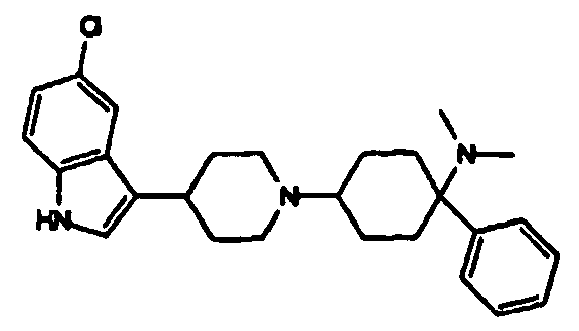
Dihydrochlorid Unpolareres Diastereoisomer 4 
Dihydrochlorid Polareres Diastereoisomer 5 
Dihydrochlorid Polareres Diastereoisomer 6 
Dihydrochlorid Unpolareres Diastereoisomer 7 
Dihydrochlorid Unpolareres Diastereoisomer 8 
Dihydrochlorid Polareres Diastereoisomer 9 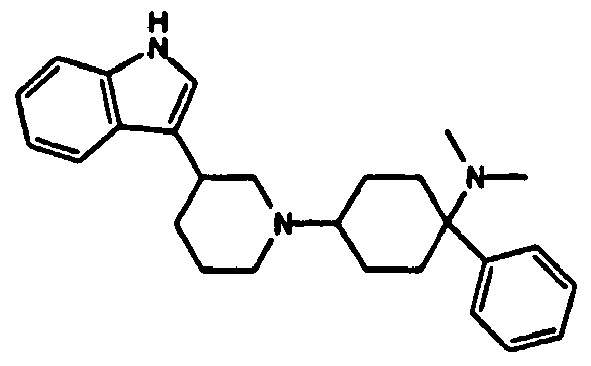
Dihydrochlorid Unpolareres Diastereoisomer 10 
Dihydrochlorid Polareres Diastereoisomer 11 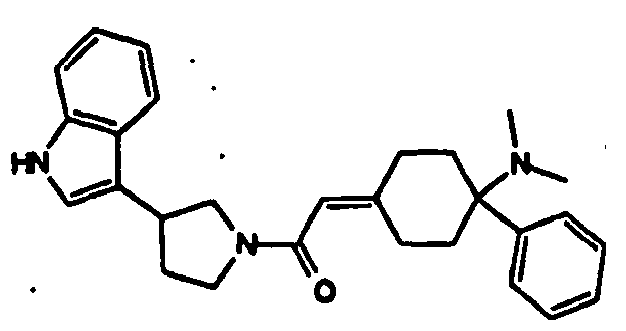
Hydrochlorid Diastereoisomerengemisch 12 
Dihydrochlorid Polareres Diastereoisomer 13 
Dihydrochlorid Unpolareres Diastereoisomer 14 
Citrat Unpolareres Diastereoisomer 15 
Citrat Polareres Diastereoisomer 16 
Hemicitrat Unpolareres Diastereoisomer 17 
Citrat Unpolareres Diastereoisomer 18 
Citrat Polareres Diastereoisomer 19 
Citrat Polarers Diastereoisomer 20 
Hemicitrat Unpolareres Diastereoisomer 21 
Citrat Unpolareres Diastereoisomer 22 
Citrat Polareres Diastereoisomer 23 
Hemicitrat Unpolareres Diastereoisomer 24 
Citrat Polareres Diastereoisomer 25 
Hydrochlorid 26 
Hydrochlorid 27 
Hydrochlorid 28 
Hydrochlorid 29 
Hydrochlorid Unpolareres Diastereoisomer 30 
Hydrochlorid Polareres Diastereoisomer 31 
Hydrochlorid Unpolareres Diastereoisomer 32 
Hydrochlorid Unpolareres Diastereoisomer 33 
Hydrochlorid Unpolareres Diastereoisomer 34 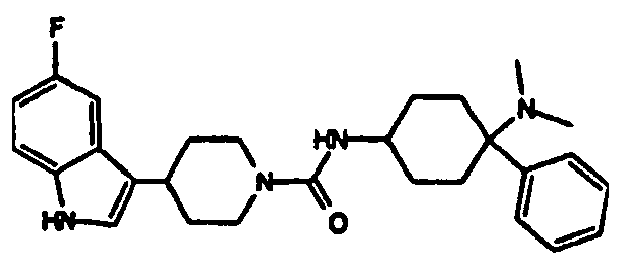
Hydrochlorid Polareres Diastereoisomer 35 
Hydrochlorid Unpolareres Diastereoisomer 36 
Hydrochlorid Polareres Diastereoisomer 37 
Hydrochlorid Unpolareres Diastereoisomer 38 
Hydrochlorid Polareres Diastereoisomer 39 
Hydrochlorid Eins von zwei Diastereoisomeren 40 
Hydrochlorid Unpolareres Diastereoisomer 41 
Hydrochlorid Polareres Diastereoisomer 42 
Hydrochlorid Polareres Diastereoisomer 43 
Citrat Unpolareres Diastereoisomer 44 
Citrat Polareres Diastereoisomer 45 
Citrat Unpolareres Diastereoisomer 46 
Citrat Polareres Diastereoisomer 47 
Citrat Unpolareres Diastereoisomer 48 
Citrat Polareres Diastereoisomer 49 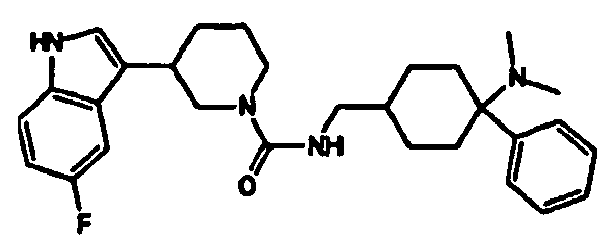
Citrat Unpolareres Diastereoisomer 50 
Citrat Polareres Diastereoisomer 51 
Citrat Unpolareres Diastereoisomer 52 
Citrat Polareres Diastereoisomer 53 
Hydrochlorid Diastereoisomerengemisch 54 
Hydrochlorid Diastereoisomerengemisch 55 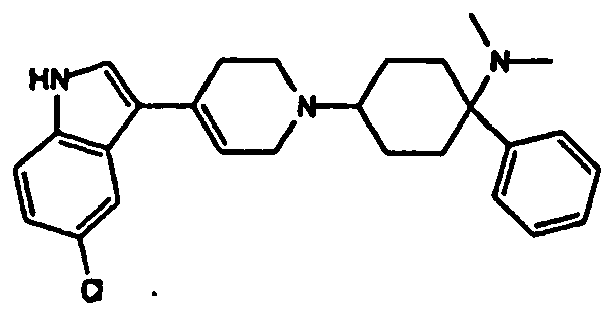
Dihydrochlorid Diastereoisomerengemisch 56 
Dihydrochlorid Diastereoisomerengemisch 57 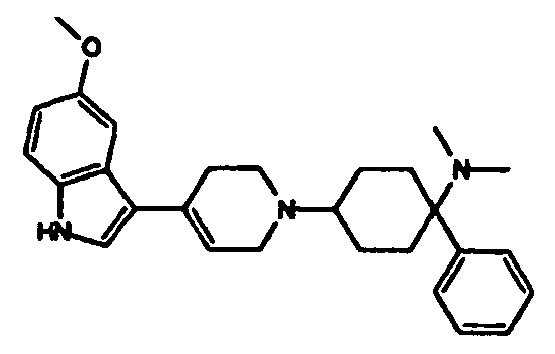
Dihydrochlorid Diastereoisomerengemisch 58 
Hydrochlorid Unpolareres Diastereoisomer 59 
Hydrochlorid Polareres Diastereoisomer 60 
Hydrochlorid Diastereoisomerengemisch 61 
Dihydrochlorid Polareres Diastereoisomer - Die in den folgenden Assays und Modellen erhobenen Daten sind in Tabelle 1 zusammengefaßt.
- Die Cyclohexan-Derivate der allgemeinen Formel I wurden in einem Rezeptorbindungsassay-mit 3H-Nociceptin/Orphanin FQ mit Membranen von rekombinanten CHO-ORL1 Zellen untersucht. Dieses Testsystem wurde gemäß der von Ardati et al. (Mol. Pharmacol., 51, 1997, S. 816-824) vorgestellten Methode durchgeführt. Die Konzentration von 3H-Nociceptin/Orphanin FQ betrug bei diesen Versuchen 0.5 nM. Die Bindungsassays wurden mit je 20 µg Membranprotein je 200 µl Ansatz in 50 mM Hepes, pH 7,4, 10 mM MgCl2 und 1 mM EDTA durchgeführt. Die Bindung an den ORL1-Rezeptor wurde unter Verwendung von je 1 mg WGA-SPA Beads (Amersham-Pharmacia, Freiburg), durch einstündige Inkubation des Ansatzes bei RT und anschliessende Messung im Szintillationscounter Trilux (Wallac, Finnland), bestimmt. Die Affinität wird in Tabelle 1 als nanomolarer Ki-Wert in oder % Inhibition bei c=1 µM angegeben.
- Die Rezeptoraffinität zum humanen µ-Opiatrezeptor wurde in einem homogenen Ansatz in Mikrotiterplatten bestimmt. Hierzu wurden Verdünnungsreihen des jeweils zu prüfenden substituierten spirocyclischen Cyclohexan-Derivates mit einer Rezeptormembranpräparation (15-40 µg Protein pro 250 µl Inkubationsansatz) von CHO-K1-Zellen, welche den humanen µ-Opiatrezeptor exprimieren (RB-HOM-Rezeptormembran-Präparation der Firma NEN, Zaventem, Belgien) in Gegenwart von 1 nmol/l des radioaktiven Liganden [3H]-Naloxon (NET719, Firma NEN, Zaventem, Belgien) sowie von 1 mg WGA-SPA-Beads (Wheat germ agglutinin SPA Beads der Firma Amersham/Pharmacia, Freiburg, Deutschland) in einem Gesamtvolumen von 250 µl für 90 Minuten bei Raumtemperatur inkubiert. Als Inkubationspuffer wurde 50 mmol/l Tris-HCl supplementiert mit 0,05 Gew.-% Natriumazid und mit 0,06 Gew.-% bovinem Serumalbumin verwendet. Zur Bestimmung der unspezifischen Bindung wurde zusätzlich 25 µmol/l Naloxon zugegeben. Nach Beendigung der neunzigminütigen Inkubationszeit wurden die Mikrotiterplatten für 20 Minuten bei 1000 g abzentrifugiert und die Radioaktivität in einem β-Counter (Microbeta-Trilux, Firma PerkinElmer Wallac, Freiburg, Deutschland) vermessen. Es wurde die prozentuale Verdrängung des radioaktiven Liganden aus seiner Bindung zum humanen µ-Opiatrezeptor bei einer Konzentration der Prüfsubstanzen von 1 µmol/l bestimmt und als prozentuale Hemmung (%Hemmung) der spezifischen Bindung angegeben. Teilweise wurden ausgehend von der prozentualen Verdrängung durch unterschiedliche Konzentrationen der zu prüfenden Verbindungen der allgemeinen Formel I IC50 Hemmkonzentrationen berechnet, die eine 50-prozentige Verdrängung des radioaktiven Liganden bewirken. Durch Umrechnung mittels der Cheng-Prusoff-Beziehung wurden Ki-Werte für die Prüfsubstanzen erhalten. In einzelnen Fällen (in Tabelle 2 durch DA gekennzeichnet) wurde wurde gegen [D-Ala2,MePhe4,Gly-ol5]enkephalin ("DAMGO") anstelle von Naloxon gemessen.
- Die Mäuse wurden jeweils einzeln in einen Testkäfig gesetzt und die Schwanzbasis dem fokussierten Wärmestrahl einer elektrischen Lampe (Tall-flick-Typ 50/08/1.bc, Labtec, Dr. Hess) ausgesetzt. Die Lampenintensität wurde so eingestellt, daß die Zeit vom Einschalten der Lampe bis zum plötzlichen Wegzucken des Schwanzes (Schmerzlatenz) bei unbehandelten Mäusen 3 bis 5 Sekunden betrug. Vor der Applikation der Lösungen enthaltend die erfindungsgemäße Verbindung bzw. der jeweiligen Vergleichslösungen wurden die Mäuse innerhalb von fünf Minuten zweimal vorgetestet und der Mittelwert dieser Messungen als Vortestmittelwert berechnet.
- Die Lösungen der erfindungsgemäßen Verbindung der allgemeinen Formel I sowie die Vergleichslösungen wurden dann intravenös appliziert. Die Schmerzmessung wurde jeweils 10, 20, 40 und 60 Minuten nach der intravenösen Applikation durchgeführt. Die analgetische Wirkung wurde als Zunahme der Schmerzlatenz (% des maximal möglichen antinociceptiven Effektes) nach der folgenden Formel bestimmt:

- Hierbei ist die Zeit T0 die Latenzzeit vor der Applikation, die Zeit T1 die Latenzzeit nach der Applikation der Wirkstoffkombination und die Zeit T2 die maximale Expositionsdauer (12 Sekunden).
Tabelle 2: Beispiel Nr. ORL1 Ki [µM] oder µ Ki [µM] Oder TaU Flick (Maus, i.v.) % Hemmung [1 µM] % Hemmung [1 µM] %Hemmung (Dosis [mg/kg]) 1 0,0038 0,0028 2 0,012 0,0025 3 0,032 0,019 4 0,054 53 % 5 0,069 36 % 6 0,047 0,1 7 0,065 0,039 8 54 % 0,54 9 0,0029 0,013 10 0,1 61 % 11 0,02 0,0008 12 10 % 66 % 13 0,087 0,022 14 63 % 52 % (DA) 15 0,1 0,03 (DA) 16 57 % 0,027 17 0,21 0,0685 18 0,068 0,024 19 0,075 0,021 20 46 % 0,026 21 47 % 0,083 (DA) 22 0,083 0,11 (DA) 23 51 % 0,048 24 0,058 0,027 25 0,039 0,031 (DA) 26 0,095 0,041 27 0,11 0,021 28 0,067 0,024 (DA) 29 46 % 0,0071 30 47 % 0,28 31 59 % 0,013 32 39 % 0,031 33 62 % 0,0083 34 66 % 0,12 35 0,033 0,0081 36 26 % 56 % 37 0,083 0,019 38 13 % 0,41 39 0,021 0,0022 40 14 % 0,022 41 55 % 0,0059 42 34 % 57 % 43 0,16 0,015 (DA) 44 0,11 0,0057 (DA) 45 52 % 0,015 46 0,092 0,07 47 56 % 0,032 48 0,091 0,0021 100 (21,5) 49 61 % 0,022 50 0,068 0,0033 51 69 % 0,018 52 0,045 0,01 53 0,056 0,0031 54 0,043 0,0079 100 % (10) 55 0,095 85 % 56 0,17 90 % 57 0,15 91 % 58 0,12 0,031 (DA) 59 0,082 0,038 (DA) 60 45 % 0,022 61 0,11 23 % (DA) - 38 g eines der erfindungsgemäßen 4-substituierte 1-Aminocyclohexan-Derivate, hier Beispiel 1, wird in 1 I Wasser für Injektionszwecke bei Raumtemperatur gelöst und anschließend durch Zugabe von wasserfreier Glukose für Injektionszwecke auf isotone Bedingungen eingestellt.
in Form ihrer Säuren oder ihrer Basen oder in Form ihrer Salze, insbesondere der physiologisch verträglichen Salze oder Salze physiologisch verträglicher Säuren oder Kationen; oder in Form ihrer Solvate, insbesondere der Hydrate.
Claims (13)
- 4-substituierte 1-Aminocyclohexan-Derivate der allgemeinen Formel I,
 n = 0 oder 1,X = eine Bindung, oder C(O), C(O)NH, C(O)CH2, C(O)CH= oder C(O)NHCH2,R1 und R2 unabhängig voneinander für H; Methyl oder Ethyl stehen oder die Reste R1 und R2 zusammen einen Ring bilden und (CH2)5 bedeuten,R3 für C1-8-Alkyl oder C3-8-Cycloalkyl, jeweils gesättigt oder ungesättigt, verzweigt oder unverzweigt, einfach oder mehrfach substituiert oder unsubstituiert; Aryl, Heteroaryl, jeweils unsubstituiert oder einfach oder mehrfach substituiert; über eine gesättigte oder ungesättigte, verzweigte oder unverzweigte, substituierte oder unsubstituierte C1-4-Alkyl-Gruppe gebundenem Aryl, C3-8-Cycloalkyl oder Heteroaryl, jeweils unsubstituiert oder einfach oder mehrfach substituiert, steht;R4 und R5 unabhängig voneinander für H; oder (CH2)mR7 stehengegebenenfalls in Form ihrer Racemate, ihrer reinen Stereoisomeren, insbesondere Enantiomeren oder Diastereomeren, oder in Form von Mischungen der Stereoisomeren, insbesondere der Enantiomeren oder Diastereomeren, in einem beliebigen Mischungsverhältnis;
wobei m = 0-6 und R7 ausgewählt aus H; C3-8-Cycloalkyl, Aryl oder Heteroaryl, jeweils unsubstituiert oder einfach oder mehrfach substituiert, bedeutet, wobei nur einer der Reste R4 und R5 H sein kann,
mit der Maßgabe, dass wenn n = 1, einer der Reste R1 oder R2 CH3 und der andere Rest R1 oder R2 H bedeutet, R3 Phenyl und R5 H bedeutet, der Rest R4 nicht 4-Fluorphenyl bedeutet,
in Form ihrer Säuren oder ihrer Basen oder in Form ihrer Salze, insbesondere der physiologisch verträglichen Salze oder Salze physiologisch verträglicher Säuren oder Kationen; oder in Form ihrer Solvate, insbesondere der Hydrate. - 4-substituierte 1-Aminocyclohexan-Derivate gemäß Anspruch 1, dadurch gekennzeichnet, dass R1 und R2 unabhängig voneinander für CH3 oder H stehen, wobei R1 und R2 nicht gleichzeitig H bedeuten.
- 4-substituierte 1-Aminocyclohexan-Derivate gemäß einem der Ansprüche 1-2, dadurch gekennzeichnet, dass
R3 für C3-8-Cycloalkyl, Aryl oder Heteroaryl, jeweils unsubstituiert oder einfach oder mehrfach substituiert: über eine gesättigte oder ungesättigte, unverzweigte, substituierte oder unsubstituierte C1-2-Alkyl-Gruppe gebundenen Aryl, C3-8-Cycloalkyl oder Heteroaryl, jeweils unsubstituiert oder einfach oder mehrfach substituiert, steht;
vorzugsweise
R3 Cyclopentyl, Cyclohexyl, Phenyl, Benzyl, Naphthyl, Anthracenyl, Thiophenyl, Benzothiophenyl, Furyl, Benzofuranyl, Benzodioxolanyl, Indolyl, Indanyl, Benzodioxanyl, Pyrrolyl, Pyridyl, Pyrimidyl oder Pyrazinyl, jeweils unsubstituiert oder einfach oder mehrfach substituiert: über eine gesättigte, unverzweigte C1-2-Alkyl-Gruppe gebundenen C5-6-Cycloalkyl, Phenyl, Naphthyl, Anthracenyl, Thiophenyl, Benzothiophenyl, Pyridyl, Furyl, Benzofuranyl, Benzodioxolanyl, Indolyl, Indanyl, Benzodioxanyl, Pyrrolyl, Pyrimidyl oder Pyrazinyl, jeweils unsubstituiert oder einfach oder mehrfach substituiert, bedeutet;
insbesondere
R3 Phenyl, Furyl, Thiophenyl, Naphthyl, Benzyl, Benzofuranyl, Indolyl, Indanyl, Benzodioxanyl, Benzodioxolanyl, Pyridyl, Pyrimidyl, Pyrazinyl oder Benzothiophenyl, jeweils unsubstituiert oder einfach oder mehrfach substituiert; über eine gesättigte, unverzweigte C1-2-Alkyl-Gruppe gebundenen Phenyl, Furyl oder Thiophenyl, jeweils unsubstituiert oder einfach oder mehrfach substituiert, bedeutet - 4-substituierte 1-Aminocyclohexan -Derivate gemäß einem der Ansprüche 1 bis 2, dadurch gekennzeichnet, dass R3 für Phenyl, Thiophenyl, Pyridyl oder Benzyl, jeweils substituiert oder unsubstituiert, steht, besonders bevorzugt für Phenyl.
- 4-Substituierte 1-Aminocyclohexan-Derivate gemäß einem der Ansprüche 1 bis 4, worin R7 H; Cyclopentyl, Cyclohexyl, Cycloheptyl, Cyclooctyl, Indolyl, Naphthyl, Benzofuranyl, Benzothiophenyl, Indanyl, Acenaphthyl, Phenyl, Thiophenyl, Furyl, Pyridyl, Pyrrolyl, Pyrazinyl oder Pyrimidyl, jeweils unsubstituiert oder einfach oder mehrfach substituiert, bedeutet.
- 4-Substituierte 1-Aminocyclohexan-Derivate gemäß einem der Ansprüche 1 bis 5, dadurch gekennzeichnet, dass R7 für Indolyl, unsubstituiert oder einfach oder mehrfach substituiert, steht.
- 4-Substituierte 1-Aminocyclohexan-Derivate gemäß einem der Ansprüche 1 bis 6 6 aus der Gruppe
{4-[3-(1H-Indol-3-yl)-pyrrolidin-1-yl]-1-phenyl-cyclohexyl}-dimethylamin; dihydrochlorid (unpolareres Diastereoisomer)
{4-[3-(1H-Indol-3-yl)-pyrrolidin-1-yl]-1-phenyl-cyclohexyl}-dimethylamin; dihydrochlorid (Diastereoisomerengemisch)
{4-[4-(5-Chlor-1H-indol-3-yl)-piperidin-1-yl]-1-phenyl-cyclohexyl}-dimethylamin; dihydrochlorid (unpolareres Diastereoisomer)
{4-[4-(5-Chlor-1H-indol-3-yl)-piperidin-1-yl]-1-phenyl-cyclohexyl}-dimethylamin; dihydrochlorid (polareres Diastereoisomer)
{4-[4-(1H-Indol-3-yl)-piperidin-1-yl]-1-phenyl-cyclohexyl}-dimethylamin; dihydrochlorid (polareres Diastereoisomer)
{4-[4-(1H-Indol-3-yl)piperidin-1-yl]-1-phenylcyclohexyl}-dimethylamin; dihydrochlorid (unpolareres Diastereoisomer)
{4-[4-(5-Methoxy-1H-indol-3-yl)-piperidin-1-yl]-1-phenyl-cyclohexyl}-dimethylamin; dihydrochlorid (unpolareres Diastereoisomer)
{4-[4-(5-Methoxy-1H-indol-3-yl)piperidin-1-yl]-1-phenylcyclohexyl}-dimethylamin; dihydrochlorid (polareres Diastereoisomer)
{4-[3-(1H-Indol-3-yl)-piperidin-1-yl]-1-phenyl-cyclohexyl}-dimethylamin; dihydrochlorid (unpolareres Diastereoisomer)
{4-[3-(1H-Indol-3-yl)piperidin-1-yl]-1-phenylcyclohexyl}-dimethylamin; dihydrochlorid (polareres Diastereoisomer)
2-(4-Dimethylamino-4-phenylcyclohexyliden)-1-[3-(1H-indol-3-yl)pyrrolidin-1-yl]ethanon; hydrochlorid (Diastereoisomerengemisch)
{1-(4-Fluorphenyl)-4-[3-(1H-indol-3-yl)pyrrolidin-1-yl]cyclohexyl}-dimethylamin; dihydrochlorid (polareres und unpolareres Diastereoisomer)
4-(5-Methoxy-1H-indol-3-yl)-3,6-dihydro-2H-pyridin-1-carbonsäure-(4-dimethylamino-4-phenylcyclohexylmethyl)-amid; citrat (polareres und unpolareres Diastereoisomer)
4-(1H-Indol-3-yl)piperidin-1-carbonsäure-(4-dimethylamino-4-phenylcyclohexylmethyl)-amid; hemicitrat bzw. -citrat (polareres und unpolareres Diastereoisomer)
4-(5-Chlor-1H-indol-3-yl)piperidin-1-carbonsäure-(4-dimethylamino-4-phenylcyclohexylmethyl}-amid; citrat (polareres Diastereoisomer) bzw. -hemicitrat (unpolareres Diastereoisomer)
4-(1H-indol)-3-yl)-3,6-dihydro-2H-pyridin-1-carbonsäure-(4-dimethylamino-4-phenylcyclohexylmethyl)-amid; citrat (polareres und unpolareres Diastereoisomer)
4-(5-Fluor-1H-indol-3-yl)piperidin-1-carbonsäure-(4-dimethylamino-4-phenylcyclohexylmethyl)-amid; hemicitrat bzw. -citrat (polareres und unpolareres Diastereoisomer)
2-(4-Dimethylamino-4-phenylcyclohexyliden)-1-[4-(1H-indol-3-yl)-3,6-dihydro-2H-pyridin-1-yl]ethanon; Hydrochlorid
2-(4-Dimethylamino-4-phenylcyclohexyliden)-1-[4-(1H-indol-3-yl)-piperidin-1-yl]ethanon; Hydrochlorid
1-[4-(5-Chlor-1H-indol-3-yl)piperidin-1-yl]-2-(4-dimethylamino-4-phenylcyclohexyliden)ethanon; Hydrochlorid
2-(4-Dimethylamino-4-phenylcyclohexyliden)-1-[4-(5-methoxy-1H-indol-3-yl)-3,6-dihydro-2H-pyridin-1-yl]ethanon; Hydrochlorid
4-(1H-indol-3-yl)piperidin-1-carbonsäure-(4-dimethylamino-4-phenylcyclohexyl)-amid; Hydrochlorid (polareres und unpolareres Diastereoisomer)
4-(5-Chlor-1H-indol-3-yl)piperidin-1-carbonsäure-(4-dimethylamino-4-phenylcyclohexyl)-amid; Hydrochlorid (unpolareres Diastereoisomer)
4-(5-Methoxy-1H-indol-3-yl)piperidin-1-carbonsäure-(4-dimethylamino-4-phenylcyclohexyl)-amid; Hydrochlorid (unpolareres Diastereoisomer)
4-(5-Fluor-1H-indol-3-yl)piperidin-1-carbonsäure-(4-dimethylamino-4-phenylcyclohexyl)-amid; Hydrochlorid (polareres und unpolareres Diastereoisomer)
3-(5-Chlor-1H-indol-3-yl)piperidin-1-carbonsäure-(4-dimethylamino-4-phenylcyclohexyl)-amid; Hydrochlorid (polareres und unpolareres Diastereoisomer)
3-(5-Methoxy-1H-indol-3-yl)piperidin-1-carbonsäure-(4-dimethylamino-4-phenylcyclohexyl)-amid; Hydrochlorid (polareres und unpolareres Diastereoisomer)
2-(4-Dimethylamino-4-phenylcyclohexyl)-1-[3-(1H-indol-3-yl)pyrrolidin-1-yl]-ethanon; Hydrochlorid
2-[4-Dimethylamino-4-(4-fluorphenyl)cyclohexyl]-1-[3-(1H-indol-3-yl)pyrrolidin-1-yl]-ethanon; Hydrochlorid (polareres und unpolareres Diastereoisomer)
3-(5-Fluor-1H-Indol-3-yl)piperidin-1-carbonsäure-(4-dimethylamino-4-phenylcyclohexyl)-amid; Hydrochlorid (polareres Diastereoisomer)
4-(5-Fluor-1H-indol-3-yl)-3,6-dihydro-2H-pyridin-1-carbonsäure-(4-dimethylamino-4-phenylcyclohexylmethyl)-amid; citrat (polareres und unpolareres Diastereoisomer)
4-(5-Methoxy-1H-indol-3-yl)piperidin-1-carbonsäure-(4-dimethylamino-4-phenylcyclohexylmethyl)-amid; citrat (polareres und unpolareres Diastereoisomer)
3-(1H-Indol-3-yl)piperidin-1-carbonsäure-(4-dimethylamino-4-phenylcyclohexylmethyl)-amid; citrat (polareres und unpolareres Diastereoisomer)
3-(5-Fluor-1H-indol-3-yl)piperidin-1-carbonsäure-(4-dimethylamino-4-phenylcyclohexylmethyl)-amid; citrat (polareres und unpolareres Diastereoisomer)
3-(1H-Indol-3-yl)pyrrolidin-1-carbonsäure-(4-dimethylamirto-4-phenylcyclohexylmethyl)-amid; citrat (polareres und unpolareres Diastereoisomer)
2-(4-Dimethylamino-4-phenylcyclohexyl)-1-[3-(1H-indol-3-yl)piperidin-1-yl]-ethanon; Hydrochlorid (Diastereoisomerengemisch)
2-(4-Dimethylamino-4-phenylcyclohexyliden)-1-[3-(1H-indol-3-yl)-piperidin-1-yl]-ethanon; Hydrochlorid (Diastereoisomerengemisch)
4-[4-(5-Chlor-1H-indol-3-yl)-3,6-dihydro-2H-pyridin-1-yl]-1-phenylcyclohexyl-dimethylamin; diHydrochlorid (Diastereoisomerengemisch)
{4-[4-(1H-Indol-3-yl)-3,6-dihydro-2H-pyridin-1-yl]-1-phenylcyclohexyl}-dimethylamin; dihydrochlorid (Diastereoisomerengemisch)
{4-[4-(5-Methoxy-1H-indol-3-yl)-3,6-dihydro-2H-pyridin-1-yl]-1-phenylcyclohexyl}-dimethylamin; dihydrochlorid (Diastereoisomerengemisch)
4-(5-Chlor-1H-indol-3-yl)-3,6-dihydro-2H-pyridin-1-carbonsäure-(4-dimethylamino-4-phenyl-cyclohexylmethyl)-amid; Hydrochlorid (unpolareres und polareres Diastereoisomer)
2-(4-Dimethylamino-4-(4-fluorphenyl)cyclohexyliden)-1-[3-(1 H-indol-3-yl)pyrrolidin-1-yl]-ethanon; Hydrochlorid (Diastereoisomerengemisch) - Arzneimittel enthaltend mindestens ein 4-substituierte 1-Aminocyclohexan-Derivat gemäß einem der Ansprüche 1 bis 7 sowie gegebenenfalls geeignete Zusatz- und/oder Hilfsstoffe und/oder gegebenenfalls weitere Wirkstoffe.
- Verwendung eines 4-substituierten 1-Aminocyclohexan-Derivats gemäß einem der Ansprüche 1 bis 7 zur Herstellung eines Arzneimittels zur Behandlung von Schmerz, insbesondere von akutem, viszeralem, neuropathischem oder chronischem Schmerz.
- Verwendung eines 4-substituierten 1-Aminocyclohexan-Derivats gemäß einem der Ansprüche 1 bis 7 zur Herstellung eines Arzneimittels zur Behandlung von Angstzuständen, von Stress und mit Stress verbundenen Syndromen, Depressionen, Epilepsie, Alzheimer Erkrankung, seniler Demenz, allgemeinen kognitiven Dysfunktionen, Lern- und Gedächtnis-Störungen (als Nootropikum), Entzugserscheinungen, Alkohol- und/oder Drogen- und/oder Medikamentenmißbrauch und/oder -abhängigkeit, sexuellen Dysfunktionen, cardiovaskulären Erkrankungen, Hypotension, Hypertension, Tinitus, Pruritus, Migräne, Schwerhörigkeit, mangelnder Darmmotilität, gestörter Nahrungsaufnahme, Anorexie, Fettsucht, lokomotorischen Störungen, Diarrhoe, Kachexie, Harninkontinenz bzw. als Muskelrelaxanz, Antikonvulsivum oder Anesthetikum bzw. zur Coadministration bei Behandlung mit einem opioiden Analgetikum oder mit einem Anesthetikum, zur Diurese oder Antinatriurese, Anxiolyse, zur Modulation der Bewegungsaktivität, zur Modulation der Neurotransmitter-Ausschüttung und Behandlung damit verbundener neurodegenerativer Erkrankungen, zur Behandlung von Entzugserscheinungen und/oder zur Reduzierung des Suchtpotentials von Opioiden.
- Verfahren zur Herstellung von 4-substituierten 1-Aminocyctohexan-Derivatengemäß einem der Ansprüche 1-7, dadurch gekennzeichnet, dass ein Pyrrolidin- oder Piperidin-Derivat
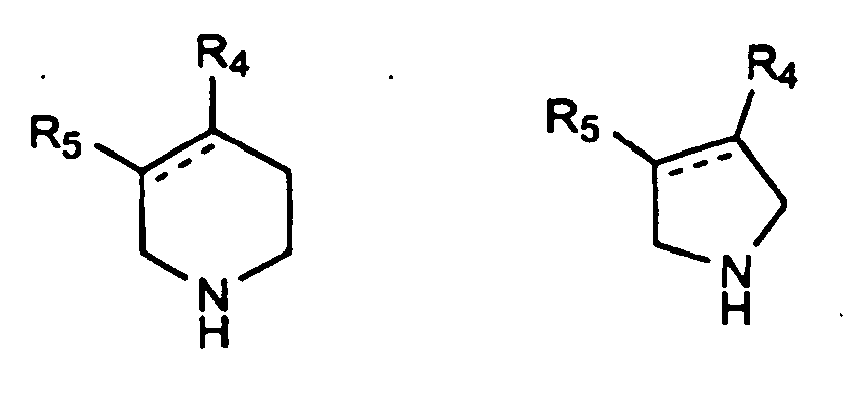
- Verfahren zur Herstellung von 4-substituierten 1-Aminocyclohexan-Derivatengemäß einem der Ansprüche 1-7, dadurch gekennzeichnet, dass ein Pyrrolidin- oder Piperidin-Derivat

- Verfahren zur Herstellung von 4-substituierten 1-Aminocyclohexan-Derivatengemäß einem der Ansprüche 1-7, dadurch gekennzeichnet, dass ein Pyrrolidin- oder Piperidin-Derivat

Priority Applications (2)
| Application Number | Priority Date | Filing Date | Title |
|---|---|---|---|
| SI200331366T SI1560823T1 (sl) | 2002-11-11 | 2003-11-05 | 4-substituirani 1-aminocikloheksanski derivati zauporabo kot ligandi ORL1-receptorja in opioidnegami-receptorja |
| CY20081101060T CY1108378T1 (el) | 2002-11-11 | 2008-09-25 | 4-υποκατεστημενα παραγωγα 1-αμινοκυκλοεξανιου για την χρησιμοποιηση σαν προσδεματα υποδοχεα orl1 ή οπιακου υποδοχεα mu |
Applications Claiming Priority (3)
| Application Number | Priority Date | Filing Date | Title |
|---|---|---|---|
| DE10252666 | 2002-11-11 | ||
| DE10252666A DE10252666A1 (de) | 2002-11-11 | 2002-11-11 | N-Piperidyl-cyclohexan-Derivate |
| PCT/EP2003/012306 WO2004043949A1 (de) | 2002-11-11 | 2003-11-05 | 4-substituierte 1-aminocyclohexan-derivate zur verwendung als orl1-rezeptor- und mu-opiat-rezeptor-liganden |
Publications (2)
| Publication Number | Publication Date |
|---|---|
| EP1560823A1 EP1560823A1 (de) | 2005-08-10 |
| EP1560823B1 true EP1560823B1 (de) | 2008-07-09 |
Family
ID=32308522
Family Applications (1)
| Application Number | Title | Priority Date | Filing Date |
|---|---|---|---|
| EP03779845A Expired - Lifetime EP1560823B1 (de) | 2002-11-11 | 2003-11-05 | 4-substituierte 1-aminocyclohexan-derivate zur verwendung als orl1-rezeptor- und mu-opiat-rezeptor-liganden |
Country Status (13)
| Country | Link |
|---|---|
| US (1) | US7759385B2 (de) |
| EP (1) | EP1560823B1 (de) |
| AR (1) | AR041941A1 (de) |
| AT (1) | ATE400569T1 (de) |
| AU (1) | AU2003287993A1 (de) |
| CY (1) | CY1108378T1 (de) |
| DE (2) | DE10252666A1 (de) |
| DK (1) | DK1560823T3 (de) |
| ES (1) | ES2309373T3 (de) |
| PE (1) | PE20040833A1 (de) |
| PT (1) | PT1560823E (de) |
| SI (1) | SI1560823T1 (de) |
| WO (1) | WO2004043949A1 (de) |
Families Citing this family (30)
| Publication number | Priority date | Publication date | Assignee | Title |
|---|---|---|---|---|
| DE10252665A1 (de) * | 2002-11-11 | 2004-06-03 | Grünenthal GmbH | 4-Aminomethyl-1-aryl-cyclohexylamin-Derivate |
| BRPI0412808A (pt) * | 2003-07-24 | 2006-09-26 | Euro Celtique Sa | compostos de piperidina e composições farmacêuticas contendo os mesmos |
| EP2080757A1 (de) * | 2003-07-24 | 2009-07-22 | Euro-Celtique S.A. | Zur Behandlung oder Vorbeugung von Schmerzen geeignete Heteroaryl-Tetrahydropiperidyl-Verbindungen |
| DE10337184A1 (de) * | 2003-08-13 | 2005-03-10 | Gruenenthal Gmbh | Substituierte 3-Pyrrolidin-Indol-Derivate |
| DE102004023635A1 (de) | 2004-05-10 | 2006-04-13 | Grünenthal GmbH | Heteroarylsubstituierte Cyclohexyl-1,4-diamin-Derivate |
| DE102004023507A1 (de) * | 2004-05-10 | 2005-12-01 | Grünenthal GmbH | Substituierte Cyclohexylessigsäure-Derivate |
| DE102004023632A1 (de) * | 2004-05-10 | 2005-12-08 | Grünenthal GmbH | Substituierte Cyclohexylcarbonsäure-Derivate |
| DE102004023522A1 (de) * | 2004-05-10 | 2005-12-01 | Grünenthal GmbH | Substituierte Cyclohexyl-1,4-diamin-Derivate |
| DE102006033109A1 (de) * | 2006-07-18 | 2008-01-31 | Grünenthal GmbH | Substituierte Heteroaryl-Derivate |
| DE102006046745A1 (de) * | 2006-09-29 | 2008-04-03 | Grünenthal GmbH | Gemischte ORL1/µ-Agonisten zur Behandlung von Schmerz |
| EP2178534A4 (de) | 2007-07-17 | 2011-03-30 | Merck Sharp & Dohme | Lösliche epoxidhydrolasehemmer, zusammensetzungen mit solchen verbindungen und behandlungsverfahren damit |
| EA019707B1 (ru) * | 2007-11-05 | 2014-05-30 | Мерк Патент Гмбх | Производные 7-азаиндола в качестве селективных ингибиторов 11-бета-гидроксистероида дегидрогеназы 1 типа |
| AR070398A1 (es) * | 2008-02-22 | 2010-03-31 | Gruenenthal Chemie | Derivados sustituidos de indol |
| CA2719736C (en) | 2008-03-27 | 2016-02-09 | Gruenenthal Gmbh | Spiro(5.5)undecane derivatives |
| KR20120075500A (ko) | 2008-03-27 | 2012-07-06 | 그뤼넨탈 게엠베하 | 치환된 4-아미노사이클로헥산 유도체 |
| PE20091657A1 (es) | 2008-03-27 | 2009-11-07 | Gruenenthal Chemie | Derivados de (hetero)aril-ciclohexano |
| CA2719743A1 (en) | 2008-03-27 | 2009-10-01 | Gruenenthal Gmbh | Substituted cyclohexyldiamines |
| WO2009118173A1 (de) | 2008-03-27 | 2009-10-01 | Grünenthal GmbH | Substituierte spirocyclische cyclohexan-derivate |
| AR073841A1 (es) | 2008-03-27 | 2010-12-09 | Gruenenthal Chemie | Hidroximetilciclohexilaminas, medicamentos y uso de los mismos para la fabricacion de medicamentos. |
| EP2776437B1 (de) * | 2011-11-07 | 2018-09-26 | Sunovion Pharmaceuticals Inc. | Modulatoren von opioidrezeptoren und verfahren zu ihrer verwendung |
| WO2017007695A1 (en) * | 2015-07-09 | 2017-01-12 | The Regents Of The University Of California | Mu opioid receptor modulators |
| WO2017023894A1 (en) * | 2015-08-03 | 2017-02-09 | Raze Therapeutics, Inc. | Mthfd2 inhibitors and uses thereof |
| JP7402857B2 (ja) | 2018-04-04 | 2023-12-21 | エピオダイン,インク. | オピオイド受容体モジュレーター、およびそれに関連する生成物ならびに方法 |
| WO2020120606A1 (en) * | 2018-12-12 | 2020-06-18 | Esteve Pharmaceuticals, S.A. | New pyrrolidine-2-carboxylic acid derivatives for treating pain and pain related conditions |
| TW202026281A (zh) * | 2018-12-12 | 2020-07-16 | 西班牙商艾斯提夫製藥股份有限公司 | 用於治療疼痛和疼痛相關病症之新吡咯啶–2– 甲酸衍生物 |
| CN115190815B (zh) | 2019-12-26 | 2024-06-18 | 吉尔伽美什制药公司 | 芳基环己基胺衍生物及其在精神障碍的治疗中的用途 |
| EP4084791B1 (de) | 2020-02-18 | 2024-12-18 | Gilgamesh Pharmaceuticals, Inc. | Spezifische tryptamine zur behandlung von stimmungsstörungen |
| TW202304869A (zh) | 2021-04-05 | 2023-02-01 | 美商艾碧奧戴股份有限公司 | 類鴉片受體調節劑 |
| US12180158B1 (en) | 2023-08-03 | 2024-12-31 | Gilgamesh Pharmaceuticals, Inc. | Crystalline fumarate salts of n-ethyl-2-(5-fluoro-1H-indol-3-yl)-n-methylethan-1-amine |
| US12129234B1 (en) | 2023-08-03 | 2024-10-29 | Gilgamesh Pharmaceuticals, Inc. | Crystalline salts of N-ethyl-(5-fluoro-1H-indol-3-yl)-N-methylethan-1-amine |
Family Cites Families (11)
| Publication number | Priority date | Publication date | Assignee | Title |
|---|---|---|---|---|
| US4113555A (en) * | 1973-11-08 | 1978-09-12 | Svenska Traforskningsinstitutet | Hard board or medium density board, process for production thereof and means for practicizing the process |
| US4113866A (en) * | 1977-04-01 | 1978-09-12 | The Upjohn Company | Analgetic compounds, compositions and process of treatment |
| TW438587B (en) * | 1995-06-20 | 2001-06-07 | Takeda Chemical Industries Ltd | A pharmaceutical composition for prophylaxis and treatment of diabetes |
| US5763445A (en) * | 1996-03-08 | 1998-06-09 | Adolor Corporation | Kappa agonist compounds pharmaceutical formulations and method of prevention and treatment of pruritus therewith |
| US5760023A (en) * | 1997-07-14 | 1998-06-02 | Adolor Corporation | Kappa agonist anti-pruritic pharmaceutical formulations and method of treating pruritus therewith |
| US6172087B1 (en) * | 1998-06-03 | 2001-01-09 | Gpi Nil Holding, Inc. | N-oxide of heterocyclic ester, amide, thioester, or ketone hair growth compositions and uses |
| MA26659A1 (fr) * | 1998-08-06 | 2004-12-20 | Pfizer | Dérivés de benzimidazole nouveaux, compositions pharmaceutiques les contenant et procédé pour leur préparation. |
| EP1242085B1 (de) * | 1999-12-06 | 2005-08-24 | Euro-Celtique, S.A. | Benzimidazolverbindungen die nociceptinrezeptoraffinität haben |
| GB0012240D0 (en) * | 2000-05-19 | 2000-07-12 | Merck Sharp & Dohme | Therapeutic agents |
| ATE407924T1 (de) | 2000-10-06 | 2008-09-15 | Mitsubishi Tanabe Pharma Corp | Stickstoffhaltige, fünfgliedrige ringverbindungen |
| DE10252665A1 (de) * | 2002-11-11 | 2004-06-03 | Grünenthal GmbH | 4-Aminomethyl-1-aryl-cyclohexylamin-Derivate |
-
2002
- 2002-11-11 DE DE10252666A patent/DE10252666A1/de not_active Withdrawn
-
2003
- 2003-11-05 PT PT03779845T patent/PT1560823E/pt unknown
- 2003-11-05 AT AT03779845T patent/ATE400569T1/de active
- 2003-11-05 ES ES03779845T patent/ES2309373T3/es not_active Expired - Lifetime
- 2003-11-05 DE DE50310122T patent/DE50310122D1/de not_active Expired - Lifetime
- 2003-11-05 AU AU2003287993A patent/AU2003287993A1/en not_active Abandoned
- 2003-11-05 DK DK03779845T patent/DK1560823T3/da active
- 2003-11-05 EP EP03779845A patent/EP1560823B1/de not_active Expired - Lifetime
- 2003-11-05 SI SI200331366T patent/SI1560823T1/sl unknown
- 2003-11-05 WO PCT/EP2003/012306 patent/WO2004043949A1/de not_active Ceased
- 2003-11-11 PE PE2003001140A patent/PE20040833A1/es not_active Application Discontinuation
- 2003-11-12 AR ARP030104144A patent/AR041941A1/es unknown
-
2005
- 2005-05-10 US US11/125,151 patent/US7759385B2/en not_active Expired - Fee Related
-
2008
- 2008-09-25 CY CY20081101060T patent/CY1108378T1/el unknown
Also Published As
| Publication number | Publication date |
|---|---|
| WO2004043949A1 (de) | 2004-05-27 |
| PT1560823E (pt) | 2008-09-25 |
| ES2309373T3 (es) | 2008-12-16 |
| AR041941A1 (es) | 2005-06-01 |
| CY1108378T1 (el) | 2014-02-12 |
| SI1560823T1 (sl) | 2008-12-31 |
| AU2003287993A1 (en) | 2004-06-03 |
| PE20040833A1 (es) | 2004-11-17 |
| US20050277674A1 (en) | 2005-12-15 |
| DE50310122D1 (de) | 2008-08-21 |
| ATE400569T1 (de) | 2008-07-15 |
| DE10252666A1 (de) | 2004-08-05 |
| US7759385B2 (en) | 2010-07-20 |
| DK1560823T3 (da) | 2008-11-10 |
| EP1560823A1 (de) | 2005-08-10 |
Similar Documents
| Publication | Publication Date | Title |
|---|---|---|
| WO2004043949A1 (de) | 4-substituierte 1-aminocyclohexan-derivate zur verwendung als orl1-rezeptor- und mu-opiat-rezeptor-liganden | |
| EP1392641B1 (de) | Substituierte cyclohexan-1,4-diaminderivate | |
| EP2121689B1 (de) | Spirocyclische cyclohexan-derivate | |
| EP1560835B1 (de) | Spirocyclische cyclohexan-derivate | |
| DE10252665A1 (de) | 4-Aminomethyl-1-aryl-cyclohexylamin-Derivate | |
| EP1560807B1 (de) | 4-hydroxymethyl-1-aryl-cyclohexylamin-derivative | |
| DE10252650A1 (de) | Cyclohexyl-Harnstoff-Derivate | |
| EP2280941B1 (de) | (hetero-)aryl-cyclohexan-derivate | |
| DE10213051B4 (de) | Substituierte 4-Aminocyclohexanole | |
| EP1406858B1 (de) | Substituierte 4-aminocyclohexanole | |
| EP1560806B1 (de) | 4-alkyl-/4-alkenyl-/4-alkinylmethyl/-1-arylcyclohexylamin-derivate | |
| EP1406859B1 (de) | Substituierte 4-aminocyclohexanolderivate | |
| DE10252874A1 (de) | 4-Alkyl-1-Aryl-Cyclohexylamin-Derivate | |
| DE10253323A1 (de) | 4-Oxymethyl-1-Aryl-Cyclohexylamin-Derivate | |
| DE10252872A1 (de) | 4-Hydroxymethyl-1-Aryl-Cyclohexylamin-Derivate |
Legal Events
| Date | Code | Title | Description |
|---|---|---|---|
| PUAI | Public reference made under article 153(3) epc to a published international application that has entered the european phase |
Free format text: ORIGINAL CODE: 0009012 |
|
| 17P | Request for examination filed |
Effective date: 20050416 |
|
| AK | Designated contracting states |
Kind code of ref document: A1 Designated state(s): AT BE BG CH CY CZ DE DK EE ES FI FR GB GR HU IE IT LI LU MC NL PT RO SE SI SK TR |
|
| AX | Request for extension of the european patent |
Extension state: AL LT LV MK |
|
| RAX | Requested extension states of the european patent have changed |
Extension state: LT Payment date: 20050416 Extension state: LV Payment date: 20050416 |
|
| 17Q | First examination report despatched |
Effective date: 20060509 |
|
| GRAP | Despatch of communication of intention to grant a patent |
Free format text: ORIGINAL CODE: EPIDOSNIGR1 |
|
| GRAS | Grant fee paid |
Free format text: ORIGINAL CODE: EPIDOSNIGR3 |
|
| GRAA | (expected) grant |
Free format text: ORIGINAL CODE: 0009210 |
|
| AK | Designated contracting states |
Kind code of ref document: B1 Designated state(s): AT BE BG CH CY CZ DE DK EE ES FI FR GB GR HU IE IT LI LU MC NL PT RO SE SI SK TR |
|
| AX | Request for extension of the european patent |
Extension state: LT LV |
|
| REG | Reference to a national code |
Ref country code: GB Ref legal event code: FG4D Free format text: NOT ENGLISH |
|
| REG | Reference to a national code |
Ref country code: CH Ref legal event code: EP |
|
| REG | Reference to a national code |
Ref country code: CH Ref legal event code: NV Representative=s name: BRAUNPAT BRAUN EDER AG |
|
| REF | Corresponds to: |
Ref document number: 50310122 Country of ref document: DE Date of ref document: 20080821 Kind code of ref document: P |
|
| REG | Reference to a national code |
Ref country code: SE Ref legal event code: TRGR |
|
| REG | Reference to a national code |
Ref country code: IE Ref legal event code: FG4D Free format text: LANGUAGE OF EP DOCUMENT: GERMAN |
|
| REG | Reference to a national code |
Ref country code: PT Ref legal event code: SC4A Free format text: AVAILABILITY OF NATIONAL TRANSLATION Effective date: 20080915 |
|
| REG | Reference to a national code |
Ref country code: RO Ref legal event code: EPE |
|
| REG | Reference to a national code |
Ref country code: GR Ref legal event code: EP Ref document number: 20080402457 Country of ref document: GR |
|
| REG | Reference to a national code |
Ref country code: DK Ref legal event code: T3 |
|
| REG | Reference to a national code |
Ref country code: EE Ref legal event code: FG4A Ref document number: E002512 Country of ref document: EE Effective date: 20081008 |
|
| REG | Reference to a national code |
Ref country code: ES Ref legal event code: FG2A Ref document number: 2309373 Country of ref document: ES Kind code of ref document: T3 |
|
| REG | Reference to a national code |
Ref country code: HU Ref legal event code: AG4A Ref document number: E003786 Country of ref document: HU |
|
| PLBE | No opposition filed within time limit |
Free format text: ORIGINAL CODE: 0009261 |
|
| STAA | Information on the status of an ep patent application or granted ep patent |
Free format text: STATUS: NO OPPOSITION FILED WITHIN TIME LIMIT |
|
| 26N | No opposition filed |
Effective date: 20090414 |
|
| PG25 | Lapsed in a contracting state [announced via postgrant information from national office to epo] |
Ref country code: MC Free format text: LAPSE BECAUSE OF NON-PAYMENT OF DUE FEES Effective date: 20081130 |
|
| REG | Reference to a national code |
Ref country code: FR Ref legal event code: PLFP Year of fee payment: 13 |
|
| REG | Reference to a national code |
Ref country code: FR Ref legal event code: PLFP Year of fee payment: 14 |
|
| REG | Reference to a national code |
Ref country code: FR Ref legal event code: PLFP Year of fee payment: 15 |
|
| PGFP | Annual fee paid to national office [announced via postgrant information from national office to epo] |
Ref country code: RO Payment date: 20170915 Year of fee payment: 15 Ref country code: SK Payment date: 20170928 Year of fee payment: 15 |
|
| PGFP | Annual fee paid to national office [announced via postgrant information from national office to epo] |
Ref country code: BG Payment date: 20170919 Year of fee payment: 15 |
|
| PGFP | Annual fee paid to national office [announced via postgrant information from national office to epo] |
Ref country code: LU Payment date: 20171024 Year of fee payment: 15 |
|
| PGFP | Annual fee paid to national office [announced via postgrant information from national office to epo] |
Ref country code: DK Payment date: 20171110 Year of fee payment: 15 Ref country code: TR Payment date: 20171030 Year of fee payment: 15 Ref country code: HU Payment date: 20170921 Year of fee payment: 15 Ref country code: NL Payment date: 20171115 Year of fee payment: 15 Ref country code: FR Payment date: 20171012 Year of fee payment: 15 Ref country code: EE Payment date: 20171029 Year of fee payment: 15 Ref country code: FI Payment date: 20171109 Year of fee payment: 15 Ref country code: CZ Payment date: 20171012 Year of fee payment: 15 |
|
| PGFP | Annual fee paid to national office [announced via postgrant information from national office to epo] |
Ref country code: PT Payment date: 20171106 Year of fee payment: 15 Ref country code: CY Payment date: 20171010 Year of fee payment: 15 Ref country code: CH Payment date: 20171114 Year of fee payment: 15 Ref country code: BE Payment date: 20170925 Year of fee payment: 15 Ref country code: GB Payment date: 20171101 Year of fee payment: 15 Ref country code: AT Payment date: 20171026 Year of fee payment: 15 Ref country code: IE Payment date: 20171109 Year of fee payment: 15 Ref country code: IT Payment date: 20171123 Year of fee payment: 15 Ref country code: ES Payment date: 20171201 Year of fee payment: 15 Ref country code: SE Payment date: 20171113 Year of fee payment: 15 Ref country code: SI Payment date: 20171011 Year of fee payment: 15 Ref country code: GR Payment date: 20171016 Year of fee payment: 15 |
|
| REG | Reference to a national code |
Ref country code: CH Ref legal event code: PCAR Free format text: NEW ADDRESS: HOLEESTRASSE 87, 4054 BASEL (CH) |
|
| REG | Reference to a national code |
Ref country code: LT Ref legal event code: MM9D Effective date: 20181105 |
|
| REG | Reference to a national code |
Ref country code: EE Ref legal event code: MM4A Ref document number: E002512 Country of ref document: EE Effective date: 20181130 |
|
| REG | Reference to a national code |
Ref country code: DK Ref legal event code: EBP Effective date: 20181130 |
|
| REG | Reference to a national code |
Ref country code: CH Ref legal event code: PL |
|
| REG | Reference to a national code |
Ref country code: SE Ref legal event code: EUG |
|
| REG | Reference to a national code |
Ref country code: NL Ref legal event code: MM Effective date: 20181201 |
|
| REG | Reference to a national code |
Ref country code: AT Ref legal event code: MM01 Ref document number: 400569 Country of ref document: AT Kind code of ref document: T Effective date: 20181105 |
|
| GBPC | Gb: european patent ceased through non-payment of renewal fee |
Effective date: 20181105 |
|
| PG25 | Lapsed in a contracting state [announced via postgrant information from national office to epo] |
Ref country code: PT Free format text: LAPSE BECAUSE OF NON-PAYMENT OF DUE FEES Effective date: 20190506 Ref country code: SE Free format text: LAPSE BECAUSE OF NON-PAYMENT OF DUE FEES Effective date: 20181106 Ref country code: CZ Free format text: LAPSE BECAUSE OF NON-PAYMENT OF DUE FEES Effective date: 20181105 Ref country code: FI Free format text: LAPSE BECAUSE OF NON-PAYMENT OF DUE FEES Effective date: 20181105 Ref country code: CY Free format text: LAPSE BECAUSE OF NON-PAYMENT OF DUE FEES Effective date: 20181105 Ref country code: LU Free format text: LAPSE BECAUSE OF NON-PAYMENT OF DUE FEES Effective date: 20181105 |
|
| REG | Reference to a national code |
Ref country code: SK Ref legal event code: MM4A Ref document number: E 4090 Country of ref document: SK Effective date: 20181105 |
|
| REG | Reference to a national code |
Ref country code: BE Ref legal event code: MM Effective date: 20181130 |
|
| PG25 | Lapsed in a contracting state [announced via postgrant information from national office to epo] |
Ref country code: LI Free format text: LAPSE BECAUSE OF NON-PAYMENT OF DUE FEES Effective date: 20181130 Ref country code: NL Free format text: LAPSE BECAUSE OF NON-PAYMENT OF DUE FEES Effective date: 20181201 Ref country code: SK Free format text: LAPSE BECAUSE OF NON-PAYMENT OF DUE FEES Effective date: 20181105 Ref country code: HU Free format text: LAPSE BECAUSE OF NON-PAYMENT OF DUE FEES Effective date: 20181106 Ref country code: EE Free format text: LAPSE BECAUSE OF NON-PAYMENT OF DUE FEES Effective date: 20181130 Ref country code: RO Free format text: LAPSE BECAUSE OF NON-PAYMENT OF DUE FEES Effective date: 20181105 Ref country code: SI Free format text: LAPSE BECAUSE OF NON-PAYMENT OF DUE FEES Effective date: 20181106 Ref country code: GR Free format text: LAPSE BECAUSE OF NON-PAYMENT OF DUE FEES Effective date: 20190605 Ref country code: BG Free format text: LAPSE BECAUSE OF NON-PAYMENT OF DUE FEES Effective date: 20190531 Ref country code: CH Free format text: LAPSE BECAUSE OF NON-PAYMENT OF DUE FEES Effective date: 20181130 |
|
| REG | Reference to a national code |
Ref country code: SI Ref legal event code: KO00 Effective date: 20190708 |
|
| PG25 | Lapsed in a contracting state [announced via postgrant information from national office to epo] |
Ref country code: AT Free format text: LAPSE BECAUSE OF NON-PAYMENT OF DUE FEES Effective date: 20181105 Ref country code: FR Free format text: LAPSE BECAUSE OF NON-PAYMENT OF DUE FEES Effective date: 20181130 Ref country code: IT Free format text: LAPSE BECAUSE OF NON-PAYMENT OF DUE FEES Effective date: 20181105 Ref country code: IE Free format text: LAPSE BECAUSE OF NON-PAYMENT OF DUE FEES Effective date: 20181105 Ref country code: DK Free format text: LAPSE BECAUSE OF NON-PAYMENT OF DUE FEES Effective date: 20181130 |
|
| PG25 | Lapsed in a contracting state [announced via postgrant information from national office to epo] |
Ref country code: BE Free format text: LAPSE BECAUSE OF NON-PAYMENT OF DUE FEES Effective date: 20181130 |
|
| PG25 | Lapsed in a contracting state [announced via postgrant information from national office to epo] |
Ref country code: GB Free format text: LAPSE BECAUSE OF NON-PAYMENT OF DUE FEES Effective date: 20181105 |
|
| REG | Reference to a national code |
Ref country code: ES Ref legal event code: FD2A Effective date: 20200102 |
|
| PG25 | Lapsed in a contracting state [announced via postgrant information from national office to epo] |
Ref country code: ES Free format text: LAPSE BECAUSE OF NON-PAYMENT OF DUE FEES Effective date: 20181106 |
|
| PGFP | Annual fee paid to national office [announced via postgrant information from national office to epo] |
Ref country code: DE Payment date: 20211130 Year of fee payment: 19 |
|
| PG25 | Lapsed in a contracting state [announced via postgrant information from national office to epo] |
Ref country code: TR Free format text: LAPSE BECAUSE OF NON-PAYMENT OF DUE FEES Effective date: 20181105 |
|
| REG | Reference to a national code |
Ref country code: DE Ref legal event code: R119 Ref document number: 50310122 Country of ref document: DE |
|
| PG25 | Lapsed in a contracting state [announced via postgrant information from national office to epo] |
Ref country code: DE Free format text: LAPSE BECAUSE OF NON-PAYMENT OF DUE FEES Effective date: 20230601 |