EP1560253A2 - Vorrichtung zum Beschichten eines Substrats mit einer Absorberanordnung - Google Patents
Vorrichtung zum Beschichten eines Substrats mit einer Absorberanordnung Download PDFInfo
- Publication number
- EP1560253A2 EP1560253A2 EP05000927A EP05000927A EP1560253A2 EP 1560253 A2 EP1560253 A2 EP 1560253A2 EP 05000927 A EP05000927 A EP 05000927A EP 05000927 A EP05000927 A EP 05000927A EP 1560253 A2 EP1560253 A2 EP 1560253A2
- Authority
- EP
- European Patent Office
- Prior art keywords
- compartment
- cathode
- substrate
- assembly
- coating
- Prior art date
- Legal status (The legal status is an assumption and is not a legal conclusion. Google has not performed a legal analysis and makes no representation as to the accuracy of the status listed.)
- Granted
Links
Images


Classifications
-
- H—ELECTRICITY
- H01—ELECTRIC ELEMENTS
- H01J—ELECTRIC DISCHARGE TUBES OR DISCHARGE LAMPS
- H01J37/00—Discharge tubes with provision for introducing objects or material to be exposed to the discharge, e.g. for the purpose of examination or processing thereof
- H01J37/32—Gas-filled discharge tubes
- H01J37/32431—Constructional details of the reactor
- H01J37/32798—Further details of plasma apparatus not provided for in groups H01J37/3244 - H01J37/32788; special provisions for cleaning or maintenance of the apparatus
- H01J37/32853—Hygiene
- H01J37/32871—Means for trapping or directing unwanted particles
-
- C—CHEMISTRY; METALLURGY
- C23—COATING METALLIC MATERIAL; COATING MATERIAL WITH METALLIC MATERIAL; CHEMICAL SURFACE TREATMENT; DIFFUSION TREATMENT OF METALLIC MATERIAL; COATING BY VACUUM EVAPORATION, BY SPUTTERING, BY ION IMPLANTATION OR BY CHEMICAL VAPOUR DEPOSITION, IN GENERAL; INHIBITING CORROSION OF METALLIC MATERIAL OR INCRUSTATION IN GENERAL
- C23C—COATING METALLIC MATERIAL; COATING MATERIAL WITH METALLIC MATERIAL; SURFACE TREATMENT OF METALLIC MATERIAL BY DIFFUSION INTO THE SURFACE, BY CHEMICAL CONVERSION OR SUBSTITUTION; COATING BY VACUUM EVAPORATION, BY SPUTTERING, BY ION IMPLANTATION OR BY CHEMICAL VAPOUR DEPOSITION, IN GENERAL
- C23C14/00—Coating by vacuum evaporation, by sputtering or by ion implantation of the coating forming material
- C23C14/0021—Reactive sputtering or evaporation
- C23C14/0036—Reactive sputtering
- C23C14/0063—Reactive sputtering characterised by means for introducing or removing gases
-
- C—CHEMISTRY; METALLURGY
- C23—COATING METALLIC MATERIAL; COATING MATERIAL WITH METALLIC MATERIAL; CHEMICAL SURFACE TREATMENT; DIFFUSION TREATMENT OF METALLIC MATERIAL; COATING BY VACUUM EVAPORATION, BY SPUTTERING, BY ION IMPLANTATION OR BY CHEMICAL VAPOUR DEPOSITION, IN GENERAL; INHIBITING CORROSION OF METALLIC MATERIAL OR INCRUSTATION IN GENERAL
- C23C—COATING METALLIC MATERIAL; COATING MATERIAL WITH METALLIC MATERIAL; SURFACE TREATMENT OF METALLIC MATERIAL BY DIFFUSION INTO THE SURFACE, BY CHEMICAL CONVERSION OR SUBSTITUTION; COATING BY VACUUM EVAPORATION, BY SPUTTERING, BY ION IMPLANTATION OR BY CHEMICAL VAPOUR DEPOSITION, IN GENERAL
- C23C14/00—Coating by vacuum evaporation, by sputtering or by ion implantation of the coating forming material
- C23C14/22—Coating by vacuum evaporation, by sputtering or by ion implantation of the coating forming material characterised by the process of coating
- C23C14/56—Apparatus specially adapted for continuous coating; Arrangements for maintaining the vacuum, e.g. vacuum locks
- C23C14/562—Apparatus specially adapted for continuous coating; Arrangements for maintaining the vacuum, e.g. vacuum locks for coating elongated substrates
-
- C—CHEMISTRY; METALLURGY
- C23—COATING METALLIC MATERIAL; COATING MATERIAL WITH METALLIC MATERIAL; CHEMICAL SURFACE TREATMENT; DIFFUSION TREATMENT OF METALLIC MATERIAL; COATING BY VACUUM EVAPORATION, BY SPUTTERING, BY ION IMPLANTATION OR BY CHEMICAL VAPOUR DEPOSITION, IN GENERAL; INHIBITING CORROSION OF METALLIC MATERIAL OR INCRUSTATION IN GENERAL
- C23C—COATING METALLIC MATERIAL; COATING MATERIAL WITH METALLIC MATERIAL; SURFACE TREATMENT OF METALLIC MATERIAL BY DIFFUSION INTO THE SURFACE, BY CHEMICAL CONVERSION OR SUBSTITUTION; COATING BY VACUUM EVAPORATION, BY SPUTTERING, BY ION IMPLANTATION OR BY CHEMICAL VAPOUR DEPOSITION, IN GENERAL
- C23C14/00—Coating by vacuum evaporation, by sputtering or by ion implantation of the coating forming material
- C23C14/22—Coating by vacuum evaporation, by sputtering or by ion implantation of the coating forming material characterised by the process of coating
- C23C14/56—Apparatus specially adapted for continuous coating; Arrangements for maintaining the vacuum, e.g. vacuum locks
- C23C14/564—Means for minimising impurities in the coating chamber such as dust, moisture, residual gases
Definitions
- the invention relates to a device for Coating a substrate with an absorber arrangement according to the preamble of claim 1.
- a Device for example, from EP 0 783 174 A2 a Device according to the preamble of claim 1 known.
- a substrate with an alternating current source with two Cathodes connected, is the one pole of the AC power source to one cathode and the other pole to the other cathode via supply lines connected, with each of the two cathodes in one own compartment of a plurality of adjacently arranged, together forming a vacuum chamber, over a passage is provided interconnected compartments.
- a method for the Generation of a low-emitting layer on one Glass substrate known in which first a reflective metal layer and then a metal oxide layer in the presence of an oxygen absorber the substrate is applied.
- an oxygen absorber is preferably a hydrocarbon such as methane used.
- the metal oxide layer can, for example, from Tin oxide, zinc oxide, tungsten oxide or other metal oxides consist.
- a disadvantage of the above-mentioned publications known devices and methods is particularly that the production of the metal layers either the Presence of a gaseous oxygen absorber requires or the application of the metal and the Metal oxide layers spatially relatively far from each other must take place separately. An appropriate facility is thus of great length and therefore costly in Provision and operation.
- the invention is therefore based on the object, a To provide apparatus for coating a substrate, in which the coating of the substrate with metal and with metallic oxides in the same device in spatial Can take place close to each other.
- an absorber arrangement present the free oxygen or a any other reactive gas, e.g. nitrogen receives, so that the substrate, which under the Absorber arrangement is carried out in the following or in before lying subjects z. B. with a metal layer can be provided whose quality is not due Oxygen, nitrogen or another reactive gas is lowered.
- the absorber arrangement has a Cathode assembly, which acts as a getter cathode, by continually inserting one into the absorber assembly Metal layer generated, which reacts with the reactive gas is available.
- the absorber arrangement for Enlargement of the surface several plate-shaped Metal elements which are sandblasted before assembly become.
- Another advantage is that to increase the reactive Surface a sieve between the plate-shaped metal elements and the substrate can be used.
- the device is cooled by the plate-shaped metal elements, for example, of a Coolant be flowed through.
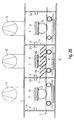
- Fig. 1 shows for better understanding of inventive measures first in one schematic sectional view of an embodiment of a Device 1 for coating a substrate 2 according to the prior art in a side view.
- Such a device 1 is used for coating a Substrate 2 such as e.g. Glass with different coatings such as. Heat protection layers or sun protection layers.
- a Substrate 2 such as e.g. Glass
- different coatings such as. Heat protection layers or sun protection layers.
- the device 1 comprises a vacuum main chamber 3, which is divided into a plurality of subjects 4 to 8, where all subjects 4 to 8 over one with the help of Shafts 26, 27 formed passage 9, 10 with each other communicating and individual subjects 4 and 8 respectively equipped with a sputtering cathode 11, 12, wherein the two cathodes 11, 12 via supply lines 13, 14 e.g. with an AC power source 15, for example a medium frequency generator connected.
- the second, third and fourth compartment 5, 6, 7 is in the embodiment each to a separate vacuum pump 16, 17, 18, e.g. a Turbopump, connected, the two compartments 4, 5 and 7, 8 with each other via openings 19, 20 in the respective partitions 21, 22 are connected.
- the subjects 4, 6 and 8 are in the illustrated embodiment Gas supply lines 23, 23a, 24, 24a, 25 and 25a connected, via which process gas or over the Gas supply lines 24 and 24a reactive gas in the individual Trays 4 to 8 can be inserted. Alternatively, you can the reactive gas also supplied in the cathode compartments become.
- the substrate 2 is during the Coating process along the passage 9, 10 or transported through the shafts 26, 27 and to the Cathodes 11, 12 moved past.
- a problem of the described vacuum chamber 3 is the Connection of the individual subjects 4 to 8 with each other.
- the Connection can not be avoided because the to be coated Substrate 2 on all subjects 4 to 8 are passed must in order to apply the desired coating can.
- the reactive gas atmosphere in In this case, the oxygen atmosphere, which for the Coating with a metal oxide in the corresponding Tray 4 to 8 is initiated, with reduced Partial pressure can also penetrate into those compartments, in which should be a coating with the metal. But penetrates oxygen, there is a risk that the Metal coating undesirably partially oxidized and their properties change.
- An inventively designed device 1 according to the 2 to 4 in contrast, has an absorber arrangement 34 for active separation of the reactive gas by gettering with a cathode assembly 37, whereby it is possible in closely adjacent compartments of the device 1 different To perform coatings that different Have reactive gas needs. This can be done spatially closely adjacent subjects reactive and nonreactive Atmospheres are generated.
- the inventive Device 1 can thus be a considerably shorter length which has a positive effect on the costs of both Deployment as well as operation.
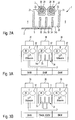
- Fig. 2A shows in a highly schematic representation the basic structure of an inventive designed device 1.
- the tray 5 is through Walls 31 separated from adjacent compartments 4 and 6.
- the walls 31 can be seen from below be explained reasons explained.
- the double cathode 30 has two in the embodiment Targets 39, which, for example, aluminum Al or titanium Ti.
- Other suitable target materials are e.g. the elements Ta, Th and Zr.
- Below the Targets 39 are formed during operation of the Cathode arrangement 37 plasma clouds 33 out.
- Between Walls 31 of the compartment 5 are in the embodiment perpendicular to the substrate 2 or parallel to the walls 31st plate-shaped elements 34a, for example Metal sheets, arranged, which the tray 5 in individual Divide areas 35 and form the absorber assembly 34.
- the optimal shape and arrangement of the plate-shaped Elements 34a is determined by the consideration that as few particles of the reactive gas on the Absorber arrangement 34 can diffuse past.
- plate-shaped elements 34a in an inclined position makes sense, as it makes the available effective Area for gettering is larger than vertical plate-shaped elements 34a.
- the target materials must be chosen so that on the one hand a very good getter effect is achieved and on the other hand, related optical properties previous coating are present so it does not to material technical incompatibilities comes. So for example, Al should be over a ZnAl oxide layer or Ti over a titanium layer for building a Titanoxidgradienten be used. intolerances
- the materials can be for example in optical Absorption, coating adhesion problems or Express particle diffusion.
- tray 4 in an oxidic Atmosphere and in compartment 6 in a non-oxidic, e.g. sputtered nitridic atmosphere persists conventional devices 1 the risk of transfer of Oxygen in the nitridic atmosphere with the result of Contamination of the metal nitride layer.
- This is through the according to the invention, counteracted by that diffuse from the tray 4 to the tray 6 Oxygen atoms in the intermediate compartment 5 at the Elements 34a of the absorber assembly 34, which always with a metal layer with high affinity for oxygen is coated by the cathode assembly 37, to Metal oxides react and are absorbed.
- FIGS. 3A and 3B show the diagrams in a highly schematic manner Operation of the absorber assembly 34 with the Cathode arrangement 37 according to FIG. 2A.
- Fig. 3A is first the situation with switched off double cathode 30, while Fig. 3B shows the operation with switched double cathode 30 shows.
- a device 1 for coating a substrate 2 represented, of which the middle compartment 5 the above mentioned absorber assembly 34 and cathode assembly 37th having.
- the device 1 has in the illustrated Embodiment per compartment 4, 5, 6 each at least one Turbopump 36, which for the generation of the vacuum needed.
- Subject 4 has a specific one Oxygen partial pressure, which is a reactive gas flow of for example, about 250 sccm, for sputtering a metal oxide layer on the substrate 2.
- a Cathode assembly 37 and an absorber assembly 34 in tray 5 used which at a defined power and Voltage, in the exemplary embodiment 75 kW at 630 V, can be operated, the oxygen concentration in compartment 6 are lowered to a reactive gas flow of about 25 sccm, which compared to the Regentgasfluß in compartment 4 only is one tenth. Without switched double cathode 30 is still the fourfold Regradgasfluß in compartment 6 before.
- the overflowing from the tray 4 reacts Oxygen with the metal layer on the plate-shaped Elements 34a of the absorber assembly 34 and beats as metal oxide at the elements 34a in compartment 5 down.
- the reactive gas flow in compartment 5 decreases, so that less oxygen can flow into the next compartment 6.
- nitrogen as well as others Reactive gases with the corresponding target materials will be realized.
- the plate-shaped elements 34a are preferably as well as the walls 31 cooled by the plate-shaped elements 34a, for example, double-walled are formed and flows through a coolant become. This increases and stabilizes the reactivity of the Surfaces.
- the elements 34a preferably sandblasted before assembly, so that they have a have high roughness.
- a screen 34b shown in Fig. 2A e.g. from a metal wire mesh, be arranged.
- the Plates can, as already mentioned above, inclined or labyrinthine and with holes or Slots be provided. The more plate-shaped elements 34a are present, the greater is the Absorb available surface and therefore better the active gas separation.
- Fig. 4 is highly schematic an overall view via a device 1 designed according to the invention shown.
- the substrate 2 first passes through one Number of empty compartments and is then using corresponding targets 32 in several successive Compartments, for example, with a metal oxide or -Nitride layer provided. Then done in the AST designated compartment the active gas separation by means of not absorber arrangement 34 and the Cathode arrangement 37. In the next compartment can then immediately with sputtering, for example, a metal layer be started without a significant contamination with reactive gas occurs.
- the device 1 makes it possible for a relatively short Plant length of the device 1 not only one, but several layers of metals, metal oxides, Metal nitrides or other layers which are different Reactive gas atmospheres, on the substrate 2 applied.
- metal, metal oxide and metal nitride layers be applied, e.g. Zinc oxide ZnOx in addition Aluminum nitride AlN.
- FIG. 5A shows the invention two diagrams showing the oxygen partial pressure in compartment 6 represent.
- FIG. 5A the signal of the Oxygen sensor in compartment 6 and the oxygen partial pressure depending on the amount of in box 4 introduced gas
- Fig. 5B the Oxygen balance in compartment 6 at constant gas inlet in Tray 4 and varied performance of the cathode assembly 37 in Tray 5 shows.
- the rising Absorption or getter effect of the cathode assembly 37 which is due to a sinking oxygen partial pressure in Tray 6 shows.
- At a power of about 75 kW will be a Saturation value reached, beyond which another Performance increase no significant reduction of Oxygen partial pressure in compartment 6 causes more.
- the invention is not limited to the illustrated embodiment limited. In particular, others are also spatial configurations possible.
Landscapes
- Chemical & Material Sciences (AREA)
- Engineering & Computer Science (AREA)
- Organic Chemistry (AREA)
- Materials Engineering (AREA)
- Mechanical Engineering (AREA)
- Metallurgy (AREA)
- Chemical Kinetics & Catalysis (AREA)
- Health & Medical Sciences (AREA)
- Epidemiology (AREA)
- Public Health (AREA)
- Physics & Mathematics (AREA)
- Plasma & Fusion (AREA)
- Analytical Chemistry (AREA)
- Physical Vapour Deposition (AREA)
Abstract
Description
- Fig. 1
- eine schematische, geschnittene seitliche Darstellung eines Ausführungsbeispiels einer Vorrichtung zur Beschichtung eines Substrates gemäß dem Stand der Technik,
- Fig. 2A
- eine prinzipielle Darstellung eines Fachs einer erfindungsgemäß ausgestalteten Vorrichtung zur Beschichtung eines Substrates mit einer Absorberanordnung gemäß einem ersten Ausführungsbeispiel,
- Fig. 2B
- eine prinzipielle Darstellung einer erfindungsgemäß ausgestalteten Vorrichtung zur Beschichtung eines Substrates mit einer Absorberanordnung gemäß einem zweiten Ausführungsbeispiel,
- Fig. 3A
- eine Darstellung dreier benachbarter Fächer der Vorrichtung gemäß Fig. 2A mit den Vakuumpumpen,
- Fig. 3B
- eine Darstellung dreier benachbarter Fächer der Vorrichtung gemäß Fig. 3A mit eingeschalteter Kathode,
- Fig. 4
- eine schematische Darstellung mehrerer Fächer einer erfindungsgemäß ausgestalteten Vorrichtung mit der Kathodenanordnung, und
- Fig. 5A-B
- Diagramme des Sauerstoffpartialdrucks in einem ausgewählten Fach einer erfindungsgemäß ausgestalteten Vorrichtung.
Claims (14)
- Vorrichtung (1) zum Beschichten eines Substrats (2), umfassend eine Vakuumkammer (3), welche durch Wandungen (31) in mehrere Fächer (4 - 8) aufgeteilt ist, wobei zumindest eine Kathoden-Targetanordnung (32) in zumindest einem der Fächer (4 - 8) angeordnet ist,
dadurch gekennzeichnet, daß zumindest ein Fach (5) eine Absorberanordnung (34) und zumindest eine Kathodenanordnung (37) zum Gettern aufweist. - Vorrichtung nach Anspruch 1,
dadurch gekennzeichnet, daß die Absorberanordnung (34) das Fach (5) in mehrere Unterbereiche (35) aufteilt und eine große Oberfläche aufweist, die von der Kathodenanordnung (37) kontinuierlich beschichtet wird. - Vorrichtung nach Anspruch 1 oder 2,
dadurch gekennzeichnet, daß die Absorberanordnung (34) mehrere plattenförmige Elemente (34a) aufweist. - Vorrichtung nach Anspruch 3,
dadurch gekennzeichnet, daß die plattenförmigen Elemente (34a) parallel oder geneigt zu den Wandungen (31) des Fachs (5) angeordnet sind. - Vorrichtung nach einem der Ansprüche 1 bis 4,
dadurch gekennzeichnet, daß die Absorberanordnung (34) aus Metall besteht. - Vorrichtung nach einem der Ansprüche 1 bis 5,
dadurch gekennzeichnet, daß die Absorberanordnung (34) sandgestrahlt ist. - Vorrichtung nach Anspruch 3 oder 4,
dadurch gekennzeichnet, daß zwischen den plattenförmigen Elementen (34a) und dem Substrat (2) ein Sieb (37b) angeordnet ist. - Vorrichtung nach einem der Ansprüche 1 bis 7,
dadurch gekennzeichnet, daß die Absorberanordnung (34) von einem Kühlmittel durchströmt ist. - Vorrichtung nach einem der Ansprüche 3, 4 oder 7,
dadurch gekennzeichnet, daß die Anzahl der plattenförmigen Elemente (34a) variabel ist. - Vorrichtung nach einem der Ansprüche 1 bis 9,
dadurch gekennzeichnet, daß die Kathodenanordnung (37) als Doppelkathode (30) ausgebildet ist. - Vorrichtung nach einem der Ansprüche 1 bis 10,
dadurch gekennzeichnet, daß die Kathodenanordnung (37) mit einer Spannung im Bereich von 550 V bis 700 V und/oder einer Leistung im Bereich von 50 kW bis 100 kW betrieben wird. - Vorrichtung nach einem der Ansprüche 1 bis 11,
dadurch gekennzeichnet, daß die Kathodenanordnung (37) zumindest ein Target (39) hat, dessen Material die chemischen Elemente Al und/oder Ti und/oder Zr und/oder Ta und/oder Th beinhaltet. - Vorrichtung nach einem der Ansprüche 1 bis 12,
dadurch gekennzeichnet, daß in zumindest einem an das mit der Getterkathode (37) versehenen Fach (5) angrenzenden Fach (4) eine oxidische oder nitridische Atmosphäre herrscht. - Vorrichtung nach einem der Ansprüche 1 bis 13,
dadurch gekennzeichnet, daß in zumindest einem an das mit der Getterkathode (37) versehenen Fach (5) angrenzenden Fach (6) eine SchutzgasAtmosphäre herrscht.
Applications Claiming Priority (2)
| Application Number | Priority Date | Filing Date | Title |
|---|---|---|---|
| DE102004004844 | 2004-01-30 | ||
| DE200410004844 DE102004004844B4 (de) | 2004-01-30 | 2004-01-30 | Vorrichtung zum Beschichten eines Substrats mit einer Absorberanordnung |
Publications (3)
| Publication Number | Publication Date |
|---|---|
| EP1560253A2 true EP1560253A2 (de) | 2005-08-03 |
| EP1560253A3 EP1560253A3 (de) | 2006-06-14 |
| EP1560253B1 EP1560253B1 (de) | 2007-10-17 |
Family
ID=34638816
Family Applications (1)
| Application Number | Title | Priority Date | Filing Date |
|---|---|---|---|
| EP20050000927 Ceased EP1560253B1 (de) | 2004-01-30 | 2005-01-18 | Vorrichtung zum Beschichten eines Substrats mit einer Absorberanordnung |
Country Status (2)
| Country | Link |
|---|---|
| EP (1) | EP1560253B1 (de) |
| DE (2) | DE102004004844B4 (de) |
Families Citing this family (1)
| Publication number | Priority date | Publication date | Assignee | Title |
|---|---|---|---|---|
| DE102015117450B4 (de) * | 2015-10-14 | 2024-11-07 | VON ARDENNE Asset GmbH & Co. KG | Prozessieranordnung und Transportanordnung |
Family Cites Families (8)
| Publication number | Priority date | Publication date | Assignee | Title |
|---|---|---|---|---|
| DE203335C (de) * | ||||
| JPS4917623B1 (de) | 1969-09-22 | 1974-05-02 | ||
| DD203335A1 (de) * | 1981-12-30 | 1983-10-19 | Ullrich Heisig | Verfahren und einrichtung zum vakuumbeschichten durch plasmatronzerstaeuben |
| DD214865A1 (de) * | 1983-05-04 | 1984-10-24 | Fi M V Ardenne Dresden | Verfahren und einrichtung zur herstellung von schichtsystemen auf flachglas |
| JPH0718423A (ja) * | 1993-07-06 | 1995-01-20 | Japan Energy Corp | 薄膜形成装置 |
| US6361618B1 (en) * | 1994-07-20 | 2002-03-26 | Applied Materials, Inc. | Methods and apparatus for forming and maintaining high vacuum environments |
| JP3735461B2 (ja) * | 1998-03-27 | 2006-01-18 | 株式会社シンクロン | 複合金属の化合物薄膜形成方法及びその薄膜形成装置 |
| DZ3047A1 (fr) * | 1999-05-27 | 2004-03-27 | Pfizer Prod Inc | Sel mutuel d'amlopidine et d'atorvastatine, procédé pour sa préparation et compositions pharmaceutiques les contenant. |
-
2004
- 2004-01-30 DE DE200410004844 patent/DE102004004844B4/de not_active Expired - Lifetime
-
2005
- 2005-01-18 EP EP20050000927 patent/EP1560253B1/de not_active Ceased
- 2005-01-18 DE DE200550001694 patent/DE502005001694D1/de not_active Expired - Lifetime
Also Published As
| Publication number | Publication date |
|---|---|
| DE102004004844B4 (de) | 2009-04-09 |
| DE102004004844A1 (de) | 2005-08-25 |
| DE502005001694D1 (de) | 2007-11-29 |
| EP1560253A3 (de) | 2006-06-14 |
| EP1560253B1 (de) | 2007-10-17 |
Similar Documents
| Publication | Publication Date | Title |
|---|---|---|
| DE69808535T2 (de) | Verfahren zur Herstellung einer organischen elektrolumineszenten Vorrichtung | |
| DE3815006A1 (de) | Vorrichtung zum herstellen von beschichtungen mit abgestufter zusammensetzung | |
| DE4132556C2 (de) | ||
| EP2665570A1 (de) | Generativ hergestellte turbinenschaufel sowie vorrichtung und verfahren zu ihrer herstellung | |
| DE102010000001A1 (de) | Inline-Beschichtungsanlage | |
| DE102007058052B4 (de) | Vakuumbeschichtungsanlage | |
| WO2005073427A2 (de) | Verfahren zur herstellung eines ultrabarriere-schichtsystems | |
| EP1626433B1 (de) | Magnetronsputtereinrichtung, Zylinderkathode und Verfahren zur Aufbringung von dünnen Mehrkomponentenschichten auf einem Substrat | |
| EP0089382B1 (de) | Plasmareaktor und seine Anwendung beim Ätzen und Beschichten von Substraten | |
| DE4313284A1 (de) | Spaltschleuse für das Ein- oder Ausbringen von Substraten von der einen in eine benachbarte Behandlungskammer | |
| DE112014005865T5 (de) | Magnesium-Aluminium-beschichtetes Stahlblech und dessen Herstellungsverfahren | |
| EP0402798B1 (de) | Beschichtungsvorrichtung | |
| DE102004021734B4 (de) | Verfahren und Vorrichtung zur kontinuierlichen Beschichtung flacher Substrate mit optisch aktiven Schichtsystemen | |
| EP1693905B1 (de) | Verfahren zur Herstellung biaxial orientierter Dünnschichten | |
| EP1673488B1 (de) | Modulare vorrichtung zur beschichtung von oberflächen | |
| DE102004014323B4 (de) | Verfahren und Anordnung zur Herstellung von Gradientenschichten oder Schichtenfolgen durch physikalische Vakuumzerstäubung | |
| DE102004004844B4 (de) | Vorrichtung zum Beschichten eines Substrats mit einer Absorberanordnung | |
| DE69400404T2 (de) | Beschichtungsvorrichtung zum aufdampfen von metallischem material auf ein substrat | |
| EP0966008A2 (de) | Verfahren zur Herstellung einer Anode für elektrolytische Kondensatoren, solchermassen hergestellte Anode und eine solche Anode aufweisender Kondensator | |
| EP0224501B1 (de) | Stapelvorrichtung für einheitliche, insbesondere plattenförmige teile | |
| DE10239014B4 (de) | Vakuumbeschichtungsanlage mit zwei Magnetrons | |
| DE10239163A1 (de) | Vorrichtung und Verfahren zur Ausbildung von Gradientenschichten auf Substraten in einer Vakuumkammer | |
| EP1520290B1 (de) | Vorrichtung zur beschichtung von substraten mittels physikalischer dampfabscheidung über den hohlkathodeneffekt | |
| EP0669406A2 (de) | Vorrichtung und Verfahren zum Beschichten von mindestens eine Einzelfaser aufweisendem Fasermedium sowie beschichtetes Fasermedium für faserverstärkte Bauteile | |
| DE102004060670B4 (de) | Verfahren und Anordnung zur Herstellung hochtemperaturbeständiger Kratzschutzschichten mit geringer Oberflächenrauigkeit |
Legal Events
| Date | Code | Title | Description |
|---|---|---|---|
| PUAI | Public reference made under article 153(3) epc to a published international application that has entered the european phase |
Free format text: ORIGINAL CODE: 0009012 |
|
| AK | Designated contracting states |
Kind code of ref document: A2 Designated state(s): AT BE BG CH CY CZ DE DK EE ES FI FR GB GR HU IE IS IT LI LT LU MC NL PL PT RO SE SI SK TR |
|
| AX | Request for extension of the european patent |
Extension state: AL BA HR LV MK YU |
|
| PUAL | Search report despatched |
Free format text: ORIGINAL CODE: 0009013 |
|
| AK | Designated contracting states |
Kind code of ref document: A3 Designated state(s): AT BE BG CH CY CZ DE DK EE ES FI FR GB GR HU IE IS IT LI LT LU MC NL PL PT RO SE SI SK TR |
|
| AX | Request for extension of the european patent |
Extension state: AL BA HR LV MK YU |
|
| RIC1 | Information provided on ipc code assigned before grant |
Ipc: C23C 14/56 20060101ALI20060505BHEP Ipc: C23C 14/00 20060101AFI20060505BHEP Ipc: H01J 37/32 20060101ALI20060505BHEP |
|
| 17P | Request for examination filed |
Effective date: 20060628 |
|
| 17Q | First examination report despatched |
Effective date: 20060727 |
|
| 17Q | First examination report despatched |
Effective date: 20060727 |
|
| AKX | Designation fees paid |
Designated state(s): DE FR GB |
|
| GRAP | Despatch of communication of intention to grant a patent |
Free format text: ORIGINAL CODE: EPIDOSNIGR1 |
|
| GRAS | Grant fee paid |
Free format text: ORIGINAL CODE: EPIDOSNIGR3 |
|
| GRAA | (expected) grant |
Free format text: ORIGINAL CODE: 0009210 |
|
| AK | Designated contracting states |
Kind code of ref document: B1 Designated state(s): DE FR GB |
|
| REG | Reference to a national code |
Ref country code: GB Ref legal event code: FG4D Free format text: NOT ENGLISH |
|
| GBT | Gb: translation of ep patent filed (gb section 77(6)(a)/1977) |
Effective date: 20071017 |
|
| REF | Corresponds to: |
Ref document number: 502005001694 Country of ref document: DE Date of ref document: 20071129 Kind code of ref document: P |
|
| ET | Fr: translation filed | ||
| PLBE | No opposition filed within time limit |
Free format text: ORIGINAL CODE: 0009261 |
|
| STAA | Information on the status of an ep patent application or granted ep patent |
Free format text: STATUS: NO OPPOSITION FILED WITHIN TIME LIMIT |
|
| 26N | No opposition filed |
Effective date: 20080718 |
|
| REG | Reference to a national code |
Ref country code: FR Ref legal event code: PLFP Year of fee payment: 11 |
|
| REG | Reference to a national code |
Ref country code: FR Ref legal event code: PLFP Year of fee payment: 12 |
|
| REG | Reference to a national code |
Ref country code: FR Ref legal event code: PLFP Year of fee payment: 13 |
|
| REG | Reference to a national code |
Ref country code: FR Ref legal event code: PLFP Year of fee payment: 14 |
|
| PGFP | Annual fee paid to national office [announced via postgrant information from national office to epo] |
Ref country code: FR Payment date: 20230123 Year of fee payment: 19 |
|
| PGFP | Annual fee paid to national office [announced via postgrant information from national office to epo] |
Ref country code: GB Payment date: 20230124 Year of fee payment: 19 Ref country code: DE Payment date: 20230126 Year of fee payment: 19 |
|
| REG | Reference to a national code |
Ref country code: DE Ref legal event code: R119 Ref document number: 502005001694 Country of ref document: DE |
|
| GBPC | Gb: european patent ceased through non-payment of renewal fee |
Effective date: 20240118 |
|
| PG25 | Lapsed in a contracting state [announced via postgrant information from national office to epo] |
Ref country code: DE Free format text: LAPSE BECAUSE OF NON-PAYMENT OF DUE FEES Effective date: 20240801 |
|
| PG25 | Lapsed in a contracting state [announced via postgrant information from national office to epo] |
Ref country code: GB Free format text: LAPSE BECAUSE OF NON-PAYMENT OF DUE FEES Effective date: 20240118 |
|
| PG25 | Lapsed in a contracting state [announced via postgrant information from national office to epo] |
Ref country code: FR Free format text: LAPSE BECAUSE OF NON-PAYMENT OF DUE FEES Effective date: 20240131 |
|
| PG25 | Lapsed in a contracting state [announced via postgrant information from national office to epo] |
Ref country code: GB Free format text: LAPSE BECAUSE OF NON-PAYMENT OF DUE FEES Effective date: 20240118 Ref country code: FR Free format text: LAPSE BECAUSE OF NON-PAYMENT OF DUE FEES Effective date: 20240131 Ref country code: DE Free format text: LAPSE BECAUSE OF NON-PAYMENT OF DUE FEES Effective date: 20240801 |