EP1559826B1 - Zufallsbetriebener Waschmaschinenkorb für verbesserte Wäschereinigung mit minimierter mechanischer Wäscheschädigung - Google Patents
Zufallsbetriebener Waschmaschinenkorb für verbesserte Wäschereinigung mit minimierter mechanischer Wäscheschädigung Download PDFInfo
- Publication number
- EP1559826B1 EP1559826B1 EP05100292A EP05100292A EP1559826B1 EP 1559826 B1 EP1559826 B1 EP 1559826B1 EP 05100292 A EP05100292 A EP 05100292A EP 05100292 A EP05100292 A EP 05100292A EP 1559826 B1 EP1559826 B1 EP 1559826B1
- Authority
- EP
- European Patent Office
- Prior art keywords
- wash chamber
- clockwise
- random
- oscillations
- wash
- Prior art date
- Legal status (The legal status is an assumption and is not a legal conclusion. Google has not performed a legal analysis and makes no representation as to the accuracy of the status listed.)
- Expired - Lifetime
Links
- 238000005406 washing Methods 0.000 title claims description 15
- 238000004140 cleaning Methods 0.000 title description 10
- 230000010355 oscillation Effects 0.000 claims description 91
- 238000000034 method Methods 0.000 claims description 21
- 239000007788 liquid Substances 0.000 claims description 7
- 238000012360 testing method Methods 0.000 description 15
- 239000004744 fabric Substances 0.000 description 10
- 230000009471 action Effects 0.000 description 8
- XLYOFNOQVPJJNP-UHFFFAOYSA-N water Substances O XLYOFNOQVPJJNP-UHFFFAOYSA-N 0.000 description 5
- 238000010586 diagram Methods 0.000 description 4
- 239000012530 fluid Substances 0.000 description 4
- 239000000463 material Substances 0.000 description 4
- 230000002441 reversible effect Effects 0.000 description 4
- 230000033001 locomotion Effects 0.000 description 3
- 238000005259 measurement Methods 0.000 description 3
- 230000005540 biological transmission Effects 0.000 description 2
- 238000010276 construction Methods 0.000 description 2
- 230000002708 enhancing effect Effects 0.000 description 2
- 230000008569 process Effects 0.000 description 2
- 238000013019 agitation Methods 0.000 description 1
- 238000010936 aqueous wash Methods 0.000 description 1
- 230000001174 ascending effect Effects 0.000 description 1
- 239000006229 carbon black Substances 0.000 description 1
- 230000008859 change Effects 0.000 description 1
- 239000004927 clay Substances 0.000 description 1
- 238000013400 design of experiment Methods 0.000 description 1
- 238000001514 detection method Methods 0.000 description 1
- 238000005108 dry cleaning Methods 0.000 description 1
- 230000000694 effects Effects 0.000 description 1
- 238000000605 extraction Methods 0.000 description 1
- 230000001939 inductive effect Effects 0.000 description 1
- 230000007246 mechanism Effects 0.000 description 1
- 238000012986 modification Methods 0.000 description 1
- 230000004048 modification Effects 0.000 description 1
- 230000009467 reduction Effects 0.000 description 1
- 238000005070 sampling Methods 0.000 description 1
- 238000009738 saturating Methods 0.000 description 1
- 238000004611 spectroscopical analysis Methods 0.000 description 1
- 238000009987 spinning Methods 0.000 description 1
Images



Classifications
-
- D—TEXTILES; PAPER
- D06—TREATMENT OF TEXTILES OR THE LIKE; LAUNDERING; FLEXIBLE MATERIALS NOT OTHERWISE PROVIDED FOR
- D06F—LAUNDERING, DRYING, IRONING, PRESSING OR FOLDING TEXTILE ARTICLES
- D06F33/00—Control of operations performed in washing machines or washer-dryers
- D06F33/30—Control of washing machines characterised by the purpose or target of the control
- D06F33/32—Control of operational steps, e.g. optimisation or improvement of operational steps depending on the condition of the laundry
- D06F33/36—Control of operational steps, e.g. optimisation or improvement of operational steps depending on the condition of the laundry of washing
-
- D—TEXTILES; PAPER
- D06—TREATMENT OF TEXTILES OR THE LIKE; LAUNDERING; FLEXIBLE MATERIALS NOT OTHERWISE PROVIDED FOR
- D06F—LAUNDERING, DRYING, IRONING, PRESSING OR FOLDING TEXTILE ARTICLES
- D06F21/00—Washing machines with receptacles, e.g. perforated, having a rotary movement, e.g. oscillatory movement
-
- D—TEXTILES; PAPER
- D06—TREATMENT OF TEXTILES OR THE LIKE; LAUNDERING; FLEXIBLE MATERIALS NOT OTHERWISE PROVIDED FOR
- D06F—LAUNDERING, DRYING, IRONING, PRESSING OR FOLDING TEXTILE ARTICLES
- D06F2103/00—Parameters monitored or detected for the control of domestic laundry washing machines, washer-dryers or laundry dryers
- D06F2103/02—Characteristics of laundry or load
- D06F2103/04—Quantity, e.g. weight or variation of weight
-
- D—TEXTILES; PAPER
- D06—TREATMENT OF TEXTILES OR THE LIKE; LAUNDERING; FLEXIBLE MATERIALS NOT OTHERWISE PROVIDED FOR
- D06F—LAUNDERING, DRYING, IRONING, PRESSING OR FOLDING TEXTILE ARTICLES
- D06F2103/00—Parameters monitored or detected for the control of domestic laundry washing machines, washer-dryers or laundry dryers
- D06F2103/02—Characteristics of laundry or load
- D06F2103/06—Type or material
-
- D—TEXTILES; PAPER
- D06—TREATMENT OF TEXTILES OR THE LIKE; LAUNDERING; FLEXIBLE MATERIALS NOT OTHERWISE PROVIDED FOR
- D06F—LAUNDERING, DRYING, IRONING, PRESSING OR FOLDING TEXTILE ARTICLES
- D06F2105/00—Systems or parameters controlled or affected by the control systems of washing machines, washer-dryers or laundry dryers
- D06F2105/46—Drum speed; Actuation of motors, e.g. starting or interrupting
- D06F2105/48—Drum speed
Definitions
- the present invention relates to washing machines and more particularly to moving clothes within the wash chamber of an automatic washer.
- washing machines include vertical axis washers that use an agitator, impeller or some other type of rotor that rotates or oscillates about a vertical axis, such as shown in U.S. Patent Nos. 5,031,427 and 5,460,018 or horizontal axis machines that input mechanical energy to the clothes load by rotating the wash chamber at a speed less than that which could cause the clothes to be held against the wall of the wash chamber by centrifugal force.
- Such horizontal axis machines are disclosed in U.S. Patent Nos. 5,219,370 and 5,974,610 .
- the wash chamber rotations or oscillations are symmetric and constant during the majority of a wash cycle. That is, they use a set, non-changing clockwise and counter clockwise wash chamber oscillation.
- a center rotor in the form of an agitator or impeller that rotates to impart mechanical energy to the wash load, and typically those rotations are symmetric and constant during the majority of the wash cycle.
- the wash chamber may be rotatable, but typically the wash chamber is rotated only during an extraction mode when it is desired to remove water or wash liquid from the clothes load, and then the wash chamber is spun in one direction only.
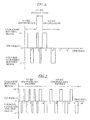
- Figure 1 depicts a typical symmetrical wash chamber oscillation period during a typical wash cycle in a horizontal or tilted axis washer.
- signals above the horizontal time axis indicate a clockwise rotation signal
- signals along the time axis indicate no rotation signal (motor off) or a pause
- signals below the time axis indicate a counter-clockwise rotation signal.
- the illustrated oscillation period includes a 0.5 second clockwise (motor on) time, followed by a 0.5 second pause (motor off), followed by a reversing 0.5 second counter-clockwise (motor on) time, followed by a 0.5 second pause (motor off).
- the oscillations are constant, in that the period is then repeated.
- the oscillation cycles may be longer or shorter, such as an 8 second clockwise rotation, 8 second pause, 8 second counter clockwise rotation and 8 second pause.
- a more complex pattern may also be provided, such as an 8 second clockwise rotation, 2 second pause, 8 second counter clockwise rotation and 2 second pause.
- the individual pattern is for a given period, it is this same pattern that is repeated for all periods.
- the washer oscillates the clothes load for a plurality of periods of clockwise and counter-clockwise oscillations, wherein the time duration of the oscillations are selected for each period.
- the oscillations can be symmetrical or asymmetrical, and can have a time duration that is variable. Further, in another embodiment, the time duration of the oscillations varies for consecutive periods.
- the stroke speed may vary randomly, the stroke angle, or the angle traversed may vary randomly, and the off time or pause between strokes or oscillations may vary randomly.
- Stroke speed or angle of a counterclockwise stroke may vary from the stroke speed or angle of a clockwise stroke within a single oscillation. These strokes or oscillations may vary randomly with each subsequent period.
- a method of washing items in an automatic washer wherein the automatic washer has a wash chamber with a central axis and the wash chamber being rotatable about the central axis.
- the method comprises the steps of loading items into the wash chamber, supplying wash liquid into the wash chamber, and oscillating the wash chamber about the central axis by speed varying, range varying, offtime varying, ontime varying, or combination thereof, oscillations.
- the oscillations can comprise rotational movement exceeding a full revolution, or being less than a full revolution.
- the wash chamber oscillates for a plurality of periods of clockwise and counter-clockwise oscillations, wherein the time duration of the speed and time duration of the strokes are selected for each period.
- the strokes can be symmetrical or asymmetrical, and can have a speed or time duration that is selected randomly. Further, in another embodiment, the time duration of the oscillations vary for consecutive periods.
- the average or mean speed or time of the time-varying oscillations can be adjusted by the controller responsive to an amount of the items, to a size of the items, or a cloth type (i.e. silk vs. denim).
- the items in the wash chamber can move, for example, in a tumbling pattern.
- an automatic washer comprises a cabinet, a wash chamber with a central axis supported within the cabinet, a motor suspended outside the wash chamber and drivingly connected to the wash chamber, the wash chamber oscillating about the central axis by speed- and time-varying oscillations.
- the wash chamber may have a horizontal axis or any non-vertical axis.
- the automatic washer may use aqueous wash liquid, conventional non-aqueous fluids known as dry cleaning fluids, other non-aqueous fluids, some combination of the foregoing or no wash liquid or fluid.
- Figure 1 depicts a timing diagram of typical symmetrical motor oscillations that are constant for all periods.
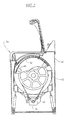
- Figure 2 depicts a side sectional view of a washing machine.
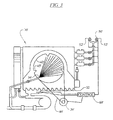
- Figure 3 depicts a side sectional view of another washing machine.
- Figure 4 depicts a timing diagram of symmetrical motor oscillations that vary with each subsequent period in accordance with the prior art.
- Figure 5 depicts a timing diagram of symmetrical motor oscillations that vary with each fourth period.
- Figure 6 illustrates experimental results of the cleaning results versus mechanical damage in a washing machine embodying the principles of the present invention.
- Figure 7 illustrates experimental results of the cleaning results versus mechanical damage in a washing machine embodying the principles of the present invention.
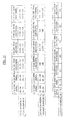
- Figure 8 depicts a table of symmetrical oscillation speeds and rpm ranges.
- Figure 9 depicts a table of asymmetrical oscillation speeds and rpm ranges.
- Figure 10 illustrates wash performance results according to the embodiment of Figure 9 .
- Figure 11 depicts Full Random, Degree Random and Ratchet Random wash profiles.
- the mechanical action inside a washing machine having a wash chamber rotatable about an axis is enhanced by using symmetric clockwise and counter-clockwise wash chamber oscillations that vary with each subsequent period.
- the oscillations may be non-symmetric or may vary over time, and not with each subsequent period.
- each oscillation as defined herein, are a series or sequence of steps or actions. There is a stroke in a first direction, followed by a pause, then a stroke in a second direction followed by a second pause. As contemplated in (different embodiments of) the present invention, each of the aforementioned steps or actions are randomly selected within certain preselected ranges of speeds, times or stroke angles.
- Methods consistent with the present invention may be embodied in any type of automatic washer in which the wash chamber is oscillated to provide the mechanical energy input to the clothes load, for example, a horizontal axis washer or a nonvertical axis washer.
- methods consistent with the present invention be embodied in a vertical axis machine.
- a vertical axis machine typically there is a center rotor in the form of an agitator or impeller that rotates to impart mechanical energy to the wash load.
- Some types of vertical axis washers may also use the wash chamber itself, or rotors or other protrusions extending into the wash chamber therefrom, as the mechanism for imputing mechanical energy into the clothes load, as opposed to a separately rotatable agitator, impeller or other rotor, and the present invention can be utilized and realized in such vertical axis washers.
- FIG. 2 illustrates an automatic washer 30 such as that disclosed in U.S. Patent No. 5,546,772 .
- the structure and operation of such a washer is described in greater detail in that patent.
- Figure 3 illustrates an automatic washer 30', such as that disclosed in U.S. Patent No. 5,219,370 .
- the structure and operation of that washer which has a front opening door providing access to the horizontal axis wash chamber, may also be utilized with the present invention.
- the following description of the operation relates to both of the illustrated embodiments and would also pertain to washers of other known constructions, including vertical axis and nonvertical axis washers.
- the invention is embodied in a washer in which the wash chamber is rotatable about an axis that is non-vertical; that is, the axis of rotation is angled from vertical by at least 20 degrees.
- the washer 30 of FIG. 2 , and the washer 30' of FIG. 3 include an outer tub 32, 32' which is disposed and supported within a cabinet structure 34.
- a motor 36, 36' is provided for rotatably driving a wash basket 42, 42' which encloses a wash chamber 44, 44'.
- the motor 36, 36' is a reversible motor.
- a reversible transmission may be used.
- the wash basket may include one or more inwardly directed protrusions 45, 45' for engaging clothes during the wash process to assist in imparting mechanical energy to the clothes load.
- the wash basket 42, 42' is rotatably supported within the tub 32, 32'. Drive power is transmitted from the motor 36, 36' to the wash basket 42, 42' via a belt 46, 46'.
- the present invention could be employed in an automatic washer which employs a direct drive type power transmission system.
- water is supplied into the automatic washer 30' from an external source 50'.
- a hot water and cold water supply is fluidly connected to the automatic washer 30'.
- a flow valve 52' controls the inlet of wash liquid into the washer 30'. Wash liquid is sprayed into the wash basket 42' through an inlet nozzle 54'.
- a controller 60' which may be in the form of an electronic controller, controls the operation of the washer in accordance with the present invention. Controller 60' is operatively connected to the motor 44' and the flow valve 52'. Controller 60' provides an oscillation signal (e.g., an on/off or variable speed signal) to the motor 44' for inducing the wash basket 42', and hence the wash chamber 44' to rotate.
- an oscillation signal e.g., an on/off or variable speed signal
- oscillate as related to wash basket or wash chamber motion, describes motion wherein the wash basket or wash chamber is alternately rotated in a first direction and then in a reverse direction.
- the wash basket and wash chamber may complete one or many full revolutions, or less than one full revolution, while rotating or spinning in one direction before being reversed to rotate in the opposite direction.
- the mechanical action inside the automatic washer 30, 30' is enhanced in some embodiments by using symmetric clockwise and counter-clockwise wash chamber oscillations that vary with each subsequent oscillation period.
- the oscillations may vary over time, but not necessarily with each successive period. For example, two to ten periods in a row may have the same oscillation before a change is made.
- the variation of the oscillations can be bi-modal, that is, limited to two selected period lengths, switching between these two lengths after every third or more period.
- Figure 4 depicts symmetrical motor oscillations that vary with each subsequent period in accordance with the prior art.
- the first random impeller oscillation time is 0.4 seconds. This value is used during one oscillation period: 0.4 seconds clockwise (motor on) time, 0.4 seconds pause (motor off), 0.4 seconds counter-clockwise (motor on) time, and 0.4 seconds pause (motor off).
- a second "random" value which may be different than the first random value of 0.4 seconds, is used. In the illustrative example, 0.2 seconds is used for the next oscillation period. Once this second oscillation period is complete, a value of 0.5 seconds is used for the next oscillation period.
- the impeller oscillation times range from 0.2 to 0.5 seconds.
- the oscillation times can be set to a greater number of discrete values than shown in Figure 4 .
- other oscillation times in the range from 0.2 to 0.5 seconds can be used, such as oscillation times of 0.222 and 0.369 seconds.
- Randomly varying the oscillation time between the limits, with each subsequent period yields a distribution of oscillation times.
- a random variation could be a predetermined variation within a given range of oscillation times to achieve a desired mean time for the oscillations. Random variation could also include predetermined variations according to some parameter or equation other than mean time. Therefore, such "random" variations which could be obtained or selected in a number of ways could be used to obtain various desired results.
- the impeller oscillation times range from 0.2 to 0.5 seconds, however, the upper and lower oscillation time limits are not limited thereto.
- the oscillations times can be lower than 0.2 seconds and can be greater than 0.5 seconds.
- the controller 60' can receive an input from a user to adjust the oscillation time based on, for example, the load size or the number of items in the load.
- the controller is provided with, for example, a keypad or operators for this purpose. Using the keypad, the user, for example, selects a small, medium, or large load size or a small, medium, or large item size.
- the controller 60' can proportionally adjust the oscillation time based on the received user input, such as proportionally to load size or item size.
- the controller 60' can increase or decrease the variation of the oscillation time based on the load size or item size.
- the washer may detect or sense the load size or item size using known load detection techniques. For example, the controller 60' can provide oscillation signals having lower average means times for small loads than for large loads.
- Figure 5 depicts a timing diagram of an illustrative "bi-modal stroke" profile.
- a "bi-modal stroke” profile symmetrical impeller oscillations having a first time value (e.g., 0.2 seconds) repeat for a first predetermined number of oscillation periods (e.g., 4 oscillation periods), then symmetrical impeller oscillations having a different time value (e.g., 0.4 seconds) repeat for a second predetermined number of oscillation periods (e.g., 6 oscillation periods), then the entire impeller oscillation sequence is repeated.
- a first time value e.g., 0.2 seconds
- a different time value e.g., 0.4 seconds
- the illustrative values are 0.2-second impeller oscillations, repeated for a total of four oscillation periods, followed by 0.4-second impeller oscillations, repeated for a total of four oscillation periods. The entire impeller oscillation sequence is then repeated.
- the duration of the oscillations and the number of periods used can be different values.
- the first oscillation time value can be 0.211 seconds, with the oscillations repeating for three periods, followed by a 0.455-second oscillation for seven periods.
- FIGS. 6 and 7 Experimental test results illustrating the enhanced cleaning action, and reduced mechanical damage, of the present invention are depicted in FIGS. 6 and 7 , with performance comparison to a typical fixed oscillation profile. Testing involved placing a test load in a horizontal axis washing machine, saturating the load with water and oscillating the wash chamber for a predetermined period of time. In the random oscillation profile samples, whose results are depicted by boxes, wash chamber oscillation was time varied between 0.135 and 2 seconds. In the fixed oscillation profile samples, whose results are depicted by dots, the wash chamber oscillation occurred in accordance with the profile of FIG. 1 .
- Measurement 2 Amount of a particular "dirt" remaining from the amount that was placed on the test clothes items.
- Test 1 The results of Test 1, in which the "dirt" comprised a common amount of clay on fabric samples, are depicted in FIG. 6 .
- Test 2 The results of Test 2, in which the "dirt" comprised a common amount of carbon black on fabric samples, are depicted in FIG. 7 .
- the mechanical action inside the automatic washer 30, 30' is enhanced in some embodiments by using alternating rotations through a fixed angle, with short pauses between each reversal, and with rotational speeds that vary periodically.
- the speed varies from an average speed by a randomly changing amount.
- the wash chamber is alternately rotated clockwise and counter-clockwise through an angle of 120°. Following each 120° rotation, the rotation stops and pauses for 0.1 seconds. A reverse rotation of 120° then follows and another 0.1 second pause and the process is repeated.
- the speed of rotation, in revolutions per minute (RPM) is varied, for example by selecting an "average" or base speed of 70 RPM and varying that speed, by a random amount in the range of + 15 RPM, every 0.2 seconds.
- an angle different than 120° can be selected, a different period of time for the pauses can be selected, a different "base" speed of rotation can be selected, a different range of speed variation from the base can be selected, and a different period of time for changing the speed can be selected or the speed could be changed upon the occurrence of an event, such as the reversal of rotation.
- the speed of rotation could also be varied according to a predetermined pattern rather than randomly.
- the rotations could be reversed following a given time period rather than a predetermined angle.
- the various times and angles can either be fixed for the entire wash cycle or can be varied periodically.
- the present invention can be implemented in washing machines having a non-horizontal axis, wherein the wash basket, or protrusions extending inwardly therefrom are used to impart mechanical energy into the clothes load, rather than a separately rotating or oscillating agitator, impeller or other rotor.
- the present invention is not limited thereto.
- the present invention can be implemented with asymmetric oscillation patterns as well.
- the present invention can be implemented with "random" clockwise and counter-clockwise oscillations with constant motor off times, with "random” clockwise and counter-clockwise oscillations with "random” motor off times, or with constant clockwise and counter-clockwise oscillations with "random” motor off times.
- "random" clockwise (CW) and counter-clockwise (CCW) oscillations vary within a selected speed or rpm (revolutions per minute) range around a selected rpm mean.
- the selected rpm mean is 70 rpm with a +/- 20 RPM range for each of the CW and CCW strokes within which "random" rpm strokes may be selected.
- the range may extend above or below +/- 20 RPM, or have a mean different than 70 rpm CW or CCW, while remaining within the scope of the invention.
- the rpm values may be varied in a bi-modal fashion while remaining within the scope of the invention.
- the On Time and Off Time may be varied in a "random" manner within a selected range of between 0.3-0.5 seconds On Time CW and CCW, and between 0-0.3 seconds Off Time.
- the range may extend above or below 0.3-0.5 seconds On Time while remaining within the scope of the invention, and the Off Time may continue beyond 0.3 seconds while remaining within the scope of the invention.
- FIG. 9 An alternative embodiment is shown in FIG. 9 , wherein the CCW RPM mean is 70, with an RPM range around the mean of +/- 10, and a CW RPM mean of 90 with an RPM range around the mean of +/- 20.
- This example illustrates that "random" generation need not be the same within the same ranges and around the same mean RPM for each of the CCW and CW directions.
- the Off Time for example need not be the same for the CCW direction as in the CW direction, in fact the Off Time in this example is a selected constant time of 0.05 seconds.
- the International Electrotechnical Commission (IEC) standard for cleaning uses A, B, C, etc. to signify a best to worse cleaning, respectively.
- the numeric values associated with an IEC rating system is determined by recording the light spectroscopy values of washed stain swatches. These values are then divided by the values obtained in a head-to-head industry cleaning standard washer. The resulting ratio is the IEC cleaning standard, which breaks down as follows. IEC A rating occurs when the swatches achieve an average score of 1.03 and above.
- An IEC B rating occurs when the swatches achieve an average score between 1.00 and 1.03.
- An IEC C rating occurs when the swatches achieve an average score between 0.97 and 1.00.
- the horizontal, or X axis in ascending order of RPM mean first and RPM range second.
- the IEC ratings are arranged along the Y or vertical axes.
- the wash performance results 101 range from approximately 1.06 to 1.04 for an RPM mean of 70 and an RPM range of ⁇ 10; results 103 range from approximately 1.05 to 1.04 for an RPM mean of 90 and an RPM range of ⁇ 10; results 105 range from approximately 1.04 to 1.03 for an RPM mean of 70 and an RPM range of ⁇ 20;and results 107 range from approximately 1.05 to 1.04 for an RPM mean of 90 and an RPM range of ⁇ 20.
- mean wash results range from approximately 1.03 to 1.05, within the IEC A rating range.
- the values within the ranges specified were determined using a uniform random generator.
- the Ratchet Random profile is unique in that the RPM values changed within its range specified every 0.3 seconds no matter the drum direction. The amount in which the RPM value changed was determined using a uniform random generator.
- the present invention can be implemented in washing machines having a non-horizontal axis, wherein the wash basket, or protrusions or rotors extending inwardly therefrom are used to impart mechanical energy into the clothes load, rather than a separately rotating or oscillating agitator, impeller or other rotor.
Landscapes
- Engineering & Computer Science (AREA)
- Textile Engineering (AREA)
- Control Of Washing Machine And Dryer (AREA)
- Accessory Of Washing/Drying Machine, Commercial Washing/Drying Machine, Other Washing/Drying Machine (AREA)
- Cleaning By Liquid Or Steam (AREA)
Claims (6)
- Verfahren zum Waschen von Gegenständen in einer automatischen Waschmaschine mit einer um eine zentrale Achse drehbaren Waschkammer, wobei das Verfahren die folgenden Schritte aufweist:Laden von Gegenständen in die Waschkammer;Eingeben von Waschflüssigkeit in die Waschkammer; undSchwingen der Waschkammer um die zentrale Achse mit zeitlich variierenden Schwingungen,dadurch gekennzeichnet, dass die Umdrehungsgeschwindigkeit der Waschkammer von einer Durchschnittsgeschwindigkeit um einen sich zufällig ändernden Betrag abweicht.
- Verfahren nach Anspruch 1, bei dem die Waschkammer schwingt, indem alternierende Umdrehungen um einen festen Winkel durchgeführt werden.
- Verfahren nach Anspruch 1 oder 2, bei dem die Waschkammer mit Schwingungen zufällig im Uhrzeigersinn und gegen den Uhrzeigersinn bei gleichbleibenden Abschaltzeiten des Motors schwingt.
- Verfahren nach Anspruch 1 oder 2, bei dem die Waschkammer mit Schwingungen zufällig im Uhrzeigersinn und gegen den Uhrzeigersinn bei zufälligen Abschaltzeiten des Motors schwingt.
- Verfahren nach Anspruch 1 oder 2, bei dem die Waschkammer mit Schwingungen gleichbleibend im Uhrzeigersinn und gegen den Uhrzeigersinn bei zufälligen Abschaltzeiten des Motors schwingt.
- Verfahren nach Anspruch 3 oder 4, bei dem die Schwingungen zufällig im Uhrzeigersinn und gegen den Uhrzeigersinn innerhalb eines ausgewählten Geschwindigkeitsmittels von 70 rpm in einem Bereich von +/- 20 rpm, aus dem zufällige Geschwindigkeitstakte ausgewählt werden können, für jeden der Takte im Uhrzeigersinn und gegen den Uhrzeigersinn variieren.
Applications Claiming Priority (2)
| Application Number | Priority Date | Filing Date | Title |
|---|---|---|---|
| US766404 | 2004-01-27 | ||
| US10/766,404 US7690063B2 (en) | 2002-05-09 | 2004-01-27 | Random tumbling washing machine wash chamber for improving cleaning while minimizing mechanical damage to clothes |
Publications (3)
| Publication Number | Publication Date |
|---|---|
| EP1559826A2 EP1559826A2 (de) | 2005-08-03 |
| EP1559826A3 EP1559826A3 (de) | 2007-06-20 |
| EP1559826B1 true EP1559826B1 (de) | 2011-09-21 |
Family
ID=34654332
Family Applications (1)
| Application Number | Title | Priority Date | Filing Date |
|---|---|---|---|
| EP05100292A Expired - Lifetime EP1559826B1 (de) | 2004-01-27 | 2005-01-19 | Zufallsbetriebener Waschmaschinenkorb für verbesserte Wäschereinigung mit minimierter mechanischer Wäscheschädigung |
Country Status (2)
| Country | Link |
|---|---|
| US (5) | US7690063B2 (de) |
| EP (1) | EP1559826B1 (de) |
Families Citing this family (33)
| Publication number | Priority date | Publication date | Assignee | Title |
|---|---|---|---|---|
| US7127767B2 (en) * | 2002-05-09 | 2006-10-31 | Whirlpool Corporation | Time-varying agitator oscillations in an automatic washer |
| KR20060023067A (ko) * | 2004-09-08 | 2006-03-13 | 삼성전자주식회사 | 세탁기 |
| TW200632179A (en) * | 2004-12-13 | 2006-09-16 | Ifb Ind Ltd | An appliance with controlled soft wash operation |
| KR101155330B1 (ko) * | 2005-06-30 | 2012-06-11 | 엘지전자 주식회사 | 드럼세탁기의 세탁 및 헹굼 방법 |
| KR101396978B1 (ko) * | 2007-08-01 | 2014-05-19 | 엘지전자 주식회사 | 드럼방식 세탁장치의 제어방법 |
| KR100934658B1 (ko) * | 2007-11-05 | 2009-12-31 | 엘지전자 주식회사 | 세탁기 및 그 제어방법 |
| DE102008008645B3 (de) * | 2008-02-11 | 2009-06-10 | Miele & Cie. Kg | Verfahren zum Behandeln von Wäsche in einer Waschmaschine |
| US20100024137A1 (en) * | 2008-08-01 | 2010-02-04 | Myong Hum Im | Washing machine and washing method therefor |
| US8763184B2 (en) * | 2008-08-01 | 2014-07-01 | Lg Electronics Inc. | Control method of a laundry machine |
| US20110030149A1 (en) * | 2008-08-01 | 2011-02-10 | In Ho Cho | Control method of a laundry machine |
| US20110047716A1 (en) * | 2008-08-01 | 2011-03-03 | In Ho Cho | Control method of a laundry machine |
| US8966944B2 (en) | 2008-08-01 | 2015-03-03 | Lg Electronics Inc. | Control method of a laundry machine |
| KR20100028920A (ko) * | 2008-09-05 | 2010-03-15 | 엘지전자 주식회사 | 세탁 방법 및 세탁기 |
| US8713736B2 (en) | 2008-08-01 | 2014-05-06 | Lg Electronics Inc. | Control method of a laundry machine |
| US9416478B2 (en) * | 2009-03-31 | 2016-08-16 | Lg Electronics Inc. | Washing machine and washing method |
| US8746015B2 (en) * | 2008-08-01 | 2014-06-10 | Lg Electronics Inc. | Laundry machine |
| AU2010214203B2 (en) | 2009-02-11 | 2013-08-22 | Lg Electronics Inc. | Washing method and washing machine |
| US10533275B2 (en) * | 2009-07-27 | 2020-01-14 | Lg Electronics Inc. | Control method of a laundry machine |
| US9234307B2 (en) * | 2009-07-27 | 2016-01-12 | Lg Electronics Inc. | Control method of a laundry machine |
| KR101731330B1 (ko) * | 2009-11-02 | 2017-04-28 | 엘지전자 주식회사 | 세탁 방법 및 세탁기 |
| US9695537B2 (en) * | 2009-07-27 | 2017-07-04 | Lg Electronics Inc. | Control method of a laundry machine |
| US9822473B2 (en) * | 2009-07-27 | 2017-11-21 | Lg Electronics Inc. | Control method of a laundry machine |
| CA2711346C (en) * | 2009-07-31 | 2013-05-07 | Lg Electronics Inc. | Washing machine and method of operating the same |
| US8186227B2 (en) * | 2009-08-10 | 2012-05-29 | Whirlpool Corporation | Method and apparatus for determining load amount in a laundry treating appliance |
| US8776297B2 (en) | 2009-10-13 | 2014-07-15 | Lg Electronics Inc. | Laundry treating apparatus and method |
| US9045853B2 (en) * | 2009-10-13 | 2015-06-02 | Lg Electronics Inc. | Laundry treating apparatus |
| CN103572545B (zh) * | 2012-08-03 | 2017-12-29 | 青岛胶南海尔洗衣机有限公司 | 一种洗衣机洗涤方法及洗衣机 |
| KR102137950B1 (ko) * | 2013-08-02 | 2020-07-27 | 삼성전자주식회사 | 세제공급장치를 구비한 세탁기 및 그 제어방법 |
| PL2878250T3 (pl) * | 2013-11-29 | 2020-09-07 | Electrolux Appliances Aktiebolag | Sposób obsługiwania cyrkulującego wodę urządzenia gospodarstwa domowego |
| KR102227372B1 (ko) * | 2014-04-21 | 2021-03-11 | 엘지전자 주식회사 | 세탁방법 |
| US10422068B2 (en) * | 2016-02-12 | 2019-09-24 | Whirlpool Corporation | Laundry treating appliance and methods of operation |
| KR20200026062A (ko) * | 2018-08-30 | 2020-03-10 | 엘지전자 주식회사 | 세탁기 및 세탁기의 제어방법 |
| CN111172706B (zh) * | 2018-10-24 | 2022-08-26 | 无锡小天鹅电器有限公司 | 衣物处理装置及该衣物处理装置的控制设备及方法 |
Family Cites Families (43)
| Publication number | Priority date | Publication date | Assignee | Title |
|---|---|---|---|---|
| US2234836A (en) * | 1936-09-28 | 1941-03-11 | Carl R Vick | Washing machine |
| US2453707A (en) * | 1944-07-26 | 1948-11-16 | Graham & Barker | Automatic washing machine |
| US2438273A (en) * | 1945-08-29 | 1948-03-23 | James A Easters | Wobble basket washing machine |
| US2645111A (en) * | 1947-11-05 | 1953-07-14 | Whirlpool Co | Wobble plate laundry machine |
| US2823975A (en) * | 1954-04-05 | 1958-02-18 | Apex Electrical Mfg Co | Washing machine |
| GB1027014A (en) * | 1962-05-18 | 1966-04-20 | Sidney Barton Pope | Improved washing machine |
| US4061000A (en) * | 1976-06-21 | 1977-12-06 | General Motors Corporation | Belt drive arrangement for agitator washer mechanism |
| US4170882A (en) * | 1977-12-19 | 1979-10-16 | Whirlpool Corporation | Agitator having vanes adjustable to provide different stroke lengths |
| US4220232A (en) * | 1978-08-02 | 1980-09-02 | General Electric Company | Two-speed drive |
| SE443004B (sv) * | 1979-05-12 | 1986-02-10 | Hoesch Werke Ag | Sett for tvettning av tvettgods i en cylindertvettmaskin med lag vetske/tvettlutsniva i trumman |
| US4476736A (en) * | 1979-09-21 | 1984-10-16 | General Electric Company | Transmission for a laundry machine |
| US4434546A (en) * | 1979-09-21 | 1984-03-06 | General Electric Company | Method of making a core |
| US4806717A (en) * | 1979-09-21 | 1989-02-21 | General Electric Company | Drive for a laundry machine |
| US4327302A (en) * | 1979-09-21 | 1982-04-27 | General Electric Company | Electronically commutated motor, stationary and rotatable assemblies therefore, and lamination |
| US4437325A (en) * | 1979-09-21 | 1984-03-20 | General Electric Company | Laundry machine |
| US4689973A (en) * | 1979-09-21 | 1987-09-01 | General Electric Company | Laundry machine drive |
| GB2074612B (en) | 1980-04-16 | 1985-11-20 | Servis Domestic Appliances Ltd | Washing textile articles |
| US4325234A (en) * | 1980-10-14 | 1982-04-20 | General Electric Company | Adjustable stoke agitation system |
| US4449384A (en) * | 1982-08-04 | 1984-05-22 | Eaton Corporation | Washing appliance control circuitry |
| NZ213490A (en) * | 1985-09-16 | 1990-03-27 | Fisher & Paykel | Cyclic motor reversal by forced commutation |
| DE3902910A1 (de) | 1989-02-01 | 1990-08-02 | Licentia Gmbh | Verfahren zur programmgestaltung fuer waschmaschinen und vorrichtung zur durchfuehrung des verfahrens |
| US5031427A (en) * | 1990-01-05 | 1991-07-16 | Whirlpool Corporation | Sump for an automatic washer |
| NZ236543A (en) * | 1990-12-19 | 1995-11-27 | Fisher & Paykel | Electronic control of laundry machine motor for agitation |
| US5219370A (en) * | 1992-01-02 | 1993-06-15 | Whirlpool Corporation | Tumbling method of washing fabric in a horizontal axis washer |
| DE4310595A1 (de) * | 1993-03-31 | 1994-10-06 | Bosch Siemens Hausgeraete | Waschmaschine mit einer reversierend betriebenen Wäschetrommel |
| CA2142687A1 (en) * | 1994-02-22 | 1995-08-23 | Dale E. Mueller | Method of rinsing in a vertical axis washer |
| US5460018A (en) * | 1994-02-22 | 1995-10-24 | Whirlpool Corporation | Vertical axis washer |
| CA2142685A1 (en) * | 1994-02-22 | 1995-08-23 | Dale E. Mueller | Method of washing in a vertical axis washer |
| US5546772A (en) * | 1994-05-02 | 1996-08-20 | Whirlpool Corporation | Tub door system for a top loading horizontal axis automatic washer |
| US5791167A (en) * | 1996-05-23 | 1998-08-11 | Whirlpool Corporation | Automatic washer and a wash plate clothes deflector therefor |
| IT1289380B1 (it) * | 1996-05-30 | 1998-10-02 | Electrolux Zanussi Elettrodome | Lavabiancheria con procedimento perfezionato di bilanciamento dinamico |
| DK0866160T3 (da) * | 1997-03-17 | 2002-11-18 | Merloni Antonio Spa | Fremgangsmåde til vask og vaskemaskine til udøvelse af denne fremgangsmåde |
| US5926887A (en) * | 1997-09-29 | 1999-07-27 | General Electric Co. | Mode shifter for a washing machine |
| US5974839A (en) * | 1997-12-23 | 1999-11-02 | Maytag Corporation | Counterbalance weight for laundry washing machine tub |
| US6189171B1 (en) * | 1999-03-16 | 2001-02-20 | General Electric Company | Washing machine having a variable speed motor |
| US6384568B1 (en) * | 2000-11-22 | 2002-05-07 | Electronic Design & Manufacturing, Inc. | Induction motor driver |
| US20030035757A1 (en) * | 2000-11-27 | 2003-02-20 | Novozymes A/S | Automated mechanical stress assay for screening cleaning ingredients |
| DE10132486A1 (de) * | 2001-07-05 | 2003-01-30 | Diehl Ako Stiftung Gmbh & Co | Drehzahlsteuerung für einen Universalmotor, insbesondere für einen Waschmaschinenbetrieb |
| DE10136519B4 (de) * | 2001-07-26 | 2004-09-02 | BSH Bosch und Siemens Hausgeräte GmbH | Verfahren zum Betreiben einer programmierbaren Waschmaschine und dafür geeignete Waschmaschine |
| US7062810B2 (en) * | 2002-05-09 | 2006-06-20 | Whirlpool Corporation | Method for washing varying clothes loads in automatic washer using common water level |
| US7127767B2 (en) * | 2002-05-09 | 2006-10-31 | Whirlpool Corporation | Time-varying agitator oscillations in an automatic washer |
| US6886372B2 (en) * | 2002-12-13 | 2005-05-03 | Maytag Corporation | Vertical axis washing machine including rotating/tipping agitator |
| US6834407B2 (en) * | 2002-12-17 | 2004-12-28 | General Electric Company | Method and apparatus for electronically commutated motor washer agitation controller |
-
2004
- 2004-01-27 US US10/766,404 patent/US7690063B2/en not_active Expired - Fee Related
-
2005
- 2005-01-19 EP EP05100292A patent/EP1559826B1/de not_active Expired - Lifetime
-
2010
- 2010-02-23 US US12/710,612 patent/US8256051B2/en not_active Expired - Fee Related
-
2012
- 2012-08-07 US US13/568,512 patent/US8595876B2/en not_active Expired - Fee Related
- 2012-08-07 US US13/568,531 patent/US20120297554A1/en not_active Abandoned
-
2013
- 2013-10-21 US US14/058,531 patent/US9523170B2/en not_active Expired - Fee Related
Also Published As
| Publication number | Publication date |
|---|---|
| EP1559826A3 (de) | 2007-06-20 |
| US8256051B2 (en) | 2012-09-04 |
| US20120297554A1 (en) | 2012-11-29 |
| US7690063B2 (en) | 2010-04-06 |
| US8595876B2 (en) | 2013-12-03 |
| EP1559826A2 (de) | 2005-08-03 |
| US20140041130A1 (en) | 2014-02-13 |
| US20100146714A1 (en) | 2010-06-17 |
| US20050160536A1 (en) | 2005-07-28 |
| US20120297553A1 (en) | 2012-11-29 |
| US9523170B2 (en) | 2016-12-20 |
Similar Documents
| Publication | Publication Date | Title |
|---|---|---|
| US8256051B2 (en) | Random tumbling washing machine wash chamber for improving cleaning while minimizing mechanical damage to clothes | |
| US7950255B2 (en) | Tangling detection for an automatic washer | |
| CN100526539C (zh) | 滚筒式洗衣机 | |
| EP2516713B1 (de) | Waschverfahren mit ökospülvorgang und zwischenvorgang | |
| EP3051016B1 (de) | Verfahren zur steuerung einer trommelwaschmaschine | |
| EP2480711B1 (de) | Waschverfahren und waschmaschine | |
| US7127767B2 (en) | Time-varying agitator oscillations in an automatic washer | |
| US6212722B1 (en) | Apparatus and method for rolling clothes in an automatic washer | |
| MX2007014939A (es) | Ajuste del nivel de agua adaptable para una lavadora automatica. | |
| EP2684990B1 (de) | Wäschebehandlungsanwendung und Betriebsverfahren | |
| US7191484B2 (en) | Laundry appliance | |
| CN101319453A (zh) | 洗衣机和控制该种洗衣机的方法 | |
| US9593438B2 (en) | Method and apparatus for determining an inertia of a laundry load in a laundry treating appliance | |
| US9212442B2 (en) | Laundry treating appliance with controlled reciprocating movement | |
| CN101812789B (zh) | 洗衣装置的控制方法 | |
| US20150330009A1 (en) | Apparatus for controlling the extraction duration in a laundry treating appliance | |
| US10087565B2 (en) | Laundry treating appliance and methods of operation | |
| AU2001233977A1 (en) | Laundry appliance | |
| US5727404A (en) | Washing machine with a double pulsator | |
| US8915972B2 (en) | Method and apparatus for determining load fall in a laundry treating appliance | |
| US20080120789A1 (en) | Cloth bunching detection and adjustment for an automatic washer | |
| KR20010045066A (ko) | 투과 세탁기의 제어 방법 |
Legal Events
| Date | Code | Title | Description |
|---|---|---|---|
| PUAI | Public reference made under article 153(3) epc to a published international application that has entered the european phase |
Free format text: ORIGINAL CODE: 0009012 |
|
| AK | Designated contracting states |
Kind code of ref document: A2 Designated state(s): AT BE BG CH CY CZ DE DK EE ES FI FR GB GR HU IE IS IT LI LT LU MC NL PL PT RO SE SI SK TR |
|
| AX | Request for extension of the european patent |
Extension state: AL BA HR LV MK YU |
|
| PUAL | Search report despatched |
Free format text: ORIGINAL CODE: 0009013 |
|
| AK | Designated contracting states |
Kind code of ref document: A3 Designated state(s): AT BE BG CH CY CZ DE DK EE ES FI FR GB GR HU IE IS IT LI LT LU MC NL PL PT RO SE SI SK TR |
|
| AX | Request for extension of the european patent |
Extension state: AL BA HR LV MK YU |
|
| 17P | Request for examination filed |
Effective date: 20071130 |
|
| AKX | Designation fees paid |
Designated state(s): DE FR GB IT |
|
| 17Q | First examination report despatched |
Effective date: 20100816 |
|
| GRAP | Despatch of communication of intention to grant a patent |
Free format text: ORIGINAL CODE: EPIDOSNIGR1 |
|
| GRAS | Grant fee paid |
Free format text: ORIGINAL CODE: EPIDOSNIGR3 |
|
| GRAA | (expected) grant |
Free format text: ORIGINAL CODE: 0009210 |
|
| AK | Designated contracting states |
Kind code of ref document: B1 Designated state(s): DE FR GB IT |
|
| REG | Reference to a national code |
Ref country code: GB Ref legal event code: FG4D |
|
| REG | Reference to a national code |
Ref country code: DE Ref legal event code: R096 Ref document number: 602005030104 Country of ref document: DE Effective date: 20111117 |
|
| PLBE | No opposition filed within time limit |
Free format text: ORIGINAL CODE: 0009261 |
|
| STAA | Information on the status of an ep patent application or granted ep patent |
Free format text: STATUS: NO OPPOSITION FILED WITHIN TIME LIMIT |
|
| 26N | No opposition filed |
Effective date: 20120622 |
|
| REG | Reference to a national code |
Ref country code: DE Ref legal event code: R097 Ref document number: 602005030104 Country of ref document: DE Effective date: 20120622 |
|
| REG | Reference to a national code |
Ref country code: FR Ref legal event code: PLFP Year of fee payment: 12 |
|
| REG | Reference to a national code |
Ref country code: FR Ref legal event code: PLFP Year of fee payment: 13 |
|
| PGFP | Annual fee paid to national office [announced via postgrant information from national office to epo] |
Ref country code: FR Payment date: 20161215 Year of fee payment: 13 |
|
| PGFP | Annual fee paid to national office [announced via postgrant information from national office to epo] |
Ref country code: DE Payment date: 20170110 Year of fee payment: 13 |
|
| PGFP | Annual fee paid to national office [announced via postgrant information from national office to epo] |
Ref country code: GB Payment date: 20170118 Year of fee payment: 13 |
|
| PGFP | Annual fee paid to national office [announced via postgrant information from national office to epo] |
Ref country code: IT Payment date: 20170123 Year of fee payment: 13 |
|
| REG | Reference to a national code |
Ref country code: DE Ref legal event code: R119 Ref document number: 602005030104 Country of ref document: DE |
|
| GBPC | Gb: european patent ceased through non-payment of renewal fee |
Effective date: 20180119 |
|
| PG25 | Lapsed in a contracting state [announced via postgrant information from national office to epo] |
Ref country code: DE Free format text: LAPSE BECAUSE OF NON-PAYMENT OF DUE FEES Effective date: 20180801 Ref country code: FR Free format text: LAPSE BECAUSE OF NON-PAYMENT OF DUE FEES Effective date: 20180131 |
|
| REG | Reference to a national code |
Ref country code: FR Ref legal event code: ST Effective date: 20180928 |
|
| PG25 | Lapsed in a contracting state [announced via postgrant information from national office to epo] |
Ref country code: GB Free format text: LAPSE BECAUSE OF NON-PAYMENT OF DUE FEES Effective date: 20180119 |
|
| PG25 | Lapsed in a contracting state [announced via postgrant information from national office to epo] |
Ref country code: IT Free format text: LAPSE BECAUSE OF NON-PAYMENT OF DUE FEES Effective date: 20180119 |