EP1549878B1 - Hauseigener kompressor zum betanken von gasbetriebenenen fahrzeugen - Google Patents
Hauseigener kompressor zum betanken von gasbetriebenenen fahrzeugen Download PDFInfo
- Publication number
- EP1549878B1 EP1549878B1 EP03753163A EP03753163A EP1549878B1 EP 1549878 B1 EP1549878 B1 EP 1549878B1 EP 03753163 A EP03753163 A EP 03753163A EP 03753163 A EP03753163 A EP 03753163A EP 1549878 B1 EP1549878 B1 EP 1549878B1
- Authority
- EP
- European Patent Office
- Prior art keywords
- appliance
- motor
- gas
- compressor
- housing
- Prior art date
- Legal status (The legal status is an assumption and is not a legal conclusion. Google has not performed a legal analysis and makes no representation as to the accuracy of the status listed.)
- Expired - Lifetime
Links
- 239000000446 fuel Substances 0.000 title claims description 16
- 238000009423 ventilation Methods 0.000 claims abstract description 18
- 238000002955 isolation Methods 0.000 claims abstract description 12
- 230000005540 biological transmission Effects 0.000 claims abstract description 9
- 230000033001 locomotion Effects 0.000 claims description 9
- 230000007613 environmental effect Effects 0.000 claims description 5
- 238000007373 indentation Methods 0.000 claims description 5
- 238000010008 shearing Methods 0.000 claims description 5
- 238000012544 monitoring process Methods 0.000 claims description 3
- 239000007789 gas Substances 0.000 abstract description 67
- VNWKTOKETHGBQD-UHFFFAOYSA-N methane Chemical compound C VNWKTOKETHGBQD-UHFFFAOYSA-N 0.000 abstract description 20
- 239000003345 natural gas Substances 0.000 abstract description 10
- 238000001816 cooling Methods 0.000 description 7
- 239000001257 hydrogen Substances 0.000 description 6
- 229910052739 hydrogen Inorganic materials 0.000 description 6
- UFHFLCQGNIYNRP-UHFFFAOYSA-N Hydrogen Chemical compound [H][H] UFHFLCQGNIYNRP-UHFFFAOYSA-N 0.000 description 5
- 230000006835 compression Effects 0.000 description 3
- 238000007906 compression Methods 0.000 description 3
- 238000013016 damping Methods 0.000 description 3
- 238000000034 method Methods 0.000 description 3
- 230000004888 barrier function Effects 0.000 description 2
- 239000000203 mixture Substances 0.000 description 2
- 239000011435 rock Substances 0.000 description 2
- 238000010521 absorption reaction Methods 0.000 description 1
- 238000013459 approach Methods 0.000 description 1
- 238000001514 detection method Methods 0.000 description 1
- 230000000694 effects Effects 0.000 description 1
- 239000002360 explosive Substances 0.000 description 1
- 230000006870 function Effects 0.000 description 1
- 150000002431 hydrogen Chemical class 0.000 description 1
- 238000004519 manufacturing process Methods 0.000 description 1
- 238000003032 molecular docking Methods 0.000 description 1
- 238000007789 sealing Methods 0.000 description 1
- XLYOFNOQVPJJNP-UHFFFAOYSA-N water Substances O XLYOFNOQVPJJNP-UHFFFAOYSA-N 0.000 description 1
Images





Classifications
-
- B—PERFORMING OPERATIONS; TRANSPORTING
- B01—PHYSICAL OR CHEMICAL PROCESSES OR APPARATUS IN GENERAL
- B01D—SEPARATION
- B01D53/00—Separation of gases or vapours; Recovering vapours of volatile solvents from gases; Chemical or biological purification of waste gases, e.g. engine exhaust gases, smoke, fumes, flue gases, aerosols
- B01D53/26—Drying gases or vapours
- B01D53/261—Drying gases or vapours by adsorption
-
- F—MECHANICAL ENGINEERING; LIGHTING; HEATING; WEAPONS; BLASTING
- F02—COMBUSTION ENGINES; HOT-GAS OR COMBUSTION-PRODUCT ENGINE PLANTS
- F02B—INTERNAL-COMBUSTION PISTON ENGINES; COMBUSTION ENGINES IN GENERAL
- F02B43/00—Engines characterised by operating on gaseous fuels; Plants including such engines
-
- F—MECHANICAL ENGINEERING; LIGHTING; HEATING; WEAPONS; BLASTING
- F02—COMBUSTION ENGINES; HOT-GAS OR COMBUSTION-PRODUCT ENGINE PLANTS
- F02F—CYLINDERS, PISTONS OR CASINGS, FOR COMBUSTION ENGINES; ARRANGEMENTS OF SEALINGS IN COMBUSTION ENGINES
- F02F3/00—Pistons
- F02F3/10—Pistons having surface coverings
-
- F—MECHANICAL ENGINEERING; LIGHTING; HEATING; WEAPONS; BLASTING
- F04—POSITIVE - DISPLACEMENT MACHINES FOR LIQUIDS; PUMPS FOR LIQUIDS OR ELASTIC FLUIDS
- F04B—POSITIVE-DISPLACEMENT MACHINES FOR LIQUIDS; PUMPS
- F04B39/00—Component parts, details, or accessories, of pumps or pumping systems specially adapted for elastic fluids, not otherwise provided for in, or of interest apart from, groups F04B25/00 - F04B37/00
- F04B39/0027—Pulsation and noise damping means
-
- F—MECHANICAL ENGINEERING; LIGHTING; HEATING; WEAPONS; BLASTING
- F04—POSITIVE - DISPLACEMENT MACHINES FOR LIQUIDS; PUMPS FOR LIQUIDS OR ELASTIC FLUIDS
- F04B—POSITIVE-DISPLACEMENT MACHINES FOR LIQUIDS; PUMPS
- F04B39/00—Component parts, details, or accessories, of pumps or pumping systems specially adapted for elastic fluids, not otherwise provided for in, or of interest apart from, groups F04B25/00 - F04B37/00
- F04B39/06—Cooling; Heating; Prevention of freezing
- F04B39/066—Cooling by ventilation
-
- F—MECHANICAL ENGINEERING; LIGHTING; HEATING; WEAPONS; BLASTING
- F04—POSITIVE - DISPLACEMENT MACHINES FOR LIQUIDS; PUMPS FOR LIQUIDS OR ELASTIC FLUIDS
- F04B—POSITIVE-DISPLACEMENT MACHINES FOR LIQUIDS; PUMPS
- F04B39/00—Component parts, details, or accessories, of pumps or pumping systems specially adapted for elastic fluids, not otherwise provided for in, or of interest apart from, groups F04B25/00 - F04B37/00
- F04B39/16—Filtration; Moisture separation
-
- Y—GENERAL TAGGING OF NEW TECHNOLOGICAL DEVELOPMENTS; GENERAL TAGGING OF CROSS-SECTIONAL TECHNOLOGIES SPANNING OVER SEVERAL SECTIONS OF THE IPC; TECHNICAL SUBJECTS COVERED BY FORMER USPC CROSS-REFERENCE ART COLLECTIONS [XRACs] AND DIGESTS
- Y02—TECHNOLOGIES OR APPLICATIONS FOR MITIGATION OR ADAPTATION AGAINST CLIMATE CHANGE
- Y02E—REDUCTION OF GREENHOUSE GAS [GHG] EMISSIONS, RELATED TO ENERGY GENERATION, TRANSMISSION OR DISTRIBUTION
- Y02E60/00—Enabling technologies; Technologies with a potential or indirect contribution to GHG emissions mitigation
- Y02E60/30—Hydrogen technology
- Y02E60/32—Hydrogen storage
-
- Y—GENERAL TAGGING OF NEW TECHNOLOGICAL DEVELOPMENTS; GENERAL TAGGING OF CROSS-SECTIONAL TECHNOLOGIES SPANNING OVER SEVERAL SECTIONS OF THE IPC; TECHNICAL SUBJECTS COVERED BY FORMER USPC CROSS-REFERENCE ART COLLECTIONS [XRACs] AND DIGESTS
- Y02—TECHNOLOGIES OR APPLICATIONS FOR MITIGATION OR ADAPTATION AGAINST CLIMATE CHANGE
- Y02T—CLIMATE CHANGE MITIGATION TECHNOLOGIES RELATED TO TRANSPORTATION
- Y02T10/00—Road transport of goods or passengers
- Y02T10/10—Internal combustion engine [ICE] based vehicles
- Y02T10/30—Use of alternative fuels, e.g. biofuels
Definitions
- This invention relates to a home refueling appliance for the refueling motor vehicles that operate on gaseous fuels.
- a compressor that delivers high-pressure gas to the storage reservoir of gaseous fuel motor vehicles and monitoring and control elements that allow the appliance to operate in an unattended manner.
- Motor vehicles that operate on gaseous fuels typically natural gas and hydrogen are refueled at stations that dispense gas at high pressure, typically 20 MPa (3000 pounds per square inch) and higher.
- These refueling stations are generally of two types.
- the first type is either a public or private refueling station that is capable of refueling gaseous-fueled motor vehicles in about the same amount of time as is required to refuel a comparable gasoline-fueled motor vehicle.
- the second type is a private refueling station that is more typically capable of refueling motor vehicles over a period of several hours, typically overnight.
- Such a system should be suitable for use in residences or other locations that have a standard electrical service and have natural gas service, a source of hydrogen, such as either a water electrolyser or natural gas reformer, or a source of another type of gaseous fuel.
- a home refueling appliance should have the capacity to fill the fuel reservoir of a typical gaseous fuel light duty vehicle in five to eight hours. It is also desireable that such a unit be conveniently mounted at a position that will protect it from damage.
- the present invention addresses all of these objectives.
- a home refueling appliance vibration is generated by the reciprocating movement of the compressor pistons and by the rotating mass of the shaft that drives the pistons.
- the reciprocating and rotating masses are dynamically unbalanced, which results in a dominant low frequency vibration of about 10 to 15 hertz during start-up and low speed operation; and a dominant high frequency vibration of up to about 30 to 35 hertz occurring during normal operation.
- the primary modes of vibration arise from reciprocating forces in a vertical plane and rotational reciprocating moments around an axis passing approximately through the center of mass of the motor/compressor assembly, as well as torsional forces caused by variations in gas pressure.
- Gas leaks can occur both from within a compressor unit and from outside a compressor unit, for example at the connection to the vehicle, or arising from the vehicle itself. It is important to detect gas leaks when they arise from either source. Gas leak sensors have been individually built into compressors, and mounted within structures to provide environmental leak detection. However, an opportunity exists with respect to the present invention to combine both functions. The present invention addresses that objective.
- the inlet pressure from a domestic natural gas main is typically about 1.38 to 3.45 kPa (0.2 to 0.5 psi). This gas pressure may be needed to sustain pilot lights operating within a nearby residence. If the main gas supply system drops to a lower level, the added burden of the home refueling appliance may cause such pilot lights to go out. Consequently, it is desirable to protect against the consumption of gas by an appliance when this will expose neighbouring appliances to the risk of having their pilot lights extinguished.
- DE 19859423 discloses a gas refuelling device including a safety sensor system for detecting dangerous gases coupled to a switching device for closing the gas supply line.
- CH 676951 considered as closest prior art, discloses an appliance for refuelling gaseous fuel motor vehicles, according to the preamble of claim 1, comprising:
- the invention relates to a wall-mounted gas compressor, and more particularly an appliance for refuelling gaseous fuel motor vehicles while they are parked at a residence or other location where a vertical wall or upright support is available, such as may be present in a garage or carport.
- the appliance comprises monitoring and control elements that allow the appliance to operate in an unattended manner, and support means to allow the appliance to be mounted on said upright support at a height that is above 0.91 m (36 inches) from the ground.
- the home refueling appliance variant of the invention is preferably designed to be mounted either on a wall, a post support member or other structure at about eye level.
- the unit is to be mounted preferably at least 0.91 m (36 inches) above the ground, and more preferably, above the height of the hood of a standard passenger vehicle, e.g. above 1.22 m (48 inches) from the ground. This is to ensure that the appliance is clear of any areas were it might be run into by a moving object, such as a motor vehicle. This avoids the cost of vehicle impact protection such as bollards and other barriers.
- the appliance can be wall-mounted either between wall studs, or flush against a flat wall through mounting brackets that are fastened to the upright support.
- the appliance can be post-mounted on, for example, a carport post or a freestanding post, either indoors or outdoors, again through mounting brackets as required.
- a spirally formatted discharge hose may be provided that retracts when not extended for use.
- the electric motor and compressor are combined in a single assembly that is mounted in a housing.
- This assembly is fitted to the housing through first vibration isolators that dampen vibrations.
- the housing itself is additionally mounted to its upright support means through second vibration isolators that further dampen vibration.
- the home refueling appliance of the invention is preferably fitted with two stages of vibration absorption: vibration isolators that seduce the transmission of vibrations from the motor/compressor assembly into the housing and further, vibration isolators that reduce the transmission of vibrations through the mounting brackets of the housing into the wall, post or other upright support to which the unit is attached.
- the outer housing is mounted on a wall through a novel.system of angled, rubber or rubber-like, e.g., flexible, polymeric, cushioning washers. Because the motor/compressor assembly is mounted on a wall surface or equivalent, with its back face to the wall, its weight tends to develop a twisting moment that would cause the unit to rotate away from the wall if it were released from its top end. If the unit were mounted on rubber cushioning washers that were oriented with their axes in a vertical alignment then, because of this torque effect, a shearing force would be applied to these washers. As these washers are intentionally very soft and of considerable thickness in order to absorb vibration, e.g., of a thickness that approaches their width, the presence of such a shearing force would be very undesirable.
- the rubber cushioning washers are set at an inclined angle that eliminates or minimizes the shearing force on such washers.
- the upper portions of the axes of the washers are angled away from the wall and towards the unit by a similar angle or optionally differing angle.
- a further stage of vibration isolation is provided in the fittings through which the motor/compressor assembly is mounted in the housing.
- These fittings preferably comprise flexible polymeric, e.g. rubber, mounts that are located on either side of a horizontal plane passing approximately through and preferably slightly above the center of mass or rogation of the motor/compressor assembly. This arrangement allows the reciprocating movements within the assembly to tend to induce a rocking motion about an axis formed by a straight line extending between the mounts.
- a damping means may also be included between the motor/compressor assembly and the housing to absorb energy arising from such rocking vibrations. This damper may be located between the body of the motor/compressor assembly and any portion of the housing or may be located beneath the assembly. A preferred location is at the top or base of the motor/compressor assembly where motion is greatest.
- this damper means includes a resilient, flexible, rubber-like member in the approximate shape of a finger extending from the motor/compressor casing downward into a socket or receiving means on the bottom, inside surface of the housing.
- the finger and receiving means act as a damping pot.
- the damper means may also be based on a rigid extension from the motor/compressor assembly extending into a flexible receiving means, e.g. a resilient rubber tube mounted on the casing. As the appliance rocks about the axis extending between the mounts, this motion is resisted by the resilient, element to dampen the vibration caused by the rotational reciprocating moments of the compressor/motor assembly.
- the invention optionally but preferably includes a cooling and ventilation system for the appliance that serves as well to detect the leakage of gas both from within the unit and from within the environment around the unit.
- This system incorporates with the housing of the unit an air inlet, a fan and an air outlet to provide an air circulation zone around the motor/compressor assembly for cooling and ventilation.
- a flammable gas sensor is then mounted in the airflow path, preferably near the top of the appliance with circulating air entering from the bottom of the appliance. This sensor is positioned to sample air that has passed by the compressor, providing an indication if gas leakage should arise from within the unit.
- the fan By mounting the appliance at an elevated level on a wall or elevated support structure, the fan will tend to circulate air from the upper region of the adjacent environmental space, e.g. the top half of a room such as a garage. Since natural gas, hydrogen and many other flammable gases are typically lighter than air, any concentrations of such lighter than air flammable gases in the adjacent space will be found in the higher elevations of the space. Due to the circulation of air created by the ventilation system, mixing will be induced and any flammable gas present in the room will tend to be drawn into the appliance.
- the flammable gas sensor will then detect not only gas that has escaped from the compressor, but also gas that has escaped in the local environment, for example, from an adjacent, parked motor vehicle. Thus both machine gas and room gas may be sampled by a single flammable gas sensor.
- An airflow sensor may also be placed in the path of the re-circulating air, preferably at the base of the housing. Such a sensor may be coupled to the control system for the appliance, ensuring that the appliance will be shut off if, for some reason, there is an interruption in the flow of ventilation and cooling air.
- the ventilation exhaust may be either re-circulated within the adjacent space or directed outdoors, as through a wall-penetrating duct connected to the air outlet of the appliance.
- the appliance will normally incorporate an input line pressure sensing means that detects the absence of pressure arising from the decoupling of the input connector from the gas line.
- This gas sensing means combined with processing circuitry, as is previously known, provides a signal for the appliance to be shut off when it senses the absence of source gas pressure. Consequently, if the inlet hose is disconnected, the appliance will not inadvertently introduce compressed air into the motor vehicle's fuel reservoir.
- This pressure sensing system also operates by sensing when the pressure of the inlet gas falls below a settable, threshold pressure level that is above zero, for example, 1.38 kPa (0.2 psi). Under such conditions operation of the appliance is suspended.
- system of the invention protects against the risk of having the compressor system of the invention interfere with neighbouring appliances.
- FIG. 1 the home refueling appliance 1 is shown mounted on a garage wall with the high-pressure discharge hose 2 connected to a car, the inlet hose 3 connected to a source of gas, and the electrical cord 4 plugged into a standard household receptacle.
- FIG 2 the circulation of air 60 caused by the ventilation fan in the appliance 1 within the garage is depicted. Because the appliance 1 is mounted at an elevated position on the garage wall 61, this circulation includes air from the upper region 62 of the garage.
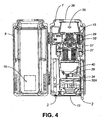
- Figure 3 is a face view of the appliance in its outer housing 7 oriented to be mounted between wall studs 5 (not shown in Figure 3) with the front access cover 6 open to expose the inner ventilation housing which serves as a shroud or cowling 22.
- the high-pressure discharge hose 2 is in its fully retracted position.
- Air inlet vents 13 are located at the bottom of the housing 7, beneath the motor/compressor assembly 32.
- An air outlet 36 is mounted at the top of the unit. Gas source 3 and gas delivery 2 lines are also connected to the unit.
- a front cowling 22 that serves as part of a shroud is attached to the back panel of the outer housing 7 by screws 23.
- the back panel of the outer housing 7 and the cowling 22 form a ventilation enclosure for the compressor 29, the compressor motor 30 and the blow-down volume 31, all of which are within a common case and constitute the motor/compressor assembly 32.
- the ventilation fan 32A and ancillary components are also shown in Figure 4.
- the ventilation fan 32A draws cooling air in through the inlet vents 13, past the air flow sensor 34, and circulates the air over the motor/compressor assembly 32, as well as other components within the enclosure formed by the back panel of the outer housing 7 and the cowling 22.
- Air on leaving this ventilation enclosure passes by the flammable gas sensor 35, shown in Figure 4 and out through the air outlet 36. All sensors are connected to a central computer-circuit based main logic controller 11, was shown by the connections in Figure 11. If the air flow sensor 34 indicates that the cooling air flow is below a pre-set minimum limit e.g., if there is an interruption in the flow of ventilation and cooling air; or if the flammable gas sensor 35 detects the presence of a flammable gas in the cooling air, the central logic controller 11 ensures that the appliance 1 will not start up if it is already shut down; or will shut down if it is running.
- a pre-set minimum limit e.g., if there is an interruption in the flow of ventilation and cooling air
- the central logic controller 11 ensures that the appliance 1 will not start up if it is already shut down; or will shut down if it is running.
- the fan 32A By mounting the appliance at an elevated level on a wall or elevated support structure, the fan 32A will tend to circulate air from the upper region of the adjacent environmental space, which may contain lighter than air flammable gases in the adjacent space. Due to the circulation of air created by the ventilation system, such flammable gas will tend to be drawn into the appliance. The flammable gas sensor 35 will then detect not only gas that has escaped from the compressor 29, but also gas that has escaped in the local environment.
- the motor/compressor assembly 32 in casing 12 is secured to the back panel of the outer housing 7 by two vibration-limiting elements in the form of polymeric side mounts 37, shown in Figure 4.
- the casing 12 is further connected to a polymeric damper 39, shown in Figure 4.
- the side mounts 37 are located slightly above the approximate center of rotation or mass of the motor/compressor assembly 32, along a horizontal line that passes preferably along a horizontal plane that passes approximately just above such center. This arrangement allows the reciprocating movements within the assembly to tend to induce a rocking motion about an axis formed by a straight line extending between the mounts.
- the two polymeric side mounts 37 and the polymeric damper 39 suppress the transmission of vibration from the motor/compressor assembly 32 to the outer housing 7.
- the damper means 39 is in the form of a finger-like protrusion that extends into socket 39 mounted on the hosing 7 that acts as a damping pot. As the appliance rocks about the axis extending between the side mounts 37, this motion is resisted by the resilient, socket-like fitting 39 to dampen the vibration caused by the rotational reciprocating moments of the compressor/motor assembly 32.
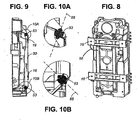
- the outer housing 7 as shown in Figure 5 itself is provided with mounting hardware which includes a frame 49 with two notched mounting bars 50 for mounting onto a lower mounting bracket 16, and an upper mounting bracket 19 as in Figures 7, 8. These brackets 16, 17 are fastened to the support structure.
- the outer housing 7, is mounted to the frame 49 through a novel system of elements in the form of angled, rubber or rubber-like, cushioning washers 53.
- the rubber cushioning washers 53 as shown in Figures 9, 10A, 10B are set at an inclined angle that eliminates or minimizes the shearing force on such washers.
- the top portion of the axes 55 of the washers 53 are angled away from the wall and towards the unit by an angle of about 45°.
- the angles of these respective cushioning washer 53 may differ in accordance with the location of the center of mass which they support.
- the notches 56 in the bars 50 of Figure 6 engage with tapered indentations 57 along the faces of brackets 16, 19. This permits the mounting of the appliance at its elevated location by the simple procedure of lifting the unit to align the notches 56 with the indentations 57 and advancing these elements into engagement. Angled sides on the indentations 57 reduce the accuracy demanded for carrying-out this "docking" procedure.
- a latch or tether 58 may also be included as fastening security means to fix the engagement of the unit to the brackets 16, 19 These components provide security in the event of seismic disruptions i.e. earthquakes.
- the appliance will normally incorporate an input line pressure sensing means 40 that detects the absence of pressure arising from the decoupling of the input connector from the source gas line 3.
- This gas sensing means 40 combined with processing circuitry, as is previously known, provides a signal for the appliance to be shut off when it senses the absence of source gas pressure. Consequently, if the inlet hose 3 is disconnected, the appliance will not inadvertently introduce compressed air into the motor vehicle's fuel reservoir.
- This pressure sensing system also operates by sensing when the pressure of the inlet gas falls below a settable, threshold pressure level that is above zero, for example, 1.38 kPa (0.2 psi). Under such conditions operation of the appliance is suspended.
- a settable, threshold pressure level that is above zero, for example, 1.38 kPa (0.2 psi). Under such conditions operation of the appliance is suspended.
- the system of the invention protects against the risk of having the compressor system of the invention interfere with neighbouring appliances.
- an inlet gas pressure sensor 40 for sensing the pressure of gas arriving from inlet line 3 is connected electrically to the main logic controller 11. If the inlet gas pressure sensor 40 sends a signal to controller 11 that a source gas pressure condition below a pre-set limit is being sensed, the controller 11 ensures that the appliance 1 will not start up if it is already shut down; or will shut it down if it is running.
- the threshold pressure for such a shut-down is settable in order to allow the appliance to accommodate the requirements of different locations, e.g. in accordance with local line gas pressures or local regulations.
- the motor controller circuitry 22 is located within the casing 12, in the blow-down volume 31.
- the wall of the casing 12 acts as heat sink for the heat produced by the motor controller circuitry 22 and as a shield for incoming and outgoing electromagnetic emissions.
- the main logic controller 11 is connected to receive signals from air flow sensor 34, flammable gas sensor 35, source gas pressure sensor 40 as well as from the manual inputs on the control and display panel 15 and other sources such as the high pressure outlet gas sensor 43.
- the main logic controller 11 is able to activate the motor 30 and govern its speed through motor controller 22 providing low speed on start-up, high speed during initial compression and reduced speed during final compression.
- the speed of the electric motor is also controlled to avoid natural resonant frequencies arising from its mechanical components that would otherwise increase the noise and vibration generated by the unit.
Landscapes
- Engineering & Computer Science (AREA)
- Mechanical Engineering (AREA)
- General Engineering & Computer Science (AREA)
- Chemical & Material Sciences (AREA)
- Combustion & Propulsion (AREA)
- Chemical Kinetics & Catalysis (AREA)
- General Chemical & Material Sciences (AREA)
- Oil, Petroleum & Natural Gas (AREA)
- Analytical Chemistry (AREA)
- Compressor (AREA)
- Filling Or Discharging Of Gas Storage Vessels (AREA)
- Structures Of Non-Positive Displacement Pumps (AREA)
- Drying Of Gases (AREA)
- Control Of Positive-Displacement Pumps (AREA)
- Vibration Prevention Devices (AREA)
- Air-Conditioning For Vehicles (AREA)
Claims (14)
- Vorrichtung zum Betanken von Kraftfahrzeugen mit gasförmigen Kraftstoff, wenn sie zu Hause oder an anderer Stelle geparkt sind, wo eine senkrechte Halterung (61) zur Verfügung steht, umfassenda) ein Gehäuse (7), das eine Motor-Kompressor-Baugruppe (32) enthält in Form eines Mehrstufen-Gaskompressors (29) und eines Elektromotors (30), der den Mehrstufen-Kompressor (29) antreibt, wobei der Kompressor (29) und der Motor (30) gemeinsam in einem abgedichteten Gehäuse (7, 22) enthalten sind;b) eine elektrische Anschlusseinrichtung zur Versorgung des Motors (33) mit Energie;c) einen Gaseinlass (3), der auf der Vorrichtung ist und der die Vorrichtung mit einer Gasquelle verbindet;d) einen Gasauslass (2) für das Anbringen von komprimierten Gas zu einem Kraftstoffvorratsbehälter; dadurch gekennzeichnet, dass die Vorrichtung zudeme) Überwachungs- und Regelelemente (34, 35) aufweist, die einen unüberwachten Betrieb der Vorrichtung erlauben, undf) eine Halterungseinrichtungen (16, 19, 49), die eine Montage der Vorrichtung auf der senkrechten Halterung (71) in einer Höhe von mehr als 0,91 Meter (36 Zoll) über Grund erlauben.
- Vorrichtung nach Anspruch 1, dadurch gekennzeichnet, dass die Vorrichtung eine schwingungstrennende Einrichtungen (37, 39, 53) aufweist, so angeordnet, dass eine Übertragung der Schwingungen von dem Motor (30) auf die senkrechte Halterung (91) vermindert ist.
- Vorrichtung nach Anspruch 2, dadurch gekennzeichnet, dass die schwingungstrennende Einrichtung (37, 39, 53) zwei schwingungstrennende Elemente besitzt, die zwischen dem Motor (30) und der senkrechten Halterung (61) in Reihe montiert sind.
- Vorrichtung nach Anspruch 3, dadurch gekennzeichnet, dass die erste schwingungstrennende Einrichtung (37, 39, 53) eine Einrichtung ist zur Verminderung der Übertragung von Schwingungen des Motors (30) in das Gehäuse (7), wobei die erste Isolationseinrichtung flexible Polymerbefestigungen (37) besitzt, die auf beiden Seiten einer horizontalen Ebene angeordnet sind, welche in etwa durch den Massenschwerpunkt der Motor-Kompressor-Baugruppe (32) geht und zwar längs einer Achse, die von einer Geraden gebildet wird, welche sich zwischen den Befestigungen (37) und durch die horizontale Ebene erstreckt und welche die Motor-Kompressor-Baugruppe (32) am Gehäuse (7) sichert.
- Vorrichtung nach Anspruch 4, dadurch gekennzeichnet, dass eine Dämpfeinrichtung (39) sich zwischen der Motor-Kompressor-Baugruppe (32) und dem Gehäuse (7) erstreckt und die Schwingungsenergie absorbiert, die aus der freien Bewegung der Motor-Kompressor-Baugruppe (32) um dessen Achse resultiert.
- Vorrichtung nach einem der Ansprüche 3 bis 5, dadurch gekennzeichnet, dass die zweite schwingungstrennende Einrichtung (53) eine Einrichtung ist zur Verminderung der Übertragung von Schwingungen von dem Vorrichtungsgehäuse (7) auf die senkrechte Halterung (61), wobei die zweite schwingungstrennende Einrichtung eine Anzahl flexibler Polymer-Beilagscheiben (53) umfasst, angeordnet auf der Vorrichtung für ein Plazieren zwischen dem Gehäuse (7) und der senkrechten Halterung (61).
- Vorrichtung nach Anspruch 6, dadurch gekennzeichnet, dass die flexiblen Polymer-Beilagscheiben (53) in einem geneigten Winkel stehen, der eine Scherkraft auf derartige Beilagscheiben (53) ausschaltet oder kleinstmöglich hält.
- Vorrichtung nach Anspruch 7, dadurch gekennzeichnet, dass die flexiblen Polymer-Beilagscheiben (53) eine Breite haben, eine Länge, eine Mittelachse und ein Befestigungsloch, das längs ihrer Mittelachse verläuft, wobei die Länge in etwa gleich der Breite ist.
- Vorrichtung nach Anspruch 7, dadurch gekennzeichnet, dass das Gehäuse (7) selbst mit Befestigungsbeschlägen versehen ist, umfassend einen Rahmen (49) mit zwei Befestigungstäben (50), welche mit Kerben (56) versehen sind für eine Befestigung auf den Befestigungsklammern (16, 19), welche auf der Halterungsstruktur (61) angeordnet sind, wobei die flexiblen Polymerbeilagscheiben (53) zwischen Rahmen (49) und Gehäuse (7) angeordnet sind.
- Vorrichtung nach Anspruch 9, dadurch gekennzeichnet, dass die Klammern (16, 19) sich verjüngende Einbuchtungen (57) besitzen zur Aufnahme der Kerben (56), so dass eine Befestigung der Vorrichtung auf den Klammern (16, 19) erfolgen kann und zwar durch Hochheben der Vorrichtung mit ihrem Rahmen (40), Ausrichten der Kerben (56) mit den Einbuchtungen (57) und Vorschieben dieser Elemente in Eingriff.
- Vorrichtung nach Anspruch 10, dadurch gekennzeichnet, dass eine Klinke oder Haltegurt (58) sich zwischen dem Rahmen (49) oder Gehäuse (7) und mindestens einer der Klammern (16, 19) erstreckt zur Bereitstellung einer Sicherung im Falle eines Erdbebens.
- Vorrichtung nach Anspruch 1, dadurch gekennzeichnet, dass ein Belüftungssystem bereitgestellt ist, umfassendg) einen Gaseinlass (13), einen Ventilator (32a) und einen Luftauslass (36) in dem Gehäuse (7), so dass eine Zone mit Luftzirkulation um die Motor-Kompressor-Baugruppe (32) bereitgestellt wird;h) einen Sensor (35) für entzündliches Gas, der nächst dem Luftauslass (36) angeordnet ist zum Erfassen eines entzündlichen Gases, das durch das Ventilationssystem geht,wodurch, ist die Vorrichtung auf der Halterungseinrichtung (16, 19, 49) montiert, der Ventilator (32A) Luft von dem benachbarten Umgebungsraum abziehen wird und der Flammgas-Sensor (35) das entzündliche Gas entdecken kann, das bis dato aus der Motor-Kompressor-Baugruppe (32) entwichen ist oder in dem benachbarten Umgebungsraum zugegen ist.
- Vorrichtung nach Anspruch 12, dadurch gekennzeichnet, dass eine Haube (22) über der Motor-Kompressor-Baugruppe (32) montiert ist zur Begrenzung der Luftzirkulationszone um die Motor-Kompressor-Baugruppe (32).
- Vorrichtung nach irgendeinem der vorhergehenden Ansprüche, in Verbindung mit einer aufrechten Halterung (61), an der die Vorrichtung befestigt ist.
Applications Claiming Priority (3)
| Application Number | Priority Date | Filing Date | Title |
|---|---|---|---|
| US265096 | 2002-10-04 | ||
| US10/265,096 US7011118B2 (en) | 2002-10-04 | 2002-10-04 | Residential compressor for refueling motor vehicles that operate on gaseous fuels |
| PCT/CA2003/001475 WO2004031643A1 (en) | 2002-10-04 | 2003-10-06 | Residential compressor for refueling motor vehicles that operate on gaseous fuels |
Publications (2)
| Publication Number | Publication Date |
|---|---|
| EP1549878A1 EP1549878A1 (de) | 2005-07-06 |
| EP1549878B1 true EP1549878B1 (de) | 2007-12-12 |
Family
ID=32042401
Family Applications (1)
| Application Number | Title | Priority Date | Filing Date |
|---|---|---|---|
| EP03753163A Expired - Lifetime EP1549878B1 (de) | 2002-10-04 | 2003-10-06 | Hauseigener kompressor zum betanken von gasbetriebenenen fahrzeugen |
Country Status (14)
| Country | Link |
|---|---|
| US (2) | US7011118B2 (de) |
| EP (1) | EP1549878B1 (de) |
| JP (1) | JP2006501416A (de) |
| CN (2) | CN100400959C (de) |
| AT (1) | ATE380968T1 (de) |
| AU (1) | AU2003271454A1 (de) |
| BR (1) | BR0315043A (de) |
| CA (1) | CA2500989A1 (de) |
| DE (1) | DE60318083T2 (de) |
| DK (1) | DK1549878T3 (de) |
| ES (1) | ES2298554T3 (de) |
| MX (1) | MXPA05003603A (de) |
| RU (1) | RU2322637C2 (de) |
| WO (1) | WO2004031643A1 (de) |
Families Citing this family (19)
| Publication number | Priority date | Publication date | Assignee | Title |
|---|---|---|---|---|
| GB0313483D0 (en) * | 2003-06-11 | 2003-07-16 | Boc Group Plc | Liquefied gas storage installation |
| US7892304B2 (en) * | 2004-12-17 | 2011-02-22 | Texaco Inc. | Apparatus and method for controlling compressor motor speed in a hydrogen generator |
| US7763087B2 (en) * | 2004-12-17 | 2010-07-27 | Texaco Inc. | Safety system architecture for a hydrogen fueling station |
| GB2435311B (en) | 2006-02-16 | 2011-01-19 | Gasfill Ltd | Fluid compressor and motor vehicle refuelling apparatus |
| WO2011115522A1 (ru) * | 2010-03-15 | 2011-09-22 | КИСЕЛЕВ, Александр Михайлович | Модуль нагрузочный испытательный резистивный (балластный) |
| US9618158B2 (en) | 2011-05-02 | 2017-04-11 | New Gas Industries, L.L.C. | Method and apparatus for compressing gas in a plurality of stages to a storage tank array having a plurality of storage tanks |
| US9296602B2 (en) * | 2012-02-07 | 2016-03-29 | Paul R. Juhasz | Vehicle fuel dispensing system for dwellings |
| DE102014000639A1 (de) | 2013-01-18 | 2014-07-24 | Michael Feldmann | Verfahren und Anlagen für eine Gastankstelle zur größenoptimierten Abgabe gasförmiger Gaskraftstoffe an mobile Verbraucher |
| WO2014194059A1 (en) | 2013-05-31 | 2014-12-04 | Intellectual Property Holdings, Llc | Natural gas compressor |
| US20140182561A1 (en) * | 2013-09-25 | 2014-07-03 | Eghosa Gregory Ibizugbe, JR. | Onboard CNG/CFG Vehicle Refueling and Storage Systems and Methods |
| EP2908044A3 (de) | 2014-01-17 | 2015-09-09 | Michael Feldmann | Verfahren und Anlagen für eine Gastankstelle zur größenoptimierten Abgabe gasförmiger Gaskraftstoffe an mobile Verbraucher |
| EP2899449A3 (de) * | 2014-01-20 | 2015-09-02 | Michael Feldmann | Verfahren und Anlagenkonfiguration zum dynamisierten Aufbau einer Gastankstellen-Infrastruktur |
| US10551001B2 (en) | 2015-09-03 | 2020-02-04 | J-W Power Company | Flow control system |
| RU178332U1 (ru) * | 2017-04-26 | 2018-03-30 | Федеральное государственное бюджетное образовательное учреждение высшего образования "Рязанский государственный агротехнологический университет имени П.А. Костычева" (ФГБОУ ВО РГАТУ) | Топливная система газового двигателя внутреннего сгорания |
| WO2020109846A1 (ru) * | 2018-11-29 | 2020-06-04 | Хайджен, Сиа | Устройство для обеспечения безопасности заправки транспортного средства компрессированным газовым топливом легче воздуха и способ заправки транспортного средства |
| DE102020201046A1 (de) | 2020-01-29 | 2021-07-29 | Robert Bosch Gesellschaft mit beschränkter Haftung | Druckgasspeicheraufnahmevorrichtung für ein Kraftfahrzeug, System mit einem Kraftfahrzeug und einer Kühlungsvorrichtung, Tankstelle für ein solches System sowie Verfahren zum Betanken eines Kraftfahrzeuges |
| RU205185U1 (ru) * | 2021-04-21 | 2021-06-30 | Общество С Ограниченной Ответственностью "Газовые Компрессорные Системы" | Индивидуальное устройство для заправки автомобильного транспорта |
| US11813916B2 (en) * | 2021-10-14 | 2023-11-14 | Beijingwest Industries Co., Ltd. | Integrated air supply unit |
| EP4198374B1 (de) * | 2021-12-20 | 2025-06-11 | Volvo Construction Equipment AB | Mobiles fluidzuführungssystem, verfahren zur zuführung von fluid, steuerungseinheit und fahrzeug, schiff oder wasserfahrzeug mit dem mobilen fluidzuführungssystem |
Family Cites Families (23)
| Publication number | Priority date | Publication date | Assignee | Title |
|---|---|---|---|---|
| US3799218A (en) * | 1972-03-27 | 1974-03-26 | M Douglass | Apparatus for dispensing compressed gas at programmed pressure and volume |
| US4501253A (en) | 1982-12-13 | 1985-02-26 | Consolidated Natural Gas Service Company, Inc. | On-board automotive methane compressor |
| US4531558A (en) * | 1983-04-13 | 1985-07-30 | Michigan Consolidated Gas Co. | Gaseous fuel refueling apparatus |
| US4624390A (en) | 1984-03-29 | 1986-11-25 | Dual Fuel Systems, Inc. | Natural gas fueling system |
| DE3873653D1 (de) | 1987-07-23 | 1992-09-17 | Sulzer Ag | Einrichtung zum betanken eines gasbrennstoffbehaelters. |
| CH676951A5 (en) | 1988-08-12 | 1991-03-28 | Sulzer Ag | Vehicle gas tank filling appliance - has second internal housing for compressor-motor group |
| NZ229839A (en) | 1988-08-15 | 1992-01-29 | Sulzer Ag | Cng refueller with temperature and pressure cut-offs |
| JPH0347478U (de) * | 1989-09-13 | 1991-05-02 | ||
| SU1809164A1 (en) * | 1990-12-17 | 1993-04-15 | Vsesoyuznyj Ni I Kt I Kompress | Vehicle gas supply compressor plant |
| NZ242143A (en) | 1991-05-30 | 1994-03-25 | Sulzer Ag | Apparatus for refuelling gas fuel tank; part of pressurised gas tank is load-bearing part for compressor housing |
| US5259424A (en) | 1991-06-27 | 1993-11-09 | Dvco, Inc. | Method and apparatus for dispensing natural gas |
| US5221192A (en) * | 1992-07-16 | 1993-06-22 | Carrier Corporation | Elastomeric compressor stud mount |
| JPH06288353A (ja) * | 1993-04-02 | 1994-10-11 | Mitsubishi Heavy Ind Ltd | 横置形圧縮機の防振支持装置 |
| US5370159A (en) | 1993-07-19 | 1994-12-06 | Price Compressor Company, Inc. | Apparatus and process for fast filling with natural gas |
| CA2116089C (en) | 1994-02-21 | 2004-05-04 | Fuelmaker Corporation | Method and apparatus for dewatering gas stream resulting in a clean water effluent |
| US5501200A (en) | 1994-06-28 | 1996-03-26 | Bogartz; Stuart P. | Compressed gas fueling system |
| JPH09196295A (ja) * | 1996-01-19 | 1997-07-29 | Tokico Ltd | ガス供給装置 |
| BE1010132A3 (nl) | 1996-04-02 | 1998-01-06 | Atlas Copco Airpower Nv | Werkwijze en inrichting voor het drogen van een door een compressor samengeperst gas. |
| RU11586U1 (ru) * | 1998-02-18 | 1999-10-16 | Всероссийский научно-исследовательский институт природных газов и газовых технологий, Российское акционерное общество "Газпром" | Передвижная газонаполнительная установка |
| DE19859423C1 (de) | 1998-12-22 | 2000-04-20 | Hermann Heinz Burger Gas Und W | Vorrichtung zum Betanken von Fahrzeugen mit Erdgas |
| CA2298137A1 (en) * | 1999-02-08 | 2000-08-08 | Yamaha Hatsudoki Kabushiki Kaisha | Fast fill method and apparatus |
| DE19933791A1 (de) * | 1999-07-20 | 2001-02-01 | Linde Gas Ag | Verfahren und Tankstelle zum Betanken eines Fahrzeugtanks mit einem gasförmigen Treibstoff |
| BE1013389A3 (nl) | 2000-04-13 | 2001-12-04 | Atlas Copco Airpower Nv | Compressorinstallatie voorzien van een drooginrichting. |
-
2002
- 2002-10-04 US US10/265,096 patent/US7011118B2/en not_active Expired - Fee Related
-
2003
- 2003-10-06 AU AU2003271454A patent/AU2003271454A1/en not_active Abandoned
- 2003-10-06 RU RU2005113867/06A patent/RU2322637C2/ru not_active IP Right Cessation
- 2003-10-06 ES ES03753163T patent/ES2298554T3/es not_active Expired - Lifetime
- 2003-10-06 DK DK03753163T patent/DK1549878T3/da active
- 2003-10-06 DE DE60318083T patent/DE60318083T2/de not_active Expired - Lifetime
- 2003-10-06 WO PCT/CA2003/001475 patent/WO2004031643A1/en not_active Ceased
- 2003-10-06 CN CNB2003801049119A patent/CN100400959C/zh not_active Expired - Fee Related
- 2003-10-06 JP JP2004540409A patent/JP2006501416A/ja active Pending
- 2003-10-06 EP EP03753163A patent/EP1549878B1/de not_active Expired - Lifetime
- 2003-10-06 CN CN2003801049142A patent/CN1720090B/zh not_active Expired - Fee Related
- 2003-10-06 MX MXPA05003603A patent/MXPA05003603A/es active IP Right Grant
- 2003-10-06 BR BR0315043-7A patent/BR0315043A/pt active Search and Examination
- 2003-10-06 US US10/530,310 patent/US20060289080A1/en not_active Abandoned
- 2003-10-06 AT AT03753163T patent/ATE380968T1/de active
- 2003-10-06 CA CA002500989A patent/CA2500989A1/en not_active Abandoned
Also Published As
| Publication number | Publication date |
|---|---|
| CN1720090B (zh) | 2010-04-28 |
| CN1720090A (zh) | 2006-01-11 |
| US20060289080A1 (en) | 2006-12-28 |
| DE60318083T2 (de) | 2008-11-20 |
| ES2298554T3 (es) | 2008-05-16 |
| AU2003271454A1 (en) | 2004-04-23 |
| WO2004031643A1 (en) | 2004-04-15 |
| CA2500989A1 (en) | 2004-04-15 |
| DE60318083D1 (de) | 2008-01-24 |
| DK1549878T3 (da) | 2008-05-05 |
| EP1549878A1 (de) | 2005-07-06 |
| RU2322637C2 (ru) | 2008-04-20 |
| MXPA05003603A (es) | 2006-04-05 |
| JP2006501416A (ja) | 2006-01-12 |
| US7011118B2 (en) | 2006-03-14 |
| ATE380968T1 (de) | 2007-12-15 |
| CN100400959C (zh) | 2008-07-09 |
| CN1720412A (zh) | 2006-01-11 |
| BR0315043A (pt) | 2005-08-23 |
| US20040065676A1 (en) | 2004-04-08 |
| RU2005113867A (ru) | 2005-10-10 |
Similar Documents
| Publication | Publication Date | Title |
|---|---|---|
| EP1549878B1 (de) | Hauseigener kompressor zum betanken von gasbetriebenenen fahrzeugen | |
| US8079829B2 (en) | Submerged DC brushless motor and pump | |
| RU2644737C2 (ru) | Разработки, касающиеся моющих/сушащих станций в туалетных комнатах | |
| JP2990570B2 (ja) | 一体型空気調和機 | |
| JPH087287Y2 (ja) | 分離型空気調和機の締結装置 | |
| KR20020067525A (ko) | 공기조화기 | |
| JP2011052842A (ja) | ヒートポンプ室外機 | |
| US7051534B2 (en) | Gas turbine arrangement having an integrated filter housing and compressor bleed duct | |
| JP2006501416A5 (de) | ||
| CN204186476U (zh) | 动力系统 | |
| CN222558726U (zh) | 水泵组件、室内机以及暖通系统 | |
| US20140154966A1 (en) | Hand dryer | |
| JP2000276674A (ja) | 家庭用セキュリテイシステム | |
| CN208803903U (zh) | 一种电站 | |
| GB2211028A (en) | Resilient mounting in a standby generator system | |
| CN215633687U (zh) | 一种送水泵房智能调压装置 | |
| CN221429300U (zh) | 一种消防报警系统总线隔离器 | |
| CN217928183U (zh) | 一种可燃气体报警器的便捷式安装机构 | |
| CN205079342U (zh) | 一种机房空调机 | |
| EP4467884A1 (de) | Wärmepumpe | |
| CN223362148U (zh) | 一种防爆型气体检测装置 | |
| CN215211266U (zh) | 一种二次供水进水智能控制装置 | |
| CN201807480U (zh) | 一种集成式人工造雾用主机组 | |
| US20090214361A1 (en) | Oil-less compressor with seal-dust protection | |
| CN105864897A (zh) | 空调器及其风管机 |
Legal Events
| Date | Code | Title | Description |
|---|---|---|---|
| PUAI | Public reference made under article 153(3) epc to a published international application that has entered the european phase |
Free format text: ORIGINAL CODE: 0009012 |
|
| 17P | Request for examination filed |
Effective date: 20050503 |
|
| AK | Designated contracting states |
Kind code of ref document: A1 Designated state(s): AT BE BG CH CY CZ DE DK EE ES FI FR GB GR HU IE IT LI LU MC NL PT RO SE SI SK TR |
|
| AX | Request for extension of the european patent |
Extension state: AL LT LV MK |
|
| DAX | Request for extension of the european patent (deleted) | ||
| GRAP | Despatch of communication of intention to grant a patent |
Free format text: ORIGINAL CODE: EPIDOSNIGR1 |
|
| GRAS | Grant fee paid |
Free format text: ORIGINAL CODE: EPIDOSNIGR3 |
|
| 17Q | First examination report despatched |
Effective date: 20050805 |
|
| RIN1 | Information on inventor provided before grant (corrected) |
Inventor name: WOJCIECHOWSKIM, PAWEL Inventor name: RACKHAM, RALPH Inventor name: CHAPNIK, BRIAN Inventor name: DEMALINE, TRACEY Inventor name: CHAN, ANTHONY Inventor name: MOJSOV, TOME |
|
| GRAA | (expected) grant |
Free format text: ORIGINAL CODE: 0009210 |
|
| AK | Designated contracting states |
Kind code of ref document: B1 Designated state(s): AT BE BG CH CY CZ DE DK EE ES FI FR GB GR HU IE IT LI LU MC NL PT RO SE SI SK TR |
|
| REG | Reference to a national code |
Ref country code: GB Ref legal event code: FG4D |
|
| REG | Reference to a national code |
Ref country code: CH Ref legal event code: EP |
|
| REG | Reference to a national code |
Ref country code: IE Ref legal event code: FG4D |
|
| REF | Corresponds to: |
Ref document number: 60318083 Country of ref document: DE Date of ref document: 20080124 Kind code of ref document: P |
|
| REG | Reference to a national code |
Ref country code: SE Ref legal event code: TRGR |
|
| REG | Reference to a national code |
Ref country code: CH Ref legal event code: NV Representative=s name: DR. LUSUARDI AG |
|
| REG | Reference to a national code |
Ref country code: DK Ref legal event code: T3 |
|
| REG | Reference to a national code |
Ref country code: ES Ref legal event code: FG2A Ref document number: 2298554 Country of ref document: ES Kind code of ref document: T3 |
|
| PG25 | Lapsed in a contracting state [announced via postgrant information from national office to epo] |
Ref country code: SI Free format text: LAPSE BECAUSE OF FAILURE TO SUBMIT A TRANSLATION OF THE DESCRIPTION OR TO PAY THE FEE WITHIN THE PRESCRIBED TIME-LIMIT Effective date: 20071212 |
|
| ET | Fr: translation filed | ||
| PG25 | Lapsed in a contracting state [announced via postgrant information from national office to epo] |
Ref country code: RO Free format text: LAPSE BECAUSE OF FAILURE TO SUBMIT A TRANSLATION OF THE DESCRIPTION OR TO PAY THE FEE WITHIN THE PRESCRIBED TIME-LIMIT Effective date: 20071212 |
|
| PG25 | Lapsed in a contracting state [announced via postgrant information from national office to epo] |
Ref country code: PT Free format text: LAPSE BECAUSE OF FAILURE TO SUBMIT A TRANSLATION OF THE DESCRIPTION OR TO PAY THE FEE WITHIN THE PRESCRIBED TIME-LIMIT Effective date: 20080512 |
|
| PLBE | No opposition filed within time limit |
Free format text: ORIGINAL CODE: 0009261 |
|
| STAA | Information on the status of an ep patent application or granted ep patent |
Free format text: STATUS: NO OPPOSITION FILED WITHIN TIME LIMIT |
|
| 26N | No opposition filed |
Effective date: 20080915 |
|
| PG25 | Lapsed in a contracting state [announced via postgrant information from national office to epo] |
Ref country code: GR Free format text: LAPSE BECAUSE OF FAILURE TO SUBMIT A TRANSLATION OF THE DESCRIPTION OR TO PAY THE FEE WITHIN THE PRESCRIBED TIME-LIMIT Effective date: 20080313 |
|
| PG25 | Lapsed in a contracting state [announced via postgrant information from national office to epo] |
Ref country code: EE Free format text: LAPSE BECAUSE OF FAILURE TO SUBMIT A TRANSLATION OF THE DESCRIPTION OR TO PAY THE FEE WITHIN THE PRESCRIBED TIME-LIMIT Effective date: 20071212 Ref country code: BG Free format text: LAPSE BECAUSE OF FAILURE TO SUBMIT A TRANSLATION OF THE DESCRIPTION OR TO PAY THE FEE WITHIN THE PRESCRIBED TIME-LIMIT Effective date: 20080312 |
|
| PG25 | Lapsed in a contracting state [announced via postgrant information from national office to epo] |
Ref country code: MC Free format text: LAPSE BECAUSE OF NON-PAYMENT OF DUE FEES Effective date: 20081031 |
|
| PG25 | Lapsed in a contracting state [announced via postgrant information from national office to epo] |
Ref country code: CY Free format text: LAPSE BECAUSE OF FAILURE TO SUBMIT A TRANSLATION OF THE DESCRIPTION OR TO PAY THE FEE WITHIN THE PRESCRIBED TIME-LIMIT Effective date: 20071212 |
|
| PG25 | Lapsed in a contracting state [announced via postgrant information from national office to epo] |
Ref country code: LU Free format text: LAPSE BECAUSE OF NON-PAYMENT OF DUE FEES Effective date: 20081006 Ref country code: HU Free format text: LAPSE BECAUSE OF FAILURE TO SUBMIT A TRANSLATION OF THE DESCRIPTION OR TO PAY THE FEE WITHIN THE PRESCRIBED TIME-LIMIT Effective date: 20080613 |
|
| REG | Reference to a national code |
Ref country code: FR Ref legal event code: TP |
|
| BECA | Be: change of holder's address |
Owner name: M.T.M. S.R.L.VIA LA MORRA 1, IT-CHERASCO Effective date: 20110131 |
|
| BECH | Be: change of holder |
Owner name: M.T.M. S.R.L. Effective date: 20110131 |
|
| REG | Reference to a national code |
Ref country code: CH Ref legal event code: PUE Owner name: M.T.M. S.R.L. Free format text: FUELMAKER CORPORATION#70 WORCESTER ROAD#TORONTO, ONTARIO M9W 5X2 (CA) -TRANSFER TO- M.T.M. S.R.L.#VIA LA MORRA 1#CHERASCO (CN) (IT) |
|
| REG | Reference to a national code |
Ref country code: NL Ref legal event code: SD Effective date: 20110127 |
|
| REG | Reference to a national code |
Ref country code: SK Ref legal event code: PC4A Ref document number: E 3286 Country of ref document: SK Owner name: 2045951 ONTARIO INC., TORONTO, ONTARIO, CA Free format text: FORMER OWNER: FUELMAKER CORPORATION, TORONTO, ONTARIO, CA Effective date: 20100811 Ref country code: SK Ref legal event code: PC4A Ref document number: E 3286 Country of ref document: SK Owner name: M.T.M. S.R.L., CHERASCO (CUNEO), IT Free format text: FORMER OWNER: 2045951 ONTARIO INC., TORONTO, ONTARIO, CA Effective date: 20100811 |
|
| REG | Reference to a national code |
Ref country code: GB Ref legal event code: 732E Free format text: REGISTERED BETWEEN 20110421 AND 20110427 |
|
| REG | Reference to a national code |
Ref country code: GB Ref legal event code: 732E Free format text: REGISTERED BETWEEN 20110428 AND 20110504 |
|
| REG | Reference to a national code |
Ref country code: ES Ref legal event code: PC2A Owner name: M.T.M. S.R.L. Effective date: 20110627 |
|
| PGFP | Annual fee paid to national office [announced via postgrant information from national office to epo] |
Ref country code: DK Payment date: 20121010 Year of fee payment: 10 |
|
| PGFP | Annual fee paid to national office [announced via postgrant information from national office to epo] |
Ref country code: FI Payment date: 20121010 Year of fee payment: 10 Ref country code: IE Payment date: 20121010 Year of fee payment: 10 Ref country code: DE Payment date: 20121003 Year of fee payment: 10 Ref country code: CH Payment date: 20121012 Year of fee payment: 10 Ref country code: FR Payment date: 20121018 Year of fee payment: 10 Ref country code: BE Payment date: 20121018 Year of fee payment: 10 Ref country code: CZ Payment date: 20121005 Year of fee payment: 10 |
|
| PGFP | Annual fee paid to national office [announced via postgrant information from national office to epo] |
Ref country code: ES Payment date: 20121031 Year of fee payment: 10 Ref country code: SE Payment date: 20121011 Year of fee payment: 10 Ref country code: IT Payment date: 20121024 Year of fee payment: 10 Ref country code: GB Payment date: 20121003 Year of fee payment: 10 Ref country code: SK Payment date: 20121008 Year of fee payment: 10 |
|
| PGFP | Annual fee paid to national office [announced via postgrant information from national office to epo] |
Ref country code: NL Payment date: 20121010 Year of fee payment: 10 Ref country code: AT Payment date: 20120927 Year of fee payment: 10 |
|
| BERE | Be: lapsed |
Owner name: M.T.M. S.R.L. Effective date: 20131031 |
|
| PG25 | Lapsed in a contracting state [announced via postgrant information from national office to epo] |
Ref country code: CZ Free format text: LAPSE BECAUSE OF NON-PAYMENT OF DUE FEES Effective date: 20131006 |
|
| REG | Reference to a national code |
Ref country code: NL Ref legal event code: V1 Effective date: 20140501 |
|
| REG | Reference to a national code |
Ref country code: DK Ref legal event code: EBP Effective date: 20131031 |
|
| PGFP | Annual fee paid to national office [announced via postgrant information from national office to epo] |
Ref country code: TR Payment date: 20121004 Year of fee payment: 10 |
|
| REG | Reference to a national code |
Ref country code: CH Ref legal event code: PL |
|
| REG | Reference to a national code |
Ref country code: SE Ref legal event code: EUG |
|
| REG | Reference to a national code |
Ref country code: AT Ref legal event code: MM01 Ref document number: 380968 Country of ref document: AT Kind code of ref document: T Effective date: 20131006 |
|
| GBPC | Gb: european patent ceased through non-payment of renewal fee |
Effective date: 20131006 |
|
| REG | Reference to a national code |
Ref country code: SK Ref legal event code: MM4A Ref document number: E 3286 Country of ref document: SK Effective date: 20131006 |
|
| REG | Reference to a national code |
Ref country code: IE Ref legal event code: MM4A |
|
| PG25 | Lapsed in a contracting state [announced via postgrant information from national office to epo] |
Ref country code: CH Free format text: LAPSE BECAUSE OF NON-PAYMENT OF DUE FEES Effective date: 20131031 Ref country code: GB Free format text: LAPSE BECAUSE OF NON-PAYMENT OF DUE FEES Effective date: 20131006 Ref country code: LI Free format text: LAPSE BECAUSE OF NON-PAYMENT OF DUE FEES Effective date: 20131031 |
|
| REG | Reference to a national code |
Ref country code: FR Ref legal event code: ST Effective date: 20140630 |
|
| REG | Reference to a national code |
Ref country code: DE Ref legal event code: R119 Ref document number: 60318083 Country of ref document: DE Effective date: 20140501 |
|
| PG25 | Lapsed in a contracting state [announced via postgrant information from national office to epo] |
Ref country code: IT Free format text: LAPSE BECAUSE OF NON-PAYMENT OF DUE FEES Effective date: 20131006 Ref country code: FR Free format text: LAPSE BECAUSE OF NON-PAYMENT OF DUE FEES Effective date: 20131031 Ref country code: DE Free format text: LAPSE BECAUSE OF NON-PAYMENT OF DUE FEES Effective date: 20140501 Ref country code: FI Free format text: LAPSE BECAUSE OF NON-PAYMENT OF DUE FEES Effective date: 20131006 Ref country code: AT Free format text: LAPSE BECAUSE OF NON-PAYMENT OF DUE FEES Effective date: 20131006 Ref country code: SE Free format text: LAPSE BECAUSE OF NON-PAYMENT OF DUE FEES Effective date: 20131007 Ref country code: NL Free format text: LAPSE BECAUSE OF NON-PAYMENT OF DUE FEES Effective date: 20140501 Ref country code: SK Free format text: LAPSE BECAUSE OF NON-PAYMENT OF DUE FEES Effective date: 20131006 |
|
| PG25 | Lapsed in a contracting state [announced via postgrant information from national office to epo] |
Ref country code: BE Free format text: LAPSE BECAUSE OF NON-PAYMENT OF DUE FEES Effective date: 20131031 |
|
| PG25 | Lapsed in a contracting state [announced via postgrant information from national office to epo] |
Ref country code: DK Free format text: LAPSE BECAUSE OF NON-PAYMENT OF DUE FEES Effective date: 20131031 Ref country code: IE Free format text: LAPSE BECAUSE OF NON-PAYMENT OF DUE FEES Effective date: 20131006 |
|
| REG | Reference to a national code |
Ref country code: ES Ref legal event code: FD2A Effective date: 20150709 |
|
| PG25 | Lapsed in a contracting state [announced via postgrant information from national office to epo] |
Ref country code: ES Free format text: LAPSE BECAUSE OF NON-PAYMENT OF DUE FEES Effective date: 20131007 |
|
| PG25 | Lapsed in a contracting state [announced via postgrant information from national office to epo] |
Ref country code: TR Free format text: LAPSE BECAUSE OF NON-PAYMENT OF DUE FEES Effective date: 20131006 |