EP1548417B1 - Sensorsystem zur Messung veränderlicher physikalischer Grössen - Google Patents
Sensorsystem zur Messung veränderlicher physikalischer Grössen Download PDFInfo
- Publication number
- EP1548417B1 EP1548417B1 EP04257249A EP04257249A EP1548417B1 EP 1548417 B1 EP1548417 B1 EP 1548417B1 EP 04257249 A EP04257249 A EP 04257249A EP 04257249 A EP04257249 A EP 04257249A EP 1548417 B1 EP1548417 B1 EP 1548417B1
- Authority
- EP
- European Patent Office
- Prior art keywords
- output
- sense element
- signal conditioning
- half bridge
- multiplexer
- Prior art date
- Legal status (The legal status is an assumption and is not a legal conclusion. Google has not performed a legal analysis and makes no representation as to the accuracy of the status listed.)
- Expired - Lifetime
Links
- 230000003750 conditioning effect Effects 0.000 claims description 33
- 230000001143 conditioned effect Effects 0.000 claims description 5
- 230000002093 peripheral effect Effects 0.000 claims description 3
- 238000012512 characterization method Methods 0.000 claims description 2
- 238000012546 transfer Methods 0.000 claims description 2
- 238000012937 correction Methods 0.000 claims 1
- 238000012360 testing method Methods 0.000 description 10
- 238000004364 calculation method Methods 0.000 description 7
- 238000005070 sampling Methods 0.000 description 7
- 238000006243 chemical reaction Methods 0.000 description 6
- 238000012795 verification Methods 0.000 description 6
- 230000001133 acceleration Effects 0.000 description 5
- 230000005540 biological transmission Effects 0.000 description 4
- 239000012530 fluid Substances 0.000 description 3
- 230000006870 function Effects 0.000 description 3
- 238000000034 method Methods 0.000 description 3
- XUIMIQQOPSSXEZ-UHFFFAOYSA-N Silicon Chemical compound [Si] XUIMIQQOPSSXEZ-UHFFFAOYSA-N 0.000 description 2
- 230000003321 amplification Effects 0.000 description 2
- 230000008901 benefit Effects 0.000 description 2
- 230000008859 change Effects 0.000 description 2
- 238000013500 data storage Methods 0.000 description 2
- 238000013524 data verification Methods 0.000 description 2
- 238000001514 detection method Methods 0.000 description 2
- 238000010586 diagram Methods 0.000 description 2
- 230000000694 effects Effects 0.000 description 2
- 238000004519 manufacturing process Methods 0.000 description 2
- 238000003199 nucleic acid amplification method Methods 0.000 description 2
- 238000012545 processing Methods 0.000 description 2
- 229910052710 silicon Inorganic materials 0.000 description 2
- 239000010703 silicon Substances 0.000 description 2
- 230000001360 synchronised effect Effects 0.000 description 2
- 238000009966 trimming Methods 0.000 description 2
- 241001168730 Simo Species 0.000 description 1
- 230000006399 behavior Effects 0.000 description 1
- 230000002939 deleterious effect Effects 0.000 description 1
- 230000001419 dependent effect Effects 0.000 description 1
- 230000001747 exhibiting effect Effects 0.000 description 1
- 239000011521 glass Substances 0.000 description 1
- 239000000463 material Substances 0.000 description 1
- 238000012986 modification Methods 0.000 description 1
- 230000004048 modification Effects 0.000 description 1
- 230000008569 process Effects 0.000 description 1
- 238000000638 solvent extraction Methods 0.000 description 1
- 230000006641 stabilisation Effects 0.000 description 1
- 238000011105 stabilization Methods 0.000 description 1
Images




Classifications
-
- G—PHYSICS
- G01—MEASURING; TESTING
- G01D—MEASURING NOT SPECIALLY ADAPTED FOR A SPECIFIC VARIABLE; ARRANGEMENTS FOR MEASURING TWO OR MORE VARIABLES NOT COVERED IN A SINGLE OTHER SUBCLASS; TARIFF METERING APPARATUS; MEASURING OR TESTING NOT OTHERWISE PROVIDED FOR
- G01D3/00—Indicating or recording apparatus with provision for the special purposes referred to in the subgroups
- G01D3/02—Indicating or recording apparatus with provision for the special purposes referred to in the subgroups with provision for altering or correcting the law of variation
- G01D3/022—Indicating or recording apparatus with provision for the special purposes referred to in the subgroups with provision for altering or correcting the law of variation having an ideal characteristic, map or correction data stored in a digital memory
-
- G—PHYSICS
- G01—MEASURING; TESTING
- G01D—MEASURING NOT SPECIALLY ADAPTED FOR A SPECIFIC VARIABLE; ARRANGEMENTS FOR MEASURING TWO OR MORE VARIABLES NOT COVERED IN A SINGLE OTHER SUBCLASS; TARIFF METERING APPARATUS; MEASURING OR TESTING NOT OTHERWISE PROVIDED FOR
- G01D3/00—Indicating or recording apparatus with provision for the special purposes referred to in the subgroups
- G01D3/028—Indicating or recording apparatus with provision for the special purposes referred to in the subgroups mitigating undesired influences, e.g. temperature, pressure
- G01D3/036—Indicating or recording apparatus with provision for the special purposes referred to in the subgroups mitigating undesired influences, e.g. temperature, pressure on measuring arrangements themselves
- G01D3/0365—Indicating or recording apparatus with provision for the special purposes referred to in the subgroups mitigating undesired influences, e.g. temperature, pressure on measuring arrangements themselves the undesired influence being measured using a separate sensor, which produces an influence related signal
Definitions
- This invention relates generally to systems for sensing a variable condition such as pressure, temperature, acceleration, torque, force and the like at a plurality of locations and more particularly to apparatus and methods for signal conditioning multiple sense elements.
- electro-hydraulic brake or EHB systems generally have six locations that require sensing of the fluid pressure.
- Pressure sensing is required at each wheel for closed loop brake force control, at a location to sense driver input and at the pressure accumulator to sense system reserve pressure.
- Hydraulic sensing points are all routed through the hydraulic control unit or HCU having a system controller, i.e., microprocessor, so that there exists one member at which all different hydraulic circuit pressures are sensed.
- the provision of six discrete pressure sensors with full conditioning electronics results in suitable operation; however, it also results in a total pressure sensor cost which is higher than desirable compared to the remaining system component costs.
- EP1235053A2 discloses an ASIC for connection to a plurality of full bridge sensors comprising multiplexers for selecting one of the sensors. Respective multiplexers are provided to connect the two outputs of the selected sensor to a signal conditioning circuit. The bias input of all the sensors are connected in common to a bias voltage while another multiplexer is provided to connect the ground terminal of the selected sensor to the ground supply of the ASIC. The conditioned signal, as well as bias voltage, are sampled by an ADC and are transmitted to an external circuit for processing. A memory storing characterization values of the sensors is also included in the ASIC for supply to the external processor.
- the ASIC also includes diagnostic fixed test bridges for diagnosing ASIC faults and a signal diagnostic path for diagnosing sense element and sense element connection faults.
- the specific sense elements disclosed in the application are formed of individual strain bridges known in the art, such as silicon resistor bridges bonded to a diaphragm through glass material fired at high temperatures and adapted for placement in a fluid pressure port. When pressurized, fluid in the pressure port causes the diaphragms and bridges to undergo elastic strain. Because the resistors in the bridges are made of silicon, they exhibit a piezoresistive effect exhibiting a change in resistance when subjected to strain. By applying a voltage to the bridges, a small voltage change results at the output of the bridges.
- the fixed test bridges provide information on specific discrete points of the signal path, in the example shown, two discrete points. While these are effective for a majority of problems, there is a possibility that some errors in the signal path could go undetected.
- EP1111344A1 discloses a sensor signal conditioning circuit for a full bridge sensor having separate signal conditioning circuits for each of the bias input to and the positive and negative outputs from of the bridge. The conditioned signals are converted to digital form where they are analysed for faults by a microcontroller.
- US4574356 discloses a circuit for processing the output of a rosette of three strain gauges. The output of each strain gauge is first passed through a respective signal conditioner. The outputs of those are then combined in an analogue signal processor and after that a second signal processor to provide results. Further copies of this circuit may be provided and the output of one of the second signal processors is selected by a channel selector for display on a set of meters.
- the present invention provides a condition responsive sensor element system in accordance with the appended claims.
- a system comprises a multiple sensor ASIC comprising four analog switching multiplexers connected to a plurality of sense elements.
- Each sense element is made up of two separate half bridges with the bridge bias of each positive bridge half connected to a respective addressable port in one multiplexer and the bridge bias of the minus bridge half connected to a respective addressable port in the second multiplexer.
- the output of each positive bridge halve is connected to a respective addressable port in the third multiplexer and the output of each minus bridge half is connected to a respective addressable port of the fourth multiplexer.
- the half bridges of each sensor are treated independently of each other having independent variable resistive bridge drives and signal paths.
- the analog signal paths are mildly trimmable including some offset and gain trim.
- the temperature signal path from the bridge bias voltage is untrimmed since such trimming is unnecessary in the particular example of the preferred embodiment described, but may include trimmable gain for other examples, if desired.
- the outputs, in the specific embodiment being described, pressure and temperature, in each path are synchronously sampled and the data held and fed into a single analog to digital converter (ADC).
- ADC analog to digital converter
- the two paths produce opposing pressure and temperature analog signals and due to their opposite polarities, produce a signature which is diagnosed by a system control ASIC.
- the pressure and temperature information from each path is synchronously sampled, as noted above and fed into a data register which the system control ASIC interfaces over a digital bus, in the present embodiment, a serial peripheral interface or SPI.
- SPI serial peripheral interface
- the system control ASIC applies a compensation algorithm to generate a fully compensated, highly accurate pressure signal and temperature signal that the system uses as a control variable in the particular application with which the described embodiment is used.
- EEPROM electronically erasable programmable read only memory chip
- the system control ASIC selects the EEPROM through the sensor ASIC by means of the SPI bus and recalls all the coefficients needed to perform selected compensation algorithms and downloads the information.
- the sensor ASIC trim settings are also recalled from the EEPROM. The exact process is dependent upon the data bus architecture, in the present case an SPI bus; as stated above, the system control ASIC recalls the trim settings from EEPROM and then loads them into the sensor ASIC.
- the system control ASIC sets up the sensor ASIC by defining the sampling sequence and notifies the system controller when it has completed the sequence.
- the system controller then recalls the data from the sensor ASIC as needed.
- the system controller recalls both positive and minus half bridge information, performs compensation algorithms on both halves independently and compares the two signals so that a very precise determination can be made when a sensor is not behaving properly to a finer resolution than is possible using uncompensated half or full bridge data.
- the system control takes the two compensated pressure and temperature signals, respectively subtracts them to obtain the equivalent of full bridge data.
- the overall system comprises a pressure sensor system having a plurality of sense elements 1-6, a multiple sensor conditioning (MSC) ASIC 10 and non-volatile memory in the form of EEPROM chip 12 which interfaces with a host system controller in the form of a system control ASIC 14.
- MSC multiple sensor conditioning
- the MSC ASIC 10 in turn includes multiplexed ASIC inputs capable of interfacing with the sense elements; redundant half bridge conditioning path architecture 10b3, 10b4, to enable system level fault detection of the sense elements and the ASIC; simplified, trimmable signal conditioning paths 10b1, 10b2 with no thermal compensation; and digital transmission of all data by an SPI bus.
- the sensor system also includes an EEPROM IC 12 external to MSC ASIC 10 for storing MSC ASIC 10 signal path trim settings (one set for each sense element) and system compensation equation coefficients (one set for each sense element).
- a system controller in the form of system control ASIC 14 is interfaced with the pressure sensor system, using the SPI bus, to read ASIC trim settings and system compensation equation coefficients from EEPROM 12; using the SPI bus, to write required operating information to MSC ASIC 10; and, using the SPI bus, to read pressure, temperature and diagnostic/test data from MSC ASIC 10.
- System controller ASIC 14 also performs mathematical compensation of pressure, temperature and diagnostic information in accordance with selected algorithm equations.
- numerals 1 and 6 indicate two of a plurality of sense elements, each in the form of a pair of half bridge structures, in the embodiment shown, there are six sense elements but the particular number is a matter of choice. Although in the preferred embodiment the sense elements are responsive to pressure, the sense elements could also be used to sense other variable conditions suitable for such bridge structures such as acceleration, torque and force.
- sensor ASIC 10 includes four analog multiplexers, BRM, INM, BRP and INP MUXES, each having six address positions BM1-BM6, IM1-IM6, BP1-BP6 and IP1-IP6.
- Each sense element half bridge has a bridge node connected to BM1-BM6 respectively for the M half bridges and BP1-BP6 respectively for the P half bridges.
- Each half bridge has a ground node connected to ground.
- the output nodes of the M half bridges are respectively connected to address positions IM1-IM6 and the output nodes of the P half bridges are respectively connected to address positions IP1-IP6.
- MSC ASIC 10 includes a first bias and temperature path and a first pressure conditioning path for the positive half bridge and a second bias and temperature path and a second pressure conditioning path for the negative half bridge with the multiplexer address used to determine which sense element at a given time is biased and connected to the half bridge signal conditioning paths.
- a respective half bridge is selected by multiplexer BRM whose setting is determined by the AM-ADR (address minus-ADR).
- the half bridge is biased through a programmable series resistor 10a1 whose magnitude is controlled by the RM-REG (resistor minus-REG) value.
- a low pass filter LPDI is used at the signal input to reject unwanted high frequency signals, for example, EMI or other noise.
- a fixed amplification is applied to the half bridge bias voltage to increase signal magnitude and improve the resolution of the analog to digital conversion.
- a sample-and-hold circuit 10c1 stores the signal prior to analog to digital conversion. All the signals to be fed into ADC 10d are sampled and held at the same time to ensure all data is synchronized in time.
- the corresponding half bridge output is selected by multiplexer INM whose setting is determined by the AM-ADR value.
- a low pass filter LPFI is used at the signal input to reject unwanted high frequency signals, as in the temperature signal path.
- the difference between the half bridge output and 1/2 Vbrm (minus half bridge bias voltage reference) is then amplified by a fixed amount.
- the initial offset voltage of this signal path (e.g., cause by mismatch between the 1/2 Vbrm reference and the half bridge output due to sense element or ASIC tolerance) is cancelled by summing in a portion of the Vbrm into the signal path.
- the magnitude and sign of the portion of Vbrm to be summed is determined by the BM-REG (bias minus-REG) value.
- a variable amplification is applied to the half bridge output signal to increase the signal magnitude and improve the resolution of the analog to digital conversion.
- the magnitude of the applied gain is determined by the GM-REG value.
- the sample-and-hold circuit 10c2 stores the signal prior to analog to digital conversion. As noted above, all the signals to be fed into ADC 10d are sampled and held at the same time to ensure all data is synchronized in time.
- the analog pressure conditioning paths 10b1, 10b2 contain trimmable offset and gain settings to compensate for sense element variations. Each half bridge has uniquely derived offset and pain trim settings that are stored in specific addresses in Data Register 10e, to be discussed.
- the outputs of the analog temperature and pressure signal conditioning paths are inputted to Sample and Hold circuits 10c1-10c4 and Analog to Digital Converter ADC 10d.
- the outputs of the ADC are stored in specific addresses in Data Register 10e.
- Voltage regulator 10g provides bias sources for the analog and ADC circuits.
- ASIC and sense element test circuits including ADC test and Sample and Hold circuit 10c5 are used during ASIC and sensor production.
- SPI Serial Peripheral Interface
- the SPI bus has a chip select line CS_N, a clock line CLK, a slave input or master output pin SIMO and a slave output or master input pin SOMI.
- CS_N chip select line
- CLK clock line
- SIMO slave input or master output pin
- SOMI slave output or master input pin
- the system control ASIC 14 is the master and draws data from and to the MSC ASIC 10 by setting the chip select pin of sensor MSC ASIC 10 low and then the clock line clocks data into or out of MSC ASIC 10 which functions as a slave.
- EEPROM chip 12 is connected to SPI bus 10h.
- system ASIC 14 when the system ASIC 14 calls for information from EEPROM chip 12 it sets the chip select line of MSC ASIC 10 low and then sends a command to set the ES_N pin which further selects the EEPROM chip 12 as slave.
- This particular routine is necessitated by only having one chip select line available from system control ASIC 14 for the pressure sensor system.
- non-volatile memory in the form of external electrically erasable programmable read only memory (EEPROM) chip 12 is connected to MSC ASIC 10 to store trim settings and communicates with the system control over the SPI bus, however, there is no direct connection between the system controller and the EPROM chip select so MSC ASIC 10 is used to control the EEPROM chip select.
- EEPROM electrically erasable programmable read only memory
- system control ASIC 14 is an automotive brake controller which uses the raw sensor signals to generate fully compensated, highly accurate pressure and temperature signals that the system controller uses as a control variable.
- System control ASIC 14 has a great deal of computational power and the sensor system made according to the invention takes advantage of this by allocating that portion of the sensor compensation involving complex calculations to provide optimum efficiency while obtaining highly accurate pressure and temperature values used by system control ASIC 14 in the brake control. This portion of the sensor compensation will be discussed below in rotation to the compensation algorithms.
- System control ASIC 14 takes the minimally conditioned sensor MSC ASIC 10 digital outputs and applies a mathematical compensation algorithm/equation to achieve the desired values. Although many system compensation algorithms can be employed, the following algorithm is preferred.
- the system uses the outputs of the compensation algorithm to derive pressure, temperature and diagnostic information as follows:
- the initialization routine loads algorithm compensation coefficients that are stored in EEPROM 12 to enable system ASIC 14 to perform the compensation procedures on the raw data transmitted from MSC ASIC 10.
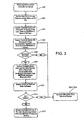
- the initialization routine starts at 100 where power is applied to system controller 14 and MSC ASIC 10.
- the system controller ASIC sets the MSC ASIC 10 chip select pin, CS_N low selecting the sensor as slave on SPI bus 10h.
- the system controller ASIC sends an SPI command to set the ES_N pin low which selects EEPROM 12 as the slave on the bus.
- this particular portion of the routine is employed instead of a conventional implementation of chip 12 being selected directly by ASIC 14 as slave due to a limitation of output pins available in the specific architecture used.
- system controller 14 sends an SPI command to read compensation algorithm data from a selected EEPROM 12 address.
- EEPROM outputs the data in that address and the routine goes through a loop until the data load is completed as determined by decision step 108.
- the system controller 14 sends a command at step 110 to read the address storing EEPROM verification data.
- CRC cyclical redundancy check
- step 112 involving putting the stored data through a mathematical equation that yields a result which is compared at step 114 to a corresponding result stored in EPROM 12. If an error is detected than the routine loops back to step 106 re-gathering the information.
- system controller 14 at step 116 deselects ASIC 10 as slave by setting the CS_N pin to a logic high.
- system controller 14 again sets pin CS_N of ASIC 10 low selecting the sensor as slave on the bus at step 120. Then at step 122, the system sends information to ASIC 10 which contains the sample sequence configuration for the six sensors and a start bit to initiate sampling. This information includes the order as well as which sensors to be sampled.
- the routine follows two parallel paths. In one path at step 124, the control logic 10f decodes the SPI data and configures its own internal circuitry in order to conduct the sampling in the requested order and number.
- MSC ASIC 10 sets a "busy" status bit equal to 1, indicating that the sampling sequence is proceeding. Meanwhile in the parallel routine branch at step 128, the system controller reads the sensor "busy" status bit and decision step 130 looks to see if the sequence has been completed; if not, the subroutine loops back to step 128.
- the first sense element in the sampling sequence is selected at step 132, the circuit data associated with the selected sense element is transferred to the relevant half bridge signal conditioning path at step 134.
- the multiplexers addresses are set selecting the specific bridge whose data is being input to the circuit.
- a specified time delay is implemented at step 138 to allow the circuit to stabilize.
- the Sample and Hold circuitry simultaneously receive the analog half bridge signal conditioning path outputs at step 140.
- the analog to digital converter 10d then at step 142 sequentially goes through the four signals of the two half bridges as well as an ADC test voltage from Sample and Hold circuit 10c5.
- the routine After the analog to digital conversions of the selected sense element pressure, temperature and ADC test voltage are completed, the results are loaded into the data register 10e at step 144 and following decision step 146, if the sequence has not been completed, the routine goes on to the next sense element in the sampling sequence at step 148. If the sequence has been completed following decision block 146, MSC ASIC 10 sets the "busy" status bit to zero at step 150 indicating that the sampling sequence has been completed.
- the system controller continues to pole the status of the sequence which is reviewed at decision block 130, and once the "busy" status bit is changed to zero a command is sent to read data from a selected MSC ASIC 10 address at step 152.
- the system controller 14 sends a command which contains a read bit and the address from which the data is to be recalled.
- the sensor ASIC adds verification information to the data address such as a parity check and transmits the requested data at the address plus the verification information attached to it at step 154.
- the system controller receives the data at step 156 and performs the appropriate calculations and if the verification calculations match at decision step 158, then it considers the data as valid. If they do not match an error is indicated and the routine loops back to step 152 to reread the data. If no error is detected, the sense element half bridge data and ADC test results are transferred to system memory at step 160 and the data load cycle continues until all the information for all the requested sense elements has been completed as determined in decision step 162.
- the system controller uses the compensation algorithm data it recalled during the initialization sequence and applies it to the sense element half bridge pressure and temperature data using the above described compensation algorithms.
- the system controller compares the positive and minus sense element half bridge compensation algorithm outputs and at decision step 168 if a fault is detected the system does not use the data but reports an error at step 170. If no error is detected, the system controller then compares the ADC test results with predefined fault bands at step 172 and if a fault is detected at decision step 174, again the data is not used by the system controller and an error reported at step 170. If no error is detected then the data is considered valid and the system controller uses the compensated sense element pressure and temperature data in its control algorithm (not shown).
- Figs. 4-6 Although the sequence of Figs. 4-6 indicated that if a fault is detected the data may not be used by the controller, as noted in Fig. 3 at decision step 114, there are certain situations in which a portion of the data can be used. Two examples of which are shown in Figs. 7 and 8 .
- an optional initialization error handling routine 200 is shown when an error is detected in which the system controller performs transmission verification on the plus signal path data at 202. If an error is not detected at decision step 204, then the error exists only in the minus signal path data and the system enters a limp mode at step 206, using the plus path data only. At step 208, the system controller uses compensation algorithm data to mathematically correct the plus sense half bridge pressure and temperature data only and at step 210 enters the limp mode of operation in the control algorithm.
- step 212 the system controller performs transmission verification on the minus signal path data. If no error is detected at the decision step 214 then the error exists only in the plus signal path and the system enters the limp mode operating from the minus signal path data only at step 216 and at step 218 the system uses only compensated minus half bridge pressure and temperature data in the control algorithm. If an error is detected at decision step 214 then an error exists in both plus and minus signal paths and a step 220 the system controller reports an error.
- FIG. 8 Another optional error handling routine 250 is shown in Fig. 8 when an error is detected in which the system controller at step 252 performs data verification on the plus signal path compensation data and if no error is detected at decision step 254 then the error exists only in the minus signal path compensation data set and the system enters a limp mode at step 256 operating from the plus signal path only and at step 258 the system controller sets the CS_N pin high, deselecting the sensor MSC ASIC and EEPROM IC as slaves on the SPI bus. If an error is detected at decision step 254 then the system controller at step 260 performs data verification on the minus signal path compensation data set.
- step 262 If no error is detected at decision step 262 then an error exists only in the plus signal path and the system enters the limp mode operating from minus signal path data only and then goes on to step 258 setting the CS_N pin high. If an error is detected at step 262, then an error exists in both the plus and the minus paths of the compensation data sets and at step 266, the system controller reports an error and goes onto step 258 setting the CS_N pin high.
- the transmission of digital data between the sensor ASIC and the system controller avoids deleterious contributions to sensor accuracy in the system. For example, ADC conversion errors in the system, output loading effects on analog signals, and so on.
- the system based computation of the thermally compensated signal provides greater signal accuracy and tighter diagnostic thresholds than can be achieved by a sensor system architecture performing the thermal compensation within the sensor system itself.
- the use of existing computational power of the system controller 14 provides the compensation operation for very little cost, if any, since only a small additional amount of memory for additional program space and data storage is required, and avoids the high cost associated with implementing the thermal compensation in the sensor ASIC, i.e., ASIC die area and test cost.
- the invention provides low cost signal conditioning for multiple sense elements while also providing high accuracy and robust fault coverage by the strategic partitioning of the signal conditioning between the two integrated circuits 10 and 14 to allow low cost per pressure sensing function, improved sensor accuracy and diagnostic capability and by the provision of sense elements each having two half bridges with identical signal conditioning paths for each half.
Landscapes
- Physics & Mathematics (AREA)
- General Physics & Mathematics (AREA)
- Engineering & Computer Science (AREA)
- Technology Law (AREA)
- Measuring Fluid Pressure (AREA)
- Testing Or Calibration Of Command Recording Devices (AREA)
- Measuring Temperature Or Quantity Of Heat (AREA)
Claims (7)
- Auf eine variable Bedingung ansprechendes Sensorsystem, das mindestens ein Element (1-6) zur Erfassung einer variablen Bedingung mit einem ersten und einem zweiten Ausgang aufweist,
einen ersten und einen zweiten Signalverarbeitungspfad (10b1, 10b2), wobei der erste Ausgang des mindestens einen Erfassungselements mit dem ersten Signalverarbeitungspfad verbunden ist und der zweite Ausgang des mindestens einen Erfassungselements mit dem zweiten Signalverarbeitungspfad verbunden ist,
einen Speicher (12) zum Speichern von Kalibrier- und Charakterisierungsdaten für das mindestens eine Erfassungselement und die Signalverarbeitungspfade und
eine Schnittstellenschaltung (10h) zum Übertragen von Daten von dem Speicher zu den Signalverarbeitungskomponenten, um die Signale des mindestens einen Erfassungselements separat zu verarbeiten, und zu einer externen Steuereinheit, um mathematische Korrekturen der verarbeiteten Signale vorzunehmen und die verarbeiteten Signale des mindestens einen Erfassungselements zu vergleichen,
dadurch gekennzeichnet, dass das mindestens eine Element (1-6) zur Erfassung einer variablen Bedingung eine erste und eine zweite Halbbrücke aufweist, wobei die erste Halbbrücke den ersten Ausgang und die zweite Halbbrücke den zweiten Ausgang bereitstellt,
jede Halbbrücke einen Vorspannknoten und einen Erdungsknoten aufweist und
das System ferner unabhängige variable Widerstände (10a1, 10a2) aufweist, die zwischen einer Spannungsquelle und einem Ausgangsanschluss mindestens eines Multiplexers in Reihe geschaltet sind, wobei der mindestens eine Multiplexer jeden Widerstand mit einem zugehörigen Vorspannknoten des mindestens einen Elements zur Erfassung einer variablen Bedingung verbindet,
und mindestens einen Multiplexer mit adressierbaren Anschlüssen aufweist, die mit den Ausgängen jeder Halbbrücke des mindestens einen Erfassungselements verbunden sind, und mit Ausgangsanschlüssen, wobei ein entsprechender Anschluss dieser Ausgangsanschlüsse sowohl mit dem ersten als auch mit dem zweiten Signalverarbeitungspfad (10b1, 10b2) verbunden ist. - Auf eine variable Bedingung ansprechendes Sensorsystem nach Anspruch 1, bei dem die Signalverarbeitungspfade (10b1, 10b2) und der mindestens eine Multiplexer in einem ASIC (10) gebildet sind.
- Auf eine variable Bedingung ansprechendes Sensorsystem nach Anspruch 2, bei dem der Speicher (12) nichtflüchtig ist.
- Auf eine variable Bedingung ansprechendes Sensorsystem nach Anspruch 3, bei dem der nichtflüchtige Speicher in einer separaten IC gebildet ist.
- Auf eine variable Bedingung ansprechendes Sensorsystem nach Anspruch 1, bei dem die variable Bedingung Druck ist.
- Auf eine variable Bedingung ansprechendes Erfassungselementsystem nach einem der vorhergehenden Ansprüche, das Folgendes aufweist:einen ersten, zweiten, dritten und vierten Multiplexer, die jeweils einen Ausgang und mehrere Adresseingabepositionen aufweisen,separate Signalverarbeitungspfade (10b1, 10b2, 10b3, 10b4),wobei die jeweiligen unabhängigen variablen Widerstände zwischen der Spannungsquelle und dem Ausgang sowohl des ersten als auch des dritten Multiplexers in Reihe geschaltet sind, wobei der Vorspannknoten jeder Halbbrücke jedes Erfassungselements an eine zugehörige Multiplexeradressposition des ersten bzw. dritten Multiplexers angeschlossen ist,wobei der Minus-Ausgangsknoten jedes Erfassungselements an eine zugehörige Multiplexeradressposition des zweiten Multiplexers angeschlossen ist und der positive Knoten jedes Erfassungselements an eine zugehörige Multiplexeradressposition des vierten Multiplexers angeschlossen ist,wobei ein zugehöriger separater Signalverarbeitungspfad an den Ausgang jedes Multiplexers angeschlossen ist,einen Analog-Digital-Wandler (10d) mit mehreren Eingängen und einem Ausgang, wobei die Signalverarbeitungspfade (10b1, 10b2, 10b3, 10b4) mit den Eingängen des Analog-Digital-Wandlers verbunden sind,ein Datenregister (10e) mit einem Eingang und einem Ausgang, wobei der Ausgang des Analog-Digital-Wandlers mit dem Eingang des Datenregisters verbunden ist,wobei die Schnittstellenschaltung (10h) mit dem Datenregister verbunden ist und Anschlüsse für die externe Steuereinheit aufweist undder Speicher (12) analoge Trimmeinstellungen für die Signalverarbeitungspfade des Erfassungselements bereitstellt.
- Auf eine variable Bedingung ansprechendes Sensorsystem nach Anspruch 6, bei dem die Datenübertragungsschaltung (10h) ein serieller peripherer Schnittstellenbus ist.
Applications Claiming Priority (2)
| Application Number | Priority Date | Filing Date | Title |
|---|---|---|---|
| US10/743,363 US7031863B2 (en) | 2003-12-22 | 2003-12-22 | Variable condition responsive sense system and method |
| US743363 | 2003-12-22 |
Publications (2)
| Publication Number | Publication Date |
|---|---|
| EP1548417A1 EP1548417A1 (de) | 2005-06-29 |
| EP1548417B1 true EP1548417B1 (de) | 2012-05-09 |
Family
ID=34552827
Family Applications (1)
| Application Number | Title | Priority Date | Filing Date |
|---|---|---|---|
| EP04257249A Expired - Lifetime EP1548417B1 (de) | 2003-12-22 | 2004-11-23 | Sensorsystem zur Messung veränderlicher physikalischer Grössen |
Country Status (3)
| Country | Link |
|---|---|
| US (1) | US7031863B2 (de) |
| EP (1) | EP1548417B1 (de) |
| JP (1) | JP4549176B2 (de) |
Cited By (1)
| Publication number | Priority date | Publication date | Assignee | Title |
|---|---|---|---|---|
| DE102013206646A1 (de) * | 2013-04-15 | 2014-10-16 | Siemens Aktiengesellschaft | Messumformer zur Prozessinstrumentierung und Verfahren zu dessen Diagnose |
Families Citing this family (13)
| Publication number | Priority date | Publication date | Assignee | Title |
|---|---|---|---|---|
| US7007552B2 (en) * | 2004-07-26 | 2006-03-07 | Texas Instruments Incorporated | Multi-channel pressure sensing apparatus |
| US7451053B2 (en) * | 2005-09-29 | 2008-11-11 | Hynix Semiconductor Inc. | On die thermal sensor of semiconductor memory device and method thereof |
| DE102005047971B4 (de) * | 2005-10-06 | 2008-01-17 | Dr.-Ing. Gschwind Elektronik Gmbh | Belastungsmessvorrichtung |
| US20110301414A1 (en) * | 2010-06-04 | 2011-12-08 | Robert Hotto | Intelligent endoscopy systems and methods |
| CN102455237A (zh) * | 2010-11-01 | 2012-05-16 | 南车洛阳机车有限公司 | 数显压力表试验台 |
| DE102012207138A1 (de) * | 2012-04-27 | 2013-10-31 | Robert Bosch Gmbh | Sensorzeit-Synchronisation |
| US8461879B1 (en) * | 2012-05-28 | 2013-06-11 | Active-Semi, Inc. | Low latency inter-die trigger serial interface for ADC |
| US9348383B2 (en) * | 2013-03-01 | 2016-05-24 | Intel Corporation | Apparatus for starting up switching voltage regulator |
| FI127069B (en) * | 2015-01-12 | 2017-10-31 | Murata Manufacturing Co | Continuous self-testing of capacitive sensor |
| US12013259B2 (en) | 2018-09-26 | 2024-06-18 | Infineon Technologies Ag | Providing compensation parameters for sensor integrated circuits |
| CN209326840U (zh) | 2018-12-27 | 2019-08-30 | 热敏碟公司 | 压力传感器及压力变送器 |
| CN113631095B (zh) | 2019-03-27 | 2024-09-06 | 日东电工株式会社 | 数据获取装置和生物传感器 |
| CN112563145A (zh) * | 2020-11-26 | 2021-03-26 | 娄底市安地亚斯电子陶瓷有限公司 | 一种汽车制剂压力应变器陶瓷电路制备方法 |
Family Cites Families (10)
| Publication number | Priority date | Publication date | Assignee | Title |
|---|---|---|---|---|
| US4574356A (en) | 1982-02-11 | 1986-03-04 | Minister Of National Defence Of Her Majesty's Canadian Government | Peak dynamic stress calculator |
| USH81H (en) | 1984-09-24 | 1986-07-01 | The United States Of America As Represented By The Secretary Of The Army | Projectile guidance recording system |
| US5014238A (en) | 1987-07-15 | 1991-05-07 | Distributed Matrix Controls Inc. | Universal input/output device |
| US5068811A (en) | 1990-07-27 | 1991-11-26 | Bha Group, Inc. | Electrical control system for electrostatic precipitator |
| DE19728381B4 (de) * | 1997-07-03 | 2006-11-09 | Robert Bosch Gmbh | Verfahren und Schaltung zur Funktionsüberwachung einer Sensorbrücke |
| US6422088B1 (en) * | 1999-09-24 | 2002-07-23 | Denso Corporation | Sensor failure or abnormality detecting system incorporated in a physical or dynamic quantity detecting apparatus |
| US6433554B1 (en) | 1999-12-20 | 2002-08-13 | Texas Instruments Incorporated | Method and apparatus for in-range fault detection of condition responsive sensor |
| JP2002298279A (ja) * | 2001-01-26 | 2002-10-11 | Texas Instruments Inc | 状態応答検出システムおよび方法 |
| US6687642B2 (en) * | 2001-01-26 | 2004-02-03 | Texas Instruments Incorporated | Condition responsive sense system and method |
| US6765391B2 (en) * | 2002-10-22 | 2004-07-20 | Texas Instruments Incorporated | Low cost asic architecture for safety critical applications monitoring an applied stimulus |
-
2003
- 2003-12-22 US US10/743,363 patent/US7031863B2/en not_active Expired - Lifetime
-
2004
- 2004-11-23 EP EP04257249A patent/EP1548417B1/de not_active Expired - Lifetime
- 2004-12-21 JP JP2004369469A patent/JP4549176B2/ja not_active Expired - Fee Related
Cited By (1)
| Publication number | Priority date | Publication date | Assignee | Title |
|---|---|---|---|---|
| DE102013206646A1 (de) * | 2013-04-15 | 2014-10-16 | Siemens Aktiengesellschaft | Messumformer zur Prozessinstrumentierung und Verfahren zu dessen Diagnose |
Also Published As
| Publication number | Publication date |
|---|---|
| US7031863B2 (en) | 2006-04-18 |
| EP1548417A1 (de) | 2005-06-29 |
| US20050137821A1 (en) | 2005-06-23 |
| JP2005181337A (ja) | 2005-07-07 |
| JP4549176B2 (ja) | 2010-09-22 |
Similar Documents
| Publication | Publication Date | Title |
|---|---|---|
| EP1235053B1 (de) | Vorrichtung und Verfahren zur Erfassung und Verarbeitung von Daten aus mehreren Sensoren | |
| US7031863B2 (en) | Variable condition responsive sense system and method | |
| EP1111344B1 (de) | Verfahren und Vorrichtung zur Sensorfehlererkennung | |
| EP0980601B1 (de) | Signalkonditionierungsschaltung mit kombiniertem adc/dac-wandler, sensorsystem und verfahren dafür | |
| EP0909378B1 (de) | System und verfahren für hochgenautemperatur-kalibration eines sensor | |
| US6519546B1 (en) | Auto correcting temperature transmitter with resistance based sensor | |
| US4192005A (en) | Compensated pressure transducer employing digital processing techniques | |
| US6434504B1 (en) | Resistance based process control device diagnostics | |
| US5499023A (en) | Method of and apparatus for automated sensor diagnosis through quantitative measurement of one of sensor-to-earth conductance or loop resistance | |
| US6450005B1 (en) | Method and apparatus for the calibration and compensation of sensors | |
| EP0533389A2 (de) | Verstärkerschaltung für Druckwandler | |
| US7712958B2 (en) | Measuring device, especially temperature measuring transducer | |
| JP2006512679A (ja) | 診断自己検査モードを有するフィールド送信機 | |
| EP0972243B1 (de) | Polynomiale rechnervorrichtung | |
| JP4514432B2 (ja) | ホイートストーンブリッジ調整回路 | |
| EP0246791B1 (de) | Umsetzersteuerung in einem Fahrzeug-Bremssystem | |
| JP2002298279A (ja) | 状態応答検出システムおよび方法 | |
| US5798692A (en) | Digital compensation circuit for calibration of sensors | |
| EP4056954B1 (de) | Aktive messkorrektur von resistiven sensoren | |
| JP2009096338A (ja) | 制御システム | |
| WO2026052856A1 (en) | Pressure sensor, method, brake system, vehicle and use of a pressure sensor | |
| US12618881B2 (en) | Device and method for ratiometric measurement of voltages for an analog-digital-converter | |
| CN120403952A (zh) | 一种总距杆力检测系统及方法 | |
| Felscher | KMA 200 | |
| CS227621B1 (cs) | Zapojení pro převod fyzikální veličiny na elektrický výstupní signál |
Legal Events
| Date | Code | Title | Description |
|---|---|---|---|
| PUAI | Public reference made under article 153(3) epc to a published international application that has entered the european phase |
Free format text: ORIGINAL CODE: 0009012 |
|
| AK | Designated contracting states |
Kind code of ref document: A1 Designated state(s): AT BE BG CH CY CZ DE DK EE ES FI FR GB GR HU IE IS IT LI LU MC NL PL PT RO SE SI SK TR |
|
| AX | Request for extension of the european patent |
Extension state: AL HR LT LV MK YU |
|
| 17P | Request for examination filed |
Effective date: 20050823 |
|
| AKX | Designation fees paid |
Designated state(s): DE FR GB |
|
| RAP1 | Party data changed (applicant data changed or rights of an application transferred) |
Owner name: SENSATA TECHNOLOGIES, INC. |
|
| GRAP | Despatch of communication of intention to grant a patent |
Free format text: ORIGINAL CODE: EPIDOSNIGR1 |
|
| RTI1 | Title (correction) |
Free format text: SENSOR SYSTEM FOR MEASURING VARIABLE PHYSICAL QUANTITIES |
|
| GRAS | Grant fee paid |
Free format text: ORIGINAL CODE: EPIDOSNIGR3 |
|
| GRAA | (expected) grant |
Free format text: ORIGINAL CODE: 0009210 |
|
| AK | Designated contracting states |
Kind code of ref document: B1 Designated state(s): DE FR GB |
|
| REG | Reference to a national code |
Ref country code: GB Ref legal event code: FG4D |
|
| REG | Reference to a national code |
Ref country code: DE Ref legal event code: R096 Ref document number: 602004037726 Country of ref document: DE Effective date: 20120705 |
|
| PGFP | Annual fee paid to national office [announced via postgrant information from national office to epo] |
Ref country code: FR Payment date: 20121010 Year of fee payment: 9 |
|
| PLBE | No opposition filed within time limit |
Free format text: ORIGINAL CODE: 0009261 |
|
| STAA | Information on the status of an ep patent application or granted ep patent |
Free format text: STATUS: NO OPPOSITION FILED WITHIN TIME LIMIT |
|
| 26N | No opposition filed |
Effective date: 20130212 |
|
| REG | Reference to a national code |
Ref country code: DE Ref legal event code: R097 Ref document number: 602004037726 Country of ref document: DE Effective date: 20130212 |
|
| REG | Reference to a national code |
Ref country code: FR Ref legal event code: ST Effective date: 20140731 |
|
| PG25 | Lapsed in a contracting state [announced via postgrant information from national office to epo] |
Ref country code: FR Free format text: LAPSE BECAUSE OF NON-PAYMENT OF DUE FEES Effective date: 20131202 |
|
| PGFP | Annual fee paid to national office [announced via postgrant information from national office to epo] |
Ref country code: DE Payment date: 20161130 Year of fee payment: 13 Ref country code: GB Payment date: 20161026 Year of fee payment: 13 |
|
| REG | Reference to a national code |
Ref country code: DE Ref legal event code: R119 Ref document number: 602004037726 Country of ref document: DE |
|
| GBPC | Gb: european patent ceased through non-payment of renewal fee |
Effective date: 20171123 |
|
| PG25 | Lapsed in a contracting state [announced via postgrant information from national office to epo] |
Ref country code: DE Free format text: LAPSE BECAUSE OF NON-PAYMENT OF DUE FEES Effective date: 20180602 |
|
| PG25 | Lapsed in a contracting state [announced via postgrant information from national office to epo] |
Ref country code: GB Free format text: LAPSE BECAUSE OF NON-PAYMENT OF DUE FEES Effective date: 20171123 |