EP1547999A1 - Standardverbindung für einen immunassay auf dioxin und verfahren für einen immunassay auf dioxin - Google Patents
Standardverbindung für einen immunassay auf dioxin und verfahren für einen immunassay auf dioxin Download PDFInfo
- Publication number
- EP1547999A1 EP1547999A1 EP03791222A EP03791222A EP1547999A1 EP 1547999 A1 EP1547999 A1 EP 1547999A1 EP 03791222 A EP03791222 A EP 03791222A EP 03791222 A EP03791222 A EP 03791222A EP 1547999 A1 EP1547999 A1 EP 1547999A1
- Authority
- EP
- European Patent Office
- Prior art keywords
- dioxins
- immunoassay
- compound
- standard
- dioxin
- Prior art date
- Legal status (The legal status is an assumption and is not a legal conclusion. Google has not performed a legal analysis and makes no representation as to the accuracy of the status listed.)
- Withdrawn
Links
- 0 Cc1c(C)c(ON(C)*)c(*)c(I)c1N Chemical compound Cc1c(C)c(ON(C)*)c(*)c(I)c1N 0.000 description 2
Images


Classifications
-
- C—CHEMISTRY; METALLURGY
- C07—ORGANIC CHEMISTRY
- C07K—PEPTIDES
- C07K5/00—Peptides containing up to four amino acids in a fully defined sequence; Derivatives thereof
- C07K5/04—Peptides containing up to four amino acids in a fully defined sequence; Derivatives thereof containing only normal peptide links
- C07K5/06—Dipeptides
- C07K5/06191—Dipeptides containing heteroatoms different from O, S, or N
-
- C—CHEMISTRY; METALLURGY
- C07—ORGANIC CHEMISTRY
- C07C—ACYCLIC OR CARBOCYCLIC COMPOUNDS
- C07C235/00—Carboxylic acid amides, the carbon skeleton of the acid part being further substituted by oxygen atoms
- C07C235/02—Carboxylic acid amides, the carbon skeleton of the acid part being further substituted by oxygen atoms having carbon atoms of carboxamide groups bound to acyclic carbon atoms and singly-bound oxygen atoms bound to the same carbon skeleton
- C07C235/04—Carboxylic acid amides, the carbon skeleton of the acid part being further substituted by oxygen atoms having carbon atoms of carboxamide groups bound to acyclic carbon atoms and singly-bound oxygen atoms bound to the same carbon skeleton the carbon skeleton being acyclic and saturated
- C07C235/18—Carboxylic acid amides, the carbon skeleton of the acid part being further substituted by oxygen atoms having carbon atoms of carboxamide groups bound to acyclic carbon atoms and singly-bound oxygen atoms bound to the same carbon skeleton the carbon skeleton being acyclic and saturated having at least one of the singly-bound oxygen atoms further bound to a carbon atom of a six-membered aromatic ring, e.g. phenoxyacetamides
- C07C235/20—Carboxylic acid amides, the carbon skeleton of the acid part being further substituted by oxygen atoms having carbon atoms of carboxamide groups bound to acyclic carbon atoms and singly-bound oxygen atoms bound to the same carbon skeleton the carbon skeleton being acyclic and saturated having at least one of the singly-bound oxygen atoms further bound to a carbon atom of a six-membered aromatic ring, e.g. phenoxyacetamides having the nitrogen atoms of the carboxamide groups bound to hydrogen atoms or to acyclic carbon atoms
-
- G—PHYSICS
- G01—MEASURING; TESTING
- G01N—INVESTIGATING OR ANALYSING MATERIALS BY DETERMINING THEIR CHEMICAL OR PHYSICAL PROPERTIES
- G01N33/00—Investigating or analysing materials by specific methods not covered by groups G01N1/00 - G01N31/00
- G01N33/48—Biological material, e.g. blood, urine; Haemocytometers
- G01N33/50—Chemical analysis of biological material, e.g. blood, urine; Testing involving biospecific ligand binding methods; Immunological testing
- G01N33/53—Immunoassay; Biospecific binding assay; Materials therefor
- G01N33/5308—Immunoassay; Biospecific binding assay; Materials therefor for analytes not provided for elsewhere, e.g. nucleic acids, uric acid, worms, mites
Definitions
- the present invention relates to an immunoassay standard for dioxins.
- the present invention further relates to an immunoassay method for dioxins using this standard, and more specifically to a method of computing the concentration or toxic equivalent (TEQ) of dioxins in the air, exhaust gases, soils, rivers, combustion ashes and the like using a dioxin analogue as a reference.
- TEQ concentration or toxic equivalent
- Dioxins is a general term for polychlorinated dibenzo-p-dioxins (PCDDs), polychlorinated dibenzofurans (PCDFs), and coplanar polychlorinated biphenyls (Co-PCBs).
- PCDDs polychlorinated dibenzo-p-dioxins
- PCDFs polychlorinated dibenzofurans
- Co-PCBs coplanar polychlorinated biphenyls
- endocrine disruptors having the action of disrupting endocrine functions in humans and wild animals have been the focus of attention as a global environmental problem. It has also been revealed that dioxins might be an endocrine disruptor having estrogen activity.
- dioxins with their various toxic properties are contained in chemicals such as herbicides and insecticides, exhaust gases and fly ashes from garbage incineration facilities, waste water from papermills, etc. Dioxins are thus detected not only in environmental samples from the air, soils, waters and sediments of rivers, harbors and ports around big cities, etc. but also in biological samples such as foods, blood, urine and mothers' milk. Since such a widespread contamination of the environment has been a big social problem, there is a pressing need to know the amount of dioxin exposure in the environment.
- Immunoassay is a method for detecting or quantitatively determining a trace amount of an antigen using the capacity of an antibody to specifically recognize the antigen, whereby the antigen can be measured with high sensitivity due to the high affinity and high specificity of the antibody for the antigen.
- immunoassay has various merits such as simplicity in pretreatment of samples, easy and quick measurement of multiple samples and low cost per measurement, and has been used in a wide variety of fields such as medicine, biochemistry, pharmaceutical sciences and agriculture.
- To detect or quantitatively determine the targeted substance by immunoassay it is necessary to label the antibody or antigen, and various labeling methods have been developed.
- EIA enzyme immunoassay
- the concentration of a targeted compound in a sample is calculated from a standard curve that is prepared by using the same compound as the targeted compound as a standard and quantitatively determining the standard in the same manner as the sample.
- dioxins encompass isomers of three types of compounds having different skeletal structures, the isomers being different in the chlorine substitution pattern, it is difficult to decide which compound should be used as a standard.
- the toxicity level of dioxins differs among congeners and isomers, the toxicity level of dioxins, a mixture of congeners and isomers having different toxicities, varies depending on the ratio of the constituent isomers. A simple sum of the individual isomer amounts does not accurately represent dioxin toxicity.
- TEFs toxic equivalency factors
- 2,3,7,8-TeCDD 2,3,7,8-TeCDD which is set as 1.
- concentrations of the individual isomers are multiplied by their TEFs to calculate their toxicity.
- the sum of these toxicity values is the toxic equivalent (TEQ), i.e., the total toxicity of all the isomers existing in the target.
- the EIA system which mainly measures 2,3,7,8-TeCDD, can not be said to be an accurate measurement system for dioxin toxicity.
- dioxin TEQ of exhaust gas emitted from waste incinerators which are a main source of dioxins, is known to be highly correlated to the concentration of pentachlorinated dibenzofurans or hexachlorinated dibenzofurans rather than 2,3,7,8-TeCDD.
- the analytes are exhaust gas samples, there are cases in which the measurements obtained using the conventional EIA system are significantly different from the results of instrumental analysis. Thus the use of the EIA system may be limited.
- the assayer should handle a highly toxic compound for the standard preparation, resulting in the necessity of ensuring safety and involving problems such as the mental burden on the assayer.
- Japanese Unexamined Patent Publications Nos. 128731/2002, 131316/2002 and 155023/2002 describe using a chlorophenol derivative as a standard.
- TEZ toxic equivalency factor
- the present invention has been accomplished on the basis of the above findings.
- the invention provides the following:
- the present invention provides an immunoassay standard for dioxins that does not have a toxic equivalency factor (TEF), and an immunoassay method using this standard that enables simple, highly sensitive measurement of dioxins concentration or toxic equivalent of environmental samples.
- TEZ toxic equivalency factor
- the concentration and TEQ have a good correlation with the TEQ obtained by the official method of determining the concentrations of dioxins having TEFs by instrumental analysis.
- the use of the compound of the invention as a standard for quantitative determination of dioxins enables accurate, highly sensitive TEQ determination of samples, allowing an accurate evaluation of dioxin toxicity compared to EIA in the prior art.
- the hitherto known official method takes a long time to evaluate TEQ because TEQ is calculated by measuring the concentrations of 29 types of dioxins and computing TEQ from the concentrations.
- immunoassay using the compound of the invention takes a comparatively short time to evaluate TEQ.
- the standard of the invention is a compound to which the WHO has not assigned any toxic equivalency factor, thus being assumed to be a non-toxic compound.
- the non-toxicity is also clear from the fact that the compound of the invention is a derivative obtained by the addition of a methylene chain and a peptide to a commercially available chlorophenol compound (for example, 2,4,5-trichlorophenol).
- chlorophenol compound for example, 2,4,5-trichlorophenol
- the compound and the immunoassay method of the invention find wide application in environmental analysis and the like and are also useful in the analysis of biological samples such as foods, mothers' milks, blood and urine.
- the compound of the following formula (1) is a novel compound not described in any publication: wherein R 1 , R 2 , R 3 and R 4 may be the same or different and represent chlorine or hydrogen, n is an integer from 1 to 10, and Z represents an amino acid residue or peptide.
- the compound of formula (1) is not particularly limited in the number and position of chlorine substituents, it is preferable, in view of the reactivity with anti-dioxin antibodies, that the total number of chlorine substituents in the compound is 3 or more, and preferably 3.
- preferable compounds are those wherein R 1 and R 2 are chlorine and R 3 and R 4 are hydrogen; those wherein R 1 and R 3 are chlorine and R 2 and R 4 are hydrogen; those wherein R 2 and R 3 are chlorine and R 1 and R 4 are hydrogen; those wherein R 2 and R 4 are chlorine and R 1 and R 3 are hydrogen; and those wherein R 3 and R 4 are chlorine and R 1 and R 2 are hydrogen.
- Particularly preferable are compounds wherein R 2 and R 3 are chlorine and R 1 and R 4 are hydrogen; and those wherein R 2 and R 4 are chlorine and R 1 and R 3 are hydrogen.
- the most preferable are compounds wherein R 2 and R 4 are chlorine and R 1 and R 3 are hydrogen.
- n is an integer from about 0 to 20, particularly an integer of about 2 to 6, and most preferably 2.
- n is within this range, synthesis is facilitated.
- the amino acid residue or peptide represented by Z is not particularly limited so long as the peptide is composed of 100 or less amino acid residues according to the usual definition of peptide.
- Excessively long peptides have increased water solubility and are thus difficult to dissolve in organic solvents at the time of measurement and may result in precipitation in the reaction mixture. Such a problem does not arise so long as the number of amino acid residues is within the above-mentioned range.
- preferable compounds are those wherein R 1 and R 2 are chlorine and R 3 and R 4 are hydrogen, n is an integer from 2 to 6, and Z is a peptide having about 1 to 4 amino acid residues; those wherein R 1 and R 3 are chlorine and R 2 and R 4 are hydrogen, n is an integer from 2 to 6, and Z is a peptide having about 1 to 4 amino acid residues; those wherein R 2 and R 3 are chlorine and R 1 and R 4 are hydrogen, n is an integer from 2 to 6, and Z is a peptide having about 1 to 4 amino acid residues; those wherein R 2 and R 4 are chlorine and R 1 and R 3 are hydrogen, n is an integer from 2 to 6, and Z is a peptide having about 1 to 4 amino acid residues; and those wherein R 3 and R 4 are chlorine and R 1 and R 2 are hydrogen, n is an integer from 2 to 6, and Z is a peptide having about 1 to 4 amino acid residues; and those wherein R 3 and R 4 are chlorine and R 1 and R 2 are hydrogen
- preferable compounds are those wherein R 2 and R 3 are chlorine and R 1 and R 4 are hydrogen, n is an integer from 2 to 6, and Z is a peptide having about 1 to 4 amino acid residues; and those wherein R 2 and R 4 are chlorine and R 1 and R 3 are hydrogen, n is an integer from 2 to 6, and Z is a peptide having about 1 to 4 amino acid residues.
- Particularly preferable compounds are those wherein R 2 and R 4 are chlorine and R 1 and R 3 are hydrogen, n is 5, and Z is an amino acid or peptide having about 1 to 3 amino acid residues; and those wherein R 2 and R 3 are chlorine and R 1 and R 4 are hydrogen, n is 2, and Z is an amino acid or peptide having about 1 to 3 amino acid residues.
- the compound of formula (1) reacts with an anti-dioxin antibody and thus can be used as an immunoassay standard for dioxins. Since this compound does not have a toxic equivalency factor (TEF), the use of the compound enables the establishment of an immunoassay system for dioxins that allows safe measurement.
- TEZ toxic equivalency factor
- the dioxins immunoassay standard of the invention can be synthesized, for example, by the following method, although the method is not limited thereto.
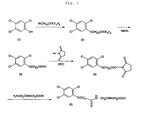
- the compound of formula (2) wherein R 1 , R 2 , R 3 and R 4 may be the same or different and represent chlorine or hydrogen, and n is an integer from 1 to 10, is activated by an activated ester method which comprises reacting the compound with N-hydroxysuccinimide to give an activated ester compound of formula (3) wherein R 1 , R 2 , R 3 and R 4 may be the same or different and represent chlorine or hydrogen, and n is an integer from 1 to 10.
- the compound of formula (3) is then reacted with an amino group-containing compound such as an amino acid or a peptide according to an ordinary method to give a compound of formula (1).
- the chlorophenol derivative of formula (2) used as the starting compound can be synthesized, for example, by the following method. Chlorophenol, potassium carbonate and ethyl 6-bromohexanoate are stirred at 60°C for 16 hours. After completion of the reaction, the reaction mixture is extracted with ethyl acetate. The extract is concentrated under reduced pressure and the residue is dissolved in ethanol. After addition of sodium hydroxide solution, the mixture is stirred at room temperature for 3 hours. After completion of the reaction, the reaction mixture is neutralized with concentrated hydrochloric acid and concentrated under reduced pressure. The resulting mixture is acidified by addition of concentrated hydrochloric acid, extracted with ethyl acetate, and recrystallized to give a chlorophenol derivative compound of formula (2).
- the dioxins immunoassay kit of the invention comprises the compound of formula (1) of the invention as a standard for dioxins quantitative determination.
- the anti-dioxin antibody may be prepared by the user or may be contained in the kit. A kit containing the antibody is convenient. The anti-dioxin antibody will be described later in another section.
- the kit may further comprise a competitive antigen. The competitive antigen will also be described later in another section.
- the kit may further comprise other items such as a reaction vessel, a blocking agent for masking the free surface of the vessel, a buffer, a secondary antibody for indirect competitive immunoassay and the like.
- the method of the invention is an immunoassay for dioxins quantitative determination using the compound of formula (1) as a standard. More specifically, the method of the invention is an immunoassay for calculating the concentration of dioxins in a sample, or for calculating the concentration of dioxins and further computing the TEQ, the method using the compound of formula (1) as a standard.
- the dioxins immunoassay of the invention comprises the following steps:
- the dioxins immunoassay of the invention is characterized by using the chlorophenol derivative of formula (1) as a standard for dioxins immunoassay and can be carried out using this standard in a similar manner as usual immunoassay.
- the compound of the invention is applicable to any known immunoassay method.
- known immunoassay methods include enzyme immunoassay (EIA), radioimmunoassay (RIA), fluorescence immunoassay (FIA), and the like.
- EIA is preferable in view of its simplicity of measurement.
- EIA includes competitive immunoassay, non-competitive immunoassay, homogeneous immunoassay, etc. Since dioxins are low molecular weight compounds, competitive assays may be usually used.
- Competitive immunoassay includes indirect competitive assays in which an antigen is immobilized on microplate wells, tubes or the like, and direct competitive assays in which an antibody is immobilized on microplate wells, tubes or the like.
- a dioxin or a complex of dioxin and carrier protein is used as a competitive antigen immobilized on wells.
- the reaction vessel is an untreated vessel made of resin, glass or the like
- a complex of dioxin and carrier protein is preferably used because it is difficult to immobilize a dioxin alone on the surface of the vessel.
- dioxin alone can be immobilized via the functional group on the vessel.
- linkers are preferably attached to dioxins, whereby steric hindrance is alleviated and the reactivity of the competitive antigen with the anti-dioxin antibody improves, resulting in enhanced assay sensitivity for dioxins in a sample.
- Examples of usable dioxins include polychlorinated dibenzo-p-dioxins (PCDDs), polychlorinated dibenzofurans (PCDFs) and coplanar polychlorinated biphenyls (Co-PCBs).
- PCDDs polychlorinated dibenzo-p-dioxins
- PCDFs polychlorinated dibenzofurans
- Co-PCBs coplanar polychlorinated biphenyls
- the carrier protein is not particularly limited and any known carrier proteins can be used.
- carrier proteins include KLM (Keyhole limpet hemocyanin), bovine serum albumin (BSA) and the like.
- the linker is preferably one that does not sterically hinder binding with the antibody nor adversely affect solubility in the reaction process.
- Examples of usable linkers include polymethylene chains and the like.
- the linker is disposed between the dioxins or dioxins-like compound and the container or between the carrier protein complex of the dioxin or dioxin-like compound and the container.
- the chlorophenol derivative of formula (1) of the invention can be used as a competitive antigen. It is particularly preferable that the competitive antigen be the same compound as the standard for the calibration curve preparation.
- an antigen to be immobilized can be produced by replacing the amino acid or peptide moiety at an end of the substituted compound of the standard represented by formula (1) with a carrier protein such as BSA.
- the antibody used in EIA can be prepared by a known method comprising haptenizing a dioxin such as polychlorinated dibenzo-p-dioxin (PCDD), polychlorinated dibenzofuran (PCDF) or coplanar polychlorinated biphenyl (Co-PCB), conjugating the hapten to a carrier protein such as BSA and immunizing a mammal using the conjugate as an immunization antigen (Kun Chae, et al., J. Agric. Food., 25, 1207-1209 (1977); Simona G. Merica, et al., Can. J. Chem., 73, 826-834 (1995)).
- a dioxin such as polychlorinated dibenzo-p-dioxin (PCDD), polychlorinated dibenzofuran (PCDF) or coplanar polychlorinated biphenyl (Co-PCB)
- PCDD polychlorinated dibenzo-p-di
- the antibody may be monoclonal or polyclonal and is not especially limited.
- the use of a monoclonal antibody is preferable in view of antibody homogeneity and unlikelihood of lot-to-lot differences in antibody production.
- the monoclonal antibody is an antibody obtained from single antibody-producing cells that are prepared by cloning a hybridoma produced by the fusion of a haptenized dioxins-immunized mouse spleen cell with a tumor cell. Any monoclonal antibody that recognizes dioxins can be used.
- the indirect competitive assay can be carried out, for example, in the following manner. First, the competitive antigen is immobilized on the surface of the wells of a reaction vessel such as a microplate. Then the portion of the surface of the wells to which the antigen is not attached is blocked with a commercially available blocking agent such as bovine serum albumin, casein or the like. A sample and a primary antibody (anti-dioxin antibody) is added to the wells, and the sample and the immobilized antigen are allowed to competitively interact with the antibody. Antibodies not bound to the immobilized antigen are removed by washing.
- a primary antibody anti-dioxin antibody
- a secondary antibody for example, an enzyme-labeled antibody prepared by labeling a goat anti-mouse immunoglobulin antibody with peroxidase (HRP), alkaline phosphatase (ALP) or like enzyme, is added to the wells and allowed to bind to the primary antibody binding to the immobilized antigen. After the resulting antibody conjugate is washed with buffer several times, the substrate for the labeled enzyme is added and absorbance of the colored enzymatic reaction product is measured.
- HRP peroxidase
- ALP alkaline phosphatase
- the enzyme is peroxidase
- hydrogen peroxide may be used as a substrate
- o-phenylenediamine or tetramethylbenzidine may be used as the coloring agent.
- alkaline phosphatase p-nitrophenylphosphoric acid is usually used as a substrate.
- the percentage of inhibition by a sample is obtained by determining the percent absorbance decrease by addition of a test sample relative to the absorbance of the sample-free reaction mixture.
- a competitive reaction is carried out in the same manner except using several known concentrations of the standard solution in place of the sample to prepare a calibration curve relating the standard solution concentrations and the percentage of inhibition.
- the dioxins concentration in the sample is calculated in terms of standard solution concentration by comparing the calibration curve and the percentage of inhibition.
- the anti-dioxin antibody is immobilized on the surface of the wells of a reaction vessel and the portion of the surface of the wells to which the antigen is not bound are blocked in the same manner as above.
- a competitive enzyme-labeled antibody and a test sample By adding a competitive enzyme-labeled antibody and a test sample to the wells, the sample and the enzyme-labeled antigen are allowed to competitively interact with the immobilized antibody.
- the enzyme-labeled antigen not bound to the antibody is then removed by washing and the substrate for the labeling enzyme is added to determine the absorbance of the reaction product.
- the enzyme-labeled antigen can be prepared by linking peroxidase, alkaline phosphatase or like enzyme to the same dioxin or dioxin-like compound used as a competitive antigen in indirect competitive immunoassay.
- an antigen prepared by replacing the amino acid or peptide moiety at an end of the compound of formula (1) with an enzyme such as peroxidase or alkaline phosphatase sensitivity is enhanced.
- a labeled antigen can be prepared by labeling the dioxins or dioxins-like compound with an isotope.
- a labeled antigen can be prepared by attaching a fluorescent substance such as rhodamine or a chemiluminescent substance to the dioxins or dioxins-like compound.
- the sample type is not specifically limited and may include, for example, environmental samples collected from the environment, biological samples, foods and like various products, and dioxin solutions prepared for experiments.
- the method of the invention is especially suitable for environmental samples for use as test samples. Examples of environmental samples include air; exhaust gases from automobiles, machines and devices, factories, and the like; soils; river, lake, harbor or port waters; combustion or fly ashes and the like.
- Biological samples include mothers' milk, blood and urine.
- test sample may be directly subjected to immunoassay or may be pretreated to extract a fraction containing large amounts of dioxin therefrom. Performing a pretreatment is preferable. Examples of pretreatment methods are given below, but are not limiting.
- a gas sample of A Nm 3 is collected and the substances contained therein are extracted with toluene.
- the extract is measured to 20ml and it is referred to as a crude extract.
- 10 ml of the extract is treated with sulfuric acid until the sulfuric acid layer becomes colorless.
- the treated extract is dissolved in hexane and cleaned up by applying it to a multilayered silica gel column comprising layers of 1 g of sodium sulfate, 1 g of 10% silver nitrate silica gel and 3 g of silica gel with 200ml of hexane.
- 1 ml of a DMSO solution containing this extract is subjected to immunoassay.
- TEQ(ng-TEQ/Nm 3 ) 0.0922 x Standard dioxins concentration ( ⁇ g/Nm 3 ) 0.8474
- 0.0922 and 0.8474 are coefficients in the correlation equation between the dioxins concentration in exhaust gases determined by the method of this invention in the Example and the dioxins TEQ obtained by the official method. These are constants assigned to each type of sample.
- Fly ashes (B g) are collected and the compounds contained therein are extracted with toluene.
- the extract is measured to 20ml and it is referred to as a crude extract. 1 ml of the extract is measured out and cleaned up. 2 ml of a DMSO solution containing this extract is subjected to immunoassay.
- TEQ(ng-TEQ/g) 0.0038 x[ Standard dioxins concentration ( ⁇ g/g)] 0.9796
- the values 0.0038 and 0.9796 are coefficients in the correlation equation between the dioxins concentration in fly ashes determined by the method of this invention in the Example and the dioxin TEQ obtained by the official method. These values are constants assigned to each type of sample.
- Soil (B g) is collected and the compounds contained therein extracted with toluene.
- the extract is measured to 20ml and it is referred to as a crude extract. 1 ml of the crude extract is measured out and cleaned up. 2 ml of a DMSO solution containing this extract is subjected to immunoassay.
- the values 9.4553 and 0.9352 are coefficients in the correlation equation between the dioxins concentration in fly ashes determined by the method of this invention in the Example and the dioxins TEQ obtained by the official method. These values are constants assigned to each type of sample. Unit conversion of the Standard dioxins concentration can be done in the same manner as in fly ashes.
- the ethyl 6-(2,4,5-trichlorophenoxy)hexanoate was dissolved in 200 ml of ethanol and then 200ml of 2N aqueous sodium hydroxide solution was added dropwise with ice-cooling and stirred at room temperature for 3 hours. After completion of the reaction, the reaction mixture was neutralized with 70 ml of concentrated hydrochloric acid and concentrated to half its original volume. The concentrated reaction mixture was acidified by addition of 5 ml of concentrated hydrochloric acid and extracted with 100 ml of ethyl acetate once and with 150 ml of ethyl acetate twice.
- the organic layer was concentrated to give 21.9 g of a white solid as a crude product.
- the crude product was purified by silica gel column chromatography (using 400 g of silica gel and methylene chloride as eluant for the first chromatographic step; using 330 g of silica gel and methylene chloride as eluant for the second chromatographic step) to give 9.73 g of succinimidyl 6-(2,4,5-trichlorophenoxyl)hexanoate (4) as a white solid (40.7% yield).
- succinimidyl 6-(2,4,5-trichlorophenoxyl)hexanoate (4) was dissolved in 100 ml of dimethyl sulfoxide. Then 100 ml of 50 mM aqueous glycylglycine solution was gradually added and stirred at room temperature for 3 hours to give an immunoassay standard solution for dioxins.
- a compound of formula (1) in which R 2 and R 3 are chlorine and R 1 and R 4 are hydrogen was synthesized in the same manner as above except that 2,4,6-trichlorophenol (commercially available product) was used as a starting compound in place of 2,4,5-trichlorophenol.
- a competitive assay antigen was prepared using succinimidyl 6-(2,4,5-trichlorophenoxyl)hexanoate (4) obtained in Example 1 and bovine serum albumin (BSA). More specifically, first, 545.5 ⁇ l of dimethyl sulfoxide was added to 1 ml of a bovine serum albumin (BSA) solution in 50mM phosphate buffer (pH 8.0) (corresponding to 15 mg (2.27 x 10 -7 mol of BSA)) with stirring while being cooled with ice.
- BSA bovine serum albumin
- Exhaust gas emitted from a waste incineration facilities was collected and the dioxins concentration of the sample was determined using a high performance gas chromatography-mass spectrometer (GC-MS) according to JIS K0311 (the official method).
- GC-MS gas chromatography-mass spectrometer
- about 3 Nm 3 of exhaust gas was sucked from the flue of a city waste incineration facilities using a gas sampling device and the sample was extracted with an organic solvent such as toluene or dichloromethane, selected in accordance with the form such as filter paper, resin or absorbent liquid.
- the concentrations of the dioxin isomers were then multiplied by their TEFs to obtain the dioxins TEQ of the exhaust gas sample.
- a competitive assay antigen prepared in Example 2 was dissolved in PBS to a concentration of about 1 ⁇ g/ml, and 100 ⁇ l of this solution was pipetted into each well.
- the plate was hermetically sealed and allowed to stand at 4°C for 18 hours to solidify the solution.
- the plate was washed with 0.05% Tween 20-containing PBS three times and 300 ⁇ l of a 5-fold diluted blocking solution (product of Nacalai Tesque Co.) was pipetted into each well.
- the plate was hermetically sealed and allowed to stand at 4°C overnight for blocking, thus giving a immunoassay plate for dioxins.
- dioxins immunoassay was performed in the following manner.
- the dioxins standard prepared in Example 1 was diluted with 50% DMSO containing 0.01% Triton X100 to produce a dilution series ranging from 0 to 0.2 ⁇ g/ml.
- the exhaust gas sample prepared in Example 3 was dissolved in DMSO and diluted with 50% DMSO containing 0.01% Triton X100 to give an assay sample.
- a hybridoma that produces an anti-dioxins monoclonal antibody was cultured in a serum-free medium in a CO 2 incubator at 37°C for 1 week or more and the culture supernatant thus obtained was purified by affinity chromatography using a protein A column and dialyzed in PBS to provide an anti-dioxins monoclonal antibody.
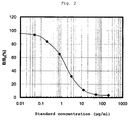
- a standard curve (calibration curve) was prepared from absorbance data obtained using the dioxins standard. Absorbance data obtained using the exhaust gas sample was compared and fitted to the calibration curve to determine the amount of dioxins in the sample in terms of standard substance concentration.
- Fig. 2 shows the obtained standard curve.
- B represents absorbance in the presence of the standard
- B 0 represents absorbance in the absence of the standard.
- Fig. 3 shows the correlation between dioxins TEQ obtained by quantitative determination using GC-MS in Example 3 and dioxins concentration in the sample obtained by performing immunoassay using the standard of the invention in Example 4.
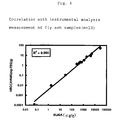
- TEQ in fly ash samples was calculated from the results of GC-MS in the same manner as in Example 3.
- Dioxin TEQ of fly ash samples was determined by EIA in the same manner as in Example 4.
- Fig. 4 shows the correlation between dioxins TEQ obtained by quantitative determination using GC-MS in Example 5 and dioxins concentration of the sample obtained by performing immunoassay using the standard of the invention in Example 6.
- TEQ in soil samples was calculated from the results of GC-MS analysis in the same manner as in Example 3.
- Fig. 5 shows the correlation between dioxins TEQ obtained by quantitative determination using GC-MS in Example 7 and dioxins concentration of the sample obtained by performing immunoassay using the standard of the invention in Example 8.
- the compound and method of the invention are suitable for quantitative determination of dioxins in environmental samples such as soil, air, exhaust gases, lake and river waters; biological samples such as mothers' milk, blood and urine; and products such as foods.
Landscapes
- Chemical & Material Sciences (AREA)
- Health & Medical Sciences (AREA)
- Life Sciences & Earth Sciences (AREA)
- Organic Chemistry (AREA)
- Molecular Biology (AREA)
- Engineering & Computer Science (AREA)
- Immunology (AREA)
- Biochemistry (AREA)
- Medicinal Chemistry (AREA)
- Hematology (AREA)
- General Health & Medical Sciences (AREA)
- Biomedical Technology (AREA)
- Urology & Nephrology (AREA)
- Genetics & Genomics (AREA)
- Food Science & Technology (AREA)
- Biotechnology (AREA)
- Cell Biology (AREA)
- Proteomics, Peptides & Aminoacids (AREA)
- Microbiology (AREA)
- Biophysics (AREA)
- Tropical Medicine & Parasitology (AREA)
- Physics & Mathematics (AREA)
- Analytical Chemistry (AREA)
- General Physics & Mathematics (AREA)
- Pathology (AREA)
- Peptides Or Proteins (AREA)
- Investigating Or Analysing Biological Materials (AREA)
Applications Claiming Priority (3)
| Application Number | Priority Date | Filing Date | Title |
|---|---|---|---|
| JP2002251616 | 2002-08-29 | ||
| JP2002251616 | 2002-08-29 | ||
| PCT/JP2003/010394 WO2004020397A1 (ja) | 2002-08-29 | 2003-08-18 | ダイオキシン類の免疫測定用標準品及びダイオキシン類の免疫測定法 |
Publications (2)
| Publication Number | Publication Date |
|---|---|
| EP1547999A1 true EP1547999A1 (de) | 2005-06-29 |
| EP1547999A4 EP1547999A4 (de) | 2006-05-03 |
Family
ID=31972689
Family Applications (1)
| Application Number | Title | Priority Date | Filing Date |
|---|---|---|---|
| EP03791222A Withdrawn EP1547999A4 (de) | 2002-08-29 | 2003-08-18 | Standardverbindung für einen immunassay auf dioxin und verfahren für einen immunassay auf dioxin |
Country Status (7)
| Country | Link |
|---|---|
| US (1) | US7211409B2 (de) |
| EP (1) | EP1547999A4 (de) |
| JP (1) | JP4476122B2 (de) |
| CN (1) | CN1315786C (de) |
| AU (1) | AU2003262242A1 (de) |
| TW (1) | TWI332492B (de) |
| WO (1) | WO2004020397A1 (de) |
Families Citing this family (6)
| Publication number | Priority date | Publication date | Assignee | Title |
|---|---|---|---|---|
| JP2004292367A (ja) * | 2003-03-27 | 2004-10-21 | Takuma Co Ltd | 2,4,5−トリクロロフェノキシアルキルカルボン酸およびそれを用いたダイオキシン類の測定方法 |
| US7767404B2 (en) * | 2005-08-16 | 2010-08-03 | Chipotle Business Group, Inc. | Apparatus and method for single-step immunosorbent assay for single and multiple analytes |
| US8735142B2 (en) * | 2005-08-16 | 2014-05-27 | Chipotle Business Group, Inc. | Systems and methods for immunosorbent assays for single and multiple analytes |
| CN101482538B (zh) * | 2008-01-11 | 2013-05-15 | 财团法人生物技术开发中心 | 戴奥辛检测装置及其检测方法 |
| JP5199944B2 (ja) * | 2009-05-14 | 2013-05-15 | 株式会社タクマ | ダイオキシン類の免疫測定方法 |
| US8877434B2 (en) * | 2012-04-19 | 2014-11-04 | Hsinyu Lee | Method and system of detecting dioxin-like compounds |
Family Cites Families (9)
| Publication number | Priority date | Publication date | Assignee | Title |
|---|---|---|---|---|
| US5145790A (en) * | 1990-05-04 | 1992-09-08 | Abbott Laboratories | Reagents and method for detecting polychlorinated biphenyls |
| US5538852A (en) * | 1992-10-02 | 1996-07-23 | Ecochem Research, Inc. | Immunoassay for polychlorinated biphenyls |
| WO1994028422A1 (en) * | 1993-05-28 | 1994-12-08 | Ensys Environmental Products Inc. | A polychlorinated biphenyls (pcb) immunoassay method, its components and a kit for use in performing the same |
| JP2002128731A (ja) * | 2000-10-25 | 2002-05-09 | Fujirebio Inc | フェノキシ化合物 |
| JP2002131316A (ja) * | 2000-10-25 | 2002-05-09 | Fujirebio Inc | 有機塩素化合物の測定方法 |
| JP2002155023A (ja) * | 2000-11-22 | 2002-05-28 | Fujirebio Inc | 置換フェノキシ化合物 |
| JP2002277467A (ja) * | 2001-03-15 | 2002-09-25 | Fujirebio Inc | 有機塩素化合物の免疫測定法 |
| US20030054424A1 (en) * | 2001-04-05 | 2003-03-20 | Allen Randy L. | Rapid and sensitive method for measuring PCB contamination |
| JP2004292367A (ja) * | 2003-03-27 | 2004-10-21 | Takuma Co Ltd | 2,4,5−トリクロロフェノキシアルキルカルボン酸およびそれを用いたダイオキシン類の測定方法 |
-
2003
- 2003-08-14 TW TW092122316A patent/TWI332492B/zh not_active IP Right Cessation
- 2003-08-18 US US10/525,626 patent/US7211409B2/en not_active Expired - Fee Related
- 2003-08-18 EP EP03791222A patent/EP1547999A4/de not_active Withdrawn
- 2003-08-18 AU AU2003262242A patent/AU2003262242A1/en not_active Abandoned
- 2003-08-18 JP JP2004532690A patent/JP4476122B2/ja not_active Expired - Fee Related
- 2003-08-18 CN CNB038205254A patent/CN1315786C/zh not_active Expired - Fee Related
- 2003-08-18 WO PCT/JP2003/010394 patent/WO2004020397A1/ja not_active Ceased
Also Published As
| Publication number | Publication date |
|---|---|
| TWI332492B (en) | 2010-11-01 |
| HK1075655A1 (en) | 2005-12-23 |
| JP4476122B2 (ja) | 2010-06-09 |
| WO2004020397A1 (ja) | 2004-03-11 |
| CN1315786C (zh) | 2007-05-16 |
| TW200415140A (en) | 2004-08-16 |
| AU2003262242A1 (en) | 2004-03-19 |
| AU2003262242A8 (en) | 2004-03-19 |
| JPWO2004020397A1 (ja) | 2005-12-15 |
| US20060166296A1 (en) | 2006-07-27 |
| CN1678568A (zh) | 2005-10-05 |
| US7211409B2 (en) | 2007-05-01 |
| EP1547999A4 (de) | 2006-05-03 |
Similar Documents
| Publication | Publication Date | Title |
|---|---|---|
| Long et al. | Portable optical immunosensor for highly sensitive detection of microcystin-LR in water samples | |
| Zhao et al. | Development of a highly sensitive, second antibody format chemiluminescence enzyme immunoassay for the determination of 17β-estradiol in wastewater | |
| Zhang et al. | Immunochemical detection of emerging organic contaminants in environmental waters | |
| CA1305929C (en) | Monoclonal antibodies and method for detecting dioxins and dibenzofurans | |
| Chiu et al. | A monoclonal immunoassay for the coplanar polychlorinated biphenyls | |
| Yakovleva et al. | Production of antibodies and development of enzyme-linked immunosorbent assays for the herbicide butachlor | |
| US7211409B2 (en) | Standard compound for immunoassay for dioxin and method of immunoassay for dioxin | |
| Darwish et al. | A prototype of ultrasensitive time-resolved fluoroimmunoassay for the quantitation of lead in plasma using a fluorescence-enhanced europium chelate label for the detection system | |
| JP2659220B2 (ja) | 除草剤の免疫学的検知方法 | |
| US5538852A (en) | Immunoassay for polychlorinated biphenyls | |
| Shi et al. | Synthesis of haptens and selective enzyme-linked immunosorbent assay of octachlorostyrene | |
| JPH01288766A (ja) | 低濃度のジオキシン類の免疫診断検出法 | |
| US5994145A (en) | Reagents, methods and kits for detecting trichloroethylene and perchloroethylene | |
| Noguera et al. | Development of an enzyme-linked immunosorbent assay for pentachlorophenol | |
| Krikunova et al. | Preliminary screening method for dioxin contamination using polarization fluoroimmunoassay for chlorinated phenoxyacid pesticides | |
| Schmidt et al. | Re-assessment of monoclonal antibodies against diclofenac for their application in the analysis of environmental waters | |
| Abuknesha et al. | Evaluation of a polyclonal antiserum to pentachlorothiophenol-acetic acid-KLH immunogen: binding properties and use with heterologous PCP derivatives in ELISA for pentachlorophenol | |
| HK1075655B (en) | Dioxins immunoassay standard and dioxins immunoassay method | |
| Noguera et al. | Development of an enzyme-linked immunosorbent assay for screening contamination by chlorophenols in environmental waters | |
| GB2312746A (en) | Immunoassay for an analyte in a water immiscible solvent | |
| US7166440B2 (en) | 2,4,5-trichlorophenoxyalkyl carboxylic acid and a method for determining dioxins using the same | |
| JP4276091B2 (ja) | 環境中のダイオキシン類の測定に適した抗ダイオキシン類モノクローナル抗体およびそれを産生するハイブリドーマ | |
| US6204005B1 (en) | Immunoassay for toxic congeners of polychlorinated biphenyls | |
| JP5041725B2 (ja) | 抗pcbモノクローナル抗体及びその製造方法、並びにpcb測定方法 | |
| JP5199944B2 (ja) | ダイオキシン類の免疫測定方法 |
Legal Events
| Date | Code | Title | Description |
|---|---|---|---|
| PUAI | Public reference made under article 153(3) epc to a published international application that has entered the european phase |
Free format text: ORIGINAL CODE: 0009012 |
|
| 17P | Request for examination filed |
Effective date: 20050303 |
|
| AK | Designated contracting states |
Kind code of ref document: A1 Designated state(s): AT BE BG CH CY CZ DE DK EE ES FI FR GB GR HU IE IT LI LU MC NL PT RO SE SI SK TR |
|
| AX | Request for extension of the european patent |
Extension state: AL LT LV MK |
|
| RIN1 | Information on inventor provided before grant (corrected) |
Inventor name: KATAOKA, SHIZUO,TAKUMA CO., LTD. Inventor name: MISHIMA, HIROTSUGU,TAKUMA CO., LTD. Inventor name: FUJIHIRA, HIROKI,TAKUMA CO., LTD. Inventor name: OKA, MASANORI,TOYO BOSEKI K.K. Inventor name: ISHIBASHI, TAKUYA,TOYO BOSEKI K.K. Inventor name: MATSUI, KAZUHIRO,TOYO BOSEKI K.K. Inventor name: NISHII, SHIGEAKI,TOYO BOSEKI K.K. |
|
| DAX | Request for extension of the european patent (deleted) | ||
| A4 | Supplementary search report drawn up and despatched |
Effective date: 20060316 |
|
| 17Q | First examination report despatched |
Effective date: 20071109 |
|
| GRAP | Despatch of communication of intention to grant a patent |
Free format text: ORIGINAL CODE: EPIDOSNIGR1 |
|
| STAA | Information on the status of an ep patent application or granted ep patent |
Free format text: STATUS: THE APPLICATION IS DEEMED TO BE WITHDRAWN |
|
| RAP1 | Party data changed (applicant data changed or rights of an application transferred) |
Owner name: TOYOBO CO., LTD. Owner name: TAKUMA CO., LTD. |
|
| 18D | Application deemed to be withdrawn |
Effective date: 20120915 |