EP1547172B1 - Verfahren zur herstellung von elektroden für energiespeichervorrichtungen - Google Patents
Verfahren zur herstellung von elektroden für energiespeichervorrichtungen Download PDFInfo
- Publication number
- EP1547172B1 EP1547172B1 EP03754715A EP03754715A EP1547172B1 EP 1547172 B1 EP1547172 B1 EP 1547172B1 EP 03754715 A EP03754715 A EP 03754715A EP 03754715 A EP03754715 A EP 03754715A EP 1547172 B1 EP1547172 B1 EP 1547172B1
- Authority
- EP
- European Patent Office
- Prior art keywords
- substrate
- salen
- conducting substrate
- redox polymer
- voltage
- Prior art date
- Legal status (The legal status is an assumption and is not a legal conclusion. Google has not performed a legal analysis and makes no representation as to the accuracy of the status listed.)
- Expired - Lifetime
Links
- 238000000034 method Methods 0.000 title claims abstract description 40
- 238000004519 manufacturing process Methods 0.000 title claims abstract description 16
- 238000004146 energy storage Methods 0.000 title claims description 8
- 229920000642 polymer Polymers 0.000 claims abstract description 76
- 239000000758 substrate Substances 0.000 claims abstract description 58
- 239000003792 electrolyte Substances 0.000 claims abstract description 32
- 150000004696 coordination complex Chemical class 0.000 claims abstract description 18
- 238000006116 polymerization reaction Methods 0.000 claims abstract description 9
- 239000002904 solvent Substances 0.000 claims abstract description 9
- VEUMANXWQDHAJV-UHFFFAOYSA-N 2-[2-[(2-hydroxyphenyl)methylideneamino]ethyliminomethyl]phenol Chemical compound OC1=CC=CC=C1C=NCCN=CC1=CC=CC=C1O VEUMANXWQDHAJV-UHFFFAOYSA-N 0.000 claims abstract description 7
- 150000001875 compounds Chemical class 0.000 claims abstract description 7
- 239000003960 organic solvent Substances 0.000 claims abstract description 7
- 230000003647 oxidation Effects 0.000 claims abstract description 7
- 238000007254 oxidation reaction Methods 0.000 claims abstract description 7
- 229910052723 transition metal Inorganic materials 0.000 claims abstract description 7
- 150000002500 ions Chemical class 0.000 claims abstract description 6
- 150000003624 transition metals Chemical class 0.000 claims abstract description 6
- WEVYAHXRMPXWCK-UHFFFAOYSA-N Acetonitrile Chemical compound CC#N WEVYAHXRMPXWCK-UHFFFAOYSA-N 0.000 claims description 24
- 229910052751 metal Inorganic materials 0.000 claims description 13
- 239000002184 metal Substances 0.000 claims description 13
- -1 tetrafluotoborates Chemical class 0.000 claims description 11
- CSCPPACGZOOCGX-UHFFFAOYSA-N Acetone Chemical compound CC(C)=O CSCPPACGZOOCGX-UHFFFAOYSA-N 0.000 claims description 8
- DZLFLBLQUQXARW-UHFFFAOYSA-N tetrabutylammonium Chemical class CCCC[N+](CCCC)(CCCC)CCCC DZLFLBLQUQXARW-UHFFFAOYSA-N 0.000 claims description 8
- 150000003839 salts Chemical class 0.000 claims description 7
- 229910052742 iron Inorganic materials 0.000 claims description 5
- 229910052759 nickel Inorganic materials 0.000 claims description 5
- 125000001424 substituent group Chemical group 0.000 claims description 5
- 229910019142 PO4 Inorganic materials 0.000 claims description 4
- 239000003575 carbonaceous material Substances 0.000 claims description 4
- 238000000576 coating method Methods 0.000 claims description 4
- 229910052763 palladium Inorganic materials 0.000 claims description 4
- 235000021317 phosphate Nutrition 0.000 claims description 4
- RUOJZAUFBMNUDX-UHFFFAOYSA-N propylene carbonate Chemical compound CC1COC(=O)O1 RUOJZAUFBMNUDX-UHFFFAOYSA-N 0.000 claims description 4
- CBXCPBUEXACCNR-UHFFFAOYSA-N tetraethylammonium Chemical class CC[N+](CC)(CC)CC CBXCPBUEXACCNR-UHFFFAOYSA-N 0.000 claims description 4
- ZCWKIFAQRXNZCH-UHFFFAOYSA-M tetramethylazanium;perchlorate Chemical class C[N+](C)(C)C.[O-]Cl(=O)(=O)=O ZCWKIFAQRXNZCH-UHFFFAOYSA-M 0.000 claims description 4
- 125000004066 1-hydroxyethyl group Chemical group [H]OC([H])([*])C([H])([H])[H] 0.000 claims description 3
- 229910052802 copper Inorganic materials 0.000 claims description 3
- 239000011248 coating agent Substances 0.000 claims description 2
- 229920001940 conductive polymer Polymers 0.000 claims description 2
- 238000004090 dissolution Methods 0.000 claims description 2
- 125000000956 methoxy group Chemical group [H]C([H])([H])O* 0.000 claims description 2
- 239000004020 conductor Substances 0.000 claims 1
- 239000008259 solid foam Substances 0.000 claims 1
- 230000015572 biosynthetic process Effects 0.000 description 19
- PXHVJJICTQNCMI-UHFFFAOYSA-N nickel Substances [Ni] PXHVJJICTQNCMI-UHFFFAOYSA-N 0.000 description 12
- 239000000126 substance Substances 0.000 description 10
- 239000003990 capacitor Substances 0.000 description 7
- 239000000243 solution Substances 0.000 description 7
- 239000000463 material Substances 0.000 description 6
- 239000000203 mixture Substances 0.000 description 6
- BASFCYQUMIYNBI-UHFFFAOYSA-N platinum Chemical compound [Pt] BASFCYQUMIYNBI-UHFFFAOYSA-N 0.000 description 6
- 230000010287 polarization Effects 0.000 description 6
- 230000007547 defect Effects 0.000 description 5
- 239000000178 monomer Substances 0.000 description 5
- KDLHZDBZIXYQEI-UHFFFAOYSA-N palladium Substances [Pd] KDLHZDBZIXYQEI-UHFFFAOYSA-N 0.000 description 5
- ZYDVNTYVDVZMKF-UHFFFAOYSA-N [Cl].[Ag] Chemical compound [Cl].[Ag] ZYDVNTYVDVZMKF-UHFFFAOYSA-N 0.000 description 4
- 239000002585 base Substances 0.000 description 4
- 230000007423 decrease Effects 0.000 description 4
- 238000007599 discharging Methods 0.000 description 4
- 239000012634 fragment Substances 0.000 description 4
- 238000010586 diagram Methods 0.000 description 3
- 230000033116 oxidation-reduction process Effects 0.000 description 3
- 229910052697 platinum Inorganic materials 0.000 description 3
- JBEGXWSLDJCTQZ-UHFFFAOYSA-N 2-[2-[(2-hydroxyphenyl)methylideneamino]ethyliminomethyl]phenol nickel Chemical compound [Ni].Oc1ccccc1C=NCCN=Cc1ccccc1O JBEGXWSLDJCTQZ-UHFFFAOYSA-N 0.000 description 2
- 150000001450 anions Chemical class 0.000 description 2
- 238000013461 design Methods 0.000 description 2
- 238000009792 diffusion process Methods 0.000 description 2
- 230000005611 electricity Effects 0.000 description 2
- 229910052762 osmium Inorganic materials 0.000 description 2
- VLTRZXGMWDSKGL-UHFFFAOYSA-M perchlorate Chemical compound [O-]Cl(=O)(=O)=O VLTRZXGMWDSKGL-UHFFFAOYSA-M 0.000 description 2
- 239000011148 porous material Substances 0.000 description 2
- 239000000047 product Substances 0.000 description 2
- 238000011946 reduction process Methods 0.000 description 2
- 229910052707 ruthenium Inorganic materials 0.000 description 2
- DKPSSMOJHLISJI-UHFFFAOYSA-N 1,10-phenanthrolin-5-amine Chemical compound C1=CC=C2C(N)=CC3=CC=CN=C3C2=N1 DKPSSMOJHLISJI-UHFFFAOYSA-N 0.000 description 1
- IWZAEAAZXRSXPX-UHFFFAOYSA-N 2-(4-ethenylpyridin-2-yl)-4-methylpyridine Chemical compound CC1=CC=NC(C=2N=CC=C(C=C)C=2)=C1 IWZAEAAZXRSXPX-UHFFFAOYSA-N 0.000 description 1
- NAZZKEZTSOOCSZ-UHFFFAOYSA-N 4-methyl-1,10-phenanthroline Chemical compound C1=CC2=CC=CN=C2C2=C1C(C)=CC=N2 NAZZKEZTSOOCSZ-UHFFFAOYSA-N 0.000 description 1
- XDUUQOQFSWSZSM-UHFFFAOYSA-N 5-chloro-1,10-phenanthroline Chemical compound C1=CC=C2C(Cl)=CC3=CC=CN=C3C2=N1 XDUUQOQFSWSZSM-UHFFFAOYSA-N 0.000 description 1
- OKTJSMMVPCPJKN-UHFFFAOYSA-N Carbon Chemical compound [C] OKTJSMMVPCPJKN-UHFFFAOYSA-N 0.000 description 1
- 229920000049 Carbon (fiber) Polymers 0.000 description 1
- LFQSCWFLJHTTHZ-UHFFFAOYSA-N Ethanol Chemical class CCO LFQSCWFLJHTTHZ-UHFFFAOYSA-N 0.000 description 1
- 208000012868 Overgrowth Diseases 0.000 description 1
- 239000004743 Polypropylene Substances 0.000 description 1
- 239000002262 Schiff base Substances 0.000 description 1
- 150000004753 Schiff bases Chemical class 0.000 description 1
- 239000007864 aqueous solution Substances 0.000 description 1
- 239000004917 carbon fiber Substances 0.000 description 1
- 150000001768 cations Chemical class 0.000 description 1
- 229910001914 chlorine tetroxide Inorganic materials 0.000 description 1
- 230000000052 comparative effect Effects 0.000 description 1
- 239000002322 conducting polymer Substances 0.000 description 1
- 238000007796 conventional method Methods 0.000 description 1
- 238000012937 correction Methods 0.000 description 1
- 239000013078 crystal Substances 0.000 description 1
- 238000011161 development Methods 0.000 description 1
- 238000001035 drying Methods 0.000 description 1
- 230000005518 electrochemistry Effects 0.000 description 1
- 238000006056 electrooxidation reaction Methods 0.000 description 1
- 239000002657 fibrous material Substances 0.000 description 1
- 239000006260 foam Substances 0.000 description 1
- 239000011521 glass Substances 0.000 description 1
- 229910002804 graphite Inorganic materials 0.000 description 1
- 239000010439 graphite Substances 0.000 description 1
- 239000003446 ligand Substances 0.000 description 1
- VNWKTOKETHGBQD-UHFFFAOYSA-N methane Chemical compound C VNWKTOKETHGBQD-UHFFFAOYSA-N 0.000 description 1
- 238000012544 monitoring process Methods 0.000 description 1
- 238000005457 optimization Methods 0.000 description 1
- 150000002902 organometallic compounds Chemical class 0.000 description 1
- VLTRZXGMWDSKGL-UHFFFAOYSA-N perchloric acid Chemical compound OCl(=O)(=O)=O VLTRZXGMWDSKGL-UHFFFAOYSA-N 0.000 description 1
- 125000001997 phenyl group Chemical group [H]C1=C([H])C([H])=C(*)C([H])=C1[H] 0.000 description 1
- IEQIEDJGQAUEQZ-UHFFFAOYSA-N phthalocyanine Chemical compound N1C(N=C2C3=CC=CC=C3C(N=C3C4=CC=CC=C4C(=N4)N3)=N2)=C(C=CC=C2)C2=C1N=C1C2=CC=CC=C2C4=N1 IEQIEDJGQAUEQZ-UHFFFAOYSA-N 0.000 description 1
- 229920001155 polypropylene Polymers 0.000 description 1
- 150000004032 porphyrins Chemical class 0.000 description 1
- 239000002244 precipitate Substances 0.000 description 1
- 229920006395 saturated elastomer Polymers 0.000 description 1
- 230000003595 spectral effect Effects 0.000 description 1
- 238000003786 synthesis reaction Methods 0.000 description 1
- 238000012360 testing method Methods 0.000 description 1
- 229910052720 vanadium Inorganic materials 0.000 description 1
- 238000005406 washing Methods 0.000 description 1
Images


Classifications
-
- H—ELECTRICITY
- H01—ELECTRIC ELEMENTS
- H01M—PROCESSES OR MEANS, e.g. BATTERIES, FOR THE DIRECT CONVERSION OF CHEMICAL ENERGY INTO ELECTRICAL ENERGY
- H01M4/00—Electrodes
- H01M4/02—Electrodes composed of, or comprising, active material
- H01M4/13—Electrodes for accumulators with non-aqueous electrolyte, e.g. for lithium-accumulators; Processes of manufacture thereof
- H01M4/139—Processes of manufacture
-
- H—ELECTRICITY
- H01—ELECTRIC ELEMENTS
- H01M—PROCESSES OR MEANS, e.g. BATTERIES, FOR THE DIRECT CONVERSION OF CHEMICAL ENERGY INTO ELECTRICAL ENERGY
- H01M4/00—Electrodes
- H01M4/02—Electrodes composed of, or comprising, active material
- H01M4/04—Processes of manufacture in general
- H01M4/0438—Processes of manufacture in general by electrochemical processing
-
- C—CHEMISTRY; METALLURGY
- C08—ORGANIC MACROMOLECULAR COMPOUNDS; THEIR PREPARATION OR CHEMICAL WORKING-UP; COMPOSITIONS BASED THEREON
- C08G—MACROMOLECULAR COMPOUNDS OBTAINED OTHERWISE THAN BY REACTIONS ONLY INVOLVING UNSATURATED CARBON-TO-CARBON BONDS
- C08G12/00—Condensation polymers of aldehydes or ketones with only compounds containing hydrogen attached to nitrogen
- C08G12/02—Condensation polymers of aldehydes or ketones with only compounds containing hydrogen attached to nitrogen of aldehydes
- C08G12/04—Condensation polymers of aldehydes or ketones with only compounds containing hydrogen attached to nitrogen of aldehydes with acyclic or carbocyclic compounds
- C08G12/06—Amines
-
- H—ELECTRICITY
- H01—ELECTRIC ELEMENTS
- H01G—CAPACITORS; CAPACITORS, RECTIFIERS, DETECTORS, SWITCHING DEVICES, LIGHT-SENSITIVE OR TEMPERATURE-SENSITIVE DEVICES OF THE ELECTROLYTIC TYPE
- H01G11/00—Hybrid capacitors, i.e. capacitors having different positive and negative electrodes; Electric double-layer [EDL] capacitors; Processes for the manufacture thereof or of parts thereof
- H01G11/84—Processes for the manufacture of hybrid or EDL capacitors, or components thereof
- H01G11/86—Processes for the manufacture of hybrid or EDL capacitors, or components thereof specially adapted for electrodes
-
- H—ELECTRICITY
- H01—ELECTRIC ELEMENTS
- H01G—CAPACITORS; CAPACITORS, RECTIFIERS, DETECTORS, SWITCHING DEVICES, LIGHT-SENSITIVE OR TEMPERATURE-SENSITIVE DEVICES OF THE ELECTROLYTIC TYPE
- H01G9/00—Electrolytic capacitors, rectifiers, detectors, switching devices, light-sensitive or temperature-sensitive devices; Processes of their manufacture
- H01G9/0029—Processes of manufacture
- H01G9/0036—Formation of the solid electrolyte layer
-
- H—ELECTRICITY
- H01—ELECTRIC ELEMENTS
- H01M—PROCESSES OR MEANS, e.g. BATTERIES, FOR THE DIRECT CONVERSION OF CHEMICAL ENERGY INTO ELECTRICAL ENERGY
- H01M10/00—Secondary cells; Manufacture thereof
- H01M10/05—Accumulators with non-aqueous electrolyte
-
- H—ELECTRICITY
- H01—ELECTRIC ELEMENTS
- H01M—PROCESSES OR MEANS, e.g. BATTERIES, FOR THE DIRECT CONVERSION OF CHEMICAL ENERGY INTO ELECTRICAL ENERGY
- H01M4/00—Electrodes
- H01M4/02—Electrodes composed of, or comprising, active material
- H01M4/04—Processes of manufacture in general
- H01M4/0438—Processes of manufacture in general by electrochemical processing
- H01M4/045—Electrochemical coating; Electrochemical impregnation
- H01M4/0452—Electrochemical coating; Electrochemical impregnation from solutions
-
- H—ELECTRICITY
- H01—ELECTRIC ELEMENTS
- H01M—PROCESSES OR MEANS, e.g. BATTERIES, FOR THE DIRECT CONVERSION OF CHEMICAL ENERGY INTO ELECTRICAL ENERGY
- H01M4/00—Electrodes
- H01M4/02—Electrodes composed of, or comprising, active material
- H01M4/04—Processes of manufacture in general
- H01M4/0438—Processes of manufacture in general by electrochemical processing
- H01M4/0464—Electro organic synthesis
- H01M4/0466—Electrochemical polymerisation
-
- H—ELECTRICITY
- H01—ELECTRIC ELEMENTS
- H01M—PROCESSES OR MEANS, e.g. BATTERIES, FOR THE DIRECT CONVERSION OF CHEMICAL ENERGY INTO ELECTRICAL ENERGY
- H01M4/00—Electrodes
- H01M4/02—Electrodes composed of, or comprising, active material
- H01M4/13—Electrodes for accumulators with non-aqueous electrolyte, e.g. for lithium-accumulators; Processes of manufacture thereof
- H01M4/137—Electrodes based on electro-active polymers
-
- H—ELECTRICITY
- H01—ELECTRIC ELEMENTS
- H01M—PROCESSES OR MEANS, e.g. BATTERIES, FOR THE DIRECT CONVERSION OF CHEMICAL ENERGY INTO ELECTRICAL ENERGY
- H01M4/00—Electrodes
- H01M4/02—Electrodes composed of, or comprising, active material
- H01M4/36—Selection of substances as active materials, active masses, active liquids
- H01M4/60—Selection of substances as active materials, active masses, active liquids of organic compounds
- H01M4/602—Polymers
- H01M4/606—Polymers containing aromatic main chain polymers
-
- Y—GENERAL TAGGING OF NEW TECHNOLOGICAL DEVELOPMENTS; GENERAL TAGGING OF CROSS-SECTIONAL TECHNOLOGIES SPANNING OVER SEVERAL SECTIONS OF THE IPC; TECHNICAL SUBJECTS COVERED BY FORMER USPC CROSS-REFERENCE ART COLLECTIONS [XRACs] AND DIGESTS
- Y02—TECHNOLOGIES OR APPLICATIONS FOR MITIGATION OR ADAPTATION AGAINST CLIMATE CHANGE
- Y02E—REDUCTION OF GREENHOUSE GAS [GHG] EMISSIONS, RELATED TO ENERGY GENERATION, TRANSMISSION OR DISTRIBUTION
- Y02E60/00—Enabling technologies; Technologies with a potential or indirect contribution to GHG emissions mitigation
- Y02E60/10—Energy storage using batteries
-
- Y—GENERAL TAGGING OF NEW TECHNOLOGICAL DEVELOPMENTS; GENERAL TAGGING OF CROSS-SECTIONAL TECHNOLOGIES SPANNING OVER SEVERAL SECTIONS OF THE IPC; TECHNICAL SUBJECTS COVERED BY FORMER USPC CROSS-REFERENCE ART COLLECTIONS [XRACs] AND DIGESTS
- Y02—TECHNOLOGIES OR APPLICATIONS FOR MITIGATION OR ADAPTATION AGAINST CLIMATE CHANGE
- Y02E—REDUCTION OF GREENHOUSE GAS [GHG] EMISSIONS, RELATED TO ENERGY GENERATION, TRANSMISSION OR DISTRIBUTION
- Y02E60/00—Enabling technologies; Technologies with a potential or indirect contribution to GHG emissions mitigation
- Y02E60/13—Energy storage using capacitors
Definitions
- the invention relates to the field of electrochemistry. More specifically, the invention relates to the methods of manufacture of electrodes chemically modified by a redox polymer intended for use in energy-storage devices (e.g. capacitors).
- energy-storage devices e.g. capacitors
- the known methods of manufacturing of electrodes with a polymer coating are mainly based on the chemical polymerization method, such as the ones described in U.S. Pat. No 4,999,263, U.S. Pat No 6,533,918, U.S. Pat. Appl. No 20020089807A1, which implies the formation of a polymer layer on a conducting substrate placed into an electrolytic bath with electrolyte- containing polymer compounds. Different polymer coatings are formed on the conducting substrate depending on the electrolytes used for this purpose.
- Redox polymers produced from the octahedral source complex compounds are known.
- Me Co, Fe, Ru, Os
- the engineering problem addressed by the present invention comprises the development of a method of manufacture of electrodes chemically modified by a redox polymer that offer a high specific energy capacity, making it possible to utilize these electrodes in energy-storage devices.
- a method of manufacture of an electrode is implemented as follows.
- a conducting substrate is placed in an electrolyte that contains an organic solvent, compounds capable of dissolving in said solvent [which dissolution is accompanied by the production of electrochemically inactive (at concentrations of no less than 0.01 mol/l) ions within the range of potentials from -3.0 V to +1.5 V] and a dissolved monomer - namely, metal complex poly-[Me(R-Salen)] at a concentration from 5x10 -5 mole/liter to that restricted by the solubility limit (where Me - transition metal, R - electron-donating substituent, Salen - residue of bis-(salicylaldehyde)-ethylenediamine in Schiff's base).
- the layer of a redox polymer can be applied onto a substrate surface via electrochemical polymerization of a metal complex poly-[Me(R-Salen)], resulting from the application of a voltage between electrode substrate (that serves as an anode) and counter-electrode (that serves as a cathode) submerged into the electrolyte.
- a material that offers a high value of the specific surface parameter that is characterized by good electronic conduction and that is electrochemically inactive within the range of potentials from -3.0 to +1.5 V (the potentials are given in comparison to a chlorine-silver electrode) can be used as a conducting substrate of the electrode.
- polymers (offering an electronic conduction property) in the form of films, porous structures, foams and so forth can be used as a conducting substrate.
- Acetonitrile, dimethyl ketone, or propylene carbonate can be used as said organic solvent that enters into the composition of the electrolyte.
- Salts of tetrabutyl ammonium, tetraethyl ammonium, and tetramethyl ammonium - perchlorates, tetrafluotoborates, hexafluoro phosphates - can be used as said compounds that enter into the composition of the electrolyte.
- a metal from the group Ni, Pd, Co, Cu, Fe is used as a transition metal Me in the said metal complex.
- a layer of a redox polymer is applied when the potential on said substrate is within the range from 0.85 V to 1.3 V (as comparised to a chlorine-silver electrode placed In the electrolyte). At that, a specific value of the potential shouldn't be higher than the potential of nonreversible oxidation of the redox polymer used - for example, 0.85 V for complex [Pd(CH 3 O-Salen)] or 1.3 V for complex [Ni(Cl-Salen)].
- Application of a layer of a redox polymer may be carried out by the simultaneous circulation of the electrolyte, which would allow to improve the quality of an electrode being produced.
- the distinctive feature of the electrode-manufacturing method encompasses the pulse mode of supplying the voltage between the substrate and counter-electrode.
- the duration of a voltage pulse may be from 1 s to 30 min with the pulse ratio being up to 3600.
- the pulse ratio means the relationship of the period of pulse repetition and the pulse duration. This relationship allows to optimize the mode of formation of the redox polymer layer and produce the electrodes offering an increased specific energy capacity.
- FIG. 1 A block diagram of an apparatus used for applying a redox polymer layer onto a substrate of an electrode in accordance with the method of the present invention is shown in Fig. 1.
- the apparatus comprises a reservoir 1, which is filled with an electrolyte 2 into which a conducting substrate 3, a comparison electrode 4 (e.g. chlorine-silver electrode), and a counter electrode 5 are submerged.
- Substrate 3 is electrically connected to the positive pole of a voltage source 6, while counter electrode 5 is connected to its negative pole.
- the Instrumentation for measuring and monitoring the voltage between substrate 3 and counter electrode 5 (a voltmeter 7), the voltage between substrate 3 and comparison electrode 4 (a voltmeter 8) and the intensity of the current flowing in the circuit of substrate 3 (an amperemeter 9) are connected according to the scheme shown in Fig. 1.
- Electrolyte 2 can be prepared from organic solvents such as the acetonitrile, dimethyl ketone, or propylene carbonate type. To prepare electrolyte 2, one should add certain substances to the above-referenced solvents. Such substances should be capable of dissolving in said solvents with the resulting concentration of no less than 0.01 mol/l and dissociating with the formation of electrochemically inactive (within the range of potentials from -3.0 V to +1.5 V) ions.
- organic solvents such as the acetonitrile, dimethyl ketone, or propylene carbonate type.
- the electrolyte contains dissolved metal complex [Me(R-Salen)], which is later used to form a redox polymer layer on electrode substrate 3.
- concentration of the dissolved metal complex can be from 5x10 -5 mole/liter and higher - up to a value restricted by the solubility limit of a metal complex in a solvent used on the process.
- a redox polymer layer on electrode substrate 3 takes place under the following conditions: voltage is applied from source 6 to in-between substrate 3 and counter electrode 5. In this process, the molecules of metal complex [Me(R-Salen)] located in electrolyte 2 are oxidized on the surface of conducting substrate 3, thus forming a redox polymer layer. This process is continued until the formation of a redox polymer layer of a required thickness is completed.
- the electrode manufactured in accordance with the above-described manner (after several auxiliary technological steps - e.g. washing and drying) can then be used in the design of an energy-storage device (e.g. a capacitor).
- an energy-storage device e.g. a capacitor
- a conducting substrate and said electrolyte with metal complex [Me(R-Salen)] represent the source materials for the electrode manufacture. These materials can be provided by any known appropriate method.
- An electrode having a higher specific energy capacity is produced in the case when in the course of a redox polymer layer formation voltage U is supplied between substrate 3 and counter electrode 5 in a pulse mode during a certain period of time ⁇ t with a periodicity T (see Fig. 2).
- Figs. 3(a)-(b) illustrate the formation of a redox polymer layer under the conditions of a pulse mode of voltage supply.
- Figs. 3(a)-(b) show electrode 11 (which is being manufactured) comprising substrate 12 with redox polymer layer 13 being formed on said substrate (this layer is shown as fragments 14 of the redox polymer with anions 15 (joined to these fragments) of the salt of electrolyte 16, into which substrate 12 is placed).
- anions 17 and cations 18 of the salt of electrolyte, as well as metal complex molecules 19 are also shown in Figs. 3(a)-(b).
- Diffusion of metal complex molecules 19 into the depth of redox polymer layer 13 being formed takes place during the breaks between the voltage pulses (see Fig. 3(a)).
- the voltage applied after such breaks provides for the correction of defects inside the volume of already formed layer 13 (see Fig. 3(b)).
- defects are, for example, individual stacks - i.e. fragments of a redox polymer, which stopped growing during the formation of the redox polymer layer for various reasons.
- the defects are corrected because metal complex molecules 19 have enough time to diffuse to a location where a defect is located during the breaks between the voltage pulses, and once they reach such a location, they get oxidized there.
- the metal complex molecules diffuse into the depth of the substrate material during the breaks between the voltage pulses.
- the use of the pulse mode of voltage application increases the total time needed to form a redox polymer layer, it makes it possible to make the electrodes with a redox polymer layer that offer an increased specific energy capacity.
- Selection of the optimal mode for the formation of the redox polymer layer depends upon a number of factors. Therefore, depending on a conducting substrate material used, the structure of a conducting substrate of an electrode, a metal complex, a composition and concentration of electrolyte, temperature, the electrolyte circulation parameters and required thickness of redox polymer layer to be formed, the value of voltage supplied, a pulse shape, a pulse duration and a time interval between pulses (voltage pulse ratio) can be different.
- the pulse mode of voltage application turns out to be useful for the manufacture of the electrodes offering a high specific energy capacity for the case of: production of a thick layer of a redox polymer, low porosity of the substrate, low concentration of a monomer in the electrolyte, high value of potential on the substrate, absence of circulation and low temperature of the electrolyte.
- Duration of the pulses may vary within the range from 1 s to 30 min.
- the duration of time intervals between the pulses may vary within the range from 10 s to 60 min.
- all of the above-indicated parameters of the pulsed voltage can vary according to any trend for the optimization of the process of redox polymer layer application. For instance, time intervals between the voltage pulses in the beginning of the process of the redox polymer layer formation may be shorter than those at the end of this process, while the duration of the voltage pulses will be shorter at the end of the process and longer in the beginning of the process.
- the supplied voltage can vary in such a way that the potential on the substrate changes according to a certain program - for example, according to the linear trend within the range from 0 to 1.3 V for complex [Ni(Cl-Salen)]; at that, the rate of the variation of a potential can vary within the range from 0.005 to 1 V/s. In general, selection of the parameters depends upon the required energy-accumulating characteristics of the redox polymer layer on the substrate.
- An electrode manufactured according to the described method can be used in energy-storage devices (for example, in an electrochemical capacitor).
- an electrochemical capacitor comprises a hermetically sealed casing filled with an electrolyte, with positive and negative electrodes located inside said casing.
- the electrodes may be separated by a porous separator - for example, by a microporous polypropylene film.
- An electrolyte for the capacitor can be prepared based on organic solvents of the acetonitrile, dimethyl ketone, or propylene carbonate type.
- organic solvents of the acetonitrile, dimethyl ketone, or propylene carbonate type To prepare an electrolyte for the capacitor, one should add certain substances to the solvents indicated above. Such substances should be capable of dissolving in said solvents with the resulting concentration of no less than 0.01 mol/l and dissociating with the formation of electrochemically inactive (within the range of potentials from -3.0 V to +1.5 V) ions, the diameter of which is no greater than 0.6 nm.
- Such substances are, for example, the salts of tetraethyl ammonium, tetramethyl ammonium - perchlorates, tetrafluotoborates, hexafluoro phosphates and other substances satisfying the above-indicated requirements.
- Illustrative examples of the implementation of the method of manufacturing an electrode are the following:
- comparative Example 1 A disk with a surface area of 38.5 cm 2 (manufactured from the commercially available crucible graphite glass) was used as a conducting substrate for an electrode.
- Ni(Salen) was used as a metal complex that forms a redox polymer.
- This complex was synthesized in the following manner. The synthesis of a nickel complex consisted in gradual pouring of the saturated ethanol solution of ligand SalEnH 2 (product of Aldrich Co.) to the saturated (at a temperature of 50°C) aqueous solution of salt of metal (Ni(ClO 4 ) 2 *6H 2 O (product of Aldrich Co.)). The resulting mixture was continuously stirred during this process at a room temperature until the crystals precipitated from the resulting solution. Then the formed precipitates were filtered under the vacuum.
- a redox polymer layer on the substrate surface was produced by the method of electrochemical polymerization under the conditions of potentiostatic polarization (application of a constant potential) with a potential on the substrate being 1.0 V (with respect to a chlorine-silver comparison electrode) for a period of 21 min in an acetonitrile solution that contained 10 -3 [Ni(salen)] mol/l of complex and 0.1 mol/l of tetrafluoroborate of tetrabutyl ammonium.
- the voltage was supplied in the pulse mode: a three-minute period of applied voltage (polarization) followed by three-minute break.
- the thickness of a polymer layer was equal to 0.2 ⁇ m.
- Tests were conducted after the electrode was manufactured.
- the charging and discharging of the electrode was conducted in an acetonitrile solution that contained the base electrolyte (0.1 mol/l of tetrafluoroborate of tetrabutyl ammonium).
- the charging mode was as follows: the galvano-static, current density was equal to 30 ⁇ A/cm 2 ; with the potential of electrode being monitored concurrently.
- the charging process was stopped when the value of the electrode potential reached 1.2 V.
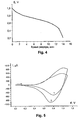
- the value of the specific energy stored (calculated from the data in Fig. 4) is equal to 290 J/g of the polymer.
- Example 2 To compare the parameters of an electrode produced in the constant voltage mode with those of an electrode produced in the pulse voltage mode, two electrodes were manufactured on a platinum substrate with an area of 0.3 cm 2 . At that, the formation of the redox polymer layer on both substrates was conducted in similar electrolytes that included an acetonitrile solution of the source complex [Ni(CH 3 O-Salen)] and 0.1 mol/l of tetrafluoroborate of tetrabutyl ammonium for one and the same effective period of time (10 minutes), but In the first case - in the constant voltage mode at a potential of 1.0 V, and in the second case - in the pulse voltage mode with the parameters being as follows: (5 polarization intervals - each of them lasted for 2 minutes - and breaks that lasted for 5 minutes).
Landscapes
- Engineering & Computer Science (AREA)
- Chemical & Material Sciences (AREA)
- Chemical Kinetics & Catalysis (AREA)
- Electrochemistry (AREA)
- Manufacturing & Machinery (AREA)
- General Chemical & Material Sciences (AREA)
- Power Engineering (AREA)
- Microelectronics & Electronic Packaging (AREA)
- Materials Engineering (AREA)
- Medicinal Chemistry (AREA)
- Polymers & Plastics (AREA)
- Organic Chemistry (AREA)
- Health & Medical Sciences (AREA)
- Battery Electrode And Active Subsutance (AREA)
- Electric Double-Layer Capacitors Or The Like (AREA)
- Secondary Cells (AREA)
Claims (13)
- Verfahren zur Herstellung einer Elektrode für Energiespeichervorrichtungen, umfassend:das Anlegen einer Spannung in einem Puls-Modus zwischen einem als Anode dienenden leitenden Substrat und einer Gegenelektrode als Kathode, beide Elektroden eintauchend in den Elektrolyten, enthaltend ein organisches Lösungsmittel, in diesem Lösungsmittel zur Löslichkeit befähigte Verbindungen, deren Auflösung durch die Bildung elektrochemisch inaktiver Ionen in Konzentrationen von nicht weniger als 0,01 mol/L innerhalb eines Potentialbereichs von -3,0 V bis +1,5 V begleitet wird, sowie einem MetallKomplex [Me(R-Salen)] in einer Konzentration von nicht weniger als 5·10-5 mol/L, wobei:Me ein Übergangsmetall ist, das mindestens zwei Oxidationsstufen aufweist,R ein Elektronen spendender Substituent,Salen ein Rückstand von Bis-(salicylaldehyd)-Ethylendiamin in Schiff scher Base ist, unddas Aufwachsen eines Redox-Polymers vom Poly-[Me(R-Salen)] -Typ auf dem leitenden Substrat durch elektrochemische Polymerisation bei der zwischen Anode und Kathode angelegten Spannung.
- Verfahren nach Anspruch 1, wobei die Dauer eines Spannungs-Pulses im Puls-Modus von 1 s bis 30 min. ist, bei einem Puls-Verhältnis von bis zu 3600.
- Verfahren nach Anspruch 1, wobei das leitende Substrat ein leitendes Material ist, das innerhalb eines Potentialbereichs von -3,0 V bis +1,5 V elektrochemisch inaktiv ist.
- Verfahren nach Anspruch 3, wobei das leitende Substrat ein Kohlenstoff-Material ist.
- Verfahren nach Anspruch 3, wobei das leitende Substrat ein Kohlenstoff-Material mit einer Metallbeschichtung ist.
- Verfahren nach Anspruch 3, wobei das leitende Substrat ein Metall ist, das einen hohen Wert an spezifischen Oberflächenparametern aufweist.
- Verfahren nach Anspruch 3, wobei das leitende Substrat ein elektrisch leitendes Polymer in Form eines Films, einer porösen Struktur oder eines festen Schaums ist.
- Verfahren nach Anspruch 1, wobei das organische Lösungsmittel Acetonitril, Dimethylketon oder Propylencarbonat umfasst.
- Verfahren nach Anspruch 1, wobei die Verbindungen Salze von Tetrabutylammonium-, Tetraethylammonium- und Tetramethylammonium-Perchlorat, -Tetrafluoroborat und -Hexafluorophosphat umfassen.
- Verfahren nach Anspruch 1, wobei das Übergangsmetall Me ausgewählt ist aus der Gruppe bestehend aus Ni, Pd, Co, Cu, Fe und Kombinationen daraus.
- Verfahren nach Anspruch 1, wobei das Aufwachsen des Redox-Polymers auf dem Substrat bei einer Spannung erfolgt, die nicht höher ist als die Spannung zur irreversiblen Oxidation des Redox-Polymers.
- Verfahren nach Anspruch 1, wobei der Elektronen spendende Substituent R CH3O-, C2H5O-, HO-, -CH3 umfasst.
- Verfahren nach Anspruch 1, weiterhin umfassend das Zirkulieren des Elektrolyten während des Aufwachsens des Redox-Polymers.
Applications Claiming Priority (3)
| Application Number | Priority Date | Filing Date | Title |
|---|---|---|---|
| US41338302P | 2002-09-25 | 2002-09-25 | |
| US413383P | 2002-09-25 | ||
| PCT/US2003/029363 WO2004030123A1 (en) | 2002-09-25 | 2003-09-15 | Method for the manufacture of electrode for energy-storage devices |
Publications (2)
| Publication Number | Publication Date |
|---|---|
| EP1547172A1 EP1547172A1 (de) | 2005-06-29 |
| EP1547172B1 true EP1547172B1 (de) | 2006-08-09 |
Family
ID=32043247
Family Applications (1)
| Application Number | Title | Priority Date | Filing Date |
|---|---|---|---|
| EP03754715A Expired - Lifetime EP1547172B1 (de) | 2002-09-25 | 2003-09-15 | Verfahren zur herstellung von elektroden für energiespeichervorrichtungen |
Country Status (12)
| Country | Link |
|---|---|
| US (1) | US7563354B2 (de) |
| EP (1) | EP1547172B1 (de) |
| JP (1) | JP4482453B2 (de) |
| KR (1) | KR100755284B1 (de) |
| AT (1) | ATE336082T1 (de) |
| AU (1) | AU2003272528A1 (de) |
| CA (1) | CA2500348C (de) |
| DE (1) | DE60307489T2 (de) |
| ES (1) | ES2270081T3 (de) |
| HK (1) | HK1079907B (de) |
| RU (1) | RU2005113150A (de) |
| WO (1) | WO2004030123A1 (de) |
Cited By (1)
| Publication number | Priority date | Publication date | Assignee | Title |
|---|---|---|---|---|
| CN105261758A (zh) * | 2015-09-02 | 2016-01-20 | 杭州聚力氢能科技有限公司 | 一种Schiff碱聚合物及其合成方法与应用 |
Families Citing this family (13)
| Publication number | Priority date | Publication date | Assignee | Title |
|---|---|---|---|---|
| AU2003269306A1 (en) * | 2002-10-03 | 2004-04-23 | Gen3 Partners, Inc | Electrochemical capacitor and method of use |
| CA2501562A1 (en) * | 2002-10-07 | 2004-04-15 | Alexander Lyubomirskiy | Method of manufacture of an electrode for electrochemical devices |
| PT1678728E (pt) * | 2003-10-14 | 2009-11-24 | Gen3 Partners Inc | Eléctrodo para dispositivos de armazenamento de energia e super-condensador electroquímico com base nesse eléctrodo |
| JP4783632B2 (ja) * | 2004-09-30 | 2011-09-28 | 日本ケミコン株式会社 | 電極材料および電気化学素子 |
| JP2008515132A (ja) * | 2004-09-30 | 2008-05-08 | 日本ケミコン株式会社 | 電極材料の製造方法 |
| JP2008546210A (ja) * | 2005-06-10 | 2008-12-18 | 日本ケミコン株式会社 | 電気化学素子用電極の製造方法及びそれを有する電気化学素子の製造方法 |
| CA2647744A1 (en) * | 2006-03-24 | 2007-10-04 | Gen 3 Partners, Inc. | Method for manufacturing an energy storage device |
| US7981259B2 (en) * | 2006-06-14 | 2011-07-19 | Applied Materials, Inc. | Electrolytic capacitor for electric field modulation |
| KR100786579B1 (ko) * | 2006-12-20 | 2007-12-21 | 한국화학연구원 | 스텝 전위법을 이용한 금속 촉매 전극의 제조 방법 |
| WO2016044857A1 (en) * | 2014-09-15 | 2016-03-24 | Powermers Inc. | Metal air energy storage device |
| RU2618232C1 (ru) | 2015-12-28 | 2017-05-03 | Пауэрмерс Инк. | Катод для металло-воздушных источников тока и металло-воздушный источник тока, включающий этот катод |
| CN108103523B (zh) * | 2017-12-07 | 2019-06-25 | 湖北文理学院 | Ni-Salen配合物的制备方法及Ni-Salen配合物 |
| CN112979897B (zh) * | 2021-03-22 | 2022-08-09 | 南昌航空大学 | 一种可愈合的离子凝胶聚合物电解质的制备方法 |
Family Cites Families (20)
| Publication number | Priority date | Publication date | Assignee | Title |
|---|---|---|---|---|
| US3962250A (en) * | 1969-12-30 | 1976-06-08 | Snam Progetti S.P.A. | Oxidation products of cobalt complexes, process for obtaining same and insertion process |
| US4666567A (en) * | 1981-07-31 | 1987-05-19 | The Boeing Company | Automated alternating polarity pulse electrolytic processing of electrically conductive substances |
| DE3244900A1 (de) * | 1982-12-04 | 1984-06-07 | Basf Ag, 6700 Ludwigshafen | Batterie oder elektrochemischer speicher auf basis von elektrochemisch oxidierbaren und/oder reduzierbaren polymeren |
| DE3406472A1 (de) * | 1984-02-23 | 1985-08-29 | Basf Ag, 6700 Ludwigshafen | Elektrochemische zelle oder batterie |
| JPS60180064A (ja) | 1984-02-24 | 1985-09-13 | Tdk Corp | 2次電池 |
| JPS6130689A (ja) | 1984-07-23 | 1986-02-12 | Matsushita Electric Ind Co Ltd | 電解重合法 |
| US4695358A (en) * | 1985-11-08 | 1987-09-22 | Florida State University | Method of removing SO2, NOX and particles from gas mixtures using streamer corona |
| US4999263A (en) * | 1987-04-15 | 1991-03-12 | Ricoh Company, Ltd. | Sheet-shaped electrode, method or producing the same, and secondary battery |
| FR2714077B1 (fr) | 1993-12-21 | 1996-03-08 | Lorraine Laminage | Procédé et bain de dépôt électrolytique de polypyrrole sur une surface de métal oxydable par électropolymérisation. |
| US5543326A (en) * | 1994-03-04 | 1996-08-06 | Heller; Adam | Biosensor including chemically modified enzymes |
| US5840443A (en) * | 1995-07-31 | 1998-11-24 | Midwest Research Institute | Redox polymer electrodes for advanced batteries |
| US5729427A (en) * | 1997-01-08 | 1998-03-17 | Motorola, Inc. | Macrocyclic complex modified electrodes and capacitors made therefrom |
| US6323309B1 (en) * | 1997-12-01 | 2001-11-27 | Massachusetts Institute Of Technology | Conducting polymer transition metal hybrid materials and sensors |
| US6294245B1 (en) * | 1999-09-22 | 2001-09-25 | Agilent Technologies, Inc. | Method for depositing electrically conducting polymer films via electrochemical deposition of precursor polymers |
| IL137796A0 (en) * | 2000-08-10 | 2001-10-31 | Elestor Ltd | All-solid-state polymer electrochemical capacitors |
| CA2474484C (en) * | 2002-01-25 | 2013-03-26 | Powermers, Inc. | Polymer-modified electrode for energy storage devices and electrochemical supercapacitor based on said polymer-modified electrode |
| US6802951B2 (en) * | 2002-01-28 | 2004-10-12 | Medtronic, Inc. | Methods of anodizing valve metal anodes |
| AU2003269306A1 (en) * | 2002-10-03 | 2004-04-23 | Gen3 Partners, Inc | Electrochemical capacitor and method of use |
| CA2501562A1 (en) * | 2002-10-07 | 2004-04-15 | Alexander Lyubomirskiy | Method of manufacture of an electrode for electrochemical devices |
| CA2647744A1 (en) * | 2006-03-24 | 2007-10-04 | Gen 3 Partners, Inc. | Method for manufacturing an energy storage device |
-
2003
- 2003-09-15 WO PCT/US2003/029363 patent/WO2004030123A1/en not_active Ceased
- 2003-09-15 JP JP2004540107A patent/JP4482453B2/ja not_active Expired - Fee Related
- 2003-09-15 CA CA2500348A patent/CA2500348C/en not_active Expired - Fee Related
- 2003-09-15 AT AT03754715T patent/ATE336082T1/de not_active IP Right Cessation
- 2003-09-15 KR KR1020057005236A patent/KR100755284B1/ko not_active Expired - Fee Related
- 2003-09-15 ES ES03754715T patent/ES2270081T3/es not_active Expired - Lifetime
- 2003-09-15 DE DE60307489T patent/DE60307489T2/de not_active Expired - Lifetime
- 2003-09-15 EP EP03754715A patent/EP1547172B1/de not_active Expired - Lifetime
- 2003-09-15 RU RU2005113150/09A patent/RU2005113150A/ru not_active Application Discontinuation
- 2003-09-15 HK HK05112094.5A patent/HK1079907B/en not_active IP Right Cessation
- 2003-09-15 AU AU2003272528A patent/AU2003272528A1/en not_active Abandoned
-
2005
- 2005-03-24 US US11/088,509 patent/US7563354B2/en not_active Expired - Lifetime
Cited By (2)
| Publication number | Priority date | Publication date | Assignee | Title |
|---|---|---|---|---|
| CN105261758A (zh) * | 2015-09-02 | 2016-01-20 | 杭州聚力氢能科技有限公司 | 一种Schiff碱聚合物及其合成方法与应用 |
| CN105261758B (zh) * | 2015-09-02 | 2017-10-03 | 杭州聚力氢能科技有限公司 | 一种Schiff碱聚合物及其合成方法与应用 |
Also Published As
| Publication number | Publication date |
|---|---|
| US7563354B2 (en) | 2009-07-21 |
| US20050217998A1 (en) | 2005-10-06 |
| HK1079907A1 (en) | 2006-04-13 |
| AU2003272528A1 (en) | 2004-04-19 |
| RU2005113150A (ru) | 2005-09-10 |
| CA2500348A1 (en) | 2004-04-08 |
| CA2500348C (en) | 2013-04-23 |
| WO2004030123A1 (en) | 2004-04-08 |
| HK1079907B (en) | 2006-11-10 |
| KR100755284B1 (ko) | 2007-09-05 |
| JP2006500784A (ja) | 2006-01-05 |
| JP4482453B2 (ja) | 2010-06-16 |
| ES2270081T3 (es) | 2007-04-01 |
| KR20050075338A (ko) | 2005-07-20 |
| ATE336082T1 (de) | 2006-09-15 |
| DE60307489T2 (de) | 2007-02-15 |
| EP1547172A1 (de) | 2005-06-29 |
| DE60307489D1 (de) | 2006-09-21 |
Similar Documents
| Publication | Publication Date | Title |
|---|---|---|
| US20100188801A1 (en) | Method of Manufacture of an Energy Storage Device | |
| EP1547172B1 (de) | Verfahren zur herstellung von elektroden für energiespeichervorrichtungen | |
| EP1547105B1 (de) | Elektrochemischer kondensator und verfahren zu dessen verwendung | |
| WO2007112075A2 (en) | Method for manufacturing an energy storage device | |
| Krasikova et al. | In situ electrochemical microbalance studies of polymerization and redox processes in polymeric complexes of transition metals with Schiff bases | |
| JP2631910B2 (ja) | ポリマー二次電池用ポリピロール成形体およびその製造方法 | |
| Elliott et al. | Electrochromic and Conductivity Behavior of Tris [Ester-Substituted Bipyridine] Ruthenium [II] Polymers on Electrodes | |
| WO2025171375A1 (en) | Organic cathode materials for magnesium ion batteries | |
| JPH06243715A (ja) | ポリピロール成形体の製造方法 | |
| EA046980B1 (ru) | Электроактивный полимер, способ его получения и электрод для энергозапасающих устройств на его основе | |
| Lupu | Electrochemical impedance spectroscopy study of electron transfer at poly (3, 4-ethylenedioxythiophene) containing gold nanoparticles coating | |
| Berkes et al. | ELECTROCHEMICAL NANOGRAVIMETRIC STUDY OF THE ADSORPTION AND ELECTROPOLYMERIZATION OF INDOLE AND 4-AMINOINDOLE |
Legal Events
| Date | Code | Title | Description |
|---|---|---|---|
| PUAI | Public reference made under article 153(3) epc to a published international application that has entered the european phase |
Free format text: ORIGINAL CODE: 0009012 |
|
| 17P | Request for examination filed |
Effective date: 20050420 |
|
| AK | Designated contracting states |
Kind code of ref document: A1 Designated state(s): AT BE BG CH CY CZ DE DK EE ES FI FR GB GR HU IE IT LI LU MC NL PT RO SE SI SK TR |
|
| AX | Request for extension of the european patent |
Extension state: AL LT LV MK |
|
| 17Q | First examination report despatched |
Effective date: 20050701 |
|
| DAX | Request for extension of the european patent (deleted) | ||
| GRAP | Despatch of communication of intention to grant a patent |
Free format text: ORIGINAL CODE: EPIDOSNIGR1 |
|
| REG | Reference to a national code |
Ref country code: HK Ref legal event code: DE Ref document number: 1079907 Country of ref document: HK |
|
| GRAS | Grant fee paid |
Free format text: ORIGINAL CODE: EPIDOSNIGR3 |
|
| GRAA | (expected) grant |
Free format text: ORIGINAL CODE: 0009210 |
|
| AK | Designated contracting states |
Kind code of ref document: B1 Designated state(s): AT BE BG CH CY CZ DE DK EE ES FI FR GB GR HU IE IT LI LU MC NL PT RO SE SI SK TR |
|
| PG25 | Lapsed in a contracting state [announced via postgrant information from national office to epo] |
Ref country code: SI Free format text: LAPSE BECAUSE OF FAILURE TO SUBMIT A TRANSLATION OF THE DESCRIPTION OR TO PAY THE FEE WITHIN THE PRESCRIBED TIME-LIMIT Effective date: 20060809 Ref country code: CZ Free format text: LAPSE BECAUSE OF FAILURE TO SUBMIT A TRANSLATION OF THE DESCRIPTION OR TO PAY THE FEE WITHIN THE PRESCRIBED TIME-LIMIT Effective date: 20060809 Ref country code: SK Free format text: LAPSE BECAUSE OF FAILURE TO SUBMIT A TRANSLATION OF THE DESCRIPTION OR TO PAY THE FEE WITHIN THE PRESCRIBED TIME-LIMIT Effective date: 20060809 Ref country code: RO Free format text: LAPSE BECAUSE OF FAILURE TO SUBMIT A TRANSLATION OF THE DESCRIPTION OR TO PAY THE FEE WITHIN THE PRESCRIBED TIME-LIMIT Effective date: 20060809 Ref country code: AT Free format text: LAPSE BECAUSE OF FAILURE TO SUBMIT A TRANSLATION OF THE DESCRIPTION OR TO PAY THE FEE WITHIN THE PRESCRIBED TIME-LIMIT Effective date: 20060809 Ref country code: BE Free format text: LAPSE BECAUSE OF FAILURE TO SUBMIT A TRANSLATION OF THE DESCRIPTION OR TO PAY THE FEE WITHIN THE PRESCRIBED TIME-LIMIT Effective date: 20060809 |
|
| REG | Reference to a national code |
Ref country code: GB Ref legal event code: FG4D |
|
| REG | Reference to a national code |
Ref country code: CH Ref legal event code: EP |
|
| REG | Reference to a national code |
Ref country code: IE Ref legal event code: FG4D |
|
| PG25 | Lapsed in a contracting state [announced via postgrant information from national office to epo] |
Ref country code: IE Free format text: LAPSE BECAUSE OF NON-PAYMENT OF DUE FEES Effective date: 20060915 |
|
| REF | Corresponds to: |
Ref document number: 60307489 Country of ref document: DE Date of ref document: 20060921 Kind code of ref document: P |
|
| PG25 | Lapsed in a contracting state [announced via postgrant information from national office to epo] |
Ref country code: MC Free format text: LAPSE BECAUSE OF NON-PAYMENT OF DUE FEES Effective date: 20060930 |
|
| PG25 | Lapsed in a contracting state [announced via postgrant information from national office to epo] |
Ref country code: BG Free format text: LAPSE BECAUSE OF FAILURE TO SUBMIT A TRANSLATION OF THE DESCRIPTION OR TO PAY THE FEE WITHIN THE PRESCRIBED TIME-LIMIT Effective date: 20061109 Ref country code: DK Free format text: LAPSE BECAUSE OF FAILURE TO SUBMIT A TRANSLATION OF THE DESCRIPTION OR TO PAY THE FEE WITHIN THE PRESCRIBED TIME-LIMIT Effective date: 20061109 Ref country code: SE Free format text: LAPSE BECAUSE OF FAILURE TO SUBMIT A TRANSLATION OF THE DESCRIPTION OR TO PAY THE FEE WITHIN THE PRESCRIBED TIME-LIMIT Effective date: 20061109 |
|
| REG | Reference to a national code |
Ref country code: HK Ref legal event code: GR Ref document number: 1079907 Country of ref document: HK |
|
| PG25 | Lapsed in a contracting state [announced via postgrant information from national office to epo] |
Ref country code: PT Free format text: LAPSE BECAUSE OF FAILURE TO SUBMIT A TRANSLATION OF THE DESCRIPTION OR TO PAY THE FEE WITHIN THE PRESCRIBED TIME-LIMIT Effective date: 20070109 |
|
| ET | Fr: translation filed | ||
| REG | Reference to a national code |
Ref country code: ES Ref legal event code: FG2A Ref document number: 2270081 Country of ref document: ES Kind code of ref document: T3 |
|
| PLBE | No opposition filed within time limit |
Free format text: ORIGINAL CODE: 0009261 |
|
| STAA | Information on the status of an ep patent application or granted ep patent |
Free format text: STATUS: NO OPPOSITION FILED WITHIN TIME LIMIT |
|
| 26N | No opposition filed |
Effective date: 20070510 |
|
| PG25 | Lapsed in a contracting state [announced via postgrant information from national office to epo] |
Ref country code: GR Free format text: LAPSE BECAUSE OF FAILURE TO SUBMIT A TRANSLATION OF THE DESCRIPTION OR TO PAY THE FEE WITHIN THE PRESCRIBED TIME-LIMIT Effective date: 20061110 |
|
| PG25 | Lapsed in a contracting state [announced via postgrant information from national office to epo] |
Ref country code: EE Free format text: LAPSE BECAUSE OF FAILURE TO SUBMIT A TRANSLATION OF THE DESCRIPTION OR TO PAY THE FEE WITHIN THE PRESCRIBED TIME-LIMIT Effective date: 20060809 |
|
| PG25 | Lapsed in a contracting state [announced via postgrant information from national office to epo] |
Ref country code: TR Free format text: LAPSE BECAUSE OF FAILURE TO SUBMIT A TRANSLATION OF THE DESCRIPTION OR TO PAY THE FEE WITHIN THE PRESCRIBED TIME-LIMIT Effective date: 20060809 Ref country code: HU Free format text: LAPSE BECAUSE OF FAILURE TO SUBMIT A TRANSLATION OF THE DESCRIPTION OR TO PAY THE FEE WITHIN THE PRESCRIBED TIME-LIMIT Effective date: 20070210 Ref country code: LU Free format text: LAPSE BECAUSE OF NON-PAYMENT OF DUE FEES Effective date: 20060915 |
|
| PG25 | Lapsed in a contracting state [announced via postgrant information from national office to epo] |
Ref country code: CY Free format text: LAPSE BECAUSE OF FAILURE TO SUBMIT A TRANSLATION OF THE DESCRIPTION OR TO PAY THE FEE WITHIN THE PRESCRIBED TIME-LIMIT Effective date: 20060809 |
|
| PGFP | Annual fee paid to national office [announced via postgrant information from national office to epo] |
Ref country code: FR Payment date: 20120323 Year of fee payment: 9 Ref country code: CH Payment date: 20120307 Year of fee payment: 9 |
|
| PGFP | Annual fee paid to national office [announced via postgrant information from national office to epo] |
Ref country code: GB Payment date: 20120301 Year of fee payment: 9 Ref country code: IT Payment date: 20120302 Year of fee payment: 9 |
|
| PGFP | Annual fee paid to national office [announced via postgrant information from national office to epo] |
Ref country code: NL Payment date: 20120319 Year of fee payment: 9 |
|
| REG | Reference to a national code |
Ref country code: NL Ref legal event code: V1 Effective date: 20130401 |
|
| REG | Reference to a national code |
Ref country code: CH Ref legal event code: PL |
|
| GBPC | Gb: european patent ceased through non-payment of renewal fee |
Effective date: 20120915 |
|
| REG | Reference to a national code |
Ref country code: FR Ref legal event code: ST Effective date: 20130531 |
|
| PG25 | Lapsed in a contracting state [announced via postgrant information from national office to epo] |
Ref country code: DE Free format text: LAPSE BECAUSE OF NON-PAYMENT OF DUE FEES Effective date: 20130403 Ref country code: GB Free format text: LAPSE BECAUSE OF NON-PAYMENT OF DUE FEES Effective date: 20120915 Ref country code: CH Free format text: LAPSE BECAUSE OF NON-PAYMENT OF DUE FEES Effective date: 20120930 Ref country code: LI Free format text: LAPSE BECAUSE OF NON-PAYMENT OF DUE FEES Effective date: 20120930 |
|
| PG25 | Lapsed in a contracting state [announced via postgrant information from national office to epo] |
Ref country code: FR Free format text: LAPSE BECAUSE OF NON-PAYMENT OF DUE FEES Effective date: 20121001 Ref country code: IT Free format text: LAPSE BECAUSE OF NON-PAYMENT OF DUE FEES Effective date: 20120915 Ref country code: NL Free format text: LAPSE BECAUSE OF NON-PAYMENT OF DUE FEES Effective date: 20130401 |
|
| REG | Reference to a national code |
Ref country code: DE Ref legal event code: R073 Ref document number: 60307489 Country of ref document: DE |
|
| REG | Reference to a national code |
Ref country code: DE Ref legal event code: R119 Ref document number: 60307489 Country of ref document: DE Effective date: 20130403 |
|
| REG | Reference to a national code |
Ref country code: FR Ref legal event code: RN Effective date: 20130827 |
|
| REG | Reference to a national code |
Ref country code: DE Ref legal event code: R074 Ref document number: 60307489 Country of ref document: DE |
|
| REG | Reference to a national code |
Ref country code: DE Ref legal event code: R074 Ref document number: 60307489 Country of ref document: DE Effective date: 20131022 Ref country code: DE Ref legal event code: R074 Ref document number: 60307489 Country of ref document: DE Effective date: 20131025 |
|
| REG | Reference to a national code |
Ref country code: FR Ref legal event code: D5 Effective date: 20131217 |
|
| PGRI | Patent reinstated in contracting state [announced from national office to epo] |
Ref country code: DE Effective date: 20131022 |
|
| REG | Reference to a national code |
Ref country code: DE Ref legal event code: R082 Ref document number: 60307489 Country of ref document: DE Representative=s name: REICHERT & LINDNER PARTNERSCHAFT PATENTANWAELT, DE Ref country code: DE Ref legal event code: R081 Ref document number: 60307489 Country of ref document: DE Owner name: POWERMERS, INC., WESTERVILLE, US Free format text: FORMER OWNER: GEN3 PARTNERS, INC., BOSTON, MA., US |
|
| REG | Reference to a national code |
Ref country code: ES Ref legal event code: PC2A Owner name: POWERMERS, INC Effective date: 20150807 |
|
| PGFP | Annual fee paid to national office [announced via postgrant information from national office to epo] |
Ref country code: DE Payment date: 20180904 Year of fee payment: 16 |
|
| PGFP | Annual fee paid to national office [announced via postgrant information from national office to epo] |
Ref country code: FI Payment date: 20180910 Year of fee payment: 16 |
|
| PGFP | Annual fee paid to national office [announced via postgrant information from national office to epo] |
Ref country code: ES Payment date: 20181001 Year of fee payment: 16 |
|
| REG | Reference to a national code |
Ref country code: DE Ref legal event code: R119 Ref document number: 60307489 Country of ref document: DE |
|
| REG | Reference to a national code |
Ref country code: FI Ref legal event code: MAE |
|
| PG25 | Lapsed in a contracting state [announced via postgrant information from national office to epo] |
Ref country code: FI Free format text: LAPSE BECAUSE OF NON-PAYMENT OF DUE FEES Effective date: 20190915 |
|
| PG25 | Lapsed in a contracting state [announced via postgrant information from national office to epo] |
Ref country code: DE Free format text: LAPSE BECAUSE OF NON-PAYMENT OF DUE FEES Effective date: 20200401 |
|
| REG | Reference to a national code |
Ref country code: ES Ref legal event code: FD2A Effective date: 20210128 |
|
| PG25 | Lapsed in a contracting state [announced via postgrant information from national office to epo] |
Ref country code: ES Free format text: LAPSE BECAUSE OF NON-PAYMENT OF DUE FEES Effective date: 20190916 |