EP1545574B1 - Verfahren zur reinigung von polypeptiden durch simulierte chromatographie im fliessbett - Google Patents
Verfahren zur reinigung von polypeptiden durch simulierte chromatographie im fliessbett Download PDFInfo
- Publication number
- EP1545574B1 EP1545574B1 EP03754547.2A EP03754547A EP1545574B1 EP 1545574 B1 EP1545574 B1 EP 1545574B1 EP 03754547 A EP03754547 A EP 03754547A EP 1545574 B1 EP1545574 B1 EP 1545574B1
- Authority
- EP
- European Patent Office
- Prior art keywords
- zone
- elution
- wash
- antibody
- solid phase
- Prior art date
- Legal status (The legal status is an assumption and is not a legal conclusion. Google has not performed a legal analysis and makes no representation as to the accuracy of the status listed.)
- Expired - Lifetime
Links
- 238000000034 method Methods 0.000 title description 45
- 238000004587 chromatography analysis Methods 0.000 title description 20
- 108090000765 processed proteins & peptides Proteins 0.000 title description 2
- 229920001184 polypeptide Polymers 0.000 title 1
- 102000004196 processed proteins & peptides Human genes 0.000 title 1
- 238000010828 elution Methods 0.000 claims description 54
- 239000007790 solid phase Substances 0.000 claims description 46
- 102000004169 proteins and genes Human genes 0.000 claims description 37
- 108090000623 proteins and genes Proteins 0.000 claims description 37
- 150000001875 compounds Chemical class 0.000 claims description 24
- 239000000872 buffer Substances 0.000 claims description 23
- 108010021625 Immunoglobulin Fragments Proteins 0.000 claims description 21
- 102000008394 Immunoglobulin Fragments Human genes 0.000 claims description 21
- 239000000203 mixture Substances 0.000 claims description 18
- 230000008929 regeneration Effects 0.000 claims description 16
- 238000011069 regeneration method Methods 0.000 claims description 16
- 239000012530 fluid Substances 0.000 claims description 14
- 239000012149 elution buffer Substances 0.000 claims description 10
- 238000011067 equilibration Methods 0.000 claims description 10
- 238000001042 affinity chromatography Methods 0.000 claims description 8
- 239000003446 ligand Substances 0.000 claims description 8
- 230000027455 binding Effects 0.000 claims description 6
- 101710120037 Toxin CcdB Proteins 0.000 claims description 5
- 239000011534 wash buffer Substances 0.000 claims description 5
- NWUYHJFMYQTDRP-UHFFFAOYSA-N 1,2-bis(ethenyl)benzene;1-ethenyl-2-ethylbenzene;styrene Chemical compound C=CC1=CC=CC=C1.CCC1=CC=CC=C1C=C.C=CC1=CC=CC=C1C=C NWUYHJFMYQTDRP-UHFFFAOYSA-N 0.000 claims description 3
- 239000003729 cation exchange resin Substances 0.000 claims description 2
- 230000008569 process Effects 0.000 description 27
- 238000001179 sorption measurement Methods 0.000 description 25
- 239000000047 product Substances 0.000 description 24
- 210000004027 cell Anatomy 0.000 description 14
- 238000000926 separation method Methods 0.000 description 14
- 238000010586 diagram Methods 0.000 description 12
- 238000004113 cell culture Methods 0.000 description 10
- 239000003463 adsorbent Substances 0.000 description 9
- 230000000694 effects Effects 0.000 description 9
- 238000012546 transfer Methods 0.000 description 9
- 238000004458 analytical method Methods 0.000 description 8
- 239000012071 phase Substances 0.000 description 8
- 238000000746 purification Methods 0.000 description 8
- 239000003480 eluent Substances 0.000 description 7
- 238000012545 processing Methods 0.000 description 7
- 241000700605 Viruses Species 0.000 description 5
- 239000000427 antigen Substances 0.000 description 5
- 102000036639 antigens Human genes 0.000 description 5
- 108091007433 antigens Proteins 0.000 description 5
- 230000008901 benefit Effects 0.000 description 5
- 238000002955 isolation Methods 0.000 description 5
- 239000011347 resin Substances 0.000 description 5
- 229920005989 resin Polymers 0.000 description 5
- 239000000243 solution Substances 0.000 description 5
- CEAZRRDELHUEMR-URQXQFDESA-N Gentamicin Chemical compound O1[C@H](C(C)NC)CC[C@@H](N)[C@H]1O[C@H]1[C@H](O)[C@@H](O[C@@H]2[C@@H]([C@@H](NC)[C@@](C)(O)CO2)O)[C@H](N)C[C@@H]1N CEAZRRDELHUEMR-URQXQFDESA-N 0.000 description 4
- 229930182566 Gentamicin Natural products 0.000 description 4
- DHMQDGOQFOQNFH-UHFFFAOYSA-N Glycine Chemical compound NCC(O)=O DHMQDGOQFOQNFH-UHFFFAOYSA-N 0.000 description 4
- FAPWRFPIFSIZLT-UHFFFAOYSA-M Sodium chloride Chemical compound [Na+].[Cl-] FAPWRFPIFSIZLT-UHFFFAOYSA-M 0.000 description 4
- 239000007983 Tris buffer Substances 0.000 description 4
- 238000011091 antibody purification Methods 0.000 description 4
- 239000010432 diamond Substances 0.000 description 4
- 230000004907 flux Effects 0.000 description 4
- 229960002518 gentamicin Drugs 0.000 description 4
- 150000003839 salts Chemical class 0.000 description 4
- LENZDBCJOHFCAS-UHFFFAOYSA-N tris Chemical compound OCC(N)(CO)CO LENZDBCJOHFCAS-UHFFFAOYSA-N 0.000 description 4
- XLYOFNOQVPJJNP-UHFFFAOYSA-N water Chemical compound O XLYOFNOQVPJJNP-UHFFFAOYSA-N 0.000 description 4
- QTBSBXVTEAMEQO-UHFFFAOYSA-N Acetic acid Chemical compound CC(O)=O QTBSBXVTEAMEQO-UHFFFAOYSA-N 0.000 description 3
- 108060003951 Immunoglobulin Proteins 0.000 description 3
- HEMHJVSKTPXQMS-UHFFFAOYSA-M Sodium hydroxide Chemical compound [OH-].[Na+] HEMHJVSKTPXQMS-UHFFFAOYSA-M 0.000 description 3
- 150000001413 amino acids Chemical group 0.000 description 3
- 238000005277 cation exchange chromatography Methods 0.000 description 3
- 238000013375 chromatographic separation Methods 0.000 description 3
- 230000007423 decrease Effects 0.000 description 3
- 238000010790 dilution Methods 0.000 description 3
- 239000012895 dilution Substances 0.000 description 3
- 239000006185 dispersion Substances 0.000 description 3
- 239000006167 equilibration buffer Substances 0.000 description 3
- 102000018358 immunoglobulin Human genes 0.000 description 3
- 239000007788 liquid Substances 0.000 description 3
- 239000000463 material Substances 0.000 description 3
- 230000009467 reduction Effects 0.000 description 3
- 239000012492 regenerant Substances 0.000 description 3
- 108090000695 Cytokines Proteins 0.000 description 2
- 102000004127 Cytokines Human genes 0.000 description 2
- KCXVZYZYPLLWCC-UHFFFAOYSA-N EDTA Chemical compound OC(=O)CN(CC(O)=O)CCN(CC(O)=O)CC(O)=O KCXVZYZYPLLWCC-UHFFFAOYSA-N 0.000 description 2
- 239000004471 Glycine Substances 0.000 description 2
- NBIIXXVUZAFLBC-UHFFFAOYSA-N Phosphoric acid Chemical compound OP(O)(O)=O NBIIXXVUZAFLBC-UHFFFAOYSA-N 0.000 description 2
- 229920004890 Triton X-100 Polymers 0.000 description 2
- 239000013504 Triton X-100 Substances 0.000 description 2
- XSQUKJJJFZCRTK-UHFFFAOYSA-N Urea Chemical compound NC(N)=O XSQUKJJJFZCRTK-UHFFFAOYSA-N 0.000 description 2
- 238000005571 anion exchange chromatography Methods 0.000 description 2
- 125000002057 carboxymethyl group Chemical group [H]OC(=O)C([H])([H])[*] 0.000 description 2
- 238000005341 cation exchange Methods 0.000 description 2
- 238000005119 centrifugation Methods 0.000 description 2
- 238000011210 chromatographic step Methods 0.000 description 2
- 239000012539 chromatography resin Substances 0.000 description 2
- 238000004140 cleaning Methods 0.000 description 2
- 238000004440 column chromatography Methods 0.000 description 2
- 239000000356 contaminant Substances 0.000 description 2
- 238000012937 correction Methods 0.000 description 2
- 239000002158 endotoxin Substances 0.000 description 2
- 230000007717 exclusion Effects 0.000 description 2
- 239000000706 filtrate Substances 0.000 description 2
- 102000037865 fusion proteins Human genes 0.000 description 2
- 108020001507 fusion proteins Proteins 0.000 description 2
- 230000008570 general process Effects 0.000 description 2
- 238000011534 incubation Methods 0.000 description 2
- 238000011068 loading method Methods 0.000 description 2
- 239000008213 purified water Substances 0.000 description 2
- 239000012557 regeneration buffer Substances 0.000 description 2
- 239000011780 sodium chloride Substances 0.000 description 2
- 238000003860 storage Methods 0.000 description 2
- 239000000725 suspension Substances 0.000 description 2
- 230000001360 synchronised effect Effects 0.000 description 2
- 230000007704 transition Effects 0.000 description 2
- PJVXUVWGSCCGHT-ZPYZYFCMSA-N (2r,3s,4r,5r)-2,3,4,5,6-pentahydroxyhexanal;(3s,4r,5r)-1,3,4,5,6-pentahydroxyhexan-2-one Chemical compound OC[C@@H](O)[C@@H](O)[C@H](O)[C@@H](O)C=O.OC[C@@H](O)[C@@H](O)[C@H](O)C(=O)CO PJVXUVWGSCCGHT-ZPYZYFCMSA-N 0.000 description 1
- HBAQYPYDRFILMT-UHFFFAOYSA-N 8-[3-(1-cyclopropylpyrazol-4-yl)-1H-pyrazolo[4,3-d]pyrimidin-5-yl]-3-methyl-3,8-diazabicyclo[3.2.1]octan-2-one Chemical class C1(CC1)N1N=CC(=C1)C1=NNC2=C1N=C(N=C2)N1C2C(N(CC1CC2)C)=O HBAQYPYDRFILMT-UHFFFAOYSA-N 0.000 description 1
- 229920000936 Agarose Polymers 0.000 description 1
- 102100022005 B-lymphocyte antigen CD20 Human genes 0.000 description 1
- 241000219310 Beta vulgaris subsp. vulgaris Species 0.000 description 1
- 239000002028 Biomass Substances 0.000 description 1
- 108010029697 CD40 Ligand Proteins 0.000 description 1
- 101150013553 CD40 gene Proteins 0.000 description 1
- 102100032937 CD40 ligand Human genes 0.000 description 1
- 229930091371 Fructose Natural products 0.000 description 1
- 239000005715 Fructose Substances 0.000 description 1
- RFSUNEUAIZKAJO-ARQDHWQXSA-N Fructose Chemical compound OC[C@H]1O[C@](O)(CO)[C@@H](O)[C@@H]1O RFSUNEUAIZKAJO-ARQDHWQXSA-N 0.000 description 1
- 101000897405 Homo sapiens B-lymphocyte antigen CD20 Proteins 0.000 description 1
- 101000878605 Homo sapiens Low affinity immunoglobulin epsilon Fc receptor Proteins 0.000 description 1
- 101000716102 Homo sapiens T-cell surface glycoprotein CD4 Proteins 0.000 description 1
- 101000914484 Homo sapiens T-lymphocyte activation antigen CD80 Proteins 0.000 description 1
- 102000017727 Immunoglobulin Variable Region Human genes 0.000 description 1
- 108010067060 Immunoglobulin Variable Region Proteins 0.000 description 1
- 102100038007 Low affinity immunoglobulin epsilon Fc receptor Human genes 0.000 description 1
- 102000007056 Recombinant Fusion Proteins Human genes 0.000 description 1
- 108010008281 Recombinant Fusion Proteins Proteins 0.000 description 1
- 240000000111 Saccharum officinarum Species 0.000 description 1
- 235000007201 Saccharum officinarum Nutrition 0.000 description 1
- 229920002684 Sepharose Polymers 0.000 description 1
- 229930006000 Sucrose Natural products 0.000 description 1
- CZMRCDWAGMRECN-UGDNZRGBSA-N Sucrose Chemical compound O[C@H]1[C@H](O)[C@@H](CO)O[C@@]1(CO)O[C@@H]1[C@H](O)[C@@H](O)[C@H](O)[C@@H](CO)O1 CZMRCDWAGMRECN-UGDNZRGBSA-N 0.000 description 1
- 235000021536 Sugar beet Nutrition 0.000 description 1
- 102100036011 T-cell surface glycoprotein CD4 Human genes 0.000 description 1
- 102100027222 T-lymphocyte activation antigen CD80 Human genes 0.000 description 1
- 239000004809 Teflon Substances 0.000 description 1
- 229920006362 Teflon® Polymers 0.000 description 1
- 102100040245 Tumor necrosis factor receptor superfamily member 5 Human genes 0.000 description 1
- 238000005377 adsorption chromatography Methods 0.000 description 1
- 229910000147 aluminium phosphate Inorganic materials 0.000 description 1
- 238000005349 anion exchange Methods 0.000 description 1
- 150000001450 anions Chemical class 0.000 description 1
- 239000003242 anti bacterial agent Substances 0.000 description 1
- 229940088710 antibiotic agent Drugs 0.000 description 1
- 238000013459 approach Methods 0.000 description 1
- 230000004071 biological effect Effects 0.000 description 1
- 238000013368 capillary electrophoresis sodium dodecyl sulfate analysis Methods 0.000 description 1
- 239000004202 carbamide Substances 0.000 description 1
- 210000004978 chinese hamster ovary cell Anatomy 0.000 description 1
- 238000010668 complexation reaction Methods 0.000 description 1
- 239000002131 composite material Substances 0.000 description 1
- 238000009295 crossflow filtration Methods 0.000 description 1
- 230000003247 decreasing effect Effects 0.000 description 1
- 230000001419 dependent effect Effects 0.000 description 1
- 238000011118 depth filtration Methods 0.000 description 1
- 238000013461 design Methods 0.000 description 1
- 238000011026 diafiltration Methods 0.000 description 1
- 238000009792 diffusion process Methods 0.000 description 1
- 238000005516 engineering process Methods 0.000 description 1
- 210000003722 extracellular fluid Anatomy 0.000 description 1
- 239000012527 feed solution Substances 0.000 description 1
- 238000000855 fermentation Methods 0.000 description 1
- 230000004151 fermentation Effects 0.000 description 1
- 238000001914 filtration Methods 0.000 description 1
- 238000005194 fractionation Methods 0.000 description 1
- 238000001879 gelation Methods 0.000 description 1
- 238000007429 general method Methods 0.000 description 1
- 239000011521 glass Substances 0.000 description 1
- 238000003306 harvesting Methods 0.000 description 1
- 238000004128 high performance liquid chromatography Methods 0.000 description 1
- 230000016784 immunoglobulin production Effects 0.000 description 1
- 229940072221 immunoglobulins Drugs 0.000 description 1
- 239000012535 impurity Substances 0.000 description 1
- 229910052500 inorganic mineral Inorganic materials 0.000 description 1
- 238000004255 ion exchange chromatography Methods 0.000 description 1
- 239000003456 ion exchange resin Substances 0.000 description 1
- 229920003303 ion-exchange polymer Polymers 0.000 description 1
- 239000007791 liquid phase Substances 0.000 description 1
- 239000012516 mab select resin Substances 0.000 description 1
- 238000013508 migration Methods 0.000 description 1
- 230000005012 migration Effects 0.000 description 1
- 239000011707 mineral Substances 0.000 description 1
- 239000000178 monomer Substances 0.000 description 1
- 238000001728 nano-filtration Methods 0.000 description 1
- 230000007935 neutral effect Effects 0.000 description 1
- 238000004810 partition chromatography Methods 0.000 description 1
- 230000001766 physiological effect Effects 0.000 description 1
- 239000002244 precipitate Substances 0.000 description 1
- 238000011027 product recovery Methods 0.000 description 1
- 238000001742 protein purification Methods 0.000 description 1
- 238000010188 recombinant method Methods 0.000 description 1
- 238000011084 recovery Methods 0.000 description 1
- 238000011012 sanitization Methods 0.000 description 1
- 238000013341 scale-up Methods 0.000 description 1
- 210000002966 serum Anatomy 0.000 description 1
- 238000001542 size-exclusion chromatography Methods 0.000 description 1
- 239000007787 solid Substances 0.000 description 1
- 230000009870 specific binding Effects 0.000 description 1
- 238000012799 strong cation exchange Methods 0.000 description 1
- 239000000126 substance Substances 0.000 description 1
- 239000005720 sucrose Substances 0.000 description 1
- 229920005613 synthetic organic polymer Polymers 0.000 description 1
- 235000020357 syrup Nutrition 0.000 description 1
- 239000006188 syrup Substances 0.000 description 1
- 238000012360 testing method Methods 0.000 description 1
- 238000000108 ultra-filtration Methods 0.000 description 1
- 238000011144 upstream manufacturing Methods 0.000 description 1
- 238000005406 washing Methods 0.000 description 1
- 239000002699 waste material Substances 0.000 description 1
- 238000012784 weak cation exchange Methods 0.000 description 1
Images






Classifications
-
- G—PHYSICS
- G01—MEASURING; TESTING
- G01N—INVESTIGATING OR ANALYSING MATERIALS BY DETERMINING THEIR CHEMICAL OR PHYSICAL PROPERTIES
- G01N30/00—Investigating or analysing materials by separation into components using adsorption, absorption or similar phenomena or using ion-exchange, e.g. chromatography or field flow fractionation
- G01N30/02—Column chromatography
-
- B—PERFORMING OPERATIONS; TRANSPORTING
- B01—PHYSICAL OR CHEMICAL PROCESSES OR APPARATUS IN GENERAL
- B01D—SEPARATION
- B01D15/00—Separating processes involving the treatment of liquids with solid sorbents; Apparatus therefor
- B01D15/08—Selective adsorption, e.g. chromatography
- B01D15/10—Selective adsorption, e.g. chromatography characterised by constructional or operational features
- B01D15/18—Selective adsorption, e.g. chromatography characterised by constructional or operational features relating to flow patterns
- B01D15/1814—Recycling of the fraction to be distributed
- B01D15/1821—Simulated moving beds
- B01D15/185—Simulated moving beds characterised by the components to be separated
-
- C—CHEMISTRY; METALLURGY
- C07—ORGANIC CHEMISTRY
- C07K—PEPTIDES
- C07K1/00—General methods for the preparation of peptides, i.e. processes for the organic chemical preparation of peptides or proteins of any length
- C07K1/14—Extraction; Separation; Purification
- C07K1/16—Extraction; Separation; Purification by chromatography
-
- B—PERFORMING OPERATIONS; TRANSPORTING
- B01—PHYSICAL OR CHEMICAL PROCESSES OR APPARATUS IN GENERAL
- B01D—SEPARATION
- B01D15/00—Separating processes involving the treatment of liquids with solid sorbents; Apparatus therefor
- B01D15/08—Selective adsorption, e.g. chromatography
- B01D15/26—Selective adsorption, e.g. chromatography characterised by the separation mechanism
- B01D15/38—Selective adsorption, e.g. chromatography characterised by the separation mechanism involving specific interaction not covered by one or more of groups B01D15/265 and B01D15/30 - B01D15/36, e.g. affinity, ligand exchange or chiral chromatography
- B01D15/3804—Affinity chromatography
- B01D15/3809—Affinity chromatography of the antigen-antibody type, e.g. protein A, G or L chromatography
-
- G—PHYSICS
- G01—MEASURING; TESTING
- G01N—INVESTIGATING OR ANALYSING MATERIALS BY DETERMINING THEIR CHEMICAL OR PHYSICAL PROPERTIES
- G01N30/00—Investigating or analysing materials by separation into components using adsorption, absorption or similar phenomena or using ion-exchange, e.g. chromatography or field flow fractionation
- G01N30/02—Column chromatography
- G01N30/26—Conditioning of the fluid carrier; Flow patterns
- G01N30/38—Flow patterns
- G01N30/46—Flow patterns using more than one column
- G01N30/468—Flow patterns using more than one column involving switching between different column configurations
Definitions
- the present invention is directed to methods of purifying antibodies or antibody fragments using simulated moving bed chromatography and to simulated moving bed chromatography systems and apparatus suitable for purifying antibodies or antibody fragments.
- Chromatographic separations used for protein purification are traditionally performed in batch mode, i.e. a single packed column is used and equilibration, load, wash, elution and regeneration/cleaning are performed sequentially. This mode leads to a comparatively long process with fairly low overall throughput.
- chromatography columns are loaded only to their so-called dynamic capacity which usually is 30 to 50% of their equilibrium capacity. This in turn requires using columns of two to three times the volume than would be needed if the columns were operated in equilibrium. Since protein chromatography resins are very expensive, this has major economic consequences adding to the cost of purification of product. Additionally, wash and elution processes in batch column chromatography require substantial fluid volumes, which is also due to the batch mode of operation which has economic consequences since the purified water used must be specially treated.
- SMB chromatography has been used in the petrochemical and mineral industries. SMB chromatography has also found application in the pharmaceutical industry for the separation of enantiomers. US 5,770,088 discloses a simulated moving bed chromatographic separation process.
- SMB chromatography examples include, for example, the separation of fructose from fructose-glucose solutions and the separation of sucrose from sugar beet or sugar cane syrups.
- Solution components are differentially absorbed by the ion exchange resin so that a separation waveform develops within the simulated moving bed.
- the present invention provides an SMB system for separating an antibody or antibody fragment from at least one immaterial component where both are present in a fluid mixture, wherein the SMB system incorporates a plurality of zones comprising a solid phase which is contacted countercurrently by the fluid mixture and wherein said zones comprise:
- said solid phase comprises a ligand for affinity chromatography.
- said solid phase comprises Protein A or Protein G.
- said solid phase comprises a cation exchange resin.
- Suitable antibodies and antibody fragments include those which bind to an antigen selected from the group consisting of CD20, CD40, CD40L, CD23, CD4, CD80 and CD86.
- immunoreactive compound refers to a compound which comprises an antigen binding region and/or a constant region from an immunoglobulin. In one aspect, included is a compound which binds to an antigen.
- An immunoreactive compound may additionally comprise peptide sequences from non-antibody compounds, such as cytokines, cytokine ligands and other antigens.
- Such immunoreactive compounds include antibodies, antibody fragments, domain-deleted antibodies, or an antibody linked to another specific binding member or mixtures thereof. Domain-deleted antibodies include compounds such as those described in WO 02/060995 .
- immunoreactive compounds include fusion proteins which comprise a region of an immunoglobulin chain fused to an amino acid sequence such as an amino acid sequence of a ligand binding partner or an amino acid sequence variant of an adhesion.
- fusion proteins include those described in United States Patent Nos. 5,428,130 and 5,565,335 .
- antibody herein is used in the broadest sense and specifically covers intact monoclonal antibodies, polyclonal antibodies, multispecific antibodies (e.g. bispecific antibodies) formed from at least two intact antibodies, humanized antibodies, primatized antibodies, domain-deleted antibodies, and antibody fragments so long as they exhibit the desired biological activity.
- multispecific antibodies e.g. bispecific antibodies
- Antibody fragments comprise a portion of an intact antibody, preferably comprising the antigen binding or variable region thereof.
- antibody fragments include Fab, Fab', F(ab')Z, and Fv fragments; diabodies; linear antibodies; single chain antibody molecules; and multispecific antibodies formed from antibody fragments.
- Domain deleted antibodies comprising immunoglobulins in which at least part of one or more constant regions have been altered or deleted to provide modified physiological properties (e.g. reduced serum half-life) may also be considered antibody fragments for the purposes of the instant disclosure.
- the domain deleted antibodies will comprise constant regions that lack the C H 2 domain.
- Chromatography refers to any analytical technique used for the chemical separation of mixtures and components, that relies upon selective attraction among the components of a mixture for a solid phase. Examples include adsorption chromatography, partition chromatography, ion exchange chromatography, size exclusion chromatography, and affinity chromatography.
- Adsorbent is used herein generically to refer to the solid phase used in chromatography for which the mobile phase components exhibit a selective affinity. Because such affinity can take a variety of forms other than adsorption (including size exclusion or complexation), the term refers to solid phases that adsorb the components of a mixture and to solid phases that do not technically adsorb components from the mobile phase, but which nevertheless behave as an adsorbent by slowing the migration velocity of one component relative to another in a chromatographic system.
- “Purified” when referring to a component or fraction indicates that its relative concentration (weight of component or fraction divided by the weight of all components or fractions in the mixture) is increased by at least 20%. In one series of embodiments, the relative concentration is increased by at least 40%, 50%, 60%, 75%, 100%, 150%, or 200%.
- a component or fraction can also be said to be purified when the relative concentration of components from which it is purified (weight of component or fraction from which it is purified divided by the weight of all components or fractions in the mixture) is decreased by at least 20%, 40%, 50%, 60%, 75%, 85%, 95%, 98% or 100%.
- the component or fraction is purified to a relative concentration of at least 50%, 65%, 75%, 85%, 90%, 97%, 98%, or 99%.
- a component or fraction in one embodiment is “separated” from other components or fractions, it will be understood that in other embodiments the component or fraction is “purified” at levels provided herein.
- Module refers to a portion of a simulated moving bed apparatus.
- a module may comprise one or a plurality of columns or vessels.
- Ring is used to describe how the modules of a SMB system are configured in relation to one another in the SMB system because the output of each module comprises the input for the successive module, in a circular fashion.
- the term “ring” should thus not be understood to be limited to a circular configuration of the modules and columns within the modules.
- Multicomponent mixture refers to a fluid mixture that comprises three or more components or fractions which can be separated using a prescribed chromatographic process, because each component or fraction displays a different affinity for the adsorbent employed.
- Immaterial component refers to a component present in the fluid mixture containing the immunoreactive compound which is not an immunoreactive compound and which is separated from immunoreactive component. Immaterial components may include host cell protein (HCP), antibiotics and other components present in the fluid mixture.
- HCP host cell protein
- Mass transfer effects refer generally to those physical phenomena which cause components of a mixture to display distinct dispersion behavior from the mixture in a given system, and to depart from the ideal system. Mass transfer effects thus include those effects modeled using axial dispersion coefficients, intraparticle diffusion coefficients, and film mass transfer coefficients. Mass transfer effects thus also include fronting and dispersion due to extra-column dead volume. A separation is hindered by non-negligible mass transfer effects if the mass transfer correction term, discussed in more detail below, is more than 2% of the mobile phase velocity in any of the zones as prescribed by equations 3-6 (the mobility phase velocities for an ideal system), to achieve a prescribed purity and yield.
- the designs of the present invention can also extend to systems in which the mass transfer correction velocity increases or decreases the mobile phase velocity for the ideal system by more than 1, 3, 5, 7.5, 10, 15, 20, 30, 50, 75, 100%, 200%, 400%, 600%, 1000%, or more.
- substantially separated from other components means that the separated component contains no more than about 20% by weight of each other component, preferably no more than about 5% by weight of each other component, and more preferably no more than about 1% by weight of each other component.
- a stream that does not contain substantial amounts of a component means that the stream contains at most about 20% by weight of the component, preferably at most about 5% by weight of the component, and more preferably at most about 1% by weight of the component.
- the present invention is directed to simulated moving bed (“SMB") systems and to simulated moving bed chromatography methods suitable for use in a process of isolating and separating antibodies made in cell culture.
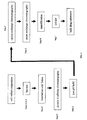
- SMB systems and methods of the present invention may be used in a process such as that depicted in Figure 1 for either Step D or Step F or Figure 2 for either Step B or D.
- a typical simulated moving bed system has at least one module or a plurality of modules filed with solid phase.
- a module may include one or a plurality of columns or vessels.
- Fluid conduits interconnect the upstream and downstream ends of the system to form a loop through which a fluid mixture is continuously circulated. At certain points liquid streams may be introduced and at other points effluent streams may be withdrawn. The constant flow of fluid through the loop is called "internal recirculation flow.”
- a manifold system of pipes and valves is provided selectively to position an inlet for feed material, an inlet for elution buffer (to disassociate a component from the solid phase), an outlet for a disassociated component and an outlet for an unassociated (or less associated) component.
- Each inlet and outlet communicates with a separate module (or vessel or column).
- Feed material enters the system at a designated point and is moved through the solid phase by the continuous internal recirculation flow. This moving contact results in a chromatographic separation of components.
- Unassociated component(s) which flow(s) at a relatively fast rate are removed from an unassociated component outlet, such as by removal of a first wash effluent stream.
- a buffer which disassociates an associated compound from the solid phase is added at its inlet value between the respective outlet valve positions of the associated and unassociated components.
- the designated inlet and outlet valve positions are displaced downstream one position on the manifold to the next solid phase bed module, which may be a discrete section of a vessel, (such as a column), or an individual vessel, e.g., column.
- the step time is chosen such that the designation of valves is properly synchronized with the internal recirculation flow. Under these conditions the system eventually reaches a steady state with specific product characteristics appearing at predetermined intervals in sequence at each valve position.
- This type of system simulates valves held in a single position while the solid phase moves at a constant and continuous rate around the recirculation loop producing constant quality product at each valve.
- An alternative apparatus actually intermittently moves the columns - often mounted on a carousel - while the valve locations are fixed.
- the simulated version more closely approaches the character of an actual moving bed system as the number of modules (or vessels or columns) and valve positions increase.
- An important distinction between batch and simulated moving bed system is that the internal recirculation flow is continuous in the simulated moving bed process. Except for very small adjustments to control internal pressure, the entering and exiting flow rates are continuous and constant, thereby approximating an actual moving bed system as closely as possible.
- An equilibrated SMB system exhibits a steady state component separation waveform along the path of the recirculation loop. This waveform moves along the path of the recirculation loop with valve switching synchronized to maintain the desired steady state.
- the zones may be viewed as stationary with the modules moving through the zones.
- Simulated moving bed processes realize the countercurrent movement of solid and liquid phases and the concomitant advantages of continuous moving beds over batch chromatography without the physical movement of solids.
- SMB processes utilize a series of modules comprising at least one solid phase connected to form a circuit.
- each module contains at least one or two or more evenly sized columns, and these columns are connected to form a continuous circuit.
- the solid phase movement is simulated by periodically moving the inlet and outlet ports one module (of if the module comprises a plurality of columns, one column) forward in the direction of flow of the mobile (fluid) phase, so that the product ports are always near the partially separated concentration waves of products in the system.
- the port switching time, zone length, and zone flow rates are all balanced to attain a desired level of purity of the product stream.
- the zones may be viewed as stationary with the modules moving through one zone to another.
- the SMB methods of the present invention are useful as part of a method for the separation of antibodies made by cell cultures, from immaterial component(s).
- Figure 1 depicts a schematic for a general process for the separation and isolation of immunoreactive compounds such as antibodies produced by cell culture from at least one immaterial component.
- the methods of the present invention may be used as a separation step in this general method or as a separation step in other general processes used in the art to isolate and purify immunoreactive compounds such as antibodies produced by recombinant and cell culture methods.
- the cell culture suspension in Step A is treated to harvest cells.
- Step B the cell culture suspension is clarified (cells, cell debris and precipitates are removed).
- One suitable method for step B is depth filtration; other suitable methods include centrifugation and tangential flow filtration.
- Step C the filtrate is incubated with Triton X-100, suitably in a vessel such as in a holding tank. Treatment with Triton X-100 is believed to inactivate viruses which may be present.
- the filtrate containing at least one immaterial component, such as host cell protein ("HCP"), and immunoreactive compound undergoes simulated moving bed chromatography according to the methods of the present invention in order to remove host cell protein ("HCP") and other immaterial components.
- HCP host cell protein
- affinity chromatography is employed.
- a solid phase which comprises Protein A or Protein G is employed. Any Protein A or Protein G affinity adsorbent may be used having either native or recumbinant Protein A or Protein G with any conventionally used solid phase backbone (including, e.g., agarose, controlled pure glass, or synthetic organic polymer).
- the solid phase comprises a recombinant Protein A.
- Step E the product stream is subjected to a low pH incubation step.
- a holding tank may be conveniently used for this step. Incubation at low pH according to this step is believed to inactivate viruses which may be present in the solution.
- Step F comprises cation exchange chromatography, preferably with a cation exchange solid phase using a bind and elute mode.
- Suitable cation exchange solid phases include strong cation exchange adsorbents including SP Sepharose XL resins using composite materials such as Hyper D (Biosepra), and tentacle resins (Merck or Tosohaas), and weak cation exchange adsorbents using carboxymethyl (CM) ligands.
- the SMB methods of the present invention may be used in this separation step (as well as Step D).
- Step F is believed to remove leached Protein A (where Step D uses affinity chromatography with a solid phase comprising Protein A) and also to remove viruses if present and other contaminants.
- Step G comprises anion exchange chromatography, preferably using a strong anion exchange solid phase in a flow through mode.
- Suitable solid phases include Fractogel TMAC.
- Step G is believed to remove residual contaminants (including DNA) and viruses if present due to adsorption to the anion exchanger.
- Step H comprises a nanofiltration step. Suitable methods include dead end filtration. Step H is believed to remove viruses which may be present by size exclusion.
- Step I comprises an ultrafiltration or diafiltration step. Step I is used to adjust concentration of antibody in solution to an appropriate concentration for storage and, if indicated, effect buffer exchange to an appropriate buffer for storage.
- Steps in the process include: (a) Fed batch fermentation in CHO cell culture: yielding 15.000 liter of broth, containing 0.5-2 g/l of antibody;(b) centrifugation for biomass removal; (c) Protein A chromatography (main objective of this step is to remove the (majority of) host cell proteins (HCP)); (d) cation exchange chromatography (the objective of this step is to remove any Protein A ligand that has leaked from the affinity gel, since both the Protein A ligand and the antibody bind to the gel and fractionation occurs during selective elution); and (e) anion exchange chromatography (main objective is to remove (adsorb) DNA, the MAb is not adsorbed since it is fairly basic in nature).
- the present invention relates to methods of using a SMB system as part of a process for the isolation and purification of antibodies or antibody fragments produced by cell culture.
- a SMB system may be used to separate an antibody or antibody fragment from host cell protein and other immaterial components employing Protein A affinity resins.
- an experimental set-up which comprises zones for associating immunoreactive compound with solid phase, removing unassociated components, disassociation/elution of immunoreactive compound from solid phase and regeneration/re-equilibration of the solid phase are used.
- the antibody or antibody fragment is associated with the Protein A module at neutral pH, unassociated components are removed in one or two wash steps, the immunoreactive compound is disassociated/eluted at low pH, and the module is regenerated and re-equilibrated by one, two or three consecutive steps. All these steps are continuously performed by a SMB system which comprises at least one module which moves through a ring which has a plurality of zones.
- a continuous flow of purified antibody or antibody fragment is obtained, with the amount of solid phase and buffer used being substantially reduced in comparison with a batch mode.
- One aspect of the present invention is directed to using a multi-zone SMB system as described herein for antibody purification with protein A affinity adsorbents.
- Protein A affinity SMB chromatography may be a powerful way to reduce the substantial cost involved in Protein A affinity chromatography.
- a reduction in module (or column) volume immediately translates into reduced cost of goods, additionally, smaller modules are easier to pack and usually cause fewer problems during operation.
- a fully automated continuous system requires much fewer operator manipulations, thus reducing the risk for failure.
- the SMB systems described herein can also be applied to the a cation exchange chromatography step in an antibody purification process, which usually occurs after Protein A affinity chromatography step.
- the economic benefits of using a SMB system for this step are similar to the Protein A affinity chromatography step.
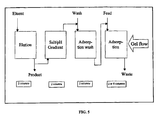
- Figure 3 depicts a four zone SMB system.
- the feed is applied to two (2) columns in parallel, and makes a second pass though two (2) parallel columns. Mass transfer is therefore spread over four columns.
- a carousel or other similar apparatus may be used to move the columns relative to stationary valves and inlet and outlet streams.
- the columns moving to the left from the adsorption zone enter the adsorption wash (or first wash) zone.
- the buffer applied here washes unbound material and removes endotoxins.
- the effluent of the adsorption wash (or first wash) zone is fed back into the adsorption zone to minimize product loss.
- the adsorption wash (or first wash) zone consists of two (2) columns in series thus reducing the amount of buffer required by about 40%.
- the product is eluted in an elution zone consisting of two (2) columns in series, again taking advantage of the resulting countercurrent effect.
- the elution zone is followed by an elution wash zone.
- the buffer applied in that zone may be a diluted equilibration buffer, its buffer capacity being much lower than the elution zone's buffer capacity.
- the elution wash buffer is recycled into the elution zone saving on water cost.
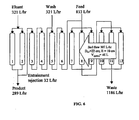
- Figure 4 depicts a process flow diagram of an alternate SMB system to Figure 3 , a four zone SMB system for the separation of antibody.
- the columns in the adsorption zone (positions 7 and 8) are connected in parallel to reduce the pressure drop.
- the amount of adsorbent (solid phase) in the adsorption zone is dimensioned such that mass transfer is not limiting.
- the columns may be arranged in a carousel. The rotation time of the carousel is set to meet the required capacity of the feed flow.
- the wash (or first wash) zone the interstitial liquid entering from the adsorption zone is washed out and fed back into the adsorption zone. Most of the endotoxin and host cell proteins are removed here and end up in the waste stream outflow from the adsorption zone.
- antibody is eluted in the elution zone; the columns at positions 3 and 4 comprise an elution zone.
- the columns at positions 1 and 2 comprise an elution wash zone and are used to wash out the interstitial eluent which is fed back into the elution zone thus saving eluent.
- the elution buffer applied to the elution zone needs to be concentrated.
- Figure 5 depicts an alternate four (4) zone SMB system. This system differs from the one depicted in Figure 3 .
- the adsorption zone has 2 The 3 columns to parallel, thus slightly increasing the times 3 columns in parallel, thus slightly increasing the gel utilization.
- the adsorption zone, adsorption wash (or first wash) zone, and elution zone are basically the same as in the system of Figure 3 ; however, there is no elution wash zone. This may lead to a decrease in product recovery as a small amount of eluent will enter the last column of the adsorption zone. From the product tank a small flow is pumped into a salt/pH gradient zone. This zone establishes a gradual transition in pH and salt concentration. Keeping the flow rate below the transport rate of interstitial liquid (back into the elution zone) assures that there will be minimal product loss. Presaturating the columns with eluent and product will also improve the effectivity of the elution zone.
- FIG. 6 An alternate SMB system of Figure 5 is depicted in Figure 6 .
- the principle is similar to the systems of Figures 3 and 4 described above, with the omission of the elution wash zone. However, one additional zone is included, the entrainment rejection zone. This allows for a higher effluent concentration. In addition, this zone will generate a pH profile in the system (in column positions 3 and 4). This might give a relatively smooth transition over the isoelectric point of the protein, thereby minimizing product decay.
- the individual columns used for Figure 6 may be much smaller than those used in the system of Figure 3 or Figure 4 .
- the system volume and gel utilization are also significantly higher. Main reason for this is that the fraction of the gel volume which is active in the adsorption zone is higher than in the system of Figure 3 or Figure 4 (6 out of 12 columns instead of 2 out of 4).
- the absolute amount of gel in the adsorption zone is more or less the same as in the system of Figure 3 or Figure 4 .
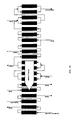
- Figure 7 depicts an eight (8) zone SMB system of the present invention. According to one embodiment, all process steps occur in two passes.
- the adsorption and elution zone have two times two parallel columns to decrease the linear flow rate. All other zones have 2 columns in series to take advantage of the countercurrent effect.
- Figures 8 to 10 depict alternate embodiments of eight (8) zone SMB systems of the present invention.
- Example 1 describes a process run using the embodiment of Figure 8 .
- Example 2 describes a process run using the embodiment of Figure 9 .
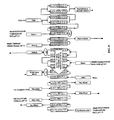
- FIG 10 depicts a diagram of an alternate embodiment of an eight (8) zone SMB system.
- regeneration of the adsorbent has been incorporated.
- the system is sanitized only once per batch run, i.e. once per 15,000 liters.
- the adsorption zone contains four columns, which are connected as two times two parallel columns.
- In the first wash zone the interstitial fluid is fed back into the adsorption zone.
- In the first wash zone three columns are connected in series to maximize the benefits of countercurrent contact.
- the first wash buffer is introduced in upflow in order to minimize the contact between high salt concentrations and concentrated MAb solutions. After a column leaves the adsorption zone, the top of the bed contains more concentrated feed solution than the bottom.
- water savings are gained from the dilution of first wash zone buffer with the effluent or buffer used for the second wash zone.
- the second wash zone has two columns and is designed to establish a low salt concentration at position 12 just before it moves to position 11. From the product tank a very low flow of product stream is pumped into column 11 to presaturate that column before it moves into the elution zone. The only function of position 11 is therefore product concentration, the common name for this process step is entrainment rejection.
- elution buffer is introduced in upflow in two times two columns in parallel. The elution buffer is diluted with the elution wash buffer used to wash out the eluent from positions 5 and 6 in the elution wash zone.
- the elution buffer applied to the elution zone should be concentrated in order to compensate for the dilution effect.
- Columns 1 to 4 are used for equilibration and regeneration and comprises an equilibration zone and a regeneration zone. If the regeneration requires a certain concentration of sodium hydroxide, the regeneration buffer applied to the system should have a higher concentration to accommodate for the dilution.
- This system depicted in Figure 10 is especially suited to a carousel type SMB system, which has the flexibility of using different flow directions in one system.
- the simulated moving bed, SMB, technology was applied to the Protein A initial purification step of a monoclonal antibody.
- the system consisted of twenty columns arranged in a circle attached to a rotating-carousel. Eight independent zones were established for the SMB continuous system.
- the central valve which consisted of three sections (top middle and bottom), delineated the eight processing zones.
- the top part of the valve remained stationary during the process and the inter-connections of the outlet ports defined the processing zones.
- the middle section of the valve was a Teflon ring that allowed the bottom section to turn freely.
- the bottom section of the valve was connected to the top and bottom of each column.
- Each processing zone required a specific buffer and flow rate.
- Eight HPLC pumps were employed to deliver to the inlet sections of the top part of the valve a constant fluid flow.
- the rotation of the columns was maintained by a controller that rotated the carousel at a specific interval. After a specific dwell time, the carousel rotated one spot to the next position, creating the counter current flow that reduces buffer consumption and increases resin capacity.
- the Equilibration buffer (10mM EDTA/50mM Tris (base)/0.5M NaCl, pH 7.5) was applied to the column in upward direction.
- the effluent of column one was directed to the bottom of column two, the effluent of which was capture in sample vessel for future analysis.
- Regeneration buffer (4M Urea/50mM Tris(Base) pH 7.0) was being applied to column three in the downward direction.
- the effluent of column three was directed to the top of column four, the effluent of which was captured in a sample vessel for future analysis.
- CIP zone buffer 1% Phosphoric acid
- Purified water (MilliQ) was applied in the upward direction to column seven, the effluent of which was applied to column eight in the upward direction.
- the effluent of column eight was monitored by a UV meter and collected in a sample vessel for future analysis.
- Elution zone buffer (100mM Glycine/200mM Acetic Acid pH 3.5) was applied in an upward direction to both column nine and column ten in a parallel manner.
- the effluent of column nine and ten were combined into a single stream that was then split to wash column eleven and twelve in an upward manner.
- the effluent of column eleven and column twelve were combined to form the product stream, which was monitored by a UV meter and collected in a sample vessel for future analysis.
- Second wash zone buffer (50mM Tris(base)/100mM Glycine pH 7.5) was applied in a downward direction to column thirteen.
- the effluent of column thirteen was applied in a downward flow to column fourteen, the effluent of which was captured in a sample vessel for future analysis.
- First wash zone buffer (10mM EDTA/50mM Tris(base)/0.5M NaCl) was applied in a downward direction to column fifteen.
- the effluent of column fifteen was monitored by a UV meter and then applied to column sixteen in a downward direction.
- the effluent of column sixteen was combined with the Feed stream.
- the feed stream which contained a mixture of host cell protein and monoclonal antibody and other components, was mixed online with the effluent of column sixteen.
- the new stream was then split and applied in parallel to both column seventeen and column eighteen in a downward direction.
- the effluent of column seventeen and column eighteen were mixed and then split and applied in parallel to column nineteen and column twenty in a downward direction.
- the effluent of column nineteen and column twenty were combined and collected in sample vessel for future analysis.
- the Description of Zones by a column number set forth hereinabove represents a snapshot in time. After the specified dwell time had elapsed, the carousel rotated one step in a clockwise direction. As an example, this means that column one, which previously was exposed to equilibration buffer in a downward direction was now in the position that column twenty was previously occupying. Consequently, column twenty was now located where column nineteen use to be, and so on for the entire column set. From a processing stand point this means that the effluent of column nineteen and column eighteen were combined then split and applied in the downward direction to column twenty and column one. The column rotation continued until there is no more feed left to process.
- Each zone described in the Description of Zones had a specific purpose in the processing of the feed.
- the regeneration step was implemented as a process-cleaning step.
- the Regeneration Zone follows to ensure that any non-specifically bound compounds were dissociated from the resin.
- the Equilibration Zone was implemented to displace the Regeneration Zone buffer and to create an environment in the column that would permit antibody binding during the initial loading period.
- the feed stream introduced the desired product to the column.
- the First Wash Zone displaced the loading feed and washed out non-specific proteins and other impurities.
- the Second Wash Zone was implemented to bring the conductivity to an acceptable base line.
- the Elution Zone was created to dissociate the antibody from the Protein-A ligand and collect the antibody.
- the Elution Wash Zone was a test section to check whether all the antibody was effectively washed out during the Elution Zone.
- a Simulated Moving Bed System which was similar to the SMB system described in Example 1 was used to purify an antibody. This system also consisted of twenty (20) columns arranged in a circle attached to a rotating carousel. Eight independent zones were established for the SMB continuous system. A diagram of this system is depicted in Figure 9 .
- Figure 12 depicts a plot of antibody concentration (IgG titer), IgG flux, and concentration of host cell proteins (HCP is shown for 9 full rotations of the SMB system.
- IgG flux (mg/ml) was depicted by the top plot of diamonds ( ⁇ ).
- IgG titer mg/ml was depicted by the lower plot of diamonds ( ⁇ ).
- HCP ppm was depicted by the plot of squares ( ⁇ ).
Landscapes
- Chemical & Material Sciences (AREA)
- Analytical Chemistry (AREA)
- Life Sciences & Earth Sciences (AREA)
- Health & Medical Sciences (AREA)
- Biochemistry (AREA)
- Organic Chemistry (AREA)
- General Health & Medical Sciences (AREA)
- Proteomics, Peptides & Aminoacids (AREA)
- Physics & Mathematics (AREA)
- Molecular Biology (AREA)
- Genetics & Genomics (AREA)
- Biophysics (AREA)
- Sustainable Development (AREA)
- Chemical Kinetics & Catalysis (AREA)
- Medicinal Chemistry (AREA)
- General Physics & Mathematics (AREA)
- Immunology (AREA)
- Pathology (AREA)
- Treatment Of Liquids With Adsorbents In General (AREA)
- Peptides Or Proteins (AREA)
- Medicines Containing Antibodies Or Antigens For Use As Internal Diagnostic Agents (AREA)
Claims (5)
- Simuliertes Fließbettsystem (SFB-System) zur Trennung eines Antikörpers oder Antikörperfragments von mindestens einer immateriellen Komponente, wobei beide in einem Fluidgemisch vorhanden sind,
wobei das SFB-System eine Vielzahl von Zonen umfasst, die eine feste Phase umfassen, die im Gegenstrom mit dem Fluidgemisch in Kontakt gebracht wird, und wobei die genannten Zonen Folgendes umfassen:(i) eine Assoziationszone, in der der Antikörper oder das Antikörperfragment und mindestens eine immaterielle Komponente differentiell mit der festen Phase assoziieren;(ii) eine Waschzone, in der mindestens eine immaterielle Komponente vorzugsweise von der festen Phase mit einem Waschzonenpuffer dissoziiert wird;(iii) eine Elutionszone, in der der Antikörper oder das Antikörperfragment vorzugsweise von der festen Phase mit einem Elutionspuffer dissoziiert wird;(iv) eine Elutionswaschzone, in der der Elutionspuffer mit einem Elutionswaschpuffer verdünnt wird;(v) eine Regenerationszone, in der alle nichtspezifisch gebundenen Verbindungen von der festen Phase dissoziiert werden, und(vi) eine Äquilibrierungszone, in der eine Umgebung geschaffen wird, in der eine Bindung des Antikörpers an die feste Phase in der Assoziationszone ermöglicht wird, und wobeisich die genannte Waschzone zwischen der genannten Assoziationszone und der genannten Elutionszone befindet,
sich die genannte Elutionswaschzone zwischen der genannten Elutionszone und der genannten Assoziationszone befindet,
sich die genannte Regenerationszone zwischen der genannten Elutionswaschzone und der genannten Assoziationszone befindet und
sich die genannte Äquilibrierungszone zwischen der genannten Regenerationszone und der genannten Assoziationszone befindet. - Simuliertes Fließbettsystem nach Anspruch 1, wobei die genannte feste Phase einen Liganden für die Affinitätschromatographie umfasst.
- Simuliertes Fließbettsystem nach Anspruch 2, wobei die genannte feste Phase Protein A oder Protein G umfasst.
- Simuliertes Fließbettsystem nach Anspruch 1, worin die genannte feste Phase ein Kationenaustauschharz umfasst.
- Verwendung des simulierten Fließbettsystems (SFB-Systems) nach einem der Ansprüche 1-4 zur Trennung eines Antikörpers oder Antikörperfragments von mindestens einer immateriellen Komponente.
Priority Applications (1)
| Application Number | Priority Date | Filing Date | Title |
|---|---|---|---|
| SI200332386T SI1545574T1 (sl) | 2002-09-13 | 2003-09-12 | Postopek za čiščenje polipeptidov s simulirano "moving bed" kromatografijo |
Applications Claiming Priority (3)
| Application Number | Priority Date | Filing Date | Title |
|---|---|---|---|
| US41050602P | 2002-09-13 | 2002-09-13 | |
| US410506P | 2002-09-13 | ||
| PCT/US2003/028809 WO2004024284A2 (en) | 2002-09-13 | 2003-09-12 | Method of purifying polypeptides by simulated moving bed chromatography |
Publications (4)
| Publication Number | Publication Date |
|---|---|
| EP1545574A2 EP1545574A2 (de) | 2005-06-29 |
| EP1545574A4 EP1545574A4 (de) | 2006-07-19 |
| EP1545574B1 true EP1545574B1 (de) | 2014-08-20 |
| EP1545574B8 EP1545574B8 (de) | 2014-09-24 |
Family
ID=31994146
Family Applications (1)
| Application Number | Title | Priority Date | Filing Date |
|---|---|---|---|
| EP03754547.2A Expired - Lifetime EP1545574B8 (de) | 2002-09-13 | 2003-09-12 | Verfahren zur reinigung von polypeptiden durch simulierte chromatographie im fliessbett |
Country Status (10)
| Country | Link |
|---|---|
| US (2) | US7220356B2 (de) |
| EP (1) | EP1545574B8 (de) |
| JP (1) | JP2006507249A (de) |
| CN (2) | CN1777435B (de) |
| AU (2) | AU2003272368C1 (de) |
| CA (1) | CA2498725C (de) |
| DK (1) | DK1545574T3 (de) |
| NZ (2) | NZ539297A (de) |
| SI (1) | SI1545574T1 (de) |
| WO (1) | WO2004024284A2 (de) |
Cited By (1)
| Publication number | Priority date | Publication date | Assignee | Title |
|---|---|---|---|---|
| EP2763771B1 (de) | 2011-10-04 | 2016-08-03 | Merck Patent GmbH | Verfahren und vorrichtung zur chromatographischen aufreinigung |
Families Citing this family (63)
| Publication number | Priority date | Publication date | Assignee | Title |
|---|---|---|---|---|
| EP1545574B8 (de) | 2002-09-13 | 2014-09-24 | Biogen Idec Inc. | Verfahren zur reinigung von polypeptiden durch simulierte chromatographie im fliessbett |
| CN1771080B (zh) * | 2003-04-08 | 2010-12-15 | 诺沃挪第克公司 | 包括至少一个色谱处理步骤的生产治疗用多肽或其前体的方法 |
| US7479222B2 (en) | 2004-02-05 | 2009-01-20 | Millipore Corporation | Porous adsorptive or chromatographic media |
| JP2008514724A (ja) | 2004-10-01 | 2008-05-08 | スリーエム イノベイティブ プロパティズ カンパニー | 液体混合物から標的分子を分離するための方法および装置 |
| EP1716900A1 (de) * | 2005-04-29 | 2006-11-02 | Eidgenössische Technische Hochschule Zürich | Verfahren und Vorrichtung zur chromatographischen Reinigung |
| CN100434135C (zh) * | 2005-09-23 | 2008-11-19 | 中国科学院过程工程研究所 | 一种使用三相逆流色谱分离纯化天然产物的方法 |
| US7544293B2 (en) | 2005-09-26 | 2009-06-09 | Semba Inc. | Valve and process for interrupted continuous flow chromatography |
| US7413660B2 (en) | 2005-09-30 | 2008-08-19 | 3M Innovative Properties Company | Single pass method and apparatus for separating a target molecule from a liquid mixture |
| US7790040B2 (en) | 2006-08-30 | 2010-09-07 | Semba Biosciences, Inc. | Continuous isocratic affinity chromatography |
| US8807164B2 (en) * | 2006-08-30 | 2014-08-19 | Semba Biosciences, Inc. | Valve module and methods for simulated moving bed chromatography |
| WO2008048395A1 (en) * | 2006-08-30 | 2008-04-24 | Semba Biosciences, Inc. | Valve module and methods for simulated moving bed chromatography |
| CN101678244B (zh) * | 2007-04-17 | 2013-06-19 | 深度控股有限公司 | 用于连续膜吸附的方法和装置 |
| WO2008153472A1 (en) | 2007-06-15 | 2008-12-18 | Ge Healthcare Bio-Sciences Ab | Chromatography method |
| US9433922B2 (en) * | 2007-08-14 | 2016-09-06 | Emd Millipore Corporation | Media for membrane ion exchange chromatography based on polymeric primary amines, sorption device containing that media, and chromatography scheme and purification method using the same |
| JP5999899B2 (ja) | 2008-04-08 | 2016-09-28 | バイオ−ラッド ラボラトリーズ インコーポレーティッド | 抗体のクロマトグラフィー精製法 |
| US8196603B2 (en) | 2008-08-20 | 2012-06-12 | Semba Biosciences, Inc. | Valve block assembly |
| CN102271775A (zh) * | 2008-12-08 | 2011-12-07 | 诺沃-诺迪斯克有限公司 | 多肽的逆流提纯 |
| LT2975051T (lt) | 2009-06-26 | 2021-07-12 | Regeneron Pharmaceuticals, Inc. | Lengvai išskiriami bispecifiniai antikūnai su natyvios formos imunoglobulinu |
| AU2010292897B2 (en) | 2009-08-06 | 2016-01-07 | Genentech, Inc. | Method to improve virus removal in protein purification |
| CN101781671A (zh) * | 2010-03-16 | 2010-07-21 | 黑龙江八一农垦大学 | 玉米抗氧化肽的分离纯化方法 |
| CN101798587B (zh) * | 2010-03-22 | 2012-07-25 | 黑龙江八一农垦大学 | 玉米降血压肽的分离纯化方法 |
| KR101152036B1 (ko) | 2010-04-27 | 2012-06-08 | (주)셀트리온 | 컬럼 순환 및 시료 연속주입법을 이용한 단백질 a 크로마토그래피 정제 방법 |
| ES2603396T3 (es) * | 2010-07-30 | 2017-02-27 | Pfizer Inc | Purificación en tándem de proteínas |
| CA2810909A1 (en) * | 2010-09-20 | 2012-03-29 | Abbvie Inc. | Purification of antibodies using simulated moving bed chromatography |
| JP2013544524A (ja) | 2010-12-06 | 2013-12-19 | ターポン バイオシステムズ,インコーポレイテッド | 生物学的生成物の連続プロセス法 |
| EP2895610B1 (de) | 2012-09-13 | 2019-11-06 | Indiana University Research and Technology Corporation | Zusammensetzungen und systeme zur induzierung von krankheitsresistenz bei pflanzen und verfahren zu ihrer verwendung |
| CN118388581A (zh) | 2013-03-08 | 2024-07-26 | 建新公司 | 治疗性蛋白药物物质的整合连续制造 |
| TWI671312B (zh) * | 2014-01-17 | 2019-09-11 | 美商健臻公司 | 無菌層析法及製法 |
| TWI709569B (zh) | 2014-01-17 | 2020-11-11 | 美商健臻公司 | 無菌層析樹脂及其用於製造方法的用途 |
| CN104263787B (zh) * | 2014-09-10 | 2015-05-20 | 中国海洋大学 | 一种脱除南极磷虾多肽中氟化物和灰分的方法 |
| TW201628649A (zh) | 2014-10-09 | 2016-08-16 | 再生元醫藥公司 | 減少醫藥調配物中微可見顆粒之方法 |
| US11566082B2 (en) | 2014-11-17 | 2023-01-31 | Cytiva Bioprocess R&D Ab | Mutated immunoglobulin-binding polypeptides |
| GB201515339D0 (en) | 2015-08-28 | 2015-10-14 | Ge Healthcare Bio Sciences Ab | A seperation matrix and a method of seperating antibodies |
| US9821249B2 (en) * | 2015-09-08 | 2017-11-21 | Orochem Technologies, Inc. | Continuous process for separation of proteins |
| WO2017072201A2 (en) * | 2015-10-26 | 2017-05-04 | Lonza Limited | A manufacturing facility for the production of biopharmaceuticals |
| US10703774B2 (en) | 2016-09-30 | 2020-07-07 | Ge Healthcare Bioprocess R&D Ab | Separation method |
| US10654887B2 (en) | 2016-05-11 | 2020-05-19 | Ge Healthcare Bio-Process R&D Ab | Separation matrix |
| ES2909833T3 (es) | 2016-05-11 | 2022-05-10 | Cytiva Bioprocess R & D Ab | Método de limpieza y/o desinfección de una matriz de separación |
| JP7031934B2 (ja) | 2016-05-11 | 2022-03-08 | サイティバ・バイオプロセス・アールアンドディ・アクチボラグ | 分離マトリックス |
| US10730908B2 (en) | 2016-05-11 | 2020-08-04 | Ge Healthcare Bioprocess R&D Ab | Separation method |
| ES2874974T3 (es) | 2016-05-11 | 2021-11-05 | Cytiva Bioprocess R & D Ab | Matriz de separación |
| US10889615B2 (en) | 2016-05-11 | 2021-01-12 | Cytiva Bioprocess R&D Ab | Mutated immunoglobulin-binding polypeptides |
| JP7106187B2 (ja) | 2016-05-11 | 2022-07-26 | サイティバ・バイオプロセス・アールアンドディ・アクチボラグ | 分離マトリックスを保存する方法 |
| KR20230041834A (ko) | 2016-08-16 | 2023-03-24 | 리제너론 파아마슈티컬스, 인크. | 혼합물로부터 개별 항체들을 정량하는 방법 |
| US12448411B2 (en) | 2016-09-30 | 2025-10-21 | Cytiva Bioprocess R&D Ab | Separation method |
| CN119492842A (zh) | 2016-10-25 | 2025-02-21 | 里珍纳龙药品有限公司 | 用于色谱数据分析的方法和系统 |
| GB201622343D0 (en) * | 2016-12-29 | 2017-02-15 | Ge Healthcare Bio Sciences Ab | Method in bioprocess purification system |
| GB201703116D0 (en) | 2017-02-27 | 2017-04-12 | Ge Healthcare Bioprocess R&D Ab | A seperation matrix and a method of seperating antibodies |
| GB201703258D0 (en) * | 2017-02-28 | 2017-04-12 | Ge Healthcare Bio Sciences Ab | Parallel separation and washing |
| GB201710130D0 (en) | 2017-06-26 | 2017-08-09 | Ge Healthcare Bioprocess R & D Ab | A Method of seperation |
| CN118416215A (zh) | 2017-09-19 | 2024-08-02 | 里珍纳龙药品有限公司 | 减少粒子形成的方法以及由其形成的组合物 |
| CN109836479B (zh) * | 2017-11-27 | 2021-01-12 | 申联生物医药(上海)股份有限公司 | 应用模拟流动床分离纯化fmd灭活病毒抗原的方法 |
| WO2019183334A1 (en) | 2018-03-21 | 2019-09-26 | Waters Technologies Corporation | Non-antibody high-affinity-based sample preparation, sorbents, devices and methods |
| DK3781280T3 (da) * | 2018-04-20 | 2022-06-20 | Propharma Group Europe B V | Fremgangsmåde til separation med simuleret bevægeligt leje |
| GB201810772D0 (en) | 2018-06-29 | 2018-08-15 | Ge Healthcare Bio Sciences Ab | Method in bioprocess purification system |
| TWI853823B (zh) | 2018-07-02 | 2024-09-01 | 美商里珍納龍藥品有限公司 | 自混合物製備多肽之系統及方法 |
| BR112021003420A2 (pt) | 2018-08-31 | 2021-05-18 | Genzyme Corporation | resina cromatográfica estéril e uso da mesma em processos de manufatura |
| EP3934620A1 (de) | 2019-03-05 | 2022-01-12 | Regeneron Pharmaceuticals, Inc. | Humanserumalbumin in formulierungen |
| EP3742160B1 (de) * | 2019-05-24 | 2023-08-09 | Sartorius Stedim Biotech GmbH | Chromatografieverfahren, verfahren zur bestimmung der konzentration von mindestens einer verbindung in einem chromatografieverfahren und verfahren zur gewinnung von mindestens einem chromatografieverfahrensparameter |
| EP3742159A1 (de) | 2019-05-24 | 2020-11-25 | Sartorius Stedim Biotech GmbH | Chromatografieverfahren, verfahren zur bestimmung des einflusses der interdependenz von mindestens zwei parametern in einem chromatografieverfahren und verfahren zur gewinnung mindestens eines chromatografieverfahrensparameters |
| AU2023245599A1 (en) * | 2022-03-27 | 2024-11-14 | Purdue Research Foundation | Chromatography methods for producing high purity, high yield lithium, cobalt, nickel, manganese salts from waste lithium-ion batteries |
| KR102853272B1 (ko) * | 2022-12-27 | 2025-09-01 | 삼성바이오로직스 주식회사 | 분리된 정제구획을 포함하는 생물학적 물질의 정제 시스템 |
| KR20260048268A (ko) | 2023-08-08 | 2026-04-09 | 씨티바 스웨덴 에이비 | 다중 모듈식 크로마토그래피 시스템 |
Family Cites Families (24)
| Publication number | Priority date | Publication date | Assignee | Title |
|---|---|---|---|---|
| US3706812A (en) * | 1970-12-07 | 1972-12-19 | Universal Oil Prod Co | Fluid-solid contacting apparatus |
| US4016149A (en) * | 1973-09-10 | 1977-04-05 | Research Corporation | Selective removal of albumin from blood fluid and compositions therefore |
| US4430496A (en) * | 1980-01-17 | 1984-02-07 | Varian Associates, Inc. | Strong anion exchange composition and methods |
| US5240602A (en) * | 1987-06-08 | 1993-08-31 | Chromatochem, Inc. | Chromatographic material |
| US5770088A (en) * | 1992-06-30 | 1998-06-23 | Daicel Chemical Industries, Ltd. | Simulated moving bed chromatographic separation process |
| DE4316136A1 (de) | 1993-05-13 | 1994-11-17 | Merck Patent Gmbh | Verfahren und Träger für die Gelpermeationschromatographie |
| US5959085A (en) * | 1993-11-23 | 1999-09-28 | Schering Corporation | Human monoclonal antibodies against human cytokines and methods of making and using such antibodies |
| CN1036050C (zh) * | 1994-12-07 | 1997-10-08 | 中国石化扬子石油化工公司 | 改进的模拟移动床的吸附分离方法 |
| AU3696595A (en) | 1994-10-22 | 1996-05-15 | Yangzi Petro-Chemical Corp. Sinopec | An improved simulated moving bed adsorption separation process |
| US5635072A (en) * | 1995-01-31 | 1997-06-03 | Uop | Simulated moving bed adsorptive separation process |
| US5645729A (en) * | 1995-02-13 | 1997-07-08 | Uop | Separations by simulated moving bed chromatography operating at low k' values using weakly interacting adsorbents as the stationary phase |
| JPH08323104A (ja) | 1995-05-30 | 1996-12-10 | Tsukishima Kikai Co Ltd | 流路分配装置、疑似移動床および連続吸着法 |
| DE19611094C2 (de) * | 1996-03-21 | 1999-06-17 | Dresden Arzneimittel | Verfahren zur Reinigung von Cyclosporin A und/oder verwandten Cyclosporinen aus einem Cyclosporin-haltigen Rohextrakt unter Anwendung chromatographischer Verfahren mit Kieselgel als Adsorbens |
| FR2750886B1 (fr) * | 1996-07-11 | 1998-09-25 | Inst Francais Du Petrole | Dispositif de rincage dans une unite d'adsorption en lit mobile simule et son utilisation |
| US6641735B1 (en) * | 2000-03-23 | 2003-11-04 | Japan Chemical Innovation Institute | Separatory material with the use of stimulus-responsive polymer and separation method by using the separatory material |
| DE19858892A1 (de) | 1998-12-19 | 2000-06-21 | Merck Patent Gmbh | Kontinuierliches Verfahren zur Trennung von Stoffen nach Molekülgröße |
| US6479300B1 (en) * | 1999-03-15 | 2002-11-12 | Millipore Corporation | Metal loaded ligand bound membranes for metal ion affinity chromatography |
| US6280623B1 (en) * | 1999-03-23 | 2001-08-28 | Hsien-Chih Ma | Differential and continuous separation apparatus with controlled parameters for solids and liquids |
| EP1231992A1 (de) | 1999-11-20 | 2002-08-21 | Scinu Tec GmbH | Verfahren zur separation von zellen und biomolekülen mittels gegenstromchromatographie |
| EP1276557A2 (de) * | 2000-04-28 | 2003-01-22 | Accurate Polymers, Ltd. | Simulierte wirksamkeit von protein a, angezeigt durch an der oberfläche einer perlförmigen cellulose gebundene liganden |
| NZ529767A (en) * | 2001-06-13 | 2005-10-28 | Taurus Hsa Llc | Purification of human serum albumin |
| CN1564685A (zh) * | 2001-10-03 | 2005-01-12 | Ucb公司 | 吡咯烷酮衍生物 |
| EP1545574B8 (de) | 2002-09-13 | 2014-09-24 | Biogen Idec Inc. | Verfahren zur reinigung von polypeptiden durch simulierte chromatographie im fliessbett |
| US6805799B2 (en) * | 2002-12-21 | 2004-10-19 | Qi-Feng Ma | Simulated moving bed chromatographic focusing |
-
2003
- 2003-09-12 EP EP03754547.2A patent/EP1545574B8/de not_active Expired - Lifetime
- 2003-09-12 CN CN03824460.8A patent/CN1777435B/zh not_active Expired - Fee Related
- 2003-09-12 NZ NZ539297A patent/NZ539297A/en not_active IP Right Cessation
- 2003-09-12 CN CN201010541907.0A patent/CN102050865B/zh not_active Expired - Fee Related
- 2003-09-12 WO PCT/US2003/028809 patent/WO2004024284A2/en not_active Ceased
- 2003-09-12 SI SI200332386T patent/SI1545574T1/sl unknown
- 2003-09-12 JP JP2004536270A patent/JP2006507249A/ja active Pending
- 2003-09-12 CA CA2498725A patent/CA2498725C/en not_active Expired - Lifetime
- 2003-09-12 DK DK03754547.2T patent/DK1545574T3/da active
- 2003-09-12 US US10/661,086 patent/US7220356B2/en not_active Expired - Lifetime
- 2003-09-12 NZ NZ563078A patent/NZ563078A/en not_active IP Right Cessation
- 2003-09-12 AU AU2003272368A patent/AU2003272368C1/en not_active Expired
-
2007
- 2007-05-21 US US11/751,147 patent/US8608960B2/en active Active - Reinstated
-
2009
- 2009-03-04 AU AU2009200842A patent/AU2009200842B2/en not_active Expired
Cited By (2)
| Publication number | Priority date | Publication date | Assignee | Title |
|---|---|---|---|---|
| EP2763771B1 (de) | 2011-10-04 | 2016-08-03 | Merck Patent GmbH | Verfahren und vorrichtung zur chromatographischen aufreinigung |
| US11590434B2 (en) | 2011-10-04 | 2023-02-28 | Merck Patent Gmbh | Method and apparatus for chromatographic purification |
Also Published As
| Publication number | Publication date |
|---|---|
| CN102050865B (zh) | 2014-03-12 |
| CN1777435B (zh) | 2011-01-12 |
| CA2498725C (en) | 2014-07-08 |
| AU2003272368C1 (en) | 2009-07-23 |
| US20070215534A1 (en) | 2007-09-20 |
| US7220356B2 (en) | 2007-05-22 |
| EP1545574A2 (de) | 2005-06-29 |
| WO2004024284A3 (en) | 2004-09-23 |
| US20040241878A1 (en) | 2004-12-02 |
| AU2003272368A1 (en) | 2004-04-30 |
| AU2003272368B2 (en) | 2008-12-04 |
| US8608960B2 (en) | 2013-12-17 |
| WO2004024284A2 (en) | 2004-03-25 |
| NZ563078A (en) | 2009-07-31 |
| AU2009200842B2 (en) | 2011-06-02 |
| CN102050865A (zh) | 2011-05-11 |
| JP2006507249A (ja) | 2006-03-02 |
| EP1545574B8 (de) | 2014-09-24 |
| CN1777435A (zh) | 2006-05-24 |
| HK1077228A1 (en) | 2006-02-10 |
| CA2498725A1 (en) | 2004-03-25 |
| SI1545574T1 (sl) | 2014-10-30 |
| AU2009200842A1 (en) | 2009-03-26 |
| DK1545574T3 (da) | 2014-09-08 |
| NZ539297A (en) | 2008-04-30 |
| EP1545574A4 (de) | 2006-07-19 |
Similar Documents
| Publication | Publication Date | Title |
|---|---|---|
| AU2003272368C1 (en) | Method of purifying polypeptides by simulated moving bed chromatography | |
| EP2160227B1 (de) | Chromatographieverfahren | |
| Steinebach et al. | Continuous counter‐current chromatography for capture and polishing steps in biopharmaceutical production | |
| US8182696B2 (en) | Multicolumn sequential separation process | |
| KR101484659B1 (ko) | 단백질 정제하는 동안 샘플 중의 하나 이상의 불순물 양을 감소시키는 방법 | |
| US8828234B2 (en) | Device for chromatographic separations | |
| EP2772289B1 (de) | Chromatographieverfahren zur Anreicherung und Isolierung | |
| US20150065696A1 (en) | Apparatus and process for purification of proteins | |
| US6551512B1 (en) | Continuous method for separating substances according to molecular size | |
| Giovannini et al. | Isolation of a recombinant antibody from cell culture supernatant: continuous annular versus batch and expanded‐bed chromatography | |
| Brower et al. | Monoclonal antibody continuous processing enabled by single use | |
| Boi et al. | Advances in membrane chromatography for the capture step of monoclonal antibodies | |
| HK1077228B (en) | Method of purifying polypeptides by simulated moving bed chromatography | |
| Steinebach | Multi-Column Chromatography for Continuous Integrated Biomanufacturing |
Legal Events
| Date | Code | Title | Description |
|---|---|---|---|
| PUAI | Public reference made under article 153(3) epc to a published international application that has entered the european phase |
Free format text: ORIGINAL CODE: 0009012 |
|
| 17P | Request for examination filed |
Effective date: 20050404 |
|
| AK | Designated contracting states |
Kind code of ref document: A2 Designated state(s): AT BE BG CH CY CZ DE DK EE ES FI FR GB GR HU IE IT LI LU MC NL PT RO SE SI SK TR |
|
| AX | Request for extension of the european patent |
Extension state: AL LT LV MK |
|
| DAX | Request for extension of the european patent (deleted) | ||
| REG | Reference to a national code |
Ref country code: HK Ref legal event code: DE Ref document number: 1077228 Country of ref document: HK |
|
| A4 | Supplementary search report drawn up and despatched |
Effective date: 20060619 |
|
| RIN1 | Information on inventor provided before grant (corrected) |
Inventor name: PENNINGS, MAARTEN.UNIVALID BIOPROCESSING BV Inventor name: BISSCHOPS,MARC.UNIVALID BIOPROCESSING BV Inventor name: CONLEY, LYNN Inventor name: PIERACCI, JOHN, P. Inventor name: SONNENFELD, ALAN, M. Inventor name: THOEMMES, JOERG, P. |
|
| 17Q | First examination report despatched |
Effective date: 20081222 |
|
| GRAP | Despatch of communication of intention to grant a patent |
Free format text: ORIGINAL CODE: EPIDOSNIGR1 |
|
| RIC1 | Information provided on ipc code assigned before grant |
Ipc: G01N 30/02 20060101ALI20140205BHEP Ipc: B01D 15/38 20060101ALI20140205BHEP Ipc: A61K 38/00 20060101AFI20140205BHEP Ipc: B01D 15/18 20060101ALI20140205BHEP Ipc: G01N 30/46 20060101ALI20140205BHEP Ipc: C07K 1/16 20060101ALI20140205BHEP |
|
| INTG | Intention to grant announced |
Effective date: 20140310 |
|
| GRAS | Grant fee paid |
Free format text: ORIGINAL CODE: EPIDOSNIGR3 |
|
| GRAA | (expected) grant |
Free format text: ORIGINAL CODE: 0009210 |
|
| AK | Designated contracting states |
Kind code of ref document: B1 Designated state(s): AT BE BG CH CY CZ DE DK EE ES FI FR GB GR HU IE IT LI LU MC NL PT RO SE SI SK TR |
|
| REG | Reference to a national code |
Ref country code: GB Ref legal event code: FG4D |
|
| REG | Reference to a national code |
Ref country code: DE Ref legal event code: R081 Ref document number: 60346660 Country of ref document: DE Owner name: BIOGEN INC., CAMBRIDGE, US Free format text: FORMER OWNER: BIOGEN IDEC INC., SAN DIEGO, CALIF., US |
|
| REG | Reference to a national code |
Ref country code: CH Ref legal event code: NV Representative=s name: SERVOPATENT GMBH, CH Ref country code: CH Ref legal event code: EP |
|
| RAP2 | Party data changed (patent owner data changed or rights of a patent transferred) |
Owner name: BIOGEN IDEC INC. |
|
| REG | Reference to a national code |
Ref country code: DK Ref legal event code: T3 Effective date: 20140902 |
|
| REG | Reference to a national code |
Ref country code: AT Ref legal event code: REF Ref document number: 683049 Country of ref document: AT Kind code of ref document: T Effective date: 20140915 |
|
| REG | Reference to a national code |
Ref country code: NL Ref legal event code: T3 Ref country code: IE Ref legal event code: FG4D |
|
| REG | Reference to a national code |
Ref country code: DE Ref legal event code: R096 Ref document number: 60346660 Country of ref document: DE Effective date: 20141002 |
|
| REG | Reference to a national code |
Ref country code: SE Ref legal event code: TRGR |
|
| PG25 | Lapsed in a contracting state [announced via postgrant information from national office to epo] |
Ref country code: BG Free format text: LAPSE BECAUSE OF FAILURE TO SUBMIT A TRANSLATION OF THE DESCRIPTION OR TO PAY THE FEE WITHIN THE PRESCRIBED TIME-LIMIT Effective date: 20141120 Ref country code: ES Free format text: LAPSE BECAUSE OF FAILURE TO SUBMIT A TRANSLATION OF THE DESCRIPTION OR TO PAY THE FEE WITHIN THE PRESCRIBED TIME-LIMIT Effective date: 20140820 Ref country code: GR Free format text: LAPSE BECAUSE OF FAILURE TO SUBMIT A TRANSLATION OF THE DESCRIPTION OR TO PAY THE FEE WITHIN THE PRESCRIBED TIME-LIMIT Effective date: 20141121 Ref country code: PT Free format text: LAPSE BECAUSE OF FAILURE TO SUBMIT A TRANSLATION OF THE DESCRIPTION OR TO PAY THE FEE WITHIN THE PRESCRIBED TIME-LIMIT Effective date: 20141222 |
|
| PG25 | Lapsed in a contracting state [announced via postgrant information from national office to epo] |
Ref country code: RO Free format text: LAPSE BECAUSE OF FAILURE TO SUBMIT A TRANSLATION OF THE DESCRIPTION OR TO PAY THE FEE WITHIN THE PRESCRIBED TIME-LIMIT Effective date: 20140820 Ref country code: EE Free format text: LAPSE BECAUSE OF FAILURE TO SUBMIT A TRANSLATION OF THE DESCRIPTION OR TO PAY THE FEE WITHIN THE PRESCRIBED TIME-LIMIT Effective date: 20140820 Ref country code: SK Free format text: LAPSE BECAUSE OF FAILURE TO SUBMIT A TRANSLATION OF THE DESCRIPTION OR TO PAY THE FEE WITHIN THE PRESCRIBED TIME-LIMIT Effective date: 20140820 Ref country code: CZ Free format text: LAPSE BECAUSE OF FAILURE TO SUBMIT A TRANSLATION OF THE DESCRIPTION OR TO PAY THE FEE WITHIN THE PRESCRIBED TIME-LIMIT Effective date: 20140820 |
|
| REG | Reference to a national code |
Ref country code: DE Ref legal event code: R097 Ref document number: 60346660 Country of ref document: DE |
|
| PLBE | No opposition filed within time limit |
Free format text: ORIGINAL CODE: 0009261 |
|
| STAA | Information on the status of an ep patent application or granted ep patent |
Free format text: STATUS: NO OPPOSITION FILED WITHIN TIME LIMIT |
|
| REG | Reference to a national code |
Ref country code: CH Ref legal event code: PFA Owner name: BIOGEN INC., US Free format text: FORMER OWNER: BIOGEN IDEC INC., US |
|
| REG | Reference to a national code |
Ref country code: DE Ref legal event code: R082 Ref document number: 60346660 Country of ref document: DE Representative=s name: MAIWALD PATENTANWALTS- UND RECHTSANWALTSGESELL, DE Ref country code: DE Ref legal event code: R082 Ref document number: 60346660 Country of ref document: DE Representative=s name: MAIWALD PATENTANWALTSGESELLSCHAFT MBH, DE Ref country code: DE Ref legal event code: R081 Ref document number: 60346660 Country of ref document: DE Owner name: BIOGEN INC., CAMBRIDGE, US Free format text: FORMER OWNER: BIOGEN IDEC INC., CAMBRIDGE, MASS., US |
|
| RAP2 | Party data changed (patent owner data changed or rights of a patent transferred) |
Owner name: BIOGEN INC. |
|
| 26N | No opposition filed |
Effective date: 20150521 |
|
| REG | Reference to a national code |
Ref country code: HK Ref legal event code: GR Ref document number: 1077228 Country of ref document: HK |
|
| REG | Reference to a national code |
Ref country code: FR Ref legal event code: CD Owner name: BIOGEN INC., US Effective date: 20150819 Ref country code: FR Ref legal event code: CA Effective date: 20150819 |
|
| REG | Reference to a national code |
Ref country code: SI Ref legal event code: SP73 Owner name: BIOGEN INC.; US Effective date: 20150930 |
|
| REG | Reference to a national code |
Ref country code: AT Ref legal event code: HC Ref document number: 683049 Country of ref document: AT Kind code of ref document: T Owner name: BIOGEN INC., US Effective date: 20151211 |
|
| PG25 | Lapsed in a contracting state [announced via postgrant information from national office to epo] |
Ref country code: CY Free format text: LAPSE BECAUSE OF FAILURE TO SUBMIT A TRANSLATION OF THE DESCRIPTION OR TO PAY THE FEE WITHIN THE PRESCRIBED TIME-LIMIT Effective date: 20140820 |
|
| PG25 | Lapsed in a contracting state [announced via postgrant information from national office to epo] |
Ref country code: TR Free format text: LAPSE BECAUSE OF FAILURE TO SUBMIT A TRANSLATION OF THE DESCRIPTION OR TO PAY THE FEE WITHIN THE PRESCRIBED TIME-LIMIT Effective date: 20140820 Ref country code: HU Free format text: LAPSE BECAUSE OF FAILURE TO SUBMIT A TRANSLATION OF THE DESCRIPTION OR TO PAY THE FEE WITHIN THE PRESCRIBED TIME-LIMIT; INVALID AB INITIO Effective date: 20030912 |
|
| REG | Reference to a national code |
Ref country code: FR Ref legal event code: PLFP Year of fee payment: 14 |
|
| REG | Reference to a national code |
Ref country code: FR Ref legal event code: PLFP Year of fee payment: 15 |
|
| REG | Reference to a national code |
Ref country code: FR Ref legal event code: PLFP Year of fee payment: 16 |
|
| REG | Reference to a national code |
Ref country code: CH Ref legal event code: PCAR Free format text: NEW ADDRESS: WANNERSTRASSE 9/1, 8045 ZUERICH (CH) |
|
| PGFP | Annual fee paid to national office [announced via postgrant information from national office to epo] |
Ref country code: NL Payment date: 20220819 Year of fee payment: 20 |
|
| PGFP | Annual fee paid to national office [announced via postgrant information from national office to epo] |
Ref country code: SE Payment date: 20220818 Year of fee payment: 20 Ref country code: LU Payment date: 20220818 Year of fee payment: 20 Ref country code: IT Payment date: 20220825 Year of fee payment: 20 Ref country code: IE Payment date: 20220819 Year of fee payment: 20 Ref country code: GB Payment date: 20220819 Year of fee payment: 20 Ref country code: FI Payment date: 20220816 Year of fee payment: 20 Ref country code: DK Payment date: 20220818 Year of fee payment: 20 Ref country code: DE Payment date: 20220818 Year of fee payment: 20 Ref country code: AT Payment date: 20220819 Year of fee payment: 20 |
|
| PGFP | Annual fee paid to national office [announced via postgrant information from national office to epo] |
Ref country code: SI Payment date: 20220830 Year of fee payment: 20 Ref country code: MC Payment date: 20220822 Year of fee payment: 20 Ref country code: FR Payment date: 20220819 Year of fee payment: 20 Ref country code: BE Payment date: 20220822 Year of fee payment: 20 |
|
| PGFP | Annual fee paid to national office [announced via postgrant information from national office to epo] |
Ref country code: CH Payment date: 20221001 Year of fee payment: 20 |
|
| REG | Reference to a national code |
Ref country code: DE Ref legal event code: R071 Ref document number: 60346660 Country of ref document: DE |
|
| REG | Reference to a national code |
Ref country code: NL Ref legal event code: MK Effective date: 20230911 |
|
| REG | Reference to a national code |
Ref country code: CH Ref legal event code: PL |
|
| REG | Reference to a national code |
Ref country code: DK Ref legal event code: EUP Expiry date: 20230912 |
|
| REG | Reference to a national code |
Ref country code: BE Ref legal event code: MK Effective date: 20230912 |
|
| REG | Reference to a national code |
Ref country code: GB Ref legal event code: PE20 Expiry date: 20230911 |
|
| REG | Reference to a national code |
Ref country code: IE Ref legal event code: MK9A |
|
| PG25 | Lapsed in a contracting state [announced via postgrant information from national office to epo] |
Ref country code: GB Free format text: LAPSE BECAUSE OF EXPIRATION OF PROTECTION Effective date: 20230911 |
|
| REG | Reference to a national code |
Ref country code: SE Ref legal event code: EUG |
|
| REG | Reference to a national code |
Ref country code: AT Ref legal event code: MK07 Ref document number: 683049 Country of ref document: AT Kind code of ref document: T Effective date: 20230912 |
|
| PG25 | Lapsed in a contracting state [announced via postgrant information from national office to epo] |
Ref country code: SI Free format text: LAPSE BECAUSE OF EXPIRATION OF PROTECTION Effective date: 20230913 |
|
| PG25 | Lapsed in a contracting state [announced via postgrant information from national office to epo] |
Ref country code: IE Free format text: LAPSE BECAUSE OF EXPIRATION OF PROTECTION Effective date: 20230912 |