EP1544321A1 - Method for coating sliding surface of high temperature member, and high temperature member and electrode for electric discharge surface treatment - Google Patents
Method for coating sliding surface of high temperature member, and high temperature member and electrode for electric discharge surface treatment Download PDFInfo
- Publication number
- EP1544321A1 EP1544321A1 EP03798445A EP03798445A EP1544321A1 EP 1544321 A1 EP1544321 A1 EP 1544321A1 EP 03798445 A EP03798445 A EP 03798445A EP 03798445 A EP03798445 A EP 03798445A EP 1544321 A1 EP1544321 A1 EP 1544321A1
- Authority
- EP
- European Patent Office
- Prior art keywords
- temperature
- electro
- surface treatment
- discharge
- lubricating property
- Prior art date
- Legal status (The legal status is an assumption and is not a legal conclusion. Google has not performed a legal analysis and makes no representation as to the accuracy of the status listed.)
- Granted
Links
- GCIMBCRXZLQTNT-UHFFFAOYSA-N BC(C)CCCCNC Chemical compound BC(C)CCCCNC GCIMBCRXZLQTNT-UHFFFAOYSA-N 0.000 description 1
Images







Classifications
-
- C—CHEMISTRY; METALLURGY
- C23—COATING METALLIC MATERIAL; COATING MATERIAL WITH METALLIC MATERIAL; CHEMICAL SURFACE TREATMENT; DIFFUSION TREATMENT OF METALLIC MATERIAL; COATING BY VACUUM EVAPORATION, BY SPUTTERING, BY ION IMPLANTATION OR BY CHEMICAL VAPOUR DEPOSITION, IN GENERAL; INHIBITING CORROSION OF METALLIC MATERIAL OR INCRUSTATION IN GENERAL
- C23C—COATING METALLIC MATERIAL; COATING MATERIAL WITH METALLIC MATERIAL; SURFACE TREATMENT OF METALLIC MATERIAL BY DIFFUSION INTO THE SURFACE, BY CHEMICAL CONVERSION OR SUBSTITUTION; COATING BY VACUUM EVAPORATION, BY SPUTTERING, BY ION IMPLANTATION OR BY CHEMICAL VAPOUR DEPOSITION, IN GENERAL
- C23C26/00—Coating not provided for in groups C23C2/00 - C23C24/00
- C23C26/02—Coating not provided for in groups C23C2/00 - C23C24/00 applying molten material to the substrate
-
- C—CHEMISTRY; METALLURGY
- C23—COATING METALLIC MATERIAL; COATING MATERIAL WITH METALLIC MATERIAL; CHEMICAL SURFACE TREATMENT; DIFFUSION TREATMENT OF METALLIC MATERIAL; COATING BY VACUUM EVAPORATION, BY SPUTTERING, BY ION IMPLANTATION OR BY CHEMICAL VAPOUR DEPOSITION, IN GENERAL; INHIBITING CORROSION OF METALLIC MATERIAL OR INCRUSTATION IN GENERAL
- C23C—COATING METALLIC MATERIAL; COATING MATERIAL WITH METALLIC MATERIAL; SURFACE TREATMENT OF METALLIC MATERIAL BY DIFFUSION INTO THE SURFACE, BY CHEMICAL CONVERSION OR SUBSTITUTION; COATING BY VACUUM EVAPORATION, BY SPUTTERING, BY ION IMPLANTATION OR BY CHEMICAL VAPOUR DEPOSITION, IN GENERAL
- C23C26/00—Coating not provided for in groups C23C2/00 - C23C24/00
-
- B—PERFORMING OPERATIONS; TRANSPORTING
- B23—MACHINE TOOLS; METAL-WORKING NOT OTHERWISE PROVIDED FOR
- B23K—SOLDERING OR UNSOLDERING; WELDING; CLADDING OR PLATING BY SOLDERING OR WELDING; CUTTING BY APPLYING HEAT LOCALLY, e.g. FLAME CUTTING; WORKING BY LASER BEAM
- B23K9/00—Arc welding or cutting
- B23K9/04—Welding for other purposes than joining, e.g. built-up welding
- B23K9/044—Built-up welding on three-dimensional surfaces
-
- B—PERFORMING OPERATIONS; TRANSPORTING
- B23—MACHINE TOOLS; METAL-WORKING NOT OTHERWISE PROVIDED FOR
- B23K—SOLDERING OR UNSOLDERING; WELDING; CLADDING OR PLATING BY SOLDERING OR WELDING; CUTTING BY APPLYING HEAT LOCALLY, e.g. FLAME CUTTING; WORKING BY LASER BEAM
- B23K9/00—Arc welding or cutting
- B23K9/18—Submerged-arc welding
- B23K9/186—Submerged-arc welding making use of a consumable electrodes
-
- C—CHEMISTRY; METALLURGY
- C23—COATING METALLIC MATERIAL; COATING MATERIAL WITH METALLIC MATERIAL; CHEMICAL SURFACE TREATMENT; DIFFUSION TREATMENT OF METALLIC MATERIAL; COATING BY VACUUM EVAPORATION, BY SPUTTERING, BY ION IMPLANTATION OR BY CHEMICAL VAPOUR DEPOSITION, IN GENERAL; INHIBITING CORROSION OF METALLIC MATERIAL OR INCRUSTATION IN GENERAL
- C23C—COATING METALLIC MATERIAL; COATING MATERIAL WITH METALLIC MATERIAL; SURFACE TREATMENT OF METALLIC MATERIAL BY DIFFUSION INTO THE SURFACE, BY CHEMICAL CONVERSION OR SUBSTITUTION; COATING BY VACUUM EVAPORATION, BY SPUTTERING, BY ION IMPLANTATION OR BY CHEMICAL VAPOUR DEPOSITION, IN GENERAL
- C23C30/00—Coating with metallic material characterised only by the composition of the metallic material, i.e. not characterised by the coating process
-
- Y—GENERAL TAGGING OF NEW TECHNOLOGICAL DEVELOPMENTS; GENERAL TAGGING OF CROSS-SECTIONAL TECHNOLOGIES SPANNING OVER SEVERAL SECTIONS OF THE IPC; TECHNICAL SUBJECTS COVERED BY FORMER USPC CROSS-REFERENCE ART COLLECTIONS [XRACs] AND DIGESTS
- Y02—TECHNOLOGIES OR APPLICATIONS FOR MITIGATION OR ADAPTATION AGAINST CLIMATE CHANGE
- Y02T—CLIMATE CHANGE MITIGATION TECHNOLOGIES RELATED TO TRANSPORTATION
- Y02T50/00—Aeronautics or air transport
- Y02T50/60—Efficient propulsion technologies, e.g. for aircraft
-
- Y—GENERAL TAGGING OF NEW TECHNOLOGICAL DEVELOPMENTS; GENERAL TAGGING OF CROSS-SECTIONAL TECHNOLOGIES SPANNING OVER SEVERAL SECTIONS OF THE IPC; TECHNICAL SUBJECTS COVERED BY FORMER USPC CROSS-REFERENCE ART COLLECTIONS [XRACs] AND DIGESTS
- Y10—TECHNICAL SUBJECTS COVERED BY FORMER USPC
- Y10T—TECHNICAL SUBJECTS COVERED BY FORMER US CLASSIFICATION
- Y10T428/00—Stock material or miscellaneous articles
- Y10T428/249921—Web or sheet containing structurally defined element or component
- Y10T428/249953—Composite having voids in a component [e.g., porous, cellular, etc.]
- Y10T428/249954—With chemically effective material or specified gas other than air, N, or carbon dioxide in void-containing component
-
- Y—GENERAL TAGGING OF NEW TECHNOLOGICAL DEVELOPMENTS; GENERAL TAGGING OF CROSS-SECTIONAL TECHNOLOGIES SPANNING OVER SEVERAL SECTIONS OF THE IPC; TECHNICAL SUBJECTS COVERED BY FORMER USPC CROSS-REFERENCE ART COLLECTIONS [XRACs] AND DIGESTS
- Y10—TECHNICAL SUBJECTS COVERED BY FORMER USPC
- Y10T—TECHNICAL SUBJECTS COVERED BY FORMER US CLASSIFICATION
- Y10T428/00—Stock material or miscellaneous articles
- Y10T428/249921—Web or sheet containing structurally defined element or component
- Y10T428/249953—Composite having voids in a component [e.g., porous, cellular, etc.]
- Y10T428/249955—Void-containing component partially impregnated with adjacent component
-
- Y—GENERAL TAGGING OF NEW TECHNOLOGICAL DEVELOPMENTS; GENERAL TAGGING OF CROSS-SECTIONAL TECHNOLOGIES SPANNING OVER SEVERAL SECTIONS OF THE IPC; TECHNICAL SUBJECTS COVERED BY FORMER USPC CROSS-REFERENCE ART COLLECTIONS [XRACs] AND DIGESTS
- Y10—TECHNICAL SUBJECTS COVERED BY FORMER USPC
- Y10T—TECHNICAL SUBJECTS COVERED BY FORMER US CLASSIFICATION
- Y10T428/00—Stock material or miscellaneous articles
- Y10T428/31504—Composite [nonstructural laminate]
- Y10T428/31678—Of metal
Definitions
- the present invention relates to a method for coating a sliding surface of a high-temperature member, the high-temperature member, and an electrode for an electro-discharge surface treatment.
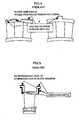
- FIG. 1 is a schematic diagram of a shrouded turbine blade as an example of a high-temperature member seen from a shroud portion
- FIG. 2 is another perspective view of a shroud section.
- the shrouded turbine blade is constituted of a blade portion 1, a dove tail portion 2, and a shroud portion 3.
- the blade portion 1 is a portion which has a blade-shaped section and in which a rotation power is generated by combustion gas.
- the dove tail portion 2 is positioned in a terminal end portion of the blade portion 1, and is fixed to a turbine disk (not shown) to transmit the rotation power to the turbine disk.
- the shroud portion 3 is attached to a blade tip end, and has a function of suppressing vibration or reducing a gas leakage in the tip end.
- the shroud portions are formed to be integrated with one or a plurality of blade portions 1, and are assembled to closely contact with one another.
- the closely contact surface is simply linear as seen from a radial direction in some case, and is stepped midway in the other case as in this example.
- the surface stepped midway will hereinafter be referred to as "Z-notched".
- shroud portions disposed adjacent to each other as shown by a two-dot chain line in FIG. 1 abut on each other on side surfaces A, B of a Z notch 3a to hold the entire position. Therefore, the Z-notched shroud portions have characteristics that the portions have a high position hold capability without being connected to each other.
- the turbine blade rotate at a high speed during operation, and not only undergoes periodic deformation and vibration but also is exposed to the combustion gas at a high temperature passed through the turbine blade. Therefore, there is a problem that the side surfaces A, B of the shroud portion receive a high surface pressure at the high temperature while rubbing, and are severely abraded. It is to be noted that the sliding surfaces A, B are not fixed, and one surface is defined as A while the surface abutting on the one surface is defined as B.
- a hard heat-resistant/wear-resistant metal has heretofore been build-up welded or thermally sprayed to the surfaces disposed adjacent to the Z notch of the turbine blade and sliding against each other (side surfaces A, B, hereinafter referred to as "sliding surfaces A, B") (e.g., [Reference 1]).
- FIGS. 3 and 4 a large number of fitting portions 5 are used in a turbine high-temperature section. As shown in FIG. 5, a large number of sliding surfaces exist even in a stator blade segment of a compressor. A rear stage of the compressor has a high temperature during the operation.
- a hard material has heretofore been attached to the surface by welding or thermal spraying. That is, a surface layer of a component is activated with grinding or blast before the welding or the thermal spraying. Subsequently, a Stellite-based alloy is built up by the welding or the thermal spraying, and grinding processing is carried out to remove an excess metal and to secure dimensions after the welding or the thermal spraying.
- the fitting portions are narrow trenches, the welding or the thermal spraying is not easily carried out, and the portions of conventional materials are easily worn.
- the secondary processing which is the re-melting processing
- a hard coat layer having good adhesion is obtained with respect to a steel material.
- the material forming hard carbide such as Ti is used as the electrode to generate the electro-discharge between the electrode and a metal material constituting the work, and then a strong hard coating layer can be formed on the surface of the metal as the work without any re-melting process (e.g., see Reference 3).
- the electrode material worn by the electro-discharge reacts with carbon C that is a component in dielectric liquid to generate titanium carbide (TiC).
- the hard coating layer having good adhesion can be formed more quickly as compared with the use of the material such as Ti. It has further been found that when the electro-discharge is generated between the metal material of the work and the green compact electrode obtained by mixing hydride such as TiH 2 with another metal or ceramic, a hard coating layer having various properties such as hardness and wear resistance can quickly be formed.
- a surface treatment electrode having a high strength can be prepared by preliminary sintering (e.g., see Reference 4).
- the preparation of the electrode for the electro-discharge surface treatment constituted of a mixed powder of WC and Co powders will be described.
- the WC and Co powders may simply be mixed, compressed, and molded.
- the powders are compressed/molded after mixing wax, moldability of the green compact is more preferably improved.
- the wax is an insulating material.
- the heating temperature needs to be kept at a temperature which is not less than a temperature to melt the wax and which is not more than a temperature to decompose the wax and to turn to soot.
- the green compact in the vacuum furnace is heated by a high-frequency coil and calcined to such an extent that a strength can bear machining, such that the compact is not excessively hardened, and exhibits a hardness like that of chalk.
- a contact portion between carbides is calcined at a comparatively low sintering temperature such that coupling is advanced but weak coupling is achieved before real sintering. It is known that when the electro-discharge surface treatment is carried out with this electrode, a dense and homogeneous coat can be formed.
- the work is used as a cathode, any of W or WC, Stellite-based alloy, TiB 2 (titanium boride), and Cr 3 C 2 (chromium carbide) is formed in a rod-shaped electrode to carry out the electro-discharge processing, and fixing layers such as W or WC, Stellite-based alloy, TiB 2 , and Cr 3 C 2 are formed on the surface of the work. Thereafter, W or WC, Cr 3 C 2 , Co, Cr, Al, Y, and the like are thermally sprayed to the surface of the fixing layer, and thereafter the surface is further subjected to plasma processing to obtain the wear resistance (e.g., see Reference 6).
- any of W or WC, Stellite-based alloy, TiB 2 (titanium boride), and Cr 3 C 2 (chromium carbide) is formed in a rod-shaped electrode to carry out the electro-discharge processing, and fixing layers such as W or WC, Stellite-based alloy, TiB 2
- an electrode for the electro-discharge processing formed of Cr 3 C 2 and the like to inhibit the wear on the electrode is disclosed (e.g., see Reference 7).
- the materials such as WC, TaC, TiC, cBN (cubic boron nitride), and diamond are used as the electrode material to attach the electrode material melted by the electro-discharge in the atmosphere to the work, and the coating layer is formed (e.g., see Reference 8).
- a ninth related art relates to an electro-discharge surface treatment technique, and lubricating materials such as BN are added to the electrode for the electro-discharge surface treatment to impart a lubricating function to the coating layer (e.g., see Reference 9).
- the lubricating materials are added to form a functional coating layer, but in most of the arts, the wear resistance at room temperature is focused on, and therefore the coating layer of the hard material such as TiC is formed on the surface of a material to be processed.
- FIG. 6 shows a schematic diagram of a turbine blade of a gas turbine engine for an airplane.
- a gas turbine engine for the airplane as shown in the figure, a plurality of turbine blades 201 contact one another and are fixed, and are constituted to rotate around an axis.
- a contact portion A among the shown turbine blades 201 is extremely rubbed and hit under a high-temperature environment.
- the wear-resistant coating layer used in the above-described related arts is degraded in hardness or oxidized under the high-temperature environment (700°C or more) under which the turbine blade is used, and therefore there is hardly wear-resistant effect.
- the coating layer to which the lubricating properties are imparted by the fourth and eighth related arts is based on an assumption of the use at room temperature.
- the lubricating properties at room temperature is far different in phenomenon and mechanism from those under the high-temperature environment exceeding 700°C for use in the gas turbine engine for the airplane.
- a first object of the present invention is to provide a method for coating a sliding surface of a high-temperature member and the high-temperature member which is little worn even by sliding movement under a high surface pressure at a high temperature, in which adhesion, dimensional precision, and workability of layers are improved and automation is possible.
- a second object of the present invention is to provide an electrode for an electro-discharge surface treatment by which a coating layer having wear resistance and lubricating property even under a high-temperature environment can be formed on a workpiece by an electro-discharge surface treatment method.
- a method for coating a sliding surface of a high-temperature member comprising the steps of: using an electrode for an electro-discharge treatment of a green compact of a high-temperature hard material (4), a material having a lubricating property at a high temperature (6), or a mixture of the high-temperature hard material (4) and the material having the lubricating property at the high temperature (6) on a sliding surface which contacts another member under a high-temperature environment to generate a pulsed electro-discharge between the electrode and the sliding surface; and forming a coating layer of a constituting material of the electrode for the electro-discharge surface treatment or a reactant of the constituting material on the sliding surface by electro-discharge energy.
- a method for coating a sliding portion comprising the steps of: subjecting a sliding surface A which contacts another member under a high-temperature environment to an electro-discharge surface treatment with a high-temperature hard material (4), a material having a lubricating property at a high temperature (6), or a mixture of the high-temperature hard material (4) and the material having the lubricating property at the high temperature (6), the electro-discharge surface treatment being a treatment of generating a pulsed electro-discharge between an electrode for the electro-discharge surface treatment and a workpiece in dielectric liquid or gas, so that a constituting material of the electrode for the electro-discharge surface treatment or a reactant of the constituting material forms into a coating layer on the surface of the workpiece by electro-discharge energy; and subjecting a sliding surface B that will abut on the sliding surface A to a welding, thermal spraying, or electro-discharge surface treatment with the material having the
- a method for coating a sliding portion comprising the steps of: subjecting a sliding surface A which contacts another member under a high-temperature environment to an electro-discharge surface treatment with a high-temperature hard material (4), a material having a lubricating property at a high temperature (6), or a mixture of the high-temperature hard material (4) and the material having the lubricating property at the high temperature (6); and subjecting the sliding surface B that will abut on the sliding surface A to the electro-discharge surface treatment with the high-temperature hard material (4), the material having the lubricating property at the high temperature (6), or the mixture of the high-temperature hard material (4) and the material having the lubricating property at the high temperature (6).
- a method for coating a sliding surface comprising the steps of: subjecting a sliding surface which contacts another member under a high-temperature environment to an electro-discharge surface treatment with a material having a lubricating property at a high temperature (6) in a porous manner; and filling pores with a solid lubricating material (7).
- the method further comprises the step of: to fill the pores with solid lubricating material, mixing the solid lubricating material in volatile solvent to brush-coat the material; or mixing the solid lubricating material in a soft rubber to be filled in the pores by rubbing.
- the solid lubricating material (7) is chromium oxide (Cr 2 O 3 ), or a mixture of chromium oxide (Cr 2 O 3 ) and silicon.
- the method further comprises the step of: performing a heating treatment after performing the electro-discharge surface treatment with the material having the lubricating property at the high temperature (6).
- the high-temperature hard material (4) is any one or a mixture of cBN, TiC, TiN, TiAlN, TiB 2 , WC, Cr 3 C 2 , SiC, ZrC, VC, B 4 C, Si 3 N 4 , ZrO 2 , and Al 2 O 3 .
- the material having the lubricating property at the high temperature (6) contains chromium and/or chromium oxide (Cr 2 O 3 ) and/or hBN.
- the material having the lubricating property at the high temperature (6) contains 10% or more of chromium, and does not contain 20% or more of nickel.
- a high-temperature member having a sliding surface which will contact another member under a high-temperature environment and on which a coating layer of a constituting material of an electrode for an electro-discharge surface treatment or a reactant of the constituting material is formed by the electro-discharge surface treatment in which the electrode of a green compact of a high-temperature hard material (4), a material having a lubricating property at a high temperature (6), or a mixture of the high-temperature hard material (4) and the material having the lubricating property at the high temperature (6) is used to generate a pulsed electro-discharge between the electrode and the sliding surface, the sliding surface contacting another member under a high-temperature environment.
- a high-temperature member comprising: one sliding surface which will contact the other sliding surface on another member under a high-temperature environment and which is subjected to a electro-discharge surface treatment with a high-temperature hard material (4), a material having a lubricating property at a high temperature (6), or a mixture of the high-temperature hard material (4) and the material having the lubricating property at the high temperature (6), wherein the other sliding surface is welded, thermally sprayed, or subjected to the electro-discharge surface treatment with the material having the lubricating property at the high temperature (6).
- a high-temperature member comprising: one sliding surface which will contact the other sliding surface on another member under a high-temperature environment and which is coated with a high-temperature hard material (4), a material having a lubricating property at a high temperature (6), or a mixture of the high-temperature hard material (4) and the material having the lubricating property at the high temperature (6), wherein the other sliding surface is subjected to an electro-discharge surface treatment with the high-temperature hard material (4), the material having the lubricating property at the high temperature (6), or the mixture of the high-temperature hard material (4) and the material having the lubricating property at the high temperature (6).
- a high-temperature member comprising: a sliding surface which will contact another member under a high-temperature environment and which is subjected to an electro-discharge surface treatment with a material having a lubricating property at a high temperature (6) in a porous manner, wherein pores are filled with a solid lubricating material (7).
- the solid lubricating material (7) is chromium oxide (Cr 2 O 3 ), or a mixture of chromium oxide (Cr 2 O 3 ) and silicon (Si).
- a heating treatment is performed such that the sliding surface has a tensile strength of 40 MPa or more.
- the material having the lubricating property at the high temperature (6) contains chromium and/or chromium oxide (Cr 2 O 3 ) and/or hBN.
- a gas turbine component or an axial flow compressor component comprising the high-temperature member which is a turbine rotor blade, a stator blade segment, a compressor stator blade segment, a combustor of a gas turbine, or a stationary component of the turbine or an afterburner.
- the sliding surfaces A, B when the sliding surfaces A, B are subjected to the electro-discharge surface treatment with the high-temperature hard material (4), high-temperature hardness of the sliding surfaces A, B can be enhanced.
- the sliding surfaces A, B is subjected to the electro-discharge surface treatment with the material having the lubricating property at the high temperature (6), the lubricating property of the sliding surfaces A, B at the high temperature can be enhanced.
- both the high-temperature hard material (4) and the material having the lubricating property at the high temperature (6) are used in the electro-discharge surface treatment, high-temperature hardness and high-temperature lubricating property can simultaneously be enhanced.
- a stable lubricating property can be obtained from a low temperature of 700°C or less to a high temperature of 700°C or more.
- the material does not come to exhibit the lubricating property by oxidation at the high temperature, but the contained material itself has the lubricating property. Therefore, the material has the lubricating property even at 700°C or less, and is not easily worn.
- the material having the lubricating property at the high temperature (6) is used in the electro-discharge surface treatment to form the coating layer on the sliding surface
- the material is subjected to the heating treatment, the porous structure can be densified and hardened, and a coating inner strength can be enhanced in a thick coating.
- the electro-discharge surface treatment a tendency to an amorphous metal structure is seen, but the structure is crystallized and stabilized by the heating treatment, and a change of a dimension at the time of operation can be prevented.
- the coating layer has an adhesion equal to that of the welding, dimensional precision and quality are stable, workability is high, and cost is remarkably low as compared with the welding or thermal spraying. Therefore, a manufacturing cost can largely be reduced.
- the electro-discharge surface treatment can easily be applied to narrow trench-lie portions such as a fitting portion only by the change of an electrode shape, and a solid heat-resistant/wear-resistant coating layer can easily be formed.
- the high-temperature hard material (4) is any one or a mixture of cBN, TiC, TiN, TiA1N, TiB 2 , WC, Cr 3 C 2 , SiC, ZrC, VC, B 4 C, Si 3 N 4 , ZrO 2 , and Al 2 O 3 .
- these high-temperature hard materials have a very high Vickers hardness at room temperature as described later, and hold a high hardness even at the high temperature, the high-temperature hardness of the sliding surfaces A, B of the high-temperature member can largely be enhanced.
- the material having the lubricating property at the high temperature (6) contains chromium and/or chromium oxide (Cr 2 O 3 ) and/or hBN.
- the material having the lubricating property at the high temperature (6) preferably contains 10% or more of chromium, and does not contain 20% or more of nickel.
- Chromium is oxidized at the high temperature to produce oxide, and fulfills the lubricating property. Therefore, a chromium-containing coating layer is formed on the sliding surfaces A, B of the high-temperature member to enhance the lubricating property at the high temperature, and the wear resistance can be enhanced equally or more as compared with the related art. When much nickel is contained, oxidation of chromium at the high temperature is inhibited.
- the solid lubricating material (7) with which the pores of the porous coating layer are filled is preferably a material of chromium oxide, or a mixture of powders of chromium oxide and silicon. Instead of being oxidized for the lubricating property at the high temperature, the contained material itself has the lubricating property. Therefore, the material has the lubricating property at 700°C or less, and is not easily worn.
- the material may be heated at 1000°C for ten minutes or more. Accordingly, a tensile strength of about 100 MPa can be obtained, and peel in a porous layer can be prevented.
- an electrode for an electro-discharge surface treatment for use in an electro-discharge surface treatment method of generating a pulsed electro-discharge between the electrode for the electro-discharge surface treatment and a workpiece in dielectric liquid or gas, so that a constituting material of the electrode for the electro-discharge treatment or a reactant of the constituting material forms into a coating layer on the surface of the workpiece by electro-discharge energy, wherein the electrode is made from a green compact of a mixture of a fine powder of a high-temperature hard material having a high hardness at a high temperature, and a fine powder of a high-temperature lubricating material which is oxidized at the high temperature to obtain a lubricating property.
- the electrode for the electro-discharge surface treatment made from a mixture of a high-temperature hard material having a high strength at the high temperature, and a high-temperature lubricating material having the lubricating property at the high temperature is used to form a coating layer which is not easily worn even under a high-temperature environment at 700°C or more on the surface of the workpiece by the electro-discharge surface treatment method.
- an electrode for an electro-discharge surface treatment for use in an electro-discharge surface treatment method of generating a pulsed electro-discharge between the electrode for the electro-discharge surface treatment and a workpiece in dielectric liquid or gas, so that a constituting material of the electrode for the electro-discharge surface treatment or a reactant of the constituting material forms into a coating layer on the surface of the workpiece by electro-discharge energy, wherein the electrode is made from a high-temperature lubricating material which is oxidized at a high temperature to obtain a lubricating property.
- the coating layer which exhibits the lubricating property under a high-temperature environment at 700°C or more and which is not easily worn is formed on the surface of the workpiece formed by the electro-discharge surface treatment method using the electrode for the electro-discharge surface treatment made from the high-temperature lubricating material having the lubricating material at the high temperature.
- the coating layer which exerts the lubricating property even under a low-temperature environment at 700°C or less and which is not easily worn is formed on the surface of the workpiece formed by the electro-discharge surface treatment method using the electrode for the electro-discharge surface treatment including the solid lubricating material itself.
- the coating layer which fulfills the lubricating property and is not easily worn even under the low-temperature environment at 700°C or less is formed.
- sliding surfaces A, B of the high-temperature member is subjected to an electro-discharge surface treatment with one or both of a high-temperature hard material (4) and a material having a lubricating property at a high temperature (6), but it is most preferable to subject both the sliding surfaces A, B of the high-temperature member to the electro-discharge surface treatment with both the high-temperature hard material (4) and the material having the lubricating property at the high temperature (6).
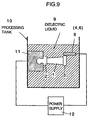
- FIG. 9 is a schematic diagram of the electro-discharge surface treatment according to the present invention.
- An electro-discharge surface treatment technique is disclosed, for example, in Japanese Laid-Open Patent Publication No. 7-197275 "Surface Treatment Method of Metal Material by In-Liquid Electro-discharge".
- the method may also be carried out even in gas.
- reference numeral 8 denotes an electro-discharge electrode
- 9 denotes dielectric liquid
- 10 denotes a processing tank
- 11 denotes an attachment member
- 12 denotes a power supply.
- a high-temperature member is fixed to the attachment member 11, and the electro-discharge electrode 8 is disposed opposite to the member in the vicinity of the sliding surface A (or B) of the high-temperature member.
- the dielectric liquid 9 is filled to such a height that at least the sliding surface A (or B) and a part of the electro-discharge electrode 8 are submerged. In this state, electro-discharge is generated between the electro-discharge electrode 8 and the sliding surface A (or B) by the power supply 12, and only the sliding surface A (or B) of the high-temperature member is coated.
- the electro-discharge surface treatment when a voltage is applied to the high-temperature member and the electro-discharge electrode 8 immersed in the dielectric liquid or gas such as an argon gas and nitrogen, pulsed electro-discharge is generated between the surfaces disposed opposite to each other.
- the surface of the electro-discharge electrode 8 is peeled and melted by the electro-discharge, the melted material is attached to the sliding surface A (or B) of the shroud portion 3, but the treatment is most preferably carried out in oil.
- the electro-discharge surface treatment is a coating method optimum for precision components such as a turbine motor blade.
- the coating layer is formed only in a portion where the electro-discharge occurs, and therefore the coating layer can locally be formed on the portion to be coated, and pre-processing such as masking is unnecessary.
- post treatments such as excessive thickness removal and dimension securing are also unnecessary. Heat input per pulse of the electro-discharge is remarkably small, and a turbine motor blade is hardly thermally deformed.
- the electro-discharge electrode 8 powders of the high-temperature hard material 4 and/or the material having the lubricating property at the high temperature 6 are mixed, compressed, and molded for use.
- the high-temperature hard material 4 may also be any or a mixture of cBN, TiC, TiN, TiAlN, TiB 2 , WC, Cr 3 C 2 , SiC, ZrC, VC, B 4 C, Si 3 N 4 , ZrO 2 , and Al 2 O 3 .
- TiC is preferable at a use temperature of the component of 900°C or less
- cBN is preferable at 900°C or more and 1000°C or less
- Al 2 O 3 , ZrO 2 are preferable at 1000°C or more.
- the materials form a coating layer, and the sliding surface can be coated with a very hard fine ceramic (e.g., Vickers hardness is 4500 with cBN) at a low cost.
- a very hard fine ceramic e.g., Vickers hardness is 4500 with cBN
- the material having the lubricating property at the high temperature (6) indicates chromium, chromium oxide, hBN, or an alloy of cobalt containing these which is a major component.
- the chromium-containing material preferably contains 10% or more of chromium, and does not contain 20% or more of nickel.
- the material having the lubricating property at the high temperature (6) When the material having the lubricating property at the high temperature (6) is used in the electrode for the electro-discharge surface treatment, the material forms the coating layer, and the lubricating property at the high temperature can be enhanced at the low cost.
- the chromium-containing material is used in the material having the lubricating property at the high temperature (6), the lubricating property at the high temperature can be enhanced. This respect will be described in detail.
- FIG. 10 is a diagram showing comparison of a wear amount of a chromium-containing Ni-based alloy with that of a Co-based alloy. From this figure, the wear amount drops for the cobalt-based alloy in a high-temperature range of 700 to 900°C. Additionally, it is seen that the wear amount rapidly increases in a high-temperature range for a nickel-based alloy.
- FIG. 11 shows comparison of Vickers hardness at the high temperature. It is seen from this figure that Ni-based Inconel 713LC is relatively high in hardness even at the high temperature. However, although Ni-based Inconel 713LC is hard, the material is remarkably worn at the high temperature as described later.
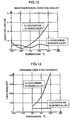
- FIG. 12 is a comparative diagram of a high-temperature oxidation amount.
- an Inconel material contains Cr, the material is not much oxidized at the high temperature, Cr 2 O 3 is not formed, and low wear is not achieved.
- Cr is oxidized to form Cr 2 O 3 , and the low wear is supposedly achieved.
- FIG. 13 is a comparative diagram of an X-ray intensity showing an amount of chromium oxide at the high temperature.
- Co-based oxide rapidly increases at a temperature of 700°C. Cobalt does not inhibit the oxidation of chromium.
- the chromium oxide amount does not change and indicates a low value in the Ni-based alloy. From this, it is seen that a large difference is produced in the wear amount by the presence/absence of oxide as shown in FIG. 8.
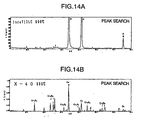
- FIGS. 14A and 14B show X-ray analysis results of the material after the heating at 900°C.
- FIG. 14A shows Ni-based Inconel 713LC
- FIG. 14B shows the Co-based alloy (X-40). It is also seen from this comparison that Cr 2 O 3 cannot apparently be formed in the Ni-based alloy.
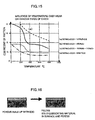
- FIG. 15 is a diagram showing a coefficient of friction of Cr 2 O 3 at the high temperature. It is seen from this figure that Cr 2 O 3 indicates a low friction at the high temperature, and the coefficient of friction drops especially at around 300°C, and is remarkably small at around 700°C.
- the lubricating property at the high temperature can be enhanced by the use of the chromium-containing material having the lubricating property at the high temperature 6.
- the lubricating property at the high temperature can also be enhanced by the use of the Cr 2 O 3 or hBN-containing material having the lubricating property at the high temperature 6.
- the sliding surface A and/or B of the high-temperature member is subjected to the electro-discharge surface treatment with the material having the lubricating property at the high temperature 6 in the porous manner, and the solid lubricating material 7 is mixed in volatile solvent, and the pore is filled with the solid lubricating material 7 by brush coating, for example. Accordingly, the lubricating property can be enhanced even at 600°C or less.
- the sliding surface A and/or B of the high-temperature member is subjected to the electro-discharge surface treatment with the material having the lubricating property at the high temperature (6), the solid lubricating material (7) is mixed in the volatile solvent and filled in the pores by the brush coating or mixed with a soft rubber and filled in the pores by rubbing, and accordingly the lubricating property can be enhanced even at 700°C or less.
- the porous structure preferably has a porosity of 10% or more.
- chromium oxide (Cr 2 O 3 ) or a mixture of chromium oxide (Cr 2 O 3 ) and silicon is used as an example of the solid lubricating material (7).
- the lubricating property is imparted, and the material is not worn regardless of the temperature.
- the solid lubricating material of Cr 2 O 3 mixed with Si is filled in the pores, the wear is remarkably little at 480°C. Si is oxidized to form SiO 2 , and liquefied glass and solid lubricating material Cr 2 O 3 produce a synergistic effect.
- Table 1 shows a test result indicating the effect of the solid lubricating material
- FIG. 16 is a schematic diagram showing that the solid lubricating material is filled in the pores of the porous structure.
- Example of test result of difference of wear at intermediate temperature Test conditions: 480°C in the atmospheric air (after once heating at 760°C) Surface pressure: 7 MPa Amplitude: 1.0 ( ⁇ 0.5) Cycle number: 10 6 Wear amount (micron) Porous build-up of Stellite 31 190 Stellite 31 filled with Cr 2 O 3 50 Stellite 31 filled with Cr 2 O 3 and Si 5
- the porous structure has a small tensile strength and has a possibility of peel. To solve this, the structure is heated at the high temperature to promote diffusion among particles, and a coupling strength is increased.
- Table 2 shows the test result of the tensile strength.
- the layer of the electro-discharge surface treatment is heated/treated at 1000°C or more for ten minutes or more, the diffusion coupling of the structure in the coating advances, and the densification and strength enhancement of the structure are realized.
- the turbine blade will be described in accordance with an example.
- Table 3 is a major component table of a mother material (Inconel 713LC) of the turbine blade, a build-up material T onto the sliding surface by the welding, and a Stellite-based lubricating material which is a coating material onto the sliding surface by the electro-discharge surface treatment.
- the mother material has a small content of Cr and Co, but the material having a large content of these is used in the build-up material T and Stellite-based lubricating material.
- the build-up material T and Stellite-based lubricating material correspond to the material having the lubricating property at the high temperature 6.
- Table 4 shows the Vickers hardness of cBN and various types of carbides which are high-temperature hard materials at room temperature.
- the mother material, build-up material T, and Stellite lubricating material of Table 3 have a low Vickers hardness of about 300 to 400. Additionally, it is known that the hardness rapidly drops at 600°C or more, and at a high temperature of 700 to 800°C, the hardness drops to about 1/2 of that at room temperature. Vickers hardness (room temperature) cBN TiC SiC Cr 3 C 2 WC ZrO 2 4500 3200 2400 2280 2200 1300
- Table 5 shows the test conditions for testing the wear on the sliding surface for confirming the effect of the present invention, and the conditions are set to those close to operation conditions of an actual jet engine.
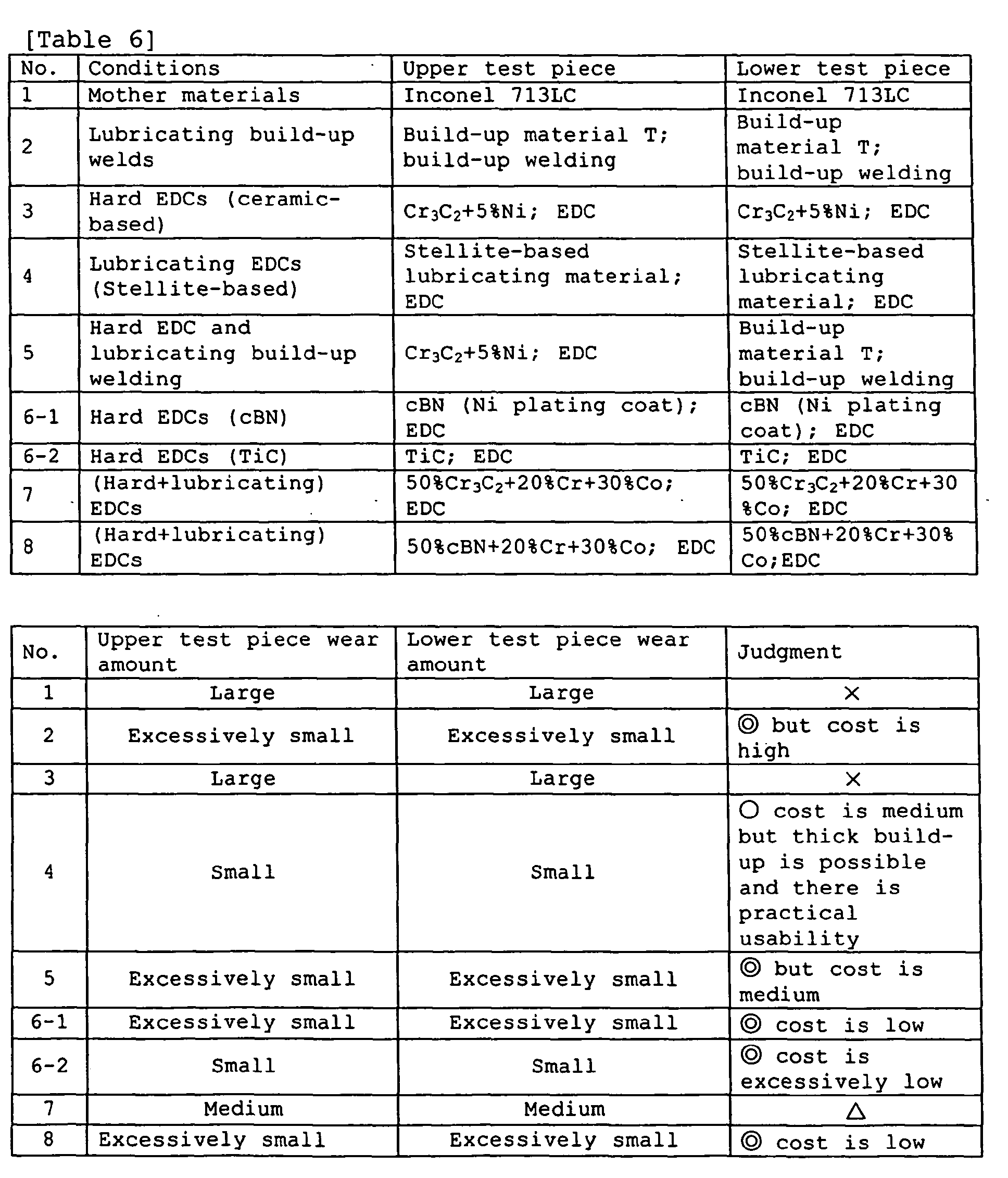
- Table 6 shows comparison of the test results, and shows the test material and the degree of wear.
- treatment number 1 both materials are the mother materials, wear is excessively large, and this treatment cannot be applied.
- Treatment number 2 shows a conventional example (build-up welding), and the wear is little, but the cost is high.
- the treatment numbers 1 and 2 show known examples. However, the material is largely worn at 480°C.
- “conditions” indicates two fictional portions (surfaces) that contact each other to be worn in the experiment.
- Treatment number 3 shows an example in which a hard ceramic-based material is used in the electrode, the electro-discharge surface treatment (described as electro-discharge coating (EDC) in Table 6) is applied, and hard chromium carbide (Cr 3 C 2 ) having good oxidation resistance at the high temperature is formed into coating layers on the opposite surfaces in order to reduce the cost.
- EDC electro-discharge coating
- Cr 3 C 2 hard chromium carbide
- Treatment number 4 shows one example of the present invention in which the Stellite-based material having a large content of Cr and having the lubricating property at the high temperature is applied to the opposite surfaces by the electro-discharge surface treatment in the same manner as in 3. In this case, it is seen that the wear amount largely drops and the treatment is applicable.
- the solid lubricating material which is chromium oxide (Cr 2 O 3 ) or a mixture of chromium oxide (Cr 2 O 3 ) and silicon is mixed with a soft rubber and filled in the pores by rubbing. Accordingly, the lubricating property can be enhanced even at 700°C or less.
- the porosity of the porous structure is preferably 10% or more.
- the porous structure has a small tensile strength and has a possibility of peel.
- the structure is heated at the high temperature to promote the diffusion among the particles, and the coupling strength is increased.
- the layers of the electro-discharge surface treatment are heated/treated at 1000°C or more for ten minutes or more, the diffusion coupling of the structure in the coating advances, and the densification and strength enhancement of the structure are realized.
- Treatment number 5 shows another example of the present invention in which one surface is subjected to the electro-discharge surface treatment with very hard chromium carbide (Cr 3 C 2 ), and on the other surface, the build-up material T having the lubricating material is build-up welded.
- Cr 3 C 2 very hard chromium carbide
- Treatment number 6-1 shows another example of the present invention in which only the hard material of cBN is applied to the opposite surfaces in the electro-discharge surface treatment in the same manner as in 3.
- cBN which does not have the lubricating property but which is excessively hard, it is observed that the coefficient of friction is large and the vibration at the time of sliding movement is large, but it is seen that the wear amount largely drops and the treatment is applicable.
- Treatment number 6-2 shows another example of the present invention in which only the hard material of TiC is applied to the opposite surfaces in the electro-discharge surface treatment in the same manner as in 3.
- any lubricating material is not used, the coefficient of friction is small, and the hardness is remarkably large. Therefore, it is seen that the wear amount largely drops and the treatment is applicable.
- TiC is oxidized at 700°C or more and is not usable at the high temperature.
- the wear is small and the high-temperature wear resistance is superior even at 1000°C. Additionally, the wear is slightly large at 480°C.
- Base material Re77 (Nickel alloy) unit: ⁇ m °C Re77
- Treatment numbers 7, 8 show the other examples of the present invention in which a mixture of hard materials of hard Cr 3 C 2 and cBN having good resistance to oxidation at the high temperature, and a Cr-containing material having the lubricating property at the high temperature is applied to the opposite surfaces in the electro-discharge surface treatment in the same manner as in 3.
- Cr 3 C 2 of the treatment number 7 is hard and contains the high-temperature lubricating material, the material is worn.
- cBN of the treatment number 8 is remarkably hard and also contains the high-temperature lubricating material, therefore the wear amount largely drops, and the treatment is applicable.
- the solid lubricating materials such as hBN may also be mixed instead.
- the mixture of hBN directly in the electrode is effective for lubrication in a range at a temperature at which a usual lubricant is usable or higher and a temperature at which Cr is oxidized at the high temperature or lower.
- the coating layer having the lubricating property can be formed over a broad range from a comparatively low temperature to a high temperature exceeding 700°C.
- Cr 3 C 2 has a function of remarkably improving roughness of the surface of the formed coating layer as compared with the use of the other materials, and Cr 3 C 2 is preferably used as the high-temperature hard material. Since the coating layer formed by the electro-discharge surface treatment is formed by pulse electro-discharge in the dielectric liquid, there is a strong tendency to convex/concave surface, but it is possible to inhibit the surface roughness and to smoothen the surface by the use of Cr 3 C 2 .
- the hardness of the sliding surface can be enhanced.
- the lubricating property of the sliding surface at the high temperature can be enhanced.
- both the high-temperature hard material (4) and the material having the lubricating property at the high temperature (6) are used in the electro-discharge surface treatment, the hardness and the high-temperature lubricating property can simultaneously be enhanced.
- the adhesion of the coating layer is equal to that in the welding, the dimensional precision and quality are stabilized and the workability is high as compared with the welding or the thermal spraying, and therefore the manufacturing cost can largely be reduced.
- the treatment can easily be applied even to the narrow trench-shaped portions such as the fitting portion only by the change of the electrode shape in order to form the coating layer by the electro-discharge.
- the high-temperature hardness of the sliding surface of the high-temperature member can largely be enhanced.
- the lubricating property is fulfilled at the high temperature, and the resistance to wear can be enhanced to obtain the resistance which is equal to or more than that of the related art.
- the coating method of the sliding surface of the high-temperature member and the high-temperature member of the present invention have superior effects that the wear is little even with the sliding movement under a high surface pressure at the high temperature, the adhesion, dimensional precision, workability of the coating layer are enhanced, the treatment by the electro-discharge is controlled by NC, and the automation is possible.
- the electrode material having the high strength and lubricating property even under the high-temperature environment is used.
- the high-temperature hard material having the high strength under the high-temperature environment selected from cBN, TiC, TiN, TiAlN, TiB 2 , WC, Cr 3 C 2 , silicon carbide (SiC), ZrC, VC, B 4 C, Si 3 N 4 , zirconium oxide (ZrO 2 ), and aluminum oxide (Al 2 O 3 ) is mixed with the high-temperature lubricating material which is oxidized under the high-temperature environment to obtain the lubricating property to form the electrode material.
- Cr is preferably used as the material having the lubricating property under the high-temperature environment in the present invention.
- Cr 2 O 3 obtained by the oxidation of Cr has a property that the lubricating property is possessed under the high-temperature environment.
- a temperature is required at about 700°C or more.
- FIGS. 10, 11, 12, 13 show data as a proof for this fact.
- a usual liquid lubricant evaporates in the high-temperature environment at 700°C or more.
- the usual chemically synthesized lubricant is decomposed by heat, and is not usable, and therefore the lubricating effect by Cr 2 O 3 has a significant meaning.
- FIG. 17 is a flowchart showing a preparation procedure of the electrode for the electro-discharge surface treatment according to the present invention.
- cBN and Stellite powder are weighed and mixed at a weight ratio of 1:4 (step S1), and charged in a mold (die) having a predetermined shape and subsequently compressed/molded to obtain a green compact (step S2).
- Stellite is an alloy containing Co and Cr which are major components and also containing several types of other components.
- cBN having a particle diameter of 2 to 4 ⁇ m, and Stellite having a particle diameter of 1 to 3 ⁇ m were used.
- FIG. 18 is a diagram showing a sectional shape of a molding unit for use in compression molding.
- a lower punch 104 is inserted via a lower part of a hole formed in a mold (die) 105, and a mixture of mixed cBN powder 101 and Stellite powder 102 is charged in a space formed by the lower punch 104 and the mold (die) 105. Thereafter, an upper punch 103 is inserted from an upper part of the hole formed in the mold (die) 105.
- the material is compressed/molded with a pressurizing unit, and the like so that a pressure is applied on the opposite sides of the upper punch 103 and lower punch 104 of a molding unit charged with the mixture of the cBN and Stellite powders, and accordingly the electrode for the electro-discharge surface treatment is prepared.
- a pressurizing unit and the like so that a pressure is applied on the opposite sides of the upper punch 103 and lower punch 104 of a molding unit charged with the mixture of the cBN and Stellite powders, and accordingly the electrode for the electro-discharge surface treatment is prepared.
- step S3 it is possible to heat/treat the compressed/molded green compact (step S3). By the heating treatment, the strength of the compressed/molded electrode can be increased.
- the wax may also be mixed. After mixing the wax into the powder in this manner, the material is compressed/molded, and the moldability of the green compact is then enhanced. Additionally, the wax is an insulating material. Therefore, when a large amount of wax is left in the electrode, an electric resistance of the electrode is increased, electro-discharge properties are degraded, and it is therefore necessary to remove the wax.
- a method of removing the wax there is a method in which a compressed/molded green compact electrode containing the wax is charged and heated in a vacuum furnace. Accordingly, the wax in the green compact is removed. It is to be noted that the method of the heating in the vacuum furnace corresponds to the process of the step S3. When the material is heated as described above, the strength of the electrode increases.
- FIG. 19 is a block diagram showing an outline of an apparatus for performing the electro-discharge surface treatment method of the present invention.
- the electro-discharge surface treatment apparatus includes an electrode for the electro-discharge surface treatment 21, processing tank 24, dielectric liquid 25, resistance 26, power supply 27, switching device 28, and control circuit 29.
- the dielectric liquid 25 mainly containing an insulating oil or water is charged in the processing tank 24, and a workpiece 22 on which the coating layer is to be formed is disposed.
- the electrode for the electro-discharge surface treatment 21 is the electrode prepared in the above-described steps of FIG. 17, and is disposed opposite to the upper part of the workpiece 22.
- the electrode for the electro-discharge surface treatment 21 is connected to the workpiece 22 via the resistance 26, power supply 27, and switching device 28.
- the switching device 28 switches the voltage and current applied to the electrode for the electro-discharge surface treatment 21 and workpiece 22.
- the switching device 28 is connected to the control circuit 29 which controls the switching device 28 to be on/off.
- a driving mechanism is disposed at the electrode for the electro-discharge surface treatment 21 and processing tank 24 in order to control the position of the coating layer formed on the surface of the workpiece 22.
- the material constituting the electrode for the electro-discharge surface treatment 21 floats in the dielectric liquid of the processing portion by heat energy.
- the floated electrode constituting material or the material obtained by the reaction of the electrode constituting material by the heat energy adheres to the surface of the workpiece 22 to form a coating layer 23.
- the coating layer 23 is formed on the surface of the workpiece 22 in this manner.
Landscapes
- Chemical & Material Sciences (AREA)
- Engineering & Computer Science (AREA)
- Mechanical Engineering (AREA)
- Chemical Kinetics & Catalysis (AREA)
- Materials Engineering (AREA)
- Metallurgy (AREA)
- Organic Chemistry (AREA)
- Physics & Mathematics (AREA)
- Plasma & Fusion (AREA)
- Other Surface Treatments For Metallic Materials (AREA)
- Structures Of Non-Positive Displacement Pumps (AREA)
- Coating By Spraying Or Casting (AREA)
Abstract
Description
| Example of test result of difference of wear at intermediate temperature | |
| Test conditions: | |
| 480°C in the atmospheric air (after once heating at 760°C) | |
| Surface pressure: 7 MPa | |
| Amplitude: 1.0 (±0.5) | |
| Cycle number: 106 | |
| Wear amount (micron) | |
| Porous build-up of Stellite 31 | 190 |
| Stellite 31 filled with Cr2O3 | 50 |
| Stellite 31 filled with Cr2O3 and | 5 |
| Tensile strength | |
| MPa | |
| Electro-discharge coating as such | 32 |
| After high-temperature heat treatment | 99 |
| Material name | Cr | Co | Mo | Ni | |
| Inconel 713LC | |||||
| 12 | 0 | 4.5 | Balance - | - | |
| build-up material T | 18 | 49 | 29 | - | - |
| Stellite-based | 25 | 56 | - | 10 | 7 |
| Vickers hardness (room temperature) | |||||
| cBN | TiC | SiC | Cr3C2 | WC | ZrO2 |
| 4500 | 3200 | 2400 | 2280 | 2200 | 1300 |
| Temperature | Surface pressure | Cycle number | Vibration number | Amplitude |
| 815°C | 7 | 1×10⁷ | 95 Hz | 0.35 mm |
| Wear test result | |||
| Wear with respect to test temperature (surface pressure = 7 MPa, amplitude = ±0.5 mm, frequency = 40 Hz, cycle number = 106) | |||
| Base material: Re77 (Nickel alloy) unit: µm | |||
| °C | Re77 | Build-up welding of build-up material T (thickness of 1 mm) | EDC of TiC (thickness of 0.03 mm) |
| 480 | 40 | 181 | 55 |
| 700 | 13 | 17 | |
| 815 | 750 | 13 | 14 |
| 1000 | Remarkably large | 3 | 25 |
| Coefficient of friction | 07 | 04 | 0.1 to 0.2 |
Claims (24)
- A method for coating a sliding surface of a high-temperature member, comprising the steps of: using an electrode for an electro-discharge treatment of a green compact of a high-temperature hard material (4), a material having a lubricating property at a high temperature (6), or a mixture of the high-temperature hard material (4) and the material having the lubricating property at the high temperature (6) on a sliding surface which contacts another member under a high-temperature environment to generate a pulsed electro-discharge between the electrode and the sliding surface; and forming a coating layer of a constituting material of the electrode for the electro-discharge surface treatment or a reactant of the constituting material on the sliding surface by electro-discharge energy.
- A method for coating a sliding portion, comprising the steps of: subjecting a sliding surface A which contacts another member under a high-temperature environment to an electro-discharge surface treatment with a high-temperature hard material (4), a material having a lubricating property at a high temperature (6), or a mixture of the high-temperature hard material (4) and the material having the lubricating property at the high temperature (6), the electro-discharge surface treatment being a treatment of generating a pulsed electro-discharge between an electrode for the electro-discharge surface treatment and a workpiece in dielectric liquid or gas, so that a constituting material of the electrode for the electro-discharge surface treatment or a reactant of the constituting material forms into a coating layer on the surface of the workpiece by electro-discharge energy; and subjecting a sliding surface B that will abut on the sliding surface A to a welding, thermal spraying, or electro-discharge surface treatment with the material having the lubricating property at the high temperature (6).
- A method for coating a sliding portion, comprising the steps of: subjecting a sliding surface A which contacts another member under a high-temperature environment to an electro-discharge surface treatment with a high-temperature hard material (4), a material having a lubricating property at a high temperature (6), or a mixture of the high-temperature hard material (4) and the material having the lubricating property at the high temperature (6); and subjecting the sliding surface B that will abut on the sliding surface A to the electro-discharge surface treatment with the high-temperature hard material (4), the material having the lubricating property at the high temperature (6), or the mixture of the high-temperature hard material (4) and the material having the lubricating property at the high temperature (6).
- A method for coating a sliding surface, comprising the steps of: subjecting a sliding surface which contacts another member under a high-temperature environment to an electro-discharge surface treatment with a material having a lubricating property at a high temperature (6) in a porous manner; and filling pores with a solid lubricating material (7).
- The method according to claim 4, further comprising the step of: to fill the pores with solid lubricating material, mixing the solid lubricating material in a volatile solvent to brush-coat the material; or mixing the solid lubricating material in a soft rubber to be filled in the pores by rubbing.
- The method according to claim 4, wherein the solid lubricating material (7) is chromium oxide (Cr2O3), or a mixture of chromium oxide (Cr2O3) and silicon.
- The method according to claim 1, 2, 3, or 4, further comprising the step of: performing a heating treatment after performing the electro-discharge surface treatment with the material having the lubricating property at the high temperature (6).
- The method according to claim 1, 2, or 3,
wherein the high-temperature hard material (4) is any one or a mixture of cBN, TiC, TiN, TiAlN, TiB2, WC, Cr3C2, SiC, ZrC, VC, B4C, Si3N4, ZrO2, and Al2O3. - The method according to claim 1, 2, 3, 4, or 7, wherein the material having the lubricating property at the high temperature (6) contains chromium and/or chromium oxide (Cr2O3) and/or hBN.
- The method according to any one of claims 1 to 4 and 7, wherein the material having the lubricating property at the high temperature (6) contains 10% or more of chromium, and does not contain 20% or more of nickel.
- A high-temperature member having a sliding surface which will contact another member under a high-temperature environment and on which a coating layer of a constituting material of an electrode for an electro-discharge surface treatment or a reactant of the constituting material is formed by the electro-discharge surface treatment in which the electrode of a green compact of a high-temperature hard material (4), a material having a lubricating property at a high temperature (6), or a mixture of the high-temperature hard material (4) and the material having the lubricating property at the high temperature (6) is used to generate a pulsed electro-discharge between the electrode and the sliding surface, the sliding surface contacting another member under a high-temperature environment.
- A high-temperature member, comprising: one sliding surface which will contact the other sliding surface on another member under a high-temperature environment and which is subjected to an electro-discharge surface treatment with a high-temperature hard material (4), a material having a lubricating property at a high temperature (6), or a mixture of the high-temperature hard material (4) and the material having the lubricating property at the high temperature (6), wherein the other sliding surface is welded, thermally sprayed, or subjected to the electro-discharge surface treatment with the material having the lubricating property at the high temperature (6).
- A high-temperature member comprising: one sliding surface which will contact the other sliding surface on another member under a high-temperature environment and which is coated with a high-temperature hard material (4), a material having a lubricating property at a high temperature (6), or a mixture of the high-temperature hard material (4) and the material having the lubricating property at the high temperature (6), wherein the other sliding surface is subjected to an electro-discharge surface treatment with the high-temperature hard material (4), the material having the lubricating property at the high temperature (6), or the mixture of the high-temperature hard material (4) and the material having the lubricating property at the high temperature (6).
- A high-temperature member comprising: a sliding surface which will contact another member under a high-temperature environment and which is subjected to an electro-discharge surface treatment with a material having a lubricating property at a high temperature (6) in a porous manner, wherein pores are filled with a solid lubricating material (7).
- The high-temperature member according to claim 14, wherein the solid lubricating material (7) is chromium oxide (Cr2O3), or a mixture of chromium oxide (Cr2O3) and silicon (Si).
- The high-temperature member according to claim 11, 12, 13, or 14, wherein after performing the electro-discharge surface treatment is performed with the material having the lubricating property at the high temperature (6), a heating treatment is performed such that the sliding surface has a tensile strength of 40 MPa or more.
- The high-temperature member according to claim 11, 12, or 13, wherein the high-temperature hard material (4) is any one or a mixture of cBN, TiC, TiN, TiAlN, TiB2, WC, Cr3C2, SiC, ZrC, VC, B4C, Si3N4, ZrO2, and Al2O3.
- The high-temperature member according to claim 11, 12, 13, or 14, wherein the material having the lubricating property at the high temperature (6) contains chromium and/or chromium oxide (Cr2O3) and/or hBN.
- The high-temperature member according to claim 11, 12, 13, 14, or 16, wherein the material having the lubricating property at the high temperature (6) contains 10% or more of chromium, and does not contain 20% or more of nickel.
- A gas turbine component or an axial flow compressor component comprising the high-temperature member according to any one of claims 11 to 19 which is a turbine rotor blade, a stator blade segment, a compressor stator blade segment, a combustor of a gas turbine, or a stationary component of the turbine or an afterburner.
- An electrode for an electro-discharge surface treatment for use in an electro-discharge surface treatment method of generating a pulsed electro-discharge between the electrode for the electro-discharge surface treatment and a workpiece in dielectric liquid or gas, so that a constituting material of the electrode for the electro-discharge treatment or a reactant of the constituting material forms into a coating layer on the surface of the workpiece by electro-discharge energy,
wherein the electrode is made from a green compact of a mixture of a fine powder of a high-temperature hard material having a high hardness at a high temperature, and a fine powder of a high-temperature lubricating material which is oxidized at the high temperature to obtain a lubricating property. - An electrode for an electro-discharge surface treatment for use in an electro-discharge surface treatment method of generating a pulsed electro-discharge between the electrode for the electro-discharge surface treatment and a workpiece in dielectric liquid or gas, so that a constituting material of the electrode for the electro-discharge surface treatment or a reactant of the constituting material forms into a coating layer on the surface of the workpiece by electro-discharge energy,
wherein the electrode is made from a high-temperature lubricating material which is oxidized at a high temperature to obtain a lubricating property. - The electrode for the electro-discharge surface treatment according to claim 21, wherein the high-temperature hard material comprises at least one or more of cBN, TiC, TiN, TiAlN, TiB2, WC, Cr3C2, SiC, ZrC, VC, B4C, Si3N4, ZrO2, and Al2O3.
- The electrode for the electro-discharge surface treatment according to claim 21 or 22, wherein the high-temperature lubricating material which is oxidized at the high temperature to obtain the lubricating property contains chromium.
Applications Claiming Priority (5)
| Application Number | Priority Date | Filing Date | Title |
|---|---|---|---|
| JP2002276860 | 2002-09-24 | ||
| JP2002276860 | 2002-09-24 | ||
| JP2002295963 | 2002-10-09 | ||
| JP2002295963 | 2002-10-09 | ||
| PCT/JP2003/012088 WO2004029329A1 (en) | 2002-09-24 | 2003-09-22 | Method for coating sliding surface of high temperature member, and high temperature member and electrode for electric discharge surface treatment |
Publications (3)
| Publication Number | Publication Date |
|---|---|
| EP1544321A1 true EP1544321A1 (en) | 2005-06-22 |
| EP1544321A4 EP1544321A4 (en) | 2011-05-04 |
| EP1544321B1 EP1544321B1 (en) | 2016-08-10 |
Family
ID=32044596
Family Applications (1)
| Application Number | Title | Priority Date | Filing Date |
|---|---|---|---|
| EP03798445.7A Expired - Lifetime EP1544321B1 (en) | 2002-09-24 | 2003-09-22 | Method for coating sliding surface of high temperature member |
Country Status (9)
| Country | Link |
|---|---|
| US (1) | US9187831B2 (en) |
| EP (1) | EP1544321B1 (en) |
| JP (1) | JP4307444B2 (en) |
| KR (1) | KR101063575B1 (en) |
| CN (1) | CN100360712C (en) |
| CA (1) | CA2484285C (en) |
| RU (1) | RU2320775C2 (en) |
| TW (1) | TWI240757B (en) |
| WO (1) | WO2004029329A1 (en) |
Cited By (10)
| Publication number | Priority date | Publication date | Assignee | Title |
|---|---|---|---|---|
| WO2008030324A3 (en) * | 2006-09-08 | 2008-04-24 | Siemens Power Generation Inc | Method for damping vibrations in a steam turbine and low coefficient of friction, wear resistant coating for steam turbine blade contact areas |
| EP2062998A4 (en) * | 2006-09-11 | 2010-04-14 | Mitsubishi Electric Corp | PROCESS FOR PRODUCING ELECTRODE FOR SURFACE TREATMENT BY ELECTRIC DISCHARGE AND ELECTRODE FOR SURFACE TREATMENT BY ELECTRIC DISCHARGE |
| US7763349B2 (en) | 2005-03-15 | 2010-07-27 | Ihi Corporation | Protective coating and metal structure |
| EP2248929A1 (en) * | 2009-05-08 | 2010-11-10 | Pratt & Whitney Services Pte Ltd. | Method of electrical discharge surface repair of a variable vane trunnion |
| EP2248928A4 (en) * | 2008-01-30 | 2012-03-07 | Ihi Corp | Discharge surface treatment method and coating block for discharge surface treatment |
| US8287968B2 (en) | 2006-04-05 | 2012-10-16 | Mitsubishi Electric Corporation | Coating film and coating-film forming method |
| EP2484806A3 (en) * | 2005-03-09 | 2012-11-21 | IHI Corporation | Surface treatment method and repair method |
| CN102906308A (en) * | 2010-05-26 | 2013-01-30 | 三菱电机株式会社 | Electrode for discharge surface treatment and discharge surface treatment film |
| EP3540095A4 (en) * | 2016-11-09 | 2020-03-25 | IHI Corporation | SLIDING ELEMENT WITH ABRASION-RESISTANT COATING FILM AND METHOD FOR FORMING ABRASION-RESISTANT COATING FILM |
| EP4063537A4 (en) * | 2019-11-21 | 2023-06-21 | IHI Corporation | Sliding component provided with wear-resistant coating film and method for forming wear-resistant coating film |
Families Citing this family (28)
| Publication number | Priority date | Publication date | Assignee | Title |
|---|---|---|---|---|
| JP2004104074A (en) * | 2002-07-17 | 2004-04-02 | Sumitomo Electric Ind Ltd | Semiconductor device components |
| US9284647B2 (en) | 2002-09-24 | 2016-03-15 | Mitsubishi Denki Kabushiki Kaisha | Method for coating sliding surface of high-temperature member, high-temperature member and electrode for electro-discharge surface treatment |
| WO2004029329A1 (en) | 2002-09-24 | 2004-04-08 | Ishikawajima-Harima Heavy Industries Co., Ltd. | Method for coating sliding surface of high temperature member, and high temperature member and electrode for electric discharge surface treatment |
| CA2483528C (en) * | 2002-10-09 | 2015-07-21 | Ishikawajima-Harima Heavy Industries Co., Ltd. | Rotating member and method for coating the same |
| JP4505415B2 (en) * | 2003-06-10 | 2010-07-21 | 株式会社Ihi | Metal part, turbine part, gas turbine engine, surface treatment method, and steam turbine engine |
| EP2392833A1 (en) * | 2003-06-11 | 2011-12-07 | Mitsubishi Denki Kabushiki Kaisha | Shaft structure for variable vanes |
| JP3864344B2 (en) * | 2003-12-05 | 2006-12-27 | フジノン株式会社 | Endoscope insertion aid |
| KR100927548B1 (en) * | 2008-01-29 | 2009-11-20 | 주식회사 티씨케이 | Metal with ceramic coating on its surface and its manufacturing method |
| SE532048C2 (en) * | 2008-03-07 | 2009-10-13 | Seco Tools Ab | Oxide coated cutting tool cutter for chip separating machining of steel |
| RU2425906C1 (en) * | 2010-01-25 | 2011-08-10 | Общество с ограниченной ответственностью Научно-производственное предприятие "Эверест-124" | Procedure for application of heat protecting wear resistant coating on items of iron and steel |
| EP2578802A4 (en) | 2010-05-24 | 2016-05-18 | Ihi Corp | Vibration damping blade for fluid |
| DE112011105866T5 (en) * | 2011-11-22 | 2014-08-28 | Mitsubishi Electric Corporation | Electrode for electrical discharge surface treatment and method for forming an electrode for electric discharge surface treatment |
| CN103619526B (en) * | 2012-02-29 | 2016-01-20 | 住友电气工业株式会社 | Coated rotary tool and manufacturing method thereof |
| CN103619525B (en) * | 2012-02-29 | 2016-10-12 | 住友电气工业株式会社 | Coating throw and manufacture method thereof |
| CN103526197B (en) | 2012-07-05 | 2016-03-16 | 通用电气公司 | The method of maintenance element |
| CN103878455B (en) * | 2014-04-02 | 2015-12-30 | 山东理工大学 | A kind of electro-deposition electric spark composite tool electrode and preparation method thereof |
| US9896585B2 (en) * | 2014-10-08 | 2018-02-20 | General Electric Company | Coating, coating system, and coating method |
| CN107208263B (en) * | 2015-01-29 | 2019-09-20 | 株式会社捷太格特 | Amorphous hydrocarbon-based film, and sliding member and sliding system having the same |
| JP2017001312A (en) * | 2015-06-11 | 2017-01-05 | 吉田 英夫 | Work film formation structure and work film formation method |
| JP6747946B2 (en) * | 2016-11-25 | 2020-08-26 | 三菱日立パワーシステムズ株式会社 | Electric discharge machining method and electric discharge machine |
| US11078588B2 (en) | 2017-01-09 | 2021-08-03 | Raytheon Technologies Corporation | Pulse plated abrasive grit |
| CN110651148B (en) | 2017-05-22 | 2022-04-01 | 日本制铁株式会社 | Threaded joint for pipe and method for manufacturing threaded joint for pipe |
| US20190186281A1 (en) * | 2017-12-20 | 2019-06-20 | United Technologies Corporation | Compressor abradable seal with improved solid lubricant retention |
| CN111094622B (en) * | 2017-12-22 | 2021-02-23 | 伊鲁米纳公司 | Fracture passivation in a matrix |
| CN112483626B (en) * | 2020-12-02 | 2022-03-08 | 东南大学 | Self-lubricating gear based on additive manufacturing and preparation method thereof |
| JP7782685B2 (en) | 2022-04-21 | 2025-12-09 | 株式会社Ihi | Method for removing electrical discharge surface treatment film |
| CN117161493B (en) * | 2023-05-17 | 2026-05-01 | 深圳乐新模塑有限公司 | High-precision matching processing technology for die and heat conducting block |
| CN118109782B (en) * | 2024-04-23 | 2024-09-20 | 深圳市奥美特纳米科技有限公司 | Impact-resistant high-strength composite ceramic coating and preparation method thereof |
Family Cites Families (153)
| Publication number | Priority date | Publication date | Assignee | Title |
|---|---|---|---|---|
| US2964420A (en) | 1955-06-14 | 1960-12-13 | Union Carbide Corp | Refractory coated body |
| US3197861A (en) | 1960-06-01 | 1965-08-03 | Continental Can Co | Production of non-porous vacuum metallized coatings on strip material |
| US3350178A (en) | 1963-05-14 | 1967-10-31 | Wall Colmonoy Corp | Sealing device |
| US3444059A (en) | 1966-06-27 | 1969-05-13 | Syntex Corp | Electrolytic reduction of cyclopentanophenanthrene derivatives |
| US3444058A (en) | 1967-01-16 | 1969-05-13 | Union Carbide Corp | Electrodeposition of refractory metals |
| US3552479A (en) | 1967-11-22 | 1971-01-05 | Martin Metals Co | Casting process involving cooling of a shell mold prior to casting metal therein |
| AT293148B (en) | 1969-04-28 | 1971-09-27 | Boehler & Co Ag Geb | Process for the manufacture of turbine blades |
| US3778586A (en) | 1970-04-02 | 1973-12-11 | Composite Sciences | Process for coating metals using resistance heating of preformed layer |
| US3754899A (en) | 1970-12-14 | 1973-08-28 | J Kanter | Austenitic alloy containing boron and processes for manufacturing thesame |
| JPS5310534B2 (en) | 1971-12-03 | 1978-04-14 | ||
| US3961910A (en) | 1973-05-25 | 1976-06-08 | Chromalloy American Corporation | Rhodium-containing superalloy coatings and methods of making same |
| US3890456A (en) | 1973-08-06 | 1975-06-17 | United Aircraft Corp | Process of coating a gas turbine engine alloy substrate |
| JPS5935731B2 (en) | 1975-02-24 | 1984-08-30 | 株式会社井上ジヤパツクス研究所 | Electrode for electrical discharge machining |
| US4124737A (en) | 1976-12-30 | 1978-11-07 | Union Carbide Corporation | High temperature wear resistant coating composition |
| GB2000069B (en) | 1977-06-14 | 1982-01-27 | Inoue Japax Res | Improvements relating to electrical machining |
| JPS5638914Y2 (en) | 1977-12-30 | 1981-09-10 | ||
| JPS6051972B2 (en) | 1978-10-04 | 1985-11-16 | 株式会社東芝 | Manufacturing method of electrode material for electrical discharge machining |
| JPS6036895B2 (en) | 1979-07-09 | 1985-08-23 | 日本鋼管株式会社 | Roll electrical discharge machining method |
| JPS56119323A (en) | 1980-02-18 | 1981-09-18 | Inoue Japax Res Inc | Wire cutting electric discharge machining apparatus |
| JPS58152373A (en) | 1982-03-05 | 1983-09-09 | Seiko Instr & Electronics Ltd | Silver peroxide cell |
| JPS6043197A (en) | 1983-08-19 | 1985-03-07 | Japanese National Railways<Jnr> | ventilation system |
| US4744725A (en) | 1984-06-25 | 1988-05-17 | United Technologies Corporation | Abrasive surfaced article for high temperature service |
| US4797527A (en) | 1985-02-06 | 1989-01-10 | Kanegafuchi Kagaku Kogyo Kabushiki Kaisha | Electrode for electric discharge machining and method for producing the same |
| JPS61246301A (en) | 1985-04-22 | 1986-11-01 | Komatsu Ltd | Manufacturing method for corrosion-resistant and wear-resistant sliding materials |
| JPS635956A (en) | 1986-06-27 | 1988-01-11 | Matsushita Electric Ind Co Ltd | Electrode fixing member for electrode head |
| US4818388A (en) | 1986-12-09 | 1989-04-04 | Taikisha Ltd. | Paint waste separating and collecting apparatus |
| US4828934A (en) * | 1986-12-12 | 1989-05-09 | Vapor Technologies, Inc. | Method of protecting ceramic bodies against mechanical and thermal action |
| US4735656A (en) | 1986-12-29 | 1988-04-05 | United Technologies Corporation | Abrasive material, especially for turbine blade tips |
| US4802828A (en) | 1986-12-29 | 1989-02-07 | United Technologies Corporation | Turbine blade having a fused metal-ceramic tip |
| US4735678A (en) | 1987-04-13 | 1988-04-05 | Olin Corporation | Forming a circuit pattern in a metallic tape by electrical discharge machining |
| US4884820A (en) | 1987-05-19 | 1989-12-05 | Union Carbide Corporation | Wear resistant, abrasive laser-engraved ceramic or metallic carbide surfaces for rotary labyrinth seal members |
| US4851188A (en) | 1987-12-21 | 1989-07-25 | United Technologies Corporation | Method for making a turbine blade having a wear resistant layer sintered to the blade tip surface |
| US4878953A (en) | 1988-01-13 | 1989-11-07 | Metallurgical Industries, Inc. | Method of refurbishing cast gas turbine engine components and refurbished component |
| ATE113223T1 (en) | 1989-06-07 | 1994-11-15 | Cusp Dental Supply Co Ltd | EDM ELECTRODE AND METHOD OF PRODUCTION. |
| US5074970A (en) | 1989-07-03 | 1991-12-24 | Kostas Routsis | Method for applying an abrasive layer to titanium alloy compressor airfoils |
| ATE155828T1 (en) | 1990-03-19 | 1997-08-15 | Duroc Ab | METHOD FOR SURFACE TREATMENT OF METALS |
| JPH0433810A (en) | 1990-05-30 | 1992-02-05 | Ibiden Co Ltd | Surface treating method of graphite mold |
| JP3132766B2 (en) | 1990-08-08 | 2001-02-05 | コーニンクレッカ フィリップス エレクトロニクス エヌ ヴィ | Method and apparatus for electrical discharge machining of hard metal objects |
| DE9013722U1 (en) | 1990-10-02 | 1991-01-24 | Berkenhoff GmbH, 6301 Heuchelheim | Wire electrode |
| US5134032A (en) | 1991-02-25 | 1992-07-28 | General Electric Company | Abrasive particle and rotary seal therewith |
| RU2007274C1 (en) * | 1991-06-24 | 1994-02-15 | Институт материаловедения Дальневосточного отделения РАН | Electrode material for electric-spark alloying, and a method of its making |
| RU2014181C1 (en) * | 1991-07-09 | 1994-06-15 | Нижегородский архитектурно-строительный институт | Electric discharge machining electrode-tool material |
| DK0522583T3 (en) | 1991-07-12 | 1995-09-25 | Praxair Technology Inc | Rotary contact gasket element coated with a chromium carbide-age-curable nickel-based alloy |
| US5314304A (en) | 1991-08-15 | 1994-05-24 | The United States Of America As Represented By The Secretary Of The Air Force | Abradeable labyrinth stator seal |
| JP3093846B2 (en) | 1991-11-18 | 2000-10-03 | 科学技術振興事業団 | Surface treatment method for metal materials |
| JP3262285B2 (en) | 1992-04-08 | 2002-03-04 | 石福金属興業株式会社 | Decoration metal craft material Metallic metal coating material for highly corrosion resistant material and method of manufacturing the same |
| JPH05287335A (en) | 1992-04-15 | 1993-11-02 | Tanaka Kikinzoku Kogyo Kk | Method for producing Au microspheres |
| CN1032162C (en) * | 1992-06-18 | 1996-06-26 | 上海先锋电机厂 | Self-lubricating graphite spraying material for cermet |
| JP3193475B2 (en) | 1992-07-31 | 2001-07-30 | 石福金属興業株式会社 | Electric discharge coating method and electric discharge coating electrode used for carrying out the method |
| US5264011A (en) | 1992-09-08 | 1993-11-23 | General Motors Corporation | Abrasive blade tips for cast single crystal gas turbine blades |
| JPH06106420A (en) | 1992-09-25 | 1994-04-19 | I N R Kenkyusho:Kk | Electrode wire for electric discharge machining |
| JPH06182626A (en) | 1992-12-17 | 1994-07-05 | Hitachi Ltd | High corrosion resistance surface treatment method |
| US5476363A (en) | 1993-10-15 | 1995-12-19 | Charles E. Sohl | Method and apparatus for reducing stress on the tips of turbine or compressor blades |
| US5603603A (en) | 1993-12-08 | 1997-02-18 | United Technologies Corporation | Abrasive blade tip |
| JP3271844B2 (en) | 1993-12-31 | 2002-04-08 | 科学技術振興事業団 | Surface treatment method for metallic materials by submerged discharge |
| JPH07301103A (en) | 1994-05-06 | 1995-11-14 | Ishikawajima Harima Heavy Ind Co Ltd | Swirl acceleration device for air passing through labyrinth seal |
| US5485890A (en) | 1994-06-14 | 1996-01-23 | Smith International, Inc. | Rock bit |
| JPH0881756A (en) | 1994-09-14 | 1996-03-26 | Yoshizawa L Ee Kk | Surface treated work |
| JP3303642B2 (en) * | 1995-03-30 | 2002-07-22 | 三菱自動車工業株式会社 | Heat storage type heat exchanger, heat-resistant sliding body used for the heat exchanger, etc. |
| US5637239A (en) | 1995-03-31 | 1997-06-10 | United Technologies Corporation | Curved electrode and method for electrical discharge machining curved cooling holes |
| US5851678A (en) | 1995-04-06 | 1998-12-22 | General Electric Company | Composite thermal barrier coating with impermeable coating |
| JP3363284B2 (en) | 1995-04-14 | 2003-01-08 | 科学技術振興事業団 | Electrode for electric discharge machining and metal surface treatment method by electric discharge |
| JPH08319804A (en) | 1995-05-24 | 1996-12-03 | Toshiba Corp | Labyrinth seal device |
| JP3376174B2 (en) | 1995-07-04 | 2003-02-10 | 三菱電機株式会社 | Surface treatment method and apparatus by electric discharge machining |
| US5964091A (en) | 1995-07-11 | 1999-10-12 | Hitachi, Ltd. | Gas turbine combustor and gas turbine |
| JP3537939B2 (en) | 1996-01-17 | 2004-06-14 | 独立行政法人 科学技術振興機構 | Surface treatment by submerged discharge |
| US5858479A (en) * | 1996-01-17 | 1999-01-12 | Japan Science And Technology Corporation | Surface treating method by electric discharge |
| JPH09290327A (en) | 1996-02-27 | 1997-11-11 | Mitsubishi Electric Corp | Electric discharge machine |
| JP3563203B2 (en) | 1996-06-12 | 2004-09-08 | 独立行政法人 科学技術振興機構 | Surface treatment method by electric discharge machining and its apparatus |
| EP0852298B1 (en) | 1996-12-14 | 2003-03-19 | Federal-Mogul Deva GmbH | Journal bearing material and method for manufacturing the same |
| US5952110A (en) | 1996-12-24 | 1999-09-14 | General Electric Company | Abrasive ceramic matrix turbine blade tip and method for forming |
| US5866518A (en) | 1997-01-16 | 1999-02-02 | The United States Of America As Represented By The Administrator Of The National Aeronautics And Space Administration | Self-lubricating composite containing chromium oxide |
| RU2106429C1 (en) * | 1997-03-28 | 1998-03-10 | Вячеслав Алексеевич Рыженков | Method for application of multilayer wear-resistant coating to articles from iron and titanium alloys |
| CH693272A5 (en) * | 1997-06-04 | 2003-05-15 | Mitsubishi Electric Corp | Etappareil process for surface treatment parétincelage. |
| JP3627784B2 (en) | 1997-06-10 | 2005-03-09 | 独立行政法人科学技術振興機構 | Discharge surface treatment method |
| WO1999023278A1 (en) | 1997-11-03 | 1999-05-14 | Siemens Aktiengesellschaft | Product,especially a gas turbine component, withe a ceramic heat insulating layer |
| US5935407A (en) | 1997-11-06 | 1999-08-10 | Chromalloy Gas Turbine Corporation | Method for producing abrasive tips for gas turbine blades |
| US6190124B1 (en) | 1997-11-26 | 2001-02-20 | United Technologies Corporation | Columnar zirconium oxide abrasive coating for a gas turbine engine seal system |
| US6254660B1 (en) | 1997-11-28 | 2001-07-03 | Saint-Gobain Recherche | Corrosion-resistant alloy, preparation process and article made from the alloy |
| JP3657880B2 (en) | 1998-03-11 | 2005-06-08 | 三菱電機株式会社 | Compact electrode for discharge surface treatment |
| WO1999047730A1 (en) * | 1998-03-16 | 1999-09-23 | Mitsubishi Denki Kabushiki Kaisha | Method for discharge surface treatment, and device and electrode for conducting the method |
| US6314778B1 (en) | 1998-03-18 | 2001-11-13 | Mitsubishi Denki Kabushiki Kaisha | Rolling die and surface processing method for rolling die |
| JPH11286768A (en) | 1998-04-02 | 1999-10-19 | Ishikawajima Harima Heavy Ind Co Ltd | Wear-resistant coating material and wear-resistant coating method |
| WO1999058743A1 (en) | 1998-05-08 | 1999-11-18 | Mitsubishi Denki Kabushiki Kaisha | Power source unit for discharge surface treatment |
| JP3627088B2 (en) | 1998-05-13 | 2005-03-09 | 三菱電機株式会社 | Discharge surface treatment method and object to be processed formed by the method |
| DE19964388B3 (en) * | 1998-05-13 | 2014-03-20 | Mitsubishi Denki K.K. | Process for forming a hard coating and apparatus for carrying it out |
| JP3609429B2 (en) | 1998-05-13 | 2005-01-12 | 三菱電機株式会社 | Compressed powder electrode for discharge surface treatment and method for producing the same, discharge surface treatment method and apparatus, and method for recycling powder electrode for discharge surface treatment |
| WO1999058280A1 (en) | 1998-05-13 | 1999-11-18 | Mitsubishi Denki Kabushiki Kaisha | Method and apparatus for treating surface of tool |
| CN1209482C (en) | 1998-06-10 | 2005-07-06 | 美国南诺考尔股份有限公司 | Method of manufacturing thermally sprayed electrodes for energy storage and energy conversion devices |
| KR100411453B1 (en) * | 1998-11-13 | 2003-12-18 | 미쓰비시덴키 가부시키가이샤 | Discharge surface treating method and discharge electrode for discharge surface treatment |
| WO2000029157A1 (en) * | 1998-11-13 | 2000-05-25 | Mitsubishi Denki Kabushiki Kaisha | Discharge surface treating method and electrode for discharge surface treatment |
| KR100415744B1 (en) | 1998-11-13 | 2004-01-24 | 미쓰비시덴키 가부시키가이샤 | Method for treating surface of die by discharge, method for producing electrode for die discharge surface treatment, and electrode for die discharge surface treatment |
| KR100411454B1 (en) * | 1998-11-13 | 2003-12-18 | 미쓰비시덴키 가부시키가이샤 | Apparatus for discharge surface treatment and method for discharge surface treatment |
| US6689424B1 (en) | 1999-05-28 | 2004-02-10 | Inframat Corporation | Solid lubricant coatings produced by thermal spray methods |
| JP2000345367A (en) | 1999-05-31 | 2000-12-12 | Nissan Motor Co Ltd | Gear surface treatment method |
| JP2000345809A (en) | 1999-06-02 | 2000-12-12 | Ishikawajima Harima Heavy Ind Co Ltd | Gas turbine engine |
| WO2000075398A1 (en) | 1999-06-02 | 2000-12-14 | Abb Research Ltd. | Coating composition for high temperature protection |
| US6935917B1 (en) | 1999-07-16 | 2005-08-30 | Mitsubishi Denki Kabushiki Kaisha | Discharge surface treating electrode and production method thereof |
| CA2382164A1 (en) * | 1999-08-17 | 2001-02-22 | Alexandr Sergeevich Shatrov | Light alloy-based composite protective multifunction coating |
| US6165628A (en) | 1999-08-30 | 2000-12-26 | General Electric Company | Protective coatings for metal-based substrates and related processes |
| US6524381B1 (en) | 2000-03-31 | 2003-02-25 | Flex Products, Inc. | Methods for producing enhanced interference pigments |
| US6808604B1 (en) | 1999-09-30 | 2004-10-26 | Mitsubishi Denki Kabushiki Kaisha | Discharge surface treatment electrode, manufacturing method thereof and discharge surface treating method |
| WO2001023641A1 (en) | 1999-09-30 | 2001-04-05 | Mitsubishi Denki Kabushiki Kaisha | Electric discharge surface treating electrode and production method thereof and electric discharge surface treating method |
| US6311576B1 (en) | 1999-10-04 | 2001-11-06 | Techmetric Inc. | Anti-backlash nut for lead screw |
| JP4410357B2 (en) | 1999-11-30 | 2010-02-03 | 三菱重工業株式会社 | Method for coating shroud contact surface and blade with shroud |
| EP1132634B1 (en) | 2000-03-08 | 2005-12-07 | Oiles Corporation | Resin composition for sliding member, and sliding member produced therefrom |
| JP2001279465A (en) * | 2000-03-29 | 2001-10-10 | Mitsubishi Electric Corp | Surface treatment method by electric discharge, surface treatment electrode used therefor, and obtained surface treatment film |
| EP1143030A1 (en) | 2000-04-03 | 2001-10-10 | ABB Alstom Power N.V. | Tip material for a turbine blade and method of manufacturing or repairing a tip of a turbine blade |
| US6558822B2 (en) | 2000-05-25 | 2003-05-06 | Ebara Corporation | Cr-containing titanium nitride film |
| US6434823B1 (en) | 2000-10-10 | 2002-08-20 | General Electric Company | Method for repairing a coated article |
| JP3801452B2 (en) * | 2001-02-28 | 2006-07-26 | 三菱重工業株式会社 | Abrasion resistant coating and its construction method |
| US20020147521A1 (en) | 2001-03-14 | 2002-10-10 | Milling Systems And Concepts Pte Ltd. | Prototype production system and method |
| US20020136613A1 (en) | 2001-03-21 | 2002-09-26 | Artran, Inc. | Rotary actuator for precision applications |
| US7063250B2 (en) * | 2001-05-31 | 2006-06-20 | Mitsubishi Heavy Industries, Ltd. | Coating forming method and coating forming material, and abrasive coating forming sheet |
| US6532656B1 (en) | 2001-10-10 | 2003-03-18 | General Electric Company | Gas turbine engine compressor blade restoration method |
| CA2366325A1 (en) | 2001-12-27 | 2003-06-27 | Todd Howley | Method of forming turbine blade root |
| US20030155045A1 (en) | 2002-02-05 | 2003-08-21 | Williams Peter C. | Lubricated low temperature carburized stainless steel parts |
| JP3876168B2 (en) | 2002-02-14 | 2007-01-31 | 三菱重工業株式会社 | Abradable coating and manufacturing method thereof |
| CN100529182C (en) | 2002-07-30 | 2009-08-19 | 三菱电机株式会社 | Electrode for electric discharge surface treatment, electric discharge surface treatment method and electric discharge surface treatment apparatus |
| WO2004029329A1 (en) | 2002-09-24 | 2004-04-08 | Ishikawajima-Harima Heavy Industries Co., Ltd. | Method for coating sliding surface of high temperature member, and high temperature member and electrode for electric discharge surface treatment |
| US9284647B2 (en) * | 2002-09-24 | 2016-03-15 | Mitsubishi Denki Kabushiki Kaisha | Method for coating sliding surface of high-temperature member, high-temperature member and electrode for electro-discharge surface treatment |
| CA2483528C (en) | 2002-10-09 | 2015-07-21 | Ishikawajima-Harima Heavy Industries Co., Ltd. | Rotating member and method for coating the same |
| WO2004108990A1 (en) | 2003-06-05 | 2004-12-16 | Mitsubishi Denki Kabushiki Kaisha | Discharge surface treating electrode, production method and evaluation method for discharge surface treating electrode, discharge surface treating device and discharge surface treating method |
| EP1643007B1 (en) | 2003-05-29 | 2014-01-15 | Mitsubishi Denki Kabushiki Kaisha | Discharge surface treatment electrode and process for its manufacture |
| CN1798871B (en) | 2003-05-29 | 2011-08-10 | 三菱电机株式会社 | Electrode for electric discharge surface treatment, and method and apparatus for electric discharge surface treatment |
| CN1798628B (en) | 2003-06-04 | 2012-04-18 | 三菱电机株式会社 | Nozzle for processing machine, contact tip for welding, manufacturing method of nozzle for processing machine, manufacturing method of contact tip for welding |
| US7892410B2 (en) | 2003-06-04 | 2011-02-22 | Mitsubishi Denki Kabushiki Kaisha | Discharge surface treatment method and discharge surface treatment apparatus |
| RU2335382C2 (en) * | 2003-06-04 | 2008-10-10 | Мицубиси Денки Кабусики Кайся | Electrode for surface treatment with electric charge, method of its production and storage |
| RU2318638C2 (en) | 2003-06-10 | 2008-03-10 | Мицубиси Денки Кабусики Кайся | Electrode for electro-discharge treatment of the surface, mode of estimation of the electrode and the mode of electro-discharge treatment of the surface |
| TWI258532B (en) | 2003-06-10 | 2006-07-21 | Ishikawajima Harima Heavy Ind | Turbine component, gas turbine engine, method for manufacturing turbine component, surface processing method, vane component, metal component, and steam turbine engine |
| JP4505415B2 (en) | 2003-06-10 | 2010-07-21 | 株式会社Ihi | Metal part, turbine part, gas turbine engine, surface treatment method, and steam turbine engine |
| SG155059A1 (en) | 2003-06-11 | 2009-09-30 | Ishikawajima Harima Heavy Ind | Repair method for machine component, production method of restored machine component, production method of machine component, gas turbine engine, electric spark machine, repair method for turbine component and production method for restored turbine compo |
| EP1643008B1 (en) | 2003-06-11 | 2017-11-15 | Mitsubishi Denki Kabushiki Kaisha | Electrical- discharge surface-treatment method |
| EP2392833A1 (en) | 2003-06-11 | 2011-12-07 | Mitsubishi Denki Kabushiki Kaisha | Shaft structure for variable vanes |
| JP4523547B2 (en) | 2003-06-11 | 2010-08-11 | 三菱電機株式会社 | Discharge surface treatment method and discharge surface treatment apparatus |
| JP4195639B2 (en) | 2003-06-11 | 2008-12-10 | 株式会社Ihi | Rotor blade, snubber coating method, snubber repair method, and restored rotor blade manufacturing method |
| JP2005008942A (en) | 2003-06-18 | 2005-01-13 | Mitsubishi Electric Corp | Surface treatment method |
| FR2860741B1 (en) | 2003-10-10 | 2007-04-13 | Snecma Moteurs | PROCESS FOR THE REPAIR OF METALLIC PARTS, ESPECIALLY TURBINE BLADES OF GAS TURBINE ENGINES |
| JP2005155711A (en) * | 2003-11-21 | 2005-06-16 | Riken Corp | Thermal spray piston ring and manufacturing method thereof |
| JPWO2005068845A1 (en) | 2004-01-14 | 2007-12-27 | 株式会社Ihi | Compressor, titanium rotor blade, jet engine, and titanium rotor blade manufacturing method |
| JP4692541B2 (en) | 2005-03-09 | 2011-06-01 | 株式会社Ihi | Surface treatment method and repair method |
| WO2006098210A1 (en) | 2005-03-15 | 2006-09-21 | Ihi Corporation | Protective coat and metal structure |
| WO2007113914A1 (en) * | 2006-04-05 | 2007-10-11 | Mitsubishi Electric Corporation | Coating and method of forming coating |
| CN101680097A (en) | 2007-03-26 | 2010-03-24 | 株式会社Ihi | Heat resistant component |
| US8330071B2 (en) | 2007-03-30 | 2012-12-11 | Ihi Corporation | Discharging surface preparation method and repairing method |
| GB2449862B (en) | 2007-06-05 | 2009-09-16 | Rolls Royce Plc | Method for producing abrasive tips for gas turbine blades |
| JP5195754B2 (en) | 2007-07-18 | 2013-05-15 | 株式会社Ihi | Discharge surface treatment electrode manufacturing method and discharge surface treatment electrode |
| EP2248928A4 (en) | 2008-01-30 | 2012-03-07 | Ihi Corp | Discharge surface treatment method and coating block for discharge surface treatment |
| JP5172465B2 (en) | 2008-05-20 | 2013-03-27 | 三菱電機株式会社 | Discharge surface treatment electrode manufacturing method and discharge surface treatment electrode |
| WO2010016121A1 (en) | 2008-08-06 | 2010-02-11 | 三菱電機株式会社 | Electric discharge surface treatment method |
| WO2010095590A1 (en) | 2009-02-18 | 2010-08-26 | 株式会社Ihi | Electrode manufacturing method and electric discharge surface treatment used therein |
| US8309233B2 (en) * | 2009-06-02 | 2012-11-13 | Integran Technologies, Inc. | Electrodeposited metallic-materials comprising cobalt on ferrous-alloy substrates |
| JP5252090B2 (en) * | 2009-11-13 | 2013-07-31 | 株式会社Ihi | Seal structure of fluid equipment |
-
2003
- 2003-09-22 WO PCT/JP2003/012088 patent/WO2004029329A1/en not_active Ceased
- 2003-09-22 CA CA2484285A patent/CA2484285C/en not_active Expired - Fee Related
- 2003-09-22 EP EP03798445.7A patent/EP1544321B1/en not_active Expired - Lifetime
- 2003-09-22 CN CNB038096110A patent/CN100360712C/en not_active Expired - Fee Related
- 2003-09-22 RU RU2004131833A patent/RU2320775C2/en active
- 2003-09-22 JP JP2005501949A patent/JP4307444B2/en not_active Expired - Lifetime
- 2003-09-22 KR KR1020047017186A patent/KR101063575B1/en not_active Expired - Fee Related
- 2003-09-23 TW TW92126154A patent/TWI240757B/en not_active IP Right Cessation
-
2004
- 2004-10-29 US US10/976,234 patent/US9187831B2/en active Active
Cited By (15)
| Publication number | Priority date | Publication date | Assignee | Title |
|---|---|---|---|---|
| EP2484806A3 (en) * | 2005-03-09 | 2012-11-21 | IHI Corporation | Surface treatment method and repair method |
| US7763349B2 (en) | 2005-03-15 | 2010-07-27 | Ihi Corporation | Protective coating and metal structure |
| US8287968B2 (en) | 2006-04-05 | 2012-10-16 | Mitsubishi Electric Corporation | Coating film and coating-film forming method |
| WO2008030324A3 (en) * | 2006-09-08 | 2008-04-24 | Siemens Power Generation Inc | Method for damping vibrations in a steam turbine and low coefficient of friction, wear resistant coating for steam turbine blade contact areas |
| US9347137B2 (en) | 2006-09-11 | 2016-05-24 | Ihi Corporation | Method of manufacturing electrode for electrical-discharge surface treatment, and electrode for electrical-discharge surface treatment |
| EP2062998A4 (en) * | 2006-09-11 | 2010-04-14 | Mitsubishi Electric Corp | PROCESS FOR PRODUCING ELECTRODE FOR SURFACE TREATMENT BY ELECTRIC DISCHARGE AND ELECTRODE FOR SURFACE TREATMENT BY ELECTRIC DISCHARGE |
| EP2248928A4 (en) * | 2008-01-30 | 2012-03-07 | Ihi Corp | Discharge surface treatment method and coating block for discharge surface treatment |
| US9478325B2 (en) | 2008-01-30 | 2016-10-25 | Ihi Corporation | Discharge surface treatment method and coating block for discharge surface treatments |
| EP2248929A1 (en) * | 2009-05-08 | 2010-11-10 | Pratt & Whitney Services Pte Ltd. | Method of electrical discharge surface repair of a variable vane trunnion |
| CN102906308A (en) * | 2010-05-26 | 2013-01-30 | 三菱电机株式会社 | Electrode for discharge surface treatment and discharge surface treatment film |
| CN102906308B (en) * | 2010-05-26 | 2016-05-11 | 三菱电机株式会社 | Electric discharge surface treating electrode and discharging surface are processed overlay film |
| EP3540095A4 (en) * | 2016-11-09 | 2020-03-25 | IHI Corporation | SLIDING ELEMENT WITH ABRASION-RESISTANT COATING FILM AND METHOD FOR FORMING ABRASION-RESISTANT COATING FILM |
| US11673194B2 (en) | 2016-11-09 | 2023-06-13 | Ihi Corporation | Slidable component including wear-resistant coating and method of forming wear-resistant coating |
| EP4063537A4 (en) * | 2019-11-21 | 2023-06-21 | IHI Corporation | Sliding component provided with wear-resistant coating film and method for forming wear-resistant coating film |
| US12173412B2 (en) | 2019-11-21 | 2024-12-24 | Ihi Corporation | Sliding component having wear-resistant coating |
Also Published As
| Publication number | Publication date |
|---|---|
| RU2004131833A (en) | 2005-05-27 |
| KR101063575B1 (en) | 2011-09-07 |
| WO2004029329A1 (en) | 2004-04-08 |
| TWI240757B (en) | 2005-10-01 |
| CA2484285A1 (en) | 2004-04-08 |
| JP4307444B2 (en) | 2009-08-05 |
| JPWO2004029329A1 (en) | 2006-01-26 |
| CN100360712C (en) | 2008-01-09 |
| US9187831B2 (en) | 2015-11-17 |
| RU2320775C2 (en) | 2008-03-27 |
| EP1544321B1 (en) | 2016-08-10 |
| US20060035068A1 (en) | 2006-02-16 |
| CA2484285C (en) | 2012-10-02 |
| TW200406496A (en) | 2004-05-01 |
| EP1544321A4 (en) | 2011-05-04 |
| CN1650047A (en) | 2005-08-03 |
| KR20050055625A (en) | 2005-06-13 |
Similar Documents
| Publication | Publication Date | Title |
|---|---|---|
| US9187831B2 (en) | Method for coating sliding surface of high-temperature member, high-temperature member and electrode for electro-discharge surface treatment | |
| US9284647B2 (en) | Method for coating sliding surface of high-temperature member, high-temperature member and electrode for electro-discharge surface treatment | |
| TWI258532B (en) | Turbine component, gas turbine engine, method for manufacturing turbine component, surface processing method, vane component, metal component, and steam turbine engine | |
| US7723636B2 (en) | Method for repairing machine part, method for forming restored machine part, method for manufacturing machine part, gas turbine engine, electric discharge machine, method for repairing turbine component, and method for forming restored turbine component | |
| JP2010523824A (en) | Method for high strength coating of workpieces and / or materials | |
| RU2365677C2 (en) | Method for surface finishing and method of repair | |
| JPWO2004011696A1 (en) | Discharge surface treatment electrode, discharge surface treatment method, and discharge surface treatment apparatus | |
| CN109804104B (en) | Sliding member provided with wear-resistant film and method for forming wear-resistant film | |
| US7824159B2 (en) | Compressor, titanium-made rotor blade, jet engine and titanium-made rotor blade producing method | |
| JP5263175B2 (en) | Discharge coating method and green compact electrode used therefor | |
| WO2005068670A1 (en) | Engine part, high-temperature part, surface treatment method, gas-turbine engine, galling preventive structure, and method for producing galling preventive structure | |
| JP4504691B2 (en) | Turbine parts and gas turbines | |
| JP4692542B2 (en) | Protective coat and metal structure | |
| JP4305928B2 (en) | Rotating body and coating method thereof | |
| JP3749618B2 (en) | Sliding member with excellent wear resistance in the presence of lubricating oil |
Legal Events
| Date | Code | Title | Description |
|---|---|---|---|
| PUAI | Public reference made under article 153(3) epc to a published international application that has entered the european phase |
Free format text: ORIGINAL CODE: 0009012 |
|
| 17P | Request for examination filed |
Effective date: 20050415 |
|
| AK | Designated contracting states |
Kind code of ref document: A1 Designated state(s): CH DE ES FR GB IT LI |
|
| AX | Request for extension of the european patent |
Extension state: AL LT LV MK |
|
| RAP1 | Party data changed (applicant data changed or rights of an application transferred) |
Owner name: MITSUBISHI DENKI KABUSHIKI KAISHA Owner name: ISHIKAWAJIMA-HARIMA HEAVY INDUSTRIES CO., LTD. |
|
| DAX | Request for extension of the european patent (deleted) | ||
| RAP1 | Party data changed (applicant data changed or rights of an application transferred) |
Owner name: ISHIKAWAJIMA-HARIMA HEAVY INDUSTRIES CO., LTD. Owner name: MITSUBISHI DENKI KABUSHIKI KAISHA |
|
| RAP1 | Party data changed (applicant data changed or rights of an application transferred) |
Owner name: MITSUBISHI DENKI KABUSHIKI KAISHA Owner name: IHI CORPORATION |
|
| A4 | Supplementary search report drawn up and despatched |
Effective date: 20110405 |
|
| RIC1 | Information provided on ipc code assigned before grant |
Ipc: C23C 26/02 20060101ALI20110330BHEP Ipc: C23C 26/00 20060101AFI20040414BHEP |
|
| 17Q | First examination report despatched |
Effective date: 20110720 |
|
| GRAP | Despatch of communication of intention to grant a patent |
Free format text: ORIGINAL CODE: EPIDOSNIGR1 |
|
| INTG | Intention to grant announced |
Effective date: 20160407 |
|
| RIN1 | Information on inventor provided before grant (corrected) |
Inventor name: GOTO, AKIHIRO Inventor name: OCHIAI, HIROYUKI Inventor name: NAKAYAMA, EIJI Inventor name: ARAI, MIKIYA Inventor name: AKIYOSHI, MASAO Inventor name: SABURI, SHIGERU Inventor name: WATANABE, MITSUTOSHI |
|
| GRAS | Grant fee paid |
Free format text: ORIGINAL CODE: EPIDOSNIGR3 |
|
| GRAA | (expected) grant |
Free format text: ORIGINAL CODE: 0009210 |
|
| AK | Designated contracting states |
Kind code of ref document: B1 Designated state(s): CH DE ES FR GB IT LI |
|
| REG | Reference to a national code |
Ref country code: GB Ref legal event code: FG4D |
|
| REG | Reference to a national code |
Ref country code: CH Ref legal event code: EP |
|
| REG | Reference to a national code |
Ref country code: FR Ref legal event code: PLFP Year of fee payment: 14 |
|
| REG | Reference to a national code |
Ref country code: DE Ref legal event code: R096 Ref document number: 60349252 Country of ref document: DE |
|
| PG25 | Lapsed in a contracting state [announced via postgrant information from national office to epo] |
Ref country code: IT Free format text: LAPSE BECAUSE OF FAILURE TO SUBMIT A TRANSLATION OF THE DESCRIPTION OR TO PAY THE FEE WITHIN THE PRESCRIBED TIME-LIMIT Effective date: 20160810 |
|
| PG25 | Lapsed in a contracting state [announced via postgrant information from national office to epo] |
Ref country code: ES Free format text: LAPSE BECAUSE OF FAILURE TO SUBMIT A TRANSLATION OF THE DESCRIPTION OR TO PAY THE FEE WITHIN THE PRESCRIBED TIME-LIMIT Effective date: 20160810 |
|
| REG | Reference to a national code |
Ref country code: CH Ref legal event code: PL |
|
| REG | Reference to a national code |
Ref country code: DE Ref legal event code: R097 Ref document number: 60349252 Country of ref document: DE |
|
| PLBE | No opposition filed within time limit |
Free format text: ORIGINAL CODE: 0009261 |
|
| STAA | Information on the status of an ep patent application or granted ep patent |
Free format text: STATUS: NO OPPOSITION FILED WITHIN TIME LIMIT |
|
| 26N | No opposition filed |
Effective date: 20170511 |
|
| PG25 | Lapsed in a contracting state [announced via postgrant information from national office to epo] |
Ref country code: CH Free format text: LAPSE BECAUSE OF NON-PAYMENT OF DUE FEES Effective date: 20160930 Ref country code: LI Free format text: LAPSE BECAUSE OF NON-PAYMENT OF DUE FEES Effective date: 20160930 |
|
| REG | Reference to a national code |
Ref country code: FR Ref legal event code: PLFP Year of fee payment: 15 |
|
| REG | Reference to a national code |
Ref country code: FR Ref legal event code: PLFP Year of fee payment: 16 |
|
| PGFP | Annual fee paid to national office [announced via postgrant information from national office to epo] |
Ref country code: FR Payment date: 20210812 Year of fee payment: 19 |
|
| PGFP | Annual fee paid to national office [announced via postgrant information from national office to epo] |
Ref country code: DE Payment date: 20210810 Year of fee payment: 19 |
|
| PGFP | Annual fee paid to national office [announced via postgrant information from national office to epo] |
Ref country code: GB Payment date: 20220804 Year of fee payment: 20 |
|
| REG | Reference to a national code |
Ref country code: DE Ref legal event code: R119 Ref document number: 60349252 Country of ref document: DE |
|
| PG25 | Lapsed in a contracting state [announced via postgrant information from national office to epo] |
Ref country code: FR Free format text: LAPSE BECAUSE OF NON-PAYMENT OF DUE FEES Effective date: 20220930 Ref country code: DE Free format text: LAPSE BECAUSE OF NON-PAYMENT OF DUE FEES Effective date: 20230401 |
|
| REG | Reference to a national code |
Ref country code: GB Ref legal event code: PE20 Expiry date: 20230921 |
|
| PG25 | Lapsed in a contracting state [announced via postgrant information from national office to epo] |
Ref country code: GB Free format text: LAPSE BECAUSE OF EXPIRATION OF PROTECTION Effective date: 20230921 |