EP1544196B1 - Procede de production de gamma-ceto-acetals - Google Patents
Procede de production de gamma-ceto-acetals Download PDFInfo
- Publication number
- EP1544196B1 EP1544196B1 EP03792719A EP03792719A EP1544196B1 EP 1544196 B1 EP1544196 B1 EP 1544196B1 EP 03792719 A EP03792719 A EP 03792719A EP 03792719 A EP03792719 A EP 03792719A EP 1544196 B1 EP1544196 B1 EP 1544196B1
- Authority
- EP
- European Patent Office
- Prior art keywords
- group
- compound
- groups
- general formula
- substituent
- Prior art date
- Legal status (The legal status is an assumption and is not a legal conclusion. Google has not performed a legal analysis and makes no representation as to the accuracy of the status listed.)
- Expired - Lifetime
Links
Classifications
-
- C—CHEMISTRY; METALLURGY
- C07—ORGANIC CHEMISTRY
- C07D—HETEROCYCLIC COMPOUNDS
- C07D207/00—Heterocyclic compounds containing five-membered rings not condensed with other rings, with one nitrogen atom as the only ring hetero atom
- C07D207/02—Heterocyclic compounds containing five-membered rings not condensed with other rings, with one nitrogen atom as the only ring hetero atom with only hydrogen or carbon atoms directly attached to the ring nitrogen atom
- C07D207/30—Heterocyclic compounds containing five-membered rings not condensed with other rings, with one nitrogen atom as the only ring hetero atom with only hydrogen or carbon atoms directly attached to the ring nitrogen atom having two double bonds between ring members or between ring members and non-ring members
- C07D207/32—Heterocyclic compounds containing five-membered rings not condensed with other rings, with one nitrogen atom as the only ring hetero atom with only hydrogen or carbon atoms directly attached to the ring nitrogen atom having two double bonds between ring members or between ring members and non-ring members with only hydrogen atoms, hydrocarbon or substituted hydrocarbon radicals, directly attached to ring carbon atoms
- C07D207/325—Heterocyclic compounds containing five-membered rings not condensed with other rings, with one nitrogen atom as the only ring hetero atom with only hydrogen or carbon atoms directly attached to the ring nitrogen atom having two double bonds between ring members or between ring members and non-ring members with only hydrogen atoms, hydrocarbon or substituted hydrocarbon radicals, directly attached to ring carbon atoms with substituted hydrocarbon radicals directly attached to the ring nitrogen atom
-
- C—CHEMISTRY; METALLURGY
- C07—ORGANIC CHEMISTRY
- C07D—HETEROCYCLIC COMPOUNDS
- C07D207/00—Heterocyclic compounds containing five-membered rings not condensed with other rings, with one nitrogen atom as the only ring hetero atom
- C07D207/02—Heterocyclic compounds containing five-membered rings not condensed with other rings, with one nitrogen atom as the only ring hetero atom with only hydrogen or carbon atoms directly attached to the ring nitrogen atom
- C07D207/30—Heterocyclic compounds containing five-membered rings not condensed with other rings, with one nitrogen atom as the only ring hetero atom with only hydrogen or carbon atoms directly attached to the ring nitrogen atom having two double bonds between ring members or between ring members and non-ring members
- C07D207/32—Heterocyclic compounds containing five-membered rings not condensed with other rings, with one nitrogen atom as the only ring hetero atom with only hydrogen or carbon atoms directly attached to the ring nitrogen atom having two double bonds between ring members or between ring members and non-ring members with only hydrogen atoms, hydrocarbon or substituted hydrocarbon radicals, directly attached to ring carbon atoms
- C07D207/33—Heterocyclic compounds containing five-membered rings not condensed with other rings, with one nitrogen atom as the only ring hetero atom with only hydrogen or carbon atoms directly attached to the ring nitrogen atom having two double bonds between ring members or between ring members and non-ring members with only hydrogen atoms, hydrocarbon or substituted hydrocarbon radicals, directly attached to ring carbon atoms with substituted hydrocarbon radicals, directly attached to ring carbon atoms
- C07D207/333—Radicals substituted by oxygen or sulfur atoms
-
- C—CHEMISTRY; METALLURGY
- C07—ORGANIC CHEMISTRY
- C07D—HETEROCYCLIC COMPOUNDS
- C07D319/00—Heterocyclic compounds containing six-membered rings having two oxygen atoms as the only ring hetero atoms
- C07D319/04—1,3-Dioxanes; Hydrogenated 1,3-dioxanes
- C07D319/06—1,3-Dioxanes; Hydrogenated 1,3-dioxanes not condensed with other rings
Definitions
- the present invention relates to a process for producing ⁇ -ketoacetal compounds.
- ⁇ -ketoacetal compounds of general formula (A) shown below are known as intermediates for producing a 4-methyl-1,2-diarylpyrrole derivative (Japanese Patent Publication (Kokai) Number 2000-80078 ) which is known as a useful analgesic (see U.S. patent number 5908858 ) (wherein Ar 1 represents an aryl group which may be optionally substituted with a substituent(s), R 1 and R 2 each independently represent a lower alkyl group or R 1 and R 2 taken together represent a trimethylene group or the like).
- the inventors have investigated a process for the production of ⁇ -ketoacetal compounds, found a process for production of them by using an enamine derivative, but not nitromethane, and obtained the desired product with high purity by a simple procedure with good yields, and thus completed the present invention.
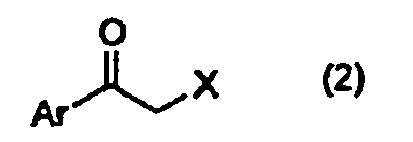
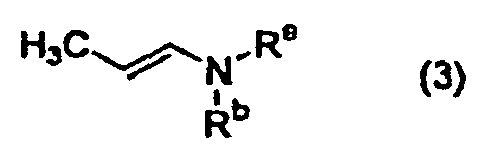
- the present invention relates to a process for the production of a compound of general formula (1) by reacting a compound of general formula (2) (wherein Ar represents a C 6 -C 10 aryl group or a C 6 -C 14 aryl group substituted with a substituent(s) independently selected from Substituent group ⁇ ; Substituent group ⁇ consists of halogen atoms, C 1 -C 6 alkyl groups, halogenated C 1 -C 6 alkyl groups, hydroxyl groups, C 1 -C 6 alkoxy groups, C 1 -C 6 alkylthio groups, mercapto groups, C 1 -C 6 alkylsulfonyl groups, and sulfamoyl groups; and X represents a halogen atom) with a compound of general formula (3) (wherein R 8 and R b are the same or different and each represents independently a C 1 -C 6 alkyl group, a C 1 -C 6 alkyl group substituted
- the preferred processes are:
- C 6 -C 10 aryl group halogen atom
- C 1 -C 6 alkyl group halogenated C 1 -C 6 alkyl group
- C 1 -C 6 alkoxy group halogenated C 1 -C 6 alkyl group
- C 1 -C 6 alkylthio group halogenated C 1 -C 6 alkyl group
- C 1 -C 6 alkylsulfonyl group C 3 -C 6 cycloalkyl group
- C 4 -C 8 alkylene group C 1 -C 6 alkylene group
- C 6 -C 10 aryl group moiety of "C 6 -C 10 aryl group” and "C 6 -C 10 aryl group substituted with a substituent(s) independently selected from Substituent group ⁇ " in the definition of Ar is a phenyl or naphthyl group and preferably a phenyl group.
- C 6 -C 10 aryl group may be optionally fused to a C 3 -C 10 cycloalkyl group (preferably C 5-6 cycloalkyl group), for example, a fused aryl group is a 5-indanyl group.
- the "C 6 -C 10 aryl group substituted with a substituent(s) independently selected from Substituent group ⁇ " in the definition of Ar is preferably a C 6 -C 10 aryl group substituted with one to four substituents independently selected from Substituent group ⁇ , more preferably a C 6 -C 10 aryl group substituted with one to three substituents independently selected from Substituent group ⁇ , and still more preferably a C 6 -C 10 aryl group substituted with one or two substituents independently selected from Substituent group ⁇ .
- halogen atom in the definitions of Substituent group ⁇ and X is a fluorine atom, a chlorine atom, a bromine atom, or an iodine atom.
- the preferred halogen atom in Substituent group ⁇ is a fluorine atom, a chlorine atom, or a bromine atom and still more preferably a fluorine atom or a chorine atom.
- the preferred halogen atom in X is a bromine atom or an iodine atom, particularly more preferably a bromine atom.
- C 1 -C 6 alkyl group in the definitions of Substituent group ⁇ , R a and R b , and the alkyl moiety of the "C 1 -C 6 alkyl group substituted with a C 1 -C 6 alkoxy group(s)" in the definitions of R a and R b are each independently a straight or branched chain alkyl group such as a methyl, ethyl, propyl, isopropyl, butyl, isobutyl, s-butyl, tert-butyl, pentyl, isopentyl, 2-methylbutyl, neopentyl, 1-ethylpropyl, hexyl, isohexyl, 4-methylpentyl, 3-methylpentyl, 2-methylpentyl, 1-methylpentyl, 3,3-dimethylbutyl, 2,2-dimethylbutyl, 1,1-dimethylbutyl, 1,
- the alkyl group in Substituent group ⁇ is preferably a straight or branched chain C 1 -C 4 alkyl group, more preferably a methyl, ethyl, propyl, isopropyl, or butyl group, still more preferably a methyl, ethyl, or propyl group, and most preferably a methyl group.
- the alkyl groups in R a and R b are preferably each independently a straight or branched chain C 2 -C 5 alkyl group, more preferably an ethyl, propyl, isopropyl, butyl, isobutyl, or isopentyl group, still more preferably an isopropyl, isobutyl, or isopentyl group, and most preferably an isobutyl group.
- halogenated C 1 -C 6 alkyl group in the definition of Substituent group a is a "C 1 -C 6 alkyl group" as indicated above in which one or more hydrogen atoms are substituted with a halogen atom(s) indicated above, and preferably a halogenated C 1 -C 4 alkyl group, more preferably a trifluoromethyl, trichloromethyl, difluoromethyl, dichloromethyl, dibromomethyl, fluoromethyl, 2,2,2-trichloroethyl, 2,2,2-trifluoroethyl, 2-bromoethyl, 2-chloroethyl, 2-fluoroethyl, or 2,2-dibromoethyl group, more preferably a trifluoromethyl, trichloromethyl, difluoromethyl, or fluoromethyl group, and most preferably a trifluoromethyl group.
- the "C 1 -C 6 alkoxy group" in the definition of Substituent group ⁇ and the "alkoxy group moiety" of the "C 1 -C 6 alkyl group substituted with a C 1 -C 6 alkoxy group(s)" in the definition of R a and R b are each independently a "C 1 -C 6 alkyl group” as indicated above to which an oxygen atom is attached, preferably a straight or branched chain C 1 -C 4 alkoxy group, more preferably a methoxy, ethoxy, propoxy, isopropoxy, or butoxy group, still more preferably a methoxy, ethoxy, or propoxy group, and most preferably an ethoxy group.
- C 1 -C 6 alkylthio group in the definition of Substituent group ⁇ is a "C 1 -C 6 alkyl group" as indicated above to which a sulfur atom is attached, preferably a straight or branched chain C 1 -C 4 alkylthio group, more preferably a methylthio, ethylthio, propoylthio, isopropoylthio, or butylthio group, and still more preferably a methylthio, ethylthio, or propylthio group.
- C 1 -C 6 alkylsulfonyl group in the definition of Substituent group ⁇ is a "C 1 -C 6 alkyl group” as indicated above to which a sulfonyl group (-SO 2 -) is attached, preferably a straight or branched chain C 1 -C 4 alkylsulfonyl group, more preferably a methylsufonyl, ethylsulfonyl, propylsulfonyl, isopropylsulfonyl, or butylsulfonyl group, still more preferably a methylsulfonyl, ethylsulfonyl, or propylsulfonyl group, and most preferably a methylsulfonyl group.
- C 3 -C 6 cycloalkyl groups in the definitions of the R a and R b are each independently a cyclopropyl, cyclobutyl, cyclopentyl, or cyclohexyl group, preferably a C 4 -C 6 cycloalkyl group, and more preferably a cyclopentyl or cyclohexyl group.
- the "C 4 -C 8 alkylene group" that is formed by R a and R b taken together is a tetramethylene, 1-methyltrimethylene, 2-methyltrimethylene, 1,1-dimethylethylene, pentamethylene, 1,1-dimethyltrimethylene, 2,2-dimethyltrimethylene, 1,2-dimethyltrimethylene, hexamethylene, 2-methylpentamethylene, heptamethylene, or 2,4-dimethylpentamethylene group, preferably a straight or branched chain C 4 -C 6 alkylene group, more preferably a tetramethylene or pentamethylene group, and still more preferably a tetramethylene group.
- C 1 -C 6 alkylene group in the definition of W is a straight or branched chain alkylene group such as a methylene, ethylene, trimethylene, propylene, tetramethylene, 1-methyltrimethylene, 2-methyltrimethylene, 1,1-dimethylethylene, pentamethylene, 1,1-dimethyltrimethylene, 2,2-dimethyltrimethylene, 1,2-dimethyltrimethylene, or hexamethylene group, and preferably a straight or branched chain C 3 -C 5 alkylene group, more preferably a trimethylene, 2-methyltrimethylene, or 2,2-dimethyltrimethylene group, still more preferably a trimethylene or 2,2-dimethyltrimethylene group, and most preferably a 2,2-dimethyltrimethylene group.
- a straight or branched chain alkylene group such as a methylene, ethylene, trimethylene, propylene, tetramethylene, 1-methyltrimethylene, 2-methyltrimethylene, 1,1-dimethylethylene
- Ar is preferably a phenyl group or a phenyl group substituted with a substituent(s) independently selected from Substituent group ⁇ ; more preferably a phenyl or a phenyl group substituted with a substituent(s) independently selected from the substituent group consisting of methyl, methoxy, ethoxy and methylthio groups; still more preferably a phenyl group substituted with a substituent(s) independently selected from the substituent group consisting of methyl, methoxy, ethoxy and methylthio groups; particularly more preferably a 4-methylphenyl, 3-methylphenyl, 4-methoxyphenyl, 4-ethoxyphenyl, 4-methylthiophenyl, 3,4-dimethylphenyl, or 3,4-dimethoxy
- X is preferably a bromine atom or an iodine atom and most preferably a bromine atom.
- W is preferably a straight or branched chain C 3 -C 5 alkylene group, more preferably a straight chain C 3 -C 5 alkylene group, still more preferably a trimethylene, 2-methyltrimethylene, or 2,2-dimethyltrimethylene group, particularly more preferably a trimethylene or 2,2-dimethyltrimethylene group, and most preferably a 2,2-dimethyltrimethylene group.
- Substituent group ⁇ preferably consists of C 1 -C 4 alkyl groups, C 1 -C 4 alkoxy groups, and C 1 -C 4 alkylthio groups, more preferably consists of methyl, methoxy, ethoxy and methylthio groups, and most preferably consists of a methyl or ethoxy group.
- the process for the production of a ⁇ -ketoacetal compound is carried out as shown below. (wherein Ar, R a , R b , X, and W have the same meanings as those indicated above).
- the step 1a is a process for the production of a dioxo compound of formula (4) which process comprises reacting a phenacyl halide compound of formula (2) with an enamine compound of formula (3) in an inert solvent in the presence or absence of a base, followed by hydrolyzing the reaction mixture using an acid to give the dioxo compound of formula (4).
- the inert solvent used in the step 1a is, for example, an aliphatic hydrocarbon such as pentane, hexane, or heptane; an aromatic hydrocarbon such as benzene, toluene, or xylene; a halogenated hydrocarbon such as dichloromethane, chloroform, carbon tetrachloride, or dichloroethane; an ether such as diethyl ether, diisopropyl ether, tetrahydrofuran, or dioxane; an alcohol such as methanol, ethanol, propanol, isopropanol, butanol, s-butanol, isobutanol, or t-butanol; an aprotic polar solvent such as N,N-dimethylformamide, N,N-dimethylacetamide, or dimethyl sulfoxide; a nitrile such as acetonitrile, or an ester such as
- the base used in step 1a is an organic amine such as pyridine, picoline, 4-(N,N-dimethylamino)pyridine, triethylamine, tributylamine, diisopropylethylamine, or N-methylpiperidine, and it is preferably triethylamine, tributylamine, or diisopropylethylamine.
- organic amine such as pyridine, picoline, 4-(N,N-dimethylamino)pyridine, triethylamine, tributylamine, diisopropylethylamine, or N-methylpiperidine, and it is preferably triethylamine, tributylamine, or diisopropylethylamine.
- the reaction temperature is between -30°C and 200°C (preferably between 0°C and 100°C).
- the reaction time depends on the reaction temperature and the like and is usually from 30 minutes to 30 hours (preferably from I hour to 20 hours).
- a dioxo compound of the formula (4) is produced by the addition of an acid to the reaction mixture.
- the acid used in the step 1a is an inorganic acid such as hydrogen chloride, hydrobromic acid, sulfuric acid, perchloric acid, or phosphoric acid; or an organic acid such as acetic acid, formic acid, oxalic acid, methanesulfonic acid, para-toluenesulfonic acid, trifluoroacetic acid, or trifluoromethanesulfonic acid, and it is preferably sulfuric acid, hydrogen chloride, or para-toluenesulfonic acid.
- the desired product in the step 1a is isolated from the reaction mixture according to a conventional procedure.
- the desired product is precipitated by cooling the reaction mixture, or the reaction mixture is appropriately neutralized, and when there are insoluble materials in the reaction mixture, the materials are removed by filtration of the reaction mixture; water is added to the reaction mixture; the mixture is extracted with an organic solvent immiscible with water such as toluene; the extract is washed with water, dried over anhydrous magnesium sulfate or the like and the solvent is removed by distillation to give the desired product.
- the product thus obtained, if necessary, can be further purified by a conventional procedure, for example, silica gel column chromatography.
- the dioxo compound of the formula (4) obtained in the step 1a may be used in the next step (step 1b) without purification.
- the step 1b is a process for the production of a compound of formula (1) which process comprises reacting a dioxo compound of formula (4) with a glycol compound of formula (5) in an inert solvent (which has the same meaning as that indicated in the step 1a) in the presence of an acid (which has the same meaning as that indicated in the step 1a) to give the compound of formula (1).
- the reaction temperature is usually between -70°C and 100°C, preferably between-30°C and 60°C.
- the reaction time is usually from 10 minutes to 20 hours, preferably from 30 minutes to 2 hours.
- the desired product in the step 1b is isolated from the reaction mixture according to a conventional procedure.
- the desired product is precipitated by cooling the reaction mixture, or the reaction mixture is appropriately neutralized, and when there are insoluble materials in the reaction mixture the materials are removed by filtration of the reaction mixture; water is added to the reaction mixture; the mixture is extracted with an organic solvent immiscible with water such as toluene; the extract is washed with water, dried over anhydrous magnesium sulfate or the like and the solvent is removed by distillation to give the desired product.
- the product thus obtained can be further purified by a conventional procedure, for example, silica gel column chromatography.
- the starting materials of the present invention of the compounds of formulae (2), (3) and (5) are known and the compounds of formulae (2) and (3) are, for example, disclosed in the U.S. Patent number 5908858 .
- a 4-methyl-1,2-diarylpyrrole derivative of the formula (7) can be prepared by carrying out the following reaction using a compound of formula (1) obtained by the procedure indicated above, (wherein Ar and W have the same meanings as those indicated above, and Y represents a methyl or amino group).
- the step 2 is a process for the production of a 1,2-diarylpyrrole compound of formula (7) which process comprises ring-closing of a compound of formula (1) with an aniline compound of formula (6) by means of a coupling reaction with dehydration in an inert solvent in the presence or absence of an acid to give a compound of formula (7).
- the solvent used in the step 2 is not particularly restricted provided that it has no adverse effect on the reaction and can dissolve the starting material to some extent, for example, it is an aliphatic hydrocarbon such as hexane, heptane or petroleum ether; an aromatic hydrocarbon such as benzene, toluene, or xylene; a halogenated hydrocarbon such as methylene chloride, chloroform, carbon tetrachloride, or dichloroethane; an ether such as diethyl ether, diisopropyl ether, tetrahydrofuran, or dioxane; an alcohol such as methanol, ethanol, propanol, isopropanol, or butanol; a nitrile such as acetonitrile, an organic acid such as formic acid, acetic acid, or propionic acid; or water or a mixture of these plural solvents.
- the preferred solvent is a mixture of an alcohol and water and the more preferred one is
- the acid used in step 2 is an inorganic acid such as hydrochloric acid or sulfuric acid; or an organic acid such as acetic acid, trifluoroacetic acid, methanesulfonic acid, para-toluenesulfonic acid, or trifluoromethanesulfonic acid, preferably an organic acid, more preferably acetic acid or para-toluenesulfonic acid, and most preferably para-toluenesulfonic acid.
- the amount of the acid used in step 2 is between 0.01 and 50 equivalents, preferably between 0.05 and 20 equivalents, and more preferably between 0.1 and 10 equivalents.
- the amount of the aniline compound of formula (6) is between 1 and 10 equivalents for one equivalent of the compound of formula (1) and preferably between I and 3 equivalents.
- the reaction temperature depends on the solvent used in the step 2. It is usually between 0°C and 200°C and preferably between room temperature and 150°C.
- the reaction time depends on the reaction temperature or the like and is usually from 10 minutes to 48 hours and preferably from 30 minutes to 15 hours.
- reaction of step 2 may be carried out with removal of water formed during the reaction; however, usually it can be conducted without removal of the water.
- the desired product is isolated from the reaction mixture according to a conventional procedure.
- the reaction mixture is appropriately neutralized, and when there are insoluble materials in the reaction mixture the materials are removed by filtration of the reaction mixture; water is added to the reaction mixture and the mixture is extracted with an organic solvent immiscible with water such as ethyl acetate; the extract is washed with water, dried over anhydrous magnesium sulfate or the like and the solvent is removed by distillation to give the desired product.
- the product thus obtained, if necessary, can be further purified by a conventional procedure, for example, recrystallization, reprecipitation, or silica gel column chromatography.
- a ⁇ -ketoacetal compound can be obtained through a simple procedure and in high yield as a high-purity product without using nitromethane.
- the present invention is exemplified by some examples shown below. However, it can not be restricted by these examples.
- a ⁇ -ketoacetal compound can be obtained through a simple procedure and in high yield as a high-purity product without using nitromethane.
Landscapes
- Chemical & Material Sciences (AREA)
- Organic Chemistry (AREA)
- Organic Low-Molecular-Weight Compounds And Preparation Thereof (AREA)
- Heterocyclic Carbon Compounds Containing A Hetero Ring Having Oxygen Or Sulfur (AREA)
Claims (13)
- Procédé pour la production d'un composé de la formule générale (1), lequel procédé comprend la réaction d'un composé de la formule générale (2):

HO-W-OH (5)
(dans laquelle W représente un groupe alkylène C1-C6) en présence d'un acide pour donner un composé de la formule générale (1):
- Procédé selon la revendication 1, dans lequel Ar est un groupe phényle ou un groupe phényle substitué avec un ou des substituants indépendamment choisis parmi le groupe substituant α.
- Procédé selon la revendication 1, dans lequel Ar est un groupe phényle ou un groupe phényle substitué avec un ou des substituants indépendamment choisis dans le groupe de substituants constitué de groupes méthyle, méthoxy, éthoxy et méthylthio.
- Procédé selon la revendication 1, dans lequel Ar est un 4-méthylphényle, un 3-méthylphényle, un 4-méthoxyphényle, un 4-éthoxyphényle, un 4-méthylthiophényle, un 3,4-diméthylphényle ou un 3,4-diméthoxyphényle.
- Procédé selon l'une quelconque des revendications 1 à 4, dans lequel X est un atome de brome ou un atome d'iode.
- Procédé selon l'une quelconque des revendications 1 à 4, dans lequel X est un atome de brome.
- Procédé selon l'une quelconque des revendications 1 à 6, dans lequel Ra et Rb sont identiques ou différents et chacun représente indépendamment un groupe alkyle C2-C5, un groupe alkyle C2-C5 substitué avec un ou des groupes alcoxy C1-C4, ou un groupe cycloalkyle C4-C6.
- Procédé selon l'une quelconque des revendications 1 à 6, dans lequel Ra et Rb sont identiques ou différents et chacun représente indépendamment un groupe isopropyle, isobutyle, isopentyle, 2-méthoxyéthyle, 3-méthoxypropyle, 2-éthoxyéthyle, cyclopentyle ou cyclohexyle.
- Procédé selon l'une quelconque des revendications 1 à 6, dans lequel Ra et Rb sont tous les deux un groupe isobutyle.
- Procédé selon l'une quelconque des revendications 1 à 9, dans lequel W est un groupe alkylène C3-C5 à chaîne droite.
- Procédé selon l'une quelconque des revendications 1 à 9, dans lequel W est un groupe 2-méthyltriméthylène ou 2,2-diméthyltriméthylène.
- Procédé pour la production d'un composé de la formule générale (7):


- Procédé selon la revendication 12 pour la production d'un composé de la formule générale (7), dans lequel Y est un groupe amino.
Applications Claiming Priority (5)
| Application Number | Priority Date | Filing Date | Title |
|---|---|---|---|
| JP2002238786 | 2002-08-20 | ||
| JP2002238786 | 2002-08-20 | ||
| JP2003131270 | 2003-05-09 | ||
| JP2003131270 | 2003-05-09 | ||
| PCT/JP2003/010471 WO2004018446A1 (fr) | 2002-08-20 | 2003-08-19 | Procede de production de $g(g)-ceto-acetals |
Publications (3)
| Publication Number | Publication Date |
|---|---|
| EP1544196A1 EP1544196A1 (fr) | 2005-06-22 |
| EP1544196A4 EP1544196A4 (fr) | 2007-05-09 |
| EP1544196B1 true EP1544196B1 (fr) | 2012-04-25 |
Family
ID=31949538
Family Applications (1)
| Application Number | Title | Priority Date | Filing Date |
|---|---|---|---|
| EP03792719A Expired - Lifetime EP1544196B1 (fr) | 2002-08-20 | 2003-08-19 | Procede de production de gamma-ceto-acetals |
Country Status (11)
| Country | Link |
|---|---|
| US (1) | US7176323B2 (fr) |
| EP (1) | EP1544196B1 (fr) |
| KR (1) | KR100988750B1 (fr) |
| AT (1) | ATE555089T1 (fr) |
| AU (1) | AU2003257568A1 (fr) |
| BR (1) | BR0313622A (fr) |
| CA (1) | CA2496225C (fr) |
| ES (1) | ES2384792T3 (fr) |
| IL (1) | IL166696A (fr) |
| TW (1) | TWI286130B (fr) |
| WO (1) | WO2004018446A1 (fr) |
Families Citing this family (1)
| Publication number | Priority date | Publication date | Assignee | Title |
|---|---|---|---|---|
| TW200812950A (en) * | 2006-08-18 | 2008-03-16 | Daiichi Sankyo Co Ltd | Process for producing acetophenone bromide |
Family Cites Families (5)
| Publication number | Priority date | Publication date | Assignee | Title |
|---|---|---|---|---|
| US5908858A (en) | 1996-04-05 | 1999-06-01 | Sankyo Company, Limited | 1,2-diphenylpyrrole derivatives, their preparation and their therapeutic uses |
| DE19647395A1 (de) * | 1996-11-15 | 1998-05-20 | Basf Ag | Verfahren zur Herstellung von cyclischen Acetalen oder Ketalen |
| US5935990A (en) | 1996-12-10 | 1999-08-10 | G.D. Searle & Co. | Substituted pyrrolyl compounds for the treatment of inflammation |
| JPH11180871A (ja) * | 1997-09-26 | 1999-07-06 | Sankyo Co Ltd | 1,2−ジフェニルピロール誘導体を含有する医薬 |
| JP2000080078A (ja) | 1998-07-08 | 2000-03-21 | Sankyo Co Ltd | 4―メチル―1,2―ジアリ―ルピロ―ル類の製造法及びその合成中間体 |
-
2003
- 2003-08-19 CA CA2496225A patent/CA2496225C/fr not_active Expired - Fee Related
- 2003-08-19 AT AT03792719T patent/ATE555089T1/de active
- 2003-08-19 AU AU2003257568A patent/AU2003257568A1/en not_active Abandoned
- 2003-08-19 BR BR0313622-1A patent/BR0313622A/pt not_active Application Discontinuation
- 2003-08-19 WO PCT/JP2003/010471 patent/WO2004018446A1/fr not_active Ceased
- 2003-08-19 TW TW092122698A patent/TWI286130B/zh not_active IP Right Cessation
- 2003-08-19 ES ES03792719T patent/ES2384792T3/es not_active Expired - Lifetime
- 2003-08-19 EP EP03792719A patent/EP1544196B1/fr not_active Expired - Lifetime
- 2003-08-19 KR KR1020057002623A patent/KR100988750B1/ko not_active Expired - Fee Related
-
2005
- 2005-02-06 IL IL166696A patent/IL166696A/en not_active IP Right Cessation
- 2005-02-09 US US11/055,645 patent/US7176323B2/en not_active Expired - Fee Related
Also Published As
| Publication number | Publication date |
|---|---|
| TWI286130B (en) | 2007-09-01 |
| US7176323B2 (en) | 2007-02-13 |
| TW200404771A (en) | 2004-04-01 |
| KR100988750B1 (ko) | 2010-10-20 |
| ES2384792T3 (es) | 2012-07-12 |
| CA2496225C (fr) | 2012-08-07 |
| EP1544196A4 (fr) | 2007-05-09 |
| BR0313622A (pt) | 2005-06-21 |
| HK1072941A1 (en) | 2005-09-16 |
| IL166696A (en) | 2010-12-30 |
| CA2496225A1 (fr) | 2004-03-04 |
| EP1544196A1 (fr) | 2005-06-22 |
| IL166696A0 (en) | 2006-01-15 |
| KR20050056996A (ko) | 2005-06-16 |
| ATE555089T1 (de) | 2012-05-15 |
| US20050148780A1 (en) | 2005-07-07 |
| AU2003257568A1 (en) | 2004-03-11 |
| WO2004018446A1 (fr) | 2004-03-04 |
Similar Documents
| Publication | Publication Date | Title |
|---|---|---|
| JP4903819B2 (ja) | ヒドロキシ酢酸エステル誘導体、その製法及び合成中間体としての用途 | |
| EP1362040B1 (fr) | Procede de preparation de mesylates de derives de piperazine | |
| AU2002250962A1 (en) | Process for the preparation of mesylates of piperazine derivatives | |
| Burns et al. | A Convenient Preparation of Benzyl 4-(R1)-3-(R2) Pyrrole-2-carboxylates | |
| EP1544196B1 (fr) | Procede de production de gamma-ceto-acetals | |
| JP4601274B2 (ja) | γ−ケトアセタール類の製造方法 | |
| HK1072941B (en) | Process for the production of gamma-keto acetals | |
| KR100519420B1 (ko) | 헤테로아릴카복실아미드및에스테르의제조방법 | |
| CA2386807C (fr) | Procede de preparation d'inhibiteurs cox-2 | |
| MXPA04009414A (es) | Alquilacion estereoselectiva de piperazinas quirales 2-metil-4-protegidas. | |
| ES2283781T3 (es) | Procedimiento para producir un compuesto de 1,2,3-triazol. | |
| US20050143407A1 (en) | Process for porducing quinolonecarboxylic acid derivative | |
| US4582913A (en) | 5-halo-4H-1,3-dioxin-4-one compounds | |
| WO1997014688A1 (fr) | PROCEDE DE PREPARATION DE DERIVES DE L'ACIDE α-CHLOROMETHYLPHENYLACETIQUE | |
| EP0698604A1 (fr) | Procédé et intermédiaires pour la préparation de la 3,4-alkylène-1,3,4-thiadiazolin-2-one | |
| NO160517B (no) | Fremgangsmaate for fremstilling av klormetylestere av penicillansyre-sulfon. | |
| RU2290398C2 (ru) | Способ получения 5-амино-3-n-r1-амино-1-r-1,2,4-триазолов | |
| EP3313821B1 (fr) | Procédé de préparation de dérivés de pyrazole carbamoylamino | |
| JP2814285B2 (ja) | アレニルβ―ラクタム化合物及びその製造法 | |
| KR100212636B1 (ko) | 제초성 피리미딜옥시벤조산 옥심에스테르 유도체의 신규한 제조방법 | |
| Eichinger et al. | A novel base promoted reaction of methyl 2-isoxazoline-5-acetates to 5-(2-oxoethyl)-3-isoxazolidinones | |
| JPH0667941B2 (ja) | 6−アリールオキシ−1H−ピラゾロ〔1,5−b〕−1,2,4−トリアゾール化合物 | |
| JP2002518471A (ja) | ピリミジノン誘導体の製法 | |
| JP2001089477A (ja) | 7−アザインドール誘導体の製造方法 | |
| JPS62138474A (ja) | 5−ヒドラジノピラゾ−ル−4−カルボキシレ−ト系化合物の製造方法 |
Legal Events
| Date | Code | Title | Description |
|---|---|---|---|
| PUAI | Public reference made under article 153(3) epc to a published international application that has entered the european phase |
Free format text: ORIGINAL CODE: 0009012 |
|
| 17P | Request for examination filed |
Effective date: 20050208 |
|
| AK | Designated contracting states |
Kind code of ref document: A1 Designated state(s): AT BE BG CH CY CZ DE DK EE ES FI FR GB GR HU IE IT LI LU MC NL PT RO SE SI SK TR |
|
| AX | Request for extension of the european patent |
Extension state: AL LT LV MK |
|
| REG | Reference to a national code |
Ref country code: HK Ref legal event code: DE Ref document number: 1072941 Country of ref document: HK |
|
| DAX | Request for extension of the european patent (deleted) | ||
| RIC1 | Information provided on ipc code assigned before grant |
Ipc: C07D 319/06 20060101ALI20070322BHEP Ipc: C07D 207/333 20060101AFI20070322BHEP |
|
| A4 | Supplementary search report drawn up and despatched |
Effective date: 20070412 |
|
| 17Q | First examination report despatched |
Effective date: 20080304 |
|
| GRAP | Despatch of communication of intention to grant a patent |
Free format text: ORIGINAL CODE: EPIDOSNIGR1 |
|
| RAP1 | Party data changed (applicant data changed or rights of an application transferred) |
Owner name: DAIICHI SANKYO COMPANY, LIMITED |
|
| GRAS | Grant fee paid |
Free format text: ORIGINAL CODE: EPIDOSNIGR3 |
|
| GRAA | (expected) grant |
Free format text: ORIGINAL CODE: 0009210 |
|
| AK | Designated contracting states |
Kind code of ref document: B1 Designated state(s): AT BE BG CH CY CZ DE DK EE ES FI FR GB GR HU IE IT LI LU MC NL PT RO SE SI SK TR |
|
| REG | Reference to a national code |
Ref country code: GB Ref legal event code: FG4D |
|
| REG | Reference to a national code |
Ref country code: CH Ref legal event code: EP |
|
| REG | Reference to a national code |
Ref country code: AT Ref legal event code: REF Ref document number: 555089 Country of ref document: AT Kind code of ref document: T Effective date: 20120515 |
|
| REG | Reference to a national code |
Ref country code: IE Ref legal event code: FG4D |
|
| REG | Reference to a national code |
Ref country code: DE Ref legal event code: R096 Ref document number: 60340757 Country of ref document: DE Effective date: 20120621 |
|
| REG | Reference to a national code |
Ref country code: CH Ref legal event code: NV Representative=s name: MARKS & CLERK (LUXEMBOURG) LLP |
|
| REG | Reference to a national code |
Ref country code: ES Ref legal event code: FG2A Ref document number: 2384792 Country of ref document: ES Kind code of ref document: T3 Effective date: 20120712 |
|
| REG | Reference to a national code |
Ref country code: NL Ref legal event code: VDEP Effective date: 20120425 |
|
| REG | Reference to a national code |
Ref country code: HK Ref legal event code: GR Ref document number: 1072941 Country of ref document: HK |
|
| REG | Reference to a national code |
Ref country code: AT Ref legal event code: MK05 Ref document number: 555089 Country of ref document: AT Kind code of ref document: T Effective date: 20120425 |
|
| PG25 | Lapsed in a contracting state [announced via postgrant information from national office to epo] |
Ref country code: SE Free format text: LAPSE BECAUSE OF FAILURE TO SUBMIT A TRANSLATION OF THE DESCRIPTION OR TO PAY THE FEE WITHIN THE PRESCRIBED TIME-LIMIT Effective date: 20120425 Ref country code: CY Free format text: LAPSE BECAUSE OF FAILURE TO SUBMIT A TRANSLATION OF THE DESCRIPTION OR TO PAY THE FEE WITHIN THE PRESCRIBED TIME-LIMIT Effective date: 20120425 Ref country code: FI Free format text: LAPSE BECAUSE OF FAILURE TO SUBMIT A TRANSLATION OF THE DESCRIPTION OR TO PAY THE FEE WITHIN THE PRESCRIBED TIME-LIMIT Effective date: 20120425 |
|
| PG25 | Lapsed in a contracting state [announced via postgrant information from national office to epo] |
Ref country code: GR Free format text: LAPSE BECAUSE OF FAILURE TO SUBMIT A TRANSLATION OF THE DESCRIPTION OR TO PAY THE FEE WITHIN THE PRESCRIBED TIME-LIMIT Effective date: 20120726 Ref country code: SI Free format text: LAPSE BECAUSE OF FAILURE TO SUBMIT A TRANSLATION OF THE DESCRIPTION OR TO PAY THE FEE WITHIN THE PRESCRIBED TIME-LIMIT Effective date: 20120425 Ref country code: PT Free format text: LAPSE BECAUSE OF FAILURE TO SUBMIT A TRANSLATION OF THE DESCRIPTION OR TO PAY THE FEE WITHIN THE PRESCRIBED TIME-LIMIT Effective date: 20120827 |
|
| PG25 | Lapsed in a contracting state [announced via postgrant information from national office to epo] |
Ref country code: BE Free format text: LAPSE BECAUSE OF FAILURE TO SUBMIT A TRANSLATION OF THE DESCRIPTION OR TO PAY THE FEE WITHIN THE PRESCRIBED TIME-LIMIT Effective date: 20120425 |
|
| PG25 | Lapsed in a contracting state [announced via postgrant information from national office to epo] |
Ref country code: NL Free format text: LAPSE BECAUSE OF FAILURE TO SUBMIT A TRANSLATION OF THE DESCRIPTION OR TO PAY THE FEE WITHIN THE PRESCRIBED TIME-LIMIT Effective date: 20120425 Ref country code: RO Free format text: LAPSE BECAUSE OF FAILURE TO SUBMIT A TRANSLATION OF THE DESCRIPTION OR TO PAY THE FEE WITHIN THE PRESCRIBED TIME-LIMIT Effective date: 20120425 Ref country code: EE Free format text: LAPSE BECAUSE OF FAILURE TO SUBMIT A TRANSLATION OF THE DESCRIPTION OR TO PAY THE FEE WITHIN THE PRESCRIBED TIME-LIMIT Effective date: 20120425 Ref country code: SK Free format text: LAPSE BECAUSE OF FAILURE TO SUBMIT A TRANSLATION OF THE DESCRIPTION OR TO PAY THE FEE WITHIN THE PRESCRIBED TIME-LIMIT Effective date: 20120425 Ref country code: DK Free format text: LAPSE BECAUSE OF FAILURE TO SUBMIT A TRANSLATION OF THE DESCRIPTION OR TO PAY THE FEE WITHIN THE PRESCRIBED TIME-LIMIT Effective date: 20120425 Ref country code: CZ Free format text: LAPSE BECAUSE OF FAILURE TO SUBMIT A TRANSLATION OF THE DESCRIPTION OR TO PAY THE FEE WITHIN THE PRESCRIBED TIME-LIMIT Effective date: 20120425 Ref country code: AT Free format text: LAPSE BECAUSE OF FAILURE TO SUBMIT A TRANSLATION OF THE DESCRIPTION OR TO PAY THE FEE WITHIN THE PRESCRIBED TIME-LIMIT Effective date: 20120425 |
|
| PLBE | No opposition filed within time limit |
Free format text: ORIGINAL CODE: 0009261 |
|
| STAA | Information on the status of an ep patent application or granted ep patent |
Free format text: STATUS: NO OPPOSITION FILED WITHIN TIME LIMIT |
|
| PG25 | Lapsed in a contracting state [announced via postgrant information from national office to epo] |
Ref country code: MC Free format text: LAPSE BECAUSE OF NON-PAYMENT OF DUE FEES Effective date: 20120831 |
|
| 26N | No opposition filed |
Effective date: 20130128 |
|
| REG | Reference to a national code |
Ref country code: IE Ref legal event code: MM4A |
|
| REG | Reference to a national code |
Ref country code: DE Ref legal event code: R097 Ref document number: 60340757 Country of ref document: DE Effective date: 20130128 |
|
| REG | Reference to a national code |
Ref country code: HU Ref legal event code: AG4A Ref document number: E015791 Country of ref document: HU |
|
| PG25 | Lapsed in a contracting state [announced via postgrant information from national office to epo] |
Ref country code: BG Free format text: LAPSE BECAUSE OF FAILURE TO SUBMIT A TRANSLATION OF THE DESCRIPTION OR TO PAY THE FEE WITHIN THE PRESCRIBED TIME-LIMIT Effective date: 20120725 Ref country code: IE Free format text: LAPSE BECAUSE OF NON-PAYMENT OF DUE FEES Effective date: 20120819 |
|
| PGFP | Annual fee paid to national office [announced via postgrant information from national office to epo] |
Ref country code: HU Payment date: 20130723 Year of fee payment: 11 Ref country code: CH Payment date: 20130813 Year of fee payment: 11 Ref country code: DE Payment date: 20130814 Year of fee payment: 11 Ref country code: ES Payment date: 20130711 Year of fee payment: 11 |
|
| PGFP | Annual fee paid to national office [announced via postgrant information from national office to epo] |
Ref country code: FR Payment date: 20130808 Year of fee payment: 11 Ref country code: GB Payment date: 20130814 Year of fee payment: 11 |
|
| PGFP | Annual fee paid to national office [announced via postgrant information from national office to epo] |
Ref country code: IT Payment date: 20130820 Year of fee payment: 11 |
|
| PG25 | Lapsed in a contracting state [announced via postgrant information from national office to epo] |
Ref country code: TR Free format text: LAPSE BECAUSE OF FAILURE TO SUBMIT A TRANSLATION OF THE DESCRIPTION OR TO PAY THE FEE WITHIN THE PRESCRIBED TIME-LIMIT Effective date: 20120425 |
|
| PG25 | Lapsed in a contracting state [announced via postgrant information from national office to epo] |
Ref country code: LU Free format text: LAPSE BECAUSE OF NON-PAYMENT OF DUE FEES Effective date: 20120819 |
|
| REG | Reference to a national code |
Ref country code: DE Ref legal event code: R119 Ref document number: 60340757 Country of ref document: DE |
|
| REG | Reference to a national code |
Ref country code: CH Ref legal event code: PL |
|
| GBPC | Gb: european patent ceased through non-payment of renewal fee |
Effective date: 20140819 |
|
| PG25 | Lapsed in a contracting state [announced via postgrant information from national office to epo] |
Ref country code: CH Free format text: LAPSE BECAUSE OF NON-PAYMENT OF DUE FEES Effective date: 20140831 Ref country code: HU Free format text: LAPSE BECAUSE OF NON-PAYMENT OF DUE FEES Effective date: 20140820 Ref country code: IT Free format text: LAPSE BECAUSE OF NON-PAYMENT OF DUE FEES Effective date: 20140819 Ref country code: LI Free format text: LAPSE BECAUSE OF NON-PAYMENT OF DUE FEES Effective date: 20140831 |
|
| REG | Reference to a national code |
Ref country code: FR Ref legal event code: ST Effective date: 20150430 |
|
| REG | Reference to a national code |
Ref country code: DE Ref legal event code: R119 Ref document number: 60340757 Country of ref document: DE Effective date: 20150303 |
|
| PG25 | Lapsed in a contracting state [announced via postgrant information from national office to epo] |
Ref country code: GB Free format text: LAPSE BECAUSE OF NON-PAYMENT OF DUE FEES Effective date: 20140819 Ref country code: DE Free format text: LAPSE BECAUSE OF NON-PAYMENT OF DUE FEES Effective date: 20150303 |
|
| PG25 | Lapsed in a contracting state [announced via postgrant information from national office to epo] |
Ref country code: FR Free format text: LAPSE BECAUSE OF NON-PAYMENT OF DUE FEES Effective date: 20140901 |
|
| PG25 | Lapsed in a contracting state [announced via postgrant information from national office to epo] |
Ref country code: ES Free format text: LAPSE BECAUSE OF NON-PAYMENT OF DUE FEES Effective date: 20140820 |