EP1539867B1 - Verfahren zum herstellen einer verpackung aus thermoformbarer folie mit hoher wärmeformbeständigkeit und wasserdampfbarriere - Google Patents
Verfahren zum herstellen einer verpackung aus thermoformbarer folie mit hoher wärmeformbeständigkeit und wasserdampfbarriere Download PDFInfo
- Publication number
- EP1539867B1 EP1539867B1 EP20030797293 EP03797293A EP1539867B1 EP 1539867 B1 EP1539867 B1 EP 1539867B1 EP 20030797293 EP20030797293 EP 20030797293 EP 03797293 A EP03797293 A EP 03797293A EP 1539867 B1 EP1539867 B1 EP 1539867B1
- Authority
- EP
- European Patent Office
- Prior art keywords
- range
- weight
- cycloolefin copolymer
- foil
- packaging
- Prior art date
- Legal status (The legal status is an assumption and is not a legal conclusion. Google has not performed a legal analysis and makes no representation as to the accuracy of the status listed.)
- Expired - Lifetime
Links
Classifications
-
- B—PERFORMING OPERATIONS; TRANSPORTING
- B32—LAYERED PRODUCTS
- B32B—LAYERED PRODUCTS, i.e. PRODUCTS BUILT-UP OF STRATA OF FLAT OR NON-FLAT, e.g. CELLULAR OR HONEYCOMB, FORM
- B32B27/00—Layered products comprising a layer of synthetic resin
- B32B27/32—Layered products comprising a layer of synthetic resin comprising polyolefins
-
- B—PERFORMING OPERATIONS; TRANSPORTING
- B32—LAYERED PRODUCTS
- B32B—LAYERED PRODUCTS, i.e. PRODUCTS BUILT-UP OF STRATA OF FLAT OR NON-FLAT, e.g. CELLULAR OR HONEYCOMB, FORM
- B32B27/00—Layered products comprising a layer of synthetic resin
- B32B27/06—Layered products comprising a layer of synthetic resin as the main or only constituent of a layer, which is next to another layer of the same or of a different material
- B32B27/08—Layered products comprising a layer of synthetic resin as the main or only constituent of a layer, which is next to another layer of the same or of a different material of synthetic resin
-
- B—PERFORMING OPERATIONS; TRANSPORTING
- B32—LAYERED PRODUCTS
- B32B—LAYERED PRODUCTS, i.e. PRODUCTS BUILT-UP OF STRATA OF FLAT OR NON-FLAT, e.g. CELLULAR OR HONEYCOMB, FORM
- B32B7/00—Layered products characterised by the relation between layers; Layered products characterised by the relative orientation of features between layers, or by the relative values of a measurable parameter between layers, i.e. products comprising layers having different physical, chemical or physicochemical properties; Layered products characterised by the interconnection of layers
- B32B7/04—Interconnection of layers
- B32B7/12—Interconnection of layers using interposed adhesives or interposed materials with bonding properties
-
- C—CHEMISTRY; METALLURGY
- C08—ORGANIC MACROMOLECULAR COMPOUNDS; THEIR PREPARATION OR CHEMICAL WORKING-UP; COMPOSITIONS BASED THEREON
- C08J—WORKING-UP; GENERAL PROCESSES OF COMPOUNDING; AFTER-TREATMENT NOT COVERED BY SUBCLASSES C08B, C08C, C08F, C08G or C08H
- C08J5/00—Manufacture of articles or shaped materials containing macromolecular substances
- C08J5/18—Manufacture of films or sheets
-
- C—CHEMISTRY; METALLURGY
- C08—ORGANIC MACROMOLECULAR COMPOUNDS; THEIR PREPARATION OR CHEMICAL WORKING-UP; COMPOSITIONS BASED THEREON
- C08L—COMPOSITIONS OF MACROMOLECULAR COMPOUNDS
- C08L23/00—Compositions of homopolymers or copolymers of unsaturated aliphatic hydrocarbons having only one carbon-to-carbon double bond; Compositions of derivatives of such polymers
- C08L23/02—Compositions of homopolymers or copolymers of unsaturated aliphatic hydrocarbons having only one carbon-to-carbon double bond; Compositions of derivatives of such polymers not modified by chemical after-treatment
- C08L23/04—Homopolymers or copolymers of ethene
- C08L23/06—Polyethylene
-
- C—CHEMISTRY; METALLURGY
- C08—ORGANIC MACROMOLECULAR COMPOUNDS; THEIR PREPARATION OR CHEMICAL WORKING-UP; COMPOSITIONS BASED THEREON
- C08L—COMPOSITIONS OF MACROMOLECULAR COMPOUNDS
- C08L23/00—Compositions of homopolymers or copolymers of unsaturated aliphatic hydrocarbons having only one carbon-to-carbon double bond; Compositions of derivatives of such polymers
- C08L23/02—Compositions of homopolymers or copolymers of unsaturated aliphatic hydrocarbons having only one carbon-to-carbon double bond; Compositions of derivatives of such polymers not modified by chemical after-treatment
- C08L23/04—Homopolymers or copolymers of ethene
- C08L23/08—Copolymers of ethene
- C08L23/0807—Copolymers of ethene with unsaturated hydrocarbons only containing four or more carbon atoms
- C08L23/0823—Copolymers of ethene with unsaturated hydrocarbons only containing four or more carbon atoms with aliphatic cyclic olefins
-
- B—PERFORMING OPERATIONS; TRANSPORTING
- B32—LAYERED PRODUCTS
- B32B—LAYERED PRODUCTS, i.e. PRODUCTS BUILT-UP OF STRATA OF FLAT OR NON-FLAT, e.g. CELLULAR OR HONEYCOMB, FORM
- B32B2307/00—Properties of the layers or laminate
- B32B2307/30—Properties of the layers or laminate having particular thermal properties
- B32B2307/308—Heat stability
-
- B—PERFORMING OPERATIONS; TRANSPORTING
- B32—LAYERED PRODUCTS
- B32B—LAYERED PRODUCTS, i.e. PRODUCTS BUILT-UP OF STRATA OF FLAT OR NON-FLAT, e.g. CELLULAR OR HONEYCOMB, FORM
- B32B2307/00—Properties of the layers or laminate
- B32B2307/70—Other properties
- B32B2307/724—Permeability to gases, adsorption
- B32B2307/7242—Non-permeable
- B32B2307/7246—Water vapor barrier
-
- B—PERFORMING OPERATIONS; TRANSPORTING
- B32—LAYERED PRODUCTS
- B32B—LAYERED PRODUCTS, i.e. PRODUCTS BUILT-UP OF STRATA OF FLAT OR NON-FLAT, e.g. CELLULAR OR HONEYCOMB, FORM
- B32B2323/00—Polyalkenes
- B32B2323/04—Polyethylene
- B32B2323/043—HDPE, i.e. high density polyethylene
-
- B—PERFORMING OPERATIONS; TRANSPORTING
- B32—LAYERED PRODUCTS
- B32B—LAYERED PRODUCTS, i.e. PRODUCTS BUILT-UP OF STRATA OF FLAT OR NON-FLAT, e.g. CELLULAR OR HONEYCOMB, FORM
- B32B2323/00—Polyalkenes
- B32B2323/04—Polyethylene
- B32B2323/046—LDPE, i.e. low density polyethylene
-
- B—PERFORMING OPERATIONS; TRANSPORTING
- B32—LAYERED PRODUCTS
- B32B—LAYERED PRODUCTS, i.e. PRODUCTS BUILT-UP OF STRATA OF FLAT OR NON-FLAT, e.g. CELLULAR OR HONEYCOMB, FORM
- B32B2323/00—Polyalkenes
- B32B2323/10—Polypropylene
-
- B—PERFORMING OPERATIONS; TRANSPORTING
- B32—LAYERED PRODUCTS
- B32B—LAYERED PRODUCTS, i.e. PRODUCTS BUILT-UP OF STRATA OF FLAT OR NON-FLAT, e.g. CELLULAR OR HONEYCOMB, FORM
- B32B2331/00—Polyvinylesters
- B32B2331/04—Polymers of vinyl acetate, e.g. PVA
-
- B—PERFORMING OPERATIONS; TRANSPORTING
- B32—LAYERED PRODUCTS
- B32B—LAYERED PRODUCTS, i.e. PRODUCTS BUILT-UP OF STRATA OF FLAT OR NON-FLAT, e.g. CELLULAR OR HONEYCOMB, FORM
- B32B2553/00—Packaging equipment or accessories not otherwise provided for
-
- Y—GENERAL TAGGING OF NEW TECHNOLOGICAL DEVELOPMENTS; GENERAL TAGGING OF CROSS-SECTIONAL TECHNOLOGIES SPANNING OVER SEVERAL SECTIONS OF THE IPC; TECHNICAL SUBJECTS COVERED BY FORMER USPC CROSS-REFERENCE ART COLLECTIONS [XRACs] AND DIGESTS
- Y10—TECHNICAL SUBJECTS COVERED BY FORMER USPC
- Y10T—TECHNICAL SUBJECTS COVERED BY FORMER US CLASSIFICATION
- Y10T428/00—Stock material or miscellaneous articles
- Y10T428/31504—Composite [nonstructural laminate]
- Y10T428/31855—Of addition polymer from unsaturated monomers
- Y10T428/31909—Next to second addition polymer from unsaturated monomers
-
- Y—GENERAL TAGGING OF NEW TECHNOLOGICAL DEVELOPMENTS; GENERAL TAGGING OF CROSS-SECTIONAL TECHNOLOGIES SPANNING OVER SEVERAL SECTIONS OF THE IPC; TECHNICAL SUBJECTS COVERED BY FORMER USPC CROSS-REFERENCE ART COLLECTIONS [XRACs] AND DIGESTS
- Y10—TECHNICAL SUBJECTS COVERED BY FORMER USPC
- Y10T—TECHNICAL SUBJECTS COVERED BY FORMER US CLASSIFICATION
- Y10T428/00—Stock material or miscellaneous articles
- Y10T428/31504—Composite [nonstructural laminate]
- Y10T428/31855—Of addition polymer from unsaturated monomers
- Y10T428/31931—Polyene monomer-containing
Definitions
- the invention relates to a method for producing a thermoformable thermoplastic polyolefin packaging by thermoforming, which has a high heat resistance and a high water vapor barrier after thermoforming.
- thermoformable films are known with a multi-layer structure of a mostly halogen-containing polymer such as polyvinyl chloride (PVC) as a carrier film and a mixture of an amorphous cycloolefin copolymer (COC) with a semi-crystalline high density polyolefin such as high density polyethylene (HDPE), low density polyethylene (LDPE) or linear low density polyethylene (LLDPE) as cover layers.
- PVC polyvinyl chloride
- COC amorphous cycloolefin copolymer
- HDPE high density polyethylene
- LDPE low density polyethylene
- LLDPE linear low density polyethylene
- thermoforming Packaging should have improved heat resistance, in the best case such a high heat resistance, that it is water vapor sterilizable, ie that it does not change its geometric shape when exposed to a temperature in the range of up to 121 ° C over a period of at least 20 minutes.
- the packaging should also provide a reliably good barrier to the passage of water vapor and be produced on an industrial scale under economic conditions.
- thermoformable film in an amount in the range of 5 to 100 wt .-%, preferably from 20 to 90 wt .-%, particularly preferably from 25 to 80 wt .-%, COC having a glass transition temperature T g in the range of 65 to 200 ° C, measured according to DIN EN ISO 11357-1 using a DSC at a heating rate of 10 K / min, and that by thermoforming at a temperature in the range of 70 to 170 ° C, preferably from 80 to 160 ° C, produced package has a heat resistance in the range of 60 to 200 ° C, preferably from 80 to 200 ° C, particularly preferably from 110 to 180 ° C. ,
- Thermoforming by the process according to the invention is advantageously carried out over a period of from 0.5 to 10 s, preferably from 1 to 7 s, at the corresponding temperature.
- the average molecular weight of the cycloolefin copolymers can be controlled in their preparation by hydrogen metering, variation of the catalyst concentration or variation of the temperature.
- the thermoformable film suitable for the process according to the invention contains cycloolefin copolymers having an average molecular weight M w in the range from 500 to 2,000,000 g / mol, preferably from 1,000 to 1,000,000 g / mol, in particular from 3,000 to 500,000 g / mol , These with the help of gel permeation chromatography (GPC) in Chloroform at 35 ° C using a RI detector determined molecular weights are relative and refer to a calibration with narrow polystyrene standards.
- GPC gel permeation chromatography
- the described cycloolefin copolymers have, according to DIN 53 728, viscosity numbers VZ in the range from 5 to 5000 ml / g, preferably from 5 to 2000 ml / g and in particular from 5 to 1000 ml / g.
- the thermoformable film generally has a thickness in the range from 5 to 1000 .mu.m, preferably from 50 to 600 .mu.m, particularly preferably from 100 to 500 .mu.m. It may be present as monofilm or as a multilayer film with two, three or even more layers, but the layer thickness of the COC-containing layer should amount to at least 10% of the total thickness of the multilayer film.
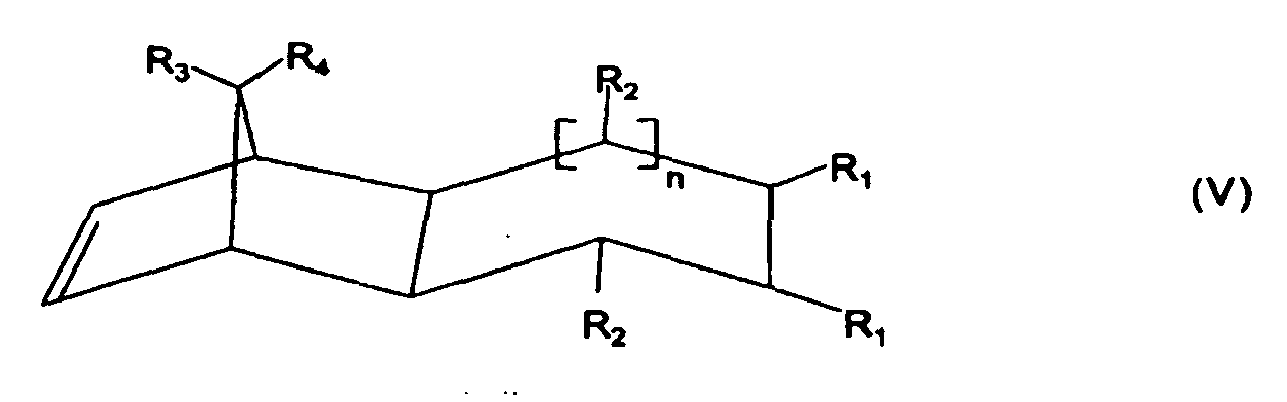
- the COC contained in the thermoformable film generally contains from 0.1 to 100.0% by weight, preferably from 0.1 to 99.9% by weight, based on the total weight of the cycloolefin copolymer, of polymerized units derived from at least a polycyclic olefin of the following formulas I, II, II ', III, IV, V or VI wherein R 1 , R 2 , R 3 , R 4 , R 5 , R 6 , R 7 and R 8 are the same or different and a Hydrogen atom or a C 1 -C 20 -hydrocarbon radical, such as a linear or branched C 1 -C 8 -alkyl radical, C 6 -C 18 -aryl radical, C 7 -C 20 -alkylenearyl radical, a cyclic or acyclic C 2 -C 20 - Alkenyl radical, or form a saturated, unsaturated or aromatic ring, wherein the same radicals R 1 to R 8 in the various
- cycloolefin copolymers used may contain from 0 to 45% by weight, based on the total weight of the cycloolefin copolymer, of polymerized units derived from one or more monocyclic olefins of the formula VIII wherein m is a number from 2 to 10.
- cyclic olefins Also included in the cyclic olefins are derivatives of these cyclic olefins having polar groups such as halogen, hydroxyl, ester, alkoxy, carboxy, cyano, amido, imido or silyl groups.
- COCs which contain polymerized units which are derived from polycyclic olefins of the formulas I or III, and polymerized units which are derived from acyclic olefins of the formula VII, in particular norbornene-based olefins such as norbornene and tetracyclododecene and optionally vinylnorbornene or norbornadiene.
- cycloolefin copolymers having polymerized units derived from acyclic olefins having terminal double bonds, such as ⁇ -olefins having 2 to 20 carbon atoms, in particular ethylene or propylene, for example ethylene / norbornene and ethylene / tetracyclododecene copolymers.
- Preferred terpolymers are ethylene / norbornene / vinylnorbornene, ethylene / norbornene / norbornadiene, ethylene / tetracyclododecene / vinylnorbornene, ethylene / tetracyclododecene / vinyltetracyclododecene or ethylene / norbornene / dicyclopentadiene terpolymers.
- COC is a copolymer of ethylene and norbornene used.
- the proportion of the polymerized units derived from a polyene, preferably vinyl norbornene or norbornadiene, is generally from 0.1 to 50.0 mol%, preferably from 0.1 to 20.0 mol%, of the fraction of the acyclic Monoolefin of the formula VII is generally 0 to 99.9 mol%, preferably 5.0 to 80.0 mol%, based on the total composition of the cycloolefin polymer.
- the proportion of polycyclic monoolefin is 0.1 to 99.9 mol%, preferably 3.0 to 75.0 mol%, based on the total composition of the COC.
- thermoformable film can be transparent or can also be prepared by adding polymers which do not form a homogeneous mixture with the COC or pigments, as an opaque film or with soluble dyes as a colored film.
- the use of the COC not only improves the sealability and the slippage of the film, but also increases the ink adhesion to the packaging produced according to the invention in their labeling or printing.
- Blends of the polymers mentioned with typical plastic additives such as antioxidants, metal deactivators, light stabilizers, plasticizers, lubricants, processing aids, antistatic agents, optical brighteners, biostabilizers, fire retardants, and fillers and reinforcing agents (see also Gumbleter, Müller, Plastics Additive Handbook, 4 th edition, 1993 , Kunststoff, Hanser) are also suitable.
- plastic additives such as antioxidants, metal deactivators, light stabilizers, plasticizers, lubricants, processing aids, antistatic agents, optical brighteners, biostabilizers, fire retardants, and fillers and reinforcing agents
- the cycloolefin copolymers can be prepared in known manner at temperatures of from -78 to 200 ° C. and a pressure of from 0.01 to 200 bar, in the presence of one or more catalyst systems containing at least one transition metal compound and optionally a cocatalyst and optionally a support material.
- Suitable transition metal compounds are metallocenes, in particular stereorigid metallocenes.
- Examples of catalyst systems suitable for the preparation of the COCs are e.g. described in US-A-5,008,356, EP-A-0 407 870, EP-A-0 485 893 and EP-A-0 503 422, to which reference is made.
- cycloolefin copolymers can also be carried out in other ways, which are briefly outlined below: Catalyst systems based on mixed catalysts of titanium salts and aluminum organyls are described in DD-A-109,224 and DD-A-237,070. EP-A-0 156 464 describes the Preparation with vanadium-based catalysts.
- the cycloolefin copolymers can also be obtained by ring-opening polymerization of at least one of the monomers of the formulas I to VI and subsequent hydrogenation of the products obtained.
- the polymerization can also take place in several stages, whereby block copolymers can also be formed, see DE-A-42 05 416.
- COCs are understood to mean those polyolefins which, despite a random arrangement of the molecular chains, are solids at room temperature.
- the heat resistance of the cycloolefin copolymers can be adjusted within a wide range.
- the glass transition temperature T g measured according to DIN EN ISO 11357-1 using a DSC at a heating rate of 10 K. / min.
- the described cycloolefin copolymers have glass transition temperatures in the range from 65 to 200 ° C., preferably from 85 to 200 ° C., in particular from 120 to 190 ° C.
- the film according to the invention can also optionally contain mixtures of different COCs with different glass transition temperatures.
- the density of the cycloolefin copolymers used in the present invention is usually in the range of 0.9 to 1.1 g / cm 3 , preferably 0.9 to 1.05 g / cm 3 .
- Suitable polyolefins which can be used in addition to the COC in the film according to the invention are high or low density polyethylenes (HDPE, LDPE, LLDPE), ethylene-vinyl acetate copolymer, ionomer, polypropylene, olefin copolymers, plastomers or mixtures thereof ,
- thermoformable film is combined with further films to form a multilayer composite.
- the composite can be produced by laminating films which have been produced individually beforehand, by co-extrusion or by extrusion coating or extrusion lamination.
- adhesion-promoting layers may be provided between the individual layers.
- the substances used for this purpose may contain at least one or more polymers and are generally known as such.
- thermoformable film film blend can be reused with all its components as regranulate and thus recycled without negatively affecting the thermoformability of the film and the heat moldability of the packaging produced therefrom.
- efficiency of the method according to the invention can be significantly improved and reduce environmental impact.
- the adhesion-enhancing layer may advantageously be applied in the melt or else as a solution, suspension or solvent-based adhesive.
- Thermoformable films for the process according to the invention can be prepared, for example, by a known process for producing a plastic monolayer or multilayer film in which the polymers for the film and / or the polymer blends are compressed in an extruder, heated and then the melt or melts a flat die is extruded and the film thus obtained on one or more rolls or on steel strips is withdrawn.
- Optionally added additives can already be present in the polymer or in the polymer mixture or they are added via the masterbatch technique.
- the melt (s) can also be extruded through an annular die, the film thus obtained being processed into a film on a blown film line and laid flat over rolls or over strips.
- one or both surfaces of the film may be corona or flame treated by known methods. By treating the surface, it is prepared for subsequent labeling or printing according to generally known methods.
- thermoformable film which is described in detail above, is characterized by a particularly good detail reproduction during thermoforming and that especially the wall thickness is formed very uniformly during thermoforming. It was further surprising that the sealing behavior of two films produced in this way is very good, i. it was possible to produce dense sealing compounds at low sealing initiation temperature, but these could then be dissolved by hand again, or it was possible to produce mechanically insoluble bonds at elevated sealing temperature.
- Another advantage of the thermoformable film is its excellent punching behavior, which is expressed by the fact that it forms no sharp edges or corners during punching.
- Table 1 clearly show the increase in the temperature stability of all polyolefin films by blending with COC.
- deep-drawn blisters of films containing COC with a T g of 140 ° C can be sterilized with steam at a temperature of 121 ° C, without any shrinkback or a change in shape occurs.
Landscapes
- Chemical & Material Sciences (AREA)
- Health & Medical Sciences (AREA)
- Chemical Kinetics & Catalysis (AREA)
- Medicinal Chemistry (AREA)
- Polymers & Plastics (AREA)
- Organic Chemistry (AREA)
- Engineering & Computer Science (AREA)
- Manufacturing & Machinery (AREA)
- Materials Engineering (AREA)
- Manufacture Of Macromolecular Shaped Articles (AREA)
- Laminated Bodies (AREA)
- Blow-Moulding Or Thermoforming Of Plastics Or The Like (AREA)
- Wrappers (AREA)
- Compositions Of Macromolecular Compounds (AREA)
Description
- Die Erfindung betrifft ein Verfahren zum Herstellen einer Verpackung aus einer thermoformbaren Folie aus thermoplastischen Polyolefinen durch Thermoformen, die nach dem Thermoformen eine hohe Wärmeformbeständigkeit und eine hohe Wasserdampfbarriere besitzt.
- Aus der JP 2000 202951 A2 sind thermoformbare Folien bekannt mit einem Mehrschichtaufbau aus einem meist halogenhaltigen Polymer wie Polyvinylchlorid (PVC) als Trägerfolie und einer Mischung eines amorphen Cycloolefincopolymers (COC) mit einem teilkristallinen Polyolefin hoher Dichte wie hochdichtes Polyethylen (HDPE), niederdichtes Polyethylen (LDPE) oder lineares niederdichtes Polyethylen (LLDPE) als Deckschichten. Nachteilig daran ist allerdings der Halogenanteil in der Trägerfolie und die meist nicht zufriedenstellende Wärmeformbeständigkeit, die nicht ausreicht, um die thermogeformte Folie ohne Formänderung einer Sterilisation mit Hilfe von Wasserdampf zu unterziehen.
- Aus der DE-A 100 09 646 ist eine Polymermischung enthaltend amorphes COC als solche bekannt und Folien oder Blisterverpackungen, die aus der Polymermischung hergestellt werden. Die Schrift beschreibt zwar, dass die beschriebene Mischung geeignet ist, um das Relaxationsverhalten, das Schrumpfverhalten oder die Wärmeformbeständigkeit zu beeinflussen, aber sie macht keine Aussage über das Wesen und das Ausmaß der erreichten Wärmeformbeständigkeit.
- Aufgabe der vorliegenden Erfindung war es, ein neues Verfahren zum Herstellen von Verpackungen zu finden, bei dem eine Folie eingesetzt wird, die eine sehr gute Thermoformbarkeit besitzt. Die so durch Thermoformen hergestellte Verpackung soll eine verbesserte Wärmeformbeständigkeit besitzen, im günstigsten Fall so eine hohe Wärmeformbeständigkeit aufweisen, dass sie wasserdampfsterilisierbar ist, d.h. dass sie ihre geometrische Form bei Einwirken einer Temperatur im Bereich von bis zu 121°C über eine Zeitdauer von mindestens 20 min nicht verändert. Zusätzlich zu dieser Eigenschaft soll die Verpackung auch noch eine zuverlässig gute Barriere gegenüber dem Durchtritt von Wasserdampf bieten und unter wirtschaftlichen Bedingungen großtechnisch zu produzieren sein.
- Gelöst wird diese Aufgabe durch ein Verfahren der eingangs genannten Gattung, dessen Kennzeichenmerkmal darin zu sehen ist, dass die thermoformbare Folie eine Menge im Bereich von 5 bis 100 Gew.-%, vorzugsweise von 20 bis 90 Gew.-%, besonders bevorzugt von 25 bis 80 Gew.-%, COC mit einer Glastemperatur Tg im Bereich von 65 bis 200 °C, gemessen nach DIN EN ISO 11357-1 mit Hilfe einer DSC bei einer Aufheizgeschwindigkeit von 10 K/min, enthält und dass die daraus durch Thermoformen bei einer Temperatur im Bereich von 70 bis 170 °C, vorzugsweise von 80 bis 160 °C, hergestellte Verpackung eine Wärmeformbeständigkeit im Bereich von 60 bis 200 °C besitzt, vorzugsweise von 80 bis 200 °C, besonders bevorzugt von 110 bis 180°C.
- Das Thermoformen nach dem erfindungsgemäßen Verfahren wird zweckmäßig über eine Zeitdauer von 0, 5 bis 10 s, vorzugsweise von 1 bis 7 s, bei der entsprechenden Temperatur durchgeführt.
- Die mittlere Molmasse der Cycloolefincopolymeren lässt sich bei ihrer Herstellung durch Wasserstoff-Dosierung, Variation der Katalysatorkonzentration oder Variation der Temperatur steuern. Die für das erfindungsgemäße Verfahren geeignete thermoformbare Folie enthält Cycloolefincopolymere mit einer mittleren Molmassen Mw im Bereich von 500 bis 2 000 000 g/mol, vorzugsweise von 1 000 bis 1 000 000 g/mol, insbesondere von 3 000 bis 500 000 g/mol. Diese mit Hilfe der Gelpermeationschromatographie (GPC) in Chloroform bei 35 °C mit Hilfe eines RI Detektors bestimmten Molmassen sind relativ und beziehen sich auf eine Eichung mit eng verteilten Polystyrolstandards.
- Die beschriebenen Cycloolefincopolymere besitzen gemäß DIN 53 728 Viskositätszahlen VZ im Bereich von 5 bis 5000 ml/g, vorzugsweise von 5 bis 2000 ml/g und insbesondere von 5 bis 1000 ml/g.
- Die thermoformbare Folie weist im allgemeinen eine Dicke im Bereich von 5 bis 1000 µm auf, vorzugsweise von 50 bis 600 µm, besonders bevorzugt von 100 bis 500 µm. Sie kann dabei als Monofolie vorliegen oder als Mehrschichtfolie mit zwei, drei oder noch mehr Schichten, wobei aber die Schichtdicke der COChaltigen Lage mindestens 10 % der Gesamtdicke der Mehrschichtfolie betragen sollte.
- Das in der thermoformbaren Folie enthaltene COC enthält im allgemeinen 0,1 bis 100,0 Gew.-%, vorzugsweise 0,1 bis 99,9 Gew.-%, bezogen auf die Gesamtmasse des Cycloolefincopolymers, polymerisierte Einheiten, welche sich ableiten von mindestens einem polycyclischen Olefin der nachfolgenden Formeln I, II, II', III, IV, V oder VI


0 bis 99,9 Gew.-%, vorzugsweise 0,1 bis 99,9 Gew.-%, bezogen auf die Gesamtmasse des Cycloolefincopolymers, polymerisierte Einheiten, welche sich ableiten von einem oder mehreren acyclischen Olefinen der Formel VII
- Außerdem können die verwendeten Cycloolefincopolymere 0 bis 45 Gew.-%, bezogen auf die Gesamtmasse des Cycloolefincopolymers, polymerisierte Einheiten enthalten, welche sich ableiten von einem oder mehreren monocyclischen Olefinen der Formel VIII

- Bei den cyclischen Olefinen sind ebenfalls Derivate dieser cyclischen Olefine mit polaren Gruppen, wie Halogen-, Hydroxyl-, Ester-, Alkoxy-, Carboxy-, Cyano-, Amido-, Imido- oder Silylgruppen, eingeschlossen.
- Bevorzugt im Sinne der Erfindung sind COCs, die polymerisierte Einheiten enthalten, welche sich ableiten von polycyclischen Olefinen der Formeln I oder III, und polymerisierte Einheiten, welche sich ableiten von acyclischen Olefinen der Formel VII, insbesondere Olefine mit Norbornengrundstruktur wie Norbornen und Tetracyclododecen und gegebenenfalls Vinylnorbornen oder Norbornadien.
- Bevorzugt sind auch Cycloolefincopolymere mit polymerisierten Einheiten, abgeleitet von acyclischen Olefinen mit endständigen Doppelbindungen wie α-Olefine mit 2 bis 20 C-Atomen, insbesondere Ethylen oder Propylen, beispielsweise Ethylen/Norbornen- und Ethylen/Tetracyclododecen-Copolymere.
- Als Terpolymere sind bevorzugt Ethylen/Norbornen/Vinylnorbonen-, Ethylen/Norbornen/Norbornadien-, Ethylen/Tetracyclododecen/Vinylnorbornen-, Ethylen/Tetracyclododecen/Vinyltetracyclododecen- oder Ethylen/Norbornen/Dicyclopentadien-Terpolymere.
- Ganz besonders vorteilhaft ist als COC ein Copolymer aus Ethylen und Norbornen einsetzbar.
- Der Anteil der polymerisierten Einheiten, die sich ableiten von einem Polyen, bevorzugt Vinylnorbornen oder Norbornadien, liegt im allgemeinen bei 0,1 bis 50,0 mol-%, vorzugsweise bei 0,1 bis 20,0 mol-%, der Anteil des acyclischen Monoolefins der Formel VII beträgt im allgemeinen 0 bis 99,9 mol-%, vorzugsweise 5,0 bis 80,0 mol-%, bezogen auf die Gesamtzusammensetzung des Cycloolefinpolymers. In den beschriebenen Terpolymeren liegt der Anteil des polycyclischen Monoolefins bei 0,1 bis 99,9 mol-%, vorzugsweise 3,0 bis 75,0 mol-%, bezogen auf die Gesamtzusammensetzung des COCs.
- Die thermoformbare Folie kann transparent sein oder auch durch Zugabe von Polymeren, die mit dem COC keine homogene Mischung bilden oder Pigmenten, als opake Folie vorliegen, oder mit löslichen Farbstoffen als gefärbte Folie hergestellt werden.
- Der Einsatz des COCs verbessert nicht nur die Siegelfähigkeit und den Schlupf der Folie, sondern erhöht auch die Farbhaftung auf der erfindungsgemäß hergestellten Verpackung bei ihrer Beschriftung oder Bedruckung.
- Abmischungen der genannten Polymere mit typischen Kunststoffadditiven wie Antioxidantien, Metalldesaktivatoren, Lichtschutzmitteln, Weichmachern, Gleitmitteln, Verarbeitungshilfsmitteln, Antistatika, optischen Aufhellern, Biostabilisatoren, Brandschutzmittel, sowie Füll- und Verstärkungsmittel (siehe auch Gächter, Müller, Plastics Additive Handbook, 4th edition, 1993, München, Hanser) sind ebenfalls geeignet.
- Die Cycloolefincopolymere können in bekannter Weise hergestellt werden bei Temperaturen von -78 bis 200 °C und einem Druck von 0,01 bis 200 bar, in Gegenwart eines oder mehrerer Katalysatorsysteme, die mindestens eine Übergangsmetallverbindung und gegebenenfalls einen Cokatalysator und gegebenenfalls ein Trägermaterial enthalten. Als Übergangsmetallverbindungen eignen sich Metallocene, insbesondere stereorigide Metallocene. Beispiele für Katalysatorsysteme, die für die Herstellung der COCs geeignet sind, sind z.B. beschrieben in US-A-5,008,356, EP-A-0 407 870, EP-A-0 485 893 und EP-A-0 503 422, worauf Bezug genommen wird.
- Die Herstellung der Cycloolefincopolymere kann auch auf anderen, nachfolgend kurz skizzierten Wegen erfolgen : Katalysatorsysteme, basierend auf Mischkatalysatoren aus Titansalzen und Aluminiumorganylen, werden in DD-A-109 224 und DD-A-237 070 beschrieben. EP-A-0 156 464 beschreibt die Herstellung mit Katalysatoren auf Vanadiumbasis.
- Die Cycloolefincopolymere können auch durch ringöffnende Polymerisation mindestens eines der Monomere mit den Formeln I bis VI und anschließender Hydrierung der erhaltenen Produkte erhalten werden.
- Die Polymerisation kann auch mehrstufig erfolgen, wobei auch Blockcopolymere entstehen können, siehe dazu DE-A-42 05 416.
- Unter COC werden solche Polyolefine verstanden, die trotz einer regellosen Anordnung der Molekülketten bei Raumtemperatur Feststoffe sind. Die Wärmeformbeständigkeiten der Cycloolefincopolymere lassen sich in einem weiten Bereich einstellen. Als Anhaltspunkt für die Wärmeformbeständigkeit, wie sie nach ISO 75 Teil 1 und Teil 2 an Spritzgußformkörpern bestimmt werden kann, lässt sich für Cycloolefincopolymere die Glasübergangstemperatur Tg heranziehen, gemessen nach DIN EN ISO 11357-1 mit Hilfe einer DSC bei einer Aufheizgeschwindigkeit von 10 K/min. Die beschriebenen Cycloolefincopolymere weisen Glasübergangstemperaturen im Bereich von 65 bis 200 °C auf, vorzugsweise von 85 bis 200 °C, insbesondere von 120 bis 190 °C. Die erfindungsgemäße Folie kann auch ggf. Mischungen von verschiedenen COCs mit unterschiedlichen Glasübergangstemperaturen enthalten.
- Die Dichte der Cycloolefincopolymere, die in der vorliegenden Erfindung eingesetzt werden, liegt üblicherweise im Bereich von 0,9 bis 1,1 g/cm3, vorzugsweise 0,9 bis 1,05 g/cm3.
- Als Polyolefine, die neben dem COC in der Folie gemäß der Erfindung eingesetzt werden können, sind Polyethylene hoher oder niederer Dichte (HDPE, LDPE, LLDPE), Ethylen-Vinylacetat-Copolymer, lonomer, Polypropylen, Olefin-Copolymere, Plastomere oder Mischungen daraus geeignet.
- Es gibt Ausführungsformen des erfindungsgemäßen Verfahrens, bei denen die thermoformbare Folie mit weiteren Folien zu einem Mehrschichtenverbund kombiniert wird. Der Verbund kann durch Laminieren von vorher einzeln für sich hergestellten Folien, durch Koextrusion oder durch Extrusionsbeschichtung bzw. Extrusionskaschierung hergestellt werden. Zusätzlich können zwischen den einzelnen Schichten weitere, die Haftung verbessernde Schichten vorgesehen sein. Die hierfür eingesetzten Substanzen können mindestens ein oder mehrere Polymere enthalten und sind als solche allgemein bekannt.
- Besonders überraschend war, dass der bei dem Fertigungsprozeß der thermoformbaren Folie anfallende Folienverschnitt mit allen seinen Komponenten wieder als Regranulat eingesetzt und somit wiederverwertet werden kann, ohne die Thermoformbarkeit der Folie und die Wärmeformbarkeit der daraus hergestellten Verpackung negativ zu beeinträchtigen. Hierdurch lässt sich die Wirtschaftlichkeit des erfindungsgemäßen Verfahrens deutlich verbessern und eine Umweltbelastung reduzieren.
- Die die Haftung verbessernde Schicht kann vorteilhaft in der Schmelze oder aber als Lösung, Suspension oder lösemittelhaltiger Klebstoff aufgebracht werden.
- Thermoformbare Folien für das erfindungsgemäße Verfahren können beispielsweise hergestellt werden durch ein bekanntes Verfahren zur Herstellung einer Kunststoff-Mono- oder Mehrschichtfolien, bei welchem die Polymeren für die Folie und/oder die Polymermischungen in einem Extruder komprimiert, erwärmt und anschließend die Schmelze oder die Schmelzen durch eine Flachdüse extrudiert werden und die so erhaltene Folie auf einer oder mehreren Walzen oder auf Stahlbändern abgezogen wird. Gegebenenfalls zugesetzte Additive können bereits im Polymer bzw. in der Polymermischung enthalten sein oder sie werden via Masterbatch-Technik zugegeben.
- Die Schmelze/n können auch durch eine Ringdüse extrudiert werden, wobei die so erhaltene Folie auf einer Blasfolienanlage zur Folie verarbeitet und über Walzen oder über Bänder flachgelegt wird.
- Gegebenenfalls kann/können eine oder beide Oberfläche/n der Folie nach bekannten Methoden korona- oder flammbehandelt werden. Durch eine Behandlung der Oberfläche wird diese für eine nachfolgende Beschriftung oder Bedruckung nach allgemein bekannten Methoden vorbereitet.
- Es war besonders überraschend, dass das erfindungsgemäße Verfahren beim Einsatz der thermoformbaren Folie, die vorstehend in allen Einzelheiten beschrieben ist, sich beim Thermoformen durch eine besonders gute Detailwiedergabe auszeichnet und dass sich vor allem die Wanddicke beim Thermoformen sehr gleichmäßig ausbildet. Weiter überraschend war, dass das Siegelverhalten von zwei derart hergestellten Folien zueinander sehr gut ist, d.h. es ließen sich bei niedriger Siegelanspringtemperatur dichte Siegelverbunde herstellen, die anschließend aber wieder per Hand zu lösen waren, bzw. ließen sich bei erhöhter Siegeltemperatur mechanisch unlösbare Verbindungen erzeugen. Ein weiterer Vorteil der thermoformbaren Folie ist ihr hervorragendes Stanzverhalten, was dadurch zum Ausdruck kommt, dass sie beim Ausstanzen keine scharfen Kanten oder Ecken ausbildet.
- In den nachfolgenden Beispielen wurden die folgenden Ausgangsmaterialien eingesetzt:
- 1. Ethylen-Norbornen Copolymer mit einer Glasübergangstemperatur (Tg)von 80 °C und einer Viskositätszahl (VZ) von 80 ml/g (Handelsname ® Topas 8007, Ticona GmbH, Frankfurt a. M.).
- 2. Ethylen-Norbornen Copolymer mit einer Tg von 140 °C und einer VZ von 60 ml/g (Handelsname ® Topas 6013, Ticona GmbH, Frankfurt a. M).
- 3. Polyethylen (Handelsname ® Lupolex 18QFA, Basell GmbH)
- 4. Polyethylen (Handelsname ® Luflexen 18PFAX, Basell GmbH)
- 5. Polypropylen (Handelsname HB600TF, Borealis)
- Aus den genannten Materialen wurden gemäß den in Tabelle 1 angeführten Beispielen Folien durch Extrusion hergestellt und um 100% bei den angegebenen Temperaturen gestreckt. Anschließend wurde die Längenänderung dieser gestreckten Folien als Funktion der Temperatur über 20 min bestimmt. Der Wert für den Schrumpf ergibt sich aus der Differenz der Länge vor und nach der Wärmelagerung geteilt durch die Ausgangslänge. Der Schrumpf ist ein Maß für die Wärmeformstabilität der thermogeformten Folien wie z.B. tiefgezogene Blisterverpackungen.
Tabelle 1 Beispiel COC Polyolefin Strecktemperatur [°C] Schrumpftemperatur* [°C] Wasserdampfdurchlässigkeit [g/m2·d] 1a 100% 8007 - 90 80 1 1b 80% 8007 20% 18QFA 90 75 1,2 1c 60% 8007 40% 18QPA 90 70 1,5 1d 20% 8007 80% 18QFA 90 30 3,8 2a 100% 6013 - 150 142 1,3 2b 80% 6013 20% 18PFAX 150 144 1,5 2c 60% 6013 40% 18PFAX 150 141 1,8 2d 40% 6013 60% 18PFAX 150 144 2,9 2e 20% 6013 80% 18PFAX 150 143 4,2 V1 - 100% 18QFA 90 < 30 4,8 V2 - 100% 18PFAX 150 80 4,7 V3 - 100% PP 70 65 2,5 *Als Schrumpftemperatur wird diejenige Temperatur angegeben, bei der der Schrumpf nach 20 min genau 5 % beträgt.
** Die Messung der Wasserdampfdurchlässigkeit erfolgte nach ASTM F 372 bei einer Temperatur von 38 °C und einer relativen Luftfeuchtigkeit von 90 % normiert auf eine Folie von 100 µm. - Die Werte in Tabelle 1 zeigen deutlich die Erhöhung der Temperaturstabilität aller Polyolefinfolien durch Blenden mit COC. Z.B. können tiefgezogene Blister aus Folien, die COC mit einer Tg von 140 °C enthalten, mit Wasserdampf bei einer Temperatur von 121 °C sterilisiert werden, ohne dass ein Rückschrumpf oder eine Formänderung eintritt.
Claims (23)
- Verfahren zum Herstellen einer Verpackung aus einer thermoformbaren Folie aus thermoplastischen Polyolefinen durch Thermoformen, die nach dem Thermoformen eine verbesserte Wärmeformbeständigkeit und eine hohe Wasserdampfbarriere besitzt, dadurch gekennzeichnet, dass die thermoformbare Folie eine Menge im Bereich von 5 bis 100 Gew.-% Cycloolefincopolymer, bezogen auf das Gesamtgewicht an Polyolefinen, mit einer Glastemperatur Tg im Bereich von 65 bis 200 °C, gemessen nach DIN EN ISO 11357-1 mit Hilfe einer DSC bei einer Aufheizgeschwindigkeit von 10 K/min, enthält und dass die daraus durch Thermoformen bei einer Temperatur im Bereich von 70 bis 170 °C hergestellte Verpackung eine Wärmeformbeständigkeit im Bereich von 60 bis 200 °C besitzt.
- Verfahren nach Anspruch 1, dadurch gekennzeichnet, dass die Verpackung durch Thermoformen bei einer Temperatur im Bereich von 80 bis 160 °C hergestellt wird.
- Verfahren nach Anspruch 1, dadurch gekennzeichnet, dass das Cycloolefincopolymer eine mittlere Molmasse, ausgedrückt als Mw, im Bereich von 500 bis 2000000 g/mol besitzt.
- Verfahren nach Anspruch 3, dadurch gekennzeichnet, dass die mittlere Molmasse im Bereich von 1000 bis 1000000 g/mol liegt.
- Verfahren nach Anspruch 4, dadurch gekennzeichnet, dass die mittlere Molmasse im Bereich von 3000 bis 500000 g/mol liegt.
- Verfahren nach einem oder mehreren der Ansprüche 1 bis 5, dadurch gekennzeichnet, dass das Cycloolefincopolymere eine Viskositätszahl gemäß DIN 53 728 im Bereich von 5 bis 5 000 ml/g besitzt.
- Verfahren nach Anspruch 6, dadurch gekennzeichnet, dass die Viskositätszahl im Bereich von 5 bis 2000 ml/g liegt.
- Verfahren nach Anspruch 7, dadurch gekennzeichnet, dass die Viskositätszahl im Bereich von 5 bis 1000 ml/g liegt.
- Verfahren nach einem oder nach mehreren der Ansprüche 1 bis 8, dadurch gekennzeichnet, dass die thermoformbare Folie eine Monofolie oder eine Mehrschichtfolie ist und eine Gesamtdicke im Bereich von 5 bis 2000 µm aufweist.
- Verfahren nach Anspruch 9, dadurch gekennzeichnet, dass die Gesamtdicke der Folie im Bereich von 50 bis 500 µm liegt.
- Verfahren nach Anspruch 10, dadurch gekennzeichnet, dass die Gesamtdicke der Folie im Bereich von 200 bis 400 µm liegt.
- Verfahren nach einem oder nach mehreren der Ansprüche 1 bis 11, dadurch gekennzeichnet, dass das Cycloolefincopolymere 0,1 Gew.-% bis 100,0 Gew.-%, bezogen auf die Gesamtmasse des Cycloolefincopolymeren, polymerisierte Einheiten enthält, welche sich ableiten von mindestens einem polycyclischen Olefin der Formeln I, II, II', III, IV, V oder VI



0 bis 99,9 Gew.-%, bezogen auf die Gesamtmasse des Cycloolefincopolymers, polymerisierte Einheiten, welche sich ableiten von einem oder mehreren acyclischen Olefinen der Formel VII
- Verfahren nach Anspruch 12, dadurch gekennzeichnet, dass das Cycloolefincopolymere 0,1 Gew.-% bis 99,9 Gew.-% polymerisierte Einheiten enthält, welche sich ableiten von mindestens einem polycyclischen Olefin der Formeln I, II, II', III, IV, V oder VI, sowie 0,1 bis 99,9 Gew.-% polymerisierte Einheiten, welche sich ableiten von einem oder mehreren acyclischen Olefinen der Formel VII.
- Verfahren nach Anspruch 13, dadurch gekennzeichnet, dass R1, R2, R3, R4, R5, R6, R7 und R8 gleich oder verschieden sind und ein Wasserstoffatom oder einen linearen oder verzweigten C1-C8-Alkylrest, C6-C18-Arylrest, C7-C20Alkylenarylrest oder einen cyclischen oder acyclischen C2-C20-Alkenylrest bedeuten und dass R9, R10, R11 und R12 gleich oder verschieden sind und ein Wasserstoffatom oder einen C1-C8-Alkylrest oder einen C6-C18-Arylrest bedeuten.
- Verfahren nach einem oder mehreren der Ansprüche 12 bis 14, dadurch gekennzeichnet, dass das Cycloolefincopolymere eine Menge von 0 bis 45 Gew.%, bezogen auf seine Gesamtmasse, polymerisierte Einheiten enthält, die sich von einem oder mehreren monoolefinischen Olefinen der Formel VIII

- Verfahren nach einem oder nach mehreren der Ansprüche 1 bis 15, dadurch gekennzeichnet, dass das Cycloolefincopolymere eine Glastemperatur Tg im Bereich von 85 bis 200 °C hat, und dass sie gegebenenfalls Mischungen von Cycloolefincopolymeren mit unterschiedlicher Tg enthält.
- Verfahren nach Anspruch 16, dadurch gekennzeichnet, dass das Cycloolefincopolymere eine Glastemperatur Tg im Bereich von 120 bis 190 °C hat.
- Verfahren nach einem oder nach mehreren der Ansprüche 1 bis 17, dadurch gekennzeichnet, dass die thermoformbare Folie als weitere Polyolefine Polyethylene hoher oder niederer Dichte (HDPE, LDPE, LLDPE), Ethylen-Vinylacetat-Copolymer, lonomer, Polypropylen, Olefin-Copolymere, Plastomere oder Mischungen daraus enthält.
- Verfahren nach einem oder nach mehreren der Ansprüche 1 bis 18, dadurch gekennzeichnet, dass die thermoformbare Folie bis zu 40 Gew.-% aus bei der Herstellung anfallendem Folienverschnitt in Form von Regranulat enthält.
- Verpackung, hergestellt nach einem Verfahren nach einem oder nach mehreren der Ansprüche 1 bis 19, dadurch gekennzeichnet dass sie nach dem Thermoformen der thermoformbaren Folie eine Wärmeformbeständigkeit im Bereich von 60 bis 200 °C besitzt.
- Verpackung nach Anspruch 20, dadurch gekennzeichnet, dass die eine Wärmeformbeständigkeit im Bereich von 80 bis 200 °C besitzt.
- Verpackung nach Anspruch 21, dadurch gekennzeichnet, dass die eine Wärmeformbeständigkeit im Bereich von 100 bis 180 °C besitzt.
- Verpackung nach einem oder mehreren der Ansprüche 20 bis 22, dadurch gekennzeichnet, dass sie eine Blisterverpackung ist.
Applications Claiming Priority (3)
| Application Number | Priority Date | Filing Date | Title |
|---|---|---|---|
| DE10242730 | 2002-09-13 | ||
| DE2002142730 DE10242730A1 (de) | 2002-09-13 | 2002-09-13 | Thermoformbare Folie mit hoher Wärmeformbeständigkeit und Wasserdampfbarriere |
| PCT/EP2003/010077 WO2004026946A1 (de) | 2002-09-13 | 2003-09-11 | Verfahren zum herstellen einer verpackung aus thermoformbarer folie mit hoher wärmeformbeständigkeit und wasserdampfbarriere |
Publications (2)
| Publication Number | Publication Date |
|---|---|
| EP1539867A1 EP1539867A1 (de) | 2005-06-15 |
| EP1539867B1 true EP1539867B1 (de) | 2006-09-20 |
Family
ID=31895993
Family Applications (1)
| Application Number | Title | Priority Date | Filing Date |
|---|---|---|---|
| EP20030797293 Expired - Lifetime EP1539867B1 (de) | 2002-09-13 | 2003-09-11 | Verfahren zum herstellen einer verpackung aus thermoformbarer folie mit hoher wärmeformbeständigkeit und wasserdampfbarriere |
Country Status (8)
| Country | Link |
|---|---|
| US (1) | US7829633B2 (de) |
| EP (1) | EP1539867B1 (de) |
| JP (1) | JP2005538236A (de) |
| AT (1) | ATE340212T1 (de) |
| AU (1) | AU2003266375A1 (de) |
| CA (1) | CA2498340C (de) |
| DE (2) | DE10242730A1 (de) |
| WO (1) | WO2004026946A1 (de) |
Families Citing this family (40)
| Publication number | Priority date | Publication date | Assignee | Title |
|---|---|---|---|---|
| CA2598665C (en) * | 2005-02-23 | 2012-09-11 | Topas Advanced Polymers, Inc. | Multilayer films including cycloolefin copolymer and styrene-butadiene copolymer |
| TW200738765A (en) * | 2006-03-23 | 2007-10-16 | Zeon Corp | Norbornene compound addition polymer film, process for production thereof, and use thereof |
| US20080107899A1 (en) * | 2006-11-07 | 2008-05-08 | Pang-Chia Lu | Metallized multi-layer films, methods of manufacture and articles made therefrom |
| WO2008136970A1 (en) * | 2007-05-02 | 2008-11-13 | Polyplastics Co., Ltd | Thermoformed articles from sheet incorporating cycloolefin copolymer |
| US20090208685A1 (en) * | 2008-02-20 | 2009-08-20 | Sealed Air Corporation (Us) | Packaging film and method of decreasing scalping of polar cyclic compounds |
| DE102008051399A1 (de) | 2008-10-11 | 2010-04-22 | Topas Advanced Polymers Gmbh | Folien und deren Verwendung |
| EP2186634A1 (de) * | 2008-11-13 | 2010-05-19 | Amcor Flexibles Transpac N.V. | Sich nicht wellende, auf Polyolefin basierende Verpackungsfolie, die zur Verpackung steriler Produkte verwendet wird |
| DE102010020487A1 (de) | 2010-05-14 | 2011-11-17 | Topas Advanced Polymers Gmbh | Pulverlacke und deren Verwendung |
| DE102010034643A1 (de) | 2010-08-17 | 2012-02-23 | Topas Advanced Polymers Gmbh | Cycloolefinpolymerzusammensetzungen, Formkörper und deren Verwendung |
| US9146287B2 (en) | 2010-11-15 | 2015-09-29 | Infineon Technologies Ag | XMR sensors with high shape anisotropy |
| DE102011113694A1 (de) | 2011-09-20 | 2013-03-21 | Topas Advanced Polymers Gmbh | Dentalschienen, deren Herstellung und deren Verwendung |
| DE102012006287A1 (de) | 2012-03-29 | 2013-10-02 | Topas Advanced Polymers Gmbh | Transparente thermoplastische Harzzusammensetzung mit hoher Duktilität und deren Verwendung |
| US11292234B2 (en) | 2012-09-13 | 2022-04-05 | Dow Global Technologies Llc | Polyolefin based films suitable for thermoforming |
| CN110126376A (zh) | 2012-12-07 | 2019-08-16 | 比密斯公司 | 多层膜 |
| US20150225151A1 (en) | 2014-02-11 | 2015-08-13 | Christopher L. Osborn | Anti-Scalping Transdermal Patch Packaging Film |
| US20150282064A1 (en) * | 2014-03-31 | 2015-10-01 | Qualcomm Incorporated | Dedicated channel for fast initial link setup in a wireless network |
| US9468584B2 (en) | 2014-04-02 | 2016-10-18 | Bemis Company, Inc. | Child-resistant packaging |
| US9694959B2 (en) | 2014-06-06 | 2017-07-04 | Bemis Company, Inc. | Blister packaging components |
| AR103007A1 (es) * | 2014-12-09 | 2017-04-12 | Dow Global Technologies Llc | Una película, un método de fabricación de la película, un envase que comprende la película y un método de fabricación del envase |
| US20160303833A1 (en) * | 2015-04-15 | 2016-10-20 | Avery Dennison Corporation | Non-PVC Label Film for Printing |
| JP6699123B2 (ja) * | 2015-10-07 | 2020-05-27 | 東ソー株式会社 | 樹脂組成物並びにこれよりなるフィルム及び積層体 |
| CN105681751A (zh) * | 2016-01-15 | 2016-06-15 | 上海小蚁科技有限公司 | 用于呈现视频的预览的方法、装置和系统 |
| DE202016001500U1 (de) | 2016-03-05 | 2016-05-09 | Topas Advanced Polymers Gmbh | Zusammensetzungen enthaltend Cycloolefincopolymer-Elastomere und daraus hergestellte Formkörper |
| US12162250B2 (en) | 2016-08-15 | 2024-12-10 | Klöckner Pentaplast Of America, Inc. | Hot fill laminate |
| DE102017004111A1 (de) | 2017-04-27 | 2018-10-31 | Topas Advanced Polymers Gmbh | Polyolefinfolie und deren Verwendung |
| WO2019009950A1 (en) * | 2017-07-06 | 2019-01-10 | Exxonmobil Chemical Patents Inc. | POLYETHYLENE COMPOSITIONS COMPRISING CYCLIC OLEFIN COPOLYMERS |
| DE202017006503U1 (de) | 2017-12-19 | 2018-06-26 | Topas Advanced Polymers Gmbh | Mehrschichtfolien enthaltend steife Cycoolefinpolymere und flexible Polymere und deren Verwendung |
| DE102018112817A1 (de) | 2018-05-29 | 2019-12-05 | Klöckner Pentaplast Gmbh | Transparente Polymerfolie mit Verfärbungskompensation |
| DE102018215043A1 (de) * | 2018-09-04 | 2020-03-05 | Huhtamaki Flexible Packaging Germany Gmbh & Co. Kg | Verwendung eines extrusionskaschierten Folienverbunds zur Herstellung eines plastisch dreidimensional umgeformten Folienverbund-Formkörpers, derartiger Formkörper und Verpackung daraus |
| US20200172715A1 (en) | 2018-11-30 | 2020-06-04 | Exxonmobil Chemical Patents Inc. | Blends of Cyclic Olefin Copolymers and Films Prepared Therefrom |
| US20230182440A1 (en) * | 2020-05-29 | 2023-06-15 | Zeon Corporation | Assembly and method for manufacturing same |
| DE202020003627U1 (de) | 2020-08-26 | 2021-01-11 | Topas Advanced Polymers Gmbh | Polyolefinzusammensetzungen, Formkörper enthaltend diese und deren Verwendung |
| DE102020006588A1 (de) | 2020-10-27 | 2022-04-28 | Topas Advanced Polymers Gmbh | Kondensator enthaltend biaxial verstreckte Polypropylen-Cycloolefinpolymer-Folie als Dielektrikum und Verwendung dieser Folie |
| EP4247881B1 (de) | 2020-11-18 | 2025-01-29 | Klöckner Pentaplast of America, Inc. | Thermogeformte verpackung und verfahren zur herstellung davon |
| EP4347257A1 (de) * | 2021-06-01 | 2024-04-10 | Klöckner Pentaplast of America, Inc. | Thermoformbare folie für barriereverpackung und verfahren zur herstellung davon |
| EP4116219A1 (de) * | 2021-07-07 | 2023-01-11 | Perlen Packaging AG, Perlen | Verwendung eines polymergemisches zur herstellung einer deckelfolie für eine blisterpackung |
| DE202021002835U1 (de) | 2021-09-01 | 2021-09-09 | Topas Advanced Polymers Gmbh | Polyolefin-Blisterverpackung und deren Verwendung |
| DE102021128332A1 (de) | 2021-10-29 | 2023-05-04 | Brückner Maschinenbau GmbH & Co. KG | Biaxial-orientierte Folie enthaltend Cycloolefinpolymere und alpha-Olefinpolymere, Verfahren zu ihrer Herstellung, sowie ihre Verwendung im Kondensator |
| CN114148004A (zh) * | 2022-02-07 | 2022-03-08 | 天津大学 | 一种电容器用聚丙烯薄膜高温介电性能的提升方法 |
| DE202022002075U1 (de) | 2022-09-19 | 2022-09-28 | Topas Advanced Polymers Gmbh | Cycloolefinpolymer-Wachs-Gemische und deren Verwendung |
Family Cites Families (22)
| Publication number | Priority date | Publication date | Assignee | Title |
|---|---|---|---|---|
| DE109224C (de) | ||||
| US4614778A (en) | 1984-02-03 | 1986-09-30 | Hirokazu Kajiura | Random copolymer |
| US5003019A (en) * | 1987-03-02 | 1991-03-26 | Mitsui Petrochemical Industries, Ltd. | Cyclo-olefinic random copolymer, olefinic random copolymer, and process for producing cyclo-olefinic random copolymers |
| JP3082768B2 (ja) * | 1988-10-21 | 2000-08-28 | 三井化学株式会社 | 環状オレフィン系重合体シートまたはフィルム |
| CA2010320C (en) | 1989-02-20 | 2001-04-17 | Yohzoh Yamamoto | Sheet or film of cyclo-olefin polymer |
| DE3922546A1 (de) * | 1989-07-08 | 1991-01-17 | Hoechst Ag | Verfahren zur herstellung von cycloolefinpolymeren |
| TW227005B (de) | 1990-11-14 | 1994-07-21 | Hoechst Ag | |
| EP0503422B1 (de) | 1991-03-09 | 1998-06-03 | TARGOR GmbH | Verfahren zur Herstellung chemisch einheitlicher Cycloolefincopolymere |
| US5468803A (en) * | 1992-03-03 | 1995-11-21 | Nippon Zeon Co. Ltd. | Medical implement, polymer composition, and optical material |
| KR100235089B1 (en) * | 1992-05-14 | 1999-12-15 | Mitsui Chemicals Inc | Ptp or blister packaging articles and packaging material therefor |
| CA2134320C (en) * | 1993-10-26 | 2001-01-09 | Toshiyuki Hirose | Polyolefin multilayer laminate and use thereof |
| JP3661234B2 (ja) * | 1995-08-11 | 2005-06-15 | 東洋製罐株式会社 | 内容物による着色を防止する方法 |
| DE59711803D1 (de) * | 1996-10-28 | 2004-09-02 | Ticona Gmbh | Mono- oder Mehrschichtfilm |
| DE19652338A1 (de) * | 1996-12-17 | 1998-06-18 | Hoechst Ag | Verfahren zur Herstellung eines Cycloolefincopolymers |
| DE19652340A1 (de) * | 1996-12-17 | 1998-06-18 | Hoechst Ag | Verfahren zur Herstellung von Cycloolefincopolymers |
| EP0849074A3 (de) * | 1996-12-19 | 2002-01-02 | Ticona GmbH | Cycloolefincopolymer enthaltende siegelfähige, orientierte Folien |
| JPH1174337A (ja) * | 1997-08-28 | 1999-03-16 | Nippon Zeon Co Ltd | 熱可塑性樹脂製容器 |
| JP3865014B2 (ja) * | 1997-10-28 | 2007-01-10 | 日本ゼオン株式会社 | 多環式重合体 |
| JP4086396B2 (ja) | 1999-01-18 | 2008-05-14 | 三菱樹脂株式会社 | 熱収縮性ポリオレフィン系積層フィルム |
| DE10009646A1 (de) * | 2000-03-01 | 2001-09-13 | Ticona Gmbh | Neues Polymergemisch |
| DE10164015A1 (de) * | 2001-12-28 | 2003-07-17 | Hydro Aluminium Deutschland | Verbundfolie mit Barriereeigenschaften |
| US6921563B2 (en) * | 2002-05-24 | 2005-07-26 | Ticona Gmbh | Multi-layer laminate, packaging material and packages made therefrom |
-
2002
- 2002-09-13 DE DE2002142730 patent/DE10242730A1/de not_active Withdrawn
-
2003
- 2003-09-11 US US10/527,659 patent/US7829633B2/en not_active Expired - Lifetime
- 2003-09-11 EP EP20030797293 patent/EP1539867B1/de not_active Expired - Lifetime
- 2003-09-11 CA CA 2498340 patent/CA2498340C/en not_active Expired - Lifetime
- 2003-09-11 DE DE50305134T patent/DE50305134D1/de not_active Expired - Lifetime
- 2003-09-11 JP JP2004537038A patent/JP2005538236A/ja active Pending
- 2003-09-11 AU AU2003266375A patent/AU2003266375A1/en not_active Abandoned
- 2003-09-11 WO PCT/EP2003/010077 patent/WO2004026946A1/de not_active Ceased
- 2003-09-11 AT AT03797293T patent/ATE340212T1/de not_active IP Right Cessation
Also Published As
| Publication number | Publication date |
|---|---|
| DE10242730A1 (de) | 2004-03-25 |
| CA2498340C (en) | 2011-10-25 |
| DE50305134D1 (de) | 2006-11-02 |
| ATE340212T1 (de) | 2006-10-15 |
| AU2003266375A1 (en) | 2004-04-08 |
| US7829633B2 (en) | 2010-11-09 |
| JP2005538236A (ja) | 2005-12-15 |
| EP1539867A1 (de) | 2005-06-15 |
| WO2004026946A1 (de) | 2004-04-01 |
| US20060020084A1 (en) | 2006-01-26 |
| CA2498340A1 (en) | 2004-04-01 |
Similar Documents
| Publication | Publication Date | Title |
|---|---|---|
| EP1539867A1 (de) | Verfahren zum herstellen einer verpackung aus thermoformbarer folie mit hoher wärmeformbeständigkeit und wasserdampfbarriere | |
| DE69328007T3 (de) | Heisschrumpfbare Folien enthaltend 'single site' katalysierte Copolymere mit langkettigen Verzweigungen | |
| DE69219045T2 (de) | Verbundfolien | |
| DE68927171T2 (de) | Orientierter film mit schwachem reibungskoeffizienten | |
| EP3119603B1 (de) | Verpackungsfolie | |
| DE69116266T2 (de) | Harzzusammensetzung und wärmeschrumpfbare Folie mit einer Schicht aus dieser Zusammensetzung | |
| DE69834551T2 (de) | Coextrudierte gestreckte filme | |
| DE69632814T2 (de) | Leichtzerbrechbare folie | |
| EP0668157B1 (de) | Siegelbare polyolefinische Mehrschichtfolie, Verfahren zu ihrer Herstellung und ihre Verwendung | |
| EP1805258B1 (de) | Polymerblends zur herstellung von folien mit reduzierter defektzahl | |
| EP1531987B1 (de) | Polyolefin-mehrschichtfolie, verfahren zu ihrer herstellung und ihre verwendung | |
| DE19832500A1 (de) | Thermoformbare Verbundfolie | |
| EP0589213A2 (de) | Siegelbare Polypropylen-Mehrschichtfolie, Verfahren zu ihrer Herstellung und ihre Verwendung | |
| CH632212A5 (de) | Heissschrumpfbare, mehrschichtige kunststoffolie. | |
| EP0838293B1 (de) | Mono- oder Mehrschichtfilm | |
| EP0616885A1 (de) | Matte, biaxial gereckte Polypropylenfolie Verfahren zu ihrer Herstellung | |
| EP0361280A2 (de) | Biaxial orientierte Polypropylenfolie für die Metallisieranwendung | |
| DE112004001741T5 (de) | Harzzusammensetzung und gestreckte Folie, die unter Verwendung derselben erhalten wird | |
| EP1417097B1 (de) | Evoh und evm in ein- oder mehrschichtigen erzeugnissen | |
| DE602005003618T2 (de) | Harzzusammensetzung und daraus erhaltener Film | |
| EP0968816A2 (de) | Extrusionsbeschichtete Folie | |
| EP0784073B1 (de) | Folien und Schichten | |
| DE102008051399A1 (de) | Folien und deren Verwendung | |
| DE10238515A1 (de) | Polyolefin-Mehrschichtfolie, ein Verfahren zur Herstellung dieser Folie sowie ihre Verwendung | |
| EP0968818B1 (de) | Thermoformbare Verbundfolie |
Legal Events
| Date | Code | Title | Description |
|---|---|---|---|
| PUAI | Public reference made under article 153(3) epc to a published international application that has entered the european phase |
Free format text: ORIGINAL CODE: 0009012 |
|
| 17P | Request for examination filed |
Effective date: 20050413 |
|
| AK | Designated contracting states |
Kind code of ref document: A1 Designated state(s): AT BE BG CH CY CZ DE DK EE ES FI FR GB GR HU IE IT LI LU MC NL PT RO SE SI SK TR |
|
| AX | Request for extension of the european patent |
Extension state: AL LT LV MK |
|
| DAX | Request for extension of the european patent (deleted) | ||
| GRAP | Despatch of communication of intention to grant a patent |
Free format text: ORIGINAL CODE: EPIDOSNIGR1 |
|
| RAP1 | Party data changed (applicant data changed or rights of an application transferred) |
Owner name: TOPAS ADVANCED POLYMERS GMBH |
|
| GRAS | Grant fee paid |
Free format text: ORIGINAL CODE: EPIDOSNIGR3 |
|
| RTI1 | Title (correction) |
Free format text: METHOD FOR THE PRODUCTION OF A PACKAGING MADE OF THERMOFORMABLE FILM HAVING HIGH THERMAL STABILITY AND WATER- VAPOUR BARRIER |
|
| GRAA | (expected) grant |
Free format text: ORIGINAL CODE: 0009210 |
|
| AK | Designated contracting states |
Kind code of ref document: B1 Designated state(s): AT BE BG CH CY CZ DE DK EE ES FI FR GB GR HU IE IT LI LU MC NL PT RO SE SI SK TR |
|
| PG25 | Lapsed in a contracting state [announced via postgrant information from national office to epo] |
Ref country code: SK Free format text: LAPSE BECAUSE OF FAILURE TO SUBMIT A TRANSLATION OF THE DESCRIPTION OR TO PAY THE FEE WITHIN THE PRESCRIBED TIME-LIMIT Effective date: 20060920 Ref country code: CZ Free format text: LAPSE BECAUSE OF FAILURE TO SUBMIT A TRANSLATION OF THE DESCRIPTION OR TO PAY THE FEE WITHIN THE PRESCRIBED TIME-LIMIT Effective date: 20060920 Ref country code: IE Free format text: LAPSE BECAUSE OF FAILURE TO SUBMIT A TRANSLATION OF THE DESCRIPTION OR TO PAY THE FEE WITHIN THE PRESCRIBED TIME-LIMIT Effective date: 20060920 Ref country code: FI Free format text: LAPSE BECAUSE OF FAILURE TO SUBMIT A TRANSLATION OF THE DESCRIPTION OR TO PAY THE FEE WITHIN THE PRESCRIBED TIME-LIMIT Effective date: 20060920 Ref country code: SI Free format text: LAPSE BECAUSE OF FAILURE TO SUBMIT A TRANSLATION OF THE DESCRIPTION OR TO PAY THE FEE WITHIN THE PRESCRIBED TIME-LIMIT Effective date: 20060920 Ref country code: NL Free format text: LAPSE BECAUSE OF FAILURE TO SUBMIT A TRANSLATION OF THE DESCRIPTION OR TO PAY THE FEE WITHIN THE PRESCRIBED TIME-LIMIT Effective date: 20060920 Ref country code: RO Free format text: LAPSE BECAUSE OF FAILURE TO SUBMIT A TRANSLATION OF THE DESCRIPTION OR TO PAY THE FEE WITHIN THE PRESCRIBED TIME-LIMIT Effective date: 20060920 |
|
| REG | Reference to a national code |
Ref country code: GB Ref legal event code: FG4D Free format text: NOT ENGLISH |
|
| REG | Reference to a national code |
Ref country code: CH Ref legal event code: EP |
|
| REG | Reference to a national code |
Ref country code: IE Ref legal event code: FG4D Free format text: LANGUAGE OF EP DOCUMENT: GERMAN |
|
| REF | Corresponds to: |
Ref document number: 50305134 Country of ref document: DE Date of ref document: 20061102 Kind code of ref document: P |
|
| PG25 | Lapsed in a contracting state [announced via postgrant information from national office to epo] |
Ref country code: DK Free format text: LAPSE BECAUSE OF FAILURE TO SUBMIT A TRANSLATION OF THE DESCRIPTION OR TO PAY THE FEE WITHIN THE PRESCRIBED TIME-LIMIT Effective date: 20061220 Ref country code: SE Free format text: LAPSE BECAUSE OF FAILURE TO SUBMIT A TRANSLATION OF THE DESCRIPTION OR TO PAY THE FEE WITHIN THE PRESCRIBED TIME-LIMIT Effective date: 20061220 Ref country code: BG Free format text: LAPSE BECAUSE OF FAILURE TO SUBMIT A TRANSLATION OF THE DESCRIPTION OR TO PAY THE FEE WITHIN THE PRESCRIBED TIME-LIMIT Effective date: 20061220 |
|
| PG25 | Lapsed in a contracting state [announced via postgrant information from national office to epo] |
Ref country code: ES Free format text: LAPSE BECAUSE OF FAILURE TO SUBMIT A TRANSLATION OF THE DESCRIPTION OR TO PAY THE FEE WITHIN THE PRESCRIBED TIME-LIMIT Effective date: 20061231 |
|
| GBT | Gb: translation of ep patent filed (gb section 77(6)(a)/1977) |
Effective date: 20061227 |
|
| NLV1 | Nl: lapsed or annulled due to failure to fulfill the requirements of art. 29p and 29m of the patents act | ||
| PG25 | Lapsed in a contracting state [announced via postgrant information from national office to epo] |
Ref country code: PT Free format text: LAPSE BECAUSE OF FAILURE TO SUBMIT A TRANSLATION OF THE DESCRIPTION OR TO PAY THE FEE WITHIN THE PRESCRIBED TIME-LIMIT Effective date: 20070312 |
|
| ET | Fr: translation filed | ||
| REG | Reference to a national code |
Ref country code: IE Ref legal event code: FD4D |
|
| PLBE | No opposition filed within time limit |
Free format text: ORIGINAL CODE: 0009261 |
|
| STAA | Information on the status of an ep patent application or granted ep patent |
Free format text: STATUS: NO OPPOSITION FILED WITHIN TIME LIMIT |
|
| 26N | No opposition filed |
Effective date: 20070621 |
|
| BERE | Be: lapsed |
Owner name: TOPAS ADVANCED POLYMERS G.M.B.H. Effective date: 20070930 |
|
| PG25 | Lapsed in a contracting state [announced via postgrant information from national office to epo] |
Ref country code: GR Free format text: LAPSE BECAUSE OF FAILURE TO SUBMIT A TRANSLATION OF THE DESCRIPTION OR TO PAY THE FEE WITHIN THE PRESCRIBED TIME-LIMIT Effective date: 20061221 Ref country code: MC Free format text: LAPSE BECAUSE OF NON-PAYMENT OF DUE FEES Effective date: 20070930 |
|
| REG | Reference to a national code |
Ref country code: CH Ref legal event code: PL |
|
| PG25 | Lapsed in a contracting state [announced via postgrant information from national office to epo] |
Ref country code: EE Free format text: LAPSE BECAUSE OF FAILURE TO SUBMIT A TRANSLATION OF THE DESCRIPTION OR TO PAY THE FEE WITHIN THE PRESCRIBED TIME-LIMIT Effective date: 20060920 Ref country code: CH Free format text: LAPSE BECAUSE OF NON-PAYMENT OF DUE FEES Effective date: 20070930 Ref country code: LI Free format text: LAPSE BECAUSE OF NON-PAYMENT OF DUE FEES Effective date: 20070930 |
|
| PG25 | Lapsed in a contracting state [announced via postgrant information from national office to epo] |
Ref country code: BE Free format text: LAPSE BECAUSE OF NON-PAYMENT OF DUE FEES Effective date: 20070930 |
|
| PG25 | Lapsed in a contracting state [announced via postgrant information from national office to epo] |
Ref country code: AT Free format text: LAPSE BECAUSE OF NON-PAYMENT OF DUE FEES Effective date: 20070911 |
|
| PG25 | Lapsed in a contracting state [announced via postgrant information from national office to epo] |
Ref country code: LU Free format text: LAPSE BECAUSE OF NON-PAYMENT OF DUE FEES Effective date: 20070911 Ref country code: CY Free format text: LAPSE BECAUSE OF FAILURE TO SUBMIT A TRANSLATION OF THE DESCRIPTION OR TO PAY THE FEE WITHIN THE PRESCRIBED TIME-LIMIT Effective date: 20060920 |
|
| PG25 | Lapsed in a contracting state [announced via postgrant information from national office to epo] |
Ref country code: TR Free format text: LAPSE BECAUSE OF FAILURE TO SUBMIT A TRANSLATION OF THE DESCRIPTION OR TO PAY THE FEE WITHIN THE PRESCRIBED TIME-LIMIT Effective date: 20060920 Ref country code: HU Free format text: LAPSE BECAUSE OF FAILURE TO SUBMIT A TRANSLATION OF THE DESCRIPTION OR TO PAY THE FEE WITHIN THE PRESCRIBED TIME-LIMIT Effective date: 20070321 |
|
| REG | Reference to a national code |
Ref country code: FR Ref legal event code: PLFP Year of fee payment: 14 |
|
| REG | Reference to a national code |
Ref country code: FR Ref legal event code: PLFP Year of fee payment: 15 |
|
| REG | Reference to a national code |
Ref country code: FR Ref legal event code: PLFP Year of fee payment: 16 |
|
| PGFP | Annual fee paid to national office [announced via postgrant information from national office to epo] |
Ref country code: GB Payment date: 20220920 Year of fee payment: 20 Ref country code: DE Payment date: 20220920 Year of fee payment: 20 |
|
| PGFP | Annual fee paid to national office [announced via postgrant information from national office to epo] |
Ref country code: FR Payment date: 20220922 Year of fee payment: 20 |
|
| PGFP | Annual fee paid to national office [announced via postgrant information from national office to epo] |
Ref country code: IT Payment date: 20220926 Year of fee payment: 20 |
|
| REG | Reference to a national code |
Ref country code: DE Ref legal event code: R071 Ref document number: 50305134 Country of ref document: DE |
|
| REG | Reference to a national code |
Ref country code: GB Ref legal event code: PE20 Expiry date: 20230910 |
|
| PG25 | Lapsed in a contracting state [announced via postgrant information from national office to epo] |
Ref country code: GB Free format text: LAPSE BECAUSE OF EXPIRATION OF PROTECTION Effective date: 20230910 |