EP1529783A2 - Derivative von 9,10-Dihydro-9-oxa-10-phosphaphenanthren-10-oxid - Google Patents
Derivative von 9,10-Dihydro-9-oxa-10-phosphaphenanthren-10-oxid Download PDFInfo
- Publication number
- EP1529783A2 EP1529783A2 EP04016470A EP04016470A EP1529783A2 EP 1529783 A2 EP1529783 A2 EP 1529783A2 EP 04016470 A EP04016470 A EP 04016470A EP 04016470 A EP04016470 A EP 04016470A EP 1529783 A2 EP1529783 A2 EP 1529783A2
- Authority
- EP
- European Patent Office
- Prior art keywords
- radicals
- derivatives
- methyl
- acid
- derivative
- Prior art date
- Legal status (The legal status is an assumption and is not a legal conclusion. Google has not performed a legal analysis and makes no representation as to the accuracy of the status listed.)
- Granted
Links
Classifications
-
- C—CHEMISTRY; METALLURGY
- C08—ORGANIC MACROMOLECULAR COMPOUNDS; THEIR PREPARATION OR CHEMICAL WORKING-UP; COMPOSITIONS BASED THEREON
- C08K—Use of inorganic or non-macromolecular organic substances as compounding ingredients
- C08K5/00—Use of organic ingredients
- C08K5/49—Phosphorus-containing compounds
- C08K5/51—Phosphorus bound to oxygen
- C08K5/53—Phosphorus bound to oxygen bound to oxygen and to carbon only
- C08K5/5313—Phosphinic compounds, e.g. R2=P(:O)OR'
-
- C—CHEMISTRY; METALLURGY
- C07—ORGANIC CHEMISTRY
- C07F—ACYCLIC, CARBOCYCLIC OR HETEROCYCLIC COMPOUNDS CONTAINING ELEMENTS OTHER THAN CARBON, HYDROGEN, HALOGEN, OXYGEN, NITROGEN, SULFUR, SELENIUM OR TELLURIUM
- C07F9/00—Compounds containing elements of Groups 5 or 15 of the Periodic Table
- C07F9/02—Phosphorus compounds
- C07F9/547—Heterocyclic compounds, e.g. containing phosphorus as a ring hetero atom
- C07F9/6564—Heterocyclic compounds, e.g. containing phosphorus as a ring hetero atom having phosphorus atoms, with or without nitrogen, oxygen, sulfur, selenium or tellurium atoms, as ring hetero atoms
- C07F9/6571—Heterocyclic compounds, e.g. containing phosphorus as a ring hetero atom having phosphorus atoms, with or without nitrogen, oxygen, sulfur, selenium or tellurium atoms, as ring hetero atoms having phosphorus and oxygen atoms as the only ring hetero atoms
- C07F9/657163—Heterocyclic compounds, e.g. containing phosphorus as a ring hetero atom having phosphorus atoms, with or without nitrogen, oxygen, sulfur, selenium or tellurium atoms, as ring hetero atoms having phosphorus and oxygen atoms as the only ring hetero atoms the ring phosphorus atom being bound to at least one carbon atom
- C07F9/657172—Heterocyclic compounds, e.g. containing phosphorus as a ring hetero atom having phosphorus atoms, with or without nitrogen, oxygen, sulfur, selenium or tellurium atoms, as ring hetero atoms having phosphorus and oxygen atoms as the only ring hetero atoms the ring phosphorus atom being bound to at least one carbon atom the ring phosphorus atom and one oxygen atom being part of a (thio)phosphinic acid ester: (X = O, S)
Definitions
- the invention relates to novel derivatives of 9,10-dihydro-9-oxa-10-phosphaphenanthren-10-oxide, Process for their preparation and the use of derivatives for flame retardation of natural and Plastics.
- DE-OS-2 034 887 describes the 9,10-dihydro-9-oxa-10-phosphaphenanthrene-10-oxide (DOP) and derivatives thereof as flame retardants, optionally substituted on the phosphorus atom substituents are provided.
- DOP 9,10-dihydro-9-oxa-10-phosphaphenanthrene-10-oxide
- EP-A-0 806 429 discloses derivatives of 4-hydroxybutane-1-phosphinic acid and / or its intramolecular ester, wherein an epoxy functionalization is provided on the phosphor (see also M.J. Alcon, M.A. Espinosa, M. Galia and V. Cadiz in Macromol. Rapid Comm. 2001, 22, 1265-71).
- a possible intramolecular phosphinic acid ester is DOP.
- the publication deals in detail with the flameproof equipment of epoxy resins.
- EP-A1-1 279 719 describes flame retardant fiber treatment agents based on derivatives of DOP.
- substituents on Phosphorus are alkyl, hydroxyalkyl, aralkyl, succinimide, Provided hydroxy, alkoxy or aralkoxy groups.
- US-A-4,228,064 discloses similar compounds for the preparation of flame-retardant polyphenylene ether resin compositions proposed.
- J. prakt. Chemie 1974, 316, 550 relates to the reaction of trialkyl orthoformate with anhydrous phosphorous acid.
- the reaction with orthoester gives diethyl phosphite ("O-alkylation") and dialkoxymethylphosphonic acid dialkyl ester (" P- dialkoxymethylation”).
- the reaction is also possible with P 4 O 6 .
- the invention in the February 20, 2002, the German Patent and Trademark Office filed patent application with the official Reference DE 102 06 982.4 relates to the implementation of certain Derivatives of DOP with alcohols under the action of a Orthocarbonklareesters.
- the reaction products are diesters of hypophosphorous acid (phosphonous acid).
- the object of the invention is therefore new compounds and to provide compositions suitable for - Purpose are suitable.
- the task also includes the To provide a method of making the new compounds and compositions.
- the task concerns the Provision of new flame-retardant natural or synthetic materials.
- the two radicals X are the same.
- the derivatives of the invention are aminals and ketals or acetals, or combinations thereof, derived from P- acyl or P- formyl-substituted compounds and 9,10-dihydro-9-oxa-10-phosphaphenanthren-10-oxide and its derivatives.
- a particular advantage of the derivatives of the invention is their universal applicability, because by a suitable choice of R 10 and / or R 11 , it is possible to introduce such functionalizations in the derivative, the reactive incorporation of the derivatives in the flameproof natural or synthetic resin permit, which leads to an improvement of the mechanical properties of the flame-retardant treated natural or plastic. On the other hand, it is possible to produce natural and synthetic flame-retardant finished textiles if reactive incorporation via functional groups on R 10 and / or R 11 is undesirable or not necessary.
- the derivatives of the invention are characterized by a high temperature and hydrolytic stability, among others attributed to the special functionalization of the phosphorus atom is. This advantage is independent of whether the derivative according to the invention in the flame-resistant nature or Plastic is reactively incorporated or in this as Additive is present.
- R 1 , R 2 , R 3 and R 4 are independently a halogen atom or a hydrocarbon group
- a preferred embodiment relates to the case where R 1 , R 2 , R 3 and R 4 are at least two, preferably at least three hydrogen atoms, in particular R 1 , R 2 , R 3 and R 4 are all hydrogen atoms.
- R 5 , R 6 , R 7 and R 8 are independently a halogen atom or a hydrocarbon group
- a preferred embodiment concerns the case where R 5 , R 6 , R 7 and R 8 are at least two, preferably at least three hydrogen atoms, in particular R 5 , R 6 , R 7 and R 8 are all hydrogen atoms.
- substitution patterns on the aromatic ring systems are preferred in which in each case two of the radicals R 1 , R 2 , R 3 and R 4 and the radicals R 5 , R 6 , R 7 and R 8 is a halogen atom or a hydrocarbon group, more preferably only in each case one of the radicals R 1 , R 2 , R 3 and R 4 , and the radicals R 5 , R 6 , R 7 and R 8 is a halogen atom or a hydrocarbon group and in particular all radicals R 1 to R 8 are hydrogen atoms.
- C 1 to C 6 alkyl groups are preferred as hydrocarbon groups. If the hydrocarbon groups contain a heteroatom, C 1 to C 6 alkoxy groups are the preferred radicals for these embodiments. The heteroatom is then oxygen.
- Optionally substituted alkyl saturated, straight-chain or branched hydrocarbon radicals, in particular having 1 to 10 carbon atoms, for example C 1 - to C 6 -alkyl, such as methyl, ethyl, propyl, 1-methylethyl, butyl, 1-methylpropyl, 2-methylpropyl, 1, 1-dimethylethyl, pentyl, 1-methylbutyl, 2-methylbutyl, 3-methylbutyl, 2,2-dimethylpropyl, 1-ethylpropyl, hexyl, 1,1-dimethylpropyl, 1, 2-dimethylpropyl, 1-methylpentyl, 2-methyl- pentyl, 3-methylpentyl, 4-methylpentyl, 1,1-dimethylbutyl, 1,2-dimethylbutyl, 1,3-dimethylbutyl, 2,2-dimethylbutyl, 2,3-dimethylbutyl, 3,3-dimethylbutyl, 1 Etylbuty
- Optionally substituted alkenyl saturated, straight-chain or branched hydrocarbon radicals, in particular having 2 to 10 hydrocarbon atoms and one double bond in any position, for example C 2 - to C 6 -alkenyl, such as ethenyl, 1-propenyl, 2-propenyl, 1-methylethenyl, 1 -Butenyl, 2-butenyl, 3-butenyl, 1-methyl-1-propenyl, 2-methyl-1-propenyl, 1-methyl-2-propenyl, 2-methyl-2-propenyl, 1-pentenyl, 2-pentenyl , 3-pentenyl, 4-pentenyl, 1-methyl-butenyl, 2-methyl-1-butenyl, 3-methyl-1-butenyl, 1-methyl-2-butenyl, 2-methyl-2-butenyl, 3-methyl 2-butenyl, 1-methyl-3-butenyl, 2-methyl-3-butenyl, 3-methyl-3-butenyl, 1,1-dimethyl-2-
- Optionally substituted alkynyl straight-chain or branched hydrocarbon groups, in particular having 2 to 20 hydrocarbon atoms and a triple bond in any position, for example C 2 - to C 6 -alkynyl, such as ethynyl, 1-propynyl, 2-propynyl, 1-butynyl, 2-butynyl , 3-butynyl, 1-methyl-2-propynyl, 1-pentynyl, 2-pentynyl, 3-pentynyl, 4-pentynyl, 1-methyl-2-butynyl, 1-methyl-3-butynyl, 2-methyl-3 -butynyl, 3-methyl-1-butynyl, - 1,1-dimethyl-2-propynyl, 1-ethyl-2-propynyl, 1-hexynyl, 2-hexynyl, 3-hexynyl, 4-hexynyl, 5-hexynyl
- An optionally substituted, saturated or on or diunsaturated ring which in addition to carbon atoms to contain three of the following heteroatoms as ring members can: oxygen, sulfur and nitrogen, for example carbocycles such as cyclopropyl, cyclopentyl, cyclohexyl, cyclopent-2-enyl, Cyclohex-2-enyl, 5- to 6-membered, saturated or unsaturated heterocycles containing one to three nitrogen atoms and / or an oxygen or sulfur atom, such as 2-tetrahydrofuranyl, 3-tetrahydrofuranyl, 2-tetrahydrothienyl, 3-tetrahydrothienyl, 2-pyrrolidinyl, 3-pyrrolidinyl, 3-isoxazolidinyl, 4-isoxazolidinyl, 5-isoxazolidinyl, 3-isothiazolidinyl, 4-isothiazolidinyl, 5-isothiazolidinyl, 3-pyrazo
- An optionally substituted mono- or binuclear aromatic Ring system which in addition to carbon atoms one to four nitrogen atoms or one or two nitrogen atoms and one Oxygen or sulfur atom or an oxygen or sulfur atom may contain as ring members, d. H.
- Aryl radicals such as phenyl and naphthyl, preferably phenyl or 1- or 2-naphthyl, and hetaryl radicals, for example 5-ring heteroaromatics one to three nitrogen atoms and / or an oxygen or Sulfur atom such as 2-furyl, 3-furyl, 2-thienyl, 3-thienyl, 1-pyrrolyl, 2-pyrrolyl, 3-pyrrolyl, 3-isoxazolyl, 4-isoxazolyl, 5-isoxazolyl, 3-isothiazolyl, 4-isothiazolyl, 5-isothiazolyl; 1-pyrazolyl, 3-pyrazolyl, 4-pyrazolyl, 5-pyrazolyl, 2-oxazolyl, 4-oxazolyl, 5-oxazolyl, 2-thiazolyl, 4-thiazolyl, 5-thiazolyl, 1-imidazolyl, 2-imidazolyl, 4-imidazolyl, 1,2,4-oxadiazol
- heteroaromatic compounds containing one to four nitrogen atoms as heteroatoms such as 2-pyridinyl, 3-pyridinyl, 4-pyridinyl, 3-pyradazinyl, 4-pyradazinyl, 2-pyrimidinyl, 4-pyrimidinyl, 5-pyrimidinyl, 2-pyrazinyl, 1,3,5-triazin-2-yl, 1,2,4-triazin-3-yl and 1,2,4,5-tetrazino-3-yl, especially 2-pyridinyl, 3-pyridinyl, 4-pyridinyl, 2-pyrimidinyl, 4-pyrimidinyl, 2-pyrazinyl and 4-pyrazinyl.
- alkyl, Alkenyl and alkynyl groups are intended to express that these groups may be partially or completely halogenated (That is, the hydrogen atoms of these groups may be partially or completely by the same or different halogen atoms as mentioned above (preferably fluorine, chlorine and bromine, in particular Fluorine and chlorine) may be replaced and / or one to three, in particular one of the following radicals can carry:
- the substituents may be six-membered heteroaromatic containing one to four nitrogen atoms as heteroatoms such as 2-pyridinyl, 3-pyridinyl, 4-pyridinyl, 3-pyradazinyl, 4-pyradazinyl, 2-pyrimidinyl, 4-pyrimidinyl, 5-pyrimidinyl, 2-pyrazinyl, 1,3,5-triazin-2-yl, 1,2,4-triazin-3-yl and 1,2,4,5-tetrazine-3-yl, especially 2-pyridinyl, 3-pyridinyl, 4-pyridinyl, 2-pyrimidinyl, 4-pyrimidinyl, 2-pyrazinyl and 4-pyrazinyl.
- heteroatoms such as 2-pyridinyl, 3-pyridinyl, 4-pyridinyl, 3-pyradazinyl, 4-pyradazinyl, 2-pyrimidinyl, 4-pyrimidinyl, 5-pyrimidinyl, 2-pyrazinyl
- cyclic (saturated, unsaturated or aromatic) groups is intended to indicate that these groups may be partially or fully halogenated (ie, the hydrogen atoms of these groups may be partially or "completely substituted by the same or different halogen atoms as above (preferably fluorine, chlorine and bromine, in particular fluorine and chlorine) may be replaced) and / or one to three, preferably one of the following radicals: nitro, cyano, C 1 - to C 4 -alkyl, C 1 - to C 4 alkoxy and C 1 - to C 4 alkoxycarbonyl.
- the mononuclear or dinuclear aromatic radicals mentioned in the radicals or heteroaromatic systems may in turn be partial or completely halogenated, d. H.
- the hydrogen atoms of these Groups can be partially or fully halogenated by such atoms Fluorine, chlorine, bromine and iodine, preferably fluorine and chlorine replaced be.
- radicals R 1 to R 8 may be halogen, such as fluorine, chlorine, bromine or iodine, preferably chlorine or bromine, derivatives are preferred in which none of the radicals R 1 to R 8 is a halogen atom. Accordingly, derivatives are preferred in which none of the radicals R 1 to R 11 has halogen atoms. Halogen-free derivatives are therefore preferred according to the invention.
- R 9 is a hydrogen atom, an alkyl or an aryl group, the definitions of the definitions of R 1 to R 8 apply mutatis mutandis, and a hydrogen atom or a methyl group are particularly preferred.
- radicals R 10 and R 11 are independently selected from alkyl, alkenyl, alkynyl, aryl and glycidyl groups, the definitions of the definitions corresponding to the radicals R 1 to R 8 apply accordingly, and methyl, ethyl and allyl are particularly preferred. In a further preferred embodiment, the radicals R 10 and R 11 are the same. Further examples of the radicals R 10 and R 11 are the optionally substituted alkyl, alkenyl and alkynyl radicals listed above with respect to the definitions of R 1 to R 8 and the abovementioned, optionally substituted, saturated or mono- or diunsaturated rings.
- radicals R 1 to R 11 for the derivative according to the invention apply mutatis mutandis to the erfihdungssiee process for the preparation of derivatives, the use of derivatives for flame retardation of natural and plastics, the process for flameproofing of natural and synthetic materials and the flameproof natural or plastic.
- radicals X are the same.
- the process according to the invention is preferably carried out in the presence of acidic catalyst, the catalyst preferably being a protic acid or a Lewis acid, more preferably acidic resin, sulfonic acid, mineral acid, trifluoroacetic acid, BF 3 , FeCl 3 or SnCl 4 , in particular hydrogen chloride or concentrated aqueous hydrochloric acid ,
- acidic catalyst preferably being a protic acid or a Lewis acid, more preferably acidic resin, sulfonic acid, mineral acid, trifluoroacetic acid, BF 3 , FeCl 3 or SnCl 4 , in particular hydrogen chloride or concentrated aqueous hydrochloric acid ,
- the educt of the formulas IIa / IIb and Orthocarboxylic acid derivative submit and then carry out the reaction, if necessary with the addition of catalyst.
- the molar ratio of Orthocarboxylic acid derivative to educt of the formula IIa can, for example in the range of 50: 1 to 1.01: 1.
- the molar ratio of orthocarboxylic acid derivative for example, in the range of 50: 1 to 2.01: 1 lie.
- the reaction temperature can range from -20 ° C to the boiling point of hereinafter referred solvent. Preferably implemented at ambient temperature.
- the pressure is normal Normal pressure.
- orthocarboxylic acid ester and / or orthocarboxylic acid amide is / are used in molar excess, based on the educt of the formulas IIa / b.
- the molar excess of orthocarboxylic acid derivative to educt of the formula II is usually higher, for example in the range from 40: 1 to 5: 1, preferably 30: 1 to 7: 1, in particular 25: 1 to 10: 1 such as 20: 1 to 15: 1.
- aprotic solvent e.g. in aromatics like Benzene, toluene, xylene, chlorinated hydrocarbons such as Chlorobenzene, chloroalkanes, ethers, such as dioxane, methyl tert-butyl ether, Tetrahydrofuran, preferably in toluene.
- the reaction takes place without use, more preferably in the absence, of protic solvent, in particular without use or in the absence of alcohol, amine and / or water.
- protic solvent in particular without use or in the absence of alcohol, amine and / or water.
- possibly present in the reaction used as catalysts protic substances and in the reaction in a molar amount, based on the starting material of the formulas IIa / b, forming alcohol R 10 OH or forming amine R 10 R 11 NH not considered a protic solvent. If necessary, such substances and water can be trapped by adding a stoichiometric excess of ortho-carboxylic acid ester.
- R 10 and R 11 are preferably independently selected from alkyl, alkenyl, alkynyl, aryl and glycidyl groups, more preferably methyl, ethyl and allyl.
- Preferred orthocarboxylic acid derivatives are orthocarboxylic acid esters R 9 C (OR 10 ) 3 , more preferably orthoformic acid esters, in particular trimethyl orthoformate, triethyl orthoformate or triallyl orthoformate.
- R 10 radicals are different. Particular preference is given to the embodiment of the process in which the compound DOP (where R 1 to R 8 are hydrogen atoms) is used as starting material of the formula IIa.
- the invention relates to the use of derivatives of the invention for flame retardation of natural and Plastics.
- the invention also relates to a method for Flameproof finishing of natural and synthetic materials, in which one Natural or plastic one or more inventive Derivatives are added.
- one Natural or plastic synthetic resin
- inventive Derivatives are added.
- the invention relates Flameproof finished natural and synthetic materials, the one or contain several derivatives of the invention, wherein the inventive Derivatives optionally reactive (chemically) involved are. Examples of preferred inventive Natural materials are cotton, wool, linen and hemp.
- the invention relates to the flameproof finish of epoxy resins.
- a flameproof epoxy resin of the present invention preferably contains 2 to 7% by weight of phosphorus in the resin composition.
- resin composition is to be understood as meaning only the total weight of the epoxy resin used and the derivative of the formula I according to the invention.
- Other optional components such as hardener, filler or glass fiber mat are not considered in this determination of the phosphorus content.
- An advantage of the present invention flameproof epoxy resin is that it can be prepared using a reactive derivative (eg R 10 and / or R 11 is allyl or glycidyl). At least a part of the reactive derivative of the formula I then reacts with the epoxy resin and / or the optionally used hardener. It is inventively preferred that at least 50 wt .-% of the phosphorus content are chemically incorporated into the epoxy resin.
- the product is a colorless, highly viscous liquid. Yield: 32.86 g, 96% d. Theory.
Landscapes
- Chemical & Material Sciences (AREA)
- Organic Chemistry (AREA)
- Health & Medical Sciences (AREA)
- Chemical Kinetics & Catalysis (AREA)
- Medicinal Chemistry (AREA)
- Polymers & Plastics (AREA)
- Life Sciences & Earth Sciences (AREA)
- Biochemistry (AREA)
- General Health & Medical Sciences (AREA)
- Molecular Biology (AREA)
- Compositions Of Macromolecular Compounds (AREA)
Abstract
Description

R1 bis R8 unabhängig voneinander ein Wasserstoffatom, Halogenatom oder eine Kohlenwasserstoffgruppe sind,
R9 ein Wasserstoffatom oder eine Kohlenwasserstoffgruppe ist und
die Reste X gleich oder verschieden sind und OR10 oder NR10R11 bedeuten und R10 und R11 gleiche oder verschiedene Kohlenwasserstoffgruppen sind, wobei R11 auch Wasserstoffatom sein kann,
wobei
- die Reste R1 bis R11 unabhängig voneinander gegebenenfalls ein oder mehrere Heteroatome ausgewählt aus Sauerstoff, Stickstoff, Schwefel, Phosphor, Silicium und Halogen enthalten,
- zwei oder mehr der Reste R1 bis R8 gegebenenfalls unter Ausbildung von einem oder mehreren Cyclen verknüpft sind und
- die Reste R10 und R11 gegebenenfalls unter Ausbildung eines Cyclus verknüpft sind..
- Alkenyl, Alkinyl, Halogenalkenyl, Halogenalkinyl, Alkenyloxy, Alkinyloxy, Halogenalkenyloxy, Halogenalkinyloxy, Alkenylthio, Alkinylthio, Alkylsulfoxy, Alkylsulfonyl, Alkenylsulfoxy, Alkinylsulfoxy, Alkinylsulfonyl.

R1 bis R8 unabhängig voneinander ein Wasserstoffatom, Halogenatom oder eine Kohlenwasserstoffgruppe sind,
R9 ein Wasserstoffatom oder eine Kohlenwasserstoffgruppe ist und die Reste X gleich oder verschieden sind und OR10 oder NR10R11 bedeuten und R10 und R11 gleiche oder verschiedene Kohlenwasserstoffgruppen sind, wobei R11 auch Wasserstoff sein kann,
wobei
- die Reste R1 bis R11 unabhängig voneinander gegebenenfalls ein oder mehrere Heteroatome ausgewählt aus Sauerstoff, Stickstoff, Schwefel, Phosphor, Silicium und Halogen enthalten,
- zwei oder mehr der Reste R1 bis R8 gegebenenfalls unter Ausbildung von einem oder mehreren Cyclen verknüpft sind und
- die Reste R10 und R11 gegebenenfalls unter Ausbildung eines Cyclus verknüpft sind.
Claims (19)
- Derivate von 9,10-Dihydro-9-oxa-10-phosphaphenanthren-10-oxid mit der Formel Iin der
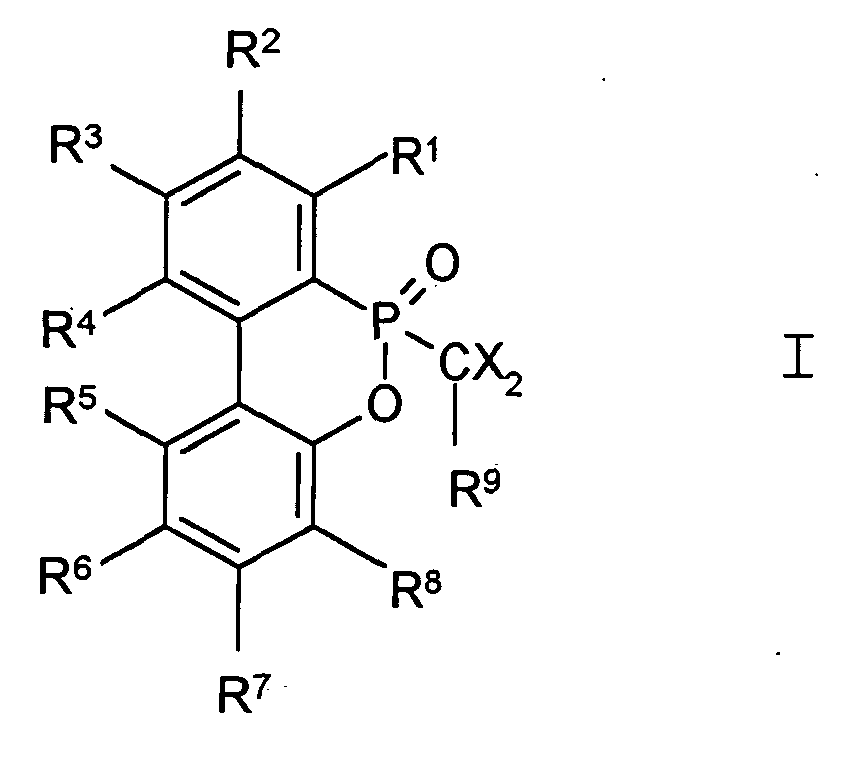
R1 bis R8 unabhängig voneinander ein Wasserstoffatom, Halogenatom oder eine Kohlenwasserstoffgruppe sind,
R9 ein Wasserstoffatom oder eine Kohlenwasserstoffgruppe ist und
die Reste X gleich oder verschieden sind und OR10 oder NR10R11 bedeuten und R10 und R11 gleiche oder verschiedene Kohlenwasserstoffgruppen sind, wobei R11 auch Wasserstoff sein kann,
wobeidie Reste R1 bis R11 unabhängig voneinander gegebenenfalls ein oder mehrere Heteroatome ausgewählt aus Sauerstoff, Stickstoff, Schwefel, Phosphor, Silicium und Halogen enthalten,zwei oder mehr der Reste R1 bis R8 gegebenenfalls unter Ausbildung von einem oder mehreren Cyclen verknüpft sind unddie Reste R10 und R11 gegebenenfalls unter Ausbildung eines Cyclus verknüpft sind. - Derivat nach Anspruch 11, dadurch gekennzeichnet, dass die beiden Reste X gleich sind.
- Derivat nach Anspruch 1 oder 2, dadurch gekennzeichnet, dass R9 ein Wasserstoffatom, eine Alkyl- oder eine Arylgruppe ist, vorzugsweise ein Wasserstoffatom oder eine Methylgruppe.
- Derivat nach einem der vorhergehenden Ansprüche, dadurch gekennzeichnet, dass R10 und R11 unabhängig voneinander ausgewählt sind aus Alkyl-, Alkenyl-, Alkinyl-, Aryl- und Glycidylgruppen, vorzugsweise Methyl, Ethyl und Allyl.
- Derivat nach einem der vorhergehenden Ansprüche, dadurch gekennzeichnet, dass R10 und R11 gleich sind.
- Derivat nach einem der vorhergehenden Ansprüche, dadurch gekennzeichnet, dass von den Resten R1, R2, R3 und R4 mindestens zwei, vorzugsweise mindestens drei Wasserstoffatome sind, wobei insbesondere R1, R2, R3 und R4 alle Wasserstoffatome sind.
- Derivat nach einem der vorhergehenden Ansprüche, dadurch gekennzeichnet, dass von den Resten R5, R6, R7 und R8 mindestens zwei, vorzugsweise mindestens drei Wasserstoffatome sind, wobei insbesondere R5, R6, R7 und R8 alle Wasserstoffatome sind.
- Verfahren zur Herstellung von Derivaten von 9,10-Dihydro-9-oxa-10-phosphaphenanthren-10-oxid durch Umsetzung von 9,10-Dihydro-9-oxa-10-phosphaphenanthren-10-oxid oder dessen Derivaten gemäß den Formeln IIa oder IIbmit einem oder mehreren Orthocarbonsäurederivaten der Formel R9CX3 und Gewinnung des Derivats, wobei

R1 bis R8 unabhängig voneinander ein Wasserstoffatom, Halogenatom oder eine Kohlenwasserstoffgruppe sind,
R9 ein Wasserstoffatom oder eine Kohlenwasserstoffgruppe ist und
die Reste X gleich oder verschieden sind und OR10 oder NR10R11 bedeuten und R10 und R11 gleiche oder verschiedene Kohlenwasserstoffgruppen sind, wobei R11 auch Wasserstoff sein kann,
wobeidie Reste R1 bis R11 unabhängig voneinander gegebenenfalls ein oder mehrere Heteroatome ausgewählt aus Sauerstoff, Stickstoff, Schwefel, Phosphor, Silicium und Halogen enthalten,zwei oder mehr der Reste R1 bis R8 gegebenenfalls unter Ausbildung von einem oder mehreren Cyclen verknüpft sind unddie Reste R10 und R11 gegebenenfalls unter Ausbildung eines Cyclus verknüpft sind. - Verfahren nach Anspruch 8, dadurch gekennzeichnet, dass die Umsetzung in Gegenwart von saurem Katalysator durchgeführt wird, wobei der Katalysator vorzugsweise eine Protonensäure oder eine Lewissäure ist, bevorzugter saures Harz, Sulfonsäure, Mineralsäure, Trifluoressigsäure, BF3, FeCl3, SnCl4, insbesondere Chlorwasserstoff oder konzentrierte Salzsäure.
- Verfahren nach Anspruch 8 oder 9, dadurch gekennzeichnet, dass die Umsetzung in Gegenwart von aprotischem Lösungsmittel durchgeführt wird, vorzugsweise Toluol.
- Verfahren nach einem Ansprüche 9 bis 10, dadurch gekennzeichnet, dass die Umsetzung ohne Einsatz von protischem Lösungsmittel durchgeführt wird.
- Verfahren nach einem der Ansprüche 8 bis 11, dadurch gekennzeichnet, dass R9 ein Wasserstoffatom, eine Alkyl- oder Arylgruppe ist, vorzugsweise ein Wasserstoffatom oder eine Methylgruppe.
- Verfahren nach einem der Ansprüche 8 bis 12, dadurch gekennzeichnet, dass die beiden Reste X gleich sind.
- Verfahren nach einem der Ansprüche 8 bis 13, dadurch gekennzeichnet, dass R10 und R11 unabhängig voneinander ausgewählt sind aus Alkyl-, Alkenyl-, Alkinyl-, Aryl- und Glycidylgruppen, vorzugsweise Methyl, Ethyl und Allyl.
- Verfahren nach Anspruch 14, dadurch gekennzeichnet, dass das Orthöcarbonsäurederivat ein Orthocarbonsäureester R9C(OR10)3 ist, vorzugsweise ein Orthoameisensäureester, bevorzugter Trimethylorthoformiat, Triethylorthoformiat oder Triallylorthoformiat.
- Verfahren nach einem der Ansprüche 8 bis 14, dadurch gekennzeichnet, dass R10 und R11 gleich sind.
- Verwendung der Derivate gemäß einem der Ansprüche 1 bis 7 zum Flammschutz von Natur- und Kunststoffen.
- Verfahren zum flammfesten Ausrüsten von Natur- und Kunststoffen, bei dem einem Natur- oder Kunststoff ein oder mehrere Derivate gemäß einem der Ansprüche 1 bis 7 zugesetzt werden.
- Flammfest ausgerüsteter Natur- oder Kunststoff, der ein oder mehrere Derivate gemäß einem der Ansprüche 1 bis 7 enthält, wobei das Derivat gegebenenfalls chemisch eingebunden ist.
Applications Claiming Priority (2)
| Application Number | Priority Date | Filing Date | Title |
|---|---|---|---|
| DE10332291A DE10332291A1 (de) | 2003-07-16 | 2003-07-16 | Derivate von 9,10-Dihydro-9-oxa-10-phosphaphenanthren-10-oxid |
| DE10332291 | 2003-07-16 |
Publications (3)
| Publication Number | Publication Date |
|---|---|
| EP1529783A2 true EP1529783A2 (de) | 2005-05-11 |
| EP1529783A3 EP1529783A3 (de) | 2005-12-28 |
| EP1529783B1 EP1529783B1 (de) | 2008-04-23 |
Family
ID=34071708
Family Applications (1)
| Application Number | Title | Priority Date | Filing Date |
|---|---|---|---|
| EP04016470A Expired - Lifetime EP1529783B1 (de) | 2003-07-16 | 2004-07-13 | Derivative von 9,10-Dihydro-9-oxa-10-phosphaphenanthren-10-oxid |
Country Status (4)
| Country | Link |
|---|---|
| US (1) | US20050020739A1 (de) |
| EP (1) | EP1529783B1 (de) |
| AT (1) | ATE393160T1 (de) |
| DE (2) | DE10332291A1 (de) |
Families Citing this family (7)
| Publication number | Priority date | Publication date | Assignee | Title |
|---|---|---|---|---|
| US7746716B2 (en) * | 2007-02-22 | 2010-06-29 | Freescale Semiconductor, Inc. | Memory having a dummy bitline for timing control |
| EP2207827A1 (de) * | 2007-10-26 | 2010-07-21 | Dow Global Technologies Inc. | Isocyanurate enthaltende epoxidharzzusammensetzung zur verwendung in elektrischen laminaten |
| PL2557085T3 (pl) | 2011-08-08 | 2015-04-30 | Empa Eidgenoessische Mat & Forschungsanstalt | Nowe pochodne fosfonamidów - ich synteza i zastosowanie jako środów zmniejszających palność |
| CN103387591B (zh) * | 2013-07-19 | 2015-08-26 | 沈阳化工大学 | 一种含磷二元醇及其制备方法 |
| EP3095790A1 (de) * | 2015-05-22 | 2016-11-23 | Universite De Bordeaux | Nukleosidlipidverbindungen mit ph-empfindlichen dialkylorthoesterketten und deren verwendung zum transport oder zur vektorisierung von mindestens einem therapeutischen wirkstoff |
| CN110885345B (zh) * | 2018-09-11 | 2022-06-28 | 财团法人工业技术研究院 | 仲胺、自由基、与烷氧胺化合物 |
| CN110643066B (zh) * | 2019-10-18 | 2021-10-15 | 广东聚航新材料研究院有限公司 | 一种磷氮阻燃剂及其制备方法 |
Family Cites Families (4)
| Publication number | Priority date | Publication date | Assignee | Title |
|---|---|---|---|---|
| JPS5927775B2 (ja) * | 1976-10-04 | 1984-07-07 | 旭化成株式会社 | 難燃性グラフト共重合体組成物 |
| KR890002086B1 (ko) * | 1986-09-12 | 1989-06-16 | 주식회사 코오롱 | 함인 질소계 난연제의 제조방법 |
| DE19619095A1 (de) * | 1996-05-06 | 1997-11-13 | Schill & Seilacher | Flammfeste Epoxidharze und Flammschutzmittel für Epoxidharze |
| JP4695279B2 (ja) * | 2001-03-21 | 2011-06-08 | 日華化学株式会社 | 難燃加工剤、難燃加工方法、及び難燃加工繊維 |
-
2003
- 2003-07-16 DE DE10332291A patent/DE10332291A1/de not_active Ceased
-
2004
- 2004-07-13 AT AT04016470T patent/ATE393160T1/de not_active IP Right Cessation
- 2004-07-13 US US10/890,035 patent/US20050020739A1/en not_active Abandoned
- 2004-07-13 DE DE502004006896T patent/DE502004006896D1/de not_active Expired - Lifetime
- 2004-07-13 EP EP04016470A patent/EP1529783B1/de not_active Expired - Lifetime
Also Published As
| Publication number | Publication date |
|---|---|
| EP1529783B1 (de) | 2008-04-23 |
| EP1529783A3 (de) | 2005-12-28 |
| DE10332291A1 (de) | 2005-02-17 |
| ATE393160T1 (de) | 2008-05-15 |
| US20050020739A1 (en) | 2005-01-27 |
| DE502004006896D1 (de) | 2008-06-05 |
Similar Documents
| Publication | Publication Date | Title |
|---|---|---|
| EP1476453B1 (de) | Verfahren zur herstellung von 6-alkoxy-(6h)-dibenz(c,e)(1,2)-oxaphosphorinen | |
| EP1512690B1 (de) | Verfahren zur Herstellung von 9,10-Dihydro-9-oxa-10-organyl-phosphaphenanthren-10-oxid und Derivaten desselben | |
| EP2449019B1 (de) | Neue derivate von 9,10-dihydro-9-oxa-10-phosphaphenanthren-10-on | |
| RU95122817A (ru) | Ортозамещенные метиламиды 2-метоксииминофенилуксусной кислоты | |
| WO2021028496A1 (de) | Polymerzusammensetzung mit phosphonatflammschutzmittel | |
| EP1506968B1 (de) | Verfahren zur Herstellung von 9,10-Dihydro-9-oxa-10-organyl-oxyphosphaphenanthren-10-oxid oder -thion und an den Phenylgruppen substituierten Derivativen desselben | |
| EP1529783B1 (de) | Derivative von 9,10-Dihydro-9-oxa-10-phosphaphenanthren-10-oxid | |
| EP0806429A2 (de) | Flammfeste Expoxidharze und Flammschutzmittel für Epoxidharze | |
| EP0032663B1 (de) | Verfahren zur Herstellung von Vinylphosphonsäurederivaten | |
| EP0765304B2 (de) | Verfahren und zwischenprodukte zur herstellung von alpha-methoxyiminocarbonsäuremethylamiden | |
| WO1998013371A1 (de) | Verfahren zur herstellung von aluminium-dialkylphosphinaten | |
| EP2256122A1 (de) | Halogenfreie Derivate des Triazins und Heptazins | |
| EP0047460B1 (de) | Verfahren zur Herstellung von Vinylphosphonsäuredichlorid und 2-Chlorethanphosphonsäuredichlorid | |
| DE3853030T2 (de) | Verfahren zur Herstellung eines Aliphatylphosphinsäure-Derivates. | |
| EP0632023B1 (de) | Verfahren zur Herstellung von gamma-Vinylpyrrolidonen | |
| US3904654A (en) | Urea-phosphorus compounds | |
| EP0047461B1 (de) | Verfahren zur Herstellung von Vinylphosphonsäurederivaten | |
| EP2260045B1 (de) | Ungesättigte diphosphinmonoxide | |
| DE4416018A1 (de) | Verfahren zur Herstellung von Vinylphophonsäuren | |
| Slimani et al. | PREPARATION OF β-KETO-β-ALKANOYLOXYPHOSPHONATES, PHOSPHINE OXIDES AND SULFIDES AND THEIR APPLICATION TO THE SYNTHESIS OF NOVEL PHOSPHORYL-AND THIOPHOSPHORYLPYRAZOLES | |
| DE3739762A1 (de) | Phosphonsaeureester, ein verfahren zu ihrer herstellung sowie ihre verwendung als flammschutzmittel | |
| EP0144743A1 (de) | Verfahren zur Herstellung organischer Chlorphosphane | |
| EP1023299A1 (de) | Kombinatorische erzeugung von phosphinsäurederivaten | |
| DE2541355A1 (de) | Substituierte cyclische phosphinsaeuren und deren ester | |
| DE19745628A1 (de) | Kombinatorische Erzeugung von phosphorhaltigen Wirkstoffen und Zwischenprodukten durch Festphasensynthese |
Legal Events
| Date | Code | Title | Description |
|---|---|---|---|
| PUAI | Public reference made under article 153(3) epc to a published international application that has entered the european phase |
Free format text: ORIGINAL CODE: 0009012 |
|
| AK | Designated contracting states |
Kind code of ref document: A2 Designated state(s): AT BE BG CH CY CZ DE DK EE ES FI FR GB GR HU IE IT LI LU MC NL PL PT RO SE SI SK TR |
|
| AX | Request for extension of the european patent |
Extension state: AL HR LT LV MK |
|
| PUAL | Search report despatched |
Free format text: ORIGINAL CODE: 0009013 |
|
| AK | Designated contracting states |
Kind code of ref document: A3 Designated state(s): AT BE BG CH CY CZ DE DK EE ES FI FR GB GR HU IE IT LI LU MC NL PL PT RO SE SI SK TR |
|
| AX | Request for extension of the european patent |
Extension state: AL HR LT LV MK |
|
| 17P | Request for examination filed |
Effective date: 20060113 |
|
| AKX | Designation fees paid |
Designated state(s): AT BE BG CH CY CZ DE DK EE ES FI FR GB GR HU IE IT LI LU MC NL PL PT RO SE SI SK TR |
|
| 17Q | First examination report despatched |
Effective date: 20070216 |
|
| GRAP | Despatch of communication of intention to grant a patent |
Free format text: ORIGINAL CODE: EPIDOSNIGR1 |
|
| RIC1 | Information provided on ipc code assigned before grant |
Ipc: C07F 9/6571 20060101AFI20070904BHEP Ipc: C08K 5/00 20060101ALI20070904BHEP |
|
| GRAS | Grant fee paid |
Free format text: ORIGINAL CODE: EPIDOSNIGR3 |
|
| GRAA | (expected) grant |
Free format text: ORIGINAL CODE: 0009210 |
|
| AK | Designated contracting states |
Kind code of ref document: B1 Designated state(s): AT BE BG CH CY CZ DE DK EE ES FI FR GB GR HU IE IT LI LU MC NL PL PT RO SE SI SK TR |
|
| REG | Reference to a national code |
Ref country code: GB Ref legal event code: FG4D Free format text: NOT ENGLISH |
|
| REG | Reference to a national code |
Ref country code: CH Ref legal event code: EP |
|
| REF | Corresponds to: |
Ref document number: 502004006896 Country of ref document: DE Date of ref document: 20080605 Kind code of ref document: P |
|
| REG | Reference to a national code |
Ref country code: IE Ref legal event code: FG4D Free format text: LANGUAGE OF EP DOCUMENT: GERMAN |
|
| PG25 | Lapsed in a contracting state [announced via postgrant information from national office to epo] |
Ref country code: SI Free format text: LAPSE BECAUSE OF FAILURE TO SUBMIT A TRANSLATION OF THE DESCRIPTION OR TO PAY THE FEE WITHIN THE PRESCRIBED TIME-LIMIT Effective date: 20080423 |
|
| NLV1 | Nl: lapsed or annulled due to failure to fulfill the requirements of art. 29p and 29m of the patents act | ||
| PG25 | Lapsed in a contracting state [announced via postgrant information from national office to epo] |
Ref country code: PT Free format text: LAPSE BECAUSE OF FAILURE TO SUBMIT A TRANSLATION OF THE DESCRIPTION OR TO PAY THE FEE WITHIN THE PRESCRIBED TIME-LIMIT Effective date: 20080923 Ref country code: NL Free format text: LAPSE BECAUSE OF FAILURE TO SUBMIT A TRANSLATION OF THE DESCRIPTION OR TO PAY THE FEE WITHIN THE PRESCRIBED TIME-LIMIT Effective date: 20080423 Ref country code: FI Free format text: LAPSE BECAUSE OF FAILURE TO SUBMIT A TRANSLATION OF THE DESCRIPTION OR TO PAY THE FEE WITHIN THE PRESCRIBED TIME-LIMIT Effective date: 20080423 Ref country code: BG Free format text: LAPSE BECAUSE OF FAILURE TO SUBMIT A TRANSLATION OF THE DESCRIPTION OR TO PAY THE FEE WITHIN THE PRESCRIBED TIME-LIMIT Effective date: 20080723 Ref country code: ES Free format text: LAPSE BECAUSE OF FAILURE TO SUBMIT A TRANSLATION OF THE DESCRIPTION OR TO PAY THE FEE WITHIN THE PRESCRIBED TIME-LIMIT Effective date: 20080803 |
|
| PG25 | Lapsed in a contracting state [announced via postgrant information from national office to epo] |
Ref country code: PL Free format text: LAPSE BECAUSE OF FAILURE TO SUBMIT A TRANSLATION OF THE DESCRIPTION OR TO PAY THE FEE WITHIN THE PRESCRIBED TIME-LIMIT Effective date: 20080423 |
|
| REG | Reference to a national code |
Ref country code: IE Ref legal event code: FD4D |
|
| ET | Fr: translation filed | ||
| PG25 | Lapsed in a contracting state [announced via postgrant information from national office to epo] |
Ref country code: DK Free format text: LAPSE BECAUSE OF FAILURE TO SUBMIT A TRANSLATION OF THE DESCRIPTION OR TO PAY THE FEE WITHIN THE PRESCRIBED TIME-LIMIT Effective date: 20080423 Ref country code: SE Free format text: LAPSE BECAUSE OF FAILURE TO SUBMIT A TRANSLATION OF THE DESCRIPTION OR TO PAY THE FEE WITHIN THE PRESCRIBED TIME-LIMIT Effective date: 20080723 Ref country code: IE Free format text: LAPSE BECAUSE OF FAILURE TO SUBMIT A TRANSLATION OF THE DESCRIPTION OR TO PAY THE FEE WITHIN THE PRESCRIBED TIME-LIMIT Effective date: 20080423 Ref country code: CZ Free format text: LAPSE BECAUSE OF FAILURE TO SUBMIT A TRANSLATION OF THE DESCRIPTION OR TO PAY THE FEE WITHIN THE PRESCRIBED TIME-LIMIT Effective date: 20080423 |
|
| PG25 | Lapsed in a contracting state [announced via postgrant information from national office to epo] |
Ref country code: SK Free format text: LAPSE BECAUSE OF FAILURE TO SUBMIT A TRANSLATION OF THE DESCRIPTION OR TO PAY THE FEE WITHIN THE PRESCRIBED TIME-LIMIT Effective date: 20080423 Ref country code: RO Free format text: LAPSE BECAUSE OF FAILURE TO SUBMIT A TRANSLATION OF THE DESCRIPTION OR TO PAY THE FEE WITHIN THE PRESCRIBED TIME-LIMIT Effective date: 20080423 |
|
| PLBE | No opposition filed within time limit |
Free format text: ORIGINAL CODE: 0009261 |
|
| REG | Reference to a national code |
Ref country code: CH Ref legal event code: PL |
|
| STAA | Information on the status of an ep patent application or granted ep patent |
Free format text: STATUS: NO OPPOSITION FILED WITHIN TIME LIMIT |
|
| PG25 | Lapsed in a contracting state [announced via postgrant information from national office to epo] |
Ref country code: MC Free format text: LAPSE BECAUSE OF NON-PAYMENT OF DUE FEES Effective date: 20080731 |
|
| 26N | No opposition filed |
Effective date: 20090126 |
|
| PG25 | Lapsed in a contracting state [announced via postgrant information from national office to epo] |
Ref country code: EE Free format text: LAPSE BECAUSE OF FAILURE TO SUBMIT A TRANSLATION OF THE DESCRIPTION OR TO PAY THE FEE WITHIN THE PRESCRIBED TIME-LIMIT Effective date: 20080423 |
|
| PG25 | Lapsed in a contracting state [announced via postgrant information from national office to epo] |
Ref country code: CH Free format text: LAPSE BECAUSE OF NON-PAYMENT OF DUE FEES Effective date: 20080731 Ref country code: LI Free format text: LAPSE BECAUSE OF NON-PAYMENT OF DUE FEES Effective date: 20080731 |
|
| PG25 | Lapsed in a contracting state [announced via postgrant information from national office to epo] |
Ref country code: IT Free format text: LAPSE BECAUSE OF FAILURE TO SUBMIT A TRANSLATION OF THE DESCRIPTION OR TO PAY THE FEE WITHIN THE PRESCRIBED TIME-LIMIT Effective date: 20080423 |
|
| PG25 | Lapsed in a contracting state [announced via postgrant information from national office to epo] |
Ref country code: AT Free format text: LAPSE BECAUSE OF NON-PAYMENT OF DUE FEES Effective date: 20080713 |
|
| PGFP | Annual fee paid to national office [announced via postgrant information from national office to epo] |
Ref country code: FR Payment date: 20090710 Year of fee payment: 6 |
|
| PG25 | Lapsed in a contracting state [announced via postgrant information from national office to epo] |
Ref country code: CY Free format text: LAPSE BECAUSE OF FAILURE TO SUBMIT A TRANSLATION OF THE DESCRIPTION OR TO PAY THE FEE WITHIN THE PRESCRIBED TIME-LIMIT Effective date: 20080423 Ref country code: HU Free format text: LAPSE BECAUSE OF FAILURE TO SUBMIT A TRANSLATION OF THE DESCRIPTION OR TO PAY THE FEE WITHIN THE PRESCRIBED TIME-LIMIT Effective date: 20081024 Ref country code: BE Free format text: LAPSE BECAUSE OF NON-PAYMENT OF DUE FEES Effective date: 20080731 Ref country code: LU Free format text: LAPSE BECAUSE OF NON-PAYMENT OF DUE FEES Effective date: 20080713 |
|
| PG25 | Lapsed in a contracting state [announced via postgrant information from national office to epo] |
Ref country code: TR Free format text: LAPSE BECAUSE OF FAILURE TO SUBMIT A TRANSLATION OF THE DESCRIPTION OR TO PAY THE FEE WITHIN THE PRESCRIBED TIME-LIMIT Effective date: 20080423 |
|
| PG25 | Lapsed in a contracting state [announced via postgrant information from national office to epo] |
Ref country code: GR Free format text: LAPSE BECAUSE OF FAILURE TO SUBMIT A TRANSLATION OF THE DESCRIPTION OR TO PAY THE FEE WITHIN THE PRESCRIBED TIME-LIMIT Effective date: 20080724 |
|
| REG | Reference to a national code |
Ref country code: FR Ref legal event code: ST Effective date: 20110331 |
|
| PG25 | Lapsed in a contracting state [announced via postgrant information from national office to epo] |
Ref country code: FR Free format text: LAPSE BECAUSE OF NON-PAYMENT OF DUE FEES Effective date: 20100802 |
|
| PGFP | Annual fee paid to national office [announced via postgrant information from national office to epo] |
Ref country code: GB Payment date: 20120711 Year of fee payment: 9 |
|
| PGFP | Annual fee paid to national office [announced via postgrant information from national office to epo] |
Ref country code: DE Payment date: 20130711 Year of fee payment: 10 |
|
| GBPC | Gb: european patent ceased through non-payment of renewal fee |
Effective date: 20130713 |
|
| PG25 | Lapsed in a contracting state [announced via postgrant information from national office to epo] |
Ref country code: GB Free format text: LAPSE BECAUSE OF NON-PAYMENT OF DUE FEES Effective date: 20130713 |
|
| REG | Reference to a national code |
Ref country code: DE Ref legal event code: R119 Ref document number: 502004006896 Country of ref document: DE |
|
| PG25 | Lapsed in a contracting state [announced via postgrant information from national office to epo] |
Ref country code: DE Free format text: LAPSE BECAUSE OF NON-PAYMENT OF DUE FEES Effective date: 20150203 |
|
| REG | Reference to a national code |
Ref country code: DE Ref legal event code: R119 Ref document number: 502004006896 Country of ref document: DE Effective date: 20150203 |