EP1529708B1 - Kippfenster für Eisenbahnwagen mit vollständigem Umkippen und Entfernung in Notsituationen - Google Patents
Kippfenster für Eisenbahnwagen mit vollständigem Umkippen und Entfernung in Notsituationen Download PDFInfo
- Publication number
- EP1529708B1 EP1529708B1 EP04425608A EP04425608A EP1529708B1 EP 1529708 B1 EP1529708 B1 EP 1529708B1 EP 04425608 A EP04425608 A EP 04425608A EP 04425608 A EP04425608 A EP 04425608A EP 1529708 B1 EP1529708 B1 EP 1529708B1
- Authority
- EP
- European Patent Office
- Prior art keywords
- pins
- tiltable portion
- window
- tiltable
- integral
- Prior art date
- Legal status (The legal status is an assumption and is not a legal conclusion. Google has not performed a legal analysis and makes no representation as to the accuracy of the status listed.)
- Expired - Lifetime
Links
- 239000011521 glass Substances 0.000 description 9
- 238000004378 air conditioning Methods 0.000 description 4
- 230000006378 damage Effects 0.000 description 2
- 208000027418 Wounds and injury Diseases 0.000 description 1
- 231100001261 hazardous Toxicity 0.000 description 1
- 208000014674 injury Diseases 0.000 description 1
- 238000012423 maintenance Methods 0.000 description 1
- 238000012986 modification Methods 0.000 description 1
- 230000004048 modification Effects 0.000 description 1
- 230000000284 resting effect Effects 0.000 description 1
- 238000005096 rolling process Methods 0.000 description 1
Images




Classifications
-
- E—FIXED CONSTRUCTIONS
- E05—LOCKS; KEYS; WINDOW OR DOOR FITTINGS; SAFES
- E05C—BOLTS OR FASTENING DEVICES FOR WINGS, SPECIALLY FOR DOORS OR WINDOWS
- E05C17/00—Devices for holding wings open; Devices for limiting opening of wings or for holding wings open by a movable member extending between frame and wing; Braking devices, stops or buffers, combined therewith
-
- B—PERFORMING OPERATIONS; TRANSPORTING
- B61—RAILWAYS
- B61D—BODY DETAILS OR KINDS OF RAILWAY VEHICLES
- B61D25/00—Window arrangements peculiar to rail vehicles
-
- E—FIXED CONSTRUCTIONS
- E05—LOCKS; KEYS; WINDOW OR DOOR FITTINGS; SAFES
- E05B—LOCKS; ACCESSORIES THEREFOR; HANDCUFFS
- E05B65/00—Locks or fastenings for special use
- E05B65/10—Locks or fastenings for special use for panic or emergency doors
- E05B65/1033—Locks or fastenings for special use for panic or emergency doors emergency release of windows, window grills, escape hatches or the like
-
- E—FIXED CONSTRUCTIONS
- E05—LOCKS; KEYS; WINDOW OR DOOR FITTINGS; SAFES
- E05C—BOLTS OR FASTENING DEVICES FOR WINGS, SPECIALLY FOR DOORS OR WINDOWS
- E05C19/00—Other devices specially designed for securing wings, e.g. with suction cups
- E05C19/006—Other devices specially designed for securing wings, e.g. with suction cups by displacement of the wing substantially in its own plane
Definitions
- the present invention relates in general to fittings for rolling stock. More particularly the invention relates to a window with opening of the tiltable type for railway carriages, designed to be tipped up and also, if necessary, removed in the event of an emergency.
- US 2003/0107221 A1 discloses a window according to the preamble of claim 1.
- the object of the present invention is to avoid the disadvantages described above by providing a window for railway carriages with opening of the tiltable type and which, if required, can be tipped up completely and possibly removed to provide an adequate aperture for evacuating passengers without the need to smash any window.
- a window according to the subject-matter of claim 1 such a window with a hinge opening for railway carriages whose characteristic feature consists in that the tiltable portion is hinged to the surround of the window by means of a pair of aligned and axially sliding pins so as to define a first position wherein they are engaged in housings integral with the surround, and a second position wherein, following axial translation one towards the other, they are disengaged therefrom.
- the tiltable portion is also hinged, parallel to the pair of pins, to an intermediate cross member of the window integral with the surround, so that, when the pins are in the first position, the tiltable portion can only perform an angular movement of preset extent after the locking means have been disabled manually, whereas, when they are placed in the second position, the tiltable portion can rotate in relation to the cross member until it is fully tipped up, the locking means being disabled following lowering of the tiltable portion as a result of disengaging of the ends of the pins from the respective housings.
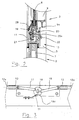
- 1 denotes generically a window of a railway carriage, which window is formed by a fixed window portion 2 and by a tiltable window portion 3 normally locked in a closed position and which can be released by staff on duty using the locks 4 situated in the upper part thereof by means of a special key for allowing limited opening of the window in the case wherein the air-conditioning of the carriage is not in operation.
- the structure of the window is, as a whole, of the conventional type and comprises a surround denoted by 5 and formed by an external part 5a for resting on the window-space formed in the side wall of the carriage, and an internal part 5b projecting internally from the outside one and acting as a support for a glass 7 of the fixed portion 2 of the window and as an abutment for the tiltable portion 3.
- the latter is in turn formed by a pane of glass 8 bordered around the perimeter by a frame 9 hinged to a transverse structure 10, whereto the lower pane of glass 7 is also attached.
- the transverse structure 10 is formed by a cross member or section bar 11 with a substantially H shape for bordering below a groove tightly housing the upper edge of the glass 7.
- the lower edge 9a of the frame 9, wherein the corresponding lower edge of the glass 8 is tightly housed, is engaged on a pair of pins 12a and 12b, coaxial and aligned one with the other and around which the frame 9 can rotate, allowing tiltable opening of the window.
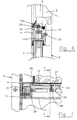
- the two pins 12a,b are slidingly engaged in bushings 13 integral with the lower edge 9a of the frame 9 and, at the ends of the cross member 11, in respective housings 14 (only one is shown in the drawings) formed in support blocks 15 attached by means of screws 16 to the inner part 11a of the H-shaped cross member 11.
- an actuation device is provided, more particularly a crank mechanism with manual actuation integral with a profile 23 and connected to the two opposite ends of the pins 12a,b. More specifically, the free ends of the two pins 12a and 12b are connected to a disk 19 by means of respective connecting rods 17 and 18, which are connected eccentrically and at diametrically opposite parts to said disk 19. Disk 19 is integral with a stem 20 pivotally supported by the profile 23 and emerging frontally therefrom with one of its heads 20a set up for actuation by means of a special key.
- the cross member 11 is connected by means of a hinge 22 to the profile 23, extending inside the same cross member 11.
- two shoulders 24 are attached (only one can be seen in the drawings), wherein a slot 25 is formed at the housings 14 of the blocks 15 whereto the shoulders 24 are adjacent.
- the profile 23 has at least two intermediate apertures 26 (only one can be seen in the drawings) with the function which is to be described herein below.
- a block 27 is attached to the pin 12a (the same applies for the pin 12b), wherefrom an appendage 28 extends (see also Figure 8 ), abutting on a ridge 23a of the profile 23.
- the appendage 28 also constitutes an abutment element for the edge 9a of the frame 9 when the latter and the glass 8 attached thereto are rotated around the pins 12a,b.
- the lower edge 9a of the frame 9 abuts on the appendage 28 on the opposite side to the ridge 23a of the profile 23, effectively limiting rotation of the frame 9 to a preset angle (denoted by ⁇ ).
- the slot 25 has a length longer than the diameter of the housing 14 and extends towards the profile 23, once the end of the pins 12a,b has disengaged from the relevant housing 14, said end goes to the base of the slot 25, causing lowering of the pins 12a,b and of the frame 9 integral thereto, while the appendage 28 is positioned in the aperture 26.
- the frame 9 is lowered automatically, once the ends of the pins 12a,b are disengaged from the housings 14, due to its own weight which automatically releases the frame from the locking devices denoted by 4 and situated in the upper part of the window.
- a third position of the pins 12a,b can be provided wherein they can also be withdrawn from the slots 25.
- This can be obtained by defining two different extents of rotation of the disk 19, corresponding to two different extents of sliding of the pins 12a,b. More particularly, with a first rotation, the pins 12a,b can be slid until they are disengaged from the housings 14 of the blocks 15 and with a second subsequent rotation, to be performed if the tiltable portion also has to be removed, the ends of the pins 12a,b can be disengaged from the slots 25 of the shoulders 24.
- Seals 29 and 30 are placed between the lower edge 9a of the frame 9 and the cross member 11 on one side and the profile 23 on the other.
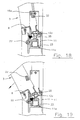
- Figures 12 and 13 illustrate a different embodiment of the device for actuating axial sliding of the pins 12a and 12b around which the tiltable part 3 rotates.
- the disk 19, whereto the pins 12a,b are connected via the connecting rods 17 and 18, is integral with a lever 32, which can also be actuated by the user, if necessary, without having to wait for help by the staff in charge, provided with the special key for turning the disk 19.
- An elastic plate 31 with an overturned V portion which engages in the disk 19 prevents free rotation of the same disk and hence axial sliding of the pins 12a,b, maintaining the tiltable part 3 in a closed position.
- the possibility of rotation around the pins 12a,b of the tiltable portion 3 is controlled by the abutting of the lower edge 9a of its frame 9 on the appendage 28 of the block 27 integral with the pin 12a and, correspondingly, the pin 12b.
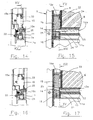
- a plate 34 with a projection 33 is attached laterally to the frame 9, holding the glass 8 of the window.
- Figure 14 illustrates the relative position of the angled edge 15a and of the projection 33 when the tiltable portion 3 is closed.
- Figure 18 illustrates the relative position of the two components when the tiltable portion 3 is open. In this condition the projection 33 abuts on the angled edge 15a, locking the tiltable portion in an open position with the preset slant.
- the window for railway carriages according to the present invention achieves in full the object set. It can in fact function as a normal window for air-conditioned carriages, since it can be locked in a closure position, and can be partially opened, in the case of non-functioning of the air-conditioning system, by actuating the locking devices 4 and rotating the tiltable portion 3 of the window 1 around the pins 12a,b.
- the window according to the invention also allows full tipping of the tiltable portion 3 in case emergency conditions should occur simply by actuating with a special key the stem head 20a placed centrally in relation to the window on the cross member 11, or by means of the lever 32, to disengage the ends of the pins 12a,b from the respective housings integral with the fixed structure. If considered necessary, it is also possible to provide for complete removal of the tiltable portion 3 of the window.
- the invention therefore allows emergency apertures through the windows to be provided without the need to smash the glass.
Landscapes
- Engineering & Computer Science (AREA)
- Mechanical Engineering (AREA)
- Business, Economics & Management (AREA)
- Emergency Management (AREA)
- Window Of Vehicle (AREA)
- Wing Frames And Configurations (AREA)
- Electric Propulsion And Braking For Vehicles (AREA)
- Aiming, Guidance, Guns With A Light Source, Armor, Camouflage, And Targets (AREA)
Claims (13)
- Kippfenster für Eisenbahnwagen, enthaltend ein Kippteil (3), das an einer Einfassung (5) davon angelenkt ist, und Einrichtungen (4) zum Verriegeln des Kippteils in einem geschlossenen Zustand, dadurch gekennzeichnet, dass das Kippteil an der Einfassung mittels eines Paars von ausgerichteten und axial verschiebbaren Stiften (12a, b) angelenkt ist, um eine erste Position, in der sie in Gehäusen (14) in Eingriff sind, die integral mit der Einfassung sind, und eine zweite Position zu definieren, in der sie auf eine axiale Verschiebung aufeinander zu davon außer Eingriff sind, welches Kippteil auch parallel zu dem Paar von Stiften an einem zwischenliegenden Kreuzungsglied (11) des Fensters integral mit der Einfassung (5) angelenkt ist, so dass, wenn die Stifte in der ersten Position sind, das Kippteil nur eine Winkelbewegung eines vorgegebenen Ausmaßes nach dem manuellen Entriegeln der Verriegelungseinrichtungen ausführen kann, wohingegen, wenn sie in der zweiten Position sind, sich das Kippteil bezüglich des Kreuzungsgliedes (11) dreht, bis es vollständig umgekippt ist, welche Verriegelungseinrichtungen nachfolgend auf das Absenken des Kippteils als ein Ergebnis des außer Eingriff Bringens der Enden der Stifte (12a, b) aus den entsprechenden Gehäusen (14) entriegelt sind.
- Fenster nach Anspruch 1, wobei das Paar von Stiften verschiebbar mit dem unteren Rand (9a) des Kippteils (3) verbunden ist und an eine Vorrichtung (17, 18, 19, 32) zum Betätigen ihrer axialen Verschiebungsbewegung zu und von einander gekoppelt ist.
- Fenster nach Anspruch 2, wobei die Vorrichtung einen manuell betätigten Kurbelmechanismus (17, 18, 19, 32) enthält, der mit einem Profil (23) integral ist, das an dem Kreuzungsglied (11) angelenkt und mit den zwei entgegengesetzten Enden der Stifte (12a, b) verbunden ist.
- Fenster nach Anspruch 3, wobei der Kurbelmechanismus einen mit einem Schaft (20), der von einem Profil (23) gestützt wird, das an dem Kreuzungsglied (11) angelenkt ist, integralen scheibenförmigen Körper (19) enthält, der exzentrisch mit zwei Verbindungsstäben (17, 18) in einer im wesentlichen diametralen Position verbunden ist, welche Verbindungsstäbe wiederum mit den entgegengesetzten Enden der Stifte (12a, b) verbunden sind, welcher Kurbelmechanismus über einen Kopf des Schaftes zum Betätigen mittels eines speziellen Schlüssels zugänglich ist.
- Fenster nach Anspruch 3, wobei der Kurbelmechanismus einen mit einem Schaft (20), der von einem Profil (23) gestützt wird, das an dem Kreuzungsglied (11) angelenkt ist, integralen scheibenförmigen Körper (19) enthält, der exzentrisch mit zwei Verbindungsstäben (17, 18) in einer im wesentlichen diametrischen Position verbunden ist, welche Verbindungsstäbe wiederum mit den entgegengesetzten Enden der Stifte (12a, b) verbunden sind, welcher Schaft integral mit einem Hebel (32) ist, der zu seiner Betätigung zugänglich ist.
- Fenster nach Anspruch,4 oder 5, wobei der Drehung des scheibenförmigen Körpers (19) elastisch entgegengewirkt wird.
- Fenster nach einem der vorhergehenden Ansprüche, wobei die anderen Ende der Stifte drehbar und verschiebbar mit Haltern (15) verbunden sind, die integral mit dem Kreuzungsglied (11) sind.
- Fenster nach einem der vorhergehenden Ansprüche, wobei das Kreuzungsglied (11) durch einen Profilstab mit einer im wesentlichen H-Form gebildet ist, worin ein Profil (23) angeordnet ist, das daran angelenkt und integral mit dem Paar von Stiften (12a, b) durch ein Paar von Endschultern (24) ist, die entsprechende Schlitze (25) haben, in welchen das Paar von Stiften in Eingriff ist.
- Fenster nach Anspruch 7 oder 8, wobei die Halter (15), die integral mit dem Profilstab (11) sind, entsprechende Gehäuse (14) für die Enden der Stifte (12a, b) in Ausrichtung mit den Schlitzen (25) der Schultern (24) haben, wobei die Länge der Schlitze größer als der Durchmesser der Gehäuse ist, welche Schlitze zu dem Profil hin verlaufen.
- Fenster nach Anspruch 9, wobei das Profil eine Längsrippe (23a) und wenigstens zwei Öffnungen (26) hat, die die Rippe unterbrechen, welche Stifte entsprechende Anlageelemente (28) halten, die an der Rippe anliegen, wenn die Stifte in der ersten Position sind, wobei der untere Rand (9a) des Kippteils an dem Anlageelement (28) auf der Seite entgegengesetzt der Rippe (23a) nach einer beschränkten Winkelbewegung des Kippteils anliegt, welche Anlageelemente in den Öffnungen in Eingriff bringbar sind, wenn die Stifte in der zweiten Position sind und in den Schlitzen der Schultern in Eingriff sind, so dass das Kippteil das Profil (23) antreiben kann, um mittels der Schultern (24) um den Profilstab (11) zu rotieren, bis es vollständig umgekippt ist.
- Fenster nach einem der vorhergehenden Ansprüche, wobei die Schlitze (24) der Schultern geschlossen sind und das Paar von Stiften gestaltet ist, um in einer dritten Position angeordnet zu werden, in der die Enden der Stifte auch aus den Schlitzen außer Eingriff sind, um ein Entfernen des Kippteils zu gestatten.
- Fenster nach einem der Ansprüche 1 bis 10, wobei die Schlitze (24) oben offen sind, so dass, wenn das Kippteil einmal vollständig umgekippt ist, die Enden des Paars von Stiften in der zweiten Position aus den Schlitzen außer Eingriff gebracht werden können, um das Kippteil zu entfernen.
- Fenster nach einem der Ansprüche 1 bis 9, wobei das Kippteil (3) einen Rahmen (9) enthält, an dessen Seiten ein Vorsprung (33) ausgebildet ist, wobei die Halter (15) bis zur Höhe des Vorsprungs (33) verlaufen und dort einen abgewinkelten Rand (15a) haben, welcher Vorsprung an dem abgewinkelten Rand anliegt, wenn die Stifte (12a, b) in den jeweiligen Gehäusen (14) der Halter (15) in Eingriff sind, um die Drehung des Kippteils zu beschränken und statt dessen eine Drehung des Kippteils zu gestatten, bis es umgekippt ist, wenn das Letztere abgesenkt ist, als ein Ergebnis, die Stifte (12a, b) aus den jeweiligen Gehäusen (14) außer Eingriff zu bringen.
Applications Claiming Priority (2)
| Application Number | Priority Date | Filing Date | Title |
|---|---|---|---|
| IT000285A ITFI20030285A1 (it) | 2003-11-05 | 2003-11-05 | Finestrino con apertura a vasistas, a ribaltamento totale e rimozione in situazioni di emergenza, per carrozze ferroviarie |
| ITFI20030285 | 2003-11-05 |
Publications (2)
| Publication Number | Publication Date |
|---|---|
| EP1529708A1 EP1529708A1 (de) | 2005-05-11 |
| EP1529708B1 true EP1529708B1 (de) | 2008-07-16 |
Family
ID=34430730
Family Applications (1)
| Application Number | Title | Priority Date | Filing Date |
|---|---|---|---|
| EP04425608A Expired - Lifetime EP1529708B1 (de) | 2003-11-05 | 2004-08-04 | Kippfenster für Eisenbahnwagen mit vollständigem Umkippen und Entfernung in Notsituationen |
Country Status (4)
| Country | Link |
|---|---|
| EP (1) | EP1529708B1 (de) |
| AT (1) | ATE401224T1 (de) |
| DE (1) | DE602004015044D1 (de) |
| IT (1) | ITFI20030285A1 (de) |
Families Citing this family (5)
| Publication number | Priority date | Publication date | Assignee | Title |
|---|---|---|---|---|
| US7758104B2 (en) * | 2007-02-13 | 2010-07-20 | Clark Equipment Company | Window arrangement for a construction vehicle |
| US8091955B2 (en) | 2009-04-16 | 2012-01-10 | Clark Equipment Company | Sliding window for work vehicle cab |
| CN101936114B (zh) * | 2010-05-10 | 2012-10-24 | 唐山轨道客车有限责任公司 | 铁路客车救援通道车窗 |
| FR3057842B1 (fr) * | 2016-10-26 | 2018-11-30 | Arianegroup Sas | Dispositif d'evacuation d'urgence de baies thermoplastiques |
| FR3108576B1 (fr) * | 2020-03-25 | 2022-04-01 | Saint Gobain | Systeme de fixation d’un vitrage lateral de moyen de transport avec un verrou |
Family Cites Families (3)
| Publication number | Priority date | Publication date | Assignee | Title |
|---|---|---|---|---|
| US2639790A (en) * | 1950-01-26 | 1953-05-26 | James G Reitzel | Emergency exit window |
| US4313280A (en) * | 1980-04-10 | 1982-02-02 | The Adams & Westlake Company | Quick opening latch arrangement for hinged vehicle windows |
| US6688659B2 (en) * | 2001-12-07 | 2004-02-10 | Atwood Mobile Products Inc. | Egress window latching mechanism |
-
2003
- 2003-11-05 IT IT000285A patent/ITFI20030285A1/it unknown
-
2004
- 2004-08-04 EP EP04425608A patent/EP1529708B1/de not_active Expired - Lifetime
- 2004-08-04 AT AT04425608T patent/ATE401224T1/de not_active IP Right Cessation
- 2004-08-04 DE DE602004015044T patent/DE602004015044D1/de not_active Expired - Fee Related
Also Published As
| Publication number | Publication date |
|---|---|
| EP1529708A1 (de) | 2005-05-11 |
| ITFI20030285A1 (it) | 2005-05-06 |
| DE602004015044D1 (de) | 2008-08-28 |
| ATE401224T1 (de) | 2008-08-15 |
Similar Documents
| Publication | Publication Date | Title |
|---|---|---|
| CN107662480B (zh) | 机动车辆及其车门铰链机构 | |
| EP1041229B1 (de) | Verriegelungssystem für Kabinenfenster | |
| EP2115252B1 (de) | Druckplattenanordnung | |
| EP2923019B1 (de) | Demontierbares scharnier und sicherheitsriegel | |
| EP0999976A1 (de) | Notausgangsvorrichtung | |
| ES2258806T3 (es) | Sistema de bloqueo para ventana basculante y giratoria. | |
| US20080040978A1 (en) | Hinge/Tilt Window Driven by an Electric Motor and Comprising a Feed Chain | |
| EP1529708B1 (de) | Kippfenster für Eisenbahnwagen mit vollständigem Umkippen und Entfernung in Notsituationen | |
| US4844524A (en) | Curtainside truck trailer closure assembly | |
| JPH02124320A (ja) | 車両ルーフ | |
| US5433039A (en) | Two-way motor vehicle door | |
| JPH04212626A (ja) | 車両ルーフ | |
| US6932395B1 (en) | Window assembly with release mechanism | |
| ES2238977T3 (es) | Dispositivo de cierre para una puerta lateral de un vehiculo automovil y vehiculo equipado con dicho dispositivo. | |
| EP1870542B1 (de) | Lukendeckelanordnung | |
| ES2699915T3 (es) | Mecanismo de giro de seguridad | |
| JP4151564B2 (ja) | 横軸回転窓 | |
| HU223252B1 (hu) | Vasalat ablakokhoz és ajtókhoz | |
| KR100462401B1 (ko) | 열림각 조정이 가능한 도어체커 | |
| JP2005163529A (ja) | 横軸回転窓 | |
| NL2014770B1 (en) | Security device for a window. | |
| JP3885687B2 (ja) | ブラインド装置 | |
| JP4376024B2 (ja) | 作業車両におけるリヤサイドパネルの開閉機構 | |
| KR100369036B1 (ko) | 자동차의 윈도우글래스 비상열림장치 | |
| KR102314299B1 (ko) | 유지보수가 용이한 터널의 공동구 덮개 |
Legal Events
| Date | Code | Title | Description |
|---|---|---|---|
| PUAI | Public reference made under article 153(3) epc to a published international application that has entered the european phase |
Free format text: ORIGINAL CODE: 0009012 |
|
| AK | Designated contracting states |
Kind code of ref document: A1 Designated state(s): AT BE BG CH CY CZ DE DK EE ES FI FR GB GR HU IE IT LI LU MC NL PL PT RO SE SI SK TR |
|
| AX | Request for extension of the european patent |
Extension state: AL HR LT LV MK |
|
| 17P | Request for examination filed |
Effective date: 20050714 |
|
| AKX | Designation fees paid |
Designated state(s): AT BE BG CH CY CZ DE DK EE ES FI FR GB GR HU IE IT LI LU MC NL PL PT RO SE SI SK TR |
|
| GRAP | Despatch of communication of intention to grant a patent |
Free format text: ORIGINAL CODE: EPIDOSNIGR1 |
|
| GRAS | Grant fee paid |
Free format text: ORIGINAL CODE: EPIDOSNIGR3 |
|
| GRAA | (expected) grant |
Free format text: ORIGINAL CODE: 0009210 |
|
| AK | Designated contracting states |
Kind code of ref document: B1 Designated state(s): AT BE BG CH CY CZ DE DK EE ES FI FR GB GR HU IE IT LI LU MC NL PL PT RO SE SI SK TR |
|
| REG | Reference to a national code |
Ref country code: GB Ref legal event code: FG4D |
|
| REG | Reference to a national code |
Ref country code: CH Ref legal event code: EP |
|
| REF | Corresponds to: |
Ref document number: 602004015044 Country of ref document: DE Date of ref document: 20080828 Kind code of ref document: P |
|
| REG | Reference to a national code |
Ref country code: IE Ref legal event code: FG4D |
|
| NLV1 | Nl: lapsed or annulled due to failure to fulfill the requirements of art. 29p and 29m of the patents act | ||
| PG25 | Lapsed in a contracting state [announced via postgrant information from national office to epo] |
Ref country code: ES Free format text: LAPSE BECAUSE OF FAILURE TO SUBMIT A TRANSLATION OF THE DESCRIPTION OR TO PAY THE FEE WITHIN THE PRESCRIBED TIME-LIMIT Effective date: 20081027 Ref country code: NL Free format text: LAPSE BECAUSE OF FAILURE TO SUBMIT A TRANSLATION OF THE DESCRIPTION OR TO PAY THE FEE WITHIN THE PRESCRIBED TIME-LIMIT Effective date: 20080716 Ref country code: PT Free format text: LAPSE BECAUSE OF FAILURE TO SUBMIT A TRANSLATION OF THE DESCRIPTION OR TO PAY THE FEE WITHIN THE PRESCRIBED TIME-LIMIT Effective date: 20081216 |
|
| PG25 | Lapsed in a contracting state [announced via postgrant information from national office to epo] |
Ref country code: SI Free format text: LAPSE BECAUSE OF FAILURE TO SUBMIT A TRANSLATION OF THE DESCRIPTION OR TO PAY THE FEE WITHIN THE PRESCRIBED TIME-LIMIT Effective date: 20080716 Ref country code: FI Free format text: LAPSE BECAUSE OF FAILURE TO SUBMIT A TRANSLATION OF THE DESCRIPTION OR TO PAY THE FEE WITHIN THE PRESCRIBED TIME-LIMIT Effective date: 20080716 Ref country code: BG Free format text: LAPSE BECAUSE OF FAILURE TO SUBMIT A TRANSLATION OF THE DESCRIPTION OR TO PAY THE FEE WITHIN THE PRESCRIBED TIME-LIMIT Effective date: 20081016 Ref country code: AT Free format text: LAPSE BECAUSE OF FAILURE TO SUBMIT A TRANSLATION OF THE DESCRIPTION OR TO PAY THE FEE WITHIN THE PRESCRIBED TIME-LIMIT Effective date: 20080716 |
|
| PG25 | Lapsed in a contracting state [announced via postgrant information from national office to epo] |
Ref country code: MC Free format text: LAPSE BECAUSE OF NON-PAYMENT OF DUE FEES Effective date: 20080831 Ref country code: BE Free format text: LAPSE BECAUSE OF FAILURE TO SUBMIT A TRANSLATION OF THE DESCRIPTION OR TO PAY THE FEE WITHIN THE PRESCRIBED TIME-LIMIT Effective date: 20080716 |
|
| REG | Reference to a national code |
Ref country code: CH Ref legal event code: PL |
|
| PG25 | Lapsed in a contracting state [announced via postgrant information from national office to epo] |
Ref country code: EE Free format text: LAPSE BECAUSE OF FAILURE TO SUBMIT A TRANSLATION OF THE DESCRIPTION OR TO PAY THE FEE WITHIN THE PRESCRIBED TIME-LIMIT Effective date: 20080716 Ref country code: DK Free format text: LAPSE BECAUSE OF FAILURE TO SUBMIT A TRANSLATION OF THE DESCRIPTION OR TO PAY THE FEE WITHIN THE PRESCRIBED TIME-LIMIT Effective date: 20080716 |
|
| PLBE | No opposition filed within time limit |
Free format text: ORIGINAL CODE: 0009261 |
|
| STAA | Information on the status of an ep patent application or granted ep patent |
Free format text: STATUS: NO OPPOSITION FILED WITHIN TIME LIMIT |
|
| PG25 | Lapsed in a contracting state [announced via postgrant information from national office to epo] |
Ref country code: CZ Free format text: LAPSE BECAUSE OF FAILURE TO SUBMIT A TRANSLATION OF THE DESCRIPTION OR TO PAY THE FEE WITHIN THE PRESCRIBED TIME-LIMIT Effective date: 20080716 Ref country code: SK Free format text: LAPSE BECAUSE OF FAILURE TO SUBMIT A TRANSLATION OF THE DESCRIPTION OR TO PAY THE FEE WITHIN THE PRESCRIBED TIME-LIMIT Effective date: 20080716 Ref country code: RO Free format text: LAPSE BECAUSE OF FAILURE TO SUBMIT A TRANSLATION OF THE DESCRIPTION OR TO PAY THE FEE WITHIN THE PRESCRIBED TIME-LIMIT Effective date: 20080716 |
|
| 26N | No opposition filed |
Effective date: 20090417 |
|
| GBPC | Gb: european patent ceased through non-payment of renewal fee |
Effective date: 20081016 |
|
| PG25 | Lapsed in a contracting state [announced via postgrant information from national office to epo] |
Ref country code: CH Free format text: LAPSE BECAUSE OF NON-PAYMENT OF DUE FEES Effective date: 20080831 Ref country code: LI Free format text: LAPSE BECAUSE OF NON-PAYMENT OF DUE FEES Effective date: 20080831 |
|
| REG | Reference to a national code |
Ref country code: FR Ref legal event code: ST Effective date: 20090630 |
|
| PG25 | Lapsed in a contracting state [announced via postgrant information from national office to epo] |
Ref country code: IE Free format text: LAPSE BECAUSE OF NON-PAYMENT OF DUE FEES Effective date: 20080804 |
|
| PG25 | Lapsed in a contracting state [announced via postgrant information from national office to epo] |
Ref country code: IT Free format text: LAPSE BECAUSE OF FAILURE TO SUBMIT A TRANSLATION OF THE DESCRIPTION OR TO PAY THE FEE WITHIN THE PRESCRIBED TIME-LIMIT Effective date: 20080716 Ref country code: DE Free format text: LAPSE BECAUSE OF NON-PAYMENT OF DUE FEES Effective date: 20090303 |
|
| PG25 | Lapsed in a contracting state [announced via postgrant information from national office to epo] |
Ref country code: FR Free format text: LAPSE BECAUSE OF NON-PAYMENT OF DUE FEES Effective date: 20080901 |
|
| PG25 | Lapsed in a contracting state [announced via postgrant information from national office to epo] |
Ref country code: GB Free format text: LAPSE BECAUSE OF NON-PAYMENT OF DUE FEES Effective date: 20081016 |
|
| PG25 | Lapsed in a contracting state [announced via postgrant information from national office to epo] |
Ref country code: SE Free format text: LAPSE BECAUSE OF FAILURE TO SUBMIT A TRANSLATION OF THE DESCRIPTION OR TO PAY THE FEE WITHIN THE PRESCRIBED TIME-LIMIT Effective date: 20081016 |
|
| PG25 | Lapsed in a contracting state [announced via postgrant information from national office to epo] |
Ref country code: PL Free format text: LAPSE BECAUSE OF FAILURE TO SUBMIT A TRANSLATION OF THE DESCRIPTION OR TO PAY THE FEE WITHIN THE PRESCRIBED TIME-LIMIT Effective date: 20080716 |
|
| PG25 | Lapsed in a contracting state [announced via postgrant information from national office to epo] |
Ref country code: CY Free format text: LAPSE BECAUSE OF FAILURE TO SUBMIT A TRANSLATION OF THE DESCRIPTION OR TO PAY THE FEE WITHIN THE PRESCRIBED TIME-LIMIT Effective date: 20080716 Ref country code: LU Free format text: LAPSE BECAUSE OF NON-PAYMENT OF DUE FEES Effective date: 20080804 Ref country code: HU Free format text: LAPSE BECAUSE OF FAILURE TO SUBMIT A TRANSLATION OF THE DESCRIPTION OR TO PAY THE FEE WITHIN THE PRESCRIBED TIME-LIMIT Effective date: 20090117 |
|
| PG25 | Lapsed in a contracting state [announced via postgrant information from national office to epo] |
Ref country code: TR Free format text: LAPSE BECAUSE OF FAILURE TO SUBMIT A TRANSLATION OF THE DESCRIPTION OR TO PAY THE FEE WITHIN THE PRESCRIBED TIME-LIMIT Effective date: 20080716 |
|
| PG25 | Lapsed in a contracting state [announced via postgrant information from national office to epo] |
Ref country code: GR Free format text: LAPSE BECAUSE OF FAILURE TO SUBMIT A TRANSLATION OF THE DESCRIPTION OR TO PAY THE FEE WITHIN THE PRESCRIBED TIME-LIMIT Effective date: 20081017 |