EP1529690A1 - Spiegelwinkelverstellvorrichtung für elektrische Kraftfahrzeugspiegelanordnung - Google Patents
Spiegelwinkelverstellvorrichtung für elektrische Kraftfahrzeugspiegelanordnung Download PDFInfo
- Publication number
- EP1529690A1 EP1529690A1 EP04018399A EP04018399A EP1529690A1 EP 1529690 A1 EP1529690 A1 EP 1529690A1 EP 04018399 A EP04018399 A EP 04018399A EP 04018399 A EP04018399 A EP 04018399A EP 1529690 A1 EP1529690 A1 EP 1529690A1
- Authority
- EP
- European Patent Office
- Prior art keywords
- count value
- pulse signal
- mirror
- motor
- vertical motion
- Prior art date
- Legal status (The legal status is an assumption and is not a legal conclusion. Google has not performed a legal analysis and makes no representation as to the accuracy of the status listed.)
- Withdrawn
Links
- 230000007274 generation of a signal involved in cell-cell signaling Effects 0.000 claims description 9
- 230000008859 change Effects 0.000 claims description 5
- 230000004044 response Effects 0.000 abstract description 7
- 238000010586 diagram Methods 0.000 description 3
- 238000000034 method Methods 0.000 description 3
- 230000002950 deficient Effects 0.000 description 2
- 230000005855 radiation Effects 0.000 description 2
- 238000007493 shaping process Methods 0.000 description 2
- 230000000087 stabilizing effect Effects 0.000 description 2
- 101000911772 Homo sapiens Hsc70-interacting protein Proteins 0.000 description 1
- 238000009825 accumulation Methods 0.000 description 1
- 238000010276 construction Methods 0.000 description 1
- 238000001514 detection method Methods 0.000 description 1
- 230000001747 exhibiting effect Effects 0.000 description 1
- 230000006870 function Effects 0.000 description 1
- 238000012986 modification Methods 0.000 description 1
- 230000004048 modification Effects 0.000 description 1
- 230000007935 neutral effect Effects 0.000 description 1
Images


Classifications
-
- B—PERFORMING OPERATIONS; TRANSPORTING
- B60—VEHICLES IN GENERAL
- B60R—VEHICLES, VEHICLE FITTINGS, OR VEHICLE PARTS, NOT OTHERWISE PROVIDED FOR
- B60R1/00—Optical viewing arrangements; Real-time viewing arrangements for drivers or passengers using optical image capturing systems, e.g. cameras or video systems specially adapted for use in or on vehicles
- B60R1/02—Rear-view mirror arrangements
- B60R1/06—Rear-view mirror arrangements mounted on vehicle exterior
- B60R1/062—Rear-view mirror arrangements mounted on vehicle exterior with remote control for adjusting position
- B60R1/07—Rear-view mirror arrangements mounted on vehicle exterior with remote control for adjusting position by electrically powered actuators
-
- H—ELECTRICITY
- H02—GENERATION; CONVERSION OR DISTRIBUTION OF ELECTRIC POWER
- H02K—DYNAMO-ELECTRIC MACHINES
- H02K11/00—Structural association of dynamo-electric machines with electric components or with devices for shielding, monitoring or protection
- H02K11/20—Structural association of dynamo-electric machines with electric components or with devices for shielding, monitoring or protection for measuring, monitoring, testing, protecting or switching
- H02K11/21—Devices for sensing speed or position, or actuated thereby
- H02K11/215—Magnetic effect devices, e.g. Hall-effect or magneto-resistive elements
Definitions
- This invention relates generally to mirror angle control apparatuses, and more particularly to a mirror angle control apparatus for controlling an angle of a mirror surface of an electric mirror assembly provided on a vehicle as a door mirror, a fender mirror and the like.
- the electric mirror assembly used for a door mirror, a fender mirror or the like in a vehicle accommodates a mirror angle control apparatus which includes a vertical motion driving motor for adjustment of mirror surface orientation upward or downward, a lateral motion driving motor for adjustment of the mirror surface orientation rightward or leftward, and a controller for controlling the number of rotations of each of these driving motors.
- the mirror angle control apparatuses for a vehicular electric mirror assembly which includes a driving motor comprised of a direct-current brush motor, a motor signal detection means for outputting a pulse signal generated as a result of waveform shaping of a highfrequency motor brush switching signal detected by a pickup coil connected in series with the driving motor, and a pulse signal count means for counting the pulse signal to thereby detect and control the number of rotations of the driving motor.
- the driving motor is comprised of a direct-current brush motor
- the wearing away of the brush, the defective condition in brush contacts, or like circumstance is likely to occur, and thus generates a disadvantageously reduced signal level of the motor brush switching signal.
- the motor brush switching signal cannot be properly wave-shaped, so that a momentary loss (so-called "dropout") of the pulse signal may occur. This resultantly makes it impossible to accurately control the number of rotations of the driving motor, which disadvantageously reduces the accuracy in mirror angle control or adjustment of mirror surface orientation.
- a mirror angle control apparatus for a vehicular electric mirror assembly includes, but not limited thereto, a driving motor with adjustment functionality of mirror surface orientation, a controller for controlling the number of rotations of the driving motor.
- the driving motor is comprised of a brushless motor for generating a pulse signal corresponding to the number of rotations of the driving motor.
- the controller is adapted to control the number of rotations of the brushless motor in accordance with a count value of the pulse signal generated by the brushless motor.
- the brushless driving motor rotates, a pulse signal corresponding to the number of its rotations is generated.
- the pulse signal (i.e ., the number of pulses thereof) is counted by the controller, and the number of rotations of the brushless motor is controlled by the controller in accordance with the count value, whereby mirror surface orientation is properly adjusted. Since the brushless motor can reliably generate a pulse signal without dropouts for a long period of time, the apparatus as above can exercise accurate control over the mirror surface orientation for a long period of time, so that the durability and reliability of the apparatus can be improved. Moreover, the use of the brushless motor serves to reduce an operation noise, making the apparatus in operation quiet, as well as to reduce a line noise and a radiation noise.
- a mirror angle control apparatus for a vehicular electric mirror assembly includes, but not limited thereto, a driving motor comprised of a pulse signal generation motor adapted to generate a pulse signal by rotation of a rotary contact fixed on a shaft of the driving motor with a gap to adjustably change an angle of a mirror surface, and a controller for controlling the number of rotations of the driving motor in accordance with a count value of the pulse signal generated by the rotation of the contact.
- a pulse signal is generated as a result of rotation of the rotary contact fixed on the drive shaft with a gap.
- the pulse signal is counted by the controller, and the number of rotations of the pulse signal generation motor is controlled by the controller in accordance with the count value, whereby mirror surface orientation is properly adjusted.
- the controller may, for example, include: (1) a reference count value setting unit for setting a reference count value as defined by the number of rotations of the driving motor required to change the angle of the mirror surface between a home position angle and a desired set angle; and (2) an excess count value memory unit for storing an excess count value corresponding to the number of extra rotations of the coasting driving motor beyond the reference count value.
- the count value of the pulse signal may preferably but not necessarily be obtained by adding the excess count value to the reference count value.
- the driving motor makes more rotations by the number of rotations the driving motor made during its coasting rotations when the mirror surface orientation is to be adjusted back to the home position angle, so that the mirror surface orientation returns accurately to the home position angle. Consequently, accumulation of angular errors in mirror surface orientation caused by the coasting rotations of the driving motor can be prevented, and thus the mirror surface orientation can be controlled with great accuracy for a long period of time.
- a mirror angle control apparatus 1 for a vehicular electric mirror assembly is an apparatus for controlling the rotations of a lateral motion motor M1 and vertical motion motor M2 included as a driving motor in a door mirror 2 of a vehicle (not shown), to thereby control an angle or orientation of a mirror surface (not shown) of the door mirror 2.
- the lateral motion motor M1 is configured to adjust mirror surface orientation in a rightward or leftward direction
- the vertical motion motor M2 is configured to adjust the mirror surface orientation in an upward or downward direction.
- the vertical motion motor M2 is comprised of a three-phase brushless motor having three Hall elements H for sensing the rotational position of a rotor (not shown), and the Hall elements H are adapted to generate a pulse signal as the rotor rotates.
- the pulse signal is output to a vertical motion motor control unit 3B.
- the lateral motion motor M1 is, like the vertical motion motor M2, comprised of a brushless motor having the same construction as described above in conjunction with the vertical motion motor M2.
- rotation of the lateral motion motor M1 is controlled, through a lateral motion motor driving unit 4A which includes a power FET bridge circuit and other circuit elements, by a lateral motion motor control unit 3A which outputs a PWM signal.
- rotation of the vertical motion motor M2 is controlled, through a vertical motion motor driving unit 4B which includes a power FET bridge circuit and other circuit elements, by a vertical motion motor control unit 3B which outputs a PWM signal.
- the lateral motion motor control unit 3A and vertical motion motor control unit 3B are connected with an in-vehicle battery 6 through a circuit stabilized power supply 5 for stabilizing a voltage to be applied.
- the lateral motion motor driving unit 4A and vertical motion motor driving unit 4B are connected with the in-vehicle battery 6 through a motor stabilized power supply 7 for stabilizing a voltage to be applied.
- the motor stabilized power supply 7 is adapted to be turned off synchronously when an ignition switch ACC/IG is turned off, under control of a main controller that transmits a control signal to the motor stabilized power supply 7 as will be described later, for the purpose of reducing a dark current.
- a mirror switch 8 manipulated by the driver
- a switch control unit 9 which receives a switching signal from the mirror switch 8
- the mirror switch 8 and the switch control unit 9 are connected with the in-vehicle battery 6 through the ignition switch ACC/IG.
- a main controller 10 and a switch unit 11 are provided.
- the switch control unit 9 is configured to output to the lateral motion motor control unit 3A or vertical motion motor control unit 3B a control signal for driving the lateral motion motor M1 or vertical motion motor M2 to rotate in a normal or reverse direction in accordance with operator's manual intervention with the mirror switch 8.
- the control signal from the switch control unit 9 is output directly to the lateral motion motor control unit 3A so as to have the lateral motion motor M1 placed at all times under control, but is output to the vertical motion motor control unit 3B indirectly through the switch unit 11.
- the main controller 10 is connected through the above circuit stabilized power supply 5 with the in-vehicle battery 6.
- the main controller 10 is configured to output to the switch unit 11 a control signal for driving the vertical motion motor M2 to rotate in a normal or reverse direction according to whether the reverse signal S1 is ON or OFF.
- the main controller 10 also outputs a switching signal to the switch unit 11 so that the control signal transmitted to the switch unit 11 is output to the vertical motion motor control unit 3B.
- the main controller 10 While the ignition switch ACC/IG is being activated to keep the power on, the main controller 10, on receiving the reverse signal S1, controls the vertical motion motor M2 to rotate in the normal direction so that the mirror surface orientation of the door mirror 2 is adjusted to tilt down from a home position angle to a set angle at which the driver is provided with a view of the area near a rear wheel of the vehicle (not shown). On the other hand, the main controller 10, which has stopped receiving the reverse signal S1, controls the vertical motion motor M2 to rotate in the reverse direction so that the mirror surface orientation of the door mirror 2 is adjusted to tilt back from the set angle to the home position angle.
- the main controller 10 is connected with a setting unit 12 for adaptively determining the set angle at which the mirror surface orientation is tilted down on receiving the reverse signal S1 and an ignition switch signal S2.
- the ignition switch signal S2 is a signal indicative of the state of the ignition switch ACC/IG, i.e., whether the ignition switch ACC/IG is on or off, and is output when the ignition switch ACC/IG is activated in the on state.
- the setting unit 12 is comprised of an external switch such as a switch assembly of DIP switches manipulative from outside by manual operation.
- the numbers of rotations of the vertical motion motor M2 corresponding to the set angles of two mirrors A and B having different gear ratios of mirror driving systems thereof can be configured in several ways as shown in TABLE 1 below: Setting No. DIP Switch Assembly Set Number of Rotations Mirror A Mirror B 1 2 3 4 1 OFF OFF OFF - 100 2.0° 1.5° 2 ON OFF OFF - 200 2.5° 2.0° 3 OFF ON OFF - 300 3.0° 2.5° 4 ON ON OFF - 400 3.5° 3.0° 5 OFF OFF ON - 500 4.0° 3.5° 6 ON OFF ON - 600 4.5° 4.0° 7 OFF ON ON - 700 5.0° 4.5° 8 ON ON ON ON - 800 5.5° 5.0°
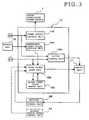
- the main controller 10 (see FIG. 1) is constructed by utilizing hardware and software of a microcomputer which typically includes but is not limited to a central processing unit (CPU), a read only memory (ROM), a random access memory (RAM), etc. More specifically, as shown in FIG. 3, the main controller 10 includes, as principal software components, not only a reference count value setting unit 10A to which a setting signal is input from the setting unit 12, but also a pulse signal count unit 10B, an excess count value memory unit 10C, a switch control unit 10D, and a power supply control unit 10E.
- the reference count value setting unit 10A when receiving a set signal indicative of the set number of rotations of the vertical motion motor M2 from the setting unit 12, updates the reference count value with the number of pulses of the pulse signal corresponding to the set number of rotations.
- the reference count value corresponds to the reference number of rotations the vertical motion motor M2 makes when the mirror surface orientation of the door mirror 2 is adjusted to tilt down from the home position angle to the predetermined set angle so that the driver is provided with a view of the area near a rear wheel of the vehicle.
- the pulse signal count unit 10B receives a reverse signal S1.
- the pulse signal count unit 10B outputs to the switch unit 11 a control signal instructing the vertical motion motor M2 to rotate normally when the reverse signal S1 is turned on, and outputs to the switch unit 11 a control signal instructing the vertical motion motor M2 to rotate reversely when the reverse signal S1 is turned off.
- the pulse signal count unit 10B receives through the vertical motion motor control unit 3B a pulse signal output from the vertical motion motor M2 comprised of a brushless motor.
- the pulse signal count unit 10B counts the number of pulses of the thus-received pulse signal so as to exercise feedback control over the number of rotations of the vertical motion motor M2. Once the counted number of pulses reaches the reference count value loaded from the reference count value setting unit 10, the pulse signal count unit 10B outputs to the switch unit 11 a control signal instructing the vertical motion motor M2 to stop rotating.
- the excessively counted number of pulses is stored in the excess count value memory unit 10C as an excess count value corresponding to the number of extra rotations of the coasting vertical motion motor M2.
- the switch control unit 10D receives a reverse signal S1 and an ignition switch signal S2.
- the switch control unit 10D outputs a switching signal to the switch unit 11 when receiving the reverse signal S1 with the ignition switch signal S2 kept on.
- the power supply control unit 10E turns the motor stabilized power supply 7 on when the ignition switch signal S2 is turned on, and turns the motor stabilized power supply 7 off to reduce a dark current when the ignition switch signal S2 is turned off.
- the ignition switch ACC/IG when the driver of the vehicle (not shown) turns the ignition switch ACC/IG on, the ignition switch signal S2 is turned on and transmitted to the power supply control unit 10E of the main controller 10, and the power supply control unit 10E turns the motor stabilized power supply 7 on.
- the lateral motion motor driving unit 4A and the vertical motion motor driving unit 4B are connected with the motor stabilized power supply 7, so that the lateral motion motor M1 and the vertical motion motor M2 may be energized and become ready to be activated.
- a switching signal is transmitted from the mirror switch 8 through the switch control unit 9 to the lateral motion motor control unit 3A, making the lateral motion motor M1 rotate in a normal or reverse direction, so that the mirror surface orientation of the door mirror 2 is adjusted to the right or to the left.
- a switching signal is transmitted from the mirror switch 8 through the switch control unit 9 and the switch unit 11 to the vertical motion motor control unit 3B, making the vertical motion motor M2 rotate in a normal or reverse direction, so that the mirror surface orientation of the door mirror 2 is adjusted upward or downward.
- the reverse signal S1 is turned on, and an ON signal is transmitted to the main controller 10.
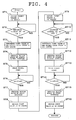
- the main controller 10 controls the rotation of the vertical motion motor M2, by following the process steps as shown in the flowchart of FIG. 4.
- a count value n of the pulse signal which the pulse signal count unit 10B outputs is reset (ST1).
- determination as to whether the reverse signal S1 is turned on is repeated until YES is returned as a result of the determination (ST2).
- step ST2 If an ON signal of the reverse signal S1 is input to the switch control unit 10D and pulse signal count unit 10B of the main controller 10, YES is returned as a result of the determination in step ST2, and a reference count value nS preset in the reference count value setting unit 10A and an excess count value nO stored in the excess count value memory unit 10C are then loaded, in step ST3, into the pulse signal count unit 10B.
- step ST4 the vertical motion motor M2 is driven to rotate in a normal direction by the following process steps.
- the pulse signal count unit 10B outputs a control signal for instructing the vertical motion motor M2 to rotate in the normal direction to the switch unit 11.
- the switch control unit 10D outputs to the switch unit 11 a switching signal for instructing the switch unit 11 to forward the control signal received from the pulse signal count unit 10B by the switch unit 11 to the vertical motion motor control unit 3B.
- the vertical motion motor M2 starts rotating in the normal direction so as to adjust the mirror surface orientation downward from the home position angle (at which the driver is provided with a rearward view during normal operation of driving the vehicle forward) to the set angle (at which the driver is provided with a view of the area near a rear wheel of the vehicle upon reversing the vehicle).
- the pulse signal generated with its rotation is transmitted through the vertical motion motor control unit 3B to the pulse signal count unit 10B.
- the pulse signal count unit 10B then counts the number of pulses of the pulse signal (ST5).
- step ST6 it is determined whether or not the count value n or the number of pulses counted by the pulse signal count unit 10B has reached a value obtained by adding the excess count value nO to the reference count value nS . This step is repeated until YES is returned as a result of the determination.
- step ST6 If YES is returned as a result of the determination in step ST6, the pulse signal count unit 10B outputs a control signal for instructing the vertical motion motor M2 to stop rotating through the switch unit 11 to the vertical motion motor control unit 3B. Consequently, the vertical motion motor M2 stops rotating, and the mirror surface orientation of the door mirror 2 is adjusted to tilt at the set angle (at which the driver is provided with a view of the area near a rear wheel of the vehicle upon reversing the vehicle) (ST7).
- step ST8 a count value of the number of pulses which exceeds the reference count value is output, as an updated excess count value nO of the rotations the coasting vertical motion motor M2 has made, from the pulse signal count unit 10B to the excess count value memory unit 10C.
- the excess count value nO is then stored in the excess count value memory unit 10C.
- step ST9 prior to the reverse rotations of the vertical motion motor M2 to return the mirror surface orientation of the door mirror 2 to the home position angle, the count value n of the pulse signal in the pulse signal count unit 10B is reset. Thereafter, it is determined whether the reverse signal S1 is turned off (ST10). This step of determination is repeated until YES is returned.
- the reverse signal S1 transmitted to the main controller 10 is turned off, and YES is returned as a result of determination in step ST10. Otherwise, if the driver turns the ignition switch ACC/IG off, the reverse signal S1 transmitted to the main controller 10 is turned off, and thus YES is returned in the determination step ST10.
- step ST11 the reference count value nS set in the reference count value setting unit 10A and the excess count value nO now stored in the excess count value memory unit 10C are loaded into the pulse signal count unit 10B.
- step ST12 the reverse signal S1 transmitted to the pulse signal count unit 10B is turned off, and thus the pulse signal count unit 10B outputs a control signal for instructing the vertical motion motor M2 to rotate in the reverse direction through the switch unit 11 to the vertical motion motor control unit 3B. Consequently, the vertical motion motor M2 starts rotating in the reverse direction so as to make the mirror surface orientation of the door mirror 2 tilt upward from the set angle (at which the driver is provided with a view of the area near a rear wheel of the vehicle upon reversing the vehicle) back to the home position angle (at which the driver is provided with a rearward view during normal operation of driving the vehicle forward).
- the pulse signal generated with the rotation of the vertical motion motor M2 is transmitted through the vertical motion motor control unit 3B and input to the pulse signal count unit 10B.
- the pulse signal count unit 10B counts the number of pulses in the input pulse signal (ST13).
- step ST14 it is determined whether a count value n of the number of pulses counted in the pulse signal count unit 10B has reached a value obtained by adding the updated excess count value nO to the reference count value nS. This step of determination is repeated until YES is returned as a result of determination.
- step ST14 If the determination in step ST14 results in YES, a control signal for instructing the vertical motion motor M2 to stop rotating is output from the pulse signal count unit 10B, and transmitted through the switch unit 11 to the vertical motion motor control unit 3B. Consequently, the vertical motion motor M2 stops rotating, and the mirror surface orientation of the door mirror 2 is adjusted back to the home position angle (at which the driver is provided with a rearward view during normal operation of driving the vehicle forward) (ST 15).
- step ST16 the count value of the number of pulses exceeding the reference count value is output from the pulse signal count unit 10B to the excess count value memory unit 10C as an updated excess count value nO of extra rotations the coasting vertical motion motor M2 makes.
- the excess count value memory unit 10C thus stores the excess count value nO .
- the mirror angle control apparatus 1 when the vertical motion motor M2 comprised of a brushless motor is driven to rotate in response to a control signal from the main controller 10, the pulse signal generated in accordance with the number of rotations thereof is counted by the pulse signal count unit 10B of the main controller 10. Feedback control based upon the count value of the pulse signal is exercised over the number of rotations of the vertical motion motor M2, whereby the mirror surface orientation of the door mirror 2 is adequately adjusted to tilt downward to a predetermined set angle and to tilt upward back to the home position angle.
- the vertical motion motor M2 is driven to make an additional number of reverse rotations corresponding to the extra rotations of the vertical motion motor M2 when the mirror surface orientation is adjusted from the set angle back to the home position angle, so that the mirror surface orientation is precisely restored back to the home position angle.
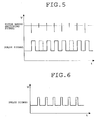
- the vertical motion motor M2 is, as is the case with the conventional mirror angle control apparatus, comprised of a direct-current brush motor, a reduced signal level of the motor brush switching signal is likely to be generated due to wearing away of the brush, defective condition in brush contacts, or the like. In this instance, the motor brush switching signal cannot be properly wave-shaped, so that a momentary loss (so-called "dropout") of the pulse signal is likely to occur ( see FIG. 5). This resultantly makes it impossible to accurately exercise feedback control over the vertical motion motor M2, which disadvantageously reduces the accuracy in adjustment of mirror surface orientation.
- the mirror angle control apparatus 1 which has the vertical motion motor M2 comprised of a brushless motor capable of reliably generating a pulse signal without momentary loss for a long period of time as shown in FIG. 6, can precisely control the mirror surface orientation of the door mirror 2 for a long period of time, thus achieving improved durability and reliability.
- the use of the brushless motor serves to reduce an operation noise, making the apparatus in operation quiet, as well as to reduce a line noise and a radiation noise.
- the mirror surface orientation of the door mirror 2 may be adjusted to the right or to the left in synchronization with a manual switching operation of the blinker of the vehicle performed by the driver.
- a right or left blinker signal is generated, and the blinker signal like a reverse signal S1 is transmitted to the main controller 10.
- a control signal is then output from the pulse signal count unit 10B of the main controller 10, and transmitted through the switch unit 11 to the lateral motion motor control unit 3A, so that feedback control may be exercised over the rotation of the lateral motion motor M1.
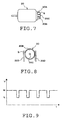
- the vertical motion motor M2 applicable for the present invention may not be limited to one comprised of a brushless motor, but those comprised of a pulse signal generation motor 20 as shown in FIGs. 7 and 8 may be used instead.
- This pulse signal generation motor 20 may include a rotary contact 20A fixed around the periphery of a rotary shaft 20C with an insulating bush 20B stuffed therebetween, and a gap G formed to extend partly but somewhat widely in a circumferential direction.
- On the periphery of the rotary contact 20A with gap G are provided a pair of brushes 20D for acquiring a pulse signal.
- the brushes 20D sandwich the rotary contact 20A with gap G from opposite sides and slidably come in contact with the same.
Landscapes
- Engineering & Computer Science (AREA)
- Multimedia (AREA)
- Mechanical Engineering (AREA)
- Microelectronics & Electronic Packaging (AREA)
- Power Engineering (AREA)
- Rear-View Mirror Devices That Are Mounted On The Exterior Of The Vehicle (AREA)
Applications Claiming Priority (2)
| Application Number | Priority Date | Filing Date | Title |
|---|---|---|---|
| JP2003378128 | 2003-11-07 | ||
| JP2003378128A JP2005138731A (ja) | 2003-11-07 | 2003-11-07 | 車両用電動ミラー装置のミラー角度制御装置 |
Publications (1)
| Publication Number | Publication Date |
|---|---|
| EP1529690A1 true EP1529690A1 (de) | 2005-05-11 |
Family
ID=34431337
Family Applications (1)
| Application Number | Title | Priority Date | Filing Date |
|---|---|---|---|
| EP04018399A Withdrawn EP1529690A1 (de) | 2003-11-07 | 2004-08-03 | Spiegelwinkelverstellvorrichtung für elektrische Kraftfahrzeugspiegelanordnung |
Country Status (3)
| Country | Link |
|---|---|
| US (1) | US7053574B2 (de) |
| EP (1) | EP1529690A1 (de) |
| JP (1) | JP2005138731A (de) |
Families Citing this family (3)
| Publication number | Priority date | Publication date | Assignee | Title |
|---|---|---|---|---|
| US20080185894A1 (en) * | 2006-10-05 | 2008-08-07 | Lear Corporation | Movable head restraint for improved vision |
| JP2009033835A (ja) * | 2007-07-25 | 2009-02-12 | Tokai Rika Co Ltd | 負荷駆動制御回路 |
| KR102231512B1 (ko) * | 2017-08-16 | 2021-03-24 | 에스트라오토모티브시스템 주식회사 | 차량의 룸 미러 자동 설정 장치 |
Citations (4)
| Publication number | Priority date | Publication date | Assignee | Title |
|---|---|---|---|---|
| US5293104A (en) * | 1989-12-16 | 1994-03-08 | Robert Bosch Gmbh | Drive device for movable structural component units |
| DE19909233A1 (de) * | 1998-03-06 | 1999-11-04 | Buhler Motor Gmbh | Stellantrieb zum Verschwenken eines Kfz-Rückblickspiegels um zumindest eine Schwenkachse |
| US6072254A (en) * | 1997-11-06 | 2000-06-06 | Robert Bosch Gmbh | Drive device with electric motor |
| FR2807234A1 (fr) * | 2000-03-29 | 2001-10-05 | Eaton Corp | Dispositif d'autopilotage pour moteur electrique monophase ou multiphase a courant continu |
Family Cites Families (11)
| Publication number | Priority date | Publication date | Assignee | Title |
|---|---|---|---|---|
| US3679954A (en) * | 1970-07-13 | 1972-07-25 | Lear Siegler Inc | Brushless d.c. motor with rate control of position sensor |
| JPS5771017A (en) * | 1980-10-22 | 1982-05-01 | Sony Corp | Generator for position detection signal |
| US4479079A (en) * | 1983-10-21 | 1984-10-23 | Hanner John C | Apparatus for varying the speed of DC motors |
| WO1994026022A1 (fr) * | 1993-04-27 | 1994-11-10 | Sankyo Seiki Mfg. Co., Ltd. | Appareil de detections de la position de rotation d'un moteur sans balais |
| US6302547B1 (en) * | 1995-02-08 | 2001-10-16 | Joseph A. Valentino | Automatically adjustable passenger mirror assembly for a trailered vehicle having a mirror position feedback and position correction device |
| US5631528A (en) * | 1995-05-04 | 1997-05-20 | Linfinity Microelectronics | Elimination of motor negative voltages during motor brake |
| US5869939A (en) * | 1997-01-31 | 1999-02-09 | Hewlett-Packard Company | Direct current motor with imbalanced winding for closed-loop feedback control |
| US5838359A (en) * | 1997-03-05 | 1998-11-17 | Xerox Corporation | Interpolated reference for improved digital feedback control regulation |
| DE29923786U1 (de) * | 1999-07-21 | 2001-04-19 | Magna Auteca Zweigniederlassung Der Magna Holding Ag, Weiz | Antriebsvorrichtung für einen verstellbaren Rückblickspiegel mit einem selbstkalibrierenden Potentiometer |
| JP3602993B2 (ja) | 1999-11-16 | 2004-12-15 | 株式会社村上開明堂 | 車両用ミラーの角度制御装置 |
| JP2004244002A (ja) * | 2002-12-20 | 2004-09-02 | Murakami Corp | 車両用アウターミラーにおけるミラーの角度調整システム |
-
2003
- 2003-11-07 JP JP2003378128A patent/JP2005138731A/ja active Pending
-
2004
- 2004-07-27 US US10/899,058 patent/US7053574B2/en not_active Expired - Fee Related
- 2004-08-03 EP EP04018399A patent/EP1529690A1/de not_active Withdrawn
Patent Citations (4)
| Publication number | Priority date | Publication date | Assignee | Title |
|---|---|---|---|---|
| US5293104A (en) * | 1989-12-16 | 1994-03-08 | Robert Bosch Gmbh | Drive device for movable structural component units |
| US6072254A (en) * | 1997-11-06 | 2000-06-06 | Robert Bosch Gmbh | Drive device with electric motor |
| DE19909233A1 (de) * | 1998-03-06 | 1999-11-04 | Buhler Motor Gmbh | Stellantrieb zum Verschwenken eines Kfz-Rückblickspiegels um zumindest eine Schwenkachse |
| FR2807234A1 (fr) * | 2000-03-29 | 2001-10-05 | Eaton Corp | Dispositif d'autopilotage pour moteur electrique monophase ou multiphase a courant continu |
Also Published As
| Publication number | Publication date |
|---|---|
| JP2005138731A (ja) | 2005-06-02 |
| US20050099149A1 (en) | 2005-05-12 |
| US7053574B2 (en) | 2006-05-30 |
Similar Documents
| Publication | Publication Date | Title |
|---|---|---|
| JP2000255384A (ja) | ワイパ制御装置 | |
| JP2638583B2 (ja) | 電流コマンドに対する二次元補間法を用いた電気アシスト・ステアリング・システムの制御方法及び装置 | |
| US6907333B2 (en) | Steering device | |
| US7136732B2 (en) | Electric power steering apparatus | |
| CN102076534A (zh) | 用于识别传动机构-驱动单元的旋转角度和逆转位置的方法 | |
| JP4191509B2 (ja) | モータ制御方法及びモータ制御装置 | |
| WO2004054856A1 (ja) | ワイパ装置制御方法及びワイパ装置並びに減速機構付きモータ | |
| JP4418385B2 (ja) | 車両用アウターミラーのリバース連動鏡面角度制御方法およびその装置、並びに、直流ブラシモータの回転量検出方法およびその装置 | |
| US6459223B2 (en) | Motor vehicle door lock and process for its control | |
| JPWO2005097569A1 (ja) | ワイパ装置制御方法 | |
| US7053574B2 (en) | Mirror angle control apparatus for vehicular electric mirror assembly | |
| JPH1170880A (ja) | ステアリング位置調整制御装置 | |
| US6437532B2 (en) | Motor vehicle door lock and process for its control | |
| JP4615885B2 (ja) | モータ制御方法及びモータ制御装置 | |
| JP5405903B2 (ja) | 車両用電装品の制御装置 | |
| KR20050018815A (ko) | 자동차 사이드미러의 제어장치 및 제어방법 | |
| JP2002249062A (ja) | 電動パワーステアリング制御装置 | |
| JP4245982B2 (ja) | ミラー制御装置 | |
| US7750588B2 (en) | Method of counting drive motor rotations, and memory modules, storage media, and motor and vehicle apparatuses utilizing same | |
| US7885743B2 (en) | Electric mirror control device and electric mirror control method | |
| JP2000289626A (ja) | ステアリング位置調整制御装置 | |
| JP2001026279A (ja) | パワーステアリング制御装置 | |
| JP5148860B2 (ja) | 車両のアウターミラー制御装置 | |
| US20250214644A1 (en) | Vehicle control device | |
| JP2004359021A (ja) | 車両用電動ミラーのモータ制御装置 |
Legal Events
| Date | Code | Title | Description |
|---|---|---|---|
| PUAI | Public reference made under article 153(3) epc to a published international application that has entered the european phase |
Free format text: ORIGINAL CODE: 0009012 |
|
| AK | Designated contracting states |
Kind code of ref document: A1 Designated state(s): AT BE BG CH CY CZ DE DK EE ES FI FR GB GR HU IE IT LI LU MC NL PL PT RO SE SI SK TR |
|
| AX | Request for extension of the european patent |
Extension state: AL HR LT LV MK |
|
| AKX | Designation fees paid | ||
| STAA | Information on the status of an ep patent application or granted ep patent |
Free format text: STATUS: THE APPLICATION IS DEEMED TO BE WITHDRAWN |
|
| 18D | Application deemed to be withdrawn |
Effective date: 20051112 |
|
| REG | Reference to a national code |
Ref country code: DE Ref legal event code: 8566 |