EP1529348B1 - Datendetektion für Kodes mit nicht gleichartigen Spreizfaktoren - Google Patents
Datendetektion für Kodes mit nicht gleichartigen Spreizfaktoren Download PDFInfo
- Publication number
- EP1529348B1 EP1529348B1 EP03739284A EP03739284A EP1529348B1 EP 1529348 B1 EP1529348 B1 EP 1529348B1 EP 03739284 A EP03739284 A EP 03739284A EP 03739284 A EP03739284 A EP 03739284A EP 1529348 B1 EP1529348 B1 EP 1529348B1
- Authority
- EP
- European Patent Office
- Prior art keywords
- communication
- columns
- matrix
- block
- column
- Prior art date
- Legal status (The legal status is an assumption and is not a legal conclusion. Google has not performed a legal analysis and makes no representation as to the accuracy of the status listed.)
- Expired - Lifetime
Links
- 238000001514 detection method Methods 0.000 title claims description 13
- 238000004891 communication Methods 0.000 claims abstract description 110
- 239000011159 matrix material Substances 0.000 claims abstract description 59
- 108010003272 Hyaluronate lyase Proteins 0.000 claims abstract description 25
- 238000000034 method Methods 0.000 claims description 13
- 238000001228 spectrum Methods 0.000 claims description 7
- 230000005540 biological transmission Effects 0.000 description 3
- 238000000354 decomposition reaction Methods 0.000 description 2
- 238000005516 engineering process Methods 0.000 description 1
- 238000005070 sampling Methods 0.000 description 1
Images

Classifications
-
- H—ELECTRICITY
- H04—ELECTRIC COMMUNICATION TECHNIQUE
- H04B—TRANSMISSION
- H04B1/00—Details of transmission systems, not covered by a single one of groups H04B3/00 - H04B13/00; Details of transmission systems not characterised by the medium used for transmission
- H04B1/69—Spread spectrum techniques
- H04B1/707—Spread spectrum techniques using direct sequence modulation
- H04B1/7097—Interference-related aspects
- H04B1/7103—Interference-related aspects the interference being multiple access interference
-
- H—ELECTRICITY
- H04—ELECTRIC COMMUNICATION TECHNIQUE
- H04J—MULTIPLEX COMMUNICATION
- H04J13/00—Code division multiplex systems
- H04J13/0007—Code type
- H04J13/004—Orthogonal
- H04J13/0044—OVSF [orthogonal variable spreading factor]
-
- H—ELECTRICITY
- H04—ELECTRIC COMMUNICATION TECHNIQUE
- H04B—TRANSMISSION
- H04B1/00—Details of transmission systems, not covered by a single one of groups H04B3/00 - H04B13/00; Details of transmission systems not characterised by the medium used for transmission
- H04B1/69—Spread spectrum techniques
- H04B1/707—Spread spectrum techniques using direct sequence modulation
-
- H—ELECTRICITY
- H04—ELECTRIC COMMUNICATION TECHNIQUE
- H04B—TRANSMISSION
- H04B1/00—Details of transmission systems, not covered by a single one of groups H04B3/00 - H04B13/00; Details of transmission systems not characterised by the medium used for transmission
- H04B1/69—Spread spectrum techniques
- H04B1/707—Spread spectrum techniques using direct sequence modulation
- H04B1/7097—Interference-related aspects
- H04B1/7103—Interference-related aspects the interference being multiple access interference
- H04B1/7105—Joint detection techniques, e.g. linear detectors
- H04B1/71052—Joint detection techniques, e.g. linear detectors using decorrelation matrix
-
- H—ELECTRICITY
- H04—ELECTRIC COMMUNICATION TECHNIQUE
- H04B—TRANSMISSION
- H04B1/00—Details of transmission systems, not covered by a single one of groups H04B3/00 - H04B13/00; Details of transmission systems not characterised by the medium used for transmission
- H04B1/69—Spread spectrum techniques
- H04B1/707—Spread spectrum techniques using direct sequence modulation
- H04B1/7097—Interference-related aspects
- H04B1/7103—Interference-related aspects the interference being multiple access interference
- H04B1/7105—Joint detection techniques, e.g. linear detectors
- H04B1/71055—Joint detection techniques, e.g. linear detectors using minimum mean squared error [MMSE] detector
-
- H—ELECTRICITY
- H04—ELECTRIC COMMUNICATION TECHNIQUE
- H04B—TRANSMISSION
- H04B2201/00—Indexing scheme relating to details of transmission systems not covered by a single group of H04B3/00 - H04B13/00
- H04B2201/69—Orthogonal indexing scheme relating to spread spectrum techniques in general
- H04B2201/707—Orthogonal indexing scheme relating to spread spectrum techniques in general relating to direct sequence modulation
- H04B2201/70703—Orthogonal indexing scheme relating to spread spectrum techniques in general relating to direct sequence modulation using multiple or variable rates
-
- H—ELECTRICITY
- H04—ELECTRIC COMMUNICATION TECHNIQUE
- H04B—TRANSMISSION
- H04B2201/00—Indexing scheme relating to details of transmission systems not covered by a single group of H04B3/00 - H04B13/00
- H04B2201/69—Orthogonal indexing scheme relating to spread spectrum techniques in general
- H04B2201/707—Orthogonal indexing scheme relating to spread spectrum techniques in general relating to direct sequence modulation
- H04B2201/70703—Orthogonal indexing scheme relating to spread spectrum techniques in general relating to direct sequence modulation using multiple or variable rates
- H04B2201/70705—Rate detection
Definitions
- This invention generally relates to wireless code division multiple access communication systems.
- the invention relates to data detection of communications having non-uniform spreading factors in such systems.
- CDMA code division multiple access
- SF Typical spreading factors
- the spectrum is time divided into frames having a predetermined number of time slots, such as fifteen time slots.
- This type of system is referred to as a hybrid CDMA/time division multiple access (TDMA) communication system.
- TDMA time division multiple access
- One such system, which restricts uplink communications and downlink communications to particular time slots, is a time division duplex communication (TDD) system.
- TDD time division duplex communication
- joint detection One approach to receive the multiple communications transmitted within the shared spectrum is joint detection.
- the joint detector uses the, known or determined, codes of the multiple communications and estimates the data of the multiple communications as soft symbols.
- Some typical implementations for joint detectors use zero forcing block linear equalizers (ZF-BLE) applying Cholesky or approximate Cholesky decomposition or fast Fourier transforms.
- ZF-BLE zero forcing block linear equalizers
- An assessment of the efficiency of various computational techniques for use in joint detectors is contained in the paper "Efficient. Multi-Rate Multi-User Detection For The Asynchronous WCDMA Uplink" by H.R. Karimi (Vehicular Technology Conference. 1999. VTC 1999-Fall. IEEF VTS 50th Amsterdam. Netherlands 12-22 Sept. 1999. Piscatawav. NJ, USA. IEEE, US. vol. 1,19 September 1999 (1999-09-19), pages, 593-597, XP010352928 ISBN: 0-7803-5435-4).
- a plurality of communication signals is received. Each communication signal has an associated code. At least two of the communication signals has a different spreading factor. The associated codes have a scrambling code period.
- a total system response matrix has blocks. Each block has one dimension of a length M and another dimension of a length based on in part M and the spreading factor of each communication. M is based on the scrambling code period. Data of the received plurality of communication signals is received using the constructed system response matrix.
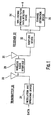
- Figure 1 is an embodiment of a non-uniform spreading factor communication system.
- Figure 2 is an illustration of a system response matrix for a k th communication.
- Figure 3 is an illustration of constructing a total system response matrix.
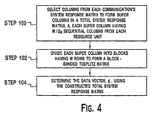
- Figure 4 is a flow chart of detecting data from communications having non-uniform spreading factors.
- the embodiments of the invention can generally be used with any type of CDMA system, such as a TDD/CDMA, TDMA/CDMA or frequency division duplex/CDMA communication system, as well as other types of communication systems.
- Figure 1 illustrates an embodiment of a non-uniform spreading factor communication system.
- a transmitter 20 and a receiver 22 are shown in Figure 1.
- the transmitter 20 may be located at a user equipment or multiple transmitting circuits 20 may be located at the base station.
- the receiver 22 may be located at either the user equipment, base station or both, although the preferred use of the receiver 22 is for use at a base station for reception of uplink communications.
- Data symbols to be transmitted to the receiver 22 are processed by a modulation and spreading device 24 at the transmitter 20.
- the modulation and spreading device 24 spreads the data with the codes and at spreading factors assigned to the communications carrying the data.
- the communications are radiated by an antenna 26 or antenna array of the transmitter 20 through a wireless radio interface 28.
- the communications are received at an antenna 30 or antenna array of the receiver 22.
- the received signal is sampled by a sampling device 32, such as at the chip rate or at a multiple of the chip rate, to produce a received vector, r.
- the received vector is processed by a channel estimation device 36 to estimate the channel impulse responses for the received communications.
- the channel estimation device 36 may use a training sequence in the received communication, a pilot signal or another technique to estimate the impulse responses.
- a non-uniform spreading factor data detection device 34 uses the codes of the received communications and the estimated impulse responses to estimate soft symbols, d , of the spread data.
- FIG. 2 and 3 Data detection for codes having non-uniform spreading factors is illustrated in Figures 2 and 3 and is described with the flow chart of Figure 4.
- a number, K, communications are transmitted during an observation interval.
- an observation interval is typically one data field of a communication burst.
- other size observation intervals may be used, such as the period of the scrambling codes.
- the samples of the combined received K communications are collected over the observation interval as a received vector, r .
- the length in chips of r is the number of chips transmitted in the observation interval of each communication, N c , added to the length of the channel impulse response, W, less one, (N c + W -1).
- a k th communication of the K communications as transmitted can be represented as x (k) .
- An i th chip within a symbol boundary of each symbol is defined as x i (k) and is per Equation 1.
- N s (k) is the number of symbols of the k th communication in the observation interval.
- d n (k) is the symbol value of an n th symbol of the N s (k) symbols.
- v (n,k) is the portion of the code sequence of the k th communication within the n th symbol boundary ( v (n,k) is zero outside the n th symbol boundary).
- v i (n,k) is the i th chip of the portion of the code sequence within the symbol boundary ( v i (n,k) is zero except for the i th chip within the n th symbol boundary).
- Equation 1 can be extended to a matrix equation per Equation 2.
- x ⁇ k V k ⁇ d ⁇ k
- V (k) is a spreading matrix for communication k and has N s (k) columns and N c rows.
- An n th column of V (k) is v (n,k) .
- x (k) After transmission through the wireless channel, x (k) experiences a channel impulse response h (k) .
- h (k) is W chips in length.
- h j (k) is a j th chip of h (k) .
- Ignoring noise, the contribution, r (k) of communication k to the received vector, r is per Equation 3.
- H (k) is the channel response matrix for communication k and has N c columns and (N c + W-1) rows.
- the support of an i th column of H (k) is the channel impulse response h (k) .
- the first element of the support for an i th column of H (k) is the i th element of that column.
- a system transmission matrix A (k) can be constructed per Equation 5.
- a k H k ⁇ V k
- FIG 2 is an illustration of a system response matrix A (k) .
- Each column of the matrix corresponds to one data symbol of the communication.
- the matrix has N s (k) columns.
- Each i th column has a block b (i) of non-zero elements.
- the number of non-zero elements is determined by adding the k th communication's spreading factor, Q k , and the impulse response length, W, minus 1, (Q k + W -1).
- the left-most column has a block b (1) starting at the top of the column. For each subsequent column, the block starts Q k chips lower in the matrix.
- the resulting overall height of the matrix in chips is (N c + W-1).
- a total system transmission matrix can be formed by combining each communication's system response matrix A (k) , such as per Equation 6.
- A A 1 ⁇ A 1 ...
- a K A K
- the height, (M + W - 1), of blocks in the matrix is based on the period of the scrambling code.
- a maximum spreading code of the K communications or a maximum spreading code of the communication system is referred to as Q MAX .
- Q MAX A maximum spreading code of the K communications or a maximum spreading code of the communication system.
- a typical TDD/CDMA communication system has a maximum spreading factor of 16 and a receiver in such a system receives communications having spreading factors of 4 and 8.
- Q MAX may be 16 (the maximum of the system) or 8 (the maximum of the received communications).
- the scrambling code period is not an integer multiple of Q MAX , a multiple of the period may be used instead of M for constructing the blocks.
- Q MAX is 16 and the period is 24, three times the period (48 chips) may be used, since it is evenly divisible by 16 and 24.
- a second super column is constructed in the same manner by selecting the next columns in the A (1) , A (2) , ..., A (K) matrices.
- the other super columns are constructed in the same manner.
- the order of the matrices can vary.
- the resource units can be arranged in any order and still achieve a reduced bandwidth, by placing resource units transmitted with the lowest spreading factors at the exterior of each block, the bandwidth may be further reduced.
- the potential reduction in bandwidth may not outweigh the added complexity for reordering the K communications.
- Each super column is divided into blocks having M rows, as per Equation 8, (step 102).
- A B 1 0 ⁇ 0 0 ⁇ B 1 ⁇ ⁇ ⁇ B L ⁇ ⁇ 0 ⁇ 0 B L ⁇ B 1 0 ⁇ 0 ⁇ ⁇ B 1 0 ⁇ ⁇ B L ⁇ 0 ⁇ 0 B L ⁇ 0 ⁇ 0 B L
- the non-zero elements of each subsequent column is M rows (one block) lower in the matrix.
- the number of non-zero blocks in each column is L, which is per Equation 9.
- L ⁇ M + W - 1 M ⁇
- the data detection can be modeled per Equation 10.
- r ⁇ A ⁇ d ⁇ + n ⁇
- Equation 10 A zero-forcing solution to Equation 10 is per Equations 11 and 12.
- Equation 10 A minimum mean square error solution to Equation 10 is per Equations 13 and 14.
- R R 0 R 1 R 2 R 3 R L - 1 0 0 0 0 0 0 0 R 1 H R 0 R 1 R 2 R 3 R L - 1 0 0 0 0 0 R 2 H R 1 H R 0 R 1 R 2 R 3 R L - 1 0 0 0 0 0 R 2 H R 1 H R 0 R 1 R 2 R 3 R L - 1 0 0 0 0 0 R 3 H R 2 H R 1 H R 0 R 1 R 2 R 3 R L - 1 0 0 0 0 R L - 1 H R 3 H R 2 H R 1 H R 0 R 1 R 2 R 3 R L - 1 0 0 0 0 R L - 1 H R 3 H R 2 H R 1 H R 0 R 1 R 2 R 3 R L - 1 0 0 0 0 R L - 1 H R 3 H R 2 H R 1 H R 0 R 1 R 2 R 3 R L - 1 0 0
- Equation 15 the R matrix is block-banded and Toeplitz.
- solving either Equation 11 or 13 for d can be readily implemented using a block Cholesky or approximate Cholesky decomposition, (step 104).
- a block fast Fourier transform approach can be used to solve for d , (step 104).
Landscapes
- Engineering & Computer Science (AREA)
- Computer Networks & Wireless Communication (AREA)
- Signal Processing (AREA)
- Physics & Mathematics (AREA)
- Mathematical Physics (AREA)
- Mobile Radio Communication Systems (AREA)
- Radar Systems Or Details Thereof (AREA)
- Data Exchanges In Wide-Area Networks (AREA)
Claims (27)
- Verfahren zum gleichzeitigen Schätzen von Daten, die in einem Spreizspektrum-Kommunikationssystem unter Verwendung verschiedener Spreizfaktoren gesendet werden, wobei das Verfahren durch die folgenden Schritte gekennzeichnet ist:Empfangen mehrerer Kommunikationssignale (30), wobei jedes Kommunikationssignal einen zugehörigen Kode hat, wobei mindestens zwei der Kommunikationssignale einen verschiedenen Spreizfaktor haben, wobei die zugehörigen Kodes eine Scramblingkodeperiode haben;Aufbauen einer Gesamtsystem-Antwortmatrix mit Blöcken, die Spalten aufweisen, welche Datensymbolen in den Kommunikationssignalen entsprechen, wobei jeder Block gebildet wird, indem diese Spalten basierend auf einem Betrag M, der ein gemeinsames Vielfaches der Scramblingkodeperiode und eines maximalen Spreizfaktors der Spreizkodes des Kommunikationssystems ist, gruppiert werden, wobei jeder Block eine Anzahl von Reihen, die teilweise auf M und einer Impulsantwort des Kommunikationssystems basiert, und eine Anzahl von Spalten hat, die eine Summe von Quotienten ist, wobei jeder Quotient M dividiert durch den Spreizfaktor (100) der Kommunikation ist, wobei die Blöcke derart angeordnet sind, daß die erste Spalte in jedem Block M Reihen tiefer als die erste Spalte in dem vorhergehenden Block (102) ist;Bilden einer zirkulanten Näherung einer System-Korrelationsmatrix unter Verwendung der Gesamtsystem-Antwortmatrix; undVerwenden der zirkulanten Näherung und eines schnellen Block-Fouriertransformationsansatzes, um Daten der mehreren empfangenen Kommunikationssignale (104) zu schätzen.
- Verfahren nach Anspruch 1, wobei M die Scramblingkodeperiode ist.
- Verfahren nach Anspruch 1, wobei M ein kleinstes gemeinsames Vielfaches der Scramblingkodeperiode und des maximalen Spreizfaktors der Spreizkodes des Kommunikationssystems ist.
- Verfahren nach Anspruch 1, das ferner das Aufbauen von Superspalten aufweist, wobei jede Superspalte für jede Kommunikation eine Anzahl aufeinanderfolgender Spalten aus einer Systemantwortmatrix dieser Kommunikation hat, wobei die Anzahl aufeinanderfolgender Spalten M geteilt durch einen Spreizfaktor dieser Kommunikation ist.
- Verfahren nach Anspruch 4, wobei jede nachfolgende Superspalte Nicht-Null-Elemente einen Block tiefer in der Matrix hat als eine vorhergehende Superspalte.
- Verfahren nach Anspruch 1, wobei die Gesamtsystem-Antwortmatrix A ist und die Datenschätzung in einer Nullen erzwingenden Lösung AHA verwendet, wobei AH eine komplex konjugiert Transponierte von A ist.
- Verfahren nach Anspruch 1, wobei die Gesamtsystem-Antwortmatrix A ist und die Datenschätzung in einer minimalen mittleren Quadratfehlerlösung AHA + σI verwendet, wobei AH eine komplex konjugiert Transponierte von A ist, σ2 die Rauschstreuung ist und I eine Einheitsmatrix ist.
- Benutzergerät zum gleichzeitigen Schätzen von Daten, die in einem Spreizspektrum-Kommunikationssystem unter Verwendung verschiedener Spreizfaktoren gesendet werden, wobei das Verfahren nach Anspruch 1 verwendet wird, dadurch gekennzeichnet, daß es aufweist:eine Einrichtung zum Empfangen der mehreren Kommunikationssignale (30), wobei jedes Kommunikationssignal einen zugehörigen Kode hat, wobei mindestens zwei der Kommunikationssignale einen verschiedenen Spreizfaktor haben, wobei die zugehörigen Kodes eine Scramblingkodeperiode haben;eine Einrichtung zum Aufbauen der Gesamtsystem-Antwortmatrix mit Blöcken, die Spalten aufweisen, welche Datensymbolen in den Kommunikationssignalen entsprechen, wobei jeder Block gebildet wird, indem diese Spalten basierend auf einem Betrag M, der ein gemeinsames Vielfaches der Scramblingkodeperiode und eines maximalen Spreizfaktors der Spreizkodes des Kommunikationssystems ist, gruppiert werden, wobei jeder Block eine Anzahl von Reihen, die teilweise auf M und einer Impulsantwort des Kommunikationssystems basiert, und eine Anzahl von Spalten hat, die eine Summe von Quotienten ist, wobei jeder Quotient M dividiert durch den Spreizfaktor (100) eines der Kommunikationssignale ist, wobei die Blöcke derart angeordnet sind, daß die erste Spalte in jedem Block M Reihen tiefer als die erste Spalte in dem vorhergehenden Block (102) ist;eine Einrichtung zum Bilden der zirkulanten Näherung einer System-Korrelationsmatrix unter Verwendung der Gesamtsystem-Antwortmatrix; undeine Einrichtung zum Verwenden der zirkulanten Näherung und eines schnellen Block-Fouriertransformationsansatzes, um Daten der mehreren empfangenen Kommunikationssignale (104) zu schätzen.
- Benutzergerät nach Anspruch 8, wobei M die Scramblingkodeperiode ist.
- Benutzergerät nach Anspruch 8, wobei M ein kleinstes gemeinsames Vielfaches der Scramblingkodeperiode und des maximalen Spreizkodes des Kommunikationssystems ist.
- Benutzergerät nach Anspruch 8, das ferner eine Einrichtung zum Aufbauen von Superspalten aufweist, wobei jede Superspalte für jede Kommunikation eine Anzahl aufeinanderfolgender Spalten aus einer Systemantwortmatrix dieser Kommunikation hat, wobei die Anzahl aufeinanderfolgender Spalten M geteilt durch einen Spreizfaktor dieser Kommunikation ist.
- Benutzergerät nach Anspruch 11, wobei jede nachfolgende Superspalte Nicht-Null-Elemente einen Block tiefer in der Matrix hat als eine vorhergehende Superspalte.
- Benutzergerät nach Anspruch 8, wobei die Gesamtsystem-Antwortmatrix A ist und die Datenschätzung in einer Nullen erzwingenden Lösung AHA verwendet, wobei AH eine komplex konjugiert Transponierte von A ist.
- Benutzergerät nach Anspruch 8, wobei die Gesamtsystem-Antwortmatrix A ist und die Datenschätzung in einer minimalen mittleren Quadratfehlerlösung AHA + σI verwendet, wobei AH eine komplex konjugiert Transponierte von A ist, σ2 die Rauschstreuung ist und I eine Einheitsmatrix ist.
- Benutzergerät nach Anspruch 8, wobei die Einrichtung zum Empfangen der mehreren Kommunikationssignale eine Antenne aufweist.
- Benutzergerät nach Anspruch 8, wobei die Einrichtung zum Aufbauen der Gesamtsystemantwortmatrix eine Datendetektionsvorrichtung aufweist.
- Benutzergerät nach Anspruch 11, wobei die Einrichtung zum Aufbauen der Superspalten eine Datendetektionsvorrichtung aufweist.
- Basisstation zum gleichzeitigen Schätzen von Daten, die in einem Spreizspektrum-Kommunikationssystem unter Verwendung verschiedener Spreizfaktoren gesendet werden, wobei das Verfahren nach Anspruch 1 verwendet wird, die dadurch gekennzeichnet ist, daß sie aufweist:eine Einrichtung zum Empfangen der mehreren Kommunikationssignale (30), wobei jedes Kommunikationssignal einen zugehörigen Kode hat, wobei mindestens zwei der Kommunikationssignale einen verschiedenen Spreizfaktor haben, wobei die zugehörigen Kodes eine Scramblingkodeperiode haben;eine Einrichtung zum Aufbauen der Gesamtsystem-Antwortmatrix mit Blöcken, die Spalten aufweisen, welche Datensymbolen in den Kommunikationssignalen entsprechen, wobei jeder Block gebildet wird, indem diese Spalten basierend auf einem Betrag M, der ein gemeinsames Vielfaches der Scramblingkodeperiode und eines maximalen Spreizkodes des Kommunikationssystems ist, gruppiert werden, wobei jeder Block eine Anzahl von Reihen, die teilweise auf M und einer Impulsantwort des Kommunikationssystems basiert, und eine Anzahl von Spalten hat, die eine Summe von Quotienten ist, wobei jeder Quotient M dividiert durch den Spreizfaktor (100) eines der Kommunikationssignale ist, wobei die Blöcke derart angeordnet sind, daß die erste Spalte in jedem Block M Reihen tiefer als die erste Spalte in dem vorhergehenden Block (102) ist;eine Einrichtung zum Bilden der zirkulanten Näherung einer System-Korrelationsmatrix unter Verwendung der Gesamtsystem-Antwortmatrix; undeine Einrichtung zum Verwenden der zirkulanten Näherung und eines schnellen Block-Fouriertransformationsansatzes, um Daten der mehreren empfangenen Kommunikationssignale (104) zu schätzen.
- Basisstation nach Anspruch 18, wobei M die Scramblingkodeperiode ist.
- Basisstation nach Anspruch 18, wobei M ein kleinstes gemeinsames Vielfaches der Scramblingkodeperiode und des maximalen Spreizkodes des Kommunikationssystems ist.
- Basisstation nach Anspruch 18, die ferner eine Einrichtung zum Aufbauen von Superspalten aufweist, wobei jede Superspalte für jede Kommunikation eine Anzahl aufeinanderfolgender Spalten aus einer Systemantwortmatrix dieser Kommunikation hat, wobei die Anzahl aufeinanderfolgender Spalten M geteilt durch einen Spreizfaktor dieser Kommunikation ist.
- Basisstation nach Anspruch 21, wobei jede nachfolgende Superspalte Nicht-Null-Elemente einen Block tiefer in der Matrix hat als eine vorhergehende Superspalte.
- Basisstation nach Anspruch 18, wobei die Gesamtsystem-Antwortmatrix A ist und die Datenschätzung in einer Nullen erzwingenden Lösung AHA verwendet, wobei AH eine komplex konjugiert Transponierte von A ist.
- Basisstation nach Anspruch 18, wobei die Gesamtsystem-Antwortmatrix A ist und die Datenschätzung in einer minimalen mittleren Quadratfehlerlösung AHA + σI verwendet, wobei AH eine komplex konjugiert Transponierte von A ist, σ2 die Rauschstreuung ist und I eine Einheitsmatrix ist.
- Basisstation nach Anspruch 18, wobei die Einrichtung zum Empfangen der mehreren Kommunikationssignale eine Antenne aufweist.
- Basisstation nach Anspruch 18, wobei die Einrichtung zum Aufbauen der Gesamtsystemantwortmatrix eine Datendetektionsvorrichtung aufweist.
- Basisstation nach Anspruch 21, wobei die Einrichtung zum Aufbauen der Superspalten eine Datendetektionsvorrichtung aufweist.
Priority Applications (1)
| Application Number | Priority Date | Filing Date | Title |
|---|---|---|---|
| EP07101345A EP1780900A3 (de) | 2002-07-01 | 2003-06-23 | Datendetektion für Codes mit ungleichförmigen Spreizfaktoren |
Applications Claiming Priority (3)
| Application Number | Priority Date | Filing Date | Title |
|---|---|---|---|
| US10/064,307 US6741653B2 (en) | 2002-07-01 | 2002-07-01 | Data detection for codes with non-uniform spreading factors |
| US64307 | 2002-07-01 | ||
| PCT/US2003/019858 WO2004004151A2 (en) | 2002-07-01 | 2003-06-23 | Data detection for codes with non-uniform spreading factors |
Related Child Applications (1)
| Application Number | Title | Priority Date | Filing Date |
|---|---|---|---|
| EP07101345A Division EP1780900A3 (de) | 2002-07-01 | 2003-06-23 | Datendetektion für Codes mit ungleichförmigen Spreizfaktoren |
Publications (4)
| Publication Number | Publication Date |
|---|---|
| EP1529348A2 EP1529348A2 (de) | 2005-05-11 |
| EP1529348A4 EP1529348A4 (de) | 2005-07-20 |
| EP1529348B1 true EP1529348B1 (de) | 2007-02-07 |
| EP1529348B8 EP1529348B8 (de) | 2007-03-21 |
Family
ID=29778418
Family Applications (2)
| Application Number | Title | Priority Date | Filing Date |
|---|---|---|---|
| EP07101345A Withdrawn EP1780900A3 (de) | 2002-07-01 | 2003-06-23 | Datendetektion für Codes mit ungleichförmigen Spreizfaktoren |
| EP03739284A Expired - Lifetime EP1529348B8 (de) | 2002-07-01 | 2003-06-23 | Datendetektion für Kodes mit nicht gleichartigen Spreizfaktoren |
Family Applications Before (1)
| Application Number | Title | Priority Date | Filing Date |
|---|---|---|---|
| EP07101345A Withdrawn EP1780900A3 (de) | 2002-07-01 | 2003-06-23 | Datendetektion für Codes mit ungleichförmigen Spreizfaktoren |
Country Status (15)
| Country | Link |
|---|---|
| US (5) | US6741653B2 (de) |
| EP (2) | EP1780900A3 (de) |
| JP (3) | JP4134034B2 (de) |
| KR (3) | KR101119427B1 (de) |
| CN (2) | CN100536358C (de) |
| AT (1) | ATE353493T1 (de) |
| AU (1) | AU2003245655A1 (de) |
| CA (2) | CA2625599C (de) |
| DE (1) | DE60311657T2 (de) |
| DK (1) | DK1529348T3 (de) |
| ES (1) | ES2279128T3 (de) |
| MX (1) | MXPA05000077A (de) |
| NO (1) | NO20050213L (de) |
| TW (4) | TWI257778B (de) |
| WO (1) | WO2004004151A2 (de) |
Families Citing this family (18)
| Publication number | Priority date | Publication date | Assignee | Title |
|---|---|---|---|---|
| US7027489B2 (en) * | 2001-04-06 | 2006-04-11 | Interdigital Technology Corporation | Iterative fast fourier transform error correction |
| KR100557102B1 (ko) * | 2002-09-07 | 2006-03-03 | 삼성전자주식회사 | 이동통신 시스템에서 직교부호의 길이에 상관없는 공동검출 수신 장치 및 방법 |
| US7408978B2 (en) * | 2002-09-09 | 2008-08-05 | Interdigital Technology Corporation | Extended algorithm data estimator |
| CN1170389C (zh) * | 2002-11-13 | 2004-10-06 | 大唐移动通信设备有限公司 | 在联合检测系统中应用长小区化码的方法 |
| US7437135B2 (en) * | 2003-10-30 | 2008-10-14 | Interdigital Technology Corporation | Joint channel equalizer interference canceller advanced receiver |
| US7400692B2 (en) | 2004-01-14 | 2008-07-15 | Interdigital Technology Corporation | Telescoping window based equalization |
| KR100925763B1 (ko) * | 2005-07-06 | 2009-11-11 | 지티이 코포레이션 | 조인트 송신 기술에 기반한 업링크 동기 구축 방법 및 그 전송 매트릭스 |
| WO2007030972A1 (en) * | 2005-09-15 | 2007-03-22 | Zte Corporation | Baseband processing method for improving signal-to-noise ratio based on multiple sampling |
| US20120269175A1 (en) * | 2011-04-21 | 2012-10-25 | Aiguo Yan | Efficient implementation of joint detection based tdscdma receivers |
| US8891347B2 (en) * | 2011-07-28 | 2014-11-18 | Empire Technology Development Llc | User-focusing technique for wireless communication systems |
| EP3017556B1 (de) | 2013-08-07 | 2024-03-20 | Huawei Technologies Co., Ltd. | System und verfahren für skalierbare digitale kommunikation mit adaptiven systemparametern |
| CN105634544B (zh) * | 2016-01-07 | 2018-11-09 | 电子科技大学 | 一种同步长码ds-cdma信号的盲解扩方法 |
| US10046566B2 (en) | 2016-08-02 | 2018-08-14 | Xerox Corporation | System for cleaning components used to clean inkjet printheads in inkjet printers |
| CN110537174B (zh) * | 2017-04-21 | 2022-09-09 | 华为技术有限公司 | 一种基于交替行锁和列锁的数据锁定方法 |
| CN110581719A (zh) * | 2018-06-11 | 2019-12-17 | 中兴通讯股份有限公司 | 一种调度方法、装置及计算机存储介质 |
| CN110071886B (zh) * | 2019-05-08 | 2022-01-14 | 哈尔滨海能达科技有限公司 | 一种信号处理方法、相关设备及LoRa无线系统 |
| CN111953380B (zh) * | 2020-07-02 | 2021-11-23 | 中国人民解放军战略支援部队信息工程大学 | 基于范数拟合的非周期长码直扩信号时延估计方法及系统 |
| US12107659B2 (en) * | 2022-11-28 | 2024-10-01 | Indian Institute Of Technology | System and method for designing low-complexity linear receivers for OTFS system |
Family Cites Families (25)
| Publication number | Priority date | Publication date | Assignee | Title |
|---|---|---|---|---|
| EP0767543A3 (de) * | 1995-10-06 | 2000-07-26 | Siemens Aktiengesellschaft | Kodemultiplexnachrichtenübertragung mit Interferenzunterdrückung |
| JP4421106B2 (ja) | 1997-09-15 | 2010-02-24 | マーティブ アセット ホールディングス, エルエルシー | Cdma通信容量を改善するための実用的な空間−時間無線方法 |
| US6307867B1 (en) * | 1998-05-14 | 2001-10-23 | Telefonaktiebolaget Lm Ericsson (Publ) | Data transmission over a communications link with variable transmission rates |
| FR2782428B1 (fr) | 1998-08-12 | 2000-09-15 | Alsthom Cge Alcatel | Dispositif permettant des facteurs d'etalement differents tout en preservant un code d'embrouillage commun, notamment pour systeme cellulaire de radiocommunications mobiles du type a acces multiple par repartition de codes |
| FR2782426B1 (fr) | 1998-08-12 | 2000-09-15 | Alsthom Cge Alcatel | Dispositif d'etalement ou de desetalement de spectre, notamment pour la transmission dans un systeme cellulaire de radiocommunications mobiles du type a acces multiple par repartition de codes |
| US6463097B1 (en) * | 1998-10-16 | 2002-10-08 | Koninklijke Philips Electronics N.V. | Rate detection in direct sequence code division multiple access systems |
| WO2000036765A1 (en) * | 1998-12-15 | 2000-06-22 | Nokia Networks Oy | A receiver |
| JP3485498B2 (ja) | 1999-06-28 | 2004-01-13 | 株式会社ケンウッド | Cdma用受信装置及びそのパス探索方法 |
| JP3818643B2 (ja) | 1999-09-14 | 2006-09-06 | インターデイジタル テクノロジー コーポレーション | 複数のユーザ信号の共同検出における演算の軽減 |
| US6714527B2 (en) * | 1999-09-21 | 2004-03-30 | Interdigital Techology Corporation | Multiuser detector for variable spreading factors |
| KR100493750B1 (ko) * | 1999-09-21 | 2005-06-07 | 인터디지탈 테크날러지 코포레이션 | 가변 확산 인자용 멀티유저 검출기 |
| JP2001111456A (ja) | 1999-10-06 | 2001-04-20 | Nec Corp | Cdma受信機及び受信方法 |
| KR100407942B1 (ko) | 1999-11-19 | 2003-12-01 | 엘지전자 주식회사 | 이동통신 시스템에서 전송 포맷 조합 지시자를 전송하는 방법 |
| US6810073B1 (en) | 1999-12-09 | 2004-10-26 | Telefonaktiebolaget Lm Ericsson (Publ) | Method and system for interference cancellation using multiple filter sets and normalized filter adaptation |
| IT1314346B1 (it) | 1999-12-30 | 2002-12-09 | Telit Mobile Terminals Spa | Metodo e dispositivo per la generazione di codici ortogonali a fattore di spreading variabile o righe di matricidi hadamard per sistemi di |
| GB2359966A (en) | 2000-03-01 | 2001-09-05 | Roke Manor Research | Post processing of spreading codes in a mobile telecommunications system |
| CN1108071C (zh) * | 2000-04-11 | 2003-05-07 | 信息产业部电信科学技术研究院 | 码分多址移动通信系统中终端设备端的一种信号处理方法 |
| JP3424748B2 (ja) | 2000-05-25 | 2003-07-07 | 日本電気株式会社 | Cdma受信装置およびレート整合処理方法 |
| JP2001358613A (ja) * | 2000-06-14 | 2001-12-26 | Fujitsu Ltd | Cdma受信装置 |
| JP3595493B2 (ja) * | 2000-07-10 | 2004-12-02 | 三菱電機株式会社 | 無線受信装置 |
| EP1305884A2 (de) * | 2000-08-04 | 2003-05-02 | TELEFONAKTIEBOLAGET LM ERICSSON (publ) | Spreizfaktordetektor |
| US7386076B2 (en) * | 2001-03-29 | 2008-06-10 | Texas Instruments Incorporated | Space time encoded wireless communication system with multipath resolution receivers |
| JP3921389B2 (ja) | 2002-01-23 | 2007-05-30 | 松下電器産業株式会社 | Cdma無線通信装置および方法 |
| US7099377B2 (en) * | 2002-04-03 | 2006-08-29 | Stmicroelectronics N.V. | Method and device for interference cancellation in a CDMA wireless communication system |
| US7003019B2 (en) | 2002-05-22 | 2006-02-21 | Interdigital Technology Corporation | Data detection for codes with non-uniform spreading factors |
-
2002
- 2002-07-01 US US10/064,307 patent/US6741653B2/en not_active Expired - Lifetime
-
2003
- 2003-06-23 CA CA2625599A patent/CA2625599C/en not_active Expired - Fee Related
- 2003-06-23 DE DE60311657T patent/DE60311657T2/de not_active Expired - Lifetime
- 2003-06-23 EP EP07101345A patent/EP1780900A3/de not_active Withdrawn
- 2003-06-23 CN CNB038158531A patent/CN100536358C/zh not_active Expired - Fee Related
- 2003-06-23 KR KR1020057017514A patent/KR101119427B1/ko not_active Expired - Fee Related
- 2003-06-23 KR KR1020107012544A patent/KR20100085165A/ko not_active Withdrawn
- 2003-06-23 TW TW092117036A patent/TWI257778B/zh not_active IP Right Cessation
- 2003-06-23 EP EP03739284A patent/EP1529348B8/de not_active Expired - Lifetime
- 2003-06-23 TW TW098138174A patent/TW201032495A/zh unknown
- 2003-06-23 TW TW093105327A patent/TWI317214B/zh not_active IP Right Cessation
- 2003-06-23 KR KR1020047021597A patent/KR100681284B1/ko not_active Expired - Fee Related
- 2003-06-23 ES ES03739284T patent/ES2279128T3/es not_active Expired - Lifetime
- 2003-06-23 CA CA002491443A patent/CA2491443C/en not_active Expired - Fee Related
- 2003-06-23 DK DK03739284T patent/DK1529348T3/da active
- 2003-06-23 CN CN2009101690094A patent/CN101651468B/zh not_active Expired - Fee Related
- 2003-06-23 TW TW095118174A patent/TWI326535B/zh not_active IP Right Cessation
- 2003-06-23 WO PCT/US2003/019858 patent/WO2004004151A2/en not_active Ceased
- 2003-06-23 AT AT03739284T patent/ATE353493T1/de not_active IP Right Cessation
- 2003-06-23 MX MXPA05000077A patent/MXPA05000077A/es active IP Right Grant
- 2003-06-23 AU AU2003245655A patent/AU2003245655A1/en not_active Abandoned
- 2003-06-23 JP JP2004517768A patent/JP4134034B2/ja not_active Expired - Fee Related
-
2004
- 2004-04-28 US US10/834,321 patent/US7313165B2/en not_active Expired - Fee Related
-
2005
- 2005-01-13 NO NO20050213A patent/NO20050213L/no not_active Application Discontinuation
-
2006
- 2006-01-13 JP JP2006006280A patent/JP4213162B2/ja not_active Expired - Fee Related
-
2007
- 2007-12-21 US US11/962,779 patent/US7596171B2/en not_active Expired - Fee Related
-
2008
- 2008-08-18 JP JP2008210132A patent/JP4944072B2/ja not_active Expired - Fee Related
-
2009
- 2009-08-28 US US12/549,959 patent/US8218607B2/en not_active Expired - Fee Related
-
2012
- 2012-07-09 US US13/544,771 patent/US20120269237A1/en not_active Abandoned
Also Published As
Similar Documents
| Publication | Publication Date | Title |
|---|---|---|
| US8218607B2 (en) | Data detection for codes with non-uniform spreading factors | |
| JP4362504B2 (ja) | 単一ユーザ検出 | |
| US7609750B2 (en) | Segment-wise channel equalization based data estimation | |
| US20040141480A1 (en) | Adaptive algorithm for a cholesky approximation | |
| EP1552405B1 (de) | Effiziente gemeinsame detektion | |
| HK1075549B (en) | Data detection for codes with non-uniform spreading factors | |
| EP1928103A1 (de) | Reduzierte Berechnung bei der Verbindungsdetektion |
Legal Events
| Date | Code | Title | Description |
|---|---|---|---|
| PUAI | Public reference made under article 153(3) epc to a published international application that has entered the european phase |
Free format text: ORIGINAL CODE: 0009012 |
|
| 17P | Request for examination filed |
Effective date: 20050126 |
|
| AK | Designated contracting states |
Kind code of ref document: A2 Designated state(s): AT BE BG CH CY CZ DE DK EE ES FI FR GB GR HU IE IT LI LU MC NL PT RO SE SI SK TR |
|
| AX | Request for extension of the european patent |
Extension state: AL LT LV MK |
|
| A4 | Supplementary search report drawn up and despatched |
Effective date: 20050606 |
|
| DAX | Request for extension of the european patent (deleted) | ||
| GRAP | Despatch of communication of intention to grant a patent |
Free format text: ORIGINAL CODE: EPIDOSNIGR1 |
|
| RTI1 | Title (correction) |
Free format text: DATA DETECTION FOR CODES WITH NON-UNIFORM SPREADING FACTORS |
|
| GRAS | Grant fee paid |
Free format text: ORIGINAL CODE: EPIDOSNIGR3 |
|
| GRAA | (expected) grant |
Free format text: ORIGINAL CODE: 0009210 |
|
| AK | Designated contracting states |
Kind code of ref document: B1 Designated state(s): AT BE BG CH CY CZ DE DK EE ES FI FR GB GR HU IE IT LI LU MC NL PT RO SE SI SK TR |
|
| PG25 | Lapsed in a contracting state [announced via postgrant information from national office to epo] |
Ref country code: BE Free format text: LAPSE BECAUSE OF FAILURE TO SUBMIT A TRANSLATION OF THE DESCRIPTION OR TO PAY THE FEE WITHIN THE PRESCRIBED TIME-LIMIT Effective date: 20070207 Ref country code: LI Free format text: LAPSE BECAUSE OF FAILURE TO SUBMIT A TRANSLATION OF THE DESCRIPTION OR TO PAY THE FEE WITHIN THE PRESCRIBED TIME-LIMIT Effective date: 20070207 Ref country code: CH Free format text: LAPSE BECAUSE OF FAILURE TO SUBMIT A TRANSLATION OF THE DESCRIPTION OR TO PAY THE FEE WITHIN THE PRESCRIBED TIME-LIMIT Effective date: 20070207 Ref country code: SI Free format text: LAPSE BECAUSE OF FAILURE TO SUBMIT A TRANSLATION OF THE DESCRIPTION OR TO PAY THE FEE WITHIN THE PRESCRIBED TIME-LIMIT Effective date: 20070207 Ref country code: NL Free format text: LAPSE BECAUSE OF FAILURE TO SUBMIT A TRANSLATION OF THE DESCRIPTION OR TO PAY THE FEE WITHIN THE PRESCRIBED TIME-LIMIT Effective date: 20070207 Ref country code: AT Free format text: LAPSE BECAUSE OF FAILURE TO SUBMIT A TRANSLATION OF THE DESCRIPTION OR TO PAY THE FEE WITHIN THE PRESCRIBED TIME-LIMIT Effective date: 20070207 |
|
| REG | Reference to a national code |
Ref country code: GB Ref legal event code: FG4D |
|
| RAP2 | Party data changed (patent owner data changed or rights of a patent transferred) |
Owner name: INTERDIGITAL TECHNOLOGY CORPORATION |
|
| REG | Reference to a national code |
Ref country code: CH Ref legal event code: EP |
|
| REG | Reference to a national code |
Ref country code: IE Ref legal event code: FG4D |
|
| REF | Corresponds to: |
Ref document number: 60311657 Country of ref document: DE Date of ref document: 20070322 Kind code of ref document: P |
|
| NLT2 | Nl: modifications (of names), taken from the european patent patent bulletin |
Owner name: INTERDIGITAL TECHNOLOGY CORPORATION Effective date: 20070228 |
|
| PG25 | Lapsed in a contracting state [announced via postgrant information from national office to epo] |
Ref country code: BG Free format text: LAPSE BECAUSE OF EXPIRATION OF PROTECTION Effective date: 20070508 |
|
| PGFP | Annual fee paid to national office [announced via postgrant information from national office to epo] |
Ref country code: MC Payment date: 20070529 Year of fee payment: 5 |
|
| REG | Reference to a national code |
Ref country code: SE Ref legal event code: TRGR |
|
| ET | Fr: translation filed | ||
| PG25 | Lapsed in a contracting state [announced via postgrant information from national office to epo] |
Ref country code: PT Free format text: LAPSE BECAUSE OF FAILURE TO SUBMIT A TRANSLATION OF THE DESCRIPTION OR TO PAY THE FEE WITHIN THE PRESCRIBED TIME-LIMIT Effective date: 20070709 |
|
| NLV1 | Nl: lapsed or annulled due to failure to fulfill the requirements of art. 29p and 29m of the patents act | ||
| REG | Reference to a national code |
Ref country code: CH Ref legal event code: PL |
|
| REG | Reference to a national code |
Ref country code: ES Ref legal event code: FG2A Ref document number: 2279128 Country of ref document: ES Kind code of ref document: T3 |
|
| PG25 | Lapsed in a contracting state [announced via postgrant information from national office to epo] |
Ref country code: SK Free format text: LAPSE BECAUSE OF FAILURE TO SUBMIT A TRANSLATION OF THE DESCRIPTION OR TO PAY THE FEE WITHIN THE PRESCRIBED TIME-LIMIT Effective date: 20070207 |
|
| PLBE | No opposition filed within time limit |
Free format text: ORIGINAL CODE: 0009261 |
|
| STAA | Information on the status of an ep patent application or granted ep patent |
Free format text: STATUS: NO OPPOSITION FILED WITHIN TIME LIMIT |
|
| PG25 | Lapsed in a contracting state [announced via postgrant information from national office to epo] |
Ref country code: CZ Free format text: LAPSE BECAUSE OF FAILURE TO SUBMIT A TRANSLATION OF THE DESCRIPTION OR TO PAY THE FEE WITHIN THE PRESCRIBED TIME-LIMIT Effective date: 20070207 Ref country code: RO Free format text: LAPSE BECAUSE OF FAILURE TO SUBMIT A TRANSLATION OF THE DESCRIPTION OR TO PAY THE FEE WITHIN THE PRESCRIBED TIME-LIMIT Effective date: 20070207 |
|
| 26N | No opposition filed |
Effective date: 20071108 |
|
| PG25 | Lapsed in a contracting state [announced via postgrant information from national office to epo] |
Ref country code: GR Free format text: LAPSE BECAUSE OF FAILURE TO SUBMIT A TRANSLATION OF THE DESCRIPTION OR TO PAY THE FEE WITHIN THE PRESCRIBED TIME-LIMIT Effective date: 20070508 |
|
| PG25 | Lapsed in a contracting state [announced via postgrant information from national office to epo] |
Ref country code: MC Free format text: LAPSE BECAUSE OF NON-PAYMENT OF DUE FEES Effective date: 20080630 Ref country code: EE Free format text: LAPSE BECAUSE OF FAILURE TO SUBMIT A TRANSLATION OF THE DESCRIPTION OR TO PAY THE FEE WITHIN THE PRESCRIBED TIME-LIMIT Effective date: 20070207 |
|
| PG25 | Lapsed in a contracting state [announced via postgrant information from national office to epo] |
Ref country code: CY Free format text: LAPSE BECAUSE OF FAILURE TO SUBMIT A TRANSLATION OF THE DESCRIPTION OR TO PAY THE FEE WITHIN THE PRESCRIBED TIME-LIMIT Effective date: 20070207 |
|
| PG25 | Lapsed in a contracting state [announced via postgrant information from national office to epo] |
Ref country code: LU Free format text: LAPSE BECAUSE OF NON-PAYMENT OF DUE FEES Effective date: 20070623 |
|
| PG25 | Lapsed in a contracting state [announced via postgrant information from national office to epo] |
Ref country code: HU Free format text: LAPSE BECAUSE OF FAILURE TO SUBMIT A TRANSLATION OF THE DESCRIPTION OR TO PAY THE FEE WITHIN THE PRESCRIBED TIME-LIMIT Effective date: 20070808 Ref country code: TR Free format text: LAPSE BECAUSE OF FAILURE TO SUBMIT A TRANSLATION OF THE DESCRIPTION OR TO PAY THE FEE WITHIN THE PRESCRIBED TIME-LIMIT Effective date: 20070207 |
|
| REG | Reference to a national code |
Ref country code: FR Ref legal event code: PLFP Year of fee payment: 14 |
|
| PGFP | Annual fee paid to national office [announced via postgrant information from national office to epo] |
Ref country code: IE Payment date: 20160524 Year of fee payment: 14 Ref country code: GB Payment date: 20160527 Year of fee payment: 14 Ref country code: ES Payment date: 20160525 Year of fee payment: 14 Ref country code: DE Payment date: 20160524 Year of fee payment: 14 Ref country code: FI Payment date: 20160524 Year of fee payment: 14 |
|
| PGFP | Annual fee paid to national office [announced via postgrant information from national office to epo] |
Ref country code: DK Payment date: 20160524 Year of fee payment: 14 Ref country code: SE Payment date: 20160527 Year of fee payment: 14 Ref country code: FR Payment date: 20160526 Year of fee payment: 14 Ref country code: IT Payment date: 20160525 Year of fee payment: 14 |
|
| REG | Reference to a national code |
Ref country code: DE Ref legal event code: R119 Ref document number: 60311657 Country of ref document: DE |
|
| REG | Reference to a national code |
Ref country code: DK Ref legal event code: EBP Effective date: 20170630 |
|
| REG | Reference to a national code |
Ref country code: SE Ref legal event code: EUG |
|
| PG25 | Lapsed in a contracting state [announced via postgrant information from national office to epo] |
Ref country code: FI Free format text: LAPSE BECAUSE OF NON-PAYMENT OF DUE FEES Effective date: 20170623 |
|
| GBPC | Gb: european patent ceased through non-payment of renewal fee |
Effective date: 20170623 |
|
| PG25 | Lapsed in a contracting state [announced via postgrant information from national office to epo] |
Ref country code: SE Free format text: LAPSE BECAUSE OF NON-PAYMENT OF DUE FEES Effective date: 20170624 |
|
| REG | Reference to a national code |
Ref country code: IE Ref legal event code: MM4A |
|
| REG | Reference to a national code |
Ref country code: FR Ref legal event code: ST Effective date: 20180228 |
|
| PG25 | Lapsed in a contracting state [announced via postgrant information from national office to epo] |
Ref country code: GB Free format text: LAPSE BECAUSE OF NON-PAYMENT OF DUE FEES Effective date: 20170623 Ref country code: DE Free format text: LAPSE BECAUSE OF NON-PAYMENT OF DUE FEES Effective date: 20180103 Ref country code: IE Free format text: LAPSE BECAUSE OF NON-PAYMENT OF DUE FEES Effective date: 20170623 |
|
| PG25 | Lapsed in a contracting state [announced via postgrant information from national office to epo] |
Ref country code: FR Free format text: LAPSE BECAUSE OF NON-PAYMENT OF DUE FEES Effective date: 20170630 Ref country code: IT Free format text: LAPSE BECAUSE OF NON-PAYMENT OF DUE FEES Effective date: 20170623 |
|
| PG25 | Lapsed in a contracting state [announced via postgrant information from national office to epo] |
Ref country code: DK Free format text: LAPSE BECAUSE OF NON-PAYMENT OF DUE FEES Effective date: 20170630 |
|
| REG | Reference to a national code |
Ref country code: ES Ref legal event code: FD2A Effective date: 20181107 |
|
| PG25 | Lapsed in a contracting state [announced via postgrant information from national office to epo] |
Ref country code: ES Free format text: LAPSE BECAUSE OF NON-PAYMENT OF DUE FEES Effective date: 20170624 |