EP1529047B1 - Neue purine derivate - Google Patents
Neue purine derivate Download PDFInfo
- Publication number
- EP1529047B1 EP1529047B1 EP03748238A EP03748238A EP1529047B1 EP 1529047 B1 EP1529047 B1 EP 1529047B1 EP 03748238 A EP03748238 A EP 03748238A EP 03748238 A EP03748238 A EP 03748238A EP 1529047 B1 EP1529047 B1 EP 1529047B1
- Authority
- EP
- European Patent Office
- Prior art keywords
- compound
- formula
- amino
- isopropyl
- ylmethyl
- Prior art date
- Legal status (The legal status is an assumption and is not a legal conclusion. Google has not performed a legal analysis and makes no representation as to the accuracy of the status listed.)
- Expired - Lifetime
Links
- 0 Cc1c(CNc2c3nc[n](*)c3nc(NC(*)(*)C(*)(*)O)n2)c(*)c(*)c(*)n1 Chemical compound Cc1c(CNc2c3nc[n](*)c3nc(NC(*)(*)C(*)(*)O)n2)c(*)c(*)c(*)n1 0.000 description 7
- XCZUADRFQHXEKD-UHFFFAOYSA-N CC(C)[n]1c2nc(Cl)nc(NCc3cnccc3)c2nc1 Chemical compound CC(C)[n]1c2nc(Cl)nc(NCc3cnccc3)c2nc1 XCZUADRFQHXEKD-UHFFFAOYSA-N 0.000 description 1
- RJQQAAMUEHNMSQ-RXMQYKEDSA-N CC[C@H](C(C)(C)O)N Chemical compound CC[C@H](C(C)(C)O)N RJQQAAMUEHNMSQ-RXMQYKEDSA-N 0.000 description 1
- BKFGLDUWYUYHRF-CRCLSJGQSA-N CC[C@H]([C@H](C)O)N Chemical compound CC[C@H]([C@H](C)O)N BKFGLDUWYUYHRF-CRCLSJGQSA-N 0.000 description 1
- XAVGPTKBLBUWBD-UHFFFAOYSA-N Fc1nc(Cl)c2[n-]c[nH]c2n1 Chemical compound Fc1nc(Cl)c2[n-]c[nH]c2n1 XAVGPTKBLBUWBD-UHFFFAOYSA-N 0.000 description 1
Classifications
-
- C—CHEMISTRY; METALLURGY
- C07—ORGANIC CHEMISTRY
- C07D—HETEROCYCLIC COMPOUNDS
- C07D473/00—Heterocyclic compounds containing purine ring systems
- C07D473/02—Heterocyclic compounds containing purine ring systems with oxygen, sulphur, or nitrogen atoms directly attached in positions 2 and 6
- C07D473/16—Heterocyclic compounds containing purine ring systems with oxygen, sulphur, or nitrogen atoms directly attached in positions 2 and 6 two nitrogen atoms
-
- A—HUMAN NECESSITIES
- A61—MEDICAL OR VETERINARY SCIENCE; HYGIENE
- A61K—PREPARATIONS FOR MEDICAL, DENTAL OR TOILETRY PURPOSES
- A61K31/00—Medicinal preparations containing organic active ingredients
- A61K31/33—Heterocyclic compounds
- A61K31/395—Heterocyclic compounds having nitrogen as a ring hetero atom, e.g. guanethidine or rifamycins
- A61K31/495—Heterocyclic compounds having nitrogen as a ring hetero atom, e.g. guanethidine or rifamycins having six-membered rings with two or more nitrogen atoms as the only ring heteroatoms, e.g. piperazine or tetrazines
- A61K31/505—Pyrimidines; Hydrogenated pyrimidines, e.g. trimethoprim
- A61K31/519—Pyrimidines; Hydrogenated pyrimidines, e.g. trimethoprim ortho- or peri-condensed with heterocyclic rings
- A61K31/52—Purines, e.g. adenine
-
- A—HUMAN NECESSITIES
- A61—MEDICAL OR VETERINARY SCIENCE; HYGIENE
- A61P—SPECIFIC THERAPEUTIC ACTIVITY OF CHEMICAL COMPOUNDS OR MEDICINAL PREPARATIONS
- A61P11/00—Drugs for disorders of the respiratory system
-
- A—HUMAN NECESSITIES
- A61—MEDICAL OR VETERINARY SCIENCE; HYGIENE
- A61P—SPECIFIC THERAPEUTIC ACTIVITY OF CHEMICAL COMPOUNDS OR MEDICINAL PREPARATIONS
- A61P13/00—Drugs for disorders of the urinary system
- A61P13/12—Drugs for disorders of the urinary system of the kidneys
-
- A—HUMAN NECESSITIES
- A61—MEDICAL OR VETERINARY SCIENCE; HYGIENE
- A61P—SPECIFIC THERAPEUTIC ACTIVITY OF CHEMICAL COMPOUNDS OR MEDICINAL PREPARATIONS
- A61P17/00—Drugs for dermatological disorders
- A61P17/06—Antipsoriatics
-
- A—HUMAN NECESSITIES
- A61—MEDICAL OR VETERINARY SCIENCE; HYGIENE
- A61P—SPECIFIC THERAPEUTIC ACTIVITY OF CHEMICAL COMPOUNDS OR MEDICINAL PREPARATIONS
- A61P17/00—Drugs for dermatological disorders
- A61P17/14—Drugs for dermatological disorders for baldness or alopecia
-
- A—HUMAN NECESSITIES
- A61—MEDICAL OR VETERINARY SCIENCE; HYGIENE
- A61P—SPECIFIC THERAPEUTIC ACTIVITY OF CHEMICAL COMPOUNDS OR MEDICINAL PREPARATIONS
- A61P19/00—Drugs for skeletal disorders
- A61P19/02—Drugs for skeletal disorders for joint disorders, e.g. arthritis, arthrosis
-
- A—HUMAN NECESSITIES
- A61—MEDICAL OR VETERINARY SCIENCE; HYGIENE
- A61P—SPECIFIC THERAPEUTIC ACTIVITY OF CHEMICAL COMPOUNDS OR MEDICINAL PREPARATIONS
- A61P19/00—Drugs for skeletal disorders
- A61P19/06—Antigout agents, e.g. antihyperuricemic or uricosuric agents
-
- A—HUMAN NECESSITIES
- A61—MEDICAL OR VETERINARY SCIENCE; HYGIENE
- A61P—SPECIFIC THERAPEUTIC ACTIVITY OF CHEMICAL COMPOUNDS OR MEDICINAL PREPARATIONS
- A61P25/00—Drugs for disorders of the nervous system
-
- A—HUMAN NECESSITIES
- A61—MEDICAL OR VETERINARY SCIENCE; HYGIENE
- A61P—SPECIFIC THERAPEUTIC ACTIVITY OF CHEMICAL COMPOUNDS OR MEDICINAL PREPARATIONS
- A61P25/00—Drugs for disorders of the nervous system
- A61P25/18—Antipsychotics, i.e. neuroleptics; Drugs for mania or schizophrenia
-
- A—HUMAN NECESSITIES
- A61—MEDICAL OR VETERINARY SCIENCE; HYGIENE
- A61P—SPECIFIC THERAPEUTIC ACTIVITY OF CHEMICAL COMPOUNDS OR MEDICINAL PREPARATIONS
- A61P25/00—Drugs for disorders of the nervous system
- A61P25/24—Antidepressants
-
- A—HUMAN NECESSITIES
- A61—MEDICAL OR VETERINARY SCIENCE; HYGIENE
- A61P—SPECIFIC THERAPEUTIC ACTIVITY OF CHEMICAL COMPOUNDS OR MEDICINAL PREPARATIONS
- A61P25/00—Drugs for disorders of the nervous system
- A61P25/28—Drugs for disorders of the nervous system for treating neurodegenerative disorders of the central nervous system, e.g. nootropic agents, cognition enhancers, drugs for treating Alzheimer's disease or other forms of dementia
-
- A—HUMAN NECESSITIES
- A61—MEDICAL OR VETERINARY SCIENCE; HYGIENE
- A61P—SPECIFIC THERAPEUTIC ACTIVITY OF CHEMICAL COMPOUNDS OR MEDICINAL PREPARATIONS
- A61P29/00—Non-central analgesic, antipyretic or antiinflammatory agents, e.g. antirheumatic agents; Non-steroidal antiinflammatory drugs [NSAID]
-
- A—HUMAN NECESSITIES
- A61—MEDICAL OR VETERINARY SCIENCE; HYGIENE
- A61P—SPECIFIC THERAPEUTIC ACTIVITY OF CHEMICAL COMPOUNDS OR MEDICINAL PREPARATIONS
- A61P3/00—Drugs for disorders of the metabolism
- A61P3/08—Drugs for disorders of the metabolism for glucose homeostasis
- A61P3/10—Drugs for disorders of the metabolism for glucose homeostasis for hyperglycaemia, e.g. antidiabetics
-
- A—HUMAN NECESSITIES
- A61—MEDICAL OR VETERINARY SCIENCE; HYGIENE
- A61P—SPECIFIC THERAPEUTIC ACTIVITY OF CHEMICAL COMPOUNDS OR MEDICINAL PREPARATIONS
- A61P31/00—Antiinfectives, i.e. antibiotics, antiseptics, chemotherapeutics
- A61P31/12—Antivirals
-
- A—HUMAN NECESSITIES
- A61—MEDICAL OR VETERINARY SCIENCE; HYGIENE
- A61P—SPECIFIC THERAPEUTIC ACTIVITY OF CHEMICAL COMPOUNDS OR MEDICINAL PREPARATIONS
- A61P31/00—Antiinfectives, i.e. antibiotics, antiseptics, chemotherapeutics
- A61P31/12—Antivirals
- A61P31/14—Antivirals for RNA viruses
-
- A—HUMAN NECESSITIES
- A61—MEDICAL OR VETERINARY SCIENCE; HYGIENE
- A61P—SPECIFIC THERAPEUTIC ACTIVITY OF CHEMICAL COMPOUNDS OR MEDICINAL PREPARATIONS
- A61P31/00—Antiinfectives, i.e. antibiotics, antiseptics, chemotherapeutics
- A61P31/12—Antivirals
- A61P31/14—Antivirals for RNA viruses
- A61P31/18—Antivirals for RNA viruses for HIV
-
- A—HUMAN NECESSITIES
- A61—MEDICAL OR VETERINARY SCIENCE; HYGIENE
- A61P—SPECIFIC THERAPEUTIC ACTIVITY OF CHEMICAL COMPOUNDS OR MEDICINAL PREPARATIONS
- A61P31/00—Antiinfectives, i.e. antibiotics, antiseptics, chemotherapeutics
- A61P31/12—Antivirals
- A61P31/20—Antivirals for DNA viruses
-
- A—HUMAN NECESSITIES
- A61—MEDICAL OR VETERINARY SCIENCE; HYGIENE
- A61P—SPECIFIC THERAPEUTIC ACTIVITY OF CHEMICAL COMPOUNDS OR MEDICINAL PREPARATIONS
- A61P31/00—Antiinfectives, i.e. antibiotics, antiseptics, chemotherapeutics
- A61P31/12—Antivirals
- A61P31/20—Antivirals for DNA viruses
- A61P31/22—Antivirals for DNA viruses for herpes viruses
-
- A—HUMAN NECESSITIES
- A61—MEDICAL OR VETERINARY SCIENCE; HYGIENE
- A61P—SPECIFIC THERAPEUTIC ACTIVITY OF CHEMICAL COMPOUNDS OR MEDICINAL PREPARATIONS
- A61P35/00—Antineoplastic agents
-
- A—HUMAN NECESSITIES
- A61—MEDICAL OR VETERINARY SCIENCE; HYGIENE
- A61P—SPECIFIC THERAPEUTIC ACTIVITY OF CHEMICAL COMPOUNDS OR MEDICINAL PREPARATIONS
- A61P35/00—Antineoplastic agents
- A61P35/02—Antineoplastic agents specific for leukemia
-
- A—HUMAN NECESSITIES
- A61—MEDICAL OR VETERINARY SCIENCE; HYGIENE
- A61P—SPECIFIC THERAPEUTIC ACTIVITY OF CHEMICAL COMPOUNDS OR MEDICINAL PREPARATIONS
- A61P37/00—Drugs for immunological or allergic disorders
- A61P37/02—Immunomodulators
- A61P37/04—Immunostimulants
-
- A—HUMAN NECESSITIES
- A61—MEDICAL OR VETERINARY SCIENCE; HYGIENE
- A61P—SPECIFIC THERAPEUTIC ACTIVITY OF CHEMICAL COMPOUNDS OR MEDICINAL PREPARATIONS
- A61P37/00—Drugs for immunological or allergic disorders
- A61P37/02—Immunomodulators
- A61P37/06—Immunosuppressants, e.g. drugs for graft rejection
-
- A—HUMAN NECESSITIES
- A61—MEDICAL OR VETERINARY SCIENCE; HYGIENE
- A61P—SPECIFIC THERAPEUTIC ACTIVITY OF CHEMICAL COMPOUNDS OR MEDICINAL PREPARATIONS
- A61P43/00—Drugs for specific purposes, not provided for in groups A61P1/00-A61P41/00
-
- A—HUMAN NECESSITIES
- A61—MEDICAL OR VETERINARY SCIENCE; HYGIENE
- A61P—SPECIFIC THERAPEUTIC ACTIVITY OF CHEMICAL COMPOUNDS OR MEDICINAL PREPARATIONS
- A61P9/00—Drugs for disorders of the cardiovascular system
-
- A—HUMAN NECESSITIES
- A61—MEDICAL OR VETERINARY SCIENCE; HYGIENE
- A61P—SPECIFIC THERAPEUTIC ACTIVITY OF CHEMICAL COMPOUNDS OR MEDICINAL PREPARATIONS
- A61P9/00—Drugs for disorders of the cardiovascular system
- A61P9/10—Drugs for disorders of the cardiovascular system for treating ischaemic or atherosclerotic diseases, e.g. antianginal drugs, coronary vasodilators, drugs for myocardial infarction, retinopathy, cerebrovascula insufficiency, renal arteriosclerosis
-
- Y—GENERAL TAGGING OF NEW TECHNOLOGICAL DEVELOPMENTS; GENERAL TAGGING OF CROSS-SECTIONAL TECHNOLOGIES SPANNING OVER SEVERAL SECTIONS OF THE IPC; TECHNICAL SUBJECTS COVERED BY FORMER USPC CROSS-REFERENCE ART COLLECTIONS [XRACs] AND DIGESTS
- Y02—TECHNOLOGIES OR APPLICATIONS FOR MITIGATION OR ADAPTATION AGAINST CLIMATE CHANGE
- Y02A—TECHNOLOGIES FOR ADAPTATION TO CLIMATE CHANGE
- Y02A50/00—TECHNOLOGIES FOR ADAPTATION TO CLIMATE CHANGE in human health protection, e.g. against extreme weather
- Y02A50/30—Against vector-borne diseases, e.g. mosquito-borne, fly-borne, tick-borne or waterborne diseases whose impact is exacerbated by climate change
Definitions
- the present invention relates to new 2,6,9-substituted purine derivatives and their biological applications.
- the invention relates to purine derivatives having antiproliferative properties which are useful in the treatment of proliferative disorders such as cancer, leukemia, psoriasis and the like.
- CDK cyclin-dependent kinase
- CDKs The activity of CDKs is regulated post-translationally, by transitory associations with other proteins, and by alterations of their intracellular localisation. Tumour development is closely associated with genetic alteration and deregulation of CDKs and their regulators, suggesting that inhibitors of CDKs may be useful anti-cancer therapeutics. Indeed, early results suggest that transformed and normal cells differ in their requirement for e.g . cyclin A/CDK2 and that it may be possible to develop novel antineoplastic agents devoid of the general host toxicity observed with conventional cytotoxic and cytostatic drugs. While inhibition of cell cycle-related CDKs is clearly relevant in e.g. oncology applications, this may not be the case for the inhibition of RNA polymerase-regulating CDKs.
- CDK9/cyclin T function was recently linked to prevention of HIV replication and the discovery of new CDK biology thus continues to open up new therapeutic indications for CDK inhibitors (Sausville, E.A. Trends Molec. Med. 2002, 8,S32-S37).
- CDKs The function of CDKs is to phosphorylate and thus activate or deactivate certain proteins, including e.g. retinoblastoma proteins, lamins, histone H1, and components of the mitotic spindle.
- the catalytic step mediated by CDKs involves a phospho-transfer reaction from ATP to the macromolecular enzyme substrate.
- Several groups of compounds (reviewed in e.g. Fischer, P.M. Curr. Opin. Drug Discovery Dev. 2001, 4, 623-634) have been found to possess anti-proliferative properties by virtue of CDK-specific ATP antagonism.
- WO 98/05335 discloses 2,6,9-trisubstituted purine derivatives that are selective inhibitors of cell cycle kinases. Such compounds are useful in the treatment of autoimmune disorders, e.g. rheumatoid arthritis, lupus, type I diabetes, multiple sclerosis; treating cancer, cardiovascular disease, such as restenosis, host v graft disease, gout, polycystic kidney disease and other proliferative diseases whose pathogenesis involves abnormal cell proliferation.
- autoimmune disorders e.g. rheumatoid arthritis, lupus, type I diabetes, multiple sclerosis
- cardiovascular disease such as restenosis, host v graft disease, gout, polycystic kidney disease and other proliferative diseases whose pathogenesis involves abnormal cell proliferation.
- WO 99/07705 discloses purine analogues that inhibit inter alia protein kinases, G-proteins and polymerases. More specifically, the invention relates to methods of using such purine analogues to treat cellular proliferative disorders and neurodegenerative diseases.
- WO 97/20842 also discloses purine derivatives displaying antiproliferative properties which are useful in treating cancer, psoriasis, and neurodegenerative disorders.
- the present invention seeks to provide new 2,6,9-substituted purine derivatives, particularly those having antiproliferative properties.
- a first aspect of the invention relates to a compound of formula I or a pharmaceutically acceptable salt thereof, wherein
- a second aspect of the invention relates to a pharmaceutical composition
- a pharmaceutical composition comprising a compound of formula 1 and a pharmaceutically acceptable carrier, diluent or excipient.
- a third aspect of the invention relates to the use of a compound of formula 1 in the preparation of a medicament for treating one or more of the following disorders:
- a fourth aspect of the invention relates to the use of a compound of formula 1 as an anti-mitotic agent.
- a fifth aspect of the invention relates to the use of a compound of formula 1 for inhibiting a protein kinase.
- a sixth aspect of the invention relates to the use of a compound of the invention in an assay for identifying further candidate compounds that influence the activity of one or more CDK enzymes.
- a first aspect of the invention relates to a compound of formula 1 as defined hereinbefore.
- the invention seeks to provide new purine derivatives which exhibit improved resistance to metabolic deactivation.
- one of R 1 and R 2 is ethyl or isopropyl, and the other is H.
- R 5 is isopropyl or cyclopentyl.
- R 6 , R 7 , R 8 and R 9 are all H.
- R 1 or R 2 is ethyl and the other is H.
- R 3 and R 4 are each independently H, methyl, ethyl, propyl, butyl or phenyl.
- R 3 and R 4 are each independently H, methyl, ethyl, n-propyl, isopropyl, n-butyl, s-butyl, t-butyl or phenyl.
- R 3 and R 4 are each independently H, methyl, ethyl, propyl or butyl.
- R 3 and R 4 are each independently H, methyl, ethyl, n-propyl, isopropyl, n-butyl, s-butyl or t-butyl.
- R 3 and R 4 are each independently H, methyl, ethyl, isopropyl or t-butyl.
- said compound of formula 1 is selected from the following:
- said compound of formula 1 is selected from the following:
- said compound of formula 1 is selected from the following:
- a second aspect of the invention relates to a pharmaceutical composition
- a pharmaceutical composition comprising a compound of formula 1 admixed with a pharmaceutically acceptable diluent, excipient or carrier, or a mixture thereof.
- the compounds of the present invention can be administered alone, they will generally be administered in admixture with a pharmaceutical carrier, excipient or diluent, particularly for human therapy.
- the pharmaceutical compositions may be for human or animal usage in human and veterinary medicine.
- Acceptable carriers or diluents for therapeutic use are well known in the pharmaceutical art, and are described, for example, in Remington's Pharmaceutical Sciences, Mack Publishing Co. (A. R Gennaro edit. 1985).
- suitable carriers include lactose, starch, glucose, methyl cellulose, magnesium stearate, mannitol, sorbitol and the like.
- suitable diluents include ethanol, glycerol and water.
- compositions may comprise as, or in addition to, the carrier, excipient or diluent any suitable binder(s), lubricant(s), suspending agent(s), coating agent(s), solubilising agent(s).
- Suitable binders include starch, gelatin, natural sugars such as glucose, anhydrous lactose, free-flow lactose, beta-lactose, corn sweeteners, natural and synthetic gums, such as acacia, tragacanth or sodium alginate, carboxymethyl cellulose and polyethylene glycol.
- Suitable lubricants include sodium oleate, sodium stearate, magnesium stearate, sodium benzoate, sodium acetate, sodium chloride and the like.
- Preservatives, stabilizers, dyes and even flavoring agents may be provided in the pharmaceutical composition.
- preservatives include sodium benzoate, sorbic acid and esters of p-hydroxybenzoic acid.
- Antioxidants and suspending agents may be also used.
- the compounds of the present invention can be present as salts or esters, in particular pharmaceutically acceptable salts or esters.
- salts of the compounds of the invention include suitable acid addition or base salts thereof.
- suitable pharmaceutical salts may be found in Berge et al, J Pharm Sci, 66, 1-19 (1977). Salts are formed, for example with strong inorganic acids such as mineral acids, e.g.
- sulphuric acid, phosphoric acid or hydrohalic acids with strong organic carboxylic acids, such as alkanecarboxylic acids of 1 to 4 carbon atoms which are unsubstituted or substituted (e.g., by halogen), such as acetic acid; with saturated or unsaturated dicarboxylic acids, for example oxalic, malonic, succinic, maleic, fumaric, phthalic or tetraphthalic; with hydroxycarboxylic acids, for example ascorbic, glycolic, lactic, malic, tartaric or citric acid; with aminoacids, for example aspartic or glutamic acid; with benzoic acid; or with organic sulfonic acids, such as (C 1 -C 4 )-alkyl- or aryl-sulfonic acids which are unsubstituted or substituted (for example, by a halogen) such as methane- or p-toluene sulfonic acid
- Esters are formed either using organic acids or alcohols/hydroxides, depending on the functional group being esterified.
- Organic acids include carboxylic acids, such as alkanecarboxylic acids of 1 to 12 carbon atoms which are unsubstituted or substituted (e.g., by halogen), such as acetic acid; with saturated or unsaturated dicarboxylic acid, for example oxalic, malonic, succinic, maleic, fumaric, phthalic or tetraphthalic; with hydroxycarboxylic acids, for example ascorbic, glycolic, lactic, malic, tartaric or citric acid; with aminoacids, for example aspartic or glutamic acid; with benzoic acid; or with organic sulfonic acids, such as (C 1 -C 4 )-alkyl- or aryl-sulfonic acids which are unsubstituted or substituted (for example, by a halogen) such as methane- or p-to
- Suitable hydroxides include inorganic hydroxides, such as sodium hydroxide, potassium hydroxide, calcium hydroxide, aluminium hydroxide.
- Alcohols include alkanealcohols of 1-12 carbon atoms which may be unsubstituted or substituted, e.g. by a halogen).
- the invention includes, where appropriate all enantiomers and tautomers of compounds of formula 1.
- the man skilled in the art will recognise compounds that possess an optical properties (one or more chiral carbon atoms) or tautomeric characteristics.
- the corresponding enantiomers and/or tautomers may be isolated/prepared by methods known in the art.
- Some of the compounds of the invention may exist as stereoisomers and/or geometric isomers - e.g. they may possess one or more asymmetric and/or geometric centres and so may exist in two or more stereoisomeric and/or geometric forms.
- the present invention contemplates the use of all the individual stereoisomers and geometric isomers of those inhibitor agents, and mixtures thereof.
- the terms used in the claims encompass these forms, provided said forms retain the appropriate functional activity (though not necessarily to the same degree).
- the present invention also includes all suitable isotopic variations of the agent or a pharmaceutically acceptable salt thereof.
- An isotopic variation of an agent of the present invention or a pharmaceutically acceptable salt thereof is defined as one in which at least one atom is replaced by an atom having the same atomic number but an atomic mass different from the atomic mass usually found in nature.
- isotopes that can be incorporated into the agent and pharmaceutically acceptable salts thereof include isotopes of hydrogen, carbon, nitrogen, oxygen, phosphorus, sulphur, fluorine and chlorine such as 2 H, 3 H, 13 C, 14 C, 15 N, 17 O, 18 O, 31 P, 32 P, 35 S, 18 F and 36 Cl, respectively.
- isotopic variations of the agent and pharmaceutically acceptable salts thereof are useful in drug and/or substrate tissue distribution studies. Tritiated, i.e., 3 H, and carbon-14, i.e., 14 C, isotopes are particularly preferred for their ease of preparation and detectability. Further, substitution with isotopes such as deuterium, i.e., 2 H, may afford certain therapeutic advantages resulting from greater metabolic stability, for example, increased in vivo half-life or reduced dosage requirements and hence may be preferred in some circumstances. Isotopic variations of the agent of the present invention and pharmaceutically acceptable salts thereof of this invention can generally be prepared by conventional procedures using appropriate isotopic variations of suitable reagents.
- the present invention also includes solvate forms of the compounds of the present invention.
- the terms used in the claims encompass these forms.
- the invention furthermore relates to compounds of the present invention in their various crystalline forms, polymorphic forms and (an)hydrous forms. It is well established within the pharmaceutical industry that chemical compounds may be isolated in any of such forms by slightly varying the method of purification and or isolation form the solvents used in the synthetic preparation of such compounds.
- the invention further includes compounds of the present invention in prodrug form.
- prodrugs are generally compounds of formula 1 wherein one or more appropriate groups have been modified such that the modification may be reversed upon administration to a human or mammalian subject.
- Such reversion is usually performed by an enzyme naturally present in such subject, though it is possible for a second agent to be administered together with such a prodrug in order to perform the reversion in vivo.
- Examples of such modifications include ester (for example, any of those described above), wherein the reversion may be carried out be an esterase etc.
- Other such systems will be well known to those skilled in the art.
- compositions of the present invention may be adapted for oral, rectal, vaginal, parenteral, intramuscular, intraperitoneal, intraarterial, intrathecal, intrabronchial, subcutaneous, intradermal, intravenous, nasal, buccal or sublingual routes of administration.
- compositions For oral administration, particular use is made of compressed tablets, pills, tablets, gellules, drops, and capsules. Preferably, these compositions contain from 1 to 250 mg and more preferably from 10-100 mg, of active ingredient per dose.
- compositions of the present invention may also be in form of suppositories, pessaries, suspensions, emulsions, lotions, ointments, creams, gels, sprays, solutions or dusting powders.
- the active ingredient can be incorporated into a cream consisting of an aqueous emulsion of polyethylene glycols or liquid paraffin.
- the active ingredient can also be incorporated, at a concentration of between 1 and 10% by weight, into an ointment consisting of a white wax or white soft paraffin base together with such stabilisers and preservatives as may be required.
- Injectable forms may contain between 10 - 1000 mg, preferably between 10 - 250 mg, of active ingredient per dose.
- compositions may be formulated in unit dosage form, i.e., in the form of discrete portions containing a unit dose, or a multiple or sub-unit of a unit dose.
- a person of ordinary skill in the art can easily determine an appropriate dose of one of the instant compositions to administer to a subject without undue experimentation.
- a physician will determine the actual dosage which will be most suitable for an individual patient and it will depend on a variety of factors including the activity of the specific compound employed, the metabolic stability and length of action of that compound, the age, body weight, general health, sex, diet, mode and time of administration, rate of excretion, drug combination, the severity of the particular condition, and the individual undergoing therapy.
- the dosages disclosed herein are exemplary of the average case. There can of course be individual instances where higher or lower dosage ranges are merited, and such are within the scope of this invention.
- the agent may be administered at a dose of from 0.01 to 30 mg/kg body weight, such as from 0.1 to 10 mg/kg, more preferably from 0.1 to 1 mg/kg body weight.
- one or more doses of 10 to 150 mg/day will be administered to the patient for the treatment of malignancy.
- the compounds of the present invention have been found to possess anti proliferative activity and are therefore believed to be of use in the treatment of proliferative disorders, such as cancers, leukaemias or other disorders associated with uncontrolled cellular proliferation such as psoriasis and restenosis.
- an anti-proliferative effect within the scope of the present invention may be demonstrated by the ability to inhibit cell proliferation in an in vitro whole cell assay, for example using any of the cell lines A549, HeLa, HT-29, MCF7, Saos-2, CCRF-CEM, HL-60 and K-562, or by showing kinase inhibition in an appropriate assay.
- assays including methods for their performance, are described in more detail in the accompanying Examples. Using such assays it may be determined whether a compound is anti-proliferative in the context of the present invention.
- One preferred embodiment of the present invention therefore relates to the use of one or more compounds of the invention in the preparation of a medicament for treating a proliferative disorder.
- preparation of a medicament includes the use of a compound of the invention directly as the medicament in addition to its use in a screening programme for further therapeutic agents or in any stage of the manufacture of such a medicament.
- proliferative disorder is used herein in a broad sense to include any disorder that requires control of the cell cycle, for example cardiovascular disorders such as restenosis and cardiomyopathy, auto-immune disorders such as glomerulonephritis and rheumatoid arthritis, dermatological disorders such as psoriasis, anti-inflammatory, anti-fungal, antiparasitic disorders such as malaria, emphysema and alopecia.
- the compounds of the present invention may induce apoptosis or maintain stasis within the desired cells as required.
- the proliferative disorder is a cancer or leukaemia.
- the proliferative disorder is psoriasis.
- the compounds of the invention may inhibit any of the steps or stages in the cell cycle, for example, formation of the nuclear envelope, exit from the quiescent phase of the cell cycle (G0), G1 progression, chromosome decondensation, nuclear envelope breakdown, START, initiation of DNA replication, progression of DNA replication, termination of DNA replication, centrosome duplication, G2 progression, activation of mitotic or meiotic functions, chromosome condensation, centrosome separation, microtubule nucleation, spindle formation and function, interactions with microtubule motor proteins, chromatid separation and segregation, inactivation of mitotic functions, formation of contractile ring, and cytokinesis functions.
- the compounds of the invention may influence certain gene functions such as chromatin binding, formation of replication complexes, replication licensing, phosphorylation or other secondary modification activity, proteolytic degradation, microtubule binding, actin binding, septin binding, microtubule organising centre nucleation activity and binding to components of cell cycle signalling pathways.
- a further aspect of the invention relates to a method of treating a proliferative disease, said method comprising administering to a mammal a therapeutically effective amount of a compound of formula 1.
- the proliferative disorder is cancer or leukaemia.
- the compound is administered in an amount sufficient to inhibit at least one CDK enzyme.
- the compound of the invention is administered in an amount sufficient to inhibit at least one of CDK1, CDK2, CDK3, CDK4, CDK6, CDK7, CDK8 and/or CDK9.
- the compound of the invention is administered in an amount sufficient to inhibit at least one of CDK2 and/or CDK4.
- the CDK enzyme is CDK2.
- the compound is administered orally.
- Another aspect of the invention relates to the use of a compound of formula 1 as an anti-mitotic agent.
- Yet another aspect of the invention relates to the use of a compound of formula 1 for treating a neurodegenerative disorder.
- the neurodegenerative disorder is neuronal apoptosis.
- Another aspect of the invention relates to the use of a compound of formula 1 as an antiviral agent.
- another aspect of the invention relates to the use of a compound of the invention in the preparation of a medicament for treating a viral disorder, such as human cytomegalovirus (HCMV), herpes simplex virus type 1 (HSV-1), human immunodeficiency virus type 1 (HIV-1), and varicella zoster virus (VZV).
- HCMV human cytomegalovirus
- HSV-1 herpes simplex virus type 1
- HSV-1 human immunodeficiency virus type 1
- VZV varicella zoster virus
- the compound of the invention is administered in an amount sufficient to inhibit one or more of the host cell CDKs involved in viral replication, i.e. CDK2, CDK7, CDK8, and CDK9 [Wang D, De la Fuente C, Deng L, Wang L, Zilberman I, Eadie C, Healey M, Stein D, Denny T, Harrison LE, Meijer L, Kashanchi F. Inhibition of human immunodeficiency virus type 1 transcription by chemical cyclin-dependent kinase inhibitors. J. Virol. 2001; 75: 7266-7279].
- CDK2 Hos involved in viral replication
- an anti-viral effect within the scope of the present invention may be demonstrated by the ability to inhibit CDK2, CDK7, CDK8 or CDK9.
- the invention relates to the use of one or more compounds of the invention in the treatment of a viral disorder which is CDK dependent or sensitive.
- CDK dependent disorders are associated with an above normal level of activity of one or more-CDK enzymes.
- Such disorders preferably associated with an abnormal level of activity of CDK2, CDK7, CDK8 and/or CDK9.
- a CDK sensitive disorder is a disorder in which an aberration in the CDK level is not the primary cause, but is downstream of the primary metabolic aberration.
- CDK2, CDK7, CDK8 and/or CDK9 can be said to be part of the sensitive metabolic pathway and CDK inhibitors may therefore be active in treating such disorders.
- Another aspect of the invention relates to the use of compounds of the invention, or pharmaceutically accetable salts thereof, in the preparation of a medicament for treating diabetes.
- the diabetes is type II diabetes.
- GSK3 is one of several protein kinases that phosphorylate glycogen synthase (GS).
- GS glycogen synthase
- Type II diabetes non-insulin dependent diabetes mellitus
- Hyperglycaemia is due to insulin resistance in the liver, muscles, and other tissues, coupled with impaired secretion of insulin.
- Skeletal muscle is the main site for insulin-stimulated glucose uptake, there it is either removed from circulation or converted to glycogen.
- Muscle glycogen deposition is the main determinant in glucose homeostasis and type II diabetics have defective muscle glycogen storage.
- GSK3 activity is important in type II diabetes [Chen, Y.H.; Hansen, L.; Chen, M.X.; Bjorbaek, C.; Vestergaard, H.; Hansen, T.; Cohen, P.T.; Pedersen, O. Diabetes , 1994, 43, 1234]. Furthermore, it has been demonstrated that GSK3 is over-expressed in muscle cells of type II diabetics and that an inverse correlation exists between skeletal muscle GSK3 activity and insulin action [Nikoulina, S.E.; Ciaraldi, T.P.; Mudaliar, S.; Mohideen, P.; Carter, L.; Henry, R.R. Diabetes , 2000, 49, 263].
- GSK3 inhibition is therefore of therapeutic significance in the treatment of diabetes, particularly type II, and diabetic neuropathy.
- GSK3 is known to phosphorylate many substrates other than GS, and is thus involved in the regulation of multiple biochemical pathways. For example, GSK is highly expressed in the central and peripheral nervous systems.
- Another aspect of the invention therefore relates to the use of compounds of the invention, or pharmaceutically acceptable salts thereof, in the preparation of a medicament for treating a CNS disorders, for example neurodegenerative disorders.
- the CNS disorder is Alzheimer's disease.
- Tau is a GSK-3 substrate which has been implicated in the etiology of Alzheimer's disease. In healthy nerve cells, Tau co-assembles with tubulin into microtubules. However, in Alzheimer's disease, tau forms large tangles of filaments, which disrupt the microtubule structures in the nerve cell, thereby impairing the transport of nutrients as well as the transmission of neuronal messages.
- GSK3 inhibitors may be able to prevent and/or reverse the abnormal hyperphosphorylation of the microtubule-associated protein tau that is an invariant feature of Alzheimer's disease and a number of other neurodegenerative diseases, such as progressive supranuclear palsy, corticobasal degeneration and Pick's disease. Mutations in the tau gene cause inherited forms of fronto-temporal dementia, further underscoring the relevance of tau protein dysfunction for the neurodegenerative process [Goedert, M. Curr . Opin . Gen . Dev ., 2001, 11, 343].
- Another aspect of the invention relates to the use of compounds of the invention, or pharmaceutically acceptable salts thereof, in the preparation of a medicament for treating bipolar disorder.
- Yet another aspect of the invention relates to the use of compounds of the invention, or pharmaceutically acceptable salts thereof, in the preparation of a medicament for treating a stroke.
- GSK3 as a pro-apoptotic factor in neuronal cells makes this protein kinase an attractive therapeutic target for the design of inhibitory drugs to treat these diseases.
- Yet another aspect of the invention relates to the use of compounds of the invention, or pharmaceutically acceptable salts thereof, in the preparation of a medicament for treating alopecia.
- a further aspect of the invention relates to a method of treating a GSK3-dependent disorder, said method comprising administering to a subject in need thereof, a compound according to the invention, or a pharmaceutically acceptable salt thereof, as defined above in an amount sufficient to inhibit GSK3.
- the compound of the invention, or pharmaceutically acceptable salt thereof is administered in an amount sufficient to inhibit GSK3 ⁇ .
- the compound of the invention is administered in an amount sufficient to inhibit at least one PLK enzyme.
- polo-like kinases constitute a family of serine/threonine protein kinases. Mitotic Drosophila melanogaster mutants at the polo locus display spindle abnormalities [Sunkel et al., J. Cell Sci., 1988, 89, 25] and polo was found to encode a mitotic kinase [Llamazares et al., Genes Dev., 1991, 5, 2153]. In humans, there exist three closely related PLKs [Glover et al., Genes Dev., 1998, 12, 3777].
- PLKs regulate some fundamental aspects of mitosis [Lane et al., J . Cell . Biol ., 1996, 135, 1701; Cogswell et al., Cell Growth Differ ., 2000, 11, 615].
- PLK1 activity is believed to be necessary for the functional maturation of centrosomes in late G2/early prophase and subsequent establishment of a bipolar spindle.
- Depletion of cellular PLK1 through the small interfering RNA (siRNA) technique has also confirmed that this protein is required for multiple mitotic processes and completion of cytokinesis [Liu et al., Proc. Natl. Acad. Sci. USA, 2002, 99, 8672].
- the compound of the invention is administered in an amount sufficient to inhibit PLK1.
- PLK1 is the best characterized; it regulates a number of cell division cycle effects, including the onset of mitosis [Toyoshima-Morimoto et al., Nature, 2001, 410, 215; Roshak et al., Cell. Signalling, 2000, 12, 405], DNA-damage checkpoint activation [Smits et al., Nat. Cell Biol., 2000, 2, 672; van Vugt et al., J. Biol. Chem., 2001, 276, 41656], regulation of the anaphase promoting complex [Sumara et al., Mol . Cell , 2002, 9, 515; Golan et al., J . Biol .
- M-phase promoting factor the complex between the cyclin dependent kinase CDK1 and B-type cyclins [Nurse, Nature, 1990, 344, 503].
- MPF M-phase promoting factor
- the latter accumulate during the S and G2 phases of the cell cycle and promote the inhibitory phosphorylation of the MPF complex by WEE1, MIK1, and MYT1 kinases.
- WEE1, MIK1, and MYT1 kinases At the end of the G2 phase, corresponding dephosphorylation by the dual-specificity phosphatase CDC25C triggers the activation of MPF [Nigg, Nat. Rev. Mol. Cell Biol., 2001, 2, 21].
- cyclin B localizes to the cytoplasm [Hagting et al., EMBO J., 1998, 17, 4127], it then becomes phosphorylated during prophase and this event causes nuclear translocation [Hagting et al., Curr . Biol ., 1999, 9, 680; Yang et al., J . Biol . Chem ., 2001, 276, 3604].
- the nuclear accumulation of active MPF during prophase is thought to be important for initiating M-phase events [Takizawa et al., Curr . Opin . Cell Biol ., 2000, 12, 658].
- nuclear MPF is kept inactive by WEE1 unless counteracted by CDC25C.
- the phosphatase CDC25C itself localized to the cytoplasm during interphase, accumulates in the nucleus in prophase [Seki et al., Mol . Biol . Cell , 1992, 3, 1373; Heald et al., Cell , 1993, 74, 463; Dalal et al., Mol . Cell. Biol ., 1999, 19, 4465].
- the compounds of the invention are ATP-antagonistic inhibitors of PLK1.
- ATP antagonism refers to the ability of an inhibitor compound to diminish or prevent PLK catalytic activity, i.e. phosphotransfer from ATP to a macromolecular PLK substrate, by virtue of reversibly or irreversibly binding at the enzyme's active site in such a manner as to impair or abolish ATP binding.
- the compound of the invention is administered in an amount sufficient to inhibit PLK2 and/or PLK3.
- PLK2 also known as SNK
- PLK3 also known as PRK and FNK
- SNK SNK
- PLK3 PLK3
- PLK3 also plays an important role in the regulation of microtubule dynamics and centrosome function in the cell and deregulated PLK3 expression results in cell cycle arrest and apoptosis [Wang et al., Mol. Cell. Biol., 2002, 22, 3450].
- PLK2 is the least well understood homologue of the three PLKs. Both PLK2 and PLK3 may have additional important post-mitotic functions [Kauselmann et al., EMBO J. , 1999, 18, 5528];
- Another aspect of the invention relates to the use of a compound of formula 1 for inhibiting a protein kinase.
- the protein kinase is a cyclin dependent kinase.
- the protein kinase is CDK1, CDK2, CDK3, CDK4, CDK6, CDK7, CDK8 or CDK9, more preferably CDK2.
- a further aspect of the invention relates to a method of inhibiting a protein kinase, said method comprising contacting said protein kinase with a compound of formula 1.
- the protein kinase is a cyclin dependent kinase, even more preferably CDK2.
- Another aspect of the invention relates to the use of a compound as defined hereinabove in an assay for identifying further candidate compounds that influence the activity of one or more CDK enzymes.
- the assay is capable of identifying candidate compounds that are capable of inhibiting one or more CDK enzymes.
- the assay is a competitive binding assay.
- the candidate compound is generated by conventional SAR modification of a compound of the invention.
- conventional SAR modification refers to standard methods known in the art for varying a given compound by way of chemical derivatisation.
- the identified compound may act as a model (for example, a template) for the development of other compounds.
- the compounds employed in such a test may be free in solution, affixed to a solid support, borne on a cell surface, or located intracellularly. The abolition of activity or the formation of binding complexes between the compound and the agent being tested may be measured.
- the assay of the present invention may be a screen, whereby a number of agents are tested.
- the assay method of the present invention is a high through-put screen.
- This invention also contemplates the use of competitive drug screening assays in which neutralising antibodies capable of binding a compound specifically compete with a test compound for binding to a compound.
- HTS high throughput screening
- the competitive binding assay comprises contacting a compound of formula 1 with a CDK enzyme in the presence of a known substrate of said CDK enzyme and detecting any change in the interaction between said CDK enzyme and said known substrate.
- a sixth aspect of the invention provides a method of detecting the binding of a ligand to a CDK enzyme, said method comprising the steps of:
- One aspect of the invention relates to a process comprising the steps of:
- Another aspect of the invention provides a process comprising the steps- of:
- Another aspect of the invention provides a process comprising the steps of:
- the invention also relates to a ligand identified by the method described hereinabove.
- Yet another aspect of the invention relates to-a pharmaceutical-composition comprising a ligand identified by the method described hereinabove.
- Another aspect of the invention relates to the use of a ligand identified by the method described hereinabove in the preparation of a pharmaceutical composition for use in the treatment of proliferative disorders.
- the above methods may be used to screen for a ligand useful as an inhibitor of one or more CDK enzymes.
- a further aspect of the invention relates to a process for preparing a compound of formula I as defined hereinabove, said process comprising reacting a compound of formula V with a compound of formula VI wherein R 1-9 are as defined in claim 1 and X is Cl or F.
- said compound of formula V is prepared by the following steps:
- said compound of formula VI is prepared by the following steps:
- steps (i) and (iii) of the above processes are achieved by means of a Swern oxidation.
- the alkylation reaction of steps (ii) and (iv) of the above processes are achieved by treating the compound with an alkyllithium reagent in the presence of a copper bromide/dimethyl sulfide complex catalyst.
- R 3 R 4 and said compound of formula VI is prepared by a process which comprises the steps of:
- said compound of formula XVI is converted to a compound of formula XVII via a double Grignard reaction.
- said compound of formula VI is prepared by the following steps:
- protecting groups PG and PG' will be familiar to those skilled in the relevant art.
- protecting group PG' is a benzyl group, Bn, and protecting group PG is a trityl group.
- the compounds of the present invention contain modified purine C-2 substituents.
- the compounds of the invention contain C-2 substituents having a secondary or tertiary alcohol group rather than a primary alcohol group.
- C-2 substituents having a secondary or tertiary alcohol group rather than a primary alcohol group.
- the present invention demonstrates that modification of the purine C-2 and C-6 substituents of roscovitine affords novel compounds with enhanced therapeutic utility. Indeed, it has been shown that placement of one or two lower alkyl substituents at the carbinol C of the purine C-2 substituent present in roscovitine is not only tolerated in terms of retaining the desired biological activity (potency and selectivity of protein kinase inhibition; cytotoxicity), but in some cases provides more potent compounds.
- the compounds of general structure 1 can be prepared by methods known in the art (reviewed in Fischer, P. M., and Lane, D. P. Curr. Med. Chem. 2001, 7, 1213-1245).
- Substituted amino alcohols 6 (R 1 or R 2 ⁇ H) can be synthesized from ⁇ -amino alcohols 7 (R 1 or R 2 ⁇ H) as shown below in Scheme 2. Many of the latter are available commercially, alternatively, they can be prepared readily by reduction of the corresponding ⁇ -amino acids.
- the initial reaction in the synthetic methodology adopted was trityl protection of the amino function to afford intermediate 8 (R 1 or R 2 ⁇ H; Evans, P. A., Holmes, A. B., and Russell, K. J. Chem. Soc., Perkin Trans. 1, 1994, 3397-3409).
- the compounds from the examples below were investigated for their CDK2/cyclin E, CDK1/cyclin B, CDK4/cyclin D1 and CDK7/cyclin H, ERK-2, and PKA inhibitory activity.
- His 6 -tagged recombinant human cyclin-dependent kinases CDKl/cyclin B1, CDK2/cyclin E, CDK4 and CDK7/cyclin H were expressed in sf9 cells using a baculovirus expression system.
- Recombinant cyclin D1 was expressed in E . coli . Proteins were purified by metal chelate affinity chromatography to greater than 90 % homogeneity.
- kinase assays were performed in 96-well plates using recombinant CDK/cyclins, recombinant active ERK-2 (Upstate Biotechnology), or cyclic AMP-dependent kinase (PKA) catalytic subunit (Calbiochem Cat. 539487).
- Assays were performed in assay buffer (25 mM ⁇ -glycerophosphate, 20 mM MOPS, 5 mM EGTA, 1 mM DTT, 1 mM Na 3 VO 3 , pH 7.4), into which were added 2-4 ⁇ g of active enzyme with appropriate substrates (purified histone H1 for CDK2, recombinant GST-retinoblastoma protein (residues 773-928) for CDK4, biotinyl-Ahx-(Tyr-Ser-Pro-Thr-Ser-Pro-Ser) 4 peptide for CDK7, myelin basic protein for ERK-2, or peptide Kemptide (Fluka Biochemika Cat.
- active enzyme purified histone H1 for CDK2, recombinant GST-retinoblastoma protein (residues 773-928) for CDK4, biotinyl-Ahx-(Tyr-Ser-Pro-Thr-
- the compounds from the examples below were subjected to a standard cellular proliferation assay using the following human tumour cell lines: A549, HeLa, HT-29, MCF7, Saos-2, CCRF-CEM, HL-60, and K-562.
- the cell lines were obtained from the ATCC (American Type Culture Collection, 10801 University Boulevard, Manessas, VA 20110-2209, USA).
- Standard 72-h MTT thiazolyl blue; 3-[4,5-dimethylthiazol-2-yl]-2,5-diphenyltetrazolium bromide
- MTT solution was then added at 20 ⁇ L per well and incubated in the dark at 37 °C for 4 h. MTT solution was removed and cells again washed with 200 ⁇ L PBS. MTT dye was solubilised with 200 ⁇ L per well of DMSO with agitation. Absorbance was read at 540 nm and data analysed using curve-fitting software (GraphPad Prism version 3.00 for Windows, GraphPad Software, San Diego California USA) to determine IC 50 values (concentration of test compound which inhibits cell growth by 50%). These values for the compounds of the present invention are shown in Table 2.
- Microsomes were obtained from Totem Biologicals, Northampton, England. Microsomal protein (0.2 mg) and roscovitine or a test compound of this invention (final concentration 10 ⁇ M) were mixed in phosphate-buffered saline (100 ⁇ L) containing NADPH (20 mM), MgCl 2 (10 mM), and EDTA (1.5 mM).
- Calibration curves were prepared at 0, 1, and 10 ⁇ M in microsomes pre-incubated for 30 min and these were also treated with methanol containing olomoucine. All samples were then centrifuged and the supernatants analysed by liquid chromatography-mass spectrometry.
- the chromatography column was a Supelco LC-ABZ, 50 x 4.6 mm, 5 ⁇ m zwitterionic column (Supelco Inc., Supelco Park, Bellefonte, PA, USA).
- Gradient eluants consisted of methanol (A) and 0.1 % formic acid in water (B). The gradient started with 10:90 (A:B v/v) which was held isocratically for 0.5 min, followed by a linear increase to 90:10 (A:B v/v) over 6 min which was then held at these conditions for a further 4 min.
- the flow rate was 1 mL/min throughout.
- LC-UV-MS samples were introduced using a Gilson 215 autosampler (Anachem Ltd., Bedfordshire, UK) attached to a Thermoseparations P4000 quaternary pump, column (as described above) and Thermoseparations UV1000 detector set to 254 nm (Thermoquest Ltd., Hemel Hempstead, Hertfordshire, UK). Eluant from the detector passed, without splitting, into a Thermoquest LCQ ion trap mass spectrometer fitted with an electrospray source operated in positive mode. Mass spectrometer conditions were sheath gas 80, auxiliary gas 20 (both arbitrary units), capillary voltage 4 to 4.5 kV and heated capillary temperature 250 to 280 °C.
- the mass range was 50-750.
- Scan time was controlled by the ion trap which was set to a maximum ion injection time of 200 ms or the time required to inject 2 ⁇ 10 8 ions; for each scan the system automatically used whichever time was reached first.
- reaction mixture was stirred at this temperature for 3 h, when TLC (hexane:ether; 80:20) indicated that the reaction had gone to completion.
- TLC hexane:ether; 80:20
- TEA a solution of TEA (10.5 mL, 5 eq, 75.33 mmol) in DCM (30 mL)
- the reaction mixture was diluted with more DCM (200 mL) and washed with water (250 mL).
- the aqueous phase was extracted with DCM (3 ⁇ 50 mL), and the combined organic phase washed with brine (50 mL), dried (MgSO 4 ) and evaporated in vacuo.
- reaction mixture was stirred at this temperature for 3 h, when TLC (hexane:ether; 80:20) indicated that the reaction had gone to completion.
- TLC hexane:ether; 80:20
- TEA a solution of TEA (8.4 mL, 5 eq, 60.27 mmol) in DCM (30 mL); and the solution allowed to warm to room temperature over 16 h.
- the reaction mixture was diluted with more DCM (100 mL) and washed with water (250 mL).
- the aqueous phase was extracted with DCM (3 ⁇ 50 mL), and the combined organic phase washed with brine (50 mL), dried (MgSO 4 and evaporated in vacuo.
- reaction mixture was stirred at this temperature for 2 h, when TLC (hexane:ether; 80:20) indicated that the reaction had gone to completion.
- TLC hexane:ether; 80:20
- a saturated aqueous solution of NH 4 Cl 100 mL
- the reaction mixture was extracted with ether (2 ⁇ 200 mL), and the combined organic phase washed with brine (50 mL), dried (MgSO 4 ) and evaporated in vacuo.
- the residue was purified by silica gel column chromatography, eluted with hexane:ether (80:20) to afford the title compound as a light yellow oil. Yield: 1.91 g (91 %).
- reaction mixture was stirred at this temperature for 2 h and then at -55 °C for 4 h, when TLC (hexane:Et 2 O 80:20) indicated that the reaction had gone to completion.
- TLC hexane:Et 2 O 80:20
- To the reaction mixture was added a saturated aqueous solution of NH 4 Cl (100 mL) and allowed to warm to room temperature over 16 h.
- the reaction mixture was extracted with Et 2 O (2 ⁇ 200 mL), and the combined organic phase washed with brine (50 mL), dried (MgSO 4 ) and evaporated in vacuo.
- the residue was purified by silica gel column chromatography, eluted with hexane:Et 2 O (80:20) to afford the title compound as a light yellow oil.
- reaction mixture was stirred at this temperature for 1 h, then allowed to warm to -55 °C and stirred at this temperature for 3 h.
- a saturated aqueous solution of NH 4 Cl 100 mL
- the reaction mixture was extracted with Et 2 O (2 ⁇ 200 mL), and the combined organic phase washed with brine (50 mL), dried (MgSO 4 ) and evaporated in vacuo.
- the residue was purified by silica gel gradient column chromatography, eluted with hexane:ether (100:0 ⁇ 90:10) to afford the title compound as a colourless oil. Yield: 0.53 g (47 %).
- reaction mixture was stirred at this temperature for 1 h, then allowed to warm to -55°C and stirred at this temperature for 3 h.
- a saturated aqueous solution of NH 4 Cl 100 mL
- the reaction mixture was extracted with Et 2 O (2 ⁇ 200 mL), and the combined organic phase washed with brine (50 mL), dried (MgSO 4 ) and evaporated in vacuo .
- the residue was purified by silica gel column chromatography, eluted with hexane:ether (100:0 ⁇ 90:10) to afford the title compound as a colourless oil; Yield: 0.36 g (32 %).
- reaction mixture was stirred at this temperature for 4 h, when TLC (hexane:ether, 80:20) indicated that the reaction had gone to completion.
- N -ethylpiperidine 7.54 mL, 5 eq, 54.88 mmol
- the reaction mixture was diluted with more DCM (50 mL) and washed with water (200 mL).
- the aqueous phase was extracted with DCM (2 ⁇ 50 mL), and the combined organic phase washed with brine (50 mL), dried (MgSO 4 ) and evaporated in vacuo.
- reaction mixture was stirred at this temperature for 4 h, when TLC (hexane:ether; 80:20) indicated that the reaction had gone to completion.
- N -ethylpiperidine (6.71 mL, 5 eq, 48.84 mmol)
- the reaction mixture was diluted with more DCM (50 mL) and washed with water (200 mL).
- the aqueous phase was extracted with DCM (2 ⁇ 50 mL), and the combined organic phase washed with brine (50 mL), dried (MgSO 4 ) and evaporated in vacuo.
- the reaction mixture was placed in a preheated oil bath at 140 °C and stirred at this temperature for 72 h.
- the reaction mixture was allowed to cool to room temperature and the solvent was evaporated in vacuo .
- the residue was partitioned between EtOAc (50 mL) and brine/water (1:1, 100 mL), the aqueous phase was extracted with more EtOAc (2 ⁇ 25 mL), and the combined organic phase was washed with brine (50 mL), dried (MgSO 4 ) and evaporated in vacuo .
- the residue was purified by gradient column chromatography on silica gel eluted with CHCl 3 :MeOH (100:0 ⁇ 98:2), to afford the title compound as a white solid.
- Roscovitine 12 3 (2 S 3 R )-3- ⁇ 9-Isopropyl-6-[(pyridin-3-ylmethyl)-amino]-9H-purin-2-ylamino ⁇ -pentan-2-ol 1.5 0.4 (2 R 3 S )-3- ⁇ 9-Isopropyl-6-[(pyridin-3-ylmethyl)-amino-9H-purin-2-ylamino ⁇ -pentan-2-ol 0.8 0.3 (3 RS ,4 R )-4- ⁇ 9-Isopropyl-6-[(pyridin-3-ylmethyl)-amino]-9H- purin-2-ylamino ⁇ -hexan-3-ol 10 1 (3 RS ,4 S )-4- ⁇ 9-Isopropyl-6-[(pyridin-3-ylmethyl)-amino]-9H- purin-2-ylamino ⁇ -hexan-3-ol 5.5 2.8 (3 RS ,4 R )-4
Landscapes
- Health & Medical Sciences (AREA)
- Life Sciences & Earth Sciences (AREA)
- Chemical & Material Sciences (AREA)
- Organic Chemistry (AREA)
- General Health & Medical Sciences (AREA)
- Public Health (AREA)
- Animal Behavior & Ethology (AREA)
- Veterinary Medicine (AREA)
- Medicinal Chemistry (AREA)
- Pharmacology & Pharmacy (AREA)
- Chemical Kinetics & Catalysis (AREA)
- General Chemical & Material Sciences (AREA)
- Nuclear Medicine, Radiotherapy & Molecular Imaging (AREA)
- Engineering & Computer Science (AREA)
- Bioinformatics & Cheminformatics (AREA)
- Virology (AREA)
- Immunology (AREA)
- Oncology (AREA)
- Neurosurgery (AREA)
- Communicable Diseases (AREA)
- Neurology (AREA)
- Biomedical Technology (AREA)
- Molecular Biology (AREA)
- Diabetes (AREA)
- Psychiatry (AREA)
- Pain & Pain Management (AREA)
- Rheumatology (AREA)
- Epidemiology (AREA)
- Heart & Thoracic Surgery (AREA)
- Cardiology (AREA)
- Dermatology (AREA)
- Physical Education & Sports Medicine (AREA)
- Urology & Nephrology (AREA)
- Hematology (AREA)
- Biotechnology (AREA)
- Transplantation (AREA)
- Obesity (AREA)
- Vascular Medicine (AREA)
- Hospice & Palliative Care (AREA)
- AIDS & HIV (AREA)
Claims (44)
- Verbindung der FormelI
 einer von R1 und R2 Methyl, Ethyl oder Isopropyl ist und der andere H ist,R3 und R4 jeweils unabhängig voneinander H, verzweigtes oder unverzweigtes C1-C6-Alkyl oder Aryl sind und wobei wenigstens einer von R3 und R4 nicht H ist,R5 eine verzweigte oder unverzweigte C1-C5-Alkylgruppe oder eine C1-C6-Cycloalkylgrupe ist, von denen jede optional mit einer oder mehreren OH-Gruppen substituiert sein kann,R6, R7, R8 und R9 jeweils unabhängig voneinander H, Halogen, NO2, OH, OMe, CN, NH2, COOH, CONH2 oder SO2NH2 sind.
 - Verbindung nach Anspruch 1, wobei einer von R1 und R2 Ethyl oder Isopropyl ist und der andere H ist.
- Verbindung nach Anspruch 1 oder Anspruch 2, wobei R5 Isopropyl oder Cyclopentyl ist.
- Verbindung nach einem der vorstehenden Ansprüche, wobei R6, R7, R8 und R9 jeweils H sind.
- Verbindung nach einem der vorstehenden Ansprüche, wobei einer von R1 und R2 Ethyl ist und der andere H ist.
- Verbindung nach einem der vorstehenden Ansprüche, wobei R3 und R4 jeweils unabhängig voneinander H, Methyl, Ethyl, n-Propyl, Isopropyl, n-Butyl, s-Butyl, t-Butyl oder Phenyl sind.
- Verbindung nach einem der vorstehenden Ansprüche, wobei R3 und R4 jeweils unabhängig voneinander H, Methyl, Ethyl, n-Propyl, Isopropyl, n-Butyl, s-Butyl oder t-Butyl sind.
- Verbindung nach Anspruch 7, wobei R3 und R4 jeweils unabhängig voneinander H, Methyl, Ethyl, Isopropyl oder t-Butyl sind.
- Verbindung nach einem der vorstehenden Ansprüche, ausgewählt unter den folgenden:(2S3R)-3-{9-Isopropyl-6-[(pyridin-3-ylmethyl)-amino]-9H-purin-2-ylamino}-pentan-2-ol,(2R3S)-3-{9-Isopropyl-6-[(pyridin-3-ylmethyl)-amino]-9H-purin-2-ylamino}-pentan-2-ol,(3RS,4R)-4-{9-Isopropyl-6-[(pyridin-3-ylmethyl)-amino]-9H-purin-2-ylamino}-hexan-3-ol,(3RS,4S)-4-{9-Isopropyl-6-[(pyridin-3-ylmethyl)-amino]-9H-purin-2-ylamino}-hexan-3-ol,(3RS,4R)-4-{9-Isopropyl-6-[(pyridin-3-ylmethyl)-amino]-9H-purin-2-ylamino}-2-methyl-hexan-3-ol,(3RS,4S)-4-{9-Isopropyl-6-[(pyridin-3-ylmethyl)-amino]-9H-purin-2-ylamino}-2-methyl-hexan-3-ol,(3RS,4R)-4-{9-Isopropyl-6-[(pyridin-3-ylmethyl)-amino]-9H-purin-2-ylamino}-2,2-dimethyl-hexan-3-ol,(3RS,4S)-4-{9-Isopropyl-6-[(pyridin-3-ylmethyl)-amino]-9H-purin-2-ylamino}-2,2-dimethyl-hexan-3-ol,(3R)-3-{9-Isopropyl-6-[(pyridin-3-ylmethyl)-amino]-9H-purin-2-ylamino}-2-methyl-pentan-2-ol,(3S)-3-{9-Isopropyl-6-[(pyridin-3-ylmethyl)-amino]-9H-purin-2-ylamino}-2-methyl-pentan-2-ol,(3S)-3-{9-Isopropyl-6-[(pyridin-3-ylmethyl)-amino]-9H-purin-2-ylamino}-2-methyl-pentan-2-ol und(3R)-3-{9-Isopropyl-6-[(pyridin-3-ylmethyl)-amino]-9H-purin-2-ylamino}-2-methyl-pentan-2-ol.
- Verbindung nach einem der vorstehenden Ansprüche, ausgewählt unter den folgenden:(2S3R)-3-{9-Isopropyl-6-[(pyridin-3-ylmethyl)-amino]-9H-purin-2-ylamino}-pentan-2-ol,(2R3S)-3-{9-Isopropyl-6-[(pyridin-3-ylmethyl)-amino]-9H-purin-2-ylamino}-pentan-2-ol,(3RS,4R)-4-{9-Isopropyl-6-[(pyridin-3-ylmethyl)-amino]-9H-purin-2-ylamino}-hexan-3-ol,(3RS,4S)-4-{9-Isopropyl-6-[(pyridin-3-ylmethyl)-amino]-9H-purin-2-ylamino}-hexan-3-ol,(3RS,4S)-4-{9-Isopropyl-6-[(pyridin-3-ylmethyl)-amino]-9H-purin-2-ylamino}-2,2-dimethyl-hexan-3-ol,(3R)-3-{9-Isopropyl-6-[(pyridin-3-ylmethyl)-amino]-9H-purin-2-ylamino}-2-methyl-pentan-2-ol und(3S)-3-{9-Isopropyl-6-[(pyridin-3-ylmethyl)-amino]-9H-purin-3-ylamino}-2-methyl-pentan-2-ol.
- Verbindung nach einem der vorstehenden Ansprüche, ausgewählt unter den folgenden:(3R)-3-{9-Isopropyl-6-[(pyridin-3-ylmethyl)-amino]-9H-purin-2-ylamino}-2-methyl-pentan-2-ol,(3S)-3-{9-Isopropyl-6-[(pyridin-3-ylmethyl)-amino]-9H-purin-2-ylamino}-2-methyl-pentan-2-ol,(2S3R)-3-{9-Isopropyl-6-[(pyridin-3-ylmethyl)-amino]-9H-purin-2-ylamino}-pentan-2-ol,(2R3S)-3-{9-Isopropyl-6-[(pyridin-3-ylmethyl)-amino]-9H-purin-2-ylamino}-pentan-2-ol undirgendein optisches Isomer von 3-{9-Isopropyl-6-[(pyridin-3-ylmethyl)-amino]-9H-purin-2-ylamino}-pentan-2-ol.
- Pharmazeutische Zusammensetzung, welche eine Verbindung nach einem der Ansprüche 1 bis 11 im Gemisch mit einem pharmazeutisch verträglichen Verdünnungsmittel, Hilfsstoff oder Träger oder einem Gemisch davon umfaßt.
- Verwendung einer Verbindung nach einem der Ansprüche 1 bis 11 bei der Herstellung eines Medikaments zur Behandlung einer proliferativen Störung.
- Verwendung nach Anspruch 13, wobei die proliferative Störung Krebs oder Leukämie ist.
- Verwendung nach Anspruch 13, wobei die proliferative Störung Glomerulonephritis, rheumatoide Arthritis, Psoriasis oder chronisch obstruktive Lungenerkrankung ist.
- Verwendung einer Verbindung nach einem der Ansprüche 1 bis 11 bei der Herstellung eines Medikaments zur Behandlung einer viralen Erkrankung.
- Verwendung nach Anspruch 16, wobei die virale Erkrankung ausgewählt ist unter menschlichem Cytomegalovirus (HCMV), Herpes simplex-Virus Typ 1 (HSV-1), menschlichem Immunschwächevirus Typ 1 (HIV-1) und Varicella zoster-Virus (VZV).
- Verwendung einer Verbindung nach einem der Ansprüche 1 bis 11 bei der Herstellung eines Medikaments zur Behandlung einer Erkrankung des ZNS.
- Verwendung nach Anspruch 18, wobei die Erkrankung des ZNS Alzheimer'sche Krankheit oder bipolare Störung ist.
- Verwendung einer Verbindung nach einem der Ansprüche 1 bis 11 bei der Herstellung eines Medikaments zur Behandlung von Alopezie.
- Verwendung einer Verbindung nach einem der Ansprüche 1 bis 11 bei der Herstellung eines Medikaments zur Behandlung eines Schlaganfalls.
- Verwendung nach einem der Ansprüche 13 bis 21, wobei die Verbindung in einer Menge verabreicht wird, die ausreichend ist, um wenigstens ein PLK-Enzym zu hemmen.
- Verwendung nach Anspruch 22, wobei das PLK-Enzym PLK1 ist.
- Verwendung nach einem der Ansprüche 13 bis 21, wobei die Verbindung in einer Menge verabreicht wird, die ausreichend ist, um wenigstens ein CDK-Enzym zu hemmen.
- Verwendung nach Anspruch 24, wobei das CDK-Enzym CDK1, CDK2, CDK3, CDK4, CDK6, CDK7, CDK8 und/oder CDK9 ist.
- Verwendung nach einem der Ansprüche 13 bis 21, wobei die Verbindung in einer Menge verabreicht wird, die ausreichend ist, um Aurorakinase zu hemmen.
- Verwendung einer Verbindung nach einem der Ansprüche 1 bis 11 bei der Herstellung eines Medikaments zur Behandlung von Diabetes.
- Verwendung nach Anspruch 27, wobei der Diabetes Typ II-Diabetes ist.
- Verwendung nach einem der Ansprüche 27 oder 28, wobei die Verbindung in einer Menge verabreicht wird, die ausreichend ist, um GSK zu hemmen.
- Verwendung nach Anspruch 29, wobei die Verbindung in einer Menge verabreicht wird, die ausreichend ist, um GSK3β zu hemmen.
- Verwendung einer Verbindung nach einem der Ansprüche 1 bis 11 als ein antimitotisches Mittel.
- Verwendung einer Verbindung nach einem der Ansprüche 1 bis 11 zur Behandlung einer neurodegenerativen Störung.
- Verwendung nach Anspruch 32 zur Behandlung von neuronaler Apoptose.
- Verwendung einer Verbindung nach einem der Ansprüche 1 bis 11 zur Inhibition einer Proteinkinase.
- Verwendung nach Anspruch 34, wobei die Proteinkinase eine cyclinabhängige Kinase ist.
- Verwendung nach Anspruch 35, wobei die cyclinabhängige Kinase CDK1, CDK2, CDK3, CDK4, CDK6, CDK7, CDK8 und/oder CDK9 ist.
- Verwendung einer Verbindung nach einem der Ansprüche 1 bis 11 in einem Test zum Identifizieren weiterer Kandidatenverbindungen, die eine(s) oder mehrere von einer cyclinabhängigen Kinase, GSK und einem PLK-Enzym hemmen können.
- Verwendung nach Anspruch 37, wobei der Test ein kompetitiver Bindungstest ist.
- Verfahren zur Herstellung einer Verbindung der Formel I, wie sie in Anspruch 1 definiert ist, wobei das Verfahren das Umsetzen einer Verbindung der Formel V mit einer Verbindung der Formel VI umfaßt

- Verfahren nach Anspruch 39, wobei die Verbindung der Formel V durch die folgenden Stufen hergestellt wird:
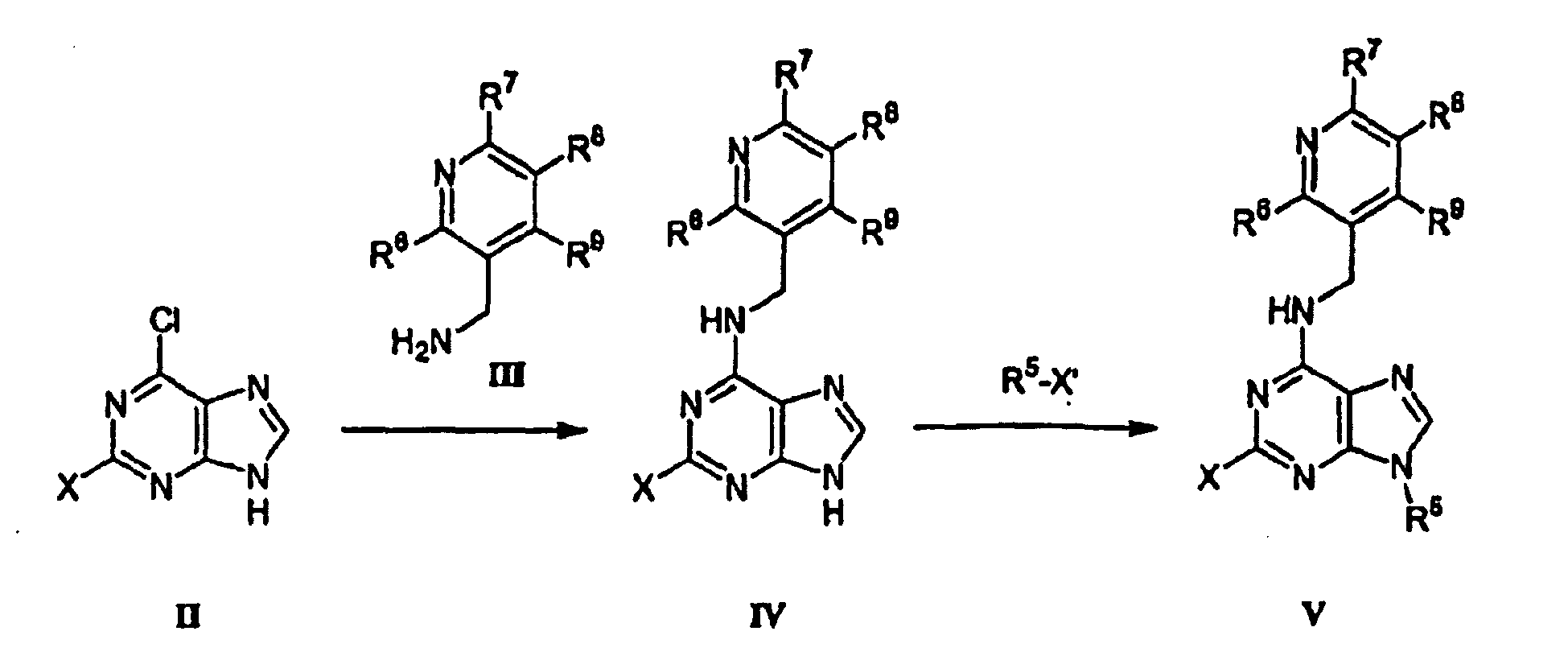 (i) Umsetzen einer Verbindung der Formel II mit einer Verbindung der Formel III unter Bildung einer Verbindung der Formel IV,(ii) Alkylieren der Verbindung der Formel IV mit einem Alkylhalogenid, R5-X', unter Bildung einer Verbindung der Formel V.
 - Verfahren nach Anspruch 39, wobei die Verbindung der Formel VI durch die folgenden Stufen hergestellt wird:
 (i) Oxidieren einer Verbindung der Formel VIII, wobei PG eine Schutzgruppe ist, unter Bildung einer Verbindung der Formel IX,(ii) Alkylieren der Verbindung der Formel IX unter Bildung einer Verbindung der Formel X,(iii) Entfernen der Schutzgruppe PG von der Verbindung der Formel Xoder(i) Oxidieren einer Verbindung der Formel VIII, wobei PG eine Schutzgruppe ist, unter Bildung einer Verbindung der Formel IX,(ii) Alkylieren der Verbindung der Formel IX unter Bildung einer Verbindung der Formel X,(iii) Oxidieren der Verbindung der Formel X unter Bildung einer Verbindung der Formel XII,(iv) Alkylieren der Verbindung der Formel XII unter Bildung einer Verbindung der Formel XIII,(v) Entfernen der Schutzgruppe PG von der Verbindung der Formel XIII.
 - Verfahren nach Anspruch 39, wobei R3 = R4 ist und die Verbindung der Formel VI durch ein Verfahren hergestellt wird, welches die folgenden Stufen umfaßt:
 (i) Umwandeln einer Verbindung der Formel XVI, wobei PG' eine Schutzgruppe ist und R eine Alkylgruppe ist, in eine Verbindung der Formel XVII,(ii) Entfernen der Schutzgruppen PG' von der Verbindung der Formel XVII unter Bildung einer Verbindung der Formel VI.
 - Verfahren nach Anspruch 42, wobei die Verbindung der Formel XVI über eine doppelte Grignard-Reaktion in eine Verbindung der Formel XVII umgewandelt wird.
- Verfahren nach einem der Ansprüche 42 oder 43, wobei die Verbindung der Formel VI durch die folgenden Stufen hergestellt wird:
 (i) Umsetzen einer Verbindung der Formel XIV mit SOCl2 und MeOH unter Bildung einer Verbindung der Formel XV,(ii) Schützen der Aminogruppe der Verbindung der Formel XV unter Bildung einer Verbindung der Formel XVIa,(iii) Umsetzen der Verbindung der Formel XVIa mit einem Grignard-Reagens R3X", wobei R3 wie in Anspruch 1 definiert ist und X" ein Halogenid ist, unter Bildung einer Verbindung der Formel XVII,(iv) Entfernen der Schutzgruppen PG' von der Verbindung der Formel XVII unter Bildung der Verbindung der Formel VI.
Applications Claiming Priority (3)
| Application Number | Priority Date | Filing Date | Title |
|---|---|---|---|
| GB0219054 | 2002-08-15 | ||
| GBGB0219054.4A GB0219054D0 (en) | 2002-08-15 | 2002-08-15 | New purine derivatives |
| PCT/GB2003/003554 WO2004016612A2 (en) | 2002-08-15 | 2003-08-13 | New purine derivatives |
Publications (3)
| Publication Number | Publication Date |
|---|---|
| EP1529047A2 EP1529047A2 (de) | 2005-05-11 |
| EP1529047B1 true EP1529047B1 (de) | 2007-02-21 |
| EP1529047B8 EP1529047B8 (de) | 2010-05-19 |
Family
ID=9942408
Family Applications (1)
| Application Number | Title | Priority Date | Filing Date |
|---|---|---|---|
| EP03748238A Expired - Lifetime EP1529047B8 (de) | 2002-08-15 | 2003-08-13 | Neue purine derivate |
Country Status (17)
| Country | Link |
|---|---|
| US (2) | US7582642B2 (de) |
| EP (1) | EP1529047B8 (de) |
| JP (1) | JP4723858B2 (de) |
| CN (1) | CN1329393C (de) |
| AT (1) | ATE354574T1 (de) |
| AU (1) | AU2003267547B2 (de) |
| BR (1) | BRPI0313477B8 (de) |
| CA (1) | CA2492659C (de) |
| DE (1) | DE60311995T2 (de) |
| DK (1) | DK1529047T3 (de) |
| ES (1) | ES2280773T3 (de) |
| GB (2) | GB0219054D0 (de) |
| IL (1) | IL166784A (de) |
| MX (1) | MXPA05001843A (de) |
| NZ (1) | NZ538135A (de) |
| PT (1) | PT1529047E (de) |
| WO (1) | WO2004016612A2 (de) |
Families Citing this family (31)
| Publication number | Priority date | Publication date | Assignee | Title |
|---|---|---|---|---|
| FR2741881B1 (fr) * | 1995-12-01 | 1999-07-30 | Centre Nat Rech Scient | Nouveaux derives de purine possedant notamment des prorietes anti-proliferatives et leurs applications biologiques |
| GB0012528D0 (en) * | 2000-05-23 | 2000-07-12 | Univ Palackeho | Triterpenoid derivatives |
| WO2003002565A1 (en) * | 2001-06-27 | 2003-01-09 | Cyclacel Limited | 2,6,9-substituted purine derivatives and their use n the treatment of proliferative disorders |
| GB0219054D0 (en) * | 2002-08-15 | 2002-09-25 | Cyclacel Ltd | New purine derivatives |
| GB0219052D0 (en) * | 2002-08-15 | 2002-09-25 | Cyclacel Ltd | New puring derivatives |
| PL1799230T3 (pl) | 2004-08-27 | 2013-05-31 | Cyclacel Ltd | Purynowe i pirymidynowe inhibitory CDK i ich zastosowanie do leczenia chorób autoimmunologicznych |
| WO2007054725A2 (en) * | 2005-11-11 | 2007-05-18 | Cyclacel Limited | Combination of a cdk-inhibitor and a hdac-inhibitor |
| DK1984353T3 (en) | 2006-01-23 | 2016-03-14 | Amgen Inc | Aurorakinasemodulatorer and method of use |
| US7560551B2 (en) | 2006-01-23 | 2009-07-14 | Amgen Inc. | Aurora kinase modulators and method of use |
| US7868177B2 (en) | 2006-02-24 | 2011-01-11 | Amgen Inc. | Multi-cyclic compounds and method of use |
| WO2008057280A1 (en) | 2006-10-27 | 2008-05-15 | Amgen Inc. | Multi-cyclic compounds and methods of use |
| GB0706633D0 (en) * | 2007-04-04 | 2007-05-16 | Cyclacel Ltd | Combination |
| GB0706632D0 (en) * | 2007-04-04 | 2007-05-16 | Cyclacel Ltd | New purine derivatives |
| MX2009010517A (es) | 2007-04-05 | 2009-10-19 | Amgen Inc | Moduladores de cinasa aurora y metodos de uso. |
| DK2209786T3 (da) | 2007-10-05 | 2013-06-03 | Verastem Inc | Pyrimidinsubstituerede purinderivater |
| JP2011515401A (ja) | 2008-03-20 | 2011-05-19 | アムジエン・インコーポレーテツド | オーロラキナーゼモジュレーターおよび使用方法 |
| US9126935B2 (en) | 2008-08-14 | 2015-09-08 | Amgen Inc. | Aurora kinase modulators and methods of use |
| JP5731978B2 (ja) * | 2008-09-26 | 2015-06-10 | インテリカイン, エルエルシー | 複素環キナーゼ阻害剤 |
| JP5363800B2 (ja) * | 2008-12-25 | 2013-12-11 | ライオン株式会社 | 育毛剤組成物 |
| CZ302122B6 (cs) * | 2009-01-28 | 2010-10-20 | Univerzita Palackého v Olomouci | Substituované deriváty 6-(2-aminobenzylamino)purinu, jejich použití jako léciva a prípravky tyto slouceniny obsahující |
| CN102428085B (zh) | 2009-04-03 | 2015-07-15 | 维拉斯通股份有限公司 | 作为激酶抑制剂的嘧啶取代的嘌呤化合物 |
| GB201001075D0 (en) | 2010-01-22 | 2010-03-10 | Cyclacel Ltd | Crystalline forms |
| WO2013059634A1 (en) | 2011-10-20 | 2013-04-25 | The Regents Of The University Of California | Use of cdk9 inhibitors to reduce cartilage degradation |
| EP2907514B1 (de) | 2014-02-17 | 2019-10-23 | Manros Therapeutics | Purinderivatverbindungen zur medizinischen Verwendung |
| US10300073B2 (en) | 2014-10-14 | 2019-05-28 | The Regents Of The University Of California | Use of CDK9 and BRD4 inhibitors to inhibit inflammation |
| AU2018213119B2 (en) | 2017-01-26 | 2021-10-28 | Cyclacel Limited | Process for preparing purine derivatives |
| EP3388432A1 (de) | 2017-04-10 | 2018-10-17 | Commissariat à l'Energie Atomique et aux Energies Alternatives | Purinderivate zur verwendung als medikament und zur verwendung bei der behandlung neurodegenerativer oder neuroinflammatorischer erkrankungen |
| GB202000901D0 (en) * | 2020-01-22 | 2020-03-04 | Cyclacel Ltd | Process |
| EP3901154A1 (de) * | 2020-04-23 | 2021-10-27 | Commissariat à l'énergie atomique et aux énergies alternatives | Purinderivate als arzneimittel zur behandlung von neonataler hypoxie-ischämie-hirnverletzung und verwandten erkrankungen |
| CN116813621A (zh) * | 2023-06-08 | 2023-09-29 | 江南大学 | 9h嘌呤类化合物及其药物组合物和用途 |
| WO2026024674A1 (en) | 2024-07-22 | 2026-01-29 | Genesis Therapeutics, Inc. | Methods of treating skp2-associated cancers |
Family Cites Families (17)
| Publication number | Priority date | Publication date | Assignee | Title |
|---|---|---|---|---|
| PT874846E (pt) | 1995-11-01 | 2003-08-29 | Novartis Ag | Derivados de purina e processos para a sua preparacao |
| FR2741881B1 (fr) * | 1995-12-01 | 1999-07-30 | Centre Nat Rech Scient | Nouveaux derives de purine possedant notamment des prorietes anti-proliferatives et leurs applications biologiques |
| US5866702A (en) * | 1996-08-02 | 1999-02-02 | Cv Therapeutics, Incorporation | Purine inhibitors of cyclin dependent kinase 2 |
| WO1998016528A1 (en) | 1996-10-11 | 1998-04-23 | Chiron Corporation | Purine inhibitors of glycogen synthase kinase 3 (gsk3) |
| AU735127B2 (en) * | 1997-08-07 | 2001-06-28 | Regents Of The University Of California, The | Purine inhibitor of protein kinases, G proteins and polymerases |
| WO1999034018A1 (en) | 1997-12-24 | 1999-07-08 | The Regents Of The University Of California | Methods of using chemical libraries to search for new kinase inhibitors |
| UA62996C2 (en) | 1998-02-26 | 2004-01-15 | Aventic Pharmaceuticals Inc | 6,9-disubstituted 2-[trans-(4-aminocyclohexyl)amino]purines |
| DE60023268T2 (de) * | 1999-02-01 | 2006-06-01 | CV Therapeutics, Inc., Palo Alto | INHIBITEURS PURIQUES DE KINASE 2 DEPENDANTE DES CYCLINES et IkB-alpha |
| US6627633B2 (en) * | 1999-03-17 | 2003-09-30 | Albany Molecular Research, Inc. | 6-substituted biaryl purine derivatives as potent cyclin/CDK inhibitors and antiproliferative agents |
| US6969720B2 (en) * | 1999-03-17 | 2005-11-29 | Amr Technology, Inc. | Biaryl substituted purine derivatives as potent antiproliferative agents |
| WO2003002565A1 (en) * | 2001-06-27 | 2003-01-09 | Cyclacel Limited | 2,6,9-substituted purine derivatives and their use n the treatment of proliferative disorders |
| US6667311B2 (en) * | 2001-09-11 | 2003-12-23 | Albany Molecular Research, Inc. | Nitrogen substituted biaryl purine derivatives as potent antiproliferative agents |
| US6812232B2 (en) * | 2001-09-11 | 2004-11-02 | Amr Technology, Inc. | Heterocycle substituted purine derivatives as potent antiproliferative agents |
| US20030229105A1 (en) * | 2002-05-21 | 2003-12-11 | Cyclacel Limited | Treatment of autoimmune disorders |
| GB0219054D0 (en) * | 2002-08-15 | 2002-09-25 | Cyclacel Ltd | New purine derivatives |
| GB0219052D0 (en) * | 2002-08-15 | 2002-09-25 | Cyclacel Ltd | New puring derivatives |
| GB0706632D0 (en) * | 2007-04-04 | 2007-05-16 | Cyclacel Ltd | New purine derivatives |
-
2002
- 2002-08-15 GB GBGB0219054.4A patent/GB0219054D0/en not_active Ceased
-
2003
- 2003-08-13 DE DE60311995T patent/DE60311995T2/de not_active Expired - Lifetime
- 2003-08-13 AT AT03748238T patent/ATE354574T1/de active
- 2003-08-13 DK DK03748238T patent/DK1529047T3/da active
- 2003-08-13 CN CNB038194252A patent/CN1329393C/zh not_active Expired - Fee Related
- 2003-08-13 BR BRPI0313477A patent/BRPI0313477B8/pt not_active IP Right Cessation
- 2003-08-13 PT PT03748238T patent/PT1529047E/pt unknown
- 2003-08-13 WO PCT/GB2003/003554 patent/WO2004016612A2/en not_active Ceased
- 2003-08-13 ES ES03748238T patent/ES2280773T3/es not_active Expired - Lifetime
- 2003-08-13 JP JP2004528667A patent/JP4723858B2/ja not_active Expired - Fee Related
- 2003-08-13 MX MXPA05001843A patent/MXPA05001843A/es active IP Right Grant
- 2003-08-13 CA CA2492659A patent/CA2492659C/en not_active Expired - Lifetime
- 2003-08-13 EP EP03748238A patent/EP1529047B8/de not_active Expired - Lifetime
- 2003-08-13 NZ NZ538135A patent/NZ538135A/en not_active IP Right Cessation
- 2003-08-13 AU AU2003267547A patent/AU2003267547B2/en not_active Ceased
- 2003-08-15 GB GB0319256A patent/GB2392155B/en not_active Expired - Fee Related
-
2005
- 2005-01-11 US US11/033,692 patent/US7582642B2/en not_active Expired - Lifetime
- 2005-02-09 IL IL166784A patent/IL166784A/en active IP Right Grant
-
2009
- 2009-06-23 US US12/489,663 patent/US8846696B2/en not_active Expired - Lifetime
Also Published As
| Publication number | Publication date |
|---|---|
| US20090325983A1 (en) | 2009-12-31 |
| DE60311995T2 (de) | 2007-10-31 |
| CA2492659A1 (en) | 2004-02-26 |
| CN1675211A (zh) | 2005-09-28 |
| US20050256142A1 (en) | 2005-11-17 |
| AU2003267547A1 (en) | 2004-03-03 |
| EP1529047A2 (de) | 2005-05-11 |
| MXPA05001843A (es) | 2005-04-19 |
| NZ538135A (en) | 2007-02-23 |
| GB2392155B (en) | 2005-03-30 |
| GB0319256D0 (en) | 2003-09-17 |
| IL166784A (en) | 2012-03-29 |
| IL166784A0 (en) | 2006-01-15 |
| CA2492659C (en) | 2012-07-17 |
| BRPI0313477B8 (pt) | 2021-05-25 |
| DE60311995D1 (de) | 2007-04-05 |
| US7582642B2 (en) | 2009-09-01 |
| JP4723858B2 (ja) | 2011-07-13 |
| EP1529047B8 (de) | 2010-05-19 |
| CN1329393C (zh) | 2007-08-01 |
| PT1529047E (pt) | 2007-03-30 |
| WO2004016612A2 (en) | 2004-02-26 |
| JP2006506341A (ja) | 2006-02-23 |
| BR0313477A (pt) | 2005-06-21 |
| US8846696B2 (en) | 2014-09-30 |
| WO2004016612A3 (en) | 2004-07-01 |
| GB2392155A (en) | 2004-02-25 |
| GB0219054D0 (en) | 2002-09-25 |
| ES2280773T3 (es) | 2007-09-16 |
| AU2003267547B2 (en) | 2009-06-18 |
| DK1529047T3 (da) | 2007-03-19 |
| BRPI0313477B1 (pt) | 2019-01-22 |
| ATE354574T1 (de) | 2007-03-15 |
Similar Documents
| Publication | Publication Date | Title |
|---|---|---|
| US8846696B2 (en) | Purine derivatives | |
| US20090270427A1 (en) | Purine derivatives | |
| US8592581B2 (en) | Trisubstituted purine derivatives | |
| US7612079B2 (en) | 2,6,9-substituted purine derivatives and their use in the treatment of proliferative disorders | |
| HK1139939B (en) | 2,6,9-substituted purine derivatives having antiproliferative properties |
Legal Events
| Date | Code | Title | Description |
|---|---|---|---|
| PUAI | Public reference made under article 153(3) epc to a published international application that has entered the european phase |
Free format text: ORIGINAL CODE: 0009012 |
|
| 17P | Request for examination filed |
Effective date: 20050302 |
|
| AK | Designated contracting states |
Kind code of ref document: A2 Designated state(s): AT BE BG CH CY CZ DE DK EE ES FI FR GB GR HU IE IT LI LU MC NL PT RO SE SI SK TR |
|
| AX | Request for extension of the european patent |
Extension state: AL LT LV MK |
|
| RAP1 | Party data changed (applicant data changed or rights of an application transferred) |
Owner name: CYCLACEL LIMITED |
|
| DAX | Request for extension of the european patent (deleted) | ||
| GRAP | Despatch of communication of intention to grant a patent |
Free format text: ORIGINAL CODE: EPIDOSNIGR1 |
|
| GRAS | Grant fee paid |
Free format text: ORIGINAL CODE: EPIDOSNIGR3 |
|
| GRAA | (expected) grant |
Free format text: ORIGINAL CODE: 0009210 |
|
| RAP1 | Party data changed (applicant data changed or rights of an application transferred) |
Owner name: CANCER RESEARCH TECHNOLOGY LIMITED |
|
| AK | Designated contracting states |
Kind code of ref document: B1 Designated state(s): AT BE BG CH CY CZ DE DK EE ES FI FR GB GR HU IE IT LI LU MC NL PT RO SE SI SK TR |
|
| PG25 | Lapsed in a contracting state [announced via postgrant information from national office to epo] |
Ref country code: SI Free format text: LAPSE BECAUSE OF FAILURE TO SUBMIT A TRANSLATION OF THE DESCRIPTION OR TO PAY THE FEE WITHIN THE PRESCRIBED TIME-LIMIT Effective date: 20070221 |
|
| RAP1 | Party data changed (applicant data changed or rights of an application transferred) |
Owner name: CANCER RESEARCH TECHNOLOGY LIMITED Owner name: CYCLACEL LIMITED |
|
| REG | Reference to a national code |
Ref country code: GB Ref legal event code: FG4D |
|
| REG | Reference to a national code |
Ref country code: RO Ref legal event code: EPE |
|
| REG | Reference to a national code |
Ref country code: CH Ref legal event code: EP |
|
| REG | Reference to a national code |
Ref country code: DK Ref legal event code: T3 |
|
| REG | Reference to a national code |
Ref country code: SE Ref legal event code: TRGR |
|
| REG | Reference to a national code |
Ref country code: PT Ref legal event code: SC4A Free format text: AVAILABILITY OF NATIONAL TRANSLATION Effective date: 20070307 |
|
| REF | Corresponds to: |
Ref document number: 60311995 Country of ref document: DE Date of ref document: 20070405 Kind code of ref document: P |
|
| REG | Reference to a national code |
Ref country code: IE Ref legal event code: FG4D |
|
| PG25 | Lapsed in a contracting state [announced via postgrant information from national office to epo] |
Ref country code: BG Free format text: LAPSE BECAUSE OF EXPIRATION OF PROTECTION Effective date: 20070522 |
|
| REG | Reference to a national code |
Ref country code: GR Ref legal event code: EP Ref document number: 20070401306 Country of ref document: GR |
|
| REG | Reference to a national code |
Ref country code: CH Ref legal event code: NV Representative=s name: MICHELI & CIE SA |
|
| REG | Reference to a national code |
Ref country code: HU Ref legal event code: AG4A Ref document number: E001526 Country of ref document: HU |
|
| ET | Fr: translation filed | ||
| REG | Reference to a national code |
Ref country code: ES Ref legal event code: FG2A Ref document number: 2280773 Country of ref document: ES Kind code of ref document: T3 |
|
| PG25 | Lapsed in a contracting state [announced via postgrant information from national office to epo] |
Ref country code: SK Free format text: LAPSE BECAUSE OF FAILURE TO SUBMIT A TRANSLATION OF THE DESCRIPTION OR TO PAY THE FEE WITHIN THE PRESCRIBED TIME-LIMIT Effective date: 20070221 |
|
| PLBE | No opposition filed within time limit |
Free format text: ORIGINAL CODE: 0009261 |
|
| 26N | No opposition filed |
Effective date: 20071122 |
|
| GBPC | Gb: european patent ceased through non-payment of renewal fee |
Effective date: 20070813 |
|
| PG25 | Lapsed in a contracting state [announced via postgrant information from national office to epo] |
Ref country code: MC Free format text: LAPSE BECAUSE OF NON-PAYMENT OF DUE FEES Effective date: 20070831 |
|
| PG25 | Lapsed in a contracting state [announced via postgrant information from national office to epo] |
Ref country code: GB Free format text: LAPSE BECAUSE OF NON-PAYMENT OF DUE FEES Effective date: 20070813 |
|
| PG25 | Lapsed in a contracting state [announced via postgrant information from national office to epo] |
Ref country code: EE Free format text: LAPSE BECAUSE OF FAILURE TO SUBMIT A TRANSLATION OF THE DESCRIPTION OR TO PAY THE FEE WITHIN THE PRESCRIBED TIME-LIMIT Effective date: 20070221 |
|
| PG25 | Lapsed in a contracting state [announced via postgrant information from national office to epo] |
Ref country code: CY Free format text: LAPSE BECAUSE OF FAILURE TO SUBMIT A TRANSLATION OF THE DESCRIPTION OR TO PAY THE FEE WITHIN THE PRESCRIBED TIME-LIMIT Effective date: 20070221 |
|
| PLAA | Information modified related to event that no opposition was filed |
Free format text: ORIGINAL CODE: 0009299DELT |
|
| PLBE | No opposition filed within time limit |
Free format text: ORIGINAL CODE: 0009261 |
|
| PLAA | Information modified related to event that no opposition was filed |
Free format text: ORIGINAL CODE: 0009299DELT |
|
| PLBE | No opposition filed within time limit |
Free format text: ORIGINAL CODE: 0009261 |
|
| STAA | Information on the status of an ep patent application or granted ep patent |
Free format text: STATUS: NO OPPOSITION FILED WITHIN TIME LIMIT |
|
| 26N | No opposition filed |
Effective date: 20071122 |
|
| RBV | Designated contracting states (corrected) |
Designated state(s): AT BE BG CH CY CZ DE DK EE ES FI FR GR HU IE IT LI LU MC NL PT RO SE SI SK TR |
|
| 26N | No opposition filed |
Effective date: 20071122 |
|
| RBV | Designated contracting states (corrected) |
Designated state(s): AT BE BG CH CY CZ DE DK EE ES FI FR GR HU IE IT LI LU MC NL PT RO SE SI SK TR |
|
| REG | Reference to a national code |
Ref country code: FR Ref legal event code: PLFP Year of fee payment: 14 |
|
| REG | Reference to a national code |
Ref country code: FR Ref legal event code: PLFP Year of fee payment: 15 |
|
| REG | Reference to a national code |
Ref country code: FR Ref legal event code: PLFP Year of fee payment: 16 |
|
| PGFP | Annual fee paid to national office [announced via postgrant information from national office to epo] |
Ref country code: NL Payment date: 20210812 Year of fee payment: 19 Ref country code: LU Payment date: 20210812 Year of fee payment: 19 |
|
| PGFP | Annual fee paid to national office [announced via postgrant information from national office to epo] |
Ref country code: IT Payment date: 20210816 Year of fee payment: 19 Ref country code: IE Payment date: 20210825 Year of fee payment: 19 Ref country code: FI Payment date: 20210825 Year of fee payment: 19 Ref country code: CZ Payment date: 20210813 Year of fee payment: 19 Ref country code: AT Payment date: 20210825 Year of fee payment: 19 Ref country code: FR Payment date: 20210818 Year of fee payment: 19 |
|
| PGFP | Annual fee paid to national office [announced via postgrant information from national office to epo] |
Ref country code: RO Payment date: 20210806 Year of fee payment: 19 Ref country code: GR Payment date: 20210825 Year of fee payment: 19 Ref country code: HU Payment date: 20210731 Year of fee payment: 19 Ref country code: SE Payment date: 20210817 Year of fee payment: 19 Ref country code: TR Payment date: 20210802 Year of fee payment: 19 Ref country code: CH Payment date: 20210813 Year of fee payment: 19 Ref country code: DE Payment date: 20210818 Year of fee payment: 19 Ref country code: BE Payment date: 20210812 Year of fee payment: 19 Ref country code: ES Payment date: 20210916 Year of fee payment: 19 Ref country code: DK Payment date: 20210818 Year of fee payment: 19 |
|
| PGFP | Annual fee paid to national office [announced via postgrant information from national office to epo] |
Ref country code: PT Payment date: 20210730 Year of fee payment: 19 |
|
| REG | Reference to a national code |
Ref country code: DE Ref legal event code: R119 Ref document number: 60311995 Country of ref document: DE |
|
| REG | Reference to a national code |
Ref country code: DK Ref legal event code: EBP Effective date: 20220831 |
|
| REG | Reference to a national code |
Ref country code: SE Ref legal event code: EUG |
|
| REG | Reference to a national code |
Ref country code: CH Ref legal event code: PL |
|
| REG | Reference to a national code |
Ref country code: NL Ref legal event code: MM Effective date: 20220901 |
|
| REG | Reference to a national code |
Ref country code: AT Ref legal event code: MM01 Ref document number: 354574 Country of ref document: AT Kind code of ref document: T Effective date: 20220813 |
|
| PG25 | Lapsed in a contracting state [announced via postgrant information from national office to epo] |
Ref country code: SE Free format text: LAPSE BECAUSE OF NON-PAYMENT OF DUE FEES Effective date: 20220814 Ref country code: RO Free format text: LAPSE BECAUSE OF NON-PAYMENT OF DUE FEES Effective date: 20220813 Ref country code: PT Free format text: LAPSE BECAUSE OF NON-PAYMENT OF DUE FEES Effective date: 20230213 Ref country code: LU Free format text: LAPSE BECAUSE OF NON-PAYMENT OF DUE FEES Effective date: 20220813 Ref country code: LI Free format text: LAPSE BECAUSE OF NON-PAYMENT OF DUE FEES Effective date: 20220831 Ref country code: FI Free format text: LAPSE BECAUSE OF NON-PAYMENT OF DUE FEES Effective date: 20220813 Ref country code: CZ Free format text: LAPSE BECAUSE OF NON-PAYMENT OF DUE FEES Effective date: 20220813 Ref country code: CH Free format text: LAPSE BECAUSE OF NON-PAYMENT OF DUE FEES Effective date: 20220831 Ref country code: AT Free format text: LAPSE BECAUSE OF NON-PAYMENT OF DUE FEES Effective date: 20220813 |
|
| REG | Reference to a national code |
Ref country code: BE Ref legal event code: MM Effective date: 20220831 |
|
| PG25 | Lapsed in a contracting state [announced via postgrant information from national office to epo] |
Ref country code: HU Free format text: LAPSE BECAUSE OF NON-PAYMENT OF DUE FEES Effective date: 20220814 Ref country code: GR Free format text: LAPSE BECAUSE OF NON-PAYMENT OF DUE FEES Effective date: 20230306 |
|
| PG25 | Lapsed in a contracting state [announced via postgrant information from national office to epo] |
Ref country code: NL Free format text: LAPSE BECAUSE OF NON-PAYMENT OF DUE FEES Effective date: 20220901 |
|
| PG25 | Lapsed in a contracting state [announced via postgrant information from national office to epo] |
Ref country code: IT Free format text: LAPSE BECAUSE OF NON-PAYMENT OF DUE FEES Effective date: 20220813 Ref country code: IE Free format text: LAPSE BECAUSE OF NON-PAYMENT OF DUE FEES Effective date: 20220813 Ref country code: FR Free format text: LAPSE BECAUSE OF NON-PAYMENT OF DUE FEES Effective date: 20220831 Ref country code: DK Free format text: LAPSE BECAUSE OF NON-PAYMENT OF DUE FEES Effective date: 20220831 Ref country code: DE Free format text: LAPSE BECAUSE OF NON-PAYMENT OF DUE FEES Effective date: 20230301 |
|
| REG | Reference to a national code |
Ref country code: ES Ref legal event code: FD2A Effective date: 20230928 |
|
| PG25 | Lapsed in a contracting state [announced via postgrant information from national office to epo] |
Ref country code: BE Free format text: LAPSE BECAUSE OF NON-PAYMENT OF DUE FEES Effective date: 20220831 |
|
| PG25 | Lapsed in a contracting state [announced via postgrant information from national office to epo] |
Ref country code: PT Free format text: LAPSE BECAUSE OF EXPIRATION OF PROTECTION Effective date: 20230824 Ref country code: ES Free format text: LAPSE BECAUSE OF NON-PAYMENT OF DUE FEES Effective date: 20220814 |
|
| PG25 | Lapsed in a contracting state [announced via postgrant information from national office to epo] |
Ref country code: PT Free format text: LAPSE BECAUSE OF NON-PAYMENT OF DUE FEES Effective date: 20220816 |
|
| PG25 | Lapsed in a contracting state [announced via postgrant information from national office to epo] |
Ref country code: PT Free format text: LAPSE BECAUSE OF NON-PAYMENT OF DUE FEES Effective date: 20220816 |