EP1524860A2 - Vorrichtung, System, und Verfahren zur Datenratensteuerung in einem Videocodierer - Google Patents
Vorrichtung, System, und Verfahren zur Datenratensteuerung in einem Videocodierer Download PDFInfo
- Publication number
- EP1524860A2 EP1524860A2 EP04024642A EP04024642A EP1524860A2 EP 1524860 A2 EP1524860 A2 EP 1524860A2 EP 04024642 A EP04024642 A EP 04024642A EP 04024642 A EP04024642 A EP 04024642A EP 1524860 A2 EP1524860 A2 EP 1524860A2
- Authority
- EP
- European Patent Office
- Prior art keywords
- picture
- bit rate
- controller
- complexity
- macroblock
- Prior art date
- Legal status (The legal status is an assumption and is not a legal conclusion. Google has not performed a legal analysis and makes no representation as to the accuracy of the status listed.)
- Ceased
Links
- 238000000034 method Methods 0.000 title claims description 25
- 230000007774 longterm Effects 0.000 claims abstract description 19
- 238000013139 quantization Methods 0.000 claims description 47
- 238000004458 analytical method Methods 0.000 claims description 17
- 230000006835 compression Effects 0.000 claims description 17
- 238000007906 compression Methods 0.000 claims description 17
- 238000005259 measurement Methods 0.000 claims description 12
- 230000032683 aging Effects 0.000 claims description 5
- 230000000694 effects Effects 0.000 claims description 5
- 230000004044 response Effects 0.000 claims description 5
- 238000012795 verification Methods 0.000 claims description 5
- 238000004364 calculation method Methods 0.000 claims description 3
- 238000012935 Averaging Methods 0.000 claims description 2
- 238000012545 processing Methods 0.000 claims 1
- 230000001419 dependent effect Effects 0.000 description 8
- 238000010586 diagram Methods 0.000 description 8
- 230000006870 function Effects 0.000 description 6
- 238000012546 transfer Methods 0.000 description 5
- 230000008901 benefit Effects 0.000 description 4
- 238000005096 rolling process Methods 0.000 description 4
- 230000009977 dual effect Effects 0.000 description 3
- 238000004519 manufacturing process Methods 0.000 description 3
- 230000001186 cumulative effect Effects 0.000 description 2
- 230000002939 deleterious effect Effects 0.000 description 2
- 238000012986 modification Methods 0.000 description 2
- 230000004048 modification Effects 0.000 description 2
- 238000003860 storage Methods 0.000 description 2
- 230000009286 beneficial effect Effects 0.000 description 1
- 230000005540 biological transmission Effects 0.000 description 1
- 238000013527 convolutional neural network Methods 0.000 description 1
- 238000013016 damping Methods 0.000 description 1
- 238000013500 data storage Methods 0.000 description 1
- 230000000593 degrading effect Effects 0.000 description 1
- 238000011161 development Methods 0.000 description 1
- 230000018109 developmental process Effects 0.000 description 1
- 238000011835 investigation Methods 0.000 description 1
- 238000013507 mapping Methods 0.000 description 1
- 230000005055 memory storage Effects 0.000 description 1
- 230000003287 optical effect Effects 0.000 description 1
- 230000008569 process Effects 0.000 description 1
- 230000000750 progressive effect Effects 0.000 description 1
- 238000004549 pulsed laser deposition Methods 0.000 description 1
- 230000009466 transformation Effects 0.000 description 1
- 238000013519 translation Methods 0.000 description 1
- 239000013598 vector Substances 0.000 description 1
Images




Classifications
-
- H—ELECTRICITY
- H04—ELECTRIC COMMUNICATION TECHNIQUE
- H04N—PICTORIAL COMMUNICATION, e.g. TELEVISION
- H04N19/00—Methods or arrangements for coding, decoding, compressing or decompressing digital video signals
- H04N19/10—Methods or arrangements for coding, decoding, compressing or decompressing digital video signals using adaptive coding
- H04N19/189—Methods or arrangements for coding, decoding, compressing or decompressing digital video signals using adaptive coding characterised by the adaptation method, adaptation tool or adaptation type used for the adaptive coding
- H04N19/196—Methods or arrangements for coding, decoding, compressing or decompressing digital video signals using adaptive coding characterised by the adaptation method, adaptation tool or adaptation type used for the adaptive coding being specially adapted for the computation of encoding parameters, e.g. by averaging previously computed encoding parameters
- H04N19/198—Methods or arrangements for coding, decoding, compressing or decompressing digital video signals using adaptive coding characterised by the adaptation method, adaptation tool or adaptation type used for the adaptive coding being specially adapted for the computation of encoding parameters, e.g. by averaging previously computed encoding parameters including smoothing of a sequence of encoding parameters, e.g. by averaging, by choice of the maximum, minimum or median value
-
- H—ELECTRICITY
- H04—ELECTRIC COMMUNICATION TECHNIQUE
- H04N—PICTORIAL COMMUNICATION, e.g. TELEVISION
- H04N19/00—Methods or arrangements for coding, decoding, compressing or decompressing digital video signals
- H04N19/10—Methods or arrangements for coding, decoding, compressing or decompressing digital video signals using adaptive coding
- H04N19/102—Methods or arrangements for coding, decoding, compressing or decompressing digital video signals using adaptive coding characterised by the element, parameter or selection affected or controlled by the adaptive coding
- H04N19/115—Selection of the code volume for a coding unit prior to coding
-
- H—ELECTRICITY
- H04—ELECTRIC COMMUNICATION TECHNIQUE
- H04N—PICTORIAL COMMUNICATION, e.g. TELEVISION
- H04N19/00—Methods or arrangements for coding, decoding, compressing or decompressing digital video signals
- H04N19/10—Methods or arrangements for coding, decoding, compressing or decompressing digital video signals using adaptive coding
- H04N19/102—Methods or arrangements for coding, decoding, compressing or decompressing digital video signals using adaptive coding characterised by the element, parameter or selection affected or controlled by the adaptive coding
- H04N19/124—Quantisation
-
- H—ELECTRICITY
- H04—ELECTRIC COMMUNICATION TECHNIQUE
- H04N—PICTORIAL COMMUNICATION, e.g. TELEVISION
- H04N19/00—Methods or arrangements for coding, decoding, compressing or decompressing digital video signals
- H04N19/10—Methods or arrangements for coding, decoding, compressing or decompressing digital video signals using adaptive coding
- H04N19/134—Methods or arrangements for coding, decoding, compressing or decompressing digital video signals using adaptive coding characterised by the element, parameter or criterion affecting or controlling the adaptive coding
- H04N19/136—Incoming video signal characteristics or properties
- H04N19/14—Coding unit complexity, e.g. amount of activity or edge presence estimation
-
- H—ELECTRICITY
- H04—ELECTRIC COMMUNICATION TECHNIQUE
- H04N—PICTORIAL COMMUNICATION, e.g. TELEVISION
- H04N19/00—Methods or arrangements for coding, decoding, compressing or decompressing digital video signals
- H04N19/10—Methods or arrangements for coding, decoding, compressing or decompressing digital video signals using adaptive coding
- H04N19/134—Methods or arrangements for coding, decoding, compressing or decompressing digital video signals using adaptive coding characterised by the element, parameter or criterion affecting or controlling the adaptive coding
- H04N19/146—Data rate or code amount at the encoder output
- H04N19/149—Data rate or code amount at the encoder output by estimating the code amount by means of a model, e.g. mathematical model or statistical model
-
- H—ELECTRICITY
- H04—ELECTRIC COMMUNICATION TECHNIQUE
- H04N—PICTORIAL COMMUNICATION, e.g. TELEVISION
- H04N19/00—Methods or arrangements for coding, decoding, compressing or decompressing digital video signals
- H04N19/10—Methods or arrangements for coding, decoding, compressing or decompressing digital video signals using adaptive coding
- H04N19/134—Methods or arrangements for coding, decoding, compressing or decompressing digital video signals using adaptive coding characterised by the element, parameter or criterion affecting or controlling the adaptive coding
- H04N19/146—Data rate or code amount at the encoder output
- H04N19/15—Data rate or code amount at the encoder output by monitoring actual compressed data size at the memory before deciding storage at the transmission buffer
-
- H—ELECTRICITY
- H04—ELECTRIC COMMUNICATION TECHNIQUE
- H04N—PICTORIAL COMMUNICATION, e.g. TELEVISION
- H04N19/00—Methods or arrangements for coding, decoding, compressing or decompressing digital video signals
- H04N19/10—Methods or arrangements for coding, decoding, compressing or decompressing digital video signals using adaptive coding
- H04N19/134—Methods or arrangements for coding, decoding, compressing or decompressing digital video signals using adaptive coding characterised by the element, parameter or criterion affecting or controlling the adaptive coding
- H04N19/154—Measured or subjectively estimated visual quality after decoding, e.g. measurement of distortion
-
- H—ELECTRICITY
- H04—ELECTRIC COMMUNICATION TECHNIQUE
- H04N—PICTORIAL COMMUNICATION, e.g. TELEVISION
- H04N19/00—Methods or arrangements for coding, decoding, compressing or decompressing digital video signals
- H04N19/10—Methods or arrangements for coding, decoding, compressing or decompressing digital video signals using adaptive coding
- H04N19/134—Methods or arrangements for coding, decoding, compressing or decompressing digital video signals using adaptive coding characterised by the element, parameter or criterion affecting or controlling the adaptive coding
- H04N19/157—Assigned coding mode, i.e. the coding mode being predefined or preselected to be further used for selection of another element or parameter
- H04N19/159—Prediction type, e.g. intra-frame, inter-frame or bidirectional frame prediction
-
- H—ELECTRICITY
- H04—ELECTRIC COMMUNICATION TECHNIQUE
- H04N—PICTORIAL COMMUNICATION, e.g. TELEVISION
- H04N19/00—Methods or arrangements for coding, decoding, compressing or decompressing digital video signals
- H04N19/10—Methods or arrangements for coding, decoding, compressing or decompressing digital video signals using adaptive coding
- H04N19/169—Methods or arrangements for coding, decoding, compressing or decompressing digital video signals using adaptive coding characterised by the coding unit, i.e. the structural portion or semantic portion of the video signal being the object or the subject of the adaptive coding
- H04N19/17—Methods or arrangements for coding, decoding, compressing or decompressing digital video signals using adaptive coding characterised by the coding unit, i.e. the structural portion or semantic portion of the video signal being the object or the subject of the adaptive coding the unit being an image region, e.g. an object
- H04N19/172—Methods or arrangements for coding, decoding, compressing or decompressing digital video signals using adaptive coding characterised by the coding unit, i.e. the structural portion or semantic portion of the video signal being the object or the subject of the adaptive coding the unit being an image region, e.g. an object the region being a picture, frame or field
-
- H—ELECTRICITY
- H04—ELECTRIC COMMUNICATION TECHNIQUE
- H04N—PICTORIAL COMMUNICATION, e.g. TELEVISION
- H04N19/00—Methods or arrangements for coding, decoding, compressing or decompressing digital video signals
- H04N19/10—Methods or arrangements for coding, decoding, compressing or decompressing digital video signals using adaptive coding
- H04N19/169—Methods or arrangements for coding, decoding, compressing or decompressing digital video signals using adaptive coding characterised by the coding unit, i.e. the structural portion or semantic portion of the video signal being the object or the subject of the adaptive coding
- H04N19/17—Methods or arrangements for coding, decoding, compressing or decompressing digital video signals using adaptive coding characterised by the coding unit, i.e. the structural portion or semantic portion of the video signal being the object or the subject of the adaptive coding the unit being an image region, e.g. an object
- H04N19/176—Methods or arrangements for coding, decoding, compressing or decompressing digital video signals using adaptive coding characterised by the coding unit, i.e. the structural portion or semantic portion of the video signal being the object or the subject of the adaptive coding the unit being an image region, e.g. an object the region being a block, e.g. a macroblock
-
- H—ELECTRICITY
- H04—ELECTRIC COMMUNICATION TECHNIQUE
- H04N—PICTORIAL COMMUNICATION, e.g. TELEVISION
- H04N19/00—Methods or arrangements for coding, decoding, compressing or decompressing digital video signals
- H04N19/10—Methods or arrangements for coding, decoding, compressing or decompressing digital video signals using adaptive coding
- H04N19/189—Methods or arrangements for coding, decoding, compressing or decompressing digital video signals using adaptive coding characterised by the adaptation method, adaptation tool or adaptation type used for the adaptive coding
- H04N19/196—Methods or arrangements for coding, decoding, compressing or decompressing digital video signals using adaptive coding characterised by the adaptation method, adaptation tool or adaptation type used for the adaptive coding being specially adapted for the computation of encoding parameters, e.g. by averaging previously computed encoding parameters
-
- H—ELECTRICITY
- H04—ELECTRIC COMMUNICATION TECHNIQUE
- H04N—PICTORIAL COMMUNICATION, e.g. TELEVISION
- H04N19/00—Methods or arrangements for coding, decoding, compressing or decompressing digital video signals
- H04N19/60—Methods or arrangements for coding, decoding, compressing or decompressing digital video signals using transform coding
- H04N19/61—Methods or arrangements for coding, decoding, compressing or decompressing digital video signals using transform coding in combination with predictive coding
Definitions
- the present invention generally relates to rate control of video compression encoders. More particularly, the present invention relates to constant bit rate (CBR) and variable bit rate (VBR) control for block-based video encoding, including but not limited to MPEG compatible video encoding.
- CBR constant bit rate
- VBR variable bit rate
- Video compression is commonly used to reduce the data storage and or transmission requirements of a recorded video stream.
- MPEG Motion Picture Experts Group
- MPEG-1 is intended for progressive video and is commonly used to store video on compact discs, such as Video Compact Disc (VCD).
- VCD Video Compact Disc
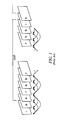
- the MPEG-1 standard defines a group of pictures (GOP).
- GOP group of pictures
- I Motion compensated predictive feedback is used to compress subsequent inter-coded frames
- P Motion compensated predictive feedback is used to compress subsequent inter-coded frames
- B Bidirectionally predicted frames, B, are coded using motion compensated prediction based on both previous and successive I or P frames.
- MPEG-2 adds compression support for interlaced video content.
- MPEG video compression divides each individual frame into regions called macroblocks. Individual macroblocks may be predicted from neighboring frames.
- a discrete cosine transform (DCT) is applied to the frame to compress the frame. The resulting DCT coefficients for each macroblock are then quantized.
- a variable length encoder is used to encode the data.
- a rate controller is used to select the quantization step size, which for a given image complexity will determine the bit rate.
- the quality of the image also depends upon the quantization step size.
- a programmable rate controller for a video compression encoder includes a variable bit rate encoder generating a first quantization step size, a constant bit rate encoder generating a second quantization step size, and a selector for selecting a maximum permissible quantization step size.
- variable bit controller has a target peak bit rate and a target average bit rate.
- variable bit rate controller adjusts the quantization step so that the average bit rate of the output bitstream of the encoder tracks the target average bit rate.
- a proportional integral control technique is used to track the target average bit rate according to a selectable time constant.
- the constant bit rate controller determines a statistical frequency of macroblock types within a current picture, generates a statistical indicator indicative of a complexity of each type of macroblock, predicts picture complexity using the statistical frequency of macroblock types and the statistical indicator of macroblock type complexity, generates a bit allocation consistent with the predicted picture complexity, and assigns a quantizer step size consistent with the bit allocation.
- Figure 1 is prior art drawing illustrating a MPEG group of pictures (GOP).
- FIG. 2 is a block diagram of a video compression encoder in accordance with one embodiment of the present invention.
- FIG. 3 is a block diagram of a CBR rate controller in accordance with one embodiment of the present invention.
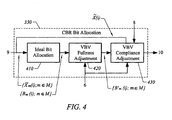
- FIG. 4 is a block diagram of a CBR bit allocator in accordance with one embodiment of the present invention.
- FIG. 5 is a block diagram of a dual CBR/VBR rate controller in accordance with one embodiment of the present invention.
- FIG. 6 is a block diagram of a core VBR rate controller in accordance with one embodiment of the present invention.
- Figure 7 is a block diagram of an equivalent model of a VBR rate controller for one set of conditions.
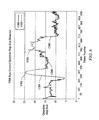
- Figure 8 is a plot illustrating exemplary quantizer step-size behavior for the dual VBR/CBR rate controller.
- FIG. 2 is a block diagram of a video compression encoder 200 in accordance with one embodiment of the present invention. It will be understood that the video compression encoder is adapted to receive video images and encode the video images to generate an output bit stream in compliance with a block-based video compression standard such as MPEG-1, MPEG-2, MPEG-4, or H.264, etc.
- a block-based video compression standard such as MPEG-1, MPEG-2, MPEG-4, or H.264, etc.
- Encoder 200 includes an MPEG motion estimation module 210, a macroblock coding decision module 220, a transform module 230 to perform a discrete cosine transform (DCT), a quantization module 240 to quantize the compressed DCT coefficients on a macroblock-per-macroblock basis according to a quantization step size, a variable length encode module 250 for encoding compressed image data into an output bitstream, and a programmable rate controller 260 for selecting the quantization step size.
- quantization module 240 includes a virtual quantizer scale that takes on values from 2 to any arbitrarily high value, e.g., 512.
- An encoder video bitstream verification (VBV) buffer (not shown) may be included in the encoder.
- a VBV buffer is a model hypothetical decoder buffer used to determine potential decoder buffer underflow and overflow conditions. It is desirable that the bitstream remain VBV compliant such that a corresponding decoder does not suffer a deleterious underflow or overflow condition.
- Programmable rate controller 260 is programmed to balance the short-term and long-term output bit production of the encoder against the video quality of the resulting decoded pictures. For MPEG-1 and MPEG-2, this balance may be accomplished by setting the quantization step size of the DCT coefficients on a macroblock-by-macroblock basis to attempt to avoid deleterious decoder buffer states that degrade image quality (e.g., underflow or overflow for constant bit rate encoding).
- programmable rate controller 260 includes a variable bit rate (VBR) rate controller 280, a constant bit rate (CBR) rate controller 290, and a selector (not shown) for selecting an output from either the VBR rate controller 280 or the CBR rate controller 290.
- the selector 510 picks the rate controller having the largest quantization step size as the output.
- VBR rate controller 280 permits a variable bit rate mode of operation.
- CBR rate controller 290 permits a constant bit rate mode of operation.
- the target average and target peak bit rates are the same.
- VBR rate controller 280 the target average and target peak bit rate may be set independently.
- CBR rate controller 290 classifies macroblock types, generates energy estimates of macroblock types, and creates a complexity estimate from macroblock statistics, from which a target bit rate is estimated. Additionally, as described below in more detail, in one embodiment the VBR rate controller 280 creates a target bit allocation by measuring changes in the average bit rate of the output bitstream over time, e.g., by tracking instantaneous and cumulative deviations between the actual and target long-term average bit rates and re-adjusting the target bit allocation accordingly.
- CBR or VBR The mode of operation (CBR or VBR) of programmable rate controller 260 will depend upon parameter constraints input to programmable rate controller 260 and a logical condition selected for the arbitration logic to choose either CBR or VBR. This permits, for example, the mode of operation to be selected to be entirely CBR, entirely VBR, or to switch back and forth between CBR and VBR depending upon the complexity of the picture frames that are being encoded and other parameters that are selected. As a result, programmable rate controller 260 has a response that may be adapted for different encoding applications by selecting the value of parameter constraints.
- Programmable rate controller 260 includes a parameter select input 215 for defining parameters to adjust the function of programmable rate controller 260.
- certain constraints such as the size of the video bitstream verification (VBV) buffer and the peak rate may be selected to guarantee MPEG-2 compliance and/or playback on a specified device, such as a VCD or DVD player.
- Other constraints, such as target long-term average bit-rate may be imposed so that applications can predict and/or pre-allocate the size of the output bitstream prior to encoding.
- Examples of programmable rate control parameters include a target average bit rate, R avg ; a maximum bit rate, R peak , corresponding to a maximum bit rate specified in the header of the bitstream used by video bitstream verification model; a bit rate time constant, ⁇ , for adjusting VBR operation to deviations in average bit rate; a VBV buffer size, B vbv in bits; a target quantizer scale, Q target for all macroblocks used by the VBR rate controller; an initial quantizer scale, Q 0 for the VBR rate controller; a minimum quantizer scale value, Q min , a lower bound on the target VBR quantizer scale value; and a maximum quantizer scale value, Q max , an upper bound on target VBR quantizer scale value for a picture.
- a VBV-delay field of the picture will be encoded with a non-0xFFFF value for MPEG-2 bitstreams, resulting in true MPEG CBR streams with zero stuffing.
- enable/disable signals may be included to enable or disable the CBR rate controller or the VBR rate controller.
- CBR rate controller 290 includes a picture analysis module 310, a complexity model module 320, a bit allocation module 330, and a picture-level quantizer assignment module 340.
- CBR rate controller 290 strives for consistent video quality over a rolling window of N future pictures, where N is a multiple of the GOP size.
- the requirement for constant bit-rate is achieved implicitly by preventing overflow and underflow in the output bit buffer (the VBV buffer for MPEG compliant encoding). Because the VBV bit buffer is filled at a constant rate once per picture, the bitstream is guaranteed to be CBR compliant if the VBV buffer does not overflow or underflow.
- the CBR rate controller 290 predicts the relationship between rate and quantizer step size based on statistics in the current picture and on the observed relationship between rate and quantizer step-size in previously encoded pictures. Based on these relationships, bits are allocated for the current picture with the goal of maintaining constant quality over the next N pictures.
- Quantization-dependent bits are encoded bits that vary directly with the quantization step size.
- quantization-dependent bits are those bits resulting from the encoding of the AC DCT coefficients.
- quantization-dependent bits are those bits resulting from the encoding of all DCT coefficients. In both cases, quantization-dependent bits exclude bits resulting from the encoding of motion vectors, headers, and skipped macroblocks.
- Quantization-independent bits are all non-quantization-dependent bits in a picture.
- the CBR rate controller 290 creates running estimates for the number quantization-independent bits in a picture independently for each picture type. The estimates are simply the output of a simple first-order infinite impulse response (IIR) filter operating on the past totals of quantization-dependent bits from pictures of the same type.
- IIR infinite impulse response
- Picture analysis module 310 classifies macroblocks by macroblock type and computes a statistical measure, called an energy value, indicative of the number of bits required to encode macroblocks of each type.
- Picture analysis module receives as inputs input image data 1, motion-compensated difference image data 2, and macroblock coding decision data 3 for picture i .
- a table listing some of the variables used in the rate quantization model is included in Appendix 2.
- a summary of some of the signals in the rate controller is included in Appendix 3.
- input image data 1 is in the form of luminance values of each pixel, which can be expressed by the equation: ⁇ P x,y ( i , j ); j ⁇ J ⁇ P x,y ( i , j ) corresponding to the set of luminance values P x,y ( i , j ) of each pixel of row x and column y of macroblock j in the original input picture for the set, J, of macroblock indices in a picture.
- motion compensated difference image data 2 can be expressed by the equation: ⁇ R x,y ( i , j ); j ⁇ J ⁇ corresponding to the set of luminance values of each pixel corresponding to row x and column y of macroblock j in the difference image resulting from the motion compensation of picture I for the set J, of macroblock indices in a picture.
- picture analysis module 310 classifies the macroblocks by macroblock types having distinct rate-quantization properties.
- the macroblock types are classified to generate statistics regarding the frequency of macroblocks that have different rate-quantization properties.
- the set of possible macroblock types is specified by the set K of different macroblocks (where K has at least two members) and is based on the macroblock coding decisions, assumed here to have been made prior to the start of rate control by macroblock coding decisions module 220.
- Examples of macroblock types in set K may include: intra blocks in an I-picture; intra blocks in a P- or B-picture; non-intra blocks in a P-picture without bi-directional motion compensation; non-Intra blocks in a B-picture without bi-directional motion; and non-intra blocks in a B-Picture with bi-directional motion.
- the number of macroblocks of each type within the set, K is counted.
- macroblock counts, ⁇ k ( i ); k ⁇ K ⁇ are computed according to the equation: where and J is a set of indices referring to each of the macroblocks in the current picture.
- the counts are normalized by the total number of macroblocks in the picture, resulting in a set of associated occurrence frequencies, ⁇ k ( i ); k ⁇ K ⁇ , given by the equation:
- Frequency measurements for the current picture are combined with past estimates to generate running frequency estimates, ⁇ ⁇ m,k ( i ); k ⁇ K , m ⁇ M ⁇ , which may be calculated according to the equation: where n is the picture type for the current picture. ⁇ m , k ( i ) may be used to estimate the probability with which a macroblock of type k will occur in a picture of type m .
- Picture analysis module 310 also generates statistical information indicative of the number of bits required to encode a macroblock of a particular type with a given quantizer step size.
- CBR rate controller 290 uses a difference measurement, such as a mean absolute difference (MAD) measure, of each macroblock type as an activity measurement to calculate an energy value indicative of the number of bits required to encode a macroblock type with a given quantizer step size.
- MAD mean absolute difference
- a macroblock type with a comparatively large MAD value is presumed to require more bits to encode than a macroblock type with a smaller MAD value.
- the MAD value may be computed as the mean absolute difference between the original luminance pixels, P x,y ( i , j ), and the mean pixel luminance of the macroblock, P ( i , j ) according to the equation:
- the MAD value is calculated as the mean absolute value of the luminance motion compensated differences, values R x,y ( i , j ) according to the equation:
- Picture analysis module 310 uses the MAD values to calculate an energy value for each macroblock type, with the energy value scaling the MAD value by an empirical factor to provide an approximate indication of image complexity.
- an energy measure, ⁇ e k ( i ); k ⁇ K ⁇ , for each macroblock type is calculated by averaging the MAD values (raised to the power ⁇ ) over all macroblocks in each macroblock type according to the equation:
- Picture analysis module 310 also generates time averaged energy estimates, ⁇ e k ( i ); k ⁇ K ⁇ which are also useful for understanding complexity.
- picture analysis module also generates an intra energy output 8 for use by bit allocation module 330 to improve bit prediction inside a VBV compliance check.
- intra energy output 8 is used by bit allocation module 330 to help anticipate sudden changes in picture complexity that otherwise might lead to VBV underflow and overflow.
- Picture analysis module 310 measures the intra energy, E intra ( i ), for the current picture by summing the energies of the original pixels for each macroblock in the image. This measurement is useful because I-frames are typically 12 to 15 frames apart.
- E intra ( i ) ⁇ ( i ) ⁇ E intra ( i -1)+(1- ⁇ ( i )) ⁇ E intra ( i ).
- Complexity model module 320 receives the macroblock classification and energy calculations information from picture analysis module 310 and measures the relative coding "complexities" for each of the macroblock types given by ⁇ x k ( i ); k ⁇ K ⁇ .
- the complexity model module 320 models the complexity for a macroblock type m according to the equation: where b ( i , j )and q ( i , j ) are respectively the number of quantization dependent bits and the quantization scale used to encode macroblock j from picture i.
- Complexity model module 320 also forms running estimates of the macroblock type complexities.
- the macroblock complexities for the current picture are combined with past values to generate running estimates for the macroblock type complexities, ⁇ x k ( i ); k ⁇ K ⁇ .
- a variety of factors may be used to create running estimates of the macroblock type complexities such as: including a contribution from all macroblocks of a macroblock type corresponding to a particular time instant; basing the contribution of a particular picture to the running-average complexity estimate for a particular macroblock type to be proportional to the number of macroblocks of that type in the picture; and statistically aging estimates such that the contribution of past macroblocks diminishes with time.
- the normalizing term in the denominator, ⁇ k ( i ) guarantees that constant input results in constant output.
- Complexity model module 320 calculates an estimate the complexity of the picture, which as described below in more detail, can be used by bit allocation module to adjust the target bit rate.
- the actual complexity, X ( i ), of the current picture (as determined after encoding) can be calculated from the encoding complexity, x k ( i ), of individual macroblocks, according to the equation:
- a predicted picture complexity can be calculated by substituting estimates of the macroblock complexities, ⁇ x k ( i ); k ⁇ K ⁇ , for the actual macroblock complexities, ⁇ x k ( i ); k ⁇ K ⁇ (which won't be known until after the picture is encoded).
- the macroblock complexities estimates are scaled for improved accuracy.
- the scale factors are the ratios of the actual macroblock energies and the macroblock energy estimates.
- the predicted picture complexity, ( i ) may be calculated according to the equation: where e 0 is a small constant (e.g., 0.5) that mitigates the effects of small energy values.
- the time averaged picture complexity is also estimated for each picture type.
- the complexities for each picture type, ⁇ X m ( i ); m ⁇ M ⁇ , are synthesized directly from the macroblock type complexities and their corresponding frequencies according to:
- Bit allocation module 330 receives complexity model data 9 from complexity model module 320, intra-energy estimates 9 from picture analysis module 310, and VBV fullness data 6 from variable length encoder 250.
- the complexity model data is used to generate an estimate of an ideal target bit rate, which is then adjusted using the intra-energy estimates and VBV fullness data to maintain VBV fullness and compliance within acceptable limits.
- bit allocation module 330 includes an ideal bit allocation module 410, a VBV fullness adjustment module 420, and a VBV compliance adjustment module 430.
- Ideal bit allocation module 410 starts with a nominal or "ideal" bit budget, B ( i ) for a forward-looking window, and adjusts it based on the difference between the actual VBV fullness and a picture-adjusted "ideal" VBV fullness, resulting in B' ( i ). Depending on the outcome of an iterative VBV compliance check, this budget may receive an adjustment to prevent VBV underflow.
- the final budget, B" ( i ) determines the bit allocation and subsequent quantizer assignment for the picture.
- ideal bit allocation module 410 receives ⁇ X m ( i ); m ⁇ M ⁇ ; which is the estimated complexity for pictures of type m after encoding picture i and M is the set of picture types (I, P, or B).
- ideal bit allocation module 410 generates ideal/target bit allocations, where ⁇ B m ( i ); m ⁇ M ⁇ is the ideal/nominal CBR bit allocation for pictures of type m prior to encoding picture i for each picture type, according to the equation: where B ( i ) is the bit budget for the next N pictures, m is the picture type index, W m is a parameter indicating the relative weighting for pictures of type m , and N m is the number of pictures of type m within a window of N pictures (usually but not necessarily a GOP). Note that the bit allocation is dynamically updated on a per-picture basis using a forward-looking rolling window.
- the target bit allocation algorithm is based on several assumptions.
- the first assumption is that the sum of the bit allocations for each of the pictures must equal the total bit budget for all of the pictures.
- B n X n W n ⁇ Q .
- VBV fullness adjustment module 420 receives the target/ideal bit allocation and also a signal indicative of VBV ( i- 1), where VBV(i) is the VBV fullness after encoding picture i .
- the CBR bit allocation module 330 strives to achieve an "ideal" VBV(i) fullness N pictures into the future.
- N The effect of N is such that as N increases, the algorithm reacts more slowly to deviations from the nominal or "ideal" VBV buffer fullness. A larger N provides a greater opportunity for constant quality video, but also a greater risk for VBV underflow.
- VBV ideal ( i ) the ideal VBV fullness, VBV ideal ( i ) can be determined for all remaining pictures in the rolling window using the ideal IPB bit allocation. Thus, it is desirable to assign a relatively full buffer just prior to encoding the I-frame, since I-frames usually generate the most bits per picture.
- the rate control creates a bit allocation, ⁇ B' m ( i ); m ⁇ M ⁇ based on the modified bit budget.
- VBV compliance check module 430 employs an iterative VBV compliance check that will reduce the proposed total bit budget, B'(i) , to prevent VBV underflow if VBV underflow is predicted to occur.
- the compliance process accomplishes this task by predicting the future path of VBV fullness, VBV predict ( i ), for the next N pictures based on an assumption that the encoder generates bits in a predetermined way. For the most part, the CBR algorithm assumes bits will be produced in accordance with the proposed bit allocation. However, there are two exceptions.
- VBV predict ( i ) drops below a specified minimum threshold VBV min , the algorithm reduces the bit allocation based on the following update procedure: where i err is the future picture index predicted to cause VBV underflow. Once the total bit budget is reduced, the CBR algorithm repeats the VBV compliance check using the reduced bit allocation, B" ( i ). The equation for B" ( i ) is derived by imposing the constraint that VBV predict ( i err ) will equal VBV min .
- the output 10 of VBV compliance adjustment is a bit budget, B" ( i ), and corresponding bit allocation, ⁇ B" m ( i ); m ⁇ M ⁇ , that is predicted to avoid VBV underflow over the next N pictures.
- the target quantizer scale for each macroblock which is nominally a real value, must be converted to an integer for compatibility with MPEG.
- a dithering algorithm may perform a translation at a specified update rate.
- programmable rate controller 260 includes a CBR rate controller 290 and a core VBR rate controller 280.
- the CBR rate controller 290 and the core VBR rate controller 280 make independent calculations of bit rate and a selection module 510 selects the maximum of the two bit rates.
- the final VBR quantizer scale, Q VBR is selected as the larger of the two proposed values:
- the core VBR rate controller 280 creates a target bit allocation, B VBR ( i ), for each picture by tracking the long-term average bit-rate.
- B VBR ( i ) A variety of tracking techniques may be used. These may include, for example, filters to filter out short term deviations in bit rate while permitting the long-term average bit-rate to vary slowly with respect to subsequent pictures within a group of pictures.
- One suitable tracking technique is to use proportional integral control techniques to select a response that is selectable by inputting a time constant that determines the nature of the response.
- Figure 6 is a block diagram illustrating a model of the core VBR rate controller 280 having a second-order Proportional-Integral (PI) controller to track the long-term average bit rate.
- PI Proportional-Integral
- This equation models the inverse relationship between the quantizer selection and the output bits produced by quantization and variable length encoding.
- the feedback transfer function, H ( z ) can be mapped into the Laplace domain and equate the resulting transfer function with the closed loop transfer function of a traditional analog second-order PI control system (with the additional assumption that the sample rate is quite large compared to the frequency range of interest).
- the rate controller of the present invention may be used for real time applications requiring a small time delay.
- the rate encoder may be implemented as a computationally efficient single pass rate encoder, i.e., a rate encoder not requiring multiple iterations of data to estimate the complexity of a picture with a sufficiently high accuracy to avoid VBV overflows and underflows.
- the rate controller can be set to a constant quality mode to provide the highest quality.
- Q target is set to the desired quality level.
- R peak , B vbv and a VBV Compliance Flag are set appropriately if VBV compliance is desired.
- a drawback of constant quality is that it results in an unpredictable file size.
- the best possible quality is selected for a predetermined file size.
- the settings for this mode of operation include: setting R avg with long term average bit rate goal; setting the time-constant, ⁇ , to a large value to minimize the effect of short-term bit rate production on quality such that ⁇ is preferably longer than the longest expected scene of any given complexity; setting Q 0 to an appropriate initial value for the VBR algorithm; setting Q min to an appropriate value so the encoder will not overly produce bits for simple content to maintain the average bit rate goal; setting Q max to an appropriate value so the encoder will not overly quantize complex scenes to maintain the average bit rate goal; and setting R peak , B vbv and setting a VBV Compliance Flag to enable VBV compliance.
- An advantage of this mode of operation is that it provides the best possible quality for a predetermined file size. However, it has the drawback that medium and high complexity scenes will end up with the same number of bits if the scene length is longer than the specified VBR time-constant.
- Another mode of operation is a true CBR video mode.
- the settings for this mode correspond to setting R peak to a desired bit-rate; setting the constant Rate Flag to true; and setting B vbv and the VBV Compliance Flag appropriately for VBV compliance.
- An advantage of this mode is that it provides true CBR video that can be written to VCD.
- a drawback is that the video quality is lower compared to other modes.
- R avg need not equal R peak and is determined by the storage capacity of the medium and the duration of the source content, and a compromise in rate must be made to fit on the disk at the expense of perfect video quality.
- a constant rate flag is set to false for this case.
- freedom exists to specify Q min , but not Q max (since it may prevent the rate control algorithm from achieving R avg ).
- R avg For a personal video recorder (PVR) the constraints on R avg are not tight, assuming a large hard drive memory storage capacity for storing compressed MPEG files. More freedom exists to choose R avg , R peak and B VBV . Freedom exists to specify Q min and Q max since the constraint on R avg is soft. For a large hard drive, quality effectively trumps rate, i.e., it is probably better to exceed R avg instead of degrading the video quality.
- Figure 8 is an exemplary plot of quantizer step size for dual mode VBR/CBR operation.
- the encoder operates in CBR mode and shifts mode to VBR for more complex scenes.
- a video compression encoder of the present invention is particularly beneficial for applications where a video compression encoder is used for applications having different constraints, such as burning a CD, PVR, etc...
- programmable rate controller 260 and encoder 200 may be implemented in hardware, software, firmware, or combination thereof. Consequently, a software embodiment of the present invention relates to a computer storage product with a computer-readable medium having computer code thereon for performing various computer-implemented operations.
- the media and computer code may be those specially designed and constructed for the purposes of the present invention, or they may be of the kind well known and available to those having skill in the computer software arts.
- Examples of computer-readable media include, but are not limited to: magnetic media such as hard disks, floppy disks, and magnetic tape; optical media such as CD-ROMs and holographic devices; magneto-optical media such as floptical disks; and hardware devices that are specially configured to store and execute program code, such as application-specific integrated circuits ("ASICs"), programmable logic devices ("PLDs”) and ROM and RAM devices.
- Examples of computer code include machine code, such as produced by a compiler, and files containing higher-level code that are executed by a computer using an interpreter.
- an embodiment of the invention may be implemented using Java, C++, or other object-oriented programming language and development tools.
- Another embodiment of the invention may be implemented in hardwired circuitry in place of, or in combination with, machine-executable software instructions.
Landscapes
- Engineering & Computer Science (AREA)
- Multimedia (AREA)
- Signal Processing (AREA)
- Computing Systems (AREA)
- Theoretical Computer Science (AREA)
- Physics & Mathematics (AREA)
- Mathematical Analysis (AREA)
- Mathematical Optimization (AREA)
- Pure & Applied Mathematics (AREA)
- General Physics & Mathematics (AREA)
- Algebra (AREA)
- Compression Or Coding Systems Of Tv Signals (AREA)
- Communication Control (AREA)
Priority Applications (1)
| Application Number | Priority Date | Filing Date | Title |
|---|---|---|---|
| EP08001754A EP1912442A3 (de) | 2003-10-16 | 2004-10-15 | Vorrichtung, System und Verfahren zur Ratensteuerung eines Videokodiergerätes |
Applications Claiming Priority (2)
| Application Number | Priority Date | Filing Date | Title |
|---|---|---|---|
| US688254 | 2003-10-16 | ||
| US10/688,254 US7535959B2 (en) | 2003-10-16 | 2003-10-16 | Apparatus, system, and method for video encoder rate control |
Related Child Applications (1)
| Application Number | Title | Priority Date | Filing Date |
|---|---|---|---|
| EP08001754A Division EP1912442A3 (de) | 2003-10-16 | 2004-10-15 | Vorrichtung, System und Verfahren zur Ratensteuerung eines Videokodiergerätes |
Publications (2)
| Publication Number | Publication Date |
|---|---|
| EP1524860A2 true EP1524860A2 (de) | 2005-04-20 |
| EP1524860A3 EP1524860A3 (de) | 2005-08-24 |
Family
ID=34377670
Family Applications (2)
| Application Number | Title | Priority Date | Filing Date |
|---|---|---|---|
| EP08001754A Withdrawn EP1912442A3 (de) | 2003-10-16 | 2004-10-15 | Vorrichtung, System und Verfahren zur Ratensteuerung eines Videokodiergerätes |
| EP04024642A Ceased EP1524860A3 (de) | 2003-10-16 | 2004-10-15 | Vorrichtung, System, und Verfahren zur Datenratensteuerung in einem Videocodierer |
Family Applications Before (1)
| Application Number | Title | Priority Date | Filing Date |
|---|---|---|---|
| EP08001754A Withdrawn EP1912442A3 (de) | 2003-10-16 | 2004-10-15 | Vorrichtung, System und Verfahren zur Ratensteuerung eines Videokodiergerätes |
Country Status (5)
| Country | Link |
|---|---|
| US (1) | US7535959B2 (de) |
| EP (2) | EP1912442A3 (de) |
| JP (1) | JP4388877B2 (de) |
| SG (1) | SG111296A1 (de) |
| TW (1) | TWI245570B (de) |
Cited By (4)
| Publication number | Priority date | Publication date | Assignee | Title |
|---|---|---|---|---|
| DE102007058033A1 (de) * | 2007-11-30 | 2009-06-04 | Paterok, Peter, Dr. | Verfahren und Vorrichtung zur verbesserten Videoausgabe |
| FR2945697A1 (fr) * | 2009-05-18 | 2010-11-19 | Actimagine | Procede et dispositif de compression d'une sequence video |
| ITTO20090486A1 (it) * | 2009-06-25 | 2010-12-26 | St Microelectronics Pvt Ltd | Controllore dinamico della velocita' di trasmissione indipendente dal gruppo di immagini |
| EP2720465A1 (de) * | 2012-09-13 | 2014-04-16 | Samsung Electronics Co., Ltd | Schaltung zur Bildkompression |
Families Citing this family (52)
| Publication number | Priority date | Publication date | Assignee | Title |
|---|---|---|---|---|
| US7266147B2 (en) * | 2003-03-31 | 2007-09-04 | Sharp Laboratories Of America, Inc. | Hypothetical reference decoder |
| US7986731B2 (en) * | 2004-02-06 | 2011-07-26 | Apple Inc. | H.264/AVC coder incorporating rate and quality controller |
| US7492820B2 (en) | 2004-02-06 | 2009-02-17 | Apple Inc. | Rate control for video coder employing adaptive linear regression bits modeling |
| US7453938B2 (en) * | 2004-02-06 | 2008-11-18 | Apple Inc. | Target bitrate estimator, picture activity and buffer management in rate control for video coder |
| US7869503B2 (en) * | 2004-02-06 | 2011-01-11 | Apple Inc. | Rate and quality controller for H.264/AVC video coder and scene analyzer therefor |
| US7746927B1 (en) * | 2004-03-26 | 2010-06-29 | Apple Inc. | Robust single-pass variable bit rate encoding |
| JP2005311559A (ja) * | 2004-04-20 | 2005-11-04 | Sony Corp | データ処理装置およびその方法と符号化装置 |
| US8548044B2 (en) * | 2005-01-26 | 2013-10-01 | Broadcom Corporation | Rate control in a video encoder according to a bit count estimate |
| US7924915B2 (en) * | 2005-01-28 | 2011-04-12 | Broadcom Corporation | Method and system for encoding video data |
| US20060239344A1 (en) * | 2005-04-25 | 2006-10-26 | Ashish Koul | Method and system for rate control in a video encoder |
| US20060256857A1 (en) * | 2005-05-16 | 2006-11-16 | Douglas Chin | Method and system for rate control in a video encoder |
| US20060256858A1 (en) * | 2005-05-16 | 2006-11-16 | Douglas Chin | Method and system for rate control in a video encoder |
| US20060256856A1 (en) * | 2005-05-16 | 2006-11-16 | Ashish Koul | Method and system for testing rate control in a video encoder |
| KR100679613B1 (ko) * | 2005-05-27 | 2007-02-06 | 한국표준과학연구원 | 탄소나노튜브 에미터를 구비하는 전계 방출 디스플레이 및그 제조 방법 |
| US8107540B2 (en) * | 2005-07-11 | 2012-01-31 | Cheetah Technologies, L.P. | Image complexity computation in packet based video broadcast systems |
| GB0522036D0 (en) * | 2005-10-28 | 2005-12-07 | Univ Hong Kong Science & Techn | Effective rate control for video encoding and transcoding |
| US8233535B2 (en) * | 2005-11-18 | 2012-07-31 | Apple Inc. | Region-based processing of predicted pixels |
| US8295343B2 (en) * | 2005-11-18 | 2012-10-23 | Apple Inc. | Video bit rate control method |
| US8861585B2 (en) * | 2006-01-20 | 2014-10-14 | Qualcomm Incorporated | Method and apparatus for error resilience algorithms in wireless video communication |
| US7917362B2 (en) * | 2006-04-19 | 2011-03-29 | Mediatek Inc. | Method and apparatus for determining a bit boundary of a repetition-coded signal |
| US20070280294A1 (en) * | 2006-05-31 | 2007-12-06 | Modulus Video, Inc. | Constrained Fidelity Constant Bit Rate Video Encoding Systems and Methods |
| JP4928176B2 (ja) * | 2006-06-27 | 2012-05-09 | キヤノン株式会社 | 映像符号化装置及び映像符号化方法 |
| US8780717B2 (en) * | 2006-09-21 | 2014-07-15 | General Instrument Corporation | Video quality of service management and constrained fidelity constant bit rate video encoding systems and method |
| TWI327429B (en) * | 2006-09-29 | 2010-07-11 | Hon Hai Prec Ind Co Ltd | Network apparatus and frame processing method thereof |
| US20080152009A1 (en) * | 2006-12-21 | 2008-06-26 | Emrah Akyol | Scaling the complexity of video encoding |
| US20090074075A1 (en) * | 2007-09-14 | 2009-03-19 | The Hong Kong University Of Science And Technology | Efficient real-time rate control for video compression processes |
| US8295344B2 (en) | 2007-10-22 | 2012-10-23 | Broadcom Corporation | Adaptive rate control for encoding of variable frame rate video sources |
| US8116372B1 (en) * | 2007-10-26 | 2012-02-14 | Xilinx, Inc. | Data structure and method using same for encoding video information |
| US8396114B2 (en) * | 2009-01-29 | 2013-03-12 | Microsoft Corporation | Multiple bit rate video encoding using variable bit rate and dynamic resolution for adaptive video streaming |
| US8311115B2 (en) * | 2009-01-29 | 2012-11-13 | Microsoft Corporation | Video encoding using previously calculated motion information |
| US8270473B2 (en) * | 2009-06-12 | 2012-09-18 | Microsoft Corporation | Motion based dynamic resolution multiple bit rate video encoding |
| US20110110422A1 (en) | 2009-11-06 | 2011-05-12 | Texas Instruments Incorporated | Transmission bit-rate control in a video encoder |
| KR101282193B1 (ko) * | 2009-11-10 | 2013-07-04 | 한국전자통신연구원 | 칼만 필터와 fir 필터를 사용한 동영상 인코더에서의 비트율 제어 방법 |
| WO2011068807A1 (en) * | 2009-12-01 | 2011-06-09 | Divx, Llc | System and method for determining bit stream compatibility |
| KR101072459B1 (ko) | 2010-02-19 | 2011-10-11 | 충북대학교 산학협력단 | 조합된 확장성 구조에서의 모드결정방법 |
| US8724710B2 (en) * | 2010-02-24 | 2014-05-13 | Thomson Licensing | Method and apparatus for video encoding with hypothetical reference decoder compliant bit allocation |
| US8705616B2 (en) | 2010-06-11 | 2014-04-22 | Microsoft Corporation | Parallel multiple bitrate video encoding to reduce latency and dependences between groups of pictures |
| TWI475888B (zh) * | 2011-07-06 | 2015-03-01 | Altek Corp | 預估影像壓縮尺寸的方法 |
| JP2013058147A (ja) * | 2011-09-09 | 2013-03-28 | Sony Corp | 画像処理装置及び方法、並びにプログラム |
| US9591318B2 (en) | 2011-09-16 | 2017-03-07 | Microsoft Technology Licensing, Llc | Multi-layer encoding and decoding |
| US9094684B2 (en) * | 2011-12-19 | 2015-07-28 | Google Technology Holdings LLC | Method for dual pass rate control video encoding |
| US11089343B2 (en) | 2012-01-11 | 2021-08-10 | Microsoft Technology Licensing, Llc | Capability advertisement, configuration and control for video coding and decoding |
| US20130188709A1 (en) | 2012-01-25 | 2013-07-25 | Sachin G. Deshpande | Video decoder for tiles with absolute signaling |
| US9510019B2 (en) | 2012-08-09 | 2016-11-29 | Google Inc. | Two-step quantization and coding method and apparatus |
| US9253483B2 (en) | 2012-09-25 | 2016-02-02 | Google Technology Holdings LLC | Signaling of scaling list |
| CN103702058B (zh) * | 2012-09-27 | 2015-09-16 | 珠海扬智电子科技有限公司 | 解交错运算的宏块状态辨识方法与影像处理装置 |
| US10171807B2 (en) * | 2015-01-29 | 2019-01-01 | Arris Enterprises Llc | Picture-level QP rate control for HEVC encoding |
| EP3324628B1 (de) | 2016-11-18 | 2021-12-29 | Axis AB | Verfahren und codierungssystem zur videocodierung |
| CA3066838A1 (en) * | 2019-01-08 | 2020-07-08 | Comcast Cable Communications, Llc | Processing media using neural networks |
| KR102791472B1 (ko) * | 2019-12-09 | 2025-04-08 | 삼성전자주식회사 | 전자장치 및 그 제어방법 |
| CN113612999B (zh) * | 2021-08-20 | 2024-03-22 | 北京市商汤科技开发有限公司 | 视频处理方法及装置、电子设备和存储介质 |
| CN118632000A (zh) * | 2023-03-07 | 2024-09-10 | 华为技术有限公司 | 一种图像编解码方法、装置及系统 |
Family Cites Families (27)
| Publication number | Priority date | Publication date | Assignee | Title |
|---|---|---|---|---|
| US5511054A (en) * | 1993-03-31 | 1996-04-23 | Sony Corporation | Apparatus and method for multiplexing encoded data signals and recording medium having multiplexed signals recorded thereon |
| BE1007490A3 (nl) | 1993-09-10 | 1995-07-11 | Philips Electronics Nv | Inrichting voor het overdragen van een pluraliteit van televisie signalen over een transmissie kanaal. |
| EP0753235B1 (de) | 1994-12-28 | 2000-07-12 | Koninklijke Philips Electronics N.V. | Pufferverwaltung in kompressionssystemen mit variabler bitrate |
| US5612900A (en) * | 1995-05-08 | 1997-03-18 | Kabushiki Kaisha Toshiba | Video encoding method and system which encodes using a rate-quantizer model |
| US5686964A (en) * | 1995-12-04 | 1997-11-11 | Tabatabai; Ali | Bit rate control mechanism for digital image and video data compression |
| US5929916A (en) | 1995-12-26 | 1999-07-27 | Legall; Didier J. | Variable bit rate encoding |
| US5650860A (en) * | 1995-12-26 | 1997-07-22 | C-Cube Microsystems, Inc. | Adaptive quantization |
| KR100297830B1 (ko) | 1996-11-09 | 2001-08-07 | 윤종용 | 영상단위별 비트발생량 조절 장치 및 방법 |
| US6055330A (en) * | 1996-10-09 | 2000-04-25 | The Trustees Of Columbia University In The City Of New York | Methods and apparatus for performing digital image and video segmentation and compression using 3-D depth information |
| US5978029A (en) * | 1997-10-10 | 1999-11-02 | International Business Machines Corporation | Real-time encoding of video sequence employing two encoders and statistical analysis |
| US6181742B1 (en) * | 1998-01-26 | 2001-01-30 | International Business Machines Corporation | Single pass target allocation for video encoding |
| US6278735B1 (en) | 1998-03-19 | 2001-08-21 | International Business Machines Corporation | Real-time single pass variable bit rate control strategy and encoder |
| US6167084A (en) * | 1998-08-27 | 2000-12-26 | Motorola, Inc. | Dynamic bit allocation for statistical multiplexing of compressed and uncompressed digital video signals |
| ES2259827T3 (es) * | 1998-10-13 | 2006-10-16 | Matsushita Electric Industrial Co., Ltd. | Regulacion de los requisitos de calculo y de memoria de un tren de bits comprimido en un decodificador de video. |
| JP4706104B2 (ja) | 1999-04-23 | 2011-06-22 | ソニー株式会社 | 画像符号化装置及びその方法 |
| US6567127B1 (en) | 1999-10-08 | 2003-05-20 | Ati International Srl | Method and apparatus for enhanced video encoding |
| US6535251B1 (en) * | 1999-10-26 | 2003-03-18 | Sharplabs Of America, Inc. | Video encoder and method for adjusting quantization step in real time |
| JP2001148858A (ja) | 1999-11-18 | 2001-05-29 | Sony Corp | 画像情報変換装置及び画像情報変換方法 |
| US6490320B1 (en) * | 2000-02-02 | 2002-12-03 | Mitsubishi Electric Research Laboratories Inc. | Adaptable bitstream video delivery system |
| JP2001251616A (ja) * | 2000-03-02 | 2001-09-14 | Media Glue Corp | 多重化音響・動画圧縮符号化信号変換方法、装置および変換プログラムを記録した媒体 |
| US8369401B1 (en) * | 2000-10-06 | 2013-02-05 | Stmicroelectronics Asia Pacific Pte Ltd. | System and method of bit allocation in scene change situations |
| CN1223197C (zh) | 2000-10-10 | 2005-10-12 | 皇家菲利浦电子有限公司 | 用于数字视频记录的视频比特率控制方法和设备 |
| US6763067B2 (en) | 2000-10-10 | 2004-07-13 | Sarnoff Corporation | Rate control for bitstream re-encoding |
| KR100468726B1 (ko) * | 2002-04-18 | 2005-01-29 | 삼성전자주식회사 | 실시간 가변 비트율 제어를 수행하는 부호화 장치 및 방법 |
| US7257162B2 (en) * | 2002-07-02 | 2007-08-14 | Conexant Systems, Inc. | Hypothetical reference decoder for compressed image and video |
| US7099389B1 (en) * | 2002-12-10 | 2006-08-29 | Tut Systems, Inc. | Rate control with picture-based lookahead window |
| SG140441A1 (en) | 2003-03-17 | 2008-03-28 | St Microelectronics Asia | Decoder and method of decoding using pseudo two pass decoding and one pass encoding |
-
2003
- 2003-10-16 US US10/688,254 patent/US7535959B2/en not_active Expired - Lifetime
-
2004
- 2004-10-15 EP EP08001754A patent/EP1912442A3/de not_active Withdrawn
- 2004-10-15 TW TW093131428A patent/TWI245570B/zh not_active IP Right Cessation
- 2004-10-15 SG SG200406502A patent/SG111296A1/en unknown
- 2004-10-15 EP EP04024642A patent/EP1524860A3/de not_active Ceased
- 2004-10-18 JP JP2004303307A patent/JP4388877B2/ja not_active Expired - Fee Related
Non-Patent Citations (2)
| Title |
|---|
| "TEST MODEL 5 ED - INTERNATIONAL ORGANIZATION FOR STANDARDIZATION = ORGANISATION INTERNATIONALE DE NORMALISATION", 1 January 1993, MPEG TEST MODEL 5. ISO-IEC/JTCI/SC29/WG11/N0400. CODED REPRESENTATION OF PICTURE AND AUDIO INFORMATION. DOCUMENT AVC-491B, VERSION 2: APRIL 1993, GENEVA, ISO, CH, PAGE(S) 1 - 119, XP001150695 * |
| MOHSENIAN N. ET AL: "Single-pass constant- and variable-bit-rate MPEG-2 video compression", IBM JOURNAL OF RESEARCH AND DEVELOPMENT, INTERNATIONAL BUSINESS MACHINES CORPORATION, NEW YORK, NY, US, vol. 43, no. 4, 1 July 1999 (1999-07-01), pages 489 - 509, XP002216512, ISSN: 0018-8646 * |
Cited By (8)
| Publication number | Priority date | Publication date | Assignee | Title |
|---|---|---|---|---|
| DE102007058033A1 (de) * | 2007-11-30 | 2009-06-04 | Paterok, Peter, Dr. | Verfahren und Vorrichtung zur verbesserten Videoausgabe |
| FR2945697A1 (fr) * | 2009-05-18 | 2010-11-19 | Actimagine | Procede et dispositif de compression d'une sequence video |
| WO2010133498A1 (fr) * | 2009-05-18 | 2010-11-25 | Mobiclip | Procede et dispositif de compression d' une sequence video |
| US8953672B2 (en) | 2009-05-18 | 2015-02-10 | Mobiclip | Method and device for compressing a video sequence |
| ITTO20090486A1 (it) * | 2009-06-25 | 2010-12-26 | St Microelectronics Pvt Ltd | Controllore dinamico della velocita' di trasmissione indipendente dal gruppo di immagini |
| US8913658B2 (en) | 2009-06-25 | 2014-12-16 | Stmicroelectronics International N.V. | GOP-independent dynamic bit-rate controller |
| US9497464B2 (en) | 2009-06-25 | 2016-11-15 | Stmicroelectronics International N.V. | GOP-independent dynamic bit-rate controller |
| EP2720465A1 (de) * | 2012-09-13 | 2014-04-16 | Samsung Electronics Co., Ltd | Schaltung zur Bildkompression |
Also Published As
| Publication number | Publication date |
|---|---|
| TWI245570B (en) | 2005-12-11 |
| SG111296A1 (en) | 2005-05-30 |
| EP1912442A3 (de) | 2009-08-12 |
| TW200526042A (en) | 2005-08-01 |
| US7535959B2 (en) | 2009-05-19 |
| JP2005192193A (ja) | 2005-07-14 |
| EP1912442A2 (de) | 2008-04-16 |
| EP1524860A3 (de) | 2005-08-24 |
| US20050084007A1 (en) | 2005-04-21 |
| JP4388877B2 (ja) | 2009-12-24 |
Similar Documents
| Publication | Publication Date | Title |
|---|---|---|
| US7535959B2 (en) | Apparatus, system, and method for video encoder rate control | |
| US7092441B1 (en) | Moving pictures encoding with constant overall bit rate | |
| EP1372113B1 (de) | Videokodierungsverfahren und -Vorrichtung mit variabler Bitrate | |
| US6654417B1 (en) | One-pass variable bit rate moving pictures encoding | |
| US9071840B2 (en) | Encoder with adaptive rate control for H.264 | |
| US6823008B2 (en) | Video bitrate control method and device for digital video recording | |
| EP0876059B1 (de) | Signalkodierung, -aufnahme und -übertragung | |
| JP2005102170A (ja) | ビデオエンコーダにおける離散的余弦変換係数に適応したフィルタリングの方法およびシステム | |
| JP2005073245A (ja) | ビデオエンコーダにおけるマクロブロックのエンコードモードを選択する方法、マイクロブロックをエンコードするモードを選択するために設計されるビデオエンコーダ、マクロブロックをエンコードするモードを選択するための命令を有するモジュールから成る有形の媒体に搭載されるコンピュータプログラム、およびマクロブロックのエンコーディングのモードを選択するために設計される回路 | |
| US8031774B2 (en) | Video encoding methods and systems with frame-layer rate control | |
| US20100166060A1 (en) | Video transcoder rate control | |
| US6982762B1 (en) | Sequence adaptive bit allocation for pictures encoding | |
| US6198878B1 (en) | Method and apparatus for encoding and decoding digital video data | |
| US20070009025A1 (en) | Method and apparatus for operational frame-layer rate control in video encoder | |
| US20120002724A1 (en) | Encoding device and method and multimedia apparatus including the encoding device | |
| US5781237A (en) | Video coding apparatus and video coding method | |
| Xie et al. | Sequence-based rate control for constant quality video | |
| Jagmohan et al. | MPEG-4 one-pass VBR rate control for digital storage | |
| US20030123539A1 (en) | Method and apparatus for video bit-rate control | |
| JP4179917B2 (ja) | 動画像符号化装置及び方法 | |
| Lee et al. | A rate control algorithm for DCT-based video coding using simple rate estimation and linear source model | |
| Yin et al. | A practical consistent-quality two-pass VBR video coding algorithm for digital storage application | |
| JP3149673B2 (ja) | 映像符号化装置、映像符号化方法、映像再生装置及び光ディスク | |
| KR100793781B1 (ko) | 실시간 동영상 부호화 장치 및 방법 | |
| JP4273386B2 (ja) | 符号化装置および符号化方法、プログラム、並びに記録媒体 |
Legal Events
| Date | Code | Title | Description |
|---|---|---|---|
| PUAI | Public reference made under article 153(3) epc to a published international application that has entered the european phase |
Free format text: ORIGINAL CODE: 0009012 |
|
| AK | Designated contracting states |
Kind code of ref document: A2 Designated state(s): AT BE BG CH CY CZ DE DK EE ES FI FR GB GR HU IE IT LI LU MC NL PL PT RO SE SI SK TR |
|
| AX | Request for extension of the european patent |
Extension state: AL HR LT LV MK |
|
| PUAL | Search report despatched |
Free format text: ORIGINAL CODE: 0009013 |
|
| AK | Designated contracting states |
Kind code of ref document: A3 Designated state(s): AT BE BG CH CY CZ DE DK EE ES FI FR GB GR HU IE IT LI LU MC NL PL PT RO SE SI SK TR |
|
| AX | Request for extension of the european patent |
Extension state: AL HR LT LV MK |
|
| 17P | Request for examination filed |
Effective date: 20051213 |
|
| AKX | Designation fees paid |
Designated state(s): AT BE BG CH CY CZ DE DK EE ES FI FR GB GR HU IE IT LI LU MC NL PL PT RO SE SI SK TR |
|
| 17Q | First examination report despatched |
Effective date: 20060303 |
|
| STAA | Information on the status of an ep patent application or granted ep patent |
Free format text: STATUS: THE APPLICATION HAS BEEN REFUSED |
|
| 18R | Application refused |
Effective date: 20101018 |