EP1524724B1 - Anschlussklemme zum Aufsetzen auf ein Trägerelement - Google Patents
Anschlussklemme zum Aufsetzen auf ein Trägerelement Download PDFInfo
- Publication number
- EP1524724B1 EP1524724B1 EP04021507A EP04021507A EP1524724B1 EP 1524724 B1 EP1524724 B1 EP 1524724B1 EP 04021507 A EP04021507 A EP 04021507A EP 04021507 A EP04021507 A EP 04021507A EP 1524724 B1 EP1524724 B1 EP 1524724B1
- Authority
- EP
- European Patent Office
- Prior art keywords
- connection terminal
- conductor
- housing
- terminal according
- connection
- Prior art date
- Legal status (The legal status is an assumption and is not a legal conclusion. Google has not performed a legal analysis and makes no representation as to the accuracy of the status listed.)
- Expired - Lifetime
Links
Images


Classifications
-
- H—ELECTRICITY
- H01—ELECTRIC ELEMENTS
- H01R—ELECTRICALLY-CONDUCTIVE CONNECTIONS; STRUCTURAL ASSOCIATIONS OF A PLURALITY OF MUTUALLY-INSULATED ELECTRICAL CONNECTING ELEMENTS; COUPLING DEVICES; CURRENT COLLECTORS
- H01R4/00—Electrically-conductive connections between two or more conductive members in direct contact, i.e. touching one another; Means for effecting or maintaining such contact; Electrically-conductive connections having two or more spaced connecting locations for conductors and using contact members penetrating insulation
- H01R4/10—Electrically-conductive connections between two or more conductive members in direct contact, i.e. touching one another; Means for effecting or maintaining such contact; Electrically-conductive connections having two or more spaced connecting locations for conductors and using contact members penetrating insulation effected solely by twisting, wrapping, bending, crimping, or other permanent deformation
- H01R4/16—Electrically-conductive connections between two or more conductive members in direct contact, i.e. touching one another; Means for effecting or maintaining such contact; Electrically-conductive connections having two or more spaced connecting locations for conductors and using contact members penetrating insulation effected solely by twisting, wrapping, bending, crimping, or other permanent deformation by bending
-
- H—ELECTRICITY
- H01—ELECTRIC ELEMENTS
- H01R—ELECTRICALLY-CONDUCTIVE CONNECTIONS; STRUCTURAL ASSOCIATIONS OF A PLURALITY OF MUTUALLY-INSULATED ELECTRICAL CONNECTING ELEMENTS; COUPLING DEVICES; CURRENT COLLECTORS
- H01R4/00—Electrically-conductive connections between two or more conductive members in direct contact, i.e. touching one another; Means for effecting or maintaining such contact; Electrically-conductive connections having two or more spaced connecting locations for conductors and using contact members penetrating insulation
- H01R4/28—Clamped connections, spring connections
- H01R4/48—Clamped connections, spring connections utilising a spring, clip, or other resilient member
- H01R4/4809—Clamped connections, spring connections utilising a spring, clip, or other resilient member using a leaf spring to bias the conductor toward the busbar
- H01R4/48185—Clamped connections, spring connections utilising a spring, clip, or other resilient member using a leaf spring to bias the conductor toward the busbar adapted for axial insertion of a wire end
- H01R4/4819—Clamped connections, spring connections utilising a spring, clip, or other resilient member using a leaf spring to bias the conductor toward the busbar adapted for axial insertion of a wire end the spring shape allowing insertion of the conductor end when the spring is unbiased
- H01R4/4823—Multiblade spring
-
- H—ELECTRICITY
- H01—ELECTRIC ELEMENTS
- H01R—ELECTRICALLY-CONDUCTIVE CONNECTIONS; STRUCTURAL ASSOCIATIONS OF A PLURALITY OF MUTUALLY-INSULATED ELECTRICAL CONNECTING ELEMENTS; COUPLING DEVICES; CURRENT COLLECTORS
- H01R4/00—Electrically-conductive connections between two or more conductive members in direct contact, i.e. touching one another; Means for effecting or maintaining such contact; Electrically-conductive connections having two or more spaced connecting locations for conductors and using contact members penetrating insulation
- H01R4/28—Clamped connections, spring connections
- H01R4/48—Clamped connections, spring connections utilising a spring, clip, or other resilient member
- H01R4/4809—Clamped connections, spring connections utilising a spring, clip, or other resilient member using a leaf spring to bias the conductor toward the busbar
- H01R4/484—Spring housing details
-
- H—ELECTRICITY
- H01—ELECTRIC ELEMENTS
- H01R—ELECTRICALLY-CONDUCTIVE CONNECTIONS; STRUCTURAL ASSOCIATIONS OF A PLURALITY OF MUTUALLY-INSULATED ELECTRICAL CONNECTING ELEMENTS; COUPLING DEVICES; CURRENT COLLECTORS
- H01R4/00—Electrically-conductive connections between two or more conductive members in direct contact, i.e. touching one another; Means for effecting or maintaining such contact; Electrically-conductive connections having two or more spaced connecting locations for conductors and using contact members penetrating insulation
- H01R4/28—Clamped connections, spring connections
- H01R4/48—Clamped connections, spring connections utilising a spring, clip, or other resilient member
- H01R4/4809—Clamped connections, spring connections utilising a spring, clip, or other resilient member using a leaf spring to bias the conductor toward the busbar
- H01R4/4846—Busbar details
-
- H—ELECTRICITY
- H01—ELECTRIC ELEMENTS
- H01R—ELECTRICALLY-CONDUCTIVE CONNECTIONS; STRUCTURAL ASSOCIATIONS OF A PLURALITY OF MUTUALLY-INSULATED ELECTRICAL CONNECTING ELEMENTS; COUPLING DEVICES; CURRENT COLLECTORS
- H01R9/00—Structural associations of a plurality of mutually-insulated electrical connecting elements, e.g. terminal strips or terminal blocks; Terminals or binding posts mounted upon a base or in a case; Bases therefor
- H01R9/22—Bases, e.g. strip, block, panel
- H01R9/24—Terminal blocks
- H01R9/26—Clip-on terminal blocks for side-by-side rail- or strip-mounting
Definitions
- the invention relates to a terminal with a housing, in particular for latching onto a carrier element, wherein in the housing at least one or more connection means for connecting in each case at least one conductor is or are used.
- a terminal block with a plurality of terminals is known, which are designed as screw connections.
- GB 2 212 008 A further shows a plug in which leads are inserted through through holes of plug contacts and clamped clamped.
- connection means comprises a bus bar, which is provided with a through hole for the passage of a conductor, wherein a clamping spring is pushed onto the busbar such that it passes through the through hole clamped inserted conductor to the busbar bending over.
- the busbar can then be provided at its remote from the through hole area in a conventional manner with any other connection for connecting a further conductor with a larger diameter. So it is particularly appropriate to form the terminal as a feed-through terminal and also to provide the busbar with one or more Wernernet® Joe, IDC connections and / or direct plug connections.
- a drawbar connection is selected as a further connection device, this expediently has the drawbar with the busbar and the clamping screw for connecting the first conductor of larger diameter, wherein the busbar of the drawbar is followed by a free busbar leg, which connects with the through-hole for inserting the second, premountable Ladder is provided with a smaller diameter.
- the clamping spring is tulip-like and by means of webs of the support element, which engage in the assembly in slots of the housing, pushed onto the busbar during assembly on the support member.
- the further conductor can be, for example, a very thin data line on the carrier element, which is inserted into the through hole only during assembly. Then, the housing is placed on the support member and locked there, wherein the clamping spring clamps the thin data line to the support member.
- the further connection device can then be a conductor with a much larger diameter - for example, from a domestic installation - introduced. It is thus not only possible in a simple manner to easily contact the very thin conductor but it is also possible in the simplest way to connect the very thin conductor with a much thicker conductor.
- the structure of the terminal is structurally simple and the assembly without special tool in the manner of a placing placement of the support element in a simple way and automatically possible.
- the housing has a cost-effective two-part construction with an upper housing part and a lower housing part, which can be locked together.
- the upper housing part is designed to be open on its side facing the lower housing part and has at least one or more partitions which, depending on the number of connecting devices - e.g. depending on the design 2, 3 or more - subdivide into a corresponding number of chambers.
- one of the connection devices is inserted as a passage connection in each of the chambers. Both the number of chambers and the connection directions can thus be varied in a simple manner to realize different numbers of connections.
- the busbar is bent in a U-shaped manner in its upper region, wherein one of the two longitudinal limbs of the U engages in the clamping yoke and is connected to the other of the two longitudinal limbs of the legs with the through hole of the U bent by 90 ° outwards ,
- one insertion opening for inserting a conductor into the clamping yoke and a further insertion opening for inserting a conductor into the through-hole are each formed on each of the side walls of the housing upper part, depending on the drawbar in a compact design.
- projecting lugs are further provided in a simple manner, which serve to engage behind a corresponding undercut in a receiving shaft of the support element, wherein a rear grip on the opposite side of the housing by means of a latching hook on the support element takes place on the housing is latched when the housing swings after the insertion of the nose in the undercuts on the support member.
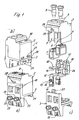
- the through-type terminal according to FIGS. 1 a - c has a housing 1 with a housing upper part 2 and a housing lower part 3 which can be latched to one another at a plurality of latching lugs 27 and latching recesses 28, in which the latching lugs 27 engage, furthermore webs 29 of the housing upper part 2 engage in the lower housing part 3.
- the upper housing part 2 is designed to be open on its side facing the lower housing part 3. It has at least one or more intermediate walls 4, which subdivide the space in the housing upper part 2 into a corresponding number of chambers 5, 6, depending on the number of connecting devices or, depending on the number of through-connections (for example two or three).
- each chamber 5, 6 one of the connection devices is inserted as a passage connection.
- each connection device 34 comprises a clamping yoke 7 with a clamping screw 8, wherein an opening 9 is provided on the upper side of the housing upper part for each clamping yoke 7, which serves to insert a screwdriver for actuating the clamping screw 8 of the clamping yoke 7.
- a busbar 10 which is bent in its upper region u-shaped, wherein one of the two longitudinal legs 11 of the U engages in the yoke 6 and wherein at the other of the two longitudinal legs 12 of the U a further bent by 90 ° outwards leg 13 is formed, which is aligned in the upper housing part down to the open side (or to the lower housing part 3) out.
- This leg 13 has, as a further connection contact of the connection device 34, a through hole 14 for the passage of a very thin conductor 20 (FIG. 2), wherein the leg 13 engages in its mounting position in a tulip-like clamping spring 15 (section of Fig. 3b).
- a tulip contact 16 To the base leg 26 of the U further integrally (eg in stamping / bending) here is a tulip contact 16, whose insertion 17 is adjacent to the drawbar in the housing, in each case adjacent to the opening 9 for the clamping screws 8 of the yoke 7 a further opening 30 (FIG. 1 a) is provided, which serves for inserting a further conductor into the tulip contact 16.
- an insertion opening 18 for inserting a conductor with a larger diameter into the clamping yoke 7 is furthermore formed per clamping yoke 7.
- each connection device 34 has three connection contacts for conductors (and / or plugs) which are conductively connected to one another: one of the tension yokes 7, one of the tulip contacts 16 (insertion direction perpendicular to the tension yoke) and Through hole 14 with the clamping spring 15th
- the one end of the thin conductor 20 is inserted during assembly, which is also bent with the U-shaped clamping spring 15 on the leg 14 in this area during insertion into a U-shape within the clamping spring 15 and thus fixed ( Fig. 2a, Fig. 3).
- the conductor 20 protrudes from the insertion opening 19 with a free end, which may be connected to an electronics on the support element.
- a carrier element 24 (such as a device housing or a circuit board receiving housing) serve on one side of the housing 1 two laterally projecting lugs 21, which serve to engage behind a corresponding undercut 22 in a receiving shaft 23 of the support member 24.
- a rear grip on the opposite side is realized on a shoulder 35 on the housing next to two projecting insertion funnel 25 at the insertion opening 19 to the through hole 14, which engage behind a latching hook 31 on the support member 24, when the housing 1 after insertion of the nose 21 in the undercuts 23rd is pivoted on the carrier element 24 (Fig. 2b).
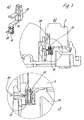
- webs 32 on the carrier element 24 engage in slots 33 of the housing lower part 3, which are designed and arranged such that they push the clamping springs 15 from a pre-assembly position on the legs 13 of the busbar 10, wherein the very thin conductor 20 -. 0.3 mm - bend in a simple manner accordingly and preassembled secured in a clamping manner (FIGS. 2 c, 3 a - c).
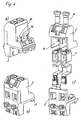
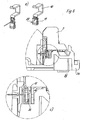
- FIGS. 4 to 6 differ from those of FIGS. 1 to 3 in that no tulip contacts are formed on the base legs 26 of the U-shaped busbars. This reduces the number of connection contacts per chamber by one, but this satisfies the requirements in many applications.
- the upper housing part 2 is provided for this according to Fig. 4-6 in the region of each chamber with an opening 36 at which the projecting here in the breakthrough conductor rails 10 with a probe or the like. Contactable.
Landscapes
- Connections Arranged To Contact A Plurality Of Conductors (AREA)
- Details Of Connecting Devices For Male And Female Coupling (AREA)
- Connection Or Junction Boxes (AREA)
- Wire Bonding (AREA)
- Lead Frames For Integrated Circuits (AREA)
- Installation Of Bus-Bars (AREA)
Description
- Die Erfindung betrifft eine Anschlussklemme mit einem Gehäuse, insbesondere zum Aufrasten auf ein Trägerelement, wobei in das Gehäuse wenigstens eine oder mehrere Anschlusseinrichtungen zum Anschluss jeweils wenigstens eines Leiters eingesetzt ist bzw. sind.
- Aus der DE 102 16 913 A1 ist eine Anschlußleiste mit mehreren Anschlüssen bekannt, die als Schraubanschlüsse ausgebildet sind.
- Die GB 2 212 008 A zeigt ferner einen Stecker, bei dem Anschlußleitungen durch Durchgangslöcher von Steckkontakten gesteckt und umbiegend festgeklemmt werden.
- Es besteht der Bedarf nach einer konstruktiv einfachen sowie leicht insbesondere auf einem Trägerelement zu montierenden Anschlussklemme, welche auf einfache Weise den Anschluss eines ersten dünneren Leiters und eines weiteren Leiters mit einem relativ zum ersten Leiter deutlich größeren Durchmesser, insbesondere eines Leiters mit einem mehrfachen Durchmesser ermöglichen soll. Es soll insbesondere möglich sein, auf einfache Weise eine Datenleitung mit einem Durchmesser von weniger als 1 mm, insbesondere weniger als 0,5 mm, mit einem Leiter mit einem mehrfachen Durchmesser von beispielsweise mehr als 1 oder 2 mm auf einfache Weise zu verbinden.
- Die Lösung dieses Problems ist die Aufgabe der Erfindung.
- Die Erfindung löst diese Aufgabe durch den Gegenstand des Anspruch 1. Danach umfasst wenigstens eine der Anschlusseinrichtungen eine Stromschiene auf, die mit einem Durchgangsloch zum Durchstecken des einen Leiters versehen ist, wobei eine Klemmfeder derart auf die Stromschiene aufschiebbar ist, dass sie den durch das Durchgangsloch gesteckten Leiter an der Stromschiene umbiegend festklemmt.
- Damit ist es auf einfache Weise möglich, an die Stromschiene einen sehr dünnen Leiter anzuschließen, wobei die Stromschiene dann an ihrem vom Durchgangsloch abgewandten Bereich in an sich bekannter Weise mit einem beliebigen sonstigen Anschluss zum Anschluss eines weiteren Leiters mit einem größeren Durchmesser versehen sein kann. So bietet es sich insbesondere an, die Anschlussklemme als Durchgangsklemme auszubilden und die Stromschiene ferner noch mit einem oder mehreren Zugbügelanschlüssen, Zugfederanschlüssen, IDC-Anschlüssen und/oder Direktsteckanschlüssen zu versehen.
- Wird als weitere Anschlusseinrichtung ein Zugbügelanschluss gewählt, weist dieser zweckmäßig den Zugbügel mit der Stromschiene und der Klemmschraube zum Anschluss des ersten Leiters größeren Durchmessers auf, wobei sich an die Stromschiene des Zugbügels ein freier Stromschienenschenkel anschließt, der mit dem Durchgangsloch zum Durchstecken des zweiten, vormontierbaren Leiters geringeren Durchmessers versehen ist.
- Nach einer vorteilhaften Variante ist die Klemmfeder tulpenartig ausgebildet und mittels Stegen des Trägerelements, welche bei der Montage in Schlitze des Gehäuses eingreifen, auf die Stromschiene bei der Montage auf dem Trägerelement aufschiebbar. Bei dem weiteren Leiter kann es sich beispielsweise um eine sehr dünne Datenleitung am Trägerelement handeln, die erst bei der Montage in das Durchgangsloch eingesteckt wird. Sodann wird das Gehäuse auf das Trägerelement aufgesetzt und dort verrastet, wobei die Klemmfeder die dünne Datenleitung am Trägerelement festklemmet. In die weitere Anschlusseinrichtung kann dann ein Leiter mit einem wesentlich größeren Durchmesser - z.B. aus einer Hausinstallation - eingeführt werden. Es ist somit nicht nur auf einfache Weise möglich, den sehr dünnen Leiter problemlos an sich zu kontaktieren sondern es wird auch auf einfachste Weise möglich, den sehr dünnen Leiter mit einem deutlich dickeren Leiter zu verbinden.
- Der Aufbau der Anschlussklemme ist konstruktiv einfach und die Montage ohne Spezialwerkzeug nach Art einer setzenden Bestückung des Trägerelementes auf einfache Weise auch automatisiert möglich.
- Besonders bevorzugt weist das Gehäuse kostengünstig einen zweiteiligen Aufbau mit einem Gehäuseoberteil und einem Gehäuseunterteil auf, die miteinander verrastbar sind.
- Zweckmäßig ist das Gehäuseoberteil an seiner zum Gehäuseunterteil gewandten Seite offen ausgelegt und weist wenigstens eine oder mehrere Zwischenwände auf, welche den Raum im Gehäuseunterteil je nach Anzahl der Anschlusseinrichtungen - z.B. je nach Auslegung 2, 3 oder mehr - in eine entsprechende Zahl von Kammern unterteilen. Dabei ist in jede der Kammern eine der Anschlusseinrichtungen als Durchgangsanschluss eingesetzt. Sowohl die Zahl der Kammern als auch die der Anschlussrichtungen kann damit zur Realisierung verschieden vieler Anschlüsse auf einfache Weise variiert werden.
- Vorteilhaft ist die Stromschiene in ihrem oberen Bereich u-förmig gebogen, wobei der eine der beiden Längsschenkel des U in den Zugbügel eingreift und wobei sich an den an den anderen der beiden Längsschenkel der Schenkel mit dem Durchgangsloch des U um 90° nach außen abgebogen anschließt.
- Es ist auch denkbar, in kostengünstiger Weise mit dem Grundschenkel der u-förmigen Stromschiene einstückig - insbesondere in Stanz-/Biegetechnik - jeweils einen weiteren Kontakt, insbesondere einen Tulpenkontakt, zu verbinden.
- Vorzugsweise ist an einer der Seitenwände des Gehäuseoberteils ferner je Zugbügel in kompakter Bauart je eine Einführöffnung zum Einführen eines Leiters in den Zugbügel und eine weitere Einführöffnung zum Einführen eines Leiters in das Durchgangsloch ausgebildet.
- Zur Festlegung und Fixierung des Gehäuses an dem Trägerelement sind weiter in einfacher Weise vorkragende Nasen vorgesehen, welche zum Hintergriff eines entsprechenden Hinterschnittes in einem Aufnahmeschacht des Trägerelementes dienen, wobei ein Hintergriff an der gegenüberliegenden Seite des Gehäuses mittels eines Rasthakens am Trägerelement erfolgt, der am Gehäuse verrastet ist, wenn das Gehäuse nach dem Einschieben der Nase in die Hinterschnitte auf das Trägerelement aufschwenkt.
- Weitere vorteilhafte Ausgestaltungen sind den übrigen Unteransprüchen zu entnehmen.
- Nachfolgend wird die Erfindung unter Bezug auf die Zeichnung näher beschrieben. Es zeigt:
- Fig. 1a, b
- zwei perspektivische Ansichten einer ersten Durchgangsklemme in zwei verschiedenen Richtungen,
- Fig. 1c
- eine Sprengansicht der Durchgangsklemme aus Fig. 1a,b; und
- Fig. 2a-c
- eine Darstellung der Metallteile einer der Anschlusseinrichtungen der Durchgangsklemme sowie zwei Darstellungen der Durchgangsklemme, welche die Montage der Metallteile und die der Durchgangsklemme an einem Trägerelement veranschaulichen;
- Fig. 3a-c
- eine Darstellung einer der Anschlusseinrichtungen der Durchgangsklemme sowie zwei Schnittdarstellungen der Durchgangsklemme im montierten Zustand
- Fig.4a, b
- zwei perspektivische Ansichten einer zweiten Durchgangsklemme in zwei verschiedenen Richtungen,
- Fig. 4c
- eine Sprengansicht der Durchgangsklemme aus Fig. 4a,b;
- Fig. 5a-c
- eine Darstellung der Metallteile der Klemme aus Fig. 4 nach Art der Darstellung der Fig. 2; und
- Fig. 6a-c
- eine Darstellung einer der Anschlusseinrichtungen der Durchgangsklemme aus Fig. 4 und 5 sowie zwei Schnittdarstellungen der Durchgangsklemme im montierten Zustand.
- Die Durchgangsklemme nach Fig. 1a -c weist ein Gehäuse 1 mit einem Gehäuseoberteil 2 und einem Gehäuseunterteil 3 auf, die miteinander an einer Mehrzahl von Rastnasen 27 sowie Rastausnehmungen 28, in welchen die Rastnasen 27 eingreifen, verrastbar sind, wobei ferner Stege 29 des Gehäuseoberteiles 2 in das Gehäuseunterteil 3 eingreifen.
- Das Gehäuseoberteil 2 ist an seiner zum Gehäuseunterteil 3 gewandten Seite offen ausgelegt. Es weist wenigstens eine oder mehrere Zwischenwände 4 auf, welche den Raum im Gehäuseoberteil 2 je nach Anzahl der Anschlusseinrichtungen bzw. je nach Anzahl der Durchgangsanschlüsse (z.B. zwei oder drei) in eine entsprechende Zahl von Kammern 5, 6 unterteilen.
- In jede Kammer 5, 6 ist eine der Anschlusseinrichtungen als Durchgangsanschluss eingesetzt.
- Hier umfasst jede Anschlusseinrichtung 34 einen Zugbügel 7 mit einer Klemmschraube 8, wobei an der Oberseite des Gehäuseoberteils je Zugbügel 7 eine Öffnung 9 vorgesehen ist, welche zum Einführen eines Schraubendrehers zur Betätigung der Klemmschraube 8 des Zugbügels 7 dient.
- In die Zugbügel 7 greift jeweils eine Stromschiene 10 ein, welche in ihrem oberen Bereich u-förmig gebogen ist, wobei der eine der beiden Längsschenkel 11 des U in den Zugbügel 6 eingreift und wobei an den an den anderen der beiden Längsschenkel 12 des U ein weiterer um 90° nach außen abgebogener Schenkel 13 angeformt ist, welcher im Gehäuseoberteil nach unten zur offenen Seite (bzw. zum Gehäuseunterteil 3 hin) hin ausgerichtet ist.
- Dieser Schenkel 13 weist als weiteren Anschlusskontakt der Anschlusseinrichtung 34 ein Durchgangsloch 14 zum Durchstecken eines sehr dünnen Leiters 20 (Fig. 2) auf, wobei der Schenkel 13 in seiner Montagestellung in eine tulpenartige Klemmfeder 15 eingreift (Schnitt der Fig. 3b).
- An den Grundschenkel 26 des U schließt sich ferner einstückig (z.B. in Stanz-/Biegetechnik) hier beispielhaft jeweils ein Tulpenkontakt 16 an, dessen Einführöffnung 17 neben dem Zugbügel im Gehäuse liegt, wobei jeweils neben der Öffnung 9 für die Klemmschrauben 8 der Zugbügel 7 eine weitere Öffnung 30 (Fig. 1a) vorgesehen ist, welche zum Einstecken eines weiteren Leiters in den Tulpenkontakt 16 dient.
- An einer der Seitenwände des Gehäuseoberteils 2 ist ferner je Zugbügel 7 eine Einführöffnung 18 zum Einführen eines Leiters mit größeren Durchmesser in den Zugbügel 7 ausgebildet.
- Unterhalb der Einführöffnung 18 liegt eine weitere Einführöffnung 19 zum Einführen des sehr dünnen Leiters 20 in das Durchgangsloch 14.
- Jede Anschlusseinrichtung 34 weist damit nach dem Ausführungsbeispiel der Fig. 1 bis 3 drei Anschlusskontakte für Leiter (und/oder Stecker) auf, welche leitend miteinander verbunden werden: einen der Zugbügel 7 , einen der Tulpenkontakte 16 (Einführrichtung senkrecht zu_der des Zugbügels) und das Durchgangsloch 14 mit der Klemmfeder 15.
- In das Durchgangsloch 14 wird bei der Montage das eine Ende des dünnen Leiters 20 eingesteckt, der mit der u-förmigen Klemmfeder 15 an dem Schenkel 14 in diesem Bereich beim Einstecken ebenfalls in eine U-Form innerhalb der Klemmfeder 15 umgebogen und damit fixiert wird (Fig. 2a, Fig. 3). Der Leiter 20 steht dabei aus der Einführöffnung 19 mit einem freien Ende vor, das mit einer Elektronik am Trägerelement verbunden sein kann.
- Zur Fixierung des Gehäuses 1 an einem Trägerelement 24 (wie ein Gerätegehäuse oder ein Leiterplatten-Aufnahmegehäuse) dienen auf der einen Seite des Gehäuses 1 zwei seitlich vorkragende Nasen 21, welche zum Hintergriff eines entsprechenden Hinterschnittes 22 in einem Aufnahmeschacht 23 des Trägerelementes 24 dienen.
- Ein Hintergriff an der gegenüberliegenden Seite wird an einem Absatz 35 am Gehäuse neben zwei vorkragenden Einführtrichter 25 an der Einführöffnung 19 zum Durchgangsloch 14 realisiert, welche einen Rasthaken 31 am Trägerelement 24 hintergreifen, wenn das Gehäuse 1 nach dem Einschieben der Nase 21 in die Hinterschnitte 23 auf das Trägerelement 24 aufgeschwenkt wird (Fig. 2b).
- Hierbei greifen Stege 32 am Trägerelement 24 in Schlitze 33 des Gehäuseunterteiles 3 ein, welche derart ausgelegt und angeordnet sind, dass sie die Klemmfedern 15 aus einer Vormontagestellung auf die Schenkel 13 der Stromschiene 10 aufschieben, wobei sie den sehr dünnen Leiter 20 - z.B. 0,3mm - in einfacher Weise entsprechend umbiegen und klemmend gesichert vormontieren (Fig. 2c, Fig. 3 a - c).
- Die Ausführungsbeispiele der Fig. 4 bis 6 unterscheiden sich von denen der Fig. 1 bis 3 dadurch, dass keine Tulpenkontakte an die Grundschenkel 26 der U-förmigen Stromschienen angeformt sind. Damit verringert sich die Anzahl der Anschlußkontakte je Kammer um eins, was aber in vielen Anwendungsfällen den Erfordernissen genügt.
- Zur einfachen Realisierung eines Prüfabgriffs ist das Gehäuseoberteil 2 dafür nach Fig. 4 - 6 im Bereich jeder Kammer mit einem Durchbruch 36 versehen, an dem die hier in der Durchbruch ragenden Stromschienen 10 mit einer Prüfspitze oder dgl. kontaktierbar sind.
-
- Gehäuse
- 1
- Gehäuseoberteil
- 2
- Gehäuseunterteil
- 3
- Zwischenwände
- 4
- Kammern
- 5, 6
- Zugbügel
- 7
- Klemmschraube
- 8
- Öffnung
- 9
- Stromschiene
- 10
- Längsschenkel
- 11
- Längsschenkel
- 12
- Schenkel
- 13
- Durchgangsloch
- 14
- Klemmfeder
- 15
- Tulpenkontakt
- 16
- Einführöffnung
- 17
- Einführöffnung
- 18
- Einführöffnung
- 19
- Leiter
- 20
- Nasen
- 21
- Hinterschnitt
- 22
- Aufnahmeschacht
- 23
- Trägerelement
- 24
- Einführtrichter
- 25
- Grundschenkel
- 26
- Rastnasen
- 27
- Rastausnehmungen
- 28
- Stege
- 29
- Öffnung
- 30
- Rasthaken
- 31
- Stege
- 32
- Schlitze
- 33
- Anschlusseinrichtung
- 34
- Absatz
- 35
- Durchbruch
- 36
Claims (13)
- Anschlussklemme mit einem Gehäuse (1), insbesondere zum Aufrasten auf ein Trägerelement, wobei in das Gehäuse (1) wenigstens eine oder mehrere Anschlusseinrichtungen (34) zum Anschluss jeweils wenigstens eines Leiters (20) eingesetzt ist,
dadurch gekennzeichnet, dass- wenigstens eine der Anschlusseinrichtungen (34) eine Stromschiene (10) aufweist, die mit einem Durchgangsloch (14) zum Durchstecken des einen Leiters (20) versehen ist,- wobei eine Klemmfeder (15) derart auf die Stromschiene aufschiebbar ist, dass sie den durch das Durchgangsloch (14) gesteckten Leiter (20) an der Stromschiene umbiegend festklemmt. - Anschlussklemme nach Anspruch 1, dadurch gekennzeichnet, dass die Anschlussklemme als Durchgangsklemme ausgebildet ist, wobei die Stromschiene (10) ferner mit einem oder mehreren Zugbügelanschlüssen, Zugfederanschlüssen, IDC-Anschlüssen und/oder Direktsteckanschlüssen versehen ist.
- Anschlussklemme nach Anspruch 1 oder 2, dadurch gekennzeichnet, dass der Zugbügelanschluss einen Zugbügel (6) mit der Stromschiene (10) und einer Klemmschraube (8) zum Anschluss des ersten Leiters größeren Durchmessers aufweist, wobei sich an die Stromschiene (10) des Zugbügels ein freier Stromschienenschenkel (13) anschließt, der mit dem Durchgangsloch (14) zum Durchstecken des zweiten, vormontierbaren Leiters (20) geringeren Durchmessers versehen ist.
- Anschlussklemme nach einem der vorstehenden Ansprüche, dadurch gekennzeichnet, dass die Klemmfeder (15) tulpenartig ausgebildet ist.
- Anschlussklemme nach einem der vorstehenden Ansprüche, dadurch gekennzeichnet, dass die Klemmfeder (15) mittels Stegen (32) des Trägerelements (24), welche bei der Montage in Schlitze (33) des Gehäuses (1) eingreifen, auf den weiteren Leiter (20) bei der Montage auf dem Trägerelement aufschiebbar ist.
- Anschlussklemme nach einem der vorstehenden Ansprüche, dadurch gekennzeichnet, dass das Gehäuse (1) einen zweiteiligen Aufbau mit einem Gehäuseoberteil (2) und einem Gehäuseunterteil (3) aufweist, die miteinander verrastbar sind.
- Anschlussklemme nach einem der vorstehenden Ansprüche, dadurch gekennzeichnet, dass das Gehäuseoberteil (2) an seiner zum Gehäuseunterteil (3) gewandten Seite offen ausgelegt ist und wenigstens eine oder mehrere Zwischenwände (4) aufweist, welche den Raum im Gehäuseoberteil (2) je nach Anzahl der Anschlusseinrichtungen in eine entsprechende Zahl von Kammern (5, 6) unterteilen.
- Anschlussklemme nach einem der vorstehenden Ansprüche, dadurch gekennzeichnet, dass in jede der Kammern (5, 6) eine der Anschlusseinrichtungen als Durchgangsanschluss eingesetzt ist.
- Anschlussklemme nach einem der vorstehenden Ansprüche, dadurch gekennzeichnet, dass die Stromschiene (10) in ihrem oberen Bereich U-förmig gebogen ist, wobei der eine der beiden Längsschenkel (11) des U in den Zugbügel (6) eingreift und wobei sich an den an den anderen der beiden Längsschenkel (12) des U um 90° nach außen abgebogen der Schenkel (13) mit dem Durchgangsloch (14) anschließt.
- Anschlussklemme nach einem der vorstehenden Ansprüche, dadurch gekennzeichnet, dass mit dem Grundschenkel (26) der U-förmigen Stromschiene (10) einstückig - insbesondere in Stanz-/Biegetechnik - jeweils ein weiterer Kontakt, insbesondere ein Tulpenkontakt (16) verbunden ist.
- Anschlussklemme nach einem der vorstehenden Ansprüche, dadurch gekennzeichnet, dass jeweils neben der Öffnung (9) für die Klemmschrauben (8) der Zugbügel (7) eine weitere Öffnung (30) vorgesehen ist, welche zum Einstecken eines weiteren Leiters in den Tulpenkontakt (16) dient.
- Anschlussklemme nach einem der vorstehenden Ansprüche, dadurch gekennzeichnet, dass an einer der Seitenwände des Gehäuseoberteils (2) ferner je Zugbügel (7) eine Einführöffnung (18) zum Einführen eines Leiters in den Zugbügel und eine weitere Einführöffnung (19) zum Einführen eines Leiters (20) in das Durchgangsloch (14) ausgebildet ist.
- Anschlussklemme nach einem der vorstehenden Ansprüche, dadurch gekennzeichnet, dass- zur Fixierung des Gehäuses (1) an dem Trägerelement (24) vorkragende Nasen (21) vorgesehen sind, welche zum Hintergriff eines entsprechenden Hinterschnittes (22) in einem Aufnahmeschacht (23) des Trägerelementes (24) dienen,- wobei ein Hintergriff an der gegenüberliegenden Seite des Gehäuses (1) mittels eines Rasthakens (31) am Trägerelement (24) erfolgt, der am Gehäuse (1) verrastet, wenn das Gehäuse (1) nach dem Einschieben der Nase (21) in die Hinterschnitte (23) auf das Trägerelement (24) aufschwenkt.
Applications Claiming Priority (2)
| Application Number | Priority Date | Filing Date | Title |
|---|---|---|---|
| DE20315898U | 2003-10-16 | ||
| DE20315898U DE20315898U1 (de) | 2003-10-16 | 2003-10-16 | Anschlußklemme zum Aufsetzen auf ein Trägerelement |
Publications (2)
| Publication Number | Publication Date |
|---|---|
| EP1524724A1 EP1524724A1 (de) | 2005-04-20 |
| EP1524724B1 true EP1524724B1 (de) | 2007-01-03 |
Family
ID=34223601
Family Applications (1)
| Application Number | Title | Priority Date | Filing Date |
|---|---|---|---|
| EP04021507A Expired - Lifetime EP1524724B1 (de) | 2003-10-16 | 2004-09-10 | Anschlussklemme zum Aufsetzen auf ein Trägerelement |
Country Status (6)
| Country | Link |
|---|---|
| US (1) | US7094071B2 (de) |
| EP (1) | EP1524724B1 (de) |
| CN (1) | CN100362701C (de) |
| AT (1) | ATE350778T1 (de) |
| DE (2) | DE20315898U1 (de) |
| ES (1) | ES2277180T3 (de) |
Families Citing this family (21)
| Publication number | Priority date | Publication date | Assignee | Title |
|---|---|---|---|---|
| FR2889366A1 (fr) * | 2005-07-26 | 2007-02-02 | Herve Loiacono | Coupe-circuit a connexion rapide |
| DE102005041778A1 (de) * | 2005-09-01 | 2007-03-08 | Phoenix Contact Gmbh & Co. Kg | Elektrische Anschlußanordnung |
| DE102005049798A1 (de) * | 2005-10-14 | 2007-04-26 | Phoenix Contact Gmbh & Co. Kg | Elektrische Klemme für Leiterplatten |
| DE102006049773B4 (de) * | 2006-10-21 | 2009-01-08 | Abb Ag | Modulares Installationsschaltgerät |
| US7384317B1 (en) * | 2006-12-21 | 2008-06-10 | General Electric Company | Multi-terminal block for electronic devices having superimposed conductor connecting levels |
| DE102008010026A1 (de) | 2008-02-20 | 2009-08-27 | Kostal Industrie Elektrik Gmbh | Elektrische Anschluss- und Verbindungsdose für ein Solarzellenmodul |
| DE102008010160A1 (de) * | 2008-02-20 | 2009-09-03 | Phoenix Contact Gmbh & Co. Kg | Leiterplattenanordnung und elektrisches Anschlussmodul |
| DE102008010375B4 (de) * | 2008-02-21 | 2013-07-04 | Lumberg Connect Gmbh | Anschlussdose für insbesondere Photovoltaikpaneele |
| CN102290468B (zh) * | 2011-06-17 | 2013-06-12 | 人和光伏科技有限公司 | 太阳能电池接线盒 |
| JP5923389B2 (ja) * | 2012-06-08 | 2016-05-24 | 矢崎総業株式会社 | 端子接続構造 |
| CN105027365B (zh) * | 2013-02-28 | 2018-05-22 | 施耐德电气美国股份有限公司 | 用于插接式中性负荷中心的适配器系统 |
| WO2015063305A1 (de) * | 2013-11-04 | 2015-05-07 | Phoenix Contact Gmbh & Co Kg | Elektrischer verbinder mit einer mantelklemme |
| CN105024181A (zh) * | 2015-08-13 | 2015-11-04 | 国家电网公司 | 用于盒内接线的电力线连接器 |
| DE202016100281U1 (de) * | 2016-01-21 | 2017-01-26 | Hora-Werk Gmbh | Sammelschienenabgreifklemme mit Klemmfedertechnik |
| US10931042B2 (en) | 2016-09-29 | 2021-02-23 | TE Connectivity Services Gmbh | Electrical connection system with two connection branches |
| US10985475B2 (en) * | 2016-09-29 | 2021-04-20 | TE Connectivity Services Gmbh | Electrical connection system with an additional leaf spring |
| CN109863646A (zh) | 2016-09-29 | 2019-06-07 | 泰科电子服务有限责任公司 | 具有导电叶片的电气连接系统 |
| BE1025936B1 (de) * | 2018-01-22 | 2019-08-21 | Phoenix Contact Gmbh & Co Kg | Baukastensystem zum Herstellen eines elektrischen Geräts |
| NO347622B1 (en) * | 2021-02-05 | 2024-01-29 | Zaptec Ip As | Input connector with integrated residual current detection |
| CN113224553B (zh) * | 2021-05-25 | 2022-11-22 | 国网黑龙江省电力有限公司佳木斯供电公司 | 一种电缆导电夹及其使用方法 |
| CH718347B1 (de) | 2022-05-06 | 2022-12-15 | Eweco Gmbh | Elektrische Federkontaktklemme für eine Zählersteckklemme. |
Family Cites Families (13)
| Publication number | Priority date | Publication date | Assignee | Title |
|---|---|---|---|---|
| US3775733A (en) * | 1971-04-12 | 1973-11-27 | Underwriters Safety Device Co | Terminal block and terminal connector |
| US3890029A (en) * | 1974-02-19 | 1975-06-17 | Thomas & Betts Corp | Partitioned electrical connector |
| DE3581138D1 (de) * | 1984-08-07 | 1991-02-07 | Sumitomo Wiring Systems | Steckverbindervorrichtung zum anschliessen von elektrischen kabeln. |
| GB8725822D0 (en) * | 1987-11-04 | 1987-12-09 | Campbell C M | Screwless plug |
| US5339232A (en) * | 1993-01-12 | 1994-08-16 | Lin Te H | Miniature light set |
| FR2739501B1 (fr) * | 1995-09-29 | 1997-12-12 | Lacroix Jacques | Dispositif de connexion pour nappes de fils a haute densite |
| US5961342A (en) * | 1998-03-19 | 1999-10-05 | Lucent Technologies Inc. | Dual sided insulation displacement connector terminal strip |
| US6074238A (en) * | 1998-05-15 | 2000-06-13 | Molex Incorporated | Electrical tap connector with spreader means |
| FR2786611B1 (fr) * | 1998-11-26 | 2001-02-09 | Jean Jacques Lefebvre | Borne de connexion pour l'alimentation en bouclage d'appareils electriques |
| DE10001667C1 (de) * | 2000-01-03 | 2001-10-25 | Dehn & Soehne | Mehrpoliger Überspannungsableiter zum Einsatz in Niederspannungs-Stromversorgungssystemen |
| FR2809872B1 (fr) * | 2000-05-30 | 2002-08-09 | Sylea | Dispositif de liaison electrique pour organe de contact electrique male et element de boitier destine a recevoir un tel dispositif |
| DE10216913A1 (de) * | 2001-09-12 | 2003-05-22 | Hager Electro Gmbh | Anschlussleiste |
| DE10201609A1 (de) | 2002-01-16 | 2003-07-31 | Baumann Maschb Solms Gmbh & Co | Anordnung und Verfahren zum Abladen von Lagen aus blattförmigen Materialien zur Bildung eines Materialstapels |
-
2003
- 2003-10-16 DE DE20315898U patent/DE20315898U1/de not_active Expired - Lifetime
-
2004
- 2004-09-10 DE DE502004002514T patent/DE502004002514D1/de not_active Expired - Lifetime
- 2004-09-10 AT AT04021507T patent/ATE350778T1/de active
- 2004-09-10 ES ES04021507T patent/ES2277180T3/es not_active Expired - Lifetime
- 2004-09-10 EP EP04021507A patent/EP1524724B1/de not_active Expired - Lifetime
- 2004-09-30 US US10/953,464 patent/US7094071B2/en not_active Expired - Fee Related
- 2004-10-15 CN CNB2004100841836A patent/CN100362701C/zh not_active Expired - Fee Related
Also Published As
| Publication number | Publication date |
|---|---|
| ATE350778T1 (de) | 2007-01-15 |
| EP1524724A1 (de) | 2005-04-20 |
| CN1610188A (zh) | 2005-04-27 |
| ES2277180T3 (es) | 2007-07-01 |
| DE502004002514D1 (de) | 2007-02-15 |
| DE20315898U1 (de) | 2005-02-24 |
| CN100362701C (zh) | 2008-01-16 |
| US20050085107A1 (en) | 2005-04-21 |
| US7094071B2 (en) | 2006-08-22 |
Similar Documents
| Publication | Publication Date | Title |
|---|---|---|
| EP3028345B1 (de) | Kontaktelement für eine steckanordnung eines insbesondere aussen geführten bussystems | |
| EP1524724A1 (de) | Anschlussklemme zum Aufsetzen auf ein Trägerelement | |
| EP2915215B1 (de) | Reihenbausteinanordnung mit einem energiebussystem | |
| EP1253670B1 (de) | Federklemme und Federklemmenreihung | |
| DE102011115637B4 (de) | Elektrische Anschlussklemme | |
| EP0849826B1 (de) | Verbindungsklemme für elektr. Leiter | |
| EP1811604B1 (de) | Elektrischer Reihenklemmenblock | |
| EP3342005B1 (de) | Elektrische reihenklemme | |
| DE102010045913B4 (de) | Wanddurchführungs-Steckverbinder und Befestigungselement hierzu | |
| DE102006003752A1 (de) | Kupplung | |
| DE102006016364A1 (de) | Klemmenblock zum Anschließen von elektrischen Leitern | |
| EP1515397A1 (de) | Anschlussvorrichtung zum Direktsteckanschluss von Leiterenden | |
| DE3146913A1 (de) | Querverbinder | |
| DE102005041778A1 (de) | Elektrische Anschlußanordnung | |
| DE19949387B4 (de) | Kontaktteil für Anschlussklemme | |
| DE202016104708U1 (de) | Elektrischer Kontaktsatz einer steckbaren Anschlussklemme | |
| DE10134417C1 (de) | Elektrische Anschluß- oder Verbindungseinrichtung | |
| DE102005009856B4 (de) | Anschluss- oder Geräteadapter | |
| WO2015091203A1 (de) | Reihenklemme | |
| EP1331693B1 (de) | Anschlussklemmenleitse | |
| DE102005050399B3 (de) | Anschlussklemme für Leiterplatten | |
| EP3698439B1 (de) | Steckverbinderteil | |
| EP3069416A1 (de) | Anschlussleiste und federklemmadapter | |
| DE2658030A1 (de) | Elektrischer verbinder und zugehoerige anschlussklemme | |
| DE102012202240B4 (de) | Klemmkörper für eine Anschlussklemme |
Legal Events
| Date | Code | Title | Description |
|---|---|---|---|
| PUAI | Public reference made under article 153(3) epc to a published international application that has entered the european phase |
Free format text: ORIGINAL CODE: 0009012 |
|
| AK | Designated contracting states |
Kind code of ref document: A1 Designated state(s): AT BE BG CH CY CZ DE DK EE ES FI FR GB GR HU IE IT LI LU MC NL PL PT RO SE SI SK TR |
|
| AX | Request for extension of the european patent |
Extension state: AL HR LT LV MK |
|
| 17P | Request for examination filed |
Effective date: 20050430 |
|
| AKX | Designation fees paid |
Designated state(s): AT BE BG CH CY CZ DE DK EE ES FI FR GB GR HU IE IT LI LU MC NL PL PT RO SE SI SK TR |
|
| GRAP | Despatch of communication of intention to grant a patent |
Free format text: ORIGINAL CODE: EPIDOSNIGR1 |
|
| GRAS | Grant fee paid |
Free format text: ORIGINAL CODE: EPIDOSNIGR3 |
|
| GRAA | (expected) grant |
Free format text: ORIGINAL CODE: 0009210 |
|
| AK | Designated contracting states |
Kind code of ref document: B1 Designated state(s): AT BE BG CH CY CZ DE DK EE ES FI FR GB GR HU IE IT LI LU MC NL PL PT RO SE SI SK TR |
|
| PG25 | Lapsed in a contracting state [announced via postgrant information from national office to epo] |
Ref country code: IE Free format text: LAPSE BECAUSE OF FAILURE TO SUBMIT A TRANSLATION OF THE DESCRIPTION OR TO PAY THE FEE WITHIN THE PRESCRIBED TIME-LIMIT Effective date: 20070103 Ref country code: PL Free format text: LAPSE BECAUSE OF FAILURE TO SUBMIT A TRANSLATION OF THE DESCRIPTION OR TO PAY THE FEE WITHIN THE PRESCRIBED TIME-LIMIT Effective date: 20070103 Ref country code: FI Free format text: LAPSE BECAUSE OF FAILURE TO SUBMIT A TRANSLATION OF THE DESCRIPTION OR TO PAY THE FEE WITHIN THE PRESCRIBED TIME-LIMIT Effective date: 20070103 Ref country code: SI Free format text: LAPSE BECAUSE OF FAILURE TO SUBMIT A TRANSLATION OF THE DESCRIPTION OR TO PAY THE FEE WITHIN THE PRESCRIBED TIME-LIMIT Effective date: 20070103 Ref country code: NL Free format text: LAPSE BECAUSE OF FAILURE TO SUBMIT A TRANSLATION OF THE DESCRIPTION OR TO PAY THE FEE WITHIN THE PRESCRIBED TIME-LIMIT Effective date: 20070103 Ref country code: DK Free format text: LAPSE BECAUSE OF FAILURE TO SUBMIT A TRANSLATION OF THE DESCRIPTION OR TO PAY THE FEE WITHIN THE PRESCRIBED TIME-LIMIT Effective date: 20070103 |
|
| REG | Reference to a national code |
Ref country code: GB Ref legal event code: FG4D Free format text: NOT ENGLISH |
|
| REF | Corresponds to: |
Ref document number: 502004002514 Country of ref document: DE Date of ref document: 20070215 Kind code of ref document: P |
|
| REG | Reference to a national code |
Ref country code: IE Ref legal event code: FG4D Free format text: LANGUAGE OF EP DOCUMENT: GERMAN |
|
| REG | Reference to a national code |
Ref country code: CH Ref legal event code: NV Representative=s name: ISLER & PEDRAZZINI AG |
|
| PG25 | Lapsed in a contracting state [announced via postgrant information from national office to epo] |
Ref country code: SE Free format text: LAPSE BECAUSE OF FAILURE TO SUBMIT A TRANSLATION OF THE DESCRIPTION OR TO PAY THE FEE WITHIN THE PRESCRIBED TIME-LIMIT Effective date: 20070403 |
|
| PG25 | Lapsed in a contracting state [announced via postgrant information from national office to epo] |
Ref country code: BG Free format text: LAPSE BECAUSE OF FAILURE TO SUBMIT A TRANSLATION OF THE DESCRIPTION OR TO PAY THE FEE WITHIN THE PRESCRIBED TIME-LIMIT Effective date: 20070404 |
|
| PG25 | Lapsed in a contracting state [announced via postgrant information from national office to epo] |
Ref country code: PT Free format text: LAPSE BECAUSE OF FAILURE TO SUBMIT A TRANSLATION OF THE DESCRIPTION OR TO PAY THE FEE WITHIN THE PRESCRIBED TIME-LIMIT Effective date: 20070604 |
|
| REG | Reference to a national code |
Ref country code: ES Ref legal event code: FG2A Ref document number: 2277180 Country of ref document: ES Kind code of ref document: T3 |
|
| NLV1 | Nl: lapsed or annulled due to failure to fulfill the requirements of art. 29p and 29m of the patents act | ||
| GBV | Gb: ep patent (uk) treated as always having been void in accordance with gb section 77(7)/1977 [no translation filed] |
Effective date: 20070103 |
|
| REG | Reference to a national code |
Ref country code: IE Ref legal event code: FD4D |
|
| EN | Fr: translation not filed | ||
| REG | Reference to a national code |
Ref country code: CH Ref legal event code: PCAR Free format text: ISLER & PEDRAZZINI AG;POSTFACH 1772;8027 ZUERICH (CH) |
|
| PLBE | No opposition filed within time limit |
Free format text: ORIGINAL CODE: 0009261 |
|
| STAA | Information on the status of an ep patent application or granted ep patent |
Free format text: STATUS: NO OPPOSITION FILED WITHIN TIME LIMIT |
|
| PG25 | Lapsed in a contracting state [announced via postgrant information from national office to epo] |
Ref country code: GB Free format text: LAPSE BECAUSE OF FAILURE TO SUBMIT A TRANSLATION OF THE DESCRIPTION OR TO PAY THE FEE WITHIN THE PRESCRIBED TIME-LIMIT Effective date: 20070103 Ref country code: SK Free format text: LAPSE BECAUSE OF FAILURE TO SUBMIT A TRANSLATION OF THE DESCRIPTION OR TO PAY THE FEE WITHIN THE PRESCRIBED TIME-LIMIT Effective date: 20070103 |
|
| 26N | No opposition filed |
Effective date: 20071005 |
|
| PG25 | Lapsed in a contracting state [announced via postgrant information from national office to epo] |
Ref country code: CZ Free format text: LAPSE BECAUSE OF FAILURE TO SUBMIT A TRANSLATION OF THE DESCRIPTION OR TO PAY THE FEE WITHIN THE PRESCRIBED TIME-LIMIT Effective date: 20070103 Ref country code: RO Free format text: LAPSE BECAUSE OF FAILURE TO SUBMIT A TRANSLATION OF THE DESCRIPTION OR TO PAY THE FEE WITHIN THE PRESCRIBED TIME-LIMIT Effective date: 20070103 |
|
| BERE | Be: lapsed |
Owner name: WEIDMULLER INTERFACE G.M.B.H. & CO. KG Effective date: 20070930 |
|
| PG25 | Lapsed in a contracting state [announced via postgrant information from national office to epo] |
Ref country code: FR Free format text: LAPSE BECAUSE OF FAILURE TO SUBMIT A TRANSLATION OF THE DESCRIPTION OR TO PAY THE FEE WITHIN THE PRESCRIBED TIME-LIMIT Effective date: 20070824 Ref country code: GR Free format text: LAPSE BECAUSE OF FAILURE TO SUBMIT A TRANSLATION OF THE DESCRIPTION OR TO PAY THE FEE WITHIN THE PRESCRIBED TIME-LIMIT Effective date: 20070404 Ref country code: MC Free format text: LAPSE BECAUSE OF NON-PAYMENT OF DUE FEES Effective date: 20070930 |
|
| PG25 | Lapsed in a contracting state [announced via postgrant information from national office to epo] |
Ref country code: BE Free format text: LAPSE BECAUSE OF NON-PAYMENT OF DUE FEES Effective date: 20070930 |
|
| PG25 | Lapsed in a contracting state [announced via postgrant information from national office to epo] |
Ref country code: FR Free format text: LAPSE BECAUSE OF FAILURE TO SUBMIT A TRANSLATION OF THE DESCRIPTION OR TO PAY THE FEE WITHIN THE PRESCRIBED TIME-LIMIT Effective date: 20070103 |
|
| PG25 | Lapsed in a contracting state [announced via postgrant information from national office to epo] |
Ref country code: EE Free format text: LAPSE BECAUSE OF FAILURE TO SUBMIT A TRANSLATION OF THE DESCRIPTION OR TO PAY THE FEE WITHIN THE PRESCRIBED TIME-LIMIT Effective date: 20070103 |
|
| PG25 | Lapsed in a contracting state [announced via postgrant information from national office to epo] |
Ref country code: CY Free format text: LAPSE BECAUSE OF FAILURE TO SUBMIT A TRANSLATION OF THE DESCRIPTION OR TO PAY THE FEE WITHIN THE PRESCRIBED TIME-LIMIT Effective date: 20070103 |
|
| PG25 | Lapsed in a contracting state [announced via postgrant information from national office to epo] |
Ref country code: LU Free format text: LAPSE BECAUSE OF NON-PAYMENT OF DUE FEES Effective date: 20070910 |
|
| PG25 | Lapsed in a contracting state [announced via postgrant information from national office to epo] |
Ref country code: HU Free format text: LAPSE BECAUSE OF FAILURE TO SUBMIT A TRANSLATION OF THE DESCRIPTION OR TO PAY THE FEE WITHIN THE PRESCRIBED TIME-LIMIT Effective date: 20070704 Ref country code: TR Free format text: LAPSE BECAUSE OF FAILURE TO SUBMIT A TRANSLATION OF THE DESCRIPTION OR TO PAY THE FEE WITHIN THE PRESCRIBED TIME-LIMIT Effective date: 20070103 |
|
| PGFP | Annual fee paid to national office [announced via postgrant information from national office to epo] |
Ref country code: CH Payment date: 20160920 Year of fee payment: 13 |
|
| PGFP | Annual fee paid to national office [announced via postgrant information from national office to epo] |
Ref country code: AT Payment date: 20160921 Year of fee payment: 13 |
|
| PGFP | Annual fee paid to national office [announced via postgrant information from national office to epo] |
Ref country code: ES Payment date: 20160916 Year of fee payment: 13 |
|
| PGFP | Annual fee paid to national office [announced via postgrant information from national office to epo] |
Ref country code: DE Payment date: 20170928 Year of fee payment: 14 Ref country code: IT Payment date: 20170926 Year of fee payment: 14 |
|
| REG | Reference to a national code |
Ref country code: CH Ref legal event code: PL |
|
| REG | Reference to a national code |
Ref country code: AT Ref legal event code: MM01 Ref document number: 350778 Country of ref document: AT Kind code of ref document: T Effective date: 20170910 |
|
| PG25 | Lapsed in a contracting state [announced via postgrant information from national office to epo] |
Ref country code: CH Free format text: LAPSE BECAUSE OF NON-PAYMENT OF DUE FEES Effective date: 20170930 Ref country code: LI Free format text: LAPSE BECAUSE OF NON-PAYMENT OF DUE FEES Effective date: 20170930 |
|
| PG25 | Lapsed in a contracting state [announced via postgrant information from national office to epo] |
Ref country code: AT Free format text: LAPSE BECAUSE OF NON-PAYMENT OF DUE FEES Effective date: 20170910 |
|
| REG | Reference to a national code |
Ref country code: ES Ref legal event code: FD2A Effective date: 20181024 |
|
| PG25 | Lapsed in a contracting state [announced via postgrant information from national office to epo] |
Ref country code: ES Free format text: LAPSE BECAUSE OF NON-PAYMENT OF DUE FEES Effective date: 20170911 |
|
| REG | Reference to a national code |
Ref country code: DE Ref legal event code: R119 Ref document number: 502004002514 Country of ref document: DE |
|
| PG25 | Lapsed in a contracting state [announced via postgrant information from national office to epo] |
Ref country code: IT Free format text: LAPSE BECAUSE OF NON-PAYMENT OF DUE FEES Effective date: 20180910 Ref country code: DE Free format text: LAPSE BECAUSE OF NON-PAYMENT OF DUE FEES Effective date: 20190402 |