EP1522293A2 - Transportierbarer Rollstuhl mit Antrieb - Google Patents
Transportierbarer Rollstuhl mit Antrieb Download PDFInfo
- Publication number
- EP1522293A2 EP1522293A2 EP04256231A EP04256231A EP1522293A2 EP 1522293 A2 EP1522293 A2 EP 1522293A2 EP 04256231 A EP04256231 A EP 04256231A EP 04256231 A EP04256231 A EP 04256231A EP 1522293 A2 EP1522293 A2 EP 1522293A2
- Authority
- EP
- European Patent Office
- Prior art keywords
- main frame
- assembly
- cross member
- subassemblies
- member assembly
- Prior art date
- Legal status (The legal status is an assumption and is not a legal conclusion. Google has not performed a legal analysis and makes no representation as to the accuracy of the status listed.)
- Withdrawn
Links
Images







Classifications
-
- A—HUMAN NECESSITIES
- A61—MEDICAL OR VETERINARY SCIENCE; HYGIENE
- A61G—TRANSPORT, PERSONAL CONVEYANCES OR ACCOMMODATION SPECIALLY ADAPTED FOR PATIENTS OR DISABLED PERSONS; OPERATING TABLES OR CHAIRS; CHAIRS FOR DENTISTRY; FUNERAL DEVICES
- A61G5/00—Chairs or personal conveyances specially adapted for patients or disabled persons, e.g. wheelchairs
- A61G5/04—Chairs or personal conveyances specially adapted for patients or disabled persons, e.g. wheelchairs motor-driven
- A61G5/041—Chairs or personal conveyances specially adapted for patients or disabled persons, e.g. wheelchairs motor-driven having a specific drive-type
- A61G5/042—Front wheel drive
-
- A—HUMAN NECESSITIES
- A61—MEDICAL OR VETERINARY SCIENCE; HYGIENE
- A61G—TRANSPORT, PERSONAL CONVEYANCES OR ACCOMMODATION SPECIALLY ADAPTED FOR PATIENTS OR DISABLED PERSONS; OPERATING TABLES OR CHAIRS; CHAIRS FOR DENTISTRY; FUNERAL DEVICES
- A61G5/00—Chairs or personal conveyances specially adapted for patients or disabled persons, e.g. wheelchairs
- A61G5/08—Chairs or personal conveyances specially adapted for patients or disabled persons, e.g. wheelchairs foldable
- A61G5/0875—Chairs or personal conveyances specially adapted for patients or disabled persons, e.g. wheelchairs foldable dismountable, e.g. where the wheelchair can be disassembled for transportation or storage
-
- A—HUMAN NECESSITIES
- A61—MEDICAL OR VETERINARY SCIENCE; HYGIENE
- A61G—TRANSPORT, PERSONAL CONVEYANCES OR ACCOMMODATION SPECIALLY ADAPTED FOR PATIENTS OR DISABLED PERSONS; OPERATING TABLES OR CHAIRS; CHAIRS FOR DENTISTRY; FUNERAL DEVICES
- A61G5/00—Chairs or personal conveyances specially adapted for patients or disabled persons, e.g. wheelchairs
- A61G5/08—Chairs or personal conveyances specially adapted for patients or disabled persons, e.g. wheelchairs foldable
- A61G5/0891—Chairs or personal conveyances specially adapted for patients or disabled persons, e.g. wheelchairs foldable having rigid supports, e.g. seat or back supports which retain their shape after folding of the wheelchair
-
- A—HUMAN NECESSITIES
- A61—MEDICAL OR VETERINARY SCIENCE; HYGIENE
- A61G—TRANSPORT, PERSONAL CONVEYANCES OR ACCOMMODATION SPECIALLY ADAPTED FOR PATIENTS OR DISABLED PERSONS; OPERATING TABLES OR CHAIRS; CHAIRS FOR DENTISTRY; FUNERAL DEVICES
- A61G5/00—Chairs or personal conveyances specially adapted for patients or disabled persons, e.g. wheelchairs
- A61G5/10—Parts, details or accessories
- A61G5/1089—Anti-tip devices
-
- H—ELECTRICITY
- H01—ELECTRIC ELEMENTS
- H01M—PROCESSES OR MEANS, e.g. BATTERIES, FOR THE DIRECT CONVERSION OF CHEMICAL ENERGY INTO ELECTRICAL ENERGY
- H01M50/00—Constructional details or processes of manufacture of the non-active parts of electrochemical cells other than fuel cells, e.g. hybrid cells
- H01M50/20—Mountings; Secondary casings or frames; Racks, modules or packs; Suspension devices; Shock absorbers; Transport or carrying devices; Holders
- H01M50/202—Casings or frames around the primary casing of a single cell or a single battery
-
- H—ELECTRICITY
- H01—ELECTRIC ELEMENTS
- H01M—PROCESSES OR MEANS, e.g. BATTERIES, FOR THE DIRECT CONVERSION OF CHEMICAL ENERGY INTO ELECTRICAL ENERGY
- H01M50/00—Constructional details or processes of manufacture of the non-active parts of electrochemical cells other than fuel cells, e.g. hybrid cells
- H01M50/20—Mountings; Secondary casings or frames; Racks, modules or packs; Suspension devices; Shock absorbers; Transport or carrying devices; Holders
- H01M50/244—Secondary casings; Racks; Suspension devices; Carrying devices; Holders characterised by their mounting method
-
- H—ELECTRICITY
- H01—ELECTRIC ELEMENTS
- H01M—PROCESSES OR MEANS, e.g. BATTERIES, FOR THE DIRECT CONVERSION OF CHEMICAL ENERGY INTO ELECTRICAL ENERGY
- H01M50/00—Constructional details or processes of manufacture of the non-active parts of electrochemical cells other than fuel cells, e.g. hybrid cells
- H01M50/20—Mountings; Secondary casings or frames; Racks, modules or packs; Suspension devices; Shock absorbers; Transport or carrying devices; Holders
- H01M50/249—Mountings; Secondary casings or frames; Racks, modules or packs; Suspension devices; Shock absorbers; Transport or carrying devices; Holders specially adapted for aircraft or vehicles, e.g. cars or trains
-
- A—HUMAN NECESSITIES
- A61—MEDICAL OR VETERINARY SCIENCE; HYGIENE
- A61G—TRANSPORT, PERSONAL CONVEYANCES OR ACCOMMODATION SPECIALLY ADAPTED FOR PATIENTS OR DISABLED PERSONS; OPERATING TABLES OR CHAIRS; CHAIRS FOR DENTISTRY; FUNERAL DEVICES
- A61G5/00—Chairs or personal conveyances specially adapted for patients or disabled persons, e.g. wheelchairs
- A61G5/06—Chairs or personal conveyances specially adapted for patients or disabled persons, e.g. wheelchairs with obstacle mounting facilities, e.g. for climbing stairs, kerbs or steps
-
- A—HUMAN NECESSITIES
- A61—MEDICAL OR VETERINARY SCIENCE; HYGIENE
- A61G—TRANSPORT, PERSONAL CONVEYANCES OR ACCOMMODATION SPECIALLY ADAPTED FOR PATIENTS OR DISABLED PERSONS; OPERATING TABLES OR CHAIRS; CHAIRS FOR DENTISTRY; FUNERAL DEVICES
- A61G5/00—Chairs or personal conveyances specially adapted for patients or disabled persons, e.g. wheelchairs
- A61G5/10—Parts, details or accessories
- A61G5/1056—Arrangements for adjusting the seat
- A61G5/1075—Arrangements for adjusting the seat tilting the whole seat backwards
-
- Y—GENERAL TAGGING OF NEW TECHNOLOGICAL DEVELOPMENTS; GENERAL TAGGING OF CROSS-SECTIONAL TECHNOLOGIES SPANNING OVER SEVERAL SECTIONS OF THE IPC; TECHNICAL SUBJECTS COVERED BY FORMER USPC CROSS-REFERENCE ART COLLECTIONS [XRACs] AND DIGESTS
- Y02—TECHNOLOGIES OR APPLICATIONS FOR MITIGATION OR ADAPTATION AGAINST CLIMATE CHANGE
- Y02E—REDUCTION OF GREENHOUSE GAS [GHG] EMISSIONS, RELATED TO ENERGY GENERATION, TRANSMISSION OR DISTRIBUTION
- Y02E60/00—Enabling technologies; Technologies with a potential or indirect contribution to GHG emissions mitigation
- Y02E60/10—Energy storage using batteries
-
- Y—GENERAL TAGGING OF NEW TECHNOLOGICAL DEVELOPMENTS; GENERAL TAGGING OF CROSS-SECTIONAL TECHNOLOGIES SPANNING OVER SEVERAL SECTIONS OF THE IPC; TECHNICAL SUBJECTS COVERED BY FORMER USPC CROSS-REFERENCE ART COLLECTIONS [XRACs] AND DIGESTS
- Y10—TECHNICAL SUBJECTS COVERED BY FORMER USPC
- Y10S—TECHNICAL SUBJECTS COVERED BY FORMER USPC CROSS-REFERENCE ART COLLECTIONS [XRACs] AND DIGESTS
- Y10S180/00—Motor vehicles
- Y10S180/907—Motorized wheelchairs
-
- Y—GENERAL TAGGING OF NEW TECHNOLOGICAL DEVELOPMENTS; GENERAL TAGGING OF CROSS-SECTIONAL TECHNOLOGIES SPANNING OVER SEVERAL SECTIONS OF THE IPC; TECHNICAL SUBJECTS COVERED BY FORMER USPC CROSS-REFERENCE ART COLLECTIONS [XRACs] AND DIGESTS
- Y10—TECHNICAL SUBJECTS COVERED BY FORMER USPC
- Y10S—TECHNICAL SUBJECTS COVERED BY FORMER USPC CROSS-REFERENCE ART COLLECTIONS [XRACs] AND DIGESTS
- Y10S297/00—Chairs and seats
- Y10S297/04—Wheelchair
Definitions
- the present invention relates to power wheelchairs, and more particularly to a power wheelchair that facilitates assembly/disassembly for ease of transportation and storage.
- Mid-wheel powered wheelchairs are often designed to position the drive wheels, i.e., the rotational axes thereof, slightly forward of the overall Center Of Gravity (COG) of the occupant and wheelchair to provide enhanced stability and maneuverability. Further, the ability to independently control the speed and torque of each wheel vastly improves the maneuverability, particularly in the yaw axis, of powered wheelchairs. That is, the drive wheels may be driven in opposite directions to enable yaw or heading changes with essentially a zero turn radius. The wheelchair, therefore, can turn within very confined areas and at essentially double the rate.
- Such mid-wheel powered wheelchairs are disclosed in Schaffner et al. U.S. Pat. Nos. 5,944,131 & 6,129,165, both commonly assigned to Pride Mobility Products Corporation of Wales, Pennsylvania.
- Contemporary powered wheelchairs which may include as many as three power supply units (e.g. batteries), a seat, footrest, a main structural frame, drive train assembly other sundry items, can weight several hundred pounds. It will be appreciated, therefore, that even the most physically able individual will require some form of assistance when transporting a powered wheelchair to another destination. In an effort to ameliorate the transportability of such powered wheelchairs, various efforts have been made to augment the lift capacity for the wheelchair user. Perhaps the best known examples are those which are used in combination with a ramp or elevator for rolling or lifting the wheelchair into a vehicle. These "powered-lift systems", as one may readily appreciate, are expensive and are limited in use on vehicles of sufficient size to accommodate the assembled wheelchair and the hydraulic or pneumatic lifting equipment.
- power supply units e.g. batteries
- wheelchairs employ folding frames or removable assemblies in an effort to reduce their weight and/or bulk. As such, these wheelchairs may be stowed and transported in vehicles having a smaller payload capacity. While these wheelchairs have improved the transportability, they typically require the disassembly of multiple components, e.g., fasteners, pins, C-rings, clamps, etc., to yield individual assemblies of appropriate size and/or weight. Alternatively, other designs require the use of special tools to "break-down" or fold the various wheelchair components.
- Kramer, Jr. et al. U.S. Pat. No. 6,220,382 discloses a wheelchair having a separable frame which requires the breakdown of as many as eight separate elements. These designs do not always facilitate rapid disassembly and/or reassembly and, furthermore, create an unwelcome opportunity to misplace, omit, or improperly install smaller assembly items.
- a transportable powered wheelchair which employs a variety of detachable modules to facilitate transportation and storage.
- the powered wheelchair includes a power supply unit, a pair of primary drive wheels, and a drive train subassembly rotatably mounting and independently driving each of the drive wheels.
- the powered wheelchair is further characterized by first and second main frame subassemblies each mounting one of the drive train subassemblies and detachably mounting the power supply unit therebetween.
- At least one cross member assembly connects the main frame subassemblies.
- the cross member is detachably mounted to each of the main frame subassemblies.
- the cross member assembly in combination with the main frame subassemblies, define a main frame assembly having first and second detachable mounts. At least one of the detachable mounts is adapted to accept and pre-position the main frame subassemblies thereby facilitating the attachment of the detachable mount.
- a seat is also detachably mounted to the main frame assembly
- the first detachable mount defines a hinge axis and the cross member assembly is caused to rotate about the hinge axis for attaching the second detachable mount to each of the main frame subassemblies.
- the cross member assembly may complete one or more electrical connections during the physical parts assembly.
- Figure 1 is a perspective view of a transportable powered wheelchair according to the present invention.
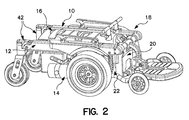
- Figure 2 is an isolated perspective view of the main frame assembly according to the present invention.
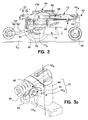
- Figure 3 is a side profile view of one of the main frame subassemblies according to the present invention.
- Figure 3a is an enlarged isolated perspective view of a castor assembly for mounting a rear wheel to an aft end of each main frame subassembly.
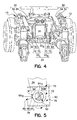
- Figure 4 is an isometric illustration of the cross member assembly from a rear view perspective illustrating the assembly components which define first and second detachable mounts for connecting the cross member assembly to each of the main frame subassemblies.
- Figure 5 depicts a cross sectional view taken substantially along line 5 - 5 of Fig. 4a for revealing the internal details of the first detachable hinge mount which connects the cross member assembly to one of the main frame subassemblies.
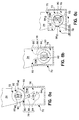
- Figure 6a is an isometric illustration of the main frame subassembly with the power supply module removed to reveal details of the second detachable mount including: a handle and a pair of retention blocks for latching the cross member assembly in an upright position.
- Figure 6b is an isometric perspective of the cross member assembly from a rear view projection wherein the handle/retention blocks and a coil spring are exploded from a housing of the cross member assembly.
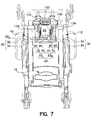
- Figure 7 is a top view of the cross member assembly supporting and pre-positioning each of the main frame subassemblies in an upright position.
- Figures 8a - 8c depict cross sectional views of the hinge mount in various positions during assembly.
- Figures 9a - 9c are broken away side views showing the cross member assembly in various positions relative to one of the main frame subassemblies as it is pivoted into upright therewith.
- Figure 10 is an exploded view of the seat support assembly for detachably mounting a seat to the main frame assembly of the wheelchair.
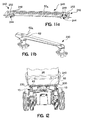
- Figure 11a is an isolated perspective view of a intermediate span bar for detachably mounting the wheelchair seat to the main frame assembly.
- Fig. 11b is an isolated perspective view of a longitudinal support bar for guiding the span bar into engagement with a pair of retaining pins, and functioning as a handle to manipulate and lift a main frame subassembly for transportation and storage.
- Fig. 12 is a rear view of the seat support assembly showing the engagement of the lateral pins with the intermediate span bar.
- Figure 13a depicts a broken away side view of a latching mechanism for retaining a forward channel to a span bar thereby retaining the wheelchair seat.
- Figure 13b is an isolated perspective view of the latching mechanism for retaining the wheelchair seat.
- Figure 13c is a broken away front view of the latching mechanism illustrating the engaged and disengaged positions thereof.
- Figures 14a - 14c depict the power supply unit including the mounting of a pair of battery boxes to a side rail support.
- Fig. 1 depicts a perspective view of an exemplary embodiment of the transportable power wheelchair of the present invention, which is generally referred to by the numeral 2.
- the wheelchair 2 as shown and described herein, is described in the context of a mid-wheel drive powered wheelchair, however, the invention is readily applicable to other powered wheelchair designs/configurations.
- the wheelchair 2 includes several modules and assemblies which may be broken-down into manageable sections for an individual (having normal strength and dexterity) to assemble/disassemble for transport.
- the phrase "manageable sections" means that the various modules, assemblies and/or subassemblies are each under a threshold weight, e.g., under 30 - 50 lbs.
- the disassembly and reassembly thereof is to be performed without the use of special tools.
- the disassembly/reassembly is preferably performed without tools of any kind, i.e., such operations are performed manually or by hand.
- the powered wheelchair 2 comprises first and second main frame subassemblies 10 and 12, respectively, each mounting a drive train subassembly 14 and detachably mounting a power supply unit 16 (best shown in Fig. 2) therebetween.
- At least one cross member assembly 20 connects the main frame subassemblies 10, 12 which, in combination, define a base or main frame assembly 18.
- the load path extends from a point or position on one of the main frame subassemblies through the cross member assembly 20 to a position on the other of the main frame subassemblies.
- the load path also crosses or passes through one of the first or second detachable mounts 22, i.e., between the cross member assembly 20 and each of the main frame subassemblies 10, 12.
- a principle teaching of the invention relates to the adaptation of the cross member assembly 20 and, in particular to the adaptation of one of the detachable mounts 22 to accept and pre-position the main frame subassemblies 10, 12 to facilitate the attachment of the other detachable mount.
- a seat support assembly 200 is adapted to facilitate assembly by several guide channels and/or tracks which forgive misalignment of assembly components. It will be appreciated that misalignment is especially problematic when assembling a seat 28 (Fig. 1) employing a mounting arrangement disposed along the underside thereof.
- a flexible/soft mount castor assembly 42 improves the ride efficacy of the wheelchair 2.
- the invention will first be described in terms of the individual modules and assemblies, which when assembled, produce a structurally-efficient transportable powered wheelchair 2. Subsequently, the discussion will focus on the assembly/disassembly of the wheelchair to gain a better appreciation for the various teachings of the invention. The description is, therefore, organized in the following order: I) Main Frame Subassemblies, II) Cross Member Assembly, III) Seat Support Assembly, IV) Power Supply Support Assembly, and V) Wheelchair Assembly/Disassembly.
- a profile view of the main frame subassembly 12 is depicted along an inwardly facing side, i.e., a side which, when assembled, faces inwardly toward the opposed subassembly.
- the main frame subassembly 12 includes a side frame support 30 having a substantially horizontal upper segment 32, i.e., horizontal relative to a ground plane G P , and a substantially vertical forward segment 34 orthogonal to the upper segment 32.
- the forward segment 34 is mounted to the underside of the upper segment 32, however, the segments 32, 34 may be integrally formed during manufacture of the side frame support 30.
- the upper segment 32 carries one of the drive train subassemblies 14 of the wheelchair propulsion system.
- the drive train subassembly 14 is pivotally mounted to the upper segment 32 about a pivot axis 14 A and independently drives a primary drive wheel 36.
- the powered wheelchair 2 may be easily maneuvered in confined areas, i.e., due to the ability to drive each wheel 36 in opposite directions.
- this drive train/wheel configuration is known as a mid-wheel design and includes a rear caster 40 for supporting the wheelchair 2 on at least three wheels, i.e., the two primary drive wheels 36 and at least one rear castored wheel 40.
- the main frame subassembly 12 preferably includes a rear castor assembly 42 which is pivot mounted to an aft end of the horizontal upper segment 32. More specifically, the castor assembly 42 includes a castor barrel 42 B adapted to support and facilitate rotation of the castor wheel 40 about a vertical axis 40 A . Furthermore, the castor assembly 42 includes an end fitting 44 projecting orthogonally from and relative to the vertical axis 40 A of the castor assembly 42. The pivot axis 44 A of the castor assembly is formed through the end fitting 44 and lies parallel to the wheelchair pitch axis (not shown), i.e., the axis about which the wheelchair 2 pitches forward or aft. Moreover, the castor assembly 42 is spring biased about the pivot axis 44 A such that the castor wheel 40 may be displaced under load in either direction, yet return to a predetermined initial operating position.
- the upper end of the castor barrel 42 B forms a cup-shaped receptacle 46 for accepting one end of a coil spring 48.
- the other end thereof bears against the upper support segment 34 such that the spring axis 48 A is spaced-apart from the pivot axis 44 A of the end fitting 44. Consequently, when an external load is applied to the castor wheel 40, whether vertical or longitudinal (i.e., fore and aft), the wheel may displace about the pivot axis 44 A until the spring force equilibrates the external load.
- the end fitting 44 and coil spring 48 serve as a simple, easily assembled and fabricated, castor wheel suspension.
- the spring force of the individual castor wheel suspension may be adjusted by a lever arm 50 projecting beyond or forwardly of the pivot axis 44 A of the end fitting 44. That is, an adjustment screw (not shown) causes a washer plate 52 to bear against a clevis attachment 53 (Fig. 3) formed at the end of the upper segment 32. As the adjustment screw is turned, the washer plate 52 incrementally changes the rotational position of the end fitting 44 relative to the horizontal upper segment 32, thus defining the initial operating position. As the axial length of the coil spring 48 changes, the preload on the end fitting 44/castor assembly 42 changes. This adjustment capability increases or decreases the spring force required to displace the castor assembly 42 and, consequently, the stiffness of the individual castor wheel suspension.
- the main frame subassembly 12 may also include an Active Anti-Tip System (AATS) 54 having a forward anti-tip wheel 56 mounted to an end of a suspension arm 58.
- AATS Active Anti-Tip System
- the AATS 54 is responsive to accelerations of the wheelchair, i.e., changes to the applied motor torque, to raise or lower the forward anti-tip wheel 56.
- An AATS 54 of the type described herein is more fully described and discussed in commonly-owned U.S. patent 6,129,165.
- the AATS system 54 will not be further discussed herein and the description found in U.S. patent 6,129,165 is incorporated herein by reference in its entirety.
- the main frame subassembly 12 includes various fittings and attachments which connect to other modules of the powered wheelchair 2. These will not be discussed in detail at this time, but merely mentioned to provide a frame of reference for related elements discussed later in the description.
- a circular retention head 90 and a pin connector 136 are disposed in combination with the forward segment 34 and upper segment 32 respectively, of the side frame support 30.
- These attachment fittings are disposed in combination with other fittings of the cross member assembly 20 to create the first and second detachable mounts.
- a lateral pin 62 is disposed in combination with a longitudinal guide/support bar 64.
- a mounting rail 66 is disposed along side the side frame support for detachably mounting the power supply unit 16 (Fig. 2).
- a latching mechanism 68 is disposed in combination with the rail 66 for supporting the power supply unit 16. The latching mechanism 68 is a safety feature which prevents electrical connections from being made until the power supply unit has fully engaged the rail 66.
- the Cross Member (CM) assembly 20 functions to structurally interconnect the main frame subassemblies 10, 12 and facilitates assembly and disassembly of the powered wheelchair 2 by supporting and pre-positioning the main frame subassemblies 10, 12.
- the CM assembly 20 creates one or more load paths extending transversely from one of the side frame supports 30 to the other.
- the load path extends across the CM assembly to identical positions along each of the main frame subassemblies 10, 12.
- the first detachable mount 22 interposes a first load path which structurally interconnects a lower portion (see Fig. 3) of each frame support 30.
- the second detachable mount 24 interposes a second load path which structurally interconnects an upper portion 32 of the frame support 30.
- both of the detachable mounts are either directly or indirectly (through an intermediate structure or component) to the vertical lower segment 34 of the side frame support 30.
- the first detachable mount 22 comprises a pair of pivot mounts 22 R , 22 L disposed on opposite sides of the CM assembly 20.
- Each of the pivot mounts 22 R , 22 L comprise a cup-shaped fitting 70 disposed in combination with the cross member assembly 20 and a retention fitting 72 disposed in combination with one of the main frame subassemblies 10, 12. More specifically, each of the cup-shaped fittings 70 (see Fig. 5) defines an open-ended pocket 76 and a slot 78 disposed through a wall 70W of the fitting 70.
- the slot 78 furthermore, has an first end 80 disposed in register with the open end 82 of the pocket 76, a second end 84 having a substantially circular geometry and a throat region 86 disposed therebetween.
- the throat region 86 defines a throat opening dimension 86 D and the circular slot end 84 defines a slot diameter dimension 84 D .
- the retention fitting 72 comprises a circular retention head 90 and a stationary axle 92 rigidly affixed to and projecting laterally from the vertical support segment 34 of the main frame subassembly 12.
- the axle 92 has a cross sectional configuration which defines a minor diameter 92 MI and a major diameter 92 MA (see Fig. 5) wherein the minor diameter 92 MI corresponds to the longitudinal width (fore and aft) dimension of the axle 92 and the major diameter 92 MA corresponds to the vertical height of the axle 92. Inasmuch as the axle 92 is stationary, such geometric relationships remain constant.
- the pocket 76 of each cup-shaped fitting 70 accepts the circular retention head 90 while the slot 78 accepts the axle 92 of the retention fitting 72.
- the minor diameter thereof must align with or be parallel to the slot axis of symmetry.
- the minor diameter 92 MI of the axle 92 must necessarily be less than the throat opening dimension 86 D and the major diameter 92 MA must be less than the slot end dimension 84 D .
- the throat opening diameter 86 D must be less than the diameter dimension 84 D . This will become evident when discussing the installation and assembly of the CM assembly 20 with each main frame subassembly 10, 12.
- the second detachable mount includes a pair of retention blocks 102, 104 disposed in combination with the cross member assembly 20 and abutment surfaces 106, 108 (in Fig. 4 dashed lead lines indicate a surface under or covered by the retention blocks 102, 104), disposed in combination with each of the main frame subassemblies 10, 12. More specifically, the retention blocks 102, 104 are mounted to a handle 100 which is pivot mounted to the cross member assembly 20.
- the handle 100 has an L-shaped side profile (best seen in Fig.
- the handle 100 is pivotally mounted to each side of the cross member assembly 20. That is, the handle 100 is pivotable about a pivot axis 100 A (shown in Fig. 6a) which is preferably disposed forwardly of an electrical connector 114 disposed in combination with the housing 116 of the cross member assembly 20.
- the handle 100 is spring-biased about its pivot axis 100 A (Fig. 6c) such that a surface of the retention blocks 102, 104 engages the abutment surfaces 106, 108 of the main frame subassemblies 10, 12.
- a coil spring 110 (Figs. 6a and 6c) connects and biases the handle 100 of the cross member assembly 20; however, a torsion or other spring-biasing element, disposed about the pivot axis 100 A , may functionally replace the coil spring 110.
- each of the retention blocks (only one retention block 102 is shown in the figure) have a substantially polygonal profile configuration defining a lead and a locking surface, 112 and 114, respectively. While the lead and locking surfaces 112, 114 are linear in the illustrated embodiment, each may be curvilinear or define a combination of linear and/or curvilinear segments. Generally, the lead surface 112 defines an acute angle relative to a line of tangency about the hinge axis 20 A of the cross member assembly 20. That is, a line tangent to a circle inscribed by the pivot motion of the handle 100 and, more particularly, to a circle inscribed by the rotational motion of the retention blocks 102, 104. The significance of the geometry and angular orientation of the retention blocks 102, 104 will be appreciated when discussing the operation of the handle 100.
- the cross member assembly 20 may structurally support other modules or assemblies and may be directly or indirectly connected to the side frame supports 30 of each of the main frame subassemblies 10, 12.
- a controller or battery charger may be disposed internally of a structural housing 130 for integrating the controller/battery charger with the cross member assembly 20.
- the housing 130 may function to effect the load paths across the cross member assembly 20.
- the cross member assembly 20 may include one or more electrical connectors 134, e.g., a conventional pin connector, for engaging an electrical receptacle 136 (shown in Figs. 6a and 6c) disposed in combination with one or both of the main frame subassemblies 10, 12.
- various electrical connections can be made simultaneously with the attachment of the detachable mounts 22, 24.
- the cross member assembly 20 attaches to the vertical lower segment 30, it should be appreciated that structural elements or components may be disposed between the cross member assembly 20 and the side frame support 30.
- the pin receptacle 136 is mounted to the lower vertical segment 34 and dually functions to provide an electrical connection for the power supply module and an abutment surface 116, 118 for the second detachable mount 24.
- the cross member assembly 20 is laid flat or horizontally (see Fig. 7) for the circular retention head 90 (Fig. 8a) to be received within the pocket 76 of the cup-shaped fitting 70. Further, the axle 92 may slide past the throat region 86 of the slot 78 to the circular slot end 88.
- the pivot mounts 22 R , 22 L function to support the main frame subassemblies 10, 12 in a substantially upright position (Fig. 7). That is, the surface area of engagement between the circular retention head 90 and the cup-shaped fitting 70 is sufficiently large to support and align the subassemblies 10, 12 in the desired upright position.
- the pivot mounts 22 R , 22 L in combination, define a hinge axis 22 A (see Fig. 7) about which the cross member assembly 20 may rotate.
- Figs. 9a through 9c depict the operational displacement of the handle 100 and one of the retention blocks 102 as it engages and disengages the abutment surface 106.
- the cross member assembly 20 lies horizontally such that the circular retention head 90 of a main frame subassembly 12 is received within the cup-shaped fitting 70.
- the axle 92 of the retention head 90 slides past the throat region of the slot 78 in one orientation, and is captured therein when oriented in a second position.
- the cup-shaped fitting 70 releases the retention head 90 when the slot 78 is substantially vertical (as shown in Fig. 9a) and captures the retention head 90 when the slot 78 (as seen in Fig. 9c) is horizontal or orthogonal to the vertical.
- the cross member assembly 20 is shown in various angular positions to reveal the motion of the handle and structural interaction of the retention block 102 with the main frame subassembly 12, and more particularly, with a pin connector 116.
- the cross member assembly 20 rotates in a clockwise direction, i.e., in the direction of arrow R 20 , about pivot axis 20 A .
- the guide surface 112 contacts the comer of the pin connector 116, thereby lifting the handle 100 vertically (i.e., rotating the handle 100 counter-clockwise).
- the retention block 102 slides over the top surface of the pin connector 136 until reaching the opposite comer or end of the connector 136, i.e., at the noon or (12 th ) hour position denoted by arrow 1200.
- the coil spring 110 (shown in Fig. 9c) causes the handle 100 to rotate in a clockwise direction as the retention block 102 passes the pin connector.
- the locking surface 114 of the retention block 102 engages the abutment surface 106 to retain the cross member assembly 20 in a vertical position.
- both retention blocks 102, 104 simultaneously engage both of the abutment surfaces 106, 108. That is, the cross member assembly 20 is retained on both sides of its housing 130 against adjacent pin connectors 136.
- Disengagement of the handle 100 and retention blocks 102, 104 is performed by reversing the operation described above. Consequently, the spring biased handle 100, retention blocks 102, 104 and retention surfaces 106, 108 may alternatively form the second detachable mount 22. Furthermore, complete rotation (see Fig. 8b) of the cup-shaped fitting 70 captures the axle 92 as a result of the orientation of the fitting 70 relative to the axle 92, i.e., the larger major diameter 92 MA of the axle 92 cannot pass the throat region 86 of the slot 78.
- cylindrical resilient bearings 160 may engage C-shaped seating surfaces 164 disposed at the forward end of each side frame support 30.
- the bumpers 160 are cylindrical and provide a soft or resilient seating surface so that additional spring force may be applied to the second detachable mount 24. Additionally, the soft mount also serves to maintain the lateral and vertical position of the cross member assembly 20 relative to each of the main frame subassemblies 10, 12.
- the handle 100 and retention blocks 102, 104 may be positively retained by the relative position of other wheelchair components.
- battery boxes 302a, 302b may be positioned proximal to the handle 100 so as to prevent its rotation and release of the cross member assembly 20 until the boxes 302a, 302b are disassembled. The assembly and disassembly of the power supply module will be discussed hereinafter.
- the seat support assembly 200 is detachably mounted to the main frame assembly 18 of the powered wheelchair 2.
- the seat support assembly 200 comprises a trapeze bar assembly 202 supporting a forward portion of the seat 28 and a pivot mount assembly 206 supporting an aft portion of the seat 28.
- the forward trapeze bar assembly 202 includes a channel 204 disposed in combination with the underside 28 U of the seat 28 and a span bar 208 disposed in combination with the main frame assembly 18.
- the channel 204 extends laterally from one side of the seat 28 to the other, has a substantially inverted J-shaped cross sectional configuration, and has an opening 210 facing downwardly for engaging the span bar 208.
- the span bar 208 comprises a laterally extending bar 212 supported by a pair of vertical stanchions 214a, 214b. Together the bar 212 and vertical stanchions 214a, 214b define a substantially double-T profile configuration, however, a variety of profile configurations may be employed including a U- or L-shaped configuration.
- the span bar 208 is disposed in combination with the cross member assembly 20.
- the vertical stanchions 214a, 214b fit into mounting sleeves 220 (see Fig. 10) and may be adjustable vertically to raise or lower the forward portion 28 F of the seat 28.
- the span bar 208 may be used as a handle for rotating the cross member assembly 20 during assembly and disassembly. This also provides a convenient means for carrying the cross member assembly 20 during transport of the wheelchair 2.
- the pivot mount assembly 206 includes, inter alia, a channel assembly 208 disposed in combination with the underside 28 U of the seat 28 aft of the trapeze bar assembly 202 and, furthermore, is adapted to facilitate pivot motion of the seat 28 about a transverse pivot axis, i.e., an axis parallel to the pitch axis (not shown) of the wheelchair.
- the pivot mount assembly 206 includes a pair of lateral pins 62 each disposed in combination with the horizontal upper segment 32 of one of the main frame subassemblies 10, 12. More specifically, the lateral pins 62 are each disposed in combination with a longitudinal support bar 230 which is mounted to the side frame support 30 of a respective main frame subassembly.
- the longitudinal support bar 230 which is disposed substantially parallel to and co-planar with the horizontal upper segment 32 of the side frame support 30, serves two principle functions.
- a first is the support of the seat, most especially, to align the underside of the seat 28 with the lateral pins 62. It will be appreciated that with pivot mounting assembly 206 being disposed its underside, assembly and disassembly must essentially be performed by tactile rather than visual feedback. Consequently, the longitudinal support bars 230 seat within a groove or track of the seat and guided onto the pins 62. This will be discussed in greater detail in the subsequent paragraphs.
- the support bars 230 function as a handle for manipulating and lifting each of the main frame subassemblies 10, 12 during assembly and disassembly. Consequently, a dedicated handle, i.e., in addition to a seat supporting/guiding bar, is not required.
- the pivot mounting assembly 206 also includes a channel 236 (Fig. 10 only) disposed in combination with the underside 28 U of the seat 28 and an interface bar 240 having end fittings 242 for engaging the lateral pins 62. More specifically, the channel 236 extends laterally across the underside 28 U of the seat, has a substantially C-shaped cross sectional configuration and has an opening 246 (see Fig. 10) facing rearwardly.
- the interface bar or intermediate span bar 240 has a cross-sectional configuration which may be accepted internally of the channel 236, a pair of grooves 244 proximal to each end for accepting and sliding along the upper surface of the longitudinal support bar 230 and a pair of tracks 248 for accepting the lateral pins 62 disposed through the support bar 230.
- the tracks 248 have an open end 252 facing rearwardly for accepting the lateral pins 62 and, when fully engaged permit a limited degree of pivotal motion about the pivot axis 62 A of the lateral pins 62.
- the longitudinal support bar 230 rides in the channels or grooves 244 of the intermediate span bar 240 to guide the lateral pins 62 into engagement. While the pins 62 are shown to extend through the longitudinal support bar, it will be appreciated that the pins 62 need only extend or project from on side of the support to effect the necessary pivot displacement. That is, assembly and disassembly requires a small degree of pivot motion to enable to forward channel 204 to sit upon the forward span bar 206.
- the latching mechanism 280 is affixed to the forward channel 204 for maintaining the position of the span bar 208. More specifically, the latching mechanism 280 includes a mounting plate 282 (Figs. 13a - 13c) affixed to a negatively sloping face surface of 284 (Fig. 13a) of the forward channel 204. Retention fingers 286a, 286b are pivotally mounted to the base plate 282 and project downwardly and rearwardly to partially close the channel opening 210.
- the fingers 286a, 286b are torsionally-biased to a fully-extended position by means of a torsion spring 288 (only the ends are visible in Figs. 13b and 13c). Further, the fully-extended position is shown in solid lines in Fig. 13c.
- the retention fingers 286a, 286b are held in the fully-extended position by a Y-shaped block 290 which abuts a pair of thumb release handles 292.
- the block 290 is pivotally mounted to a bracket 294 of the latch plate 282 and may be rotated to a "stop" or "release” position.
- Fig. 13a shows the stop position of the block 290 in solid lines and the release position in phantom or dashed lines. Further, the block 290 has been omitted from Fig. 13c to more clearly illustrate the "release" position of the retention fingers 286a, 286b.
- a power supply unit 16 for providing power to the wheelchair 2 detachably mounts to each of the main frame subassemblies 10, 12.
- the power supply unit 16 comprises two battery boxes 302a, 302b for housing two DC batteries (not shown).
- Each of the battery boxes 302a, 302b have flanges 304 projecting laterally to each side of the boxes 302a, 302b and each flange 304 thereof includes a runner 308 along its peripheral edge.
- the runners 308 slidably engage rails 310 which mount to the main frame subassemblies 10, 12. More specifically, each rail 310 is disposed in combination with the upper support segment 32 of each of the main frame subassemblies 10, 12.
- the rails 310 are generally parallel and adapted in length to receive two battery boxes 302a, 302b in tandem.
- Each of the battery boxes 302a, 302b are slid longitudinally into the rails 310 and have intermediate connectors 312b disposed between the boxes to electrically connect the battery boxes 302a, 302b. Furthermore, connectors 312a (see Fig. 7) may be employed should the cross member assembly 20 be integrated with a controller or battery charger. Handles 313a, 313b are provided along the upper surface of the battery boxes 302a, 302b to facilitate lifting and manipulation as the boxes 302a, 302b are slid into or out of the rails 310. In Fig.
- a retention pin 318 projects upwardly into the channel 320 of the rail 310 to ensure that the power supply unit 16 will not inadvertently slide rearwardly out of engagement, i.e., upon an acceleration of the powered wheelchair 2. That is, the retention pin 318 may be recessed into an aperture against the biasing force of a spring (not shown) when the weight of the battery box 302, i.e., as applied by the rail thereof, urges the pin 318 downwardly. When the battery box 302 has passed the retention pin 318 in the channel 320, the biasing force of the spring causes the retention pin 318 to project upwardly into the channel 320.
- a further safety feature is provided by a latching mechanism 322 which is disposed in combination with the retention pin 318.
- the latching mechanism 322 which is operable to prohibit electrical connectivity between the plug 314 and receptacle 316 until the runner has fully engaged the rail 310, i.e., slid past the retention pin 318. More specifically, the latching mechanism employs a lever 324 to interfere with the plug/receptacle engagement when the battery boxes 302a, 302b are not fully engaged.
- the lever 324 rotates downwardly to block the insertion of the plug 314 into the receptacle 316 when the retention pin 318 is recessed, i.e., when the weight of the battery box 302b is on the retention pin, and, consequently, not fully engaged.
- the lever 324 may only be removed or rotated to a non-interfering position when the retention pin 318 is fully extended, i.e., when the rail 308 has passed the retention pin and the weight of the box 302b is not acting on the pin 308.
- a single latch mechanism 322, along one of the rails 310 is employed to avoid the complexities and cost of redundant latch mechanisms.
- the transportable wheelchair 2 is assembled by first laying the cross member assembly 20 flat or horizontally on the ground.
- the main frame assemblies 10, 12 are positioned upright to engage the cross member assembly 20 by effecting the first detachable mount 22.
- the mount 22 is capable of maintaining the relative position of the subassemblies 10, 12.
- the cross member assembly 20 is then rotated to effect engagement of the second detachable mount 22 while, in one embodiment of the invention, simultaneously effecting engagement of one or more electrical connectors (see Fig. 9).
- the battery boxes 302a, 302b are slid forwardly into engagement with the rails 310 until the retention pin 318 (Fig.
- the seat 28 is laid upon the longitudinal support bars 230 such that the grooves 242 of the interface bar 240 may slide forward and aft.
- the seat is pivoted upwardly and slid rearwardly causing the lateral pins 62 engage the track 244 of the interface bar 248.
- the seat 28 is pivoted downwardly so that the channel 204 sits upon an span bar 208.
- the latching mechanism 280 must be open to allow the forward channel 204 to engage the span bar 208 as the seat 16 is set vertically downward.
- the thumb release handles 292 are released to allow the torsionally-biased fingers 286a, 286b to close the opening 210 of the forward channel 204.
- the disassembly of the powered wheelchair 2 is essentially the reverse of the foregoing assembly steps and, in the interest of brevity, will not be reiterated herein.
- the various assembly/disassembly steps may be arranged in a different order, depending upon the clearance provided between elements.
- the battery boxes may be installed before or after the seat has been attached to the main frame assembly 18.
- the transportable powered wheelchair of the present invention is modularized to separate the wheelchair into manageable sections or modules. That is, the powered wheelchair comprises only five modules, i.e., two main frame subassemblies, a cross member assembly and two (2) battery boxes, which define the power supply unit.
- the assembly process. is facilitated by first and second detachable mounts 22, 24 for connecting the cross member assembly to each of the main frame subassemblies 10, 12. That is, the first detachable mount 22 functions to spatially position and support the main frame subassemblies 10, 12, i.e., in an upright position.
- first detachable mount 22 maintains such pre-positioning to permit the attachment of the second detachable mount 24 to structurally interconnect the subassemblies 10, 12 at two positions.
- the detachable mounts are also spaced-apart to structurally augment the main frame assembly 18.
- the cross member assembly 20 may function to facilitate electrical connections between the power supply unit 12 and the electrical systems employed on the powered wheelchair 2. That is, the electrical connections are made simultaneously as the second detachable mount 24 is made.
- the cross member assembly 20 may structurally support other systems to integrate such modules and reduce the number of assemblies to be connected.
- the cross member assembly is configured to permit handling and attachment by a simple rotational motion which negates the need for two or more persons to assemble/disassemble the powered wheelchair.
- the cross member assembly may further produce or provide a support for the seat assembly. This is, the cross member assembly may support the trapeze bar assembly.
- the abutment surfaces 106, 108 are disposed in combination with the pin connectors 136, i.e., along the back side surface of each of the connectors 136.
- any surface disposed in combination with one or both of the main frame subassemblies 10, 12 which is capable of reacting a substantially horizontal load or load component may be employed.
- the batteries 302a, 320b are shown as having a runner disposed in combination with a rail, other detachable mounting schemes may be employed.
- the battery boxes may include J-hooks for being hung upon a longitudinal rod disposed along the side frame supports of the main frame subassemblies.
- a footrest assembly may be incorporated as an option, and, therefore, may be disposed in combination with the cross member assembly.
Landscapes
- General Health & Medical Sciences (AREA)
- Animal Behavior & Ethology (AREA)
- Life Sciences & Earth Sciences (AREA)
- Veterinary Medicine (AREA)
- Health & Medical Sciences (AREA)
- Public Health (AREA)
- Electrochemistry (AREA)
- General Chemical & Material Sciences (AREA)
- Chemical Kinetics & Catalysis (AREA)
- Chemical & Material Sciences (AREA)
- Aviation & Aerospace Engineering (AREA)
- Engineering & Computer Science (AREA)
- Handcart (AREA)
- Carriages For Children, Sleds, And Other Hand-Operated Vehicles (AREA)
Applications Claiming Priority (4)
| Application Number | Priority Date | Filing Date | Title |
|---|---|---|---|
| US50948903P | 2003-10-08 | 2003-10-08 | |
| US509489P | 2003-10-08 | ||
| US55400504P | 2004-03-16 | 2004-03-16 | |
| US554005P | 2004-03-16 |
Publications (2)
| Publication Number | Publication Date |
|---|---|
| EP1522293A2 true EP1522293A2 (de) | 2005-04-13 |
| EP1522293A3 EP1522293A3 (de) | 2005-12-14 |
Family
ID=34316846
Family Applications (1)
| Application Number | Title | Priority Date | Filing Date |
|---|---|---|---|
| EP04256231A Withdrawn EP1522293A3 (de) | 2003-10-08 | 2004-10-08 | Transportierbarer Rollstuhl mit Antrieb |
Country Status (3)
| Country | Link |
|---|---|
| US (1) | US7207403B2 (de) |
| EP (1) | EP1522293A3 (de) |
| CA (1) | CA2484343A1 (de) |
Cited By (5)
| Publication number | Priority date | Publication date | Assignee | Title |
|---|---|---|---|---|
| EP1721592A3 (de) * | 2005-05-14 | 2006-11-22 | Specialised Orthotic Services Limited | Rollstühle |
| DE102014204787A1 (de) * | 2014-03-14 | 2015-09-17 | Karl Ahmerkamp | Faltbarer Rollstuhl mit elektrischem Antrieb und Batterieträger |
| WO2018054693A1 (de) * | 2016-09-23 | 2018-03-29 | Otto Bock Mobility Solution Gmbh | Chassis für eine mobilitätshilfe und für einen elektrorollstuhl |
| EP3351228A1 (de) * | 2016-12-14 | 2018-07-25 | Sunrise Medical GmbH | Modulare radanordnung für einen rollstuhl |
| EP3871964A1 (de) * | 2020-02-26 | 2021-09-01 | Zhejiang Innuovo Rehabilitation Devices Co. Ltd | Mobilitätsroller |
Families Citing this family (27)
| Publication number | Priority date | Publication date | Assignee | Title |
|---|---|---|---|---|
| US20070145711A1 (en) * | 2002-04-30 | 2007-06-28 | Mulhern James P | Rear wheel drive vehicle with ground-contacting anti-tip wheels |
| US7207403B2 (en) * | 2003-10-08 | 2007-04-24 | Pride Mobility Products Corporation | Transportable power wheelchair |
| JP2007532157A (ja) * | 2004-04-08 | 2007-11-15 | レボ・アーゲー,ヴォーレン | 中間車輪駆動車椅子、特に昇降型車椅子 |
| US20060076748A1 (en) * | 2004-10-08 | 2006-04-13 | Sunrise Medical Hhg Inc. | Wheelchair with damping mechanism |
| US20060076747A1 (en) * | 2004-10-08 | 2006-04-13 | Sunrise Medical Hhg Inc. | Wheelchair suspension system |
| TWI262863B (en) * | 2005-07-19 | 2006-10-01 | Wen-Chyan Shin | The sea gull type linking of frame of vehicle |
| US20070034434A1 (en) * | 2005-08-12 | 2007-02-15 | Wu's Tech Co., Ltd. | Liftable seat frame of electric scooter |
| US7896394B2 (en) | 2005-08-18 | 2011-03-01 | Sunrise Medical Hhg, Inc. | Midwheel drive wheelchair with independent front and rear suspension |
| WO2007047612A2 (en) * | 2005-10-17 | 2007-04-26 | Pride Mobility Products Corporation | Powered wheelchair having side access battery compartment |
| CN2882586Y (zh) * | 2006-03-08 | 2007-03-28 | 唐承慧 | 一种新型中驱电动轮椅车的前后臂连接机构 |
| US20100215055A1 (en) * | 2009-02-25 | 2010-08-26 | Glaser Stephen D | Method and apparatus for using multiple protocols on a communication link |
| US7828310B2 (en) * | 2009-02-25 | 2010-11-09 | Karma Medical Products Co., Ltd. | Chassis structure for mid-wheel drive power wheelchair |
| JP2012521330A (ja) * | 2009-03-24 | 2012-09-13 | フラワーズ,アイ.ピー. | 三輪自動車のスタビライザ |
| US20110016628A1 (en) * | 2009-07-21 | 2011-01-27 | Masterson Jr Russell P | Portable apparatus for moving subjects |
| USD635493S1 (en) | 2009-10-12 | 2011-04-05 | Pride Mobility Products Corporation | Combined shroud and battery compartment for a wheelchair |
| USD635492S1 (en) | 2009-10-12 | 2011-04-05 | Pride Mobility Products Corporation | Combined shroud and battery compartment for a wheelchair |
| US8616309B2 (en) * | 2009-10-12 | 2013-12-31 | Pride Mobility Products Corporation | Wheelchair |
| US8851214B2 (en) | 2010-07-15 | 2014-10-07 | Permobil Ab | Electric mid-wheel drive wheelchair |
| US20120279789A1 (en) * | 2011-05-02 | 2012-11-08 | Bradley Brill | Detachable power drive unit for propelling and steering manual wheelchairs |
| US10052247B2 (en) * | 2015-08-24 | 2018-08-21 | Dream Roller Mobility, LLC | Wheelchair with four wheel independent suspension and modular seating |
| US10335330B2 (en) | 2017-03-02 | 2019-07-02 | Travelsys4u Ltd. | Motor-driven chair steered by seat rotation |
| JP6924680B2 (ja) * | 2017-11-28 | 2021-08-25 | 本田技研工業株式会社 | 電動車椅子 |
| KR102730522B1 (ko) | 2019-12-13 | 2024-11-15 | 현대자동차주식회사 | 시트의 배터리 충전 시스템 및 방법 |
| KR102729870B1 (ko) * | 2019-12-13 | 2024-11-14 | 현대자동차주식회사 | 배터리 자동 충전이 가능한 이동식 시트 제어 장치 |
| CN114224628B (zh) * | 2021-12-24 | 2025-09-05 | 深圳市优必选科技股份有限公司 | 车架及轮椅 |
| CA3168572C (en) | 2022-07-13 | 2025-08-05 | Invacare Corporation | WHEELCHAIR AND SUSPENSION SYSTEMS |
| USD1033279S1 (en) | 2022-08-22 | 2024-07-02 | Three Oceans, LLC | Scooter |
Citations (3)
| Publication number | Priority date | Publication date | Assignee | Title |
|---|---|---|---|---|
| US5944131A (en) | 1996-07-03 | 1999-08-31 | Pride Health Care, Inc. | Mid-wheel drive power wheelchair |
| US6129165A (en) | 1996-07-03 | 2000-10-10 | Pride Mobility Products, Corporation | Curb-climbing power wheelchair |
| US6220382B1 (en) | 1998-11-17 | 2001-04-24 | Burke Mobility Products, Inc. | Powered wheelchair with separating frame |
Family Cites Families (54)
| Publication number | Priority date | Publication date | Assignee | Title |
|---|---|---|---|---|
| US2369040A (en) * | 1943-04-20 | 1945-02-06 | Walk A Chair Corp | Wheeled invalid chair |
| US3437164A (en) * | 1966-02-14 | 1969-04-08 | Rodney R Rabjohn | Battery support device for power-operated vehicles and the like |
| US3618968A (en) * | 1969-05-01 | 1971-11-09 | Edward M Greer | Patient-operated wheelchair |
| US3749192A (en) * | 1971-07-16 | 1973-07-31 | A Karchak | Collapsible wheel chair |
| US3820811A (en) * | 1972-10-13 | 1974-06-28 | S Lapham | Self tracking industrial trailer |
| US3883153A (en) * | 1973-06-25 | 1975-05-13 | Bhupindar Singh | Apparatus for suppressing spring action between the wheel mounts and frame of a vehicle |
| GB1435539A (en) * | 1973-06-27 | 1976-05-12 | Doherty Sons Ltd Edward | Wheelchair |
| US3896891A (en) * | 1973-08-31 | 1975-07-29 | Stainless Medical Products Inc | Modular motorized wheel chair |
| GB1478046A (en) * | 1973-12-05 | 1977-06-29 | Bell A | Wheelchairs |
| US3917312A (en) * | 1974-07-29 | 1975-11-04 | Everst & Jennings Inc | Indoor/outdoor wheelchair frame |
| US4209073A (en) * | 1978-03-01 | 1980-06-24 | Clarence Enix | Collapsible four wheel electric powered vehicle |
| US4323133A (en) * | 1979-03-05 | 1982-04-06 | Williams Patrick Y | Folding frameworks and wheel-chairs |
| US4405142A (en) * | 1981-03-09 | 1983-09-20 | Stainless Medical Products, Inc. | Knock down wheel chair |
| US4763951A (en) * | 1983-08-19 | 1988-08-16 | Michael W. Silverman | Threaded locking coupler |
| US4576389A (en) * | 1985-01-25 | 1986-03-18 | James Villaveces | Cart for transporting shock sensitive loads, or unstable loads |
| DE3514572A1 (de) * | 1985-04-23 | 1986-10-30 | Günter Meier GmbH, 4952 Porta Westfalica | Krankenfahrstuhl |
| US4754946A (en) * | 1986-04-14 | 1988-07-05 | Constantin Bruce J | Wheelchair restraining device |
| US4741547A (en) * | 1987-05-14 | 1988-05-03 | Tholkes Alan L | Folding wheelchair |
| US5145197A (en) * | 1987-09-14 | 1992-09-08 | Contemporary Medical Equipment Corp. | Folding wheelchair with rigid seat |
| US5156226A (en) * | 1988-10-05 | 1992-10-20 | Everest & Jennings, Inc. | Modular power drive wheelchair |
| US4967864A (en) * | 1988-10-05 | 1990-11-06 | Everest & Jennings, Inc. | Modular power drive wheelchair |
| US4955624A (en) * | 1989-04-26 | 1990-09-11 | Jeun Long Guo | Wheelchair with height adjustable seat |
| US5176393A (en) * | 1990-04-27 | 1993-01-05 | Medical Composite Technology | Modular wheelchair |
| US5143391A (en) * | 1990-04-27 | 1992-09-01 | Medical Composite Technology | Modular wheelchair |
| US5197559A (en) * | 1990-09-04 | 1993-03-30 | Fortress Life-Style, Inc. | Foldable wheelchair with optional power or manual drive |
| US5141250A (en) * | 1990-12-05 | 1992-08-25 | Morgan Jerry E | Lightweight transportable wheelchair |
| US5186480A (en) * | 1990-12-05 | 1993-02-16 | Morgan Technology, Inc. | Lightweight transportable wheelchair |
| US5112069A (en) * | 1991-09-16 | 1992-05-12 | Aldus Richard E | Travel-air chair |
| US5351774A (en) * | 1992-06-02 | 1994-10-04 | Quickie Designs Inc. | Powered wheelchair with a detachable power drive assembly |
| US5288091A (en) * | 1993-01-29 | 1994-02-22 | Noma Outdoor Products, Inc. | Four wheel steering apparatus |
| US5358263A (en) * | 1993-04-30 | 1994-10-25 | Aldus Richard E | Travel-air chair |
| US5427398A (en) * | 1993-10-29 | 1995-06-27 | Weybrecht; Steven L. | All-terrain wheelchairs and apparatus therefor |
| US5423562A (en) * | 1993-11-05 | 1995-06-13 | Pearce, Jr.; Fredric C. | Chair lift |
| US5487437A (en) * | 1994-03-07 | 1996-01-30 | Avitan; Isaac | Coupled differential turning control system for electric vehicle traction motors |
| US5522734A (en) * | 1994-04-15 | 1996-06-04 | Invacare Corporation | Apparatus for interconnecting wheelchair batteries |
| US5575348A (en) * | 1994-04-15 | 1996-11-19 | Invacare Corporation | Powered wheelchair with adjustable center of gravity and independent suspension |
| DE4422700A1 (de) * | 1994-06-29 | 1996-01-04 | Abb Management Ag | Diffusor für Turbomaschine |
| EP0702945A1 (de) * | 1994-09-13 | 1996-03-27 | Ortopedia Gmbh | Rollstuhl mit verstellbarem Rahmen |
| US5564786A (en) * | 1994-11-10 | 1996-10-15 | Labac Systems, Inc. | Modular adjustable seat frame for wheelchairs |
| US5924506A (en) * | 1996-01-23 | 1999-07-20 | Peg Perego Pines S.P.A. | Motorized wheel assembly and toy vehicle with such wheel assembly |
| US6186252B1 (en) * | 1996-07-03 | 2001-02-13 | Pride Mobility Products, Corporation | Foldable midwheel drive power chair |
| US5947501A (en) * | 1996-08-29 | 1999-09-07 | Osborn; Robert Kent | Wheelchair attachable transfer board and armrest combination |
| US5996716A (en) * | 1996-10-25 | 1999-12-07 | Orthofab | Adjustable wheelchair |
| GB2333500A (en) * | 1998-01-22 | 1999-07-28 | Invacare Deutschland Gmbh | Folding wheelchair with tilting upper frame |
| DE69942326D1 (de) * | 1998-04-24 | 2010-06-17 | Johnson Diversey Inc | Gerät zum Reinigen von Fussböden |
| US6073958A (en) * | 1998-06-11 | 2000-06-13 | Gagnon; Brian | All terrain wheelchair |
| AUPP670498A0 (en) * | 1998-10-23 | 1998-11-19 | Roller Chair Pty Ltd | Improved mid-wheel drive wheelchair |
| US6241275B1 (en) * | 1999-06-14 | 2001-06-05 | Sunrise Medical Hhg Inc. | Foldable wheelchair and link configuration for foldable wheelchair |
| US6439331B1 (en) * | 2000-08-21 | 2002-08-27 | Ju-Yu Fan | Chassis of an electric walk-substituting car |
| US7040429B2 (en) * | 2001-10-10 | 2006-05-09 | Invacare Corporation | Wheelchair suspension |
| WO2003103366A2 (en) * | 2002-06-05 | 2003-12-18 | Invacare Corporation | Mid-wheel drive scooter |
| US7083195B2 (en) * | 2002-10-25 | 2006-08-01 | Invacare Corporation | Suspension with releasable locking system |
| US20040084230A1 (en) * | 2002-10-28 | 2004-05-06 | Christopher Grymko | Transportable wheelchair |
| US7207403B2 (en) * | 2003-10-08 | 2007-04-24 | Pride Mobility Products Corporation | Transportable power wheelchair |
-
2004
- 2004-10-07 US US10/960,541 patent/US7207403B2/en not_active Expired - Fee Related
- 2004-10-08 EP EP04256231A patent/EP1522293A3/de not_active Withdrawn
- 2004-10-08 CA CA002484343A patent/CA2484343A1/en not_active Abandoned
Patent Citations (3)
| Publication number | Priority date | Publication date | Assignee | Title |
|---|---|---|---|---|
| US5944131A (en) | 1996-07-03 | 1999-08-31 | Pride Health Care, Inc. | Mid-wheel drive power wheelchair |
| US6129165A (en) | 1996-07-03 | 2000-10-10 | Pride Mobility Products, Corporation | Curb-climbing power wheelchair |
| US6220382B1 (en) | 1998-11-17 | 2001-04-24 | Burke Mobility Products, Inc. | Powered wheelchair with separating frame |
Cited By (8)
| Publication number | Priority date | Publication date | Assignee | Title |
|---|---|---|---|---|
| EP1721592A3 (de) * | 2005-05-14 | 2006-11-22 | Specialised Orthotic Services Limited | Rollstühle |
| EP2263630A1 (de) * | 2005-05-14 | 2010-12-22 | Specialised Orthotic Services Limited | Rollstühle |
| DE102014204787A1 (de) * | 2014-03-14 | 2015-09-17 | Karl Ahmerkamp | Faltbarer Rollstuhl mit elektrischem Antrieb und Batterieträger |
| DE102014204787B4 (de) * | 2014-03-14 | 2017-05-11 | Karl Ahmerkamp | Faltbarer Rollstuhl, Schnellwechselvorrichtung und Verwendung einer geführten Schiene als Schnellwechselvorrichtung |
| WO2018054693A1 (de) * | 2016-09-23 | 2018-03-29 | Otto Bock Mobility Solution Gmbh | Chassis für eine mobilitätshilfe und für einen elektrorollstuhl |
| US11000433B2 (en) | 2016-09-23 | 2021-05-11 | Otto Bock Mobility Solutions Gmbh | Chassis for a mobility aid and for an electric wheelchair |
| EP3351228A1 (de) * | 2016-12-14 | 2018-07-25 | Sunrise Medical GmbH | Modulare radanordnung für einen rollstuhl |
| EP3871964A1 (de) * | 2020-02-26 | 2021-09-01 | Zhejiang Innuovo Rehabilitation Devices Co. Ltd | Mobilitätsroller |
Also Published As
| Publication number | Publication date |
|---|---|
| EP1522293A3 (de) | 2005-12-14 |
| US20050077698A1 (en) | 2005-04-14 |
| CA2484343A1 (en) | 2005-04-08 |
| US7207403B2 (en) | 2007-04-24 |
Similar Documents
| Publication | Publication Date | Title |
|---|---|---|
| US7207403B2 (en) | Transportable power wheelchair | |
| US20040084230A1 (en) | Transportable wheelchair | |
| US8408343B2 (en) | Powered wheelchair configurations and related methods of use | |
| US20080087481A1 (en) | Powered wheelchair having an articulating beam and related methods of use | |
| US8037953B2 (en) | Powered wheelchair having a side-access battery compartment | |
| US5351774A (en) | Powered wheelchair with a detachable power drive assembly | |
| US6481739B1 (en) | Docking assembly | |
| US20090000835A1 (en) | Power supply assembly for motorized vehicles | |
| US5156226A (en) | Modular power drive wheelchair | |
| US7117967B2 (en) | Wheel chair apparatus and method | |
| EP0841051A2 (de) | Rollstuhl mit kippbarem Sitz und mit Schwerpunktausgleichseinrichtung | |
| US8336904B2 (en) | Modular wheelchair with in-line chassis | |
| US7100718B2 (en) | Adjustable wheelchair | |
| DE102011087253A1 (de) | Transportvorrichtung | |
| EP3941413A1 (de) | Aufhängungssystem für einen rollstuhl | |
| WO2000019958A1 (en) | Motorized chair base | |
| AU2002333033A1 (en) | Adjustable wheelchair |
Legal Events
| Date | Code | Title | Description |
|---|---|---|---|
| PUAI | Public reference made under article 153(3) epc to a published international application that has entered the european phase |
Free format text: ORIGINAL CODE: 0009012 |
|
| AK | Designated contracting states |
Kind code of ref document: A2 Designated state(s): AT BE BG CH CY CZ DE DK EE ES FI FR GB GR HU IE IT LI LU MC NL PL PT RO SE SI SK TR |
|
| AX | Request for extension of the european patent |
Extension state: AL HR LT LV MK |
|
| PUAL | Search report despatched |
Free format text: ORIGINAL CODE: 0009013 |
|
| AK | Designated contracting states |
Kind code of ref document: A3 Designated state(s): AT BE BG CH CY CZ DE DK EE ES FI FR GB GR HU IE IT LI LU MC NL PL PT RO SE SI SK TR |
|
| AX | Request for extension of the european patent |
Extension state: AL HR LT LV MK |
|
| RIC1 | Information provided on ipc code assigned before grant |
Ipc: 7A 61G 5/06 B Ipc: 7A 61G 5/08 B Ipc: 7A 61G 5/04 A |
|
| AKX | Designation fees paid |
Designated state(s): AT BE BG CH CY CZ DE DK EE ES FI FR GB GR HU IE IT LI LU MC NL PL PT RO SE SI SK TR |
|
| STAA | Information on the status of an ep patent application or granted ep patent |
Free format text: STATUS: THE APPLICATION IS DEEMED TO BE WITHDRAWN |
|
| 18D | Application deemed to be withdrawn |
Effective date: 20060615 |