EP1519934B1 - Pyrazoloisoquinolinenderivaten zur inhibierung von nfkappab-induzierende kinase - Google Patents
Pyrazoloisoquinolinenderivaten zur inhibierung von nfkappab-induzierende kinase Download PDFInfo
- Publication number
- EP1519934B1 EP1519934B1 EP03762498A EP03762498A EP1519934B1 EP 1519934 B1 EP1519934 B1 EP 1519934B1 EP 03762498 A EP03762498 A EP 03762498A EP 03762498 A EP03762498 A EP 03762498A EP 1519934 B1 EP1519934 B1 EP 1519934B1
- Authority
- EP
- European Patent Office
- Prior art keywords
- methyl
- alkyl
- pyrazolo
- independently
- isoquinoline
- Prior art date
- Legal status (The legal status is an assumption and is not a legal conclusion. Google has not performed a legal analysis and makes no representation as to the accuracy of the status listed.)
- Expired - Lifetime
Links
- 0 CC1(*)/C=C(\c([n]nc2*)c2N=C2B*)/C2=C\*(*)CC1 Chemical compound CC1(*)/C=C(\c([n]nc2*)c2N=C2B*)/C2=C\*(*)CC1 0.000 description 3
Classifications
-
- C—CHEMISTRY; METALLURGY
- C07—ORGANIC CHEMISTRY
- C07D—HETEROCYCLIC COMPOUNDS
- C07D471/00—Heterocyclic compounds containing nitrogen atoms as the only ring hetero atoms in the condensed system, at least one ring being a six-membered ring with one nitrogen atom, not provided for by groups C07D451/00 - C07D463/00
- C07D471/02—Heterocyclic compounds containing nitrogen atoms as the only ring hetero atoms in the condensed system, at least one ring being a six-membered ring with one nitrogen atom, not provided for by groups C07D451/00 - C07D463/00 in which the condensed system contains two hetero rings
- C07D471/04—Ortho-condensed systems
-
- A—HUMAN NECESSITIES
- A61—MEDICAL OR VETERINARY SCIENCE; HYGIENE
- A61P—SPECIFIC THERAPEUTIC ACTIVITY OF CHEMICAL COMPOUNDS OR MEDICINAL PREPARATIONS
- A61P11/00—Drugs for disorders of the respiratory system
- A61P11/06—Antiasthmatics
-
- A—HUMAN NECESSITIES
- A61—MEDICAL OR VETERINARY SCIENCE; HYGIENE
- A61P—SPECIFIC THERAPEUTIC ACTIVITY OF CHEMICAL COMPOUNDS OR MEDICINAL PREPARATIONS
- A61P19/00—Drugs for skeletal disorders
- A61P19/02—Drugs for skeletal disorders for joint disorders, e.g. arthritis, arthrosis
-
- A—HUMAN NECESSITIES
- A61—MEDICAL OR VETERINARY SCIENCE; HYGIENE
- A61P—SPECIFIC THERAPEUTIC ACTIVITY OF CHEMICAL COMPOUNDS OR MEDICINAL PREPARATIONS
- A61P29/00—Non-central analgesic, antipyretic or antiinflammatory agents, e.g. antirheumatic agents; Non-steroidal antiinflammatory drugs [NSAID]
-
- A—HUMAN NECESSITIES
- A61—MEDICAL OR VETERINARY SCIENCE; HYGIENE
- A61P—SPECIFIC THERAPEUTIC ACTIVITY OF CHEMICAL COMPOUNDS OR MEDICINAL PREPARATIONS
- A61P37/00—Drugs for immunological or allergic disorders
-
- A—HUMAN NECESSITIES
- A61—MEDICAL OR VETERINARY SCIENCE; HYGIENE
- A61P—SPECIFIC THERAPEUTIC ACTIVITY OF CHEMICAL COMPOUNDS OR MEDICINAL PREPARATIONS
- A61P37/00—Drugs for immunological or allergic disorders
- A61P37/02—Immunomodulators
-
- A—HUMAN NECESSITIES
- A61—MEDICAL OR VETERINARY SCIENCE; HYGIENE
- A61P—SPECIFIC THERAPEUTIC ACTIVITY OF CHEMICAL COMPOUNDS OR MEDICINAL PREPARATIONS
- A61P43/00—Drugs for specific purposes, not provided for in groups A61P1/00-A61P41/00
Definitions
- the invention relates to novel Pyrazoloisoquinolinenderivate, processes for their preparation and use thereof as medicaments, in particular their use for the inhibition of NF ⁇ B-inducing kinase (NIK).
- NIK NF ⁇ B-inducing kinase
- NF ⁇ B is a heterodimeric transcription factor that can activate a variety of genes, including but not limited to, proinflammatory cytokines such as IL-1, IL-2, TNF ⁇ or IL-6.
- NF ⁇ B is present in the cytosol of cells complexed with its naturally occurring inhibitor I ⁇ B.
- NF ⁇ B is activated beyond normal levels. It has been shown that drugs such as glucocorticoids, salicylates or gold salts, which are used in rheumatism, inhibit the NF ⁇ B-activating signaling pathway at different sites or directly interfere with the transcription of genes.
- the IkB kinase has a central function in the NFkB signal transduction pathway because it mediates the phosphorylation of IkB. IKK is also activated by phosphorylation.
- NFkB-inducing kinase NIK
- NIK NFkB-inducing kinase
- the pyrazoloisoquinoline derivatives according to the invention are strong and very specific inhibitors of NIK and have good water solubility.
- the invention further relates to compounds of the formula I selected from the group 5- (3-methoxy-phenyl) -3-methyl-1H-pyrazolo [4,3-c] isoquinoline, 3- (3-methyl-1H-pyrazolo [4,3-c] isoquinolin-5-yl) -phenol, 5- (2-methoxy-phenyl) -3-methyl-1H-pyrazolo [4,3-c] isoquinoline, 5- (2,3-dimethoxyphenyl) -3-methyl-1H-pyrazolo [4,3-c] isoquinoline, 5- (2,4-dimethoxyphenyl) -3-methyl-1H-pyrazolo [4,3-c] isoquinoline, 5- (2,6-dimethoxyphenyl) -3-methyl-1H-pyrazolo [4,3-c] isoquinoline, 5- (3,4-dimethoxyphenyl) -3-methyl-1H-pyrazolo [4,3-c] isoquinoline, 5- (3
- (C 1 -C 6 ) -alkyl is understood to mean hydrocarbon radicals whose carbon chain is straight-chain or branched and contains 1 to 6 carbon atoms, for example methyl, ethyl, propyl, iso-pentyl, Neopentyl, hexyl, 2,3-dimethylbutane or neohexyl.
- “(C 3 -C 6 ) -cycloalkyl radicals” are, for example, compounds derived from 3- to 6-membered monocycles such as cyclopropyl, cyclobutyl, cyclopentyl or cyclohexyl.
- halogen is meant fluorine, chlorine, bromine or iodine.
- (C 6 -C 14 ) -aryl is understood as meaning aromatic carbon radicals having 6 to 14 carbon atoms in the ring.
- Examples of (C 6 -C 14 ) -aryl radicals are phenyl, naphthyl, for example 1-naphthyl, 2-naphthyl, biphenylyl, for example 2-biphenylyl, 3-biphenylyl and 4-biphenylyl, anthryl or fluorenyl.
- Biphenylyl radicals, naphthyl radicals and in particular phenyl radicals are preferred aryl radicals.
- the substituent may be in the 2-position, the 3-position or the 4-position.
- Double substituted phenyl may be substituted in the 2,3-position, the 2,4-position, the 2,5-position, the 2,6-position, the 3,4-position or the 3,5-position.
- trisubstituted phenyl radicals the substituents in the 2,3,4-position, the 2,3,5-position, the 2,4,5-position, the 2,4,6-position, the 2,3, 6-position or the 3,4,5-position.
- heteroaryl having 5 to 14 ring members means a moiety of a monocyclic or polycyclic aromatic system having 5 to 14 ring members containing 1, 2, 3, 4 or 5 heteroatoms as ring members. Examples of heteroatoms are N, O and S. If several heteroatoms are present, they may be the same or different. Heteroaryl is particularly preferably a monocyclic or bicyclic aromatic radical having 5 to 10 ring members, in particular a 5-membered to 6-membered monocyclic aromatic group of 1, 2 or 3, in particular 1 or 2, identical or different heteroatoms from the series Contains N, 0 and S.
- heterocycle having 5 to 12 ring members means a monocyclic or bicyclic 5-membered to 12-membered heterocyclic ring which is partially saturated or fully saturated. Examples of heteroatoms are N, O and S.
- heteroaryl having 5 to 14 ring members or “heterocycle having 5 to 12 ring members” are radicals such as acridinyl, azaindole (1H-pyrrolopyridinyl), azabenzimidazoyl, azaspirodecanyl, azepinyl, azetidinyl, aziridinyl, benzimidazolyl, benzofuranyl, Benzothiofuranyl, benzothiophenyl, benzoxazolyl, benzthiazolyl, benztriazolyl, benztetrazolyl, benzisoxazolyl, benzisothiazolyl, carbazolyl, 4aH-carbazolyl, carbolinyl, quinazoline, quinoline, quinolidinyl, quinoxalinyl; Chromanyl, chromenyl, cinnolinyl, decahydroquinolinyl, 4,5-
- the starting materials of the formula IV, Va and Vb used and reagents can either be prepared by known processes or are commercially available.
- the reactions take place, for example, by reaction of 3,5-substituted-1H-pyrazol-4-ylamines (compounds of the formula IV) with acids (compounds of the formula Va) by the carbodiimide method or with acid chlorides (compounds of the formula Vb) to the corresponding amides (compounds of the formula VI)
- the compound of formula I if it occurs in diastereoisomeric or enantiomeric form and is obtained in the chosen synthesis as mixtures thereof, separated into the pure stereoisomers, either by chromatography on an optionally chiral support material, or, if the racemic compound of Formula 1 is capable of salt formation, by fractional crystallization of diastereomeric salts formed with an optically active base or acid as an excipient.
- Suitable chiral stationary phases for the thin-layer or column chromatographic separation of enantiomers are, for example, modified silica gel carriers (so-called Pirkle phases) and high molecular weight carbohydrates such as triacetylcellulose.
- racemic compounds of formula I which contain a basic group such as an amino group, with optically active acids such as (+) - camphor-10-sulfonic acid, D- and L-tartaric acid, D- and L- Convert lactic acid and (+) and (-) - mandelic acid into the pure enantiomers.
- optically active acids such as (+) - camphor-10-sulfonic acid, D- and L-tartaric acid, D- and L- Convert lactic acid and (+) and (-) - mandelic acid into the pure enantiomers.
- the chirality of the introduced in enantiomerically pure form amino acid or alcohol residue can be used to separate the isomers by performing a separation of the diastereomers now present by crystallization or chromatography at suitable stationary phases and then splits off the entrained chiral moiety by suitable methods again.
- Acidic or basic products of the compound of formula I may be in the form of their salts or in free form. Preference is given to pharmacologically acceptable salts, for. As alkali or alkaline earth metal salts or hydrochlorides, hydrobromides, sulfates, hemisulfates, all sorts of phosphates and salts of amino acids, natural bases or carboxylic acids.
- the preparation of physiologically acceptable salts of compounds capable of salt formation of the formula I, including their stereoisomeric forms, according to process step c) is carried out in a manner known per se.
- the compounds of formula I form with basic reagents such as hydroxides, carbonates, bicarbonates, alcoholates and ammonia or organic bases, for example trimethyl- or triethylamine, ethanolamine or triethanolamine or even basic amino acids, such as lysine, ornithine or arginine, stable alkali metal, alkaline earth metal or optionally substituted ammonium salts.
- basic reagents such as hydroxides, carbonates, bicarbonates, alcoholates and ammonia or organic bases, for example trimethyl- or triethylamine, ethanolamine or triethanolamine or even basic amino acids, such as lysine, ornithine or arginine, stable alkali metal, alkaline earth metal or optionally substituted ammonium salts.
- connections of the formula I have basic groups
- both inorganic and organic acids such as hydrochloric, hydrobromic, sulfuric, phosphoric, methanesulfonic, benzenesulfonic, p-toluenesulfonic, 4-bromobenzenesulfone, cyclohexylamidosulfone, trifluoromethylsulfone, acetic, oxalic , Wein-, succinic or trifluoroacetic acid in question.
- the invention also relates to pharmaceutical compositions, characterized by an effective content of at least one compound of formula I and / or a physiologically acceptable salt of the compound of formula I and / or an optionally stereoisomeric form of the compound of formula I, together with a pharmaceutically acceptable and physiological compatible carrier, additive and / or other active ingredients and excipients.
- a pharmaceutically acceptable and physiological compatible carrier additive and / or other active ingredients and excipients.
- the compounds of the formula I are suitable for the preparation of a medicament for the prophylaxis and therapy of all such diseases, in whose course an increased activity of NF ⁇ B-inducing kinase is involved.
- the diseases in which an increased activity of NF ⁇ B-inducing kinase is involved include, for example, degenerative joint diseases such as osteoarthritis or rheumatoid arthritis.
- the compounds of formula II are suitable for the treatment of asthma and transplants such as rejection of the body against the transmitted organ and also rejection reactions of the transferred organ against the body, in which the transferred organ was transplanted.
- the application of the medicaments according to the invention can be effected by oral, inhalative, rectal or transdermal administration or by subcutaneous, intra-articular, intraperitoneal or intravenous injection.
- the oral application is preferred.
- the invention also relates to a process for the preparation of a medicament, which comprises bringing at least one compound of formula 1 into a suitable administration form with a pharmaceutically suitable and physiologically acceptable carrier and optionally further suitable active substances, additives or excipients.
- Suitable solid or galenic preparation forms are, for example, granules, powders, dragees, tablets, (micro) capsules, suppositories, syrups, juices, suspensions, emulsions, drops or injectable solutions and preparations with protracted release of active ingredient, in the preparation of which customary auxiliaries, such as excipients, Explosive, binding, coating, swelling, lubricating or lubricants, flavoring agents, sweeteners and solubilizers. Find use.
- customary auxiliaries such as excipients, Explosive, binding, coating, swelling, lubricating or lubricants, flavoring agents, sweeteners and solubilizers.
- auxiliaries are magnesium carbonate, titanium dioxide, lactose, mannitol and other sugars, talc, milk protein, gelatin, starch, cellulose and its derivatives, animal and vegetable oils such as cod liver oil, sunflower, peanut or sesame oil, polyethylene glycol and solvents such as about sterile water and mono- or polyhydric alcohols such as glycerol, called.
- the pharmaceutical preparations are prepared and administered in dosage units, each unit containing as active ingredient a specific dose of the compound of formula I according to the invention.
- this dose may be up to about 1000 mg, however, preferably about 50 to 300 mg and in the case of injection solutions in ampoule form up to about 300 mg, but preferably about 10 to 100 mg.
- daily doses of about 20 mg to 1000 mg of active ingredient, preferably about 100 mg to 500 mg, are indicated for the treatment of an adult patient weighing approximately 70 kg. However, higher or lower daily doses may be appropriate.
- the administration of the daily dose can be carried out by single administration in the form of a single unit dose or several smaller dosage units as well as by multiple subdivided doses at specific intervals.
- End products are usually determined by mass spectroscopic methods (FAB, ESI-MS), indicated in each case the main peak. Temperatures in degrees Celsius, RT means room temperature (22 ° C to 26 ° C). Used abbreviations are either explained or correspond to the usual conventions.
- N- [5- (3,4-Dimethoxy-phenyl) -3-methyl-1H-pyrazol-4-yl] -3-methoxy-benzamide The preparation is carried out analogously to Example 15 a), starting from 300 mg of 5- (3,4-dimethoxyphenyl) -3-methyl-1H-pyrazol-4-ylamine (44) and 242 mg of 3-methoxy-benzoic acid chloride. 53. C 20 H 21 N 3 O 4 (367.41) MS (ESI) 368 (M + H)
- the pyrazoloisoquinoline derivatives of the invention were tested for NIK inhibitory activity in various in vitro assay systems.
- Human peripheral blood lymphocytes were preincubated for 1 h with different concentrations of the compounds and then stimulated with LPS or IL1 ⁇ for 24 h. Thereafter, in the culture supernatant, the release of TNF ⁇ was measured by means of a commercially available ELISA test kit, and the IC50 was determined for each compound. The cytotoxicity was measured by LDH release using a commercially available test kit and the LD50 determined for each compound.
- human heparinized whole blood was preincubated for 1 h with various concentrations of the compounds and then stimulated with LPS for 24 h. After 24 h, in the supernatant, the release of IL1 ⁇ , TNF ⁇ and IL6 was measured with commercially available test kits and the 1C50 for each compound was determined.
- Tables 1, 2 and 3 below show the results.
- Table 1 Inhibition of TNF ⁇ release in LPS-stimulated human peripheral blood lymphocytes:
Landscapes
- Health & Medical Sciences (AREA)
- Chemical & Material Sciences (AREA)
- Organic Chemistry (AREA)
- Animal Behavior & Ethology (AREA)
- General Health & Medical Sciences (AREA)
- Chemical Kinetics & Catalysis (AREA)
- General Chemical & Material Sciences (AREA)
- Medicinal Chemistry (AREA)
- Nuclear Medicine, Radiotherapy & Molecular Imaging (AREA)
- Veterinary Medicine (AREA)
- Pharmacology & Pharmacy (AREA)
- Life Sciences & Earth Sciences (AREA)
- Public Health (AREA)
- Bioinformatics & Cheminformatics (AREA)
- Engineering & Computer Science (AREA)
- Immunology (AREA)
- Rheumatology (AREA)
- Pulmonology (AREA)
- Pain & Pain Management (AREA)
- Orthopedic Medicine & Surgery (AREA)
- Physical Education & Sports Medicine (AREA)
- Pharmaceuticals Containing Other Organic And Inorganic Compounds (AREA)
- Nitrogen Condensed Heterocyclic Rings (AREA)
- Investigating Or Analyzing Materials By The Use Of Electric Means (AREA)
- Laminated Bodies (AREA)
- Vehicle Interior And Exterior Ornaments, Soundproofing, And Insulation (AREA)
Description
- Die Erfindung betrifft neue Pyrazoloisoquinolinenderivate, Verfahren zu ihrer Herstellung und Verwendung derselben als Arzneimittel, insbesondere deren Verwendung zur Inhibierung von NFκB-induzierende Kinase (NIK). Die Pyrazoloisoquinolinenderivate können daher zur Behandlung degenerativer Gelenkerkrankungen eingesetzt werden.
- NFκB ist ein heterodimerer Transkriptionsfaktor, der eine Vielzahl von Gene aktivieren kann, die unter anderen für proinflammatorische Cytokine wie IL-1, IL-2, TNFα oder IL-6 kodieren. NFκB liegt im Cytosol von Zellen komplexiert mit seinem natürlich vorkommenden Inhibitor IκB vor. Die Stimulation von Zellen, beispielsweise durch Cytokine, führt zur Phosphorylierung und anschließenden proteolytischen Abbau von IκB. Dieser proteolytische Abbau führt zur Aktivierung von NFκB, das anschließend in den Kern der Zelle wandert und dort eine Vielzahl von proinflammatorischen Genen aktiviert.
In Erkrankungen wie Rheumatoider Arthritis (bei der Entzündung), Osteoarthritis oder Asthma ist NFκB über das normale Maß hinaus aktiviert. Es konnte gezeigt werden, dass Arzneimittel wie Glucocorticoide, Salicylate oder Goldsalze, die in der Rheumatherapie eingesetzt werden, an verschiedenen Stellen in die NFκBaktivierende Signalkette inhibierend eingreifen oder direkt mit der Transkription der Gene interferieren. - Die IkB Kinase (IKK) hat eine zentrale Funktion im NFkB Signaltransduktionsweg da sie die Phosphorylierung von IkB vermittelt. IKK wird ebenfalls durch Phosphorylierung aktiviert. Die NFkB-induzierende Kinase (NIK) ist eine Ser/Thr Kinase und an der Aktivierung von IKK beteiligt. Durch Überexpression von NIK in Zellkultur konnte Stimulus-unabhängig die Expression von NFkB-aktivierten Reportergenen oder die Expression des NFkB-induzierte Adhesionsmoleküls ICAM1 verstärkt werden. NIK vermittelt diesen Effekt durch Interaktion und Phosphorylierung der IKKα Untereinheit von IKK. Im Gegensatz dazu konnte durch die Überexpression einer dominant negativen NIK Mutante in Zellkultur die Expression eines NFkB-aktivierten Reportergens als auch die IL1-induzierte Expression des Adhesionsmoleküls ICAM1 gehemmt werden. Durch die Überexpression der C-terminalen Domäne von NIK, die für die Interaktion mit IKK verantwortlich ist, konnte in Zellkultur die TNFα-induzierte Expression eines NFkB-aktivierten Reportergenes inhibiert werden. Pyrazoloisoquinolinenderivate mit inhibitorischer Aktivität gegen NIK können ebenfalls die TNFα-Freisetzung in LPS- und IL1 β-stimulierten humanen peripheren Blutlymphozyten, sowie die Freisetzung von IL1 β, TNFα und 1L6 in LPS-stimuliertem humanem Vollblut hemmen.
Pyrazol-isoquinolineverbindungen mit anti-inflammatorischer Aktivität wurden bereits in der VeröffenlichungsschriftGB 2 185 255 A EP 1134221 A1 beschrieben und deren Verwendung zur Behandlung von Erkrankungen, in deren Verlauf eine erhöhte Aktivität von NFkB vorkommt. - In dem Bestreben wirksame Verbindungen zur Behandlung von Erkrankungen zu erhalten an deren Verlauf eine verstärkte Aktivität von NFkB-induzierende Kinase beteiligt ist wurde nun gefunden, dass die erfindungsgemäßen Pyrazoloisoquinolinenderivate starke und sehr spezifische Inhibitoren von NIK sind und eine gute Wasserlöslichkeit aufweisen.
- Die Erfindung betrifft daher die Verbindungen der Formel I

- A für
- 1. -(C1-C6)-Alkyl, worin Alkyl gerade oder verzweigt ist und ein- oder zweifach unabhängig voneinander substituiert ist durch
- 1.1 -O-R1 oder
- 1.2 C(O)-OR1, worin R1 für
- a) Wasserstoffatom oder
- b) -(C1-C6)-Alkyl steht,
- 2. -O-R1,
- 3. C(O)-OR1,
- 4. Heteroaryl mit 5 bis 14 Ringgliedern, worin Heteroaryl unsubstituiert oder ein-, zwei- oder dreifach unabhängig voneinander durch R2 substituiert ist, steht, oder
- 5. -(C1-C6)-Alkyl, worin Alkyl gerade oder verzweigt ist,
- 1. -(C1-C6)-Alkyl, worin Alkyl gerade oder verzweigt ist und ein- oder zweifach unabhängig voneinander substituiert ist durch
- B für
- 1. eine kovalente Bindung oder
- 2. -(C1-C4)-Alkylen, worin Alkylen gerade oder verzweigt ist und ein- oder
zweifach unabhängig voneinander durch R1 substituiert ist und R1 wie oben definiert ist, steht,
- D für
- 1. Heteroaryl mit 5 bis 14 Ringgliedern, worin Heteroaryl unsubstituiert
oder ein-, zwei- oder dreifach unabhängig voneinander substituiert ist durch R2,
worin R2 für- a) Wasserstoffatom,
- b) -(C1-C4)-Alkyl,
- c) -OH,
- d) -O-(C1-C4)-Alkyl,
- e) Halogen oder
- f) -N(R3)-R4, worin R3 und R4 unabhängig voneinander Wasserstoffatom oder -(C1-C4)-Alkyl bedeuten, steht,
- 2. Heterocyclus mit 5 bis 12 Ringgliedern, worin Heterocyclus unsubstituiert oder ein-, zwei- oder dreifach unabhängig voneinander substituiert ist durch R2, und R2 wie oben definiert ist,
- 3. -(C6-C14)-Aryl, worin Aryl ein-, zwei- oder dreifach unabhängig voneinander substituiert ist durch
- a) -OH,
- b) -O-(C1-C4)-Alkyl, oder
- c) -N(R3)-R4, worin R3 und R4 unabhängig voneinander Wasserstoffatom oder -(C1-C4)-Alkyl bedeuten, oder
- 4. -(C3-C6)-Cycloalkyl, worin Cycloalkyl unsubstituiert oder ein-, zwei- oder dreifach unabhängig voneinander substituiert ist durch R2, und R2 wie oben definiert ist, steht, und
- X und Z gleich oder verschieden sind und unabhängig voneinander für
- a) Wasserstoffatom,
- b) -(C1-C4)-Alkyl,
- c) -OH,
- d) -O-(C1-C4)-Alkyl oder
- e) Halogen stehen.
- 1. Heteroaryl mit 5 bis 14 Ringgliedern, worin Heteroaryl unsubstituiert
- Die Erfindung betrifft ferner Verbindungen der Formel I, wobei
- A für
- 1. -(C1-C3)-Alkyl, worin Alkyl gerade oder verzweigt ist und ein- oder zweifach unabhängig voneinander substituiert ist durch
- 1.1 -O-R1 oder
- 1.2 -C(O)-OR1, worin R1 für
- a) Wasserstoffatom oder
- b) -(C1-C3)-Alkyl steht, oder
- 2. C(O)-OR1, steht,
- 1. -(C1-C3)-Alkyl, worin Alkyl gerade oder verzweigt ist und ein- oder zweifach unabhängig voneinander substituiert ist durch
- B für eine kovalente Bindung steht,
- D für
- 1. Phenyl, worin Phenyl unsubstituiert oder ein-, zwei- oder dreifach unabhängig voneinander substituiert ist durch R2,
worin R2 für- a) Wasserstoffatom,
- b) -(C1-C4)-Alkyl oder
- c) -N(R3)-R4, worin R3 und R4 unabhängig voneinander Wasserstoffatom oder -(C1-C3)-Alkyl bedeuten, steht,
- 2. Pyridyl, worin Pyridyl unsubstituiert oder ein-, zwei- oder dreifach unabhängig voneinander substituiert ist durch R2 und R2 wie oben definiert ist, oder
- 3. -(C4-C6)-Cycloalkyl, worin Cycloalkyl unsubstituiert oder ein-, zwei- oder dreifach unabhängig voneinander substituiert ist durch R2 und R2 wie oben definiert ist, steht, und
- 1. Phenyl, worin Phenyl unsubstituiert oder ein-, zwei- oder dreifach unabhängig voneinander substituiert ist durch R2,
- Die Erfindung betrifft ferner Verbindungen der Formel I ausgewählt aus der Gruppe
5-(3-Methoxy-phenyl)-3-methyl-1 H-pyrazolo[4,3-c]isoquinolin,
3-(3-Methyl-1 H-pyrazolo[4,3-c]isoquinolin-5-yl)-phenol,
5-(2-Methoxy-phenyl)-3-methyl-1 H-pyrazol[4,3-c]isoquinolin,
5-(2,3-Dimethoxy-phenyl)-3-methyl-1 H-pyrazol[4,3-c]isoquinolin,
5-(2,4-Dimethoxy-phenyl)-3-methyl-1 H-pyrazol[4,3-c]isoquinolin,
5-(2,6-Dimethoxy-phenyl)-3-methyl-1 H-pyrazol[4,3-c]isoquinolin,
5-(3,4-Dimethoxy-phenyl)-3-methyl-1 H-pyrazol[4,3-c]isoquinolin,
5-(3,5-Dimethoxy-phenyl)-3-methyl-1 H-pyrazol[4,3-c]isoquinolin,
5-(2,3,4-Trimethoxy-phenyl)-3-methyl-1 H-pyrazol[4,3-c]isoquinolin,
5-(2,4,6-Trimethoxy-phenyl)-3-methyl-1 H-pyrazol[4,3-c]isoquinolin,
5-(3,4,5-Trimethoxy-phenyl)-3-methyl-1 H-pyrazol[4,3-c]isoquinolin,
5-(2-Ethoxy-phenyl)-3-methyl-1 H-pyrazol[4,3-c]isoquinolin,
5-(4-Diethylamino-phenyl)-3-methyl-1 H-pyrazol[4,3-c]isoquinolin,
3-Methyl-5-pyridin-4-yl-1 H-pyrazol[4,3-c]isoquinolin,
3-Methyl-5-pyridin-3-yl-1 H-pyrazol[4,3-c]isoquinolin,
3-Methyl-5-pyridin-2-yl-1 H-pyrazol[4,3-c]isoquinolin,
3-Methyl-5-(1-methyl-piperidin-4-yl)-1 H-pyrazol[4,3-c]isoquinolin,
7,8-Dimethoxy-5-(3-methoxy-phenyl)-3-methyl-1 H-pyrazol[4,3-c]isoquinolin,
7,8-Dimethoxy-3-methyl-5-pyridin-2-yl-1 H-pyrazol[4,3-c]isoquinolin,
7,8-Dimethoxy-3-methyl-5-pyridin-3-yl-1 H-pyrazol[4,3-c]isoquinolin,
7-Methoxy-5-(3-methoxy-phenyl)-3-methyl-1 H-pyrazol[4,3-c]isoquinolin,
2-(3-Methyl-1 H-pyrazol[4,3-c]isoquinolin-5-yl)-phenol,
4-(3-Methyl-1 H-pyrazol[4,3-c]isoquinolin-5-yl)-benzen-2,4-diol oder
4-(3-Methyl-1 H-pyrazol[4,3-c]isoquinolin-5-yl)-benzen-1,2-diol. - Unter dem Begriff "(C1-C6)-Alkyl" werden Kohlenwasserstoffreste verstanden, deren Kohlenstoffkette geradkettig oder verzweigt ist und 1 bis 6 Kohlenstoffatome enthält, beispielsweise Methyl, Ethyl, Propyl, IsoPentyl, Neopentyl, Hexyl, 2,3-Dimethylbutan oder Neohexyl. "(C3-C6)-Cycloalkyl-Reste" sind beispielsweise Verbindungen, die sich von 3- bis 6-gliedrige Monocyclen wie Cyclopropyl, Cyclobutyl, Cyclopentyl oder Cyclohexyl herleiten. Unter dem Begriff "Halogen" wird Fluor, Chlor, Brom oder Jod verstanden.
Unter dem Begriff "(C6-C14)-Aryl" werden aromatische Kohlenstoffreste verstanden mit 6 bis 14 Kohlenstoffatomen im Ring. (C6-C14)-Arylreste sind beispielsweise Phenyl, Naphthyl, zum Beispiel 1-Naphthyl, 2-Naphthyl, Biphenylyl, zum Beispiel 2-Biphenylyl, 3-Biphenylyl und 4-Biphenylyl, Anthryl oder Fluorenyl. Biphenylylreste, Naphthylreste und insbesondere Phenylreste sind bevorzugte Arylreste. - In monosubstituierten Phenylresten kann sich der Substituent in der 2-Position, der 3-Position oder der 4-Position befinden. Zweifach substituiertes Phenyl kann in der 2,3-Position, der 2,4-Position, der 2,5-Position, der 2,6-Position, der 3,4-Position oder der 3,5-Position substituiert sein. in dreifach substituierten Phenylresten können sich die Substituenten in der 2,3,4-Position, der 2,3,5-Position, der 2,4,5-Position, der 2,4,6-Position, der 2,3,6-Position oder der 3,4,5-Position befinden.
- Der Begriff "Heteroaryl mit 5 bis 14 Ringgliedern" steht für einen Rest eines monocyclischen oder polycyclischen aromatischen Systems mit 5 bis 14 Ringgliedern, das 1, 2, 3, 4 oder 5 Heteroatome als Ringglieder enthält. Beispiele für Heteroatome sind N, 0 und S. Sind mehrere Heteroatome enthalten, können diese gleich oder verschieden sein.
Besonders bevorzugt steht Heteroaryl für einen monocyclischen oder bicyclischen aromatischen Rest mit 5 bis 10 Ringgliedern, insbesondere für einen 5-gliedrigen bis 6-gliedrigen monocyclischen aromatischen Rest, der 1, 2 oder 3, insbesondere 1 oder 2, gleiche oder verschiedene Heteroatome aus der Reihe N, 0 und S enthält.
Der Begriff "Heterocyclus mit 5 bis 12 Ringgliedern" steht für einen monocyclischen oder bicyclischen 5-gliedrigen bis 12-gliedrigen heterocyclischen Ring, der teilweise gesättigt oder vollständig gesättigt ist. Beispiele für Heteroatome sind N, 0 und S. - Beispiele für die Begriffe "Heteroaryl mit 5 bis 14 Ringgliedern" oder "Heterocyclus mit 5 bis 12 Ringgliedern" sind Reste wie Acridinyl, Azaindole (1H-pyrrolopyridinyl), Azabenzimidazoyl, Azaspirodecanyl, Azepinyl, Azetidinyl, Aziridinyl, Benzimidazolyl, Benzofuranyl, Benzothiofuranyl, Benzothiophenyl, Benzoxazolyl, Benzthiazolyl, Benztriazolyl, Benztetrazolyl, Benzisoxazolyl, Benzisothiazolyl, Carbazolyl, 4aH-Carbazolyl, Carbolinyl, Chinazolin, Chinolin, Chinolidinyl, Chinoxalinyl; Chromanyl, Chromenyl, Cinnolinyl, Decahydrochinolinyl, 4,5-Dihydrooxazolinyl, Dioxazolyl, Dioxazinyl, 1,3-Dioxolanyl, 1,3-Dioxolenyl, 6H-1,5,2-Dithiazinyl, Dihydrofuro[2,3-b]-tetrahydrofuranyl, Furanyl, Furazanyl, Imidazolidinyl, Imidazolinyl, imidazolyl, 1H-Indazolyl, Indolinyl, Indolizinyl, Indolyl, 3H-Indolyl, Isobenzofuranyl, Isochinolin, Isochromanyl, Isoindazolyl, Isoindolinyl, Isoindolyl, Isoquinolinyl, isothiazolyl, Isothiazolidinyl, Isothiazolinyl, Isoxazolyl, Isoxazolinyl, Isoxazolidinyl, 2-Isoxazolinyl, Ketopiperazinyl, Morpholinyl, Naphthyridinyl, Octahydroisoquinolinyl, Oxadiazolyl, 1,2,3-Oxadiazolyl, 1,2,4-Oxadiazolyl, 1,2,5-Oxadiazolyl, 1,3,4-Oxadiazolyl, 1,2-Oxa-thiepanyl, 1,2-Oxathiolanyl, 1,4-Oxazepanyl, 1,2-Oxazinyl, 1,3-Oxazinyl, 1,4-Oxazinyl, Oxazolidinyl, Oxazolinyl, Oxazolyl, Oxetanyl, Oxocanyl, Phenanthridinyl, Phenanthrolinyl, Phenazinyl, Phenothiazinyl, Phenoxathiinyl, Phenoxazinyl, Phthalazinyl, Piperazinyl, Piperidinyl, Pteridinyl, Purinyl, Pyranyl, Pyrazinyl, Pyrazolidinyl, Pyrazolinyl, Pyrazolyl, Pyridazinyl, Pyridooxazolyl, Pyridoimidazolyl, Pyridothiazolyl, Pyridinyl, Pyridyl, Pyrimidinyl, Pyrrolidinyl, Pyrrolidinonyl, Pyrrolinyl, 2H-Pyrrolyl, Pyrrolyl, Tetrahydrofuranyl, Tetrahydroisochinolinyl, Tetrahydrochinolinyl, Tetrahydrofuranyl, Tetrahydropyranyl, 1,4,5,6-Tetrahydro-pyridazinyl, Tetrahydropyridinyl, Tetrahydrothiophenyl, Tetrazinyl, Tetrazolyl, 6H-1,2,5-Thiadiazinyl, 1,2,3-Thiadiazolyl, 1,2,4-Thiadiazolyl, 1,2,5-Thiadiazolyl, 1,3,4-Thiadiazolyl, Thianthrenyl, 1,2-Thiazinyl,1,3-Thiazinyl,1,4-Thiazinyl,1,3-Thiazolyl, Thiazolyl, Thiazolidinyl, Thiazolinyl, Thienyl, Thietanyl, Thienothiazolyl, Thienooxazolyl, Thienoimidazolyl, Thietanyl, Thiomorpholinyl, Thiophenolyl, Thiophenyl, Thiopyranyl, 1,2,3-Triazinyl, 1,2,4-Triazinyl, 1,3,5-Triazinyl, 1,2,3-Triazolyl, 1,2,3-Triazolyl, 1,2,4-Triazolyl, 1,2,5-Triazolyl, 1,3,4-Triazolyl und Xanthenyl.
Bevorzugt sind Reste, die sich von Benzodioxolan, Benzofuran, Benzothiazol, Benzothiophen, Benzoxazol, β-Carbolin, Chinazolin, Chinolin, Chinoxalin, Cinnolin, Cyclohepta[b]-5-pyrrol, 4,5-Dihydro-1,3-oxazol, Dihydropyridin, 4,5-Dihydro-1,3-thiazol, 1,3-Dioxolan, Furan, 3-Hydroxypyrro-2,4-dion, Imidazol, 2-Imidazolin, Imidazolidin, Indazol, Indol, Indolin, Isochinolin, Isoindol, Isoindolin, Isoxazolone; isothiazol, Isoxazol, Morpholin, Oxadiazolidindion, Oxadiazolon, 1,2,3,5-Oxathiadiazol-2-Oxid, Oxazol, 1,3-Oxazolidin, 5-Oxo-1,2,4-Thiadiazol, Perhydroazepin, Perhydro-1,4-dioxan, Phthalazin, Piperazin, Piperidin, Pyrazin, Pyrazol, Pyridin, Pyrimidin, Pyrrol, Pyrrolidin, Pyrrolin, Tetrahydrofuran, 1,2,3,4-Tetrahydroisoquinolin, Tetrahydropyridin, 1,2,3,4-Tetrahydroquinolin, Tetrahydrothiophen, Tetrazol, 1,3-Thiazol, Thiazolidin, Thiomorpholin, Thiophen, Triazol und Triazolon ableiten lassen. - Die Erfindung betrifft ferner ein Verfahren zur Herstellung der Verbindung der Formel I und/oder einer stereoisomeren Form der Verbindung der Formel I und/oder eines physiologisch verträglichen Salzes der Verbindung der Formel I, das dadurch gekennzeichnet ist, dass man
- a) eine Verbindung der Formel IV


- b) eine nach Verfahren a) hergestellte Verbindung der Formel 1, die aufgrund ihrer chemischen Struktur in enantiomeren Formen auftritt, durch Salzbildung mit enantiomerenreinen Säuren oder Basen, Chromatographie an chiralen Stationärphasen oder Derivatisierung mittels chiraler enantiomerenreinen Verbindungen wie Aminosäuren, Trennung der somit erhaltenen Diastereomeren, und Abspaltung der chiralen Hilfsgruppen in die reinen Enantiomeren auftrennt, oder
- c) die nach den Verfahren a) oder b) hergestellte Verbindung der Formel I entweder in freier Form isoliert oder im Falle des Vorliegens von sauren oder basischen Gruppen in physiologisch verträgliche Salze umwandelt.
- Die eingesetzten Ausgangsprodukte der Formel IV, Va und Vb und Reagenzien können entweder nach bekannten Verfahren hergestellt werden oder sind käuflich erhältlich.
Die Umsetzungen erfolgen beispielsweise durch Reaktion von 3,5 substituierten-1H-pyrazol-4-ylaminen (Verbindungen der Formel IV) mit Säuren (Verbindungen der Formel Va) nach der Carbodiimidmethode oder mit Säurechloriden (Verbindungen
- Aus Verbindungen der Formel VI können alle geschützten Verbindungen der Formel I in Anwesenheit von Phsphorpentoxid und Phosphoroxychlorid in einem Lösungsmittel, beispielsweise siedendem Xylol, hergestellt werden. Entschützung von funktionellen Gruppen und weitere Funtionalsierung erfolgt ausgehend von geschützten Verbindungen der Formel I.
- Im Verfahrensschritt b) wird die Verbindung der Formel I sofern sie in diastereoisomerer oder enantiomerer Form auftritt und bei der gewählten Synthese als deren Gemische anfällt, in die reinen Stereoisomeren getrennt, entweder durch Chromatographie an einem gegebenenfalls chiralen Trägermaterial, oder, sofern die racemischen Verbindung der Formel 1 zur Salzbildung befähigt ist, durch fraktionierte Kristallisation der mit einer optisch aktiven Base oder Säure als Hilfsstoff gebildeten diastereomeren Salze. Als chirale Stationärphasen für die dünnschicht- oder säulenchromatographische Trennung von Enantiomeren eignen sich zum Beispiel modifizierte Kieselgelträger (sogenannte Pirkle-Phasen) sowie hochmolekulare Kohlenhydrate wie Triacetylcellulose. Für analytische Zwecke sind nach entsprechender, dem Fachmann bekannter Derivatisierung, auch gaschromatographische Methoden an chiralen Stationärphasen anwendbar. Zur Enantiomerentrennung der racemischen Carbonsäuren werden mit einer optisch aktiven, in der Regel kommerziell erhältlichen Base wie (-)-Nicotin, (+)- und (-)-Phenyl-ethylamin, Chininbasen, L-Lysin oder L-und D-Arginin die unterschiedlich löslichen diastereomeren Salze gebildet, die schwerer lösliche Komponente als Feststoff isoliert, das leichter lösliche Diastereomer aus der Mutterlauge abgeschieden, und aus den so gewonnenen diastereomeren Salzen die reinen Enantiomeren gewonnen. Auf prinzipiell gleiche Weise kann man die racemischen Verbindungen der Formel I, die eine basische Gruppe wie eine Aminogruppe enthalten, mit optisch aktiven Säuren, wie (+)-Campher-10-sulfonsäure, D- und L- Weinsäure, D-und L- Milchsäure sowie (+) und (-)-Mandelsäure in die reinen Enantiomeren überführen. Auch kann man chirale Verbindungen, die Alkohol- oder Amin-funktionen enthalten, mit entsprechend aktivierten oder gegebenenfalls N-geschützten enantiomerenreinen Aminosäuren in die entsprechenden Ester oder Amide, oder umgekehrt chirale Carbonsäuren mit carboxygeschützten enantiomerenreinen Aminosäuren in die Amide oder mit enantiomerenreinen Hydroxycarbonsäuren wie Milchsäure, in die entsprechenden chiralen Ester überführen. Sodann kann die Chiralität des in enantiomerenreiner Form eingebrachten Aminosäure- oder Alkoholrestes zur Trennung der Isomeren genutzt werden, indem man eine Trennung der nunmehr vorliegenden Diastereomeren durch Kristallisation oder Chromatographie an geeigneten Stationärphasen vornimmt und danach den mitgeführte chiralen Molekülteil mittels geeigneter Methoden wieder abspaltet.
- Saure oder basische Produkte der Verbindung der Formel I können in Form ihrer Salze oder in freier Form vorliegen. Bevorzugt sind pharmakologisch verträgliche Salze, z. B. Alkali- oder Erdalkalimetallsalze bzw. Hydrochloride, Hydrobromide, Sulfate, Hemisulfate, alle möglichen Phosphate sowie Salze der Aminosäuren, natürlicher Basen oder Carbonsäuren.
- Die Herstellung physiologisch verträglicher Salze aus zur Salzbildung befähigten Verbindungen der Formel I, einschließlich deren stereoisomeren Formen, gemäß Verfahrensschritt c) erfolgt in an sich bekannter Weise. Die Verbindungen der Formel I bilden mit basischen Reagenzien wie Hydroxiden, Carbonaten, Hydrogencarbonaten, Alkoholaten sowie Ammoniak oder organischen Basen, beispielsweise Trimethyl- oder Triethylamin, Ethanolamin oder Triethanolamin oder auch basischen Aminosäuren, etwa Lysin, Ornithin oder Arginin, stabile Alkali-, Erdalkali- oder gegebenenfalls substituierte Ammoniumsalze. Sofern die Verbindungen der Formel I basische Gruppen aufweisen, lassen sich mit starken Säuren auch stabile Säureadditionssalze herstellen. Hierfür kommen sowohl anorganische als auch organische Säuren wie Chlorwasserstoff-, Bromwasserstoff-, Schwefel-, Phosphor-, Methansulfon-, Benzolsulfon-, p-Toluolsulfon-, 4-Brombenzol-sulfon-, Cyclohexylamidosulfon-, Trifluormethylsulfon-, Essig-, Oxal-, Wein-, Bernstein- oder Trifluoressigsäure in Frage.
- Die Erfindung betrifft auch Arzneimittel, gekennzeichnet durch einen wirksamen Gehalt an mindestens einer Verbindung der Formel I und/oder eines physiologisch verträglichen Salzes der Verbindung der Formel I und/oder eine gegebenenfalls stereoisomere Form der Verbindung der Formel I, zusammen mit einem pharmazeutisch geeigneten und physiologisch verträglichen Trägerstoff, Zusatzstoff und/oder anderen Wirk- und Hilfsstoffen.
Aufgrund der pharmakologischen Eigenschaften eignen sich die Verbindungen der Formel I zur Herstellung eines Arzneimittels zur Prophylaxe und Therapie all solcher Erkrankungen, an deren Verlauf eine verstärkte Aktivität von NFκB-induzierende Kinase beteiligt ist. - Die Erfindung betrifft ferner die Verwendung der Verbindung der Formel II

- A für
- 1. -(C1-C6)-Alkyl, worin Alkyl gerade oder verzweigt ist und ein- oder zweifach unabhängig voneinander substituiert ist durch
- 1.1 -O-R1 oder
- 1.2 C(O)-OR1, worin R1 für
- a) Wasserstoffatom oder
- b) -(C1-C6)-Alkyl steht,
- 2. -O-R 1,
- 3. C(O)-OR1,
- 4. Heteroaryl mit 5 bis 14 Ringgliedern, worin Heteroaryl unsubstituiert oder substituiert ist,
- 5. -(C1-C6)-Alkyl, worin Alkyl gerade oder verzweigt ist, oder
- 6. -(C6-C14)-Aryl, worin Aryl unsubstituiert oder ein-, zwei- oder dreifach unabhängig voneinander substituiert ist durch R2, steht,
- 1. -(C1-C6)-Alkyl, worin Alkyl gerade oder verzweigt ist und ein- oder zweifach unabhängig voneinander substituiert ist durch
- B für
- 1. eine kovalente Bindung oder
- 2. -(C1-C4)-Alkylen, worin Alkylen gerade oder verzweigt ist und ein- oder zweifach unabhängig voneinander durch R1 substituiert ist und R1 wie - oben definiert ist, steht,
- D für
- 1. Heteroaryl mit 5 bis 14 Ringgliedern, worin Heteroaryl unsubstituiert oder ein-, zwei- oder dreifach unabhängig voneinander substituiert ist durch R2, worin R2 für
- a) Wasserstoffatom,
- b) -(C1-C4)-Alkyl,
- c) -OH,
- d) -O-(C1-C4)-Alkyl,
- e) Halogen oder
- f) -N(R3)-R4, worin R3 und R4 unabhängig voneinander Wasserstoffatom oder -(C1-C4)-Alkyl bedeuten, steht,
- 2. Heterocyclus mit 5 bis 12 Ringgliedern, worin Heterocyclus unsubstituiert oder ein-, zwei- oder dreifach unabhängig voneinander substituiert ist durch R2, und R2 wie oben definiert ist,
- 3. -(C6-C14)-Aryl, worin Aryl unsubstituiert oder ein-, zwei- oder dreifach unabhängig voneinander substituiert ist durch R2, und R2 wie oben definiert ist, oder
- 4. -(C3-C6)-Cycloalkyl, worin Cycloalkyl unsubstituiert oder ein-, zwei- oder dreifach unabhängig voneinander substituiert ist durch R2, und R2 wie oben definiert ist, steht, und
- 1. Heteroaryl mit 5 bis 14 Ringgliedern, worin Heteroaryl unsubstituiert oder ein-, zwei- oder dreifach unabhängig voneinander substituiert ist durch R2, worin R2 für
- X und Z gleich oder verschieden sind und unabhängig voneinander für
- a) Wasserstoffatom,
- b) -(C1-C4)-Alkyl,
- c) -OH,
- d) -O-(C1-C4)-Alkyl oder
- e) Halogen stehen,
- Die Erfindung betrifft ferner die Verwendung der Verbindung der Formel II, wobei
- A für
- 1. -(C1-C3)-Alkyl, worin Alkyl gerade oder verzweigt ist und unsubstituiert ist oder ein- oder zweifach unabhängig voneinander substituiert ist durch
- 1.1 -O-R1 oder
- 1.2 C(O)-OR1 ,
worin R1 für- a) Wasserstoffatom oder
- b) -(C1-C3)-Alkyl steht,
- 2. Phenyl oder
- 3. C(O)-OR1, steht,
- 1. -(C1-C3)-Alkyl, worin Alkyl gerade oder verzweigt ist und unsubstituiert ist oder ein- oder zweifach unabhängig voneinander substituiert ist durch
- B für eine kovalente Bindung steht,
- D für
- 1. Phenyl, worin Phenyl unsubstituiert oder ein-, zwei- oder dreifach unabhängig voneinander substituiert ist durch R2, worin R2 für
- a) Wasserstoffatom,
- b) -(C1-C4)-Alkyl oder
- c) -N(R3)-R4, worin R3 und R4 unabhängig voneinander Wasserstoffatom oder -(C1-C3)-Alkyl bedeuten, steht,
- 2. Pyridyl, worin Pyridyl unsubstituiert oder ein-, zwei- oder dreifach unabhängig voneinander substituiert ist durch R2 und R2 wie oben definiert ist, oder
- 3. -(C4-C6)-Cycloalkyl, worin Cycloalkyl unsubstituiert oder ein-, zwei- oder dreifach unabhängig voneinander substituiert ist durch R2 und R2 wie oben definiert ist, steht, und
- 1. Phenyl, worin Phenyl unsubstituiert oder ein-, zwei- oder dreifach unabhängig voneinander substituiert ist durch R2, worin R2 für
- Zu den Erkrankungen, an deren Verlauf eine verstärkte Aktivität von NFκB-induzierende Kinase beteiligt ist, gehören beispielsweise degenerative Gelenkerkrankungen wie Osteoarthritis oder rheumatoide Arthritis. Weiterhin eignen sich die Verbindungen der Formel II zur Behandlung von Asthma und Transplantationen wie Abstoßungsreaktionen des Körpers gegen das übertragene Organ und auch Abstoßungsreaktionen des übertragenen Organs gegen den Körper, in welches das übertragene Organ verpflanzt wurde.
- Die Applikation der erfindungsgemäßen Arzneimittel kann durch orale, inhalative, rektale oder transdermale Applikation oder durch subkutane, intraartikuläre, intraperitoneale oder intravenöse Injektion erfolgen. Bevorzugt ist die orale Applikation.
- Die Erfindung betrifft auch ein Verfahren zur Herstellung eines Arzneimittels, das dadurch gekennzeichnet, dass man mindestens eine Verbindung der Formel 1 mit einem pharmazeutisch geeigneten und physiologisch verträglichen Träger und gegebenenfalls weiteren geeigneten Wirk-, Zusatz- oder Hilfsstoffen in eine geeignete Darreichungsform bringt.
- Geeignete feste oder galenische Zubereitungsformen sind beispielsweise Granulate, Pulver, Dragees, Tabletten, (Mikro)Kapseln, Suppositorien, Sirupe, Säfte, Suspensionen, Emulsionen, Tropfen oder injizierbare Lösungen sowie Präparate mit protrahierter Wirkstoff-Freigabe, bei deren Herstellung übliche Hilfsmittel wie Trägerstoffe, Spreng-, Binde-, Überzugs-, Quellungs-, Gleit- oder Schmiermittel, Geschmacksstoffe, Süßungsmittel und Lösungsvermittler . Verwendung finden. Als häufig verwendete Hilfsstoffe seien Magnesiumcarbonat, Titandioxid, Laktose, Mannit und andere Zucker, Talkum, Milcheiweiß, Gelatine, Stärke, Cellulose und ihre Derivate, tierische und pflanzliche Öle wie Lebertran, Sonnenblumen-, Erdnuß- oder Sesamöl, Polyethylen-glykol und Lösungsmittel wie etwa steriles Wasser und ein- oder mehrwertige Alkohole wie Glycerin, genannt.
- Vorzugsweise werden die pharmazeutischen Präparate in Dosierungseinheiten hergestellt und verabreicht, wobei jede Einheit als aktiven Bestandteil eine bestimmte Dosis der erfindungsgemäßen Verbindung der Formel I enthält. Bei festen Dosierungseinheiten wie Tabletten, Kapseln, Dragees oder Suppositorien, kann diese Dosis bis zu etwa 1000 mg, bevorzugt jedoch etwa 50 bis 300 mg und bei Injektionslösungen in Ampullenform bis zu etwa 300 mg, vorzugsweise aber etwa 10 bis 100 mg, betragen.
- Für die Behandlung eines erwachsenen, etwa 70 kg schweren Patienten sind je nach Wirksamkeit der Verbindung gemäß Formel I, Tagesdosen von etwa 20 mg bis 1000 mg Wirkstoff, bevorzugt etwa 100 mg bis 500 mg indiziert. Unter Umständen können jedoch auch höhere oder niedrigere Tagesdosen angebracht sein. Die Verabreichung der Tagesdosis kann sowohl durch Einmalgabe in Form einer einzelnen Dosierungseinheit oder aber mehrerer kleinerer Dosierungseinheiten als auch durch Mehrfachgabe unterteilter Dosen in bestimmten Intervallen erfolgen.
- Endprodukte werden in der Regel durch massenspektroskopische Methoden (FAB-, ESI-MS) bestimmt, angegeben sind jeweils der Hauptpeak. Temperaturangaben in Grad Celsius, RT bedeutet Raumtemperatur (22 °C bis 26 °C). Verwendete Abkürzungen sind entweder erläutert oder entsprechen den üblichen Konventionen.
- Nachfolgend ist die Erfindung an Hand von Beispielen näher erläutert.
- Zu einer Lösung von 260 mg Benzoesäure in 10 mL Methylenchlorid wurden 574 mg Hydroxybenzotriazol und 822 µL Diisopropylcarbodiimid gegeben, dazu wurde bei 0 °C 500 mg 3,5-Diphenyl-1H-pyrazol-4-ylamin in 2 mL Acetonitril zugetropft, 12 Stunden (h) bei Raumtemperatur (RT) gerührt, mit Wasser versetzt und mit Ethylacetat extrahiert. Die organische Phase wurde über Magnesiumsulfat getrocknet und unter verminderten Druck eingeengt. Der Rückstand enthielt die Titelverbindung und wurde in die Folgereaktion ohne weitere Aufreinigung eingesetzt.
- Zu einer Lösung von 240 mg N-(3,5-Diphenyl-1H-pyrazol-4-yl)-benzylamin (2) in 10 mL Xylol wurden 201 mg Phosphorpentoxid gegeben, dazu wurden bei 150 °C 195 µl Phosphoroxychlorid zugetropft. Die Reaktionslösung wurde 4 h bei 150 °C gerührt, anschließend 12 h bei RT gerührt, mit gesättigter Natriumhydrogencarbonat-Lösung versetzt und mit Methylenchlorid extrahiert. Die organische Phase wurde über Magnesiumsulfat getrocknet, unter verminderten Druck eingeengt und über HPLC (Merk-Hibar-Lichrospher® 100-RP-18, Wasser (0,1 %Trifluoressigsäure)/ Acetonitril (0,1%Trifluoressigsäure) = 80/20 -> 10/90) gereinigt. Man erhielt:
1. C22H15N3 (321,38) MS (ESI) 322 (M+H) - Zu einer Lösung von 160 mg 3-Methoxy-benzoesäure in 10 mL Dimethylformamid wurden 311 mg Hydroxybenzotriazol und 445 µL Diisopropylcarbodiimid gegeben, dazu wurden 200 mg 3-Methyl-5-phenyl-1H-pyrazol-4-ylamin zugegeben, 12 h bei RT gerührt, mit Wasser versetzt und mit Methylenchlorid extrahiert. Die organische Phase wurde über Magnesiumsulfat getrocknet, unter verminderten Druck eingeengt und über HPLC (Merk-Hibar-Lichrospher 100-RP-18, Wasser (0,1%Trifluoressigsäure)/ Acetonitril (0,1%Trifluoressigsäure) = 80/20 -> 10/90) gereinigt. Man erhielt: 4 C17H15N3O2 (293,33) MS (ESI) 294 (M+H)
- 128 mg 3-Methoxy-N-(3-methyl-5-phenyl-1 H-pyrazol-4-yl)-benzamid (4) wurden in 5 mL Xylol suspendiert, bei 160 °C gekocht, dazu wurde 119 mg Phosphorpentoxid gegeben, und 15 min bei 160 °C nachgerüht. Zu der Suspension wurden 27 µL Phosphoroxychlorid zugetropft, 12 h bei 160°C gerührt, mit gesättigter Natriumhydrogencarbonat-Lösung versetzt und mit Ethylacetat extrahiert. Die organische Phase wurde über Magnesiumsulfat getrocknet, unter verminderten Druck eingeengt und über HPLC (Merk-Hibar-Lichrospher® 100-RP-18, Wasser (0,1%Trifluoressigsäure)/ Acetonitril (0,1%Trifluoressigsäure) = 80/20 -> 10/90) gereinigt. Man erhielt: 3. C18H15N3O (298,34) MS (ESI) 290 (M+H)
- Zu einer Lösung von 55 mg 5-(3-Methoxy-phenyl)-3-methyl-1H-pyrazolo[4,3-c]isoquinoline (3) in 3 mL Methylenchlorid wurden bei -78 °C 380 µL 1 M Bortribromid-Lösung in Methylenchlorid zugetropft. Die Reaktionslösung wurde 12 h bei RT gerührt, unter verminderten Druck eingeengt und über HPLC (Merk-Hibar-Lichrospher® 100-RP-18, Wasser (0,1%Trifluoressigsäure)/ Acetonitril (0,1%Trifluoressigsäure) = 80/20 -> 10/90) gereinigt. Man erhielt:
5. C17H13N3O (275,31) MS (ESI) 276 (M+H) - Die Herstellung erfolgte analog zu Beispiel 2 a), ausgehend von 175 mg 2-Methoxybenzoesäure. Man erhielt: 7. C18H17N3O2 (307,36) MS (ESI) 308 (M+H)
- Die Herstellung erfolgte analog zu Beispiel 1 b), ausgehend von 90 mg 2-Methoxy-N-(3-methyl-5-phenyl-1H-pyrazol-4-yl)-benzamid (7). Man erhielt: 6.
C18H15N3O (289,34) MS (ESI) 290 (M+H) - Die Herstellung erfolgte analog zu Beispiel 2 a), ausgehend von 210 mg 2,3-Dimethoxybenzoesäure. Man erhielt: 9. C19H19N3 O3 (337,38) MS (ESI) 338 (M+H)
- Die Herstellung erfolgte analog zu Beispiel 1 b), ausgehend von 40 mg 2,3-Dimethoxy-N-(3-methyl-5-phenyl-1H-pyrazol-4-yl)-benzamide (9). Man erhielt: 8.
C19H17N3O2 (319,37) MS (ESI) 320 (M+H) - Die Herstellung erfolgte analog zu Beispiel 2 a), ausgehend von 210 mg 2,4-Dimethoxybenzoesäure. Man erhielt: 11. C19H19N3O3 (337,38) MS (ESI) 338 (M+H)
- Die Herstellung erfolgte analog zu Beispiel 1 b), ausgehend von 87 mg 2,4-Dimethoxy-N-(3-methyl-5-phenyl-1H-pyrazol-4-yl)-benzamide (11). Man erhielt: 10.
C19H17N3O2 (319,37) MS (ESI) 320 (M+H) - Die Herstellung erfolgte analog zu Beispiel 2 a), ausgehend von 210 mg 2,6-Dimethoxybenzoesäure. Man erhielt: 13. C19H19N3O3 (337,38) MS (ESI) 338 (M+H)
- Die Herstellung erfolgte analog zu Beispiel 1 b), ausgehend von 100 mg 2,6-Dimethoxy-N-(3-methyl-5-phenyl-1H-pyrazol-4-yl)-benzamid (13). Man erhielt: 12
C19H17N3O2 (319,37) MS (ESI) 320 (M+H) - Die Herstellung erfolgte analog zu Beispiel 2 a), ausgehend von 210 mg 3,4-Dimethoxybenzoesäure. Man erhielt: 15. C19H19N3 O3 (337,38) MS (ESI) 338 (M+H)
- Die Herstellung erfolgte analog zu Beispiel 1 b), ausgehend von 100 mg 3,4-Dimethoxy-N-(3-methyl-5-phenyl-1 H-pyrazol-4-yl)-benzamid (15). Man erhielt: 14.
C19H17N3O2 (319,37) MS (ESI) 320 (M+H) - Die Herstellung erfolgte analog zu Beispiel 2 a), ausgehend von 210 mg 3,5-Dimethoxybenzoesäure. Man erhielt: 17. C19H19N3 O3 (337,38) MS (ESI) 338 (M+H)
- Die Herstellung erfolgte analog zu Beispiel 1 b), ausgehend von 60 mg 3,5-Dimethoxy-N-(3-methyl-5-phenyl-1 H-pyrazol-4-yl)-benzamid (17). Man erhielt: 16.
C19H17N3O2 (319,37) MS (ESI) 320 (M+H) - Die Herstellung erfolgte analog zu Beispiel 2 a), ausgehend von 244 mg 2,3,4-Trimethoxybenzoesäure. Man erhielt: 19. C20H21N3O4 (367,41) MS (ESI) 368 (M+H)
- Die Herstellung erfolgte analog zu Beispiel 1 b), ausgehend von 73 mg 2,3,4-Trimethoxy-N-(3-methyl-5-phenyl-1 H-pyrazol-4-yl)-benzamid (19). Man erhielt: 18
C20H19N3O3 (349,39) MS (ESI) 350 (M+H) - Die Herstellung erfolgte analog zu Beispiel 2 a), ausgehend von 244 mg 2,4,6-Trimethoxybenzoesäure. Man erhielt: 21. C20H21N3O4 (367,41) MS (ESI) 368 (M+H)
- Die Herstellung erfolgte analog zu Beispiel 1 b) , ausgehend von 63 mg 2,4,6-Trimethoxy-N-(3-methyl-5-phenyl-1 H-pyrazol-4-yl)-benzamid (21). Man erhielt: 20
C20H19N3O3 (349,39) MS (ESI) 350 (M+H) - Die Herstellung erfolgte analog zu Beispiel 2 a), ausgehend von 244 mg 3,4,5-Trimethoxybenzoesäure. Man erhielt: 23. C20H21N3O4 (367,41) MS (ESI) 368 (M+H)
- Die Herstellung erfolgte analog zu Beispiel 1 b) , ausgehend von 65 mg 3,4,5-Trimethoxy-N-(3-methyl-5-phenyl-1 H-pyrazol-4-yl)-benzamid (23) Man erhielt: 22 C20H19N3O3 (349,39) MS (ESI) 350 (M+H)
- Die Herstellung erfolgte analog zu Beispiel 2 a), ausgehend von 191 mg 2-Ethoxybenzoesäure. Man erhielt: 25. C19H19N3O2 (321,38) MS (ESI) 322 (M+H)
- Die Herstellung erfolgte analog zu Beispiel 1 b) , ausgehend von 60 mg 2-Ethoxy-N-(3-methyl-5-phenyl-1 H-pyrazol-4-yl)-benzamid (25). Man erhielt: 24
C19H17N3O (303,37) MS (ESI) 304 (M+H) - Die Herstellung erfolgte analog zu Beispiel 2 a), ausgehend von 222 mg 4-Diethylaminobenzoesäure. Man erhielt: 27. C21H24N4O (348,45) MS (ESI) 349 (M+H)
- Die Herstellung erfolgte analog zu Beispiel 1 b), ausgehend von 130 mg 4-Diethylamino-N-(3-methyl-5-phenyl-1H-pyrazol-4-yl)-benzamid (27). Man erhielt: 26
C21 H22N4 (330,44) MS (ESI) 331 (M+H) - Zu einer Lösung von 200 mg 3-Methyl-5-phenyl-1 H-pyrazol-4-ylamin in 2 mL Pyridin wurden 205 mg lsonicotinsäurechlorid*HCl zugefügt, anschließend wurde 12 h bei RT gerührt, mit Wasser versetzt und mit Methylenchlorid extrahiert. Die organische Phase wurde über Magnesiumsulfat getrocknet, unter verminderten Druck eingeengt und über HPLC (Merk-Hibar-Lichrospher® 100-RP-18, Wasser (0,1%Trifluoressigsäure)/ Acetonitril (0,1%Trifluoressigsäure) = 80/20 -> 10/90) gereinigt. Man erhielt: 27 C16H14N4O (278,32) MS (ESI) 279 (M+H)
- Die Herstellung erfolgte analog zu Beispiel 1 b), ausgehend von 110 mg N-(3-Methyl-5-phenyl-1 H-pyrazol-4-yl)-isonicotinamid (29). Man erhielt: 28
C16H12N4 (260,30) MS (ESI) 261 (M+H) - Die Herstellung erfolgte analog zu Beispiel 15 a), ausgehend von 205 mg Nicotinsäurechlorid*HCl. Man erhielt: 31. C16H14N4O (278,32) MS (ESI) 279 (M+H)
- Die Herstellung erfolgte analog zu Beispiel 1 b), ausgehend von 140 mg N-(3-Methyl-5-phenyl-1 H-pyrazol-4-yl)-nicotinamid (31). Man erhielt: 30
C16H12N4 (260,30) MS (ESI) 261 (M+H) - Die Herstellung erfolgte analog zu Beispiel 15 a), ausgehend von 205 mg Pyridin-2-carbonyl chlorid*HCl. Man erhielt: 33 C16H14N4O (278,32) MS (ESI) 279 (M+H)
- Die Herstellung erfolgte analog zu Beispiel 1 b), ausgehend von 110 mg Pyridin-2-carboxylic acid (3-methyl-5-phenyl-1H-pyrazol-4-yl)-amid (33). Man erhielt: 32
C16H12N4 (260,30) MS (ESI) 261 (M+H) - Die Herstellung erfolgte analog zu Beispiel 15 a), ausgehend von 152 µL Phenylacetylchlorid. Man erhielt: 35. C18H17N3O (291,36) MS (ESI) 292 (M+H)
- Die Herstellung erfolgte analog zu Beispiel 1 b), mit 50 mg N-(3-Methyl-5-phenyl-1 H-pyrazol-4-yl)-2-phenyl-acetamid (35). Man erhielt: 34 C18H15N3 (273,34)MS (ESI) 274 (M+H)
- Die Herstellung erfolgte analog zu Beispiel 15 a), ausgehend von 127 µL 3-Phenylpropionsäurechlorid. Man erhielt: 37. C19H19N3O (305,38) MS (ESI) 306 (M+H)
- Die Herstellung erfolgte analog zu Beispiel 1 b), ausgehend von 110 mg N-(3-Methyl-5-phenyl-1H-pyrazol-4-yl)-3-phenyl-propionamid (37). Man erhielt: 36
C18H15N3 (287,37) MS (ESI) 288 (M+H) - a) 1-Methyl-piperidine-4-carboxylic acid (3-methyl-5-phenyl-1H-pyrazol-4-yl)-amid (39) Die Herstellung erfolgte analog zu Beispiel 2 a), ausgehend von 207 mg 1-Methylpiperidin-4-carbonsäure*HCl und 197 µL Diisopropylethylamin. Man erhielt: 39
C17H22N4O (298,39) MS (ESI) 299 (M+H) - Die Herstellung erfolgte analog zu Beispiel 1 b) , ausgehend von 220 mg 1-Methyl-piperidin-4-carboxylsäure (3-methyl-5-phenyl-1H-pyrazol-4-yl)-amid (39). Man erhielt: 38
C17H20N4 (280,38) MS (ESI) 281 (M+H) - 3,9 g Natriumhydrid wurden in 150 mL Cyclohexan vorgelegt, dazu wurde eine Lösung aus 15 g 1-(3,4-Dimethoxy-phenyl)-ethanon in 16,3 mL Ethylacetat zugegeben. Die Reaktionslösung wurde 1 h bei 80 °C gekocht, anschließend mit Essigsäure versetzt und mit MTB-Ether extrahiert. Die MTB-Ether Phase wurde über Magnesiumsulfat getrocknet und einrotiert. Rückstand wurde über Kieselgel (Ethylacetat/Heptan 1/6) chromatographiert. Man erhielt: 41 C12H14O4 (222,24) MS (ESI) 223 (M+H)
- 5 g 1-(3,4-Dimethoxy-phenyl)-butane-1,3-dione (41) wurden in 25 mL Essigsäure vorgelegt, bei 15°C wurden 1,71 g Natriumnitrit in 5 mL Wasser gelöst zugetropft. Man rührte 1 h bei RT, anschließend blieb die Reaktionslösung 2 h stehen. Zu der Lösung wurden 50 g Eis zugegeben, dann wurde das ganze 12 h bei 0 °C gelagert, wobei das Produkt ausfiel. Anschließend wurde abgesaugt und bei 50°C im Trockenschrank getrocknet. Man erhielt: 42
C12H13NO5 (251,24) MS (ESI) 252 (M+H) - 6,77 g 1-(3,4-Dimethoxy-phenyl)-butane-1,2,3-trione 2-oxime (42) wurden in 54 mL Essigsäure gelöst, bei RT wurden 0,96 g Hydrazin zugetropft und 2 h bei 60°C nachgerührt. In die Reaktionslösung wurde Eis gegeben, mit Natriumcarbonat neutralisiert und mit MTB-Ether extrahiert. Die organische Phase wurde über Magnesiumsulfat getrocknet und einrotiert. Man erhielt: 43. C12H13N3O3 (247,26) MS (ESI) 248 (M+H)
- 4,84 g 5-(3,4-Dimethoxy-phenyl)-3-methyl-4-nitro-1H-pyrazol (43) wurden in 80 mL Ethanol gelöst und 0,5 g Pd/C wurden dazugegeben. Die Lösung wurde 2 h unter Wasserstoff geschüttelt, anschließend über Magnesiumsulfat filtriert und einrotiert. Der Rückstand wurde über Kieselgel (Ethylacetat/Heptan 3/1) chromatographiert. Man erhielt: 44
C12H15N3O2 (233,27) MS (ESI) 234 (M+H) - Die Herstellung erfolgte analog zu Beispiel 15 a), ausgehend von 500 mg 5-(3,4-Dimethoxyphenyl)-3-methyl-1H-pyrazol-4-ylamine (44) und 280 µL Benzoylchlorid. Man erhielt: 45
C19H19N3O3 (337,38) MS (ESI) 338 (M+H) - Die Herstellung erfolgte analog zu Beispiel 1 b), ausgehend von 187 mg N-[5-(3,4-Dimethoxyphenyl)-3-methyl-1 H-pyrazol-4-yl]-benzamid (45). Man erhielt: 40
C19H17N3O2 (319,37) MS (ESI) 320 (M+H) - Die Herstellung erfolgte analog zu Beispiel 21 a), ausgehend von 15 g 1-(4-Methoxy-phenyl)-ethanon. Man erhielt: 47. C11H12O3 (192,22) MS (ESI) 193 (M+H)
- Die Herstellung erfolgte analog zu Beispiel 21 b), ausgehend von 5 g 1-(4-Methoxy-phenyl)-butan-1,3-dion (47). Man erhielt: 48
C11H11NO4 (221,21) MS (ESI) 222 (M+H) - Die Herstellung erfolgte analog zu Beispiel 21 c), ausgehend von 4,19 g 1-(4-Methoxy-phenyl)-butan-1,2,3-trione 2-oxime (48).
Man erhielt: 49. C11H11N3O2 (217,23) MS (ESI) 218 (M+H) - Die Herstellung erfolgte analog zu Beispiel 21 d), ausgehend von 3,17 g 5-(4-Methoxy-phenyl)-3-methyl-4-nitro-1H-pyrazol (49). Man erhielt: 50. C11H13N3O (203,25) MS (ESI) 204 (M+H)
- Die Herstellung erfolgte analog zu Beispiel 15 a), ausgehend von 500 mg 5-(4-Methoxy-phenyl)-3-methyl-1H-pyrazol-4-ylamin (50) und 315 µl Benzoylchlorid. Man erhielt: 51
C18H17N3O2 (307,36) MS (ESI) 308 (M+H) - Die Herstellung erfolgte analog zu Beispiel 1 b), ausgehend von 230 mg N-[5-(4-Methoxyphenyl)-3-methyl-1 H-pyrazol-4-yl]-benzamd (51). Man erhielt: 46
C18H15N3O (289,34) MS (ESI) 290 (M+H) - a) N-[5-(3,4-Dimethoxy-phenyl)-3-methyl-1H-pyrazol-4-yl]-3-methoxy-benzamid (53) Die Herstellung erfolgt analog zu Beispiel 15 a), ausgehend von 300 mg 5-(3,4-Dimethoxyphenyl)-3-methyl-1 H-pyrazol-4-ylamin (44) und 242 mg 3-Methoxy-benzoesäurechlorid. Man erhielt: 53. C20H21N3O4 (367,41) MS (ESI) 368 (M+H)
- Die Herstellung erfolgte analog zu Beispiel 1 b), ausgehend von 291 mg N-[5-(3,4-Dimethoxyphenyl)-3-methyl-1 H-pyrazol-4-yl]-3-methoxy-benzamid (53). Man erhielt: 52
C20H19N3O3 (349,39) MS (ESI) 350 (M+H) - Die Herstellung erfolgte analog zu Beispiel 15 a), ausgehend von 200 mg 5-(3,4-Dimethoxyphenyl)-3-methyl-1H-pyrazol-4-ylamin (44) und 168 mg Pyridin-2-carbonylchlorid * HCl. Man erhielt: 55. C18H18N4O3 (338,37) MS (ESI) 339 (M+H)
- Die Herstellung erfolgte analog zu Beispiel 1 b), ausgehend von 160 mg Pyridine-2-carboxylic acid [5-(3,4-dimethoxy-phenyl)-3-methyl-1 H-pyrazol-4-yl]- amid (55). Man erhielt: 54
C20H19N3O3 (320,35) MS (ESI) 321 (M+H) - Die Herstellung erfolgte analog zu Beispiel 15 a), ausgehend von 200 mg 5-(3,4-Dimethoxyphenyl)-3-methyl-1H-pyrazol-4-ylamine (44) und 168 mg Nicotinsäurechlorid*HCl. Man erhielt: 57. C18H18N4O3 (338,37) MS (ESI) 339 (M+H)
- Die Herstellung erfolgte analog zu Beispiel 1 b), ausgehend von 126 mg N-[5-(3,4-Dimethoxyphenyl)-3-methyl-1 H-pyrazol-4-yl]-nicotinamid (57). Man erhielt: 56 C20H19N3O3 (320,35) MS (ESI) 321 (M+H)
- Die Herstellung erfolgte analog zu Beispiel 15 a), ausgehend von 300 mg 5-(4-Methoxy-phenyl)-3-methyl-1 H-pyrazol-4-ylamin (50) und 277 mg 3-Methoxy-benzoesäurechlorid. Man erhielt: 59. C19H19N3O3 (337,38) MS (ESI) 338 (M+H)
- Die Herstellung erfolgte analog zu Beispiel 1 b), ausgehend von 263 mg 3-Methoxy-N-[5-(4-methoxy-phenyl)-3-methyl-1 H-pyrazol-4-yl]-benzamid (59). Man erhielt: 58 C19H17N3O2 (319,37) MS (ESI) 320 (M+H)
- Zu einer Lösung von 600 mg 5-phenyl-3-methyl-1 H-pyrazol[4,3-c]isoquinolin in 36 mL Pyridin wurden 2,1 g Kaliumpermanganat in 36 mL Wasser zugegeben. Der Ansatz wurde bei 40 °C 12 h gerührt. Die entstandene Suspension wurde über Kieselgel abgesaugt, unter verminderten Druck eingeengt und über HPLC (Merk-Hibar-Lichrospher® 100-RP-18, Wasser (0,1%Trifluoressigsäure)/ Acetonitril (0,1%Trifluoressigsäure) = 80/20 -> 10/90) gereinigt. Man erhielt: 60. C17H11 N3O2 (289,30) MS (ESI) 290 (M+H)
- 18 µL Thionylchlorid wurden in 0,5 mL Methanol vorgelegt und 30 min gerührt. Dazu wurden 19 mg 5-Phenyl-1H-pyrazol[4,3-c]isoquinolin-3-carbonsäure (60) in 0,5 mL Methanol zugetropft. Der Ansatz wurde 12 h bei RT gerührt, mit gesättigter Natriumhydrogencarbonat-Lösung versetzt und jeweils 1x mit Ethylacetat und Methylenchlorid extrahiert. Die organischen Phasen wurden vereinigt über Magnesiumsulfat getrocknet, unter verminderten Druck eingeengt und über HPLC (Merck-Hibar-Lichrospher 100-RP-18, Wasser (0,1%Trifluoressigsäure)/ Acetonitril (0,1%Trifluoressigsäure) = 80/20 -> 10/90) gereinigt. Man erhielt: 61. C18H13N3O2 (303,32) MS (ESI) 304 (M+H)
- 7,5 mg Lithiumaluminiumhydrid wurden in 1,5 mL Tetrahydrofuran vorgelegt und 10 min gerührt. Dazu wurden 6 mg 5-Phenyl-1 H-pyrazol[4,3-c]isoquinolin-3-carbonsäuremethylester (61) in 1,5 mL Tetrahydrofuran zugetropft. Der Ansatz wurde 3 h bei 80 °C gerührt, mit Wasser versetzt und mit Methylenchlorid extrahiert. Die organische Phase wurde über Magnesiumsulfat getrocknet, unter verminderten Druck eingeengt und über HPLC (Merck-Hibar-Lichrospher® 100-RP-18, Wasser (0,1%Trifluoressigsäure)/ Acetonitril (0,1%Trifluoressigsäure) = 80/20 -> 10/90) gereinigt. Man erhielt: 62
C17H13N3O1 (275,31) MS (ESI) 276 (M+H) - Die Herstellung erfolgt analog zu Beispiel 3, mit 210 mg 5-(2-Methoxy-phenyl)-3-methyl-1H-pyrazol[4,3-c]isoquinolin (6). Man erhielt: 63. C17H13N3O (275,31) MS (ESI) 276 (M+H)
- Die Herstellung erfolgte analog zu Beispiel 3, ausgehend von 9 mg 5-(3,5-Dimethoxy-phenyl)-3-methyl-1H-pyrazol[4,3-c]isoquinolin (16). Man erhielt: 64
C17H13N3O2 (291,31) MS (ESI) 292 (M+H) - Die Herstellung erfolgte analog zu Beispiel 3, ausgehend von 40 mg 5-(2,3-Dimethoxy-phenyl)-3-methyl-1H-pyrazol[4,3-c]isoquinolin (8). Man erhielt: 65
C17H13N3O2 (291,31) MS (ESI) 292 (M+H) - Die erfindungsgemäßen Pyrazoloisoquinolinderivate wurden in verschiedenen in vitro Assay Systemen auf inhibitorische Aktivität gegen NIK getestet. Dabei wurden humane periphere Blutlymphocyten für 1 h mit unterschiedlichen Konzentrationen der Verbindungen vorinkubiert und dann für 24 h mit LPS oder IL1β stimuliert. Danach wurde im Kulturüberstand die Freisetzung von TNFα mittels eines kommerziell erhältlichen ELISA Test Kits gemessen und die IC50 für die jeweilige Verbindung bestimmt. Die Zytotoxizität wurde über LDH Freisetzung mittels eines kommerziell erhältlichen Test Kits gemessen und die LD50 für die jeweilige Verbindung bestimmt. In einem weiteren Ansatz wurde humanes heparinisiertes Vollblut für 1 h mit unterschied-lichen Konzentrationen der Verbindungen vorinkubiert und dann für 24 h mit LPS stimuliert. Nach 24 h wurde im Überstand die Freisetzung von IL1β, TNFα und IL6 mit kommerziell erhältlichen Test Kits gemessen und die 1C50 für die jeweilige Verbindung bestimmt.
- Die nachfolgenden Tabellen 1, 2 und 3 zeigen die Ergebnisse.
Tabelle 1: Inhibition der TNFα Freisetzung in LPS-stimulierten humanen peripheren Blutlymphocyten: Beispiel Nr. TNFα Freisetzung IC50 (µM) IL6 Freisetzung IC50 (µM) Zytotoxizität LD50 (µM) 1 1,9 80 >100 2 9 >100 >100 3 7,5 80 >100 Das Zeichen ">" bedeutet größer als Tabelle 2: Inhibition der TNFα Freisetzung in IL1β-stimulierten humanen peripheren Blutlymphocyten: Beispiel Nr. TNFα Freisetzung IC50 (µM) IL6 Freisetzung IC50 (µM) Zytotoxizität LD50 (µM) 1 5 80 >100 2 35 >100 >100 3 8 >100 >100 Tabelle 3: Inhibition der IL1 β, TNFα und IL6 Freisetzung in LPS-stimuliertem heparinisiertem humanem Vollblut: Beispiel Nr. IL1β Freisetzung IC50 (µM) TNFα Freisetzung IC50 (µM) IL6 Freisetzung IC50 (µM) 1 33 12.5 >100 2 1.3 1.2 7 3 29 5 >100
Claims (7)
- Verbindung der Formel I
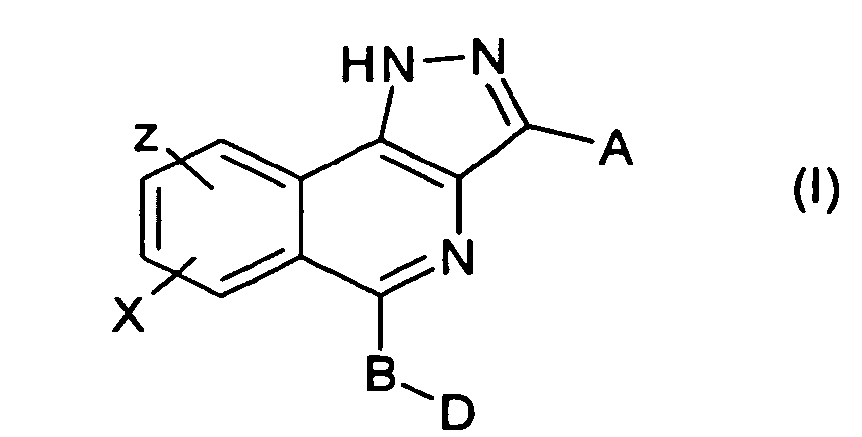 A für1. -(C1-C6)-Alkyl, worin Alkyl gerade oder verzweigt ist und ein- oder zweifach unabhängig voneinander substituiert ist durch1.1 -O-R1 oder1.2 C(O)-OR1, worin R1 füra) Wasserstoffatom oderb) -(C1-C6)-Alkyl steht,2. -O-R1,3. C(O)-OR1,4. Heteroaryl mit 5 bis 14 Ringgliedern, worin Heteroaryl unsubstituiert oder ein-, zwei- oder dreifach unabhängig voneinander durch R2 substituiert ist, steht, oder5. -(C1-C6)-Alkyl, worin Alkyl gerade oder verzweigt ist,B für1. eine kovalente Bindung oder2. -(C1-C4)-Alkylen, worin Alkylen gerade oder verzweigt ist und ein- oder
zweifach unabhängig voneinander durch R1 substituiert ist und R1 wie oben definiert ist, steht,D fürX und Z gleich oder verschieden sind und unabhängig voneinander für1. Heteroaryl mit 5 bis 14 Ringgliedern, worin Heteroaryl unsubstituiert
oder ein-, zwei- oder dreifach unabhängig voneinander substituiert ist durch R2,
worin R2 füra) Wasserstoffatom,b) -(C1-C4)-Alkyl,c) -OH,d) -O-(C1-C4)-Alkyl,e) Halogen oderf) -N(R3)-R4, worin R3 und R4 unabhängig voneinander Wasserstoffatom oder -(C1-C4)-Alkyl bedeuten, steht,2. Heterocyclus mit 5 bis 12 Ringgliedern, worin Heterocyclus unsubstituiert oder ein-, zwei- oder dreifach unabhängig voneinander substituiert ist durch R2, und R2 wie oben definiert ist,3. -(C6-C14)-Aryl, worin Aryl ein-, zwei- oder dreifach unabhängig voneinander substituiert ist durcha) -OH,b) -O-(C1-C4)-Alkyl, oderc) -N(R3)-R4, worin R3 und R4 unabhängig voneinander Wasserstoffatom oder -(C1-C4)-Alkyl bedeuten, oder4. -(C3-C6)-Cycloalkyl, worin Cycloalkyl unsubstituiert oder ein-, zwei- oder dreifach unabhängig voneinander substituiert ist durch R2, und R2 wie oben definiert ist, steht, unda) Wasserstoffatom,b) -(C1-C4)-Alkyl,c) -OH,d) -O-(C1-C4)-Alkyl odere) Halogen stehen. - Verbindung der Formel I gemäß Anspruch 1, wobeiA für1. -(C1-C3)-Alkyl, worin Alkyl gerade oder verzweigt ist und ein- oder zweifach unabhängig voneinander substituiert ist durch1.1 -O-R1 oder1.2 -C(O)-OR1, worin R1 füra) Wasserstoffatom oderb) -(C1-C3)-Alkyl steht, oder2. C(O)-OR1, steht,B für eine kovalente Bindung steht,D für1. Phenyl, worin Phenyl unsubstituiert oder ein-, zwei- oder dreifach unabhängig voneinander substituiert ist durch R2,
worin R2 füra) Wasserstoffatom,b) -(C1-C4)-Alkyl oderc) -N(R3)-R4, worin R3 und R4 unabhängig voneinander Wasserstoffatom oder -(C1-C3)-Alkyl bedeuten, steht,2. Pyridyl, worin Pyridyl unsubstituiert oder ein-, zwei- oder dreifach unabhängig voneinander substituiert ist durch R2 und R2 wie oben definiert ist, oder3. -(C4-C6)-Cycloalkyl, worin Cycloalkyl unsubstituiert oder ein-, zwei- oder dreifach unabhängig voneinander substituiert ist durch R2 und R2 wie oben definiert ist, steht, undX und Z gleich oder verschieden sind und unabhängig voneinander für Wasserstoffatom oder Halogen stehen. - Verbindung der Formel I gemäß Anspruch 1, dadurch gekennzeichnet, dass die Verbindung der Formel I aus der Gruppe
5-(3-Methoxy-phenyl)-3-methyl-1H-pyrazolo[4,3-c]isoquinolin,
3-(3-Methyl-1H-pyrazolo[4,3-c]isoquinolin-5-yl)-phenol,
5-(2-Methoxy-phenyl)-3-methyl-1H-pyrazol[4,3-c]isoquinolin,
5-(2,3-Dimethoxy-phenyl)-3-methyl-1 H-pyrazol[4,3-c]isoquinolin,
5-(2,4-Dimethoxy-phenyl)-3-methyl-1 H-pyrazol[4,3-c]isoquinolin,
5-(2,6-Dimethoxy-phenyl)-3-methyl-1H-pyrazol[4,3-c]isoquinolin,
5-(3,4-Dimethoxy-phenyl)-3-methyl-1H-pyrazol[4,3-c]isoquinolin,
5-(3,5-Dimethoxy-phenyl)-3-methyl-1H-pyrazol[4,3-c]isoquinolin,
5-(2,3,4-Trimethoxy-phenyl)-3-methyl-1H-pyrazol[4,3-c]isoquinolin,
5-(2,4,6-Trimethoxy-phenyl)-3-methyl-1H-pyrazol[4,3-c]isoquinolin,
5-(3,4,5-Trimethoxy-phenyl)-3-methyl-1H-pyrazol[4,3-c]isoquinolin,
5-(2-Ethoxy-phenyl)-3-methyl-1H-pyrazol[4,3-c]isoquinolin,
5-(4-Diethylamino-phenyl)-3-methyl-1 H-pyrazol[4,3-c]isoquinolin,
3-Methyl-5-pyridin-4-yl-1 H-pyrazol[4,3-c]isoquinolin,
3-Methyl-5-pyridin-3-yl-1 H-pyrazol[4,3-c]isoquinolin,
3-Methyl-5-pyridin-2-yl-1 H-pyrazol[4,3-c]isoquinolin,
3-Methyl-5-(1-methyl-piperidin-4-yl)-1 H-pyrazol[4,3-c]isoquinolin,
7,8-Dimethoxy-5-(3-methoxy-phenyl)-3-methyl-1 H-pyrazol[4,3-c]isoquinolin,
7,8-Dimethoxy-3-methyl-5-pyridin-2-yl-1 H-pyrazol[4,3-c]isoquinolin,
7,8-Dimethoxy-3-methyl-5-pyridin-3-yl-1 H-pyrazol[4,3-c]isoquinolin,
7-Methoxy-5-(3-methoxy-phenyl)-3-methyl-1 H-pyrazol[4,3-c]isoquinolin,
2-(3-Methyl-1 H-pyrazol[4,3-c]isoquinolin-5-yl)-phenol,
4-(3-Methyl-1 H-pyrazol[4,3-c]isoquinolin-5-yl)-benzen-2,4-diol oder
4-(3-Methyl-1 H-pyrazol[4,3-c]isoquinolin-5-yl)-benzen-1,2-diol ausgewählt ist. - Verfahren zur Herstellung der Verbindung der Formel I gemäß einem oder mehreren der Ansprüche 1 bis 3, dadurch gekennzeichnet, dass mana) eine Verbindung der Formel IV


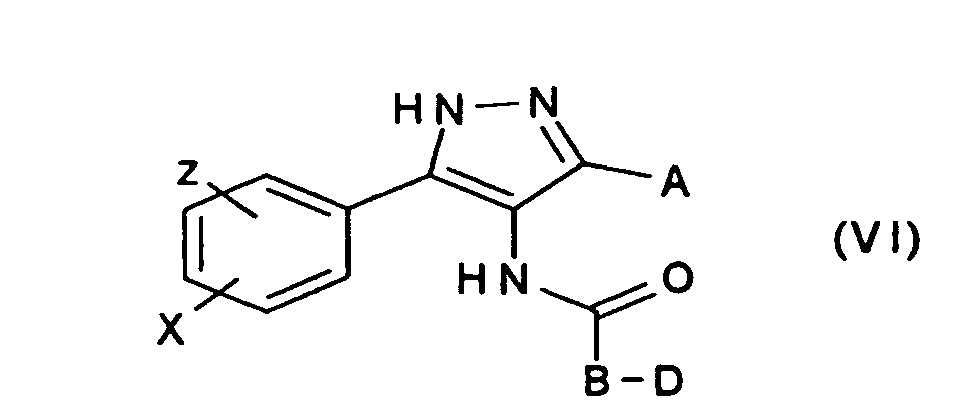 b) eine nach Verfahren a) hergestellte Verbindung der Formel 1, die aufgrund ihrer chemischen Struktur in enantiomeren Formen auftritt, durch Salzbildung mit enantiomerenreinen Säuren oder Basen, Chromatographie an chiralen Stationärphasen oder Derivatisierung mittels chiraler enantiomerenreinen Verbindungen wie Aminosäuren, Trennung der somit erhaltenen Diastereomeren, und Abspaltung der chiralen Hilfsgruppen in die reinen Enantiomeren auftrennt, oderc) die nach den Verfahren a) oder b) hergestellte Verbindung der Formel 1 entweder in freier Form isoliert oder im Falle des Vorliegens von sauren oder basischen Gruppen in physiologisch verträgliche Salzeumwandelt.
 - Arzneimittel, gekennzeichnet durch einen wirksamen Gehalt an mindestens einer Verbindung der Formel I gemäß einem oder mehreren der Ansprüche 1 bis 3 zusammen mit einem pharmazeutisch geeigneten und physiologisch verträglichen Trägerstoff, Zusatzstoff und/oder anderen Wirk- und Hilfsstoffen.
- Verwendung der Verbindung der Formel II
 A für1. -(C1-C6)-Alkyl, worin Alkyl gerade oder verzweigt ist und ein- oder zweifach unabhängig voneinander substituiert ist durch1.1 -O-R1 oder1.2 C(O)-OR1 , worin R1 füra) Wasserstoffatom oderb) -(C1-C6)-Alkyl steht,2. -O-R1,3. C(O)-OR1,4. Heteroaryl mit 5 bis 14 Ringgliedern, worin Heteroaryl unsubstituiert oder substituiert ist,5. -(C1-C6)-Alkyl, worin Alkyl gerade oder verzweigt ist, oder6. -(C6-C14)-Aryl, worin Aryl unsubstituiert oder ein-, zwei- oder dreifach unabhängig voneinander substituiert ist durch R2, steht,Bfür 1. eine kovalente Bindung oder2. -(C1-C4)-Alkylen, worin Alkylen gerade oder verzweigt ist und ein- oder zweifach unabhängig voneinander durch R1 substituiert ist und R1 wie oben definiert ist, steht,D fürX und Z gleich oder verschieden sind und unabhängig voneinander für1. Heteroaryl mit 5 bis 14 Ringgliedern, worin Heteroaryl unsubstituiert oder ein-, zwei- oder dreifach unabhängig voneinander substituiert durch R2 ist, worin R2 füra) Wasserstoffatom,b) -(C1-C4)-Alkyl,c) -OH,d) -O-(C1-C4)-Alkyl,e) Halogen oderf) -N(R3)-R4, worin R3 und R4 unabhängig voneinander Wasserstoffatom oder-(C1-C4)-Alkyl bedeuten, steht,2. Heterocyclus mit 5 bis 12 Ringgliedern, worin Heterocyclus unsubstituiert oder ein-, zwei- oder dreifach unabhängig voneinander substituiert ist durch R2, und R2 wie oben definiert ist,3. -(C6-C14)-Aryl, worin Aryl unsubstituiert oder ein-, zwei- oder dreifach unabhängig voneinander substituiert ist durch R2, und R2 wie oben definiert ist, oder4. -(C3-C6)-Cycloalkyl, worin Cycloalkyl unsubstituiert oder ein-, zwei- oder dreifach unabhängig voneinander substituiert ist durch R2, und R2 wie oben definiert ist, steht, und1. Wasserstoffatom,2. -(C1-C4)-Alkyl,3. -OH,4. -O-(C1-C4)-Alkyl oder5. Halogen stehen,zur Herstellung eines Arzneimittels zur Prophylaxe und Therapie von Osteoarthritis, oder Abstoßungsreaktionen des Körpers gegen ein übertragenes Organ oder Abstoßungsreaktionen des übertragenen Organs gegen den Körper.
 - Verwendung der Verbindung der Formel II gemäß Anspruch 6, wobeiA für1. -(C1-C3)-Alkyl, worin Alkyl gerade oder verzweigt ist und unsubstituiert ist oder ein- oder zweifach unabhängig voneinander substituiert ist durch1.1 -O-R1 oder1.2 C(O)-OR1 ,
worin R1 füra) Wasserstoffatom oderb) -(C1-C3)-Alkyl steht,2. Phenyl oder3. C(O)-OR1, steht,B für eine kovalente Bindung steht,D fürX und Z gleich oder verschieden sind und unabhängig voneinander für Wasserstoffatom oder Halogen stehen.1. Phenyl, worin Phenyl unsubstituiert oder ein-, zwei- oder dreifach unabhängig voneinander durch R2 substituiert ist, worin R2 füra) Wasserstoffatom,b) -(C1-C4)-Alkyl oderc) -N(R3)-R4, worin R3 und R4 unabhängig voneinander Wasserstoffatom oder -(C1-C3)-Alkyl bedeuten, steht,2. Pyridyl, worin Pyridyl unsubstituiert oder ein-, zwei- oder dreifach unabhängig voneinander substituiert ist durch R2 und R2 wie oben definiert ist, oder3. -(C4-C6)-Cycloalkyl, worin Cycloalkyl unsubstituiert oder ein-, zwei- oder dreifach unabhängig voneinander substituiert ist durch R2 und R2 wie oben definiert ist, steht, und
Applications Claiming Priority (3)
| Application Number | Priority Date | Filing Date | Title |
|---|---|---|---|
| DE10229762A DE10229762A1 (de) | 2002-07-03 | 2002-07-03 | Pyrazoloisoquinolinenderivaten zur Inhibierung von NFkappaB-induzierende Kinase |
| DE10229762 | 2002-07-03 | ||
| PCT/EP2003/006500 WO2004005287A1 (de) | 2002-07-03 | 2003-06-20 | Pyrazoloisoquinolinenderivaten zur inhibierung von nfkappab-induzierende kinase |
Publications (2)
| Publication Number | Publication Date |
|---|---|
| EP1519934A1 EP1519934A1 (de) | 2005-04-06 |
| EP1519934B1 true EP1519934B1 (de) | 2007-09-19 |
Family
ID=29761582
Family Applications (1)
| Application Number | Title | Priority Date | Filing Date |
|---|---|---|---|
| EP03762498A Expired - Lifetime EP1519934B1 (de) | 2002-07-03 | 2003-06-20 | Pyrazoloisoquinolinenderivaten zur inhibierung von nfkappab-induzierende kinase |
Country Status (12)
| Country | Link |
|---|---|
| US (1) | US6841556B2 (de) |
| EP (1) | EP1519934B1 (de) |
| JP (1) | JP4603355B2 (de) |
| AT (1) | ATE373658T1 (de) |
| AU (1) | AU2003242737B2 (de) |
| BR (1) | BRPI0312424A8 (de) |
| CA (1) | CA2490571C (de) |
| DE (2) | DE10229762A1 (de) |
| IL (1) | IL165995A0 (de) |
| MX (1) | MXPA05000038A (de) |
| TW (1) | TW200418852A (de) |
| WO (1) | WO2004005287A1 (de) |
Families Citing this family (6)
| Publication number | Priority date | Publication date | Assignee | Title |
|---|---|---|---|---|
| US7132428B2 (en) * | 2003-07-03 | 2006-11-07 | Aventis Pharmaceuticals Inc. | Pyrazoloisoquinoline derivative as kinase inhibitors for the treatment of various disorders |
| WO2006040645A1 (en) * | 2004-10-11 | 2006-04-20 | Ranbaxy Laboratories Limited | N-(3,5-dichloropyridin-4-yl)-2,4,5-alkoxy and 2,3,4-alkoxy benzamide derivatives as pde-iv (phophodiesterase type-iv) inhibitors for the treatment of inflammatory diseases such as asthma |
| AU2009263037B2 (en) * | 2008-06-26 | 2011-10-06 | Amgen Inc. | Alkynyl alcohols as kinase inhibitors |
| FR2944792B1 (fr) * | 2009-04-24 | 2011-05-20 | Sanofi Aventis | Derives de 1h-pyrazolo[4,3-c]isoquinoleines, leur preparation et leur application en therapeutique |
| EP2551670A1 (de) | 2011-07-27 | 2013-01-30 | Merck Patent GmbH | Zellenbasierte NIK-Hemmeranalyse |
| EP4169904A1 (de) | 2021-10-25 | 2023-04-26 | Yukin Therapeutics | Substituierte chinoline als verbesserte nik inhibitoren |
Family Cites Families (11)
| Publication number | Priority date | Publication date | Assignee | Title |
|---|---|---|---|---|
| GB8419658D0 (en) * | 1984-08-01 | 1984-09-05 | Wellcome Found | Nitrogen containing heterocyclic compounds |
| GB8600752D0 (en) * | 1986-01-14 | 1986-02-19 | Roussel Lab Ltd | Chemical compounds |
| US4748246A (en) * | 1987-05-07 | 1988-05-31 | American Home Products Corporation | Pyrazolo(4,3-c)quinolines |
| US5124337A (en) * | 1991-05-20 | 1992-06-23 | Schering Corporation | N-acyl-tetrahydroisoquinolines as inhibitors of acyl-coenzyme a:cholesterol acyl transferase |
| ATE162525T1 (de) * | 1991-07-30 | 1998-02-15 | Ciba Geigy Ag | Heteroaryl substituierte hydroxylaminderivate als lipoxygenase-inhibitoren |
| GB9322828D0 (en) * | 1993-11-05 | 1993-12-22 | Sandoz Ltd | Organic compounds |
| ID16283A (id) * | 1996-03-20 | 1997-09-18 | Astra Pharma Prod | Senyawa yang berguna dibidang farmasi |
| CA2295626A1 (en) * | 1997-07-09 | 1999-01-21 | Peter Cage | Novel compounds |
| EP1134221A1 (de) * | 2000-03-15 | 2001-09-19 | Aventis Pharma Deutschland GmbH | Substituierte beta-Carboline als lkB-Kinasehemmer |
| JP2002193938A (ja) * | 2000-12-01 | 2002-07-10 | Bayer Ag | 4−アリールピリジン誘導体 |
| CA2460939C (en) | 2001-09-19 | 2008-07-29 | Pharmacia Corporation | Substituted pyrazolyl compounds for the treatment of inflammation |
-
2002
- 2002-07-03 DE DE10229762A patent/DE10229762A1/de not_active Withdrawn
-
2003
- 2003-06-20 AU AU2003242737A patent/AU2003242737B2/en not_active Ceased
- 2003-06-20 EP EP03762498A patent/EP1519934B1/de not_active Expired - Lifetime
- 2003-06-20 BR BRPI0312424A patent/BRPI0312424A8/pt not_active Application Discontinuation
- 2003-06-20 MX MXPA05000038A patent/MXPA05000038A/es active IP Right Grant
- 2003-06-20 JP JP2004518545A patent/JP4603355B2/ja not_active Expired - Fee Related
- 2003-06-20 AT AT03762498T patent/ATE373658T1/de not_active IP Right Cessation
- 2003-06-20 WO PCT/EP2003/006500 patent/WO2004005287A1/de not_active Ceased
- 2003-06-20 DE DE50308230T patent/DE50308230D1/de not_active Expired - Lifetime
- 2003-06-20 CA CA2490571A patent/CA2490571C/en not_active Expired - Fee Related
- 2003-07-01 TW TW092117902A patent/TW200418852A/zh unknown
- 2003-07-03 US US10/613,482 patent/US6841556B2/en not_active Expired - Lifetime
-
2004
- 2004-12-26 IL IL16599504A patent/IL165995A0/xx unknown
Also Published As
| Publication number | Publication date |
|---|---|
| US6841556B2 (en) | 2005-01-11 |
| WO2004005287A1 (de) | 2004-01-15 |
| BR0312424A8 (pt) | 2016-02-16 |
| AU2003242737B2 (en) | 2009-01-22 |
| MXPA05000038A (es) | 2005-04-08 |
| EP1519934A1 (de) | 2005-04-06 |
| IL165995A0 (en) | 2006-01-15 |
| WO2004005287A9 (de) | 2004-03-04 |
| ATE373658T1 (de) | 2007-10-15 |
| BR0312424A (pt) | 2005-04-26 |
| JP2006513137A (ja) | 2006-04-20 |
| CA2490571C (en) | 2011-03-15 |
| BRPI0312424A8 (pt) | 2016-02-16 |
| CA2490571A1 (en) | 2004-01-15 |
| US20040097541A1 (en) | 2004-05-20 |
| TW200418852A (en) | 2004-10-01 |
| DE50308230D1 (de) | 2007-10-31 |
| JP4603355B2 (ja) | 2010-12-22 |
| DE10229762A1 (de) | 2004-01-22 |
| AU2003242737A1 (en) | 2004-01-23 |
Similar Documents
| Publication | Publication Date | Title |
|---|---|---|
| DE60112974T2 (de) | Carbolinderivate | |
| US6001847A (en) | Chemical compounds | |
| DE60216115T2 (de) | BENZIMIDAZO 4,5-föISOCHINOLINON-DERIVATE | |
| DE60315674T2 (de) | Neue imidazopyridine und ihre verwendung | |
| JP4394960B2 (ja) | Akt活性阻害薬 | |
| DE60038498T2 (de) | Triazole als Farnesyltransferaseinhibitoren | |
| DE69503753T2 (de) | Tetracyclische derivate, verfahren zu ihrer herstellung und ihre verwendung | |
| JP2021534106A (ja) | Pad4阻害剤としての置換チエノピロール | |
| JP2007521227A (ja) | キナーゼ阻害剤としてのピラゾロイソキノリン誘導体 | |
| MC1491A1 (fr) | Nouveaux composes bicycliques,procedes pour les preparer et formules pharmaceutiques contenant ces composes | |
| US3594380A (en) | Isoquinolin-1(2h)-ones | |
| JP2004501919A (ja) | 化学化合物 | |
| DE60121587T2 (de) | Zyklische gmp-spezifische phosphodiesteraseinhibitoren | |
| EP2240486B1 (de) | Triazoliumsalze als par1-inhibitoren, ihre herstellung und verwendung als arzneimittel | |
| EP0213499A2 (de) | Aminosäure-Derivate, Verfahren zu ihrer Herstellung und Verwendung | |
| EP2558465B1 (de) | Trizyklische pyridyl-vinyl-pyrrole als par1-inhibitoren | |
| WO2004005287A9 (de) | Pyrazoloisoquinolinenderivaten zur inhibierung von nfkappab-induzierende kinase | |
| BRPI0616663A2 (pt) | composto e uma base livre ou um sal, solvato ou solvato de um sal do mesmo farmaceuticamente aceitável, formulação farmacêutica, uso de um composto, e, processo para a preparação de um composto | |
| EP1670766B1 (de) | Bicyclische Iminosäurederivate zur Behandlung von (unter anderem) Erkrankungen des Bewegungsapparates | |
| US7132428B2 (en) | Pyrazoloisoquinoline derivative as kinase inhibitors for the treatment of various disorders | |
| US5114944A (en) | 2-phenylpyrazolo[1,5-a]pyrimidine-3-acetic acid derivatives exhibiting therapeutic effects | |
| EP0268178A1 (de) | Neue Pyrrolo-benzimidazole, diese Verbindungen enthaltende Arzneimittel und Verfahren zu ihrer Herstellung | |
| EP1585728A1 (de) | Iminosäurederivate als inhibitoren von matrix-metalloproteinasen | |
| EP0037471A1 (de) | 1-Aroyl-2-phenylamino-2-imidazoline, ihre Herstellung und diese enthaltende Arzneimittel | |
| WO2011128420A1 (de) | Pyridyl-vinyl-pyrazolo-chinoline als par1-inhibitoren |
Legal Events
| Date | Code | Title | Description |
|---|---|---|---|
| PUAI | Public reference made under article 153(3) epc to a published international application that has entered the european phase |
Free format text: ORIGINAL CODE: 0009012 |
|
| 17P | Request for examination filed |
Effective date: 20050203 |
|
| AK | Designated contracting states |
Kind code of ref document: A1 Designated state(s): AT BE BG CH CY CZ DE DK EE ES FI FR GB GR HU IE IT LI LU MC NL PT RO SE SI SK TR |
|
| AX | Request for extension of the european patent |
Extension state: AL LT LV MK |
|
| DAX | Request for extension of the european patent (deleted) | ||
| RAP1 | Party data changed (applicant data changed or rights of an application transferred) |
Owner name: SANOFI-AVENTIS DEUTSCHLAND GMBH |
|
| RIN1 | Information on inventor provided before grant (corrected) |
Inventor name: NAUMANN, THORSTEN Inventor name: FLOHR, STEFANIE |
|
| RIN1 | Information on inventor provided before grant (corrected) |
Inventor name: FLOHR, STEFANIE Inventor name: NAUMANN, THORSTEN |
|
| GRAP | Despatch of communication of intention to grant a patent |
Free format text: ORIGINAL CODE: EPIDOSNIGR1 |
|
| GRAS | Grant fee paid |
Free format text: ORIGINAL CODE: EPIDOSNIGR3 |
|
| GRAA | (expected) grant |
Free format text: ORIGINAL CODE: 0009210 |
|
| AK | Designated contracting states |
Kind code of ref document: B1 Designated state(s): AT BE BG CH CY CZ DE DK EE ES FI FR GB GR HU IE IT LI LU MC NL PT RO SE SI SK TR |
|
| REG | Reference to a national code |
Ref country code: GB Ref legal event code: FG4D Free format text: NOT ENGLISH |
|
| REG | Reference to a national code |
Ref country code: CH Ref legal event code: EP |
|
| REF | Corresponds to: |
Ref document number: 50308230 Country of ref document: DE Date of ref document: 20071031 Kind code of ref document: P |
|
| REG | Reference to a national code |
Ref country code: IE Ref legal event code: FG4D Free format text: LANGUAGE OF EP DOCUMENT: GERMAN |
|
| GBT | Gb: translation of ep patent filed (gb section 77(6)(a)/1977) |
Effective date: 20071113 |
|
| PG25 | Lapsed in a contracting state [announced via postgrant information from national office to epo] |
Ref country code: FI Free format text: LAPSE BECAUSE OF FAILURE TO SUBMIT A TRANSLATION OF THE DESCRIPTION OR TO PAY THE FEE WITHIN THE PRESCRIBED TIME-LIMIT Effective date: 20070919 |
|
| NLV1 | Nl: lapsed or annulled due to failure to fulfill the requirements of art. 29p and 29m of the patents act | ||
| ET | Fr: translation filed | ||
| PG25 | Lapsed in a contracting state [announced via postgrant information from national office to epo] |
Ref country code: ES Free format text: LAPSE BECAUSE OF FAILURE TO SUBMIT A TRANSLATION OF THE DESCRIPTION OR TO PAY THE FEE WITHIN THE PRESCRIBED TIME-LIMIT Effective date: 20071230 Ref country code: GR Free format text: LAPSE BECAUSE OF FAILURE TO SUBMIT A TRANSLATION OF THE DESCRIPTION OR TO PAY THE FEE WITHIN THE PRESCRIBED TIME-LIMIT Effective date: 20071220 Ref country code: NL Free format text: LAPSE BECAUSE OF FAILURE TO SUBMIT A TRANSLATION OF THE DESCRIPTION OR TO PAY THE FEE WITHIN THE PRESCRIBED TIME-LIMIT Effective date: 20070919 |
|
| REG | Reference to a national code |
Ref country code: IE Ref legal event code: FD4D |
|
| PG25 | Lapsed in a contracting state [announced via postgrant information from national office to epo] |
Ref country code: SK Free format text: LAPSE BECAUSE OF FAILURE TO SUBMIT A TRANSLATION OF THE DESCRIPTION OR TO PAY THE FEE WITHIN THE PRESCRIBED TIME-LIMIT Effective date: 20070919 Ref country code: PT Free format text: LAPSE BECAUSE OF FAILURE TO SUBMIT A TRANSLATION OF THE DESCRIPTION OR TO PAY THE FEE WITHIN THE PRESCRIBED TIME-LIMIT Effective date: 20080219 Ref country code: CZ Free format text: LAPSE BECAUSE OF FAILURE TO SUBMIT A TRANSLATION OF THE DESCRIPTION OR TO PAY THE FEE WITHIN THE PRESCRIBED TIME-LIMIT Effective date: 20070919 |
|
| PG25 | Lapsed in a contracting state [announced via postgrant information from national office to epo] |
Ref country code: RO Free format text: LAPSE BECAUSE OF FAILURE TO SUBMIT A TRANSLATION OF THE DESCRIPTION OR TO PAY THE FEE WITHIN THE PRESCRIBED TIME-LIMIT Effective date: 20070919 Ref country code: SE Free format text: LAPSE BECAUSE OF FAILURE TO SUBMIT A TRANSLATION OF THE DESCRIPTION OR TO PAY THE FEE WITHIN THE PRESCRIBED TIME-LIMIT Effective date: 20071219 |
|
| PLBE | No opposition filed within time limit |
Free format text: ORIGINAL CODE: 0009261 |
|
| STAA | Information on the status of an ep patent application or granted ep patent |
Free format text: STATUS: NO OPPOSITION FILED WITHIN TIME LIMIT |
|
| PG25 | Lapsed in a contracting state [announced via postgrant information from national office to epo] |
Ref country code: DK Free format text: LAPSE BECAUSE OF FAILURE TO SUBMIT A TRANSLATION OF THE DESCRIPTION OR TO PAY THE FEE WITHIN THE PRESCRIBED TIME-LIMIT Effective date: 20070919 |
|
| 26N | No opposition filed |
Effective date: 20080620 |
|
| PG25 | Lapsed in a contracting state [announced via postgrant information from national office to epo] |
Ref country code: IE Free format text: LAPSE BECAUSE OF FAILURE TO SUBMIT A TRANSLATION OF THE DESCRIPTION OR TO PAY THE FEE WITHIN THE PRESCRIBED TIME-LIMIT Effective date: 20070919 |
|
| BERE | Be: lapsed |
Owner name: SANOFI-AVENTIS DEUTSCHLAND G.M.B.H. Effective date: 20080630 |
|
| PG25 | Lapsed in a contracting state [announced via postgrant information from national office to epo] |
Ref country code: MC Free format text: LAPSE BECAUSE OF NON-PAYMENT OF DUE FEES Effective date: 20080630 |
|
| REG | Reference to a national code |
Ref country code: CH Ref legal event code: PL |
|
| PG25 | Lapsed in a contracting state [announced via postgrant information from national office to epo] |
Ref country code: BE Free format text: LAPSE BECAUSE OF NON-PAYMENT OF DUE FEES Effective date: 20080630 |
|
| PG25 | Lapsed in a contracting state [announced via postgrant information from national office to epo] |
Ref country code: EE Free format text: LAPSE BECAUSE OF FAILURE TO SUBMIT A TRANSLATION OF THE DESCRIPTION OR TO PAY THE FEE WITHIN THE PRESCRIBED TIME-LIMIT Effective date: 20070919 |
|
| PG25 | Lapsed in a contracting state [announced via postgrant information from national office to epo] |
Ref country code: SI Free format text: LAPSE BECAUSE OF FAILURE TO SUBMIT A TRANSLATION OF THE DESCRIPTION OR TO PAY THE FEE WITHIN THE PRESCRIBED TIME-LIMIT Effective date: 20070919 Ref country code: LI Free format text: LAPSE BECAUSE OF NON-PAYMENT OF DUE FEES Effective date: 20080630 Ref country code: CH Free format text: LAPSE BECAUSE OF NON-PAYMENT OF DUE FEES Effective date: 20080630 |
|
| PG25 | Lapsed in a contracting state [announced via postgrant information from national office to epo] |
Ref country code: CY Free format text: LAPSE BECAUSE OF FAILURE TO SUBMIT A TRANSLATION OF THE DESCRIPTION OR TO PAY THE FEE WITHIN THE PRESCRIBED TIME-LIMIT Effective date: 20070919 |
|
| PG25 | Lapsed in a contracting state [announced via postgrant information from national office to epo] |
Ref country code: BG Free format text: LAPSE BECAUSE OF FAILURE TO SUBMIT A TRANSLATION OF THE DESCRIPTION OR TO PAY THE FEE WITHIN THE PRESCRIBED TIME-LIMIT Effective date: 20071219 Ref country code: AT Free format text: LAPSE BECAUSE OF NON-PAYMENT OF DUE FEES Effective date: 20080620 |
|
| PG25 | Lapsed in a contracting state [announced via postgrant information from national office to epo] |
Ref country code: LU Free format text: LAPSE BECAUSE OF NON-PAYMENT OF DUE FEES Effective date: 20080620 Ref country code: HU Free format text: LAPSE BECAUSE OF FAILURE TO SUBMIT A TRANSLATION OF THE DESCRIPTION OR TO PAY THE FEE WITHIN THE PRESCRIBED TIME-LIMIT Effective date: 20080320 |
|
| PG25 | Lapsed in a contracting state [announced via postgrant information from national office to epo] |
Ref country code: TR Free format text: LAPSE BECAUSE OF FAILURE TO SUBMIT A TRANSLATION OF THE DESCRIPTION OR TO PAY THE FEE WITHIN THE PRESCRIBED TIME-LIMIT Effective date: 20070919 |
|
| PG25 | Lapsed in a contracting state [announced via postgrant information from national office to epo] |
Ref country code: IT Free format text: LAPSE BECAUSE OF NON-PAYMENT OF DUE FEES Effective date: 20080630 |
|
| REG | Reference to a national code |
Ref country code: FR Ref legal event code: PLFP Year of fee payment: 14 |
|
| REG | Reference to a national code |
Ref country code: FR Ref legal event code: PLFP Year of fee payment: 15 |
|
| REG | Reference to a national code |
Ref country code: FR Ref legal event code: PLFP Year of fee payment: 16 |
|
| PGFP | Annual fee paid to national office [announced via postgrant information from national office to epo] |
Ref country code: DE Payment date: 20180605 Year of fee payment: 16 |
|
| PGFP | Annual fee paid to national office [announced via postgrant information from national office to epo] |
Ref country code: FR Payment date: 20180511 Year of fee payment: 16 |
|
| PGFP | Annual fee paid to national office [announced via postgrant information from national office to epo] |
Ref country code: GB Payment date: 20180403 Year of fee payment: 16 |
|
| REG | Reference to a national code |
Ref country code: DE Ref legal event code: R119 Ref document number: 50308230 Country of ref document: DE |
|
| GBPC | Gb: european patent ceased through non-payment of renewal fee |
Effective date: 20190620 |
|
| PG25 | Lapsed in a contracting state [announced via postgrant information from national office to epo] |
Ref country code: GB Free format text: LAPSE BECAUSE OF NON-PAYMENT OF DUE FEES Effective date: 20190620 Ref country code: DE Free format text: LAPSE BECAUSE OF NON-PAYMENT OF DUE FEES Effective date: 20200101 |
|
| PG25 | Lapsed in a contracting state [announced via postgrant information from national office to epo] |
Ref country code: FR Free format text: LAPSE BECAUSE OF NON-PAYMENT OF DUE FEES Effective date: 20190630 |