EP1518533A2 - Sprühbare kosmetische Formulierung - Google Patents
Sprühbare kosmetische Formulierung Download PDFInfo
- Publication number
- EP1518533A2 EP1518533A2 EP04012315A EP04012315A EP1518533A2 EP 1518533 A2 EP1518533 A2 EP 1518533A2 EP 04012315 A EP04012315 A EP 04012315A EP 04012315 A EP04012315 A EP 04012315A EP 1518533 A2 EP1518533 A2 EP 1518533A2
- Authority
- EP
- European Patent Office
- Prior art keywords
- preparations
- cosmetic
- preparation
- group
- preparations according
- Prior art date
- Legal status (The legal status is an assumption and is not a legal conclusion. Google has not performed a legal analysis and makes no representation as to the accuracy of the status listed.)
- Withdrawn
Links
Classifications
-
- A—HUMAN NECESSITIES
- A61—MEDICAL OR VETERINARY SCIENCE; HYGIENE
- A61K—PREPARATIONS FOR MEDICAL, DENTAL OR TOILETRY PURPOSES
- A61K8/00—Cosmetics or similar toiletry preparations
- A61K8/02—Cosmetics or similar toiletry preparations characterised by special physical form
- A61K8/04—Dispersions; Emulsions
- A61K8/042—Gels
-
- A—HUMAN NECESSITIES
- A61—MEDICAL OR VETERINARY SCIENCE; HYGIENE
- A61K—PREPARATIONS FOR MEDICAL, DENTAL OR TOILETRY PURPOSES
- A61K8/00—Cosmetics or similar toiletry preparations
- A61K8/02—Cosmetics or similar toiletry preparations characterised by special physical form
- A61K8/04—Dispersions; Emulsions
- A61K8/046—Aerosols; Foams
-
- A—HUMAN NECESSITIES
- A61—MEDICAL OR VETERINARY SCIENCE; HYGIENE
- A61K—PREPARATIONS FOR MEDICAL, DENTAL OR TOILETRY PURPOSES
- A61K8/00—Cosmetics or similar toiletry preparations
- A61K8/18—Cosmetics or similar toiletry preparations characterised by the composition
- A61K8/19—Cosmetics or similar toiletry preparations characterised by the composition containing inorganic ingredients
- A61K8/26—Aluminium; Compounds thereof
-
- A—HUMAN NECESSITIES
- A61—MEDICAL OR VETERINARY SCIENCE; HYGIENE
- A61Q—SPECIFIC USE OF COSMETICS OR SIMILAR TOILETRY PREPARATIONS
- A61Q19/00—Preparations for care of the skin
Definitions
- the present invention relates to gel-type, finely dispersed systems of the oil-in-water type and hydrodispersion gels preferably as cosmetic or dermatological Preparations.
- Gels are dimensionally stable, easily deformable, on liquids u.
- Gases rich disperse systems of at least two components which consists mostly of a solid, colloidally divided substance with long or highly branched particles (eg gelatin, silica, montmorillonite, bentonites, polysaccharides, pectins, etc., often called thickeners gelling agents ) and a Liquid (usually water) exist as a dispersant.
- the solid substance is coherent, ie it forms a spatial network in the dispersion medium, wherein the particles adhere to each other at various points by means of minor or major valences.
- hydrogels Dimensionally stable hydrogels arise z. B. already from 0.2% agar and 99.8% water or 0.6% gelatin u. 99.4% water. Soles can also form gels, u. Although by a flocculation od. Flocculation process mentioned.
- Xerogels are gels that have lost their fluid in some way (by evaporation, squeezing, or aspiration), which also changes the spatial arrangement of the mesh, so that the distances between the structural elements only have dimensions of atomic distances ( example: dried gelatin, Glue, agar-agar). Xerogels are a limit state to the solid state. Xerogels in the chemical laboratory are the silica gels. By swelling (with the addition of the dispersant) the Xero- can go back into lyogels.
- Gels can be incoherent systems (each particle is free to move as a "kinetic unit” and is not related to any other particle) or coherent systems (the dispersed substance, due to cohesion, somehow depends, e.g., reticulated, and is no longer freely mobile ). These definitions are identical to the division into brine (incoherent) u. Gels (coherent). In the case of brines, the type of dispersants is usually added for labeling, e.g. B. hydrosols u. Organosols as lyosols, aerosols. Sols have liquid (or gas) properties.
- Emulsions are generally understood to mean heterogeneous systems that do not consist of two or only to a limited extent miscible liquids, commonly referred to as Phases are called.
- Phases are used in an emulsion, one of the two liquids is in shape finest droplets dispersed in the other liquid.
- oil-in-water emulsion O / W emulsion, eg milk
- O / W emulsion oil-in-water emulsion
- the basic character of an O / W emulsion is characterized by the water.
- a very elegant form of oil-in-water emulsion is the silicone-in-water emulsion.
- no traditional lipids are emulsified, but predominantly silicone oils (cyclic and / or linear silicone oils), which give a silky, light skin feel.
- a water-in-oil emulsion (W / O emulsion, eg butter) is the reverse principle, with the basic character being determined by the oil.
- Emulsions To achieve the permanent dispersion of one liquid in another, is at Emulsions in the conventional sense, the addition of a surfactant (Emulsifier) necessary.
- Emulsifiers have an amphiphilic molecular structure consisting of a polar (hydrophilic) and a nonpolar (lipophilic) moiety, which are spatially separated from each other.
- simple emulsions lie in the one Phase finely dispersed, enclosed by an emulsifier shell droplets of the second Phase (water droplets in W / O or lipid vesicles in O / W emulsions) before.
- emulsifiers They reduce the interfacial tension between the phases by acting on the Interface between the two liquids are arranged. They form at the phase boundary Oil / water interface films, resulting in irreversible confluence the droplet is counteracted.
- Emulsifier mixtures To stabilize emulsions become common Emulsifier mixtures used.
- Emulsions are an important product type in the field of cosmetic and / or dermatological Preparations.
- Cosmetic preparations are used essentially for skin care.
- skin care In the cosmetic sense, first and foremost is that the natural function of the skin as a barrier against environmental influences (eg dirt, chemicals, microorganisms) and against Strengthen the loss of endogenous substances (eg water, natural fats, electrolytes) or restored. If this function is disturbed, it can become too strong Absorption of toxic or allergenic substances or infestation of microorganisms and as a result, toxic or allergic skin reactions occur.
- the aim of skin care is also the daily caused by washing the fat and To compensate for water loss of the skin. This is especially important when the natural Regeneration capacity is insufficient.
- skin care products are intended Environmental influences, especially against sun and wind, protect and skin aging delay.
- Cosmetic preparations are also used as deodorants. Such formulations serve to eliminate body odor that arises when the odorless in itself fresh sweat is decomposed by microorganisms.
- Medical topical compositions typically contain one or more Drugs in effective concentration.
- Drugs in effective concentration.
- emulsifiers can be used chemical substance, in an individual case allergic or on hypersensitivity of the user cause underlying reactions.
- Of essential importance are not the chemical, but the surface properties of the solid particles.
- emulsions are also referred to as Pickering emulsions.
- European Published Patent Application 0 686 391 also describes "emulsions" of the type water-in-oil, which are free of surface-active substances and only by Be stabilized solids.
- spherical polyalkylsilsesquioxane particles are used here used, which have a diameter of 100 nm to 20 microns, which are added to the oil phase and thicken them.
- This kind of preparations can therefore be described as oil gels (also: oleogels), in which water stable can be dispersed.
- WO-document WO-98/42301 describes emulsifier-free finely dispersed systems of the type of water-in-oil, which by the addition of micronized, inorganic pigments stabilized, selected from the group of metal oxides, in particular titanium dioxide become.
- Hydrodispersions make dispersions of a liquid, semi-solid or solid internal (discontinuous) lipid phase in one outer aqueous (continuous) phase.
- the stability can be ensured, for example, by establishing a gel skeleton in the aqueous phase ( coherent system ) in which the lipid droplets are stably suspended.
- the German Offenlegungsschrift P 44 25 268 A1 describes stable finely dispersed, emulsifier-free cosmetic or dermatological preparations of the oil-in-water type, which contain one or more thickeners from the group of acrylic acid polymers, polysaccharides and their alkyl ethers in addition to an oil and a water phase for these thickeners a lowering of the interfacial tension must not be measurable.
- cosmetic and dermatological bases to develop for cosmetic and dermatological preparations that are characterized by good skin compatibility.
- an object of the present invention products with the widest possible to provide a variety of applications.
- basics for Forms of preparation such as cleansing emulsions, face and body care preparations or deodorants, but also pronounced medical-pharmaceutical dosage forms be created, for example, preparations for acne and others Skin symptoms.
- Another object of the present invention was to provide the prior art with cosmetic or dermatological preparations in which the use of Emulsifiers conventional type is reduced to a minimum.
- the phyllosilicates are present in colloidally dissolved form in the preparations according to the invention.
- colloidal solutions are the finely divided solid particles, with particle sizes between 1000 and 1 nm.
- colloidal solutions represent a special form of homogeneous suspensions. Such a colloidal solution is achieved by dispersing the sheet silicates in the water phase under the action of high shear forces. As a result, these layered silicates insistially incorporate foreign molecules (here water) into the layer structure and form a coherent system (gel) . When loaded, these layers break up into smaller molecular assemblies with partial fragmentation. This process is reversible as soon as the load is eliminated.
- Suitable dispersing machines are i.a. under the name Ultra-Turrax® (company IKA) available and create final fineness of the particles of up to 5 microns.
- the preparations according to the invention are sprayable despite their gel structure Formulations having a viscosity and / or yield point of over 2500 mPas (Measurement with viscose ester VT-02 from Haake, rotating body 1, measured value after 30s, scale 1) to creamy consistency.
- mPas Measurement with viscose ester VT-02 from Haake, rotating body 1, measured value after 30s, scale 1
- Usually have to be sprayable Formulations have a viscosity of less than 1000 mPas, better still below 500 mPas (or water-thin) in order to be sprayable with normal spray heads.
- the preparations according to the invention can be sprayed by conventional spray heads, since by the pressure on the spray head (pump) occurring shear forces the Phyllosilicate scaffold breaks down short-term and reversible and the preparation with it becomes thin and sprayable (thixotropy).
- the lipid droplets stably suspended.
- the stability of colloidal solutions is greatly enhanced by the surface charges of the Particles, their electrostatic interactions as well as by conductivity u. PH value the outer phase determined. The excess or falling below a certain pH (isoelectric point) leads to flocculation (coagulation) of the dispersion, as well as exceeding a certain conductivity.
- the preparations according to the invention are blends of oils or oil-soluble Substances and water or water-soluble components, by the addition stabilized by phyllosilicates and optionally modified phyllosilicate particles and must contain only small amounts of conventional emulsifiers.
- the preparations according to the invention are extremely satisfactory in every respect Preparations that surprisingly show excellent cosmetic properties the skin does not leave a dry or dull impression and one have excellent skin tolerance.
- the formation of roll-like particles when juxtaposing with conventional ones cosmetic preparation of treated skin areas is at the preparations of the invention are not recognizable.
- Another advantage is that the structure is retained in the preparation and after the Bottling is stable. Also occurs during storage or transport to the user no separation of the emulsions and the active substances contained therein and / or Pigments. Floating or sinking of particles is also at Conditions that are common for the storage of cosmetic preparations, not too observe.
- the floating is effected by the gel skeleton suppressed.
- Preparations with optimum texture show a viscosity reduction (pseudoplastic behavior) only under shear stress (when pumping).
- a high shear stability is important to ensure a sufficiently high viscosity and good stability even after repeated pumping of the preparation. After completion of the pumping or distribution process on the skin, the preparations in the resting state should 'regenerate' and so build up the necessary viscosity to keep the active ingredients on the skin longer, and to allow a prolonged effect.
- Silicates are salts and esters (silicic acid esters) of orthosilicic acid [Si (OH) 4 ] and their condensation products.
- the silicates are not only the most species-rich class of minerals, but also extremely important geologically and technically. Over 80% of the earth's crust is made up of silicates.
- Layer silicates (phyllosilicates, leaf silicates) are (ideally) silicate structures with two-dimensionally infinite layers of [SiO 4 ] 4 tetrahedra, each tetrahedron being connected via 3 bridging oxygens to neighboring tetrahedra.
- Chemical formulas can only be approximated for phyllosilicates because they have a large ion exchange capacity and silicon can be exchanged for aluminum and this in turn against magnesium, Fe 2+ , Fe 3+ , Zn and the like.
- the resulting possibly negative charge of the layers is usually compensated by cations, in particular by Na + and Ca 2+ in interlayer positions.
- Phyllosilicates can be obtained by reversible storage of water (in the 2- to 7-fold Amount) and other substances such. As alcohols, glycols and the like swell. Their use as thickeners in cosmetic products is accordingly known in itself. However, the state of the art could not lead the way present invention.
- Advantageous phyllosilicates in the sense of the present invention are, for example, those their largest direction of expansion in the unmodified and unswollen state has an average length of less than 10 microns.
- the naturally occurring phyllosilicates must be prepared before use become. Under treatment u.a. cleaning by washing and grinding Understood. Particularly advantageous is the isomorphic substitution of the in the natural cationic cations with high valency cations lower valence.
- the effective Size of processed sheet silicate particles in a cosmetic or Of course, dermatological formulation depends on the amount stored substances.
- Advantageous phyllosilicates in the context of the present invention are, for example, processed smectites (smectites).
- Smectites are always very fine-grained (mostly ⁇ 2 mm), mostly as lamellar, moss-like or spherical aggregates occurring three-layer clay minerals (2: 1 sheet silicates) in which a central layer of octahedrally coordinated cations sandwiched by 2 layers of [(Si Al) O 4 ] tetrahedra is surrounded.
- Smectites are ideally described by the following structural formula wherein white filled circles represent silicon and / or aluminum atoms, light gray circles oxygen atoms, dark gray circles hydrogen atoms and black circles aluminum, magnesium, iron and / or other exchange cations:
- Advantageous processed smectites are z. B. prepared Montmorillonlte . Montmorillonites n H 2 O or Al 2 O 3 ⁇ 4 SiO 2 ⁇ H 2 O ⁇ n H 2 O described by the approximate chemical formula Al2 [(OH) 2 / Si 4 O 10] ⁇ and set to the dioctahedral Smectites belonging clay minerals.
- Bentonites are clays and rocks that contain smectites, especially montmorillonite, as main minerals.
- the "raw" bentonites are either the non-swellable calcium bentonites (referred to in the UK as Fuller earths) or the swellable sodium bentonites (also: Wyoming bentonites).
- Fuller earths the non-swellable calcium bentonites
- sodium bentonites also: Wyoming bentonites.
- Particularly advantageous in the context of the present invention are the processed hectorites.
- Especially advantageous is the use of synthetic sodium magnesium silicates (INCI name: Sodium Magnesium Silicate) of the type Optigel SH® and of the type Laponite XLG®.
- Saponite is a swellable magnesium aluminum silicate belonging to the smectites in which the octahedral layers in the structure are almost exclusively occupied by Mg, Fe 2+ and Fe 3+ ions.
- a negative charge of x ⁇ 0.6 per O 10 (OH) 2 in the tetrahedral layers is compensated by cations between the layer packages.
- magnesium aluminum silicates INCI name: magnesium aluminum silicates
- layered silicates of the type Laponite XLG ® show in one Concentration of 1 to 5 wt .-% - based on the total weight of the preparations - And in combination with nonionic and anionic emulsifiers the desired Gelation behavior.
- the gelation triggered by the phyllosilicates is due to the addition of electrolytes but flocculation may occur if the electrolyte content is too high.
- Modified sheet silicates in the context of the present invention are sheet silicates, in particular the already mentioned sheet silicate types, their organophilia (also: lipophilicity) - For example, by reaction with quaternary ammonium compounds - was increased.
- organophilia also: lipophilicity
- Such phyllosilicates are also referred to as organophilic phyllosilicates.
- bentones d. H. organic derivatives of montmorillonites (or bentonites) and / or hectorites, which are prepared by ion exchange reactions with alkylammonium bases.
- Advantageous modified sheet silicates in the context of the present invention can be obtained, for example, by reacting sheet silicates with quaternium-18.
- Quaternium-18 is a mixture of quaternary ammonium chloride salts, which are described by the following structural formula: wherein the radicals R 1 are independently selected from the group methyl and hydrogenated Talgreste having a chain length of 12 to 20 carbon atoms.
- stearalkonium hectorite a reaction product of hectorite and stearalkonium chloride (benzyldimethylstearylammonium chloride), and quaternium-18 hectorite, a reaction product of hectorite and quaternium-18, which z. B. under the trade names Bentone 27 and Bentone 38 at Nordmann & Rassmann are available.
- the advantage in the use of modified phyllosilicates in inventive Preparations lies in a reduction in the amount of conventional emulsifiers, the Stability of the O / W emulsion cause.
- the total amount of one or more phyllosilicates and / or modified Phyllosilicates in the finished cosmetic or dermatological preparations advantageously selected from the range from 0.05 to 20.0% by weight, preferably from 0.1 to 5.0% by weight, based on the total weight of the preparations.
- the preparations according to the invention only by the addition of one or more phyllosilicates and / or modified It may also be advantageous to further stabilize phyllosilicates, further amphiphilic Pigments which improve the feel of the skin, the coloring of the Preparation and UV protection of the preparation and in particular the skin serve.
- Such pigments are, for example, micronized, inorganic pigments chosen are from the group of amphiphilic metal oxides, in particular from the group Titanium dioxide, zinc oxide, silicon dioxide or silicates (for example talcum), where the metal oxides may be present both individually and in admixture. It is essentially irrelevant in which of the naturally occurring modifications used amphiphilic metal oxides.
- the modified ones according to the invention To combine phyllosilicates with untreated, almost pure pigment particles, especially with those which are also used as a dye in the food industry and / or used as an absorber of UV radiation in sunscreens can.
- the zinc oxide pigments available from Merck are advantageous as well as those which are neutral under the trade names zinc oxide Haarmann & Reimer or NanoX available from the Harcros Chemical Group.
- the superficial are water-repellent treated ("coated"), where at the same time an amphiphilic Character of these pigments are to be formed or to be retained.
- This surface treatment may be that the pigments are known per se Procedure be provided with a thin hydrophobic layer.
- the total concentration of all Emulsifiers greater than 1.0 wt .-%, more preferably between 1.0 wt .-% and 5.5% by weight, based on the total weight of the preparations.
- preparations are significantly less as 5.5% by weight of one or more emulsifiers.
- preparations according to the invention which contain from 0.001 to 3.5% by weight of one or more contain several emulsifiers.
- An optionally desired oil component of the cosmetic or dermatological cleaning preparations - for example in the form of Cleaning emulsions - in the context of the present invention is advantageously selected from the group of esters of saturated and / or unsaturated, branched and / or unbranched Alkanecarboxylic acids of a chain length of 3 to 30 carbon atoms and saturated and / or unsaturated, branched and / or unbranched alcohols of a chain length from 3 to 30 carbon atoms, from the group of esters of aromatic carboxylic acids and saturated and / or unsaturated, branched and / or unbranched alcohols a chain length of 3 to 30 carbon atoms.
- ester oils can then be advantageous are selected from the group isopropyl myristate, isopropyl palmitate, isopropyl stearate, Isopropyl oleate, n-butyl stearate, n-hexyl laurate, n-decyl oleate, isooctyl stearate, isononyl stearate, Isononyl isononanoate, 2-ethylhexyl palmitate, 2-ethylhexyl laurate, 2-hexyldecyl stearate, 2-octyl dodecyl palmitate, oleyl oleate, oleyl erucate, erucyl oleate, erucyl erucate, and the like synthetic, semi-synthetic and natural mixtures of such esters, e.g. B. jojoba oil.
- the oil component can be advantageously selected from the group of branched and unbranched hydrocarbons and waxes, the silicone oils, Dialkyl ethers, the group of saturated or unsaturated, branched or unbranched alcohols, and the fatty acid triglycerides, namely the triglycerol esters saturated and / or unsaturated, branched and / or unbranched alkanecarboxylic acids a chain length of 8 to 24, in particular 12 to 18 carbon atoms.
- the fatty acid triglycerides can be advantageously selected from the group of synthetic, semi-synthetic and natural oils, e.g. Olive oil, sunflower oil, Soybean oil, peanut oil, rapeseed oil, almond oil, palm oil, coconut oil, palm kernel oil, and the like.
- any mixtures of such oil and wax components are advantageous in the Use of the present invention. It may also be advantageous if necessary waxes, for example cetyl palmitate, as the sole lipid component of the oil phase use.
- the oil component is selected from the group 2-ethylhexyl isostearate, octyldodecanol, Isotridecyl isononanoate, isoeicosane, 2-ethylhexyl cocoate, C12-15 alkyl benzoate, Caprylic capric acid triglyceride, dicaprylyl ether.
- Particularly advantageous are mixtures of C12-15-alkyl benzoate and 2-ethylhexyl isostearate, Mixtures of C12-15 alkyl benzoate and Isotridecylisononanoat and mixtures from C12-15 alkyl benzoate, 2-ethylhexyl isostearate and isotridecyl isononanoate.
- hydrocarbons paraffin oil, squalane and squalene are advantageous in the sense to use the present invention.
- the oil component may further contain cyclic or linear silicone oils have or consist entirely of such oils, although preferred is added, besides the silicone oil or the silicone oils, an additional content of others To use oil phase components.
- cyclomethicone octamethylcyclotetrasiloxane
- silicone oil octamethylcyclotetrasiloxane
- other silicone oils are beneficial in the sense of the present invention, for example hexamethylcyclotrisiloxane, polydimethylsiloxane, Poly (methylphenylsiloxane).
- mixtures of cyclomethicone and isotridecyl isononanoate from cyclomethicone and 2-ethylhexyl isostearate.
- the oil component is also advantageously selected from the group of phospholipids.
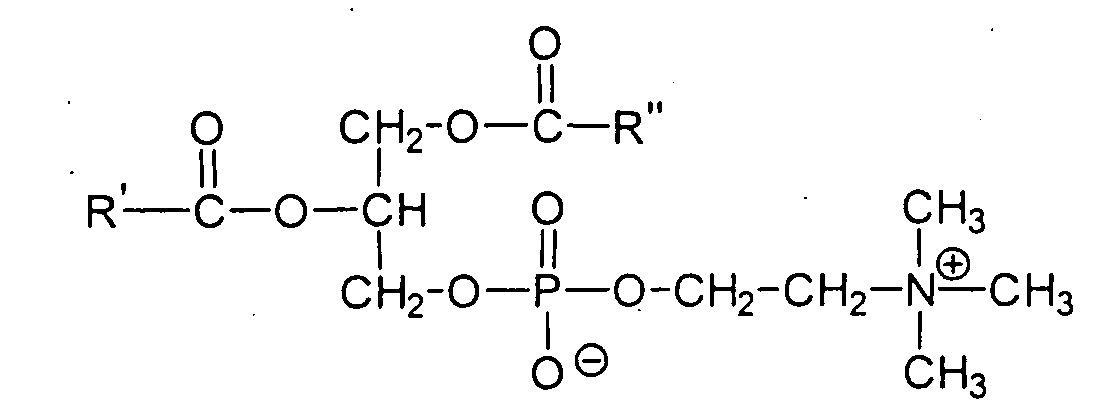
- the phospholipids are phosphoric acid esters of acylated glycerols.
- the lecithins which are distinguished by the general structure in which R 'and R "are typically unbranched aliphatic radicals having 15 or 17 carbon atoms and up to 4 cis double bonds.
- the emulsions or gels according to the invention can be used as a basis for cosmetic or dermatological formulations. These can be put together as usual and, for example, for the treatment and care of the skin, the nails, as Lip care product, as Deo apparatus and as make-up or make-up removal in the decorative cosmetics or serve as a sunscreen preparation.
- the application will be the Cosmetic and dermatological preparations according to the invention in the for Cosmetics usual way applied to the skin in sufficient quantity.
- cosmetic or topical dermatological compositions used in the context of the present invention for example be used as skin protection cream, cleansing milk, sunscreen lotion, nutritional cream, day or Night cream, etc. It is possibly possible and advantageous, the inventive Compositions as a basis for pharmaceutical formulations to use.
- the cosmetic and dermatological preparations according to the invention can contain cosmetic excipients, such as is commonly used in such preparations be, for.
- cosmetic excipients such as is commonly used in such preparations be, for.
- Preservatives, bactericides, perfumes, preventing substances foaming, dyes, pigments which have a coloring effect, thickeners, softening, moisturizing and / or moisturizing substances, Fats, oils, waxes or other common ingredients of a cosmetic or dermatological Such as alcohols, polyols, polymers, foam stabilizers, electrolytes, organic solvents or silicone derivatives.
- compositions according to the invention are very good vehicles for cosmetic or dermatological agents in the skin, wherein beneficial agents are antioxidants which protect the skin from oxidative stress can protect.
- the preparations advantageously contain one or more antioxidants.
- antioxidants As favorable, but nevertheless optional to use antioxidants, all for cosmetic and / or dermatological applications suitable or customary Antioxidants are used. It is advantageous, antioxidants as the only Use drug class, such as if a cosmetic or dermatological Application is in the foreground, such. B. the fight against oxidative stress of the skin. However, it is also favorable to use the preparations according to the invention To provide a content of one or more antioxidants, if the Preparations should serve a different purpose, for. B. as deodorants or sunscreens.
- the antioxidants are selected particularly advantageously from the group consisting of amino acids (eg glycine, histidine, tyrosine, tryptophan) and their derivatives, imidazoles (eg urocanic acid) and their derivatives, peptides such as D, L-carnosine, D. Carnosine, L-carnosine and their derivatives (eg anserine), carotenoids, carotenes (eg ⁇ -carotene, ⁇ -carotene, lycopene) and their derivatives, chlorogenic acid and its derivatives, lipoic acid and derivatives thereof (eg B.
- amino acids eg glycine, histidine, tyrosine, tryptophan
- imidazoles eg urocanic acid
- peptides such as D, L-carnosine, D.
- Carnosine, L-carnosine and their derivatives eg anserine
- carotenoids eg ⁇ -caro
- ascorbyl palmitate Mg ascorbyl phosphate, ascorbyl acetate), tocopherols and derivatives (eg, vitamin E acetate), vitamin A and derivatives (vitamin A palmitate), as well as coniferyl benzoate of benzoin, rutinic acid and derivatives thereof, Glycosylrutin, ferulic acid, furfurylidenglucitol, carnosine, butylhydroxytoluene, butylhydroxyanisole, nordihydroguaiacetic acid, nordihydroguiaretic acid, trihydroxybutyrophenone, uric acid and its derivatives, mannose and its derivatives, zinc and its derivatives (eg ZnO, ZnSO 4 ), Selenium and its derivatives (e.g.
- the amount of the aforementioned antioxidants (one or more compounds) in the Preparations according to the invention are preferably from 0.001 to 30% by weight, especially preferably 0.05 to 20 wt .-%, in particular 0.1 to 10 wt .-%, based on the total weight the preparation.
- vitamin E and / or its derivatives are the antioxidant or antioxidants, it is advantageous, their respective concentrations from the range of 0.001 to 10 wt .-%, based on the total weight of the formulation to choose.
- vitamin A or vitamin A derivatives, or carotenes or their derivatives, the or which are antioxidants, it is advantageous to their respective concentrations from the Range of 0.001-10% by weight based on the total weight of the formulation choose.
- the active ingredients can also be very be selected from the group of lipophilic active ingredients, in particular from following group:
- vitamins eg. As ascorbic acid
- the active ingredients from the group of lipid-replaceable substances select, for example Purcellinöl, Eucerit® and Neocerit®.
- cosmetic and dermatological preparations which are used in the Form of a sunscreen.
- these contain in addition to the invention Active substance combinations additionally at least one UV-A filter substance and / or at least one UV-B filter substance.
- Active substance combinations additionally at least one UV-A filter substance and / or at least one UV-B filter substance.
- Such formulations can, although not necessary, optionally also one or more inorganic pigments contained as UV filter substances.
- inorganic pigments based on metal oxides and / or other sparingly water-soluble or insoluble metal compounds, in particular the oxides of titanium (TiO 2 ), zinc (ZnO), iron (eg Fe 2 O 3 ), zirconium (ZrO 2 ), silicon (SiO 2 ), manganese (eg MnO), aluminum (Al 2 O 3 ), cerium (eg Ce 2 O 3 ), mixed oxides of the corresponding metals and mixtures of such oxides.
- UV protectants as well as antioxidants and, if desired, Preservatives, effective protection of the preparations themselves against spoilage represents.
- preparations according to the invention can also be used as a basis for cosmetic Deodorants or antiperspirants are used, so that the present Invention in a particular embodiment as a basis for cosmetic Deodorants.
- Cosmetic deodorants serve to eliminate body odor that arises when the odorless fresh sweat is decomposed by microorganisms.
- the usual cosmetic deodorants are based on different principles of action.
- antiperspirants can by astringents - predominantly aluminum salts such as aluminum hydroxychloride (alchloride hydrate) - reduces the formation of sweat become.
- the Bacterial flora on the skin can be reduced. It should ideally only the smell causing microorganisms are effectively reduced.
- the sweat flow itself is not influenced by this, in the ideal case, only the microbial decomposition of the Sweat temporarily stopped.
- odor maskers such as the common perfume ingredients, Odor absorber, for example, in the patent publication DE-P 40 09 347 layered silicates described, of these in particular montmorillonite; Kaolinite, llit, 3, 6, 5,entane, 1,8-dimethylcellulose, 1,8-dimethylcellulose, 1,8-dimethylcellulose, 1,8-dimethylcellulose, 1,8-dimethylcellulose, 1,8-dimethylcellulose, 1,8-dimethoxysulfate, and/orinhibiting agents.
- Advantageous substances are, for example 2,4,4'-trichloro-2'-hydroxydiphenyl ether (Irgasan), 1,6-di- (4-chlorophenylbiguanido) -hexane (Chlorhexidine), 3,4,4'-trichlorocarbanilide, quaternary ammonium compounds, clove oil, Mint oil, thyme oil, triethyl citrate, farnesol (3,7,11-trimethyl-2,6,10-dodecatrien-1-ol) as well as in the patent publications DE-37 40 186, DE-39 38 140, DE-42 04 321, DE-42 29 707, DE-43 09 372, DE-44 11 664, DE-195 41 967, DE-195 43 695, DE-195 43 696, DE-195 47 160, DE-196 02 108, DE-19602110, DE-19602111, DE-196 31 003, DE-196 31 004 and DE-196 34 019 and the patents DE
- the cosmetic deodorants of the invention may be in the form of normal Containable containers containing aqueous cosmetic preparations.
- the amount of antiperspirant active ingredients or deodorants (one or more compounds) in the preparations is preferably 0.01 to 30 wt .-%, especially preferably 0.1 to 20 wt .-%, in particular 1 to 10 wt .-%, based on the total weight the preparation.
- the formulations of the invention are also excellent excipients for dermatological agents.
- they are useful as carriers for anti-acne substances.
- Acne is a skin disorder of various forms and causes, characterized by non-inflammatory and inflammatory nodules, resulting from clogged hair follicles (comedones), which can lead to pustules, abscesses and scarring.
- the most common is acne vulgaris, which occurs predominantly during puberty.
- Causative conditions for acne vulgaris are keratinization and obstruction of the hair follicle mouth, the sebum production dependent on the blood level of male sex hormones and the production of free fatty acids and tissue damaging enzymes by bacteria ( Propionibacterium acnes ).
- acne-active substances which are active, for example, against Propionibacterium acnes (for example those which are described in DE-OS 42 29 707, DE-OS 43 05 069, DE-OS 43 07 976, DE-OS.
- OS 43 37 711, DE-OS 43 29 379 but also other acne-active substances, for example all-trans-retinoic acid, 13-cis-retinoic acid and related substances) or antiinflammatory agents, for example batyl alcohol ( ⁇ -Octadecylglycerylether) , Selachyl alcohol ( ⁇ -9-octadecenyl glyceryl ether), chimyl alcohol ( ⁇ -hexadecyl glyceryl ether) and / or bisabolol as well as antibiotics and / or keratolytics.
- acne-active substances for example all-trans-retinoic acid, 13-cis-retinoic acid and related substances
- antiinflammatory agents for example batyl alcohol ( ⁇ -Octadecylglycerylether) , Selachyl alcohol ( ⁇ -9-octadecenyl glyceryl ether), chimyl alcohol ( ⁇ -hexadecyl glyceryl
- Keratolytics are substances that are dead skin (such as warts, corns, calluses and the like) soften, so that they can be removed more easily or with it falls off or dissolves.
- All common acne-active substances can be used to advantage, in particular benzoyl peroxide, bituminosulfonates (ammonium, sodium and calcium salts of shale oil sulfonic acids), salicylic acid (2-hydroxybenzoic acid), miconazole (1- [2- (2,4-dichlorobenzyloxy) -2- (2,4-dichlorophenyl) ethyl] imidazole) and derivatives, adapalene (6- [3- (1-adamantyl) -4-methoxyphenyl] -2-naphthoic acid), azelaic acid (nonanedioic acid), mesulfen (2 , 7 - Dimethylthianthren, C 14 H 12 S 2 ) and alumina, zinc oxide and / or finely divided sulfur.
- the amount of anti-acne agent (one or more compounds) in the preparations is preferably 0.01 to 30 wt .-%, particularly preferably 0.1 to 20 wt .-%, in particular 1 - 10 wt .-%, based on the total weight of the preparation.
- a technical manufacturing specification in the batch process could look as follows:
- the fatty phase A is heated to 75-80 ° C and placed in a stirred tank.
- a layer silicate-containing water phase B is heated in a stirred tank to 75 ° C and homogenized.
- phase B is introduced into the vigorously stirred phase A under reduced pressure and with stirring.
- the dispersion formed is homogenized under vacuum, and cooled to 50 ° C with slow stirring.
- another homogenization step is carried out, after which it is cooled to 35 ° C.
- the active ingredient phase C and / or the perfume D are then added and stirred at 30 ° C.
Landscapes
- Health & Medical Sciences (AREA)
- Life Sciences & Earth Sciences (AREA)
- Veterinary Medicine (AREA)
- Animal Behavior & Ethology (AREA)
- General Health & Medical Sciences (AREA)
- Public Health (AREA)
- Birds (AREA)
- Epidemiology (AREA)
- Chemical & Material Sciences (AREA)
- Dispersion Chemistry (AREA)
- Inorganic Chemistry (AREA)
- Dermatology (AREA)
- Cosmetics (AREA)
Abstract
Description
Auch aus Solen können sich Gele bilden, u. zwar durch einen Flockung od. Ausflockung genannten Vorgang. Xerogele sind Gele, die ihre Flüssigkeit auf irgendeine Weise (durch Verdampfen, Abpressen oder Absaugen) verloren haben, wobei sich auch die räumliche Anordnung des Netzes verändert, so dass die Abstände zwischen den Strukturelementen nur noch Dimensionen von Atomabständen besitzen (Beispiel: eingetrocknete Gelatine, Leim, Agar-Agar). Bei Xerogelen handelt es sich um einen Grenzzustand zum Festkörper. Xerogele im chemischen Laboratorium sind die Kieselgele. Durch Quellung (bei Zugabe des Dispersionsmittels) können die Xero- wieder in Lyogele übergehen.
Gele können inkohärente Systeme (jedes Teilchen ist als "kinetische Einheit" frei beweglich und hängt mit keinem anderen Teilchen zusammen) oder kohärente Systeme (die dispergierte Substanz hängt hier infolge der Kohäsion irgendwie, z. B. netzartig, zusammen und ist nicht mehr frei beweglich). Diese Definitionen sind identisch mit der Einteilung in Sole (inkohärent) u. Gele (kohärent). Bei Solen pflegt man die Art der Dispersionsmittel zur Kennzeichnung zuzufügen, z. B. Hydrosole u. Organosole als Lyosole, Aerosole. Sole haben Flüssigkeits- (bzw. Gas-) Eigenschaften. Bei Gelen unterscheidet man flüssigkeitshaltige Lyogele (wobei es wieder Hydrogele, Sulfogele usw. gibt) und Xerogele, die (wie z. B. Kieselsäure-Gel oder Gelatine-Blättchen) keine Flüssigkeit enthalten. Mit Gasen als Dispersionsmittel erhält man Aerogele.
Die physikal.-chem. Eigenschaften von Dispersionen unterscheiden sich beträchtlich von denen anderer Substanzen. Sie sind insbesondere abhängig von Größe, Gestalt u. Struktur der Partikel. Emulsionen z. B. erscheinen klar-durchsichtig, wenn sie nur Teilchen mit <0,01 µm, dagegen milchig-trüb, wenn sie Teilchen mit >0,1 µm Durchmesser enthalten.
Eine sehr elegante Form er ÖI-in-Wasser-Emulsion ist die Silikon-in-Wasser-Emulsion. Hier werden keine traditionellen Lipide emulgiert, sondern überwiegend Silikonöle (zyklische und/oder lineare Silikonöle), die ein seidiges, leichtes Hautgefühl ergeben. Bei einer Wasser-in-ÖI-Emulsion (W/O-Emulsion, z. B. Butter) handelt es sich um das umgekehrte Prinzip, wobei der Grundcharakter hier durch das Öl bestimmt wird.
- Das wohl bekannteste Beispiel eines anionischen Emulgators ist die Seife, als die man gewöhnlich die wasserlöslichen Natrium- oder Kaliumsalze der gesättigten und ungesättigten höheren Fettsäuren bezeichnet.
- Wichtige Vertreter der kationischen Emulgatoren sind die quartären Ammonium-Verbindungen.
- Der hydrophile Molekülteil nichtionischer Emulgatoren besteht häufig aus Glycerin, Polyglycerin, Sorbitanen, Kohlenhydraten bzw. Polyoxyethylenglykolen und ist meistens über Ester- und Etherbindungen mit dem lipophilen Molekülteil verknüpft. Dieser besteht üblicherweise aus Fettalkoholen, Fettsäuren oder Isofettsäuren.
In kolloidalen Lösungen liegen die feinverteilten Feststoffpartikel, mit Teilchengrößen zwischen 1000 und 1 nm vor.
Kolloide Lösungen stellen eine spezielle Form der homogenen Suspensionen dar. Eine solche koloidale Lösung wird dadurch erreicht, dass die Schichtsilikate in der Wasserphase unter Einwirkung hoher Scherkräfte dispergiert werden.
Diese Schichtsilikate nehmen dadurch insetiv Fremdmoleküle (hier Wasser) in die Schichtstruktur auf und bilden ein kohärentes System (Gel) aus. Bei Belastung brechen diese Schichten unter teilweiser Fragmentierung in kleinere Molekülverbände auf. Dieser Prozess ist reversibel, sobald die Belastung entfällt.
Eine hohe Scherstabilität ist wichtig, um auch nach mehrmaligem Pumpen der Zubereitung eine ausreichend hohe Viskosität und gute Stabilität zu garantieren.
Nach Beendigung des Pumpvorgangs bzw. Verteilvorgangs auf der Haut soll die Zubereitungen im Ruhezustand wieder ,regenerieren' und so die notwendige Viskosität aufbauen, um die Wirkstoffe länger auf der Haut halten zu können, und eine verlängerte Wirkung zu ermöglichen.
Smektite sind stets sehr feinkörnige (meist < 2 mm), überwiegend als lamellenförmige, moosartige oder kugelförmige Aggregate vorkommende Dreischicht-Tonminerale (2:1-Schichtsilikate), in denen eine zentrale Schicht aus oktaedrisch koordinierten Kationen sandwichartig von 2 Schichten aus [(Si,Al)O4]-Tetraedern umgeben ist. Smektite werden idealisiert durch die folgende Strukturformel beschrieben, worin weiß ausgefüllte Kreise Silizium- und/oder Aluminiumatome, hellgrau ausgefüllte Kreise Sauerstoffatome, dunkelgrau ausgefüllte Kreise Wasserstoffatome und schwarz ausgefüllte Kreise Aluminium-, Magnesium-, Eisenatome und/oder weitere Austauschkationen darstellen:

Durch teilweisen isomorphen Austausch von Ca-Ionen im Ca-Bentonit durch Na-Ionen, können Fuller-Erden quellfähig gemacht werden.
Insbesondere Vorteilhaft ist die Verwendung von synthetischen Natrium Magnesium Silikaten (INCI Name: Sodium Magnesium Silicate) vom Typ Optigel SH® und vom Typ Laponite XLG®.
Insbesondere vorteilhaft ist die Verwendung von Magnesiumaluminiumsilikaten (INCI Name: Magnesium Aluminium Silicate) z.B. vom Typ VEEGUM®.(natürlichen Ursprungs).
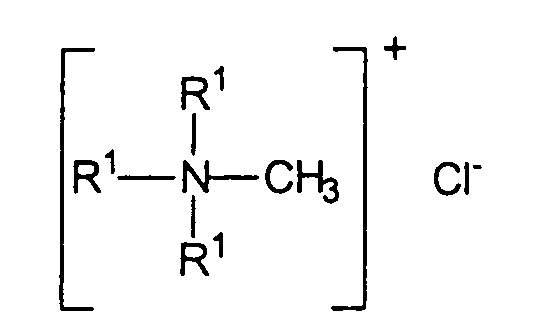
die Reste R1 unabhängig voneinander gewählt werden aus der Gruppe Methyl und hydrierte Talgreste mit einer Kettenlänge von 12 bis 20 Kohlenstoffatomen.
- der Fettalkoholethoxylate der allgemeinen Formel R-O-(-CH2-CH2-O-)n-H, wobei R einen verzweigten oder unverzweigten Alkyl-, Aryl- oder Alkenylrest und n eine Zahl von 10 bis 50 darstellen
- der ethoxylierten Wollwachsalkohole,
- der Polyethylenglycolether der allgemeinen Formel R-O-(-CH2-CH2-O-)n-R', wobei R und R' unabhängig voneinander verzweigte oder unverzweigte Alkyl- oder Alkenylreste und n eine Zahl von 10 bis 80 darstellen
- der Fettsäureethoxylate der allgemeinen Formel
R-COO-(-CH2-CH2-O-)n -H, wobei R einen verzweigten oder unverzweigten Alkyloder Alkenylrest und n eine Zahl von 10 bis 40 darstellen, - der veretherten Fettsäureethoxylate der allgemeinen Formel
R-COO-(-CH2-CH2-O-)n -R', wobei R und R' unabhängig voneinander verzweigte oder unverzweigte Alkyl- oder Alkenylreste und n eine Zahl von 10 bis 80 darstellen, - der veresterten Fettsäureethoxylate der allgemeinen Formel
R-COO-(-CH2-CH2-O-)n -C(O)-R', wobei R und R' unabhängig voneinander verzweigte oder unverzweigte Alkyl- oder Alkenylreste und n eine Zahl von 10 bis 80 darstellen, - der Polyethylenglycolglycerinfettsäureester gesättigter und/oder ungesättigter, verzweigter und/oder unverzweigter Fettsäuren und einem Ethoxylierungsgrad zwischen 3 und 50,
- der ethoxylierten Sorbitanester mit einem Ethoxylierungsgrad von 3 bis 100
- der Cholesterinethoxylate mit einem Ethoxylierungsgrad zwischen 3 und 50,
- der ethoxylierten Triglyceride mit einem Ethoxylierungsgrad zwischen 3 und 150,
- der Alkylethercarbonsäuren der allgemeinen Formel
R-O-(-CH2-CH2-O-)n-CH2-COOH bzw. deren kosmetisch oder pharmazeutisch akzeptablen Salze, wobei R einen verzweigten oder unverzweigten Alkyl- oder Alkenylrest mit 5 - 30 C-Atomen und n eine Zahl von 5 bis 30 darstellen, - der Polyoxyethylensorbitolfettsäureester, basierend auf verzweigten oder unverzweigten Alkan- oder Alkensäuren und einen Ethoxylierungsgrad von 5 bis 100 aufweisend, beispielsweise vom Sorbeth-Typ,
- der Alkylethersulfate bzw. die diesen Sulfaten zugrundeliegenden Säuren der allgemeinen Formel R-O-(-CH2-CH2-O-)n-SO3-H mit kosmetisch oder pharmazeutisch akzeptablen Kationen, wobei R einen verzweigten oder unverzweigten Alkyloder Alkenylrest mit 5 - 30 C-Atomen und n eine Zahl von 1 bis 50 darstellen.
- der Fettalkoholpropoxylate der allgemeinen Formel
R-O-(-CH2-CH(CH3)-O-)n-H, wobei R einen verzweigten oder unverzweigten Alkyloder Alkenylrest und n eine Zahl von 10 bis 80 darstellen, - der Polypropylenglycolether der allgemeinen Formel
R-O-(-CH2-CH(CH3)-O-)n-R', wobei R und R' unabhängig voneinander verzweigte oder unverzweigte Alkyl- oder Alkenylreste und n eine Zahl von 10 bis 80 darstellen - der propoxylierten Wollwachsalkohole,
- der veretherten Fettsäurepropoxylate der allgemeinen Formel
R-COO-(-CH2-CH(CH3)-O-)n-R', wobei R und R' unabhängig voneinander verzweigte oder unverzweigte Alkyl- oder Alkenylreste und n eine Zahl von 10 bis 80 darstellen, - der veresterten Fettsäurepropoxylate der allgemeinen Formel
R-COO-(-CH2-CH(CH3)-O-)n-C(O)-R', wobei R und R' unabhängig voneinander verzweigte oder unverzweigte Alkyl- oder Alkenylreste und n eine Zahl von 10 bis 80 darstellen, - der Fettsäurepropoxylate der allgemeinen Formel
R-COO-(-CH2-CH(CH3)-O-)n-H, wobei R einen verzweigten oder unverzweigten Alkyl- oder Alkenylrest und n eine Zahl von 10 bis 80 darstellen, - der Polypropylenglycolglycerinfettsäureester gesättigter und/oder ungesättigter, verzweigter und/oder unverzweigter Fettsäuren und einem Propoxylierungsgrad zwischen 3 und 80
- der propoxylierten Sorbitanester mit einem Propoxylierungsgrad von 3 bis 100
- der Cholesterinpropoxylate mit einem Propoxylierungsgrad von 3 bis 100
- der propoxylierten Triglyceride mit einem Propoxylierungsgrad von 3 bis 100
- der Alkylethercarbonsäuren der allgemeinen Formel
R-O-(-CH2-CH(CH3)O-)n-CH2-COOH bzw. deren kosmetisch oder pharmazeutisch akzeptablen Salze, wobei R einen verzweigten oder unverzweigten Alkyl- oder Alkenylrest und n eine Zahl von 3 bis 50 darstellen, - der Alkylethersulfate bzw. die diesen Sulfaten zugrundeliegenden Säuren der allgemeinen Formel R-O-(-CH2-CH(CH3)-O-)n-SO3-H mit kosmetisch oder pharmazeutisch akzeptablen Kationen, wobei R einen verzweigten oder unverzweigten Alkyl- oder Alkenylrest mit 5 - 30 C-Atomen und n eine Zahl von 1 bis 50 darstellen,
- der Fettalkoholethoxylate/propoxylate der allgemeinen Formel
R-O-Xn-Ym-H, wobei R einen verzweigten oder unverzweigten Alkyl- oder Alkenylrest darstellen, wobei X und Y nicht identisch sind und jeweils entweder eine Oxyethylengruppe oder eine Oxypropylengruppe und n und m unabhängig voneinander Zahlen von 5 bis 50 darstellen, - der Polypropylenglycolether der allgemeinen Formel
R-O-Xn-Ym-R', wobei R und R' unabhängig voneinander verzweigte oder unverzweigte Alkyl- oder Alkenylreste darstellen, wobei X und Y nicht identisch sind und jeweils entweder eine Oxyethylengruppe oder eine Oxypropylengruppe und n und m unabhängig voneinander Zahlen von 5 bis 100 darstellen, - der veretherten Fettsäurepropoxylate der allgemeinen Formel
R-COO-Xn-Ym-R', wobei R und R' unabhängig voneinander verzweigte oder unverzweigte Alkyl- oder Alkenylreste darstellen, wobei X und Y nicht identisch sind und jeweils entweder eine Oxyethylengruppe oder eine Oxypropylengruppe und n und m unabhängig voneinander Zahlen von 5 bis 100 darstellen, - der Fettsäureethoxylate/propoxylate der allgemeinen Formel
R-COO-Xn-Ym-H, wobei R einen verzweigten oder unverzweigten Alkyl- oder Alkenylrest, wobei X und Y nicht identisch sind und jeweils entweder eine Oxyethylengruppe oder eine Oxypropylengruppe und n und m unabhängig voneinander Zahlen von 5 bis 50 darstellen.
Anschließend wird Phase B unter Unterdruck und Rühren in die kräftig gerührte Phase A eingetragen. Anschließend wird die gebildete Dispersion unter Vakuum homogenisiert, und langsamen Rühren auf 50 °C abgekühlt. Bei dieser Temperatur erfolgt nochmals ein Homogenisierungsschritt, nach dem auf 35 °C abgekühlt wird. Bei dieser Temperatur werden dann die Wirkstoffphase C und/oder das Parfum D zugegeben und auf 30°C kaltgerührt.
| 1 | 2 | 3 | 4 | 5 | |
| Glycerylsterat | 1,0 | --- | -- | 3,0 | 5,0 |
| PEG-40-Stearat | 10,0 | --- | 5 | -- | -- |
| Stearinsäure-Na-Salz | --- | 5,5 | --- | --- | 2,5 |
| Sorbitanstearat | --- | 1,5 | 3 | --- | --- |
| Cyclomethicon | 1 | 2,5 | 5 | 7,5 | 3 |
| Dimethicon | 5,0 | 3,0 | 5,0 | 2,0 | 15,0 |
| Behenylalkohol | 1 | 2 1 | 1 | --- | |
| Stearylalkohol | 1 | 1 | --- | ||
| Cetylstearylalkohol | 1 | 1 | --- | ||
| hydriertes Polyisobuten | 0,5 | 0,75 | 1,0 | 2,0 | 0,25 |
| Octyldodecanol | 0,5 | 1,0 | 0,75 | 3,0 | 0,25 |
| Schichtsilikat | 0,1 | --- | 0,25 | 1,0 | 0,5 |
| Panthenol | 0,5 | 1,0 | 0,75 | 0,25 | 0,1 |
| Glycerin | 3,0 | 5,0 | --- | --- | --- |
| Parfum | q,s, | q,s, | q,s, | q,s, | q,s, |
| Methylparaben | 0,4 | 0,1 | 0,05 | 0,3 | 0,4 |
| Propylparaben | 0,3 | 0,4 | 0,25 | 0,15 | --- |
| modifizierte Stärke | --- | 2,5 | --- | 0,15 | -- |
| Wasser | ad 100 | ad 100 | ad 100 | ad 100 | ad 100 |
| 6 | 7 | 8 | 9 | 10 | |
| Polyethylenglycol(21 ) stearylether | 1 | -- | 2,5 | 2 | 1,5 |
| Polyethylenglycol(2)stearylether | 1 | -- | 0,5 | 3 | 1,5 |
| Cetearylglucosid | --- | 8 | --- | --- | --- |
| Cyclomethicon | 2,5 | 3 | 12,5 | 2 | --- |
| Behenylalkohol | 1 | 0,5 | --- | 1 | --- |
| Stearylalkohol | 1,5 | 0,75 | --- | 2 | --- |
| Cetylstearylalkohol | 0,3 | 1,0 | --- | --- | 2 |
| hydriertes Polyisobuten | 0,5 | 0,75 | 1,0 | 2,0 | 0,25 |
| Octyldodecanol | 0,5 | 1,0 | 0,75 | 3,0 | 0,25 |
| Schichtsilikat | 0,5 | 1,0 | 1,5 | 3,75 | 1,5 |
| Panthenol | 0,5 | 1,0 | 0,75 | 0,25 | 0,1 |
| Glycerin | 3,0 | 5,0 | --- | --- | --- |
| Parfum | q,s, | q,s, | q,s, | q,s, | q,s, |
| Methylparaben | 0,4 | 0,1 | 0,05 | 0,3 | 0,4 |
| Propylparaben | 0,3 | 0,4 | 0,25 | 0,15 | --- |
| Benzylalkohol | --- | --- | 0,05 | --- | 0,1 |
| modifizierte Stärke | --- | 2,5 | --- | 0,15 | -- |
| Wasser | ad 100 | ad 100 | ad 100 | ad 100 | ad 100 |
| 11 | 12 | 13 | 14 | 15 | |
| Bis-PEG/PPG-16/16 PEG/PPG16/16 Dimethicone, Caprylic/Caprictriglycerid | 1,0 | 2,0 | 8,0 | 3,0 | 5,0 |
| Cyclomethicon | 12,5 | 15 | 25,0 | 10,0 | 7,5 |
| Dimethicon | 5,0 | 15,0 | 5,0 | 12,0 | 15,0 |
| Schichtsilikat, modifiziert | 0,5 | 0,75 | 1,0 | 2,0 | 0,25 |
| Octyldodecanol | 0,5 | 1,0 | 0,75 | 3,0 | 0,25 |
| Glycerin | 5,0 | 7,5 | 10,0 | 3,0 | 1,0 |
| Panthenol | 0,5 | 1,0 | 0,75 | 0,25 | 0,1 |
| Parfum | q,s, | q,s, | q,s, | q,s, | q,s, |
| Methylparaben | 0,4 | 0,1 | 0,05 | 0,3 | 0,4 |
| Propylparaben | 0,3 | 0,4 | 0,25 | 0,15 | --- |
| modifizierte Stärke | --- | 2,5 | --- | 0,15 | -- |
| Wasser | ad 100 | ad 100 | ad 100 | ad 100 | ad 100 |
| 16 | 17 | 18 | 19 | 20 | |
| Glycerylsterat Selbstemulgierend | 1,0 | --- | -- | 3,0 | 5,0 |
| PEG-100-Stearat | 10,0 | --- | 5 | -- | -- |
| Glycerylstearatcitrat | --- | 5,5 | --- | --- | 2,5 |
| Sorbitanstearat | --- | 1,5 | 3 | --- | --- |
| Cyclomethicon | 1 | 2,5 | 5 | 7,5 | 3 |
| Dimethicon | 5,0 | 13,0 | 5,0 | 12,0 | 15,0 |
| Behenylalkohol | 1 | 2 | 1 | --- | |
| Stearylalkohol | 1 | 1 | --- | ||
| Cetylstearylalkohol | 1 | 1 | --- | ||
| hydriertes Polyisobuten | 0,5 | 0,75 | 1,0 | 2,0 | 0,25 |
| Octyldodecanol | 0,5 | 1,0 | 0,75 | 3,0 | 0,25 |
| Schichtsilikat | 0,1 | 5,5 | 2,5 | 1,0 | 0,5 |
| Panthenol | 0,5 | 1,0 | 0,75 | 0,25 | 0,1 |
| Glycerin | 3,0 | 5,0 | --- | --- | --- |
| Parfum | q,s, | q,s, | q,s, | q,s, | q,s, |
| Methylparaben | 0,4 | 0,1 | 0,05 | 0,3 | 0,4 |
| Propylparaben | 0,3 | 0,4 | 0,25 | 0,15 | --- |
| lodopropynylbutylcarbamat | --- | --- | 0,05 | --- | 0,1 |
| modifizierte Stärke | --- | 2,5 | --- | 0,15 | -- |
| Wasser | ad 100 | ad 100 | ad 100 | ad 100 | ad 100 |
| 26 | 27 | 28 | 29 | 30 | |
| Stearinsäure, Na-Salz | 0,75 | 1,5 | 2,75 | 3,5 | 2,5 |
| Sorbitanstearat | --- | 1,5 | 3 | --- | --- |
| Cyclomethicon | 1 | 2,5 | 5 | 7,5 | 3 |
| Behenylalkohol | 1 | --- | 0,2 | 1 | --- |
| Stearylalkohol | --- | 1 | --- | 1 | --- |
| Cetylstearylalkohol | --- | --- | 1 | 1 | --- |
| Mineralöl | 0,5 | 0,75 | 1,0 | 2,0 | 0,25 |
| Octyldodecanol | 0,5 | 1,0 | 0,75 | 3,0 | 0,25 |
| Schichtsilikat | 1,0 | 2,5 | 5,0 | 1,0 | 0,5 |
| Harnstoff | 0,5 | 1,0 | 0,75 | 0,25 | 0,1 |
| Glycerin | 3,0 | 5,0 | --- | --- | --- |
| Parfum | q,s, | q,s, | q,s, | q,s, | q,s, |
| Methylparaben | 0,4 | 0,1 | 0,05 | 0,3 | 0,4 |
| Propylparaben | 0,3 | 0,4 | 0,25 | 0,15 | --- |
| Wasser | ad 100 | ad 100 | ad 100 | ad 100 | ad 100 |
| 31 | 32 | 33 | 34 | 35 | |
| Schichtsilikat | 1,0 | 1,5 | 2,5 | 4,0 | 2,5 |
| PEG-40 -Stearat | 0,5 | --- | 0,75 | -- | -- |
| Cyclomethicon | 1 | 2,5 | 5 | 7,5 | 3 |
| Dimethicon | 0,5 | 1,0 | 0,75 | 1,25 | 1,0 |
| Stearylalkohol | --- | 1 | --- | 1 | --- |
| Cetylstearylalkohol | --- | --- | 1 | 1 | --- |
| hydriertes Polyisobuten | 0,5 | 0,75 | 1,0 | 2,0 | 0,25 |
| Octyldodecanol | 0,5 | 1,0 | 0,75 | 3,0 | 0,25 |
| Panthenol | 0,5 | 1,0 | 0,75 | 0,25 | 0,1 |
| Glycerin | 3,0 | 5,0 | --- | --- | --- |
| Parfum | q,s, | q,s, | q,s, | q,s, | q,s, |
| Methylparaben | 0,4 | 0,1 | 0,05 | 0,3 | 0,4 |
| Propylparaben | 0,3 | 0,4 | 0,25 | 0,15 | --- |
| Ethanol | --- | --- | 5,0 | --- | 3,5 |
| Wasser | ad 100 | ad 100 | ad 100 | ad 100 | ad 100 |
Claims (12)
- Gelförmige kosmetische oder dermatologische Zubereitung, die ein feindisperses System vom Typ Emulsion oder Hydrodispersion darstellt, dadurch gekennzeichnet, dass sieeine Wasserphase,mindestens ein Schichtsilikat, insbesondere ein aufbereitetes natürliches oder synthetisches Schichtsilikat,gegebenenfalls ein modifiziertes Schichtsilikat, welches sowohl hydrophile als auch lipophile Eigenschaften zeigteinen oder mehrere Emulgatoren aus der Gruppe anionische oder nichtionische Emulgatoren, mit eine Gesamtkonzentration von 1,0 bis 5,5 Gew.-%, bezogen auf die gesamte Zubereitung,eine Ölphase und/oder Silikonölphase, mit eine Gesamtkonzentration von 0,001 bis 20 Gew.-%, bezogen auf die gesamte Zubereitung, enthält undim ruhenden Zustand eine gelförmige Konsistenz aufweist und unter Scherbeanspruchung einer reversiblen Viskositätsänderung, insbesondere einer Viskositätserniedrigung, unterliegt.
- Zubereitungen nach Anspruch 1, dadurch gekennzeichnet, dass die Zubereitungen sprühbar und pumpbar sind.
- Zubereitungen nach einem der vorhergehenden Ansprüche, dadurch gekennzeichnet, dass weitere kosmetische oder pharmazeutische Hilfs-, Zusatz- und/oder Wirkstoffe enthalten sind.
- Zubereitungen nach einem der vorhergehenden Ansprüche, dadurch gekennzeichnet, dass mindestens ein Schichtsilikat ein Natriummagnesiumsilikat oder ein Magnesiumaluminiumsilikat, insbesondere ein synthetisches Natriummagnesiumsilikat oder Magnesiumaluminiumsilikat ist.
- Zubereitungen nach einem der vorhergehenden Ansprüche, dadurch gekennzeichnet, dass mindestens ein Schichtsilikat ein Schichtsilikat aus der Gruppe Laponite®, Veegum® oder OPTIGEL® ist.
- Zubereitungen nach einem der vorhergehenden Ansprüche, dadurch gekennzeichnet, dass der Gehalt an einem oder mehreren aufbereiteten natürlichen Schichtsilikat und/oder synthetischen Schichtsilikat zwischen 0,05 Gew.-% und 10 Gew.-% ist, vorteilhaft zwischen 0,5 und 4 Gew.-%, bezogen auf das Gesamtgewicht der Zubereitungen.
- Zubereitungen nach einem der vorhergehenden Ansprüche, dadurch gekennzeichnet, dass neben einem oder mehreren aufbereiteten natürlichen bzw. synthetischen Schichtsilikaten und gegebenenfalls modifizierten Schichtsilikaten weitere Pigmente enthalten sind, insbesondere modifizierte Polysaccharide und/oder mikrofeine Polymerpartikel und/oder mikronisierte, anorganische Pigmente, die gewählt werden aus der Gruppe der amphiphilen Metalloxide, insbesondere aus der Gruppe Titandioxid, Zinkoxid, Eisenoxide bzw. Eisenmischoxide, Siliciumdioxid bzw. Silicate, wobei die Pigmente sowohl einzeln als auch im Gemisch vorliegen können.
- Zubereitungen nach einem der vorhergehenden Ansprüche, enthaltend einen oder mehrere Zusatz- oder Wirkstoffe, gewählt aus der Gruppe der Antioxidantien und/oder der Gruppe der UV-Filtersubstanzen.
- Zubereitungen nach einem der vorhergehenden Ansprüche, enthaltend einen oder mehrere Zusatz- oder Wirkstoffe, gewählt aus der Gruppe der Adstringentien und/oder antimikrobiell wirksamen Stoffe und/oder gegen Akne wirksamen Stoffe.
- Kosmetisches Produkt, dadurch gekennzeichnet, dass eswobei sich die Zubereitung im Produktbehälter befindet und durch Betätigung der Zerstäubereinrichtung entnommen werden kann.einen Zerstäubereinrichtung, insbesondere eine Zerstäuberpumpe,einen mit der Zerstäubereinrichtung kombinierbaren Produktbehälter undeine Zubereitung nach mindesten einem der vorgehenden Ansprüche enthält,
- Verwendung einer Zubereitung nach mindestens einem der Ansprüche 1 bis 9 als sprühbares Gel, insbesondere als sprühbares gelförmiges Kosmetikum.
- Verfahren zur Herstellung geförmiger kosmetischer oder dermatologischer Zubereitungen nach Anspruch 1 bis 9, bei dem in einem ersten Schritt ein Schichtsilikat in Wasser unter Einwirkung hoher Scherkräfte dispergiert wird, so dass eine homogene Phase entsteht, die in einem zweiten Schritt unter Rühren in eine Phase eingetragen wird, die die weiteren Bestandteile der Zubereitung enthält, so dass eine homogene Verteilung innerhalb der alle Komponenten umfassenden Zubereitung vorliegt.
Applications Claiming Priority (2)
| Application Number | Priority Date | Filing Date | Title |
|---|---|---|---|
| DE10343851 | 2003-09-23 | ||
| DE2003143851 DE10343851A1 (de) | 2003-09-23 | 2003-09-23 | Sprühbare kosmetische Formulierung |
Publications (2)
| Publication Number | Publication Date |
|---|---|
| EP1518533A2 true EP1518533A2 (de) | 2005-03-30 |
| EP1518533A3 EP1518533A3 (de) | 2005-08-10 |
Family
ID=34177887
Family Applications (1)
| Application Number | Title | Priority Date | Filing Date |
|---|---|---|---|
| EP04012315A Withdrawn EP1518533A3 (de) | 2003-09-23 | 2004-05-25 | Sprühbare kosmetische Formulierung |
Country Status (2)
| Country | Link |
|---|---|
| EP (1) | EP1518533A3 (de) |
| DE (1) | DE10343851A1 (de) |
Cited By (7)
| Publication number | Priority date | Publication date | Assignee | Title |
|---|---|---|---|---|
| WO2005123027A1 (en) * | 2004-06-08 | 2005-12-29 | Colgate-Palmolive Company | Water-based gelling agent spray-gel and its application in personal care formulation |
| WO2006134038A1 (de) * | 2005-06-16 | 2006-12-21 | Beiersdorf Ag | Multifunktionsflasche |
| WO2008006484A1 (de) * | 2006-07-13 | 2008-01-17 | Beiersdorf Ag | Kosmetische oder dermatologische zubereitungen mit einem gehalt an folsäure, flüchtigen und nichtflüchtigen siliconen |
| US8668916B2 (en) | 2010-09-24 | 2014-03-11 | Conopco, Inc. | HIPE-gelation process for making highly concentrated, spherical biopolymer gel particle suspensions |
| US10105297B2 (en) | 2016-04-01 | 2018-10-23 | L'oreal | Sunscreen compositions and methods for boosting efficacy |
| US10758463B2 (en) | 2016-04-01 | 2020-09-01 | L'oreal | Heat-protective compositions and methods of use |
| US12427444B2 (en) | 2018-06-15 | 2025-09-30 | W.R. Grace & Co.-Conn. | Defoamer active, manufacturing thereof, and deforming formulation |
Family Cites Families (12)
| Publication number | Priority date | Publication date | Assignee | Title |
|---|---|---|---|---|
| LU78831A1 (fr) * | 1978-01-06 | 1979-09-06 | Oreal | Composition pour le nettoyage de la peau |
| JP2657504B2 (ja) * | 1988-01-12 | 1997-09-24 | 株式会社資生堂 | 油中水型乳化組成物 |
| US5460620A (en) * | 1992-07-31 | 1995-10-24 | Creative Products Resource, Inc. | Method of applying in-tandem applicator pads for transdermal delivery of a therapeutic agent |
| JP3105704B2 (ja) * | 1993-07-16 | 2000-11-06 | 三菱鉛筆株式会社 | 液状化粧料 |
| US5882662A (en) * | 1997-05-09 | 1999-03-16 | Avon Products, Inc. | Cosmetic compositions containing smectite gels |
| US6194372B1 (en) * | 1998-11-20 | 2001-02-27 | Beaumont Products, Inc. | Solvent based sprayable gel |
| DE10137047A1 (de) * | 2001-07-31 | 2003-02-27 | Henkel Kgaa | Versprühbarer Reiniger, enthaltend eine tröpfchenförmige apolare Komponente |
| DE10141682A1 (de) * | 2001-08-25 | 2003-03-06 | Beiersdorf Ag | Verwendung von Cyclodextrinen zur Herstellung kosmetischer und dermatologischer Zubereitungen mit verbesserter Verteilbarkeit von Füllstoffen auf der Haut sowie kosmetische und dermatologische Zubereitungen mit einem Gehalt an Cyclodextrinen und Füllstoffen |
| DE10144061A1 (de) * | 2001-09-07 | 2003-04-17 | Beiersdorf Ag | Selbstschäumende oder schaumförmige Zubereitungen mit anorganischen Gelbildnern, organischen Hydrokolloiden und partikulären hydrophoben und/oder hydrophobisierten und/oder ölabsorbierenden Festkörpersubstanzen |
| US20030059446A1 (en) * | 2001-09-18 | 2003-03-27 | Kulkarni Arun B. | Physically stable sprayable gel composition |
| FR2856294B1 (fr) * | 2003-06-18 | 2005-08-05 | Expanscience Lab | Utilisation cosmetique d'une composition comprenant au moins une oxazoline, a titre de principe actif, comme amincissant et/ou pour prevenir et/ou traiter la cellulite |
| US20050036960A1 (en) * | 2003-08-12 | 2005-02-17 | Deborah Bussey | Sprayable skin protectant compositions |
-
2003
- 2003-09-23 DE DE2003143851 patent/DE10343851A1/de not_active Withdrawn
-
2004
- 2004-05-25 EP EP04012315A patent/EP1518533A3/de not_active Withdrawn
Cited By (7)
| Publication number | Priority date | Publication date | Assignee | Title |
|---|---|---|---|---|
| WO2005123027A1 (en) * | 2004-06-08 | 2005-12-29 | Colgate-Palmolive Company | Water-based gelling agent spray-gel and its application in personal care formulation |
| WO2006134038A1 (de) * | 2005-06-16 | 2006-12-21 | Beiersdorf Ag | Multifunktionsflasche |
| WO2008006484A1 (de) * | 2006-07-13 | 2008-01-17 | Beiersdorf Ag | Kosmetische oder dermatologische zubereitungen mit einem gehalt an folsäure, flüchtigen und nichtflüchtigen siliconen |
| US8668916B2 (en) | 2010-09-24 | 2014-03-11 | Conopco, Inc. | HIPE-gelation process for making highly concentrated, spherical biopolymer gel particle suspensions |
| US10105297B2 (en) | 2016-04-01 | 2018-10-23 | L'oreal | Sunscreen compositions and methods for boosting efficacy |
| US10758463B2 (en) | 2016-04-01 | 2020-09-01 | L'oreal | Heat-protective compositions and methods of use |
| US12427444B2 (en) | 2018-06-15 | 2025-09-30 | W.R. Grace & Co.-Conn. | Defoamer active, manufacturing thereof, and deforming formulation |
Also Published As
| Publication number | Publication date |
|---|---|
| EP1518533A3 (de) | 2005-08-10 |
| DE10343851A1 (de) | 2005-04-14 |
Similar Documents
| Publication | Publication Date | Title |
|---|---|---|
| DE69600872T2 (de) | Zusammensetzung, enthaltend eine wässrige Dispersion von einen säurefunktionellen UV-Filter enthaltenden Lipidvesikeln zur topischen Anwendung | |
| DE69500077T2 (de) | Kosmetische und dermatologische Zusammensetzung bestehend aus einem öligen Kügelchen und mit lamellaren Flüssigkristallen beschichtete Öl in Wasser Emulsion | |
| DE69404390T3 (de) | Öl-in-Wasser kosmetische oder dermatologische Emulsion, die eine selbstemulgierende Zusammensetzung enthält | |
| DE602004012213T2 (de) | Zusammenstetzung zum Schminken, enthaltend Emulsion mit nichtionischen grenzflächenaktiven Stoffen und ionischen grenzflächenaktiven Stoffen und feste Partikel | |
| EP1100433B1 (de) | Emulgatorfreie und bornitrid enthaltende feindisperse systeme vom typ öl-in-wasser und wasser-in-öl | |
| DE19640092A1 (de) | Strukturen mit Lipid-Doppelmembranen, in deren lipophilen Bereich längerkettige Moleküle eintauchen oder durch hydrophobe Wechselwirkungen an solche Moleküle angedockt sind | |
| EP1140008A1 (de) | Kosmetische oder pharmazeutische lecithinhaltige gele oder niedrigviskose, lecithinhaltige o/w-mikroemulsionen | |
| EP0987001A2 (de) | Emulgatorfreie feindisperse Systeme vom Type Öl-in-Wasser und Wasser-in-Öl | |
| EP1100431A1 (de) | Emulgatorfreie feindisperse systeme vom typ öl-in-wasser und wasser-in-öl | |
| EP2815737A1 (de) | DMS (Derma Membrane Structure) in Schaum-Cremes | |
| EP0934053A1 (de) | Kosmetische oder dermatologische mikroemulsion | |
| DE19548016A1 (de) | Kosmetische und dermatologische Lichtschutzformulierungen in Form von O/W-Makroemulsionen, O/W-Mikroemulsionen oder O/W/O-Emulsionen mit einem Gehalt an in gelöster Form vorliegenden, an sich schwerlöslichen UV-Filtersubstanzen, insbesondere Triazinderivaten | |
| EP2335675A1 (de) | Emulgatorfreie, Polymer-stabilisierte Schaumformulierungen | |
| EP0930866A1 (de) | Kosmetische oder dermatologische gele auf der basis von mikroemulsionen | |
| DE19548013A1 (de) | Verfahren zur Herstellung von O/W- oder O/W/O-Emulsionen sowie nach solchen Verfahren erhältliche O/W- und O/W/O-Emulsionen | |
| DE19842786A1 (de) | Emulgatorfreie feindisperse Systeme vom Typ Öl-in-Wasser und Wasser-in-Öl | |
| DE19842767A1 (de) | Emulgatorfreie feindisperse Systeme von Typ Öl-in-Wasser und Wasser-in-Öl | |
| DE19939139A1 (de) | Emulgatorfreie feindisperse Systeme vom Typ Wasser-in-Öl | |
| EP1200039B1 (de) | Emulgatorfreie feindisperse systeme vom typ wasser-in-öl | |
| EP0836847B1 (de) | Stabile Mehrphasenemulsion vom Typ O1/W/O2 | |
| DE10047250A1 (de) | Emulgatorfreie feindisperse Systeme vom Typ Wasser-in-Öl mit einem Gehalt an Ethylcellulose | |
| WO2000007547A1 (de) | Emulgatorfreie feindisperse systeme vom typ öl-in-wasser und wasser-in-öl | |
| EP1083861B1 (de) | Wasserhaltige kosmetische oder pharmazeutische stifte | |
| DE10343851A1 (de) | Sprühbare kosmetische Formulierung | |
| DE19548015A1 (de) | Kosmetische und dermatologische Lichtschutzformulierungen mit einem Gehalt an hydrophoben anorganischen Mikropigmenten |
Legal Events
| Date | Code | Title | Description |
|---|---|---|---|
| PUAI | Public reference made under article 153(3) epc to a published international application that has entered the european phase |
Free format text: ORIGINAL CODE: 0009012 |
|
| AK | Designated contracting states |
Kind code of ref document: A2 Designated state(s): AT BE BG CH CY CZ DE DK EE ES FI FR GB GR HU IE IT LI LU MC NL PL PT RO SE SI SK TR |
|
| AX | Request for extension of the european patent |
Extension state: AL HR LT LV MK |
|
| PUAL | Search report despatched |
Free format text: ORIGINAL CODE: 0009013 |
|
| AK | Designated contracting states |
Kind code of ref document: A3 Designated state(s): AT BE BG CH CY CZ DE DK EE ES FI FR GB GR HU IE IT LI LU MC NL PL PT RO SE SI SK TR |
|
| AX | Request for extension of the european patent |
Extension state: AL HR LT LV MK |
|
| 17P | Request for examination filed |
Effective date: 20060210 |
|
| AKX | Designation fees paid |
Designated state(s): AT BE BG CH CY CZ DE DK EE ES FI FR GB GR HU IE IT LI LU MC NL PL PT RO SE SI SK TR |
|
| 17Q | First examination report despatched |
Effective date: 20061031 |
|
| STAA | Information on the status of an ep patent application or granted ep patent |
Free format text: STATUS: THE APPLICATION IS DEEMED TO BE WITHDRAWN |
|
| 18D | Application deemed to be withdrawn |
Effective date: 20111201 |