EP1517958B1 - Strahlungshärtbare elastomere materialien mit geringer spannungsrelaxation - Google Patents
Strahlungshärtbare elastomere materialien mit geringer spannungsrelaxation Download PDFInfo
- Publication number
- EP1517958B1 EP1517958B1 EP03763076A EP03763076A EP1517958B1 EP 1517958 B1 EP1517958 B1 EP 1517958B1 EP 03763076 A EP03763076 A EP 03763076A EP 03763076 A EP03763076 A EP 03763076A EP 1517958 B1 EP1517958 B1 EP 1517958B1
- Authority
- EP
- European Patent Office
- Prior art keywords
- elastomeric
- layer
- radiation
- stress relaxation
- film
- Prior art date
- Legal status (The legal status is an assumption and is not a legal conclusion. Google has not performed a legal analysis and makes no representation as to the accuracy of the status listed.)
- Expired - Lifetime
Links
- DGUQMWXDVORMLN-UHFFFAOYSA-N CS(C)OS(C)(C)CCCOc(cc1)ccc1C(C1=CCCC=C1)=O Chemical compound CS(C)OS(C)(C)CCCOc(cc1)ccc1C(C1=CCCC=C1)=O DGUQMWXDVORMLN-UHFFFAOYSA-N 0.000 description 1
Images

Classifications
-
- B—PERFORMING OPERATIONS; TRANSPORTING
- B32—LAYERED PRODUCTS
- B32B—LAYERED PRODUCTS, i.e. PRODUCTS BUILT-UP OF STRATA OF FLAT OR NON-FLAT, e.g. CELLULAR OR HONEYCOMB, FORM
- B32B27/00—Layered products comprising a layer of synthetic resin
- B32B27/06—Layered products comprising a layer of synthetic resin as the main or only constituent of a layer, which is next to another layer of the same or of a different material
- B32B27/08—Layered products comprising a layer of synthetic resin as the main or only constituent of a layer, which is next to another layer of the same or of a different material of synthetic resin
-
- A—HUMAN NECESSITIES
- A61—MEDICAL OR VETERINARY SCIENCE; HYGIENE
- A61F—FILTERS IMPLANTABLE INTO BLOOD VESSELS; PROSTHESES; DEVICES PROVIDING PATENCY TO, OR PREVENTING COLLAPSING OF, TUBULAR STRUCTURES OF THE BODY, e.g. STENTS; ORTHOPAEDIC, NURSING OR CONTRACEPTIVE DEVICES; FOMENTATION; TREATMENT OR PROTECTION OF EYES OR EARS; BANDAGES, DRESSINGS OR ABSORBENT PADS; FIRST-AID KITS
- A61F13/00—Bandages or dressings; Absorbent pads
- A61F13/15—Absorbent pads, e.g. sanitary towels, swabs or tampons for external or internal application to the body; Supporting or fastening means therefor; Tampon applicators
- A61F13/45—Absorbent pads, e.g. sanitary towels, swabs or tampons for external or internal application to the body; Supporting or fastening means therefor; Tampon applicators characterised by the shape
- A61F13/49—Absorbent pads, e.g. sanitary towels, swabs or tampons for external or internal application to the body; Supporting or fastening means therefor; Tampon applicators characterised by the shape specially adapted to be worn around the waist, e.g. diapers, nappies
- A61F13/49007—Form-fitting, self-adjusting disposable diapers
- A61F13/49009—Form-fitting, self-adjusting disposable diapers with elastic means
- A61F13/4902—Form-fitting, self-adjusting disposable diapers with elastic means characterised by the elastic material
-
- A—HUMAN NECESSITIES
- A61—MEDICAL OR VETERINARY SCIENCE; HYGIENE
- A61F—FILTERS IMPLANTABLE INTO BLOOD VESSELS; PROSTHESES; DEVICES PROVIDING PATENCY TO, OR PREVENTING COLLAPSING OF, TUBULAR STRUCTURES OF THE BODY, e.g. STENTS; ORTHOPAEDIC, NURSING OR CONTRACEPTIVE DEVICES; FOMENTATION; TREATMENT OR PROTECTION OF EYES OR EARS; BANDAGES, DRESSINGS OR ABSORBENT PADS; FIRST-AID KITS
- A61F13/00—Bandages or dressings; Absorbent pads
- A61F13/15—Absorbent pads, e.g. sanitary towels, swabs or tampons for external or internal application to the body; Supporting or fastening means therefor; Tampon applicators
- A61F13/15577—Apparatus or processes for manufacturing
-
- A—HUMAN NECESSITIES
- A61—MEDICAL OR VETERINARY SCIENCE; HYGIENE
- A61F—FILTERS IMPLANTABLE INTO BLOOD VESSELS; PROSTHESES; DEVICES PROVIDING PATENCY TO, OR PREVENTING COLLAPSING OF, TUBULAR STRUCTURES OF THE BODY, e.g. STENTS; ORTHOPAEDIC, NURSING OR CONTRACEPTIVE DEVICES; FOMENTATION; TREATMENT OR PROTECTION OF EYES OR EARS; BANDAGES, DRESSINGS OR ABSORBENT PADS; FIRST-AID KITS
- A61F13/00—Bandages or dressings; Absorbent pads
- A61F13/15—Absorbent pads, e.g. sanitary towels, swabs or tampons for external or internal application to the body; Supporting or fastening means therefor; Tampon applicators
- A61F13/51—Absorbent pads, e.g. sanitary towels, swabs or tampons for external or internal application to the body; Supporting or fastening means therefor; Tampon applicators characterised by the outer layers of the pads
- A61F13/511—Topsheet, i.e. the permeable cover or layer facing the skin
- A61F13/51121—Topsheet, i.e. the permeable cover or layer facing the skin characterised by the material
-
- A—HUMAN NECESSITIES
- A61—MEDICAL OR VETERINARY SCIENCE; HYGIENE
- A61F—FILTERS IMPLANTABLE INTO BLOOD VESSELS; PROSTHESES; DEVICES PROVIDING PATENCY TO, OR PREVENTING COLLAPSING OF, TUBULAR STRUCTURES OF THE BODY, e.g. STENTS; ORTHOPAEDIC, NURSING OR CONTRACEPTIVE DEVICES; FOMENTATION; TREATMENT OR PROTECTION OF EYES OR EARS; BANDAGES, DRESSINGS OR ABSORBENT PADS; FIRST-AID KITS
- A61F13/00—Bandages or dressings; Absorbent pads
- A61F13/15—Absorbent pads, e.g. sanitary towels, swabs or tampons for external or internal application to the body; Supporting or fastening means therefor; Tampon applicators
- A61F13/51—Absorbent pads, e.g. sanitary towels, swabs or tampons for external or internal application to the body; Supporting or fastening means therefor; Tampon applicators characterised by the outer layers of the pads
- A61F13/511—Topsheet, i.e. the permeable cover or layer facing the skin
- A61F13/512—Topsheet, i.e. the permeable cover or layer facing the skin characterised by its apertures, e.g. perforations
- A61F13/5123—Topsheet, i.e. the permeable cover or layer facing the skin characterised by its apertures, e.g. perforations the apertures being formed on a multilayer top sheet
-
- A—HUMAN NECESSITIES
- A61—MEDICAL OR VETERINARY SCIENCE; HYGIENE
- A61F—FILTERS IMPLANTABLE INTO BLOOD VESSELS; PROSTHESES; DEVICES PROVIDING PATENCY TO, OR PREVENTING COLLAPSING OF, TUBULAR STRUCTURES OF THE BODY, e.g. STENTS; ORTHOPAEDIC, NURSING OR CONTRACEPTIVE DEVICES; FOMENTATION; TREATMENT OR PROTECTION OF EYES OR EARS; BANDAGES, DRESSINGS OR ABSORBENT PADS; FIRST-AID KITS
- A61F13/00—Bandages or dressings; Absorbent pads
- A61F13/15—Absorbent pads, e.g. sanitary towels, swabs or tampons for external or internal application to the body; Supporting or fastening means therefor; Tampon applicators
- A61F13/51—Absorbent pads, e.g. sanitary towels, swabs or tampons for external or internal application to the body; Supporting or fastening means therefor; Tampon applicators characterised by the outer layers of the pads
- A61F13/511—Topsheet, i.e. the permeable cover or layer facing the skin
- A61F13/513—Topsheet, i.e. the permeable cover or layer facing the skin characterised by its function or properties, e.g. stretchability, breathability, rewet, visual effect; having areas of different permeability
-
- B—PERFORMING OPERATIONS; TRANSPORTING
- B32—LAYERED PRODUCTS
- B32B—LAYERED PRODUCTS, i.e. PRODUCTS BUILT-UP OF STRATA OF FLAT OR NON-FLAT, e.g. CELLULAR OR HONEYCOMB, FORM
- B32B25/00—Layered products comprising a layer of natural or synthetic rubber
- B32B25/04—Layered products comprising a layer of natural or synthetic rubber comprising rubber as the main or only constituent of a layer, which is next to another layer of the same or of a different material
- B32B25/08—Layered products comprising a layer of natural or synthetic rubber comprising rubber as the main or only constituent of a layer, which is next to another layer of the same or of a different material of synthetic resin
-
- B—PERFORMING OPERATIONS; TRANSPORTING
- B32—LAYERED PRODUCTS
- B32B—LAYERED PRODUCTS, i.e. PRODUCTS BUILT-UP OF STRATA OF FLAT OR NON-FLAT, e.g. CELLULAR OR HONEYCOMB, FORM
- B32B27/00—Layered products comprising a layer of synthetic resin
- B32B27/28—Layered products comprising a layer of synthetic resin comprising synthetic resins not wholly covered by any one of the sub-groups B32B27/30 - B32B27/42
-
- B—PERFORMING OPERATIONS; TRANSPORTING
- B32—LAYERED PRODUCTS
- B32B—LAYERED PRODUCTS, i.e. PRODUCTS BUILT-UP OF STRATA OF FLAT OR NON-FLAT, e.g. CELLULAR OR HONEYCOMB, FORM
- B32B27/00—Layered products comprising a layer of synthetic resin
- B32B27/30—Layered products comprising a layer of synthetic resin comprising vinyl (co)polymers; comprising acrylic (co)polymers
-
- B—PERFORMING OPERATIONS; TRANSPORTING
- B32—LAYERED PRODUCTS
- B32B—LAYERED PRODUCTS, i.e. PRODUCTS BUILT-UP OF STRATA OF FLAT OR NON-FLAT, e.g. CELLULAR OR HONEYCOMB, FORM
- B32B27/00—Layered products comprising a layer of synthetic resin
- B32B27/32—Layered products comprising a layer of synthetic resin comprising polyolefins
-
- B—PERFORMING OPERATIONS; TRANSPORTING
- B32—LAYERED PRODUCTS
- B32B—LAYERED PRODUCTS, i.e. PRODUCTS BUILT-UP OF STRATA OF FLAT OR NON-FLAT, e.g. CELLULAR OR HONEYCOMB, FORM
- B32B27/00—Layered products comprising a layer of synthetic resin
- B32B27/42—Layered products comprising a layer of synthetic resin comprising condensation resins of aldehydes, e.g. with phenols, ureas or melamines
-
- B—PERFORMING OPERATIONS; TRANSPORTING
- B32—LAYERED PRODUCTS
- B32B—LAYERED PRODUCTS, i.e. PRODUCTS BUILT-UP OF STRATA OF FLAT OR NON-FLAT, e.g. CELLULAR OR HONEYCOMB, FORM
- B32B3/00—Layered products comprising a layer with external or internal discontinuities or unevennesses, or a layer of non-planar shape; Layered products comprising a layer having particular features of form
- B32B3/26—Layered products comprising a layer with external or internal discontinuities or unevennesses, or a layer of non-planar shape; Layered products comprising a layer having particular features of form characterised by a particular shape of the outline of the cross-section of a continuous layer; characterised by a layer with cavities or internal voids ; characterised by an apertured layer
-
- B—PERFORMING OPERATIONS; TRANSPORTING
- B32—LAYERED PRODUCTS
- B32B—LAYERED PRODUCTS, i.e. PRODUCTS BUILT-UP OF STRATA OF FLAT OR NON-FLAT, e.g. CELLULAR OR HONEYCOMB, FORM
- B32B37/00—Methods or apparatus for laminating, e.g. by curing or by ultrasonic bonding
- B32B37/14—Methods or apparatus for laminating, e.g. by curing or by ultrasonic bonding characterised by the properties of the layers
- B32B37/15—Methods or apparatus for laminating, e.g. by curing or by ultrasonic bonding characterised by the properties of the layers with at least one layer being manufactured and immediately laminated before reaching its stable state, e.g. in which a layer is extruded and laminated while in semi-molten state
- B32B37/153—Methods or apparatus for laminating, e.g. by curing or by ultrasonic bonding characterised by the properties of the layers with at least one layer being manufactured and immediately laminated before reaching its stable state, e.g. in which a layer is extruded and laminated while in semi-molten state at least one layer is extruded and immediately laminated while in semi-molten state
-
- B—PERFORMING OPERATIONS; TRANSPORTING
- B32—LAYERED PRODUCTS
- B32B—LAYERED PRODUCTS, i.e. PRODUCTS BUILT-UP OF STRATA OF FLAT OR NON-FLAT, e.g. CELLULAR OR HONEYCOMB, FORM
- B32B5/00—Layered products characterised by the non- homogeneity or physical structure, i.e. comprising a fibrous, filamentary, particulate or foam layer; Layered products characterised by having a layer differing constitutionally or physically in different parts
- B32B5/02—Layered products characterised by the non- homogeneity or physical structure, i.e. comprising a fibrous, filamentary, particulate or foam layer; Layered products characterised by having a layer differing constitutionally or physically in different parts characterised by structural features of a fibrous or filamentary layer
- B32B5/022—Non-woven fabric
-
- B—PERFORMING OPERATIONS; TRANSPORTING
- B32—LAYERED PRODUCTS
- B32B—LAYERED PRODUCTS, i.e. PRODUCTS BUILT-UP OF STRATA OF FLAT OR NON-FLAT, e.g. CELLULAR OR HONEYCOMB, FORM
- B32B7/00—Layered products characterised by the relation between layers; Layered products characterised by the relative orientation of features between layers, or by the relative values of a measurable parameter between layers, i.e. products comprising layers having different physical, chemical or physicochemical properties; Layered products characterised by the interconnection of layers
- B32B7/04—Interconnection of layers
- B32B7/12—Interconnection of layers using interposed adhesives or interposed materials with bonding properties
-
- C—CHEMISTRY; METALLURGY
- C08—ORGANIC MACROMOLECULAR COMPOUNDS; THEIR PREPARATION OR CHEMICAL WORKING-UP; COMPOSITIONS BASED THEREON
- C08F—MACROMOLECULAR COMPOUNDS OBTAINED BY REACTIONS ONLY INVOLVING CARBON-TO-CARBON UNSATURATED BONDS
- C08F287/00—Macromolecular compounds obtained by polymerising monomers on to block polymers
-
- C—CHEMISTRY; METALLURGY
- C08—ORGANIC MACROMOLECULAR COMPOUNDS; THEIR PREPARATION OR CHEMICAL WORKING-UP; COMPOSITIONS BASED THEREON
- C08L—COMPOSITIONS OF MACROMOLECULAR COMPOUNDS
- C08L53/00—Compositions of block copolymers containing at least one sequence of a polymer obtained by reactions only involving carbon-to-carbon unsaturated bonds; Compositions of derivatives of such polymers
-
- C—CHEMISTRY; METALLURGY
- C08—ORGANIC MACROMOLECULAR COMPOUNDS; THEIR PREPARATION OR CHEMICAL WORKING-UP; COMPOSITIONS BASED THEREON
- C08L—COMPOSITIONS OF MACROMOLECULAR COMPOUNDS
- C08L53/00—Compositions of block copolymers containing at least one sequence of a polymer obtained by reactions only involving carbon-to-carbon unsaturated bonds; Compositions of derivatives of such polymers
- C08L53/02—Compositions of block copolymers containing at least one sequence of a polymer obtained by reactions only involving carbon-to-carbon unsaturated bonds; Compositions of derivatives of such polymers of vinyl-aromatic monomers and conjugated dienes
-
- B—PERFORMING OPERATIONS; TRANSPORTING
- B32—LAYERED PRODUCTS
- B32B—LAYERED PRODUCTS, i.e. PRODUCTS BUILT-UP OF STRATA OF FLAT OR NON-FLAT, e.g. CELLULAR OR HONEYCOMB, FORM
- B32B2307/00—Properties of the layers or laminate
- B32B2307/50—Properties of the layers or laminate having particular mechanical properties
- B32B2307/51—Elastic
-
- B—PERFORMING OPERATIONS; TRANSPORTING
- B32—LAYERED PRODUCTS
- B32B—LAYERED PRODUCTS, i.e. PRODUCTS BUILT-UP OF STRATA OF FLAT OR NON-FLAT, e.g. CELLULAR OR HONEYCOMB, FORM
- B32B2323/00—Polyalkenes
-
- B—PERFORMING OPERATIONS; TRANSPORTING
- B32—LAYERED PRODUCTS
- B32B—LAYERED PRODUCTS, i.e. PRODUCTS BUILT-UP OF STRATA OF FLAT OR NON-FLAT, e.g. CELLULAR OR HONEYCOMB, FORM
- B32B2398/00—Unspecified macromolecular compounds
- B32B2398/20—Thermoplastics
-
- B—PERFORMING OPERATIONS; TRANSPORTING
- B32—LAYERED PRODUCTS
- B32B—LAYERED PRODUCTS, i.e. PRODUCTS BUILT-UP OF STRATA OF FLAT OR NON-FLAT, e.g. CELLULAR OR HONEYCOMB, FORM
- B32B2437/00—Clothing
-
- B—PERFORMING OPERATIONS; TRANSPORTING
- B32—LAYERED PRODUCTS
- B32B—LAYERED PRODUCTS, i.e. PRODUCTS BUILT-UP OF STRATA OF FLAT OR NON-FLAT, e.g. CELLULAR OR HONEYCOMB, FORM
- B32B2535/00—Medical equipment, e.g. bandage, prostheses or catheter
-
- B—PERFORMING OPERATIONS; TRANSPORTING
- B32—LAYERED PRODUCTS
- B32B—LAYERED PRODUCTS, i.e. PRODUCTS BUILT-UP OF STRATA OF FLAT OR NON-FLAT, e.g. CELLULAR OR HONEYCOMB, FORM
- B32B2555/00—Personal care
- B32B2555/02—Diapers or napkins
-
- Y—GENERAL TAGGING OF NEW TECHNOLOGICAL DEVELOPMENTS; GENERAL TAGGING OF CROSS-SECTIONAL TECHNOLOGIES SPANNING OVER SEVERAL SECTIONS OF THE IPC; TECHNICAL SUBJECTS COVERED BY FORMER USPC CROSS-REFERENCE ART COLLECTIONS [XRACs] AND DIGESTS
- Y10—TECHNICAL SUBJECTS COVERED BY FORMER USPC
- Y10T—TECHNICAL SUBJECTS COVERED BY FORMER US CLASSIFICATION
- Y10T428/00—Stock material or miscellaneous articles
- Y10T428/24—Structurally defined web or sheet [e.g., overall dimension, etc.]
- Y10T428/24273—Structurally defined web or sheet [e.g., overall dimension, etc.] including aperture
-
- Y—GENERAL TAGGING OF NEW TECHNOLOGICAL DEVELOPMENTS; GENERAL TAGGING OF CROSS-SECTIONAL TECHNOLOGIES SPANNING OVER SEVERAL SECTIONS OF THE IPC; TECHNICAL SUBJECTS COVERED BY FORMER USPC CROSS-REFERENCE ART COLLECTIONS [XRACs] AND DIGESTS
- Y10—TECHNICAL SUBJECTS COVERED BY FORMER USPC
- Y10T—TECHNICAL SUBJECTS COVERED BY FORMER US CLASSIFICATION
- Y10T428/00—Stock material or miscellaneous articles
- Y10T428/24—Structurally defined web or sheet [e.g., overall dimension, etc.]
- Y10T428/24273—Structurally defined web or sheet [e.g., overall dimension, etc.] including aperture
- Y10T428/24281—Struck out portion type
-
- Y—GENERAL TAGGING OF NEW TECHNOLOGICAL DEVELOPMENTS; GENERAL TAGGING OF CROSS-SECTIONAL TECHNOLOGIES SPANNING OVER SEVERAL SECTIONS OF THE IPC; TECHNICAL SUBJECTS COVERED BY FORMER USPC CROSS-REFERENCE ART COLLECTIONS [XRACs] AND DIGESTS
- Y10—TECHNICAL SUBJECTS COVERED BY FORMER USPC
- Y10T—TECHNICAL SUBJECTS COVERED BY FORMER US CLASSIFICATION
- Y10T428/00—Stock material or miscellaneous articles
- Y10T428/24—Structurally defined web or sheet [e.g., overall dimension, etc.]
- Y10T428/24273—Structurally defined web or sheet [e.g., overall dimension, etc.] including aperture
- Y10T428/24322—Composite web or sheet
- Y10T428/24331—Composite web or sheet including nonapertured component
Definitions
- the present invention relates to low stress relaxation elastomeric compositions and products made from them
- the invention relates to selective crosslinking of the elastomeric compositions using functionalized macromolecular crosslinking agents to provide improved mechanical and elastic properties.
- the invention relates to processes for making melt processable and radiation curable elastomeric compositions into products, such as substantially planar films; macroscopically-expanded, three-dimensional webs; apertured webs; laminates of the films or webs; and absorbent articles with components made from such films, webs or laminates.
- Elastomeric block copolymers having vinylarene polymer blocks and olefinic and/or diene polymer blocks typically exhibit a bi-phasic morphology, in which similar blocks come together to form one phase distinct from a second phase formed by the other blocks.
- the block copolymers form a three-dimensional, entangled (i.e., physical crosslinks) network structure.
- the polymeric chains may move about and disentangle from those physical crosslinks, resulting in loss of elastic and mechanical properties.
- Low molecular weight crosslinking agents have been used to create chemical crosslinks among polymeric chains to improve properties. However, it is known that small molecules are thermodynamically more compatible, thus, less selective, with respect to both phases of the bi-phasic copolymers.
- Elasticized portions of health care or personal hygiene products are conformable to the body, and create a relatively occlusive environment under the products. As materials with greater elasticity are used in such products to provide a better fit to the body, the air flow to the skin and the vapor flow from the occluded areas are reduced. Breathability (particularly vapor permeability) becomes an important factor for skin health.
- Several methods for rendering elastomeric materials more porous and more breathable are known in the art, such as die punching, slitting, and hot-pin aperturing. Improved methods to produce better porous films or webs, such as macroscopically-expanded, three-dimensional webs, are disclosed in U. S.
- Patents 3,929,135 (Thompson ); 4,342,314 (Radel et al. ); 5,733,628 (Pelkie ); 6,303,208 (Pelkie ); and PCT Publication WO 98/37266 (Curro et al. ).
- elastomeric materials are known to suffer defects, such as pinholes, fisheyes, or the like, under the above processes or combinations thereof. Such defects in the elastomeric materials may act as stress concentrators that promote tear initiation, tear propagation and catastrophic failure of the materials during use.
- melt processable elastomeric compositions that may be preferentially crosslinked in a select phase of the composition.
- macromolecular crosslinking agents capable of preferential crosslinking in a select phase of the composition and contributing to improved mechanical and elastic properties of the resulting elastomeric compositions.
- elastomeric compositions that are suitable for forming elastomeric products, such as apertured or macroscopically-expanded three-dimensional elastomeric webs, or components of absorbent products (including health care products or personal hygiene products) or stretchable garments.
- the absorbent products may include taped/fastened diapers, pull-on diapers, training pants, incontinence garments, sanitary napkins, pantiliners, wipes, wound dressings, bandages, drapes and wraps.
- the present invention is directed to a radiation-curable, low stress relaxation elastomeric composition with improved mechanical and elastic properties.
- the composition comprises :
- the invention may further relate to elastomeric films, webs, and laminates made from the elastomeric compositions, as well as articles containing such films, webs or laminates.
- the term “comprising” means that the various components, ingredient, or steps may be conjointly employed in practicing the present invention. Accordingly, the term “comprising” encompasses the more restrictive terms “consisting of” and “consisting essentially of”.
- the terms “elastic” or “elastomeric” refer to any material which is capable of being elongated or deformed under an externally applied force, and which will substantially resume its original dimension or shape, sustaining only small permanent set (typically no more than about 20%), after the external force is released.
- the term “elastomer” refers to any material exhibiting elastic properties as described hereinabove.
- thermoplastic refers to any material which may be melted and resolidified with little or no change in physical properties (assuming a minimum of oxidative degradation).
- the term “stretchable laminates” refers to multi-layer films, three-dimensional macroscopically-expanded webs or apertured webs made from such films, wherein at least one layer of the films or webs comprise an elastomeric material of the present invention.
- composite laminates refers to the combinations of the preceding films/webs with fibrous nonwoven materials as well as combinations of monolithic films comprising the elastomeric material of the present invention with fibrous nonwoven materials.
- the present invention relates to a radiation-curable low stress relaxation elastomeric materials exhibiting improved elastic and mechanical properties, such as tensile modulus, ultimate elongation, and stress relaxation properties.
- the elastomeric material may be used in monolithic films or in multi-layer films having skin layers.
- the elastomeric films may be formed into apertured webs or macroscopically-expanded, three-dimensional, elastomeric webs. Further, the elastomeric films or webs may be joined to nonwoven fibrous webs and incrementally stretched (i.e., activated) to form elastomeric laminates.
- the elastomeric films, webs or laminates are suitable for use in elasticized or body-hugging portions of disposable absorbent articles such as side panels, waist bands, cuffs, or health care products such as dressings, bandages and wraps.
- the porous extensible polymeric webs or laminates of the present invention may also be used in other portions of the absorbent articles where a stretchable or breathable material is desired, such as topsheets or backsheets.
- the elastomeric compositions of the present invention comprise an elastomeric block copolymer having least one hard block and at least one soft block, a macro photoinitiator, a processing oil, and optionally, a thermoplastic polymer and/or a crosslinking agent.
- Suitable block copolymers for use herein may comprise at least one "hard” polymeric block and at least one "soft” polymeric block.
- the hard blocks (or the A blocks) are either amorphous and have a second order transition temperature or glass transition temperature above room temperature, or crystalline with a crystallizable segment (which may be in the backbone, in the side chain, or in the pendant groups) and have a first order transition temperature or crystalline melting temperature above room temperature.
- the definitions of these phase transitions can be found in Principles of Polymer Chemistry, by Flory, Cornell University Press (1953 ).
- the soft blocks typically have a glass transition temperature below room temperature.
- the soft blocks are relatively mobile at room temperature.
- the hard blocks and the soft blocks tend to segregate from one another and form separate phases.
- These copolymers are generally referred to as thermoplastic elastomers (TPE's), wherein the hard blocks exhibit substantially thermoplastic characteristic and the soft blocks exhibit substantially elastomeric characteristic.
- the hard block may comprise a polyvinylarene derived from monomers such as styrene, ⁇ -methyl styrene, para-methyl styrene, other alkyl styrene derivatives, or mixtures thereof.
- the hard block may also be a random copolymer derived from vinylarene monomers and short C2-C6 olefinic monomers such as ethylene, propylene, butylene, C4-C6 diene monomers such as isoprene, butadiene, or mixtures of diene/alkene monomers.
- the hard block of the TPE comprises from about 1% to 20%, by weight of the hard block, of unsaturated or partially saturated dienes.
- the hard block desirably has a number-average molecular weight between from about 1,000 to about 200,000, preferably from about 2,000 to about 100,000, more preferably from about 5,000 to about 60,000.
- the hard block may comprise from about 10% to about 80%, preferably from about 20% to about 50%, more preferably from about 25 to about 35% of the total weight of the block copolymer.
- the soft block may be a diene polymer derived from unsaturated or partially saturated, diene monomers of from about 4 to about 6 carbons. Suitable diene monomers may include butadiene, isoprene, and the like.
- the soft block may also be an olefinic polymer derived from linear or branched alkene monomers of from about 2 to about 6 carbon atoms. Suitable alkene monomers may include ethylene, propylene, butylene, and the like.
- the soft block may also comprise a combination of the above monomers, such as ethylene/propylene polymers, ethylene/butylene polymers, and the like.
- the number-average molecular weight of the soft block may be from about 1,000 to about 300,000, preferably from about 10,000 to about 200,000, and more preferably from about 20,000 to about 100,000.
- the soft block may comprise from about 20% to about 90%, preferably from about 50% to about 80%, more preferably from about 65% to about 75% of the total weight of the copolymer.
- Suitable block copolymers for use herein may comprise at least one soft (i.e., substantially elastomeric) block portion B and at least one hard (i.e., substantially thermoplastic) block portions A.
- the block copolymers may have multiple blocks, such as A-B-A triblock copolymers, A-B-A-B tetrablock copolymers, or A-B-A-B-A pentablock copolymers, and the like.
- block copolymers having more than one A block and/or more than one B block, wherein each A block may be derived from the same or different vinylarene monomers and each B block may be derived from the same or different diene or olefinic monomers.
- a triblock copolymer may have an elastomeric midblock B and two thermoplastic endblocks A and A', wherein A and A' may be derived from different vinylarene monomers.
- the olefinic block may comprise at least about 50 percent by weight of the block copolymer.
- the unsaturation in diene monomer may be selectively hydrogenated, if desired, to reduce sensitivity to oxidative degradation and may result in improved elastic and mechanical properties.
- a polyisoprene block can be selectively reduced to form an ethylene-propylene block.
- the vinylarene block may comprise at least about 10 percent by weight of the block copolymer. Higher vinylarene content provides low stress relaxation and high elastic/tensile properties.
- Exemplary block copolymers may include styrene-diene-styrene or styrene-olefin-styrene triblock copolymers such as styrene-butadiene-styrene (S-B-S), styrene-ethylene/butylene-styrene (S-EB-S), styrene-ethylene/propylene-styrene (S-EP-S), styrene-isoprene-styrene (S-I-S), hydrogenated polystyrene-isoprene/butadiene-styrene (S-IB-S), and mixtures thereof.
- Commercially available block copolymers include KRATON® from the Shell Chemical Company, Huston, TX, SEPTON® from Kuraray America, Inc. New York, NY, and VECTOR® from Dexco Chemical Company, Houston, TX.
- the block copolymers may also be radial, having three or more arms, each arm being a copolymer having the structure of B-A, B-A-B-A, or the like, and the B blocks being at or near the center portion of the radial polymer.
- the block copolymer may be used in the elastomeric composition in an amount effective to achieve the desired properties, such as tensile, elastic and stress relaxation and other mechanical properties.
- the block copolymer will generally be present in the elastomeric composition in an amount typically from about 20 to about 80 weight percent, preferably from about 25 to about 75 weight percent, and more preferably from about 30 to about 70 weight percent, of the composition.
- the block copolymers used in this invention may be end-group modified.
- end-group modified it is meant that polymers contain functional groups such as acrylate, alkylacrylate, maleates, fumarates, itaconate, citraconate, vinyl ether, vinyl ester, cinnamate, gamma-ketoacrylate, maleimide, hydroxyl, primary, secondary and tertiary amine, carboxyl, epoxy and thiol at one or two ends of the block copolymer.
- end-group modified it is meant that polymers contain functional groups such as acrylate, alkylacrylate, maleates, fumarates, itaconate, citraconate, vinyl ether, vinyl ester, cinnamate, gamma-ketoacrylate, maleimide, hydroxyl, primary, secondary and tertiary amine, carboxyl, epoxy and thiol at one or two ends of the block copolymer.
- Preferred end-group modified polymers are the general form:
- A is a styrene polymer block
- B is a polymer block of ethylene/ propylene, ethylene/butylenes, butadiene and/ or isoprene
- R and R' are end-groups as described above.
- the photoinitiators may be functionalized macromolecules containing ultraviolet (UV) responsive substituents, which are prone to generate free radicals when exposed to a UV radiation.
- UV ultraviolet
- the resulting free radicals may abstract protons from the unsaturations in the TPEs to form radicals, which lead to chemical crosslinks between TPEs. These chemical crosslinks enhance the physical entanglements, resulting in strengthening of the three-dimensional network structure of the TPE matrix and improved elastic and mechanical properties.
- the photoinitiators in their radical form may also react with one another and form an interpenetrating network with the TPE network that further enhances the elastic and mechanical properties of the resulting compositions.
- the macromolecular photoinitiators may exhibit elastic and mechanical properties of a polymeric material.
- the macro photoinitiators when blended with thermoplastic elastomers, they may enhance the elastic and mechanical properties of the blended compositions such that no additional thermoplastic materials may be needed to achieve the desired properties.
- the macro photoinitiators is present in the amount ranging from 1 to 60 wt%, preferably from about 5 to about 50 wt% and more preferably from about 10 to about 40 wt% of the composition.
- the macro photoinitiators for the present invention has a number average molecular weight from 5,000 to 300,000, preferably from 10,000 to 200,000 and more preferably from 25,000 to 150,000.
- macro photoinitiators containing aromatic or vinylarene monomeric units are more compatible with the hard phase of the TPEs and those containing aliphatic or olefinic monomeric units are more compatible with the soft phase of the TPEs.
- the macro photoinitiators comprise substituted monomers, which contain UV responsive substitutents. At least about 5%, preferably at least about 7% and more preferably at least about 10% of the monomeric units of a macro photoinitiator are substituted monomers, in order to produce a sufficient amount of crosslinks, which lead to improved elastic and mechanical properties.
- the substituted monomers may have the general structure: wherein R 1 may be vinyl, vinylarene, acrylate or methacrylate monomer and R 2 may be alkyl, aryl, alkylaryl, alkoxy, substituted alkyl, halogen, alkylsulphonates, alkylammonium sulphonates, peresters, cinnamates and tertiary amines.
- Macro photoinitiators may include, in the polymer backbone, substituted monomers having, but not limited to, the following exemplary structures:
- the macro photoinitiator may be a substituted polystyrene containing acetophenone or benzophenone functional groups on the aromatic or aliphatic carbons of styrene and at least about 5 % of the monomers are substituted.
- the macro photoinitiator may be prepared by grafting UV active groups into the polymer backbone which can be obtained from National Starch & Chemicals, Bridgewater, NJ, where the polymeric back bone may be any polymer with residual unsaturation repeat units.
- Useful polymers include, but are not limited to, styrene-butadiene-styrene (S-B-S), styrene-isoprene-styrene (S-I-S), polystyrene-isoprene/butadiene-styrene (S-IB-S), styrene-butadiene rubber (SBR), ethylene-propylene-dicyclopentadiene (EPDM), acrylonitrile butadiene styrene (ABS), polybutadiene (PBD), polyisoprene (PI) and mixtures there of.
- S-B-S styrene-butadiene-styrene
- S-I-S styrene-isoprene-styrene
- S-IB-S polystyrene-isoprene/butadiene-styrene
- SBR
- crosslinking agents may also be used to speed up the crosslinking reaction.
- the crosslinking agents may contain multiple free radical receptive functionalities (typically with abstractable protons), which react with free radicals from the photoinitiators and/or other crosslinking agents.
- the multiple functionalities of the crosslinking agents may form multiple chemical crosslinks with the TPEs to and to improve the properties of the curable elastomeric composition.
- the molecular weight of the crosslinking agent may be low, typically less than about 700.
- Exemplary crosslinking agent may be a thiol, such as trimethylolpropane tris(3-mercaptopropionate); a di- or tri-acrylate, such as trimethylolpropane triacrylate; or a di- or tri-methacrylate, such as trimethylolpropane trimethacrylate all are available from Sigma-Aldrich Chemicals.
- the low molecular weight crosslinking agents may be present in the amount ranging from about 0.5 to about 10 wt%, more preferably from about 1 to about 8 wt% and most preferably from about 1.5 to about 5 wt% of the composition.
- Macromolecules containing both the UV responsive substitutents and the free radical receptive functionalities may also be suitable for use herein.
- Such macromolecules may function as photoinitiators as well as crosslinking agents.
- processing oils or plasticizing oils such as a hydrocarbon oils
- processing oils may be added to lower the viscosity and enhance the processability of the elastomeric compositions.
- processing oils tend to negatively affect the elastic, stress relaxation and tensile properties of the compositions.
- the typical range of the processing oil in the present elastomeric composition is from about 5 to about 60 wt%, preferably from about 10 to about 50 wt%, and more preferably from about 15 to about 45 wt% of the elastomeric compositions.
- the processing oil is compatible with the composition, and is substantially non-degrading at the processing temperature.
- Suitable for use herein are hydrocarbon oils that are aliphatic (including linear, branched or cyclic) or aromatic.
- the oils may be mineral oil as well as other petroleum-derived oils and waxes, such as parafinic oil, naphthenic oil, petrolateum, microcrystalline wax, paraffin or isoparaffin wax.
- Synthetic waxes such as Fischer-Tropsch wax; natural waxes, such as spermaceti, carnauba, ozokerite, beeswax, candelilla, paraffin, ceresin, esparto, ouricuri, rezowax; and other known mineral and mined waxes, are also suitable for use herein.
- Olefinic oligomers and low molecular weight polymers may also be used herein.
- the olefinic oligomers may be polypropylenes, polybutylenes, hydrogenated polyisoprenes, hydrogenated polybutadienes, or the like having a weight average molecular weight between about 350 to about 8000.
- the processing oil is a white mineral oil available under the tradename BRITOL® from Witco Company, Greenwich, CT.
- the processing oil is another mineral oil under the tradename DRAKEOL® from Pennzoil Company Penrenco Division, Karns City, PA.
- thermoplastic polymers or thermoplastic polymer compositions may be used in the elastomeric compositions of the present invention.
- the thermoplastic polymers may preferentially associate with the hard blocks of the block copolymers and be incorporated into the entangled three-dimensional network structure of the hard phase. Not intending to be bound by theory, it is believed that this entangled network structure improves the tensile, elastic and stress relaxation properties.
- Thermoplastic polymers such as polyphenylene oxide, and vinylarene polymers derived from monomers including styrene, ⁇ -methyl styrene, para-methyl styrene, other alkyl styrene derivatives, vinyl toluene, and mixtures thereof, are useful in the present invention. Because they are generally considered to be chemically compatible with the styrenic hard blocks of the block copolymer. Compatible components may be more easily mix and incorporated into the entangled three-dimensional network structure, and they have a lower tendency to physically separate (i.e., disentangle) from the network structure.
- polymers having high glass transition temperatures are advantageous to use as the optional component in the elastomeric composition of the present invention.
- glass transition temperatures (Tg) higher than the use temperature of the elastomeric material, these polymers are relatively immobile at the use temperature and serve to "lock in" the three-dimensional network structure and provide the desired elastic and mechanical properties.
- Tg glass transition temperatures
- these polymers become more mobile.
- the mobile polymer chains may disentangle from the network structure, resulting in a weakened network structure and deteriorated elastic and mechanical properties.
- the stress relaxation properties are especially sensitive to such effects.
- polymers having high glass transition temperatures such as polyphenylene oxide or vinylarene polymers
- melt processability and processing temperature are factors to be considered as well.
- the former relates to ease of processing the elastomeric material and the applicability of various processing techniques.
- the latter relates to joining or applying the elastomeric material to other substrates or components having low thermal degradation temperatures (e.g., polyethylene) or delicate structures (e.g., a nonwoven web).
- Vinylarene polymers useful herein as optional component may typically have a glass transition temperature ranges from about 58°C to about 180°C, more preferably from about 70°C to about 150°C, more preferably from about 90°C to about 130°C.
- Thermoplastic polymers useful herein as the optional component may have an average molecular weight that is sufficiently high to provide high glass transition temperature, tensile and elastic properties. Further, these thermoplastic polymers may have an average molecular weight not significantly different from that of the hard blocks of the elastomeric block copolymers to achieve compatibility with the hard blocks.
- Suitable vinylarene polymers for use herein typically have a number-average molecular weight of about 600 to about 200,000, more preferably of about 5,000 to about 150,000, and most preferably from about 10,000 to about 100,000.
- Suitable vinylarene polymers may have a molecular weight distribution in the range of about 1 to about 4.
- the vinylarene may be a polystyrene having a number-average molecular weight of about 40,000 to about 60,000, such as NOVACOR® PS 3900 series from Nova Chemicals, Inc., Monaca, PA.
- thermoplastic polymers or compositions when present, are typically in an amount from about 1 to about 60 weight percent, preferably from about 5 to about 40 weight percent, and more preferably from about 10 to about 30 weight percent of the low stress relaxation elastomeric composition used in the present invention.
- the elastomeric compositions of the present invention may also comprise other additives such as antioxidants or stabilizers, anti-block or slip agents.
- Typical antioxidants are hindered phenols (i.e., those having sterically bulky groups, such as t-butyl groups, in the proximity of the phenolic hydroxyl group) or multi-functional phenols (i.e., those containing sulfur or phosphorous).
- a hindered phenol antioxidant IRGANOX® 1010 is available from Ciba-Geigy Company, Hawthorn, New York.
- additives may also be included in the elastomeric compositions, including, but not limited to, pigments, dyes, UV absorbers, odor control agents, perfumes, fillers, and desiccants.
- Each additive may be present in an amount less than about 10 wt%, preferably less than 5 wt% and more preferably less than 1 wt%.
- the present invention also relates to films comprising the above elastomeric compositions. Further, the elastomeric film may contain one or more skin layers on its opposed surfaces to improve processability and handling of the film.
- a typical skin layer may comprise polymers that are at least partially compatible or miscible with a component of the elastomeric block copolymers to provide sufficient adhesion between the elastomeric layer and the skin layer for further processing and handling.
- Thermoplastic polymers suitable for use herein as the skin layer may be polyolefins derived from monomers such as ethylene, propylene, butylene; ⁇ -alkenes including 1-butene, 1-hexene, 1-octene, and the like; polydienes derived from monomers such as isoprene, butadiene, 1,3-pentadiene and the like; and mixtures of these monomers; ethylene copolymers such as ethylenevinylacetate copolymers (EVA), ethylene-methacrylate copolymers (EMA), and ethylene-acrylic acid copolymers; polyvinylarenes such as polystyrene, poly( ⁇ -methyl styrene), styrenic random block copolymer (such as INDEX® interpolymers, available from Dow Chemicals, Midland, MI); polyphenylene oxide; and blends thereof.
- monomers such as ethylene, propylene, butylene
- the materials for the skin layer may have melt flow properties specifically suited for co-processing the skin material with the above elastomeric compositions to form a multi-layer film.
- a representative method to produce the multi-layer polymeric film is coextrusion.
- the elastomeric composition is coextruded with the thermoplastic polymers to provide an elastomeric center layer between two skin layers, each being substantially facially joined to one of the opposing surfaces of the center layer.
- the two skin layers may have the same or different compositions.
- adhesives and/or tie layers may be used to promote adhesion between the center elastomeric layer and the thermoplastic skin layer.
- Each tie layer when employed, may comprise from about 5 to 10 percent of the total film thickness.
- the elastomeric layer itself is capable of undergoing from 50% to 1200% elongation at room temperature as a monolithic, non-apertured film.
- the elastomer layer may comprise either pure elastomers or elastomeric compositions.
- the elastomeric materials of the present invention may exhibit a stress relaxation at 200% elongation of less than about 20%, more preferably less than about 30%, and most preferably less than about 40% at room temperature.
- the elastomeric materials of the present invention exhibit a stress of less than about 45%, preferably less than about 50%, and more preferably less than about 55% relaxation, at 50% elongation after 10 hours at body temperature (about 100°F or 36°C) .
- the skin layer of the present invention is preferably thinner and substantially less elastic than the elastomeric layer.
- the skin layers may even be inelastic.
- the resulting films or webs may have modified elastic properties that are different from those of the monolithic elastomer layer. If more than one skin layer is used, the skin layers may have the same or different material characteristics.
- the elastomeric layer may comprise from about 20% to about 95% of the total thickness of the film and each skin layer may comprise from about 1% to about 40% of the total thickness of the film.
- the elastomeric film (monolithic or multi-layer) has a thickness of from about 0.5 mils to about 20 mils, preferably from about 1.0 mil to 5.0 mils.
- Each skin layer is typically about 0.05 mil to about 5 mils thick, and preferably from about 0.1 mil to about 1.5 mils thick.
- the elastomeric layer is about 3.2 mils thick and each skin layer is about 0.15 mil thick.
- the elastomeric layer is about 3.2 to 3.0 mils thick and each skin layer is about 0.12 to 0.10 mil thick
- a macroscopically-expanded, three-dimensional web made from multi-layer polymeric films such as those described herein.
- Detailed descriptions of such webs are disclosed in U. S. Patents 3,929,135 (Thompson ); 4,342,314 (Radel et al. ); 5,733,628 (Pelkie ); 6,303,208 (Pelkie ); and PCT Publication WO 98/37266 (Curro et al. ).
- Such three-dimensional web exhibits the advantages of high porosity and high elasticity, as well as reliability, and high strength.
- FIG. 1 is a representative embodiment of a macroscopically-expanded, three-dimensional web 80 of the present invention.
- Web 80 exhibits a multiplicity of primary apertures 71, which are formed in plane 102 of the first surface 90 by a continuous network of interconnecting members, e.g., members 91, 92, 93, 94, 95 interconnected to one another.
- the shape of primary apertures 71 as projected on the plane of the first surface 90 are preferably in the shape of polygons, e.g., squares, hexagons, etc., in an ordered or random pattern.
- each interconnecting member comprises a base portion 81 located in plane 102, and each base portion has a sidewall portion 83 attached to each edge thereof.
- the sidewall portions 83 extend generally in the direction of the second surface 85 of the web and intersect with side walls of adjoining interconnecting members.
- the intersecting sidewall portions are interconnected to one another intermediate the first and second surfaces of the web, and terminate substantially concurrently with one another to form a secondary aperture 72 in the plane 106 of the second surface 85.
- FIG. 2 is a further enlarged, partial view of a web of the type generally similar to web 80 of FIG. 1 , but illustrating an alternative web construction according to the present invention.
- the multi-layer polymeric apertured film 120 of web 80 is preferably comprised of at least one elastomeric layer 101, and at least one skin layer 103. While FIG. 2 shows a two-layer embodiment with the skin layer 103 nearer the first surface 90, it is believed that the order of layering of the apertured film 120 is not limiting. Though in some embodiments, as shown in FIG. 2 , the polymeric layers terminate substantially concurrently in the plane of the second surface, it is understood that it is not essential that they do so, i.e., one or more layers may extend further toward the second surface than the others.
- the elastomeric film or web of the present invention may be used in disposable absorbent articles or health care products. It is understood that even stretchable garments such as undergarments, stockings, leggings, swimwear, and other sportswear, may benefit from the porous, extensible characteristics of an elastomeric film or web of the present invention.
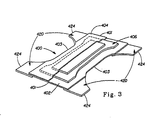
- FIG. 3 A representative embodiment of a disposable absorbent article containing an elastomeric film or web made of the present elastomeric composition is shown in FIG. 3 in the form of a diaper 400 in a flattened state (i.e., prior to its being placed on a wearer).
- the term "diaper” refers to a garment generally worn by infants and incontinent persons that is worn about the lower torso of the wearer. Exemplary diaper configurations are described generally in U.S. Patents 3,860,003 (Buell ); 5,151,092 (Buell et al. ); 5,221,274 (Buell et al. ); 5,554,145 (Roe et al. ); 5,569,234 (Buell et al. ); 5,580,411 (Nease et al. ) and U.S. Patent Application Serial No. 08/915,471 .
- FIG. 3 is a representative embodiment of the diaper 400 in which the topsheet 404 and the backsheet 402 are co-extensive and have length and width dimensions generally larger than those of the absorbent core 406.
- the topsheet 404 is joined with and superimposed on the backsheet 402 to form the periphery of the diaper 400.
- the periphery defines the outer perimeter or the edges of the diaper 400.
- the periphery comprises the end edges 401 and the longitudinal edges 403.
- the diaper may comprise a pair of elastomeric side panels 420, which extend laterally from end edges 401 of diaper 400 in an extended configuration.
- opposing sides 424 of the garment may be seamed or welded to form a pant. This allows the article to be used as a pull-on diaper or training pant.
- Exemplary diapers with elasticized side panels are disclosed in U.S. Patents 4,857,067 (Wood et al. ); 4,381,781 (Sciaraffa et al. ); 4,938,753 (Van Gompel et al. ); 5,151,092 (Buell ); 5,221,274 (Buell ); 5,246,433 (Hasse et al.
- the elastomeric side panels 420 may comprise the elastomeric film or web of the present invention.
- the film or web of the present invention when used as the side panels, it may be further processed to form a composite laminate by bonding it on one, or both sides thereof, with fibrous nonwoven materials to form a laminate.
- the elastomeric film or web of the present invention may also be used in other portions of the diaper, including elastic members adjacent the periphery of the diaper 400, such as the waist and leg openings, elastic topsheet or backsheet.
- the multi-layer film 120 of the present invention may be processed using conventional procedures for producing multi-layer films on conventional coextruded film-making equipment.
- polymers can be melt processed into films using either cast or blown film extrusion methods both of which are described in " Plastics Extrusion Technology” 2nd Ed., by Allan A. Griff (Van Nostrand Reinhold, 1976 ).
- Coextrusion processes are also described in U.S. Patents 4,152,387 , 4,197,069 , 4,533,308 , all are issued to Cloeren.
- the multi-layer elastomeric film After the multi-layer elastomeric film has been coextruded, it is preferably fed to a forming process for aperturing, resulting in a macroscopically-expanded, three-dimensional, elastomeric web of the present invention.
- a forming process for aperturing for aperturing, resulting in a macroscopically-expanded, three-dimensional, elastomeric web of the present invention.
- Such processes may include hydroforming, vacuum forming and are described in U.S. Patents 3,929,135 ; 4,342,314 ; 4,154,240 ; 4,695,422 ; 4,552,709 ; 4,878,825 ; 4,741,877 ; 5,733,628 (Pelkie ) and PCT Publication WO 98/37266 (Curro et al. ).
- aperturing planar, non-apertured elastomeric films are also known in the art, such as die punching, slitting and hot-pin melt aperturing.
- the monolithic or multi-layer films comprising the elastomeric compositions of the present invention may be formed into apertured webs using these methods.
- the film or web may be further processed to form a composite laminate by bonding with fibrous nonwoven materials on one or both sides thereof, to form a laminate, using methods known in the art, such as adhesive, heat, pressure, or ultrasonic bonding.
- the composite laminate may become less elastomeric than the elastomeric film or web alone, due to the relative inelasticity of the bonded nonwoven.
- the composite laminate may be processed by methods and apparatus used for elasticizing "zero strain" laminates by an incremental stretching process, as disclosed in the aforementioned U.S. Patents 5,143,679 (Weber et al. ); 5,156,793 (Buell et al.
- the resulting elasticized "zero-strain" composite laminate has a soft, compliant, cloth-like feel and a comfortable, snug fit when used in an absorbent article or other personal/health care products.
- the radiation crosslinking may be performed with controlled UV radiation in the wavelength range of 250 to 400 nm and a dosage ranging from about 0.1 to about 10 J/cm 2 , preferably from about 0.5 to about 8 J/cm 2 and more preferably from about 1 to about 5 J/cm 2 .
- An equipment suitable for use herein may be a benchtop conveyor Model LC-6B available from INPRO Technologies, Inc., Fredrick, MD.
- the radiation crosslinking step is typically performed after the coextrusion and/or aperturing steps.
- the properties determined by this method may correlate with the stretchability of the elastomeric film. These properties are relevant to the choice of material suitable for use as the elastic component of an absorbent article, particularly pull-on diapers, training pants, disposable diapers with fasteners, or other absorbent garments for adult use, that is substantially stretched when being put on.
- a commercial tensile tester from Instron Engineering Corp., Canton, MA or SINTECH-MTS Systems Corporation, Eden Prairie, MN may be used for this test.
- the films are cut into 1" (2.54 cm) wide in MD (the machine direction of the film) by 2"(5.08 cm) long in CD (the cross direction which is at a 90° angle from MD) samples.
- the instrument is interfaced with a computer for controlling the test speed and other test parameters, and for collecting, calculating and reporting the data.
- the tensile stress-strain properties of the film are determined according to ASTM Method D882-83. These tensile properties are measured at room temperature (about 20°C). The procedure is as follows:
- the property determined by this method may correlate with the elastic forces experienced by a wearer while wearing a product having elastic components, such as a side panel, a waist band, and the like, specifically how the product fits at body temperature after it has been worn for an extended period of time.
- the property determined by this method is relevant to the choice of materials that resist stress relaxation under sustained load at body temperature (approximately 36°C, 100°F), hence provide sustained fit over a long wear time of an absorbent article.
- the instrument and the sample are the same as Test Method A above.
- the sustained load stress relaxation is measured at 36°C (100°F) (about human body temperature). The procedure is as follows:
- the property determined by this method may correlate with the forces a wearer experiences from an elastic component incorporated into a product.
- the first cycle is a pre-straining step that simulates the conditions the elastic component experiences as the product is initially stretched in order to put the product on a wearer or to adjust the product to fit the wearer.
- the second cycle measures the reduction in elastic forces (i.e., stress relaxation) resulting from the pre-straining step.
- test Method A The instrument and the sample are the same as Test Method A above.
- the test procedure is similar to Test Method B above, except for the following modifications: (1) the test is done at room temperature (about 20°C); (2) the test terminates after step 7(c); and (3) the stress relaxation at 200% elongation is calculated as the % loss between the initial load and the final load of step 7(b). The unload stress at 50% and 30% elongation during step 7(c) is reported.
- a formulation is prepared by blending varying amounts of a styrenic elastomeric copolymer such as Vector 4211, Vector 8505 series form Dexco Company, Houston, TX, a 70/30 blend of S-B-S/ methacrylate modified S-B (SB-MA) from Dexco Company, Houston, TX, a vinylarene resin such as polystyrene PS3900 from Nova Chemical, Inc. Monaca, PA, a macro photoinitiator from National Starch and Chemicals Bridgewater, NJ, and mineral oil such as Drakeol® available from Pennzoil Co., Penrenco Div., Karns City, PA, to form an elastomeric mixture.
- a styrenic elastomeric copolymer such as Vector 4211, Vector 8505 series form Dexco Company, Houston, TX
- SB-MA S-B-S/ methacrylate modified S-B
- a vinylarene resin such as polystyrene PS
- the compounded formulations are prepared by dry blending the polymeric components and oil for at least 24 hours.
- a Haake batch mixer compounder is pre-heated to 150°C and the dry blend formulation is added slowly into the compounder.
- some of the components are in form of viscous liquid, which are added to the polymeric components and oil mixture via pipettes directly during the compounding procedure.
- elastomeric compositions suitable for use herein are shown in Table 1. The amount of each component is expressed in weight percent of the elastomeric composition. Additives, specifically antioxidants, which are present only in small amounts, are not shown in the compositions of TABLE 1. Typically, the elastomeric compositions useful in the present invention comprise about 0.5 wt% of antioxidants and about 0.3 wt% of light stabilizers. TABLE 1 Elastomeric Compositions (Weight Percent) Example 1 2 3 4 S-I-S 43 72 43 0 S-B-S 0 0 29 72 SBS/ SB-MA 28 0 0 0 Polystyrene PS3900 15 15 15 15 15 15 15 15 15 Mineral Oil 10 8 8 8 Macro photoinitiator 4 5 5 5 5
- the physical properties of pressed films are determined prior to and after the exposure to UV irradiation.
- the films are prepared by weighing approximately 12 grams of compounded formulation.
- the formulation is compression molded by placing the pre-weighed formulation between two pieces of PTFE (Teflon) film (0.010 in thick), which is then placed between preheated aluminum plates that are inserted into a Carver Press model 3853-0 with heated plates set to approximately 168°C.
- the formulation is allowed to heat up for 3 minutes and then it is pressed between the plates with an applied pressure of 2500 psi.
- the formulation is allowed to flow under pressure for 30 seconds.
- the resulting film is then quenched to ambient temperature and subsequently cut into three equal portions.
- Each portion is placed between films of PTFE and preheated aluminum plates and allowed to heat up to 168°C for 1 minute in the Carver press before 2,000 psi of pressure is applied.
- the formulation is allowed to flow under this pressure for 30 seconds.
- the pressure is removed and the sample is rotated 90° and inserted back into the press and immediately 3,000 psi of pressure is applied.
- the formulation is again allowed to flow for 30 seconds.
- the pressure is removed and the sample is flipped and inserted back into the press and immediately 4,000 psi of pressure is applied.
- the formulation is again allowed to flow for 30 seconds.
- the pressure is removed and the sample is rotated 90° and inserted back into the press and immediately 5,000 psi of pressure is applied.
- the formulation is again allowed to flow for 30 seconds.
- After the final pressing the film is quenched to ambient temperature.
- the resulting film thickness is between 4 mils up to 10 mils thick.
- the films are cut into proper sample size according to the test methods described hereinabo
- a benchtop conveyor Model LC-6B available from INPRO Technologies, Inc., Fredrick, MD is used to UV irradiate the cut films for crosslinking studies and compared to the uncrosslinked corresponding films.
- the UV crosslinking is done by placing the films on the moving conveyor belt at the speed of approximately 54-feet/min. under the UV source. This step is repeated 4 times to achieve approximately 1.4 to 2.5 J/cm 2 of UV dosage.
Landscapes
- Health & Medical Sciences (AREA)
- Engineering & Computer Science (AREA)
- Chemical & Material Sciences (AREA)
- Epidemiology (AREA)
- Biomedical Technology (AREA)
- Heart & Thoracic Surgery (AREA)
- Vascular Medicine (AREA)
- Life Sciences & Earth Sciences (AREA)
- Animal Behavior & Ethology (AREA)
- General Health & Medical Sciences (AREA)
- Public Health (AREA)
- Veterinary Medicine (AREA)
- Chemical Kinetics & Catalysis (AREA)
- Medicinal Chemistry (AREA)
- Polymers & Plastics (AREA)
- Organic Chemistry (AREA)
- Manufacturing & Machinery (AREA)
- Textile Engineering (AREA)
- Laminated Bodies (AREA)
- Compositions Of Macromolecular Compounds (AREA)
- Materials For Medical Uses (AREA)
- Polymerisation Methods In General (AREA)
- Macromonomer-Based Addition Polymer (AREA)
- Processes Of Treating Macromolecular Substances (AREA)
- Manufacture Of Macromolecular Shaped Articles (AREA)
Claims (13)
- Strahlungshärtbares Material, umfassend:a) zu 20 bis 80 Gew.-% ein thermoplastisches Elastomer (TPE), das ein Blockcopolymer mit mindestens einem harten Block, der Vinylarene umfasst, und mindestens einem weichen Block, der Diene umfasst, ist;b) zu 5 bis 60 Gew.-% ein Prozessöl;c) zu 1 Gew.-% bis 60 Gew.-% einen Makrophotoinitiator mit einem Molekulargewichts-Zahlenmittel von 5.000 bis 300.000; und wobei der Makrophotoinitiator Monomere umfasst, die ausgewählt sind aus der Gruppe, bestehend aus Vinylarenen, ungesättigten Dienen, teilweise gesättigten Dienen und Mischungen davon.d) optional zu 0,5 bis 10 Gew.-% ein Vernetzungsmittel; unde) optional zu 1 bis 60 Gew.-% eine Zusammensetzung aus thermoplastischen Polymeren, ein Polyvinylaren umfassend;wobei das Material nach dem Härten eine Spannungsrelaxation von weniger als 20 Prozent nach 200 %-iger Längung bei Raumtemperatur und eine Spannungsrelaxation von weniger als 45 Prozent nach 10 Stunden bei 36 °C (100 °F) und 50 % Längung aufweist.
- Strahlungshärtbares Material nach Anspruch 1, wobei mindestens 5 % der Monomere des Makrophotoinitiators substituierte Monomere mit reaktiven Substituenten sind, wobei die substituierten Monomere die Struktur

- Strahlungshärtbares Material nach einem der vorstehenden Ansprüche, wobei 1 bis 20 % des harten Blocks ungesättigte oder teilweise gesättigte Diene umfassen.
- Strahlungshärtbares Material nach einem der vorstehenden Ansprüche, wobei das Prozessöl ausgewählt ist aus der Gruppe, bestehend aus Kohlenwasserstoffölen, von Erdöl abgeleiteten Ölen und Wachsen, synthetischen Wachsen, natürlichen Wachsen, mineralischen oder bergmännisch abgebauten Wachsen, olefinischen Oligomeren und Mischungen davon; und das Vernetzungsmittel ein Thiol, ein Diacrylat, ein Triacrylat, ein Dimethacrylat oder ein Trimethacrylat ist.
- Coextrudierte, UV-härtbare elastomere Folie, wobei die Folie eine elastomere Schicht und mindestens eine thermoplastische Hautschicht, die mit der elastomeren Schicht verbunden ist, umfasst, wobei die elastomere Schicht das strahlungshärtbare Material nach einem der vorstehenden Ansprüche umfasst.
- Artikel, der angrenzend an den Körper einer Person zu tragen ist, wobei mindestens ein Teil des Artikels ein dehnbares Laminat umfasst, das eine elastomere Schicht mit einander entgegengesetzten ersten und zweiten Oberflächen und mindestens eine erste Hautschicht, die mit der ersten Oberfläche der elastomeren Schicht verbunden ist, umfasst, wobei die elastomere Schicht das strahlungshärtbare Material nach einem der Ansprüche 1 bis 5 umfasst.
- Artikel nach Anspruch 6, wobei das dehnbare Laminat ferner eine zweite Hautschicht umfasst, die mit der zweiten Oberfläche der elastomeren Schicht verbunden ist.
- Artikel nach Anspruch 7, wobei die erste und die zweite Hautschicht gleich oder unterschiedlich sind und ein thermoplastisches Polymer, ausgewählt aus der Gruppe, bestehend aus Polyolefinen, α-Alkenpolymeren, Polydienen, Ethylencopolymeren, Polyvinylarenen, Polyphenylenoxid und Mischungen davon, umfassen.
- Artikel nach einem der Ansprüche 6 bis 8, wobei das dehnbare Laminat eine mehrschichtige Folie, eine dreidimensionale makroskopisch ausgedehnte Bahn oder eine perforierte Bahn ist.
- Artikel nach einem der Ansprüche 6 bis 9, wobei das dehnbare Laminat mit einem Faservliesmaterial auf einer offenen Oberfläche der ersten Hautschicht verbunden ist, um ein Verbundstofflaminat zu bilden.
- Artikel nach einem der Ansprüche 6 bis 10, wobei der Teil des Artikels ausgewählt ist aus der Gruppe, bestehend aus einem Seitenfeld, einem elastischen Beinelement, einem elastischen Taillenelement, einer elastischen Oberschicht, einer elastischen Unterschicht und Kombinationen davon.
- Artikel nach einem der Ansprüche 6 bis 11, wobei der Artikel eine geklebte/befestigte Windel, eine Windelhose, ein Übungshöschen, ein Inkontinenzkleidungsstück, eine Damenbinde, eine Slipeinlage, ein Tuch, eine Wundkompresse, ein Verband, eine Decke, ein Wickel, ein Schwimmkleidungsstück, ein Sportkleidungsstück, ein Strumpf, eine Legging oder ein Unterwäschestück ist.
- Verfahren zum Herstellen eines dehnbaren Laminats, das die folgenden Schritte umfasst:Coextrudieren eines elastomeren Materials nach Ansprüchen 1-4 und eines thermoplastischen Polymers, um ein dehnbares Laminat zu bilden, das eine elastomere Kernschicht und mindestens eine thermoplastische Hautschicht umfasst;Strahlungsvernetzen des dehnbaren Laminats, um eine ausreichende Menge an Vernetzungen zu bewirken, um die Spannungsrelaxationseigenschaften der elastomeren Folie zu verbessern;Perforieren des dehnbaren Laminats;optional Verbinden einer freien Oberfläche der Hautschicht mit einem Faservliesmaterial, um ein Verbundstofflaminat zu bilden; undoptional inkrementelles Dehnen von mindestens einem Teil des Verbundstofflaminats, um das Faservliesmaterial in dem gedehnten Abschnitt dauerhaft zu längen.
Applications Claiming Priority (3)
| Application Number | Priority Date | Filing Date | Title |
|---|---|---|---|
| US39349802P | 2002-07-03 | 2002-07-03 | |
| US393498P | 2002-07-03 | ||
| PCT/US2003/020692 WO2004005398A1 (en) | 2002-07-03 | 2003-07-01 | Radiation curable low stress relaxation elastomeric materials |
Publications (2)
| Publication Number | Publication Date |
|---|---|
| EP1517958A1 EP1517958A1 (de) | 2005-03-30 |
| EP1517958B1 true EP1517958B1 (de) | 2009-03-25 |
Family
ID=30115591
Family Applications (1)
| Application Number | Title | Priority Date | Filing Date |
|---|---|---|---|
| EP03763076A Expired - Lifetime EP1517958B1 (de) | 2002-07-03 | 2003-07-01 | Strahlungshärtbare elastomere materialien mit geringer spannungsrelaxation |
Country Status (10)
| Country | Link |
|---|---|
| US (1) | US7445831B2 (de) |
| EP (1) | EP1517958B1 (de) |
| JP (1) | JP2005530030A (de) |
| CN (1) | CN1324081C (de) |
| AT (1) | ATE426639T1 (de) |
| AU (1) | AU2003253769A1 (de) |
| CA (1) | CA2489168A1 (de) |
| DE (1) | DE60326845D1 (de) |
| MX (1) | MXPA05000090A (de) |
| WO (1) | WO2004005398A1 (de) |
Families Citing this family (65)
| Publication number | Priority date | Publication date | Assignee | Title |
|---|---|---|---|---|
| US8198200B2 (en) | 2004-03-29 | 2012-06-12 | The Procter & Gamble Company | Web materials having both plastic and elastic properties |
| US8568382B2 (en) | 2004-03-29 | 2013-10-29 | The Procter & Gamble Company | Disposable absorbent articles having co-elongation |
| US20050215972A1 (en) | 2004-03-29 | 2005-09-29 | Roe Donald C | Disposable absorbent articles with zones comprising elastomeric components |
| US7820875B2 (en) | 2004-03-29 | 2010-10-26 | The Procter & Gamble Company | Disposable absorbent articles being adaptable to wearer's anatomy |
| US7501034B2 (en) | 2004-10-15 | 2009-03-10 | The Procter & Gamble Company | Method for producing a corrugated stretch laminate |
| US7513969B2 (en) * | 2004-10-15 | 2009-04-07 | The Procter & Gamble Company | Method for producing a corrugated stretch laminate with a free formed printed elastic member |
| DE102004061985A1 (de) * | 2004-12-23 | 2006-07-06 | Rehau Ag + Co | TPV-Alternative |
| CA2609987A1 (en) * | 2005-06-20 | 2007-01-04 | Pliant Corporation | Low cost multilayer elastomeric films having a low permanent set |
| AT502764B1 (de) * | 2005-09-12 | 2010-11-15 | Semperit Ag Holding | Mischung und verfahren zur herstellung eines vernetzten elastomers sowie vorrichtung zur herstellung eines tauchartikels |
| DE102006040181A1 (de) | 2006-08-26 | 2008-02-28 | Nordenia Technologies Gmbh | Elastische Folie, insbesondere für Hygieneartikel |
| US7910795B2 (en) * | 2007-03-09 | 2011-03-22 | Kimberly-Clark Worldwide, Inc. | Absorbent article containing a crosslinked elastic film |
| US8945079B2 (en) * | 2007-09-07 | 2015-02-03 | The Procter & Gamble Company | Disposable wearable absorbent articles with anchoring subsystems |
| US9060900B2 (en) | 2007-09-07 | 2015-06-23 | The Proctor & Gamble Company | Disposable wearable absorbent articles with anchoring subsystems |
| US8790325B2 (en) * | 2007-09-07 | 2014-07-29 | The Procter & Gamble Company | Disposable wearable absorbent articles with anchoring subsystems |
| US20090069777A1 (en) * | 2007-09-07 | 2009-03-12 | Andrew James Sauer | Disposable wearable absorbent articles with anchoring subsystems |
| US9056031B2 (en) | 2007-09-07 | 2015-06-16 | The Procter & Gamble Company | Disposable wearable absorbent articles with anchoring subsystems |
| US8858523B2 (en) * | 2007-09-07 | 2014-10-14 | The Procter & Gamble Company | Disposable wearable absorbent articles with anchoring subsystems |
| US8668679B2 (en) * | 2007-09-07 | 2014-03-11 | The Procter & Gamble Company | Disposable wearable absorbent articles with anchoring subsystems |
| US8597268B2 (en) | 2007-09-07 | 2013-12-03 | The Procter & Gamble Company | Disposable wearable absorbent articles with anchoring subsystems |
| US9498932B2 (en) | 2008-09-30 | 2016-11-22 | Exxonmobil Chemical Patents Inc. | Multi-layered meltblown composite and methods for making same |
| US10161063B2 (en) | 2008-09-30 | 2018-12-25 | Exxonmobil Chemical Patents Inc. | Polyolefin-based elastic meltblown fabrics |
| US9168718B2 (en) | 2009-04-21 | 2015-10-27 | Exxonmobil Chemical Patents Inc. | Method for producing temperature resistant nonwovens |
| US8664129B2 (en) | 2008-11-14 | 2014-03-04 | Exxonmobil Chemical Patents Inc. | Extensible nonwoven facing layer for elastic multilayer fabrics |
| US8748693B2 (en) | 2009-02-27 | 2014-06-10 | Exxonmobil Chemical Patents Inc. | Multi-layer nonwoven in situ laminates and method of producing the same |
| CA2739412A1 (en) * | 2008-10-01 | 2010-04-08 | Action Bandage, L.L.C. | Wound care device |
| US8348929B2 (en) | 2009-08-05 | 2013-01-08 | Rocin Laboratories, Inc. | Endoscopically-guided tissue aspiration system for safely removing fat tissue from a patient |
| US8465471B2 (en) | 2009-08-05 | 2013-06-18 | Rocin Laboratories, Inc. | Endoscopically-guided electro-cauterizing power-assisted fat aspiration system for aspirating visceral fat tissue within the abdomen of a patient |
| US8668975B2 (en) | 2009-11-24 | 2014-03-11 | Exxonmobil Chemical Patents Inc. | Fabric with discrete elastic and plastic regions and method for making same |
| JP5955832B2 (ja) * | 2010-03-22 | 2016-07-20 | ヘンケル アイピー アンド ホールディング ゲゼルシャフト ミット ベシュレンクテル ハフツング | マクロ光開始剤およびそれらの硬化性組成物 |
| KR101932166B1 (ko) | 2011-02-14 | 2018-12-24 | 쿠라레이 아메리카 인코포레이티드 | 막 및 시트에 유용한 엘라스토머 제형 |
| US9546277B2 (en) | 2013-10-24 | 2017-01-17 | Poly-America, L.P. | Thermoplastic films and bags |
| US9290303B2 (en) | 2013-10-24 | 2016-03-22 | Poly-America, L.P. | Thermoplastic films with enhanced resistance to puncture and tear |
| EP3078692B1 (de) | 2013-12-06 | 2021-01-27 | LG Chem, Ltd. | Blockcopolymer |
| WO2015084125A1 (ko) | 2013-12-06 | 2015-06-11 | 주식회사 엘지화학 | 블록 공중합체 |
| US10160822B2 (en) | 2013-12-06 | 2018-12-25 | Lg Chem, Ltd. | Monomer and block copolymer |
| EP3078687B1 (de) | 2013-12-06 | 2020-06-03 | LG Chem, Ltd. | Blockcopolymer |
| WO2015084127A1 (ko) | 2013-12-06 | 2015-06-11 | 주식회사 엘지화학 | 블록 공중합체 |
| WO2015084121A1 (ko) | 2013-12-06 | 2015-06-11 | 주식회사 엘지화학 | 블록 공중합체 |
| JP6361893B2 (ja) | 2013-12-06 | 2018-07-25 | エルジー・ケム・リミテッド | ブロック共重合体 |
| WO2015084128A1 (ko) | 2013-12-06 | 2015-06-11 | 주식회사 엘지화학 | 블록 공중합체 |
| CN105899558B (zh) | 2013-12-06 | 2018-09-18 | 株式会社Lg化学 | 嵌段共聚物 |
| JP6432847B2 (ja) | 2013-12-06 | 2018-12-05 | エルジー・ケム・リミテッド | ブロック共重合体 |
| JP6419820B2 (ja) | 2013-12-06 | 2018-11-07 | エルジー・ケム・リミテッド | ブロック共重合体 |
| CN106459326B (zh) | 2013-12-06 | 2019-08-13 | 株式会社Lg化学 | 嵌段共聚物 |
| EP3078686B1 (de) | 2013-12-06 | 2018-10-31 | LG Chem, Ltd. | Blockcopolymer |
| WO2015084131A1 (ko) | 2013-12-06 | 2015-06-11 | 주식회사 엘지화학 | 블록 공중합체 |
| US10633533B2 (en) | 2014-09-30 | 2020-04-28 | Lg Chem, Ltd. | Block copolymer |
| WO2016053010A1 (ko) | 2014-09-30 | 2016-04-07 | 주식회사 엘지화학 | 블록 공중합체 |
| US10287430B2 (en) | 2014-09-30 | 2019-05-14 | Lg Chem, Ltd. | Method of manufacturing patterned substrate |
| JP6538159B2 (ja) | 2014-09-30 | 2019-07-03 | エルジー・ケム・リミテッド | ブロック共重合体 |
| CN107075028B (zh) | 2014-09-30 | 2020-04-03 | 株式会社Lg化学 | 嵌段共聚物 |
| US10310378B2 (en) | 2014-09-30 | 2019-06-04 | Lg Chem, Ltd. | Block copolymer |
| JP6633062B2 (ja) | 2014-09-30 | 2020-01-22 | エルジー・ケム・リミテッド | パターン化基板の製造方法 |
| WO2016053001A1 (ko) | 2014-09-30 | 2016-04-07 | 주식회사 엘지화학 | 블록 공중합체 |
| US10240035B2 (en) | 2014-09-30 | 2019-03-26 | Lg Chem, Ltd. | Block copolymer |
| EP3214102B1 (de) | 2014-09-30 | 2022-01-05 | LG Chem, Ltd. | Blockcopolymer |
| JP2016112878A (ja) * | 2014-12-12 | 2016-06-23 | 日東電工株式会社 | 伸縮性積層体、それを含む物品、伸縮性積層体伸長物、および、それを含む物品 |
| CN108603079B (zh) * | 2016-02-01 | 2021-11-26 | 3M创新有限公司 | 可适形的、可剥离的粘合剂制品 |
| WO2018081500A1 (en) | 2016-10-27 | 2018-05-03 | The Procter & Gamble Company | Deflection member for making fibrous structures |
| WO2020243748A1 (en) | 2019-05-31 | 2020-12-03 | The Procter & Gamble Company | Methods of making a deflection member |
| DE112022005305T5 (de) | 2021-11-04 | 2024-08-29 | The Procter & Gamble Company | Bahnmaterialstrukturierungsband, verfahren zum herstellen und verfahren zum verwenden |
| CA3181019A1 (en) | 2021-11-04 | 2023-05-04 | The Procter & Gamble Company | Web material structuring belt, method for making and method for using |
| GB2626904A (en) | 2021-11-04 | 2024-08-07 | Procter & Gamble | Web material structuring belt, method for making structured web material and structured web material made by the method |
| US12397528B2 (en) | 2021-11-04 | 2025-08-26 | The Procter & Gamble Company | Web material structuring belt, method for making and method for using |
| CA3237079A1 (en) | 2023-05-02 | 2025-06-17 | The Procter & Gamble Company | Web material structuring belt comprising a seam and method for making and using |
Family Cites Families (51)
| Publication number | Priority date | Publication date | Assignee | Title |
|---|---|---|---|---|
| US3860003B2 (en) * | 1973-11-21 | 1990-06-19 | Contractable side portions for disposable diaper | |
| US3929135A (en) * | 1974-12-20 | 1975-12-30 | Procter & Gamble | Absorptive structure having tapered capillaries |
| IT1034633B (it) * | 1975-03-27 | 1979-10-10 | Tecnologie Spa | Processo per la precipitazione di metalli preziosi da soluzioni che li contengono |
| US4152387A (en) * | 1976-05-21 | 1979-05-01 | Peter Cloeren | Method for forming multi-layer laminates |
| US4197069A (en) * | 1976-05-21 | 1980-04-08 | Peter Cloeren | Variable thickness extrusion die |
| JPS5389293A (en) * | 1977-01-14 | 1978-08-05 | Olympus Optical Co | High frequency cauterization power supply |
| US4133731A (en) * | 1978-03-03 | 1979-01-09 | Shell Oil Company | Radiation cured, high temperature adhesive composition |
| US4342314A (en) | 1979-03-05 | 1982-08-03 | The Procter & Gamble Company | Resilient plastic web exhibiting fiber-like properties |
| US4381781A (en) | 1981-01-05 | 1983-05-03 | Kimberly-Clark Corporation | Flexible waist diaper |
| US4556464A (en) * | 1983-04-04 | 1985-12-03 | Shell Oil Company | Endblock crosslinked block copolymer adhesive composition |
| US4741877A (en) * | 1983-10-17 | 1988-05-03 | The Procter & Gamble Company | Uniformly debossing and aperturing a moving plastic web using stationary support member in forming area |
| EP0138601B1 (de) * | 1983-10-17 | 1989-01-11 | The Procter & Gamble Company | Verfahren und Einrichtung zum gleichmässigen Tiefprägen und fakultativen Perforieren einer sich bewegenden Kunststoffbahn |
| US4552709A (en) * | 1983-11-04 | 1985-11-12 | The Procter & Gamble Company | Process for high-speed production of webs of debossed and perforated thermoplastic film |
| US4695422A (en) * | 1984-02-16 | 1987-09-22 | The Procter & Gamble Company | Production of formed material by solid-state formation with a high-pressure liquid stream |
| US4533308A (en) * | 1984-04-16 | 1985-08-06 | Peter Cloeren | Multimanifold extrusion die and coextrusion process |
| US4716183A (en) * | 1985-11-22 | 1987-12-29 | Raychem Corp. | Styrene-diene block copolymer compositions |
| US4650214A (en) * | 1985-12-16 | 1987-03-17 | Trw Automotive Products Inc. | Belt turning ring and clamping device |
| US4857067A (en) * | 1987-12-04 | 1989-08-15 | Minnesota Mining And Manufacturing Company | Disposable diaper having shirred ears |
| US4938753A (en) * | 1987-12-16 | 1990-07-03 | Kimberly-Clark Corporation | Seam construction in a disposable training pant, incontinence garment, or diaper |
| US5459174A (en) * | 1988-05-27 | 1995-10-17 | Merrill; Natalie A. | Radiation curable isoolefin copolymers |
| DE3914374A1 (de) * | 1989-04-29 | 1990-10-31 | Basf Ag | Durch ultraviolette strahlung unter luftsauerstoffatmosphaere vernetzbare copolymerisate |
| US5143679A (en) * | 1991-02-28 | 1992-09-01 | The Procter & Gamble Company | Method for sequentially stretching zero strain stretch laminate web to impart elasticity thereto without rupturing the web |
| US5221274A (en) * | 1991-06-13 | 1993-06-22 | The Procter & Gamble Company | Absorbent article with dynamic elastic waist feature having a predisposed resilient flexural hinge |
| US5151092A (en) | 1991-06-13 | 1992-09-29 | The Procter & Gamble Company | Absorbent article with dynamic elastic waist feature having a predisposed resilient flexural hinge |
| US5167897A (en) * | 1991-02-28 | 1992-12-01 | The Procter & Gamble Company | Method for incrementally stretching a zero strain stretch laminate web to impart elasticity thereto |
| US5156793A (en) | 1991-02-28 | 1992-10-20 | The Procter & Gamble Company | Method for incrementally stretching zero strain stretch laminate web in a non-uniform manner to impart a varying degree of elasticity thereto |
| US5246433A (en) * | 1991-11-21 | 1993-09-21 | The Procter & Gamble Company | Elasticized disposable training pant and method of making the same |
| EP0625998B1 (de) * | 1992-02-10 | 1996-06-05 | Minnesota Mining And Manufacturing Company | Strahlungsvernetzte Elastomere |
| US5407717A (en) * | 1993-04-14 | 1995-04-18 | Minnesota Mining And Manufacturing Company | Crosslinked absorbent pressure sensitive adhesive and wound dressing |
| US5358500A (en) * | 1993-06-03 | 1994-10-25 | The Procter & Gamble Company | Absorbent articles providing sustained dynamic fit |
| US5518801A (en) * | 1993-08-03 | 1996-05-21 | The Procter & Gamble Company | Web materials exhibiting elastic-like behavior |
| CN1130182C (zh) * | 1993-11-19 | 2003-12-10 | 普罗克特和甘保尔公司 | 具有可在多个方向上伸展的侧翼的吸湿用品 |
| US5554145A (en) * | 1994-02-28 | 1996-09-10 | The Procter & Gamble Company | Absorbent article with multiple zone structural elastic-like film web extensible waist feature |
| US5580411A (en) * | 1995-02-10 | 1996-12-03 | The Procter & Gamble Company | Zero scrap method for manufacturing side panels for absorbent articles |
| US5569234A (en) * | 1995-04-03 | 1996-10-29 | The Procter & Gamble Company | Disposable pull-on pant |
| US6369123B1 (en) * | 1995-08-14 | 2002-04-09 | 3M Innovative Properties Company | Radiation-crosslinkable elastomers and photocrosslinkers therefor |
| US5628097A (en) * | 1995-09-29 | 1997-05-13 | The Procter & Gamble Company | Method for selectively aperturing a nonwoven web |
| US5897545A (en) * | 1996-04-02 | 1999-04-27 | The Procter & Gamble Company | Elastomeric side panel for use with convertible absorbent articles |
| US6120487A (en) * | 1996-04-03 | 2000-09-19 | The Procter & Gamble Company | Disposable pull-on pant |
| US5650214A (en) | 1996-05-31 | 1997-07-22 | The Procter & Gamble Company | Web materials exhibiting elastic-like behavior and soft, cloth-like texture |
| ZA976110B (en) * | 1996-07-12 | 1999-01-11 | Dow Chemical Co | Elastomers processes for their manufacture and articles made from these elastomers |
| US5733628A (en) * | 1996-10-10 | 1998-03-31 | Tredegar Industries, Inc. | Breathable elastic polymeric film laminates |
| DE69808254T2 (de) | 1997-02-21 | 2003-01-23 | The Procter & Gamble Company, Cincinnati | Reissfeste poröse dehnbare bahn |
| US6586354B1 (en) * | 1998-12-28 | 2003-07-01 | Kimberly-Clark Worldwide, Inc. | Microlayer breathable hybrid films of degradable polymers and thermoplastic elastomers |
| EP1092174B1 (de) | 1998-06-11 | 2003-03-19 | Dow Global Technologies Inc. | Photohärtende elastomere polymere |
| US6207237B1 (en) * | 1998-09-30 | 2001-03-27 | Kimberly-Clark Corporation | Elastic nonwoven webs and films |
| US6294698B1 (en) * | 1999-04-16 | 2001-09-25 | Kimberly-Clark Worldwide, Inc. | Photoinitiators and applications therefor |
| CN1214077C (zh) | 1999-09-17 | 2005-08-10 | 宝洁公司 | 低应力松弛弹性体材料 |
| WO2001019916A1 (en) | 1999-09-17 | 2001-03-22 | The Procter & Gamble Company | Radiation crosslinked elastomeric materials |
| US6448301B1 (en) | 2000-09-08 | 2002-09-10 | 3M Innovative Properties Company | Crosslinkable polymeric compositions and use thereof |
| US6602956B2 (en) * | 2001-11-13 | 2003-08-05 | Solvay Engineered Polymers | Melt strength thermoplastic elastomers and methods for making same |
-
2003
- 2003-07-01 EP EP03763076A patent/EP1517958B1/de not_active Expired - Lifetime
- 2003-07-01 WO PCT/US2003/020692 patent/WO2004005398A1/en not_active Ceased
- 2003-07-01 CA CA002489168A patent/CA2489168A1/en not_active Abandoned
- 2003-07-01 DE DE60326845T patent/DE60326845D1/de not_active Expired - Lifetime
- 2003-07-01 AT AT03763076T patent/ATE426639T1/de not_active IP Right Cessation
- 2003-07-01 CN CNB038155826A patent/CN1324081C/zh not_active Expired - Fee Related
- 2003-07-01 AU AU2003253769A patent/AU2003253769A1/en not_active Abandoned
- 2003-07-01 US US10/610,605 patent/US7445831B2/en not_active Expired - Fee Related
- 2003-07-01 MX MXPA05000090A patent/MXPA05000090A/es unknown
- 2003-07-01 JP JP2004519722A patent/JP2005530030A/ja active Pending
Also Published As
| Publication number | Publication date |
|---|---|
| US20040049836A1 (en) | 2004-03-18 |
| ATE426639T1 (de) | 2009-04-15 |
| WO2004005398A1 (en) | 2004-01-15 |
| MXPA05000090A (es) | 2005-04-08 |
| CA2489168A1 (en) | 2004-01-15 |
| DE60326845D1 (de) | 2009-05-07 |
| CN1665879A (zh) | 2005-09-07 |
| US7445831B2 (en) | 2008-11-04 |
| CN1324081C (zh) | 2007-07-04 |
| AU2003253769A1 (en) | 2004-01-23 |
| EP1517958A1 (de) | 2005-03-30 |
| JP2005530030A (ja) | 2005-10-06 |
Similar Documents
| Publication | Publication Date | Title |
|---|---|---|
| US7445831B2 (en) | Radiation curable low stress relaxation elastomeric materials | |
| US6617016B2 (en) | Low stress relaxation elastomeric materials | |
| EP1228144B1 (de) | Strahlungvernetzte elastomerische materialien | |
| US7717893B2 (en) | Absorbent articles comprising a slow recovery elastomer | |
| US20120123373A1 (en) | Elastomeric compositions that resist force loss and disintegration | |
| CN101198303B (zh) | 包括缓慢恢复的弹性体的吸收制品 | |
| US20120123369A1 (en) | Elastomeric compositions that resist force loss and disintegration | |
| US20120123371A1 (en) | Elastomeric compositions that resist force loss and disintegration | |
| US20120123372A1 (en) | Elastomeric compositions that resist force loss and disintegration | |
| US9017305B2 (en) | Elastomeric compositions that resist force loss and disintegration | |
| US20120123367A1 (en) | Elastomeric compositions that resist force loss and disintegration | |
| US20120123368A1 (en) | Elastomeric compositions that resist force loss and disintegration | |
| KR20110007609A (ko) | 다층 필름으로부터 형성된 잠재 탄성 복합체 | |
| CN101083968A (zh) | 包括缓慢恢复拉伸层压材料的吸收制品 | |
| ZA200201710B (en) | Radiation crosslinked elastomeric materials. | |
| HK1047443B (en) | Low stress relaxation elastomeric materials | |
| CA2159937A1 (en) | Process for elastication of articles, such as hygienic articles, and article thereof |
Legal Events
| Date | Code | Title | Description |
|---|---|---|---|
| PUAI | Public reference made under article 153(3) epc to a published international application that has entered the european phase |
Free format text: ORIGINAL CODE: 0009012 |
|
| 17P | Request for examination filed |
Effective date: 20041210 |
|
| AK | Designated contracting states |
Kind code of ref document: A1 Designated state(s): AT BE BG CH CY CZ DE DK EE ES FI FR GB GR HU IE IT LI LU MC NL PT RO SE SI SK TR |
|
| AX | Request for extension of the european patent |
Extension state: AL LT LV MK |
|
| DAX | Request for extension of the european patent (deleted) | ||
| 17Q | First examination report despatched |
Effective date: 20071026 |
|
| GRAP | Despatch of communication of intention to grant a patent |
Free format text: ORIGINAL CODE: EPIDOSNIGR1 |
|
| GRAS | Grant fee paid |
Free format text: ORIGINAL CODE: EPIDOSNIGR3 |
|
| GRAA | (expected) grant |
Free format text: ORIGINAL CODE: 0009210 |
|
| AK | Designated contracting states |
Kind code of ref document: B1 Designated state(s): AT BE BG CH CY CZ DE DK EE ES FI FR GB GR HU IE IT LI LU MC NL PT RO SE SI SK TR |
|
| REG | Reference to a national code |
Ref country code: GB Ref legal event code: FG4D |
|
| REG | Reference to a national code |
Ref country code: CH Ref legal event code: EP |
|
| REG | Reference to a national code |
Ref country code: IE Ref legal event code: FG4D |
|
| REF | Corresponds to: |
Ref document number: 60326845 Country of ref document: DE Date of ref document: 20090507 Kind code of ref document: P |
|
| PG25 | Lapsed in a contracting state [announced via postgrant information from national office to epo] |
Ref country code: FI Free format text: LAPSE BECAUSE OF FAILURE TO SUBMIT A TRANSLATION OF THE DESCRIPTION OR TO PAY THE FEE WITHIN THE PRESCRIBED TIME-LIMIT Effective date: 20090325 Ref country code: SI Free format text: LAPSE BECAUSE OF FAILURE TO SUBMIT A TRANSLATION OF THE DESCRIPTION OR TO PAY THE FEE WITHIN THE PRESCRIBED TIME-LIMIT Effective date: 20090325 |
|
| PG25 | Lapsed in a contracting state [announced via postgrant information from national office to epo] |
Ref country code: AT Free format text: LAPSE BECAUSE OF FAILURE TO SUBMIT A TRANSLATION OF THE DESCRIPTION OR TO PAY THE FEE WITHIN THE PRESCRIBED TIME-LIMIT Effective date: 20090325 Ref country code: SE Free format text: LAPSE BECAUSE OF FAILURE TO SUBMIT A TRANSLATION OF THE DESCRIPTION OR TO PAY THE FEE WITHIN THE PRESCRIBED TIME-LIMIT Effective date: 20090625 |
|
| NLV1 | Nl: lapsed or annulled due to failure to fulfill the requirements of art. 29p and 29m of the patents act | ||
| PG25 | Lapsed in a contracting state [announced via postgrant information from national office to epo] |
Ref country code: BE Free format text: LAPSE BECAUSE OF FAILURE TO SUBMIT A TRANSLATION OF THE DESCRIPTION OR TO PAY THE FEE WITHIN THE PRESCRIBED TIME-LIMIT Effective date: 20090325 |
|
| PG25 | Lapsed in a contracting state [announced via postgrant information from national office to epo] |
Ref country code: EE Free format text: LAPSE BECAUSE OF FAILURE TO SUBMIT A TRANSLATION OF THE DESCRIPTION OR TO PAY THE FEE WITHIN THE PRESCRIBED TIME-LIMIT Effective date: 20090325 Ref country code: PT Free format text: LAPSE BECAUSE OF FAILURE TO SUBMIT A TRANSLATION OF THE DESCRIPTION OR TO PAY THE FEE WITHIN THE PRESCRIBED TIME-LIMIT Effective date: 20090901 Ref country code: CZ Free format text: LAPSE BECAUSE OF FAILURE TO SUBMIT A TRANSLATION OF THE DESCRIPTION OR TO PAY THE FEE WITHIN THE PRESCRIBED TIME-LIMIT Effective date: 20090325 Ref country code: ES Free format text: LAPSE BECAUSE OF FAILURE TO SUBMIT A TRANSLATION OF THE DESCRIPTION OR TO PAY THE FEE WITHIN THE PRESCRIBED TIME-LIMIT Effective date: 20090706 |
|
| PG25 | Lapsed in a contracting state [announced via postgrant information from national office to epo] |
Ref country code: SK Free format text: LAPSE BECAUSE OF FAILURE TO SUBMIT A TRANSLATION OF THE DESCRIPTION OR TO PAY THE FEE WITHIN THE PRESCRIBED TIME-LIMIT Effective date: 20090325 Ref country code: NL Free format text: LAPSE BECAUSE OF FAILURE TO SUBMIT A TRANSLATION OF THE DESCRIPTION OR TO PAY THE FEE WITHIN THE PRESCRIBED TIME-LIMIT Effective date: 20090325 Ref country code: RO Free format text: LAPSE BECAUSE OF FAILURE TO SUBMIT A TRANSLATION OF THE DESCRIPTION OR TO PAY THE FEE WITHIN THE PRESCRIBED TIME-LIMIT Effective date: 20090325 |
|
| PG25 | Lapsed in a contracting state [announced via postgrant information from national office to epo] |
Ref country code: BG Free format text: LAPSE BECAUSE OF FAILURE TO SUBMIT A TRANSLATION OF THE DESCRIPTION OR TO PAY THE FEE WITHIN THE PRESCRIBED TIME-LIMIT Effective date: 20090625 Ref country code: DK Free format text: LAPSE BECAUSE OF FAILURE TO SUBMIT A TRANSLATION OF THE DESCRIPTION OR TO PAY THE FEE WITHIN THE PRESCRIBED TIME-LIMIT Effective date: 20090325 |
|
| PLBE | No opposition filed within time limit |
Free format text: ORIGINAL CODE: 0009261 |
|
| STAA | Information on the status of an ep patent application or granted ep patent |
Free format text: STATUS: NO OPPOSITION FILED WITHIN TIME LIMIT |
|
| PG25 | Lapsed in a contracting state [announced via postgrant information from national office to epo] |
Ref country code: MC Free format text: LAPSE BECAUSE OF NON-PAYMENT OF DUE FEES Effective date: 20090731 |
|
| REG | Reference to a national code |
Ref country code: CH Ref legal event code: PL |
|
| 26N | No opposition filed |
Effective date: 20091229 |
|
| REG | Reference to a national code |
Ref country code: IE Ref legal event code: MM4A |
|
| PG25 | Lapsed in a contracting state [announced via postgrant information from national office to epo] |
Ref country code: LI Free format text: LAPSE BECAUSE OF NON-PAYMENT OF DUE FEES Effective date: 20090731 Ref country code: CH Free format text: LAPSE BECAUSE OF NON-PAYMENT OF DUE FEES Effective date: 20090731 |
|
| PG25 | Lapsed in a contracting state [announced via postgrant information from national office to epo] |
Ref country code: IE Free format text: LAPSE BECAUSE OF NON-PAYMENT OF DUE FEES Effective date: 20090701 |
|
| PG25 | Lapsed in a contracting state [announced via postgrant information from national office to epo] |
Ref country code: GR Free format text: LAPSE BECAUSE OF FAILURE TO SUBMIT A TRANSLATION OF THE DESCRIPTION OR TO PAY THE FEE WITHIN THE PRESCRIBED TIME-LIMIT Effective date: 20090626 |
|
| PG25 | Lapsed in a contracting state [announced via postgrant information from national office to epo] |
Ref country code: IT Free format text: LAPSE BECAUSE OF FAILURE TO SUBMIT A TRANSLATION OF THE DESCRIPTION OR TO PAY THE FEE WITHIN THE PRESCRIBED TIME-LIMIT Effective date: 20090325 |
|
| PG25 | Lapsed in a contracting state [announced via postgrant information from national office to epo] |
Ref country code: LU Free format text: LAPSE BECAUSE OF NON-PAYMENT OF DUE FEES Effective date: 20090701 |
|
| PG25 | Lapsed in a contracting state [announced via postgrant information from national office to epo] |
Ref country code: HU Free format text: LAPSE BECAUSE OF FAILURE TO SUBMIT A TRANSLATION OF THE DESCRIPTION OR TO PAY THE FEE WITHIN THE PRESCRIBED TIME-LIMIT Effective date: 20090926 |
|
| PG25 | Lapsed in a contracting state [announced via postgrant information from national office to epo] |
Ref country code: TR Free format text: LAPSE BECAUSE OF FAILURE TO SUBMIT A TRANSLATION OF THE DESCRIPTION OR TO PAY THE FEE WITHIN THE PRESCRIBED TIME-LIMIT Effective date: 20090325 |
|
| PG25 | Lapsed in a contracting state [announced via postgrant information from national office to epo] |
Ref country code: CY Free format text: LAPSE BECAUSE OF FAILURE TO SUBMIT A TRANSLATION OF THE DESCRIPTION OR TO PAY THE FEE WITHIN THE PRESCRIBED TIME-LIMIT Effective date: 20090325 |
|
| PGFP | Annual fee paid to national office [announced via postgrant information from national office to epo] |
Ref country code: FR Payment date: 20140624 Year of fee payment: 12 |
|
| REG | Reference to a national code |
Ref country code: FR Ref legal event code: ST Effective date: 20160331 |
|
| PG25 | Lapsed in a contracting state [announced via postgrant information from national office to epo] |
Ref country code: FR Free format text: LAPSE BECAUSE OF NON-PAYMENT OF DUE FEES Effective date: 20150731 |
|
| PGFP | Annual fee paid to national office [announced via postgrant information from national office to epo] |
Ref country code: DE Payment date: 20180619 Year of fee payment: 16 Ref country code: GB Payment date: 20180627 Year of fee payment: 16 |
|
| REG | Reference to a national code |
Ref country code: DE Ref legal event code: R119 Ref document number: 60326845 Country of ref document: DE |
|
| GBPC | Gb: european patent ceased through non-payment of renewal fee |
Effective date: 20190701 |
|
| PG25 | Lapsed in a contracting state [announced via postgrant information from national office to epo] |
Ref country code: GB Free format text: LAPSE BECAUSE OF NON-PAYMENT OF DUE FEES Effective date: 20190701 Ref country code: DE Free format text: LAPSE BECAUSE OF NON-PAYMENT OF DUE FEES Effective date: 20200201 |