EP1517534A2 - Kommunikationsvorrichtung mit Mitteln zur Sprachsynthese, Informationsverarbeitungsmethode, Programm und Speichermedium - Google Patents
Kommunikationsvorrichtung mit Mitteln zur Sprachsynthese, Informationsverarbeitungsmethode, Programm und Speichermedium Download PDFInfo
- Publication number
- EP1517534A2 EP1517534A2 EP04255549A EP04255549A EP1517534A2 EP 1517534 A2 EP1517534 A2 EP 1517534A2 EP 04255549 A EP04255549 A EP 04255549A EP 04255549 A EP04255549 A EP 04255549A EP 1517534 A2 EP1517534 A2 EP 1517534A2
- Authority
- EP
- European Patent Office
- Prior art keywords
- voice
- communicating party
- synthesis
- setting
- synthesized
- Prior art date
- Legal status (The legal status is an assumption and is not a legal conclusion. Google has not performed a legal analysis and makes no representation as to the accuracy of the status listed.)
- Withdrawn
Links
Images




Classifications
-
- H—ELECTRICITY
- H04—ELECTRIC COMMUNICATION TECHNIQUE
- H04M—TELEPHONIC COMMUNICATION
- H04M1/00—Substation equipment, e.g. for use by subscribers
- H04M1/57—Arrangements for indicating or recording the number of the calling subscriber at the called subscriber's set
- H04M1/575—Means for retrieving and displaying personal data about calling party
- H04M1/578—Means for retrieving and displaying personal data about calling party associated with a synthesized vocal announcement
-
- H—ELECTRICITY
- H04—ELECTRIC COMMUNICATION TECHNIQUE
- H04M—TELEPHONIC COMMUNICATION
- H04M1/00—Substation equipment, e.g. for use by subscribers
- H04M1/72—Mobile telephones; Cordless telephones, i.e. devices for establishing wireless links to base stations without route selection
- H04M1/724—User interfaces specially adapted for cordless or mobile telephones
- H04M1/72403—User interfaces specially adapted for cordless or mobile telephones with means for local support of applications that increase the functionality
- H04M1/7243—User interfaces specially adapted for cordless or mobile telephones with means for local support of applications that increase the functionality with interactive means for internal management of messages
-
- H—ELECTRICITY
- H04—ELECTRIC COMMUNICATION TECHNIQUE
- H04N—PICTORIAL COMMUNICATION, e.g. TELEVISION
- H04N1/00—Scanning, transmission or reproduction of documents or the like, e.g. facsimile transmission; Details thereof
- H04N1/0035—User-machine interface; Control console
- H04N1/00405—Output means
-
- H—ELECTRICITY
- H04—ELECTRIC COMMUNICATION TECHNIQUE
- H04N—PICTORIAL COMMUNICATION, e.g. TELEVISION
- H04N1/00—Scanning, transmission or reproduction of documents or the like, e.g. facsimile transmission; Details thereof
- H04N1/0035—User-machine interface; Control console
- H04N1/00405—Output means
- H04N1/00488—Output means providing an audible output to the user
-
- H—ELECTRICITY
- H04—ELECTRIC COMMUNICATION TECHNIQUE
- H04N—PICTORIAL COMMUNICATION, e.g. TELEVISION
- H04N1/00—Scanning, transmission or reproduction of documents or the like, e.g. facsimile transmission; Details thereof
- H04N1/32—Circuits or arrangements for control or supervision between transmitter and receiver or between image input and image output device, e.g. between a still-image camera and its memory or between a still-image camera and a printer device
- H04N1/32005—Automation of particular receiver jobs, e.g. rejecting unwanted calls
- H04N1/32016—Automation of particular receiver jobs, e.g. rejecting unwanted calls according to the caller's identification, e.g. fax number
-
- H—ELECTRICITY
- H04—ELECTRIC COMMUNICATION TECHNIQUE
- H04N—PICTORIAL COMMUNICATION, e.g. TELEVISION
- H04N1/00—Scanning, transmission or reproduction of documents or the like, e.g. facsimile transmission; Details thereof
- H04N1/00127—Connection or combination of a still picture apparatus with another apparatus, e.g. for storage, processing or transmission of still picture signals or of information associated with a still picture
Definitions
- This invention relates to a communication apparatus such as a telephone or facsimile machine having a voice synthesizing function.
- a function for thus setting an incoming alert tone for every communicating party is also applicable to ordinary telephones and is not restricted to mobile telephones.
- an ordinary telephone may be provided with a service such as "NUMBER DISPLAY", which notifies the user of the telephone number of the caller, or "NAME DISPLAY", which notifies the user of the name of the caller.
- a service such as "NUMBER DISPLAY", which notifies the user of the telephone number of the caller, or "NAME DISPLAY", which notifies the user of the name of the caller.
- a facsimile machine FAX SFX-LP60 (as December 18, 2002) manufactured and sold by Sanyo Electric Company has a voice synthesizing function and a function for calling out the name of the other party aloud by a synthesized voice when an incoming call arrives or when a telephone call is made.
- the above-described facsimile machine supports an "L-Mode" service in which it is connected to the Internet via a telephone to achieve e-mail and WWW access.
- This facsimile machine also has a function for reading aloud received e-mail by synthesized voice (namely a function for informing the user of the content of communication).
- This function utilizing voice synthesis is convenient when one's hands are not free, as when preparing a meal, or when one is too far from the telephone to see the liquid crystal display screen.
- voice-synthesis settings can be made for every communicating party, such as by setting volume or speed at which information is called out, at the same time as the type of voice synthesized. Even greater convenience is obtained if setting of voice synthesis can be performed individually for every item that is to be read aloud by synthesized sound.
- an object of the present invention is to enhance the entertainment value of a communication apparatus having a voice synthesizing function by allowing the user to make a voice-synthesis-related setting for every communicating party.
- a communication apparatus for producing synthesized voice of information relating to a communicating party and outputting the synthesized voice, characterized by comprising:
- Fig. 1 is a block diagram illustrating the structure of a communication apparatus according to this embodiment. This embodiment will be described with regard to a case where the invention is mounted in a telephone as a communication apparatus having a voice synthesizing function. However, the invention is not limited to this arrangement and may take on other forms.
- the apparatus includes a control memory (ROM) 101, a central processing unit (CPU) 102, a memory (RAM) 103, an external storage device 104, an input unit 105, a display unit 106, a voice output unit (speaker) 107, a communicating unit 108 and a bus 109.
- ROM control memory
- CPU central processing unit
- RAM memory
- external storage device 104 external storage device
- input unit 105 a display unit
- speaker voice output unit
- communicating unit 108 a communicating unit 108
- bus 109 a bus 109.
- a control program executed in the telephone of this embodiment and data used by this control program are stored in the external storage device 104. Under the control of the CPU 102, the control program and data are loaded in the memory 103 via the bus 109 and the program is executed by the CPU 102. It goes without saying that the control program and data may be stored in the control memory 101. Further, the sending and receiving of telephone calls and the sending and receiving of data via the Internet are executed by the communicating unit 108.
- Fig. 2 is a block diagram illustrating a modular implementation of processing regarding voice readout from the telephone in this embodiment of the invention.
- a voice-synthesis setting unit 201 performs a voice-synthesis setting for every communicating party and every item to be read aloud by voice and stores the content of these settings in a voice-synthesis setting table 206.
- a communication-party identifying unit 202 identifies the communicating party, such as a caller of an incoming call or the source of an e-mail transmission.
- a read-aloud-item identifying unit 203 identifies what is the information that is to be read aloud by synthesized sound.
- a voice-synthesis setting readout unit 204 reads voice-synthesis settings, which correspond to the identified communicating party and identified read-aloud item, out of the voice-synthesis setting table 206.
- a voice synthesizing unit 205 executes voice synthesis using acoustic data, etc., which is retained in voice-synthesizing data 207, necessary for voice synthesis and outputs synthesized sound.
- FIG. 3 is a flowchart illustrating the flow of processing for performing voice-synthesis settings for every communicating party and every item to be read out aloud. This processing is executed by the voice-synthesis setting unit 201.
- the user makes a voice-synthesis setting for every communicating party, such as the originating source of a telephone call or the source of an e-mail transmission, and for every item to be read out aloud (e.g., notification of an incoming call, notification of incoming e-mail and content of e-mail).
- a voice-synthesis setting for every communicating party, such as the originating source of a telephone call or the source of an e-mail transmission, and for every item to be read out aloud (e.g., notification of an incoming call, notification of incoming e-mail and content of e-mail).
- settings capable of being changed relate to items of information necessary for read-out aloud, such as type of voice, speed at which an item is read out aloud, voice pitch and answer messages, etc.
- the type of voice mentioned here is that of a speaking individual that is the source of acoustic data used in creating synthesized sound, such as the voice of a child, the voice of a woman or the voice of a man
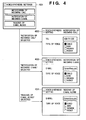
- FIG. 4 An example of a method of setting voice synthesis is illustrated in Figs. 4 and 5.
- the setting method illustrated in Fig. 4 sets voice synthesis, which corresponds to the telephone number (or e-mail address) of each communicating party, for every item to be read aloud.
- first the item to be read aloud is selected (401), then the communicating party and type of voice to be used in read-out aloud are selected for every item to be read aloud (402 to 404).
- Fig. 5 illustrates an example in which set items for voice synthesis have been added to an address book (telephone directory) for collectively managing information for every individual, this being implemented in a mobile telephone or multifunction telephone.
- Fig. 5 illustrates the manner in which type of voice and volume have been set using voice synthesis for arrival of e-mail and for reading aloud the content of e-mail.
- the set content is stored in the voice-synthesis setting table 206 at step S302.
- the content stored in the voice-synthesis setting table 206 may be mounted in a form included in the address book.
- Fig. 6 illustrates an example of data stored in the voice-synthesis setting table 206.
- the following items are stored for every line: a telephone number in a column 602, an e-mail address in a column 603, a voice-synthesis setting, which is used when giving notification of an incoming call, in a column 604, a voice-synthesis setting, which is used when giving notification of incoming e-mail, in a column 605, and a voice-synthesis setting, which is used when reading the content of e-mail aloud, in a column 606.
- the names and pronunciations thereof corresponding to telephone numbers and e-mail are stored in a column 601.
- the fourth line (D) is for setting of initial values of settings for voice synthesis. This is applied to a communicating party or item read out aloud for which voice-synthesis settings have not been made in subsequent processing. It may be so arranged that the initial values can be set by the user at step S301.
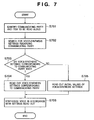
- Fig. 7 is a flowchart illustrating an example of an operation for voice readout from a telephone according to this embodiment.
- the communication-party identifying unit 202 identifies the communicating party, which is the source at which the call originated, and the read-aloud-item identifying unit 203 identifies the item to be read aloud by synthesized sound (step S701).
- the communication-party identifying unit 202 acquires the telephone number of the call originator provided by a number-display service or the like and adopts the acquired telephone number as the communicating party.
- the read-aloud-item identifying unit 203 identifies that the item to be read aloud by synthesized sound in response to the incoming call is notification of an incoming call.
- the voice-synthesis setting readout unit 204 searches the voice-synthesis setting table 206 for the acquired telephone number of the communicating party and voice-synthesis settings corresponding to notification of the incoming call (step S702).
- the settings are read out of the voice-synthesis setting table 206 (step S704) and the voice synthesizing unit 205 executes voice synthesis in accordance with the settings read out (step S706).
- initial values of voice-synthesis settings are read out of the voice-synthesis setting table 206 (step S704) and voice synthesis is carried out in accordance with these settings (step S706).
- the voice-synthesis setting for notification of an incoming call corresponding to this telephone number is "CHILD; Volume 4" stored in column 604 on line B of Fig. 6. Further, if the telephone number of the call originator is found to be "123-345-5667", there is no corresponding voice-synthesis setting for notification of an incoming call, though the this telephone number has been stored in the table. Accordingly, the initial values of the voice-synthesis settings (column 604, line D in Fig. 6) "WOMAN; Volume 2" are read out (step S705) and voice synthesis is performed using these settings. If there is an incoming call from a telephone number that has not been stored in the voice-synthesis setting table 206, then voice synthesis is performed in similar fashion using the initial values of the voice-synthesis settings.
- the basic operation is similar to that of the case where notification of an incoming call is given. If incoming e-mail is sensed by the communicating unit 108, the communication-party identifying unit 202 identifies the communicating party by acquiring the e-mail address of the transmitting source from the "From:" field of the received e-mail at the identification step S701. Further, the read-aloud-item identifying unit 203 identifies that the item to be read aloud by synthesized sound is notification of incoming e-mail (or reading of e-mail aloud) attendant upon arrival of e-mail.
- the voice-synthesis settings for notification of incoming e-mail (or for reading e-mail aloud) corresponding to the acquired e-mail address of the source are retrieved from the voice-synthesis setting table 206 (step S702).
- the settings are read out of the voice-synthesis setting table 206 (step S704) and the voice synthesizing unit 205 executes voice synthesis using the settings read out (step S706).
- initial values of voice-synthesis settings are read out of the voice-synthesis setting table 206 (step S704) and voice synthesis is carried out using these settings (step S706).
- the only registered e-mail addresses are "Canon@xxx.zzz" and "png@ccc.rrr.eee”. Accordingly, if the source of an e-mail transmission has an address other than these two e-mail addresses, then voice is synthesized using the initial values of voice-synthesis settings. Specifically, the settings stored in column 605, line D of Fig. 6 are used to synthesize voice in case of notification of incoming e-mail, and the settings stored in column 606, line D of Fig. 6 are used to synthesize voice in a case where e-mail is to be read aloud. The settings are "WOMAN; Volume 2" in both cases.
- voice is synthesized using the relevant settings (column 605, line A and column 606, line C, respectively).
- voice that differs for every communicating party and every item to be read aloud can be synthesized in a telephone that is capable of voice synthesis.
- a voice can be set in accordance with user preference, as by using a plain voice in case of mail from one's office and a cute child's voice in case of mail from a child.
- Achievement is experienced by selective use of voice in a manner similar to the setting of an incoming-call alert melody in a mobile telephone.
- voice is synthesized for every communicating party even with regard to the reading aloud of e-mail, enjoyment is similarly enhanced.
- convenience is enhanced further because a communicating party can be identified by the type of voice that is heard.
- notification of an incoming call, notification of incoming e-mail and the content of e-mail are described as items to be read aloud.
- the invention is not limited to this arrangement and it goes without saying that the user can make desired voice-synthesis settings for every communicating party in similar fashion with regard to other examples as well, such as the reading aloud of web pages, telephone voice guidance and answer messages for when the called party is absent.
- voice-synthesis settings can be changed for every communicating party by acquiring the URL as the communicating party in a manner similar to that when e-mail is read aloud.
- the present invention may be applied to a system constituted by a plurality of devices (e.g., a host computer, interface, reader, printer, etc.) or to an apparatus comprising a single device (e.g., a copier or facsimile machine, etc.).
- a system constituted by a plurality of devices (e.g., a host computer, interface, reader, printer, etc.) or to an apparatus comprising a single device (e.g., a copier or facsimile machine, etc.).
- the object of the invention is attained also by supplying a storage medium storing the program codes of the software for performing the functions of the foregoing embodiment to a system or an apparatus, reading the program codes with a computer (e.g., a CPU or MPU) of the system or apparatus from the storage medium, and then executing the program codes.
- a computer e.g., a CPU or MPU
- the program codes read from the storage medium implement the novel functions of the embodiment and the storage medium storing the program codes constitutes the invention.
- Examples of storage media that can be used for supplying the program code are a floppy disk, hard disk, optical disk, magneto-optical disk, CD-ROM, CD-R, magnetic tape, non-volatile type memory card or ROM, etc.
- the present invention covers a case where an operating system or the like running on the computer performs a part of or the entire process in accordance with the designation of program codes and implements the functions according to the embodiment.
- the present invention further covers a case where, after the program codes read from the storage medium are written in a function expansion board inserted into the computer or in a memory provided in a function expansion unit connected to the computer, a CPU or the like contained in the function expansion board or function expansion unit performs a part of or the entire process in accordance with the designation of program codes and implements the function of the above embodiment.
Landscapes
- Engineering & Computer Science (AREA)
- Signal Processing (AREA)
- Multimedia (AREA)
- Business, Economics & Management (AREA)
- General Business, Economics & Management (AREA)
- Human Computer Interaction (AREA)
- Computer Networks & Wireless Communication (AREA)
- Automation & Control Theory (AREA)
- Telephonic Communication Services (AREA)
- Telephone Function (AREA)
Applications Claiming Priority (2)
| Application Number | Priority Date | Filing Date | Title |
|---|---|---|---|
| JP2003326439A JP2005091888A (ja) | 2003-09-18 | 2003-09-18 | 通信装置、情報処理方法ならびにプログラム、記憶媒体 |
| JP2003326439 | 2003-09-18 |
Publications (2)
| Publication Number | Publication Date |
|---|---|
| EP1517534A2 true EP1517534A2 (de) | 2005-03-23 |
| EP1517534A3 EP1517534A3 (de) | 2005-05-25 |
Family
ID=34191350
Family Applications (1)
| Application Number | Title | Priority Date | Filing Date |
|---|---|---|---|
| EP04255549A Withdrawn EP1517534A3 (de) | 2003-09-18 | 2004-09-14 | Kommunikationsvorrichtung mit Mitteln zur Sprachsynthese, Informationsverarbeitungsmethode, Programm und Speichermedium |
Country Status (3)
| Country | Link |
|---|---|
| US (1) | US20050065794A1 (de) |
| EP (1) | EP1517534A3 (de) |
| JP (1) | JP2005091888A (de) |
Families Citing this family (2)
| Publication number | Priority date | Publication date | Assignee | Title |
|---|---|---|---|---|
| US7594910B2 (en) * | 2004-03-18 | 2009-09-29 | C. R. Bard, Inc. | Catheter connector |
| US11838459B2 (en) | 2019-06-07 | 2023-12-05 | Canon Kabushiki Kaisha | Information processing system, information processing apparatus, and information processing method |
Family Cites Families (9)
| Publication number | Priority date | Publication date | Assignee | Title |
|---|---|---|---|---|
| JPS5838055A (ja) * | 1981-08-28 | 1983-03-05 | Nippon Telegr & Teleph Corp <Ntt> | 電話機 |
| JPH066428A (ja) * | 1992-06-18 | 1994-01-14 | Nec Corp | 着呼識別機能付電話機 |
| FR2748176B1 (fr) * | 1996-04-24 | 1998-07-10 | Parrot Sa | Appareil electronique portatif a annuaire telephonique et recepteur de radiomessagerie integres |
| JP3287281B2 (ja) * | 1997-07-31 | 2002-06-04 | トヨタ自動車株式会社 | メッセージ処理装置 |
| US6324511B1 (en) * | 1998-10-01 | 2001-11-27 | Mindmaker, Inc. | Method of and apparatus for multi-modal information presentation to computer users with dyslexia, reading disabilities or visual impairment |
| US20030147518A1 (en) * | 1999-06-30 | 2003-08-07 | Nandakishore A. Albal | Methods and apparatus to deliver caller identification information |
| AT5668U1 (de) * | 2001-05-23 | 2002-09-25 | Siemens Ag Oesterreich | Verfahren zur signalisierung in einem telekommunikationsendgerät |
| CA2448586A1 (en) * | 2001-05-28 | 2002-12-05 | Matsushita Electric Industrial Co., Ltd. | Communication apparatus |
| US6570983B1 (en) * | 2001-07-06 | 2003-05-27 | At&T Wireless Services, Inc. | Method and system for audibly announcing an indication of an identity of a sender of a communication |
-
2003
- 2003-09-18 JP JP2003326439A patent/JP2005091888A/ja active Pending
-
2004
- 2004-09-08 US US10/935,108 patent/US20050065794A1/en not_active Abandoned
- 2004-09-14 EP EP04255549A patent/EP1517534A3/de not_active Withdrawn
Also Published As
| Publication number | Publication date |
|---|---|
| EP1517534A3 (de) | 2005-05-25 |
| JP2005091888A (ja) | 2005-04-07 |
| US20050065794A1 (en) | 2005-03-24 |
Similar Documents
| Publication | Publication Date | Title |
|---|---|---|
| JP4296598B2 (ja) | 通信端末装置および通信端末処理プログラム | |
| US6298128B1 (en) | Unified directory for caller ID and electronic mail addresses | |
| JP4377982B2 (ja) | ワイヤレスlanとpbx間のディジタル無線通信システム | |
| JP2003018283A (ja) | 電話システム用発信元識別方法、及びそれを適用した発信元識別機能付き電話システム | |
| US6070053A (en) | Radio communication system including independent calling sound notification | |
| EP1517534A2 (de) | Kommunikationsvorrichtung mit Mitteln zur Sprachsynthese, Informationsverarbeitungsmethode, Programm und Speichermedium | |
| JP2004282609A (ja) | 音情報提供システム | |
| JP2004280515A (ja) | 電子メール自動返信方法、携帯端末装置 | |
| CN1592330B (zh) | 通信终端装置及其发送方法 | |
| MX2007010421A (es) | Segmentos de tono de llamada definidos en una fuente de audio. | |
| EP1528765A1 (de) | Anrufsmeldung mittels übertragenen Medienobjekten | |
| US20060217982A1 (en) | Semiconductor chip having a text-to-speech system and a communication enabled device | |
| JP2003319087A (ja) | 通信装置 | |
| JP2002027112A (ja) | 着信通知データ指定機能付き通信システムおよび着信通知方法 | |
| WO2007135833A1 (ja) | 通信装置 | |
| JP4721399B2 (ja) | 音声出力装置、音声出力方法、およびプログラム | |
| JP2002244980A (ja) | 移動体通信端末における受信メール通知方法及び受信メール通知装置 | |
| JP3064930B2 (ja) | 発呼側情報表示システム | |
| JP2007264466A (ja) | 音声合成装置 | |
| JP2004164377A (ja) | 携帯端末装置 | |
| JP2001285564A (ja) | 通信メディア統合装置における発信者id抽出方法 | |
| KR100953631B1 (ko) | 이동통신 단말기 및 이것의 수신음 설정 방법 | |
| JP3995137B2 (ja) | 音声ダイヤル機能付き電話機 | |
| US20030103622A1 (en) | Method of calling up target call receiver and communications terminal equipment used for implementing same | |
| JP2007201746A (ja) | 留守番電話装置及び情報処理端末を用いる留守番電話システム |
Legal Events
| Date | Code | Title | Description |
|---|---|---|---|
| PUAI | Public reference made under article 153(3) epc to a published international application that has entered the european phase |
Free format text: ORIGINAL CODE: 0009012 |
|
| AK | Designated contracting states |
Kind code of ref document: A2 Designated state(s): AT BE BG CH CY CZ DE DK EE ES FI FR GB GR HU IE IT LI LU MC NL PL PT RO SE SI SK TR |
|
| AX | Request for extension of the european patent |
Extension state: AL HR LT LV MK |
|
| PUAL | Search report despatched |
Free format text: ORIGINAL CODE: 0009013 |
|
| AK | Designated contracting states |
Kind code of ref document: A3 Designated state(s): AT BE BG CH CY CZ DE DK EE ES FI FR GB GR HU IE IT LI LU MC NL PL PT RO SE SI SK TR |
|
| AX | Request for extension of the european patent |
Extension state: AL HR LT LV MK |
|
| 17P | Request for examination filed |
Effective date: 20051125 |
|
| AKX | Designation fees paid |
Designated state(s): DE FR GB |
|
| STAA | Information on the status of an ep patent application or granted ep patent |
Free format text: STATUS: THE APPLICATION HAS BEEN WITHDRAWN |
|
| 18W | Application withdrawn |
Effective date: 20060424 |