EP1516865A1 - Carbonsäureester auf Basis von Limonanalkohol (3-(4'-Methylcyclohexyl)butanol) mit niedrigem Stockpunkt - Google Patents
Carbonsäureester auf Basis von Limonanalkohol (3-(4'-Methylcyclohexyl)butanol) mit niedrigem Stockpunkt Download PDFInfo
- Publication number
- EP1516865A1 EP1516865A1 EP04021663A EP04021663A EP1516865A1 EP 1516865 A1 EP1516865 A1 EP 1516865A1 EP 04021663 A EP04021663 A EP 04021663A EP 04021663 A EP04021663 A EP 04021663A EP 1516865 A1 EP1516865 A1 EP 1516865A1
- Authority
- EP
- European Patent Office
- Prior art keywords
- methylcyclohexyl
- reaction
- carboxylic acid
- acid
- ester
- Prior art date
- Legal status (The legal status is an assumption and is not a legal conclusion. Google has not performed a legal analysis and makes no representation as to the accuracy of the status listed.)
- Granted
Links
Classifications
-
- C—CHEMISTRY; METALLURGY
- C07—ORGANIC CHEMISTRY
- C07C—ACYCLIC OR CARBOCYCLIC COMPOUNDS
- C07C69/00—Esters of carboxylic acids; Esters of carbonic or haloformic acids
- C07C69/34—Esters of acyclic saturated polycarboxylic acids having an esterified carboxyl group bound to an acyclic carbon atom
- C07C69/40—Succinic acid esters
-
- C—CHEMISTRY; METALLURGY
- C07—ORGANIC CHEMISTRY
- C07C—ACYCLIC OR CARBOCYCLIC COMPOUNDS
- C07C69/00—Esters of carboxylic acids; Esters of carbonic or haloformic acids
- C07C69/34—Esters of acyclic saturated polycarboxylic acids having an esterified carboxyl group bound to an acyclic carbon atom
- C07C69/38—Malonic acid esters
-
- C—CHEMISTRY; METALLURGY
- C07—ORGANIC CHEMISTRY
- C07C—ACYCLIC OR CARBOCYCLIC COMPOUNDS
- C07C69/00—Esters of carboxylic acids; Esters of carbonic or haloformic acids
- C07C69/34—Esters of acyclic saturated polycarboxylic acids having an esterified carboxyl group bound to an acyclic carbon atom
- C07C69/42—Glutaric acid esters
-
- C—CHEMISTRY; METALLURGY
- C07—ORGANIC CHEMISTRY
- C07C—ACYCLIC OR CARBOCYCLIC COMPOUNDS
- C07C69/00—Esters of carboxylic acids; Esters of carbonic or haloformic acids
- C07C69/34—Esters of acyclic saturated polycarboxylic acids having an esterified carboxyl group bound to an acyclic carbon atom
- C07C69/44—Adipic acid esters
-
- C—CHEMISTRY; METALLURGY
- C07—ORGANIC CHEMISTRY
- C07C—ACYCLIC OR CARBOCYCLIC COMPOUNDS
- C07C69/00—Esters of carboxylic acids; Esters of carbonic or haloformic acids
- C07C69/34—Esters of acyclic saturated polycarboxylic acids having an esterified carboxyl group bound to an acyclic carbon atom
- C07C69/50—Sebacic acid esters
-
- C—CHEMISTRY; METALLURGY
- C10—PETROLEUM, GAS OR COKE INDUSTRIES; TECHNICAL GASES CONTAINING CARBON MONOXIDE; FUELS; LUBRICANTS; PEAT
- C10M—LUBRICATING COMPOSITIONS; USE OF CHEMICAL SUBSTANCES EITHER ALONE OR AS LUBRICATING INGREDIENTS IN A LUBRICATING COMPOSITION
- C10M105/00—Lubricating compositions characterised by the base-material being a non-macromolecular organic compound
- C10M105/08—Lubricating compositions characterised by the base-material being a non-macromolecular organic compound containing oxygen
- C10M105/32—Esters
- C10M105/36—Esters of polycarboxylic acids
-
- C—CHEMISTRY; METALLURGY
- C07—ORGANIC CHEMISTRY
- C07C—ACYCLIC OR CARBOCYCLIC COMPOUNDS
- C07C2601/00—Systems containing only non-condensed rings
- C07C2601/12—Systems containing only non-condensed rings with a six-membered ring
- C07C2601/14—The ring being saturated
-
- C—CHEMISTRY; METALLURGY
- C10—PETROLEUM, GAS OR COKE INDUSTRIES; TECHNICAL GASES CONTAINING CARBON MONOXIDE; FUELS; LUBRICANTS; PEAT
- C10M—LUBRICATING COMPOSITIONS; USE OF CHEMICAL SUBSTANCES EITHER ALONE OR AS LUBRICATING INGREDIENTS IN A LUBRICATING COMPOSITION
- C10M2207/00—Organic non-macromolecular hydrocarbon compounds containing hydrogen, carbon and oxygen as ingredients in lubricant compositions
- C10M2207/28—Esters
- C10M2207/282—Esters of (cyclo)aliphatic oolycarboxylic acids
-
- C—CHEMISTRY; METALLURGY
- C10—PETROLEUM, GAS OR COKE INDUSTRIES; TECHNICAL GASES CONTAINING CARBON MONOXIDE; FUELS; LUBRICANTS; PEAT
- C10N—INDEXING SCHEME ASSOCIATED WITH SUBCLASS C10M RELATING TO LUBRICATING COMPOSITIONS
- C10N2040/00—Specified use or application for which the lubricating composition is intended
Definitions
- the present invention relates to novel carboxylic acid esters based on Limonan alcohol, process for their preparation and their use.
- Carboxylic esters are found on a large scale and in many ways Application in the art, such as lubricants, plasticizers and fragrances. There are many different ones in the industry Ester used, starting from simple carboxylic acid esters Monocarboxylic acids and monoalcohols to complex ester oils from mixtures of mono- and dicarboxylic acids with mono- and polyfunctional Alcohols. By selecting suitable starting materials let the physical properties of the material, e.g. boiling point or viscosity, and the chemical properties, such as. the hydrolytic stability or the stability account for oxidative degradation. Also on the solution more concrete Application problems can be targeted carboxylic acid esters be tailored.
- lubricants includes strict only take products that are sliding or rolling for lubrication Elements are used. Those in engineering in numerous applications used lubricants consist mainly of mineral oils or fully or partially synthetic products. Lubricants on Base of mineral oils are very versatile. They do not serve only for lubrication and power transmission at high and low temperatures, but also for heat transfer and insulation. For requirements, the mineral oil products can only partially fulfill synthetic fluids with lubricating oil-like character too technical lead to better solutions. Synthetic base oils are made largely uniform substances produced under controlled conditions and can have different chemical compound classes belong.
- ester oils are used on a large scale in aviation, for example, as turbine and instrument oils, used as fats or gun oils. These Ester oils are produced by the reaction of acids or acid anhydrides, in particular of mono- or dicarboxylic acids and alcohols, in particular prepared from mono-, di-, tri- or tetra-alcohols.
- esters are e.g. aliphatic Monocarboxylic acids with 5-10 carbon atoms.
- dicarboxylic acids are adipic acid, azelaic acid or sebacic acid in technical quantities to disposal.
- alcohols come in addition to the aliphatic Alcohols such as 2-ethylhexanol especially polyhydric alcohols such as Ethylene glycol and its oligomers di-, tri- and tetraethylene glycol, Propylene glycol and its oligomers, 1,3-propanediol, 1,4-butanediol, 1,6-hexanediol, neopentyl glycol, trimethylolpropane, glycerol and Pentaerythritol used.
- Plasticizers find in large scale and in a variety of applications in plastics, Coating agents, sealants, rubber and rubber articles. They occur with high polymer thermoplastic materials, without chemically react, preferably by their dissolving and swelling capacity in physical interaction. This forms a homogeneous System whose thermoplastic range over the original Polymer is shifted to lower temperatures, i.a. with the result that its mechanical properties are optimized, e.g. Shape change capacity, elasticity, strength can be increased and the hardness is reduced.
- plasticizers as wide as possible applications they have to meet a number of criteria. Ideally, they should be odorless, colorless, resistant to light, cold and heat be.
- plasticizers should be easy be and to meet environmental requirements, avoiding of waste materials, such as non-recyclable by-products and pollutants containing wastewater done.
- plasticizers include the esters of di- and polycarboxylic acids with plasticizer alcohols, i. unbranched or branched primary alcohols having about 6 to 20 carbon atoms, used as individual compounds or as mixtures become.
- plasticizer alcohols i. unbranched or branched primary alcohols having about 6 to 20 carbon atoms, used as individual compounds or as mixtures become.
- ester plasticizers are in particular Phthalic acid ester used for softening of PVC.
- ester plasticizers also called G-esters are abbreviated, contains as the alcohol component diols or ether diols, namely ethylene glycol, diethylene glycol, triethylene glycol and tetraethylene glycol.
- ester compounds In addition to the efforts for targeted adjustment of the application technology Properties of ester compounds have been around for quite some time Made efforts to use the starting materials of ester compounds, i.e. the acid and / or the alcohol component, from renewable To gain raw materials and so compared to this commodity base to give more weight to the petroleum base.
- ester compounds and their use as lubricants are those on oleic acids based neopentyl, trimethylolpropane or pentaerythritol ester, such as the products Edenor® PDO or Edenor® 2742 of the company Cognis.
- the object of the invention is therefore to provide carboxylic acid esters which used with particular success as lubricants or plasticizers and based on renewable raw materials.
- the object of the invention is to provide a method that the production of such carboxylic esters from readily available, in sufficient quantity available at low cost Starting products based on renewable raw materials allowed. Particular emphasis is placed in this context on the fact that the Esterification process can be realized with simple technical means can and does not require elaborate or specialized equipment.
- limonane alcohol Used as the alcohol component in the new ester compounds limonane alcohol [3- (4'-methylcyclohexyl) butanol].
- the production of limonane alcohol as the alcohol component takes place by hydroformylation of limes.
- Limonene is inexpensive in large quantities available and is made from essential oils, such as from Orange oil or pine needle oil won. Limes are used for the perfumery of detergents as well as in the paint and varnish industry.
- the rhodium-catalyzed hydroformylation of Limonene leads in very high yields to limonenealdehyde [3- (4'-methyl-3-cyclohexen-1-yl) butyraldehyde].
- the reaction with synthesis gas generally takes place in a customary organic solvent, such as cyclohexane, toluene or n-hexane at temperatures of 80 to 150 ° C and pressures of 10 to 30 MPa in the presence of known organic Phosphorus (III) compounds, such as triphenylphosphine, as ligands.
- Limenaldehyde is made by distillative workup recovered from the crude hydroformylation product and then in the presence of conventional hydrogenation catalysts with hydrogen at elevated pressure and elevated temperature to limonane alcohol implemented. It is possible to use the hydrogenation catalysts customary in the art, such as carrier-containing or carrier-free metal catalysts, for example, nickel, palladium or copper as catalytically active Metal included, insert.
- Promoters such as zirconium or manganese.
- Usual carrier materials are silica or alumina.
- the hydrogenation reaction is carried out under conventional temperature conditions a range of 70 to 150 ° C and common pressure conditions in a range of 2 to 30 MPa performed.
- the hydrogenation reaction proceeds in high yields. This is limonane alcohol after a technically simple process cost-effective for the production of new Carboxylic acid esters available.
- These simple representatives of Aliphatic dicarboxylic acids are available on an industrial scale or can be prepared by known methods.
- the immediate esterification of alcohols with carboxylic acids belongs to the basic operations of organic chemistry.
- To the reaction speed To increase the implementation usually leads in Presence of catalysts through.
- the use of one of the reactants in excess and / or the separation of in the course of the reaction Water formed ensures that the balance is adequate the mass action law to the side of the reaction product, ie the Esters, is moved, i. high yields can be achieved.
- the amount required to completely separate the water The entraining agent can be determined according to the stoichiometry of the Esterification reaction calculated water formation and from the composition determine the binary azeotrope in a simple manner. It has proven to use the Schleppsch in excess, appropriate in a proportion of 50 to 200 wt .-% over the theoretically calculated Quantity is.
- Schleppsch in excess, appropriate in a proportion of 50 to 200 wt .-% over the theoretically calculated Quantity is.
- the reaction of limonane alcohol and carboxylic acid can be without use a catalyst can be carried out.
- This variant of the implementation has the advantage of avoiding impurities from the reaction mixture feed, which lead to an undesirable contamination of the ester can.
- the increase in Reaction temperature lead to thermal damage to the ester can. Therefore, it is not always possible to use a catalyst which facilitates the reaction and increases the reaction rate, avoid. Often, the catalyst can be an excess of the acid, which is also the reaction component of the limonan alcohol.
- esterification catalysts for influencing the Reaction rate suitable, such as mineral acids such as sulfuric acid, Phosphoric acid, polyphosphoric acid or their acid salts, trialkyl or triaryl phosphates, formic acid, methanesulfonic acid or p-toluenesulfonic acid.
- the amount of catalyst used can be over a wide range extend. It can be from 1 to 10 mol% of catalyst, based used on dicarboxylic acid. As larger amounts of catalyst however, hardly gives any advantages, the catalyst concentration is usually 2 to 8, preferably 3 to 6, mol%, in each case on used dicarboxylic acid. Appropriately, you decide if necessary by preliminary tests for each individual case, whether without a catalyst at higher temperature or with catalyst at low temperature to work is.
- the esterification can be carried out in stoichiometric amounts of limonan alcohol and acid are made. Preferably, however, one uses limonane alcohol in excess, to be as complete as possible in finite time Achieve implementation.
- the reaction between limonan alcohol and the acid is dependent from the feeds in the range of about 80 to 110 ° C. It can end at temperatures of 160 to 200 ° C at atmospheric pressure be guided. These temperatures are Guide values that are appropriately adhered to. Lower temperatures can e.g. sufficient, if in the special case a sufficiently high Reaction rate is achieved or only partial sales sought become. Higher temperatures are possible when the occurrence of Decomposition products, i.a. color damaging effect exclude is. The application of reduced or increased pressure is not but it will limit itself to special cases.
- the reaction mixture obtained after completion of the reaction contains optionally in addition to the ester as a desired reaction product unreacted starting materials, especially excess limonan alcohol, if you worked with an excess of alcohol.
- to Work-up is the reactor discharge by conventional methods freed from the catalyst. If the catalyst is present as a solid, e.g. in Form of a hydrogen sulfate, the product is filtered in conventional filter apparatus at normal temperature or at temperatures up to 150 ° C. Filtration can be carried out by conventional filtration aids, such as aluminum oxide, Silica gel, diatomaceous earth, activated carbon are supported. Subsequently is distilled off excess and unreacted starting materials.
- an alkaline reagent e.g. aqueous soda or Provide sodium hydroxide solution.
- the Ester dried, for example, by passing an inert gas through the Product conducts or applies vacuum. If the catalyst in the reaction mixture dissolved, such as sulfuric acid or para-toluenesulfonic acid, If necessary, distilled after previous filtration, first still present starting materials, and then treated with an alkaline reagent. If necessary, subject the product a steam distillation before the final drying step.
- the Isolation of the ester still further purification steps connect, for example a fractional distillation in vacuo.
- the esterification reaction may be batchwise or else continuous performed the typical chemical apparatuses become.
- Stirred boilers with a heating device have proved their worth and means for supplying the azeotrope former are equipped.
- ester compounds of the invention are suitable for their Excellent viscosity and low temperature performance as Lubricants that are used at low temperatures but which nevertheless have a high molecular weight.
- Esters from the renewable raw material limonene easily accessible. They are also used as plasticizers for many common high polymers thermoplastics suitable.
- the organic phase is washed twice a total of 227.2 g of water. After two phase separation becomes the organic phase (394.5 g) at a head temperature of 208 ° C. and fractionally distilled at a pressure of 100 Pa.
- the ester (221.8 g) is isolated in a purity of 92.6%. This corresponds to a yield of 77.1% of theory.
- the organic phase is washed twice with total Washed 245.3 g of water. After two phase separation becomes the organic phase (410.5g) at a head temperature of 210 ° C and fractionally distilled at a pressure of 100 Pa.
- the ester (290.0 g) is isolated in a purity of 91.7%. This corresponds to a yield from 91.4% of theory.
- 161.8 g of sebacic acid (0.8 mol), 290.2 g (1.6 mol) of 3- (4'-methylcyclohexyl) butanol, 7.6 g of p-toluenesulfonic acid monohydrate (0.040 mol) and 50 g of toluene are in a 11-necked three-necked flask with stirrer, internal thermometer and water and initially heated to reflux. Within 60 minutes, 30.2 g of water are removed. The temperature of the reaction mixture increases to 186 ° C at the end of the reaction. The reaction mixture is cooled to room temperature and treated with 162.2 g of aqueous sodium hydroxide solution (1 wt .-%).
- the organic phase is washed twice with a total of 911.9 g of water.
- the organic phase (435.9 g) is freed from low boilers at a bottom temperature of 240 ° C and a pressure of 100 Pa.
- the ester (321.8 g) is isolated in a purity of 95.6%. This corresponds to a yield of 79% of theory.
Landscapes
- Chemical & Material Sciences (AREA)
- Organic Chemistry (AREA)
- Health & Medical Sciences (AREA)
- Emergency Medicine (AREA)
- Chemical Kinetics & Catalysis (AREA)
- General Chemical & Material Sciences (AREA)
- Oil, Petroleum & Natural Gas (AREA)
- Organic Low-Molecular-Weight Compounds And Preparation Thereof (AREA)
- Lubricants (AREA)
- Low-Molecular Organic Synthesis Reactions Using Catalysts (AREA)
Abstract
Description
| Eigenschaften der Esterverbindungen | |||
| Ester | V40 mm2/s | V100 mm2/s | Pourpoint °C |
| Di-(3-(4'-Methylcyclohexyl)butyl)-malonsäureester | 30.9 | 4.9 | -51 |
| Di-(3-(4'-Methylcyclohexyl)butyl)-bernsteinsäureester | 41.1 | 5.8 | -42 |
| Di-(3-(4'-Methylcyclohexyl)butyl)-glutarsäureester | 38.4 | 5.9 | -54 |
| Di-(3-(4'-Methylcyclohexyl)butyl)-adipinsäureester | 38.5 | 6.0 | ≤-45 |
| Di-(3-(4'-Methylcyclohexyl)butyl)sebacinsäureester | 50.2 | 7.7 | ≤-48 |
Bestimmung des Pourpoints gemäß ASTM D97.
Claims (6)
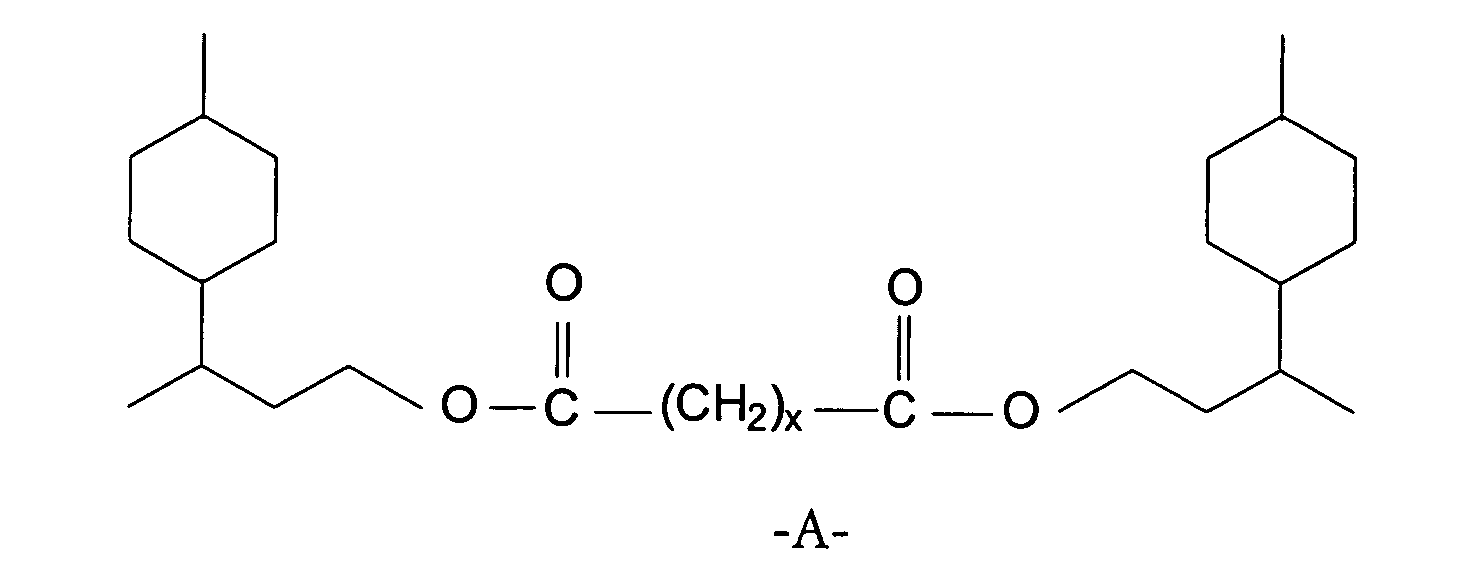
- Carbonsäureester der allgemeinen Formelin der A gleich -(CH2)x-, mit x = 1-10, bedeutet.
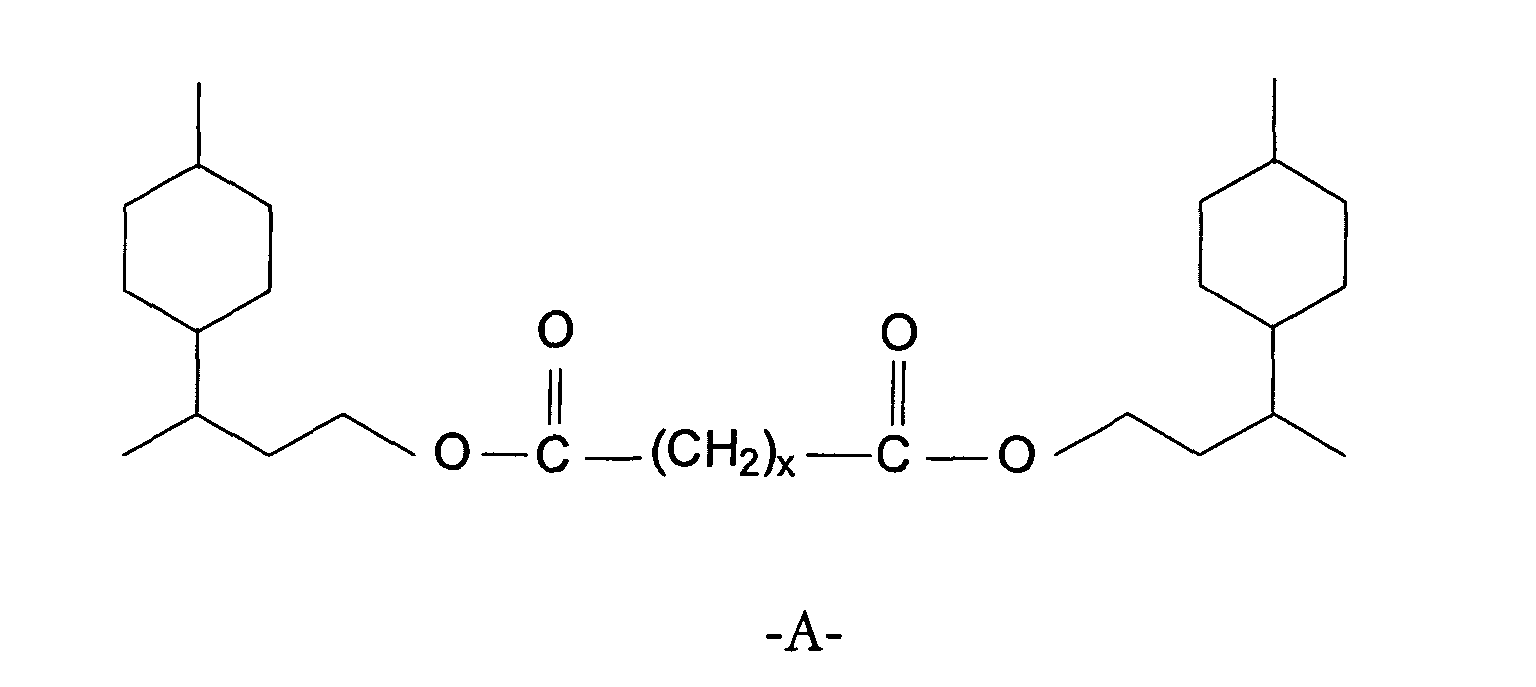
- Carbonsäureester nach Anspruch 1, dadurch gekennzeichnet, dass x gleich 1, 2, 3, 4, 7, 8 oder 10 bedeutet.
- Verfahren zur Herstellung der Carbonsäureester gemäß Anspruch 1, durch Umsetzung von 3-(4'-Methylcyclohexyl)butanol mit Dicarbonsäuren der allgemeinen Formeloder deren Anhydriden der allgemeinen Formel
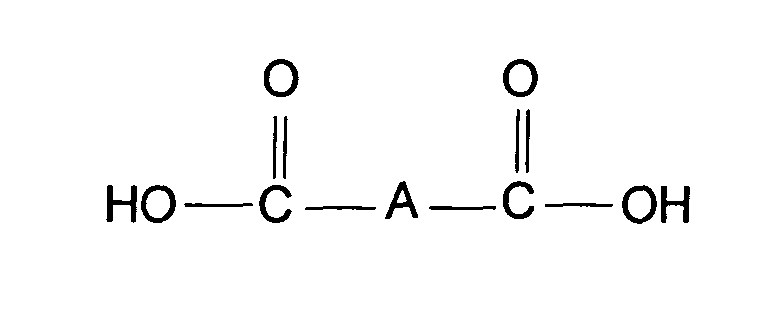 wobei A die in Anspruch 1 genannte Bedeutung besitzt, in Gegenwart eines Schleppmittels zur Entfernung des im Verlauf der Umsetzung gebildeten Wassers als azeotropes Gemisch und gegebenenfalls in Gegenwart eines Katalysators, Abtrennung überschüssiger und nicht umgesetzter Ausgangsstoffe, Behandlung mit einem alkalischen Reagenz zur Entfernung acider Bestandteile, gegebenenfalls anschließende Wasserdampfdestillation, und abschließende Trocknung oder fraktionierte Destillation.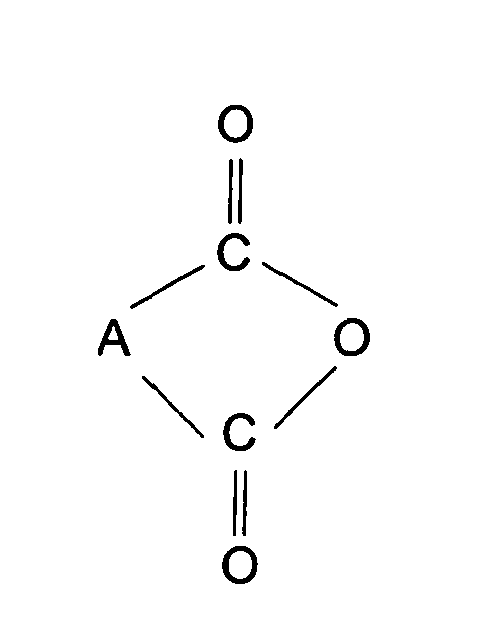
- Verwendung der Carbonsäureester gemäß Anspruch 1 als Schmiermittel oder Weichmacher für thermoplastische Kunststoffe.
- Schmiermittel auf Basis der Verbindungen gemäß Anspruch 1.
- Weichmacher auf Basis der Verbindungen gemäß Anspruch 1.
Applications Claiming Priority (2)
| Application Number | Priority Date | Filing Date | Title |
|---|---|---|---|
| DE10343623A DE10343623A1 (de) | 2003-09-20 | 2003-09-20 | Carbonsäureester auf Basis von Limonanalkohol [3-(4'-Methylcyclohexyl)butanol] mit niedrigem Stockpunkt |
| DE10343623 | 2003-09-20 |
Publications (2)
| Publication Number | Publication Date |
|---|---|
| EP1516865A1 true EP1516865A1 (de) | 2005-03-23 |
| EP1516865B1 EP1516865B1 (de) | 2007-11-21 |
Family
ID=34177859
Family Applications (1)
| Application Number | Title | Priority Date | Filing Date |
|---|---|---|---|
| EP04021663A Expired - Lifetime EP1516865B1 (de) | 2003-09-20 | 2004-09-11 | Carbonsäureester auf Basis von Limonanalkohol (3-(4'-Methylcyclohexyl)butanol) mit niedrigem Stockpunkt |
Country Status (4)
| Country | Link |
|---|---|
| US (1) | US7196128B2 (de) |
| EP (1) | EP1516865B1 (de) |
| JP (1) | JP2005089465A (de) |
| DE (2) | DE10343623A1 (de) |
Cited By (3)
| Publication number | Priority date | Publication date | Assignee | Title |
|---|---|---|---|---|
| WO2012024808A1 (de) * | 2010-08-25 | 2012-03-01 | Panolin Ag | Esteröle |
| EP2071010A4 (de) * | 2006-10-06 | 2012-05-30 | Idemitsu Kosan Co | Schmierfett |
| DE102013208386A1 (de) | 2013-05-07 | 2014-11-13 | Evonik Industries Ag | Biobasierte Polyesterpolyole aus Limonenderivaten |
Families Citing this family (1)
| Publication number | Priority date | Publication date | Assignee | Title |
|---|---|---|---|---|
| US9721652B2 (en) | 2015-11-17 | 2017-08-01 | Sandisk Technologies Llc | State dependent sensing for wordline interference correction |
Citations (2)
| Publication number | Priority date | Publication date | Assignee | Title |
|---|---|---|---|---|
| US2889354A (en) * | 1955-10-06 | 1959-06-02 | Monsanto Chemicals | Dicarboxylate esters of alcohol containing a quaternary carbon in the beta-position |
| GB880961A (en) * | 1958-09-23 | 1961-10-25 | Distillers Co Yeast Ltd | Di-(3-cyclohexylbutyl) adipate and plasticised compositions thereof |
Family Cites Families (6)
| Publication number | Priority date | Publication date | Assignee | Title |
|---|---|---|---|---|
| US2539503A (en) * | 1945-02-03 | 1951-01-30 | William A Zisman | Lubricating compositions |
| GB782973A (en) * | 1952-12-18 | 1957-09-18 | Ruhrchemie Ag | Ester oils derived from terpenes and a process for their production |
| JPS6150941A (ja) * | 1984-08-17 | 1986-03-13 | Nippon Synthetic Chem Ind Co Ltd:The | グリオキシル酸エステルの製造方法 |
| JPH0631366B2 (ja) * | 1986-01-31 | 1994-04-27 | 東燃株式会社 | トラクシヨンフル−ド |
| GB8626510D0 (en) * | 1986-11-06 | 1986-12-10 | Shell Int Research | Ester compounds as lubricants |
| DE19940991B4 (de) * | 1999-08-28 | 2007-04-05 | Celanese Chemicals Europe Gmbh | Verfahren zur Herstellung von Esterweichmachern |
-
2003
- 2003-09-20 DE DE10343623A patent/DE10343623A1/de not_active Ceased
-
2004
- 2004-07-08 US US10/886,967 patent/US7196128B2/en not_active Expired - Fee Related
- 2004-09-11 EP EP04021663A patent/EP1516865B1/de not_active Expired - Lifetime
- 2004-09-11 DE DE502004005550T patent/DE502004005550D1/de not_active Expired - Lifetime
- 2004-09-16 JP JP2004269206A patent/JP2005089465A/ja active Pending
Patent Citations (2)
| Publication number | Priority date | Publication date | Assignee | Title |
|---|---|---|---|---|
| US2889354A (en) * | 1955-10-06 | 1959-06-02 | Monsanto Chemicals | Dicarboxylate esters of alcohol containing a quaternary carbon in the beta-position |
| GB880961A (en) * | 1958-09-23 | 1961-10-25 | Distillers Co Yeast Ltd | Di-(3-cyclohexylbutyl) adipate and plasticised compositions thereof |
Cited By (4)
| Publication number | Priority date | Publication date | Assignee | Title |
|---|---|---|---|---|
| EP2071010A4 (de) * | 2006-10-06 | 2012-05-30 | Idemitsu Kosan Co | Schmierfett |
| US8703678B2 (en) | 2006-10-06 | 2014-04-22 | Idemitsu Kosan Co., Ltd. | Grease |
| WO2012024808A1 (de) * | 2010-08-25 | 2012-03-01 | Panolin Ag | Esteröle |
| DE102013208386A1 (de) | 2013-05-07 | 2014-11-13 | Evonik Industries Ag | Biobasierte Polyesterpolyole aus Limonenderivaten |
Also Published As
| Publication number | Publication date |
|---|---|
| US20050065254A1 (en) | 2005-03-24 |
| US7196128B2 (en) | 2007-03-27 |
| DE10343623A1 (de) | 2005-04-28 |
| JP2005089465A (ja) | 2005-04-07 |
| DE502004005550D1 (de) | 2008-01-03 |
| EP1516865B1 (de) | 2007-11-21 |
Similar Documents
| Publication | Publication Date | Title |
|---|---|---|
| EP2308824B1 (de) | Verfahren zur Herstellung von Polyolestern | |
| EP2308823B1 (de) | Verfahren zur Herstellung von Polyolestern | |
| EP1081126B1 (de) | Verfahren zur Herstellung von Esterweichmachern | |
| EP0717023B1 (de) | Verfahren zur Herstellung von optisch aktiven Alkoholen durch catalytische Reduktion der optisch aktiven Carbonsäuren | |
| DE1593002A1 (de) | Verfahren zur Herstellung von Dithiophosphatoalkylcarbonsaeureestern | |
| EP0317909A2 (de) | Verfahren zur Herstellung von alpha-Alkylacroleinen | |
| EP1318970B1 (de) | Verfahren zur herstellung von guerbetalkoholen | |
| WO2015036090A1 (de) | Verfahren zur nachbehandlung von polyolestern | |
| EP1468982B1 (de) | Carbonsäureester auf Basis von 2-Hydroxymethylnorbornan | |
| EP1516865B1 (de) | Carbonsäureester auf Basis von Limonanalkohol (3-(4'-Methylcyclohexyl)butanol) mit niedrigem Stockpunkt | |
| DE102013018456B4 (de) | Verfahren zur Gewinnung von mit Polyolestern angereicherten Produktströmen aus den Nebenströmen der Polyolesterherstellung | |
| EP0839789A1 (de) | Verfahren zur Reinigung von O-Phthaldialdehyd | |
| WO2002024621A1 (de) | Verfahren zur herstellung von verzweigten alkoholen und/oder kohlenwasserstoffen | |
| EP0025869B1 (de) | 3-Methyl-cyclohexadecen-5-on-1, Verfahren zu seiner Herstellung und seine Verwendung als Riechstoff | |
| DE2416584C2 (de) | Verfahren zur Herstellung von Squalan | |
| EP1243642A2 (de) | Verfahren zur Herstellung von Alkylcarbonsäureallylestern | |
| EP0945424A2 (de) | Verfahren zur Herstellung von Hydroxybenzoesäureestern von Oxoalkoholen | |
| CH650488A5 (de) | Verfahren zur herstellung des m-phenoxy-benzyl-alkohols. | |
| DE2260447C3 (de) | Verfahren zur Herstellung von Methyljasmonat | |
| DE1668265C (de) | alpha,3,3 Trimethylcyclohexylmethanol, dessen niedere Alkansaureester bzw 3,3 Dimethylcyclohexylmethylketon sowie Ver fahren zu deren Herstellung | |
| DE10200971A1 (de) | Neue Schmierstoffe und Druckübertragungsmittel auf Basis von Oleochemikalien, deren Herstellung und Verwendung | |
| WO2001002327A1 (de) | Verfahren zur herstellung von hexandiol | |
| DE1061775B (de) | Verfahren zur Herstellung von Estern aus Dicyclopentenylestern | |
| DE3046059C2 (de) | 4-Halogen-5,5-dialkoxypentansäureester, Verfahren zu ihrer Herstellung und ihre Verwendung zur Herstellung von 2,2-Dialkyl-3-formylcyclopropancarbonsäureestern | |
| DE4215494A1 (de) | Verfahren zur Herstellung von Hydroxypivalinsäureestern |
Legal Events
| Date | Code | Title | Description |
|---|---|---|---|
| PUAI | Public reference made under article 153(3) epc to a published international application that has entered the european phase |
Free format text: ORIGINAL CODE: 0009012 |
|
| AK | Designated contracting states |
Kind code of ref document: A1 Designated state(s): AT BE BG CH CY CZ DE DK EE ES FI FR GB GR HU IE IT LI LU MC NL PL PT RO SE SI SK TR |
|
| AX | Request for extension of the european patent |
Extension state: AL HR LT LV MK |
|
| 17P | Request for examination filed |
Effective date: 20050923 |
|
| AKX | Designation fees paid |
Designated state(s): AT BE BG CH CY CZ DE DK EE ES FI FR GB GR HU IE IT LI LU MC NL PL PT RO SE SI SK TR |
|
| 17Q | First examination report despatched |
Effective date: 20061207 |
|
| GRAP | Despatch of communication of intention to grant a patent |
Free format text: ORIGINAL CODE: EPIDOSNIGR1 |
|
| RAP1 | Party data changed (applicant data changed or rights of an application transferred) |
Owner name: OXEA DEUTSCHLAND GMBH |
|
| GRAS | Grant fee paid |
Free format text: ORIGINAL CODE: EPIDOSNIGR3 |
|
| GRAA | (expected) grant |
Free format text: ORIGINAL CODE: 0009210 |
|
| AK | Designated contracting states |
Kind code of ref document: B1 Designated state(s): AT BE BG CH CY CZ DE DK EE ES FI FR GB GR HU IE IT LI LU MC NL PL PT RO SE SI SK TR |
|
| REG | Reference to a national code |
Ref country code: GB Ref legal event code: FG4D Free format text: NOT ENGLISH |
|
| REG | Reference to a national code |
Ref country code: IE Ref legal event code: FG4D Free format text: LANGUAGE OF EP DOCUMENT: GERMAN |
|
| REG | Reference to a national code |
Ref country code: CH Ref legal event code: NV Representative=s name: BOVARD AG PATENTANWAELTE Ref country code: CH Ref legal event code: EP |
|
| REF | Corresponds to: |
Ref document number: 502004005550 Country of ref document: DE Date of ref document: 20080103 Kind code of ref document: P |
|
| GBT | Gb: translation of ep patent filed (gb section 77(6)(a)/1977) |
Effective date: 20080227 |
|
| PG25 | Lapsed in a contracting state [announced via postgrant information from national office to epo] |
Ref country code: SE Free format text: LAPSE BECAUSE OF FAILURE TO SUBMIT A TRANSLATION OF THE DESCRIPTION OR TO PAY THE FEE WITHIN THE PRESCRIBED TIME-LIMIT Effective date: 20080221 Ref country code: ES Free format text: LAPSE BECAUSE OF FAILURE TO SUBMIT A TRANSLATION OF THE DESCRIPTION OR TO PAY THE FEE WITHIN THE PRESCRIBED TIME-LIMIT Effective date: 20080304 |
|
| PG25 | Lapsed in a contracting state [announced via postgrant information from national office to epo] |
Ref country code: BG Free format text: LAPSE BECAUSE OF FAILURE TO SUBMIT A TRANSLATION OF THE DESCRIPTION OR TO PAY THE FEE WITHIN THE PRESCRIBED TIME-LIMIT Effective date: 20080221 Ref country code: FI Free format text: LAPSE BECAUSE OF FAILURE TO SUBMIT A TRANSLATION OF THE DESCRIPTION OR TO PAY THE FEE WITHIN THE PRESCRIBED TIME-LIMIT Effective date: 20071121 Ref country code: PL Free format text: LAPSE BECAUSE OF FAILURE TO SUBMIT A TRANSLATION OF THE DESCRIPTION OR TO PAY THE FEE WITHIN THE PRESCRIBED TIME-LIMIT Effective date: 20071121 Ref country code: SI Free format text: LAPSE BECAUSE OF FAILURE TO SUBMIT A TRANSLATION OF THE DESCRIPTION OR TO PAY THE FEE WITHIN THE PRESCRIBED TIME-LIMIT Effective date: 20071121 |
|
| ET | Fr: translation filed | ||
| PG25 | Lapsed in a contracting state [announced via postgrant information from national office to epo] |
Ref country code: DK Free format text: LAPSE BECAUSE OF FAILURE TO SUBMIT A TRANSLATION OF THE DESCRIPTION OR TO PAY THE FEE WITHIN THE PRESCRIBED TIME-LIMIT Effective date: 20071121 Ref country code: CZ Free format text: LAPSE BECAUSE OF FAILURE TO SUBMIT A TRANSLATION OF THE DESCRIPTION OR TO PAY THE FEE WITHIN THE PRESCRIBED TIME-LIMIT Effective date: 20071121 |
|
| PG25 | Lapsed in a contracting state [announced via postgrant information from national office to epo] |
Ref country code: RO Free format text: LAPSE BECAUSE OF FAILURE TO SUBMIT A TRANSLATION OF THE DESCRIPTION OR TO PAY THE FEE WITHIN THE PRESCRIBED TIME-LIMIT Effective date: 20071121 Ref country code: SK Free format text: LAPSE BECAUSE OF FAILURE TO SUBMIT A TRANSLATION OF THE DESCRIPTION OR TO PAY THE FEE WITHIN THE PRESCRIBED TIME-LIMIT Effective date: 20071121 |
|
| PLBE | No opposition filed within time limit |
Free format text: ORIGINAL CODE: 0009261 |
|
| STAA | Information on the status of an ep patent application or granted ep patent |
Free format text: STATUS: NO OPPOSITION FILED WITHIN TIME LIMIT |
|
| PG25 | Lapsed in a contracting state [announced via postgrant information from national office to epo] |
Ref country code: PT Free format text: LAPSE BECAUSE OF FAILURE TO SUBMIT A TRANSLATION OF THE DESCRIPTION OR TO PAY THE FEE WITHIN THE PRESCRIBED TIME-LIMIT Effective date: 20080421 |
|
| REG | Reference to a national code |
Ref country code: IE Ref legal event code: FD4D |
|
| 26N | No opposition filed |
Effective date: 20080822 |
|
| PG25 | Lapsed in a contracting state [announced via postgrant information from national office to epo] |
Ref country code: IE Free format text: LAPSE BECAUSE OF FAILURE TO SUBMIT A TRANSLATION OF THE DESCRIPTION OR TO PAY THE FEE WITHIN THE PRESCRIBED TIME-LIMIT Effective date: 20071121 |
|
| PG25 | Lapsed in a contracting state [announced via postgrant information from national office to epo] |
Ref country code: GR Free format text: LAPSE BECAUSE OF FAILURE TO SUBMIT A TRANSLATION OF THE DESCRIPTION OR TO PAY THE FEE WITHIN THE PRESCRIBED TIME-LIMIT Effective date: 20080222 |
|
| PG25 | Lapsed in a contracting state [announced via postgrant information from national office to epo] |
Ref country code: MC Free format text: LAPSE BECAUSE OF NON-PAYMENT OF DUE FEES Effective date: 20080930 Ref country code: EE Free format text: LAPSE BECAUSE OF FAILURE TO SUBMIT A TRANSLATION OF THE DESCRIPTION OR TO PAY THE FEE WITHIN THE PRESCRIBED TIME-LIMIT Effective date: 20071121 |
|
| PG25 | Lapsed in a contracting state [announced via postgrant information from national office to epo] |
Ref country code: CY Free format text: LAPSE BECAUSE OF FAILURE TO SUBMIT A TRANSLATION OF THE DESCRIPTION OR TO PAY THE FEE WITHIN THE PRESCRIBED TIME-LIMIT Effective date: 20071121 |
|
| PGFP | Annual fee paid to national office [announced via postgrant information from national office to epo] |
Ref country code: AT Payment date: 20090916 Year of fee payment: 6 Ref country code: CH Payment date: 20090923 Year of fee payment: 6 Ref country code: GB Payment date: 20090922 Year of fee payment: 6 Ref country code: NL Payment date: 20090915 Year of fee payment: 6 |
|
| PGFP | Annual fee paid to national office [announced via postgrant information from national office to epo] |
Ref country code: DE Payment date: 20090930 Year of fee payment: 6 |
|
| PGFP | Annual fee paid to national office [announced via postgrant information from national office to epo] |
Ref country code: BE Payment date: 20091023 Year of fee payment: 6 |
|
| PG25 | Lapsed in a contracting state [announced via postgrant information from national office to epo] |
Ref country code: LU Free format text: LAPSE BECAUSE OF NON-PAYMENT OF DUE FEES Effective date: 20080911 Ref country code: HU Free format text: LAPSE BECAUSE OF FAILURE TO SUBMIT A TRANSLATION OF THE DESCRIPTION OR TO PAY THE FEE WITHIN THE PRESCRIBED TIME-LIMIT Effective date: 20080522 |
|
| PG25 | Lapsed in a contracting state [announced via postgrant information from national office to epo] |
Ref country code: TR Free format text: LAPSE BECAUSE OF FAILURE TO SUBMIT A TRANSLATION OF THE DESCRIPTION OR TO PAY THE FEE WITHIN THE PRESCRIBED TIME-LIMIT Effective date: 20071121 |
|
| PG25 | Lapsed in a contracting state [announced via postgrant information from national office to epo] |
Ref country code: IT Free format text: LAPSE BECAUSE OF NON-PAYMENT OF DUE FEES Effective date: 20080930 |
|
| BERE | Be: lapsed |
Owner name: OXEA DEUTSCHLAND G.M.B.H. Effective date: 20100930 |
|
| REG | Reference to a national code |
Ref country code: CH Ref legal event code: PFA Owner name: OXEA DEUTSCHLAND GMBH Free format text: OXEA DEUTSCHLAND GMBH#OTTO-ROELEN-STRASSE 3#46147 OBERHAUSEN (DE) -TRANSFER TO- OXEA DEUTSCHLAND GMBH#OTTO-ROELEN-STRASSE 3#46147 OBERHAUSEN (DE) |
|
| REG | Reference to a national code |
Ref country code: NL Ref legal event code: V1 Effective date: 20110401 |
|
| REG | Reference to a national code |
Ref country code: CH Ref legal event code: PL |
|
| REG | Reference to a national code |
Ref country code: DE Ref legal event code: R081 Ref document number: 502004005550 Country of ref document: DE Owner name: OXEA GMBH, DE Free format text: FORMER OWNER: OXEA DEUTSCHLAND GMBH, 46147 OBERHAUSEN, DE Effective date: 20110315 |
|
| GBPC | Gb: european patent ceased through non-payment of renewal fee |
Effective date: 20100911 |
|
| REG | Reference to a national code |
Ref country code: FR Ref legal event code: ST Effective date: 20110531 |
|
| REG | Reference to a national code |
Ref country code: DE Ref legal event code: R119 Ref document number: 502004005550 Country of ref document: DE Effective date: 20110401 |
|
| PG25 | Lapsed in a contracting state [announced via postgrant information from national office to epo] |
Ref country code: DE Free format text: LAPSE BECAUSE OF NON-PAYMENT OF DUE FEES Effective date: 20110401 Ref country code: CH Free format text: LAPSE BECAUSE OF NON-PAYMENT OF DUE FEES Effective date: 20100930 Ref country code: BE Free format text: LAPSE BECAUSE OF NON-PAYMENT OF DUE FEES Effective date: 20100930 Ref country code: LI Free format text: LAPSE BECAUSE OF NON-PAYMENT OF DUE FEES Effective date: 20100930 Ref country code: FR Free format text: LAPSE BECAUSE OF NON-PAYMENT OF DUE FEES Effective date: 20100930 |
|
| PG25 | Lapsed in a contracting state [announced via postgrant information from national office to epo] |
Ref country code: GB Free format text: LAPSE BECAUSE OF NON-PAYMENT OF DUE FEES Effective date: 20100911 Ref country code: NL Free format text: LAPSE BECAUSE OF NON-PAYMENT OF DUE FEES Effective date: 20110401 Ref country code: AT Free format text: LAPSE BECAUSE OF NON-PAYMENT OF DUE FEES Effective date: 20100911 |
|
| PGFP | Annual fee paid to national office [announced via postgrant information from national office to epo] |
Ref country code: FR Payment date: 20091001 Year of fee payment: 6 |