EP1515443A1 - Frequenzstabilisierung eines als niederfrequenter Taktgeber in Mobilfunkgeräten verwendeten stromgesteuerten Oszillatorschaltkreises - Google Patents
Frequenzstabilisierung eines als niederfrequenter Taktgeber in Mobilfunkgeräten verwendeten stromgesteuerten Oszillatorschaltkreises Download PDFInfo
- Publication number
- EP1515443A1 EP1515443A1 EP03292213A EP03292213A EP1515443A1 EP 1515443 A1 EP1515443 A1 EP 1515443A1 EP 03292213 A EP03292213 A EP 03292213A EP 03292213 A EP03292213 A EP 03292213A EP 1515443 A1 EP1515443 A1 EP 1515443A1
- Authority
- EP
- European Patent Office
- Prior art keywords
- frequency
- oscillator circuit
- current
- signal
- control
- Prior art date
- Legal status (The legal status is an assumption and is not a legal conclusion. Google has not performed a legal analysis and makes no representation as to the accuracy of the status listed.)
- Granted
Links
- 230000006641 stabilisation Effects 0.000 title claims description 14
- 238000000034 method Methods 0.000 claims description 28
- 238000011105 stabilization Methods 0.000 claims description 13
- 239000004065 semiconductor Substances 0.000 claims description 5
- 238000009795 derivation Methods 0.000 claims description 3
- 239000003795 chemical substances by application Substances 0.000 description 8
- 230000005540 biological transmission Effects 0.000 description 3
- 239000003990 capacitor Substances 0.000 description 2
- 230000010355 oscillation Effects 0.000 description 2
- 230000002123 temporal effect Effects 0.000 description 2
- 230000004913 activation Effects 0.000 description 1
- 230000000052 comparative effect Effects 0.000 description 1
- 239000013078 crystal Substances 0.000 description 1
- 230000001627 detrimental effect Effects 0.000 description 1
- 238000011161 development Methods 0.000 description 1
- 230000018109 developmental process Effects 0.000 description 1
- 238000007599 discharging Methods 0.000 description 1
- 238000005265 energy consumption Methods 0.000 description 1
- WABPQHHGFIMREM-VENIDDJXSA-N lead-201 Chemical compound [201Pb] WABPQHHGFIMREM-VENIDDJXSA-N 0.000 description 1
- 239000010453 quartz Substances 0.000 description 1
- VYPSYNLAJGMNEJ-UHFFFAOYSA-N silicon dioxide Inorganic materials O=[Si]=O VYPSYNLAJGMNEJ-UHFFFAOYSA-N 0.000 description 1
Images
Classifications
-
- H—ELECTRICITY
- H03—ELECTRONIC CIRCUITRY
- H03L—AUTOMATIC CONTROL, STARTING, SYNCHRONISATION OR STABILISATION OF GENERATORS OF ELECTRONIC OSCILLATIONS OR PULSES
- H03L7/00—Automatic control of frequency or phase; Synchronisation
- H03L7/06—Automatic control of frequency or phase; Synchronisation using a reference signal applied to a frequency- or phase-locked loop
- H03L7/08—Details of the phase-locked loop
-
- H—ELECTRICITY
- H03—ELECTRONIC CIRCUITRY
- H03K—PULSE TECHNIQUE
- H03K3/00—Circuits for generating electric pulses; Monostable, bistable or multistable circuits
- H03K3/01—Details
- H03K3/011—Modifications of generator to compensate for variations in physical values, e.g. voltage, temperature
-
- H—ELECTRICITY
- H03—ELECTRONIC CIRCUITRY
- H03K—PULSE TECHNIQUE
- H03K3/00—Circuits for generating electric pulses; Monostable, bistable or multistable circuits
- H03K3/02—Generators characterised by the type of circuit or by the means used for producing pulses
- H03K3/023—Generators characterised by the type of circuit or by the means used for producing pulses by the use of differential amplifiers or comparators, with internal or external positive feedback
- H03K3/0231—Astable circuits
-
- H—ELECTRICITY
- H03—ELECTRONIC CIRCUITRY
- H03L—AUTOMATIC CONTROL, STARTING, SYNCHRONISATION OR STABILISATION OF GENERATORS OF ELECTRONIC OSCILLATIONS OR PULSES
- H03L1/00—Stabilisation of generator output against variations of physical values, e.g. power supply
- H03L1/02—Stabilisation of generator output against variations of physical values, e.g. power supply against variations of temperature only
- H03L1/022—Stabilisation of generator output against variations of physical values, e.g. power supply against variations of temperature only by indirect stabilisation, i.e. by generating an electrical correction signal which is a function of the temperature
Definitions
- the invention relates to a device and a method for Frequency stabilization of a current-controlled oscillator circuit according to the independent claims and thereon based an apparatus and a method for generating a frequency stabilized clock and a clock such device containing semiconductor chip.
- Time windows in TDMA methods.
- the Timing used for example to operate a real-time clock In mobile, network-independent devices is also the Power consumption of the clock will be low, above all during stand-by operation is important.
- a high-frequency crystal oscillator delivers one Highly accurate timing for data transmission.
- a low frequency Oscillator delivers a clock with less Accuracy and lower power consumption.
- the low-frequency oscillator can, for example, as external Component constructed in the form of a second quartz oscillator become.
- this increases the number of used Components, which is detrimental to the component costs, the Requires space and the power consumption of the circuit.
- the object of the invention is an apparatus and a method for frequency stabilization of a current controlled oscillator circuit specify which with a simplified Circuit design can be realized.
- the inventive device and the invention Methods are used for the frequency stabilization of a current-controlled Oscillator circuit, i. an oscillator circuit, its frequency over the strength of the control current can be adjusted.
- the device instructs in a comparison means for comparing the Output frequency of the oscillator circuit with the frequency a reference signal and a control means for setting the Control current of the oscillator circuit.
- An essential Thought of the invention is now within the Control means a resistance means with adjustable total resistance provided.
- the resistance agent is a Voltage applied and by means of the adjustable total resistance the current controlled.
- the comparison agent gives depending on a comparison of the output frequency of the controlling oscillator circuit having the frequency of a reference signal a control signal to the adjustable resistance means within the tax money.
- a stabilized voltage is applied to the resistance means, which, for example, in a known manner from a Band gap is derived.
- This will be a stabilized Control current generates the frequency of the oscillator circuit stabilized.
- the device according to the invention becomes the frequency of a current controlled oscillator circuit stabilized in a simplified way.
- the resistance means is controlled digitally by the comparison means.
- the control can be done via a bitword of width N. This restricts the adjustable resistances of the resistor to 2 N discrete states.
- the resistance means can thus be constructed as a resistance means whose total resistance can only be changed in discrete stages.
- the resistance means may be constructed, for example, of switches and associated resistors, each controllable switch being associated with a bit of the bitword. The total resistance of the resistance means can thus be determined by setting the bits of the bitword connected to switches.
- a further advantageous embodiment of the invention includes N one-way switches, which are independently controlled can be.
- Each of the N one-way switches is located doing so in one of N parallel current paths, respectively a series circuit including the switch and at least contain a resistor. This can be the total resistance of the resistance means linearly in small steps be varied.
- the comparison means advantageously consists of a derivation means, a control means, an adjustment means and optionally a filter.
- the dissipation agent directs from the feedback signal of the oscillator circuit as well from the reference signal depending on an intermediate signal, wherein both intermediate signals have an identical target frequency.
- the control agent determines based on the frequency deviation the two intermediate signals, a control signal, the necessary Frequency change of the oscillator circuit describes.
- the adjusting means takes the control signal of the control means and sets this in a control signal for the resistance means around.
- the adjusting means and the resistor means interposed a filter, the Oscillations of the control signal during the described calibration process suppressed.
- the filter can continue to do so be used to determine the end of the calibration process, So to determine when the balance of the oscillator circuit with the reference signal sufficient quality has reached. This is for example based on a characteristic Sequence of control signals detected.
- the derivation means has two independent channels. Each channel points a frequency divider, the respective input signal (The feedback signal of the oscillator circuit, as well as the Reference signal) receives. Both input signals have in general different frequencies and are governed by the two frequency divider into two output and intermediate signals implemented with identical target frequency. advantageously, can do without one of the two frequency dividers if, the target frequency is identical to the frequency of that input signal, which is the lower frequency having.
- the excellent meter reading can be the maximum value of respective counter and the output signal is with the Overflow signal of the counter identical.
- control means has this in addition to the resistance means an additional Means for controlling the control current of the oscillator circuit on which of the frequency changes of the oscillator circuit, as a result of a temperature change of the frequency-determining Components, counteracts.
- the frequency-determining Components are mainly within the Oscillator circuit and its control.
- Temperature fluctuations of the oscillator frequency are essentially due to fluctuations in the control current.
- An advantageous embodiment of the so-called Temperature compensation means is therefore simplified and mainly holds the control current with temperature changes constant.
- the temperature compensation agent thus acts the temperature dependence of the resistance means opposite or compensates for this temperature dependence.
- the temperature compensation agent as so-called PTAT source (Proportional To Absolute Temperature) train.
- a PTAT source has individual characteristics, which change in proportion to the absolute temperature.
- the control current thus remains constant Temperature fluctuations and thus also largely the Frequency of the oscillator circuit.
- the resistance means has a as simple as possible or easily compensated temperature response. This can be achieved by using the resistance means from as few as possible of different ones Consists of types of components and this in as possible are simply interconnected (e.g., waiving cascades).
- the resistance means in a particularly preferred embodiment identical, parallel Rungs, where the rungs each a series connection comprising a switch and a resistor.
- a temperature compensation agent By using a temperature compensation agent is the frequency stability significantly improved. Especially advantageous is the continuous correction of the oscillator frequency, reducing the time between two calibration cycles can be increased. This reduces the Number of calibration cycles required in a given period of time, resulting in an overall reduced power consumption reflects.
- the inventive method for frequency stabilization of a current controlled oscillator circuit includes the Calibration of the current-controlled oscillator circuit with a reference signal. First, the two frequencies compared, i. it will be the deviation of the frequency of the Oscillator circuit determined by a desired frequency. Out This deviation is a control variable determined with their Help a resistance means is controlled, which controls the control of the oscillator circuit and thus its frequency adapts.
- the frequency a current controlled oscillator circuit to simplified Fashion set.
- the method becomes the temperature-induced changes of the characteristics the frequency-determining components of the oscillator circuit and its control via a customized Strength of the control current compensated.
- control current becomes constant with temperature changes which, above all, the temperature-related change the resistance of the resistance means is met.
- the calibration of the oscillator circuit with a reference signal is the calibration of the oscillator circuit with a reference signal only within delimited time periods carried out.
- the compensation of the temperature dependence the frequency-determining components of the oscillator circuit and its control is carried out continuously.
- the periods of time during which the calibration of the oscillator circuit is done with a reference signal is by an increased power consumption of the invention Device marked. If the calibration is only in demarcated Time intervals are carried out, the sinks in the Average recorded power.
- the time interval between two time periods, during which the calibration of the oscillator circuit with a reference signal is increased, whereby the average power consumption of the invention Device continues to drop.
- Method for frequency stabilization of a current-controlled Oscillator circuit includes the necessary for calibration Comparison of the two input frequencies following substeps.
- a first step of the two Input signals two independent output signals with identical Target frequency derived.
- the two signals each one period of each Intermediate signal represent, to a so-called Signal pair are summarized.
- the two signals of the Signal pairs generally have a certain temporal Offset, the so-called phase of the signal pair.
- the phase of a Signal pair is, for example, by counting the pulses a high-frequency signal.
- the input signal with the higher frequency can be used.
- the phase determination is repeated. From this, the phase difference of two signal pairs is determined. Based on the phase difference and between the two signal pairs elapsed time can change to the necessary frequency the oscillator circuit inferred become.
- the inventive method for frequency stabilization of a current-controlled oscillator circuit can, for example used in a method for generating a timing become. However, there are still other uses conceivable.
- the device according to the invention and the inventive Method becomes a simplified structure of frequency stabilization a current controlled oscillator circuit realized.
- the advantageous embodiments are marked by a reduced power consumption of the device for frequency stabilization, as well as an improved Frequency constancy of the oscillator circuit.
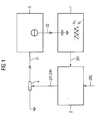
- Fig. 1 the current-controlled oscillator circuit 1 by a capacity and by the schematic representation the temporal voltage curve at the capacitance 14 in the form a triangle voltage indicated.
- Comparative 2 receives the output signal 201 of the oscillator circuit 1 and the reference signal 202. It generates a control signal from this 231/241, for example in the form of a bit word, for Control of the resistance 4.
- the control current 31 is controlled.
- the frequency adjusted Control current 31 can by means of the temperature compensation means 5, which is designed as a PTAT source, to Compensation of frequency fluctuations of the oscillator circuit additionally adjusted due to temperature fluctuations become. With the help of the control current 31/32 the frequency becomes the current controlled oscillator circuit 1 is controlled.
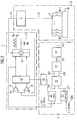
- the current controlled oscillator circuit 1 consists of a known multivibrator with comparators 11.
- the control current 32 is used for controlled charging and discharging of the capacitor 14 by means of the current converter 13.
- the voltage across the capacitance is monitored by means of two comparators 11.
- the comparators obtain their voltages V H and V L from a band gap. For example, when the lower voltage limit V L is reached, the corresponding comparator sends a signal to the control unit 12. This causes the current converter 13 to end the discharge process of the capacitor 14 and to start the charging process. The same happens when the upper voltage limit V H is reached .
- the output frequency 201 of the current-controlled oscillator circuit 1 is available via the lead 201.
- the output frequency of the oscillator circuit has a target value of 32,768 Hz.
- the output frequency 201 of the oscillator circuit 1 is fed to a counter 21.
- This counter 21 counts to 256, thereafter outputs an overflow signal on the output line 211, and starts counting again.
- On the output line 211 is therefore a signal with the target frequency of 128 Hz.
- the reference signal 202 is supplied to the counter 21 'with the frequency 26 MHz.
- On the output line 211 ' is after division of the signal by 203125 also a signal with the frequency of 128 Hz.
- the control means 22 measures the phase of a first and a second signal pair, for which purpose the pulses of the high-frequency reference signal between the signals of a given signal pair are counted. From the difference between the two phases, the necessary frequency change of the oscillator circuit is determined. A corresponding control signal is output via the supply lines 221 to the adjusting means 23. The adjusting means 23 changes the control signal 231 for the resistance means 4 accordingly.
- the control of the resistance means 4 via a multi-bit line 231/241 happens.
- the bitword on the multi-bit line 231/241 may be additionally filtered (filter 24) to avoid oscillations of the individual bit numbers during calibration. With the help of the bit word an adjustable resistance means 4 is controlled.
- the resistance means 4 consists of 50 parallel current paths in each of which a one-way switch and a single resistor are connected in series. The components in each current path are identical. Each switch of the variable resistance means 4 is controlled by one bit of the bit word 231/241. With the aid of the total resistance of the resistance means 4, the control current 31 is determined for the oscillator circuit.
- the control current 31 is additionally by the temperature compensation means 5, which consists of a PTAT source.
- the temperature compensation means 5 which consists of a PTAT source.
Landscapes
- Stabilization Of Oscillater, Synchronisation, Frequency Synthesizers (AREA)
Abstract
Description
- Fig. 1:
- einen schematischen Überblick der erfindungsgemäßen Vorrichtung;
- Fig. 2:
- ein detailliertes Ausführungsbeispiel.
Claims (16)
- Vorrichtung zur Frequenzstabilisierung eines stromgesteuerten Oszillatorschaltkreises (1), enthaltenddadurch gekennzeichnet, dassein Mittel (2) zum Vergleichen der Ausgangsfrequenz des Oszillatorschaltkreises (1) mit der Frequenz eines Referenzsignals (202), undein Mittel (3) zum Steuern des Steuerstroms (32) des Oszillatorschaltkreis, welches von dem Vergleichsmittel (2) angesteuert wird,
das Steuermittel (3) ein Widerstandsmittel (4) mit einstellbarem Gesamtwiderstand aufweist, durch welches der Steuerstrom (32) zumindest teilweise bestimmt wird. - Vorrichtung nach Anspruch 1,
dadurch gekennzeichnet, dass
das Widerstandsmittel (4) durch ein Bitwort (241) ansteuerbar ist, und eine Anzahl mit Widerständen verbundener Schalter aufweist, wobei jeweils ein Schalter durch ein Bit des Bitworts (241) gesteuert wird. - Vorrichtung nach Anspruch 2,
dadurch gekennzeichnet, dass
das Widerstandmittel (4) eine Anzahl paralleler Strompfade aufweist, welche jeweils eine Serienschaltung, enthaltend einen Widerstand und einen Einwegeschalter, enthalten. - Vorrichtung nach einem der Ansprüche 1 - 3,
dadurch gekennzeichnet, dass
das Vergleichsmittel (2)ein Mittel (21,21') zum Ableiten zweier Signale (211,211') mit einer identischen Zielfrequenz aus der Ausgangsfrequenz (201) des Oszillatorschaltkreises (1) und der Frequenz des Referenzsignals (202),ein Kontrollmittel (22) zur Ermittlung eines Steuersignals (221) auf der Basis einer Frequenzabweichung der zwei abgeleiteten Signale (21,21'),ein Einstellmittel (23) zur Einstellung des steuerbaren Widerstandsmittels (4) nach Maßgabe des Steuersignals (221) beinhaltet. - Vorrichtung nach Anspruch 4,
dadurch gekennzeichnet, dass
das Ableitungsmittel zwei Frequenzteiler (21,21') aufweist, wobei die Frequenzteiler (21,21') beide Eingangssignale (201,202) auf zwei Ausgangssignale (211,211') mit identischer Zielfrequenz umsetzen. - Vorrichtung nach Anspruch 5,
dadurch gekennzeichnet, dass
die Frequenzteiler (21,21') des Ableitungsmittels als Zähler ausgebildet sind, die bei Erreichen eines bestimmten Zählerstandes ein Ausgangssignal (211,211') ausgegeben. - Vorrichtung nach einem oder mehreren der vorhergehenden Ansprüche,
dadurch gekennzeichnet, dass
das Steuermittel (3) ferner ein Temperaturausgleichsmittel (5) zur zusätzlichen Steuerung des Steuerstroms (32) des Oszillatorschaltkreises (1) aufweist, welches der Frequenzänderung des Oszillatorschaltkreises (1), durch die temperaturbedingten Änderungen der Charakteristika der für die Frequenz maßgeblichen Bauelemente, insbesondere der temperaturbedingten Änderung des Steuerstroms (32), entgegenwirkt und insbesondere durch eine PTAT-Quelle gebildet ist. - Vorrichtung zur Erzeugung eines stabilisierten Zeittaktes, enthaltendeinen stromgesteuerten Oszillatorschaltkreis (1), sowieeine Vorrichtung zu dessen Frequenzstabilisierung gemäß einem oder mehrerer der vorhergehenden Ansprüche.
- Vorrichtung nach Anspruch 8,
dadurch gekennzeichnet, dass
der stromgesteuerte Oszillatorschaltkreis (1) und/oder die Vorrichtung zu dessen Frequenzstabilisierung auf einem Halbleiter-Chip integriert ist. - Halbleiter-Chip,
der eine Vorrichtung gemäß Anspruch 9 aufweist. - Verfahren zur Frequenzstabilisierung eines stromgesteuerten Oszillatorschaltkreises,
bei welchem der Steuerstrom (32) des Oszillatorschaltkreises (1) durch Kalibrierung des stromgesteuerten Oszillatorschaltkreises (1) mit einem Referenzsignal (202) gesteuert wird, wobei die Kalibrierung folgende Teilschritte aufweist:a) Vergleichen der Frequenzen des Oszillatorschaltkreises (201) und des Referenzsignals (202);b) Ermitteln einer Steuergröße (241) zum Einstellen des Gesamtwiderstands eines Widerstandsmittels (4), durch welches der Steuerstrom (32) des Oszillatorschaltkreises (1) und somit dessen Frequenz angepasst wird. - Verfahren nach Anspruch 11,
dadurch gekennzeichnet, dass
der Steuerstrom (32) des Oszillatorschaltkreises (1) zusätzlich in einer Art und Weise gesteuert wird, welche die Temperaturabhängigkeit der Frequenz-bestimmenden Bauteile des Oszillatorschaltkreises (1) und der Steuerung kompensiert, insbesondere wird der Steuerstrom (32) bei Temperaturänderungen konstant gehalten. - Verfahren nach Anspruch 11 oder 12,
dadurch gekennzeichnet, dass
die Kalibrierung nur innerhalb abgegrenzter Zeitabschnitte durchgeführt wird. - Verfahren nach Anspruch 12 oder 13,
dadurch gekennzeichnet, dass
die Kompensation der Temperaturabhängigkeit der Frequenz-bestimmenden Bauteile des Oszillatorschaltkreises kontinuierlich durchgeführt wird. - Verfahren nach einem oder mehreren der vorhergehenden Verfahrensansprüche,
dadurch gekennzeichnet, dass
das Vergleichen der Frequenzen des Oszillatorschaltkreises (1) und des Referenzsignals (202) gemäß Teilschritt a) folgende Schritte beinhaltet:Erzeugen eines ersten Signalpaares anhand des Signals des Oszillatorschaltkreises und des Referenzsignals;Bestimmen der Phase des Signalpaares durch Zählen der Takte eines höherfrequenten Signals zwischen den beiden Pulsen des Signalpaares;Erzeugen eines zweiten Signalpaares und Bestimmen der Phase des zweiten Signalpaares;Bestimmen der Phasendifferenz der beiden Signalpaare;Ermitteln einer notwendigen Frequenzänderung des Oszillatorschaltkreises anhand der Phasendifferenz; - Verfahren zur Erzeugung eines stabilisierten Zeittaktes, enthaltend ein Verfahren zur Frequenzstabilisierung eines stromgesteuerten Oszillatorschaltkreises (1) gemäß Anspruch 11.
Priority Applications (2)
| Application Number | Priority Date | Filing Date | Title |
|---|---|---|---|
| DE50304150T DE50304150D1 (de) | 2003-09-09 | 2003-09-09 | Frequenzstabilisierung eines als niederfrequenter Taktgeber in Mobilfunkgeräten verwendeten stromgesteuerten Oszillatorschaltkreises |
| EP20030292213 EP1515443B1 (de) | 2003-09-09 | 2003-09-09 | Frequenzstabilisierung eines als niederfrequenter Taktgeber in Mobilfunkgeräten verwendeten stromgesteuerten Oszillatorschaltkreises |
Applications Claiming Priority (1)
| Application Number | Priority Date | Filing Date | Title |
|---|---|---|---|
| EP20030292213 EP1515443B1 (de) | 2003-09-09 | 2003-09-09 | Frequenzstabilisierung eines als niederfrequenter Taktgeber in Mobilfunkgeräten verwendeten stromgesteuerten Oszillatorschaltkreises |
Publications (2)
| Publication Number | Publication Date |
|---|---|
| EP1515443A1 true EP1515443A1 (de) | 2005-03-16 |
| EP1515443B1 EP1515443B1 (de) | 2006-07-05 |
Family
ID=34130372
Family Applications (1)
| Application Number | Title | Priority Date | Filing Date |
|---|---|---|---|
| EP20030292213 Expired - Lifetime EP1515443B1 (de) | 2003-09-09 | 2003-09-09 | Frequenzstabilisierung eines als niederfrequenter Taktgeber in Mobilfunkgeräten verwendeten stromgesteuerten Oszillatorschaltkreises |
Country Status (2)
| Country | Link |
|---|---|
| EP (1) | EP1515443B1 (de) |
| DE (1) | DE50304150D1 (de) |
Citations (5)
| Publication number | Priority date | Publication date | Assignee | Title |
|---|---|---|---|---|
| US4450518A (en) * | 1980-07-04 | 1984-05-22 | Itt Industries, Inc. | Control system for adjusting a physical quantity |
| US5543754A (en) * | 1994-10-11 | 1996-08-06 | National Semiconductor Corporation | Capacitor and resistor controlled oscillator timing lock loop for precision time constants |
| US5859560A (en) * | 1993-02-11 | 1999-01-12 | Benchmarq Microelectroanics, Inc. | Temperature compensated bias generator |
| US6100766A (en) * | 1997-05-16 | 2000-08-08 | Fujitsu Limited | Correction circuit controlling sensitivities of an oscillator circuit and electronic device using the same |
| DE10029421A1 (de) * | 2000-06-15 | 2002-01-03 | Infineon Technologies Ag | Kalibriervorrichtung und -verfahren für die Taktgenerierung auf einem integrierten Schaltkreis |
-
2003
- 2003-09-09 EP EP20030292213 patent/EP1515443B1/de not_active Expired - Lifetime
- 2003-09-09 DE DE50304150T patent/DE50304150D1/de not_active Expired - Fee Related
Patent Citations (5)
| Publication number | Priority date | Publication date | Assignee | Title |
|---|---|---|---|---|
| US4450518A (en) * | 1980-07-04 | 1984-05-22 | Itt Industries, Inc. | Control system for adjusting a physical quantity |
| US5859560A (en) * | 1993-02-11 | 1999-01-12 | Benchmarq Microelectroanics, Inc. | Temperature compensated bias generator |
| US5543754A (en) * | 1994-10-11 | 1996-08-06 | National Semiconductor Corporation | Capacitor and resistor controlled oscillator timing lock loop for precision time constants |
| US6100766A (en) * | 1997-05-16 | 2000-08-08 | Fujitsu Limited | Correction circuit controlling sensitivities of an oscillator circuit and electronic device using the same |
| DE10029421A1 (de) * | 2000-06-15 | 2002-01-03 | Infineon Technologies Ag | Kalibriervorrichtung und -verfahren für die Taktgenerierung auf einem integrierten Schaltkreis |
Also Published As
| Publication number | Publication date |
|---|---|
| DE50304150D1 (de) | 2006-08-17 |
| EP1515443B1 (de) | 2006-07-05 |
Similar Documents
| Publication | Publication Date | Title |
|---|---|---|
| DE69314519T2 (de) | Frequenzsynthetisierer | |
| DE102007034186B4 (de) | Digital gesteuerter Oszillator | |
| DE69613660T2 (de) | Energiesparende Phasenregelkreisschaltung | |
| DE10321200B3 (de) | Einrichtung und Verfahren zur Kalibrierung von R/C-Filterschaltungen | |
| DE10156027B4 (de) | Abgleichbare Filterschaltung | |
| DE69434280T2 (de) | Taktgenerator und Phasenkomparator zur Verwendung in einem derartigen Taktgenerator | |
| DE3650110T2 (de) | Integrierte Schaltung mit Phasenregelschleife. | |
| DE69700270T2 (de) | Frequenzvervielfacher, bei dem das Multiplikationsverhältnis in der ersten Stufe grösser ist als in den nachfolgenden Stufen | |
| DE3587141T2 (de) | Zentrierschaltung eines spannungsgesteuerten oszillators. | |
| DE2427592A1 (de) | Oszillatorschaltung | |
| DE2216123C3 (de) | Verfahren und Anordnung zur Analog-Digital-Umsetzung unter mehrfacher Integration | |
| DE2708021B2 (de) | Schaltungsanordnung in integrierter CMOS-Technik zur Regelung der Speisespannung für eine Last | |
| DE3036785C2 (de) | Oszillatorschaltung | |
| DE2943510C2 (de) | Phasengeregelter Hochfrequenzoszillator | |
| DE1959162B2 (de) | Stufenweise nach einem Frequenzraster einstellbarer Frequenzgenerator | |
| EP0166749B1 (de) | Phasenregelkreis | |
| DE102007001148A1 (de) | Phasenregelschleife zum schnellen Einregeln und darauf bezogenes Verfahren | |
| EP1573921B1 (de) | Digital steuerbarer oszillator | |
| DE2513948A1 (de) | Dekadisch einstellbarer frequenzgenerator mit einer phasengerasteten regelschleife | |
| EP1515443B1 (de) | Frequenzstabilisierung eines als niederfrequenter Taktgeber in Mobilfunkgeräten verwendeten stromgesteuerten Oszillatorschaltkreises | |
| EP0630129A2 (de) | Verfahren zur Erzeugung eines synchronisierten Taktes mit einer Schaltungsanordnung für einen regelbaren Oszillator | |
| DE19725587C2 (de) | Frequenzmultiplizierer zum Steuern der Impulsbreite | |
| DE10049531C2 (de) | Taktgenerator | |
| DE102010028963A1 (de) | Schaltung zur Taktung eines FPGA | |
| DE3852954T2 (de) | Integrierbare phasenregelschleife. |
Legal Events
| Date | Code | Title | Description |
|---|---|---|---|
| PUAI | Public reference made under article 153(3) epc to a published international application that has entered the european phase |
Free format text: ORIGINAL CODE: 0009012 |
|
| AK | Designated contracting states |
Kind code of ref document: A1 Designated state(s): AT BE BG CH CY CZ DE DK EE ES FI FR GB GR HU IE IT LI LU MC NL PT RO SE SI SK TR |
|
| AX | Request for extension of the european patent |
Extension state: AL LT LV MK |
|
| 17P | Request for examination filed |
Effective date: 20050331 |
|
| 17Q | First examination report despatched |
Effective date: 20050506 |
|
| GRAP | Despatch of communication of intention to grant a patent |
Free format text: ORIGINAL CODE: EPIDOSNIGR1 |
|
| AKX | Designation fees paid |
Designated state(s): DE FR GB |
|
| GRAS | Grant fee paid |
Free format text: ORIGINAL CODE: EPIDOSNIGR3 |
|
| GRAA | (expected) grant |
Free format text: ORIGINAL CODE: 0009210 |
|
| AK | Designated contracting states |
Kind code of ref document: B1 Designated state(s): DE FR GB |
|
| REG | Reference to a national code |
Ref country code: GB Ref legal event code: FG4D Free format text: NOT ENGLISH |
|
| REF | Corresponds to: |
Ref document number: 50304150 Country of ref document: DE Date of ref document: 20060817 Kind code of ref document: P |
|
| PGFP | Annual fee paid to national office [announced via postgrant information from national office to epo] |
Ref country code: FR Payment date: 20060922 Year of fee payment: 4 |
|
| GBT | Gb: translation of ep patent filed (gb section 77(6)(a)/1977) |
Effective date: 20061005 |
|
| PGFP | Annual fee paid to national office [announced via postgrant information from national office to epo] |
Ref country code: DE Payment date: 20061114 Year of fee payment: 4 |
|
| ET | Fr: translation filed | ||
| PLBE | No opposition filed within time limit |
Free format text: ORIGINAL CODE: 0009261 |
|
| STAA | Information on the status of an ep patent application or granted ep patent |
Free format text: STATUS: NO OPPOSITION FILED WITHIN TIME LIMIT |
|
| 26N | No opposition filed |
Effective date: 20070410 |
|
| GBPC | Gb: european patent ceased through non-payment of renewal fee |
Effective date: 20070909 |
|
| PG25 | Lapsed in a contracting state [announced via postgrant information from national office to epo] |
Ref country code: DE Free format text: LAPSE BECAUSE OF NON-PAYMENT OF DUE FEES Effective date: 20080401 |
|
| REG | Reference to a national code |
Ref country code: FR Ref legal event code: ST Effective date: 20080531 |
|
| PG25 | Lapsed in a contracting state [announced via postgrant information from national office to epo] |
Ref country code: FR Free format text: LAPSE BECAUSE OF NON-PAYMENT OF DUE FEES Effective date: 20071001 |
|
| PG25 | Lapsed in a contracting state [announced via postgrant information from national office to epo] |
Ref country code: GB Free format text: LAPSE BECAUSE OF NON-PAYMENT OF DUE FEES Effective date: 20070909 |