EP1514756A2 - Hauptzylinder - Google Patents
Hauptzylinder Download PDFInfo
- Publication number
- EP1514756A2 EP1514756A2 EP04254913A EP04254913A EP1514756A2 EP 1514756 A2 EP1514756 A2 EP 1514756A2 EP 04254913 A EP04254913 A EP 04254913A EP 04254913 A EP04254913 A EP 04254913A EP 1514756 A2 EP1514756 A2 EP 1514756A2
- Authority
- EP
- European Patent Office
- Prior art keywords
- piston
- master cylinder
- plunger
- bore
- dump valve
- Prior art date
- Legal status (The legal status is an assumption and is not a legal conclusion. Google has not performed a legal analysis and makes no representation as to the accuracy of the status listed.)
- Granted
Links
Images

Classifications
-
- B—PERFORMING OPERATIONS; TRANSPORTING
- B60—VEHICLES IN GENERAL
- B60T—VEHICLE BRAKE CONTROL SYSTEMS OR PARTS THEREOF; BRAKE CONTROL SYSTEMS OR PARTS THEREOF, IN GENERAL; ARRANGEMENT OF BRAKING ELEMENTS ON VEHICLES IN GENERAL; PORTABLE DEVICES FOR PREVENTING UNWANTED MOVEMENT OF VEHICLES; VEHICLE MODIFICATIONS TO FACILITATE COOLING OF BRAKES
- B60T11/00—Transmitting braking action from initiating means to ultimate brake actuator without power assistance or drive or where such assistance or drive is irrelevant
- B60T11/10—Transmitting braking action from initiating means to ultimate brake actuator without power assistance or drive or where such assistance or drive is irrelevant transmitting by fluid means, e.g. hydraulic
- B60T11/16—Master control, e.g. master cylinders
-
- B—PERFORMING OPERATIONS; TRANSPORTING
- B60—VEHICLES IN GENERAL
- B60T—VEHICLE BRAKE CONTROL SYSTEMS OR PARTS THEREOF; BRAKE CONTROL SYSTEMS OR PARTS THEREOF, IN GENERAL; ARRANGEMENT OF BRAKING ELEMENTS ON VEHICLES IN GENERAL; PORTABLE DEVICES FOR PREVENTING UNWANTED MOVEMENT OF VEHICLES; VEHICLE MODIFICATIONS TO FACILITATE COOLING OF BRAKES
- B60T13/00—Transmitting braking action from initiating means to ultimate brake actuator with power assistance or drive; Brake systems incorporating such transmitting means, e.g. air-pressure brake systems
- B60T13/10—Transmitting braking action from initiating means to ultimate brake actuator with power assistance or drive; Brake systems incorporating such transmitting means, e.g. air-pressure brake systems with fluid assistance, drive, or release
- B60T13/12—Transmitting braking action from initiating means to ultimate brake actuator with power assistance or drive; Brake systems incorporating such transmitting means, e.g. air-pressure brake systems with fluid assistance, drive, or release the fluid being liquid
- B60T13/14—Transmitting braking action from initiating means to ultimate brake actuator with power assistance or drive; Brake systems incorporating such transmitting means, e.g. air-pressure brake systems with fluid assistance, drive, or release the fluid being liquid using accumulators or reservoirs fed by pumps
- B60T13/142—Systems with master cylinder
-
- Y—GENERAL TAGGING OF NEW TECHNOLOGICAL DEVELOPMENTS; GENERAL TAGGING OF CROSS-SECTIONAL TECHNOLOGIES SPANNING OVER SEVERAL SECTIONS OF THE IPC; TECHNICAL SUBJECTS COVERED BY FORMER USPC CROSS-REFERENCE ART COLLECTIONS [XRACs] AND DIGESTS
- Y10—TECHNICAL SUBJECTS COVERED BY FORMER USPC
- Y10T—TECHNICAL SUBJECTS COVERED BY FORMER US CLASSIFICATION
- Y10T29/00—Metal working
- Y10T29/49—Method of mechanical manufacture
- Y10T29/49229—Prime mover or fluid pump making
- Y10T29/49231—I.C. [internal combustion] engine making
- Y10T29/49233—Repairing, converting, servicing or salvaging
-
- Y—GENERAL TAGGING OF NEW TECHNOLOGICAL DEVELOPMENTS; GENERAL TAGGING OF CROSS-SECTIONAL TECHNOLOGIES SPANNING OVER SEVERAL SECTIONS OF THE IPC; TECHNICAL SUBJECTS COVERED BY FORMER USPC CROSS-REFERENCE ART COLLECTIONS [XRACs] AND DIGESTS
- Y10—TECHNICAL SUBJECTS COVERED BY FORMER USPC
- Y10T—TECHNICAL SUBJECTS COVERED BY FORMER US CLASSIFICATION
- Y10T29/00—Metal working
- Y10T29/49—Method of mechanical manufacture
- Y10T29/49716—Converting
Definitions
- the present invention relates to combined master cylinder and dump valves, and also to a method of manufacturing such valves.
- the invention also relates to a method of manufacturing a combined master cylinder and booster.
- Certain vehicles such as bulldozers, use a hydrostatic drive system.
- an engine driven hydraulic pump will provide a flow of pressurised hydraulic fluid to a hydraulic motor.
- the hydraulic motor is coupled to wheels (or tracks) of the vehicle.
- the vehicle will be provided with brakes, and in order not to overheat the brakes, pressurised flow to the hydraulic motor must substantially cease prior to the brakes being applied.
- certain other vehicles such as agricultural tractors, are known to use a combined brake master cylinder and booster.
- those vehicles that use hydrostatic drive systems do not use a combined brake master cylinder and booster.
- those vehicles that use a combined brake master cylinder and booster do not have hydrostatic drive systems.
- a combined master cylinder and dump valve including a body having a body bore, a brake port, a tank port, and a pressure port with each port being hydraulically connected with the body bore, a piston slideable within the body bore and a plunger, the piston delimiting a part of the body bore to define a master cylinder for pressurising the brake port, the piston further including a piston seal for isolating the pressure port from the tank port, and including a piston bore, a first piston hole set for hydraulically connecting the pressure port to the piston bore and a second piston hole set for hydraulically connecting the piston bore to the tank port, the plunger being slideably received in the piston bore and having a plunger bore, a plunger hole set for selectively connecting the first piston hole set with the plunger bore, a plunger seal arrangement for selectively isolating the first piston hole set from the plunger bore, the plunger bore being hydraulically connected to the piston bore, such that: -
- a method of manufacturing one of a combined master cylinder and dump valve and a combined master cylinder and booster including the steps of:-
- a method of manufacturing a combined master cylinder and dump valve and a combined master cylinder and booster including the steps of:-
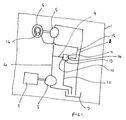
- a vehicle 1 having an engine 2 drivingly coupled to a hydraulic pump 3.
- a hydraulic line 4 couples the output from hydraulic pump 3 to the input of a hydraulic motor 5.
- the hydraulic motor 5 is drivingly coupled to wheels 6 of the vehicle.
- the output from the hydraulic motor 5 returns to the hydraulic tank 7 via hydraulic line 8, tee'd of hydraulic line 4 is hydraulic line 9 which is connected to the pressure port 10 of a combined master cylinder and dump valve 11 (herein known as a CMDV) according to the present invention.
- Hydraulic line 12 connects the tank port 13 of the CMDV to tank.
- Hydraulic line 15 connects the brake port 14 of the CMDV to brake 16. Operation of the vehicle is as follows:-
- engine 2 drives hydraulic pump 3 which takes hydraulic fluid from tank 7 and pressurises it. Pressurised fluid is then fed along hydraulic line 4 to hydraulic motor 5 which is caused to rotate, in turn, rotating wheel 6 and hence moving the vehicle.
- hydraulic motor 5 which is caused to rotate, in turn, rotating wheel 6 and hence moving the vehicle.
- the dump valve components of the CMDV will vent line 4 to tank via lines 9 and 12.
- the master cylinder components of the CMDV will then act to hydraulically pressurise line 15, thereby applying the brakes.
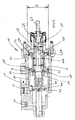
- the CMDV can be seen in more detail in figure 2.
- the CMDV includes a body 20, typically formed as a casting and then subsequently machined.
- Body 20 includes a central body bore 22 having a first cylindrical portion 24 of diameter d and a second cylindrical portion 26 of diameter D.
- Pressure port 10 and tank port 13 are both hydraulically connected to the second cylindrical portion 26, and brake port 14 is hydraulically connected to the first cylindrical portion 24.
- First cylindrical portion 24 defines a master cylinder 24A and the second cylindrical portion 26 defines a body main cylinder 26A.
- a master cylinder recuperation hole 28 is capable of selectively hydraulically connecting master cylinder 24A with the body main cylinder 26A.
- piston 30 Slideably mounted within the body is a piston 30.
- a first end 32 of piston 30 is received within the first cylindrical portion 24 with the remainder of the piston being generally received within second cylindrical portion 26.
- First end 32 includes a master cylinder seal 34.
- a first piston land 36 receives a first piston seal 37 for sealing the first piston land to the second cylindrical portion 26.
- a second piston land 38 receives a second piston seal 39 for sealing the second piston land to the second cylindrical portion 26. It can be seen that the first and second piston lands are spaced apart axially and define an annular region 40 of the body main cylinder 26A.
- the piston includes a piston bore 42 and a first piston hole set 44 includes a series of circumferentially spaced radially orientated holes (only two of which are shown) which hydraulically connect annular region 40 with piston bore 42.
- the piston and in particular the first piston land 36, together with the body main cylinder 26A define an annular region 46, to the left of first piston land 36 when viewing figure 2.
- a second piston hole set 48 includes a series of radially orientated holes (only two shown) which hydraulically connect the piston bore 42 with the annular region 46.
- a check valve 50 is capable of selectively allowing hydraulic fluid to flow from piston bore 42 into the master cylinder 24A.
- Piston bore 42 includes cylindrical portion 43 of diameter E. Slideably mounted within cylindrical portion 43 (of diameter E) is a first end 52A of a plunger 52. Mounted on first end 52A is a plunger seal arrangement 54 which includes a first plunger seal 55 and a second plunger seal 56 both in sealing relationship with the walls of cylindrical portion 43.
- first plunger seal 55 is axially spaced from the second plunger seal 56.
- First end 52A further includes a plunger hole set 58 which hydraulically connects a region of the piston bore to the right (when viewing figure 2) of second plunger seal 56 with a plunger bore 60 of the plunger.
- a circlip 62 is mounted in a groove of the piston and retains the plunger generally within the piston bore.
- a second end 52B of the plunger 52 includes a groove 64 to receive a third plunger seal 65.
- a second end 52B further includes a recess 66 which receives a push rod 67.
- a closing spiggot 68 is generally top hat in cross section and includes a land having a seal 69 to seal between the land and the second cylindrical portion 62.
- the closing spiggot includes a central bore 70 of diameter F for slideably receiving the second end 52B of the plunger 52, and in particular for sealingly engaging the third plunger seal 65.
- Seal 69 prevents the leakage of hydraulic fluid outside of the CMDV.
- a closing plate 72 is secured to the body 20 via bolt (not shown) or studs and nuts (not shown) which engage threaded holes 74.
- a first resilient means in the form of a first spring 76 acts between a first spring abutment 77 of the piston and a spring abutment 78 of the plunger to bias these abutments apart.
- a second resilient means in the form of a second spring 80 act between a spring abutment 81 of the body and a second spring abutment 82 (in this case the first piston land 36) of the piston 30 to bias the abutments 81 and 82 apart.
- Plunger 52 includes a plunger abutment 84 and piston 30 includes a corresponding piston abutment 86.
- abutments 84 and 86 are spaced apart by distance x. Operation of the CMDV is as follows.
- operator pedal force is applied to push rod 67 which initially moves plunger 52 to the left, relative to piston 30 thereby progressively closing the gap between abutments 84 and 86, and hydraulically connecting pressure port 10 with tank port 13, thereby operating as a dump valve.
- piston 30 is caused to move to the left such that master cylinder seal 34 moves past recuperation hole 28, thereby sealing the master cylinder 24A and allowing brake port 14 to be pressurised, to apply the brakes.
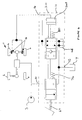
- Figure 4 shows a detailed schematic view of the combined master cylinder and dump valve 11 with body 20 being represented by the chain dotted line.
- the three ports pressure port 10, tank port 13 and brake port 14
- the check valve 50 and master cylinder recuperation hole 28 must recuperate the master cylinder from a region of the body 20 that is full of hydraulic fluid.
- recuperation hole 28 and check valve 50 both recuperate the master cylinder from the annular region 46 which effectively acts as an internal tank.
- This internal "tank" 46 has been represented on figure 4.
- Pressure port 10 is permanently hydraulically connected to annular region 40, since first piston seal 37 always sits to the left of pressure port 10 when viewing figure 2, and third piston seal 39 always sits to the right of pressure port 10 even at the extreme of movement of the piston towards the left when viewing figure 2.
- Annular region 40 is in permanent hydraulic connection with the first piston hole set 44.
- Tank port 13 annular region 46, second piston hole set 48, piston bore 42, plunger bore 60 and plunger hole set 58 are all permanently hydraulically connected to each other.
- the plunger seal arrangement 54 ensures that the first piston hole set 44 is hydraulically isolated from the plunger hole set 58. However, as second plunger seal 56 moves to the left of the first piston hole set, the first piston hole set becomes hydraulically connected with the plunger hole set 58.
- Check valve 50 selectively allows for recuperation of the master cylinder 24 in a known manner.
- Figure 2 shows the CMDV in a rest position, with no force being applied to the push rod 67.
- spring 80 acts to bias piston 30 into abutting engagement with closing spiggot 68, which acts as a stop.
- first spring 76 biases plunger 52 to the right when viewing the figure, into abutting engagement with circlip 62. It can be seen that in this position, recuperating holes 28 are open, and first piston hole set 44 has been closed by plunger seal arrangement 54. As such, pressure port 10 cannot vent to tank port 13 and hence hydraulic line 9 is closed.
- hydraulic pump 3 is capable of driving hydraulic motor 5.
- pressure port 10 is hydraulically connected to tank port 13 (i.e. the dump valve is opened) prior to the master cylinder 24A pressurising the brake port 14 (i.e. prior to the brakes being applied).
- first and second springs 76 and 80 and the distance x between abutments 84 and 86 must be correctly designed.
- one installation may have an installed pre-load on second spring 80 of 200 newtons.
- First spring 76 may have an installed pre-load of 60 newtons and distance x may be 7mm.
- the spring rate of first spring 76 would be 140 newtons per 7mm.
- the installed pre-load of the first spring 76 when the CMDV is in the rest position, is less than the installed pre-load of the second spring 80.
- the first spring 76 will compress in preference to second spring 80.
- This in turn means that as push rod 67 moves to the left, the piston initially remains stationary and the plunger seal arrangement 54 moves to the left relative to the stationary first piston hole set. Further movement of the push rod 67 to the left causes the distance between abutments 84 and 86 to further close and second plunger seal 56 ultimately will move to the left of the first piston hole set, thereby hydraulically connecting the pressure port to the tank port and hence opening the dump valve.
- first spring 76 will have been compressed by 7mm and will therefore be exherting a load of 200 newtons (i.e. an initial installed load of 60 newtons plus 7mm of compression at a rate of 140 newtons per 7mm compression). It will be appreciated therefore that as abutments 84 and 86 contact each other, the spring load exerted by first spring 76 is substantially equal to the spring load exherted by second spring 80. Further movement of the push rod to the left causes abutment 84 to press on abutment 86, thereby moving the piston to the left, closing the recuperation valve 28, and hence pressurising the master cylinder and brake port 14.
- the release of the brake pedal causes the components to return the position shown in figure 2, thereby releasing the brake, and closing the dump valve, thus allowing the hydraulic pump 3 to drive the hydraulic motor 5 to move the vehicle.
- the first piston hole set comprises a plurality of holes spaced circumferentially around the piston. All holes are formed at the same longitudinal position of the piston.
- the first piston hole set can comprise a series of circumferentially spaced holes, with each hole being at a different longitudinal position of the piston.
- the plunger seal arrangement of such an embodiment is in the form of a first plunger seal and a second plunger seal, then these plunger seals must be spaced apart sufficiently to encompass all holes of the first piston hole set to ensure that the first piston hole set is hydraulically isolated from the first plunger hole set and a central region of the piston bore.
- the holes of the first piston hole set are formed as part of a helix around the piston circumference.
- the first piston hole set may include 16 radially orientated holes each of 1.5mm diameter.
- adjacent holes can be longitudinally offset by 0.2mm.
- a dump valve which progressively opens. This is particularly beneficial, since it allows the operator to "inch forward" the vehicle in a controlled manner, thereby allowing for good control of the vehicle at very slow speeds.
- the holes are provided on a helix, though of course it is not necessary to provide the holes in this form in order to provide a first piston hole set wherein different holes are positioned at different longitudinal positions on the piston.
- the 16 hole arrangements mentioned above might be used in conjunction with a distance x between abutment 84 and 86 of 7mm. This allows for manufacturing tolerance errors, and an initial movement of the plunger (of say 2mm) between the rest position, and the first of the 16 holes starting to open.
- the spring force of the first spring 76 when compressed by distance x (200 newtons) is substantially equal to the spring force of spring 80 when in a rest condition (also 200 newtons). This provides for a good pedal feel and a substantially seamless transition from the dump valve being fully open to the start of the brakes being applied.
- hole set covers a set having any number of holes, including just a single hole.
- Figure 2 shows various seals which are elastomeric in nature. Under certain circumstances, where a limited amount of seal leakage can be tolerated, certain seals can be defined by a simple piston land or a plunger land, in the absence of any elastomeric or other separate “sealing" component.
- a known combined master cylinder and booster 110 (known here as a CMB). Certain components of the CMB 110 are identical with the CMDV 11.
- body 20 master cylinder seal 34, check valve 50, first piston seal 37, second piston seal 39, third plunger seal 65, first plunger seal 55, second plunger seal 56, closing plate 72, closing spiggot 68, closing spiggot seal 69, and push rod 67.
- figure 3 is an engineering manufacturing drawing and figure 2 is a schematic drawing.
- Figure 3 is a true representation of the components.
- figure 3 includes protective caps over the ports which are removed prior to fitting the valve.
- first piston hole set 144 of piston 130 includes a series of circumferentially spaced, radially orientated holes. However, all holes are located at the same axial position on the piston.
- Second piston hole set 148 also includes a series of circumferentially spaced radially orientated holes, again all located at the same longitudinal position on the piston. It can be seen that the first piston hole set is positioned just to the left of the second plunger seal 56, and the second piston hole set 148 is positioned just to the left of the first plunger seal 55.
- Boost ratios of 3-1, 4-1 and 5-1 can be provided by ensuring that D is 1.732, 2.000, 2.236 times larger than F respectively.
- piston 30 and piston 130 show relatively few differences.
- the main difference is the difference in position of the second piston hole sets 48 and 148.
- the master cylinder piston portion 131 can be identical the corresponding portion of piston 30.
- plunger 52 and plunger 152 again shows there to be few differences, the main difference being in the alternative positioning of first plunger seal 55.
- second plunger seal 56 is located at the same position, and that part of plunger 152 to the left of second plunger seal 56 is identical to the corresponding part of plunger 52.
- the applicant has been able to adapt a device (the CMB) having one type of valve (a booster valve) to a completely different device (CMDV) having a completely different sort of valve (a dump valve) for use in a completely different application.
- This adaptation has been carried out using a considerable number of common components, thereby by virtue of the economies of scale, potentially providing for both a cheaper CMDV, and also a cheaper CMB.
- the boost ratio of the CMB is dependent upon the relative diameters F and D.
- the applicant is the first to realise that it is possible to retain the same diameters D and F of a CMB, and apply them to a CMDV, even though the relative diameters play no part in the operation of the CMDV.
- the body 20 will be made from a casting. Where there are minor differences between the finally machined body of a CMDV and the finally machined body of a CMB (e.g. a different thread size on one or more of the ports), then it is possible to use the same bare body casting and machine it in a slightly different manner to provide for the slightly differing CMDV and CMB finally machined bodies. However, under other circumstances, it is possible to use the same bare casting, and machine it in an identical manner (for example body 20) to provide a body for both a CMDV and a CMB.
- the plunger may be provided as a common bare casting and machined slightly differently to provide a CMDV plunger or a CMB plunger.
Landscapes
- Engineering & Computer Science (AREA)
- Transportation (AREA)
- Mechanical Engineering (AREA)
- Transmission Of Braking Force In Braking Systems (AREA)
Applications Claiming Priority (2)
| Application Number | Priority Date | Filing Date | Title |
|---|---|---|---|
| GB0321389 | 2003-09-12 | ||
| GBGB0321389.9A GB0321389D0 (en) | 2003-09-12 | 2003-09-12 | Master cylinder |
Publications (3)
| Publication Number | Publication Date |
|---|---|
| EP1514756A2 true EP1514756A2 (de) | 2005-03-16 |
| EP1514756A3 EP1514756A3 (de) | 2005-08-17 |
| EP1514756B1 EP1514756B1 (de) | 2007-11-14 |
Family
ID=29226964
Family Applications (1)
| Application Number | Title | Priority Date | Filing Date |
|---|---|---|---|
| EP04254913A Expired - Lifetime EP1514756B1 (de) | 2003-09-12 | 2004-08-16 | Hauptzylinder |
Country Status (8)
| Country | Link |
|---|---|
| US (1) | US7107769B2 (de) |
| EP (1) | EP1514756B1 (de) |
| JP (1) | JP4740569B2 (de) |
| KR (1) | KR101117372B1 (de) |
| CN (1) | CN100389991C (de) |
| BR (1) | BRPI0403809B8 (de) |
| DE (1) | DE602004010016T2 (de) |
| GB (1) | GB0321389D0 (de) |
Cited By (1)
| Publication number | Priority date | Publication date | Assignee | Title |
|---|---|---|---|---|
| CN116279361A (zh) * | 2023-03-31 | 2023-06-23 | 洛阳市伟林液压机械有限公司 | 一种限压式单柱塞增力制动泵 |
Families Citing this family (6)
| Publication number | Priority date | Publication date | Assignee | Title |
|---|---|---|---|---|
| US7972554B2 (en) * | 2007-10-24 | 2011-07-05 | Nestle Waters Management & Technology | Air cartridge devices and methods of using same |
| KR101418326B1 (ko) * | 2012-12-24 | 2014-07-10 | 주식회사 만도 | 브레이크 시스템용 마스터실린더 |
| KR102118065B1 (ko) * | 2013-11-04 | 2020-06-02 | 현대모비스 주식회사 | 페달시뮬레이터 |
| KR102493133B1 (ko) * | 2016-05-26 | 2023-01-30 | 에이치엘만도 주식회사 | 펌프 하우징 분리형 브레이크 장치 |
| CN108238028B (zh) * | 2016-12-26 | 2019-11-22 | 比亚迪股份有限公司 | 制动系统的制动主缸及具有其的制动系统 |
| CN115476827A (zh) * | 2022-08-24 | 2022-12-16 | 洛阳市伟林液压机械有限公司 | 一种非独泵供油的助力制动泵 |
Family Cites Families (15)
| Publication number | Priority date | Publication date | Assignee | Title |
|---|---|---|---|---|
| US3054387A (en) * | 1959-09-21 | 1962-09-18 | Gen Motors Corp | Hydraulic booster unit |
| DE1455841A1 (de) * | 1964-10-21 | 1969-08-07 | Rotenburger Metallwerke Gmbh | Hydraulischer Antrieb |
| DE1650627C3 (de) * | 1967-07-08 | 1975-02-27 | Robert Bosch Gmbh, 7000 Stuttgart | Hydrostatischer Antrieb |
| US3543508A (en) * | 1968-10-16 | 1970-12-01 | Hyster Co | Hydrostatic transmission with pressure control |
| GB1348246A (en) * | 1970-05-26 | 1974-03-13 | Dowty Hydraulic Units Ltd | Hydraulic apparatus |
| JPS5837721Y2 (ja) * | 1979-08-02 | 1983-08-25 | 日産自動車株式会社 | 油圧ブ−スタ |
| JPS59133358A (ja) * | 1983-01-20 | 1984-07-31 | Sumitomo Electric Ind Ltd | 連続溶融めつき方法 |
| JPH07218331A (ja) * | 1994-01-28 | 1995-08-18 | Nippondenso Co Ltd | 自動車用内燃機関のノッキング検出装置及びその製造方法 |
| JPH08159175A (ja) * | 1994-12-02 | 1996-06-18 | Exedy Corp | 自動変速機用蓄圧装置 |
| US5778672A (en) | 1996-10-17 | 1998-07-14 | Deere & Company | Brake valve |
| JP3473368B2 (ja) * | 1998-01-09 | 2003-12-02 | トヨタ自動車株式会社 | 回転位相差可変機構 |
| US6792132B1 (en) * | 1998-02-03 | 2004-09-14 | Hakuju Institute For Health Science Co., Ltd. | Inspection method for microorganisms and the like, and unit therefor |
| JP2000335397A (ja) | 1999-05-27 | 2000-12-05 | Bosch Braking Systems Co Ltd | マスタシリンダ |
| US6609370B2 (en) * | 2000-01-05 | 2003-08-26 | Arvinmeritor, Inc. | Dual hydraulic booster assemblies for vehicle hydraulic braking systems |
| GB0218167D0 (en) * | 2002-08-06 | 2002-09-11 | Meritor Heavy Vehicle Braking | In line vacuum bleeding device |
-
2003
- 2003-09-12 GB GBGB0321389.9A patent/GB0321389D0/en not_active Ceased
-
2004
- 2004-08-16 DE DE602004010016T patent/DE602004010016T2/de not_active Expired - Lifetime
- 2004-08-16 EP EP04254913A patent/EP1514756B1/de not_active Expired - Lifetime
- 2004-08-30 BR BRPI0403809-6A patent/BRPI0403809B8/pt not_active IP Right Cessation
- 2004-09-08 US US10/936,784 patent/US7107769B2/en not_active Expired - Lifetime
- 2004-09-13 CN CNB2004100747139A patent/CN100389991C/zh not_active Expired - Fee Related
- 2004-09-13 JP JP2004265190A patent/JP4740569B2/ja not_active Expired - Fee Related
- 2004-09-13 KR KR1020040072995A patent/KR101117372B1/ko not_active Expired - Fee Related
Cited By (1)
| Publication number | Priority date | Publication date | Assignee | Title |
|---|---|---|---|---|
| CN116279361A (zh) * | 2023-03-31 | 2023-06-23 | 洛阳市伟林液压机械有限公司 | 一种限压式单柱塞增力制动泵 |
Also Published As
| Publication number | Publication date |
|---|---|
| KR20050027158A (ko) | 2005-03-17 |
| JP4740569B2 (ja) | 2011-08-03 |
| CN1593995A (zh) | 2005-03-16 |
| DE602004010016T2 (de) | 2008-09-18 |
| EP1514756A3 (de) | 2005-08-17 |
| DE602004010016D1 (de) | 2007-12-27 |
| US20050057091A1 (en) | 2005-03-17 |
| BRPI0403809B8 (pt) | 2013-02-19 |
| BRPI0403809B1 (pt) | 2013-01-08 |
| CN100389991C (zh) | 2008-05-28 |
| US7107769B2 (en) | 2006-09-19 |
| KR101117372B1 (ko) | 2012-03-07 |
| EP1514756B1 (de) | 2007-11-14 |
| JP2005088887A (ja) | 2005-04-07 |
| BRPI0403809A (pt) | 2005-05-24 |
| GB0321389D0 (en) | 2003-10-15 |
Similar Documents
| Publication | Publication Date | Title |
|---|---|---|
| EP3145771B1 (de) | Betätigungssystem für eine fahrzeugbremse und verfahren zum betrieb des betätigungssystems | |
| DE112014004233B4 (de) | Bremsvorrichtung und Verfahren zum Betrieb einer Bremsvorrichtung | |
| US10730495B2 (en) | Vehicle brake system having plunger power source | |
| DE202015008975U1 (de) | Bremsanlage mit Schwimmkolben-Hauptbremszylindereinheit mit neuartiger MUX-Regelung (MUX 2.0) mit mindestens einem Auslassventil | |
| DE102014111594A1 (de) | Betätigungssystem, insbesondere für eine Fahrzeugbremse und Verfahren zum Betrieb des Betätigungssystems | |
| CN111511616B (zh) | 具有制动踏板单元的车辆制动系统 | |
| EP1646543B1 (de) | Elektrohydraulische bremsanlage für kraftfahrzeuge | |
| CN1288016C (zh) | 一种液压阀组件及一种用于车辆的双向制动组件 | |
| CN103459217A (zh) | 电动制动装置 | |
| DE102014107112A1 (de) | Betätigungssystem für eine Fahrzeugbremse und Verfahren zum Betrieb des Betätigungssystems | |
| EP1514756B1 (de) | Hauptzylinder | |
| US3834277A (en) | Hydraulic servo unit for automotive braking system | |
| WO2012167979A1 (de) | Bremsanlage für kraftfahrzeuge sowie verfahren zum betrieb einer bremsanlage | |
| WO2005087565A1 (de) | Bremskrafterzeuger für eine hydraulische fahrzeugbremsanlage und fahrzeugbremsanlage | |
| CN110816504B (zh) | 一种柱塞泵式分布式自主制动系统 | |
| EP0955222B1 (de) | Hydraulische Bremsanlage, insbesondere für Kraftfahrzeuge | |
| DE10234693C1 (de) | Bremskraftverstärker mit Notbremsassistentfunktion | |
| JP2002514714A (ja) | 駆動装置 | |
| EP1388477A1 (de) | Hydraulisches Bremsventil und Verfahren zum Entlüften eines hydraulischen Bremssystems | |
| EP2464550B1 (de) | Bremsbetätigungseinheit zur betätigung einer kraftfahrzeugbremsanlage vom typ "brake-by-wire" sowie verfahren zum betreiben einer kraftfahrzeugbremsanlage mit einer derartigen bremsbetätigungseinheit | |
| DE4015883A1 (de) | Hydraulischer kraftverstaerker | |
| US5191765A (en) | Master cylinder for a hydraulic brake system and steering brake system | |
| EP1892440A1 (de) | Kolben | |
| HK1099259A (en) | A bi-directional braking assembly for a vehicle | |
| US10532723B2 (en) | Hydraulic device for controlling braking for farm vehicles and the like |
Legal Events
| Date | Code | Title | Description |
|---|---|---|---|
| PUAI | Public reference made under article 153(3) epc to a published international application that has entered the european phase |
Free format text: ORIGINAL CODE: 0009012 |
|
| AK | Designated contracting states |
Kind code of ref document: A2 Designated state(s): AT BE BG CH CY CZ DE DK EE ES FI FR GB GR HU IE IT LI LU MC NL PL PT RO SE SI SK TR |
|
| AX | Request for extension of the european patent |
Extension state: AL HR LT LV MK |
|
| PUAL | Search report despatched |
Free format text: ORIGINAL CODE: 0009013 |
|
| AK | Designated contracting states |
Kind code of ref document: A3 Designated state(s): AT BE BG CH CY CZ DE DK EE ES FI FR GB GR HU IE IT LI LU MC NL PL PT RO SE SI SK TR |
|
| AX | Request for extension of the european patent |
Extension state: AL HR LT LV MK |
|
| 17P | Request for examination filed |
Effective date: 20060217 |
|
| AKX | Designation fees paid |
Designated state(s): AT BE BG CH CY CZ LI |
|
| RBV | Designated contracting states (corrected) |
Designated state(s): DE ES FR GB IT SE |
|
| REG | Reference to a national code |
Ref country code: DE Ref legal event code: 8566 |
|
| RAP1 | Party data changed (applicant data changed or rights of an application transferred) |
Owner name: CARLISLE BRAKE PRODUCTS (UK) LIMITED |
|
| GRAP | Despatch of communication of intention to grant a patent |
Free format text: ORIGINAL CODE: EPIDOSNIGR1 |
|
| GRAS | Grant fee paid |
Free format text: ORIGINAL CODE: EPIDOSNIGR3 |
|
| GRAA | (expected) grant |
Free format text: ORIGINAL CODE: 0009210 |
|
| AK | Designated contracting states |
Kind code of ref document: B1 Designated state(s): DE ES FR GB IT SE |
|
| REG | Reference to a national code |
Ref country code: GB Ref legal event code: FG4D |
|
| REF | Corresponds to: |
Ref document number: 602004010016 Country of ref document: DE Date of ref document: 20071227 Kind code of ref document: P |
|
| PG25 | Lapsed in a contracting state [announced via postgrant information from national office to epo] |
Ref country code: SE Free format text: LAPSE BECAUSE OF FAILURE TO SUBMIT A TRANSLATION OF THE DESCRIPTION OR TO PAY THE FEE WITHIN THE PRESCRIBED TIME-LIMIT Effective date: 20080214 Ref country code: ES Free format text: LAPSE BECAUSE OF FAILURE TO SUBMIT A TRANSLATION OF THE DESCRIPTION OR TO PAY THE FEE WITHIN THE PRESCRIBED TIME-LIMIT Effective date: 20080225 |
|
| ET | Fr: translation filed | ||
| PLBE | No opposition filed within time limit |
Free format text: ORIGINAL CODE: 0009261 |
|
| STAA | Information on the status of an ep patent application or granted ep patent |
Free format text: STATUS: NO OPPOSITION FILED WITHIN TIME LIMIT |
|
| 26N | No opposition filed |
Effective date: 20080815 |
|
| PG25 | Lapsed in a contracting state [announced via postgrant information from national office to epo] |
Ref country code: IT Free format text: LAPSE BECAUSE OF NON-PAYMENT OF DUE FEES Effective date: 20080831 |
|
| REG | Reference to a national code |
Ref country code: FR Ref legal event code: PLFP Year of fee payment: 13 |
|
| REG | Reference to a national code |
Ref country code: FR Ref legal event code: PLFP Year of fee payment: 14 |
|
| REG | Reference to a national code |
Ref country code: FR Ref legal event code: PLFP Year of fee payment: 15 |
|
| PGFP | Annual fee paid to national office [announced via postgrant information from national office to epo] |
Ref country code: FR Payment date: 20180718 Year of fee payment: 15 Ref country code: DE Payment date: 20180716 Year of fee payment: 15 |
|
| PGFP | Annual fee paid to national office [announced via postgrant information from national office to epo] |
Ref country code: GB Payment date: 20180726 Year of fee payment: 15 |
|
| REG | Reference to a national code |
Ref country code: DE Ref legal event code: R119 Ref document number: 602004010016 Country of ref document: DE |
|
| GBPC | Gb: european patent ceased through non-payment of renewal fee |
Effective date: 20190816 |
|
| PG25 | Lapsed in a contracting state [announced via postgrant information from national office to epo] |
Ref country code: DE Free format text: LAPSE BECAUSE OF NON-PAYMENT OF DUE FEES Effective date: 20200303 Ref country code: FR Free format text: LAPSE BECAUSE OF NON-PAYMENT OF DUE FEES Effective date: 20190831 |
|
| PG25 | Lapsed in a contracting state [announced via postgrant information from national office to epo] |
Ref country code: GB Free format text: LAPSE BECAUSE OF NON-PAYMENT OF DUE FEES Effective date: 20190816 |