EP1512606B1 - Organisationswagen - Google Patents
Organisationswagen Download PDFInfo
- Publication number
- EP1512606B1 EP1512606B1 EP03020214A EP03020214A EP1512606B1 EP 1512606 B1 EP1512606 B1 EP 1512606B1 EP 03020214 A EP03020214 A EP 03020214A EP 03020214 A EP03020214 A EP 03020214A EP 1512606 B1 EP1512606 B1 EP 1512606B1
- Authority
- EP
- European Patent Office
- Prior art keywords
- trolley
- vertical
- organisation
- supports
- transverse profiled
- Prior art date
- Legal status (The legal status is an assumption and is not a legal conclusion. Google has not performed a legal analysis and makes no representation as to the accuracy of the status listed.)
- Expired - Lifetime
Links
Images

Classifications
-
- A—HUMAN NECESSITIES
- A47—FURNITURE; DOMESTIC ARTICLES OR APPLIANCES; COFFEE MILLS; SPICE MILLS; SUCTION CLEANERS IN GENERAL
- A47L—DOMESTIC WASHING OR CLEANING; SUCTION CLEANERS IN GENERAL
- A47L13/00—Implements for cleaning floors, carpets, furniture, walls, or wall coverings
- A47L13/10—Scrubbing; Scouring; Cleaning; Polishing
- A47L13/50—Auxiliary implements
- A47L13/51—Storing of cleaning tools, e.g. containers therefor
-
- B—PERFORMING OPERATIONS; TRANSPORTING
- B62—LAND VEHICLES FOR TRAVELLING OTHERWISE THAN ON RAILS
- B62B—HAND-PROPELLED VEHICLES, e.g. HAND CARTS OR PERAMBULATORS; SLEDGES
- B62B2202/00—Indexing codes relating to type or characteristics of transported articles
- B62B2202/50—Cleaning or gardening articles
Definitions
- the invention relates to an organization trolley for the transport and storage of a variety of different objects, in particular cleaning utensils, with a chassis that carries wheels on its underside, and arranged in several levels superimposed compartments for receiving the objects to be transported.
- Such organization cars have long been known in various designs. They are used, for example, in the cleaning and care of buildings, in hotel service or as a mobile supply and disposal system.
- cleaning devices such as e.g. Buckets and cleaning utensils, cleaning products, toiletries, laundry or even containers for waste space in the compartments of the organization trolley.
- Basic module is always the chassis with the wheels, which then with a limited Number of components in the manner of a kit can be upgraded to an almost unlimited number of variants.
- a rack is constructed which supports, e.g. for more platforms, carries.
- the platform is designed as a flat plate and equipped with grid-mounted fastening devices.
- the frame consists of vertical supports, which can be coupled to the fastening devices of the platform.
- first latching means are provided on the vertical supports, which interact positively with second latching means on the holders.
- Organization trolleys and cleaning trolleys of the type described above usually have open structures, i. not only the individual elements of which they are composed but also the objects placed on them are openly accessible from all sides. This is disadvantageous in two respects: Firstly, the objects to be transported are neither protected against falling out nor against dust or unauthorized access; on the other hand, a packed organization trolley of a conventional nature does not provide a beautiful sight, as any visitor to a hospital or guest of a hotel will confirm.
- the task is therefore to develop a trolley with flexible modular design so that the objects transported on it are protected against falling out, dust and unauthorized access and at the same time the whole car receives a visually appealing appearance.
- the solution of this object is achieved by a trolley according to claim 1. Preferred embodiments will become apparent from the dependent claims.
- the base plate, the vertical supports and the transverse profile carriers form the load-bearing structure, which is supplemented by the vertical struts and flat cladding elements.
- the vertical beams form the side surfaces of the car which are closed by the fairing members. Since the vertical beams and the cladding elements do not belong to the supporting structure of the organization trolley, they can be relatively easily performed. As a result, the total weight of the company car is only marginally increased.
- Another advantage of the proposed construction is that, if desired, only a certain portion or even a single compartment of the carriage may be formed closed with trim elements while leaving other sections or compartments open. For example, only the front side and a longitudinal side of the car can be closed with cladding elements, while the compartments remain accessible from the opposite side.
- the organization trolley according to the invention can be optimally adapted to the respective application.
- an organization trolley which comprises a chassis with a base plate and a plurality of compartments arranged one above the other. On the bottom plate vertical spars are mounted, where flat cladding elements are attached. These trim elements extend over the entire height of the car.
- the cladding elements are inserted between two adjacent transverse profile carriers or between two transverse profile carriers and vertical bars, so that the transverse profile carriers and / or vertical bars are part of the closed outer wall.
- the vertical beams are part of the supporting structure, whereas in the organization trolley according to the invention, the vertical beams are mounted only when needed and for the purpose of the lining to the ends of the cross profile support to hold a cladding element.
- US 2002/0109318 A1 shows an organization trolley with chassis, wheels, vertical pillars and several storage compartments arranged one above the other. There are also large-scale trim elements such as a door and a front present.
- the organization trolley according to the invention has a modular structure of cross-member beams and vertical beams with intermediate flat trim parts, this modular structure for making a trim is independent of the supporting structure of the car.
- EP 0 645 129 A2 discloses a utensil trolley with a side element and a number of panel parts arranged one above the other.
- the back (see Figure 2) is formed by a lower panel and an upper panel.
- this prior art carriage does not show the separation according to the invention in a load-bearing structure and an independent modular modular panel comprising vertical profile support, vertical beams and intermediate flat panel elements.
- the vertical supports are arranged on the bottom plate in the grid.
- Base plate, vertical supports and cross-sectional support are preferably formed as described in the earlier application EP 03 000 752.0 the same applicant in detail.
- the mechanical connection between the cladding elements and the transverse profile carriers holding them is preferably effected by grooves which are provided in the region of the outer sides of the transverse profile carriers and into which the cladding element can be inserted with its upper or lower edge.
- the cladding elements can also be mechanically or otherwise connected in a fixed or detachable manner with the transverse profile carriers or the vertical beams, for example by a tongue and groove connection, connectors, clamping means or screws.
- the vertical bars at the ends of the cross profile support is preferably a positive clamping connection in the form of T-slots on the front sides of the cross profile and this carrier corresponding T-bars on the Vertical beams, which can be inserted into the T-slots of the cross-section beams from above or below.
- a useful addition to the organization trolley according to the invention is a horizontal end strip, which connects the upper ends of two adjacent vertical beams together.
- the end strip on its underside carry pins which engage in corresponding recesses in the end faces of the vertical beams.
- the end strip expediently comprises the upper edge of a flat paneling element.
- Such a trained end strip complements two parallel and spaced vertical beams to a frame that includes the cladding element. Since this end bar as well as the vertical bars has no supporting function, their outer shape can be designed mainly after aesthetic considerations.
- the end strip may have a closed smooth outer contour, which is important for hygiene and care reasons in an organization car, which is also used for cleaning purposes.
- the trim elements used between the cross-profile and the vertical beams can be easily formed as a flat cladding panels.
- the cladding elements can also be designed as openable doors, which are then pivotally mounted by means of a hinge to a vertical spar.
- the adjacent vertical spar can then be provided with a stop for the door. If the door is also equipped with a lock, individual compartments or also a whole section of the organization trolley can be firmly closed in order to secure the objects stored therein against unauthorized access.
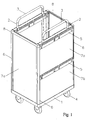
- the organization trolley exemplified in Figure 1 has a chassis which consists essentially of a rectangular bottom plate 1 and four vertical supports 2, which are firmly connected to the bottom plate 1.
- the vertical supports 2 are formed by round tubes. In each case two adjacent vertical supports 2 are connected to each other in the region of their upper end by a bracket 3.
- pivotable wheels 4 are screwed to the four corners.
- transverse profile support 5 are mounted vertically adjustable in height.
- the transverse profile support 5, the vertical supports 2 encompassing clamp elements.
- the transverse profile carrier 5 have holding and fastening means in the form of angled webs, clamping strips and grooves for holding (not shown) shelves.
- the structural design of the base plate 1, the vertical supports 2, the bracket 3 and in particular the cross-sectional member 5 and the connection technique used here are described in detail in the application EP 03 000 752.0 the same applicant.
- Base plate 1 vertical supports 2, 3 brackets and the cross-sectional support 5 form the modular structure and any expandable supporting structure of the organization car.
- Cladding elements in the form of planar cladding panels 7a, 7b are each between two transverse profile support 5 and two Vertical beams 6 used and form the side walls of the organization car.
- Two end strips 8 comprise the upper edges of the trim panels 7a.
- the transverse profile carriers 5 have, in the region of their outsides, upwardly open grooves 9a and mirror-inverted grooves 9b, into which the upper or lower edges of the lining plate 7b are inserted.
- the vertical beams 6 also have mutually facing grooves 10a, 10b, which receive the left or right edge of the trim panel 7a used there.
- the cladding panel 7a can be easily inserted from above between the grooves 10a, 10b of two adjacent vertical beams 6, and as in a similar manner the cladding panel 7b from the front into the grooves 9a, 9b of two adjacent cross-sectional support 5 is inserted ,
- FIG. 2 also shows that the transverse profile carriers 5 have on their front side a vertically extending T-slot into which a corresponding T-bar 12 can be inserted on the rear side of the vertical bars 6.
- the end strip 8 is placed on the vertical beams 6 and the upper edge of the trim panel 7a.
- the end strip 8 carries at its bottom pin 13, which engage corresponding recesses 14 in the end faces of the vertical bars 6 by clamping.
- the vertical beams 6 and the end strip 8 have a smooth, rounded in the vertical edges outer contour.
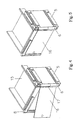
- a door 16 is pivotally mounted as a cladding element 17 by means of a hinge 17 to the right of the vertical struts 6 to be seen there.
- the door 16 is shown in the closed state.
- Vertical beams 6, cladding panels 7a, 7b and end strips 8 can be combined with each other so that the organization trolley, for example, only on the front side and on a long side closed walls, whereas one side remains open to conveniently invite or remove items.
- additional doors 16 By means of additional doors 16, however, it is also possible to realize an organization trolley with side walls closed all around.
- the conclusion towards the top usually forms a removable shelf, which may for example be designed as a lateral tray 15, as shown in Figures 3, 4 and 5.
Landscapes
- Handcart (AREA)
- Holders For Apparel And Elements Relating To Apparel (AREA)
- Ropes Or Cables (AREA)
- Solid-Sorbent Or Filter-Aiding Compositions (AREA)
- Absorbent Articles And Supports Therefor (AREA)
Description
- Die Erfindung betrifft einen Organisationswagen zum Transport und zur Aufbewahrung einer Vielzahl von verschiedenen Gegenständen, insbesondere Reinigungsutensilien, mit einem Fahrgestell, das an seiner Unterseite Räder trägt, und mit in mehreren Ebenen übereinander angeordneten Fächern für die Aufnahme der zu transportierenden Gegenstände.
- Derartige Organisationswagen sind in vielfältigen Ausführungen seit langem bekannt. Sie werden beispielsweise bei der Reinigung und Pflege von Gebäuden, im Hotel-Service oder als mobiles Ver- und Entsorgungssystem eingesetzt. Je nach Verwendungszweck finden Reinigungsgeräte wie z.B. Eimer und Putzgeräte, Reinigungsmittel, Toilettenartikel, Wäsche oder auch Behälter für Abfall Platz in den Fächern des Organisationswagens.
- Um den Wagen in Form und Größe an den gewünschten Einsatzzweck optimal anpassen zu können, weist er üblicherweise eine modulare Struktur auf. Grundmodul ist immer das Fahrgestell mit den Rädern, das dann mit einer begrenzten Anzahl von Bauelementen nach Art eines Baukastens zu einer fast unbegrenzten Zahl von Varianten aufgerüstet werden kann.
- In der älteren Anmeldung EP 03 000 752.0 desselben Anmelders ist ein aktueller, modular aufgebauter Transportwagen für Gegenstände beschrieben. Auf einer Plattform mit Rädern ist ein Gestell aufgebaut, welches Halterungen, z.B. für weitere Plattformen, trägt. Die Plattform ist als ebene Platte ausgebildet und mit im Raster angeordneten Befestigungseinrichtungen ausgestattet. Das Gestell besteht aus vertikalen Stützen, die an die Befestigungseinrichtungen der Plattform ankoppelbar sind. Hierzu sind an den vertikalen Stützen erste Einrastmittel vorgesehen, die mit zweiten Einrastmitteln an den Halterungen formschlüssig zusammenwirken.
- Organisationswagen und Reinigungswagen der vorstehend beschriebenen Art haben üblicherweise offene Strukturen, d.h. nicht nur die einzelnen Elemente, aus denen sie zusammengesetzt sind, sondern auch die darauf abgestellten Gegenstände sind von allen Seiten offen zugänglich. Dies ist in zweierlei Hinsicht nachteilig: Zum einen sind die zu transportierenden Gegenstände weder gegen Herausfallen noch gegen Staub oder unbefugten Zugriff geschützt; zum anderen bietet ein vollgepackter Organisationswagen herkömmlicher Art keinen schönen Anblick, wie jeder Besucher eines Krankenhauses oder Gast eines Hotels bestätigen wird.
- Die Aufgabe besteht also darin, einen Organisationswagen mit flexiblem modularen Aufbau so weiter zu entwickeln, dass die darauf transportierten Gegenstände gegen Herausfallen, Staub und unbefugten Zugriff geschützt sind und gleichzeitig der ganze Wagen ein optisch ansprechendes Erscheinungsbild erhält. Die Lösung dieser Aufgabe erfolgt durch einen Organisationswagen gemäß Anspruch 1. Bevorzugte Ausführungen ergeben sich aus den abhängigen Ansprüchen.
- Bei dem erfindungsgemäßen Organisationswagen bilden die Bodenplatte, die Vertikalstützen und die Querprofilträger die tragende Struktur, welche um die Vertikalholme und flächige Verkleidungselemente ergänzt wird. Zusammen mit den Querprofilträgern bilden die Vertikalholme die Seitenflächen des Wagens, die von den Verkleidungselementen geschlossen werden. Da die Vertikalholme und die Verkleidungselemente nicht zur tragenden Struktur des Organisationswagens gehören, können sie relativ leicht ausgeführt werden. Das Gesamtgewicht des Organisationswagens erhöht sich dadurch nur unwesentlich. Ein weiterer Vorteil der vorgeschlagenen Konstruktion besteht darin, dass bei Bedarf nur ein bestimmter Abschnitt oder gar nur ein einzelnes Fach des Wagens mit Verkleidungselementen geschlossen ausgebildet werden kann, während andere Abschnitte bzw. Fächer offen bleiben. Beispielsweise lässt sich nur die Stirnseite und eine Längsseite des Wagens mit Verkleidungselementen schließen, während die Fächer von der gegenüberliegenden Seite her offen zugänglich bleiben. Damit lässt sich der erfindungsgemäße Organisationswagen dem jeweiligen Einsatzzweck optimal anpassen.
- Aus der FR 2 833 913 A1 ist ein Organisationswagen bekannt, der ein Fahrgestell mit einer Bodenplatte und mehrere, übereinander angeordnete Fächer umfasst. Auf die Bodenplatte sind vertikale Holme montiert, an denen flächige Verkleidungselemente befestigt sind. Diese Verkleidungselemente erstrecken sich über die gesamte Höhe des Wagens. Bei dem erfindungsgemäßen Wagen dagegen sind die Verkleidungselemente zwischen zwei benachbarte Querprofilträger oder zwischen zwei Querprofilträger und Vertikalholme eingesetzt, so dass die Querprofilträger und/oder Vertikalholme Bestandteil der geschlossenen Außenwand sind. Beim Organisationswagen nach FR 2 833 913 A1 gehören die Vertikalholme mit zur tragenden Struktur, wohingegen beim Organisationswagen nach der Erfindung die Vertikalholme nur bei Bedarf und zum Zwecke der Verkleidung an die Enden der Querprofilträger montiert werden, um ein Verkleidungselement zu halten.
- Die US 2002/0109318 A1 zeigt einen Organisationswagen mit Fahrgestell, Rädern, vertikalen Stützpfeilern und mehreren, übereinander angeordneten Aufbewahrungsfächern. Es sind ferner großflächige Verkleidungselemente wie eine Tür und eine Front vorhanden. Demgegenüber hat der erfindungsgemäße Organisationswagen eine modulare Struktur aus Querprofilträgern und Vertikalholmen mit zwischengesetzten ebenen Verkleidungsteilen, wobei diese modulare Struktur zur Herstellung einer Verkleidung unabhängig von der tragenden Struktur des Wagens ist.
- Die EP 0 645 129 A2 offenbart einen Utensilienwagen mit einem Seitenelement und einer Anzahl übereinander angeordneter Paneelenteile. Die Rückseite (vergleiche Figur 2) wird von einem unteren Paneel und einem oberen Paneel gebildet. Auch dieser vorbekannte Wagen zeigt nicht die erfindungsgemäße Trennung in eine tragende Struktur und eine davon unabhängige, modulare aufgebaute Verkleidung, umfassend Vertikalprofilträger, Vertikalholme und zwischengesetzte flächige Verkleidungselemente.
- Bevorzugt wird eine Ausführung des Fahrgestells, bei der jeweils zwei benachbarte Vertikalstützen im Bereich Ihrer oberen Enden durch einen Bügel miteinander verbunden sind. Das erhöht die Stabilität der tragenden Struktur des Wagens.
- Vorteilhaft sind die Vertikalstützen auf der Bodenplatte im Raster angeordnet. Bodenplatte, Vertikalstützen und Querprofilträger sind dabei vorzugsweise so ausgebildet, wie in der älteren Anmeldung EP 03 000 752.0 desselben Anmelders im Einzelnen beschrieben.
- Die mechanische Verbindung zwischen den Verkleidungselementen und den diese haltenden Querprofilträgern geschieht vorzugsweise durch Nuten, die im Bereich der Außenseiten der Querprofilträger vorgesehen sind und in die das Verkleidungselement mit seinem oberen oder unteren Rand einschiebbar ist. In gleicher Weise dienen gegeneinander weisende Nuten an den Vertikalholmen zur Aufnahme der seitlichen Ränder eines Verkleidungselementes. Die Verkleidungselemente können aber auch in anderer Weise fest oder lösbar mit den Querprofilträgern bzw. den Vertikalholmen mechanisch verbunden werden, beispielsweise durch eine Nut- und Federverbindung, Steckverbindern, Klemmmitteln oder auch Schrauben.
- Zur Befestigung der Vertikalholme an den Enden der Querprofilträger dient vorzugsweise eine formschlüssige Klemmverbindung in Form von T-Nuten an den Stirnseiten der Querprofilträger und hierzu korrespondierende T-Leisten an den Vertikalholmen, welche in die T-Nuten der Querprofilträger von oben oder unten einschiebbar sind.
- Eine sinnvolle Ergänzung des erfindungsgemäßen Organisationswagens stellt eine horizontale Abschlussleiste dar, welche die oberen Enden zweier benachbarter Vertikalholme miteinander verbindet. Hierzu kann die Abschlussleiste an ihrer Unterseite Zapfen tragen, welche in korrespondierende Aussparungen in den Stirnseiten der Vertikalholme eingreifen. Zweckmäßig umfasst die Abschlussleiste den oberen Rand eines flächigen Verkleidungselementes. Eine derart ausgebildete Abschlussleiste ergänzt zwei, parallel und im Abstand zueinander angeordnete Vertikalholme zu einem Rahmen, der das Verkleidungselement umfasst. Da auch diese Abschlussleiste ebenso wie die Vertikalholme keine tragende Funktion hat, kann ihre äußere Form vor allem nach ästhetischen Gesichtspunkten gestaltet werden. Insbesondere kann die Abschlussleiste eine geschlossene glatte Außenkontur aufweisen, was bei einem Organisationswagen, der auch für Reinigungszwecke eingesetzt wird, aus Hygiene- und Pflegegründen wichtig ist.
- Die zwischen die Querprofilträger und die Vertikalholme eingesetzten Verkleidungselemente können einfach als ebene Verkleidungsplatten ausgebildet sein. Die Verkleidungselemente können aber auch als öffenbare Türen ausgebildet sein, die dann mittels eines Scharniers an einem Vertikalholm schwenkbar befestigt sind. Der benachbarte Vertikalholm kann dann mit einem Anschlag für die Tür versehen werden. Ist die Tür zudem mit einem Schloss ausgerüstet, so können einzelne Fächer oder auch ein ganzer Abschnitt des Organisationswagens fest verschlossen werden, um die darin aufbewahrten Gegenstände gegen unbefugten Zugriff zu sichern.
- Ein Ausführungsbeispiel der Erfindung wird nachstehend anhand der beigefügten Zeichnungen näher beschrieben. Es zeigen:
- Figur 1
- einen Organisationswagen mit geschlossen ausgebildeten Seitenwänden, in einer perspektivischen Ansicht schräg von oben;
- Figur 2
- die obere linke Ecke des Organisationswagens von Figur 1, in einer Explosionsdarstellung;
- Figur 3
- die Ecke von Figur 2 mit teilweise geschnitten dargestellten Einzelteilen und eine zusätzliche Wanne;
- Figur 4
- die Ecke eines Organisationswagen ähnlich wie in Figur 2, mit einer Tür in geöffnetem Zustand;
- Figur 5
- die Ecke des Organisationswagens von Figur 4 mit geschlossener Tür.
- Der in Figur 1 beispielhaft dargestellte Organisationswagen hat ein Fahrgestell, das im Wesentlichen aus einer rechteckigen Bodenplatte 1 und vier Vertikalstützen 2 besteht, die mit der Bodenplatte 1 fest verbunden sind. Die Vertikalstützen 2 sind von Rundrohren gebildet. Jeweils zwei benachbarte Vertikalstützen 2 sind im Bereich ihres oberen Endes durch einen Bügel 3 miteinander verbunden. An der Unterseite der Bodenplatte 1 sind an den vier Ecken schwenkbare Räder 4 angeschraubt.
- An den Vertikalstützen 2 sind Querprofilträger 5 aus Kunststoff höhenverschiebbar befestigt. Hierzu weisen die Querprofilträger 5 die Vertikalstützen 2 umgreifende Klammerelemente auf. Die Querprofilträger 5 weisen Halte- und Befestigungsmittel in Form von abgewinkelten Stegen, Klemmleisten und Nuten zur Halterung von (nicht dargestellten) Fachböden auf. Die konstruktive Ausgestaltung der Bodenplatte 1, der Vertikalstützen 2, des Bügels 3 und insbesondere der Querprofilträger 5 sowie die hier verwendete Verbindungstechnik sind in der Anmeldung EP 03 000 752.0 desselben Anmelders im Detail beschrieben.
- Bodenplatte 1, Vertikalstützen 2, Bügel 3 und die Querprofilträger 5 bilden die modular aufgebaute und beliebig erweiterbare tragende Struktur des Organisationswagens.
- An den vorderen und hinteren Enden der Querprofilträger 5 sind insgesamt vier Vertikalholme 6 befestigt. Verkleidungselemente in Form von ebenen Verkleidungsplatten 7a, 7b sind jeweils zwischen zwei Querprofilträger 5 bzw. zwei Vertikalholme 6 eingesetzt und bilden die Seitenwände des Organisationswagens. Zwei Abschlussleisten 8 umfassen die oberen Ränder der Verkleidungsplatten 7a.
- Wie in den Figuren 2 und 3 erkennbar, weisen die Querprofilträger 5 im Bereich ihrer Außenseiten nach oben offene Nuten 9a und spiegelbildlich nach unten offene Nuten 9b auf, in welche die oberen bzw. unteren Ränder der Verkleidungsplatte 7b eingeschoben sind. Die Vertikalholme 6 weisen gleichfalls gegeneinander weisende Nuten 10a, 10b auf, welche den linken bzw. rechten Rand der dort eingesetzten Verkleidungsplatte 7a aufnehmen.
- Insbesondere aus Figur 2 wird deutlich, dass die Verkleidungsplatte 7a einfach von oben zwischen die Nuten 10a, 10b zweier benachbarter Vertikalholme 6 eingeschoben werden kann, und wie in ähnlicher Weise die Verkleidungsplatte 7b von vorne in die Nuten 9a, 9b zweier benachbarter Querprofilträger 5 einschiebbar ist.
- In Figur 2 lässt sich ferner erkennen, dass die Querprofilträger 5 an ihrer Stirnseite eine vertikal verlaufende T-Nut aufweisen, in welche eine korrespondierende T-Leiste 12 an der Rückseite der Vertikalholme 6 einschiebbar sind. Zum Schluss wird die Abschlussleiste 8 auf die Vertikalholme 6 und den oberen Rand der Verkleidungsplatte 7a aufgesetzt. Hierzu trägt die Abschlussleiste 8 an ihrer Unterseite Zapfen 13, welche korrespondierende Aussparungen 14 in den Stirnseiten der Vertikalholme 6 klemmend eingreifen. Die Vertikalholme 6 und die Abschlussleiste 8 weisen eine glatte, im Bereich der vertikalen Kanten abgerundete Außenkontur auf.
- Die Montage der Vertikalholme 6, der Verkleidungsplatten 7a bzw. 7b und der Abschlussleiste 8 erfordern kein Werkzeug und können vom Benutzer auch jederzeit nachträglich und bedarfsweise durchgeführt werden.
- In Figur 4 ist als Verkleidungselement eine Tür 16 mittels eines Scharniers 17 an den rechten der dort zu sehenden Vertikalholme 6 schwenkbar befestigt. In Figur 5 ist die Tür 16 in geschlossenem Zustand dargestellt.
- Vertikalholme 6, Verkleidungsplatten 7a, 7b und Abschlussleisten 8 können so miteinander kombiniert werden, dass der Organisationswagen z.B. nur an der Stirnseite und an einer Längsseite geschlossene Wände hat, wohingegen eine Seite offen bleibt, um bequem Gegenstände einzuladen oder herauszunehmen. Mittels zusätzlicher Türen 16 lässt sich aber auch ein Organisationswagen mit ringsum geschlossenen Seitenwänden realisieren. Den Abschluss nach oben hin bildet in der Regel ein herausnehmbarer Fachboden, der beispielsweise als seitliche Wanne 15 ausgeführt sein kann, wie in den Figuren 3, 4 und 5 dargestellt.
-
- 1
- Bodenplatte
- 2
- Vertikalstütze
- 3
- Bügel
- 4
- Rad
- 5
- Querprofilträger
- 6
- Vertikalholm
- 7a, 7b
- Verkleidungsplatten
- 8
- Abschlussleiste
- 9a, 9b
- Nuten (in 5)
- 10a, 10b
- Nuten (in 6)
- 11
- T-Nut (an 5)
- 12
- T-Leiste (an 6)
- 13
- Zapfen (von 8)
- 14
- Aussparung (in 6)
- 15
- Wanne
- 16
- Tür
- 17
- Scharnier (von 16)
- 18
- Wanne
Claims (10)
- Organisationswagen zum Transport und zur Aufbewahrung einer Vielzahl von verschiedenen Gegenständen, insbesondere Reinigungsutensilien, mit- in mehreren Ebenen übereinander angeordneten Fächern für die Aufnahme der zu transportierenden Gegenstände;- einem Fahrgestell, das eine Bodenplatte (1) und darauf angeordnete Vertikalstützen (2) umfasst und an seiner Unterseite Räder (4) trägt;- einer Anzahl von Querprofilträgern (5), die jeweils an mindestens einer Vertikalstütze (2) befestigt sind und Haltemittel für Fachböden aufweisen;- wobei die Bodenplatte (1), die Vertikalstützen (2) und die Querprofilträger (5) die tragende Struktur des Organisationswagens bilden;- wenigstens zwei zusätzlichen, an die tragende Struktur anmondierbaren Vertikalholmen (6), die jeweils an den Enden mindestens zweier benachbarter Querprofilträger (5) befestigt sind;- flächige Verkleidungselemente, die zwischen zwei benachbarten Querprofilträgern (5) und/oder Vertikalholmen (6) eingesetzt sind.
- Organisationswagen nach Anspruch 1, dadurch gekennzeichnet, dass jeweils zwei benachbarte Vertikalstützen (2) im Bereich ihrer oberen Enden durch einen Bügel (3) miteinander verbunden sind.
- Organisationswagen nach Anspruch 1 oder 2, dadurch gekennzeichnet, dass die Vertikalstützen (2) auf der Bodenplatte (1) im Raster angeordnet sind.
- Organisationswagen nach einem der Ansprüche 1 bis 3, dadurch gekennzeichnet, dass die Querprofilträger (5) im Bereich ihrer Außenseiten Nuten (9a, 9b) aufweisen, in die der Rand eines Verkleidungselementes einschiebbar ist.
- Organisationswagen nach einem der Ansprüche 1 bis 4, dadurch gekennzeichnet, dass die Vertikalholme (6) gegeneinander weisende Nuten (10a, 10b) aufweisen, in die der Rand eines Verkleidungselementes einschiebbar ist.
- Organisationswagen nach einem der Ansprüche 1 bis 3, dadurch gekennzeichnet, dass- die Querprofilträger (5) an zumindest einer Stirnseite eine vertikal verlaufende T-Nut (11) aufweisen;- die Vertikalholme (6) korrespondierende T-Leisten (12) aufweisen, welche in die T-Nuten der Querprofilträger einschiebbar sind.
- Organisationswagen nach einem der Ansprüche 1 bis 6, gekennzeichnet durch eine horizontale Abschlussleiste (8), welche die oberen Enden zweier benachbarter Vertikalholme (6) miteinander verbindet und den oberen Rand eines Verkleidungselementes umfasst.
- Organisationwagen nach Anspruch 7, dadurch gekennzeichnet , dass die Abschlussleiste (8) an ihrer Unterseite Zapfen (13) aufweist, welche in korrespondierende Aussparungen (14) in den Stirnseiten der Vertikalholme (6) eingreifen.
- Organisationswagen nach einem der Ansprüche 1 bis 8, dadurch gekennzeichnet, dass die Verkleidungselemente als ebene Verkleidungsplatten (7a, 7b) ausgebildet sind.
- Organisationswagen nach einem der Ansprüche 1 bis 8, dadurch gekennzeichnet, dass die Verkleidungselemente als öffenbare Türen (16) ausgebildet sind, welche mittels eines Scharniers (17) an einem Vertikalholm schwenkbar befestigt sind.
Priority Applications (7)
| Application Number | Priority Date | Filing Date | Title |
|---|---|---|---|
| PT03020214T PT1512606E (pt) | 2003-09-06 | 2003-09-06 | Carro multiusos |
| DK03020214T DK1512606T3 (da) | 2003-09-06 | 2003-09-06 | Organisationsvogn |
| DE50305502T DE50305502D1 (de) | 2003-09-06 | 2003-09-06 | Organisationswagen |
| SI200330618T SI1512606T1 (sl) | 2003-09-06 | 2003-09-06 | Organizacijski vozicek |
| EP03020214A EP1512606B1 (de) | 2003-09-06 | 2003-09-06 | Organisationswagen |
| AT03020214T ATE343504T1 (de) | 2003-09-06 | 2003-09-06 | Organisationswagen |
| ES03020214T ES2275052T3 (es) | 2003-09-06 | 2003-09-06 | Carrito de organizacion. |
Applications Claiming Priority (1)
| Application Number | Priority Date | Filing Date | Title |
|---|---|---|---|
| EP03020214A EP1512606B1 (de) | 2003-09-06 | 2003-09-06 | Organisationswagen |
Publications (2)
| Publication Number | Publication Date |
|---|---|
| EP1512606A1 EP1512606A1 (de) | 2005-03-09 |
| EP1512606B1 true EP1512606B1 (de) | 2006-10-25 |
Family
ID=34130158
Family Applications (1)
| Application Number | Title | Priority Date | Filing Date |
|---|---|---|---|
| EP03020214A Expired - Lifetime EP1512606B1 (de) | 2003-09-06 | 2003-09-06 | Organisationswagen |
Country Status (7)
| Country | Link |
|---|---|
| EP (1) | EP1512606B1 (de) |
| AT (1) | ATE343504T1 (de) |
| DE (1) | DE50305502D1 (de) |
| DK (1) | DK1512606T3 (de) |
| ES (1) | ES2275052T3 (de) |
| PT (1) | PT1512606E (de) |
| SI (1) | SI1512606T1 (de) |
Cited By (3)
| Publication number | Priority date | Publication date | Assignee | Title |
|---|---|---|---|---|
| DE102007010937A1 (de) * | 2007-03-07 | 2008-09-11 | Melchert, Franz Adolf | Zimmermädchenwagen mit verschließbaren Fächern bzw. verschließbarem Ablageboden |
| DE102010032962A1 (de) | 2010-07-30 | 2012-02-02 | Wanzl Metallwarenfabrik Gmbh | Transportcontainer |
| US9980623B2 (en) | 2008-11-05 | 2018-05-29 | Ecolab Usa Inc. | Cleaning trolley |
Families Citing this family (7)
| Publication number | Priority date | Publication date | Assignee | Title |
|---|---|---|---|---|
| EP2314497B1 (de) * | 2009-10-22 | 2014-08-27 | VERMOP Salmon GmbH | Transportwagen für Reinigungsutensilien |
| USD624724S1 (en) | 2009-11-03 | 2010-09-28 | Ecolab Inc. | Cleaning trolley |
| USD624270S1 (en) | 2009-11-03 | 2010-09-21 | Ecolab Inc. | Cleaning trolley |
| USD624269S1 (en) | 2009-11-03 | 2010-09-21 | Ecolab Inc. | Cleaning trolley |
| USD624271S1 (en) | 2009-11-03 | 2010-09-21 | Ecolab Inc. | Cleaning trolley |
| DE102017010460A1 (de) * | 2017-11-13 | 2019-05-16 | Carl Freudenberg Kg | Reinigungsfahrwagen und Verfahren zu dessen Montage |
| DE102020111731A1 (de) | 2020-04-29 | 2021-11-04 | Alfred Kärcher SE & Co. KG | Reinigungswagen |
Family Cites Families (4)
| Publication number | Priority date | Publication date | Assignee | Title |
|---|---|---|---|---|
| US5016948A (en) * | 1989-02-02 | 1991-05-21 | Intermetro Industries Corporation | Modular utility cart |
| DE10064490C1 (de) * | 2000-12-22 | 2002-03-14 | Henkel Ecolab Gmbh & Co Ohg | Transportwagen für die gewerbliche Gebäudereinigung |
| US6827357B2 (en) * | 2001-02-09 | 2004-12-07 | Akro-Mils, A Division Of Myers Industries Company | Janitorial cart |
| ITMI20010670U1 (it) * | 2001-12-20 | 2003-06-20 | Vdm Srl | Carrello attrezzato per la pulizia di ambienti in particolare di ambienti tipo ospedali alberghi uffici uffici comunita' o simili ad elevata |
-
2003
- 2003-09-06 EP EP03020214A patent/EP1512606B1/de not_active Expired - Lifetime
- 2003-09-06 PT PT03020214T patent/PT1512606E/pt unknown
- 2003-09-06 AT AT03020214T patent/ATE343504T1/de active
- 2003-09-06 SI SI200330618T patent/SI1512606T1/sl unknown
- 2003-09-06 DE DE50305502T patent/DE50305502D1/de not_active Expired - Lifetime
- 2003-09-06 DK DK03020214T patent/DK1512606T3/da active
- 2003-09-06 ES ES03020214T patent/ES2275052T3/es not_active Expired - Lifetime
Cited By (5)
| Publication number | Priority date | Publication date | Assignee | Title |
|---|---|---|---|---|
| DE102007010937A1 (de) * | 2007-03-07 | 2008-09-11 | Melchert, Franz Adolf | Zimmermädchenwagen mit verschließbaren Fächern bzw. verschließbarem Ablageboden |
| US9980623B2 (en) | 2008-11-05 | 2018-05-29 | Ecolab Usa Inc. | Cleaning trolley |
| DE102010032962A1 (de) | 2010-07-30 | 2012-02-02 | Wanzl Metallwarenfabrik Gmbh | Transportcontainer |
| DE202010018158U1 (de) | 2010-07-30 | 2014-11-05 | Wanzl Metallwarenfabrik Gmbh | Transportcontainer |
| DE102010032962B4 (de) * | 2010-07-30 | 2025-04-17 | Wanzl GmbH & Co. KGaA | Transportcontainer |
Also Published As
| Publication number | Publication date |
|---|---|
| DK1512606T3 (da) | 2007-02-26 |
| ES2275052T3 (es) | 2007-06-01 |
| PT1512606E (pt) | 2007-02-28 |
| SI1512606T1 (sl) | 2007-04-30 |
| DE50305502D1 (de) | 2006-12-07 |
| ATE343504T1 (de) | 2006-11-15 |
| EP1512606A1 (de) | 2005-03-09 |
Similar Documents
| Publication | Publication Date | Title |
|---|---|---|
| DE4324628A1 (de) | Vorrichtung zur Bereitstellung von Werkzeug und Material | |
| DE9313158U1 (de) | Aufbewahrungs- und Transportkoffer für Beleuchtungsausrüstung | |
| DE2339808A1 (de) | Behaelter fuer modulsystem | |
| DE8211051U1 (de) | Transportabler Vorrats- und/oder Lagerbehaelter fuer Kleinteile oder dergleichen | |
| EP2424762B1 (de) | Vorrichtung für den transport von bühnenausrüstungen | |
| DE2530281C2 (de) | ||
| DE69117773T2 (de) | Regalanlage für lieferwagen | |
| DE4006874C1 (de) | ||
| EP1512606A1 (de) | Organisationswagen | |
| EP1772389A1 (de) | Grossladungsträger | |
| EP1987735B2 (de) | Blockregal zur Lagerung insbesondere von Fahrzeugrädern | |
| DE102005058954B4 (de) | Hintere Gepäckablage für ein Steilheck-Fahrzeug | |
| DE102005020613B4 (de) | Modulträger für eine Fahrerkabine sowie Verfahren zum Bestücken einer Fahrerkabine eines Kraftfahrzeugs mit Möbelelementen | |
| DE102008011785B3 (de) | Lager-, Transport- und Sequenzwagen | |
| EP1362760B1 (de) | Dämpfungsvorrichtung für einen nicht motorisierten Wagen und Wagen | |
| WO2019092079A1 (de) | Reinigungsfahrwagen und verfahren zu dessen montage | |
| EP1043188A2 (de) | Einbau für den Laderaum eines Transportfahrzeugs oder -behälters | |
| DE19500531A1 (de) | Tablettwagen | |
| DE4306525C1 (de) | Einkaufskorb | |
| DE202004003561U1 (de) | Stapelbarer Einkaufswagen | |
| DE20006296U1 (de) | Einrichtung für die Aufnahme einer Mehrzahl von Behältern | |
| DE3310873A1 (de) | Transportabler vorrats- und/oder lagerbehaelter fuer kleinteile oder dergleichen | |
| EP1142511A1 (de) | Einrichtung für die Aufnahme einer Mehrzahl von Behältern | |
| DE29720097U1 (de) | Kühlschranktür | |
| DE2109666B2 (de) | Kistenförmiger Transportbehälter für große, sperrige Güter |
Legal Events
| Date | Code | Title | Description |
|---|---|---|---|
| PUAI | Public reference made under article 153(3) epc to a published international application that has entered the european phase |
Free format text: ORIGINAL CODE: 0009012 |
|
| AK | Designated contracting states |
Kind code of ref document: A1 Designated state(s): AT BE BG CH CY CZ DE DK EE ES FI FR GB GR HU IE IT LI LU MC NL PT RO SE SI SK TR |
|
| AX | Request for extension of the european patent |
Extension state: AL LT LV MK |
|
| 17P | Request for examination filed |
Effective date: 20050712 |
|
| AKX | Designation fees paid |
Designated state(s): AT BE BG CH CY CZ DE DK EE ES FI FR GB GR HU IE IT LI LU MC NL PT RO SE SI SK TR |
|
| GRAP | Despatch of communication of intention to grant a patent |
Free format text: ORIGINAL CODE: EPIDOSNIGR1 |
|
| GRAS | Grant fee paid |
Free format text: ORIGINAL CODE: EPIDOSNIGR3 |
|
| GRAA | (expected) grant |
Free format text: ORIGINAL CODE: 0009210 |
|
| AK | Designated contracting states |
Kind code of ref document: B1 Designated state(s): AT BE BG CH CY CZ DE DK EE ES FI FR GB GR HU IE IT LI LU MC NL PT RO SE SI SK TR |
|
| REG | Reference to a national code |
Ref country code: GB Ref legal event code: FG4D Free format text: NOT ENGLISH |
|
| REG | Reference to a national code |
Ref country code: CH Ref legal event code: EP |
|
| REG | Reference to a national code |
Ref country code: IE Ref legal event code: FG4D Free format text: LANGUAGE OF EP DOCUMENT: GERMAN |
|
| REF | Corresponds to: |
Ref document number: 50305502 Country of ref document: DE Date of ref document: 20061207 Kind code of ref document: P |
|
| REG | Reference to a national code |
Ref country code: RO Ref legal event code: EPE Ref country code: CH Ref legal event code: NV Representative=s name: TROESCH SCHEIDEGGER WERNER AG |
|
| REG | Reference to a national code |
Ref country code: SE Ref legal event code: TRGR |
|
| REG | Reference to a national code |
Ref country code: GR Ref legal event code: EP Ref document number: 20070400049 Country of ref document: GR Ref country code: EE Ref legal event code: FG4A Ref document number: E000770 Country of ref document: EE Effective date: 20061222 |
|
| GBT | Gb: translation of ep patent filed (gb section 77(6)(a)/1977) |
Effective date: 20070125 |
|
| REG | Reference to a national code |
Ref country code: DK Ref legal event code: T3 |
|
| REG | Reference to a national code |
Ref country code: PT Ref legal event code: SC4A Free format text: AVAILABILITY OF NATIONAL TRANSLATION Effective date: 20070116 |
|
| ET | Fr: translation filed | ||
| REG | Reference to a national code |
Ref country code: HU Ref legal event code: AG4A Ref document number: E001188 Country of ref document: HU |
|
| REG | Reference to a national code |
Ref country code: ES Ref legal event code: FG2A Ref document number: 2275052 Country of ref document: ES Kind code of ref document: T3 |
|
| PLBE | No opposition filed within time limit |
Free format text: ORIGINAL CODE: 0009261 |
|
| STAA | Information on the status of an ep patent application or granted ep patent |
Free format text: STATUS: NO OPPOSITION FILED WITHIN TIME LIMIT |
|
| 26N | No opposition filed |
Effective date: 20070726 |
|
| PGFP | Annual fee paid to national office [announced via postgrant information from national office to epo] |
Ref country code: TR Payment date: 20070823 Year of fee payment: 5 |
|
| PGFP | Annual fee paid to national office [announced via postgrant information from national office to epo] |
Ref country code: BG Payment date: 20070817 Year of fee payment: 5 Ref country code: EE Payment date: 20070918 Year of fee payment: 5 |
|
| PG25 | Lapsed in a contracting state [announced via postgrant information from national office to epo] |
Ref country code: CY Free format text: LAPSE BECAUSE OF NON-PAYMENT OF DUE FEES Effective date: 20070906 |
|
| REG | Reference to a national code |
Ref country code: EE Ref legal event code: MM4A Ref document number: E000770 Country of ref document: EE Effective date: 20080930 |
|
| PG25 | Lapsed in a contracting state [announced via postgrant information from national office to epo] |
Ref country code: EE Free format text: LAPSE BECAUSE OF NON-PAYMENT OF DUE FEES Effective date: 20080930 |
|
| PG25 | Lapsed in a contracting state [announced via postgrant information from national office to epo] |
Ref country code: BG Free format text: LAPSE BECAUSE OF NON-PAYMENT OF DUE FEES Effective date: 20080930 |
|
| PG25 | Lapsed in a contracting state [announced via postgrant information from national office to epo] |
Ref country code: TR Free format text: LAPSE BECAUSE OF NON-PAYMENT OF DUE FEES Effective date: 20100916 |
|
| PG25 | Lapsed in a contracting state [announced via postgrant information from national office to epo] |
Ref country code: TR Free format text: LAPSE BECAUSE OF NON-PAYMENT OF DUE FEES Effective date: 20080906 |
|
| PGFP | Annual fee paid to national office [announced via postgrant information from national office to epo] |
Ref country code: SK Payment date: 20130904 Year of fee payment: 11 Ref country code: FI Payment date: 20130919 Year of fee payment: 11 Ref country code: RO Payment date: 20130830 Year of fee payment: 11 Ref country code: LU Payment date: 20130925 Year of fee payment: 11 Ref country code: SI Payment date: 20130827 Year of fee payment: 11 Ref country code: MC Payment date: 20130920 Year of fee payment: 11 Ref country code: GR Payment date: 20130918 Year of fee payment: 11 |
|
| PG25 | Lapsed in a contracting state [announced via postgrant information from national office to epo] |
Ref country code: MC Free format text: LAPSE BECAUSE OF NON-PAYMENT OF DUE FEES Effective date: 20140930 Ref country code: FI Free format text: LAPSE BECAUSE OF NON-PAYMENT OF DUE FEES Effective date: 20140906 Ref country code: RO Free format text: LAPSE BECAUSE OF NON-PAYMENT OF DUE FEES Effective date: 20140906 Ref country code: LU Free format text: LAPSE BECAUSE OF NON-PAYMENT OF DUE FEES Effective date: 20140906 |
|
| REG | Reference to a national code |
Ref country code: GR Ref legal event code: ML Ref document number: 20070400049 Country of ref document: GR Effective date: 20150403 |
|
| REG | Reference to a national code |
Ref country code: SK Ref legal event code: MM4A Ref document number: E 1324 Country of ref document: SK Effective date: 20140906 |
|
| REG | Reference to a national code |
Ref country code: SI Ref legal event code: KO00 Effective date: 20150504 |
|
| PG25 | Lapsed in a contracting state [announced via postgrant information from national office to epo] |
Ref country code: SI Free format text: LAPSE BECAUSE OF NON-PAYMENT OF DUE FEES Effective date: 20140907 Ref country code: SK Free format text: LAPSE BECAUSE OF NON-PAYMENT OF DUE FEES Effective date: 20140906 |
|
| PG25 | Lapsed in a contracting state [announced via postgrant information from national office to epo] |
Ref country code: GR Free format text: LAPSE BECAUSE OF NON-PAYMENT OF DUE FEES Effective date: 20150403 |
|
| PGFP | Annual fee paid to national office [announced via postgrant information from national office to epo] |
Ref country code: CZ Payment date: 20150902 Year of fee payment: 13 Ref country code: PT Payment date: 20150828 Year of fee payment: 13 Ref country code: ES Payment date: 20150923 Year of fee payment: 13 Ref country code: IE Payment date: 20150928 Year of fee payment: 13 |
|
| PGFP | Annual fee paid to national office [announced via postgrant information from national office to epo] |
Ref country code: SE Payment date: 20150922 Year of fee payment: 13 Ref country code: HU Payment date: 20150914 Year of fee payment: 13 |
|
| PGFP | Annual fee paid to national office [announced via postgrant information from national office to epo] |
Ref country code: DK Payment date: 20150923 Year of fee payment: 13 |
|
| REG | Reference to a national code |
Ref country code: FR Ref legal event code: PLFP Year of fee payment: 14 |
|
| REG | Reference to a national code |
Ref country code: DK Ref legal event code: EBP Effective date: 20160930 |
|
| PG25 | Lapsed in a contracting state [announced via postgrant information from national office to epo] |
Ref country code: SE Free format text: LAPSE BECAUSE OF NON-PAYMENT OF DUE FEES Effective date: 20160907 |
|
| REG | Reference to a national code |
Ref country code: SE Ref legal event code: EUG |
|
| PG25 | Lapsed in a contracting state [announced via postgrant information from national office to epo] |
Ref country code: CZ Free format text: LAPSE BECAUSE OF NON-PAYMENT OF DUE FEES Effective date: 20160906 Ref country code: PT Free format text: LAPSE BECAUSE OF NON-PAYMENT OF DUE FEES Effective date: 20170306 |
|
| REG | Reference to a national code |
Ref country code: IE Ref legal event code: MM4A |
|
| PG25 | Lapsed in a contracting state [announced via postgrant information from national office to epo] |
Ref country code: IE Free format text: LAPSE BECAUSE OF NON-PAYMENT OF DUE FEES Effective date: 20160906 |
|
| PG25 | Lapsed in a contracting state [announced via postgrant information from national office to epo] |
Ref country code: HU Free format text: LAPSE BECAUSE OF NON-PAYMENT OF DUE FEES Effective date: 20160907 |
|
| REG | Reference to a national code |
Ref country code: FR Ref legal event code: PLFP Year of fee payment: 15 |
|
| PG25 | Lapsed in a contracting state [announced via postgrant information from national office to epo] |
Ref country code: DK Free format text: LAPSE BECAUSE OF NON-PAYMENT OF DUE FEES Effective date: 20160930 |
|
| PG25 | Lapsed in a contracting state [announced via postgrant information from national office to epo] |
Ref country code: ES Free format text: LAPSE BECAUSE OF NON-PAYMENT OF DUE FEES Effective date: 20160907 |
|
| REG | Reference to a national code |
Ref country code: ES Ref legal event code: FD2A Effective date: 20180626 |
|
| REG | Reference to a national code |
Ref country code: FR Ref legal event code: PLFP Year of fee payment: 16 |
|
| PGFP | Annual fee paid to national office [announced via postgrant information from national office to epo] |
Ref country code: NL Payment date: 20220922 Year of fee payment: 20 Ref country code: GB Payment date: 20220927 Year of fee payment: 20 Ref country code: DE Payment date: 20220920 Year of fee payment: 20 Ref country code: AT Payment date: 20220919 Year of fee payment: 20 |
|
| PGFP | Annual fee paid to national office [announced via postgrant information from national office to epo] |
Ref country code: FR Payment date: 20220920 Year of fee payment: 20 Ref country code: BE Payment date: 20220921 Year of fee payment: 20 |
|
| PGFP | Annual fee paid to national office [announced via postgrant information from national office to epo] |
Ref country code: IT Payment date: 20220930 Year of fee payment: 20 |
|
| PGFP | Annual fee paid to national office [announced via postgrant information from national office to epo] |
Ref country code: CH Payment date: 20220928 Year of fee payment: 20 |
|
| REG | Reference to a national code |
Ref country code: DE Ref legal event code: R071 Ref document number: 50305502 Country of ref document: DE Ref country code: NL Ref legal event code: MK Effective date: 20230905 |
|
| REG | Reference to a national code |
Ref country code: CH Ref legal event code: PL |
|
| REG | Reference to a national code |
Ref country code: GB Ref legal event code: PE20 Expiry date: 20230905 |
|
| REG | Reference to a national code |
Ref country code: BE Ref legal event code: MK Effective date: 20230906 |
|
| REG | Reference to a national code |
Ref country code: AT Ref legal event code: MK07 Ref document number: 343504 Country of ref document: AT Kind code of ref document: T Effective date: 20230906 |
|
| PG25 | Lapsed in a contracting state [announced via postgrant information from national office to epo] |
Ref country code: GB Free format text: LAPSE BECAUSE OF EXPIRATION OF PROTECTION Effective date: 20230905 |