EP1510112B1 - Verfahren zur hermetischen behäusung von optischen bauelementen sowie verfahrensgemäss hergestellte optische bauelemente - Google Patents
Verfahren zur hermetischen behäusung von optischen bauelementen sowie verfahrensgemäss hergestellte optische bauelemente Download PDFInfo
- Publication number
- EP1510112B1 EP1510112B1 EP03724979A EP03724979A EP1510112B1 EP 1510112 B1 EP1510112 B1 EP 1510112B1 EP 03724979 A EP03724979 A EP 03724979A EP 03724979 A EP03724979 A EP 03724979A EP 1510112 B1 EP1510112 B1 EP 1510112B1
- Authority
- EP
- European Patent Office
- Prior art keywords
- glass
- housing
- glass solder
- pane
- housing body
- Prior art date
- Legal status (The legal status is an assumption and is not a legal conclusion. Google has not performed a legal analysis and makes no representation as to the accuracy of the status listed.)
- Expired - Lifetime
Links
Images

Classifications
-
- G—PHYSICS
- G02—OPTICS
- G02B—OPTICAL ELEMENTS, SYSTEMS OR APPARATUS
- G02B7/00—Mountings, adjusting means, or light-tight connections, for optical elements
-
- H—ELECTRICITY
- H01—ELECTRIC ELEMENTS
- H01S—DEVICES USING THE PROCESS OF LIGHT AMPLIFICATION BY STIMULATED EMISSION OF RADIATION [LASER] TO AMPLIFY OR GENERATE LIGHT; DEVICES USING STIMULATED EMISSION OF ELECTROMAGNETIC RADIATION IN WAVE RANGES OTHER THAN OPTICAL
- H01S5/00—Semiconductor lasers
- H01S5/02—Structural details or components not essential to laser action
- H01S5/022—Mountings; Housings
- H01S5/0225—Out-coupling of light
- H01S5/02257—Out-coupling of light using windows, e.g. specially adapted for back-reflecting light to a detector inside the housing
-
- H—ELECTRICITY
- H05—ELECTRIC TECHNIQUES NOT OTHERWISE PROVIDED FOR
- H05K—PRINTED CIRCUITS; CASINGS OR CONSTRUCTIONAL DETAILS OF ELECTRIC APPARATUS; MANUFACTURE OF ASSEMBLAGES OF ELECTRICAL COMPONENTS
- H05K5/00—Casings, cabinets or drawers for electric apparatus
- H05K5/06—Hermetically-sealed casings
-
- H—ELECTRICITY
- H01—ELECTRIC ELEMENTS
- H01S—DEVICES USING THE PROCESS OF LIGHT AMPLIFICATION BY STIMULATED EMISSION OF RADIATION [LASER] TO AMPLIFY OR GENERATE LIGHT; DEVICES USING STIMULATED EMISSION OF ELECTROMAGNETIC RADIATION IN WAVE RANGES OTHER THAN OPTICAL
- H01S5/00—Semiconductor lasers
- H01S5/02—Structural details or components not essential to laser action
- H01S5/022—Mountings; Housings
- H01S5/02208—Mountings; Housings characterised by the shape of the housings
- H01S5/02212—Can-type, e.g. TO-CAN housings with emission along or parallel to symmetry axis
Definitions
- the invention relates to a method for hermetic Housing of optical components, in particular for Production of a housing body or parts thereof, at which is a hermetic encapsulation of preferably optoelectronic components, and further relates according to the method produced optical components.
- Hermetically encapsulated enclosures are often used sensitive components such as lasers or photodiodes Protect environmental factors and help to create a ensure sufficient service life of these components.
- US-A-5 878 069 shows a method according to the Preamble of expression 1.
- Housing of this type often consist of a sleeve-shaped Metal body and one in the sleeve recordable and as Window serving glass pane.
- Such housing / optical caps was connected by Metal and glass component by means of a ring arranged glass solder, which as sintered molding was used ; see. DE-A-37 29 411). This had first before the actually joining the components of the glass solder molding in a separate operation in sintering technology getting produced. Subsequently, the molding was fit inserted in the sleeve-shaped metal component and with the covered by a round glass pane. It then follows the Smelting process, hermetically sealed at the sleeve and glass and are positively connected to each other.
- this technique encounters significant Feasibility limits, as soon as the glass window is no longer in Shape as a round disk but with a square contour, especially as a rectangle or in others, of a simple round geometry deviating forms is needed or the surface to be covered with glass solder is not horizontal or arched shaped.
- the corresponding glass solder moldings in Sintering technology is only of their form very limited and not with the required accuracy possible.
- the conventional method is because too much Lotmenge and the slipping of the Lotringes before the Melting or unsuitable during the soldering process.
- the invention is based on the object, a precise and for various housing geometries applicable method of to develop in the preamble of claim 1 mentioned type which is a reliable and inexpensive, preferably hermetic, connection between metal sleeve and glass pane allows.
- This task is performed using a procedure with the characteristics of Claim 1 and by a housing body with the features of Claim 19 solved.
- the glass solder as a moldable mass, in particular as a paste is applied and by at least one single energy input, in particular by burnout organic components, the glass solder pre-glazed and in fixed its shape has great advantages, since almost any shape, both two-dimensional plane as well vaulted forms provided with glass solder locally exactly defined can be.
- the housing element in the Housing assembly can then be heated by at least one partially hermetic connection between the housing element and Housing arrangement can be made.
- this includes Housing element a window, which consists of a glass sheet, and the Housing arrangement a housing cap.
- the application of the glass solder paste can advantageously at least partially on the glass pane and / or the housing cap be effected, whereby by a multiple order the height of the applied glass solder and also its quantity exactly is adjustable.
- the glass solder paste on a Antireflection or anti-scratch coating are applied, which on the surface of the housing element, in particular of the Window is arranged and can thereby high quality optical elements, such as lenses, ball lenses, Cylindrical lenses or optical filters such as DWDM filters or Grid to be mounted.
- the shape of the glass solder paste, in particular the cross section or the thickness of a applied route by adjusting the paste rheology is influenced and / or adjusted, because this is the Viscosity of the glass solder paste to the respective Mounting condition to be adjusted, where at lower Viscosities thinner solder cords and at higher viscosities thicker solder cords are produced. Furthermore, the bleeding the applied Lotschnur by their viscosity influenced or adapted to the assembly process.
- the glass solder paste is applied in a metered manner by means of a metering device, in particular a dispenser and preferably by means of a needle dispenser, surfaces running obliquely or in a complex manner in the space can be provided with glass solder reliably and in a precisely predefined manner.
- a metering device in particular a dispenser and preferably by means of a needle dispenser
- surfaces running obliquely or in a complex manner in the space can be provided with glass solder reliably and in a precisely predefined manner.
- cylindrical surfaces of housings or cylindrical lenses for example, in x- and / or y-direction scanning optical detection or writing systems are interconnected.
- the metering device is a ring or rectangular dispenser provided with a nozzle, because then a single, metered and preferably time / pressure-controlled application can be sufficient with the appropriate application geometry in order to completely apply the required quantity of glass solder.
- the Lotschnurdicke the paste-applied glass solder advantageously influenced and / or adjusted.
- Glass solder paste by means of stencil printing, in particular by means of Screen printing technique, the glass sheet is applied.
- the Manufacture can be designed inexpensively by first clicking on a mother disc which a variety of individual discs defines or includes a glass solder predefined Surface geometry is applied by a Energy input, in particular by burning organic Components the glass solder pre-glazed and in its shape is fixed, discs separated from the mother disc and the scattered glass with pre-glazed glass solder inserted into the housing cap and by thermal Influence a hermetic connection between glass pane and housing cap is made.
- the disc from the mother glass by Cracking and breaking or separated by laser cutting.
- housing body with a section of a pre-glazed glass solder independently tradable goods because then a customer whose own housing elements, such as For example, windows, lenses or filters in the Insert housing body and by heating or Energy input in this hermetically secure.
- housing elements such as For example, windows, lenses or filters in the Insert housing body and by heating or Energy input in this hermetically secure.
- a particularly preferred housing body comprises a metallic, sleeve-shaped cap, a housing element, which preferably serves as a window pane as well as between window and metal cap arranged glass solder.
- the invention uses as a link between
- a metal sleeve the housing body forms and about a glass sheet, which is a housing element forms, as a shapable mass applicable glass solder, preferably a glass solder paste.
- a shapable mass applicable glass solder preferably a glass solder paste.
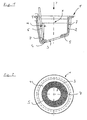
- Fig. 1 is a designated overall with 1 opto-cap during the manufacturing process.
- This opto cap 1 comprises a cylindrical or frusto-conical metal sleeve 2 with a passage opening 3 in the bottom surface. 4
- the passage opening 3 is suitable, for example, the Light of a laser beam or through optical elements like For example, lenses or filters affect pass through allow.
- a pasty glass solder 5 which in the present Example, the opening 3 completely surrounds as a soldering cord with applied to a needle dispenser.
- Fig. 2 is a look in the in Figure 1 illustrated optical cap in the direction of arrow Y from Fig. 1 shows.
- the needle 6 emerges a needle dispenser into the interior of the metal sleeve 3 and carries at the lower end 7 the pasty Glass solder 5 on.
- Such needle dispensers are For example, from the company. Sieghard Schiller GmbH & Co. Kg., Sonnenbuehl, Germany, under the name Inline Dispensers distributed.
- Preferred thicknesses of applied glass solder paste start from about 500 microns Solder cord thickness, which is about the width of a plotted Line width correspond and are in their width not limited according to the invention.
- the process of applying includes a controller or Setting the travel speed of the dispenser needle at least during the application of the glass solder paste, the Pressure with which the glass solder paste emerges and the time How long the glass solder paste exits, so that hereby the Layer thickness of a jself one-time order is adjustable.
- the Needle 6 a tilt by an angle ⁇ of about 30 degrees +/- 3 degrees relative to the longitudinal axis X of the optical cap 1 and is along an oblique to the axis X ellipse moved parallel to the lower bottom surface 4. Also the Inclination of the bottom surface 4 is about 30 degrees relative to Longitudinal axis X.
- the needle 6 parallel to the longitudinal axis Y of in Fig. Represented optical cap are performed.
- increasing layers can be partially or complete multiple orders.
- the metal sleeve 2 After application of the glass solder, the metal sleeve 2 is combined heated with the glass solder layer 5 whereby the pasty Glaslot für 5 glazed and subsequently in their position is fixed. Here, organic components of the pasty glass solder removed.
- glass solder for example, all of the Fa. Schott glass used to sell glass solder,
- the glass solders with the designation 8465, 8467, 8468, 8470, 8471, 8472, 8474 and composite glass solders with the Number G017-002, G017-344, G017-339, G017-340, G017-383, G017-393, G017-334 and crystallizing glass solders such
- the glass solders 8587, 8593, 8596, 8597 and can as housing elements preferably glass window soldered each have a higher temperature resistance This means a higher temperature Tg than that corresponding soldering temperature of the glass solder used exhibit.
- a preferred glasses are special glasses with the designation D263, AF37, AF45, B270, Borofloat TM 33 and Borofloat40 of the Fa. Schott Glass, Mainz.
- the sleeve-shaped housing cap is preferably made a metallic alloy containing certain amounts of nickel contains, such as the alloy with the name NiFe47.
- optical caps can be parallel with Multi-needle dispensers are coated. It will be in their Location of aligned metal sleeves in multiple carriers arranged and with multiple needle systems in a single Coated operation.
- a depression 7 in the metal sleeve 3 causes in Interaction with a correspondingly shaped nose in one Carrier that an angular positioning of all Opto-caps become possible at the same time.
- a housing element such as For example, a glass pane 8, Fig. 10 in the mounted state is inserted in the sleeve 2 become.
- the glass sheet 8 is one of the above mentioned glasses of the company Schott Glass, Mainz.
- the Glass sheet 8 is made of the above-mentioned glass the designation D263 the company Schott glass, Mainz
- Dispensing the glass solder with a multi-needle system is preferably done with a dispenser head with 2, 4 or 8 Needles increasing the productivity of the order Number of needles multiplied.
- the offset or offset control of dispenser needles with each other can be done by a needle control station.
- the resulting needle position correction is performed by Realized independent adjustment axes, each Needle equipped with its own independent axis system is.
- Vorverglasens process along with the process of Soldering within a single rounding step be performed, which a corresponding longer duration has to do with the burning out of organic components enable. A subsequent cleaning of the case may arise, although not usually necessary, remove organic matter residues.
- round through holes 3 as well as glass panes 8 also rectangular, elliptical, oval, polygonal or depending on the application specific shaped openings 3 and glass panels 8 or optical Elements 8 are attached to the housing elements 2.
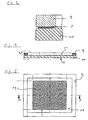
- Fig. 3 is a rectangular metallic carrier. 9 represented, on which a glass sheet 10 by means of a Glass solder layer 5 is attached.
- the invention differs from conventional methods, in which for the attachment of such rectangular Glass panes on metallic carriers so far metal layers had to be applied to the glass, which follow with a Metallot soldered to the carrier 9.
- the method according to the invention no longer requires one Such Metallevampfung, whereby this form of Fixing is very cost effective and time effective.
- the glass sheet 10 in housings optical CCD sensors, the glass sheet 10 an antireflection layer 11, 12th on one or both of their major surfaces.
- Fig. 5 is a plan view of the in Figs. 3 and Fig. 4 shows a rectangular optical cap illustrated is to recognize that the glass sheet 10 with finished housing For example, it can be arranged in front of a CCD array 13.
- CCD array 13 may also be micromechanical adjustable mirror systems, such as TV and Video projection devices or other elements with one encapsulated rectangular inlet or outlet window become.
- micromechanical adjustable mirror systems such as TV and Video projection devices or other elements with one encapsulated rectangular inlet or outlet window become.
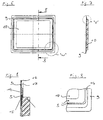
- Fig. 6 shows another embodiment of a Housing arrangement according to the invention, in which the Glass sheet 10 but not the same side dimensions as the metallic carrier 9 has.
- the metallic carrier 9 has in this embodiment a web 14 which defines a bead 15 in which the glass solder layer 5 on a defined by the carrier 9 Pad is arranged. Through the web 14 and the bead 15 the glass solder is bounded laterally and can also be softer, more flowable glass solder with lower viscosity Find use.
- a metallic edge region 16 of the further holder for example, serve on an external module 17.
- an external module 17 for example, for the plant a Seal for resealable housings or windows Use find or can by further Attachment techniques such as gluing or soldering external enclosures are attached.
- the metallic carrier can thus form part of a complex shaped housing structure, especially a larger housing cap.
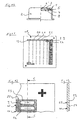
- FIG. 11 shows a mother plate 18, on which a plurality, preferably identically shaped window surfaces 19 to 24 is defined by the application of the glass solder layer 5.
- the glass solder layer 5 can indeed with Mehrnadeldispensern also be applied in this embodiment, however this is the technique of stencil printing, in particular the Screen printing preferred.
- the glass solder layer 5 can be applied to a one-piece mother plate 18 in a predefined form can be printed by heating a pre-glazing can be made and then along breaklines 25, 26 and 27, for example, by scribing and breaking the Mother plate 18 a separation of the discs or the window areas 19 to 24 performed become.
- the pre-glazing may be after or before the separation of the respective window areas 19 to 24 are made.
- a completely closed plumb line 26th be applied. This is done with the help of a dispenser 27, which has an annular nozzle 28 and preferably a time / pressure control device for the order process includes.
- the mother plate 18 shown in Fig. 11 also with a correspondingly shaped rectangular simple or multi-nozzle are printed stepwise, with a Stepper device each one offset preferably around the Width or length of a window surface of the windows 19 to 24 generated.
Landscapes
- Physics & Mathematics (AREA)
- General Physics & Mathematics (AREA)
- Optics & Photonics (AREA)
- Engineering & Computer Science (AREA)
- Microelectronics & Electronic Packaging (AREA)
- Electromagnetism (AREA)
- Condensed Matter Physics & Semiconductors (AREA)
- Joining Of Glass To Other Materials (AREA)
- Glass Compositions (AREA)
- Optical Couplings Of Light Guides (AREA)
- Semiconductor Lasers (AREA)
- Led Device Packages (AREA)
- Light Receiving Elements (AREA)
Description
Äußerst vorteilhaft ist es, wenn die Dosiervorrichtung ein mit einer Düse versehener Ring- oder Rechteckdispenser ist, denn dann kann bei entsprechender Auftragsgeometrie ein einziger, dosierter und vorzugsweise zeit/druckgesteuerter Auftrag ausreichen, um die benötigte Glaslotmenge vollständig aufzubringen.
Es zeigen:
- Fig. 1
- Teile eines Gehäusekörpers, welcher die Optokappe eines optoelektronischen Bauteils umfaßt, im vorliegenden Falle eines Halbleiterlasers, in einer Querschnittdarstellung in der Ebene der Längsachse X der Optokappe,
- Fig. 2
- einen Blick in die in Figur 1 dargestellte Optokappe in Richtung des Pfeiles Y aus Fig. 1,
- Fig. 3
- ein Detail einer Querschnittsansicht einer rechteckförmigen Optokappe, welche in deren Gesamtheit im Querschnitt in Fig. 4 dargestellt ist,
- Fig. 4
- eine Querschnittsansicht durch eine rechteckförmige Optokappe mit Angabe der Lage der Detaildarstellung gemäß Fig. 3,
- Fig. 5
- eine Aufsicht auf die in den Fig. 3 und 4 dargestellte rechteckförmige Optokappe,
- Fig. 6
- eine Aufsicht auf eine weitere Ausführungsform einer rechteckförmigen Optokappe,
- Fig. 7
- eine Querschnittsdarstellung der rechteckförmigen Optokappe aus Fig. 6 entlang in der in Fig. 6 dargestellten Eben BB,
- Fig. 8
- ein Detail der Fig. 7, welches in Fig. 7 mit V bezeichnet ist,
- Fig. 9
- ein Detail der Fig. 6, welches in Fig. 6 mit W bezeichnet ist,
- Fig. 10
- eine weiter Ausführungsform einer Optokappe in einer teilweisen Querschnittdarstellung in einer Ebene, welche die Längsachse X- dieser Optokappe umfaßt,
- Fig. 11
- eine Mutterscheibe mit einer Vielzahl von Fenstern welche jeweils zu eigenständig montagefähigen Einzelfenstern vereinzelbar sind,
- Fig. 12
- eine Detaildarstellung der in Fig. 11 dargestellten Mutterscheibe nach dem Aufbringen von Glaslot,
- Fig. 13
- eine Querschnittsdarstellung durch die Detailansicht der Fig. 12 entlang der Ebene CC,
- Fig. 14
- eine Querschnittsdarstellung durch eine Optokappe und einem Dispenser mit einer ring- oder rechteckförmigen Düse vor und nach dem Auftragen der Glaslotpaste.
Claims (28)
- Verfahren zum Herstellen eines Gehäusekörpers, oder zumindest von Teilen eines Gehäusekörpers, insbesondere zum Herstellen einer Verkapselung von optoelektronischen Bauteilen, umfassend
das Zusammenfügen eines Gehäuseelements mit einer, vorzugsweise metallischen, Gehäuseanordnung,
das in Kontakt bringen von Gehäuseelement und Gehäuseanordnung mit einem Glaslot,
dadurch gekennzeichnet, dass vor dem Zusammenfügen von Gehäuseelement und
Gehäuseanordnung das Glaslot als formbare Masse, insbesondere als Paste, aufgetragen wird,
dass durch zumindest einen einmaligen Energieeintrag, insbesondere durch Ausbrennen organischer Bestandteile, das Glaslot vorverglast und in seiner Form fixiert wird
und dass nach Einsetzen des Gehäuseelements in die Gehäuseanordnung durch Erwärmen eine zumindest bereichsweise hermetische Verbindung zwischen Gehäuseelement und Gehäuseanordnung hergestellt wird. - Verfahren nach Anspruch 1, dadurch gekennzeichnet, dass das Gehäuseelement ein Fenster, welches aus einer Glasscheibe besteht, und die Gehäuseanordnung eine Gehäusekappe umfasst.
- Verfahren nach Anspruch 1 oder 2, dadurch gekennzeichnet, dass das Auftragen der Glaslotpaste zumindest bereichsweise auf der Glasscheibe und/oder der Gehäusekappe erfolgt.
- Verfahren nach einem der Ansprüche 1, 2 oder 3, dadurch gekennzeichnet, dass das Auftragen der Glaslotpaste in die Gehäusekappe auf einer im Umfangsbereich angeordneten Auflagefläche erfolgt.
- Verfahren nach einem der Ansprüche von 1 bis 4, dadurch gekennzeichnet, dass das Auftragen der Glaslotpaste auf die Auflagefläche in der Gehäusekappe in einem durch eine Sicke von der übrigen Auflagefläche abgegrenzten Lotbereich erfolgt.
- Verfahren nach einem der Ansprüche von 1 bis 5, dadurch gekennzeichnet, dass das Auftragen der Glaslotpaste auf eine eckige, vorzugsweise eine rechteckige Glasscheibe oder Gehäusekappe erfolgt.
- Verfahren nach einem der Ansprüche von 1 bis 6, dadurch gekennzeichnet, dass die Glaslotpaste auf eine Antireflex- oder Antikratzschicht aufgetragen wird, welche an der Oberfläche des Gehäuselements, insbesondere des Fensters angeordnet ist.
- Verfahren nach einem der Ansprüche von 1 bis 7, dadurch gekennzeichnet, dass die Formgebung der Glaslotpaste, insbesondere der Querschnitt oder die Dicke einer aufgetragenen Strecke durch Einstellung der Pastenrheologie beeinflußt und/oder eingestellt wird.
- Verfahren nach einem der Ansprüche von 1 bis 8, dadurch gekennzeichnet, dass die Glaslotpaste mittels einer Dosiervorrichtung, insbesondere mittels eines Dispensers und vorzugsweise mittels eines Nadeldispensers, dosiert aufgetragen wird.
- Verfahren nach Anspruch 9, dadurch gekennzeichnet, dass die Dosiervorrichtung ein mit einer Düse versehener Ring- oder Rechteckdispenser ist.
- Verfahren nach Anspruch 9 oder 10, dadurch gekennzeichnet, dass durch Wahl der Dispensernadel oder der Abmessungen der Düse die Lotschnurdicke des pastenförmig aufgebrachten Glaslots beinflusst und/oder eingestellt wird.
- Verfahren nach Anspruch 9 bis 11, dadurch gekennzeichnet, dass das Glaslot durch eine Druck/Zeitsteuerung gesteuert aus der Nadel gepresst und/oder die Verfahrgeschwindigkeit der Dispensernadel zumindest während des Auftragens der Glaslotpaste eingestellt wird.
- Verfahren nach einem der Ansprüche von 1 bis 7, dadurch gekennzeichnet, dass die Glaslotpaste mittels Siebdrucktechnik vorzugsweise auf die Glasscheibe aufgetragen wird.
- Verfahren nach Anspruch 13, dadurch gekennzeichnet, dass die Formgebung der Glaslotpaste, insbesondere die Dicke der Lotschnur durch mehrfachen Auftrag beeinflußt und/oder eingestellt wird.
- Verfahren nach Anspruch 13 und 14, dadurch gekennzeichnet, dass die Formgebung der Glaslotpaste durch die Geometrie des Siebes und oder einer Druckschablone beeinflusst und/oder eingestellt wird.
- Verfahren nach einem der Ansprüche von 13 bis 15, dadurch gekennzeichnet, dass zunächst auf einer Mutterscheibe, welche eine Vielzahl von Einzelscheiben definiert oder umfasst, ein Glaslot in vordefinierter Flächengeometrie aufgebracht wird,
durch einen Energieeintrag, insbesondere durch Ausbrennen organischer Bestandteile das Glaslot vorverglast und in seiner Form fixiert wird,
Scheiben aus der Mutterscheibe vereinzelt werden und
die vereinzelte Scheibe mit vorverglastem Glaslot in die Gehäusekappe eingesetzt und
durch thermische Einwirkung eine hermetische Verbindung zwischen Glasscheibe und Gehäusekappe hergestellt wird. - Verfahren nach einem der Ansprüche von 12 bis 16, dadurch gekennzeichnet, dass die Scheibe aus der Mutterglasscheibe durch Ritzen und Brechen oder mittels Laserschneiden vereinzelt wird.
- Verfahren nach einem der Ansprüche von 1 bis 17, dadurch gekennzeichnet, dass ein Sinterglas-Formkörper und pasteuses Glaslot auf den Gehäusekörper und/oder das Gehäuseelement aufgebracht wird.
- Gehäusekörper, dadurch gekennzeichnet, daß dieser mit einem Verfahren gemäß einem der Ansprüche von 1 bis 18 hergestellt ist.
- Gehäusekörper nach Anspruch 19, dadurch gekennzeichnet, daß dieser einen Abschnitt eines vorverglasten Glaslots umfasst.
- Gehäusekörper nach Anspruch 19 oder 20 umfassend eine metallische, hülsenförmigen Kappe, ein Gehäuseelement, welches vorzugsweise eine als Fenster dienende Glasscheibe aufweist, sowie ein zwischen Fenster und Metallkappe angeordnetes Glaslot.
- Gehäusekörper nach Anspruch 21, dadurch gekennzeichnet, dass der Gehäusekörper eine Optokappe zur Verkapselung von optischen Bauelementen wie Laser oder Photodioden umfasst.
- Gehäusekörper nach Anspruch 22, umfassend eine runde oder rechteckige Metallhülse und eine zu einer inneren Stirnfläche der Metallhülse im wesentlichen kongruenten runde oder rechteckige Glasscheibe, welche stirnseitig die Metallhülse von deren Innenseite her berührt und ein auf Glasscheibe und / oder Metallhülse aufgetragenes Glaslot, welches mittels Dispensen oder Siebdruck aufgetragen ist.
- Gehäusekörper nach Anspruch 23, dadurch gekennzeichnet, dass die Metallhülse im Innern eine stirnseitig umlaufende Auflage besitzt, auf der die Glaslotpaste angeordnet ist.
- Gehäusekörper nach Anspruch 24, dadurch gekennzeichnet, dass die stirnseitig umlaufende Auflage eine Sicke besitzt, die einen für das Glaslot vorgesehenen Lotbereich von der übrigen Fläche der Auflage abgrenzt.
- Gehäusekörper nach einem der Ansprüche von 19 bis 25, dadurch gekennzeichnet, dass die Ebene der umlaufenden Auflage relativ zu einer Längsachse des Gehäusekörpers geneigt ist.
- Gehäusekörper nach einem der Ansprüche von 19 bis 26, dadurch gekennzeichnet, dass die Glasscheibe mit einer Antireflex- und/oder Antikratzschicht versehen ist und auf die geneigte Auflage aufgelötet ist.
- Gehäusekörper nach Anspruch 21, dadurch gekennzeichnet, dass das Gehäuseelement ein optisches Element umfasst, welches eine Linse, Zylinderlinse oder sphärische Linse ist.
Applications Claiming Priority (3)
| Application Number | Priority Date | Filing Date | Title |
|---|---|---|---|
| DE10224710 | 2002-06-03 | ||
| DE10224710A DE10224710B4 (de) | 2002-06-04 | 2002-06-04 | Verfahren zur hermetischen Gehäusung von optischen Bauelementen sowie verfahrensgemäß hergestellte optische Bauelemente |
| PCT/EP2003/003649 WO2003103358A1 (de) | 2002-06-03 | 2003-04-09 | Verfahren zur hermetischen gehäusung von optischen bauelementen sowie verfahrensgemäss hergestellte optische bauelemente |
Publications (3)
| Publication Number | Publication Date |
|---|---|
| EP1510112A1 EP1510112A1 (de) | 2005-03-02 |
| EP1510112B1 true EP1510112B1 (de) | 2005-12-21 |
| EP1510112B8 EP1510112B8 (de) | 2006-04-05 |
Family
ID=29594244
Family Applications (1)
| Application Number | Title | Priority Date | Filing Date |
|---|---|---|---|
| EP03724979A Expired - Lifetime EP1510112B8 (de) | 2002-06-04 | 2003-04-09 | Verfahren zur hermetischen gehäusung von optischen bauelementen sowie verfahrensgemäss hergestellte optische bauelemente |
Country Status (10)
| Country | Link |
|---|---|
| US (1) | US7368758B2 (de) |
| EP (1) | EP1510112B8 (de) |
| JP (1) | JP2005531478A (de) |
| KR (2) | KR20050030898A (de) |
| CN (1) | CN1297183C (de) |
| AT (1) | ATE313933T1 (de) |
| AU (1) | AU2003227579A1 (de) |
| CA (1) | CA2485498C (de) |
| DE (2) | DE10224710B4 (de) |
| WO (1) | WO2003103358A1 (de) |
Families Citing this family (10)
| Publication number | Priority date | Publication date | Assignee | Title |
|---|---|---|---|---|
| DE10016628A1 (de) * | 2000-04-04 | 2001-10-18 | Schott Glas | Verfahren zum Herstellen von kleinen Dünnglasscheiben und größere Dünnglasscheibe als Halbfabrikat für dieses Herstellen |
| CN1856683B (zh) * | 2004-01-22 | 2011-07-06 | 欧洲原子能研究组织 | 易排空的平板太阳能收集器 |
| FR2894037B1 (fr) * | 2005-11-28 | 2007-12-28 | Alcatel Sa | Instrument optique comprenant une cavite d'entree dans laquelle est place un miroir |
| DE102006031358A1 (de) * | 2006-07-05 | 2008-01-17 | Schott Ag | Verfahren zur Gehäusung optischer oder optoelektronischer Bauteile, sowie verfahrensgemäß herstellbares optisches oder optoelektronisches Gehäuseelement |
| DE102007050002A1 (de) * | 2007-10-16 | 2009-04-23 | Fraunhofer-Gesellschaft zur Förderung der angewandten Forschung e.V. | Mikromechanisches Sensor- oder Aktorbauelement und Verfahren zur Herstellung von mikromechanischen Sensor- oder Aktorbauelementen |
| DE102013007703A1 (de) * | 2013-05-03 | 2014-11-06 | Forschungszentrum Jülich GmbH | Verfahren zur Herstellung einer Glaslot-Gründichtung |
| DE102016215322A1 (de) | 2016-08-17 | 2018-02-22 | Robert Bosch Gmbh | Gehäuse und Verfahren zur Herstellung eines Gehäuses |
| DE102016215361A1 (de) | 2016-08-17 | 2018-02-22 | Robert Bosch Gmbh | Gehäuse und Verfahren zur Herstellung eines Gehäuses |
| JP6805081B2 (ja) | 2017-05-26 | 2020-12-23 | 新光電気工業株式会社 | 発光装置用蓋体 |
| CN109632875B (zh) * | 2018-12-29 | 2021-08-03 | 湖北航天技术研究院总体设计所 | 一种模拟抛罩气动加热光学头罩的热性能试验系统及方法 |
Family Cites Families (21)
| Publication number | Priority date | Publication date | Assignee | Title |
|---|---|---|---|---|
| DE1596849B2 (de) * | 1967-01-10 | 1973-06-14 | Jenaer Glaswerk Schott & Gen , 6500 Mainz | Verfahren zum herstellen von glasmetall-verschmelzungen mit einschmelzleitern aus reaktions- und sorptionsaktiven stoffen |
| US3983771A (en) * | 1975-11-28 | 1976-10-05 | Ppg Industries, Inc. | Apparatus for precise subdivision of glass sheets |
| NL7904283A (nl) * | 1979-05-31 | 1980-12-02 | Philips Nv | Koppelelement met een lichtbron en en lensvormig element. |
| DE3137685C2 (de) * | 1981-09-22 | 1983-11-03 | Siemens AG, 1000 Berlin und 8000 München | Leuchtdiode für Signalleuchten. |
| JPS5925284A (ja) * | 1982-08-03 | 1984-02-09 | Nec Corp | 光半導体装置 |
| DE3729411A1 (de) | 1987-09-03 | 1989-03-16 | Diehl Gmbh & Co | Optik fuer strahlungssensor |
| DE3742893A1 (de) * | 1987-12-17 | 1989-07-06 | Siemens Ag | Verfahren zur partiellen metallisierung von faserfoermigen festkoerpern, insbesondere lichtwellenleitern, und vorrichtung zur durchfuehrung des verfahrens |
| DE3830149A1 (de) | 1988-09-05 | 1990-03-15 | Siemens Ag | Optische linse zum hermetischen dichten verschliessen von gehaeusen |
| US5255333A (en) * | 1989-08-09 | 1993-10-19 | Siemens Aktiengesellschaft | Opto-electronic transducer arrangement having a lens-type optical coupling |
| US5140384A (en) * | 1990-06-14 | 1992-08-18 | Rohm Co., Ltd. | Semiconductor laser device mounted on a stem |
| US5274502A (en) * | 1991-10-31 | 1993-12-28 | Corning Incorporated | Molded lens with integral mount and method |
| US5323051A (en) * | 1991-12-16 | 1994-06-21 | Motorola, Inc. | Semiconductor wafer level package |
| JP3144279B2 (ja) * | 1995-09-18 | 2001-03-12 | 株式会社村田製作所 | センサ製造用パレット及び赤外線センサの製造方法 |
| KR100436467B1 (ko) | 1995-11-14 | 2004-08-09 | 로무 가부시키가이샤 | 반도체레이저및그제조방법 |
| JP3423855B2 (ja) * | 1996-04-26 | 2003-07-07 | 株式会社デンソー | 電子部品搭載用構造体および電子部品の実装方法 |
| JPH09307144A (ja) * | 1996-05-14 | 1997-11-28 | Matsushita Electric Ind Co Ltd | 発光素子及びその製造方法 |
| US6420205B1 (en) * | 1999-03-24 | 2002-07-16 | Kyocera Corporation | Method for producing package for housing photosemiconductor element |
| AU2001266071A1 (en) * | 2000-06-21 | 2001-11-12 | Carl-Zeiss-Stiftung Trading As Schott Glas | Method for working glass sheets |
| US6536958B2 (en) * | 2000-12-20 | 2003-03-25 | Triquint Technology Holding Co. | Optical device package with hermetically bonded fibers |
| AT5153U1 (de) * | 2001-03-22 | 2002-03-25 | Avl List Gmbh | Optischer sensor zur erfassung von verbrennungsvorgängen |
| US6627814B1 (en) * | 2002-03-22 | 2003-09-30 | David H. Stark | Hermetically sealed micro-device package with window |
-
2002
- 2002-06-04 DE DE10224710A patent/DE10224710B4/de not_active Expired - Lifetime
-
2003
- 2003-04-09 CN CNB038129256A patent/CN1297183C/zh not_active Expired - Lifetime
- 2003-04-09 DE DE50302009T patent/DE50302009D1/de not_active Expired - Fee Related
- 2003-04-09 AT AT03724979T patent/ATE313933T1/de not_active IP Right Cessation
- 2003-04-09 CA CA2485498A patent/CA2485498C/en not_active Expired - Lifetime
- 2003-04-09 US US10/515,034 patent/US7368758B2/en not_active Expired - Lifetime
- 2003-04-09 KR KR1020047019778A patent/KR20050030898A/ko not_active Ceased
- 2003-04-09 EP EP03724979A patent/EP1510112B8/de not_active Expired - Lifetime
- 2003-04-09 AU AU2003227579A patent/AU2003227579A1/en not_active Abandoned
- 2003-04-09 JP JP2004510299A patent/JP2005531478A/ja active Pending
- 2003-04-09 KR KR1020087031341A patent/KR20090007498A/ko not_active Ceased
- 2003-04-09 WO PCT/EP2003/003649 patent/WO2003103358A1/de not_active Ceased
Also Published As
| Publication number | Publication date |
|---|---|
| CN1659940A (zh) | 2005-08-24 |
| DE10224710A1 (de) | 2004-01-08 |
| US20050224827A1 (en) | 2005-10-13 |
| KR20050030898A (ko) | 2005-03-31 |
| DE50302009D1 (de) | 2006-01-26 |
| EP1510112A1 (de) | 2005-03-02 |
| KR20090007498A (ko) | 2009-01-16 |
| CA2485498A1 (en) | 2003-12-11 |
| DE10224710B4 (de) | 2005-12-08 |
| US7368758B2 (en) | 2008-05-06 |
| AU2003227579A1 (en) | 2003-12-19 |
| WO2003103358A1 (de) | 2003-12-11 |
| CA2485498C (en) | 2012-05-29 |
| ATE313933T1 (de) | 2006-01-15 |
| EP1510112B8 (de) | 2006-04-05 |
| JP2005531478A (ja) | 2005-10-20 |
| CN1297183C (zh) | 2007-01-24 |
Similar Documents
| Publication | Publication Date | Title |
|---|---|---|
| DE112009001347T5 (de) | Schmelzverbindungsprozess für Glas | |
| DE3138296C2 (de) | ||
| DE102010062118B4 (de) | Herstellungsverfahren für eine Abdeckvorrichtung für ein mikro-opto-mechanisches Bauteil | |
| DE69412906T2 (de) | Glaspolyedern und Verfahren zu ihrer Herstellung | |
| DE112009001326T5 (de) | Schmelzverbindungsprozess für Glas | |
| DE102005024497B4 (de) | Verfahren zum mechanischen Brechen von geritzten flachen Werkstücken aus sprödbrüchigem Material | |
| DE10224710B4 (de) | Verfahren zur hermetischen Gehäusung von optischen Bauelementen sowie verfahrensgemäß hergestellte optische Bauelemente | |
| WO2008006504A2 (de) | Verfahren zur herstellung optoelektronischer bauelemente und damit hergestellte erzeugnisse | |
| DE112004000581T5 (de) | Verfahren zum Schneiden von Glas | |
| EP0428575A1 (de) | Verfahren zum beschriften von verbundbauteilen mit laserstrahlung und mit diesem verfahren hergestelltes verbundbauteil | |
| DE102018111898B4 (de) | Verfahren zur Herstellung eines Gehäuses für ein optoelektronisches Bauelement | |
| EP2520394B1 (de) | Vorrichtung und Verfahren zum Randentschichten und Kerben beschichteter Substrate mit zwei von der gleichen Seite auf das beschichtete transparente Substrat einwirkenden Laserquellen | |
| EP4429999A1 (de) | Hermetisch verbundene anordnung | |
| DE19901623B4 (de) | Verfahren und Vorrichtung zur thermischen Verbindung von Anschlußflächen zweier Substrate | |
| DE68925224T2 (de) | Verfahren zur Herstellung einer Farbkathodenstrahlröhre und Farbkathodenstrahlröhre | |
| DE2924068C2 (de) | Verfahren zur Herstellung koplanarer optoelektronischer Koppelelemente | |
| DE102017127597A1 (de) | Optoelektronisches bauelement und verfahren zum herstellen eines optoelektronischen bauelements | |
| EP1607781B1 (de) | Anordnung eines mikrooptischen Bauelements auf einem Substrat, Verfahren zur Justierung der Anordnung und optisches System mit der Anordnung | |
| DE69027039T2 (de) | Geteilter schattenmaskenträgerrahmen und verfahren für eine farbkathodenstrahlröhre mit gespannter flachmaske | |
| EP0887118A2 (de) | Verfahren und Vorrichtung zur Reparatur kleiner Lackfehler in Lackschichten | |
| EP0867418B1 (de) | Verfahren und Vorrichtung zur Erzeugung von grossflächigen Präzisionsstrukturen auf Flachglas | |
| AT523200B1 (de) | Vorrichtung zur additiven fertigung | |
| DE69708564T2 (de) | Flüssigkristallanzeigeeinheit und deren Herstellungsverfahren | |
| WO2019214867A1 (de) | Herstellungsverfahren für eine mikromechanische vorrichtung mit geneigten optischen fenstern und entsprechende mikromechanische vorrichtung | |
| EP4519201A1 (de) | Verfahren zur herstellung eines verbund-kappenelements und verbund-kappenelement |
Legal Events
| Date | Code | Title | Description |
|---|---|---|---|
| PUAI | Public reference made under article 153(3) epc to a published international application that has entered the european phase |
Free format text: ORIGINAL CODE: 0009012 |
|
| 17P | Request for examination filed |
Effective date: 20041106 |
|
| AK | Designated contracting states |
Kind code of ref document: A1 Designated state(s): AT BE BG CH CY CZ DE DK EE ES FI FR GB GR HU IE IT LI LU MC NL PT RO SE SI SK TR |
|
| AX | Request for extension of the european patent |
Extension state: AL LT LV MK |
|
| GRAP | Despatch of communication of intention to grant a patent |
Free format text: ORIGINAL CODE: EPIDOSNIGR1 |
|
| GRAS | Grant fee paid |
Free format text: ORIGINAL CODE: EPIDOSNIGR3 |
|
| GRAA | (expected) grant |
Free format text: ORIGINAL CODE: 0009210 |
|
| RIN1 | Information on inventor provided before grant (corrected) |
Inventor name: SAUSENTHALER, EDELTRAUD Inventor name: MUND, DIETRICH Inventor name: MAYER, MARKUS Inventor name: SCHACHTLBAUER, KLAUS Inventor name: HAMMER, BERND Inventor name: HETTLER, ROBERT |
|
| AK | Designated contracting states |
Kind code of ref document: B1 Designated state(s): AT BE BG CH CY CZ DE DK EE ES FI FR GB GR HU IE IT LI LU MC NL PT RO SE SI SK TR |
|
| PG25 | Lapsed in a contracting state [announced via postgrant information from national office to epo] |
Ref country code: IT Free format text: LAPSE BECAUSE OF FAILURE TO SUBMIT A TRANSLATION OF THE DESCRIPTION OR TO PAY THE FEE WITHIN THE PRESCRIBED TIME-LIMIT;WARNING: LAPSES OF ITALIAN PATENTS WITH EFFECTIVE DATE BEFORE 2007 MAY HAVE OCCURRED AT ANY TIME BEFORE 2007. THE CORRECT EFFECTIVE DATE MAY BE DIFFERENT FROM THE ONE RECORDED. Effective date: 20051221 Ref country code: CZ Free format text: LAPSE BECAUSE OF FAILURE TO SUBMIT A TRANSLATION OF THE DESCRIPTION OR TO PAY THE FEE WITHIN THE PRESCRIBED TIME-LIMIT Effective date: 20051221 Ref country code: RO Free format text: LAPSE BECAUSE OF FAILURE TO SUBMIT A TRANSLATION OF THE DESCRIPTION OR TO PAY THE FEE WITHIN THE PRESCRIBED TIME-LIMIT Effective date: 20051221 Ref country code: SI Free format text: LAPSE BECAUSE OF FAILURE TO SUBMIT A TRANSLATION OF THE DESCRIPTION OR TO PAY THE FEE WITHIN THE PRESCRIBED TIME-LIMIT Effective date: 20051221 Ref country code: FI Free format text: LAPSE BECAUSE OF FAILURE TO SUBMIT A TRANSLATION OF THE DESCRIPTION OR TO PAY THE FEE WITHIN THE PRESCRIBED TIME-LIMIT Effective date: 20051221 Ref country code: NL Free format text: LAPSE BECAUSE OF FAILURE TO SUBMIT A TRANSLATION OF THE DESCRIPTION OR TO PAY THE FEE WITHIN THE PRESCRIBED TIME-LIMIT Effective date: 20051221 Ref country code: SK Free format text: LAPSE BECAUSE OF FAILURE TO SUBMIT A TRANSLATION OF THE DESCRIPTION OR TO PAY THE FEE WITHIN THE PRESCRIBED TIME-LIMIT Effective date: 20051221 Ref country code: IE Free format text: LAPSE BECAUSE OF FAILURE TO SUBMIT A TRANSLATION OF THE DESCRIPTION OR TO PAY THE FEE WITHIN THE PRESCRIBED TIME-LIMIT Effective date: 20051221 |
|
| REG | Reference to a national code |
Ref country code: GB Ref legal event code: FG4D Free format text: NOT ENGLISH |
|
| REG | Reference to a national code |
Ref country code: CH Ref legal event code: EP |
|
| GBT | Gb: translation of ep patent filed (gb section 77(6)(a)/1977) |
Effective date: 20051221 |
|
| REG | Reference to a national code |
Ref country code: IE Ref legal event code: FG4D Free format text: LANGUAGE OF EP DOCUMENT: GERMAN |
|
| REF | Corresponds to: |
Ref document number: 50302009 Country of ref document: DE Date of ref document: 20060126 Kind code of ref document: P |
|
| PG25 | Lapsed in a contracting state [announced via postgrant information from national office to epo] |
Ref country code: GR Free format text: LAPSE BECAUSE OF FAILURE TO SUBMIT A TRANSLATION OF THE DESCRIPTION OR TO PAY THE FEE WITHIN THE PRESCRIBED TIME-LIMIT Effective date: 20060321 Ref country code: BG Free format text: LAPSE BECAUSE OF FAILURE TO SUBMIT A TRANSLATION OF THE DESCRIPTION OR TO PAY THE FEE WITHIN THE PRESCRIBED TIME-LIMIT Effective date: 20060321 Ref country code: DK Free format text: LAPSE BECAUSE OF FAILURE TO SUBMIT A TRANSLATION OF THE DESCRIPTION OR TO PAY THE FEE WITHIN THE PRESCRIBED TIME-LIMIT Effective date: 20060321 Ref country code: SE Free format text: LAPSE BECAUSE OF FAILURE TO SUBMIT A TRANSLATION OF THE DESCRIPTION OR TO PAY THE FEE WITHIN THE PRESCRIBED TIME-LIMIT Effective date: 20060321 |
|
| PG25 | Lapsed in a contracting state [announced via postgrant information from national office to epo] |
Ref country code: ES Free format text: LAPSE BECAUSE OF FAILURE TO SUBMIT A TRANSLATION OF THE DESCRIPTION OR TO PAY THE FEE WITHIN THE PRESCRIBED TIME-LIMIT Effective date: 20060401 |
|
| PG25 | Lapsed in a contracting state [announced via postgrant information from national office to epo] |
Ref country code: AT Free format text: LAPSE BECAUSE OF NON-PAYMENT OF DUE FEES Effective date: 20060409 |
|
| PGFP | Annual fee paid to national office [announced via postgrant information from national office to epo] |
Ref country code: DE Payment date: 20060419 Year of fee payment: 4 |
|
| PG25 | Lapsed in a contracting state [announced via postgrant information from national office to epo] |
Ref country code: BE Free format text: LAPSE BECAUSE OF NON-PAYMENT OF DUE FEES Effective date: 20060430 Ref country code: MC Free format text: LAPSE BECAUSE OF NON-PAYMENT OF DUE FEES Effective date: 20060430 |
|
| PG25 | Lapsed in a contracting state [announced via postgrant information from national office to epo] |
Ref country code: PT Free format text: LAPSE BECAUSE OF FAILURE TO SUBMIT A TRANSLATION OF THE DESCRIPTION OR TO PAY THE FEE WITHIN THE PRESCRIBED TIME-LIMIT Effective date: 20060522 |
|
| NLV1 | Nl: lapsed or annulled due to failure to fulfill the requirements of art. 29p and 29m of the patents act | ||
| PG25 | Lapsed in a contracting state [announced via postgrant information from national office to epo] |
Ref country code: HU Free format text: LAPSE BECAUSE OF FAILURE TO SUBMIT A TRANSLATION OF THE DESCRIPTION OR TO PAY THE FEE WITHIN THE PRESCRIBED TIME-LIMIT Effective date: 20060622 |
|
| REG | Reference to a national code |
Ref country code: IE Ref legal event code: FD4D |
|
| ET | Fr: translation filed | ||
| PLBE | No opposition filed within time limit |
Free format text: ORIGINAL CODE: 0009261 |
|
| STAA | Information on the status of an ep patent application or granted ep patent |
Free format text: STATUS: NO OPPOSITION FILED WITHIN TIME LIMIT |
|
| 26N | No opposition filed |
Effective date: 20060922 |
|
| REG | Reference to a national code |
Ref country code: CH Ref legal event code: PL |
|
| BERE | Be: lapsed |
Owner name: SCHOTT A.G. Effective date: 20060430 |
|
| PG25 | Lapsed in a contracting state [announced via postgrant information from national office to epo] |
Ref country code: DE Free format text: LAPSE BECAUSE OF NON-PAYMENT OF DUE FEES Effective date: 20071101 |
|
| PG25 | Lapsed in a contracting state [announced via postgrant information from national office to epo] |
Ref country code: CH Free format text: LAPSE BECAUSE OF NON-PAYMENT OF DUE FEES Effective date: 20070430 Ref country code: LI Free format text: LAPSE BECAUSE OF NON-PAYMENT OF DUE FEES Effective date: 20070430 |
|
| PG25 | Lapsed in a contracting state [announced via postgrant information from national office to epo] |
Ref country code: EE Free format text: LAPSE BECAUSE OF FAILURE TO SUBMIT A TRANSLATION OF THE DESCRIPTION OR TO PAY THE FEE WITHIN THE PRESCRIBED TIME-LIMIT Effective date: 20051221 |
|
| PG25 | Lapsed in a contracting state [announced via postgrant information from national office to epo] |
Ref country code: LU Free format text: LAPSE BECAUSE OF NON-PAYMENT OF DUE FEES Effective date: 20060409 Ref country code: TR Free format text: LAPSE BECAUSE OF FAILURE TO SUBMIT A TRANSLATION OF THE DESCRIPTION OR TO PAY THE FEE WITHIN THE PRESCRIBED TIME-LIMIT Effective date: 20051221 |
|
| PG25 | Lapsed in a contracting state [announced via postgrant information from national office to epo] |
Ref country code: CY Free format text: LAPSE BECAUSE OF FAILURE TO SUBMIT A TRANSLATION OF THE DESCRIPTION OR TO PAY THE FEE WITHIN THE PRESCRIBED TIME-LIMIT Effective date: 20051221 |
|
| REG | Reference to a national code |
Ref country code: FR Ref legal event code: PLFP Year of fee payment: 14 |
|
| REG | Reference to a national code |
Ref country code: FR Ref legal event code: PLFP Year of fee payment: 15 |
|
| REG | Reference to a national code |
Ref country code: FR Ref legal event code: PLFP Year of fee payment: 16 |
|
| PGFP | Annual fee paid to national office [announced via postgrant information from national office to epo] |
Ref country code: GB Payment date: 20220420 Year of fee payment: 20 Ref country code: FR Payment date: 20220420 Year of fee payment: 20 |
|
| REG | Reference to a national code |
Ref country code: GB Ref legal event code: PE20 Expiry date: 20230408 |
|
| PG25 | Lapsed in a contracting state [announced via postgrant information from national office to epo] |
Ref country code: GB Free format text: LAPSE BECAUSE OF EXPIRATION OF PROTECTION Effective date: 20230408 |