EP1500427A2 - Emulgator für dünnflüssige W/O-Emulsionen auf Basis von teilvernetzten Polyglycerinestern der Polyhydroxystearinsäure - Google Patents
Emulgator für dünnflüssige W/O-Emulsionen auf Basis von teilvernetzten Polyglycerinestern der Polyhydroxystearinsäure Download PDFInfo
- Publication number
- EP1500427A2 EP1500427A2 EP04016322A EP04016322A EP1500427A2 EP 1500427 A2 EP1500427 A2 EP 1500427A2 EP 04016322 A EP04016322 A EP 04016322A EP 04016322 A EP04016322 A EP 04016322A EP 1500427 A2 EP1500427 A2 EP 1500427A2
- Authority
- EP
- European Patent Office
- Prior art keywords
- acid
- polyglycerol
- acids
- mol
- esterification
- Prior art date
- Legal status (The legal status is an assumption and is not a legal conclusion. Google has not performed a legal analysis and makes no representation as to the accuracy of the status listed.)
- Granted
Links
Classifications
-
- C—CHEMISTRY; METALLURGY
- C08—ORGANIC MACROMOLECULAR COMPOUNDS; THEIR PREPARATION OR CHEMICAL WORKING-UP; COMPOSITIONS BASED THEREON
- C08G—MACROMOLECULAR COMPOUNDS OBTAINED OTHERWISE THAN BY REACTIONS ONLY INVOLVING UNSATURATED CARBON-TO-CARBON BONDS
- C08G63/00—Macromolecular compounds obtained by reactions forming a carboxylic ester link in the main chain of the macromolecule
- C08G63/66—Polyesters containing oxygen in the form of ether groups
-
- A—HUMAN NECESSITIES
- A61—MEDICAL OR VETERINARY SCIENCE; HYGIENE
- A61K—PREPARATIONS FOR MEDICAL, DENTAL OR TOILETRY PURPOSES
- A61K47/00—Medicinal preparations characterised by the non-active ingredients used, e.g. carriers or inert additives; Targeting or modifying agents chemically bound to the active ingredient
- A61K47/06—Organic compounds, e.g. natural or synthetic hydrocarbons, polyolefins, mineral oil, petrolatum or ozokerite
- A61K47/08—Organic compounds, e.g. natural or synthetic hydrocarbons, polyolefins, mineral oil, petrolatum or ozokerite containing oxygen, e.g. ethers, acetals, ketones, quinones, aldehydes, peroxides
- A61K47/14—Esters of carboxylic acids, e.g. fatty acid monoglycerides, medium-chain triglycerides, parabens or PEG fatty acid esters
-
- A—HUMAN NECESSITIES
- A61—MEDICAL OR VETERINARY SCIENCE; HYGIENE
- A61K—PREPARATIONS FOR MEDICAL, DENTAL OR TOILETRY PURPOSES
- A61K8/00—Cosmetics or similar toiletry preparations
- A61K8/02—Cosmetics or similar toiletry preparations characterised by special physical form
- A61K8/04—Dispersions; Emulsions
- A61K8/06—Emulsions
-
- A—HUMAN NECESSITIES
- A61—MEDICAL OR VETERINARY SCIENCE; HYGIENE
- A61K—PREPARATIONS FOR MEDICAL, DENTAL OR TOILETRY PURPOSES
- A61K8/00—Cosmetics or similar toiletry preparations
- A61K8/02—Cosmetics or similar toiletry preparations characterised by special physical form
- A61K8/04—Dispersions; Emulsions
- A61K8/06—Emulsions
- A61K8/064—Water-in-oil emulsions, e.g. Water-in-silicone emulsions
-
- A—HUMAN NECESSITIES
- A61—MEDICAL OR VETERINARY SCIENCE; HYGIENE
- A61K—PREPARATIONS FOR MEDICAL, DENTAL OR TOILETRY PURPOSES
- A61K8/00—Cosmetics or similar toiletry preparations
- A61K8/18—Cosmetics or similar toiletry preparations characterised by the composition
- A61K8/30—Cosmetics or similar toiletry preparations characterised by the composition containing organic compounds
- A61K8/33—Cosmetics or similar toiletry preparations characterised by the composition containing organic compounds containing oxygen
- A61K8/39—Derivatives containing from 2 to 10 oxyalkylene groups
-
- A—HUMAN NECESSITIES
- A61—MEDICAL OR VETERINARY SCIENCE; HYGIENE
- A61K—PREPARATIONS FOR MEDICAL, DENTAL OR TOILETRY PURPOSES
- A61K9/00—Medicinal preparations characterised by special physical form
- A61K9/10—Dispersions; Emulsions
- A61K9/107—Emulsions ; Emulsion preconcentrates; Micelles
-
- A—HUMAN NECESSITIES
- A61—MEDICAL OR VETERINARY SCIENCE; HYGIENE
- A61Q—SPECIFIC USE OF COSMETICS OR SIMILAR TOILETRY PREPARATIONS
- A61Q19/00—Preparations for care of the skin
-
- C—CHEMISTRY; METALLURGY
- C07—ORGANIC CHEMISTRY
- C07C—ACYCLIC OR CARBOCYCLIC COMPOUNDS
- C07C69/00—Esters of carboxylic acids; Esters of carbonic or haloformic acids
- C07C69/66—Esters of carboxylic acids having esterified carboxylic groups bound to acyclic carbon atoms and having any of the groups OH, O—metal, —CHO, keto, ether, acyloxy, groups, groups, or in the acid moiety
- C07C69/67—Esters of carboxylic acids having esterified carboxylic groups bound to acyclic carbon atoms and having any of the groups OH, O—metal, —CHO, keto, ether, acyloxy, groups, groups, or in the acid moiety of saturated acids
- C07C69/675—Esters of carboxylic acids having esterified carboxylic groups bound to acyclic carbon atoms and having any of the groups OH, O—metal, —CHO, keto, ether, acyloxy, groups, groups, or in the acid moiety of saturated acids of saturated hydroxy-carboxylic acids
-
- C—CHEMISTRY; METALLURGY
- C09—DYES; PAINTS; POLISHES; NATURAL RESINS; ADHESIVES; COMPOSITIONS NOT OTHERWISE PROVIDED FOR; APPLICATIONS OF MATERIALS NOT OTHERWISE PROVIDED FOR
- C09K—MATERIALS FOR MISCELLANEOUS APPLICATIONS, NOT PROVIDED FOR ELSEWHERE
- C09K23/00—Use of substances as emulsifying, wetting, dispersing, or foam-producing agents
- C09K23/34—Higher-molecular-weight carboxylic acid esters
Definitions
- the invention includes their preparation and use as W / O emulsifiers in cosmetic or pharmaceutical preparations and as an aid for the dispersion of inorganic Micropigments in oil dispersions.
- a generally desirable goal is therefore water-in-oil emulsions as easily as possible, i. low viscosity like oil-in-water emulsions to do without their special To give up care effect.
- it is the task preferably low viscosity, non-sticky and yet stable To allow water-in-oil emulsions.
- Emulsifier use a special key role too.
- Coemulsifiers in particular ethylene oxide adducts in combination with metal soaps, expand the scope only on paraffin oil lotions.
- the polyglycerol esters of dimeric and polymerized C 18 unsaturated fatty acids are obtained from the mono- and diglycerides of vegetable oils, preferably soybean oil, by a thermal treatment lasting several hours at about 300 ° C. or by the transesterification of a thermally polymerized vegetable oil with polyglycerol.
- Polyglycerol polyricinoleates are also powerful W / O emulsifiers (DE-B-44 09 569).
- the chemically related to the polyglycerol polyricinoleate also Polyglycerol polyhydroxystearate producible from vegetable raw materials has a satisfactory sensory quality and has the basic ability to form creamy and especially flowable W / O emulsions.
- esters of polycarboxylic acids with Polyhydroxy compounds proposed.
- condensation of Starting compounds are obtained with excess products Carboxyl groups, which are subsequently neutralized.
- the Reaction products are suitable as O / W emulsifiers.
- EP-B-0 835 862 describes polyglycerol partial esters, obtainable by esterification of a polyglycerine mixture with a degree of esterification of polyglycerol between 30 and 75% and saturated or unsaturated, linear or branched Fatty acids with 12 to 22 carbon atoms and dimer fatty acids with an average functionality of 2 to 2.4. These possess compared to the polyglycerol polyhydroxystearate the additional advantage of improved stability, in particular a higher freeze-thaw load capacity of the produced therewith W / O emulsions. The emulsions are still relatively thick and cause a slightly sticky Skin feel.
- freeze-thaw load capacity is for the Transport and storage of emulsion preparations of considerable practical interest.
- prolonged storage at very low temperatures or extreme temperature fluctuations For longer transport routes, the insufficient Emulsion stabilization by clear water deposits in the emulsion preparation or even to complete refraction lead the emulsion.
- the object of the invention was an emulsifier develop the formulation of low-viscosity emulsions allows a pleasant feeling on the skin and at the same time a have improved freeze-thaw resistance.
- Another object of the invention is the use of the Polyglycerolpartialester according to the invention as W / O emulsifiers in cosmetic or pharmaceutical preparations.
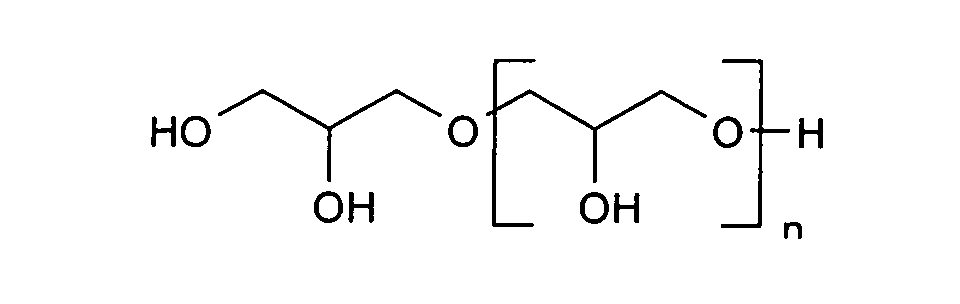
- polyglycerols are in particular those of the general formula with an average condensation degree n of 1 to 11, preferably 2 to 6, particularly preferably 3 to 6 and hydroxyl numbers of about 1350 to about 800, preferably about 1200 to about 900 suitable.
- polyglycerol mixtures the z. B. by alkaline catalyzed condensation of glycerol obtained at elevated temperatures, from which optionally by distillation process fractions can be obtained with the desired degree of condensation.
- polyglycerols which, by other means, z. B. from epichlorohydrin or glycidol are obtained.
- the dimer fatty acids used are known a mixture of acyclic and cyclic dicarboxylic acids, by a catalyzed dimerization of unsaturated Fatty acids with 12 to 22 carbon atoms can be obtained and an average functionality of 2 to 3, preferably about 2 exhibit. They may also be of minor extent polymeric Contain fatty acids (trimeric and higher functional).
- the Acid numbers are in the range of 150 to 290, preferably 190 up to 200.
- dimer acids For the production and use of dimer acids and their physical properties and chemical properties is also on the Publication "The Dimer Acids: The chemical and physical properties, reactions and applications ", Ed E.C. Leonard; Humko Sheffield Chemical, 1975, Memphis, Tenn.,.
- Emulsifiers particularly suitable for the purpose of the invention as Emulsifiers is the use of relatively short chain di- or Tricarboxylic acids instead of dimer acids, such as oxalic acid, Malonic acid, succinic acid, glutaric acid, adipic acid, pimelic acid, Casric acid, azelaic acid, sebacic acid, dodecanedioic acid. Also suitable are hydroxydi- or -tricarboxylic acids, such as malic acid, tartaric acid, citric acid.
- alkanedicarboxylic acids with 4 to 14 C atoms.
- fatty acid components are especially saturated fatty acids, such as lauric acid, tridecanoic acid, myristic acid, Palmitic acid, margaric acid, stearic acid, Isostearic acid, arachidic acid and behenic acid and mixtures thereof.
- saturated fatty acids such as lauric acid, tridecanoic acid, myristic acid, Palmitic acid, margaric acid, stearic acid, Isostearic acid, arachidic acid and behenic acid and mixtures thereof.
- Naturally occurring mixtures are, for example, the coconut fatty acids which contain lauric acid as the main constituent, but also saturated C 14 - to C 18 -fatty acids and optionally saturated C 8 - to C 10 -fatty acids and unsaturated fatty acids, and tallow fatty acids which essentially comprise a mixture of palmitic acid and stearic acid.
- additional unsaturated fatty acid components are suitable monoolefinic unsaturated acids, for example hexadecenoic acids, Octadecenoic acids, such as oleic acid (cis-9-octadecenoic acid) or elaidic acid (trans-9-octadecenoic acid), eicosenoic acids and Docosenoic acids, such as erucic acid (cis-13-docosenoic acid) or Brassidic acid (trans-13-docosenoic acid), polyunsaturated Fatty acids, for example octadecadienoic acids and octadecatrienoic acids, such as linoleic acid and linolenic acid, as well as mixtures thereof.
- monoolefinic unsaturated acids for example hexadecenoic acids, Octadecenoic acids, such as oleic acid (cis-9-octadecenoic acid) or ela
- liquid fatty acids such as oleic, ricinoleic, erucic and isostearic acids containing from 18 to 22 carbon atoms.
- Their solidification points are below 35 ° C due to a branch or double bond in the hydrocarbon chain.
- fatty acid mixtures which may also contain wax-like components, such as hardened ricinoleic acid.
- lactones such as butyrolactone or caprolactone as the fatty acid component is possible.
- Polyglycerinpartialestern invention are the Hydroxyl groups of polyglycerol to 20 to 75%, preferably 40 to 70%, esterified.
- the molar ratio polyhydroxystearic acid according to the invention to diacid / dimer acid to fatty acid is in the range 0.25 to 4 mol to 0.1 to 2 mol to 0 to 10 mol, preferably in the range 0.25 to 2 mol to 0.3 to 1 mol to 0.5 to 3 mol, whereby by suitable selection of the hydrophilic and lipophilic Molecular parts an HLB value of about 3 to 8 is set, in order to stabilize W / O emulsions favorable properties to obtain. This is achieved by the proportion hydrophilic components in the range 10 to 70%, preferably 20 to 40%.
- the polyglycerol partial esters according to the invention can be used in known manner by heating the reaction components and distillative removal of the resulting water of reaction getting produced.
- For acceleration can be acidic or basic catalysts, such as sulfonic acids, phosphoric acid or Phosphoric acid, Lewis acids, such as tin salts, alkali or Alkaline earth metal oxides or hydroxides, alcoholates or salts be used.
- the addition of a catalyst is but not necessary.
- the progressive sales can for example, via the separated reaction water, through Measurement of acid number or followed by infrared spectroscopy become.
- an acid number in the final product ⁇ 20 preferably ⁇ 10 desired.
- the polyglycerol esters according to the invention are suitable for stabilization of aqueous emulsions and dispersions.
- emulsifiers for the preparation cosmetic or pharmaceutical preparations.
- upcoming cosmetic preparations by use of Oil-in-water or water-in-oil emulsifiers an easy scratchable consistency, because through these emulsifier systems an oil or fat well in an aqueous phase or incorporate an aqueous phase well in an oil or fat lets, for example, creams, such as skin care creams, baby creams or sunscreen creams, ointments, lotions or makeup.
- creams such as skin care creams, baby creams or sunscreen creams, ointments, lotions or makeup.
- pharmaceutical preparations such as ointments or creams, you need oil-in-water or water-in-oil emulsifiers for the application of active ingredients.
- the Polyglycerinpartialester used according to the invention cause compared to the prior art at low temperatures a significantly increased storage stability of the produced with them cosmetic and pharmaceutical preparations, which is harder to do compared to oil-in-water emulsions stabilizing water-in-oil emulsions particularly significant is.
- polyglycerol partial esters according to the invention produced water-in-oil emulsions are also less viscous than similar stable emulsions with emulsifiers are made of the prior art.
- 88.4 g (0.31 mol) of isostearic acid and 157.5 g (0.13 mol) of polyhydroxystearic acid having an acid number (SZ) of 47 are esterified with 100 g of polyglycerol in the first stage at 240 ° C and under nitrogen.
- the acid number was ⁇ 10.
- the second stage is cooled down to 130 ° C and 22.5 g (0.11 mol) of sebacic added. The mixture is heated again to 240 ° C and stirred at this temperature for 3 hours. A viscous product with an acid number of ⁇ 5 is obtained.
- the emulsifier used is a prior art emulsifier based on polyglycerol partial esters of fatty acid and dimer acid (EP-B-0 835 862).
- Formulation 1A (%)
- Formulation 1B (%)
- Formulation 2A (%)
- Formulation 2B (%)
- an emulsifier according to Embodiment 1 is used as the emulsifier.
- Formulation 3A (%)
- Formulation 3B (%)
- a Emulsifier according todiagsbsp. 1 2.50 2.50 Castor wax 0.25 0.25 Ceresin W 80 0.25 0.25 paraffin oil - 14.00 octyl palmitate 11.00 8.00 C 8/10 - triglycerin 11.00 - B glycerin 3.35 3.35 bronopol 0.05 0.05 MgSO 4 ⁇ 7H 2 O 0.60 0.60 water 71.00 71.00
- an emulsifier according to Embodiment 2 is used as the emulsifier.
- Formulation 4A (%)
- Formulation 4B (%)
- a Emulsifier according todiagsbsp. 2 2.50 2.50 Castor wax 0.25 0.25 Ceresin W 80 0.25 0.25 paraffin oil - 14.00 octyl palmitate 11.00 8.00 C 8/10 triglycerin 11.00 - B glycerin 3.35 3.35 bronopol 0.05 0.05 MgSO 4 ⁇ 7H 2 O 0.60 0.60 water 71.00 71.00
- an emulsifier according to Embodiment 3 is used as the emulsifier.
- Formulation 5A% Formulation 5B% A Emulsifier according todiagsbsp. 3 2.50 2.50 Castor wax 0.25 0.25 Ceresin W 80 0.25 0.25 paraffin oil - 14.00 octyl palmitate 11.00 8.00 C 8/10 triglycerin 11.00 - B glycerin 3.35 3.35 bronopol 0.05 0.05 MgSO 4 ⁇ 7H 2 O 0.60 0.60 0.60 water 71.00 71.00
- an emulsifier according to Embodiment 4 is used as the emulsifier.
- Formulation 6A (%) Formulation 6B (%) A Emulsifier according todiagsbsp. 4 2.50 2.50 Castor wax 0.25 0.25 Ceresin W 80 0.25 0.25 paraffin oil - 14.00 octyl palmitate 11.00 8.00 C 8/10 triglycerin 11.00 - B glycerin 3.35 3.35 bronopol 0.05 0.05 MgSO 4 ⁇ 7H 2 O 0.60 0.60 water 71.00 71.00
- emulsions 3A, 3B, 4A, 4B, 5A, 5B, 6A and 6B made with an inventive emulsifier show emulsion 1A and 1B, based on a prior art emulsifier of polyglycerol partial esters of fatty acid and dimer acid (EP-B-0 835 862), an increased viscosity and thus a slightly sticky skin feeling.
- Emulsions 2A and 2B prepared with an emulsifier from State of the art based on Polyglycerinpartialestern the Polyhydroxystearic acid (DE-A-44 09 569), although a mean viscosity but a significant separation of water after low-temperature storage (12 h at -15 ° C or -25 ° C), which makes transport of the emulsions difficult.
Landscapes
- Health & Medical Sciences (AREA)
- Chemical & Material Sciences (AREA)
- Life Sciences & Earth Sciences (AREA)
- Veterinary Medicine (AREA)
- Public Health (AREA)
- General Health & Medical Sciences (AREA)
- Animal Behavior & Ethology (AREA)
- Organic Chemistry (AREA)
- Epidemiology (AREA)
- Dispersion Chemistry (AREA)
- Medicinal Chemistry (AREA)
- Birds (AREA)
- Oil, Petroleum & Natural Gas (AREA)
- Engineering & Computer Science (AREA)
- Chemical Kinetics & Catalysis (AREA)
- Pharmacology & Pharmacy (AREA)
- Dermatology (AREA)
- General Chemical & Material Sciences (AREA)
- Emergency Medicine (AREA)
- Polymers & Plastics (AREA)
- Materials Engineering (AREA)
- Cosmetics (AREA)
- Medicinal Preparation (AREA)
- Emulsifying, Dispersing, Foam-Producing Or Wetting Agents (AREA)
- Organic Low-Molecular-Weight Compounds And Preparation Thereof (AREA)
- Polyesters Or Polycarbonates (AREA)
Abstract
Description

- N =
- 1 bis 10, vorzugsweise 2 bis 8, insbesondere 2 bis 5 Fettsäureeinheiten gebildet, die Säurezahlen zwischen 187 und 20 bevorzugt zwischen 96 und 45 aufweisen.
| Monomergehalte von ca. | 7 bis 15 Gew.-% |
| Dimergehalte von ca. | 70 bis 77 Gew.-% |
| Polymergehalte von ca. | 15 bis 16 Gew.-%. |
Desweiteren ist die Verwendung von Lactonen, wie Butyrolacton oder Caprolacton als Fettsäurekomponente möglich.
zweiten Stufe mit Dicarbonsäure und/oder Dimersäure zu einem Gesamtveresterungsgrad 20 bis 75 %, bevorzugt 40 bis 60 %, verestert.
- Esteröle, wie Octylpalmitat, Octylstearat, Cetyloctanoat, Capryl/Caprinsäuretriglyceride, Decyloleat, Cetearyloctanoat, Isopropylmyristat, Isopropylpalmitat, C12-13-Alkylbenzoat, Stearylheptanoat, Dibutyladipate
- Pflanzenöle, wie Weizenkeimöl, Jojobaöl, Olivenöl, Borretschöl, Avocadoöl, Erdnussöl, Mandelöl, Sonnenblumenöl, Walnussöl
- höhere Alkohole, wie Octyldodecanol (oder Guerbet-Alkohole allgemein), Oleylalkohol, und
- paraffinartige (Kohlenwasserstoff)Öle, wie Paraffinöl, Isohexadecane, Polydecene, Vaseline, Paraffinum perliquidum, Squalan.
88,4 g (0,31 mol) Isostearinsäure und 157,5 g (0,13 mol) Polyhydroxystearinsäure mit einer Säurezahl (SZ) von 47 werden mit 100 g Polyglycerin in der ersten Stufe bei 240 °C und unter Stickstoffdurchleitung verestert. Nach 2 Stunden Reaktionszeit bei dieser Temperatur betrug die Säurezahl < 10. In zweiter Stufe wird auf 130 °C heruntergekühlt und 22,5 g (0,11 mol) Sebacinsäure zugegeben. Der Ansatz wird wieder auf 240 °C erhitzt und bei dieser Temperatur 3 Stunden gerührt. Es wird ein viskoses Produkt mit einer Säurezahl von < 5 erhalten.
61 g Polyglycerin (OH-Z = 1.090), 91,1 g (0,32 mol) Isostearinsäure, 20,2 g (0,1 mol) Sebacinsäure sowie 141,7 g (0,12 mol) Polyhydroxystearinsäure mit einer Säurezahl (SZ) von 59 werden zusammen vorgelegt und dann unter Stickstoffdurchleitung bis auf 240 °C solange erhitzt, bis die Säurezahl < 5 beträgt.
| Formulierung 1A (%) | Formulierung 1B (%) | |
| A Emulgator nach Stand der Technik | 2,50 | 2,50 |
| Castorwachs | 0,25 | 0,25 |
| Ceresin W 80 | 0,25 | 0,25 |
| Paraffinöl | - | 14,00 |
| Octylpalmitat | 11,00 | 8,00 |
| C8/10-Triglycerin | 11,00 | - |
| B Glycerin | 3,35 | 3,35 |
| Bronopol | 0,05 | 0,05 |
| MgSO4 x 7 H2O | 0,60 | 0,60 |
| Wasser | 71,00 | 71,00 |
| Formulierung 2A (%) | Formulierung 2B (%) | |
| A Emulgator nach Stand der Technik | 2,50 | 2,50 |
| Castorwachs | 0,25 | 0,25 |
| Ceresin W 80 | 0,25 | 0,25 |
| Paraffinöl | - | 14,00 |
| Octylpalmitat | 11,00 | 8,00 |
| C8/10-Triglycerin | 11,00 | - |
| B Glycerin | 3,35 | 3,35 |
| Bronopol | 0,05 | 0,05 |
| MgSO4 x 7 H2O | 0,60 | 0,60 |
| Wasser | 71,00 | 71,00 |
| Formulierung 3A (%) | Formulierung 3B (%) | |
| A Emulgator nach Ausführungsbsp. 1 | 2,50 | 2,50 |
| Castorwachs | 0,25 | 0,25 |
| Ceresin W 80 | 0,25 | 0,25 |
| Paraffinöl | - | 14,00 |
| Octylpalmitat | 11,00 | 8,00 |
| C8/10- Triglycerin | 11,00 | - |
| B Glycerin | 3,35 | 3,35 |
| Bronopol | 0,05 | 0,05 |
| MgSO4 x 7 H2O | 0,60 | 0,60 |
| Wasser | 71,00 | 71,00 |
| Formulierung 4A (%) | Formulierung 4B (%) | |
| A Emulgator nach Ausführungsbsp. 2 | 2,50 | 2,50 |
| Castorwachs | 0,25 | 0,25 |
| Ceresin W 80 | 0,25 | 0,25 |
| Paraffinöl | - | 14,00 |
| Octylpalmitat | 11,00 | 8,00 |
| C8/10-Triglycerin | 11,00 | - |
| B Glycerin | 3,35 | 3,35 |
| Bronopol | 0,05 | 0,05 |
| MgSO4 x 7 H2O | 0,60 | 0,60 |
| Wasser | 71,00 | 71,00 |
| Formulierung 5A % | Formulierung 5B % | |
| A Emulgator nach Ausführungsbsp. 3 | 2,50 | 2,50 |
| Castorwachs | 0,25 | 0,25 |
| Ceresin W 80 | 0,25 | 0,25 |
| Paraffinöl | - | 14,00 |
| Octylpalmitat | 11,00 | 8,00 |
| C8/10-Triglycerin | 11,00 | - |
| B Glycerin | 3,35 | 3,35 |
| Bronopol | 0,05 | 0,05 |
| MgSO4 x 7 H2O | 0,60 | 0,60 |
| Wasser | 71,00 | 71,00 |
| Formulierung 6A (%) | Formulierung 6B (%) | |
| A Emulgator nach Ausführungsbsp. 4 | 2,50 | 2,50 |
| Castorwachs | 0,25 | 0,25 |
| Ceresin W 80 | 0,25 | 0,25 |
| Paraffinöl | - | 14,00 |
| Octylpalmitat | 11,00 | 8,00 |
| C8/10-Triglycerin | 11,00 | - |
| B Glycerin | 3,35 | 3,35 |
| Bronopol | 0,05 | 0,05 |
| MgSO4 x 7 H2O | 0,60 | 0,60 |
| Wasser | 71,00 | 71,00 |
| Viskosität [Pas] | Stabilität | |
| Emulsion 1A | 28 | stabil |
| Emulsion 1B | 23 | stabil |
| Emulsion 2A | 19 | Wasserabscheidung bei -15 °C |
| Emulsion 2B | 15 | Wasserabscheidung bei -25 °C |
| Emulsion 3A | 13 | stabil |
| Emulsion 3B | 8 | stabil |
| Emulsion 4A | 13 | stabil |
| Emulsion 4B | 10 | stabil |
| Emulsion 5A | 12 | stabil |
| Emulsion 5B | 10 | stabil |
| Emulsion 6A | 11 | stabil |
| Emulsion 6B | 9 | stabil |
Claims (10)
- Polyglycerinpartialester von Polyhydroxystearinsäure und mehrfunktionellen Carbonsäuren, erhältlich durch Veresterung einesa) Polyglyceringemisches mitb) Polyhydroxystearinsäure undc) Di- und/oder Tricarbonsäuren und gegebenenfalls/oder mitd) Dimerfettsäuren, unde) Fettsäuren mit 6 bis 22 C-Atomen.
- Polyglycerinpartialester gemäß Anspruch 1, dadurch gekennzeichnet, dass das Polyglyceringemisch gemäß a) einen mittleren Kondensationsgrad von 1 bis 10 aufweist.
- Polyglycerinpartialester gemäß den Ansprüchen 1 bis 2, dadurch gekennzeichnet, dass die Polyhydroxystearinsäure gemäß b) einen mittleren Kondensationsgrad von 1 bis 10 aufweist.
- Polyglycerinpartialester gemäß den Ansprüchen 1 bis 3, dadurch gekennzeichnet, dass die Di- und/oder Tricarbonsäuren gemäß c) aliphatische, lineare oder verzweigte Dicarbonsäuren sind und 2 bis 16 C-Atome aufweisen.
- Polyglycerinpartialester gemäß den Ansprüchen 1 bis 4, dadurch gekennzeichnet, dass die Dimerfettsäuren gemäß d) eine mittlere Funktionalität von 2 bis 3 aufweisen.
- Polyglycerinpartialester gemäß den Ansprüchen 1 bis 5, dadurch gekennzeichnet, dass die Fettsäuren gemäß e) gesättigte oder ungesättigte, lineare oder verzweigte einbasische Säuren mit 6 bis 22 C-Atomen sind.
- Polyglycerinpartialester gemäß den Ansprüchen 1 bis 6, dadurch gekennzeichnet, dass der Veresterungsgrad der Polyglycerinmischung zwischen 20 und 75 % der OH-Gruppen liegt.
- Polyglycerinpartialester gemäß den Ansprüchen 1 bis 7, dadurch gekennzeichnet, dass es erhältlich ist durch Veresterung vonmit der Maßgabe, dass die Summe der COOH-Gruppen in etwa 20 bis 75 % der OH-Gruppen des Polyglyceringemisches entspricht.a) 1,0 mol OH-Gruppen eines Polyglyceringemisches mitb) 0,01 bis 0,9 mol COOH-Gruppen einer Polyhydroxystearinsäure undc) 0,01 bis 0,9 mol COOH-Gruppen von Di- und/oder Tricarbonsäuren und/oderd) 0 bis 0,9 mol COOH-Gruppen von Dimerfettsäuren, unde) 0,1 bis 0,9 mol COOH-Gruppen von Fettsäuren mit 6 bis 22 C-Atomen,
- Verfahren zur Herstellung der Polyglycerinpartialester gemäß Anspruch 1, dadurch gekennzeichnet, dass in
erster Stufe Polyglycerin bis zu einem Veresterungsgrad von 10 bis 70 %, bevorzugt 25 bis 40 %, mit Fettsäure und
Di- und/oder Tricarbonsäuren und/oder Dimersäure verestert und in
zweiter Stufe mit Polyhydroxystearinsäure zu einem Gesamtveresterungsgrad 20 bis 75 %, bevorzugt 40 bis 60 %, verestert wird oder dass in
erster Stufe Polyglycerin bis zu einem Veresterungsgrad von 10 bis 70 %, bevorzugt 25 bis 40 %, mit Fettsäure und Polyhydroxystearinsäure verestert und in
zweiter Stufe mit Di- und/oder Tricarbonsäuren und/oder Dimersäure zu einem Gesamtveresterungsgrad 20 bis 75 %, bevorzugt 40 bis 60 %, verestert wird. - Verwendung der erfindungsgemäßen Polyglycerinpartialester als W/O-Emulgatoren in kosmetischen oder pharmazeutischen Zubereitungen.
Priority Applications (1)
| Application Number | Priority Date | Filing Date | Title |
|---|---|---|---|
| PL04016322T PL1500427T3 (pl) | 2003-07-23 | 2004-07-12 | Emulgator do rzadkich emulsji W/O na bazie częściowo usieciowanych estrów poliglicerynowych kwasu polihydroksystearynowego |
Applications Claiming Priority (2)
| Application Number | Priority Date | Filing Date | Title |
|---|---|---|---|
| DE10333443A DE10333443A1 (de) | 2003-07-23 | 2003-07-23 | Emulgator für dünnflüssige W/O-Emulsionen auf Basis von teilvernetzten Polyglycerinestern der Polyhydroxystearinsäure |
| DE10333443 | 2003-07-23 |
Publications (3)
| Publication Number | Publication Date |
|---|---|
| EP1500427A2 true EP1500427A2 (de) | 2005-01-26 |
| EP1500427A3 EP1500427A3 (de) | 2010-08-25 |
| EP1500427B1 EP1500427B1 (de) | 2014-04-09 |
Family
ID=33483026
Family Applications (1)
| Application Number | Title | Priority Date | Filing Date |
|---|---|---|---|
| EP04016322.2A Expired - Lifetime EP1500427B1 (de) | 2003-07-23 | 2004-07-12 | Emulgator für dünnflüssige W/O-Emulsionen auf Basis von teilvernetzten Polyglycerinestern der Polyhydroxystearinsäure |
Country Status (8)
| Country | Link |
|---|---|
| US (1) | US7851511B2 (de) |
| EP (1) | EP1500427B1 (de) |
| JP (1) | JP5498639B2 (de) |
| CN (1) | CN1331584C (de) |
| CA (1) | CA2469174C (de) |
| DE (1) | DE10333443A1 (de) |
| ES (1) | ES2470323T3 (de) |
| PL (1) | PL1500427T3 (de) |
Cited By (14)
| Publication number | Priority date | Publication date | Assignee | Title |
|---|---|---|---|---|
| WO2011098310A1 (en) * | 2010-02-12 | 2011-08-18 | Evonik Goldschmidt Gmbh | New polyglycerol esters and their use |
| DE102011085535A1 (de) | 2011-11-01 | 2013-05-02 | Beiersdorf Ag | Kosmetische oder dermatologische Wasser–in–Öl-Emulsionen mit einem Gehalt anHarnstoff und Polyglyceryl-4 Diisostearat/Polyhydroxystearat/Sebacat. |
| WO2014012699A2 (de) | 2012-07-18 | 2014-01-23 | Beiersdorf Ag | Neustes kosmetisches sonnenschutzspray |
| DE102012212531A1 (de) | 2012-07-18 | 2014-01-23 | Beiersdorf Ag | Neues kosmetisches Sonnenschutzspray |
| EP2363387B1 (de) | 2010-03-05 | 2016-12-14 | Evonik Degussa GmbH | Partialester eines Polyglycerins mit mindestens einer Carbonsäure und einer polyfunktionalen Carbonsäure, ihre Herstellung und Verwendung |
| EP3168251A1 (de) | 2015-11-16 | 2017-05-17 | Evonik Degussa GmbH | Vernetzte polyglycerinester |
| WO2017121847A1 (en) * | 2016-01-15 | 2017-07-20 | Croda International Plc | Composition, emulsion, method and use |
| WO2018033259A1 (de) | 2016-08-18 | 2018-02-22 | Evonik Degussa Gmbh | Vernetzte polyglycerinester |
| CN107849476A (zh) * | 2015-07-24 | 2018-03-27 | 赢创油品添加剂有限公司 | 聚甘油酯作为润滑剂配制剂中的摩擦改良剂的用途 |
| WO2022249046A3 (en) * | 2021-05-25 | 2023-02-02 | Intercos S.P.A. | Fluid cosmetic compositions with unusual rheologic characteristics, polymers adapted to provide the above said characteristics and their synthesis |
| EP4279531A1 (de) | 2022-05-18 | 2023-11-22 | Evonik Operations GmbH | Vernetzte polyglycerinester |
| EP4279532A1 (de) | 2022-05-18 | 2023-11-22 | Evonik Operations GmbH | Vernetzte polyglycerinpartialester |
| WO2025003289A1 (en) | 2023-06-30 | 2025-01-02 | Evonik Operations Gmbh | Polyglycerol partial ester comprising oleic acid |
| WO2025172151A1 (en) | 2024-02-12 | 2025-08-21 | Evonik Operations Gmbh | Polyol partial esters of poly(polyhydroxy fatty acid) |
Families Citing this family (53)
| Publication number | Priority date | Publication date | Assignee | Title |
|---|---|---|---|---|
| DE10120927A1 (de) * | 2001-04-30 | 2002-10-31 | Stockhausen Chem Fab Gmbh | Verwendung von multiplen Emulsionen als Hautschutzprodukte |
| EP3428257B1 (de) | 2003-09-29 | 2023-06-14 | Deb IP Limited | Gelförmige und schäumende zusammensetzungen mit hohem alkoholgehalt |
| DE102004026684A1 (de) * | 2004-05-28 | 2005-12-29 | Stockhausen Gmbh | Hautreinigungsmittel, insbesondere zur Entfernung von Druckfarben und/oder Tintenverschmutzungen |
| DE102004062775A1 (de) * | 2004-12-21 | 2006-06-29 | Stockhausen Gmbh | Alkoholischer Pumpschaum |
| DE102005003164A1 (de) * | 2005-01-21 | 2006-07-27 | Goldschmidt Gmbh | Polyglycerinpartialester von Polyricinolsäure und mehrfunktionellen Carbonsäuren und deren Verwendung zur Herstellung von Emulsionen und Dispersionen |
| CN103417388A (zh) | 2005-03-07 | 2013-12-04 | 戴博全球保健有限公司 | 含有有机硅表面活性剂的高醇含量发泡组合物 |
| DE102005051222A1 (de) * | 2005-10-26 | 2007-05-03 | Goldschmidt Gmbh | Flüssige, PEG-freie, kalt verarbeitbare Öl-in-Wasser-Emulgatoren, erhältlich durch Kombination von Emulgatoren auf der Basis von Polyolpartialestern und Säurepartialestern |
| US20070148101A1 (en) * | 2005-12-28 | 2007-06-28 | Marcia Snyder | Foamable alcoholic composition |
| JP4778352B2 (ja) * | 2006-04-14 | 2011-09-21 | 高級アルコール工業株式会社 | 油性基剤およびそれを含有する外用剤 |
| DE102006053360A1 (de) * | 2006-11-10 | 2008-05-15 | Evonik Stockhausen Gmbh | Hautreinigungsmittel, insbesondere Kälteschutzcreme |
| DE102006053500A1 (de) | 2006-11-14 | 2008-05-15 | Evonik Goldschmidt Gmbh | Antimikrobielle Zusammensetzungen |
| DE102007022693A1 (de) | 2007-05-11 | 2009-01-15 | Evonik Stockhausen Gmbh | Haut- und Händereinigungsmittel mit hydrophilen Emollients |
| US7638116B2 (en) * | 2007-10-29 | 2009-12-29 | Zenitech Llc | Polyglycerol dimer polyester resins |
| FR2925362B1 (fr) * | 2007-12-20 | 2010-11-05 | Oreal | Emulsion eau-dans-huile (e/h) stabilisee par un emulsionnant lipophile et un polysaccharide modifie hydrophobe |
| ES2558156T3 (es) * | 2007-12-20 | 2016-02-02 | L'oreal | Emulsión de agua en aceite (W/O) estabilizada con un emulsionante lipófilo y un polisacárido modificado hidrófobamente |
| FR2927535B1 (fr) * | 2008-02-18 | 2010-12-24 | Oreal | Emulsion eau-dans-huile (e/h) stabilisee par un emulsionnant lipophile |
| DE102008026051A1 (de) * | 2008-05-30 | 2009-12-03 | Evonik Stockhausen Gmbh | Haut- und Handreinigungsmittel |
| MX2011001697A (es) | 2008-08-15 | 2011-03-04 | Procter & Gamble | Composiciones beneficas que comprenden esteres de poliglicerol. |
| FR2940907B1 (fr) | 2009-01-15 | 2011-03-04 | Oreal | Composition cosmetique ou dermatologique, comprenant un retinoide, un compose non phosphate a base d'adenosine et un polymere semi-cristallin |
| US20100196304A1 (en) * | 2009-01-30 | 2010-08-05 | Lavay Carter | Polyglycerol silicone polymers in personal care |
| DE102009001748A1 (de) | 2009-03-23 | 2010-09-30 | Evonik Goldschmidt Gmbh | Formulierungen enthaltend Sorbitancarbonsäureester |
| DE102009028156A1 (de) | 2009-07-31 | 2011-02-03 | Evonik Stockhausen Gmbh | Schäumbare O/W-Emulsion |
| DE102009028143A1 (de) | 2009-07-31 | 2011-02-03 | Evonik Stockhausen Gmbh | Hautschutzmittel, insbesondere gegen hydrophobe (lipophile) als auch gegen hydrophile (lipophobe) Schadstoffe |
| DE102009046272A1 (de) | 2009-11-02 | 2011-05-05 | Evonik Stockhausen Gmbh | Reibmittel auf natürlicher Rohstoffbasis mit die Rheologie verbessernden Eigenschaften |
| US20110201534A1 (en) * | 2010-02-12 | 2011-08-18 | Jennifer Beth Ponder | Benefit compositions comprising polyglycerol esters |
| US20110201537A1 (en) * | 2010-02-12 | 2011-08-18 | Jennifer Beth Ponder | Benefit compositions comprising crosslinked polyglycerol esters |
| US20110201532A1 (en) * | 2010-02-12 | 2011-08-18 | Jennifer Beth Ponder | Benefit compositions comprising crosslinked polyglycerol esters |
| JP5722304B2 (ja) * | 2010-03-01 | 2015-05-20 | 日本化薬株式会社 | 有害生物防除組成物 |
| GB201011852D0 (en) * | 2010-07-14 | 2010-09-01 | Croda Int Plc | Novel oligoester |
| DE102011004815A1 (de) | 2011-02-28 | 2012-08-30 | Evonik Stockhausen Gmbh | Haut- und Handreinigungsmittel enthaltend superabsorbierende Partikel |
| US8821630B2 (en) | 2011-05-06 | 2014-09-02 | W. R. Grace & Co.-Conn. | Carboxylated-carboxylic polyglycerol compositions for use in cementitious compositions |
| FR3004644B1 (fr) | 2013-04-19 | 2015-08-07 | Oreal | Composition cosmetique contenant une phase huileuse comprenant un elastomere de silicone en suspension aqueuse et un tensioactif particulier. |
| FR3004647B1 (fr) | 2013-04-19 | 2015-07-03 | Oreal | Composition contenant une emulsion, la phase huileuse comprenant un compose comprenant un elastomere de silicone et tensio-actif, une poudre d'elastomere de silicone et un poly alkyl (meth) acrylate |
| WO2015006352A1 (en) | 2013-07-09 | 2015-01-15 | Biosynthetic Technologies, Llc | Polyol estolides and methods of making and using the same |
| DE102013224957A1 (de) | 2013-12-05 | 2015-06-11 | Evonik Industries Ag | Polyglycerinpartialester, ihre Herstellung und Verwendung |
| FR3014689B1 (fr) * | 2013-12-17 | 2017-09-08 | Oreal | Emulsion eau-dans-huile comprenant un ester d'acide gras et de polyol, une cire d'abeille et des particules de polymeres expanses |
| WO2015161378A1 (en) * | 2014-04-22 | 2015-10-29 | Intelactive S.A. | Emulsifiers having water-in-oil-stabilizing properties and compositions, uses and methods relating to same |
| FR3060361B1 (fr) | 2016-12-21 | 2018-12-07 | L'oreal | Emulsion eau-dans-huile comprenant un systeme emulsionnant particulier, une argile lipophile, une poudre d’organopolysiloxane elastomerique enrobee d’une resine de silicone |
| US11452680B2 (en) | 2018-10-26 | 2022-09-27 | Innovacos Corp. | Liquids having oil-in-water self-emulsifying properties, compositions, uses and methods relating to same |
| DE102020204937A1 (de) * | 2020-04-20 | 2021-10-21 | Beiersdorf Aktiengesellschaft | Umweltfreundliches Sonnenschutzmittel |
| WO2021241000A1 (ja) * | 2020-05-29 | 2021-12-02 | 太陽化学株式会社 | 組成物 |
| FR3112286B1 (fr) | 2020-07-10 | 2023-02-24 | Oreal | Emulsion eau dans huile à haute teneur en phase interne aqueuse |
| EP4484406A1 (de) * | 2022-02-24 | 2025-01-01 | The Nisshin Oillio Group, Ltd. | Oligoester und diesen oligoester enthaltendes kosmetikum |
| WO2025105505A1 (en) | 2023-11-14 | 2025-05-22 | L'oreal | Non-sticky stable composition with texture transformation property |
| FR3157803B3 (fr) | 2023-12-27 | 2026-01-02 | Oreal | Composition stable non collante et non huileuse avec propriété de transformation de texture |
| FR3157804B3 (fr) | 2023-12-27 | 2026-01-09 | Oreal | Composition stable non collante avec propriété de transformation de texture |
| JP7732687B1 (ja) | 2024-02-22 | 2025-09-02 | 日本エマルジョン株式会社 | 可溶化剤組成物および化粧料 |
| WO2026105885A1 (en) | 2024-11-14 | 2026-05-21 | L'oreal | Non-greasy refreshing stable composition with large amount of water |
| WO2026105884A1 (en) | 2024-11-14 | 2026-05-21 | L'oreal | Non-greasy refreshing stable composition with large amount of water |
| WO2026105886A1 (en) | 2024-11-14 | 2026-05-21 | L'oreal | W/o type composition comprising two or more waxes |
| FR3169703A1 (fr) | 2024-12-17 | 2026-06-19 | L'oreal | Composition cosmétique en émulsion inverse comprenant une huile, un tensioactif et des polymères |
| FR3169699A1 (fr) | 2024-12-17 | 2026-06-19 | L'oreal | Composition cosmétique en émulsion inverse comprenant une huile, un tensioactif, un polymère filmogène et un hydroxyacide |
| FR3169702A1 (fr) | 2024-12-17 | 2026-06-19 | L'oreal | Composition cosmétique en émulsion inverse comprenant une huile, un tensioactif, un polymère filmogène et une base xanthique |
Family Cites Families (8)
| Publication number | Priority date | Publication date | Assignee | Title |
|---|---|---|---|---|
| DE3041073C2 (de) * | 1980-10-31 | 1986-01-02 | Dynamit Nobel Ag, 5210 Troisdorf | Wollwachssubstitute |
| DE4012693A1 (de) | 1990-04-20 | 1991-10-24 | Henkel Kgaa | Ester von polycarbonsaeuren mit polyhydroxyverbindungen |
| DE4409569C1 (de) * | 1994-03-21 | 1995-08-10 | Henkel Kgaa | Polyglycerinpolyricinoleate |
| DE4420516C2 (de) * | 1994-06-13 | 1998-10-22 | Henkel Kgaa | Polyglycerinpolyhydroxystearate |
| DE19641604C1 (de) * | 1996-10-09 | 1998-03-12 | Goldschmidt Ag Th | Polyglycerinpartialester von Fettsäuren und mehrfunktionellen Carbonsäuren, deren Herstellung und Verwendung |
| DE59814440D1 (de) * | 1997-09-26 | 2010-04-22 | Beiersdorf Ag | Dünnflüssige kosmetische oder dermatologische Zubereitungen vom Typ Wasser-in-Öl |
| US7670624B2 (en) * | 2004-01-29 | 2010-03-02 | Astella Pharma Inc. | Gastrointestinal-specific multiple drug release system |
| DE102005007059A1 (de) * | 2005-02-15 | 2006-08-24 | Röhm GmbH & Co. KG | Teilneutralisiertes anionisches (Meth)acrylat-Copolymer |
-
2003
- 2003-07-23 DE DE10333443A patent/DE10333443A1/de not_active Withdrawn
-
2004
- 2004-05-28 CA CA2469174A patent/CA2469174C/en not_active Expired - Lifetime
- 2004-07-12 PL PL04016322T patent/PL1500427T3/pl unknown
- 2004-07-12 EP EP04016322.2A patent/EP1500427B1/de not_active Expired - Lifetime
- 2004-07-12 ES ES04016322.2T patent/ES2470323T3/es not_active Expired - Lifetime
- 2004-07-21 JP JP2004213038A patent/JP5498639B2/ja not_active Expired - Lifetime
- 2004-07-22 CN CNB2004100544647A patent/CN1331584C/zh not_active Expired - Lifetime
- 2004-07-22 US US10/896,815 patent/US7851511B2/en active Active
Cited By (22)
| Publication number | Priority date | Publication date | Assignee | Title |
|---|---|---|---|---|
| EP2360140A1 (de) * | 2010-02-12 | 2011-08-24 | Evonik Goldschmidt GmbH | Neue Polyglycerolester und deren Verwendung |
| US8664175B2 (en) | 2010-02-12 | 2014-03-04 | Evonik Goldschmidt Gmbh | Polyglycerol esters and their use |
| WO2011098310A1 (en) * | 2010-02-12 | 2011-08-18 | Evonik Goldschmidt Gmbh | New polyglycerol esters and their use |
| EP2363387B1 (de) | 2010-03-05 | 2016-12-14 | Evonik Degussa GmbH | Partialester eines Polyglycerins mit mindestens einer Carbonsäure und einer polyfunktionalen Carbonsäure, ihre Herstellung und Verwendung |
| DE102011085535A1 (de) | 2011-11-01 | 2013-05-02 | Beiersdorf Ag | Kosmetische oder dermatologische Wasser–in–Öl-Emulsionen mit einem Gehalt anHarnstoff und Polyglyceryl-4 Diisostearat/Polyhydroxystearat/Sebacat. |
| WO2013064432A2 (de) | 2011-11-01 | 2013-05-10 | Beiersdorf Ag | Kosmetische oder dermatologische wasser-in-öl-emulsionen mit einem gehalt an harnstoff und polyglyceryl-4 diisostearat/polyhydroxystearat/sebacat |
| WO2014012699A2 (de) | 2012-07-18 | 2014-01-23 | Beiersdorf Ag | Neustes kosmetisches sonnenschutzspray |
| DE102012212531A1 (de) | 2012-07-18 | 2014-01-23 | Beiersdorf Ag | Neues kosmetisches Sonnenschutzspray |
| DE102012212548A1 (de) | 2012-07-18 | 2014-01-23 | Beiersdorf Ag | Neustes kosmetisches Sonnenschutzspray |
| WO2014012705A2 (de) | 2012-07-18 | 2014-01-23 | Beiersdorf Ag | Neues kosmetisches sonnenschutzspray |
| CN107849476A (zh) * | 2015-07-24 | 2018-03-27 | 赢创油品添加剂有限公司 | 聚甘油酯作为润滑剂配制剂中的摩擦改良剂的用途 |
| EP3168251A1 (de) | 2015-11-16 | 2017-05-17 | Evonik Degussa GmbH | Vernetzte polyglycerinester |
| US9890107B2 (en) | 2015-11-16 | 2018-02-13 | Evonik Degussa Gmbh | Cross-linked polyglycerol esters |
| WO2017121847A1 (en) * | 2016-01-15 | 2017-07-20 | Croda International Plc | Composition, emulsion, method and use |
| US11364186B2 (en) | 2016-01-15 | 2022-06-21 | Croda International Plc | Composition, emulsion, method and use |
| WO2018033259A1 (de) | 2016-08-18 | 2018-02-22 | Evonik Degussa Gmbh | Vernetzte polyglycerinester |
| US11807603B2 (en) | 2016-08-18 | 2023-11-07 | Evonik Operations Gmbh | Cross-linked polyglycerol esters |
| WO2022249046A3 (en) * | 2021-05-25 | 2023-02-02 | Intercos S.P.A. | Fluid cosmetic compositions with unusual rheologic characteristics, polymers adapted to provide the above said characteristics and their synthesis |
| EP4279531A1 (de) | 2022-05-18 | 2023-11-22 | Evonik Operations GmbH | Vernetzte polyglycerinester |
| EP4279532A1 (de) | 2022-05-18 | 2023-11-22 | Evonik Operations GmbH | Vernetzte polyglycerinpartialester |
| WO2025003289A1 (en) | 2023-06-30 | 2025-01-02 | Evonik Operations Gmbh | Polyglycerol partial ester comprising oleic acid |
| WO2025172151A1 (en) | 2024-02-12 | 2025-08-21 | Evonik Operations Gmbh | Polyol partial esters of poly(polyhydroxy fatty acid) |
Also Published As
| Publication number | Publication date |
|---|---|
| PL1500427T3 (pl) | 2014-08-29 |
| EP1500427A3 (de) | 2010-08-25 |
| CN1331584C (zh) | 2007-08-15 |
| CA2469174C (en) | 2011-03-15 |
| US20050031580A1 (en) | 2005-02-10 |
| CN1575848A (zh) | 2005-02-09 |
| CA2469174A1 (en) | 2005-01-23 |
| JP2005041873A (ja) | 2005-02-17 |
| DE10333443A1 (de) | 2005-02-10 |
| EP1500427B1 (de) | 2014-04-09 |
| US7851511B2 (en) | 2010-12-14 |
| JP5498639B2 (ja) | 2014-05-21 |
| ES2470323T3 (es) | 2014-06-23 |
Similar Documents
| Publication | Publication Date | Title |
|---|---|---|
| EP1500427B1 (de) | Emulgator für dünnflüssige W/O-Emulsionen auf Basis von teilvernetzten Polyglycerinestern der Polyhydroxystearinsäure | |
| EP0835862B1 (de) | Polyglycerinpartialester von Fettsäuren und mehrfunktionellen Carbonsäuren, deren Herstellung und Verwendung | |
| EP1683781B1 (de) | Polyglycerinpartialester von Polyricinolsäure und mehrfunktionellen Carbonsäuren und deren Verwendung zur Herstellung von Emulsionen und Dispersionen | |
| EP2363387B1 (de) | Partialester eines Polyglycerins mit mindestens einer Carbonsäure und einer polyfunktionalen Carbonsäure, ihre Herstellung und Verwendung | |
| EP2088988B1 (de) | Hautschutzmittel, insbesondere kälteschutzcreme | |
| DE3685675T2 (de) | Perfluorpolyetherpraeparate. | |
| EP0559013B1 (de) | Flüssige oder pastöse, lagerstabile, multiple Emulsion des Typs O/W/O | |
| EP0853494B1 (de) | O/w-emulgatoren | |
| EP3600228B1 (de) | Verfahren und erzeugnis zur herstellung ceramidhaltiger formulierungen | |
| EP0554292A1 (de) | Öl-in-wasser-emulsionen. | |
| EP0723432B1 (de) | Fliessfähiges emulsionskonzentrat | |
| DE102022207466A1 (de) | Verfahren zur Herstellung einer kosmetischen Wasser-in-Öl-Emulsion aus einer Glycerin-in-Öl-Emulsion | |
| DE3540175C2 (de) | Dithranolhaltige pharmazeutische Zubereitung | |
| DE2023786C3 (de) | ||
| EP1426401A1 (de) | Emulgator-Wachs-Gele auf Wasserbasis | |
| DE4005819A1 (de) | Verwendung von mischungen aus polyglycerinfettsaeureestern als emulgatoren in kosmetischen und pharmazeutischen zubereitungen | |
| EP1344517A1 (de) | Stabile Dispersionskonzentrate | |
| DE4309390C2 (de) | Verfahren zur Regulierung der Viskosität von Emulsionen | |
| DE19505004C1 (de) | Multiple W/O/W-Emulsionen und Verfahren zu deren Herstellung | |
| DE3723237C2 (de) | ||
| WO1996026710A1 (de) | Kosmetische und/oder pharmazeutische zubereitungen | |
| EP1189687A1 (de) | Fliessfähige zubereitungen vom emulsionstyp w/o mit erhöhtem wassergehalt mit einem gehalt an mittelpolaren lipiden | |
| DE1492260C (de) | Rasierhilfsmittel zur Vorbereitung der Elektrorasur | |
| DE69124976T2 (de) | Stabile Emulsionen aus Perfluoropolyäthern und Fettsubstanzen und Verfahren zu ihrer Herstellung | |
| DE1247332B (de) | Verfahren zur Herstellung waessriger Emulsionen von OElen, Fetten und Wachsen |
Legal Events
| Date | Code | Title | Description |
|---|---|---|---|
| PUAI | Public reference made under article 153(3) epc to a published international application that has entered the european phase |
Free format text: ORIGINAL CODE: 0009012 |
|
| 17P | Request for examination filed |
Effective date: 20040717 |
|
| AK | Designated contracting states |
Kind code of ref document: A2 Designated state(s): AT BE BG CH CY CZ DE DK EE ES FI FR GB GR HU IE IT LI LU MC NL PL PT RO SE SI SK TR |
|
| AX | Request for extension of the european patent |
Extension state: AL HR LT LV MK |
|
| RAP1 | Party data changed (applicant data changed or rights of an application transferred) |
Owner name: GOLDSCHMIDT GMBH |
|
| RAP1 | Party data changed (applicant data changed or rights of an application transferred) |
Owner name: EVONIK GOLDSCHMIDT GMBH |
|
| PUAL | Search report despatched |
Free format text: ORIGINAL CODE: 0009013 |
|
| AK | Designated contracting states |
Kind code of ref document: A3 Designated state(s): AT BE BG CH CY CZ DE DK EE ES FI FR GB GR HU IE IT LI LU MC NL PL PT RO SE SI SK TR |
|
| AX | Request for extension of the european patent |
Extension state: AL HR LT LV MK |
|
| 17Q | First examination report despatched |
Effective date: 20110404 |
|
| AKX | Designation fees paid |
Designated state(s): AT BE BG CH CY CZ DE DK EE ES FI FR GB GR HU IE IT LI LU MC NL PL PT RO SE SI SK TR |
|
| RAP1 | Party data changed (applicant data changed or rights of an application transferred) |
Owner name: EVONIK DEGUSSA GMBH |
|
| RIC1 | Information provided on ipc code assigned before grant |
Ipc: C08G 63/664 20060101ALI20131024BHEP Ipc: B01F 17/00 20060101AFI20131024BHEP Ipc: A61K 9/107 20060101ALI20131024BHEP Ipc: A61K 8/39 20060101ALI20131024BHEP Ipc: B01F 17/36 20060101ALI20131024BHEP |
|
| GRAP | Despatch of communication of intention to grant a patent |
Free format text: ORIGINAL CODE: EPIDOSNIGR1 |
|
| INTG | Intention to grant announced |
Effective date: 20131205 |
|
| GRAS | Grant fee paid |
Free format text: ORIGINAL CODE: EPIDOSNIGR3 |
|
| GRAA | (expected) grant |
Free format text: ORIGINAL CODE: 0009210 |
|
| AK | Designated contracting states |
Kind code of ref document: B1 Designated state(s): AT BE BG CH CY CZ DE DK EE ES FI FR GB GR HU IE IT LI LU MC NL PL PT RO SE SI SK TR |
|
| REG | Reference to a national code |
Ref country code: GB Ref legal event code: FG4D Free format text: NOT ENGLISH |
|
| REG | Reference to a national code |
Ref country code: AT Ref legal event code: REF Ref document number: 661026 Country of ref document: AT Kind code of ref document: T Effective date: 20140415 Ref country code: CH Ref legal event code: EP |
|
| REG | Reference to a national code |
Ref country code: IE Ref legal event code: FG4D Free format text: LANGUAGE OF EP DOCUMENT: GERMAN |
|
| REG | Reference to a national code |
Ref country code: DE Ref legal event code: R096 Ref document number: 502004014577 Country of ref document: DE Effective date: 20140522 |
|
| REG | Reference to a national code |
Ref country code: ES Ref legal event code: FG2A Ref document number: 2470323 Country of ref document: ES Kind code of ref document: T3 Effective date: 20140623 |
|
| REG | Reference to a national code |
Ref country code: NL Ref legal event code: T3 |
|
| REG | Reference to a national code |
Ref country code: PL Ref legal event code: T3 |
|
| PG25 | Lapsed in a contracting state [announced via postgrant information from national office to epo] |
Ref country code: FI Free format text: LAPSE BECAUSE OF FAILURE TO SUBMIT A TRANSLATION OF THE DESCRIPTION OR TO PAY THE FEE WITHIN THE PRESCRIBED TIME-LIMIT Effective date: 20140409 Ref country code: GR Free format text: LAPSE BECAUSE OF FAILURE TO SUBMIT A TRANSLATION OF THE DESCRIPTION OR TO PAY THE FEE WITHIN THE PRESCRIBED TIME-LIMIT Effective date: 20140710 Ref country code: BG Free format text: LAPSE BECAUSE OF FAILURE TO SUBMIT A TRANSLATION OF THE DESCRIPTION OR TO PAY THE FEE WITHIN THE PRESCRIBED TIME-LIMIT Effective date: 20140709 |
|
| PG25 | Lapsed in a contracting state [announced via postgrant information from national office to epo] |
Ref country code: SE Free format text: LAPSE BECAUSE OF FAILURE TO SUBMIT A TRANSLATION OF THE DESCRIPTION OR TO PAY THE FEE WITHIN THE PRESCRIBED TIME-LIMIT Effective date: 20140409 |
|
| PG25 | Lapsed in a contracting state [announced via postgrant information from national office to epo] |
Ref country code: PT Free format text: LAPSE BECAUSE OF FAILURE TO SUBMIT A TRANSLATION OF THE DESCRIPTION OR TO PAY THE FEE WITHIN THE PRESCRIBED TIME-LIMIT Effective date: 20140811 |
|
| REG | Reference to a national code |
Ref country code: DE Ref legal event code: R097 Ref document number: 502004014577 Country of ref document: DE |
|
| PG25 | Lapsed in a contracting state [announced via postgrant information from national office to epo] |
Ref country code: DK Free format text: LAPSE BECAUSE OF FAILURE TO SUBMIT A TRANSLATION OF THE DESCRIPTION OR TO PAY THE FEE WITHIN THE PRESCRIBED TIME-LIMIT Effective date: 20140409 Ref country code: SK Free format text: LAPSE BECAUSE OF FAILURE TO SUBMIT A TRANSLATION OF THE DESCRIPTION OR TO PAY THE FEE WITHIN THE PRESCRIBED TIME-LIMIT Effective date: 20140409 Ref country code: EE Free format text: LAPSE BECAUSE OF FAILURE TO SUBMIT A TRANSLATION OF THE DESCRIPTION OR TO PAY THE FEE WITHIN THE PRESCRIBED TIME-LIMIT Effective date: 20140409 Ref country code: RO Free format text: LAPSE BECAUSE OF FAILURE TO SUBMIT A TRANSLATION OF THE DESCRIPTION OR TO PAY THE FEE WITHIN THE PRESCRIBED TIME-LIMIT Effective date: 20140409 Ref country code: CZ Free format text: LAPSE BECAUSE OF FAILURE TO SUBMIT A TRANSLATION OF THE DESCRIPTION OR TO PAY THE FEE WITHIN THE PRESCRIBED TIME-LIMIT Effective date: 20140409 |
|
| PLBE | No opposition filed within time limit |
Free format text: ORIGINAL CODE: 0009261 |
|
| STAA | Information on the status of an ep patent application or granted ep patent |
Free format text: STATUS: NO OPPOSITION FILED WITHIN TIME LIMIT |
|
| PG25 | Lapsed in a contracting state [announced via postgrant information from national office to epo] |
Ref country code: LU Free format text: LAPSE BECAUSE OF FAILURE TO SUBMIT A TRANSLATION OF THE DESCRIPTION OR TO PAY THE FEE WITHIN THE PRESCRIBED TIME-LIMIT Effective date: 20140712 |
|
| 26N | No opposition filed |
Effective date: 20150112 |
|
| REG | Reference to a national code |
Ref country code: IE Ref legal event code: MM4A |
|
| REG | Reference to a national code |
Ref country code: DE Ref legal event code: R097 Ref document number: 502004014577 Country of ref document: DE Effective date: 20150112 |
|
| PG25 | Lapsed in a contracting state [announced via postgrant information from national office to epo] |
Ref country code: SI Free format text: LAPSE BECAUSE OF FAILURE TO SUBMIT A TRANSLATION OF THE DESCRIPTION OR TO PAY THE FEE WITHIN THE PRESCRIBED TIME-LIMIT Effective date: 20140409 |
|
| PG25 | Lapsed in a contracting state [announced via postgrant information from national office to epo] |
Ref country code: IE Free format text: LAPSE BECAUSE OF NON-PAYMENT OF DUE FEES Effective date: 20140712 |
|
| REG | Reference to a national code |
Ref country code: AT Ref legal event code: MM01 Ref document number: 661026 Country of ref document: AT Kind code of ref document: T Effective date: 20140712 |
|
| PGFP | Annual fee paid to national office [announced via postgrant information from national office to epo] |
Ref country code: NL Payment date: 20150721 Year of fee payment: 12 |
|
| PG25 | Lapsed in a contracting state [announced via postgrant information from national office to epo] |
Ref country code: AT Free format text: LAPSE BECAUSE OF NON-PAYMENT OF DUE FEES Effective date: 20140712 |
|
| PG25 | Lapsed in a contracting state [announced via postgrant information from national office to epo] |
Ref country code: MC Free format text: LAPSE BECAUSE OF FAILURE TO SUBMIT A TRANSLATION OF THE DESCRIPTION OR TO PAY THE FEE WITHIN THE PRESCRIBED TIME-LIMIT Effective date: 20140409 |
|
| PG25 | Lapsed in a contracting state [announced via postgrant information from national office to epo] |
Ref country code: CY Free format text: LAPSE BECAUSE OF FAILURE TO SUBMIT A TRANSLATION OF THE DESCRIPTION OR TO PAY THE FEE WITHIN THE PRESCRIBED TIME-LIMIT Effective date: 20140409 |
|
| REG | Reference to a national code |
Ref country code: FR Ref legal event code: PLFP Year of fee payment: 13 |
|
| PG25 | Lapsed in a contracting state [announced via postgrant information from national office to epo] |
Ref country code: TR Free format text: LAPSE BECAUSE OF FAILURE TO SUBMIT A TRANSLATION OF THE DESCRIPTION OR TO PAY THE FEE WITHIN THE PRESCRIBED TIME-LIMIT Effective date: 20140409 Ref country code: BE Free format text: LAPSE BECAUSE OF FAILURE TO SUBMIT A TRANSLATION OF THE DESCRIPTION OR TO PAY THE FEE WITHIN THE PRESCRIBED TIME-LIMIT Effective date: 20140731 Ref country code: HU Free format text: LAPSE BECAUSE OF FAILURE TO SUBMIT A TRANSLATION OF THE DESCRIPTION OR TO PAY THE FEE WITHIN THE PRESCRIBED TIME-LIMIT; INVALID AB INITIO Effective date: 20040712 |
|
| PGFP | Annual fee paid to national office [announced via postgrant information from national office to epo] |
Ref country code: IT Payment date: 20160725 Year of fee payment: 13 Ref country code: CH Payment date: 20160721 Year of fee payment: 13 |
|
| REG | Reference to a national code |
Ref country code: NL Ref legal event code: MM Effective date: 20160801 |
|
| PG25 | Lapsed in a contracting state [announced via postgrant information from national office to epo] |
Ref country code: NL Free format text: LAPSE BECAUSE OF NON-PAYMENT OF DUE FEES Effective date: 20160801 |
|
| REG | Reference to a national code |
Ref country code: FR Ref legal event code: PLFP Year of fee payment: 14 |
|
| REG | Reference to a national code |
Ref country code: CH Ref legal event code: PL |
|
| PG25 | Lapsed in a contracting state [announced via postgrant information from national office to epo] |
Ref country code: CH Free format text: LAPSE BECAUSE OF NON-PAYMENT OF DUE FEES Effective date: 20170731 Ref country code: LI Free format text: LAPSE BECAUSE OF NON-PAYMENT OF DUE FEES Effective date: 20170731 |
|
| REG | Reference to a national code |
Ref country code: FR Ref legal event code: PLFP Year of fee payment: 15 |
|
| PG25 | Lapsed in a contracting state [announced via postgrant information from national office to epo] |
Ref country code: IT Free format text: LAPSE BECAUSE OF NON-PAYMENT OF DUE FEES Effective date: 20170712 |
|
| REG | Reference to a national code |
Ref country code: DE Ref legal event code: R081 Ref document number: 502004014577 Country of ref document: DE Owner name: EVONIK OPERATIONS GMBH, DE Free format text: FORMER OWNER: EVONIK DEGUSSA GMBH, 45128 ESSEN, DE |
|
| REG | Reference to a national code |
Ref country code: ES Ref legal event code: PC2A Owner name: EVONIK OPERATIONS GMBH Effective date: 20200622 |
|
| REG | Reference to a national code |
Ref country code: DE Ref legal event code: R079 Ref document number: 502004014577 Country of ref document: DE Free format text: PREVIOUS MAIN CLASS: B01F0017000000 Ipc: C09K0023000000 |
|
| P01 | Opt-out of the competence of the unified patent court (upc) registered |
Effective date: 20230526 |
|
| PGFP | Annual fee paid to national office [announced via postgrant information from national office to epo] |
Ref country code: PL Payment date: 20230630 Year of fee payment: 20 |
|
| PGFP | Annual fee paid to national office [announced via postgrant information from national office to epo] |
Ref country code: GB Payment date: 20230719 Year of fee payment: 20 Ref country code: ES Payment date: 20230926 Year of fee payment: 20 |
|
| PGFP | Annual fee paid to national office [announced via postgrant information from national office to epo] |
Ref country code: FR Payment date: 20230725 Year of fee payment: 20 Ref country code: DE Payment date: 20230719 Year of fee payment: 20 |
|
| REG | Reference to a national code |
Ref country code: DE Ref legal event code: R071 Ref document number: 502004014577 Country of ref document: DE |
|
| REG | Reference to a national code |
Ref country code: GB Ref legal event code: PE20 Expiry date: 20240711 |
|
| REG | Reference to a national code |
Ref country code: ES Ref legal event code: FD2A Effective date: 20240801 |
|
| PG25 | Lapsed in a contracting state [announced via postgrant information from national office to epo] |
Ref country code: GB Free format text: LAPSE BECAUSE OF EXPIRATION OF PROTECTION Effective date: 20240711 |
|
| PG25 | Lapsed in a contracting state [announced via postgrant information from national office to epo] |
Ref country code: ES Free format text: LAPSE BECAUSE OF EXPIRATION OF PROTECTION Effective date: 20240713 |
|
| PG25 | Lapsed in a contracting state [announced via postgrant information from national office to epo] |
Ref country code: GB Free format text: LAPSE BECAUSE OF EXPIRATION OF PROTECTION Effective date: 20240711 Ref country code: ES Free format text: LAPSE BECAUSE OF EXPIRATION OF PROTECTION Effective date: 20240713 |