EP1489055A2 - Verfahren zur chemischen Delamination von Glimmer - Google Patents
Verfahren zur chemischen Delamination von Glimmer Download PDFInfo
- Publication number
- EP1489055A2 EP1489055A2 EP04010965A EP04010965A EP1489055A2 EP 1489055 A2 EP1489055 A2 EP 1489055A2 EP 04010965 A EP04010965 A EP 04010965A EP 04010965 A EP04010965 A EP 04010965A EP 1489055 A2 EP1489055 A2 EP 1489055A2
- Authority
- EP
- European Patent Office
- Prior art keywords
- mica
- muscovite
- delamination
- nitrate
- treated
- Prior art date
- Legal status (The legal status is an assumption and is not a legal conclusion. Google has not performed a legal analysis and makes no representation as to the accuracy of the status listed.)
- Withdrawn
Links
Images


Classifications
-
- C—CHEMISTRY; METALLURGY
- C01—INORGANIC CHEMISTRY
- C01B—NON-METALLIC ELEMENTS; COMPOUNDS THEREOF; METALLOIDS OR COMPOUNDS THEREOF NOT COVERED BY SUBCLASS C01C
- C01B33/00—Silicon; Compounds thereof
- C01B33/20—Silicates
- C01B33/36—Silicates having base-exchange properties but not having molecular sieve properties
- C01B33/38—Layered base-exchange silicates, e.g. clays, micas or alkali metal silicates of kenyaite or magadiite type
- C01B33/42—Micas ; Interstratified clay-mica products
-
- C—CHEMISTRY; METALLURGY
- C04—CEMENTS; CONCRETE; ARTIFICIAL STONE; CERAMICS; REFRACTORIES
- C04B—LIME, MAGNESIA; SLAG; CEMENTS; COMPOSITIONS THEREOF, e.g. MORTARS, CONCRETE OR LIKE BUILDING MATERIALS; ARTIFICIAL STONE; CERAMICS; REFRACTORIES; TREATMENT OF NATURAL STONE
- C04B14/00—Use of inorganic materials as fillers, e.g. pigments, for mortars, concrete or artificial stone; Treatment of inorganic materials specially adapted to enhance their filling properties in mortars, concrete or artificial stone
- C04B14/02—Granular materials, e.g. microballoons
- C04B14/04—Silica-rich materials; Silicates
- C04B14/20—Mica; Vermiculite
- C04B14/206—Mica or vermiculite modified by cation-exchange; chemically exfoliated vermiculate
- C04B14/208—Mica or vermiculite modified by cation-exchange; chemically exfoliated vermiculate delaminated mica or vermiculite platelets
Definitions
- the invention relates to a method for the chemical delamination of Mica and chemically delaminated mica available after this Method.
- Mica is one of the three-layer silicates, their characteristic The property of the layered is the structure of their layer stack.
- Tabular muscovite obtained from pegmatites and phlogopite as table mica or leaf mica as well as mica waste or micanite (Press mica) z. B. because of the very low electrical Conductivity and high resistance to heat shock in the Electrical engineering (including as insulators) and in the electronics industry used.
- Mica waste and mica slate as dry milled Mica is also used, for example, for roofing felt, in the fire protection industry, in joint cements for plasterboard and as an additive for Drilling fluids, as wet mica for paints, and precious plasters and added as a filler in plastic goods.
- Composite pigments made of mica and titanium dioxide can also serve as pearlescent pigments (Römpp Lexicon Chemie - CDROM Version 2.0, Stuttgart / New York: Georg Thieme Verlag 1999).
- A is particularly important for the technical use of these minerals high aspect ratio (diameter / thickness) of the individual Layer packets, which are separated by the separation of the stacked layers from each other (delamination) can be increased.
- US 3,770,651 discloses a chemical process for delamination of mica by using salt melts from alkali, alkaline earth, Cerium or zinc halides at temperatures between 500 and 1000 ° C, where, in addition to delamination, at least part of the Interlayer cations is replaced.
- the structure of the Mica severely damaged by this procedure because the used very high temperatures in its dehydration range (850 - 920 ° C).
- the object of the present invention is a method for chemical To provide delamination, in addition to the delamination at the same time also an exchange of divalent or polyvalent metal cations in the Mica is possible.
- the mica is reacted with at least one salt of divalent or multivalent metal cations at a temperature> 100 ° C. and a pressure> 10 5 Pa, it is possible according to the invention in addition to the delamination of the mica to achieve an exchange of the interlayer cations and thus to change the chemical properties of the mica.
- the mica used can be of natural origin or synthetic. Trioctahedral (e.g. biotite, phlogopite) and / or dioctahedral mica (e.g. muscovite, paragonite, margarite) can be used as the mica.
- the mica from the group of dioctahedral mica is preferred selected.
- Musovite, paragonite is particularly preferred as mica or margarite. It is very particularly preferred Muscovite.
- metal cations are divalent or polyvalent Metal cations used, the metals as pure two or polyvalent ions are used. It should B. no mixed Cations made of metals and oxides can be used.
- Metal cations are preferably selected from the group consisting of Aluminum, copper, magnesium, zinc, barium selected.
- the salt of the metal cations is aqueous Solution is used.
- the salt should be very be easily soluble.
- the metal cation salt is preferably a nitrate.
- the metal cation salt is particularly preferably used in the form of a supersaturated aqueous solution. Excellent results are then achieved with the method according to the invention and the amounts of liquid used can be kept low, so that little waste is produced.
- the supersaturated aqueous solution is very particularly preferably 1.6 to 11.9 times supersaturated. Approx. 5 times for aluminum nitrate, approx. 48 times for barium nitrate, approx. 1.6 times for copper nitrate, approx. 7.9 times for magnesium nitrate and approx. 3.5 for zinc nitrate -supersaturated solution used.
- supersaturated is an aqueous solution viewed, the one above that specified at 20 ° C and normal pressure Amount of salt exceeding solubility is added, which is dissolves under the process conditions (temperature and pressure) and thus a solution that is oversaturated compared to these conditions Salt is obtained ..
- normal pressure is understood to mean a pressure of 10 5 Pa, which can vary within the framework of the usual environmental fluctuations.
- a pressure which is substantially above this normal pressure is to be used under the conditions of the invention.
- the pressure is preferably above 2 * 10 5 Pa, 3 * 10 5 Pa, 4 * 10 5 Pa, 5 * 10 5 Pa, 6 * 10 5 Pa, 7 * 10 5 Pa, 8 * 10 5 Pa, 9 * 10 5 Pa, 1 * 10 6 Pa, 1.1 * 10 6 Pa, 1.2 * 10 6 Pa, 1.3 * 10 6 Pa, 1.4 * 10 6 Pa, 1.5 * 10 6 Pa, 1 , 6 * 10 6 Pa, 1.7 * 10 6 Pa, 1.8 * 10 6 Pa or 1.9 * 10 6 Pa.
- the pressure is preferably not above 2.0 * 10 6 Pa.
- Temperatures are preferred during implementation after inventive method below 300 ° C. Very cheap are temperatures between 130 and 190 ° C, in particular 150 - 190 ° C and most preferably 170-190 ° C.
- the process is conveniently carried out in a suitable autoclave carried out, which may include an inner Teflon container.
- the invention further includes chemically delaminated mica, according to the above inventive method was prepared.
- mica produced or modified has a comparison improved (narrower) or unimodal distribution compared to the starting material the grain sizes.
- X-ray diffractometry was used for the mineralogical phase analysis. The measurements were carried out on a Siemens D5000. Cu K ⁇ radiation was used for this, with a step width of 0.01 ° 2 ° and a counting rate of 2 s per step.
- Electron microscopic methods were available for imaging structures in the nanometer range.
- ESEM Environmental Scanning Electron Microscope
- Philips ESEM XL 30 FEG operating the device
- water vapor partial pressures of up to several torr can be set with this microscope, it is possible to carefully examine moist and therefore very sensitive minerals.
- the recordings were made with acceleration voltages of 15 & 20 kV in H 2 O mode, the water vapor pressure was 1.0 Torr, with a spot size of 3.0.
- the muscovite is placed in a Teflon container in a stainless steel autoclave.
- the respective nitrate salt of the metal cations is then mixed in a beaker with the respective volume of H 2 O, poured into the autoclave container and mixed with the muscovite.
- the container is provided with a sealing ring and covered with a Teflon lid.
- a stainless steel cover plate is placed on top of this and the cover is then screwed on.
- the autoclaves were then heated to temperatures up to 190 ° C in the preheated drying cabinet. (For exact temperature information see 1-7).
- the autoclaves are cooled in a water bath at 20 ° C. for 20 minutes.
- the sample suspension is then brought to a volume of 200 ml by adding H 2 O bidist and filtered with a vacuum pump through cellulose nitrate filters (pore size: 0.45 mm, from Sartorius).
- the filter cake is then washed with 400 ml of H 2 O and dried at 60 ° C. for 24 hours. This procedure produces a very fine-grained, silvery powder.
- the washed and dried reaction products were then without further pretreatments using X-ray diffractometry and Electron microscopy examined as well as their specific surfaces determined.
- 1 layered silicates is their sandwich-like structure consisting of two corner-linked [SiO 4 ] tetrahedron layers and in between a [Al (O / OH) 6 ] octahedron layer ("TOT") linked over the edges. Due to partial substitution of the central tetrahedral atoms (silicon) by aluminum, the TOT layer packets have a negative charge. Their charge balance takes place via the incorporation of large monovalent interlayer cations (generally potassium and sodium) via which the layers are coordinated (Bailey et al. Chapter 1 in Micas, Reviews in Mineralogy, Vol. 13, pp. 1 - 12, 1984; Jasmund et al.
- the mineral rectorite is an example of this.
- Rectorite is is a regular alternating bearing mineral, quasi consisting of Muskovite and Montmorillonite packets, whose first base reflex at ⁇ 24 ⁇ which is based on the basic reflex of muscovite ( ⁇ 10 ⁇ ) and Montmorillonite (12-15 ⁇ ). Since similar reflexes in Muscovite treated according to the invention also occur and in same range, for example for magnesium nitrate treated Muskovit at 23.6, 11.8 and 11.3 ⁇ , the changed muscovite can with the structure of the rectorite can be compared (see Tab. 1).
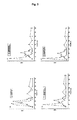
- Figures 1 and 2 are X-ray diffractograms of the treated Muscovite samples are shown. The counting rate is plotted against the Angle 2 ⁇ between 3 and 10 °.
- Figures 1 a and 1 b are the changes in the starting material in the course of the reaction due to the superposition in each case according to certain Times of recorded reflexes are shown.
- the lines marked with (1) each represent the starting material.
- the lines marked with (2) represent in contrast represents the treated muscovite.
- Table 1 shows a detailed list of the newly formed reflections in the range 3 ° - 10 ° 2
- Tabelle cation T reaction XRD reflections [ ⁇ ] AI 150 ° C + 23.5,11.7,9.9 Ba 170 ° C (-) slight peak shift (questionable) 10.5,10.1 Li / Ba 170 ° C + 21.9, 12.1, 11.1 Cu 130 ° C + 22.4, 11.2, 10.9, 10.6 Li 130 ° C + 22.6, 12.3, 11.3 mg 190 ° C + 23.6, 11.8, 11.3.9.9 Zn 170 ° C + 24.5, 11.9, 11.4, 10.7 N / A 170 ° C - - Li / Na 170 ° C - - - +: Changes in the reflex positions in the diffractogram, -: No change in the diffractogram.
- the sharp decrease in stack thickness i.e. an increasing delamination of the treated muscovite is affected by the increasing Temperature and reaction time significantly increasing half-value widths of reflexes, as well as the simultaneous decrease in peak intensities displayed.
- Electron microscope images illustrated the strong ones Changes in the crystal morphology of the treated muscovites in the Delamination.
- the particles are sometimes not only parallel to the Split layers, but also the formation of Fractures in the crystals which leads to intensive grain reduction.
Landscapes
- Chemical & Material Sciences (AREA)
- Engineering & Computer Science (AREA)
- Organic Chemistry (AREA)
- Ceramic Engineering (AREA)
- Civil Engineering (AREA)
- Materials Engineering (AREA)
- Structural Engineering (AREA)
- Inorganic Chemistry (AREA)
- Silicates, Zeolites, And Molecular Sieves (AREA)
Abstract
Description
Die eingesetzten Glimmer können natürlicher Herkunft oder synthetisch hergestellt sein. Als Glimmer können trioktaedrischer (z. B. Biotit, Phlogopit) und/oder dioktaedrischer Glimmer (z. B. Muskovit, Paragonit, Margarit) verwendet werden.
Vorzugsweise wird bei Aluminiumnitrat eine ca. 5-fach, bei Bariumnitrat eine ca. 48-fach, bei Kupfernitrat eine ca. 1,6-fach, bei Magnesiumnitrat eine ca. 7,9-fach und bei Zinknitrat eine ca. 3,5-fach übersättigte Lösung eingesetzt.
| Metallkationsalz | Art.-Nr. | Löslichkeit bei 20 °C [g/L] | Konzentration [g/L] | Übersättigung |
| Al(NO3)3*9 H2O | 101063 | 419 | 2097 | 5 |
| Ba(NO3)2 | 101729 | 90 | 4333 | 48,1 |
| Cu(NO3)2*3H2O | 102753 | 2670 | 4355 | 1,6 |
| LiNO3 | 105653 | 522 | 2600 | 4,9 |
| Mg(NO3)2*6H2O | 105855 | 420 | 3333 | 7,9 |
| NaNO3 | 106546 | 874 | 4333 | 4,9 |
| Zn(NO3)2*6H2O | 108836 | 1843 | 6500 | 3,5 |
Reaktionstemperatur 170 °C, Reaktionsdauer: 72 Std.
Reaktionstemperatur: 130 °C, Reaktionsdauer: 48 Std.
Reaktionstemperatur: 130 °C, Reaktionsdauer: 48 Std.
Reaktionstemperatur: 190 °C, Reaktionsdauer: 60 Std.
Reaktionstemperatur: 170 °C, Reaktionsdauer: 96 Std.
Reaktionstemperatur: 170 °C, Reaktionsdauer: 60 Std..
Reaktionstemperatur: 150 °C, Reaktionsdauer: 72 Std.
| Kation | T | Reaktion | XRD-Reflexe [Å] |
| AI | 150 °C | + | 23.5,11.7,9.9 |
| Ba | 170°C | (-) | leichte Peakverschiebung (fraglich) 10.5,10.1 |
| Li/Ba | 170 °C | + | 21.9, 12.1, 11.1 |
| Cu | 130 °C | + | 22.4, 11.2, 10.9, 10.6 |
| Li | 130 °C | + | 22.6,12.3, 11.3 |
| Mg | 190 °C | + | 23.6, 11.8, 11.3,9.9 |
| Zn | 170 °C | + | 24.5, 11.9, 11.4, 10.7 |
| Na | 170 °C | - | - |
| Li/Na | 170°C - | - | - |
| +: Änderungen der Reflexpositionen im Diffraktogramm, | |||
| -: Keine Veränderung des Diffraktogramms. |
| Veränderung der mittleren Korngröße durch die Nitratbehandlung | |
| Muskovit | Mittlere Korngröße [µm] |
| Vor der Behandlung | 90 - 100 |
| Cu-Kation behandeltes | 40 - 50 |
| Li-Kation behandeltes | 20 - 30 |
| Mg-Kation behandeltes | 60 - 70 |
| Zn-Kation behandeltes | 30 - 40 |
| Veränderung der spezifischen Oberfläche in Abhängigkeit von der Behandlungsdauer | ||
| Reaktionsdauer [h] | Spez. Oberfläche [m2/g] | |
| LiNO3 | Mg(NO3)2 | |
| 0 | 8,4 | 8,4 |
| 8 | 10,9 | 37,47 |
| 16 | 14,7 | 37,0 |
| 24 | 12,9 | 32,0 |
Claims (14)
- Verfahren zur chemischen Delamination von Glimmer, wobei der Glimmer mit mindestens einem Salz mindestens eines zwei- oder mehrwertigen Metallkations bei einer Temperatur > 100 °C und einem Druck > 105 Pa umgesetzt wird.
- Verfahren nach Anspruch 1, dadurch gekennzeichnet, dass der Glimmer aus der Gruppe bestehend aus Muskovit, Paragonit, Margarit ausgewählt wird.
- Verfahren nach Anspruch 1 oder 2, dadurch gekennzeichnet, dass das Metallkation aus der Gruppe bestehend aus Aluminium, Kupfer, Magnesium, Zink, Barium ausgewählt wird.
- Verfahren nach einem der vorhergehenden Ansprüche, dadurch gekennzeichnet, dass das Metallkationsalz als wäßrige Lösung eingesetzt wird.
- Verfahren nach einem der vorhergehenden Ansprüche, dadurch gekennzeichnet, dass das Metallkationsalz als übersättigte wässrige Lösung eingesetzt wird.
- Verfahren nach Anspruch 5, dadurch gekennzeichnet, dass die übersättigte wässrige Lösung 1,6 bis 48,1-fach übersättigt ist.
- Verfahren nach einem der vorhergehenden Ansprüche, dadurch gekennzeichnet, dass das Metallkationsalz ein Nitrat ist.
- Verfahren nach einem der vorhergehenden Ansprüche, dadurch gekennzeichnet, dass die Temperatur bei der Umsetzung < 300 °C ist.
- Verfahren nach einem der vorhergehenden Ansprüche, dadurch gekennzeichnet, dass die Temperatur bei der Umsetzung zwischen 130 und 190 °C liegt.
- Verfahren nach einem der vorhergehenden Ansprüche, dadurch gekennzeichnet, dass der Druck oder Umsetzung < 20x105 Pa ist.
- Verfahren nach einem der vorhergehenden Ansprüche, dadurch gekennzeichnet, dass es im Autoklaven durchgeführt wird.
- Chemisch delaminierter Glimmer erhältlich nach einem Verfahren der Ansprüche 1 bis 11.
- Chemisch delaminierter Glimmer nach Anspruch 12, der eine mittlere Korngröße von 30 bis 70 µm aufweist.
- Chemisch delaminierter Glimmer nach Anspruch 12 oder 13, wobei es sich um Muskovit handelt.
Applications Claiming Priority (2)
| Application Number | Priority Date | Filing Date | Title |
|---|---|---|---|
| DE10327627 | 2003-06-20 | ||
| DE2003127627 DE10327627A1 (de) | 2003-06-20 | 2003-06-20 | Verfahren zur chemischen Delamination von Glimmer |
Publications (2)
| Publication Number | Publication Date |
|---|---|
| EP1489055A2 true EP1489055A2 (de) | 2004-12-22 |
| EP1489055A3 EP1489055A3 (de) | 2006-03-15 |
Family
ID=33394881
Family Applications (1)
| Application Number | Title | Priority Date | Filing Date |
|---|---|---|---|
| EP04010965A Withdrawn EP1489055A3 (de) | 2003-06-20 | 2004-05-07 | Verfahren zur chemischen Delamination von Glimmer |
Country Status (2)
| Country | Link |
|---|---|
| EP (1) | EP1489055A3 (de) |
| DE (1) | DE10327627A1 (de) |
Family Cites Families (3)
| Publication number | Priority date | Publication date | Assignee | Title |
|---|---|---|---|---|
| US2842183A (en) * | 1956-09-24 | 1958-07-08 | Gen Electric | Mica paper |
| US3770651A (en) * | 1971-11-24 | 1973-11-06 | Du Pont | Delamination of mica by molten salts |
| WO1999003576A1 (en) * | 1997-07-15 | 1999-01-28 | Alliedsignal Inc. | Chemically modified micas for removal of cesium salts from aqueous solution |
-
2003
- 2003-06-20 DE DE2003127627 patent/DE10327627A1/de not_active Withdrawn
-
2004
- 2004-05-07 EP EP04010965A patent/EP1489055A3/de not_active Withdrawn
Also Published As
| Publication number | Publication date |
|---|---|
| EP1489055A3 (de) | 2006-03-15 |
| DE10327627A1 (de) | 2005-01-13 |
Similar Documents
| Publication | Publication Date | Title |
|---|---|---|
| DE3586667T2 (de) | Synthetisches lamellares magnesium-phyllosilikat und verfahren zu seiner herstellung. | |
| Dardir et al. | Cosmetic and pharmaceutical qualifications of Egyptian bentonite and its suitability as drug carrier for Praziquantel drug | |
| DE69518132T2 (de) | Verfahren zum Behandeln von Titandioxidpigmenten, Titandioxidpigment und ihre Verwendung in der Papierherstellung | |
| DE69604142T2 (de) | Nickel- und kobalthaltige hydrotalcitartige materialen mit plattenförmige morphologie und verfahren zu ihrer herstellung | |
| DE69431664T2 (de) | Verfahren zur herstellung von kugelartigen aggregaten aus plättchenförmigem synthetischem hydrotalcit | |
| DE69513182T2 (de) | Zwei-pulver-verfahren zur herstellung von hydrotalcit und hydrotalcitähnlichen verbindungen | |
| DE3688896T2 (de) | Addukte aus geschichteten gemischten Metallhydroxyden und Ton als Verdickungsmittel für Wasser und andere hydrophile Flüssigkeiten. | |
| DE2652409C2 (de) | Verfahren zur Herstellung von Waschmittelverstärkern | |
| EP0572037B1 (de) | Streichpigment | |
| DE1262864B (de) | Verfahren zur Herstellung von Glimmerplaettchen | |
| DE1467093A1 (de) | Schichtaehnliches,tonartiges Mineral | |
| EP2526057A1 (de) | Verfahren zur herstellung von schichtsilicat-plättchen mit hohem aspektverhältnis | |
| DE3617115A1 (de) | Verfahren zur herstellung von beta"-aluminiumoxid | |
| EP1789367B1 (de) | Feinteilige erdalkalititanate und verfahren zu deren herstellung unter verwendung von titanoxidpartikeln | |
| DE1417969A1 (de) | Kieselsaeure- und Alumosilicatpigmente | |
| DE602004000821T2 (de) | Oberflächenbehandeltes ultrafeines Metallpulver | |
| DE1667502B2 (de) | Synthetisches, quellfähiges, tonähnliches Material | |
| DE3731919A1 (de) | Neue aluminium-magnesium-hydroxi-verbindungen | |
| DE1467062A1 (de) | Reaktives siliziumhaltiges Material und Verfahren zu seiner Herstellung | |
| DE3806187C2 (de) | Zusammengesetztes Phyllosilicat und Verfahren zu seiner Herstellung | |
| DE69501989T2 (de) | Synthetisches Mischschichtsilicat und Methoden zu seiner Herstellung | |
| DE1134783B (de) | Verfahren zur Herstellung von mit Siliciumdioxyd ueberzogenen Bariummetaborat-Pigmenten | |
| DE2927444A1 (de) | Alkalicalciumsilikate und verfahren zu deren herstellung | |
| DE3688153T2 (de) | Schuppenartige feine Kristalle des Zirkoniumoxydtyps und Verfahren zu deren Herstellung. | |
| DE69631492T2 (de) | Modifizierte kaoline |
Legal Events
| Date | Code | Title | Description |
|---|---|---|---|
| PUAI | Public reference made under article 153(3) epc to a published international application that has entered the european phase |
Free format text: ORIGINAL CODE: 0009012 |
|
| AK | Designated contracting states |
Kind code of ref document: A2 Designated state(s): AT BE BG CH CY CZ DE DK EE ES FI FR GB GR HU IE IT LI LU MC NL PL PT RO SE SI SK TR |
|
| AX | Request for extension of the european patent |
Extension state: AL HR LT LV MK |
|
| PUAL | Search report despatched |
Free format text: ORIGINAL CODE: 0009013 |
|
| AK | Designated contracting states |
Kind code of ref document: A3 Designated state(s): AT BE BG CH CY CZ DE DK EE ES FI FR GB GR HU IE IT LI LU MC NL PL PT RO SE SI SK TR |
|
| AX | Request for extension of the european patent |
Extension state: AL HR LT LV MK |
|
| 17P | Request for examination filed |
Effective date: 20060902 |
|
| AKX | Designation fees paid |
Designated state(s): AT BE BG CH CY CZ DE DK EE ES FI FR GB GR HU IE IT LI LU MC NL PL PT RO SE SI SK TR |
|
| 17Q | First examination report despatched |
Effective date: 20070314 |
|
| RAP1 | Party data changed (applicant data changed or rights of an application transferred) |
Owner name: KARLSRUHER INSTITUT FUER TECHNOLOGIE |
|
| STAA | Information on the status of an ep patent application or granted ep patent |
Free format text: STATUS: THE APPLICATION IS DEEMED TO BE WITHDRAWN |
|
| 18D | Application deemed to be withdrawn |
Effective date: 20111201 |