EP1481106B1 - Tole ou bande en alliage al-mg pour la fabrication de pieces pliees a faible rayon de pliage - Google Patents
Tole ou bande en alliage al-mg pour la fabrication de pieces pliees a faible rayon de pliage Download PDFInfo
- Publication number
- EP1481106B1 EP1481106B1 EP03735766A EP03735766A EP1481106B1 EP 1481106 B1 EP1481106 B1 EP 1481106B1 EP 03735766 A EP03735766 A EP 03735766A EP 03735766 A EP03735766 A EP 03735766A EP 1481106 B1 EP1481106 B1 EP 1481106B1
- Authority
- EP
- European Patent Office
- Prior art keywords
- mpa
- sheet
- strip
- thickness
- production
- Prior art date
- Legal status (The legal status is an assumption and is not a legal conclusion. Google has not performed a legal analysis and makes no representation as to the accuracy of the status listed.)
- Expired - Lifetime
Links
Images
Classifications
-
- C—CHEMISTRY; METALLURGY
- C22—METALLURGY; FERROUS OR NON-FERROUS ALLOYS; TREATMENT OF ALLOYS OR NON-FERROUS METALS
- C22C—ALLOYS
- C22C21/00—Alloys based on aluminium
- C22C21/06—Alloys based on aluminium with magnesium as the next major constituent
-
- C—CHEMISTRY; METALLURGY
- C22—METALLURGY; FERROUS OR NON-FERROUS ALLOYS; TREATMENT OF ALLOYS OR NON-FERROUS METALS
- C22F—CHANGING THE PHYSICAL STRUCTURE OF NON-FERROUS METALS AND NON-FERROUS ALLOYS
- C22F1/00—Changing the physical structure of non-ferrous metals or alloys by heat treatment or by hot or cold working
- C22F1/04—Changing the physical structure of non-ferrous metals or alloys by heat treatment or by hot or cold working of aluminium or alloys based thereon
- C22F1/047—Changing the physical structure of non-ferrous metals or alloys by heat treatment or by hot or cold working of aluminium or alloys based thereon of alloys with magnesium as the next major constituent
Definitions
- the invention relates to the manufacture of folded parts with a small bending radius, and most often stamped, intended in particular for the automotive industry, from aluminum alloy sheet or strip of the aluminum-magnesium type, that is to say of the 5000 series according to the nomenclature of the Aluminum Association.
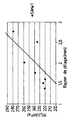
- Example 1 The single figure illustrates the results of Example 1 in yield strength R 0.2 and radius of bending.
- the invention is based on the combination of the narrow selection of an Al-Mg alloy composition with more than 4% Mg, and a particular manufacturing range to obtain a compromise of properties, in particular between the limit of elasticity, elongation and folding ability, particularly favorable for producing stamped and folded parts with a small bending radius.
- the alloys according to the invention are alloys with more than 4.5% Mg as the alloys 5182, 5019 or 5083 mentioned above.
- Magnesium contributes to the mechanical strength and its content can be adjusted as a function of the desired mechanical strength. Beyond 5.5% Mg, the alloy becomes more difficult to cast and to implement.
- the control of the total content of manganese and chromium is an important point to obtain all the desired properties.
- a content of less than 0.3% improves the elongation, but decreases the yield strength without improving the folding ability.
- a content greater than 0.7% improves the yield strength without greatly reducing elongation, but surprisingly gives a wrong bend radius.
- the method of manufacturing the strips according to the invention comprises casting a plate of the alloy in question, its hot rolling to obtain a strip of thickness e c , then its cold rolling to the final thickness e f , between 1 and 5 mm.
- the final thickness e f must be between 40 and 70% of the thickness of the hot-rolled strip e c . If the cold rolling rate is insufficient, the desired yield strength can not be reached. If it is too important, the coefficient of hardening n becomes too low and the formability is insufficient.
- the cold-rolled strip then undergoes a restoring anneal at a temperature between 180 and 280 ° C.
- the control of this temperature is important: a lack of restoration or a too low temperature impairs the elongation. Conversely, an annealing temperature greater than 280 ° C leads to a recrystallized state, with insufficient mechanical strength.
- An essential characteristic of the method of manufacturing strips and sheets according to the invention is the absence of re-curing after the restoration annealing, either by cold rolling or by planing under tension. Admittedly, such work hardening would increase the yield strength, but reduce the elongation and the coefficient of hardening too much, which would be unfavorable to the formability and the folding ability. In addition, the gain in elastic limit is lost very quickly during the baking treatment of paints, while for the restored products and not re-locked, the loss of mechanical resistance to baking paints is reduced.
- Another advantage of the absence of hardening, especially by planing, after restoration is to obtain sheets and strips with low anisotropy, with a difference between the elasticity limits in the L and T directions of less than 15 MPa , and most often less than 10 MPa ..
- the sheets and strips according to the invention are particularly well suited to the manufacture of stamped and folded parts with a small bending radius, particularly for the automotive industry. 180 ° bending radii are obtained less than the thickness of the sheet or strip, or even less than 80% of this thickness.
- the coefficient of hardening n is greater than 0.10, which contributes to the rapid increase in the mechanical strength of the parts during their shaping, and therefore to the use of lower thicknesses.
- anti-intrusion opening reinforcements which comprise stamped and folded parts, and which are subjected to the treatment of baking paints, including cataphoresis layers.
- the loss of elastic limit remains less than 20 MPa.
- Another interesting use of the sheets and strips according to the invention is the manufacture of jacks, which allow a significant weight gain compared to steel jacks.
- the plates were cast in 7 different alloys A to G, the alloys A to E having a composition according to the invention, and the alloys F and G a composition outside the invention.
- the compositions (% by weight) are indicated in Table 1: Table 1 Alloy mg mn Cu Yes Fe AT 4.62 0.37 0.06 0.13 0.30 B 4.76 0.36 0.05 0.10 0.31 VS 4.61 0.35 0.05 0.14 0.37 D 4.53 0.36 0.05 0.09 0.29 E 5.18 0.35 0.06 0.11 0.18 F 4.58 0.27 0.02 0.04 0.17 BOY WUT 5.10 0.81 0.05 0.11 0.24
- the high Mn alloy H has an elongation ⁇ 15% and a relatively high limiting bending radius, greater than 80% of the thickness.
- the alloy F at low Mn also has a fairly high bending radius.
- FIG. 1 shows the compromise between the elastic limit R 0.2 and the bending radius. A radius of 1.5 mm is considered acceptable for a R 0.2 of 200 MPa and 2.5 mm for a R 0.2 of 280 MPa.
- the points corresponding to the 5 alloys according to the invention are on the left of the right, and show a good compromise between the two properties.
- the points corresponding to the alloys F and G are on the right of the right and therefore do not present an acceptable compromise.
- the mechanical characteristics in the long direction have been measured, namely the breaking strength R m , the elastic limit R 0.2 and the elongation A 80 , before and after heat treatment.
- the results are shown in Tables 3 (for restored alloy C), 4 (for E) and 5 (for C hardened).
- the exit thickness of the hot rolling was varied, the final thickness remaining at 3 mm, so that the ratio e f / e c was varied between 70% and 40%.
- the final annealing temperature was also varied between 200 and 320 ° C. No hardening subsequent to the final annealing was performed. In each case the breaking strength Rm, the yield strength R 0.2 , the elongation A and the coefficient of work hardening n were measured. The results, corresponding to the average of 5 measurements, are shown in Table 7: Table 7 e f / e c (%) 200 ° C 230 ° C 260 ° C 290 ° C.
Landscapes
- Chemical & Material Sciences (AREA)
- Organic Chemistry (AREA)
- Engineering & Computer Science (AREA)
- Materials Engineering (AREA)
- Mechanical Engineering (AREA)
- Metallurgy (AREA)
- Thermal Sciences (AREA)
- Crystallography & Structural Chemistry (AREA)
- Physics & Mathematics (AREA)
- Heat Treatment Of Sheet Steel (AREA)
- Bending Of Plates, Rods, And Pipes (AREA)
- Shaping Metal By Deep-Drawing, Or The Like (AREA)
- Metal Rolling (AREA)
- Laminated Bodies (AREA)
- Pressure Welding/Diffusion-Bonding (AREA)
- Manufacture And Refinement Of Metals (AREA)
- Electrolytic Production Of Metals (AREA)
- Body Structure For Vehicles (AREA)
Description
- L'invention concerne la fabrication de pièces pliées à faible rayon de pliage, et le plus souvent embouties, destinées notamment à la construction automobile, à partir de tôles ou bandes en alliage d'aluminium du type aluminium-magnésium, c'est-à-dire de la série 5000 selon la nomenclature de l'Aluminum Association.
- Les alliages aluminium-magnésium à plus de 4% de magnésium sont largement utilisés en construction automobile pour des pièces autres que les peaux de carrosserie, par exemple des renforts ou des pièces de structure, éventuellement mises en forme par emboutissage ou pliage. Ils permettent une bonne résistance mécanique sans nécessiter, comme les alliages de peau de la série 6000, de traitement thermique de mise en solution et trempe. On peut citer, par exemple, les alliages 5019, 5182 et 5083, dont la composition (% en poids) enregistrée à l'Aluminum Association est indiquée au tableau 1 :
Tableau 1 Alliage Si Fe Cu Mn Mg Cr Zn 5019 < 0,40 < 0,50 < 0,10 0,1-0,6 4,5-5,6 < 0,20 < 0,20 5182 < 0,20 < 0,35 < 0,15 0,2-0,5 4,0-5,0 < 0,10 < 0,25 5083 < 0,40 < 0,40 < 0,10 0,4-1,0 4,0-4,9 0,05-0,25 < 0,25 - La fabrication de pièces embouties et pliées nécessite un matériau présentant une formabilité suffisante pour réaliser les parties embouties des pièces, et une aptitude au pliage d'autant meilleure qu'on souhaite obtenir des rayons de pliage très faibles, typiquement de l'ordre de l'épaisseur de la tôle. Cette aptitude doit être aussi bonne dans le sens du laminage que dans le sens perpendiculaire. La tôle ou la bande doit présenter une résistance mécanique aussi élevée que possible de manière à réduire au maximum l'épaisseur, et d'obtenir ainsi l'effet d'allégement optimal résultant de l'utilisation de l'aluminium par rapport à l'acier.
Par ailleurs, les pièces de véhicules automobiles sont soumises à un traitement thermique lors de la cuisson des peintures de la carrosserie, qui se fait à une température comprise entre 150 et 200°C pendant 15 à 30 mn. Il faut donc tenir compte de la perte éventuelle de résistance mécanique au cours de cette opération, et il est souhaitable que cette dégradation soit la plus faible possible. L'invention a pour but des tôles et bandes en alliage Al-Mg permettant de satisfaire ces exigences. - L'invention a pour objet une tôle ou bande en alliage d'aluminium d'épaisseur comprise entre 1 et 5 mm, destinée à la fabrication de pièces embouties et pliées à faible rayon de pliage, de composition (% en poids) :
- Si < 0,3 Fe : 0,2 - 0,4 Mn : 0,3 - 0,45 Mg : 4,5 - 5,5 Cr < 0,04 - 0,1 Cu < 0,1 Zn < 0,1 autres éléments < 0,05 chacun et < 0,15 au total, reste aluminium, et, pour cette composition particulière, R0,2 sens T > 240 MPa, A80 > 15% et Rm - R0,2 > 90 MPa.
- La figure unique illustre les résultats de l'exemple 1 en limite d'élasticité R0,2 et rayon de pliage.
- L'invention repose sur la combinaison de la sélection étroite d'une composition d'alliage Al-Mg à plus de 4% de Mg, et d'une gamme de fabrication particulière pour obtenir un compromis de propriétés, notamment entre la limite d'élasticité, l'allongement et l'aptitude au pliage, particulièrement favorable à la réalisation de pièces embouties et pliées avec un faible rayon de pliage.
- Les alliages selon l'invention sont des alliages à plus de 4,5% de Mg comme les alliages 5182, 5019 ou 5083 mentionnés plus haut.
- Le magnésium contribue à la résistance mécanique et on peut en ajuster la teneur en fonction de la résistance mécanique désirée. Au-delà de 5,5% de Mg, l'alliage devient plus difficile à couler et à mettre en oeuvre.
- Le contrôle de la teneur totale en manganèse et chrome est un point important pour obtenir l'ensemble des propriétés souhaitées. Une teneur inférieure à 0,3% améliore l'allongement, mais diminue la limite d'élasticité sans pour autant améliorer l'aptitude au pliage. Une teneur supérieure à 0,7% améliore la limite d'élasticité sans trop réduire l'allongement, mais, de manière surprenante, donne un mauvais rayon de pliage.
- Le procédé de fabrication des bandes selon l'invention comporte la coulée d'une plaque de l'alliage considéré, son laminage à chaud pour obtenir une bande d'épaisseur ec, puis son laminage à froid jusqu'à l'épaisseur finale ef, comprise entre 1 et 5 mm. Pour obtenir les propriétés désirées, l'épaisseur finale ef doit être comprise entre 40 et 70% de l'épaisseur de la bande laminée à chaud ec. Si le taux de laminage à froid est insuffisant, on ne peut pas atteindre la limite d'élasticité souhaitée. S'il est trop important, le coefficient d'écrouissage n devient trop faible et la formabilité est insuffisante.
- La bande laminée à froid subit ensuite un recuit de restauration à une température comprise entre 180 et 280°C. Le contrôle de cette température est important : une absence de restauration ou une température trop faible nuit à l'allongement. Inversement, une température de recuit supérieure à 280°C conduit à un état recristallisé, avec une résistance mécanique insuffisante.
- Une caractéristique essentielle du procédé de fabrication des bandes et tôles selon l'invention est l'absence de réécrouissage après le recuit de restauration, soit par laminage à froid, soit par planage sous tension. Certes, un tel écrouissage augmenterait la limite d'élasticité, mais réduirait trop l'allongement et le coefficient d'écrouissage, ce qui serait défavorable à la formabilité et à l'aptitude au pliage. De plus, le gain en limite d'élasticité est perdu très rapidement lors du traitement de cuisson des peintures, alors que pour les produits restaurés et non réécrouis, la perte de résistance mécanique à la cuisson des peintures est plus réduite.
- Un autre avantage de l'absence d'écrouissage, notamment par planage, après restauration est d'obtenir des tôles et bandes présentant une faible anisotropie, avec une différence entre les limites d'élasticité dans les sens L et T de moins de 15 MPa, et le plus souvent de moins de 10 MPa..
- Pour éviter de ré-écrouir le métal après restauration, il est nécessaire de bien maîtriser la planéité de la bande lors du laminage à froid, et surtout lors du parachèvement, notamment lors du refendage de bandes relativement étroites d'épaisseur assez forte, où il faut éviter les déformations du type « lame de sabre ».
- Les tôles et bandes selon l'invention sont particulièrement bien adaptées à la fabrication de pièces embouties et pliées à faible rayon de pliage, notamment pour l'industrie automobile. On obtient des rayons de pliage à 180° inférieurs à l'épaisseur de la tôle ou de la bande, voire inférieurs à 80% de cette épaisseur. Le coefficient d'écrouissage n est supérieur à 0,10, ce qui contribue à l'augmentation rapide de la résistance mécanique des pièces lors de leur mise en forme, et donc à l'utilisation d'épaisseurs plus faibles.
- On peut mentionner à titre d'exemple d'utilisation les renforts d'ouvrants anti-intrusion qui comportent des parties embouties et pliées, et qui sont soumis au traitement de cuisson des peintures, notamment des couches de cataphorèse. Pour un traitement de 20 mn à 200°C, la perte de limite d'élasticité reste inférieure à 20 MPa. Une autre utilisation intéressante des tôles et bandes selon l'invention est la fabrication de crics, qui permettent un gain de poids important par rapport aux crics en acier.
- On a coulé des plaques en 7 alliages différents A à G, les alliages A à E ayant une composition selon l'invention, et les alliages F et G une composition hors invention. Les compositions (% en poids) sont indiquées au tableau 1 :
Tableau 1 Alliage Mg Mn Cu Si Fe A 4,62 0,37 0,06 0,13 0,30 B 4,76 0,36 0,05 0,10 0,31 C 4,61 0,35 0,05 0,14 0,37 D 4,53 0,36 0,05 0,09 0,29 E 5,18 0,35 0,06 0,11 0,18 F 4,58 0,27 0,02 0,04 0,17 G 5,10 0,81 0,05 0,11 0,24 - Les plaques ont été laminées à chaud pour obtenir des bandes d'épaisseur 5 mm, puis laminées à froid jusqu'à 3mm, soit 60% de l'épaisseur de la bande à chaud. Les bandes ont subi un recuit de restauration à 200°C. On a mesuré la limite d'élasticité R0,2 sens L, l'allongement à la rupture A80 selon la norme NF EN 10002-1 relative aux essais de traction sur matériaux métalliques, et le rayon de pliage à 180°. Les résultats sont indiqués au tableau 2 :
Tableau 2 Alliage R0,2 (MPa) A80 (%) Rayon pliage (mm) A 239 15,5 1,8 B 223 16,2 1,5 C 225 17,5 1,4 D 220 16,5 1,7 E 258 16,8 2,0 F 235 16,9 2,5 G 279 12,2 2,8 - On constate que l'alliage à Mn élevé H a un allongement < 15% et un rayon de pliage limite assez élevé, supérieur à 80% de l'épaisseur. L'alliage F à bas Mn a aussi un rayon de pliage assez élevé. On a représenté à la figure 1 le compromis entre la limite d'élasticité R0,2 et le rayon de pliage. On considère comme acceptable un rayon de 1,5 mm pour un R0,2 de 200 MPa et de 2,5 mm pour un R0,2 de 280 MPa. Les points correspondant aux 5 alliages selon l'invention sont à gauche de la droite, et montrent un bon compromis entre les deux propriétés. Les points correspondant aux alliages F et G sont à droite de la droite et ne présentent donc pas un compromis acceptable.
- On a effectué un traitement thermique de 20 mn respectivement à 170°C, 185°C et 200°C, simulant des traitements de cuisson des peintures d'un véhicule automobile, sur des échantillons de tôle de l'exemple 1 en alliage C et E, et sur un échantillon de l'alliage C ayant subi en plus un écrouissage par planage par traction. On a mesuré les caractéristiques mécaniques dans le sens long, à savoir la résistance à la rupture Rm, la limite d'élasticité R0,2 et l'allongement A80, avant et après traitement thermique. Les résultats sont indiqués aux tableaux 3 (pour l'alliage C restauré), 4 (pour E) et 5 (pour C écroui).
Tableau 3 (C non écroui) Cuisson Sans 20 mn 170°C 20 mn 185°C 20 mn 200°C Rm (MPa) 325 316 314 313 R0,2(MPa) 225 212 210 208 A80(%) 17,5 16,6 18,5 19,0 Tableau 4 (E non écroui) Cuisson Sans 20 mn 170°C 20 mn 185°C 20 mn 200°C Rm(MPa) 355 351 353 351 R0,2(MPa) 258 254 256 254 A80(%) 16,8 16,2 16,6 16,7 Tableau 5 (C écroui) Cuisson Sans 20 mn 170°C 20 mn 185°C 20 mn 200°C Rm(MPa) 328 320 315 313 R0,2(MPa) 242 214 210 207 A80(%) 14,9 16,0 17,2 18,7 - On constate que la chute de R0,2 due au traitement thermique est beaucoup plus faible pour les échantillons non écrouis que pour l'échantillon écroui.
- Sur les échantillons C et E de l'exemple 1, on a mesuré les caractéristiques mécaniques Rm, R0,2 et A80 dans le sens long, à 45° et dans le sens travers. Les résultats sont indiqués au tableau 6 :
Tableau 6 C long C 45° C travers E long E 45° E travers Rm(MPa) 324 325 324 357 347 352 R0,2 (MPa) 225 229 230 258 247 255 A80(%) 17,5 19,1 18,2 16,8 16,6 16,1 - On constate que les caractéristiques mécaniques, notamment la limite d'élasticité, varient très peu en fonction du sens de la mesure.
- On a coulé des plaques en alliage de composition :
Si Fe Mn Mg Cu Cr 0,12 0,18 0,33 4,57 0,04 0,06 - On a fait varier l'épaisseur de sortie du laminage à chaud, l'épaisseur finale restant à 3 mm, de sorte qu'on a fait varier le rapport ef/ec entre 70% et 40%. On a également fait varier la température de recuit final entre 200 et 320°C. Aucun écrouissage postérieur au recuit final n'a été effectué. On a mesuré dans chacun des cas la résistance à la rupture Rm, la limite d'élasticité R0,2, l'allongement A et le coefficient d'écrouissage n. Les résultats, correspondant à la moyenne de 5 mesures, sont indiqués au tableau 7 :
Tableau 7 ef/ec (%) 200°C 230°C 260°C 290°C 320°C 70 Rm(MPa) 305 304 296 289 266 R0,2(MPa) 209 207 197 179 126 A80(%) 16,4 17,8 18,7 21,4 25,5 n 0,168 0,172 0,178 0,203 0,309 60 Rm (MPa) 317 313 307 285 267 R0,2(MPa) 228 222 216 166 132 A80 (%) 15,9 17,5 18,7 23,6 25,9 n 0,155 0,157 0,165 0,242 0,312 50 Rm(MPa) 339 332 333 283 268 R0,2(MPa) 261 253 244 161 138 A80(%) 15,2 17,1 18,6 24,6 27,0 n 0,135 0,141 0,155 0,262 0,307 40 Rm(MPa) 338 330 337 278 268 R0,2(MPa) 260 251 248 156 142 A80(%) 14,5 16,1 18,9 25,0 25,9 n 0,133 0,137 0,156 0,274 0,304 - On constate une chute importante de Rm et surtout de R0,2 lorsque la température du recuit final passe de 260 à 290°C, ce qui correspond au passage à la température de recristallisation. Par ailleurs, à température de restauration donnée, on constate que, lorsque le rapport ef/ec diminue, c'est-à-dire lorsque le laminage à froid est plus important, R0,2 augmente, mais l'allongement et le coefficient d'écrouissage n diminuent.
Claims (9)
- Tôle ou bande en alliage d'aluminium d'épaisseur comprise entre 1 et 5 mm, destinée à la fabrication de pièces embouties et pliées à faible rayon de pliage, de composition (% en poids) : Si < 0,3 Fe : 0,2 - 0,4 Mn : 0,3 - 0,45 Cr : 0,04 - 0,1 Mg:4,5 - 5,5 Cu < 0,1 Zn < 0,1, autres éléments < 0,05 chacun et < 0,15 au total, reste aluminium, caractérisée en ce qu'elle présente, à l'état restauré, une limite d'élasticité R0,2 sens T > 240 MPa, un allongement A80 > 15% et une différence Rm - R0,2 > 90 MPa.
- Tôle ou bande selon la revendication 1, caractérisée en ce que son rayon de pliage à 180° est inférieur à son épaisseur.
- Tôle ou bande selon la revendication 2, caractérisée en ce que son rayon de pliage est inférieur à 80% de son épaisseur.
- Tôle ou bande selon l'une des revendications 1 à 3, caractérisée en ce que la différence entre la limite d'élasticité sens L et sens T est inférieure à 15 MPa.
- Tôle ou bande selon la revendication 4, caractérisée en ce que la différence entre la limite d'élasticité sens L et sens T est inférieure à 10 MPa.
- Tôle ou bande selon l'une des revendications 1 à 5, caractérisée en ce que la différence entre la limite d'élasticité avant et après un traitement de cuisson de peinture de 20 mn à 185°C est inférieure à 20 MPa.
- Procédé de fabrication d'une tôle ou bande selon l'une des revendications 1 à 6, comportant la coulée d'une plaque, son laminage à chaud jusqu'à une épaisseur ec, le laminage à froid jusqu'à une épaisseur finale ef comprise entre 70 et 40% de ec, et un recuit de restauration à une température comprise entre 180 et 280°C sans écrouissage ultérieur.
- Utilisation de tôles ou bandes selon l'une des revendications 1 à 7 pour la fabrication de renforts d'ouvrant de véhicule automobile.
- Utilisation de tôles ou bandes selon l'une des revendications 1 à 7 pour la fabrication de crics.
Applications Claiming Priority (3)
| Application Number | Priority Date | Filing Date | Title |
|---|---|---|---|
| FR0202897 | 2002-03-07 | ||
| FR0202897A FR2836929B1 (fr) | 2002-03-07 | 2002-03-07 | Tole ou bande en alliage a1-mg pour la fabrication de pieces pliees a faible rayon de pliage |
| PCT/FR2003/000691 WO2003074747A1 (fr) | 2002-03-07 | 2003-03-04 | Tole ou ba 0nde en alliage al-mg pour la fabrication de pieces pliees a faible rayon de pliage |
Publications (2)
| Publication Number | Publication Date |
|---|---|
| EP1481106A1 EP1481106A1 (fr) | 2004-12-01 |
| EP1481106B1 true EP1481106B1 (fr) | 2006-12-13 |
Family
ID=27763621
Family Applications (1)
| Application Number | Title | Priority Date | Filing Date |
|---|---|---|---|
| EP03735766A Expired - Lifetime EP1481106B1 (fr) | 2002-03-07 | 2003-03-04 | Tole ou bande en alliage al-mg pour la fabrication de pieces pliees a faible rayon de pliage |
Country Status (9)
| Country | Link |
|---|---|
| EP (1) | EP1481106B1 (fr) |
| AT (1) | ATE348199T1 (fr) |
| AU (1) | AU2003238148A1 (fr) |
| DE (1) | DE60310381T2 (fr) |
| ES (1) | ES2279123T3 (fr) |
| FR (1) | FR2836929B1 (fr) |
| PL (1) | PL198511B1 (fr) |
| RS (1) | RS50328B (fr) |
| WO (1) | WO2003074747A1 (fr) |
Families Citing this family (3)
| Publication number | Priority date | Publication date | Assignee | Title |
|---|---|---|---|---|
| US20140157894A1 (en) * | 2012-12-12 | 2014-06-12 | Tung Thih Electronic Co., Ltd. | Transducer Case |
| CN103900629A (zh) * | 2012-12-24 | 2014-07-02 | 同致电子企业股份有限公司 | 传感器外壳 |
| KR102078945B1 (ko) * | 2015-06-05 | 2020-02-19 | 노벨리스 인크. | 고 강도 5xxx 알루미늄 합금들 및 이를 만드는 방법들 |
Family Cites Families (11)
| Publication number | Priority date | Publication date | Assignee | Title |
|---|---|---|---|---|
| CH638243A5 (de) * | 1978-07-05 | 1983-09-15 | Alusuisse | Verfahren zur herstellung von magnesium- und zinkhaltigen aluminium-legierungs-blechen. |
| US4284437A (en) * | 1979-12-18 | 1981-08-18 | Sumitomo Light Metal Industries, Ltd. | Process for preparing hard tempered aluminum alloy sheet |
| JPH02149634A (ja) * | 1988-11-30 | 1990-06-08 | Kobe Steel Ltd | 繰り返し曲げ性に優れたタブ用Al合金板とその製造方法 |
| JPH0699789B2 (ja) * | 1989-02-23 | 1994-12-07 | 住友軽金属工業株式会社 | 耐食性に優れる高強度成形用アルミニウム合金硬質板の製造方法 |
| JP2925891B2 (ja) * | 1993-04-14 | 1999-07-28 | 住友軽金属工業株式会社 | 記録媒体カセットのシャッター用アルミニウム合金材料並びにその製造方法及びそれを使用したアルミニウム合金シャッター |
| JP2921820B2 (ja) * | 1994-05-11 | 1999-07-19 | 本田技研工業株式会社 | 冷間予成形可能な超塑性成形用アルミニウム合金板及びその製造方法 |
| JP3523687B2 (ja) * | 1994-05-30 | 2004-04-26 | 住友軽金属工業株式会社 | 曲げ加工性に優れたステイオンタブ用アルミニウム合金板材およびその製造方法 |
| EP0799900A1 (fr) * | 1996-04-04 | 1997-10-08 | Hoogovens Aluminium Walzprodukte GmbH | Alliage d'aluminium-magnesium à haute résistance mécanique pour structures soudées de grandes dimensions |
| US5985058A (en) * | 1997-06-04 | 1999-11-16 | Golden Aluminum Company | Heat treatment process for aluminum alloys |
| JP3656150B2 (ja) * | 1997-09-11 | 2005-06-08 | 日本軽金属株式会社 | アルミニウム合金板の製造方法 |
| FR2792001B1 (fr) * | 1999-04-12 | 2001-05-18 | Pechiney Rhenalu | Procede de fabrication de pieces de forme en alliage d'aluminium type 2024 |
-
2002
- 2002-03-07 FR FR0202897A patent/FR2836929B1/fr not_active Expired - Fee Related
-
2003
- 2003-03-04 RS YUP-784/04A patent/RS50328B/sr unknown
- 2003-03-04 PL PL369769A patent/PL198511B1/pl not_active IP Right Cessation
- 2003-03-04 EP EP03735766A patent/EP1481106B1/fr not_active Expired - Lifetime
- 2003-03-04 DE DE60310381T patent/DE60310381T2/de not_active Expired - Lifetime
- 2003-03-04 WO PCT/FR2003/000691 patent/WO2003074747A1/fr not_active Ceased
- 2003-03-04 AU AU2003238148A patent/AU2003238148A1/en not_active Abandoned
- 2003-03-04 ES ES03735766T patent/ES2279123T3/es not_active Expired - Lifetime
- 2003-03-04 AT AT03735766T patent/ATE348199T1/de not_active IP Right Cessation
Non-Patent Citations (1)
| Title |
|---|
| J.R. DAVIS ASM: "ASM Specialty Handbook - Aluminum and Aluminum Alloys", 1993, USA * |
Also Published As
| Publication number | Publication date |
|---|---|
| ATE348199T1 (de) | 2007-01-15 |
| WO2003074747A1 (fr) | 2003-09-12 |
| PL369769A1 (en) | 2005-05-02 |
| ES2279123T3 (es) | 2007-08-16 |
| DE60310381T2 (de) | 2007-09-20 |
| RS50328B (sr) | 2009-09-08 |
| FR2836929B1 (fr) | 2005-01-07 |
| EP1481106A1 (fr) | 2004-12-01 |
| DE60310381D1 (de) | 2007-01-25 |
| FR2836929A1 (fr) | 2003-09-12 |
| AU2003238148A1 (en) | 2003-09-16 |
| RS78404A (sr) | 2006-12-15 |
| PL198511B1 (pl) | 2008-06-30 |
Similar Documents
| Publication | Publication Date | Title |
|---|---|---|
| EP2155916B1 (fr) | Acier a faible densite presentant une bonne aptitude a l'emboutissage | |
| EP1472380B1 (fr) | Tole en alliage al-si-mg pour peau de carrosserie automobile | |
| EP1819461B1 (fr) | Procede de fabrication de toles d' acier austenitique , fer-carbone-manganese a tres hautes caracteristiques de resistance et excellente homogénéité. | |
| EP1633900B1 (fr) | Pavillon de toit de carrosserie d'automobile en tole d'alliage al-si-mg fixee sur un cadre en acier | |
| EP2697406B1 (fr) | Alliages aluminium cuivre magnesium performants a haute temperature | |
| EP2563944B1 (fr) | Materiau en aluminium resistant aux dommages avec une microstructure multi-couches | |
| EP4038214B1 (fr) | Toles de precision en alliage d'aluminium | |
| EP3167091B1 (fr) | Tôle d'acier laminée à chaud et procédé de fabrication associé | |
| KR101103135B1 (ko) | 알루미늄합금 시트 및 그 제조방법 | |
| KR101401060B1 (ko) | 높은 소성 요구에 적용하기 위한 almgsi 스트립 | |
| FR2926564A1 (fr) | Tole a habillage | |
| EP3362282B1 (fr) | Composant de structure de caisse automobile presentant un excellent compromis entre resistance mecanique et comportement au crash | |
| EP3201372B1 (fr) | Tôles isotropes en alliage d'aluminium-cuivre-lithium pour la fabrication de fuselages d'avion et procédé de fabrication de celle-ci | |
| EP3894608A1 (fr) | Procédé de fabrication de tôles d'aluminium 6xxx présentant une haute qualité de surface | |
| EP1339887A1 (fr) | Procede de fabrication d'une bande plaquee en alliage d'aluminium pour la fabrication d'echangeurs de chaleur brases | |
| EP1143027B1 (fr) | Procédé de fabrication d'éléments de structure d'avions en alliage d'aluminium Al-Si-Mg | |
| CA3046364C (fr) | Alliages d'aluminium de haute resistance et de haute aptitude au formage resistance au durcissement par vieillissement naturel et ses procedes de fabrication | |
| EP3607104A1 (fr) | Procede ameliore de fabrication de composant de structure de caisse automobile | |
| FR2828498A1 (fr) | Produit corroye en alliage d'aluminium et de magnesium, et structure soudee et reservoir comportant un tel produit | |
| JP2001240930A (ja) | ドアビーム用Al−Mg−Si系アルミニウム合金押出材及びドアビーム | |
| JP2003089859A (ja) | 曲げ加工性に優れたアルミニウム合金板の製造方法 | |
| EP1481106A1 (fr) | Tole ou ba 0nde en alliage al-mg pour la fabrication de pieces pliees a faible rayon de pliage | |
| FR3122187A1 (fr) | Tôles d’aluminium 5xxx dotée d’une aptitude à la mise en forme élevée | |
| EP4355923A1 (fr) | Bande en alliage 6xxx et procede de fabrication | |
| FR3144624A1 (fr) | Procédé de fabrication d’une tôle en alliage 6xxx avec une excellente qualité de surface. |
Legal Events
| Date | Code | Title | Description |
|---|---|---|---|
| PUAI | Public reference made under article 153(3) epc to a published international application that has entered the european phase |
Free format text: ORIGINAL CODE: 0009012 |
|
| 17P | Request for examination filed |
Effective date: 20040907 |
|
| AK | Designated contracting states |
Kind code of ref document: A1 Designated state(s): AT BE BG CH CY CZ DE DK EE ES FI FR GB GR HU IE IT LI LU MC NL PT RO SE SI SK TR |
|
| AX | Request for extension of the european patent |
Extension state: AL LT LV |
|
| GRAP | Despatch of communication of intention to grant a patent |
Free format text: ORIGINAL CODE: EPIDOSNIGR1 |
|
| GRAS | Grant fee paid |
Free format text: ORIGINAL CODE: EPIDOSNIGR3 |
|
| GRAA | (expected) grant |
Free format text: ORIGINAL CODE: 0009210 |
|
| AK | Designated contracting states |
Kind code of ref document: B1 Designated state(s): AT BE BG CH CY CZ DE DK EE ES FI FR GB GR HU IE IT LI LU MC NL PT RO SE SI SK TR |
|
| PG25 | Lapsed in a contracting state [announced via postgrant information from national office to epo] |
Ref country code: NL Free format text: LAPSE BECAUSE OF FAILURE TO SUBMIT A TRANSLATION OF THE DESCRIPTION OR TO PAY THE FEE WITHIN THE PRESCRIBED TIME-LIMIT Effective date: 20061213 Ref country code: DK Free format text: LAPSE BECAUSE OF FAILURE TO SUBMIT A TRANSLATION OF THE DESCRIPTION OR TO PAY THE FEE WITHIN THE PRESCRIBED TIME-LIMIT Effective date: 20061213 Ref country code: IE Free format text: LAPSE BECAUSE OF FAILURE TO SUBMIT A TRANSLATION OF THE DESCRIPTION OR TO PAY THE FEE WITHIN THE PRESCRIBED TIME-LIMIT Effective date: 20061213 Ref country code: AT Free format text: LAPSE BECAUSE OF FAILURE TO SUBMIT A TRANSLATION OF THE DESCRIPTION OR TO PAY THE FEE WITHIN THE PRESCRIBED TIME-LIMIT Effective date: 20061213 Ref country code: FI Free format text: LAPSE BECAUSE OF FAILURE TO SUBMIT A TRANSLATION OF THE DESCRIPTION OR TO PAY THE FEE WITHIN THE PRESCRIBED TIME-LIMIT Effective date: 20061213 Ref country code: SI Free format text: LAPSE BECAUSE OF FAILURE TO SUBMIT A TRANSLATION OF THE DESCRIPTION OR TO PAY THE FEE WITHIN THE PRESCRIBED TIME-LIMIT Effective date: 20061213 |
|
| RAP1 | Party data changed (applicant data changed or rights of an application transferred) |
Owner name: ALCAN RHENALU |
|
| REG | Reference to a national code |
Ref country code: GB Ref legal event code: FG4D Free format text: NOT ENGLISH |
|
| REG | Reference to a national code |
Ref country code: CH Ref legal event code: EP |
|
| REG | Reference to a national code |
Ref country code: IE Ref legal event code: FG4D Free format text: LANGUAGE OF EP DOCUMENT: FRENCH |
|
| REF | Corresponds to: |
Ref document number: 60310381 Country of ref document: DE Date of ref document: 20070125 Kind code of ref document: P |
|
| REG | Reference to a national code |
Ref country code: RO Ref legal event code: EPE |
|
| PG25 | Lapsed in a contracting state [announced via postgrant information from national office to epo] |
Ref country code: BG Free format text: LAPSE BECAUSE OF FAILURE TO SUBMIT A TRANSLATION OF THE DESCRIPTION OR TO PAY THE FEE WITHIN THE PRESCRIBED TIME-LIMIT Effective date: 20070313 |
|
| REG | Reference to a national code |
Ref country code: CH Ref legal event code: NV Representative=s name: WILLIAM BLANC & CIE CONSEILS EN PROPRIETE INDUSTRI |
|
| REG | Reference to a national code |
Ref country code: SE Ref legal event code: TRGR |
|
| GBT | Gb: translation of ep patent filed (gb section 77(6)(a)/1977) |
Effective date: 20070315 |
|
| REG | Reference to a national code |
Ref country code: HU Ref legal event code: AG4A Ref document number: E001361 Country of ref document: HU |
|
| PG25 | Lapsed in a contracting state [announced via postgrant information from national office to epo] |
Ref country code: PT Free format text: LAPSE BECAUSE OF FAILURE TO SUBMIT A TRANSLATION OF THE DESCRIPTION OR TO PAY THE FEE WITHIN THE PRESCRIBED TIME-LIMIT Effective date: 20070514 |
|
| NLV1 | Nl: lapsed or annulled due to failure to fulfill the requirements of art. 29p and 29m of the patents act | ||
| REG | Reference to a national code |
Ref country code: ES Ref legal event code: FG2A Ref document number: 2279123 Country of ref document: ES Kind code of ref document: T3 |
|
| PLBE | No opposition filed within time limit |
Free format text: ORIGINAL CODE: 0009261 |
|
| STAA | Information on the status of an ep patent application or granted ep patent |
Free format text: STATUS: NO OPPOSITION FILED WITHIN TIME LIMIT |
|
| 26N | No opposition filed |
Effective date: 20070914 |
|
| BERE | Be: lapsed |
Owner name: ALCAN RHENALU Effective date: 20070331 |
|
| PG25 | Lapsed in a contracting state [announced via postgrant information from national office to epo] |
Ref country code: BE Free format text: LAPSE BECAUSE OF NON-PAYMENT OF DUE FEES Effective date: 20070331 |
|
| PG25 | Lapsed in a contracting state [announced via postgrant information from national office to epo] |
Ref country code: MC Free format text: LAPSE BECAUSE OF NON-PAYMENT OF DUE FEES Effective date: 20070331 |
|
| PG25 | Lapsed in a contracting state [announced via postgrant information from national office to epo] |
Ref country code: GR Free format text: LAPSE BECAUSE OF FAILURE TO SUBMIT A TRANSLATION OF THE DESCRIPTION OR TO PAY THE FEE WITHIN THE PRESCRIBED TIME-LIMIT Effective date: 20070314 |
|
| PG25 | Lapsed in a contracting state [announced via postgrant information from national office to epo] |
Ref country code: EE Free format text: LAPSE BECAUSE OF FAILURE TO SUBMIT A TRANSLATION OF THE DESCRIPTION OR TO PAY THE FEE WITHIN THE PRESCRIBED TIME-LIMIT Effective date: 20061213 |
|
| PG25 | Lapsed in a contracting state [announced via postgrant information from national office to epo] |
Ref country code: CY Free format text: LAPSE BECAUSE OF FAILURE TO SUBMIT A TRANSLATION OF THE DESCRIPTION OR TO PAY THE FEE WITHIN THE PRESCRIBED TIME-LIMIT Effective date: 20061213 Ref country code: LU Free format text: LAPSE BECAUSE OF NON-PAYMENT OF DUE FEES Effective date: 20070304 |
|
| PGFP | Annual fee paid to national office [announced via postgrant information from national office to epo] |
Ref country code: CH Payment date: 20100325 Year of fee payment: 8 Ref country code: CZ Payment date: 20100225 Year of fee payment: 8 Ref country code: ES Payment date: 20100326 Year of fee payment: 8 Ref country code: HU Payment date: 20100316 Year of fee payment: 8 Ref country code: RO Payment date: 20100301 Year of fee payment: 8 |
|
| PGFP | Annual fee paid to national office [announced via postgrant information from national office to epo] |
Ref country code: IT Payment date: 20100325 Year of fee payment: 8 Ref country code: SK Payment date: 20100225 Year of fee payment: 8 |
|
| PGFP | Annual fee paid to national office [announced via postgrant information from national office to epo] |
Ref country code: GB Payment date: 20100326 Year of fee payment: 8 Ref country code: TR Payment date: 20100224 Year of fee payment: 8 |
|
| REG | Reference to a national code |
Ref country code: CH Ref legal event code: PFA Owner name: ALCAN RHENALU Free format text: ALCAN RHENALU#7, PLACE DU CHANCELIER ADENAUER#75116 PARIS (FR) -TRANSFER TO- ALCAN RHENALU#7, PLACE DU CHANCELIER ADENAUER#75116 PARIS (FR) |
|
| PGFP | Annual fee paid to national office [announced via postgrant information from national office to epo] |
Ref country code: SE Payment date: 20100329 Year of fee payment: 8 |
|
| REG | Reference to a national code |
Ref country code: CH Ref legal event code: PCAR Free format text: NOVAGRAAF SWITZERLAND SA;CHEMIN DE L'ECHO 3;1213 ONEX (CH) |
|
| REG | Reference to a national code |
Ref country code: CH Ref legal event code: PL |
|
| REG | Reference to a national code |
Ref country code: SE Ref legal event code: EUG |
|
| GBPC | Gb: european patent ceased through non-payment of renewal fee |
Effective date: 20110304 |
|
| PG25 | Lapsed in a contracting state [announced via postgrant information from national office to epo] |
Ref country code: CZ Free format text: LAPSE BECAUSE OF NON-PAYMENT OF DUE FEES Effective date: 20110304 |
|
| REG | Reference to a national code |
Ref country code: SK Ref legal event code: MM4A Ref document number: E 1655 Country of ref document: SK Effective date: 20110304 |
|
| REG | Reference to a national code |
Ref country code: FR Ref legal event code: CD Owner name: CONSTELLIUM FRANCE, FR Effective date: 20111123 |
|
| PG25 | Lapsed in a contracting state [announced via postgrant information from national office to epo] |
Ref country code: HU Free format text: LAPSE BECAUSE OF NON-PAYMENT OF DUE FEES Effective date: 20110305 Ref country code: CH Free format text: LAPSE BECAUSE OF NON-PAYMENT OF DUE FEES Effective date: 20110331 Ref country code: LI Free format text: LAPSE BECAUSE OF NON-PAYMENT OF DUE FEES Effective date: 20110331 |
|
| PG25 | Lapsed in a contracting state [announced via postgrant information from national office to epo] |
Ref country code: SK Free format text: LAPSE BECAUSE OF NON-PAYMENT OF DUE FEES Effective date: 20110304 Ref country code: GB Free format text: LAPSE BECAUSE OF NON-PAYMENT OF DUE FEES Effective date: 20110304 Ref country code: IT Free format text: LAPSE BECAUSE OF NON-PAYMENT OF DUE FEES Effective date: 20110304 |
|
| REG | Reference to a national code |
Ref country code: ES Ref legal event code: FD2A Effective date: 20120424 |
|
| PGFP | Annual fee paid to national office [announced via postgrant information from national office to epo] |
Ref country code: FR Payment date: 20120406 Year of fee payment: 10 |
|
| PG25 | Lapsed in a contracting state [announced via postgrant information from national office to epo] |
Ref country code: RO Free format text: LAPSE BECAUSE OF NON-PAYMENT OF DUE FEES Effective date: 20110304 |
|
| REG | Reference to a national code |
Ref country code: DE Ref legal event code: R082 Ref document number: 60310381 Country of ref document: DE Representative=s name: BEETZ & PARTNER PATENT- UND RECHTSANWAELTE, DE |
|
| PG25 | Lapsed in a contracting state [announced via postgrant information from national office to epo] |
Ref country code: ES Free format text: LAPSE BECAUSE OF NON-PAYMENT OF DUE FEES Effective date: 20110305 |
|
| PGFP | Annual fee paid to national office [announced via postgrant information from national office to epo] |
Ref country code: DE Payment date: 20120328 Year of fee payment: 10 |
|
| REG | Reference to a national code |
Ref country code: DE Ref legal event code: R082 Ref document number: 60310381 Country of ref document: DE Representative=s name: BEETZ & PARTNER PATENT- UND RECHTSANWAELTE, DE Effective date: 20120622 Ref country code: DE Ref legal event code: R081 Ref document number: 60310381 Country of ref document: DE Owner name: CONSTELLIUM FRANCE, FR Free format text: FORMER OWNER: ALCAN RHENALU, PARIS, FR Effective date: 20120622 |
|
| PG25 | Lapsed in a contracting state [announced via postgrant information from national office to epo] |
Ref country code: SE Free format text: LAPSE BECAUSE OF NON-PAYMENT OF DUE FEES Effective date: 20110305 |
|
| PG25 | Lapsed in a contracting state [announced via postgrant information from national office to epo] |
Ref country code: TR Free format text: LAPSE BECAUSE OF NON-PAYMENT OF DUE FEES Effective date: 20110304 |
|
| REG | Reference to a national code |
Ref country code: FR Ref legal event code: ST Effective date: 20131129 |
|
| REG | Reference to a national code |
Ref country code: DE Ref legal event code: R119 Ref document number: 60310381 Country of ref document: DE Effective date: 20131001 |
|
| PG25 | Lapsed in a contracting state [announced via postgrant information from national office to epo] |
Ref country code: DE Free format text: LAPSE BECAUSE OF NON-PAYMENT OF DUE FEES Effective date: 20131001 Ref country code: FR Free format text: LAPSE BECAUSE OF NON-PAYMENT OF DUE FEES Effective date: 20130402 |