EP1480440B1 - Image processing apparatus, control method therefor, and program - Google Patents
Image processing apparatus, control method therefor, and program Download PDFInfo
- Publication number
- EP1480440B1 EP1480440B1 EP04252925A EP04252925A EP1480440B1 EP 1480440 B1 EP1480440 B1 EP 1480440B1 EP 04252925 A EP04252925 A EP 04252925A EP 04252925 A EP04252925 A EP 04252925A EP 1480440 B1 EP1480440 B1 EP 1480440B1
- Authority
- EP
- European Patent Office
- Prior art keywords
- page
- image
- comparison image
- page images
- document
- Prior art date
- Legal status (The legal status is an assumption and is not a legal conclusion. Google has not performed a legal analysis and makes no representation as to the accuracy of the status listed.)
- Expired - Lifetime
Links
Images








Classifications
-
- G—PHYSICS
- G06—COMPUTING OR CALCULATING; COUNTING
- G06T—IMAGE DATA PROCESSING OR GENERATION, IN GENERAL
- G06T7/00—Image analysis
- G06T7/0002—Inspection of images, e.g. flaw detection
-
- G—PHYSICS
- G06—COMPUTING OR CALCULATING; COUNTING
- G06V—IMAGE OR VIDEO RECOGNITION OR UNDERSTANDING
- G06V10/00—Arrangements for image or video recognition or understanding
- G06V10/98—Detection or correction of errors, e.g. by rescanning the pattern or by human intervention; Evaluation of the quality of the acquired patterns
- G06V10/993—Evaluation of the quality of the acquired pattern
-
- G—PHYSICS
- G06—COMPUTING OR CALCULATING; COUNTING
- G06V—IMAGE OR VIDEO RECOGNITION OR UNDERSTANDING
- G06V30/00—Character recognition; Recognising digital ink; Document-oriented image-based pattern recognition
- G06V30/40—Document-oriented image-based pattern recognition
- G06V30/41—Analysis of document content
- G06V30/414—Extracting the geometrical structure, e.g. layout tree; Block segmentation, e.g. bounding boxes for graphics or text
-
- H—ELECTRICITY
- H04—ELECTRIC COMMUNICATION TECHNIQUE
- H04N—PICTORIAL COMMUNICATION, e.g. TELEVISION
- H04N1/00—Scanning, transmission or reproduction of documents or the like, e.g. facsimile transmission; Details thereof
- H04N1/00127—Connection or combination of a still picture apparatus with another apparatus, e.g. for storage, processing or transmission of still picture signals or of information associated with a still picture
-
- H—ELECTRICITY
- H04—ELECTRIC COMMUNICATION TECHNIQUE
- H04N—PICTORIAL COMMUNICATION, e.g. TELEVISION
- H04N1/00—Scanning, transmission or reproduction of documents or the like, e.g. facsimile transmission; Details thereof
- H04N1/32—Circuits or arrangements for control or supervision between transmitter and receiver or between image input and image output device, e.g. between a still-image camera and its memory or between a still-image camera and a printer device
- H04N1/32561—Circuits or arrangements for control or supervision between transmitter and receiver or between image input and image output device, e.g. between a still-image camera and its memory or between a still-image camera and a printer device using a programmed control device, e.g. a microprocessor
-
- G—PHYSICS
- G06—COMPUTING OR CALCULATING; COUNTING
- G06T—IMAGE DATA PROCESSING OR GENERATION, IN GENERAL
- G06T2207/00—Indexing scheme for image analysis or image enhancement
- G06T2207/30—Subject of image; Context of image processing
- G06T2207/30108—Industrial image inspection
- G06T2207/30144—Printing quality
-
- H—ELECTRICITY
- H04—ELECTRIC COMMUNICATION TECHNIQUE
- H04N—PICTORIAL COMMUNICATION, e.g. TELEVISION
- H04N1/00—Scanning, transmission or reproduction of documents or the like, e.g. facsimile transmission; Details thereof
- H04N1/32—Circuits or arrangements for control or supervision between transmitter and receiver or between image input and image output device, e.g. between a still-image camera and its memory or between a still-image camera and a printer device
- H04N1/32101—Display, printing, storage or transmission of additional information, e.g. ID code, date and time or title
- H04N1/32106—Display, printing, storage or transmission of additional information, e.g. ID code, date and time or title separate from the image data, e.g. in a different computer file
- H04N1/32122—Display, printing, storage or transmission of additional information, e.g. ID code, date and time or title separate from the image data, e.g. in a different computer file in a separate device, e.g. in a memory or on a display separate from image data
-
- H—ELECTRICITY
- H04—ELECTRIC COMMUNICATION TECHNIQUE
- H04N—PICTORIAL COMMUNICATION, e.g. TELEVISION
- H04N2201/00—Indexing scheme relating to scanning, transmission or reproduction of documents or the like, and to details thereof
- H04N2201/0077—Types of the still picture apparatus
- H04N2201/0081—Image reader
-
- H—ELECTRICITY
- H04—ELECTRIC COMMUNICATION TECHNIQUE
- H04N—PICTORIAL COMMUNICATION, e.g. TELEVISION
- H04N2201/00—Indexing scheme relating to scanning, transmission or reproduction of documents or the like, and to details thereof
- H04N2201/0077—Types of the still picture apparatus
- H04N2201/0082—Image hardcopy reproducer
-
- H—ELECTRICITY
- H04—ELECTRIC COMMUNICATION TECHNIQUE
- H04N—PICTORIAL COMMUNICATION, e.g. TELEVISION
- H04N2201/00—Indexing scheme relating to scanning, transmission or reproduction of documents or the like, and to details thereof
- H04N2201/0077—Types of the still picture apparatus
- H04N2201/0087—Image storage device
-
- H—ELECTRICITY
- H04—ELECTRIC COMMUNICATION TECHNIQUE
- H04N—PICTORIAL COMMUNICATION, e.g. TELEVISION
- H04N2201/00—Indexing scheme relating to scanning, transmission or reproduction of documents or the like, and to details thereof
- H04N2201/32—Circuits or arrangements for control or supervision between transmitter and receiver or between image input and image output device, e.g. between a still-image camera and its memory or between a still-image camera and a printer device
- H04N2201/3201—Display, printing, storage or transmission of additional information, e.g. ID code, date and time or title
- H04N2201/3225—Display, printing, storage or transmission of additional information, e.g. ID code, date and time or title of data relating to an image, a page or a document
- H04N2201/3226—Display, printing, storage or transmission of additional information, e.g. ID code, date and time or title of data relating to an image, a page or a document of identification information or the like, e.g. ID code, index, title, part of an image, reduced-size image
-
- H—ELECTRICITY
- H04—ELECTRIC COMMUNICATION TECHNIQUE
- H04N—PICTORIAL COMMUNICATION, e.g. TELEVISION
- H04N2201/00—Indexing scheme relating to scanning, transmission or reproduction of documents or the like, and to details thereof
- H04N2201/32—Circuits or arrangements for control or supervision between transmitter and receiver or between image input and image output device, e.g. between a still-image camera and its memory or between a still-image camera and a printer device
- H04N2201/3201—Display, printing, storage or transmission of additional information, e.g. ID code, date and time or title
- H04N2201/3225—Display, printing, storage or transmission of additional information, e.g. ID code, date and time or title of data relating to an image, a page or a document
- H04N2201/3232—Display, printing, storage or transmission of additional information, e.g. ID code, date and time or title of data relating to an image, a page or a document of a page, copy or picture number
Definitions
- the present invention relates to an image processing technique capable of retrieving corresponding original electronic data from a paper document read by an image input apparatus such as a copying machine, and utilizing the original electronic data for printing, distribution, storage, editing, and the like.
- N-page printing For example, materials often distributed at a meeting and the like are merely a reference, and in many cases, an N-page document is laid out and printed on one paper sheet such that two or four pages of one document are laid out and printed on one paper sheet (to be referred to as N-page printing hereinafter).
- N-page printing When the pages of documents must be referred to at once, they are sometimes coupled and printed (to be referred to as coupled printing hereinafter).
- page numbers may be printed in an order of bookbinding so as to fold a document into two after printing (to be referred to as bookbinding printing hereinafter).
- N-page printing Printing of laying out an N-page document and printing it on one paper sheet, such as N-page printing, coupled printing, and bookbinding printing, will be called Nup printing.
- original electronic data of scanned electronic data can be retrieved by comparing bit by bit the scanned electronic data obtained by scanning a paper document and electronic data in a storage medium.
- EP-A-0657831 describes an image retrieving method and apparatus wherein a database stores a plurality of images together with known additional information such as the name of the image and feature data for identifying each of the images to enable images similar to an illustrative image designated by a user to be retrieved from the database.
- US2003/0081678 describes an image processing apparatus wherein an initial similarity candidate calculates a similarity between first and second images, expressed by quantized DCT coefficients, on the basis of at least first and second image feature data for the first and second images.
- the process described takes into account image rotation and mirror conversion.
- EP-A-0987637 describes an image storage method in which images are stored in association with feature data and attribute information.
- the present invention has been made to overcome the conventional drawbacks.
- an image processing apparatus as set out in claim 1.
- An image processing apparatus embodying the invention is capable of retrieving and utilizing original electronic data from an Nup-printed paper document.
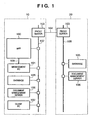
- Fig. 1 is a block diagram showing the configuration of an image processing system according to the first embodiment of the present invention.
- the image processing system is implemented in an environment where offices 10 and 20 are connected by a network 104 such as the Internet.
- a LAN 107 constructed in the office 10 is connected to an MFP (Multi Function Peripheral) 100 serving as a multifunction apparatus which realizes a plurality of types of functions, a management PC 101 which controls the MFP 100, a client PC 102, a document management server 106, a database 105 for the server 106, and a proxy server 103.
- MFP Multi Function Peripheral
- the LAN 107 in the office 10 and a LAN 108 in the office 20 are connected to the network 104 via the proxy servers 103 of the two offices.
- the MFP 100 comprises an image reader which electronically reads particularly a paper document, and an image processor which executes image processes for an image signal obtained from the image reader.
- the image signal can be transmitted to the management PC 101 via a LAN 109.
- the management PC 101 is a general PC, and incorporates various building components such as an image storage unit, image processor, display, and input unit. Some of the building components are integrated into the MFP 100.
- the network 104 is a so-called communication network which is typically realized by one or a combination of the Internet, LAN, WAN, telephone line, dedicated digital circuit, ATM, frame relay line, communication satellite channel, cable television line, data broadcasting radio channel, and the like as far as the network enables data exchange.
- Various terminals such as the management PC 101, client PC 102, and document management server each have standard building components (e.g., CPU, RAM, ROM, hard disk, external storage, network interface, display, keyboard, and mouse) which are standard equipment for a general-purpose computer.
- standard building components e.g., CPU, RAM, ROM, hard disk, external storage, network interface, display, keyboard, and mouse
- Fig. 2 is a block diagram showing the detailed arrangement of the MFP according to the first embodiment of the present invention.
- an image reader 110 including a document table and auto document feeder (ADF) irradiates a bundle or one of document images with a light source (not shown), forms a reflected document image on a solid-state image sensing element via a lens, and obtains a raster image reading signal from the solid-state image sensing element as a raster image at a predetermined density (600 DPI or the like).
- ADF auto document feeder
- the MFP 100 has a copying function of printing an image corresponding to an image reading signal on a printing medium by a printing unit 112.
- the image reading signal is processed by a data processor 115 to generate a printing signal, and the printing signal is printed on a printing medium by the printing unit 112.
- a printing signal for one copy is temporarily stored and held in a storage unit 111, and such printing signals are sequentially output to the printing unit 112 to print them on printing media.
- image signals-of pages designated by the data processor 115 are reduced and laid out so as to be able to print them on one paper sheet.
- the resultant data is output to the printing unit 112 to print on a printing medium.
- a printing signal output from the client PC 102 is received by the data processor 115 via the LAN 107 and a network I/F 114.
- the data processor 115 converts the printing signal into raster data printable by the printing unit 112, and the printing unit 112 prints the data on a printing medium.
- An instruction from the operator to the MFP 100 is input from an input unit 113 formed by a key operation unit attached to the MFP 100 and a keyboard and mouse connected to the management PC 101.
- a series of operations are controlled by a controller (not shown) in the data processor 115.
- An operation input state and image data during processing are displayed on a display 116.
- the storage unit 111 is also controlled by the management PC 101. Data exchange and control between the MFP 100 and the management PC 101 are performed via a network I/F 117 and the LAN 109.
- a user interface which provides the user with various operations and displays for executing various processes (to be described later) is implemented by the display 116 and input unit 113.
- Processes executed by the image processing system according to the present invention are roughly classified into two processes: a registration process of registering image data and a retrieval process of retrieving desired image data.
- various processes are executed by distributing them to various terminals which form the image processing system. These processes may be executed in one terminal (e.g., the MFP 100).
- image data generated by scanning and inputting a paper document is registered, or image data prepared by rasterizing an electronic document created by a document creation application or the like into a raster image is registered.
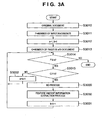
- Fig. 3A is a flowchart showing the registration process according to the first embodiment of the present invention.
- a paper document to be registered can have one or a plurality of pages. For a plurality of pages, image data (page images) obtained from the paper document are managed as one file.
- step S3010 an original document to be registered is input. Along with this input, various pieces of information for managing an original document are generated and stored in the storage unit 111.
- the electronic data is stored in the hard disk of the client PC 102, the database 105 of the document management server 106 in the office 10 or 20, or the storage unit 111 of the MFP 100.
- Electronic data of an original document to be registered is read out from the storage source, input to the data processor 115 via the network I/F 114, and converted into a raster image by the data processor 115.
- the paper document is raster-scanned by the image reader 110 of the MFP 100 to obtain a raster image.
- the first embodiment can process both electronic data and a paper document as an original document to be registered.
- the raster image is pre-processed by the data processor 115 and saved in the storage unit 111 (in subsequent processes, the raster image is used as electronic data of an original document for a paper document).
- a unique document ID is issued for each original document to be registered, and saved as address information in the storage unit 111 in correspondence with the address of the electronic data of the original document.
- the address is full path information which is formed by a URL, server name, directory, and file name and represents an electronic data storage destination.
- An example of address information is shown in Fig. 4 .
- the address information storage destination is the database 105, storage unit 111, or the like.
- the file format of electronic data when the original document is a paper document is, e.g., BMP, but is not limited to this and may be any file format (e.g., GIF or JPEG) capable of saving color information.
- the file format of electronic data when the original document is electronic data is a file format (*.doc or *.pdf) depending on an application (e.g., MS-Word available from Microsoft® or Acrobat available from Adobe Systems®) which creates the electronic data.
- an application e.g., MS-Word available from Microsoft® or Acrobat available from Adobe Systems®
- step S3011 the number of documents input in step S3010 is set as an input document count P.
- step S3012 "1" is set as the default value of a variable a representing the number of processing documents and the default value of a variable b representing the number of processing pages in one document to be processed.
- step S3013 the number of pages in the ath document is set as a page count Q of one document.
- Whether P is equal to or larger than a is determined as end determination. If P is smaller than a (NO in step S3014), the process ends. If P is equal to or larger than a (YES in step S3014), an unprocessed document exists, and the process continues.
- step S3015 whether Q is equal to or larger than b is determined as end determination of each document. If Q is smaller than b (NO in step S3015), the process advances to step S3032 to increment a by one, and returns to step S3014 to change the processing target to the next document. If Q is equal to or larger than b (YES in step S3015), an unprocessed page exists, and the process continues.
- a block selection (BS) process is performed for Q pages of the Pth document. This process is executed under the control of the management PC 101.
- the CPU of the management PC 101 segments the raster image of the original document to be processed that is stored in the storage unit 111, into a text/line image part and halftone image part.
- the CPU further segments the text/line part into blocks of paragraphs, or tables or pictures formed by lines.
- the halftone image part is segmented into blocks such as an image part and background part of blocks separated into rectangles.
- a block ID which specifies the page number of a page to be processed and each block in the page is issued.
- the attribute (image, text, or the like) of each block, the size, the position (coordinates within the page) in the original document, and the block are associated and stored as block information in the storage unit 111.
- An example of the block information is shown in Fig. 5 .
- step S3030 the data processor 115 performs a feature amount information extraction process of extracting feature amount information of each block in accordance with the type of block.
- a text block undergoes an OCR process to extract a character code as a text feature amount.
- An image feature amount pertaining to the color is extracted from an image block.
- feature amounts corresponding to respective blocks are integrated for each original document, and stored as feature amount information in the storage unit 111 in association with a document ID, page number, and block ID. Examples of feature amount information are shown in Figs. 6 and 7 .
- step S3031 b is incremented by one, and the process returns to step S3014 to shift the processing target to the next page.
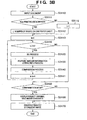
- Fig. 3B is a flowchart showing the retrieval process according to the first embodiment of the present invention.
- step S3110 a paper document serving as a retrieval condition is input.
- This process is the same as the process in step S3010, and a description thereof will be omitted. Note that a raster image generated by this process is merely temporarily saved, and address information for the paper document need not be saved in the storage unit 111.
- step S3111 whether the user has designated Nup printing is determined. If Nup printing has been designated (YES in step S3111), the process advances to step S3112 to set, as a page count L, the number of pages on one paper sheet designated by the user. If no Nup printing has been designated (NO in step S3111), the process advances to step S3115 to regard the number of pages as one on one paper sheet and set "1" as the page count L.
- step S3113 "1" is set as the default value of the variable b representing the number of processing pages in one document to be processed. Whether L is equal to or larger than b is determined as end determination of the comparison process. If L is smaller than b (NO in step S3116), the process advances to step S3150. If L is equal to or larger than b (YES in step S3116), an unprocessed page exists, and the process advances to step S3120 and continues.
- step S3120 the block selection (BS) process is done for the image region of the bth page in the raster image.
- Fig. 8 shows an example of Nup-printing two pages.
- reference numeral 810 denotes a region of one entire paper sheet; 811 and 812, page images of respective pages; and 813 and 814, page numbers of the pages.
- the block selection process is performed for only a target processing region 815 including the page image 811 of the first page.
- the block selection process is done for the target processing region including the page image 812 of the second page.
- the block selection process is the same as that in step S3020, and a description thereof will be omitted. Note that the attribute, size, and position of each block generated by the block selection process are merely temporarily saved, and block information for the paper document need not be saved in the storage unit 111.
- the target processing region is determined on the basis of a predetermined processing order by segmenting a paper document on one paper sheet into L regions on the basis of the L value and the orientation of the paper document.
- step S3130 a feature amount information extraction process of extracting feature amount information of each block is executed. This process is the same as the process in step S3030, and a description thereof will be omitted. Note that the feature amount of each block generated by this process is merely temporarily saved, and feature amount information for the paper document need not be saved in the storage unit 111.
- step S3140 feature amount information of the image (reference comparison image) of the bth page in the input paper document and feature amount information of the electronic data (target comparison image) stored in the hard disk of the client PC 102, the database 105 of the document management server 106 in the office 10 or 20, or the storage unit 111 of the MFP 100 are compared to calculate the similarity.
- An original document candidate is determined as a retrieval result on the basis of the similarity.
- step S3141 b is incremented by one, and the process returns to step S3116 to shift the processing target to the next page.
- step S3116 If L is smaller than b in step S3116 (NO in step S3116), the process advances to step S3150 to determine whether a user confirmation mode has been set.
- a user interface containing original document candidates is implemented by the display 116 and input unit 113.
- the user interface allows the user to confirm the contents of the original document candidates. Details of the arrangement of the user interface will be described later.
- step S3150 If no user confirmation mode is set in step S3150 (NO in step S3150), a document which is determined in the comparison process to be most similar is automatically selected, and the process advances to step S3170. If the user confirmation mode is set (YES in step S3150), the process advances to step S3160 to display/select an original document candidate. This selection is realized by displaying the thumbnail images of original document candidates on the display 116 and prompting the user to select the thumbnail image of a desired original document candidate from the original document candidates.
- step S3170 the selected original document undergoes one of printing, distribution, storage, and editing of the original document on the basis of a manipulation by the user via the user interface implemented by the display 116 and input unit 113.
- the block selection process and feature amount information extraction process are performed for each page contained in one document. Similar image retrieval is sequentially executed for pages by using the results of these processes. All electronic data corresponding to pages can be retrieved and utilized.
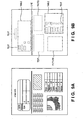
- a raster image in Fig. 9A is recognized as meaningful blocks, as shown in Fig. 9B .
- the attributes e.g., TEXT/PICTURE/PHOTO/LINE/TABLE
- the attributes are determined to segment the image into blocks having different attributes.
- An input image is binarized into a monochrome image, and edge tracking is performed to extract a cluster of pixels surrounded by a black pixel edge.
- edge tracking is also performed for internal white pixels to extract a cluster of white pixels.
- a cluster of black pixels is recursively extracted from the cluster of white pixels with a predetermined area or more.
- Obtained clusters of black pixels are classified by size and shape into blocks having different attributes.
- a block having an aspect ratio of almost 1 and a size of a predetermined range is defined as a pixel cluster corresponding to a text.
- a part of adjacent characters which can be neatly grouped is defined as a text block.
- a plane pixel cluster is defined as a line block.
- a range of a black pixel cluster which neatly contains rectangular white pixel clusters with a predetermined size or more is defined as a table block.
- a region where indefinite pixel clusters scatter is defined as a photo block.
- a pixel cluster with another arbitrary shape is defined as a picture block.
- the feature amount information extraction process adopts different processing methods for an image block and text block, and these methods will be separately described.
- Image blocks include photo and picture blocks in the example of Fig. 9B , but can be limited to at least one of photo and picture blocks in accordance with the application purpose.
- a feature amount information extraction process for an image block will be described.
- the first embodiment executes a color feature amount information extraction process of extracting the color feature amount of the image color.
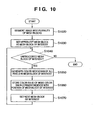
- Fig. 10 is a flowchart showing details of the color feature amount information extraction process according to the first embodiment of the present invention.
- step S1020 the image is segmented into a plurality of mesh blocks.
- the image is segmented into nine mesh blocks in the vertical and horizontal directions each.
- step S1030 a mesh block of interest to be processed is set to the upper left block.
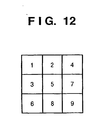
- the mesh block of interest is set by looking up an order decision table which decides a processing order in advance, as shown in Fig. 12 .
- step S1040 whether an unprocessed mesh block of interest exists is determined. If no unprocessed mesh block of interest exists (NO in step S1040), the process ends. If an unprocessed mesh block of interest exists (YES in step S1040), the process advances to step S1050.
- step S1050 the density values of all pixels in a mesh block of interest are projected into color bins serving as subspaces prepared by dividing the color space in Fig. 13 , and the color histogram of the color bins is generated.
- step S1060 the color bin ID of the mode color bin of the color histogram is determined as the representative color of the mesh block of interest.
- the determined color bin ID is stored in the storage unit 111 in correspondence with the mesh block of interest and its position.
- step S1070 the next mesh block of interest to be processed is set by looking up the order decision table in Fig. 12 .
- the flow then returns to step S1040 to recursively repeat the processes in steps S1040 to S1070 until no unprocessed mesh block of interest exists.
- Text feature amount information of a text block is a character code obtained by performing the OCR (Optical Character Recognition) process for the text block.
- OCR Optical Character Recognition
- a several ten-dimensional observation feature vector of a numerical value series converted from the feature of a character image and a dictionary feature vector obtained in advance for each character type are compared to output a character type with the shortest distance as a recognition result.
- Extraction of a feature vector can be realized by various known methods. For example, a character is segmented into meshes, character lines in each mesh block are counted as linear elements in each direction, and a mesh count-dimensional vector is defined as a feature.
- step S3020 or S3120 To execute character recognition for a text block extracted by the block selection process (step S3020 or S3120), whether the text block is a horizontal/vertical writing is determined. A character string is extracted in a corresponding direction, and then a character is extracted from the character string to acquire a character image.
- a horizontal/vertical writing In determination of a horizontal/vertical writing, horizontal/vertical projection to a pixel value within the text block is formed.
- the text block is determined to be a horizontal writing when the variance of horizontal projection is large, and a vertical writing when the variance of vertical projection is large.
- decomposition into a character string and character for a text block of a horizontal writing, a column is extracted using the horizontal projection, and a character is extracted from the vertical projection of the extracted column.
- the horizontal and vertical directions are reversed.
- Nup printing designation whether the user has set Nup printing via the user interface of the MFP 100 is determined, and if Nup printing has been set, the number of pages contained in a document of one paper sheet is designated.
- Fig. 14 is a view showing an example of the user interface according to the first embodiment of the present invention.
- Reference numeral 1411 denotes a display/operation panel.
- Reference numerals 1412 to 1415 denote various function buttons.
- the function buttons 1412 to 1415 are used to designate printing, distribution, storage, and editing of an image to be processed.
- Reference numeral 1416 denotes a start button which is clicked to execute a function selected with a function button.
- Reference numeral 1425 denotes a ten-key pad which allows designating the number of print sheets and the number of pages on one paper sheet in Nup printing.
- Reference numeral 1417 denotes a display area which is formed by a touch panel and can be directly touched by the user to designate selection.
- Reference numeral 1418 denotes a paper document confirmation area where a paper document image read by the image reader 110 is reduced to a size within the area and displayed. The user can confirm the state of the paper document image in the area 1418.
- Reference numeral 1419 denotes an area where the type of input document is confirmed.
- the area 1419 allows confirming the content of the type of read paper document.
- reference numeral 1420 denotes a designation area for designating Nup printing. When Nup printing is designated, the display state of the designation area 1420 changes to a colored display, blinking display, highlighted display, or the like in order to exhibit the designated state.
- Reference numeral 1424 denotes an area where the number of pages on one paper sheet is displayed when Nup printing is designated. Especially when no Nup printing is designated, "1" is set. The number of pages is designated using the ten-key pad 1425.
- Nup printing can be designated for a read paper document.
- the number of pages of a document on one paper sheet can be designated while the state is displayed.
- step S3140 Details of the comparison process in step S3140 will be explained with reference to Fig. 15 .
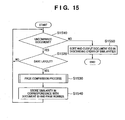
- Fig. 15 is a flowchart showing details of the comparison process according to the first embodiment of the present invention.
- step S1510 whether an uncompared original document exists is determined by referring to address information. If no uncompared original document exists (NO in step S1510), the process advances to step S1550. If an uncompared original document exists (YES in step S1510), the process advances to step S1520.
- the layout is then compared.
- the layout includes the attribute, size, and position of a block in block information. If the layouts of a reference comparison image (paper document) and target comparison image (electronic data) coincide with each other (YES in step S1520), the process advances to step S1530. If these layouts do not coincide with each other (NO in step S1520), the process returns to step S1510.
- step S1530 a page comparison process of comparing the page of the reference comparison image (paper document) and the page of the target comparison image (electronic data) is executed.
- This comparison is comprehensively performed using feature amounts corresponding to a character and image in accordance with the block attribute, thereby calculating similarity. Details of this process will be described later.
- step S1540 the similarity of the document is temporarily stored in the storage unit 111 in correspondence with the document ID and page number of the target comparison image.
- step S1510 If all documents have been compared in step S1510 (NO in step S1510), the process advances to step S1550 to sort and output document IDs and page numbers in the descending order of similarities.
- step S1530 Details of the page comparison process in step S1530 will be explained with reference to Fig. 16 .
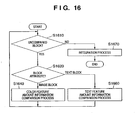
- Fig. 16 is a flowchart showing details of the page comparison process according to the first embodiment of the present invention.
- step S1610 whether an uncompared block exists in electronic data corresponding to a document ID and page number subjected to a process is determined by referring to block information. If no uncompared block exists (NO in step S1610), the process advances to step S1670. If an uncompared block exists (YES in step S1610), the process advances to step S1620.
- step S1620 the attribute of a block to be compared is determined. If the attribute exhibits an image block, the process advances to step S1640. If the attribute exhibits a text block, the process advances to step S1660.
- a color feature amount information comparison process which is a similarity comparison between the reference comparison block and the target comparison block is executed on the basis of color feature amount information. Details of this process will be described later.
- the obtained similarity is temporarily stored in the storage unit 111 in correspondence with the document ID, page number, and block ID of the target comparison block.
- a text feature amount information comparison process which is a similarity comparison between the reference comparison block and the target comparison block is executed on the basis of text feature amount information. Details of this process will be described later.
- the obtained similarity is temporarily stored in the storage unit 111 in correspondence with the document ID, page number, and block ID of the target comparison block.
- step S1610 If comparisons with all blocks end in step S1610 (NO in step S1610), the process advances to step S1670 to perform an integration process of integrating the similarities of all blocks contained in the pages of the target comparison document (electronic data) that are stored in the storage unit 111 by the processes in steps S1640 and S1660, and calculating the similarity between the paper document serving as a retrieval condition and the page of the original document. Details of this process will be described later.
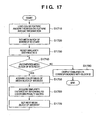
- step S1640 Details of the color feature amount information comparison process in step S1640 will be described with reference to Fig. 17 .
- Fig. 17 is a flowchart showing details of the color feature amount information comparison process according to the first embodiment of the present invention.
- step S1710 the color feature amounts of a reference comparison image block and target comparison image block are read out from color feature amount information.
- step S1720 a mesh block of interest in an image block to be processed is set as the start block.
- step S1730 the similarity distance representing the similarity between the color feature amount of the reference comparison image block and that of the target comparison image block is reset to 0.
- step S1740 whether an uncompared mesh block of interest exists is determined. If no uncompared mesh block of interest exists (NO in step S1740), the process advances to step S1780. If an uncompared mesh block of interest exists (YES in step S1740), the process advances to step S1750.
- step S1750 the color bin IDs of mesh blocks of interest are acquired from the color feature amounts of the reference comparison image and target comparison image.
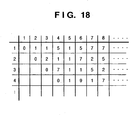
- step S1760 the local similarity distance of the mesh block of interest that corresponds to the interval between the acquired color bin IDs is acquired by referring to a color bin penalty matrix in Fig. 18 .
- the local similarity distance is added to the similarity distance acquired in the immediately preceding process.
- the similarity distance is stored in the storage unit 111.
- the color bin penalty matrix will be explained with reference to Fig. 18 .
- Fig. 18 is a view showing the structure of the color bin penalty matrix according to the first embodiment of the present invention.
- the color bin penalty matrix manages the local similarity distance between color bin IDs.
- the color bin penalty matrix is configured such that the similarity distance is 0 for the same color bin ID, and as the difference between color bin IDs increases, i.e., the similarity decreases, the similarity distance increases. Diagonal positions for the same color bin ID have a similarity distance of 0, and color bin IDs are symmetrical about the similarity distance of 0.
- the similarity distance between color bin IDs can be acquired only by referring to the color bin penalty matrix, attaining high processing speed.
- step S1770 the next mesh block of interest to be processed is set by looking up the order decision table in Fig. 12 . After that, the process returns to step S1740.
- step S1740 If no uncompared mesh block of interest exists in step S1740 (NO in step S1740), the process advances to step S1780 to convert the similarity distance stored in the storage unit 111 into a similarity and output the similarity paired with the block ID.
- step S1660 Details of the text feature amount information comparison process in step S1660 will be described.
- character codes in the text blocks of a reference comparison image and target comparison image are compared to calculate the similarity from the coincidence between the character codes.
- the similarity is ideally 100%.
- a recognition error may occur in the OCR process for a text block in a paper document serving as a retrieval condition.
- even a comparison with an original document may not attain a similarity of 100%, but has a similarity of almost 100%.
- step S1670 Details of the integration process in step S1670 will be explained.
- the calculated similarities of blocks are integrated such that the similarity of a block which occupies a large part of an original document serving as a target comparison image is reflected at a higher ratio in the similarity of the whole original document.
- w1 to w6 are weighting factors for evaluating the similarities of blocks.
- the similarity of a block which occupies a large part of an original document can be reflected at a higher ratio in the similarity of the whole original document.
- the confirmation mode may be designated from a user interface by the user in advance, or whether to set the confirmation mode may be determined automatically.
- the automatic determination method is as follows. For example, when only one original document candidate is retrieved, or when the differences in similarity between the first original document candidate and the second and subsequent original document candidates are equal to or larger than a predetermined value and the first original document candidate is more likely to be a desired original document, a "non-confirmation mode" is determined and the process advances to step S3170; otherwise, the "confirmation mode" is determined.
- the "confirmation mode" is set to confirm only the page which does not satisfy the condition.
- original document candidates are displayed in the descending order of similarities in a user interface implemented by the display 116 and input unit 113 of the MFP 100, and the user is prompted to select a desired original document from the displayed candidates.
- Fig. 19 is a view showing an example of the user interface according to the first embodiment of the present invention.
- Reference numeral 1917 denotes a display area which is formed by a touch panel and can be directly touched by the user to designate selection.
- the display area 1917 is the same as the display area in Fig. 14 .
- Reference numeral 1918 denotes a mode display area which represents the confirmation mode in Fig. 19 .
- the mode display area 1918 generally displays an automatically determined mode. By touching the mode display area 1918, the user can cyclically designate the "confirmation mode” and "non-confirmation mode”.
- Reference numerals 1919 to 1928 denote thumbnail images of original document candidates to be output as retrieval results.
- the thumbnail images are displayed in the descending order of similarities with numbers from 1919.
- thumbnail images are displayed, and if more than 10 thumbnail images exist, up to 10 thumbnail images are displayed.
- a desired thumbnail image is selected from the thumbnail images 1919 to 1928, thereby selecting a desired original document.
- the selected original document can undergo various processes.
- Reference numeral 1929 denotes a button which is displayed upon scanning an Nup-printed paper document and represents which of the candidates of pages in the document is displayed. By selecting the button 1929, the candidate can be switched to select the candidate of another page.
- step S3170 Details of the printing/distribution/storage/editing process in step S3170 will be explained.
- the retrieval results (original document) of a plurality of pages corresponding to the pages of the document are attained.
- the printing condition may be defined such that one page is printed on one paper sheet, Nup printing with a layout changed from that of original Nup printing is done, pages are printed on two sides of one paper sheet, pages are overlaid and printed on one paper sheet, or bookbinding printing is performed in a different order. Only pages designated by the user may be printed on one paper sheet.
- a process such as distribution, storage, or editing may be done for all retrieval results, or only pages designated by the user may undergo a process such as distribution, storage, or editing.
- original electronic data can be retrieved for all pages contained in an Nup-printed paper document, and various applications using the retrieved electronic data can be implemented.
- the first embodiment whether an input paper document is Nup-printed is determined, and if so, the number of pages contained in a document of one paper sheet is designated by the user.
- the contents of an input paper document is analyzed, whether the paper document is Nup-printed is determined, and if so, the number of pages contained in a document of one paper sheet is automatically determined. Automatic determination is executed after input of a paper document in step S3110 of Fig. 3B according to the first embodiment.
- Fig. 20 is a flowchart showing the retrieval process according to the second embodiment of the present invention.
- a paper document is input in step S3110, and an Nup printing determination process of determining whether the input scanned image is Nup-printed is determined in step S2011.
- a process in step S3111 is executed on the basis of the determination result.
- the page number is printed at the upper or lower end of the paper document.
- Nup printing a plurality of page numbers are printed at equal intervals within the paper document. The second embodiment utilizes this fact to determine whether the scanned image to be processed is Nup-printed.
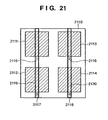
- Fig. 21 is a view showing an example of Nup-printing a 4-page document on one paper sheet according to the second embodiment of the present invention.
- reference numeral 2110 denotes a region of the entire paper sheet in Nup printing.
- Reference numerals 2111 to 2114 denote page images of pages.
- Reference numerals 2115 to 2118 denote page numbers assigned to pages.
- Reference numerals 2119 and 2120 denote page number retrieval regions (to be described later) within bold frames.
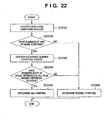
- step S2011 Details of the Nup-printing determination process in step S2011 will be explained with reference to Figs. 21 and 22 .
- Fig. 22 is a flowchart showing details of the Nup printing determination process according to the second embodiment of the present invention.
- step S2210 an OCR process is done for upper and lower end regions in the region 2110 of the entire paper sheet.
- step S2220 whether two or more page numbers (e.g., Arabic figures or alphanumeric characters) exist at equal intervals within the upper or lower end region is determined as the process result of the OCR process. If no two or more page numbers exist (NO in step S2220), the process advances to step S2260 to determine normal printing. If two or more page numbers exist (YES in step S2220), the process advances to step S2230.
- page numbers e.g., Arabic figures or alphanumeric characters
- step S2230 a page number retrieval region for retrieving another page number is set on the basis of the detected page number, and the OCR process is executed for the set page number retrieval region.
- the page number retrieval regions 2119 and 2120 are set for the page number images 2117 and 2118 in the longitudinal direction on the entire paper sheet containing the page numbers.
- the page number retrieval regions 2119 and 2120 undergo the OCR process.
- step S2240 whether page numbers are detected in the respective page number retrieval regions and the intervals between the page numbers in the page number retrieval regions are equal is determined. If the intervals are not equal (NO in step S2240), the process advances to step S2260 to determine normal printing. If the intervals are equal (YES in step S2240), the process advances to step S2250 to determine that the scanned image is Nup-printed.
- Determination of whether the intervals are equal is executed for the intervals between page numbers including an error range which considers an error to a certain extent. That is, when the intervals between the page numbers fall within the error range, the intervals between the page numbers are determined to be equal to each other.
- the page numbers 2115 (“1") and 2117 (“3") are detected in the page number retrieval region 2119, and the page numbers 2116 ("2") and 2118 ("4") are detected in the page number retrievalregion 2120.
- the intervals between the page numbers in the page number retrieval regions 2119 and 2120 are equal to each other.
- the scanned image is determined to be Nup-printed.
- the number of pages on one paper sheet can be calculated by multiplying the number of page numbers detected in step S2210 and the number of page numbers detected in one page number retrieval region in step S2230.
- the number of pages is temporarily saved in a storage unit 111.
- Whether a scanned image is Nup-printed is automatically determined, in addition to the effects described in the first embodiment. Whether a scanned image is Nup-printed can be determined, and if so, the number of contained pages can be determined without any cumbersome operation by the user.
- the process result of the Nup printing determination process in step S2011 may be temporarily presented to the user to confirm it.
- the determination result is displayed as a reduced image in, e.g., a paper document confirmation area 1418 of Fig. 14 .
- a chance to correct the determination content can be given using an area 1419.
- the determination content can be corrected to prevent output of erroneous original electronic data.
- a page number is detected using the OCR process in the Nup printing determination process of step S2011.
- the present invention is not limited to this.
- a page number may be detected as follows.
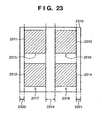
- the third embodiment will exemplify Nup printing of a 4-page document on one paper sheet, as shown in Fig. 23 .
- An area 2310 corresponds to the area 2110 in Fig. 21 ; an area 2311, to the area 2111; an area 2312, to the area 2112; an area 2313, to the area 2113; an area 2314, to the area 2114; an area 2315, to the area 2115; an area 2316, to the area 2116; an area 2317, to the area 2117; and an area 2318, to the area 2118.
- a description of these areas will be omitted.
- reference numeral 2320 denotes a left margin (leftmost margin) for two left pages.
- Reference numeral 2321 denotes a right margin (rightmost margin) for two right pages.
- Reference numeral 2319 denotes an intermediate margin between the two left pages and the two right pages. The intermediate margin 2319 is longer than the left margin 2320 or the right margin 2321 because the right margin for the two left pages and the left margin for the two right pages are coupled.
- a scanned image can be determined to be Nup-page-printed.
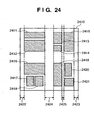
- Reference numeral 2410 denotes a region of the entire paper sheet.
- the block selection process is done for the region 2410 to obtain blocks 2411 to 2421 as block selection process results.
- the leftmost end of the detected blocks is detected to calculate a left margin 2422 as the difference from the left end of the entire paper region.
- the left margin 2422 corresponds to the left margin 2320 in Fig. 23 .
- the rightmost end of the blocks is detected to calculate a right margin 2423 as the difference from the right end of the entire paper region.
- the right margin 2423 corresponds to the right margin 2321 in Fig. 23 .
- the lateral intervals between the blocks are calculated to obtain intermediate margin candidates 2424 and 2425 for the intermediate margin 2319.
- the intermediate margin candidate 2424 which is longer than the left margin 2422 and the right margin 2423 is defined as an intermediate margin.
- the number of pages in the lateral direction is given by the number of detected intermediate margins + 1.
- the same process is also performed in the longitudinal direction.
- the results in the lateral and longitudinal directions are multiplied to calculate the total number of pages.
- the third embodiment automatically determines whether a scanned image is Nup-printed, similar to the effects described in the second embodiment. Whether a scanned image is Nup-printed can be determined, and if so, the number of contained pages can be determined without any cumbersome operation by the user.
- a page to be processed may be selected by touching an area where a desired page is displayed, by the user within the paper document confirmation area 1418 of Fig. 14 and designating the page. At this time, the processes from steps S3120 to S3140 are performed for only the designated page region.
- processes may be done for only a designated page region by presenting to the user an Nup printing determination result and performing the same procedures. Accordingly, the user can perform a process such as printing for only a specific page in an Nup-printed paper document.
- the mode color of an image to be processed is extracted as color feature information.
- the present invention is not limited to this, and for example, an average color may be extracted as color feature information.
- the color feature amount is used as an image feature amount.
- the present invention is not limited to this, and may adopt one or an arbitrary combination of a plurality of types of image feature amounts such as a brightness feature amount expressed by a mode brightness, average brightness, or the like, a texture feature amount expressed by a cooccurrence matrix, contrast, entropy, Gabor transformation, or the like, and a shape feature amount expressed by an edge, Fourier descriptor, or the like.
- the block selection process is performed to segment a document to be processed into a text block and image block, and retrieval is done comprehensively using the feature amounts of these blocks.
- the entire document may be regarded as one image to retrieve an original document. If the precision permits, the original document may be retrieved using only an image block in the document.
- a character code or image may be directly extracted from electronic data and compared.
- the text feature amount employs a character code. Instead, the part of speech of a word may be extracted in advance by matching with a word dictionary, and a noun may be defined as a text feature amount.
- an original document to be registered is not an Nup-printed paper document (or its electronic data) but a normally printed paper document (or its electronic data).
- An Nup-printed paper document (or its electronic data) may also be set as an original document to be registered.
- the user designates Nup printing and the number of pages contained in a document of one paper sheet (or electronic data) in a registration process.
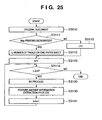
- Fig. 25 shows a registration process of registering an Nup-printed paper document of one paper sheet for descriptive convenience.
- Steps in Fig. 25 are implemented by almost the same step combination as some of the steps in Figs. 3A and 3B of the first embodiment.
- step S3010 an original document to be registered is input.
- step S3111 whether the user has designated that the original document is an Nup-printed document is determined.
- step S3111 If the original document is determined to be designated as an Nup-printed document (YES in step S3111), the number of pages on one paper sheet designated by the user is set as the page count L in step S3112. If the original document is determined not to be designated as an Nup-printed document (NO in step S3111), "1" is set as the page count L in step S3115.
- step S3113 "1" is set as the default value of the variable b representing the number of processing pages in one document to be processed. Whether L is equal to or larger than b is determined as end determination of the comparison process. If L is smaller than b (NO in step S3116), the registration process ends.
- step S3116 If L is equal to or larger than b (YES in step S3116), an unprocessed page exists, and the process advances to step S3120 to perform a block selection process for the region of the bth page in the Nup original document.
- step S3130 feature amount information of each block is extracted and stored in a storage unit 111.
- step S3141 b is incremented by one, and the process returns to step S3116.
- a plurality of Nup-printed paper documents can be registered. This can also be implemented by combining necessary steps out of the steps in Figs. 3A and 3B .
- the resolution may be converted such that each page image contained in a document image to be registered becomes identical to one page printed on one paper sheet.
- the resultant image may be registered as a document image obtained by printing one page on one paper sheet.
- a document image corresponding to an Nup-printed paper document may be directly registered.
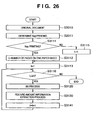
- Fig. 26 shows a registration process of registering an Nup-printed paper document of one paper sheet for descriptive convenience.
- Steps in Fig. 26 are realized by almost the same step combination as some of the steps in Fig. 3A of the first embodiment and Fig. 20 of the second embodiment.
- step S3010 an original document to be registered is input.
- step S2011 whether the original document is an Nup-printed document is automatically determined. If the original document is determined to be an Nup-printed document, the number of determined pages is set as the page count L in step S3112. If the original document is determined not to be an Nup-printed document, "1" is set as the page count L in step S3115.
- step S3113 "1" is set as the default value of the variable b representing the number of processing pages in one document to be processed. Whether L is equal to or larger than b is determined as end determination of the comparison process. If L is smaller than b (NO in step S3116), the registration process ends.
- step S3116 If L is equal to or larger than b (YES in step S3116), an unprocessed page exists, and the process advances to step S3120 to perform a block selection process for the region of the bth page in the Nup original document.
- step S3130 feature amount information of each block is extracted and stored in a storage unit 111.
- step S3141 b is incremented by one, and the process returns to step S3116.
- a plurality of Nup-printed paper documents can also be registered. This can also be implemented by combining necessary steps out of the steps in Fig. 3A of the first embodiment and Fig. 20 of the second embodiment.
- the embodiments have been described in detail above.
- the present invention can take embodiments of a system, apparatus, method, program, storage medium, and the like. More specifically, the present invention may be applied to a system including a plurality of devices or an apparatus formed by a single device.
- the present invention is also achieved by supplying a software program (in the above embodiments, programs corresponding to flowcharts shown in the drawings) for realizing the functions of the above-described embodiments to a system or apparatus directly or from a remote place, and reading out and executing the supplied program codes by the computer of the system or apparatus.
- a software program in the above embodiments, programs corresponding to flowcharts shown in the drawings
- the present invention is realized by program codes installed in the computer in order to realize the functional processes of the present invention by the computer. That is, the present invention includes a computer program for realizing the functional processes of the present invention.
- the present invention can take any program form such as an object code, a program executed by an interpreter, or script data supplied to an OS as long as a program function is attained.
- a recording medium for supplying the program includes a floppy® disk, hard disk, optical disk, magnetooptical disk, MO, CD-ROM, CD-R, CD-RW, magnetic tape, nonvolatile memory card, ROM, and DVD (DVD-ROM and DVD-R).
- the program can also be supplied by connecting a client computer to an Internet Web page via the browser of the client computer, and downloading the computer program of the present invention or a compressed file containing an automatic installing function from the Web page to a recording medium such as a hard disk.
- the program can also be realized by grouping program codes which form the program of the present invention into a plurality of files, and downloading the files from different Web pages. That is, the present invention also includes a WWW server which allows a plurality of users to download the program files for realizing the functional processes of the present invention by a computer.
- the program of the present invention can also be encrypted, stored in a storage medium such as a CD-ROM, and distributed to the user.
- a user who satisfies predetermined conditions is prompted to download decryption key information from a Web page via the Internet.
- the user executes the encrypted program by using the key information, and installs the program in the computer.
- the functions of the above-described embodiments are realized when the computer executes the readout program. Also, the functions of the above-described embodiments are realized when an OS or the like running on the computer performs some or all of actual processes on the basis of the instructions of the program.
Landscapes
- Engineering & Computer Science (AREA)
- Physics & Mathematics (AREA)
- Multimedia (AREA)
- Quality & Reliability (AREA)
- General Physics & Mathematics (AREA)
- Theoretical Computer Science (AREA)
- Computer Vision & Pattern Recognition (AREA)
- Signal Processing (AREA)
- Geometry (AREA)
- Artificial Intelligence (AREA)
- Computer Graphics (AREA)
- Computer Hardware Design (AREA)
- Microelectronics & Electronic Packaging (AREA)
- Processing Or Creating Images (AREA)
- Information Retrieval, Db Structures And Fs Structures Therefor (AREA)
- Image Analysis (AREA)
- Facsimile Image Signal Circuits (AREA)
Applications Claiming Priority (4)
| Application Number | Priority Date | Filing Date | Title |
|---|---|---|---|
| JP2003142408 | 2003-05-20 | ||
| JP2003142408 | 2003-05-20 | ||
| JP2004069487A JP4405831B2 (ja) | 2003-05-20 | 2004-03-11 | 画像処理装置及びその制御方法、プログラム |
| JP2004069487 | 2004-03-11 |
Publications (3)
| Publication Number | Publication Date |
|---|---|
| EP1480440A2 EP1480440A2 (en) | 2004-11-24 |
| EP1480440A3 EP1480440A3 (en) | 2005-05-11 |
| EP1480440B1 true EP1480440B1 (en) | 2009-07-22 |
Family
ID=33100435
Family Applications (1)
| Application Number | Title | Priority Date | Filing Date |
|---|---|---|---|
| EP04252925A Expired - Lifetime EP1480440B1 (en) | 2003-05-20 | 2004-05-18 | Image processing apparatus, control method therefor, and program |
Country Status (5)
| Country | Link |
|---|---|
| US (1) | US8203748B2 (enExample) |
| EP (1) | EP1480440B1 (enExample) |
| JP (1) | JP4405831B2 (enExample) |
| CN (1) | CN1271505C (enExample) |
| DE (1) | DE602004022103D1 (enExample) |
Families Citing this family (38)
| Publication number | Priority date | Publication date | Assignee | Title |
|---|---|---|---|---|
| JP4720529B2 (ja) * | 2005-03-10 | 2011-07-13 | 富士ゼロックス株式会社 | 画像処理装置、画像形成装置、画像処理方法及びプログラム |
| JP4682663B2 (ja) * | 2005-03-28 | 2011-05-11 | 富士ゼロックス株式会社 | ドキュメント処理装置 |
| JP4788205B2 (ja) * | 2005-06-22 | 2011-10-05 | 富士ゼロックス株式会社 | 文書検索装置及び文書検索プログラム |
| JPWO2007004519A1 (ja) * | 2005-06-30 | 2009-01-29 | オリンパス株式会社 | 検索システム及び検索方法 |
| JP4920928B2 (ja) * | 2005-08-08 | 2012-04-18 | キヤノン株式会社 | 画像処理装置及びその制御方法、プログラム |
| JP4533273B2 (ja) * | 2005-08-09 | 2010-09-01 | キヤノン株式会社 | 画像処理装置及び画像処理方法、プログラム |
| JP4906044B2 (ja) * | 2005-09-28 | 2012-03-28 | キヤノン株式会社 | 情報検索装置及びその制御方法、コンピュータプログラム、並びに、記憶媒体 |
| JP2007141159A (ja) * | 2005-11-22 | 2007-06-07 | Fuji Xerox Co Ltd | 画像処理装置、画像処理方法、及び画像処理プログラム |
| JP2007201548A (ja) * | 2006-01-23 | 2007-08-09 | Sharp Corp | 画像処理装置 |
| JP2007316849A (ja) * | 2006-05-24 | 2007-12-06 | Canon Inc | 情報処理装置、情報処理システム、及びその制御方法、プログラム、記憶媒体 |
| JP4830721B2 (ja) * | 2006-08-29 | 2011-12-07 | 富士ゼロックス株式会社 | 情報処理装置及びプログラム |
| US8261200B2 (en) * | 2007-04-26 | 2012-09-04 | Fuji Xerox Co., Ltd. | Increasing retrieval performance of images by providing relevance feedback on word images contained in the images |
| US8384929B2 (en) * | 2007-05-03 | 2013-02-26 | Sharp Laboratories Of America, Inc. | Systems and methods for efficiently handling image data |
| JP4469885B2 (ja) | 2007-09-07 | 2010-06-02 | シャープ株式会社 | 画像照合装置、画像照合方法、画像データ出力処理装置、プログラム、及び記録媒体 |
| JP4362528B2 (ja) | 2007-09-10 | 2009-11-11 | シャープ株式会社 | 画像照合装置、画像照合方法、画像データ出力処理装置、プログラム、及び記録媒体 |
| US8260061B2 (en) | 2007-09-21 | 2012-09-04 | Sharp Kabushiki Kaisha | Image data output processing apparatus and image data output processing method |
| JP5343190B2 (ja) * | 2008-02-04 | 2013-11-13 | 株式会社日立情報通信エンジニアリング | 画像処理装置及び画像処理プログラム |
| JP4588771B2 (ja) | 2008-02-26 | 2010-12-01 | シャープ株式会社 | 画像処理方法、画像処理装置、画像形成装置、プログラム及び記憶媒体 |
| WO2010110181A1 (ja) * | 2009-03-27 | 2010-09-30 | 日本電気株式会社 | パターン照合装置、パターン照合方法及びパターン照合プログラム |
| JP5312164B2 (ja) * | 2009-04-10 | 2013-10-09 | キヤノン株式会社 | 画像形成システム、コンピュータプログラム、及び制御方法 |
| US8467110B2 (en) * | 2009-05-21 | 2013-06-18 | Kyocera Document Solutions Inc. | Image reading apparatus, image forming apparatus, and image reading method |
| US8854697B2 (en) * | 2009-07-02 | 2014-10-07 | Xerox Corporation | System and method for scanning and enlarging user selected grid areas of a printed page |
| CN102023966B (zh) * | 2009-09-16 | 2014-03-26 | 鸿富锦精密工业(深圳)有限公司 | 用于合约比较的计算机系统及合约比较方法 |
| JP5570176B2 (ja) * | 2009-10-19 | 2014-08-13 | キヤノン株式会社 | 画像処理システム及び情報処理方法 |
| JP5763965B2 (ja) | 2011-05-11 | 2015-08-12 | キヤノン株式会社 | 情報処理装置、情報処理方法、及びプログラム |
| JP2013168858A (ja) * | 2012-02-16 | 2013-08-29 | Fuji Xerox Co Ltd | 画像処理装置及びプログラム |
| JP6070976B2 (ja) * | 2012-02-28 | 2017-02-01 | 富士ゼロックス株式会社 | 画像処理装置、画像処理システム、及びプログラム |
| JP2014121043A (ja) * | 2012-12-19 | 2014-06-30 | Canon Inc | 画像生成装置、方法およびプログラム |
| US20150161087A1 (en) * | 2013-12-09 | 2015-06-11 | Justin Khoo | System and method for dynamic imagery link synchronization and simulating rendering and behavior of content across a multi-client platform |
| US9164874B1 (en) * | 2013-12-20 | 2015-10-20 | Amazon Technologies, Inc. | Testing conversion and rendering of digital content |
| US10678488B2 (en) * | 2016-01-20 | 2020-06-09 | Ricoh Company, Ltd. | Dynamic splitting of portable document format print jobs |
| JP6690340B2 (ja) * | 2016-03-22 | 2020-04-28 | 富士ゼロックス株式会社 | 情報処理装置及びプログラム |
| US10282402B2 (en) | 2017-01-06 | 2019-05-07 | Justin Khoo | System and method of proofing email content |
| US11102316B1 (en) | 2018-03-21 | 2021-08-24 | Justin Khoo | System and method for tracking interactions in an email |
| US12363057B1 (en) | 2018-07-20 | 2025-07-15 | Justin Khoo | System and method for processing of speech content in email messages |
| JP2021193770A (ja) | 2020-06-08 | 2021-12-23 | コニカミノルタ株式会社 | 検索システム |
| JP2021193495A (ja) | 2020-06-08 | 2021-12-23 | コニカミノルタ株式会社 | 検索システム |
| CN112306433A (zh) * | 2020-11-12 | 2021-02-02 | 深圳市华博创新科技有限公司 | 一种电子稿袋印刷处理方法 |
Family Cites Families (18)
| Publication number | Priority date | Publication date | Assignee | Title |
|---|---|---|---|---|
| JPH0317851A (ja) | 1989-06-14 | 1991-01-25 | Hitachi Ltd | 磁気記録再生装置 |
| US5991466A (en) * | 1991-07-31 | 1999-11-23 | Canon Kabushiki Kaisha | Image retrieving apparatus |
| JP3017851B2 (ja) | 1991-07-31 | 2000-03-13 | キヤノン株式会社 | 画像記憶装置 |
| JP3234064B2 (ja) * | 1993-09-02 | 2001-12-04 | キヤノン株式会社 | 画像検索方法並びにその装置 |
| JP3026712B2 (ja) * | 1993-12-09 | 2000-03-27 | キヤノン株式会社 | 画像検索方法及びその装置 |
| DE69535098T2 (de) * | 1994-11-15 | 2007-04-19 | Canon K.K. | Verfahren und -vorrichtung zur Suche von Bildern in einer Datenbank |
| US6785429B1 (en) * | 1998-07-08 | 2004-08-31 | Matsushita Electric Industrial Co., Ltd. | Multimedia data retrieval device and method |
| US6813394B1 (en) | 1998-08-31 | 2004-11-02 | Canon Kabushiki Kaisha | Image storage method and apparatus |
| JP3897476B2 (ja) * | 1999-02-15 | 2007-03-22 | キヤノン株式会社 | 画像処理装置及びその方法、コンピュータ可読メモリ |
| JP2001043239A (ja) * | 1999-07-30 | 2001-02-16 | Canon Inc | 画像記憶方法及び装置及び記憶媒体 |
| JP2001257862A (ja) | 2000-03-09 | 2001-09-21 | Ricoh Co Ltd | 画像形成装置 |
| US7034951B1 (en) * | 2000-05-10 | 2006-04-25 | Hewlett-Packard Development Company, L.P. | Printer collator facility and method |
| JP2002150306A (ja) * | 2000-09-04 | 2002-05-24 | Minolta Co Ltd | 画像処理装置、画像処理方法、画像処理プログラムおよび画像処理プログラムを記録したコンピュータ読取可能な記録媒体 |
| JP4785303B2 (ja) * | 2000-10-31 | 2011-10-05 | キヤノン株式会社 | 印刷制御装置、印刷制御方法およびプログラム |
| JP4672909B2 (ja) * | 2001-06-07 | 2011-04-20 | キヤノン株式会社 | 画像形成装置および画像形成制御方法 |
| JP2003006643A (ja) * | 2001-06-25 | 2003-01-10 | Canon Inc | 画像処理装置及びその方法、プログラム |
| JP3962635B2 (ja) * | 2001-06-26 | 2007-08-22 | キヤノン株式会社 | 画像処理装置およびその制御方法 |
| JP4266695B2 (ja) * | 2003-04-30 | 2009-05-20 | キヤノン株式会社 | 画像処理装置及び画像処理方法 |
-
2004
- 2004-03-11 JP JP2004069487A patent/JP4405831B2/ja not_active Expired - Fee Related
- 2004-05-18 DE DE602004022103T patent/DE602004022103D1/de not_active Expired - Lifetime
- 2004-05-18 US US10/847,573 patent/US8203748B2/en not_active Expired - Fee Related
- 2004-05-18 EP EP04252925A patent/EP1480440B1/en not_active Expired - Lifetime
- 2004-05-20 CN CNB2004100453313A patent/CN1271505C/zh not_active Expired - Fee Related
Also Published As
| Publication number | Publication date |
|---|---|
| JP4405831B2 (ja) | 2010-01-27 |
| US20040234169A1 (en) | 2004-11-25 |
| CN1271505C (zh) | 2006-08-23 |
| CN1550971A (zh) | 2004-12-01 |
| US8203748B2 (en) | 2012-06-19 |
| DE602004022103D1 (de) | 2009-09-03 |
| EP1480440A2 (en) | 2004-11-24 |
| EP1480440A3 (en) | 2005-05-11 |
| JP2005004724A (ja) | 2005-01-06 |
Similar Documents
| Publication | Publication Date | Title |
|---|---|---|
| EP1480440B1 (en) | Image processing apparatus, control method therefor, and program | |
| JP4371965B2 (ja) | 画像処理装置、画像処理方法 | |
| US7272269B2 (en) | Image processing apparatus and method therefor | |
| US7593961B2 (en) | Information processing apparatus for retrieving image data similar to an entered image | |
| JP4181892B2 (ja) | 画像処理方法 | |
| US20070076984A1 (en) | Electronic document creating apparatus | |
| JP2007174270A (ja) | 画像処理装置、画像処理方法、記憶媒体、プログラム | |
| US7746507B2 (en) | Image processing apparatus for image retrieval and control method therefor | |
| JP4920928B2 (ja) | 画像処理装置及びその制御方法、プログラム | |
| US8144988B2 (en) | Document-image-data providing system, document-image-data providing device, information processing device, document-image-data providing method, information processing method, document-image-data providing program, and information processing program | |
| US8818110B2 (en) | Image processing apparatus that groups object images based on object attribute, and method for controlling the same | |
| US8266146B2 (en) | Information processing apparatus, information processing method and medium storing program thereof | |
| US8194982B2 (en) | Document-image-data providing system, document-image-data providing device, information processing device, document-image-data providing method, information processing method, document-image-data providing program, and information processing program | |
| EP1061460B1 (en) | Partial image forming method and apparatus for filing documents | |
| JP4179977B2 (ja) | スタンプ処理装置、電子承認システム、プログラム、及び記録媒体 | |
| JP4047222B2 (ja) | 画像処理装置及びその制御方法、プログラム | |
| JP5298997B2 (ja) | 文書画像編集装置、文書画像編集方法、文書画像編集プログラム、及びその方法をコンピュータに実行させるプログラムを記憶したコンピュータ読み取り可能な記録媒体 | |
| JP2004348467A (ja) | 画像検索装置及びその制御方法、プログラム | |
| JP2006333248A (ja) | 画像処理装置、画像処理方法、プログラム及び記憶媒体 | |
| JP2005149323A (ja) | 画像処理システム及び画像処理装置並びに画像処理方法 | |
| JP5652509B2 (ja) | 編集装置、編集方法、及びプログラム | |
| JP2006023946A (ja) | 画像処理装置及びその制御方法、プログラム | |
| JP2008148263A (ja) | 画像形成装置及びその制御方法 | |
| JP2008107901A (ja) | 画像処理装置及びその制御方法、プログラム |
Legal Events
| Date | Code | Title | Description |
|---|---|---|---|
| PUAI | Public reference made under article 153(3) epc to a published international application that has entered the european phase |
Free format text: ORIGINAL CODE: 0009012 |
|
| AK | Designated contracting states |
Kind code of ref document: A2 Designated state(s): AT BE BG CH CY CZ DE DK EE ES FI FR GB GR HU IE IT LI LU MC NL PL PT RO SE SI SK TR |
|
| AX | Request for extension of the european patent |
Extension state: AL HR LT LV MK |
|
| PUAL | Search report despatched |
Free format text: ORIGINAL CODE: 0009013 |
|
| AK | Designated contracting states |
Kind code of ref document: A3 Designated state(s): AT BE BG CH CY CZ DE DK EE ES FI FR GB GR HU IE IT LI LU MC NL PL PT RO SE SI SK TR |
|
| AX | Request for extension of the european patent |
Extension state: AL HR LT LV MK |
|
| 17P | Request for examination filed |
Effective date: 20051111 |
|
| AKX | Designation fees paid |
Designated state(s): DE ES FR GB IT |
|
| GRAP | Despatch of communication of intention to grant a patent |
Free format text: ORIGINAL CODE: EPIDOSNIGR1 |
|
| GRAS | Grant fee paid |
Free format text: ORIGINAL CODE: EPIDOSNIGR3 |
|
| GRAA | (expected) grant |
Free format text: ORIGINAL CODE: 0009210 |
|
| AK | Designated contracting states |
Kind code of ref document: B1 Designated state(s): DE ES FR GB IT |
|
| REG | Reference to a national code |
Ref country code: GB Ref legal event code: FG4D |
|
| REF | Corresponds to: |
Ref document number: 602004022103 Country of ref document: DE Date of ref document: 20090903 Kind code of ref document: P |
|
| PG25 | Lapsed in a contracting state [announced via postgrant information from national office to epo] |
Ref country code: ES Free format text: LAPSE BECAUSE OF FAILURE TO SUBMIT A TRANSLATION OF THE DESCRIPTION OR TO PAY THE FEE WITHIN THE PRESCRIBED TIME-LIMIT Effective date: 20091102 |
|
| PLBE | No opposition filed within time limit |
Free format text: ORIGINAL CODE: 0009261 |
|
| STAA | Information on the status of an ep patent application or granted ep patent |
Free format text: STATUS: NO OPPOSITION FILED WITHIN TIME LIMIT |
|
| 26N | No opposition filed |
Effective date: 20100423 |
|
| REG | Reference to a national code |
Ref country code: FR Ref legal event code: ST Effective date: 20110131 |
|
| PG25 | Lapsed in a contracting state [announced via postgrant information from national office to epo] |
Ref country code: IT Free format text: LAPSE BECAUSE OF FAILURE TO SUBMIT A TRANSLATION OF THE DESCRIPTION OR TO PAY THE FEE WITHIN THE PRESCRIBED TIME-LIMIT Effective date: 20090722 |
|
| PG25 | Lapsed in a contracting state [announced via postgrant information from national office to epo] |
Ref country code: FR Free format text: LAPSE BECAUSE OF NON-PAYMENT OF DUE FEES Effective date: 20100531 |
|
| PGFP | Annual fee paid to national office [announced via postgrant information from national office to epo] |
Ref country code: GB Payment date: 20190529 Year of fee payment: 16 Ref country code: DE Payment date: 20190731 Year of fee payment: 16 |
|
| REG | Reference to a national code |
Ref country code: DE Ref legal event code: R119 Ref document number: 602004022103 Country of ref document: DE |
|
| GBPC | Gb: european patent ceased through non-payment of renewal fee |
Effective date: 20200518 |
|
| PG25 | Lapsed in a contracting state [announced via postgrant information from national office to epo] |
Ref country code: GB Free format text: LAPSE BECAUSE OF NON-PAYMENT OF DUE FEES Effective date: 20200518 |
|
| PG25 | Lapsed in a contracting state [announced via postgrant information from national office to epo] |
Ref country code: DE Free format text: LAPSE BECAUSE OF NON-PAYMENT OF DUE FEES Effective date: 20201201 |