EP1460098A1 - Verfahren zur Herstellung von organisch modifizierten Polyorganosiloxanen - Google Patents
Verfahren zur Herstellung von organisch modifizierten Polyorganosiloxanen Download PDFInfo
- Publication number
- EP1460098A1 EP1460098A1 EP04005390A EP04005390A EP1460098A1 EP 1460098 A1 EP1460098 A1 EP 1460098A1 EP 04005390 A EP04005390 A EP 04005390A EP 04005390 A EP04005390 A EP 04005390A EP 1460098 A1 EP1460098 A1 EP 1460098A1
- Authority
- EP
- European Patent Office
- Prior art keywords
- acid
- methacrylic
- acrylic
- acrylic acid
- polyorganosiloxanes
- Prior art date
- Legal status (The legal status is an assumption and is not a legal conclusion. Google has not performed a legal analysis and makes no representation as to the accuracy of the status listed.)
- Granted
Links
- 229920001296 polysiloxane Polymers 0.000 title claims description 3
- 238000004519 manufacturing process Methods 0.000 title description 2
- 239000002253 acid Substances 0.000 claims abstract description 35
- 239000000203 mixture Substances 0.000 claims abstract description 34
- -1 siloxane structure Chemical group 0.000 claims abstract description 34
- 238000006243 chemical reaction Methods 0.000 claims abstract description 31
- LFQSCWFLJHTTHZ-UHFFFAOYSA-N Ethanol Chemical compound CCO LFQSCWFLJHTTHZ-UHFFFAOYSA-N 0.000 claims abstract description 28
- 229920000570 polyether Polymers 0.000 claims abstract description 27
- 239000004721 Polyphenylene oxide Substances 0.000 claims abstract description 26
- 150000003839 salts Chemical class 0.000 claims abstract description 23
- 229910052739 hydrogen Inorganic materials 0.000 claims abstract description 12
- 125000003118 aryl group Chemical group 0.000 claims abstract description 10
- 229920006395 saturated elastomer Polymers 0.000 claims abstract description 8
- 150000005846 sugar alcohols Polymers 0.000 claims abstract description 7
- 125000004435 hydrogen atom Chemical group [H]* 0.000 claims abstract description 6
- 125000002877 alkyl aryl group Chemical group 0.000 claims abstract description 5
- 150000001414 amino alcohols Chemical class 0.000 claims abstract description 5
- 230000015556 catabolic process Effects 0.000 claims abstract description 4
- 238000006731 degradation reaction Methods 0.000 claims abstract description 4
- 125000004469 siloxy group Chemical group [SiH3]O* 0.000 claims abstract description 3
- 238000000034 method Methods 0.000 claims description 41
- NIXOWILDQLNWCW-UHFFFAOYSA-N 2-Propenoic acid Natural products OC(=O)C=C NIXOWILDQLNWCW-UHFFFAOYSA-N 0.000 claims description 27
- SMZOUWXMTYCWNB-UHFFFAOYSA-N 2-(2-methoxy-5-methylphenyl)ethanamine Chemical compound COC1=CC=C(C)C=C1CCN SMZOUWXMTYCWNB-UHFFFAOYSA-N 0.000 claims description 26
- 239000003054 catalyst Substances 0.000 claims description 23
- 230000008569 process Effects 0.000 claims description 19
- 150000001298 alcohols Chemical class 0.000 claims description 17
- QTBSBXVTEAMEQO-UHFFFAOYSA-N Acetic acid Chemical compound CC(O)=O QTBSBXVTEAMEQO-UHFFFAOYSA-N 0.000 claims description 12
- POULHZVOKOAJMA-UHFFFAOYSA-N dodecanoic acid Chemical compound CCCCCCCCCCCC(O)=O POULHZVOKOAJMA-UHFFFAOYSA-N 0.000 claims description 12
- 239000001257 hydrogen Substances 0.000 claims description 11
- WPYMKLBDIGXBTP-UHFFFAOYSA-N benzoic acid Chemical compound OC(=O)C1=CC=CC=C1 WPYMKLBDIGXBTP-UHFFFAOYSA-N 0.000 claims description 10
- 230000003197 catalytic effect Effects 0.000 claims description 9
- UFHFLCQGNIYNRP-UHFFFAOYSA-N Hydrogen Chemical compound [H][H] UFHFLCQGNIYNRP-UHFFFAOYSA-N 0.000 claims description 8
- XUIMIQQOPSSXEZ-UHFFFAOYSA-N Silicon Chemical group [Si] XUIMIQQOPSSXEZ-UHFFFAOYSA-N 0.000 claims description 7
- 150000001732 carboxylic acid derivatives Chemical class 0.000 claims description 7
- 229910052751 metal Chemical class 0.000 claims description 7
- 239000002184 metal Chemical class 0.000 claims description 7
- 150000007524 organic acids Chemical class 0.000 claims description 7
- 229910052710 silicon Inorganic materials 0.000 claims description 7
- 239000005639 Lauric acid Substances 0.000 claims description 6
- OKKJLVBELUTLKV-UHFFFAOYSA-N Methanol Chemical compound OC OKKJLVBELUTLKV-UHFFFAOYSA-N 0.000 claims description 6
- MUBZPKHOEPUJKR-UHFFFAOYSA-N Oxalic acid Chemical compound OC(=O)C(O)=O MUBZPKHOEPUJKR-UHFFFAOYSA-N 0.000 claims description 6
- 125000004432 carbon atom Chemical group C* 0.000 claims description 6
- JVTAAEKCZFNVCJ-UHFFFAOYSA-N lactic acid Chemical compound CC(O)C(O)=O JVTAAEKCZFNVCJ-UHFFFAOYSA-N 0.000 claims description 6
- BDAGIHXWWSANSR-UHFFFAOYSA-N methanoic acid Natural products OC=O BDAGIHXWWSANSR-UHFFFAOYSA-N 0.000 claims description 6
- FJKROLUGYXJWQN-UHFFFAOYSA-N papa-hydroxy-benzoic acid Natural products OC(=O)C1=CC=C(O)C=C1 FJKROLUGYXJWQN-UHFFFAOYSA-N 0.000 claims description 6
- OBETXYAYXDNJHR-SSDOTTSWSA-M (2r)-2-ethylhexanoate Chemical compound CCCC[C@@H](CC)C([O-])=O OBETXYAYXDNJHR-SSDOTTSWSA-M 0.000 claims description 5
- LQJBNNIYVWPHFW-UHFFFAOYSA-N 20:1omega9c fatty acid Natural products CCCCCCCCCCC=CCCCCCCCC(O)=O LQJBNNIYVWPHFW-UHFFFAOYSA-N 0.000 claims description 5
- 239000005711 Benzoic acid Substances 0.000 claims description 5
- OBETXYAYXDNJHR-UHFFFAOYSA-N alpha-ethylcaproic acid Natural products CCCCC(CC)C(O)=O OBETXYAYXDNJHR-UHFFFAOYSA-N 0.000 claims description 5
- 235000010233 benzoic acid Nutrition 0.000 claims description 5
- YWWVWXASSLXJHU-AATRIKPKSA-N (9E)-tetradecenoic acid Chemical compound CCCC\C=C\CCCCCCCC(O)=O YWWVWXASSLXJHU-AATRIKPKSA-N 0.000 claims description 4
- IJFXRHURBJZNAO-UHFFFAOYSA-N 3-hydroxybenzoic acid Chemical compound OC(=O)C1=CC=CC(O)=C1 IJFXRHURBJZNAO-UHFFFAOYSA-N 0.000 claims description 4
- FERIUCNNQQJTOY-UHFFFAOYSA-N Butyric acid Chemical compound CCCC(O)=O FERIUCNNQQJTOY-UHFFFAOYSA-N 0.000 claims description 4
- YZGQDNOIGFBYKF-UHFFFAOYSA-N Ethoxyacetic acid Chemical compound CCOCC(O)=O YZGQDNOIGFBYKF-UHFFFAOYSA-N 0.000 claims description 4
- OFOBLEOULBTSOW-UHFFFAOYSA-N Malonic acid Chemical compound OC(=O)CC(O)=O OFOBLEOULBTSOW-UHFFFAOYSA-N 0.000 claims description 4
- 235000011054 acetic acid Nutrition 0.000 claims description 4
- WNLRTRBMVRJNCN-UHFFFAOYSA-N adipic acid Chemical compound OC(=O)CCCCC(O)=O WNLRTRBMVRJNCN-UHFFFAOYSA-N 0.000 claims description 4
- 125000003158 alcohol group Chemical group 0.000 claims description 4
- 125000000217 alkyl group Chemical group 0.000 claims description 4
- 150000001875 compounds Chemical class 0.000 claims description 4
- JBDSSBMEKXHSJF-UHFFFAOYSA-N cyclopentanecarboxylic acid Chemical compound OC(=O)C1CCCC1 JBDSSBMEKXHSJF-UHFFFAOYSA-N 0.000 claims description 4
- GHVNFZFCNZKVNT-UHFFFAOYSA-N decanoic acid Chemical compound CCCCCCCCCC(O)=O GHVNFZFCNZKVNT-UHFFFAOYSA-N 0.000 claims description 4
- XBDQKXXYIPTUBI-UHFFFAOYSA-N dimethylselenoniopropionate Natural products CCC(O)=O XBDQKXXYIPTUBI-UHFFFAOYSA-N 0.000 claims description 4
- UKMSUNONTOPOIO-UHFFFAOYSA-N docosanoic acid Chemical compound CCCCCCCCCCCCCCCCCCCCCC(O)=O UKMSUNONTOPOIO-UHFFFAOYSA-N 0.000 claims description 4
- IPCSVZSSVZVIGE-UHFFFAOYSA-N hexadecanoic acid Chemical compound CCCCCCCCCCCCCCCC(O)=O IPCSVZSSVZVIGE-UHFFFAOYSA-N 0.000 claims description 4
- FUZZWVXGSFPDMH-UHFFFAOYSA-N hexanoic acid Chemical compound CCCCCC(O)=O FUZZWVXGSFPDMH-UHFFFAOYSA-N 0.000 claims description 4
- BDJRBEYXGGNYIS-UHFFFAOYSA-N nonanedioic acid Chemical compound OC(=O)CCCCCCCC(O)=O BDJRBEYXGGNYIS-UHFFFAOYSA-N 0.000 claims description 4
- WWZKQHOCKIZLMA-UHFFFAOYSA-N octanoic acid Chemical compound CCCCCCCC(O)=O WWZKQHOCKIZLMA-UHFFFAOYSA-N 0.000 claims description 4
- SECPZKHBENQXJG-FPLPWBNLSA-N palmitoleic acid Chemical compound CCCCCC\C=C/CCCCCCCC(O)=O SECPZKHBENQXJG-FPLPWBNLSA-N 0.000 claims description 4
- WLJVNTCWHIRURA-UHFFFAOYSA-N pimelic acid Chemical compound OC(=O)CCCCCC(O)=O WLJVNTCWHIRURA-UHFFFAOYSA-N 0.000 claims description 4
- YGSDEFSMJLZEOE-UHFFFAOYSA-N salicylic acid Chemical compound OC(=O)C1=CC=CC=C1O YGSDEFSMJLZEOE-UHFFFAOYSA-N 0.000 claims description 4
- CXMXRPHRNRROMY-UHFFFAOYSA-N sebacic acid Chemical compound OC(=O)CCCCCCCCC(O)=O CXMXRPHRNRROMY-UHFFFAOYSA-N 0.000 claims description 4
- TYFQFVWCELRYAO-UHFFFAOYSA-N suberic acid Chemical compound OC(=O)CCCCCCC(O)=O TYFQFVWCELRYAO-UHFFFAOYSA-N 0.000 claims description 4
- ZDPHROOEEOARMN-UHFFFAOYSA-N undecanoic acid Chemical compound CCCCCCCCCCC(O)=O ZDPHROOEEOARMN-UHFFFAOYSA-N 0.000 claims description 4
- NQPDZGIKBAWPEJ-UHFFFAOYSA-N valeric acid Chemical compound CCCCC(O)=O NQPDZGIKBAWPEJ-UHFFFAOYSA-N 0.000 claims description 4
- WRIDQFICGBMAFQ-UHFFFAOYSA-N (E)-8-Octadecenoic acid Natural products CCCCCCCCCC=CCCCCCCC(O)=O WRIDQFICGBMAFQ-UHFFFAOYSA-N 0.000 claims description 3
- OSWFIVFLDKOXQC-UHFFFAOYSA-N 4-(3-methoxyphenyl)aniline Chemical compound COC1=CC=CC(C=2C=CC(N)=CC=2)=C1 OSWFIVFLDKOXQC-UHFFFAOYSA-N 0.000 claims description 3
- QSBYPNXLFMSGKH-UHFFFAOYSA-N 9-Heptadecensaeure Natural products CCCCCCCC=CCCCCCCCC(O)=O QSBYPNXLFMSGKH-UHFFFAOYSA-N 0.000 claims description 3
- 239000005642 Oleic acid Substances 0.000 claims description 3
- ZQPPMHVWECSIRJ-UHFFFAOYSA-N Oleic acid Natural products CCCCCCCCC=CCCCCCCCC(O)=O ZQPPMHVWECSIRJ-UHFFFAOYSA-N 0.000 claims description 3
- 229920005830 Polyurethane Foam Polymers 0.000 claims description 3
- 239000002537 cosmetic Substances 0.000 claims description 3
- 235000019253 formic acid Nutrition 0.000 claims description 3
- 238000009472 formulation Methods 0.000 claims description 3
- 125000001188 haloalkyl group Chemical group 0.000 claims description 3
- QXJSBBXBKPUZAA-UHFFFAOYSA-N isooleic acid Natural products CCCCCCCC=CCCCCCCCCC(O)=O QXJSBBXBKPUZAA-UHFFFAOYSA-N 0.000 claims description 3
- 239000004310 lactic acid Substances 0.000 claims description 3
- 235000014655 lactic acid Nutrition 0.000 claims description 3
- ZQPPMHVWECSIRJ-KTKRTIGZSA-N oleic acid Chemical compound CCCCCCCC\C=C/CCCCCCCC(O)=O ZQPPMHVWECSIRJ-KTKRTIGZSA-N 0.000 claims description 3
- 125000001181 organosilyl group Chemical group [SiH3]* 0.000 claims description 3
- 239000011496 polyurethane foam Substances 0.000 claims description 3
- 125000004665 trialkylsilyl group Chemical group 0.000 claims description 3
- 125000000026 trimethylsilyl group Chemical group [H]C([H])([H])[Si]([*])(C([H])([H])[H])C([H])([H])[H] 0.000 claims description 3
- OYHQOLUKZRVURQ-NTGFUMLPSA-N (9Z,12Z)-9,10,12,13-tetratritiooctadeca-9,12-dienoic acid Chemical compound C(CCCCCCC\C(=C(/C\C(=C(/CCCCC)\[3H])\[3H])\[3H])\[3H])(=O)O OYHQOLUKZRVURQ-NTGFUMLPSA-N 0.000 claims description 2
- WLJVXDMOQOGPHL-PPJXEINESA-N 2-phenylacetic acid Chemical compound O[14C](=O)CC1=CC=CC=C1 WLJVXDMOQOGPHL-PPJXEINESA-N 0.000 claims description 2
- 125000003903 2-propenyl group Chemical group [H]C([*])([H])C([H])=C([H])[H] 0.000 claims description 2
- 229940090248 4-hydroxybenzoic acid Drugs 0.000 claims description 2
- FKLSONDBCYHMOQ-UHFFFAOYSA-N 9E-dodecenoic acid Natural products CCC=CCCCCCCCC(O)=O FKLSONDBCYHMOQ-UHFFFAOYSA-N 0.000 claims description 2
- YWWVWXASSLXJHU-UHFFFAOYSA-N 9E-tetradecenoic acid Natural products CCCCC=CCCCCCCCC(O)=O YWWVWXASSLXJHU-UHFFFAOYSA-N 0.000 claims description 2
- 235000021357 Behenic acid Nutrition 0.000 claims description 2
- 239000005632 Capric acid (CAS 334-48-5) Substances 0.000 claims description 2
- 239000005635 Caprylic acid (CAS 124-07-2) Substances 0.000 claims description 2
- FEWJPZIEWOKRBE-JCYAYHJZSA-N Dextrotartaric acid Chemical compound OC(=O)[C@H](O)[C@@H](O)C(O)=O FEWJPZIEWOKRBE-JCYAYHJZSA-N 0.000 claims description 2
- 235000021314 Palmitic acid Nutrition 0.000 claims description 2
- 235000021319 Palmitoleic acid Nutrition 0.000 claims description 2
- 235000021355 Stearic acid Nutrition 0.000 claims description 2
- KDYFGRWQOYBRFD-UHFFFAOYSA-N Succinic acid Natural products OC(=O)CCC(O)=O KDYFGRWQOYBRFD-UHFFFAOYSA-N 0.000 claims description 2
- FEWJPZIEWOKRBE-UHFFFAOYSA-N Tartaric acid Natural products [H+].[H+].[O-]C(=O)C(O)C(O)C([O-])=O FEWJPZIEWOKRBE-UHFFFAOYSA-N 0.000 claims description 2
- 239000000654 additive Substances 0.000 claims description 2
- 239000001361 adipic acid Substances 0.000 claims description 2
- 235000011037 adipic acid Nutrition 0.000 claims description 2
- DTOSIQBPPRVQHS-PDBXOOCHSA-N alpha-linolenic acid Chemical compound CC\C=C/C\C=C/C\C=C/CCCCCCCC(O)=O DTOSIQBPPRVQHS-PDBXOOCHSA-N 0.000 claims description 2
- 235000020661 alpha-linolenic acid Nutrition 0.000 claims description 2
- 229940116226 behenic acid Drugs 0.000 claims description 2
- KDYFGRWQOYBRFD-NUQCWPJISA-N butanedioic acid Chemical compound O[14C](=O)CC[14C](O)=O KDYFGRWQOYBRFD-NUQCWPJISA-N 0.000 claims description 2
- 125000000484 butyl group Chemical group [H]C([*])([H])C([H])([H])C([H])([H])C([H])([H])[H] 0.000 claims description 2
- XZJZNZATFHOMSJ-KTKRTIGZSA-N cis-3-dodecenoic acid Chemical compound CCCCCCCC\C=C/CC(O)=O XZJZNZATFHOMSJ-KTKRTIGZSA-N 0.000 claims description 2
- SECPZKHBENQXJG-UHFFFAOYSA-N cis-palmitoleic acid Natural products CCCCCCC=CCCCCCCCC(O)=O SECPZKHBENQXJG-UHFFFAOYSA-N 0.000 claims description 2
- IFDVQVHZEKPUSC-UHFFFAOYSA-N cyclohex-3-ene-1,2-dicarboxylic acid Chemical compound OC(=O)C1CCC=CC1C(O)=O IFDVQVHZEKPUSC-UHFFFAOYSA-N 0.000 claims description 2
- XUDOZULIAWNMIU-UHFFFAOYSA-N delta-hexenoic acid Chemical compound OC(=O)CCCC=C XUDOZULIAWNMIU-UHFFFAOYSA-N 0.000 claims description 2
- BEFDCLMNVWHSGT-UHFFFAOYSA-N ethenylcyclopentane Chemical compound C=CC1CCCC1 BEFDCLMNVWHSGT-UHFFFAOYSA-N 0.000 claims description 2
- LQJBNNIYVWPHFW-QXMHVHEDSA-N gadoleic acid Chemical compound CCCCCCCCCC\C=C/CCCCCCCC(O)=O LQJBNNIYVWPHFW-QXMHVHEDSA-N 0.000 claims description 2
- VKOBVWXKNCXXDE-UHFFFAOYSA-N icosanoic acid Chemical compound CCCCCCCCCCCCCCCCCCCC(O)=O VKOBVWXKNCXXDE-UHFFFAOYSA-N 0.000 claims description 2
- 239000000976 ink Substances 0.000 claims description 2
- 239000004922 lacquer Substances 0.000 claims description 2
- 229960004488 linolenic acid Drugs 0.000 claims description 2
- KQQKGWQCNNTQJW-UHFFFAOYSA-N linolenic acid Natural products CC=CCCC=CCC=CCCCCCCCC(O)=O KQQKGWQCNNTQJW-UHFFFAOYSA-N 0.000 claims description 2
- WQEPLUUGTLDZJY-UHFFFAOYSA-N n-Pentadecanoic acid Natural products CCCCCCCCCCCCCCC(O)=O WQEPLUUGTLDZJY-UHFFFAOYSA-N 0.000 claims description 2
- QIQXTHQIDYTFRH-UHFFFAOYSA-N octadecanoic acid Chemical compound CCCCCCCCCCCCCCCCCC(O)=O QIQXTHQIDYTFRH-UHFFFAOYSA-N 0.000 claims description 2
- OQCDKBAXFALNLD-UHFFFAOYSA-N octadecanoic acid Natural products CCCCCCCC(C)CCCCCCCCC(O)=O OQCDKBAXFALNLD-UHFFFAOYSA-N 0.000 claims description 2
- 229960002446 octanoic acid Drugs 0.000 claims description 2
- 235000006408 oxalic acid Nutrition 0.000 claims description 2
- 239000003973 paint Substances 0.000 claims description 2
- HVAMZGADVCBITI-UHFFFAOYSA-N pent-4-enoic acid Chemical compound OC(=O)CCC=C HVAMZGADVCBITI-UHFFFAOYSA-N 0.000 claims description 2
- 150000003022 phthalic acids Chemical class 0.000 claims description 2
- IUGYQRQAERSCNH-UHFFFAOYSA-N pivalic acid Chemical compound CC(C)(C)C(O)=O IUGYQRQAERSCNH-UHFFFAOYSA-N 0.000 claims description 2
- 229920003023 plastic Polymers 0.000 claims description 2
- 239000004033 plastic Substances 0.000 claims description 2
- 235000019260 propionic acid Nutrition 0.000 claims description 2
- IUVKMZGDUIUOCP-BTNSXGMBSA-N quinbolone Chemical compound O([C@H]1CC[C@H]2[C@H]3[C@@H]([C@]4(C=CC(=O)C=C4CC3)C)CC[C@@]21C)C1=CCCC1 IUVKMZGDUIUOCP-BTNSXGMBSA-N 0.000 claims description 2
- 229960004889 salicylic acid Drugs 0.000 claims description 2
- 239000004334 sorbic acid Substances 0.000 claims description 2
- 235000010199 sorbic acid Nutrition 0.000 claims description 2
- 229940075582 sorbic acid Drugs 0.000 claims description 2
- 239000003381 stabilizer Substances 0.000 claims description 2
- 239000008117 stearic acid Substances 0.000 claims description 2
- 239000011975 tartaric acid Substances 0.000 claims description 2
- 235000002906 tartaric acid Nutrition 0.000 claims description 2
- TUNFSRHWOTWDNC-HKGQFRNVSA-N tetradecanoic acid Chemical compound CCCCCCCCCCCCC[14C](O)=O TUNFSRHWOTWDNC-HKGQFRNVSA-N 0.000 claims description 2
- UFDHBDMSHIXOKF-UHFFFAOYSA-N tetrahydrophthalic acid Natural products OC(=O)C1=C(C(O)=O)CCCC1 UFDHBDMSHIXOKF-UHFFFAOYSA-N 0.000 claims description 2
- 239000004753 textile Substances 0.000 claims description 2
- NIDHFQDUBOVBKZ-NSCUHMNNSA-N trans-hex-4-enoic acid Chemical compound C\C=C\CCC(O)=O NIDHFQDUBOVBKZ-NSCUHMNNSA-N 0.000 claims description 2
- 229940005605 valeric acid Drugs 0.000 claims description 2
- CERQOIWHTDAKMF-UHFFFAOYSA-N Methacrylic acid Chemical compound CC(=C)C(O)=O CERQOIWHTDAKMF-UHFFFAOYSA-N 0.000 claims 20
- FBUKVWPVBMHYJY-UHFFFAOYSA-N nonanoic acid Chemical compound CCCCCCCCC(O)=O FBUKVWPVBMHYJY-UHFFFAOYSA-N 0.000 claims 2
- DURPTKYDGMDSBL-UHFFFAOYSA-N 1-butoxybutane Chemical compound CCCCOCCCC DURPTKYDGMDSBL-UHFFFAOYSA-N 0.000 claims 1
- AWQSAIIDOMEEOD-UHFFFAOYSA-N 5,5-Dimethyl-4-(3-oxobutyl)dihydro-2(3H)-furanone Chemical compound CC(=O)CCC1CC(=O)OC1(C)C AWQSAIIDOMEEOD-UHFFFAOYSA-N 0.000 claims 1
- AWMVMTVKBNGEAK-UHFFFAOYSA-N Styrene oxide Chemical compound C1OC1C1=CC=CC=C1 AWMVMTVKBNGEAK-UHFFFAOYSA-N 0.000 claims 1
- QGZKDVFQNNGYKY-UHFFFAOYSA-O ammonium group Chemical class [NH4+] QGZKDVFQNNGYKY-UHFFFAOYSA-O 0.000 claims 1
- 229920002554 vinyl polymer Polymers 0.000 claims 1
- 125000003710 aryl alkyl group Chemical group 0.000 abstract 1
- 125000000524 functional group Chemical group 0.000 abstract 1
- 125000004417 unsaturated alkyl group Chemical group 0.000 abstract 1
- IJGRMHOSHXDMSA-UHFFFAOYSA-N Atomic nitrogen Chemical compound N#N IJGRMHOSHXDMSA-UHFFFAOYSA-N 0.000 description 12
- KPUWHANPEXNPJT-UHFFFAOYSA-N disiloxane Chemical class [SiH3]O[SiH3] KPUWHANPEXNPJT-UHFFFAOYSA-N 0.000 description 12
- PVEOYINWKBTPIZ-UHFFFAOYSA-N but-3-enoic acid Chemical compound OC(=O)CC=C PVEOYINWKBTPIZ-UHFFFAOYSA-N 0.000 description 11
- VEXZGXHMUGYJMC-UHFFFAOYSA-N Hydrochloric acid Chemical compound Cl VEXZGXHMUGYJMC-UHFFFAOYSA-N 0.000 description 7
- YXFVVABEGXRONW-UHFFFAOYSA-N Toluene Chemical compound CC1=CC=CC=C1 YXFVVABEGXRONW-UHFFFAOYSA-N 0.000 description 6
- XXROGKLTLUQVRX-UHFFFAOYSA-N allyl alcohol Chemical compound OCC=C XXROGKLTLUQVRX-UHFFFAOYSA-N 0.000 description 6
- 239000007795 chemical reaction product Substances 0.000 description 6
- 229910052757 nitrogen Inorganic materials 0.000 description 6
- 238000009833 condensation Methods 0.000 description 5
- 230000005494 condensation Effects 0.000 description 5
- 239000002904 solvent Substances 0.000 description 5
- ZCYVEMRRCGMTRW-UHFFFAOYSA-N 7553-56-2 Chemical compound [I] ZCYVEMRRCGMTRW-UHFFFAOYSA-N 0.000 description 4
- KFZMGEQAYNKOFK-UHFFFAOYSA-N Isopropanol Chemical compound CC(C)O KFZMGEQAYNKOFK-UHFFFAOYSA-N 0.000 description 4
- 238000001914 filtration Methods 0.000 description 4
- 229910052740 iodine Inorganic materials 0.000 description 4
- 239000011630 iodine Substances 0.000 description 4
- 239000000047 product Substances 0.000 description 4
- 125000003580 L-valyl group Chemical group [H]N([H])[C@]([H])(C(=O)[*])C(C([H])([H])[H])(C([H])([H])[H])[H] 0.000 description 3
- DNIAPMSPPWPWGF-UHFFFAOYSA-N Propylene glycol Chemical compound CC(O)CO DNIAPMSPPWPWGF-UHFFFAOYSA-N 0.000 description 3
- 230000015572 biosynthetic process Effects 0.000 description 3
- BLUMOBPWAAOPOY-UHFFFAOYSA-M cesium;benzoate Chemical compound [Cs+].[O-]C(=O)C1=CC=CC=C1 BLUMOBPWAAOPOY-UHFFFAOYSA-M 0.000 description 3
- MXSHHHVKQWTICU-UHFFFAOYSA-M cesium;dodecanoate Chemical compound [Cs+].CCCCCCCCCCCC([O-])=O MXSHHHVKQWTICU-UHFFFAOYSA-M 0.000 description 3
- KRKNYBCHXYNGOX-UHFFFAOYSA-N citric acid Chemical compound OC(=O)CC(O)(C(O)=O)CC(O)=O KRKNYBCHXYNGOX-UHFFFAOYSA-N 0.000 description 3
- IXCSERBJSXMMFS-UHFFFAOYSA-N hydrogen chloride Substances Cl.Cl IXCSERBJSXMMFS-UHFFFAOYSA-N 0.000 description 3
- 229910000041 hydrogen chloride Inorganic materials 0.000 description 3
- 238000006386 neutralization reaction Methods 0.000 description 3
- BASFCYQUMIYNBI-UHFFFAOYSA-N platinum Substances [Pt] BASFCYQUMIYNBI-UHFFFAOYSA-N 0.000 description 3
- NLXLAEXVIDQMFP-UHFFFAOYSA-N Ammonia chloride Chemical compound [NH4+].[Cl-] NLXLAEXVIDQMFP-UHFFFAOYSA-N 0.000 description 2
- VEXZGXHMUGYJMC-UHFFFAOYSA-M Chloride anion Chemical compound [Cl-] VEXZGXHMUGYJMC-UHFFFAOYSA-M 0.000 description 2
- 235000013162 Cocos nucifera Nutrition 0.000 description 2
- 244000060011 Cocos nucifera Species 0.000 description 2
- IAYPIBMASNFSPL-UHFFFAOYSA-N Ethylene oxide Chemical compound C1CO1 IAYPIBMASNFSPL-UHFFFAOYSA-N 0.000 description 2
- LRHPLDYGYMQRHN-UHFFFAOYSA-N N-Butanol Chemical compound CCCCO LRHPLDYGYMQRHN-UHFFFAOYSA-N 0.000 description 2
- GOOHAUXETOMSMM-UHFFFAOYSA-N Propylene oxide Chemical compound CC1CO1 GOOHAUXETOMSMM-UHFFFAOYSA-N 0.000 description 2
- 150000007513 acids Chemical class 0.000 description 2
- 150000003863 ammonium salts Chemical class 0.000 description 2
- 239000002585 base Substances 0.000 description 2
- TVFDJXOCXUVLDH-UHFFFAOYSA-N caesium atom Chemical class [Cs] TVFDJXOCXUVLDH-UHFFFAOYSA-N 0.000 description 2
- 229910052799 carbon Inorganic materials 0.000 description 2
- 150000001721 carbon Chemical group 0.000 description 2
- 150000001768 cations Chemical class 0.000 description 2
- XIIRXVQABLTDBS-UHFFFAOYSA-M cesium;2-ethylhexanoate Chemical compound [Cs+].CCCCC(CC)C([O-])=O XIIRXVQABLTDBS-UHFFFAOYSA-M 0.000 description 2
- 239000000460 chlorine Substances 0.000 description 2
- 235000014113 dietary fatty acids Nutrition 0.000 description 2
- 150000002009 diols Chemical class 0.000 description 2
- 229930195729 fatty acid Natural products 0.000 description 2
- 239000000194 fatty acid Substances 0.000 description 2
- 150000004665 fatty acids Chemical class 0.000 description 2
- 239000007789 gas Substances 0.000 description 2
- 239000007788 liquid Substances 0.000 description 2
- 230000004048 modification Effects 0.000 description 2
- 238000012986 modification Methods 0.000 description 2
- 125000000962 organic group Chemical group 0.000 description 2
- 150000003057 platinum Chemical class 0.000 description 2
- 229920001451 polypropylene glycol Polymers 0.000 description 2
- SCVFZCLFOSHCOH-UHFFFAOYSA-M potassium acetate Chemical compound [K+].CC([O-])=O SCVFZCLFOSHCOH-UHFFFAOYSA-M 0.000 description 2
- 239000011541 reaction mixture Substances 0.000 description 2
- 238000003756 stirring Methods 0.000 description 2
- 239000000126 substance Substances 0.000 description 2
- KAKVFSYQVNHFBS-UHFFFAOYSA-N (5-hydroxycyclopenten-1-yl)-phenylmethanone Chemical compound OC1CCC=C1C(=O)C1=CC=CC=C1 KAKVFSYQVNHFBS-UHFFFAOYSA-N 0.000 description 1
- BJEPYKJPYRNKOW-REOHCLBHSA-N (S)-malic acid Chemical compound OC(=O)[C@@H](O)CC(O)=O BJEPYKJPYRNKOW-REOHCLBHSA-N 0.000 description 1
- BHKKSKOHRFHHIN-MRVPVSSYSA-N 1-[[2-[(1R)-1-aminoethyl]-4-chlorophenyl]methyl]-2-sulfanylidene-5H-pyrrolo[3,2-d]pyrimidin-4-one Chemical compound N[C@H](C)C1=C(CN2C(NC(C3=C2C=CN3)=O)=S)C=CC(=C1)Cl BHKKSKOHRFHHIN-MRVPVSSYSA-N 0.000 description 1
- RTBFRGCFXZNCOE-UHFFFAOYSA-N 1-methylsulfonylpiperidin-4-one Chemical compound CS(=O)(=O)N1CCC(=O)CC1 RTBFRGCFXZNCOE-UHFFFAOYSA-N 0.000 description 1
- NYHNVHGFPZAZGA-UHFFFAOYSA-N 2-hydroxyhexanoic acid Chemical compound CCCCC(O)C(O)=O NYHNVHGFPZAZGA-UHFFFAOYSA-N 0.000 description 1
- ZAMOUSCENKQFHK-UHFFFAOYSA-N Chlorine atom Chemical compound [Cl] ZAMOUSCENKQFHK-UHFFFAOYSA-N 0.000 description 1
- XDTMQSROBMDMFD-UHFFFAOYSA-N Cyclohexane Chemical compound C1CCCCC1 XDTMQSROBMDMFD-UHFFFAOYSA-N 0.000 description 1
- BDAGIHXWWSANSR-UHFFFAOYSA-M Formate Chemical compound [O-]C=O BDAGIHXWWSANSR-UHFFFAOYSA-M 0.000 description 1
- IGFHQQFPSIBGKE-UHFFFAOYSA-N Nonylphenol Natural products CCCCCCCCCC1=CC=C(O)C=C1 IGFHQQFPSIBGKE-UHFFFAOYSA-N 0.000 description 1
- 229910008051 Si-OH Inorganic materials 0.000 description 1
- 229910006358 Si—OH Inorganic materials 0.000 description 1
- 230000001476 alcoholic effect Effects 0.000 description 1
- 238000006136 alcoholysis reaction Methods 0.000 description 1
- 229910052783 alkali metal Inorganic materials 0.000 description 1
- 150000008044 alkali metal hydroxides Chemical class 0.000 description 1
- BJEPYKJPYRNKOW-UHFFFAOYSA-N alpha-hydroxysuccinic acid Natural products OC(=O)C(O)CC(O)=O BJEPYKJPYRNKOW-UHFFFAOYSA-N 0.000 description 1
- 235000019270 ammonium chloride Nutrition 0.000 description 1
- JFCQEDHGNNZCLN-UHFFFAOYSA-N anhydrous glutaric acid Natural products OC(=O)CCCC(O)=O JFCQEDHGNNZCLN-UHFFFAOYSA-N 0.000 description 1
- 230000008901 benefit Effects 0.000 description 1
- PNPBGYBHLCEVMK-UHFFFAOYSA-N benzylidene(dichloro)ruthenium;tricyclohexylphosphanium Chemical compound Cl[Ru](Cl)=CC1=CC=CC=C1.C1CCCCC1[PH+](C1CCCCC1)C1CCCCC1.C1CCCCC1[PH+](C1CCCCC1)C1CCCCC1 PNPBGYBHLCEVMK-UHFFFAOYSA-N 0.000 description 1
- 150000001639 boron compounds Chemical class 0.000 description 1
- ZOAIGCHJWKDIPJ-UHFFFAOYSA-M caesium acetate Chemical compound [Cs+].CC([O-])=O ZOAIGCHJWKDIPJ-UHFFFAOYSA-M 0.000 description 1
- ATZQZZAXOPPAAQ-UHFFFAOYSA-M caesium formate Chemical compound [Cs+].[O-]C=O ATZQZZAXOPPAAQ-UHFFFAOYSA-M 0.000 description 1
- BVKZGUZCCUSVTD-UHFFFAOYSA-N carbonic acid Chemical class OC(O)=O BVKZGUZCCUSVTD-UHFFFAOYSA-N 0.000 description 1
- HENDMPXHKSEXLO-KVVVOXFISA-M cesium;(z)-octadec-9-enoate Chemical compound [Cs+].CCCCCCCC\C=C/CCCCCCCC([O-])=O HENDMPXHKSEXLO-KVVVOXFISA-M 0.000 description 1
- 229910052801 chlorine Inorganic materials 0.000 description 1
- 150000001805 chlorine compounds Chemical class 0.000 description 1
- 235000015165 citric acid Nutrition 0.000 description 1
- 238000000576 coating method Methods 0.000 description 1
- 238000005260 corrosion Methods 0.000 description 1
- 230000007797 corrosion Effects 0.000 description 1
- 125000004122 cyclic group Chemical group 0.000 description 1
- 239000002274 desiccant Substances 0.000 description 1
- 238000004821 distillation Methods 0.000 description 1
- 230000000694 effects Effects 0.000 description 1
- 239000003995 emulsifying agent Substances 0.000 description 1
- 238000011067 equilibration Methods 0.000 description 1
- 230000007717 exclusion Effects 0.000 description 1
- 239000000706 filtrate Substances 0.000 description 1
- 239000011984 grubbs catalyst Substances 0.000 description 1
- 229910052736 halogen Inorganic materials 0.000 description 1
- 150000002367 halogens Chemical class 0.000 description 1
- MNWFXJYAOYHMED-UHFFFAOYSA-N heptanoic acid Chemical compound CCCCCCC(O)=O MNWFXJYAOYHMED-UHFFFAOYSA-N 0.000 description 1
- 238000007210 heterogeneous catalysis Methods 0.000 description 1
- 150000002431 hydrogen Chemical class 0.000 description 1
- 238000005984 hydrogenation reaction Methods 0.000 description 1
- 238000006459 hydrosilylation reaction Methods 0.000 description 1
- 125000002887 hydroxy group Chemical group [H]O* 0.000 description 1
- 239000012535 impurity Substances 0.000 description 1
- 239000001630 malic acid Substances 0.000 description 1
- 235000011090 malic acid Nutrition 0.000 description 1
- WREDNSAXDZCLCP-UHFFFAOYSA-N methanedithioic acid Chemical compound SC=S WREDNSAXDZCLCP-UHFFFAOYSA-N 0.000 description 1
- SNQQPOLDUKLAAF-UHFFFAOYSA-N nonylphenol Chemical compound CCCCCCCCCC1=CC=CC=C1O SNQQPOLDUKLAAF-UHFFFAOYSA-N 0.000 description 1
- 150000004045 organic chlorine compounds Chemical class 0.000 description 1
- 150000002894 organic compounds Chemical class 0.000 description 1
- 125000003110 organyloxy group Chemical group 0.000 description 1
- 230000003647 oxidation Effects 0.000 description 1
- 238000007254 oxidation reaction Methods 0.000 description 1
- 125000004430 oxygen atom Chemical group O* 0.000 description 1
- XNGIFLGASWRNHJ-UHFFFAOYSA-L phthalate(2-) Chemical compound [O-]C(=O)C1=CC=CC=C1C([O-])=O XNGIFLGASWRNHJ-UHFFFAOYSA-L 0.000 description 1
- 229910052697 platinum Inorganic materials 0.000 description 1
- 229920005862 polyol Polymers 0.000 description 1
- 150000003077 polyols Chemical class 0.000 description 1
- ZUFQCVZBBNZMKD-UHFFFAOYSA-M potassium 2-ethylhexanoate Chemical compound [K+].CCCCC(CC)C([O-])=O ZUFQCVZBBNZMKD-UHFFFAOYSA-M 0.000 description 1
- 235000011056 potassium acetate Nutrition 0.000 description 1
- KYKNRZGSIGMXFH-ZVGUSBNCSA-M potassium bitartrate Chemical compound [K+].OC(=O)[C@H](O)[C@@H](O)C([O-])=O KYKNRZGSIGMXFH-ZVGUSBNCSA-M 0.000 description 1
- PHZLMBHDXVLRIX-UHFFFAOYSA-M potassium lactate Chemical compound [K+].CC(O)C([O-])=O PHZLMBHDXVLRIX-UHFFFAOYSA-M 0.000 description 1
- 239000001521 potassium lactate Substances 0.000 description 1
- 235000011085 potassium lactate Nutrition 0.000 description 1
- 229960001304 potassium lactate Drugs 0.000 description 1
- 239000001472 potassium tartrate Substances 0.000 description 1
- 229940111695 potassium tartrate Drugs 0.000 description 1
- 235000011005 potassium tartrates Nutrition 0.000 description 1
- 238000002360 preparation method Methods 0.000 description 1
- 230000001681 protective effect Effects 0.000 description 1
- 230000035484 reaction time Effects 0.000 description 1
- 238000009419 refurbishment Methods 0.000 description 1
- 238000007086 side reaction Methods 0.000 description 1
- 239000010703 silicon Substances 0.000 description 1
- 230000006641 stabilisation Effects 0.000 description 1
- 238000011105 stabilization Methods 0.000 description 1
- 238000006467 substitution reaction Methods 0.000 description 1
- 239000000758 substrate Substances 0.000 description 1
- 230000002110 toxicologic effect Effects 0.000 description 1
- 231100000027 toxicology Toxicity 0.000 description 1
- 229910052723 transition metal Inorganic materials 0.000 description 1
- 150000003624 transition metals Chemical class 0.000 description 1
- 150000004072 triols Chemical class 0.000 description 1
- OBAJXDYVZBHCGT-UHFFFAOYSA-N tris(pentafluorophenyl)borane Chemical compound FC1=C(F)C(F)=C(F)C(F)=C1B(C=1C(=C(F)C(F)=C(F)C=1F)F)C1=C(F)C(F)=C(F)C(F)=C1F OBAJXDYVZBHCGT-UHFFFAOYSA-N 0.000 description 1
- 238000005292 vacuum distillation Methods 0.000 description 1
- XLYOFNOQVPJJNP-UHFFFAOYSA-N water Substances O XLYOFNOQVPJJNP-UHFFFAOYSA-N 0.000 description 1
Classifications
-
- C—CHEMISTRY; METALLURGY
- C08—ORGANIC MACROMOLECULAR COMPOUNDS; THEIR PREPARATION OR CHEMICAL WORKING-UP; COMPOSITIONS BASED THEREON
- C08G—MACROMOLECULAR COMPOUNDS OBTAINED OTHERWISE THAN BY REACTIONS ONLY INVOLVING UNSATURATED CARBON-TO-CARBON BONDS
- C08G77/00—Macromolecular compounds obtained by reactions forming a linkage containing silicon with or without sulfur, nitrogen, oxygen or carbon in the main chain of the macromolecule
- C08G77/42—Block-or graft-polymers containing polysiloxane sequences
- C08G77/46—Block-or graft-polymers containing polysiloxane sequences containing polyether sequences
-
- C—CHEMISTRY; METALLURGY
- C08—ORGANIC MACROMOLECULAR COMPOUNDS; THEIR PREPARATION OR CHEMICAL WORKING-UP; COMPOSITIONS BASED THEREON
- C08G—MACROMOLECULAR COMPOUNDS OBTAINED OTHERWISE THAN BY REACTIONS ONLY INVOLVING UNSATURATED CARBON-TO-CARBON BONDS
- C08G77/00—Macromolecular compounds obtained by reactions forming a linkage containing silicon with or without sulfur, nitrogen, oxygen or carbon in the main chain of the macromolecule
- C08G77/04—Polysiloxanes
- C08G77/06—Preparatory processes
- C08G77/08—Preparatory processes characterised by the catalysts used
-
- C—CHEMISTRY; METALLURGY
- C08—ORGANIC MACROMOLECULAR COMPOUNDS; THEIR PREPARATION OR CHEMICAL WORKING-UP; COMPOSITIONS BASED THEREON
- C08G—MACROMOLECULAR COMPOUNDS OBTAINED OTHERWISE THAN BY REACTIONS ONLY INVOLVING UNSATURATED CARBON-TO-CARBON BONDS
- C08G77/00—Macromolecular compounds obtained by reactions forming a linkage containing silicon with or without sulfur, nitrogen, oxygen or carbon in the main chain of the macromolecule
- C08G77/04—Polysiloxanes
- C08G77/38—Polysiloxanes modified by chemical after-treatment
Definitions
- the invention relates to a process for the production of organically modified polyorganosiloxanes, in which, using a catalytic mixture consisting of at least one acid and at least one salt of an acid, a hydrogen atom bonded to the silicon is replaced by an alcoholate residue.
- siloxanes Due to their unique properties such as water repellency, interfacial activity, temperature stability etc., siloxanes are used in numerous technical applications. These include the stabilization of polyurethane foams, use as emulsifiers, in release coatings and many more.
- SiC linkage a carbon atom is bonded directly to a silicon atom
- SiOC linkage a carbon atom is bonded to the silicon atom via an oxygen atom
- the SiC link mostly results from a hydrosilylation reaction, while several methods are available for the formation of a SiOC link.
- SiOC linkages are formed by the reaction of a siloxane with a leaving group attached to the silicon atom (eg halogen) and an alcohol. Chlorosiloxanes in particular are widespread for this type of reaction. However, chlorosiloxanes are difficult to handle because they are extremely reactive.
- chlorosiloxanes has the further disadvantage that the hydrogen chloride formed in the course of the reaction limits handling to corrosion-resistant systems and leads to ecological problems.
- organic chlorine compounds can be formed in the presence of chlorosiloxanes and alcohols, which are not desirable for toxicological reasons.
- Bases that serve as HCl scavengers often have to be used to achieve good sales. The use of these bases leads to the formation of large amounts of salt load, which in turn cause problems in removal on an industrial scale.
- EP-B-0 475 440 describes a process in which SiH siloxanes are reacted with an alcohol with the addition of an organic acid in the presence of a Pt salt. Under these conditions, there is no modification of the basic siloxane structure. However, it is essential for the reaction that both large amounts of organic acid (0.1 to 1 mol based on alcohol), toluene as solvent and a platinum salt are used. Since both the toluene and the organic acid are undesirable in the end product, they have to be separated off after the reaction has ended. Platinum salts are not only expensive, they are also not entirely harmless from a physiological point of view. In the cosmetic industry in particular, there is a desire for products free of platinum.
- Tris (pentafluorophenyl) borane can be used as a catalyst for the reaction, using 1 to 8 mol% of the compound as a catalyst and working in a solvent (JM Blackwell, KL Foster, VH Beck, WE Piers J. Org. Chem. 1999, 64, 4887-4892).
- a disadvantage of this catalyst is that it remains in the reaction product and that it is insufficiently biodegradable.
- boron compounds are often undesirable because they are physiologically active.
- This process can be used without a solvent. Disadvantages of this catalyst are the high price and the fact that it is very sensitive to oxidation, so that work must be carried out with careful exclusion of air.
- the catalyst is not only active in the desired dehydrogenative condensation, but also in the homogeneously catalyzed hydrogenation, so that the hydrogen formed during the condensation can hydrogenate the double bonds present in the substrate (SV Maifeld, RL Miller, D. Lee Tetrahedron Lett. 2002 , 43, 6363-6366).
- the mixtures according to the invention show high catalytic activity even in small amounts, which ensures a rapid and selective reaction, whereas, in contrast, neither the pure acid nor the pure salt have any significant catalytic activity in these amounts.
- the catalyst according to the invention enables the solvent-free conversion of polyorganosiloxanes of the general formula (I) to known and new substituted polyorganosiloxanes.
- the catalyst is physiologically harmless and can easily be filtered off after the reaction. Avoiding solvents is economically and ecologically advantageous.
- the siloxane framework is not degraded in this process.
- mixtures of at least one acid and at least one salt of an acid preferably mixtures of at least one organic acid, such as. B. a carboxylic acid, dithiocarboxylic acid, aryl- / alkylsulfonic acid, aryl- / alkylphosphonic acid or aryl- / alkylsulfinic acid and at least one metal or ammonium salt of an organic acid, where the metal cation can be mono- or polyvalent.
- the ratio of salt to acid can be varied within a wide range; a molar ratio of acid to salt in the range from 1: 5 to 5: 1, in particular 2: 3 to 3: 2 molar equivalents, is preferred.
- polyvalent acids or mixtures of mono- and polyvalent acids as well as the corresponding salts with mono- or polyvalent cations can be used.
- the pKs value of the acid should not be negative, otherwise the siloxane skeleton will be equilibrated.
- a particularly preferred embodiment of the invention consists in the use of catalytic systems consisting of a 1: 1 mixture of a carboxylic acid and its metal or ammonium salt, the metal being a main group element or transition metal, particularly preferably a metal of the 1st and 2nd main groups is.
- the organic radical of the carboxylic acid is selected from cyclic, linear or branched, saturated, mono- or polyunsaturated alkyl, aryl, alkylaryl or arylalkyl radicals with 1 to 40, in particular 1 to 20 carbon atoms, haloalkyl groups with 1 to 40 carbon atoms, hydroxy, carboxy, or alkoxy-substituted alkyl, aryl, alkylaryl or arylalkyl radicals having 1 to 40 carbon atoms.
- acetic acid Formic acid, acetic acid, propionic acid, butyric acid, valeric acid, caproic acid, oenanthic acid, caprylic acid, pellargonic acid, capric acid, undecanoic acid, lauric acid, myristic acid, palmitic acid, stearic acid, arachic acid, behenic acid, cyclopentane carboxylic acid, cyclohexane acid, vinyl acetic acid, vinyl acetic acid, acrylic acid, vinyl acetic acid, vinyl acetic acid, vinyl acetic acid, acrylic acid, vinyl acetic acid, vinyl acetic acid, vinyl acetic acid, acrylic acid, vinyl acetic acid, vinyl acetic acid, vinyl acetic acid, acrylic acid, vinyl acetic acid, acrylic acid, vinyl acetic acid, acrylic acid, vinyl acetic acid, acrylic acid, vinyl acetic acid, acrylic acid, acrylic acid - / 4-pentenoic acid, 2- / 3- / 4- / 5-hexen
- any organic compound containing alcoholic hydroxyl groups can be used in the process according to the invention, including the diols, triols, polyols, amino alcohols and, for example, hydroxycarboxylic acids and their respective derivatives.
- Ethanol and propylene oxide or ethylene oxide functionalized polyether alcohols which have been started, for example, with butyl alcohol, allyl alcohol or nonylphenol are particularly preferred.
- the alcohol is preferably used in equimolar amounts or in excess; the molar ratio of SiH groups is particularly preferably set in the process according to the invention to alcohol groups in the range from 1: 1 to 1: 3 molar equivalents.
- Partially substituted polyorganosiloxanes which, in addition to the substituted Si-O-C units, have not yet converted Si (H) units can also be prepared without further ado by the process according to the invention.
- the molar ratio of SiH groups to alcohol groups is preferably set in the range from 1: 0.1 to 1: 0.99 molar equivalents.
- Polyorganosiloxanes used in the process according to the invention can be purely terminal, i.e. H. Si-H groups are only on the head groups of the polysiloxane chain, purely on the side, i.e. H. Si-H groups are only inside, but not on the head groups of the polysiloxane chain, or be mixed.
- comb-like, ⁇ , ⁇ -disubstituted and mixed polydimethyl-hydrogen siloxanes of the general formula (I) can be used in the process according to the invention.
- the process according to the invention can be carried out without solvents, which is a considerable advantage over the process of the prior art, in particular for large-scale implementation from an economic and ecological point of view.
- polyorganosiloxanes can be prepared according to the invention which have been substituted with organyloxy groups and / or amino-organyloxy groups and not with hydrochloric acid, hydrogen chloride or their neutralization products originating from the substitution reaction corresponding chlorides are contaminated. This considerably facilitates further processing or refurbishment. For example, there is no need for complex filtration of the chloride-containing neutralization product, for example in the form of ammonium chloride.
- the process according to the invention has therefore found a technically simple route, polyorganosiloxanes containing terminal and / or pendant Si-OC-linked uniform or mixed radicals, selected from linear or branched, saturated, mono- or polyunsaturated, aromatic, aliphatic-aromatic , optionally other mono or poly alcohols, polyethers, polyether alcohols or amino alcohols, in particular N-alkyl, arylamino-EO, - PO alcohols, N-alkyl or arylamino alcohols or mixtures thereof which are free of the impurities mentioned, in particular Residual components of hydrochloric acid and neutralization products that contain chloride.
- Polyorganosiloxanes in which the radicals are selected from simple alcohols such as methanol, ethanol etc. and butyl polyether and / or allyl polyether are particularly preferred.
- the polyorganosiloxanes according to the invention can be used for finishing textiles, as additives for plastics, lacquers, printing inks and for cosmetic formulations or in the field of architectural paints and / or as polyurethane foam stabilizers.
- an ⁇ , ⁇ -SiH-functional siloxane with an SiH value of 1.82 val / kg was used, which corresponds to an average chain length of 15 (M'-OD 13 -M ').
- a 10% by mass excess of butanol-started polypropylene oxide polyether (average molecular weight of 1,800 g / mol) with an OH number of 30 mg KOH / g was used as the alcohol, which corresponds to an average chain length of 30.
- the polyether was dried for 1 hour at 120 ° C. and 30 mbar while passing nitrogen through. All reactions were carried out under protective gas. The reaction produced hydrogen, which was removed via a bubble counter.
- the polyether is initially charged and stirred under nitrogen for 30 min at the reaction temperature. After the catalyst mixture has been added, the mixture is stirred for a further 10 min. The SiH siloxane is then added dropwise within 30 min and the mixture is stirred at the reaction temperature until the evolution of hydrogen ceases. The progress as well as the end point of the reaction is observed or determined by determining the residual SiH functions by means of gas volumetric hydrogen determination.
- the removal of the catalyst mixture is done by simple filtration through a pleated filter. A colorless to slightly yellow liquid with a viscosity in the range from 370 to 410 mPas (Brookfield viscometer) is obtained.
- the end product is characterized by means of 29 Si NMR, which demonstrates the selective formation of the SiOC linkage.
- the polyether was introduced and stirred under nitrogen at 120 ° C. for 30 min. After adding 2.5 mol% (based on alcohol) of a 1: 1 mixture of benzoic acid and cesium benzoate, the mixture was stirred for a further 10 min and then the SiH-siloxane was added dropwise within 30 min. The reaction mixture was stirred at 120 ° C. until the SiH content was 0 after 3 hours. The reaction mixture was mixed with 2.1% by mass (based on the total mass) of isopropanol. After stirring for 3 hours at 130 ° C., the excess isopropanol was removed by distillation in vacuo. The catalyst mixture was removed by simple filtration through a pleated filter. A colorless liquid with a viscosity of 1,400 mPas (Brookfield viscometer) is obtained.
- the end product was characterized by means of 29 Si NMR, which demonstrates the selectivity of the SiOC linkage.
Landscapes
- Chemical & Material Sciences (AREA)
- Health & Medical Sciences (AREA)
- Chemical Kinetics & Catalysis (AREA)
- Medicinal Chemistry (AREA)
- Polymers & Plastics (AREA)
- Organic Chemistry (AREA)
- General Chemical & Material Sciences (AREA)
- Silicon Polymers (AREA)
Abstract
Description
- Gegenstand der Erfindung ist ein Verfahren zur Herstellung organisch modifizierter Polyorganosiloxane, bei dem unter der Verwendung einer katalytischen Mischung, bestehend aus mindestens einer Säure und mindestens einem Salz einer Säure, ein an das Silicium gebundenes Wasserstoffatom durch einen Alkoholatrest ersetzt wird.
- Siloxane werden aufgrund ihrer einzigartigen Eigenschaften wie Wasserabstoßung, Grenzflächenaktivität, Temperaturstabilität etc. in zahlreichen technischen Anwendungen eingesetzt. Dazu zählen die Stabilisierung von Polyurethan-Schäumen, der Einsatz als Emulgatoren, in Trennbeschichtungen und viele weitere.
- Um die einzigartigen Eigenschaften von Siloxanen in technischen Anwendungen nutzen zu können, ist jedoch zumeist eine Modifizierung des Siloxans mit organischen Gruppen erforderlich, da das reine Silicon im allgemeinen unverträglich mit wässrigen oder organischen Formulierungen ist.
- Um organische Gruppen an ein Siloxan zu binden, stehen grundsätzlich zwei verschiedene Bindungstypen zur Verfügung. Im ersten Fall ist ein Kohlenstoffatom direkt an ein Siliciumatom gebunden (SiC-Verknüpfung), im zweiten Fall ist ein Kohlenstoffatom über ein Sauerstoffatom an das Siliciumatom gebunden (SiOC-Verknüpfung). Die SiC-Verknüpfung resultiert zumeist aus einer Hydrosilylierungsreaktion, während für die Bildung einer SiOC-Verknüpfung mehrere Methoden zur Verfügung stehen. Klassischerweise werden SiOC-Verknüpfungen durch die Reaktion eines Siloxans mit einer am Siliciumatom gebundenen Abgangsgruppe (z.B. Halogen) und einem Alkohol gebildet. Besonders Chlorsiloxane sind für diesen Reaktionstyp weit verbreitet. Chlorsiloxane sind jedoch schwierig zu handhaben, da sie äußerst reaktionsfreudig sind. Der Einsatz von Chlorsiloxanen ist weiterhin mit dem Nachteil verbunden, dass der im Verlauf der Reaktion gebildete Chlorwasserstoff eine Handhabung auf korrosionsbeständige Anlagen beschränkt und zu ökologischen Problemen führt. Darüber hinaus können in Gegenwart von Chlorsiloxanen und Alkoholen organische Chlorverbindungen gebildet werden, die aus toxikologischen Gründen nicht wünschenswert sind. Weiterhin ist es nicht einfach, bei der Reaktion eines Chlorsiloxans mit einem Alkohol einen quantitativen Umsatz zu erreichen. Häufig müssen Basen, die als HCl-Fänger dienen, eingesetzt werden, um gute Umsätze zu erzielen. Durch Einsatz dieser Basen kommt es zur Bildung großer Mengen an Salzfracht, die ihrerseits im industriellen Maßstab Probleme bei der Entfernung bereiten.
- Als Alternative zu diesem Verfahren bietet sich an, Alkohole mit Siloxanen umzusetzen, in denen Wasserstoff direkt an das Siliciumatom gebunden ist (SiH-Siloxane). Unter geeigneten Bedingungen kommt es hier bei Ausbildung der SiOC-Bindung lediglich zur Abspaltung von Wasserstoff und es fällt keine Salzfracht an. Diese dehydrogenative Kondensation läuft nur in Anwesenheit eines Katalysators ab. Die US-A-5 147 965 verweist auf ein Verfahren, das in der japanischen Patentveröffentlichung JP-A-4-819941 beschrieben wird und bei dem ein SiH-Siloxan mit einem Alkohol unter Zugabe von Alkalimetallhydroxiden oder Alkalimetallalkoxiden umgesetzt wird. Als nachteilig an diesem Verfahren wird erwähnt, dass diese Bedingungen zwar geeignet sind, eine dehydrogenative Kondensation zu katalysieren, es jedoch zugleich zu einer Equilibrierung und damit einem Umbau des Siloxangrundgerüstes kommt. Soll das Siloxangrundgerüst im Verlauf der Reaktion nicht verändert werden, ist diese Methode ungeeignet. Im Gegensatz dazu beschreibt die EP-B-0 475 440 ein Verfahren, bei dem SiH-Siloxane mit einem Alkohol unter Zugabe einer organischen Säure in Gegenwart eines Pt-Salzes umgesetzt werden. Unter diesen Bedingungen kommt es zu keinem Umbau des Siloxangrundgerüstes. Für die Reaktion ist es aber unabdingbar, dass sowohl große Mengen an organischer Säure (0,1 bis 1 Mol bezogen auf Alkohol), Toluol als Lösungsmittel und ein Platinsalz eingesetzt werden. Da sowohl das Toluol als auch die organische Säure im Endprodukt unerwünscht sind, müssen diese nach beendeter Reaktion abgetrennt werden. Platinsalze sind nicht nur teuer, sondern sie sind aus physiologischer Sicht auch nicht ganz unbedenklich. Gerade im Bereich der kosmetischen Industrie gibt es den Wunsch nach Produkten frei von Platin.
- Für die Herstellung von Alkoxysilanen durch Alkoholyse von monomeren Hydrosilanen beschreibt die Literatur die heterogene Katalyse von Salzen, wie z. B. Kaliumtartrat, - phthalat oder -formiat. Die Umsetzungen erfordern den äqiumolaren Einsatz der Salze (bezogen auf SiH-Einheiten) und gelingen nur bei hohen Temperaturen von ca. 180 °C (J. Boyer, R.J.P. Corriu, R. Perz, C. Reye J. Organomet. Chem. 1978, 157, 153-162). Sowohl die drastischen Bedingungen als auch die großen Mengen an notwendigem Salz machen die Reaktion für den technischen Maßstab unattraktiv.
- In jüngster Zeit wurde in der Literatur über zwei weitere Methoden zur dehydrogenativen Kondensation von monomeren Hydro-Silanen mit Alkoholen berichtet. Zum einen kann Tris(pentafluorphenyl)boran als Katalysator für die Reaktion verwendet werden, wobei 1 bis 8 Mol-% der Verbindung als Katalysator eingesetzt werden und man in einem Lösungsmittel arbeitet (J.M. Blackwell, K.L. Foster, V.H. Beck, W.E. Piers J. Org. Chem. 1999, 64, 4887-4892). Nachteilig an diesem Katalysator ist sein Verbleiben im Reaktionsprodukt und seine ungenügende biologische Abbaubarkeit. Darüber hinaus sind Borverbindungen häufig unerwünscht, da sie physiologisch wirksam sind.
- Zum anderen kann die Reaktion durch den Grubbs-Katalysator Cl2(PCy3)2Ru=CHPh katalysiert werden, wobei 0,5 Mol-% der Verbindung als Katalysator eingesetzt werden. Bei diesem Verfahren kann ohne Lösungsmittel gearbeitet werden. Nachteilig an diesem Katalysator sind der hohe Preis und der Umstand, dass er sehr empfindlich gegen Oxidation ist, so dass unter sorgfältigem Luftausschluss gearbeitet werden muß. Darüber hinaus ist der Katalysator nicht nur in der gewünschten dehydrogenativen Kondensation, sondern auch in der homogen katalysierten Hydrierung aktiv, so dass der während der Kondensation gebildete Wasserstoff im Substrat enthaltene Doppelbindungen hydrieren kann (S. V. Maifeld, R. L. Miller, D. Lee Tetrahedron Lett. 2002, 43, 6363-6366).
- Es bestand daher der Bedarf, ein technisch einfaches Verfahren zu finden, das es erlaubt, Siloxane ohne Abbau des Siloxangrundgerüsts chlorfrei und lösemittelfrei mit Alkoholen selektiv zu verknüpfen, wobei mit einem preiswerten katalytischen System gearbeitet wird, das physiologisch unbedenklich ist und einfach abgetrennt werden kann.
- In dem Bestreben, die Nachteile des Standes der Technik zu überwinden und ein Verfahren bereitzustellen, welches eine vorteilhafte alternative Herstellung von alkoxy-modifizierten Siloxanen ermöglicht, wurde nun gefunden, dass dieses Ziel durch die Reaktion eines SiH-Siloxans mit einem Alkohol in Gegenwart einer geringen Menge einer katalytischen Mischung erreicht werden kann, die aus mindestens einer Säure und mindestens einem Salz einer Säure besteht.
- Gegenstand der Erfindung ist demzufolge ein Verfahren zur Umsetzung von
- A) -Si(H)-Einheiten enthaltenden Polyorganosiloxanen der allgemeinen Formel (I)

- R
- einen oder mehrere gleiche oder verschiedene Reste, ausgewählt aus linearen oder verzweigten, gesättigten, ein- oder mehrfach ungesättigten Alkyl-, Aryl-, Alkylaryl- oder Arylalkylresten mit 1 bis 20, insbesondere 1 bis 10 Kohlenstoffatomen, Halogenalkylgruppen mit 1 bis 20 Kohlenstoffatomen, Siloxygruppen und Triorganosiloxygruppen,
- R' und R"
- unabhängig voneinander H oder R,
- x
- eine ganze Zahl von 0 bis 300, vorzugsweise von 0 bis 100, und
- y
- unabhängig davon eine ganze Zahl von 0 bis 80, insbesondere 0 bis 50, darstellt; mit
- B) einem Alkohol, der ausgewählt ist aus der Gruppe der linearen oder verzweigten, gesättigten, ein- oder mehrfach ungesättigten, aromatischen, aliphatisch-aromatischen, gegebenenfalls andere Funktionen tragenden Mono- oder Polyalkoholen, Polyethermono- oder polyalkoholen, Aminoalkoholen, insbesondere N-Alkyl-, Arylamino-EO-, -PO-Alkoholen, N-Alkyl- oder Arylaminoalkoholen sowie deren Gemischen,
- Überraschenderweise zeigen die erfindungsgemäßen Mischungen bereits in geringen Mengen eine hohe katalytische Aktivität, die eine zügige und selektive Reaktion gewährleistet, während im Gegensatz dazu weder die reine Säure noch das reine Salz in diesen Mengen eine nennenswerte katalytische Aktivität aufweisen. Der erfindungsgemäße Katalysator ermöglicht die lösemittelfreie Umsetzung von Polyorgano-Wasserstoffsiloxanen der allgemeinen Formel (I) zu an sich bekannten und neuen substituierten Polyorganosiloxanen. Der Katalysator ist physiologisch unbedenklich und kann nach der Reaktion leicht abfiltriert werden. Der Verzicht auf Lösemittel ist wirtschaftlich und ökologisch vorteilhaft. Des Weiteren wird bei diesem Verfahren das Siloxangrundgerüst nicht abgebaut.
- Überraschenderweise wurde gefunden, dass bei Einsatz ungesättigter Alkohole keine Reaktion der Si(H)-Funktion an der Doppelbindung stattfindet. Auf diese Weise können ungesättigte Si-O-C-verknüpfte Reaktionsprodukte hergestellt werden.
- Als wirksame Katalysatoren im Sinne der vorliegenden Erfindung werden Mischungen aus mindestens einer Säure und mindestens einem Salz einer Säure, bevorzugt Mischungen aus mindestens einer organischen Säure, wie z. B. einer Carbonsäure, Dithiocarbonsäure, Aryl-/Alkylsulfonsäure, Aryl-/Alkylphosphonsäure oder Aryl-/Alkylsulfinsäure und mindestens einem Metall- oder Ammoniumsalz einer organischen Säure, wobei das Metallkation ein- oder mehrwertig sein kann, eingesetzt. Das Verhältnis von Salz und Säure kann in weiten Bereichen variiert werden, bevorzugt ist ein Stoffmengenverhältnis von Säure zu Salz im Bereich von 1 : 5 bis 5 : 1, insbesondere 2 : 3 bis 3 : 2 Moläquivalenten. Weiterhin können mehrwertige Säuren oder Mischungen aus ein- und mehrwertigen Säuren sowie die entsprechenden Salze mit ein- oder mehrwertigen Kationen eingesetzt werden. Der pKs-Wert der Säure sollte nicht negativ sein, da es sonst zur Equilibrierung des Siloxangrundgerüsts kommt.
- Eine besonders bevorzugte Ausführungsform der Erfindung besteht in der Verwendung von katalytischen Systemen, bestehend aus einer 1 : 1 Mischung aus einer Carbonsäure und ihrem Metall- oder Ammoniumsalz, wobei das Metall ein Hauptgruppenelement oder Übergangsmetall, besonders bevorzugt ein Metall der 1. und 2. Hauptgruppe ist. Der organische Rest der Carbonsäure ist ausgewählt aus cyclischen, linearen oder verzweigten, gesättigten, einoder mehrfach ungesättigten Alkyl-, Aryl-, Alkylaryloder Arylalkylresten mit 1 bis 40, insbesondere 1 bis 20 Kohlenstoffatomen, Halogenalkylgruppen mit 1 bis 40 Kohlenstoffatomen, hydroxy-, carboxy- oder alkoxysubstituierten Alkyl-, Aryl-, Alkylaryl- oder Arylalkylresten mit 1 bis 40 Kohlenstoffatomen.
- Insbesondere sind solche Systeme bevorzugt, deren Carbonsäure ausgewählt ist aus:
- Ameisensäure, Essigsäure, Propionsäure, Buttersäure, Valeriansäure, Capronsäure, Önanthsäure, Caprylsäure, Pellargonsäure, Caprinsäure, Undecansäure, Laurinsäure, Myristinsäure, Palmitinsäure, Stearinsäure, Arachinsäure, Behensäure, Cyclopentancarbonsäure, Cyclohexancarbonsäure, Acrylsäure, Methacrylsäure, Vinylessigsäure, Crotonsäure, 2-/3-/4-Pentensäure, 2-/3-/4-/5-Hexensäure, Lauroleinsäure, Myristoleinsäure, Palmitoleinsäure, Ölsäure, Gadoleinsäure, Sorbinsäure, Linolsäure, Linolensäure, Pivalinsäure, Ethoxyessigsäure, Phenylessigsäure, Milchsäure, Hydroxycapronsäure, 2-Ethylhexansäure, Oxalsäure, Malonsäure, Bernsteinsäure, Äpfelsäure, Weinsäure, Citronensäure, Glutarsäure, Adipinsäure, Pimelinsäure, Korksäure, Azelainsäure, Sebacinsäure, Benzoesäure, o-/m-/p-Tolylsäure, Salicylsäure, 3-/4-Hydroxybenzoesäure, Phthalsäuren, oder deren ganz oder teilweise hydrierten Derivaten wie Hexahydro- oder Tetrahydrophthalsäure, oder Gemischen derselben.
- Im erfindungsgemäßen Verfahren kann grundsätzlich jede alkoholische Hydroxylgruppen aufweisende organische Verbindung eingesetzt werden, einschließlich der Diole, Triole, Polyole, Aminoalkohole und beispielsweise Hydroxycarbonsäuren und deren jeweiligen Derivate. Besonders bevorzugt sind Ethanol sowie Propylenoxid- bzw. Ethylenoxid-funktionalisierte Polyetheralkohole, die beispielsweise mit Butylalkohol, Allylalkohol oder Nonylphenol gestartet wurden.
- Der Alkohol wird vorzugsweise äquimolar oder im Überschuss eingesetzt; besonders bevorzugt stellt man beim erfindungsgemäßen Verfahren das Stoffmengen-Verhältnis von SiH-Gruppen zu Alkoholgruppen im Bereich von 1 : 1 bis zu 1 : 3 Moläquivalenten ein.
- Ohne weiteres lassen sich nach dem erfindungsgemäßen Verfahren auch teilsubstituierte Polyorganosiloxane herstellen, die neben den substituierten Si-O-C-Einheiten noch nicht umgesetzte Si(H)-Einheiten aufweisen. Dazu wird das Stoffmengen-Verhältnis von SiH-Gruppen zu Alkoholgruppen vorzugsweise im Bereich von 1 : 0,1 bis 1 : 0,99 Moläquivalenten eingestellt.
- Um die Nebenreaktion von Si-H zu Si-OH zu unterbinden, ist es vorteilhaft, die eingesetzten Alkohole, insbesondere beim Einsatz von Polyetheralkoholen, vor dem Einsatz zu trocknen. Dies kann nach bekannten Verfahren wie beispielsweise durch Trocknungsmittel oder Vakuumdestillation erfolgen.
- Im erfindungsgemäßen Verfahren eingesetzte Polyorganosiloxane können rein endständig, d. h. Si-H-Gruppen befinden sich lediglich an den Kopfgruppen der Polysiloxankette, rein seitenständig, d. h. Si-H-Gruppen befinden sich lediglich im Innern, nicht jedoch an den Kopfgruppen der Polysiloxankette, oder gemischtständig sein.
- In gleicher Weise und ganz besonders bevorzugt können im erfindungsgemäßen Verfahren kammartige, α,ω-disubstituierte und gemischte Polydimethyl-Wasserstoffsiloxane der allgemeinen Formel (I) eingesetzt werden.
- Ganz besonders bevorzugt ist beispielsweise der Einsatz von Polyorganosiloxanen der nachstehenden Formel (III):
M-O-Dx-D'y-M (III)
wobei - M
- für Trialkylsilyl, insbesondere Trimethylsilyl,
- D
- für Dialkylsilyloxy, insbesondere Dimethylsilyloxy und
- D'
- für
- Ebenso ganz besonders bevorzugt ist beispielsweise der Einsatz von Polyorganosiloxanen der nachstehenden Formel (IV) :
M'-O-Dx-M' (IV)
wobei - M'
- für Dialkyl(hydrogen)silyl, insbesondere Dimethylhydrogensilyl und
- D
- für Dialkylsilyloxy, insbesondere Dimethylsilyloxy
- Das erfindungsgemäße Verfahren kann lösungsmittelfrei durchgeführt werden, was insbesondere für die großtechnische Realisierung unter wirtschaftlichen und ökologischen Aspekten einen erheblichen Vorteil gegenüber dem Verfahren des Standes der Technik darstellt.
- Im Gegensatz zum Verfahren nach dem Stand der Technik, wie z.B. ausgehend von Chlorsiloxanen, sind erfindungsgemäß Polyorganosiloxane herstellbar, die mit Organyloxy-Gruppen und/oder Amino-Organyloxy-Gruppen substituiert wurden und nicht mit aus der Substitutionsreaktion stammender Salzsäure, Chlorwasserstoff bzw. deren Neutralisationsprodukten entsprechenden Chloriden verunreinigt sind. Dies erleichtert eine Weiterverarbeitung bzw. Aufarbeitung erheblich. Beispielsweise entfällt eine aufwendige Abfiltration des chloridhaltigen Neutralisationsproduktes, beispielsweise in Form von Ammoniumchlorid.
- Mit dem erfindungsgemäßen Verfahren ist daher ein technisch einfacher Weg gefunden worden, Polyorganosiloxane, enthaltend endständige und/oder seitenständige Si-O-C-verknüpfte einheitliche oder gemischte Reste, ausgewählt aus linearen oder verzweigten, gesättigten, ein- oder mehrfach ungesättigten, aromatischen, aliphatisch-aromatischen, gegebenenfalls andere Funktionen tragenden Monooder Polyalkoholen, Polyethern, Polyetheralkoholen oder Aminoalkoholen, insbesondere N-Alkyl-, Arylamino-EO-, - PO-Alkoholen, N-Alkyl- oder Arylaminoalkoholen oder Gemischen davon herzustellen, die frei sind von den genannten Verunreinigungen, insbesondere Restbestandteilen an Salzsäure und Neutralisationsprodukten, die Chlorid enthalten.
- Dabei sind solche Polyorganosiloxane besonders bevorzugt, in denen die Reste ausgewählt sind aus einfachen Alkoholen wie Methanol, Ethanol etc. und Butylpolyether und/oder Allylpolyether.
- Die erfindungsgemäßen Polyorganosiloxane sind für die Ausrüstung von Textilien, als Additive für Kunststoffe, Lacke, Druckfarben und für kosmetische Formulierungen oder im Bautenfarbenbereich und/oder als Polyurethan-Schaumstabilisatoren verwendbar.
-
- Zur Überprüfung der katalytischen Aktivität der einzelnen Katalysatoren wurde ein α,ω-SiH-funktionelles Siloxan mit einem SiH-Wert von 1,82 val/kg verwendet, was einer durchschnittlichen Kettenlänge von 15 entspricht (M'-O-D13-M'). Als Alkohol wurde mit 10 Massen-% Überschuss ein mit Butanol gestarteter Polypropylenoxid-Polyether (mittlere Molmasse von 1.800 g/mol) mit einer OH-Zahl von 30 mg KOH/g verwendet, was einer durchschnittlichen Kettenlänge von 30 entspricht. Der Polyether wurde für 1 Stunde bei 120 °C und 30 mbar unter Durchleiten von Stickstoff getrocknet. Alle Reaktionen wurden unter Schutzgas ausgeführt. Bei der Reaktion entstand Wasserstoff, der über einen Blasenzähler abgeleitet wurde.
- Alle Versuche wurden nach der gleichen Vorschrift durchgeführt.
- Der Polyether wird vorgelegt und unter Stickstoff für 30 min bei Reaktionstemperatur gerührt. Nach Zugabe der Katalysatormischung wird für weitere 10 min gerührt. Anschließend tropft man das SiH-Siloxan binnen 30 min zu und rührt die Mischung bei Reaktionstemperatur, bis die Wasserstoffentwicklung zum Erliegen kommt. Der Fortgang wie auch der Endpunkt der Reaktion wird durch die Bestimmung der Rest-SiH-Funktionen mittels gasvolumetrischer Wasserstoffbestimmung beobachtet bzw. bestimmt. Die Entfernung der Katalysatormischung erfolgt durch einfache Filtration über einen Faltenfilter. Man erhält eine farblose bis leicht gelbe Flüssigkeit mit einer Viskosität im Bereich von 370 bis 410 mPas (Brookfield-Viskosimeter). Das Endprodukt wird mittels 29Si-NMR charakterisiert, wodurch die selektive Bildung der SiOC-Verknüpfung belegt wird.
- In der folgenden Tabelle sind der verwendete Katalysator (1 : 1 Mischung aus Säure und Salz der Säure), die Menge an Katalysator (bezogen auf Alkohol), die Reaktionstemperatur und die Reaktionszeit aufgeführt, nach der 100 % Umsatz (SiH-Wert = 0 val/kg Prüfsubstanz) erreicht war.
Katalysator Mol-% T [°C] t [h] Ameisensäure/Cäsium-Formiat 5 120 8 Essigsäure/Kalium-Acetat 5 120 8 Essigsäure/Cäsium-Acetat 2,5 120 10 Milchsäure/Kalium-Lactat 5,2 110 8 2-Ethylhexansäure/ Kalium-2-Ethylhexanoat 2,5 110 6 2-Ethylhexansäure/ Cäsium-2-Ethylhexanoat 2,5 120 5 2-Ethylhexansäure/ Cäsium-2-Ethylhexanoat 5 120 4 Laurinsäure/Kalium-Laurat 5 120 8 Laurinsäure/Cäsium-Laurat 2,5 120 6 Ölsäure/Cäsium-Oleat 2,5 120 4 Benzoesäure/Cäsium-Benzoat 2,5 120 11 o-Tolylsäure/Cäsium-Salz der o-Tolylsäure 2,5 120 7 Kokosfettsäure (Schnitt)/Cäsiumsalz der Kokosfettsäure 2,5 120 4 - Umgesetzt wurde ein α,ω-SiH-funktionelles Siloxan mit einem SiH-Wert von 1,82 val/kg, was einer durchschnittlichen Kettenlänge von 15 entspricht (M'-O-D13-M'), mit einem mit Propylenglykol gestarteten Polyether (mittlere Molmasse von 2.200 g/mol), der zu 90 % Propylenoxid (Rest Ethylenoxid) enthält, mit einer OH-Zahl von 47 mg KOH/g. Das eingesetzte Stoffmengenverhältnis von α,ω-SiH-Siloxan zu α,ω-hydroxyfunktionalisiertem Polyether betrug 4 : 5 Moläquivalente. Die Trocknung des Polyethers erfolgte für 1 Stunde bei 120 °C und 30 mbar unter Durchleiten von Stickstoff. Der Polyether wurde vorgelegt und unter Stickstoff für 30 min bei 120 °C gerührt. Nach Zugabe von 2,5 Mol-% (bezogen auf Alkohol) einer 1 : 1 Mischung aus Benzoesäure und Cäsiumbenzoat wurde für weitere 10 min gerührt und anschließend das SiH-Siloxan binnen 30 min zugetropft. Die Reaktionsmischung wurde bei 120 °C gerührt, bis nach 3 Stunden der SiH-Gehalt bei 0 lag. Die Reaktionsmischung wurde mit 2,1 Massen-% (bezogen auf die Gesamtmasse) Isopropanol versetzt. Nach 3 Stunden Rühren bei 130 °C wurde der Überschuss an Isopropanol destillativ im Vakuum entfernt. Die Entfernung der Katalysatormischung erfolgte durch einfache Filtration über einen Faltenfilter. Man erhält eine farblose Flüssigkeit mit einer Viskosität von 1.400 mPas (Brookfield-Viskosimeter).
- Das Endprodukt wurde mittels 29Si-NMR charakterisiert, wodurch die Selektivität der SiOC-Verknüpfung belegt wird.
- Umgesetzt wurde ein α,ω-SiH-funktionelles Siloxan mit einem SiH-Wert von 1,82 val/kg, was einer durchschnittlichen Kettenlänge von 15 entspricht (M'-O-D13-M'), mit einem mit Allylalkohol gestarteten Polypropylenoxid-Polyether (mittlere Molmasse 400 g/mol) mit einer Iod-Zahl von 63 g Iod/100 g Prüfsubstanz. Der Polyether wurde mit 10 Massen-% Überschuss eingesetzt. Die Trocknung des Polyethers erfolgte für 1 Stunde bei 120 °C und 30 mbar unter Durchleiten von Stickstoff. Der Polyether wurde vorgelegt und unter Stickstoff für 30 min bei 120 °C gerührt. Nach Zugabe von 2,5 Mol-% (bezogen auf Alkohol) einer 1 : 1 Mischung aus Laurinsäure und Cäsiumlaurat wurde für weitere 10 min gerührt und anschließend das SiH-Siloxan binnen 30 min zugetropft. Nach 3 Stunden Rühren bei 120 °C war ein SiH-Wert von 0 erreicht. Die Entfernung der Katalysatormischung erfolgte durch einfache Filtration über einen Faltenfilter. Das Filtrat hatte eine Iod-Zahl von 28 (theoretische Iod-Zahl 29 entsprechend vollständig vorhandener Doppelbindungen). Das Endprodukt wurde mittels 29Si-NMR charakterisiert, wodurch die selektive SiOC-Verknüpfung unter Erhalt der Doppelbindungen belegt wurde.

Claims (17)
- Verfahren zur Umsetzung von -Si(H)-Einheiten enthaltenden Polyorganosiloxanen der allgemeinen Formel (I)
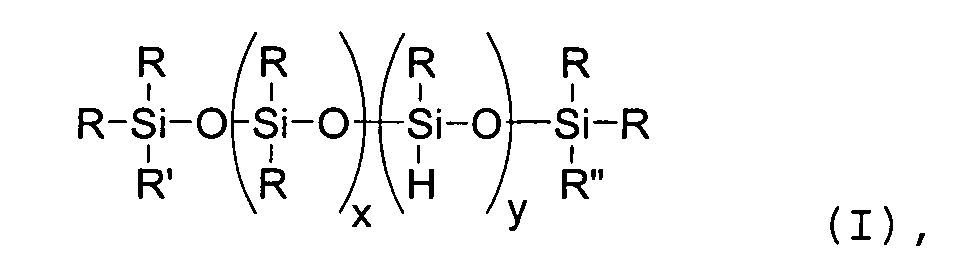 R einen oder mehrere gleiche oder verschiedene Reste, ausgewählt aus linearen oder verzweigten, gesättigten, ein- oder mehrfach ungesättigten Alkyl-, Aryl-, Alkylaryl- oder Arylalkylresten mit 1 bis 20, Halogenalkylgruppen mit 1 bis 20 Kohlenstoffatomen, Siloxygruppen und Triorganosiloxygruppen,R' und R" unabhängig voneinander H oder R,x eine ganze Zahl von 0 bis 300,y unabhängig davon eine ganze Zahl von 0 bis 80 darstellt;mit einem Alkohol, der ausgewählt ist aus der Gruppe der linearen oder verzweigten, gesättigten, ein- oder mehrfach ungesättigten, aromatischen, aliphatisch-aromatischen, gegebenenfalls andere Funktionen tragenden Mono- oder Polyalkoholen, Polyethermono- oder polyalkoholen, Aminoalkoholen, insbesondere N-Alkyl-, Arylamino-EO-, - PO-Alkoholen, N-Alkyl- oder Arylaminoalkoholen sowie deren Gemischen, indem man in einem Verfahrensschritt unter Einsatz eines Katalysators in den Si(H)(R)-O-Einheiten des Polyorganosiloxans vorhandene Wasserstoffatome teilweise oder vollständig durch Alkoholatreste der eingesetzten Alkohole ersetzt, ohne dass es zu einem Abbau des Siloxangrundgerüsts kommt, dadurch gekennzeichnet, dass als Katalysator eine Mischung aus mindestens einer Säure und mindestens einem Salz einer Säure eingesetzt wird.
 - Verfahren gemäß Patentanspruch 1, dadurch gekennzeichnet, dass der pKs-Wert der Säure nicht negativ ist.
- Verfahren gemäß einem der Patentansprüche 1 bis 2, dadurch gekennzeichnet, dass die katalytische Mischung ein Stoffmengenverhältnis von Säure zu Salz im Bereich von 1 : 5 bis 5 : 1 Moläquivalenten, besonders bevorzugt ein Stoffmengenverhältnis von 1 : 1 Moläquivalenten beinhaltet.
- Verfahren gemäß einem der Patentansprüche 1 bis 3, dadurch gekennzeichnet, dass die katalytische Mischung aus mindestens einer organischen Säure und mindestens einem Salz einer organischen Säure, bevorzugt aus einer Carbonsäure und dem Salz derselben Carbonsäure besteht.
- Verfahren gemäß einem der Patentansprüche 1 bis 4, dadurch gekennzeichnet, dass die Carbonsäure der Katalysatormischung ausgewählt ist aus der Gruppe:
Ameisensäure, Essigsäure, Propionsäure, Buttersäure, Valeriansäure, Capronsäure, Heptansäure, Caprylsäure, Nonansäure, Caprinsäure, Undecansäure, Laurinsäure, Myristinsäure, Palmitinsäure, Stearinsäure, Arachinsäure, Behensäure, Cyclopentancarbonsäure, Cyclohexancarbonsäure, Acrylsäure, Methacrylsäure, Vinylessigsäure, Crotonsäure, 2-/3-/4-Pentensäure, 2-/3-/4-/5-Hexensäure, Lauroleinsäure, Myristoleinsäure, Palmitoleinsäure, Ölsäure, Gadoleinsäure, Sorbinsäure, Linolsäure, Linolensäure, Pivalinsäure, Ethoxyessigsäure, Phenylessigsäure, Milchsäure, 2-Ethylhexansäure, Oxalsäure, Malonsäure, Bernsteinsäure, Weinsäure, Glutarsäure, Adipinsäure, Pimelinsäure, Korksäure, Azelainsäure, Sebacinsäure, Benzoesäure, o-/m-/p-Tolylsäure, Salicylsäure, 3-/4-Hydroxybenzoesäure, Phthalsäuren, oder deren ganz oder teilweise hydrierten Derivaten wie Hexahydro- oder Tetrahydrophthalsäure, oder Gemischen derselben. - Verfahren gemäß einem der Patentansprüche 1 bis 5, dadurch gekennzeichnet, dass das Salz ein Ammoniumoder ein Metallsalz ist.
- Verfahren gemäß Patentanspruch 6, dadurch gekennzeichnet, dass das Metall ein Element der 1. und 2. Hauptgruppe ist.
- Verfahren gemäß einem der Patentansprüche 1 bis 7, dadurch gekennzeichnet, dass als Alkohol mindestens eine Verbindung aus der Gruppe: Methanol, Ethanol, Butylpolyetheralkohole, Allylpolyetheralkohole oder Nonylphenylpolyetheralkohole, styroloxidhaltige und/ oder butyloxidhaltige Polyetheralkohole eingesetzt wird.
- Verfahren gemäß einem der Patentansprüche 1 bis 8, dadurch gekennzeichnet, dass ein Stoffmengenverhältnis von SiH-Gruppen zu Alkoholgruppen im Bereich von 1 : 1 bis 1 : 3 Moläquivalenten eingestellt wird.
- Verfahren gemäß einem der Patentansprüche 1 bis 8, dadurch gekennzeichnet, dass das Stoffmengenverhältnis von SiH-Gruppen zu Alkoholgruppen im Bereich von 1 : 0,1 bis 1 : 0,99 Moläquivalenten liegt.
- Verfahren gemäß einem der Patentansprüche 1 bis 10, dadurch gekennzeichnet, dass als Polyorganosiloxane endständige SiH-Polyorganosiloxane eingesetzt werden.
- Verfahren gemäß einem der Patentansprüche 1 bis 10, dadurch gekennzeichnet, dass als Polyorganosiloxane seitenständige oder gleichzeitig seitenständige und endständige (gemischtständige) SiH-Polyorganosiloxane eingesetzt werden.
- Verfahren gemäß einem der Patentansprüche 1 bis 12, dadurch gekennzeichnet, dass als Polysiloxane Verbindungen ausgewählt aus der Gruppe der kammartigen, α,ω-disubstituierten und gemischten Polydimethyl-Wasserstoffsiloxane der allgemeinen Formel (I) eingesetzt werden.
- Verfahren gemäß Patentanspruch 11, dadurch gekennzeichnet, dass Polyorganosiloxane eingesetzt werden, die ausgewählt sind aus der Gruppe der allgemeinen Formel (IV):
M'-O-Dx-M' (IV)
worinM' für Dialkyl(hydrogen)silyl, insbesondere Dimethylhydrogensilyl undD für Dialkylsilyloxy, insbesondere Dimethylsilyloxysteht und x die oben angegebene Bedeutung hat. - Verfahren gemäß Patentanspruch 12, dadurch gekennzeichnet, dass Polyorganosiloxane eingesetzt werden, die ausgewählt sind aus der Gruppe der allgemeinen Formel (III):
M-O-Dx-D'y-M (III)
wobeiM für Trialkylsilyl, insbesondere Trimethylsilyl,D für Dialkylsilyloxy, insbesondere Dimethylsilyloxy undD' für
- Verfahren gemäß einem der Patentansprüche 1 bis 15, dadurch gekennzeichnet, dass die Umsetzung lösungsmittelfrei durchgeführt wird.
- Verwendung von alkoxy-modifizierten Polyorganosiloxanen, hergestellt gemäß Verfahren der Ansprüche 1 bis 16, zur Ausrüstung von Textilien, als Additive für Kunststoffe, Lacke, Druckfarben und für kosmetische Formulierungen, im Bautenfarbenbereich und/oder als Polyurethan-Schaumstabilisatoren.
Applications Claiming Priority (2)
| Application Number | Priority Date | Filing Date | Title |
|---|---|---|---|
| DE10312634 | 2003-03-21 | ||
| DE10312634 | 2003-03-21 |
Publications (2)
| Publication Number | Publication Date |
|---|---|
| EP1460098A1 true EP1460098A1 (de) | 2004-09-22 |
| EP1460098B1 EP1460098B1 (de) | 2006-06-14 |
Family
ID=32798017
Family Applications (1)
| Application Number | Title | Priority Date | Filing Date |
|---|---|---|---|
| EP04005390A Expired - Lifetime EP1460098B1 (de) | 2003-03-21 | 2004-03-06 | Verfahren zur Herstellung von organisch modifizierten Polyorganosiloxanen |
Country Status (3)
| Country | Link |
|---|---|
| US (1) | US7053166B2 (de) |
| EP (1) | EP1460098B1 (de) |
| DE (1) | DE502004000736D1 (de) |
Cited By (8)
| Publication number | Priority date | Publication date | Assignee | Title |
|---|---|---|---|---|
| EP1544232A1 (de) * | 2003-12-19 | 2005-06-22 | Goldschmidt GmbH | Polysiloxane mit über SiOC-Gruppen gebundenen (Meth)acrylsäureestergruppen, Verfahren zu deren Herstellung sowie deren Verwendung als strahlenhärtbare abhäsive Beschichtung |
| EP1980295A2 (de) | 2007-04-10 | 2008-10-15 | Evonik Goldschmidt GmbH | Silicontensidzusammensetzungen und deren Verwendung zur Erzeugung von Schaum |
| DE102007037292A1 (de) | 2007-08-07 | 2009-02-12 | Evonik Goldschmidt Gmbh | Verfahren zur Herstellung von verzweigten Polyorganosiloxanen |
| EP2042542A1 (de) | 2007-09-28 | 2009-04-01 | Evonik Goldschmidt GmbH | Verwendung linearer Siloxane und Verfahren zu deren Herstellung |
| WO2010147227A1 (en) * | 2009-06-15 | 2010-12-23 | Dow Corning Toray Co., Ltd. | Method of producing a polyether-modified organopolysiloxane |
| EP2301987A1 (de) | 2009-09-24 | 2011-03-30 | Evonik Goldschmidt GmbH | Vernetzte Polysiloxane, Verfahren zu deren Herstellung und Verwendung von vernetzten Polysiloxanen in Emulgatorsystemen für Wasser-in-Öl-Emulsionen |
| DE102010002180A1 (de) | 2010-02-22 | 2011-08-25 | Evonik Goldschmidt GmbH, 45127 | Stickstoffhaltige silizium-organische Pfropfmischpolymere |
| DE102011005607A1 (de) | 2011-03-16 | 2012-09-20 | Evonik Goldschmidt Gmbh | Verfahren zur Herstllung von organomodifizierten Polysiloxanen |
Families Citing this family (20)
| Publication number | Priority date | Publication date | Assignee | Title |
|---|---|---|---|---|
| DE102004024009A1 (de) * | 2004-05-14 | 2005-12-01 | Goldschmidt Gmbh | Verwendung von neuen Polysiloxanen mit über SiOC-Gruppen gebundenen (Meth)acrylsäureestergruppen als Additive für strahlenhärtende Beschichtungen |
| DE102004039911A1 (de) * | 2004-08-18 | 2006-02-23 | Goldschmidt Gmbh | Katalytisches System für die dehydrogenative Kondensation von Polyorganosiloxanen mit Alkoholen und ein Verfahren zur Herstellung von organisch modifizierten Polyorganosiloxanen |
| KR101223639B1 (ko) * | 2007-08-03 | 2013-01-17 | 삼성전자주식회사 | 잉크 조성물, 이를 포함한 잉크 카트리지 및 잉크젯 기록장치 |
| DE102008001786A1 (de) | 2008-05-15 | 2009-11-26 | Evonik Goldschmidt Gmbh | Verwendung organomodifizierter Siloxanblockcopolymere als Pflegewirkstoff zur Pflege von menschlichen oder tierischen Körperteilen |
| DE102008043343A1 (de) * | 2008-10-31 | 2010-05-06 | Evonik Goldschmidt Gmbh | Silikonpolyetherblock-Copolymere mit definierter Polydispersität im Polyoxyalkylenteil und deren Verwendung als Stabilisatoren zur Herstellung von Polyurethanschäumen |
| FR2946657A1 (fr) * | 2009-06-12 | 2010-12-17 | Bluestar Silicones France | Procede d'etancheification et d'assemblage de composants d'un groupe moto-propulseur |
| FR2946656A1 (fr) * | 2009-06-12 | 2010-12-17 | Bluestar Silicones France | Procede d'etancheification et d'assemblage de composants d'un groupe moto-propulseur |
| US8455562B2 (en) * | 2009-06-19 | 2013-06-04 | Bluestar Silicones France Sas | Silicone composition suitable for cross-linking by dehydrogenative condensation in the presence of a non-metal catalyst |
| ES2477562T3 (es) * | 2009-06-19 | 2014-07-17 | Bluestar Silicones France | Composición de silicona reticulable por deshidrogenación-condensación en presencia de un catalizador no metálico |
| FR2946981A1 (fr) * | 2009-06-19 | 2010-12-24 | Bluestar Silicones France | Composition silicone reticulable par deshydrogenocondensation en presence d'un catalyseur metallique |
| DE102010039004A1 (de) * | 2010-08-06 | 2012-02-09 | Evonik Goldschmidt Gmbh | Silikoncopolymere mit seitenständigen über Allylglycidylether und verwandte Verbindungen angebundenen Alkylreisten und ihre Verwendung als Stabilisatoren zur Herstellug von Polyurethanweichschäumen |
| DE102013216777A1 (de) | 2013-08-23 | 2015-02-26 | Evonik Industries Ag | Bei Raumtemperatur härtbare Silikonharz-Zusammensetzungen |
| US11622929B2 (en) | 2016-03-08 | 2023-04-11 | Living Proof, Inc. | Long lasting cosmetic compositions |
| WO2017157836A1 (en) | 2016-03-16 | 2017-09-21 | Construction Research & Technology Gmbh | Surface applied corrosion inhibitor |
| JP6900064B2 (ja) * | 2017-03-02 | 2021-07-07 | 国立研究開発法人産業技術総合研究所 | 配列制御オリゴシロキサン、それらの製造方法及びオリゴシロキサン合成機 |
| US10987300B2 (en) | 2017-09-13 | 2021-04-27 | Living Proof, Inc. | Long lasting cosmetic compositions |
| US10842729B2 (en) | 2017-09-13 | 2020-11-24 | Living Proof, Inc. | Color protectant compositions |
| AU2018370210B2 (en) | 2017-11-20 | 2024-09-26 | Living Proof, Inc. | Properties for achieving long-lasting cosmetic performance |
| BR112020021902B1 (pt) | 2018-04-27 | 2024-02-20 | Living Proof, Inc | Composições cosméticas de poliuretano-ureia para tratamento capilar, método de preservação da ondulação no cabelo humano e os usos de poliuretano-ureia |
| KR102994064B1 (ko) * | 2021-05-07 | 2026-07-21 | 와커 헤미 아게 | 유기폴리실록산, 이를 함유하는 조성물 및 분말 제형, 및 소포제로서의 이의 용도 |
Citations (6)
| Publication number | Priority date | Publication date | Assignee | Title |
|---|---|---|---|---|
| US2658908A (en) * | 1950-07-27 | 1953-11-10 | Wacker Chemie Gmbh | Production of hydrolyzable siloxanes |
| US3801616A (en) * | 1972-03-10 | 1974-04-02 | Union Carbide Corp | Process for producing siloxane-polyoxyalkylene block copolymers |
| EP0019837A1 (de) * | 1979-06-01 | 1980-12-10 | Chemische Fabrik Pfersee GmbH | Verfahren zum Weichmachen von Textilmaterial, hierfür geeignete Mittel sowie das nach dem Verfahren behandelte Textilmaterial |
| GB2219300A (en) * | 1988-06-02 | 1989-12-06 | Nuenchritz Chemie | Producing viscous silicone resin solution |
| US5310842A (en) * | 1990-09-14 | 1994-05-10 | Shin-Etsu Chemical Co., Ltd. | Higher alkoxy-substituted organopolysiloxane |
| WO1996028497A1 (fr) * | 1995-03-15 | 1996-09-19 | Firmenich S.A. | Polysiloxanes nouveaux, leur utilisation en parfumerie et procede pour leur preparation |
Family Cites Families (4)
| Publication number | Priority date | Publication date | Assignee | Title |
|---|---|---|---|---|
| JP2580379B2 (ja) | 1990-09-14 | 1997-02-12 | 信越化学工業株式会社 | アルコキシ変性シリコ―ンの製造方法 |
| FR2773166B1 (fr) * | 1997-12-31 | 2000-03-24 | Rhodia Chimie Sa | Emulsion silicone aqueuse, utile comme base de preparation de revetement hydrofuge et antiadherent pour papier, procede de preparation d'une emulsion de ce type et de revetements antiadherents |
| JP3476368B2 (ja) * | 1998-07-10 | 2003-12-10 | 信越化学工業株式会社 | 室温硬化性オルガノポリシロキサン組成物 |
| US6593436B2 (en) * | 2000-11-29 | 2003-07-15 | Crompton Corporation | Continuous manufacture of silicone copolymers via static mixing plug flow reactors |
-
2004
- 2004-03-06 DE DE502004000736T patent/DE502004000736D1/de not_active Expired - Lifetime
- 2004-03-06 EP EP04005390A patent/EP1460098B1/de not_active Expired - Lifetime
- 2004-03-19 US US10/804,511 patent/US7053166B2/en not_active Expired - Fee Related
Patent Citations (6)
| Publication number | Priority date | Publication date | Assignee | Title |
|---|---|---|---|---|
| US2658908A (en) * | 1950-07-27 | 1953-11-10 | Wacker Chemie Gmbh | Production of hydrolyzable siloxanes |
| US3801616A (en) * | 1972-03-10 | 1974-04-02 | Union Carbide Corp | Process for producing siloxane-polyoxyalkylene block copolymers |
| EP0019837A1 (de) * | 1979-06-01 | 1980-12-10 | Chemische Fabrik Pfersee GmbH | Verfahren zum Weichmachen von Textilmaterial, hierfür geeignete Mittel sowie das nach dem Verfahren behandelte Textilmaterial |
| GB2219300A (en) * | 1988-06-02 | 1989-12-06 | Nuenchritz Chemie | Producing viscous silicone resin solution |
| US5310842A (en) * | 1990-09-14 | 1994-05-10 | Shin-Etsu Chemical Co., Ltd. | Higher alkoxy-substituted organopolysiloxane |
| WO1996028497A1 (fr) * | 1995-03-15 | 1996-09-19 | Firmenich S.A. | Polysiloxanes nouveaux, leur utilisation en parfumerie et procede pour leur preparation |
Cited By (14)
| Publication number | Priority date | Publication date | Assignee | Title |
|---|---|---|---|---|
| EP1544232A1 (de) * | 2003-12-19 | 2005-06-22 | Goldschmidt GmbH | Polysiloxane mit über SiOC-Gruppen gebundenen (Meth)acrylsäureestergruppen, Verfahren zu deren Herstellung sowie deren Verwendung als strahlenhärtbare abhäsive Beschichtung |
| EP1980295A2 (de) | 2007-04-10 | 2008-10-15 | Evonik Goldschmidt GmbH | Silicontensidzusammensetzungen und deren Verwendung zur Erzeugung von Schaum |
| DE102007016966A1 (de) | 2007-04-10 | 2008-10-16 | Evonik Goldschmidt Gmbh | Silicontensidzusammensetzungen und deren Verwendung zur Erzeugung von Schaum |
| DE102007037292A1 (de) | 2007-08-07 | 2009-02-12 | Evonik Goldschmidt Gmbh | Verfahren zur Herstellung von verzweigten Polyorganosiloxanen |
| EP2028213A1 (de) | 2007-08-07 | 2009-02-25 | Evonik Goldschmidt GmbH | Verfahren zur Herstellung von verzweigten Polyorganosiloxanen |
| US7829647B2 (en) | 2007-08-07 | 2010-11-09 | Evonik Goldschmidt Gmbh | Process for the preparation of branched polyorganosiloxanes |
| DE102007046736A1 (de) | 2007-09-28 | 2009-04-02 | Evonik Goldschmidt Gmbh | Verwendung linearer Siloxane und Verfahren zu deren Herstellung |
| EP2042542A1 (de) | 2007-09-28 | 2009-04-01 | Evonik Goldschmidt GmbH | Verwendung linearer Siloxane und Verfahren zu deren Herstellung |
| WO2010147227A1 (en) * | 2009-06-15 | 2010-12-23 | Dow Corning Toray Co., Ltd. | Method of producing a polyether-modified organopolysiloxane |
| EP2301987A1 (de) | 2009-09-24 | 2011-03-30 | Evonik Goldschmidt GmbH | Vernetzte Polysiloxane, Verfahren zu deren Herstellung und Verwendung von vernetzten Polysiloxanen in Emulgatorsystemen für Wasser-in-Öl-Emulsionen |
| US8470306B2 (en) | 2009-09-24 | 2013-06-25 | Evonik Goldschmidt Gmbh | Crosslinked polysiloxanes, a process for their preparation and use of the crosslinked polysiloxanes in emulsifier systems for water-in-oil emulsions |
| DE102010002180A1 (de) | 2010-02-22 | 2011-08-25 | Evonik Goldschmidt GmbH, 45127 | Stickstoffhaltige silizium-organische Pfropfmischpolymere |
| EP2363422A1 (de) | 2010-02-22 | 2011-09-07 | Evonik Goldschmidt GmbH | Stickstoffhaltige silizium-organische Pfropfcopolymere |
| DE102011005607A1 (de) | 2011-03-16 | 2012-09-20 | Evonik Goldschmidt Gmbh | Verfahren zur Herstllung von organomodifizierten Polysiloxanen |
Also Published As
| Publication number | Publication date |
|---|---|
| US20040186259A1 (en) | 2004-09-23 |
| EP1460098B1 (de) | 2006-06-14 |
| DE502004000736D1 (de) | 2006-07-27 |
| US7053166B2 (en) | 2006-05-30 |
Similar Documents
| Publication | Publication Date | Title |
|---|---|---|
| EP1460098B1 (de) | Verfahren zur Herstellung von organisch modifizierten Polyorganosiloxanen | |
| EP1627892B1 (de) | Verfahren zur Herstellung von organisch modifizierten Polyorganosiloxanen durch katalytische dehydrogenative Kondensation von Polyorganosiloxanen mit Alkoholen | |
| EP1679335B1 (de) | Siloxanblockcopolymere | |
| EP3744763B1 (de) | Massgeschneiderte sioc basierte polyethersiloxane | |
| DE102005051939A1 (de) | Verfahren zur Herstellung von organisch modifizierten Polyorganosiloxanen | |
| DE3781886T2 (de) | Verfahren zur herstellung eines acrylat- oder methacrylatgruppen enthaltenden polysiloxans. | |
| DE2215393C3 (de) | Siloxan-Polyoxyalkylen-Blockcopolymere, ihre Herstellung und Verwendung | |
| DE1283238B (de) | Verfahren zur Herstellung von Hydroxyalkyloxyalkylsiloxanen | |
| EP0170287B1 (de) | Verfahren zum Stabilisieren von Organopolysiloxan | |
| EP1460099A1 (de) | Verfahren zur Umsetzung von Polyorganosiloxanen | |
| DE3533028A1 (de) | Verfahren zum stabilisieren von organopolysiloxanen | |
| DE2857670C2 (de) | ||
| DE2437954A1 (de) | Aus zwei teilen bestehende, bei raumtemperatur vulkanisierbare systeme | |
| DE2631957A1 (de) | Verfahren zum polymerisieren eines hydroxylendblockierten polydiorganosiloxans | |
| EP3215570B1 (de) | Vernetzbare organopolysiloxanzusammensetzungen | |
| DE69620575T2 (de) | Härtbare polymethylsilsesquioxanzusammensetzung | |
| EP0305737A2 (de) | Verfahren zum Kondensieren und/oder Äquilibrieren von Organo-(poly)siloxanen | |
| EP3269723A1 (de) | Härter für silikonkautschukmassen | |
| DE3702631C2 (de) | Verfahren zur Herstellung primärer Aminosiloxane | |
| DE1246251B (de) | Verfahren zur Herstellung von Organosiliciumverbindungen mit Si-gebundenen Hydroxylgruppen | |
| DE1570719A1 (de) | Verfahren zur Herstellung von Organosilizium-Polymeren | |
| DE3518880A1 (de) | Funktionalisierte phenylengruppen-haltige organopolysiloxane und verfahren zu ihrer herstellung | |
| DE102005022856A1 (de) | Verfahren zur Herstellung von Diorganopolysiloxanen | |
| EP2176320A1 (de) | Polyhydroxyamidogruppen aufweisende organopolysiloxane und deren herstellung | |
| DE2554498C2 (de) | Organopolysiloxanzubereitung und deren Verwendung |
Legal Events
| Date | Code | Title | Description |
|---|---|---|---|
| PUAI | Public reference made under article 153(3) epc to a published international application that has entered the european phase |
Free format text: ORIGINAL CODE: 0009012 |
|
| 17P | Request for examination filed |
Effective date: 20040318 |
|
| AK | Designated contracting states |
Kind code of ref document: A1 Designated state(s): AT BE BG CH CY CZ DE DK EE ES FI FR GB GR HU IE IT LI LU MC NL PL PT RO SE SI SK TR |
|
| AX | Request for extension of the european patent |
Extension state: AL LT LV MK |
|
| RAP1 | Party data changed (applicant data changed or rights of an application transferred) |
Owner name: GOLDSCHMIDT GMBH |
|
| AKX | Designation fees paid |
Designated state(s): BE DE FR GB IT NL |
|
| GRAP | Despatch of communication of intention to grant a patent |
Free format text: ORIGINAL CODE: EPIDOSNIGR1 |
|
| GRAS | Grant fee paid |
Free format text: ORIGINAL CODE: EPIDOSNIGR3 |
|
| GRAA | (expected) grant |
Free format text: ORIGINAL CODE: 0009210 |
|
| AK | Designated contracting states |
Kind code of ref document: B1 Designated state(s): BE DE FR GB IT NL |
|
| PG25 | Lapsed in a contracting state [announced via postgrant information from national office to epo] |
Ref country code: IT Free format text: LAPSE BECAUSE OF FAILURE TO SUBMIT A TRANSLATION OF THE DESCRIPTION OR TO PAY THE FEE WITHIN THE PRESCRIBED TIME-LIMIT;WARNING: LAPSES OF ITALIAN PATENTS WITH EFFECTIVE DATE BEFORE 2007 MAY HAVE OCCURRED AT ANY TIME BEFORE 2007. THE CORRECT EFFECTIVE DATE MAY BE DIFFERENT FROM THE ONE RECORDED. Effective date: 20060614 |
|
| REG | Reference to a national code |
Ref country code: GB Ref legal event code: FG4D Free format text: NOT ENGLISH |
|
| REF | Corresponds to: |
Ref document number: 502004000736 Country of ref document: DE Date of ref document: 20060727 Kind code of ref document: P |
|
| GBT | Gb: translation of ep patent filed (gb section 77(6)(a)/1977) |
Effective date: 20060923 |
|
| ET | Fr: translation filed | ||
| PLBE | No opposition filed within time limit |
Free format text: ORIGINAL CODE: 0009261 |
|
| STAA | Information on the status of an ep patent application or granted ep patent |
Free format text: STATUS: NO OPPOSITION FILED WITHIN TIME LIMIT |
|
| 26N | No opposition filed |
Effective date: 20070315 |
|
| NLT1 | Nl: modifications of names registered in virtue of documents presented to the patent office pursuant to art. 16 a, paragraph 1 |
Owner name: EVONIK GOLDSCHMIDT GMBH |
|
| REG | Reference to a national code |
Ref country code: FR Ref legal event code: CD |
|
| PGFP | Annual fee paid to national office [announced via postgrant information from national office to epo] |
Ref country code: FR Payment date: 20120403 Year of fee payment: 9 |
|
| PGFP | Annual fee paid to national office [announced via postgrant information from national office to epo] |
Ref country code: DE Payment date: 20120323 Year of fee payment: 9 |
|
| PGFP | Annual fee paid to national office [announced via postgrant information from national office to epo] |
Ref country code: GB Payment date: 20120322 Year of fee payment: 9 Ref country code: BE Payment date: 20120329 Year of fee payment: 9 Ref country code: IT Payment date: 20120327 Year of fee payment: 9 |
|
| PGFP | Annual fee paid to national office [announced via postgrant information from national office to epo] |
Ref country code: NL Payment date: 20120327 Year of fee payment: 9 |
|
| BERE | Be: lapsed |
Owner name: *EVONIK GOLDSCHMIDT G.M.B.H. Effective date: 20130331 |
|
| REG | Reference to a national code |
Ref country code: NL Ref legal event code: V1 Effective date: 20131001 |
|
| GBPC | Gb: european patent ceased through non-payment of renewal fee |
Effective date: 20130306 |
|
| REG | Reference to a national code |
Ref country code: FR Ref legal event code: ST Effective date: 20131129 |
|
| REG | Reference to a national code |
Ref country code: DE Ref legal event code: R119 Ref document number: 502004000736 Country of ref document: DE Effective date: 20131001 |
|
| PG25 | Lapsed in a contracting state [announced via postgrant information from national office to epo] |
Ref country code: FR Free format text: LAPSE BECAUSE OF NON-PAYMENT OF DUE FEES Effective date: 20130402 Ref country code: BE Free format text: LAPSE BECAUSE OF NON-PAYMENT OF DUE FEES Effective date: 20130331 Ref country code: DE Free format text: LAPSE BECAUSE OF NON-PAYMENT OF DUE FEES Effective date: 20131001 Ref country code: GB Free format text: LAPSE BECAUSE OF NON-PAYMENT OF DUE FEES Effective date: 20130306 |
|
| PG25 | Lapsed in a contracting state [announced via postgrant information from national office to epo] |
Ref country code: NL Free format text: LAPSE BECAUSE OF NON-PAYMENT OF DUE FEES Effective date: 20131001 Ref country code: IT Free format text: LAPSE BECAUSE OF NON-PAYMENT OF DUE FEES Effective date: 20130306 |