EP1449941B1 - Verfahren zur herstellung von kurzfasern aus polytrimethylenterephthalat - Google Patents
Verfahren zur herstellung von kurzfasern aus polytrimethylenterephthalat Download PDFInfo
- Publication number
- EP1449941B1 EP1449941B1 EP02775380A EP02775380A EP1449941B1 EP 1449941 B1 EP1449941 B1 EP 1449941B1 EP 02775380 A EP02775380 A EP 02775380A EP 02775380 A EP02775380 A EP 02775380A EP 1449941 B1 EP1449941 B1 EP 1449941B1
- Authority
- EP
- European Patent Office
- Prior art keywords
- polytrimethylene terephthalate
- tow
- undrawn
- undrawn tow
- staple fibers
- Prior art date
- Legal status (The legal status is an assumption and is not a legal conclusion. Google has not performed a legal analysis and makes no representation as to the accuracy of the status listed.)
- Expired - Lifetime
Links
- -1 polytrimethylene terephthalate Polymers 0.000 title claims description 36
- 229920002215 polytrimethylene terephthalate Polymers 0.000 title claims description 28
- 239000000835 fiber Substances 0.000 title claims description 24
- 238000004519 manufacturing process Methods 0.000 title claims description 9
- XLYOFNOQVPJJNP-UHFFFAOYSA-N water Substances O XLYOFNOQVPJJNP-UHFFFAOYSA-N 0.000 claims description 28
- 229920000642 polymer Polymers 0.000 claims description 18
- 238000002074 melt spinning Methods 0.000 claims description 5
- 238000000034 method Methods 0.000 description 19
- 230000000052 comparative effect Effects 0.000 description 7
- LYCAIKOWRPUZTN-UHFFFAOYSA-N Ethylene glycol Chemical compound OCCO LYCAIKOWRPUZTN-UHFFFAOYSA-N 0.000 description 6
- KKEYFWRCBNTPAC-UHFFFAOYSA-N Terephthalic acid Chemical compound OC(=O)C1=CC=C(C(O)=O)C=C1 KKEYFWRCBNTPAC-UHFFFAOYSA-N 0.000 description 6
- 238000009987 spinning Methods 0.000 description 5
- 239000000155 melt Substances 0.000 description 4
- 229920000139 polyethylene terephthalate Polymers 0.000 description 4
- 239000005020 polyethylene terephthalate Substances 0.000 description 4
- 230000006866 deterioration Effects 0.000 description 3
- 238000011156 evaluation Methods 0.000 description 3
- WGCNASOHLSPBMP-UHFFFAOYSA-N hydroxyacetaldehyde Natural products OCC=O WGCNASOHLSPBMP-UHFFFAOYSA-N 0.000 description 3
- 230000001105 regulatory effect Effects 0.000 description 3
- FJKROLUGYXJWQN-UHFFFAOYSA-N 4-hydroxybenzoic acid Chemical compound OC(=O)C1=CC=C(O)C=C1 FJKROLUGYXJWQN-UHFFFAOYSA-N 0.000 description 2
- 239000006096 absorbing agent Substances 0.000 description 2
- WNLRTRBMVRJNCN-UHFFFAOYSA-N adipic acid Chemical compound OC(=O)CCCCC(O)=O WNLRTRBMVRJNCN-UHFFFAOYSA-N 0.000 description 2
- WERYXYBDKMZEQL-UHFFFAOYSA-N butane-1,4-diol Chemical compound OCCCCO WERYXYBDKMZEQL-UHFFFAOYSA-N 0.000 description 2
- 239000003795 chemical substances by application Substances 0.000 description 2
- 238000001816 cooling Methods 0.000 description 2
- WOZVHXUHUFLZGK-UHFFFAOYSA-N dimethyl terephthalate Chemical compound COC(=O)C1=CC=C(C(=O)OC)C=C1 WOZVHXUHUFLZGK-UHFFFAOYSA-N 0.000 description 2
- 238000001035 drying Methods 0.000 description 2
- 238000001125 extrusion Methods 0.000 description 2
- QQVIHTHCMHWDBS-UHFFFAOYSA-N isophthalic acid Chemical compound OC(=O)C1=CC=CC(C(O)=O)=C1 QQVIHTHCMHWDBS-UHFFFAOYSA-N 0.000 description 2
- 238000005259 measurement Methods 0.000 description 2
- 239000004745 nonwoven fabric Substances 0.000 description 2
- 230000000704 physical effect Effects 0.000 description 2
- 238000003860 storage Methods 0.000 description 2
- DNIAPMSPPWPWGF-VKHMYHEASA-N (+)-propylene glycol Chemical compound C[C@H](O)CO DNIAPMSPPWPWGF-VKHMYHEASA-N 0.000 description 1
- YPFDHNVEDLHUCE-UHFFFAOYSA-N 1,3-propanediol Substances OCCCO YPFDHNVEDLHUCE-UHFFFAOYSA-N 0.000 description 1
- KZEVSDGEBAJOTK-UHFFFAOYSA-N 1-(2,4,6,7-tetrahydrotriazolo[4,5-c]pyridin-5-yl)-2-[5-[2-[[3-(trifluoromethoxy)phenyl]methylamino]pyrimidin-5-yl]-1,3,4-oxadiazol-2-yl]ethanone Chemical compound N1N=NC=2CN(CCC=21)C(CC=1OC(=NN=1)C=1C=NC(=NC=1)NCC1=CC(=CC=C1)OC(F)(F)F)=O KZEVSDGEBAJOTK-UHFFFAOYSA-N 0.000 description 1
- ISPYQTSUDJAMAB-UHFFFAOYSA-N 2-chlorophenol Chemical compound OC1=CC=CC=C1Cl ISPYQTSUDJAMAB-UHFFFAOYSA-N 0.000 description 1
- 229940090248 4-hydroxybenzoic acid Drugs 0.000 description 1
- KCTNTUSQUJQECU-UHFFFAOYSA-L 5-sulfobenzene-1,3-dicarboxylate;tetrabutylphosphanium Chemical compound OS(=O)(=O)C1=CC(C([O-])=O)=CC(C([O-])=O)=C1.CCCC[P+](CCCC)(CCCC)CCCC.CCCC[P+](CCCC)(CCCC)CCCC KCTNTUSQUJQECU-UHFFFAOYSA-L 0.000 description 1
- WTFUTSCZYYCBAY-SXBRIOAWSA-N 6-[(E)-C-[[4-[2-(2,3-dihydro-1H-inden-2-ylamino)pyrimidin-5-yl]piperazin-1-yl]methyl]-N-hydroxycarbonimidoyl]-3H-1,3-benzoxazol-2-one Chemical compound C1C(CC2=CC=CC=C12)NC1=NC=C(C=N1)N1CCN(CC1)C/C(=N/O)/C1=CC2=C(NC(O2)=O)C=C1 WTFUTSCZYYCBAY-SXBRIOAWSA-N 0.000 description 1
- 229920003171 Poly (ethylene oxide) Polymers 0.000 description 1
- 239000004952 Polyamide Substances 0.000 description 1
- KDYFGRWQOYBRFD-UHFFFAOYSA-N Succinic acid Natural products OC(=O)CCC(O)=O KDYFGRWQOYBRFD-UHFFFAOYSA-N 0.000 description 1
- ORLQHILJRHBSAY-UHFFFAOYSA-N [1-(hydroxymethyl)cyclohexyl]methanol Chemical compound OCC1(CO)CCCCC1 ORLQHILJRHBSAY-UHFFFAOYSA-N 0.000 description 1
- 238000010521 absorption reaction Methods 0.000 description 1
- 239000002253 acid Substances 0.000 description 1
- 239000000654 additive Substances 0.000 description 1
- 239000001361 adipic acid Substances 0.000 description 1
- 235000011037 adipic acid Nutrition 0.000 description 1
- 125000005907 alkyl ester group Chemical group 0.000 description 1
- 239000002518 antifoaming agent Substances 0.000 description 1
- 239000003963 antioxidant agent Substances 0.000 description 1
- KDYFGRWQOYBRFD-NUQCWPJISA-N butanedioic acid Chemical compound O[14C](=O)CC[14C](O)=O KDYFGRWQOYBRFD-NUQCWPJISA-N 0.000 description 1
- 230000001276 controlling effect Effects 0.000 description 1
- 239000003484 crystal nucleating agent Substances 0.000 description 1
- 238000000354 decomposition reaction Methods 0.000 description 1
- 238000002845 discoloration Methods 0.000 description 1
- 230000000694 effects Effects 0.000 description 1
- 239000012760 heat stabilizer Substances 0.000 description 1
- XXMIOPMDWAUFGU-UHFFFAOYSA-N hexane-1,6-diol Chemical compound OCCCCCCO XXMIOPMDWAUFGU-UHFFFAOYSA-N 0.000 description 1
- 229920001519 homopolymer Polymers 0.000 description 1
- RXOHFPCZGPKIRD-UHFFFAOYSA-N naphthalene-2,6-dicarboxylic acid Chemical compound C1=C(C(O)=O)C=CC2=CC(C(=O)O)=CC=C21 RXOHFPCZGPKIRD-UHFFFAOYSA-N 0.000 description 1
- 230000002093 peripheral effect Effects 0.000 description 1
- 229920002647 polyamide Polymers 0.000 description 1
- 238000006068 polycondensation reaction Methods 0.000 description 1
- 229920000728 polyester Polymers 0.000 description 1
- 229920000166 polytrimethylene carbonate Polymers 0.000 description 1
- YRVCHYUHISNKSG-UHFFFAOYSA-N propane-1,3-diol Chemical compound OCCCO.OCCCO YRVCHYUHISNKSG-UHFFFAOYSA-N 0.000 description 1
- 238000011084 recovery Methods 0.000 description 1
- 239000002904 solvent Substances 0.000 description 1
- 238000004804 winding Methods 0.000 description 1
- 239000002759 woven fabric Substances 0.000 description 1
- PAPBSGBWRJIAAV-UHFFFAOYSA-N ε-Caprolactone Chemical compound O=C1CCCCCO1 PAPBSGBWRJIAAV-UHFFFAOYSA-N 0.000 description 1
Images
Classifications
-
- D—TEXTILES; PAPER
- D01—NATURAL OR MAN-MADE THREADS OR FIBRES; SPINNING
- D01F—CHEMICAL FEATURES IN THE MANUFACTURE OF ARTIFICIAL FILAMENTS, THREADS, FIBRES, BRISTLES OR RIBBONS; APPARATUS SPECIALLY ADAPTED FOR THE MANUFACTURE OF CARBON FILAMENTS
- D01F6/00—Monocomponent artificial filaments or the like of synthetic polymers; Manufacture thereof
- D01F6/58—Monocomponent artificial filaments or the like of synthetic polymers; Manufacture thereof from homopolycondensation products
- D01F6/62—Monocomponent artificial filaments or the like of synthetic polymers; Manufacture thereof from homopolycondensation products from polyesters
Definitions
- the present invention relates to a method of producing polytrimethylene terephthalate staple fibers.
- the polytrimethylene terephthalate obtained by polycondensing terephthalic acid or a lower alkyl ester of the terephthalic acid, for example, dimethyl terephthalate, with trimethylene glycol (1,3-propanediol) is a polymer having both properties similar to those of polyamides, for example, a low modulus of elasticity (a soft handle), an excellent elastic recovery ratio and easy dyeability, and performances similar to those of polyethylene terephthalate, for example, high light resistance, thermal setting properties, dimensional stability and a low water absorption.
- Techniques for producing polytrimethylene terephthalate staple fibers utilizing the excellent characteristics thereof have been studied from various standpoints for the purpose of a practical use of the staple fibers in waddings, nonwoven fabrics, spun yarn woven fabrics etc.
- An object of the present invention is to provide a method, of producing polytrimethylene terephthalate staple fibers, which enables a change in physical properties of the undrawn filament tow composed of polytrimethylene terephthalate with time to be reduced and polytrimethylene terephthalate staple fibers having uniform quality to be stably produced.
- the inventors of the present invention have found that the above-mentioned object can be attained by keeping the undrawn filament tow, produced by a melt-spinning procedure and stored in a can, at a prescribed water content at a prescribed temperature until the tow is fed to the drawing step, to hinder the deterioration in quality of the polytrimethylene terephthalate staple fiber, and the present invention was completed on the basis of the above-mentioned finding.
- the method of producing the polytrimethylene terephthalate staple fibers of the present invention with which the object can be achieved is characterized in that during the period of time after a polytrimethylene terephthalate polymer is melt-spun and the resultant undrawn tow is taken up through a taking-up roller and placed in a can, but before the undrawn tow stored in the can is subjected to a drawing step, the water content of the undrawn tow is maintained at 0.5 to 12% by mass, and the temperature of the ambient atmosphere surrounding the undrawn tow is maintained at 35°C or less.
- the polymer usable for the method of the present invention comprises, as a principal component, polytrimethylene terephthalate obtained by a polycondensation of terephthalic acid with 1,3-propanediol.
- the polytrimethylene terephthalate polymer may be a polytrimethylene terephthalate homopolymer or a polytrimethylene terephthalate copolymer as described below.
- At least one acid component selected from isophthalic acid, succinic acid, adipic acid, 2,6-naphthalenedicarboxylic acid, 5-sodium sulfoisophthalic acid, and tetrabutylphosphonium 5-sulfoisophthalate; or at least one glycol component selected from 1,4-butanediol, 1,6-hexanediol and cyclohexanedimethanol; or at least one member selected from ⁇ -caprolactone, 4-hydroxybenzoic acid, polyoxyethylene glycol, polytetramethylene glycol, etc.
- additives for example delustering agents heat stabilizers, antifoaming agents, orthochromatic agents, antioxidants, ultraviolet absorbers, infrared absorbers, crystal nucleating agents, fluorescent brighteners etc. if necessary, may be copolymerized or mixed in the polymer.
- the intrinsic viscosity of the polymer used in the present invention is preferably within the range of 0.5 to 1.8, more preferably within the range of 0.7 to 1.2. If the intrinsic viscosity is less than 0.4, it may be difficult to obtain a sufficient fiber strength because the molecular weight of the polymer is too low. Conversely, if the intrinsic viscosity exceeds 1.8, the spinning may be difficult because the melt viscosity is too high.
- the polytrimethylene terephthalate polymer is initially melt-spun through a conventional spinneret.
- the melt extrusion temperature is preferably within the range of 235 to 285 °C, more preferably within the range of 240 to 260 °C. If the spinning temperature is higher than 285 °C, discoloration or deterioration of strength and elongation due to decomposition of the polymer may readily occur. Conversely, if the spinning temperature is lower than 235 °C, it is difficult to obtain fibers having a sufficient strength and elongation.
- the polymer melt extruded from the spinneret is taken up by a take-up roller and cooling air, at 20 to 30 °C, is preferably blown on the polymer just under the spinneret to solidify the melt extruded polymer. Further, the polymer is solidified into a filament yarn and then water and an oil are preferably applied to the resulting filament yarn. In the process, the amount of water can suitably be regulated to thereby adjust the water content of the undrawn filament tow stored in a can. There is no special limitation on a method for applying the water and the oil to the filament yarn; however, an oiling roller method is preferably applied.
- the taking-up speed of the filament yarn by the take-up roller is preferably 500 to 2,000 m/min, more preferably 1,000 to 1,500 m/min.
- the filament yarn taken up with the take-up roller is subsequently stored as an undrawn tow in the can.
- the filament yarn taken-up by a taking-up roller and the taken-up filament yarn falls down into a can naturally, if the water content of the filament yarn is too low, the individual filaments may be disordered and a trouble such as winding the filaments around the roller may occur.
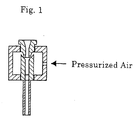
- the filament yarn taken-up through the taking up roller is preferably passed through a suction apparatus using a pressurized air stream as shown in Fig. 1, to positively cause the filament yarn to fall into the can and be contained therein.
- the undrawn tow (not shown) is sucked downward by the sucking action of the pressurized air stream.
- the undrawn tow contained in the can is then temporarily stored and subsequently drawn in a drawing step.
- the water content of the undrawn tow within must be maintained in the range of 0.5 to 12% by mass, preferably within the range of 1 to 7% by mass, more preferably within the range of 1 to 4% by mass.
- the individual filaments in the undrawn tow may easily stick each other during storage.
- the water content is higher than 12% by weight, water collects in the can in which the filament yarn is stored, the water content of a portion of the undrawn tow located in the bottom part of the can increases and the sticking of the individual filaments with each other may be promoted.
- the atmospheric temperature When the undrawn tow is temporarily stored, the atmospheric temperature must be maintained at 35 °C or below, preferably 0 to 30 °C, more preferably 0 to 25 °C. If the atmospheric temperature is higher than 35 °C, there is a fear of shrinking the undrawn tow or causing mutual sticking of the individual filaments.
- the shrinkage of the undrawn tow after the passage of 24 hours is preferably 20% or below, more preferably 10% or below.
- the undrawn filament yarns taken out from a plurality of cans are usually combined and drawn.
- the drawing procedure can be stably carried out by controlling the shrinkage in the above-mentioned range, and a drawn filament yarn and staple fibers having a uniform quality can be obtained.
- a method which is generally carried out for polyethylene terephthalate fibers can be adopted, as a method for drawing the undrawn tow.
- the drawn tow can be crimped and further cut into staple fibers by the method which is generally performed for the polyethylene terephthalate fibers.
- the shrinkage of the undrawn tow, which is prepared by a melt-spinning, with time can markedly be reduced.
- the resulting undrawn tow has an excellent quality without mutual sticking or entanglement of the individual filaments. Therefore, the polytrimethylene terephthalate staple fibers obtained by the production method of the present invention have high quality and are extremely suitable as staple fibers for waddings, nonwoven fabrics or spun yarns.
- the intrinsic viscosity was determined at 35°C by using o-chlorophenol as a solvent.
- the undrawn tow just after being contained in a can was placed in a hot-air dryer and dried at 110 °C for 1 hour to determine the water content by the following equation water.
- Moisture content of undrawn tow A 0 - A 1 / A 1 ⁇ 100 % wherein, A 0 is the mass of the undrawn tow before drying; and A 1 is the mass of the undrawn tow after drying.
- the water content in the undrawn tow was changed by appropriately changing the number of revolutions of an oiling roller installed between a spinneret and a take-up roller.
- the temperature in a closed room in which the undrawn tow was allowed to stand was taken as the atmospheric temperature.
- the time passed from the time just after storing the tow in the can to the measurement of the shrinkage of the undrawn tow was taken as the elapsed time.
- the thickness of the undrawn tow was measured after the passage of a prescribed time (the elapsed time) from start of the storing of the undrawn tow in the can, and an increase in the thickness from the thickness of the undrawn tow just after the start storing in the can was calculated as a shrinkage of the undrawn tow.
- Polytrimethylene terephthalate chips having an intrinsic viscosity of 0.93 were dried at 130 °C for 5 hours, then melted at 250 °C, and the melt was extruded through a spinneret provided with 1,008 spinning holes with a circular section having a diameter of 0.28 mm at an extrusion rate of 660 g/min, and cooling air at 25 °C was blown from the outside to the peripheries of polymer streams to solidify the polymer streams.
- the resulting filaments were then brought into contact with an oiling roller to impart water and an oil to the filament.
- the filaments were taken up with a take-up roller at a peripheral speed of the roller of 1,300 m/min and then passed through a pressurized air type suction apparatus (shown in Figure 1) installed just downstream from the take-up roller and placed, as a undrawn tow, in a can.
- a pressurized air type suction apparatus shown in Figure 1 installed just downstream from the take-up roller and placed, as a undrawn tow, in a can.
- the water content and thickness of the undrawn tow placed in the can were immediately measured, and the undrawn tow was then placed in bags and hermetically sealed so as not to allow the water to evaporate.
- the resultant undrawn tow was stored in rooms at the indoor temperatures shown in Table 1. After the passage of a prescribed time, the undrawn tow was taken out from the bags to measure the thickness. Thereby, the shrinkage of the tow was determined and surface conditions of the undrawn tow were judged by the naked eye observation. Table 1 shows the results of evaluation.
- the shrinkage percentage was determined and the surface conditions of the undrawn tows were simultaneously judged by the naked eye observation in the same manner as in Example 1, except that the water content of the undrawn tow was reduced by regulating the number of revolutions of the oiling roller. Table 1 shows the results of evaluation.
- the shrinkage of the undrawn tow was determined and the surface conditions of the undrawn tow were simultaneously judged by the naked eye observation in the same manner as in Example 1, except that the water content of the undrawn tow was increased by regulating the number of revolutions of the oiling roller and the pressurized air type suction device was removed. Table 1 shows the results of evaluation.
- a change in physical properties of an undrawn tow comprising polytrimethylene terephthalate with the lapse of time can be reduced, and polytrimethylene terephthalate staple fibers having uniform quality can be stably produced.
Landscapes
- Chemical & Material Sciences (AREA)
- Chemical Kinetics & Catalysis (AREA)
- General Chemical & Material Sciences (AREA)
- Engineering & Computer Science (AREA)
- Textile Engineering (AREA)
- Artificial Filaments (AREA)
- Yarns And Mechanical Finishing Of Yarns Or Ropes (AREA)
- Spinning Methods And Devices For Manufacturing Artificial Fibers (AREA)
Claims (5)
- Verfahren zur Herstellung von Polytrimethylenterephihalat-Stapelfasem, dadurch gekennzeichnet, dass während der Zeit, nachdem ein Polytrimethylenterephthalatpolymer schmelzgesponnen und das resultierende unverstreckte Kabel durch eine Abnahmewalze abgenommen und in einer Kanne abgelegt wurde, aber bevor das in der Kanne gelagerte unverstreckte Kabel einem Verstrecken unterworfen wird, der Wassergehalt des unverstreckten Kabels auf 0,5 bis 12 Massen% und die Temperatur der das unverstreckte Kabel umgebenden Atmosphäre auf 35°C oder weniger gehalten wird.
- Verfahren zur Herstellung von Polytrimethylenterephthalat-Stapeifasem nach Anspruch 1, wobei das unverstreckte Kabel durch eine Druckluft verwendende Saugvorrichtung geleitet wird, nachdem es durch die Abnahmewalze abgenommen wurde, aber bevor es in der Kanne abgelegt wird.
- Verfahren zur Herstellung von Polytrimethylenterephthalat-Sfapelfasem nach Anspruch 1 oder 2, wobei die Grenzviskosität des Polytrimethylenterephthalatpolymers im Bereich von 0,5 bis 1,8 liegt
- Verfahren zur Herstellung von Polytrimethylenterephthalat-Stapelfasem nach einem der Ansprüche 1 bis 3, wobei das Schmelzspinnen bei einer Temperatur im Bereich von 235 bis 285°C durchgeführt wird.
- Verfahren zur Herstellung von Polytrimethylenterephthalat-Stapelfasem nach einem der Ansprüche 1 bis 4, wobei das Abnehmen bei einer Geschwindigkeit von 500 bis 2000 m/min durchgeführt wird.
Applications Claiming Priority (3)
| Application Number | Priority Date | Filing Date | Title |
|---|---|---|---|
| JP2001326069 | 2001-10-24 | ||
| JP2001326069 | 2001-10-24 | ||
| PCT/JP2002/011000 WO2003035949A1 (fr) | 2001-10-24 | 2002-10-23 | Procede de production d'une fibre courte de polytrimethylene terephtalate |
Publications (3)
| Publication Number | Publication Date |
|---|---|
| EP1449941A1 EP1449941A1 (de) | 2004-08-25 |
| EP1449941A4 EP1449941A4 (de) | 2005-10-19 |
| EP1449941B1 true EP1449941B1 (de) | 2007-02-14 |
Family
ID=19142519
Family Applications (1)
| Application Number | Title | Priority Date | Filing Date |
|---|---|---|---|
| EP02775380A Expired - Lifetime EP1449941B1 (de) | 2001-10-24 | 2002-10-23 | Verfahren zur herstellung von kurzfasern aus polytrimethylenterephthalat |
Country Status (11)
| Country | Link |
|---|---|
| US (1) | US20040051203A1 (de) |
| EP (1) | EP1449941B1 (de) |
| JP (1) | JP3845705B2 (de) |
| KR (1) | KR100909191B1 (de) |
| CN (1) | CN1243860C (de) |
| CA (1) | CA2433005A1 (de) |
| DE (1) | DE60218207T2 (de) |
| ES (1) | ES2278053T3 (de) |
| MX (1) | MXPA03005475A (de) |
| TW (1) | TW574450B (de) |
| WO (1) | WO2003035949A1 (de) |
Families Citing this family (1)
| Publication number | Priority date | Publication date | Assignee | Title |
|---|---|---|---|---|
| CN110820073B (zh) * | 2019-11-25 | 2022-05-31 | 杭州奔马化纤纺丝有限公司 | 一种抗菌原生涤纶短纤维的制备工艺 |
Family Cites Families (8)
| Publication number | Priority date | Publication date | Assignee | Title |
|---|---|---|---|---|
| AU1802499A (en) * | 1997-12-03 | 1999-06-16 | Ason Engineering, Inc. | Nonwoven fabrics formed from ribbon-shaped fibers and method and apparatus for making the same |
| JPH11189938A (ja) | 1997-12-24 | 1999-07-13 | Toray Ind Inc | ポリプロピレンテレフタレート短繊維およびその製造方法 |
| ATE417950T1 (de) * | 1999-03-15 | 2009-01-15 | Asahi Chemical Ind | Polytrimethylenterephthalatfaser |
| DE19934551A1 (de) * | 1999-07-22 | 2001-01-25 | Lurgi Zimmer Ag | PTT-Stapelfasern und Verfahren zu ihrer Herstellung |
| JP2001181942A (ja) * | 1999-12-22 | 2001-07-03 | Teijin Ltd | 嵩高紡績糸織物 |
| US6881047B2 (en) * | 2000-05-18 | 2005-04-19 | Invista North America S.A.R.L. | Process and apparatus for improved conditioning of melt-spun material |
| US6458455B1 (en) * | 2000-09-12 | 2002-10-01 | E. I. Du Pont De Nemours And Company | Poly(trimethylene terephthalate) tetrachannel cross-section staple fiber |
| KR100532552B1 (ko) * | 2001-02-02 | 2005-12-02 | 아사히 가세이 셍이 가부시키가이샤 | 후가공성이 우수한 복합섬유 및 그 제조방법 |
-
2002
- 2002-10-23 EP EP02775380A patent/EP1449941B1/de not_active Expired - Lifetime
- 2002-10-23 US US10/451,422 patent/US20040051203A1/en not_active Abandoned
- 2002-10-23 DE DE60218207T patent/DE60218207T2/de not_active Expired - Lifetime
- 2002-10-23 TW TW091124547A patent/TW574450B/zh active
- 2002-10-23 CN CNB028033035A patent/CN1243860C/zh not_active Expired - Fee Related
- 2002-10-23 ES ES02775380T patent/ES2278053T3/es not_active Expired - Lifetime
- 2002-10-23 KR KR1020037008483A patent/KR100909191B1/ko not_active Expired - Fee Related
- 2002-10-23 CA CA002433005A patent/CA2433005A1/en not_active Abandoned
- 2002-10-23 WO PCT/JP2002/011000 patent/WO2003035949A1/ja not_active Ceased
- 2002-10-23 JP JP2003538442A patent/JP3845705B2/ja not_active Expired - Lifetime
- 2002-10-23 MX MXPA03005475A patent/MXPA03005475A/es active IP Right Grant
Also Published As
| Publication number | Publication date |
|---|---|
| DE60218207T2 (de) | 2007-11-22 |
| MXPA03005475A (es) | 2003-10-06 |
| US20040051203A1 (en) | 2004-03-18 |
| CN1243860C (zh) | 2006-03-01 |
| TW574450B (en) | 2004-02-01 |
| DE60218207D1 (de) | 2007-03-29 |
| EP1449941A1 (de) | 2004-08-25 |
| JPWO2003035949A1 (ja) | 2005-02-10 |
| CA2433005A1 (en) | 2003-05-01 |
| EP1449941A4 (de) | 2005-10-19 |
| KR20040048376A (ko) | 2004-06-09 |
| KR100909191B1 (ko) | 2009-07-23 |
| ES2278053T3 (es) | 2007-08-01 |
| WO2003035949A1 (fr) | 2003-05-01 |
| JP3845705B2 (ja) | 2006-11-15 |
| CN1479813A (zh) | 2004-03-03 |
Similar Documents
| Publication | Publication Date | Title |
|---|---|---|
| US20090035568A1 (en) | Polytrimethylene terephthalate hollow composite staple fibers and process for producing same | |
| US5585056A (en) | Plasticizers for fibers used to form surgical devices | |
| US20030096114A1 (en) | Method of fabricating a non-hollow fiber having a regular polygonal cross-section | |
| JP3241359B2 (ja) | ポリトリメチレンテレフタレート繊維 | |
| EP1449941B1 (de) | Verfahren zur herstellung von kurzfasern aus polytrimethylenterephthalat | |
| US5349044A (en) | Polyamide monofilament suture manufactured from higher order polyamide | |
| US20060188715A1 (en) | Artificial hair and manufacturing method of the same | |
| JPH0246687B2 (de) | ||
| JP3554620B2 (ja) | 吸放湿性を有する生分解性複合繊維とその製造法 | |
| JPWO2001068498A1 (ja) | 延伸糸パーン | |
| JP3806320B2 (ja) | ポリトリメチレンテレフタレート短繊維の製造方法 | |
| JP3693552B2 (ja) | ポリエステル繊維の製造方法 | |
| JP3554617B2 (ja) | 吸放湿性を有する生分解性複合繊維とその製造法 | |
| EP1520066B1 (de) | Verfahren zur herstellung von stabilen polytrimethylene terephthalate spulen | |
| JP2003129337A (ja) | ポリトリメチレンテレフタレート繊維及びその製造方法 | |
| JP3318574B2 (ja) | 極細ポリエステル繊維の製造方法 | |
| JP2003221730A (ja) | ポリトリメチレンテレフタレート繊維の溶融紡糸方法 | |
| KR20250174057A (ko) | 폴리트리메틸렌테레프탈레이트 섬유 및 그의 제조 방법, 그리고 해당 폴리트리메틸렌테레프탈레이트 섬유를 포함하는 공기 혼섬사, 및 그것을 포함하는 포백 | |
| JPS59100708A (ja) | 潜在嵩高性繊維の製造方法 | |
| JP2004092007A (ja) | 漁網用ポリエステル繊維およびその製造方法 | |
| CA1037673A (en) | Polyester fiber | |
| JP2002249926A (ja) | ポリエステル高収縮糸およびその製造方法 | |
| JP2001131820A (ja) | 油剤付与方法 | |
| JP2001271223A (ja) | ポリエステル繊維の製造方法 | |
| HK1090395B (en) | Polytrimethylene terephthalate hollow composite staple fibers and process for producing same |
Legal Events
| Date | Code | Title | Description |
|---|---|---|---|
| PUAI | Public reference made under article 153(3) epc to a published international application that has entered the european phase |
Free format text: ORIGINAL CODE: 0009012 |
|
| 17P | Request for examination filed |
Effective date: 20030625 |
|
| AK | Designated contracting states |
Kind code of ref document: A1 Designated state(s): AT BE BG CH CY CZ DE DK EE ES FI FR GB GR IE IT LI LU MC NL PT SE SK TR |
|
| AX | Request for extension of the european patent |
Extension state: AL LT LV MK RO SI |
|
| A4 | Supplementary search report drawn up and despatched |
Effective date: 20050907 |
|
| GRAP | Despatch of communication of intention to grant a patent |
Free format text: ORIGINAL CODE: EPIDOSNIGR1 |
|
| RBV | Designated contracting states (corrected) |
Designated state(s): DE ES IE IT TR |
|
| GRAS | Grant fee paid |
Free format text: ORIGINAL CODE: EPIDOSNIGR3 |
|
| GRAA | (expected) grant |
Free format text: ORIGINAL CODE: 0009210 |
|
| AK | Designated contracting states |
Kind code of ref document: B1 Designated state(s): DE ES IE IT TR |
|
| REF | Corresponds to: |
Ref document number: 60218207 Country of ref document: DE Date of ref document: 20070329 Kind code of ref document: P |
|
| REG | Reference to a national code |
Ref country code: IE Ref legal event code: FG4D |
|
| REG | Reference to a national code |
Ref country code: ES Ref legal event code: FG2A Ref document number: 2278053 Country of ref document: ES Kind code of ref document: T3 |
|
| PLBE | No opposition filed within time limit |
Free format text: ORIGINAL CODE: 0009261 |
|
| STAA | Information on the status of an ep patent application or granted ep patent |
Free format text: STATUS: NO OPPOSITION FILED WITHIN TIME LIMIT |
|
| 26N | No opposition filed |
Effective date: 20071115 |
|
| PGFP | Annual fee paid to national office [announced via postgrant information from national office to epo] |
Ref country code: IE Payment date: 20090928 Year of fee payment: 8 |
|
| PGFP | Annual fee paid to national office [announced via postgrant information from national office to epo] |
Ref country code: TR Payment date: 20090916 Year of fee payment: 8 |
|
| PGFP | Annual fee paid to national office [announced via postgrant information from national office to epo] |
Ref country code: DE Payment date: 20091123 Year of fee payment: 8 Ref country code: ES Payment date: 20091028 Year of fee payment: 8 |
|
| PGFP | Annual fee paid to national office [announced via postgrant information from national office to epo] |
Ref country code: IT Payment date: 20091027 Year of fee payment: 8 |
|
| REG | Reference to a national code |
Ref country code: DE Ref legal event code: R119 Ref document number: 60218207 Country of ref document: DE Effective date: 20110502 |
|
| PG25 | Lapsed in a contracting state [announced via postgrant information from national office to epo] |
Ref country code: IE Free format text: LAPSE BECAUSE OF NON-PAYMENT OF DUE FEES Effective date: 20101025 |
|
| REG | Reference to a national code |
Ref country code: ES Ref legal event code: FD2A Effective date: 20111118 |
|
| PG25 | Lapsed in a contracting state [announced via postgrant information from national office to epo] |
Ref country code: IT Free format text: LAPSE BECAUSE OF NON-PAYMENT OF DUE FEES Effective date: 20101023 |
|
| PG25 | Lapsed in a contracting state [announced via postgrant information from national office to epo] |
Ref country code: ES Free format text: LAPSE BECAUSE OF NON-PAYMENT OF DUE FEES Effective date: 20101024 |
|
| PG25 | Lapsed in a contracting state [announced via postgrant information from national office to epo] |
Ref country code: TR Free format text: LAPSE BECAUSE OF NON-PAYMENT OF DUE FEES Effective date: 20101023 |
|
| PG25 | Lapsed in a contracting state [announced via postgrant information from national office to epo] |
Ref country code: DE Free format text: LAPSE BECAUSE OF NON-PAYMENT OF DUE FEES Effective date: 20110502 |