EP1437758A2 - Elektronenmikroskop und Verfahren zur Untersuchung biologischer Proben - Google Patents
Elektronenmikroskop und Verfahren zur Untersuchung biologischer Proben Download PDFInfo
- Publication number
- EP1437758A2 EP1437758A2 EP20030016333 EP03016333A EP1437758A2 EP 1437758 A2 EP1437758 A2 EP 1437758A2 EP 20030016333 EP20030016333 EP 20030016333 EP 03016333 A EP03016333 A EP 03016333A EP 1437758 A2 EP1437758 A2 EP 1437758A2
- Authority
- EP
- European Patent Office
- Prior art keywords
- specimen
- electron
- accelerating voltage
- image
- bio
- Prior art date
- Legal status (The legal status is an assumption and is not a legal conclusion. Google has not performed a legal analysis and makes no representation as to the accuracy of the status listed.)
- Withdrawn
Links
Images



Classifications
-
- H—ELECTRICITY
- H01—ELECTRIC ELEMENTS
- H01J—ELECTRIC DISCHARGE TUBES OR DISCHARGE LAMPS
- H01J37/00—Discharge tubes with provision for introducing objects or material to be exposed to the discharge, e.g. for the purpose of examination or processing thereof
- H01J37/02—Details
- H01J37/22—Optical, image processing or photographic arrangements associated with the tube
-
- H—ELECTRICITY
- H01—ELECTRIC ELEMENTS
- H01J—ELECTRIC DISCHARGE TUBES OR DISCHARGE LAMPS
- H01J37/00—Discharge tubes with provision for introducing objects or material to be exposed to the discharge, e.g. for the purpose of examination or processing thereof
- H01J37/26—Electron or ion microscopes; Electron or ion diffraction tubes
-
- H—ELECTRICITY
- H01—ELECTRIC ELEMENTS
- H01J—ELECTRIC DISCHARGE TUBES OR DISCHARGE LAMPS
- H01J2237/00—Discharge tubes exposing object to beam, e.g. for analysis treatment, etching, imaging
- H01J2237/05—Arrangements for energy or mass analysis
-
- H—ELECTRICITY
- H01—ELECTRIC ELEMENTS
- H01J—ELECTRIC DISCHARGE TUBES OR DISCHARGE LAMPS
- H01J2237/00—Discharge tubes exposing object to beam, e.g. for analysis treatment, etching, imaging
- H01J2237/26—Electron or ion microscopes
- H01J2237/28—Scanning microscopes
- H01J2237/2809—Scanning microscopes characterised by the imaging problems involved
-
- H—ELECTRICITY
- H01—ELECTRIC ELEMENTS
- H01J—ELECTRIC DISCHARGE TUBES OR DISCHARGE LAMPS
- H01J2237/00—Discharge tubes exposing object to beam, e.g. for analysis treatment, etching, imaging
- H01J2237/26—Electron or ion microscopes
- H01J2237/28—Scanning microscopes
- H01J2237/2813—Scanning microscopes characterised by the application
Definitions
- the present invention relates to an electron microscope which can irradiate an electron beam onto a specimen and detects an electron transmitting the specimen or a secondary electron and a reflected electron emitted from the surface of the specimen to obtain a magnified image. More specifically, the present invention relates to a bio electron microscope.
- HTD-040 (issued in November 2001) of Hitachi High-Technologies Corporation. It has an electron gun, an illumination system electron lens, a specimen holder and stage, an imaging system electron lens, a camera, an evacuation system, and a control system. Electron accelerating voltages for a bio TEM are mainly 100kV and 120kV, and may be used by lowering it to about 50kV. A bio specimen observation procedure by the transmission electron microscope is described in "Electron Microscope", Vol.37, No.2, p.81-84 (2002).
- a small round structured virus having a diameter of several tens of nm causing food poisoning is purified and concentrated from a fecal matter to observe an image magnified tens of thousands of times to hundreds of thousands of times, and then, the presence or absence of virus and the species of the virus are decided from its shape and the characteristic of its inner structure.
- CT computed tomography
- Bio specimens used for the transmission electron microscope are broadly divided into three: 1 ⁇ a stained section specimen, 2 ⁇ a negative stained specimen, and 3 ⁇ a frozen section specimen.
- the stained section specimen the tissue of an animal or plant is cut into a section having a thickness of several tens of nm using a microtome equipped with a blade of diamond or glass, which is then placed on a meshed thin plate for electron microscope.
- a microtome equipped with a blade of diamond or glass
- fixation, anhydration, embedding and cutting of the tissue To obtain contrast corresponding to the tissue structure in an electron microscope image, staining the specimen is generally needed.
- a reagent including heavy metal such as uranium acetate, lead citrate, lead hydroxide, or lead acetate is used.
- the specimen is double-stained by uranium and lead.
- staining is needed is that since a main element constituting a living body are light elements such as hydrogen, oxygen, carbon and nitrogen, those scattering factors to an electron beam and its difference between the elements are small so that image contrast is very hard to provide. Stained is protein in the tissue. The higher the concentration of protein, the stronger protein is stained. As a result, contrast dependent on the concentration of protein is obtained in the electron microscope image.
- a tissue or fecal matter purified and concentrated using a reagent and a centrifugal machine is placed on a meshed thin plate for electron microscope.
- a particulate specimen such as virus is a representative example.
- a stain a phosphorate tungsten acid (PTA) liquid is generally used.
- PTA phosphorate tungsten acid
- a bank of the stain is formed around the virus to form contrast between the bank and the virus.
- a tissue is brought into contact with a copper block cooled by liquid helium or liquid nitrogen to be instantaneously frozen, and is then cut in a frozen state using a microtome equipped with a cooling stage. Observation of a tissue structure in an active state is aimed. Fixation and staining are not conducted, and a cryo-electron microscope equipped with a cooling specimen stage is used for observation. Since the specimen is not stained, the image contrast is very low.
- a lens current, a shutter, and a specimen stage are controlled by a PC (personal computer) to facilitate operation such as focusing, photographing, and specimen slight movement. They have functions of automatic focus, automatic photographing, and automatic montage (obtaining a wide area image joined by automatically repeating specimen slight movement and photographing).
- the electron microscope is not equipped with functions of specimen preparation such as extraction, purification, concentration and staining to observe a specimen by the electron microscope, and of analyzing the species of virus and a protein three-dimensional structure from a photographed image.
- the bio specimen observed by the transmission electron microscope is susceptible to damage by electron irradiation.
- a constituent constituting the tissue contains about 85% water. It also contains 10% protein, 2% adipo, 1.5% mineral, and 1.1% nucleic acid which are weak to electron irradiation.
- damage such as deformation, decomposition and destruction of the fine structure occurs.
- the stained section specimen and the negative stained specimen stained by heavy metal are rather stronger to electron irradiation than the frozen section specimen.
- the damage cannot be avoided as an essential problem. With the damage, the bio fine structure cannot be correctly analyzed and the accuracy of the examination is lowered.
- the prior art electron microscope basically observes a magnified image of fine structure. Understanding the image, that is, extracting necessary information must be conducted by a user.
- a typical pathologic diagnosis by the electron microscope includes specification of viral disease. The species of virus is specified from the structure characteristic of a viral image observed by the electron microscope. For that, high knowledge and experience are needed. Only a limited number of scientists can conduct this.
- the recent electron microscopes are equipped with image processing software. It can subject fast Fourier transformation to an image photographed by a CCD camera for frequency component analysis and conduct grain size analysis. It, however, is only placed supportably in order that the user can extract necessary information.
- an object of the present invention is to realize a bio electron microscope and an observation method which can observe a bio specimen by low damage and high contrast to perform high-accuracy image analysis, and conduct high-throughput specimen preparation:
- FIG. 1 shows scanning transmission electron microscope images (STEM images) observed using a bio electron microscope and an observation method according to the present invention.
- a specimen is a stained section specimen of Arabidopsis (plant) and has a specimen thickness of 100nm.
- the specimen is observed by an incident electron beam having an optimum accelerating voltage of 10kV
- the specimen is observed by an incident electron beam having a critical electron accelerating voltage possible to transmit a specimen of 3kV (The definitions of the critical electron accelerating voltage possible to transmit a specimen and the optimum accelerating voltage are described later.).
- the former can obtain image qualities such as a resolution and contrast which are by no means inferior to the prior art bio transmission electron microscope (TEM) of a 100kV accelerating voltage class.
- TEM bio transmission electron microscope
- the energy of the incident electron beam is below 1/10 to significantly reduce damage to the specimen, and at the same time, the image qualities can be held high.
- This provides an observation method very effective for a bio specimen susceptible to damage by electron irradiation.
- the damage such as deformation, decomposition, and destruction of the bio fine structure which has been a problem in the prior art bio specimen can be reduced to below 1/10.
- Correct analysis of a fine structure and high-accuracy pathological examination can be conducted.
- the resolution and contrast are both significantly deteriorated. This is caused by the fact that the energy of the incident electron beam is too low and hardly transmits the specimen.
- Table 1 the stained section specimen of Arabidopsis (plant) is observed at various electron accelerating voltages to summarize accelerating voltage dependence of the resolution and contrast.
- Data shown in the section of the resolution are fast Fourier transformation (FFT) images of the area indicated by ⁇ (hollow square figure) in FIG. 1(a), and the diameter indicated by the arrow range is in proportion to a maximum spatial frequency, that is, an inverse number of the resolution. The larger the numerical value, the higher the resolution becomes.
- Data shown in the section of the contrast express distributions of the intensity (arbitrary unit) in each pixel forming the images as the number of pixels. The half maximum full-width of peak indicated by the arrow range corresponds to the contrast. The larger the numerical value, the images are formed at various intensities and the contrast is good.
- the critical electron accelerating voltage possible to transmit a specimen is defined as an accelerating voltage when the resolution is lowered to 3/10 or the contrast is lowered to 1/20 to an image observed at an accelerating voltage of 30kV.
- the optimum accelerating voltage is defined as a minimum accelerating voltage which can obtain about the same resolution and contrast as those of the image observed at an accelerating voltage.of 30kV.
- SPECIMEN CRITICAL ELECTRON ACCELERATING VOLTAGE POSSIBLE TO TRANSMIT A SPECIMEN (a) OPTIMUM ACCELERATING VOLTAGE (b) FACTOR m (b/a) ARABIDOPSIS (100nm THICK) 3.0kV 7.5kV 2.5 MOUSE (100nm THICK) 3.5kV 9.0kV 2.6 MOUSE (300nm THICK) 5.5kV 14.0kV 2.5
- Table 2 shows, when bio specimens in which the kinds of tissues and the thickness of sections are different are observed, critical electron accelerating voltages possible to transmit a specimen, optimum accelerating voltages, and ratios between the optimum accelerating voltages and the critical electron accelerating voltages possible to transmit a specimen as factors m. It is found that the factors m are not dependent on the kind of the tissues and the thickness of the sections and have a fixed value of almost 2.5. The factors m are varied by the constituent'of the bio specimen, the preparation method, and the observed area.
- the critical electron accelerating voltage possible to transmit a specimen is in proportion to the transmissivity of the electron beam to the bio specimen.
- the transmissivity is in proportion to penetration depth of the electron beam.
- a maximum penetration depth R is expressed by the formula of Kanaya and Okayama (K. Kanaya and S. Okayama; J. Phys. D: Appl. Phys. 5 (1972) 43) : R (cm) ⁇ 2.76 ⁇ 10 -11 AV 5/3 / ⁇ Z 8/9 where A: atomic mass, ⁇ : density, Z: atomic number, and V: electron accelerating voltage.
- the existence percentage (density) of the staining atoms is dependent on the concentration distribution of protein in the fine structure. Depending on which fine structure is included in the area, there may be density fluctuation of about ⁇ 60%.
- the existence percentage (density) fluctuation of the staining atoms is about ⁇ 30% of about 1/2 of the stained section specimen.
- the frozen section specimen has no staining atoms and has no fluctuation depending on the area. From the above, the ratio between maximum and minimum accelerating voltages giving the fixed maximum penetration depth R is obtained using Formula 1 to decide the range of the factor m in consideration of an experimental values error of ⁇ 20% from an experimental value of 2.5.
- the specimens of the preparation methods are decided as shown in the lowest, stage of Table 3.
- selection of the optimum accelerating voltage suitable for this is enabled.
- selection of the factor m of 1.2 to 4.2 can correspond to all the bio specimens.
- Table 4 shows display screens in which the optimum accelerating voltages of bio specimen observation are decided by the above method.
- the critical electron accelerating voltage possible to transmit a specimen is 3kV and the optimum accelerating voltage is 10kV.
- the process to decide both is as follows. First, the bio specimen is introduced into a specimen chamber of the bio electron microscope to decide an area. Here, the area near the fine structure region noted.is selected. Next, the electron accelerating voltage of 30kV as an initial value is gradually lowered to photograph an electron microscope image, writing image data to an image analyzing computer. For the written image data, respective quantitative values of a resolution and contrast are sequentially obtained using fast Fourier transformation (FFT) and intensity distribution analysis software (The same data as that of Table 1 is obtained.).
- FFT fast Fourier transformation
- the accelerating voltage at this time is the critical electron accelerating voltage possible to transmit a specimen.
- the critical electron accelerating voltage possible to transmit a specimen is multiplied by m to obtain the optimum accelerating voltage.
- the area is moved to the noted fine structure region noted to observe the desired electron microscope image at the optimum accelerating voltage, which is then written. Very low damage observation can be achieved. When the specimen holder of a specimen cooling type is used, it is more effective.
- FIG. 2 shows an overall block diagram of the bio electron microscope of the present invention. It has an electron illumination system having an electron gun 1, a condenser lens 2, a scanning coil 3, an objective lens 4 and a condenser aperture driven with pulse motor 15, an imaging system having a beam alignment coil 5, an electron energy filter 6, an energy selection slit 7 and an electron detector 8, a meshed thin plate transfer for electron microscope 9, specimen preparation micro equipment 10, a specimen holder 11, a recipe server for arbitrary accelerating voltage 12, an image and analyzed data display screen 13, and an equipment controlling and image analyzing computer 14.
- the method for imaging an electron microscope image is the same as that of the prior art scanning transmission electron microscope (STEM) .
- the optimum conditions of the illumination system and the imaging system are also changed.
- the optimum conditions at an arbitrary accelerating voltage emission current of the electron gun, the condenser apertures position, and exciting current in the respective lens
- the accelerating voltage of 30kV as an initial value can be automatically controlled in an arbitrary voltage step by the equipment controlling and image analyzing computer 14.
- the equipment controlling and image analyzing computer 14 and the recipe server for arbitrary accelerating voltage 12 are engaged with each other.
- the analysis software of the resolution, and contrast can automatically execute the above observation process since the timing of input and analysis execution of image data formed by a signal from the electron detector 8 is controlled by a signal from the equipment controlling and image analyzing computer 14 and the recipe server for arbitrary accelerating voltage 12.
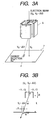
- FIG. 3(a) shows a block diagram of the electron energy filter. It is of a small size of about 10mm square having an electrode for electrostatic deflection and an electrode for magnetic deflection. It deflects an electron beam transmitting the bio specimen according to an energy to obtain energy diffusion of the electron beam on the energy selection slit 7.
- FIG. 3(b) a specific example of energy selection is shown.
- the energy of the electron beam transmitting the specimen is assumed to be a mixture of V 0 and V 0 - ⁇ V.
- ⁇ tV 1 ⁇ V/2dV 0 2
- t 1/2 of the height of the electrode for electrostatic deflection
- V 1 an applied voltage of the electrode for electrostatic deflection
- d a space between the electrodes for electrostatic deflection
- V 0 an energy of an electron beam incident upon the specimen
- ⁇ V an energy lost in the specimen.
- a slit width u of 0.010mm corresponds to an energy width of about 35eV.
- a 250eV energy distribution image can be obtained at the energy resolution of the value.
- the influence of carbon (C(280eV)) widely included in specimen embedding resin and the specimen can be removed to make the contrast of the image higher.
- Ca(350eV), N(415eV) and O (520eV) are fetched into the slit, distribution images of the respective elements can be obtained. Not only the fine structure but also the elements can be analyzed.
- the equipment controlling and image analyzing computer 14 is equipped with image analysis software identifying the species of virus and protein in a bio specimen. The analyzed result is displayed'on the image and analyzed data display screen 13.
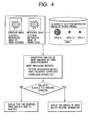
- FIG. 4 shows a flowchart of the image processing specifying the species of virus using the image analysis software. An image obtained by observing the specimen of virus is written as an observed image to the equipment controlling and image analyzing computer 14.
- the computer is equipped with a database of electron microscope images of viruses whose species are known. As shown in FIG. 4, various pathogenic viruses have a characteristic in their structures, and the sizes and structures are almost fixed between the same species of viruses.
- the database has representative images (reference images) of various viruses and its related information such as their properties and remedies.
- the image magnification and contrast of the observed image are adjusted so as to be compared with the reference image. Then, the similarity between the observed image and the reference image in the database is quantitatively analyzed by using image processing. As the image processing method, the pattern recognition method using frequency components and the correlation method are used. When the similarity is within the specified condition, the species of the observed virus and its related information are displayed. Otherwise, there is displayed that the virus was not able to be analyzed. This can automatically execute, at the observed place, identification of the species of'virus which has needed high knowledge and experience so as to make the pathological diagnosis more efficient.
- the specimen preparation micro equipment 10 automatically executes the specimen preparation when a specimen of a very small amount of a tissue or fecal matter is injected.
- FIG. 5 shows the construction of the specimen preparation micro equipment. It is chip-like with a size of about several cm square and a thickness of several mm. It is of a mechanism so as to be detachable from the specimen stage driving system part of the bio electron microscope. On the chip are formed the micro chamber, micro pump and micro fluid channel executing the preparation process using the MEMS (Micro Electro Mechanical Systems) technique. The chip is provided on its back surface with an electrode to supply a driving power of the micro chamber, micro pump and micro fluid channel from the specimen stage driving system.
- FIG. 5 shows the construction of the specimen preparation micro equipment. It is chip-like with a size of about several cm square and a thickness of several mm. It is of a mechanism so as to be detachable from the specimen stage driving system part of the bio electron microscope. On the chip are formed the micro chamber, micro pump and micro fluid channel executing the preparation
- the preparation process is as follows. First, a fecal matter dissolved in water is injected into the uppermost stream micro chamber. It is then moved to the next process in the micro fluid channel. A homogenate device performs high-speed micro-centrifugation to separate the phase containing virus. A virus purification device further conducts ultra high-speed micro-centrifugation while injecting a reagent when needed, thereby removing noises. The purified virus specimen is moved to the meshed thin plate with supporting film for electron microscope. The micro pump is used to supply the negative stain from the staining device onto the meshed thin plate. It is air-dried.
- the meshed thin plate is placed on the specimen holder 11 by the meshed thin plate transfer 9 for electron microscope.
- the meshed thin plate transfer 9 for electron microscope has at its front edge a pin detaching the meshed thin plate.
- the specimen holder 11 is moved to the electron microscope specimen chamber for observation.
- the above operation is controlled by the equipment controlling and image analyzing computer 14 and can be automatically executed.
- the present invention can automatically execute the specimen preparation which has been troublesome and has needed a skill to significantly improve the efficiency of the specimen preparation.
- the preparation condition can be fixed to bring the purified state and stained state between the specimens to the same level. As a result, the high accuracy of the examination and analysis can be achieved.
- the effects of the embodiment of the present invention are as follows.
- the observation method of a bio specimen using the electron accelerating voltage 1.2 to 4.2 times the critical electron accelerating voltage possible to transmit a specimen can significantly reduce the electron beam irradiation damage (to 1/10) as compared with the prior art and can observe the bio structure at high accuracy.
- the electron energy filter With the electron energy filter, the unstained specimen by the small and low-cost equipment construction can be observed at high contrast.
- the method for image processing analyzing similarity between the observed image of the bio specimen and the reference image in the database can automatically execute, at the observed place, identification of the species of virus which has needed high knowledge and experience.
- the specimen preparation micro equipment which can be systematic in the electron microscope body can automatically execute the specimen preparation which has been troublesome and has needed a skill to significantly improve the efficiency of the specimen preparation.
Landscapes
- Chemical & Material Sciences (AREA)
- Analytical Chemistry (AREA)
- Analysing Materials By The Use Of Radiation (AREA)
- Investigating Or Analysing Biological Materials (AREA)
- Sampling And Sample Adjustment (AREA)
Applications Claiming Priority (2)
| Application Number | Priority Date | Filing Date | Title |
|---|---|---|---|
| JP2003002724 | 2003-01-09 | ||
| JP2003002724A JP2004212355A (ja) | 2003-01-09 | 2003-01-09 | バイオ電子顕微鏡及び試料の観察方法 |
Publications (1)
| Publication Number | Publication Date |
|---|---|
| EP1437758A2 true EP1437758A2 (de) | 2004-07-14 |
Family
ID=32501218
Family Applications (1)
| Application Number | Title | Priority Date | Filing Date |
|---|---|---|---|
| EP20030016333 Withdrawn EP1437758A2 (de) | 2003-01-09 | 2003-07-18 | Elektronenmikroskop und Verfahren zur Untersuchung biologischer Proben |
Country Status (3)
| Country | Link |
|---|---|
| US (1) | US6875984B2 (de) |
| EP (1) | EP1437758A2 (de) |
| JP (1) | JP2004212355A (de) |
Cited By (4)
| Publication number | Priority date | Publication date | Assignee | Title |
|---|---|---|---|---|
| CN105486553A (zh) * | 2014-09-01 | 2016-04-13 | 力晶科技股份有限公司 | 穿透式电子显微镜试片的制备方法 |
| CN108375599A (zh) * | 2018-02-02 | 2018-08-07 | 华南农业大学 | 一种微小型昆虫复眼的透射电镜样品制片方法 |
| CN109136323A (zh) * | 2018-09-21 | 2019-01-04 | 云南省农业科学院生物技术与种质资源研究所 | 一种马铃薯y病毒粒体的原位分离固定电子显微镜诊断方法 |
| CN109207552A (zh) * | 2018-09-21 | 2019-01-15 | 云南省农业科学院生物技术与种质资源研究所 | 一种小西葫芦黄花叶病毒粒体的原位分离固定电子显微镜诊断方法 |
Families Citing this family (50)
| Publication number | Priority date | Publication date | Assignee | Title |
|---|---|---|---|---|
| JP4154300B2 (ja) * | 2003-09-08 | 2008-09-24 | 株式会社日立ハイテクノロジーズ | 透過電子顕微鏡システムおよびそれを用いた検査方法 |
| US7173259B2 (en) * | 2004-06-09 | 2007-02-06 | Taiwan Semiconductor Manufacturing Co., Ltd. | Automatically aligning objective aperture for a scanning electron microscope |
| US7312448B2 (en) * | 2005-04-06 | 2007-12-25 | Carl Zeiss Nts Gmbh | Method and apparatus for quantitative three-dimensional reconstruction in scanning electron microscopy |
| TWI275118B (en) * | 2005-12-09 | 2007-03-01 | Li Bing Huan | Sample box of electron microscope for observing a general sample/live cell |
| JP4808100B2 (ja) * | 2006-07-28 | 2011-11-02 | 花王株式会社 | 細菌の共凝集能の評価方法 |
| US8577171B1 (en) * | 2006-07-31 | 2013-11-05 | Gatan, Inc. | Method for normalizing multi-gain images |
| US9008378B2 (en) | 2006-12-20 | 2015-04-14 | The Board Of Trustees Of The Leland Stanford Junior University | Arrangement and imaging of biological samples |
| US7936913B2 (en) * | 2007-08-07 | 2011-05-03 | Nextslide Imaging Llc | Network image review in clinical hematology |
| EA201000427A1 (ru) * | 2007-10-04 | 2010-10-29 | Хэлсион Молекулар | Секвенирование нуклеиново-кислотных полимеров с использованием электронной микроскопии |
| US7659510B2 (en) * | 2008-03-28 | 2010-02-09 | Chih-Yu Chao | Cryo-charging specimen holder for electron microscope |
| US20100111841A1 (en) * | 2008-10-31 | 2010-05-06 | Searete Llc | Compositions and methods for surface abrasion with frozen particles |
| US8762067B2 (en) * | 2008-10-31 | 2014-06-24 | The Invention Science Fund I, Llc | Methods and systems for ablation or abrasion with frozen particles and comparing tissue surface ablation or abrasion data to clinical outcome data |
| US8409376B2 (en) | 2008-10-31 | 2013-04-02 | The Invention Science Fund I, Llc | Compositions and methods for surface abrasion with frozen particles |
| US8551505B2 (en) * | 2008-10-31 | 2013-10-08 | The Invention Science Fund I, Llc | Compositions and methods for therapeutic delivery with frozen particles |
| US8788211B2 (en) * | 2008-10-31 | 2014-07-22 | The Invention Science Fund I, Llc | Method and system for comparing tissue ablation or abrasion data to data related to administration of a frozen particle composition |
| US20100111834A1 (en) * | 2008-10-31 | 2010-05-06 | Searete Llc, A Limited Liability Corporation Of The State Of Delaware | Compositions and methods for therapeutic delivery with frozen particles |
| US9056047B2 (en) | 2008-10-31 | 2015-06-16 | The Invention Science Fund I, Llc | Compositions and methods for delivery of frozen particle adhesives |
| US20100111831A1 (en) * | 2008-10-31 | 2010-05-06 | Searete Llc, A Limited Liability Corporation Of The State Of Delaware | Compositions and methods for surface abrasion with frozen particles |
| US9060934B2 (en) * | 2008-10-31 | 2015-06-23 | The Invention Science Fund I, Llc | Compositions and methods for surface abrasion with frozen particles |
| US9050070B2 (en) * | 2008-10-31 | 2015-06-09 | The Invention Science Fund I, Llc | Compositions and methods for surface abrasion with frozen particles |
| US9060926B2 (en) * | 2008-10-31 | 2015-06-23 | The Invention Science Fund I, Llc | Compositions and methods for therapeutic delivery with frozen particles |
| US9072799B2 (en) * | 2008-10-31 | 2015-07-07 | The Invention Science Fund I, Llc | Compositions and methods for surface abrasion with frozen particles |
| US8545855B2 (en) * | 2008-10-31 | 2013-10-01 | The Invention Science Fund I, Llc | Compositions and methods for surface abrasion with frozen particles |
| US8793075B2 (en) * | 2008-10-31 | 2014-07-29 | The Invention Science Fund I, Llc | Compositions and methods for therapeutic delivery with frozen particles |
| US8545806B2 (en) * | 2008-10-31 | 2013-10-01 | The Invention Science Fund I, Llc | Compositions and methods for biological remodeling with frozen particle compositions |
| US9060931B2 (en) * | 2008-10-31 | 2015-06-23 | The Invention Science Fund I, Llc | Compositions and methods for delivery of frozen particle adhesives |
| US8725420B2 (en) | 2008-10-31 | 2014-05-13 | The Invention Science Fund I, Llc | Compositions and methods for surface abrasion with frozen particles |
| US8731840B2 (en) * | 2008-10-31 | 2014-05-20 | The Invention Science Fund I, Llc | Compositions and methods for therapeutic delivery with frozen particles |
| US8603494B2 (en) * | 2008-10-31 | 2013-12-10 | The Invention Science Fund I, Llc | Compositions and methods for administering compartmentalized frozen particles |
| US20100111835A1 (en) * | 2008-10-31 | 2010-05-06 | Searete Llc, A Limited Liability Corporation Of The State Of Delaware | Compositions and methods for therapeutic delivery with frozen particles |
| US20100111857A1 (en) | 2008-10-31 | 2010-05-06 | Boyden Edward S | Compositions and methods for surface abrasion with frozen particles |
| US8731841B2 (en) * | 2008-10-31 | 2014-05-20 | The Invention Science Fund I, Llc | Compositions and methods for therapeutic delivery with frozen particles |
| US9050317B2 (en) * | 2008-10-31 | 2015-06-09 | The Invention Science Fund I, Llc | Compositions and methods for therapeutic delivery with frozen particles |
| US20100111836A1 (en) * | 2008-10-31 | 2010-05-06 | Searete Llc, A Limited Liability Corporation Of The State Of Delaware | Compositions and methods for therapeutic delivery with frozen particles |
| US9072688B2 (en) * | 2008-10-31 | 2015-07-07 | The Invention Science Fund I, Llc | Compositions and methods for therapeutic delivery with frozen particles |
| US8603495B2 (en) * | 2008-10-31 | 2013-12-10 | The Invention Science Fund I, Llc | Compositions and methods for biological remodeling with frozen particle compositions |
| US8414356B2 (en) * | 2008-10-31 | 2013-04-09 | The Invention Science Fund I, Llc | Systems, devices, and methods for making or administering frozen particles |
| US8563012B2 (en) * | 2008-10-31 | 2013-10-22 | The Invention Science Fund I, Llc | Compositions and methods for administering compartmentalized frozen particles |
| US8858912B2 (en) * | 2008-10-31 | 2014-10-14 | The Invention Science Fund I, Llc | Frozen compositions and methods for piercing a substrate |
| US8721583B2 (en) * | 2008-10-31 | 2014-05-13 | The Invention Science Fund I, Llc | Compositions and methods for surface abrasion with frozen particles |
| HUE055674T2 (hu) * | 2010-10-29 | 2021-12-28 | Thermo Fisher Scientific Oy | Rendszerelrendezés automatizált mintaelõkészítõ és -elemzõ rendszerhez |
| WO2013138208A1 (en) * | 2012-03-16 | 2013-09-19 | Dennis Robert T | Research on, identification of and screening for biological materials using low energy electron microscopy |
| JP5836221B2 (ja) * | 2012-08-03 | 2015-12-24 | 株式会社日立ハイテクノロジーズ | 荷電粒子線装置 |
| JP6309195B2 (ja) * | 2013-02-18 | 2018-04-11 | 株式会社ホロン | 走査型電子顕微鏡および検査装置 |
| US10416429B2 (en) * | 2017-09-15 | 2019-09-17 | Agile Focus Designs, LLC | Dynamic focus and zoom system for use with wide-field, confocal and multiphoton microscopes |
| JP7181002B2 (ja) * | 2018-05-24 | 2022-11-30 | 日本電子株式会社 | 生物組織画像処理システム及び機械学習方法 |
| JP7181003B2 (ja) * | 2018-05-24 | 2022-11-30 | 日本電子株式会社 | 生物組織画像処理装置及び方法 |
| US11914131B1 (en) * | 2020-08-16 | 2024-02-27 | Gregory Dimitrenko | Optical testing system for detecting infectious disease, testing device, specimen collector and related methods |
| CN112381817B (zh) * | 2020-11-30 | 2021-06-25 | 中国科学院自动化研究所 | 扫描电镜透射模式与透射电镜联用的病毒快速检测系统 |
| WO2024002399A1 (en) | 2022-06-29 | 2024-01-04 | Delong Instruments A.S. | A multi-mode low-voltage electron microscope |
Family Cites Families (5)
| Publication number | Priority date | Publication date | Assignee | Title |
|---|---|---|---|---|
| US5640012A (en) * | 1995-08-25 | 1997-06-17 | Gatan, Inc. | Precision-controlled slit mechanism for electron microscope |
| DE19811395A1 (de) * | 1998-03-16 | 1999-09-23 | Deutsches Krebsforsch | Verfahren zur Kontrastverstärkung für ein Transmissionselektronenmikroskop |
| US6140645A (en) * | 1997-10-20 | 2000-10-31 | Jeol Ltd. | Transmission electron microscope having energy filter |
| JP4069545B2 (ja) * | 1999-05-19 | 2008-04-02 | 株式会社日立製作所 | 電子顕微方法及びそれを用いた電子顕微鏡並び生体試料検査方法及び生体検査装置 |
| JP4312910B2 (ja) * | 1999-12-02 | 2009-08-12 | 株式会社日立製作所 | レビューsem |
-
2003
- 2003-01-09 JP JP2003002724A patent/JP2004212355A/ja active Pending
- 2003-07-18 EP EP20030016333 patent/EP1437758A2/de not_active Withdrawn
- 2003-07-18 US US10/621,444 patent/US6875984B2/en not_active Expired - Fee Related
Cited By (4)
| Publication number | Priority date | Publication date | Assignee | Title |
|---|---|---|---|---|
| CN105486553A (zh) * | 2014-09-01 | 2016-04-13 | 力晶科技股份有限公司 | 穿透式电子显微镜试片的制备方法 |
| CN108375599A (zh) * | 2018-02-02 | 2018-08-07 | 华南农业大学 | 一种微小型昆虫复眼的透射电镜样品制片方法 |
| CN109136323A (zh) * | 2018-09-21 | 2019-01-04 | 云南省农业科学院生物技术与种质资源研究所 | 一种马铃薯y病毒粒体的原位分离固定电子显微镜诊断方法 |
| CN109207552A (zh) * | 2018-09-21 | 2019-01-15 | 云南省农业科学院生物技术与种质资源研究所 | 一种小西葫芦黄花叶病毒粒体的原位分离固定电子显微镜诊断方法 |
Also Published As
| Publication number | Publication date |
|---|---|
| US6875984B2 (en) | 2005-04-05 |
| JP2004212355A (ja) | 2004-07-29 |
| US20040135083A1 (en) | 2004-07-15 |
Similar Documents
| Publication | Publication Date | Title |
|---|---|---|
| EP1437758A2 (de) | Elektronenmikroskop und Verfahren zur Untersuchung biologischer Proben | |
| US9040909B2 (en) | System and method for simultaneous detection of secondary electrons and light in a charged particle beam system | |
| EP2387062B1 (de) | Simultane Elektronendetektion | |
| US8912491B2 (en) | Method of performing tomographic imaging of a sample in a charged-particle microscope | |
| JP6400283B2 (ja) | 設定可能な荷電粒子装置 | |
| EP2477206B1 (de) | Verfahren zur Bearbeitung und/oder Analyse einer Probe mit einem Teilchenstrahlgerät | |
| US10665419B2 (en) | Intelligent pre-scan in scanning transmission charged particle microscopy | |
| JP2014056820A (ja) | 荷電粒子顕微鏡内において試料の断層撮像を実行する方法 | |
| US11817290B2 (en) | Method, device and system for reducing off-axial aberration in electron microscopy | |
| JP5727564B2 (ja) | 荷電粒子レンズ系における収差を調査及び補正する方法 | |
| US10483084B2 (en) | Object preparation device and particle beam device having an object preparation device and method for operating the particle beam device | |
| CN115997113B (zh) | 使用聚焦离子束对样品进行微加工的方法和设备 | |
| CN109411320A (zh) | 透射带电粒子显微镜中的衍射图案检测 | |
| KR20200101290A (ko) | 집속 이온 빔 불순물 식별 | |
| US11593938B2 (en) | Rapid and automatic virus imaging and analysis system as well as methods thereof | |
| CN115901815A (zh) | 用于元素图绘制的方法和系统 | |
| CN109841473A (zh) | 具有可调整光束能散度的透射带电粒子显微镜 | |
| JP2019102464A (ja) | 改善されたeels/eftemモジュールを有する透過型荷電粒子顕微鏡 | |
| JP2000304712A (ja) | 電子線分析・観察装置および電子線マイクロアナライザ | |
| Fukuda et al. | Preparation of vitrified cells for TEM by cryo-FIB microscopy | |
| CN113848220A (zh) | 使用透射带电粒子显微镜对样本进行成像的方法 | |
| US6841776B1 (en) | Method and apparatus for high-speed inspection and review | |
| US8502142B2 (en) | Charged particle beam analysis while part of a sample to be analyzed remains in a generated opening of the sample | |
| US20240362778A1 (en) | Rapid and automatic virus imaging and analysis system as well as methods thereof | |
| JP4111778B2 (ja) | 集束イオンビーム装置により一部が薄膜状に加工された試料の電子顕微鏡による観察方法 |
Legal Events
| Date | Code | Title | Description |
|---|---|---|---|
| PUAI | Public reference made under article 153(3) epc to a published international application that has entered the european phase |
Free format text: ORIGINAL CODE: 0009012 |
|
| AK | Designated contracting states |
Kind code of ref document: A2 Designated state(s): AT BE BG CH CY CZ DE DK EE ES FI FR GB GR HU IE IT LI LU MC NL PT RO SE SI SK TR |
|
| AX | Request for extension of the european patent |
Extension state: AL LT LV MK |
|
| STAA | Information on the status of an ep patent application or granted ep patent |
Free format text: STATUS: THE APPLICATION HAS BEEN WITHDRAWN |
|
| 18W | Application withdrawn |
Effective date: 20080624 |