EP1430266B1 - Sich zerlegendes jagdgeschoss - Google Patents
Sich zerlegendes jagdgeschoss Download PDFInfo
- Publication number
- EP1430266B1 EP1430266B1 EP02772078A EP02772078A EP1430266B1 EP 1430266 B1 EP1430266 B1 EP 1430266B1 EP 02772078 A EP02772078 A EP 02772078A EP 02772078 A EP02772078 A EP 02772078A EP 1430266 B1 EP1430266 B1 EP 1430266B1
- Authority
- EP
- European Patent Office
- Prior art keywords
- bullet
- hunting
- core
- balls
- granules
- Prior art date
- Legal status (The legal status is an assumption and is not a legal conclusion. Google has not performed a legal analysis and makes no representation as to the accuracy of the status listed.)
- Expired - Lifetime
Links
- 239000008187 granular material Substances 0.000 claims abstract description 22
- 239000000126 substance Substances 0.000 claims abstract description 4
- 239000000463 material Substances 0.000 claims description 9
- 239000002245 particle Substances 0.000 claims description 5
- XEEYBQQBJWHFJM-UHFFFAOYSA-N Iron Chemical compound [Fe] XEEYBQQBJWHFJM-UHFFFAOYSA-N 0.000 claims description 4
- 229910045601 alloy Inorganic materials 0.000 claims description 3
- 239000000956 alloy Substances 0.000 claims description 3
- OKTJSMMVPCPJKN-UHFFFAOYSA-N Carbon Chemical group [C] OKTJSMMVPCPJKN-UHFFFAOYSA-N 0.000 claims description 2
- RYGMFSIKBFXOCR-UHFFFAOYSA-N Copper Chemical group [Cu] RYGMFSIKBFXOCR-UHFFFAOYSA-N 0.000 claims description 2
- 229910001128 Sn alloy Inorganic materials 0.000 claims description 2
- 229910000831 Steel Inorganic materials 0.000 claims description 2
- 229910052802 copper Inorganic materials 0.000 claims description 2
- 239000010949 copper Substances 0.000 claims description 2
- 229910002804 graphite Inorganic materials 0.000 claims description 2
- 239000010439 graphite Substances 0.000 claims description 2
- 229910052742 iron Inorganic materials 0.000 claims description 2
- 239000007769 metal material Substances 0.000 claims description 2
- 229920001343 polytetrafluoroethylene Polymers 0.000 claims description 2
- 239000010959 steel Substances 0.000 claims description 2
- 239000000470 constituent Substances 0.000 claims 6
- 239000004429 Calibre Substances 0.000 claims 1
- HCHKCACWOHOZIP-UHFFFAOYSA-N Zinc Chemical compound [Zn] HCHKCACWOHOZIP-UHFFFAOYSA-N 0.000 claims 1
- 229910001297 Zn alloy Inorganic materials 0.000 claims 1
- 238000007373 indentation Methods 0.000 claims 1
- -1 polytetrafluoroethylene Polymers 0.000 claims 1
- 239000004810 polytetrafluoroethylene Substances 0.000 claims 1
- 239000011701 zinc Substances 0.000 claims 1
- 230000000694 effects Effects 0.000 abstract description 4
- 241001465754 Metazoa Species 0.000 abstract 2
- 239000002184 metal Substances 0.000 abstract 1
- 239000011162 core material Substances 0.000 description 20
- 238000000354 decomposition reaction Methods 0.000 description 5
- 230000000149 penetrating effect Effects 0.000 description 2
- 230000035515 penetration Effects 0.000 description 2
- 239000007787 solid Substances 0.000 description 2
- 235000001674 Agaricus brunnescens Nutrition 0.000 description 1
- 239000003795 chemical substances by application Substances 0.000 description 1
- 230000006835 compression Effects 0.000 description 1
- 238000007906 compression Methods 0.000 description 1
- 238000011109 contamination Methods 0.000 description 1
- 230000006378 damage Effects 0.000 description 1
- 230000007613 environmental effect Effects 0.000 description 1
- 238000013467 fragmentation Methods 0.000 description 1
- 238000006062 fragmentation reaction Methods 0.000 description 1
- 230000005484 gravity Effects 0.000 description 1
- 239000002689 soil Substances 0.000 description 1
- GZCWPZJOEIAXRU-UHFFFAOYSA-N tin zinc Chemical compound [Zn].[Sn] GZCWPZJOEIAXRU-UHFFFAOYSA-N 0.000 description 1
Images
Classifications
-
- F—MECHANICAL ENGINEERING; LIGHTING; HEATING; WEAPONS; BLASTING
- F42—AMMUNITION; BLASTING
- F42B—EXPLOSIVE CHARGES, e.g. FOR BLASTING, FIREWORKS, AMMUNITION
- F42B12/00—Projectiles, missiles or mines characterised by the warhead, the intended effect, or the material
- F42B12/02—Projectiles, missiles or mines characterised by the warhead, the intended effect, or the material characterised by the warhead or the intended effect
- F42B12/34—Projectiles, missiles or mines characterised by the warhead, the intended effect, or the material characterised by the warhead or the intended effect expanding before or on impact, i.e. of dumdum or mushroom type
-
- F—MECHANICAL ENGINEERING; LIGHTING; HEATING; WEAPONS; BLASTING
- F42—AMMUNITION; BLASTING
- F42B—EXPLOSIVE CHARGES, e.g. FOR BLASTING, FIREWORKS, AMMUNITION
- F42B12/00—Projectiles, missiles or mines characterised by the warhead, the intended effect, or the material
- F42B12/02—Projectiles, missiles or mines characterised by the warhead, the intended effect, or the material characterised by the warhead or the intended effect
- F42B12/36—Projectiles, missiles or mines characterised by the warhead, the intended effect, or the material characterised by the warhead or the intended effect for dispensing materials; for producing chemical or physical reaction; for signalling ; for transmitting information
- F42B12/367—Projectiles fragmenting upon impact without the use of explosives, the fragments creating a wounding or lethal effect
-
- F—MECHANICAL ENGINEERING; LIGHTING; HEATING; WEAPONS; BLASTING
- F42—AMMUNITION; BLASTING
- F42B—EXPLOSIVE CHARGES, e.g. FOR BLASTING, FIREWORKS, AMMUNITION
- F42B12/00—Projectiles, missiles or mines characterised by the warhead, the intended effect, or the material
- F42B12/72—Projectiles, missiles or mines characterised by the warhead, the intended effect, or the material characterised by the material
- F42B12/74—Projectiles, missiles or mines characterised by the warhead, the intended effect, or the material characterised by the material of the core or solid body
-
- F—MECHANICAL ENGINEERING; LIGHTING; HEATING; WEAPONS; BLASTING
- F42—AMMUNITION; BLASTING
- F42B—EXPLOSIVE CHARGES, e.g. FOR BLASTING, FIREWORKS, AMMUNITION
- F42B8/00—Practice or training ammunition
- F42B8/12—Projectiles or missiles
- F42B8/14—Projectiles or missiles disintegrating in flight or upon impact
- F42B8/16—Projectiles or missiles disintegrating in flight or upon impact containing an inert filler in powder or granular form
Definitions
- the invention relates to a decaying hunting ground as a mantle projectile.
- a mantle projectile which may be both a sectionmantel- and a solid shell projectile whose bullet core consists exclusively of void-free compressed balls or granules of a metallic material.
- Suitable materials for the balls or granules are all materials that can be pressed into a void-free core, including lead or lead-containing alloys.
- lead-free materials are preferably used.
- the compressed bullet core made of bullets or granules held by the bullet jacket breaks up with the bullet casing on impact in the target.
- the diameter of the balls or the grain size of the granules determine both the energy output, as well as the predetermined breaking points in the bullet core and thus the size of the resulting parts during its decomposition. Larger balls or granules penetrate deeper into the target medium and cause a deeper penetrating destruction channel in the tissue than a comparable number of smaller balls or granules particles.
- sharp edges are formed on the compressed balls or granule particles, which increase the effect of the splinters.
- the size of the balls or granules is, depending on the caliber, between 1 mm and 12 mm, preferably between 3 mm and 6 mm.
- the balls with the largest diameter are used, for example, caliber .50.
- the bullet core can also be composed in such a way that the front region, for example the ogival region, consists of spheres or granulate particles of smaller size than the cylindrical part.
- the core decomposes already when hitting many small splinters. A pressing of the two areas can not be done together. Each area must be pressed individually.
- the balls or granules of different sizes may also consist of different materials, but the optimum center of gravity in terms of ballistics must be ensured.
- the spheres or granules may be coated with a release substance prior to compression to ensure better disassembly in the target.
- Suitable release agents are, for example, graphite or polytetrafluoroethylene (Teflon).
- the projectile cores may also be prefabricated, i. pre-pressed into the bullet form, are introduced into the coats.
- predetermined breaking points in the jacket are advantageous.
- the predetermined breaking points extend in the axial direction and lie on the inside of the jacket, preferably in the ogival region.
- the dismantling of the projectile can be influenced by the number and position of the predetermined breaking points in the mantle. The closer the predetermined breaking points are to the top of the projectile, the sooner the mantle mushrooms and breaks up into splinters.
- Other predetermined breaking points may be on the outer circumference radially extending notches such as a sharp edge in hunting bullets.
- copper, its alloys, plated steel, soft iron and zinc-tin alloys are suitable as materials for the jacket.
- the described structure of the bullet core is suitable for all types of bullets that are partially or fully dismantled. These also include projectiles with some hard core, with a bullet core made of different materials and projectiles with an additional, non-dispersing penetrator in the projectile or in the bullet tail, as known for example from WO 01/20244 A1 or WO 01/20245 A1 are.
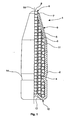
- FIG. 1 shows a part jacket 1.
- the core material was filled and then pressed lunker arthritis to the core 3.
- the core material in the present embodiment consists of large balls 4 and small balls 5.
- the projectile casing 1 was pulled onto the illustrated projectile shape.
- a compact bullet core 3 has been created with predetermined breaking points between the compressed balls.
- the projectile casing 2 is not closed in Geunterbug 6. From the opening 7 of the shell 2, the projectile core 3 protrudes and forms the projectile tip 8.
- predetermined break points in the form of grooves pressed into the shell 2 run on the inside of the shell 2 in the direction of the axis 10 of the projectile 1 Stern 12 of the projectile 1 is to stabilize the projectile movement and thus to increase the precision of a dome 13.
- a so-called sharp edge 14 located on the outer circumference of the shell 2 notch with a sharp edge, on the one hand a clean shot into the ceiling of the game conditionally and on the other hand forms another breaking point in the decomposition of the shell 2.
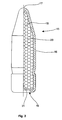
- FIG. 2 shows a solid shell projectile 15.
- the projectile casing 16 is closed in the projectile nose 17.
- the core material consists of granules 18, which was first filled through the open rear 19 and then compressed lunkerhin to a compact core 20. Subsequently, the rear portion 19 of the projectile 15 was provided with a cover 21 and this jammed. Again, a compact bullet core 20 has been created with predetermined breaking points between the granules.
- 14 is a notch in the cylindrical part of the projectile shell 16, as described in the embodiment of Figure 1.
Landscapes
- Engineering & Computer Science (AREA)
- General Engineering & Computer Science (AREA)
- Chemical & Material Sciences (AREA)
- Combustion & Propulsion (AREA)
- Physics & Mathematics (AREA)
- Thermal Sciences (AREA)
- Powder Metallurgy (AREA)
- Aiming, Guidance, Guns With A Light Source, Armor, Camouflage, And Targets (AREA)
- Acyclic And Carbocyclic Compounds In Medicinal Compositions (AREA)
- Toys (AREA)
- Fats And Perfumes (AREA)
- Fodder In General (AREA)
- Manufacture Of Metal Powder And Suspensions Thereof (AREA)
- Placing Or Removing Of Piles Or Sheet Piles, Or Accessories Thereof (AREA)
- Road Signs Or Road Markings (AREA)
- Separation Of Suspended Particles By Flocculating Agents (AREA)
- Steroid Compounds (AREA)
- Pharmaceuticals Containing Other Organic And Inorganic Compounds (AREA)
- Springs (AREA)
- Cultivation Of Seaweed (AREA)
Description
- Die Erfindung betrifft ein sich zerlegendes Jagdgeschoss als Mantelgeschoss.
- Die Zerlegung eines Geschosses im Wildkörper nach dem Eindringen in diesen bestimmt die Energieabgabe des Geschosses und damit die Wirkung des Schusses. Bei schwachem Wild ist eine andere Zerlegung erforderlich als beim Hochwild.
- Es ist deshalb die Aufgabe der Erfindung, ein Geschoss zu finden, welches auf das zu jagende Wild abgestimmt sich beim Eindringen in das Zielmedium in eine definierte Splittermenge mit definierter Größe der Splitter zerlegt.
- Zur Lösung der Aufgabe wird ein Mantelgeschoss vorgestellt, das sowohl ein Teilmantel- als auch ein Vollmantelgeschoss sein kann, dessen Geschosskern ausschliesslich aus lunkerfrei verpressten Kugeln oder Granulat aus einem metallischen Werkstoff besteht. Als Werkstoff für die Kugeln oder das Granulat eignen sich alle Werkstoffe, die sich zu einem lunkerfreien Kern verpressen lassen, unter anderem auch Blei oder bleihaltige Legierungen. Aus Gründen des Umweltschutzes, zur vorteilhaften Vermeidung einer Kontaminierung des Bodens und des Wildbrets, werden vorzugsweise bleifreie Werkstoffe verwendet.
- Der vom Geschossmantel gehaltene verpresste Geschosskern aus Kugeln oder Granulat zerlegt sich mit dem Geschossmantel beim Aufprall im Ziel. Dabei bestimmen der Durchmesser der Kugeln oder die Korngröße des Granulats sowohl die Energieabgabe, als auch die Sollbruchstellen im Geschosskern und damit die Größe der bei seiner Zerlegung entstehenden Einzelteile. Größere Kugeln oder Granulatteilchen dringen tiefer in das Zielmedium ein und führen im Gewebe einen tiefer eindringenden Zerstörungskanal herbei als eine in der Masse vergleichbare Anzahl kleinerer Kugeln oder Granulatteilchen. Durch das Verpressen des Materials des Kerns entstehen scharfe Kanten an den verpressten Kugeln oder Granulatteilchen, die die Wirkungsweise der Splitter erhöhen.
- Die Größe der Kugeln oder des Granulats liegt, je nach Kaliber, zwischen 1 mm und 12 mm, bevorzugt zwischen 3 mm und 6 mm. Die Kugeln mit dem größten Durchmesser werden beispielsweise bei Kaliber .50 eingesetzt.
- Der Geschosskern kann auch dergestalt zusammengesetzt sein, dass der vordere Bereich, beispielsweise der ogivale Bereich, aus Kugeln oder Granulatteilchen geringerer Größe besteht wie der zylindrische Teil. Dadurch zerlegt sich der Kern bereits beim Auftreffen in viele kleine Splitter. Ein Verpressen der beiden Bereiche kann nicht gemeinsam erfolgen. Jeder Bereich muss einzeln verpresst werden. Die Kugeln oder Granulatteilchen unterschiedlicher Größe können auch aus unterschiedlichen Werkstoffen bestehen, wobei aber die optimale Schwerpunktlage in Bezug auf die Ballistik gewährleistet sein muss.
- Die Kugeln oder Granulatteilchen können vor dem Verpressen mit einer Trennsubstanz beschichtet werden, um ein besseres Zerlegen im Ziel zu gewährleisten. Als Trennmittel eignen sich beispielsweise Graphit oder Polytetrafluorethylen (Teflon).
- Die Geschosskerne können auch vorgefertigt, d.h. in die Geschossform vorgepresst, in die Mäntel eingebracht werden.
- Ist eine Zerlegung des Geschosses bereits beim Auftreffen oder in geringer Eindringtiefe bzw. bei geringeren Projektilgeschwindigkeiten gewünscht, sind Sollbruchstellen im Mantel von Vorteil. Die Sollbruchstellen verlaufen in axialer Richtung und liegen auf der Innenseite des Mantels, bevorzugt im ogivalen Bereich. Die Zerlegung des Geschosses kann durch die Anzahl und die Lage der Sollbruchstellen im Mantel beeinflusst werden. Je näher die Sollbruchstellen zur Spitze des Geschosses hin liegen, desto eher pilzt der Mantel auf und zerlegt sich in Splitter. Weitere Sollbruchstellen können auf den Außenumfang radial verlaufende Einkerbungen sein wie beispielsweise ein Scharfrand bei Jagdgeschossen.
- Als Werkstoffe für den Mantel eignen sich insbesondere Kupfer, dessen Legierungen, plattierter Stahl, Weicheisen und Zink-Zinn-Legierungen.
- Der geschilderte Aufbau des Geschosskerns eignet sich für alle Geschosstypen, die teil- oder voll zerlegbar sind. Dazu gehören auch Geschosse mit teilweise hartem Kern, mit einem Geschosskern aus unterschiedlichen Werkstoffen und Geschosse mit einem zusätzlichen, sich nicht zerlegenden Penetrator im Geschossbug oder im Geschossheck, wie sie beispielsweise aus der WO 01/20244 A1 beziehungsweise aus der WO 01/20245 A1 bekannt sind.
- Durch die aufgezeigten Gestaltungsmöglichkeiten des Kerns eines Geschosses ist es möglich Geschosse herzustellen, die auf den jeweiligen Verwendungszweck abgestimmt sind und die bei jeder Auftreffgeschwindigkeit aufgrund ihres darauf abgestimmten Zerlegungsverhaltens jeweils eine optimale Wirkung erzielen.
- Anhand von Ausführungsbeispielen wird die Erfindung näher erläutert.
- Es zeigen in schematisierter Darstellung:
- Figur 1
- ein Teilmantelgeschoss, halbseitig im Schnitt dargestellt, und
- Figur 2
- ein Vollmantelgeschoss, ebenfalls halbseitig im Schnitt dargestellt.
- In Figur 1 ist ein Teilmantelgeschoss 1 dargestellt. In den zunächst unverformten, offenen Geschossmantel 2 wurde das Kernmaterial eingefüllt und dann lunkerfrei zum Kern 3 verpresst. Das Kernmaterial besteht im vorliegenden Ausführungsbeispiel aus großen Kugeln 4 und kleinen Kugeln 5. Anschließend wurde der Geschossmantel 1 auf die dargestellte Geschossform eingezogen. Dabei ist ein kompakter Geschosskern 3 mit Sollbruchstellen zwischen den verpressten Kugeln entstanden. Der Geschossmantel 2 ist im Geschossbug 6 nicht geschlossen. Aus der Öffnung 7 des Mantels 2 tritt der Geschosskern 3 hervor und bildet die Geschossspitze 8. Im ogivalen Bereich 9 verlaufen auf der Innenseite des Mantels 2 in Richtung der Achse 10 des Geschosses 1 Sollbruchstellen in Form von in den Mantel 2 gepresste Rillen 11. Im Heck 12 des Geschosses 1 befindet sich zur Stabilisierung der Geschossbewegung und damit zur Steigerung der Präzision eine Kalotte 13. Im zylindrischen Bereich des Geschosses 1 befindet sich ein sogenannter Scharfrand 14, eine sich auf dem äußeren Umfang des Mantels 2 befindliche Einkerbung mit scharfer Kante, die einerseits einen sauberen Einschuss in die Decke des Wildes bedingt und andererseits eine weitere Sollbruchstelle bei der Zerlegung des Mantels 2 bildet.
- In Figur 2 ist ein Vollmantelgeschoss 15. dargestellt. Der Geschossmantel 16 ist in der Geschossspitze 17 geschlossen. Das Kernmaterial besteht aus Granulat 18, das zunächst durch das offene Heck 19 eingefüllt und dann lunkerfrei zu einem kompakten Kern 20 verpresst wurde. Anschließend wurde der Heckbereich 19 des Geschosses 15 mit einer Abdeckung 21 versehen und diese verklemmt. Auch hier ist ein kompakter Geschosskern 20 mit Sollbruchstellen zwischen den Granulatteilchen entstanden. Mit 14 ist eine Einkerbung im zylindrischen Teil des Geschossmantels 16 bezeichnet, wie sie im Ausführungsbeispiel der Figur 1 beschrieben ist.
Claims (17)
- Sich vollständig zerlegendes Jagdgeschoss als Mantelgeschoss, dadurch gekennzeichnet, dass der Kern (3; 20) ausschließlich aus Kugeln (4, 5) oder aus Granulat (18) aus einem metallischen Werkstoff besteht und dass die Kugeln (4, 5) oder das Granulat (18) lunkerfrei verpresst sind.
- Jagdgeschoss nach Anspruch 1, dadurch gekennzeichnet, dass das Geschoss ein Teilmantelgeschoss (1) ist und dass der Geschosskern (3) die Geschossspitze (8) bildet.
- Jagdgeschoss nach Anspruch 1, dadurch gekennzeichnet, dass das Geschoss ein Vollmantelgeschoss (15) ist.
- Jagdgeschoss nach einem der Ansprüche 1 bis 3, dadurch gekennzeichnet, dass der Geschosskern (3; 20) aus Kugeln (4, 5) oder Granulatteilchen (18) unterschiedlicher Größe zusammengesetzt ist.
- Jagdgeschoss nach einem der Ansprüche 1 bis 4, dadurch gekennzeichnet, dass die Größe der Kugeln oder des Granulats, je nach Kaliber, zwischen 1 mm und 12 mm, bevorzugt zwischen 3 mm und 6 mm, liegt.
- Jagdgeschoss nach Anspruch 4 oder 5, dadurch gekennzeichnet, dass ein Bereich des Geschosskems (3; 20) aus Granulat oder aus Kugeln einer anderen Größe zusammengesetzt ist als der andere Bereich und dass beide Bereiche getrennt verpresst sind.
- Jagdgeschoss nach Anspruch 6, dadurch gekennzeichnet, dass die Bereiche aus Granulat oder aus Kugeln aus unterschiedlichen Werkstoffen bestehen.
- Jagdgeschoss nach einem der Ansprüche 1 bis 7, dadurch gekennzeichnet, dass die Kugeln (4, 5) oder Granulatteilchen (18) mit einer Trennsubstanz beschichtet sind.
- Jagdgeschoss nach Anspruch 8, dadurch gekennzeichnet, dass die Trennsubstanz Graphit oder Polytetrafluorethylen ist.
- Jagdgeschoss nach einem der Ansprüche 1 bis 9, dadurch gekennzeichnet, dass die Geschosskerne (3; 20) vorgefertigt in die Mäntel (2; 16) eingebracht sind.
- Jagdgeschoss nach einem der Ansprüche 1 bis 10, dadurch gekennzeichnet, dass der Geschossmantel (2) Sollbruchstellen (11, 14) aufweist.
- Jagdgeschoss nach Anspruch 11, dadurch gekennzeichnet, dass die Sollbruchstellen (11) in Richtung der Geschossachse (10) verlaufen.
- Jagdgeschoss nach einem der Ansprüche 1 bis 12, dadurch gekennzeichnet, dass der Werkstoff des Geschossmantels (2; 16) Kupfer, dessen Legierungen, plattierter Stahl, Weicheisen oder Zink-Zinn-Legierungen sind.
- Jagdgeschoss nach einem der Ansprüche 1 bis 13, dadurch gekennzeichnet, dass das Geschoss (1) im Heckbereich (12) eine Kalotte (13) aufweist.
- Jagdgeschoss nach einem der Ansprüche 1 bis 14, dadurch gekennzeichnet, dass das Geschoss (1) einen Scharfrand (14) auf seinem äußeren Umfang aufweist.
- Jagdgeschoss nach einem der Ansprüche 1 bis 15, dadurch gekennzeichnet, dass das Geschoss aus zwei Teilkemen zusammengesetzt ist und dass ein sich nicht zerlegender Teilkem im Geschossbug und ein sich zerlegender Teilkem im Geschossheck angeordnet ist.
- Jagdgeschoss nach einem der Ansprüche 1 bis 15, dadurch gekennzeichnet, dass das Geschoss aus zwei Teilkemen zusammengesetzt ist und dass ein sich zerlegender Teilkem im Geschossbug und ein sich nicht zerlegender Teilkem im Geschossheck angeordnet ist.
Applications Claiming Priority (5)
| Application Number | Priority Date | Filing Date | Title |
|---|---|---|---|
| DE10146797 | 2001-09-22 | ||
| DE10146797 | 2001-09-22 | ||
| DE10239910 | 2002-08-30 | ||
| DE10239910A DE10239910A1 (de) | 2001-09-22 | 2002-08-30 | Sich zerlegendes Jagdgeschoss |
| PCT/DE2002/003523 WO2003027602A1 (de) | 2001-09-22 | 2002-09-18 | Sich zerlegendes jagdgeschoss |
Publications (2)
| Publication Number | Publication Date |
|---|---|
| EP1430266A1 EP1430266A1 (de) | 2004-06-23 |
| EP1430266B1 true EP1430266B1 (de) | 2006-06-28 |
Family
ID=26010207
Family Applications (1)
| Application Number | Title | Priority Date | Filing Date |
|---|---|---|---|
| EP02772078A Expired - Lifetime EP1430266B1 (de) | 2001-09-22 | 2002-09-18 | Sich zerlegendes jagdgeschoss |
Country Status (8)
| Country | Link |
|---|---|
| US (1) | US7509911B2 (de) |
| EP (1) | EP1430266B1 (de) |
| AT (1) | ATE331935T1 (de) |
| BR (1) | BR0212731B1 (de) |
| DE (2) | DE50207397D1 (de) |
| DK (1) | DK1430266T3 (de) |
| ES (1) | ES2268091T3 (de) |
| WO (1) | WO2003027602A1 (de) |
Families Citing this family (13)
| Publication number | Priority date | Publication date | Assignee | Title |
|---|---|---|---|---|
| US20050109234A1 (en) * | 2001-08-23 | 2005-05-26 | Lloyd Richard M. | Kinetic energy rod warhead with lower deployment angles |
| DE102004035385A1 (de) * | 2003-08-05 | 2005-03-03 | Ruag Ammotec Gmbh | Teilzerlegungsgeschoss mit massivem Kern und Kern aus gepresstem Pulver |
| DE102004035371A1 (de) * | 2003-08-05 | 2005-03-10 | Ruag Ammotec Gmbh | Teilzerlegungsgeschoss mit Doppelkern |
| JP2007508524A (ja) | 2003-10-14 | 2007-04-05 | レイセオン・カンパニー | 地雷防護システム |
| US20050183617A1 (en) | 2004-02-23 | 2005-08-25 | Macdougall John | Jacketed ammunition |
| US20090320711A1 (en) * | 2004-11-29 | 2009-12-31 | Lloyd Richard M | Munition |
| US8393273B2 (en) * | 2009-01-14 | 2013-03-12 | Nosler, Inc. | Bullets, including lead-free bullets, and associated methods |
| FR2988793B1 (fr) * | 2012-03-28 | 2015-04-03 | Mbda France | Missile tactique et masselotte d'equilibrage pour ce missile |
| EP3105530B1 (de) * | 2014-02-10 | 2018-04-04 | RUAG Ammotec GmbH | Zerlegungsgeschoss mit geschosskernen aus pb oder pb-freien materialien mit abgestufter zerlegung |
| SG11201704809SA (en) | 2014-12-11 | 2017-07-28 | Ruag Ammotec Ag | Projectile with reduced ricochet risk |
| US10222183B2 (en) | 2015-03-02 | 2019-03-05 | Timothy G. Smith | Lead-free rimfire projectile |
| USD778392S1 (en) | 2015-03-02 | 2017-02-07 | Timothy G. Smith | Lead-free rimfire projectile |
| US9702677B2 (en) | 2015-04-27 | 2017-07-11 | Basic Electronics, Inc. | Ammunition for providing a multilayer flowering upon impact |
Family Cites Families (6)
| Publication number | Priority date | Publication date | Assignee | Title |
|---|---|---|---|---|
| FR2442428A1 (fr) | 1978-11-23 | 1980-06-20 | France Etat | Nouveau projectile a energie cinetique |
| EP0616684A1 (de) * | 1991-10-18 | 1994-09-28 | Snc Industrial Technologies Inc./ Les Technologies Industrielles Snc Inc. | Übungsgeschoss |
| US5454325A (en) | 1993-09-20 | 1995-10-03 | Beeline Custom Bullets Limited | Small arms ammunition bullet |
| EP0769131A4 (de) * | 1994-07-06 | 1998-06-03 | Lockheed Martin Energy Sys Inc | Bleifreie, umweltfreundliche geschosse und herstellungsverfahren |
| US5917143A (en) * | 1997-08-08 | 1999-06-29 | Remington Arms Company, Inc. | Frangible powdered iron projectiles |
| US7217389B2 (en) | 2001-01-09 | 2007-05-15 | Amick Darryl D | Tungsten-containing articles and methods for forming the same |
-
2002
- 2002-09-18 WO PCT/DE2002/003523 patent/WO2003027602A1/de not_active Ceased
- 2002-09-18 BR BRPI0212731-8B1A patent/BR0212731B1/pt not_active IP Right Cessation
- 2002-09-18 DE DE50207397T patent/DE50207397D1/de not_active Expired - Lifetime
- 2002-09-18 DK DK02772078T patent/DK1430266T3/da active
- 2002-09-18 DE DE10297723T patent/DE10297723D2/de not_active Expired - Fee Related
- 2002-09-18 US US10/489,980 patent/US7509911B2/en not_active Expired - Lifetime
- 2002-09-18 EP EP02772078A patent/EP1430266B1/de not_active Expired - Lifetime
- 2002-09-18 AT AT02772078T patent/ATE331935T1/de active
- 2002-09-18 ES ES02772078T patent/ES2268091T3/es not_active Expired - Lifetime
Also Published As
| Publication number | Publication date |
|---|---|
| ATE331935T1 (de) | 2006-07-15 |
| WO2003027602A1 (de) | 2003-04-03 |
| DK1430266T3 (da) | 2006-10-30 |
| DE50207397D1 (de) | 2006-08-10 |
| BR0212731A (pt) | 2004-10-05 |
| DE10297723D2 (de) | 2005-02-17 |
| US20050066848A1 (en) | 2005-03-31 |
| US7509911B2 (en) | 2009-03-31 |
| ES2268091T3 (es) | 2007-03-16 |
| EP1430266A1 (de) | 2004-06-23 |
| BR0212731B1 (pt) | 2013-07-23 |
Similar Documents
| Publication | Publication Date | Title |
|---|---|---|
| DE19700349C2 (de) | Geschoß oder Gefechtskopf zur Bekämpfung gepanzerter Ziele | |
| AT393559B (de) | Geschoss | |
| DE69225232T2 (de) | Jagdkugel mit reduzierter absetzung von blei in die umwelt | |
| EP2551630B1 (de) | Mehrteiliges Teilzerlegungs-Jagdgeschoss | |
| EP1570228B1 (de) | Büchsengeschoss für jagdzwecke | |
| EP0015574A2 (de) | Geschoss, beispielsweise für Jagdzwecke, und Verfahren zu seiner Herstellung | |
| DE2947165A1 (de) | Geschoss mit kinetischer energie | |
| WO2006086902A1 (de) | Geschoss | |
| EP1430266A1 (de) | Sich zerlegendes jagdgeschoss | |
| US8578856B2 (en) | Partial decomposition projectile with a double core | |
| DE102004035385A1 (de) | Teilzerlegungsgeschoss mit massivem Kern und Kern aus gepresstem Pulver | |
| DE10045009A1 (de) | Jagdbüchsengeschoß mit zusätzlich gekapseltem Kern | |
| EP1196734B1 (de) | Teilzerlegungsgeschoss mit penetrator im geschossbug | |
| EP1430267B1 (de) | Sich vollständig zerlegendes geschoss | |
| DE3403438A1 (de) | Ballastkoerper | |
| DE10239910A1 (de) | Sich zerlegendes Jagdgeschoss | |
| EP1656533B1 (de) | Teilzerlegungsgeschoss mit massivem kern und kern aus gepresstem pulver | |
| WO2016091991A1 (de) | Geschoss mit reduzierter abprallergefährlichkeit | |
| DE202012010484U1 (de) | Geschoss mit verringertem Penetrationsvermögen | |
| EP1656534B1 (de) | Teilzerlegungsgeschoss mit doppelkern | |
| EP1625346B1 (de) | Universal-ke-geschoss, insbesondere für mittelkalibermunition | |
| DE10239918A1 (de) | Sich vollständig zerlegendes Geschoss | |
| EP4343268B1 (de) | Pele-geschoss mit reaktivmaterial | |
| DE102013004027A1 (de) | Geschoss mit einem nicht-newtonschen Fluid und Füllkörpern | |
| DE102020110980A1 (de) | Geschoss aus einem bleifreien Material |
Legal Events
| Date | Code | Title | Description |
|---|---|---|---|
| PUAI | Public reference made under article 153(3) epc to a published international application that has entered the european phase |
Free format text: ORIGINAL CODE: 0009012 |
|
| 17P | Request for examination filed |
Effective date: 20040422 |
|
| AK | Designated contracting states |
Kind code of ref document: A1 Designated state(s): AT BE BG CH CY CZ DE DK EE ES FI FR GB GR IE IT LI LU MC NL PT SE SK TR |
|
| AX | Request for extension of the european patent |
Extension state: AL LT LV MK RO SI |
|
| GRAP | Despatch of communication of intention to grant a patent |
Free format text: ORIGINAL CODE: EPIDOSNIGR1 |
|
| GRAS | Grant fee paid |
Free format text: ORIGINAL CODE: EPIDOSNIGR3 |
|
| GRAA | (expected) grant |
Free format text: ORIGINAL CODE: 0009210 |
|
| AK | Designated contracting states |
Kind code of ref document: B1 Designated state(s): AT BE BG CH CY CZ DE DK EE ES FI FR GB GR IE IT LI LU MC NL PT SE SK TR |
|
| PG25 | Lapsed in a contracting state [announced via postgrant information from national office to epo] |
Ref country code: NL Free format text: LAPSE BECAUSE OF FAILURE TO SUBMIT A TRANSLATION OF THE DESCRIPTION OR TO PAY THE FEE WITHIN THE PRESCRIBED TIME-LIMIT Effective date: 20060628 Ref country code: IE Free format text: LAPSE BECAUSE OF FAILURE TO SUBMIT A TRANSLATION OF THE DESCRIPTION OR TO PAY THE FEE WITHIN THE PRESCRIBED TIME-LIMIT Effective date: 20060628 |
|
| REG | Reference to a national code |
Ref country code: GB Ref legal event code: FG4D Free format text: NOT ENGLISH |
|
| REG | Reference to a national code |
Ref country code: CH Ref legal event code: EP |
|
| REG | Reference to a national code |
Ref country code: IE Ref legal event code: FG4D Free format text: LANGUAGE OF EP DOCUMENT: GERMAN |
|
| REF | Corresponds to: |
Ref document number: 50207397 Country of ref document: DE Date of ref document: 20060810 Kind code of ref document: P |
|
| PG25 | Lapsed in a contracting state [announced via postgrant information from national office to epo] |
Ref country code: MC Free format text: LAPSE BECAUSE OF NON-PAYMENT OF DUE FEES Effective date: 20060930 |
|
| REG | Reference to a national code |
Ref country code: SE Ref legal event code: TRGR |
|
| GBT | Gb: translation of ep patent filed (gb section 77(6)(a)/1977) |
Effective date: 20060924 |
|
| REG | Reference to a national code |
Ref country code: DK Ref legal event code: T3 |
|
| REG | Reference to a national code |
Ref country code: GR Ref legal event code: EP Ref document number: 20060403235 Country of ref document: GR |
|
| REG | Reference to a national code |
Ref country code: PT Ref legal event code: SC4A Free format text: AVAILABILITY OF NATIONAL TRANSLATION Effective date: 20060925 |
|
| NLV1 | Nl: lapsed or annulled due to failure to fulfill the requirements of art. 29p and 29m of the patents act | ||
| REG | Reference to a national code |
Ref country code: EE Ref legal event code: FG4A Ref document number: E000703 Country of ref document: EE Effective date: 20060928 |
|
| REG | Reference to a national code |
Ref country code: CH Ref legal event code: NV Representative=s name: ISLER & PEDRAZZINI AG |
|
| ET | Fr: translation filed | ||
| REG | Reference to a national code |
Ref country code: IE Ref legal event code: FD4D |
|
| REG | Reference to a national code |
Ref country code: ES Ref legal event code: FG2A Ref document number: 2268091 Country of ref document: ES Kind code of ref document: T3 |
|
| PLBE | No opposition filed within time limit |
Free format text: ORIGINAL CODE: 0009261 |
|
| STAA | Information on the status of an ep patent application or granted ep patent |
Free format text: STATUS: NO OPPOSITION FILED WITHIN TIME LIMIT |
|
| 26N | No opposition filed |
Effective date: 20070329 |
|
| REG | Reference to a national code |
Ref country code: CH Ref legal event code: PCAR Free format text: ISLER & PEDRAZZINI AG;POSTFACH 1772;8027 ZUERICH (CH) |
|
| PG25 | Lapsed in a contracting state [announced via postgrant information from national office to epo] |
Ref country code: TR Free format text: LAPSE BECAUSE OF FAILURE TO SUBMIT A TRANSLATION OF THE DESCRIPTION OR TO PAY THE FEE WITHIN THE PRESCRIBED TIME-LIMIT Effective date: 20060628 Ref country code: LU Free format text: LAPSE BECAUSE OF NON-PAYMENT OF DUE FEES Effective date: 20060918 |
|
| PG25 | Lapsed in a contracting state [announced via postgrant information from national office to epo] |
Ref country code: CY Free format text: LAPSE BECAUSE OF FAILURE TO SUBMIT A TRANSLATION OF THE DESCRIPTION OR TO PAY THE FEE WITHIN THE PRESCRIBED TIME-LIMIT Effective date: 20060628 |
|
| REG | Reference to a national code |
Ref country code: FR Ref legal event code: PLFP Year of fee payment: 15 |
|
| REG | Reference to a national code |
Ref country code: FR Ref legal event code: PLFP Year of fee payment: 16 |
|
| REG | Reference to a national code |
Ref country code: FR Ref legal event code: PLFP Year of fee payment: 17 |
|
| PGFP | Annual fee paid to national office [announced via postgrant information from national office to epo] |
Ref country code: DE Payment date: 20211130 Year of fee payment: 20 |
|
| PGFP | Annual fee paid to national office [announced via postgrant information from national office to epo] |
Ref country code: GB Payment date: 20220322 Year of fee payment: 20 Ref country code: FI Payment date: 20220323 Year of fee payment: 20 Ref country code: DK Payment date: 20220324 Year of fee payment: 20 Ref country code: CH Payment date: 20220324 Year of fee payment: 20 Ref country code: BG Payment date: 20220323 Year of fee payment: 20 Ref country code: AT Payment date: 20220323 Year of fee payment: 20 |
|
| PGFP | Annual fee paid to national office [announced via postgrant information from national office to epo] |
Ref country code: SK Payment date: 20220318 Year of fee payment: 20 Ref country code: SE Payment date: 20220324 Year of fee payment: 20 Ref country code: PT Payment date: 20220318 Year of fee payment: 20 Ref country code: GR Payment date: 20220323 Year of fee payment: 20 Ref country code: FR Payment date: 20220324 Year of fee payment: 20 Ref country code: ES Payment date: 20220323 Year of fee payment: 20 Ref country code: EE Payment date: 20220323 Year of fee payment: 20 Ref country code: CZ Payment date: 20220318 Year of fee payment: 20 Ref country code: BE Payment date: 20220322 Year of fee payment: 20 |
|
| PGFP | Annual fee paid to national office [announced via postgrant information from national office to epo] |
Ref country code: IT Payment date: 20220324 Year of fee payment: 20 |
|
| REG | Reference to a national code |
Ref country code: DE Ref legal event code: R071 Ref document number: 50207397 Country of ref document: DE |
|
| REG | Reference to a national code |
Ref country code: DK Ref legal event code: EUP Expiry date: 20220918 |
|
| REG | Reference to a national code |
Ref country code: ES Ref legal event code: FD2A Effective date: 20220926 |
|
| REG | Reference to a national code |
Ref country code: CH Ref legal event code: PL |
|
| REG | Reference to a national code |
Ref country code: BE Ref legal event code: MK Effective date: 20220918 |
|
| REG | Reference to a national code |
Ref country code: SK Ref legal event code: MK4A Ref document number: E 1257 Country of ref document: SK Expiry date: 20220918 Ref country code: FI Ref legal event code: MAE Ref country code: GB Ref legal event code: PE20 Expiry date: 20220917 |
|
| PG25 | Lapsed in a contracting state [announced via postgrant information from national office to epo] |
Ref country code: SK Free format text: LAPSE BECAUSE OF EXPIRATION OF PROTECTION Effective date: 20220918 Ref country code: PT Free format text: LAPSE BECAUSE OF EXPIRATION OF PROTECTION Effective date: 20220928 Ref country code: GB Free format text: LAPSE BECAUSE OF EXPIRATION OF PROTECTION Effective date: 20220917 Ref country code: ES Free format text: LAPSE BECAUSE OF EXPIRATION OF PROTECTION Effective date: 20220919 Ref country code: CZ Free format text: LAPSE BECAUSE OF EXPIRATION OF PROTECTION Effective date: 20220918 |
|
| REG | Reference to a national code |
Ref country code: AT Ref legal event code: MK07 Ref document number: 331935 Country of ref document: AT Kind code of ref document: T Effective date: 20220918 |