EP1419872A1 - Verfahren zur Extrusion eines Gemisches - Google Patents
Verfahren zur Extrusion eines Gemisches Download PDFInfo
- Publication number
- EP1419872A1 EP1419872A1 EP03292601A EP03292601A EP1419872A1 EP 1419872 A1 EP1419872 A1 EP 1419872A1 EP 03292601 A EP03292601 A EP 03292601A EP 03292601 A EP03292601 A EP 03292601A EP 1419872 A1 EP1419872 A1 EP 1419872A1
- Authority
- EP
- European Patent Office
- Prior art keywords
- zone
- screw
- thermoplastic
- temperature
- extruder
- Prior art date
- Legal status (The legal status is an assumption and is not a legal conclusion. Google has not performed a legal analysis and makes no representation as to the accuracy of the status listed.)
- Granted
Links
- 238000000034 method Methods 0.000 title claims description 17
- 239000000203 mixture Substances 0.000 title claims description 8
- 229920001169 thermoplastic Polymers 0.000 claims abstract description 21
- 239000004416 thermosoftening plastic Substances 0.000 claims abstract description 20
- 238000002844 melting Methods 0.000 claims abstract description 19
- 230000008018 melting Effects 0.000 claims abstract description 19
- 239000008187 granular material Substances 0.000 claims abstract description 11
- 239000000843 powder Substances 0.000 claims abstract description 8
- VGGSQFUCUMXWEO-UHFFFAOYSA-N Ethene Chemical compound C=C VGGSQFUCUMXWEO-UHFFFAOYSA-N 0.000 claims description 5
- 238000010438 heat treatment Methods 0.000 claims description 4
- 150000002978 peroxides Chemical class 0.000 claims description 4
- QYMGIIIPAFAFRX-UHFFFAOYSA-N butyl prop-2-enoate;ethene Chemical compound C=C.CCCCOC(=O)C=C QYMGIIIPAFAFRX-UHFFFAOYSA-N 0.000 claims description 3
- 229920006245 ethylene-butyl acrylate Polymers 0.000 claims description 3
- 229920005638 polyethylene monopolymer Polymers 0.000 claims description 3
- 238000005496 tempering Methods 0.000 claims description 2
- 239000005977 Ethylene Substances 0.000 claims 3
- 229920001577 copolymer Polymers 0.000 claims 3
- QLZJUIZVJLSNDD-UHFFFAOYSA-N 2-(2-methylidenebutanoyloxy)ethyl 2-methylidenebutanoate Chemical compound CCC(=C)C(=O)OCCOC(=O)C(=C)CC QLZJUIZVJLSNDD-UHFFFAOYSA-N 0.000 claims 2
- 229920006244 ethylene-ethyl acrylate Polymers 0.000 claims 2
- 239000005042 ethylene-ethyl acrylate Substances 0.000 claims 2
- 229920006225 ethylene-methyl acrylate Polymers 0.000 claims 2
- 239000005043 ethylene-methyl acrylate Substances 0.000 claims 2
- NIXOWILDQLNWCW-UHFFFAOYSA-M Acrylate Chemical compound [O-]C(=O)C=C NIXOWILDQLNWCW-UHFFFAOYSA-M 0.000 claims 1
- 239000000178 monomer Substances 0.000 claims 1
- 229920002959 polymer blend Polymers 0.000 claims 1
- 239000008188 pellet Substances 0.000 abstract description 5
- 239000012530 fluid Substances 0.000 abstract 2
- 238000001125 extrusion Methods 0.000 description 5
- 239000004698 Polyethylene Substances 0.000 description 3
- 239000004020 conductor Substances 0.000 description 3
- 238000005192 partition Methods 0.000 description 3
- 239000004033 plastic Substances 0.000 description 3
- 229920003023 plastic Polymers 0.000 description 3
- 229920000573 polyethylene Polymers 0.000 description 3
- -1 polyethylene copolymer Polymers 0.000 description 3
- 241000237858 Gastropoda Species 0.000 description 2
- 239000000654 additive Substances 0.000 description 2
- 238000006243 chemical reaction Methods 0.000 description 2
- 239000003431 cross linking reagent Substances 0.000 description 2
- 238000000354 decomposition reaction Methods 0.000 description 2
- 229920001684 low density polyethylene Polymers 0.000 description 2
- 239000004702 low-density polyethylene Substances 0.000 description 2
- 238000004519 manufacturing process Methods 0.000 description 2
- 239000000155 melt Substances 0.000 description 2
- 239000012815 thermoplastic material Substances 0.000 description 2
- XLYOFNOQVPJJNP-UHFFFAOYSA-N water Substances O XLYOFNOQVPJJNP-UHFFFAOYSA-N 0.000 description 2
- XMNIXWIUMCBBBL-UHFFFAOYSA-N 2-(2-phenylpropan-2-ylperoxy)propan-2-ylbenzene Chemical compound C=1C=CC=CC=1C(C)(C)OOC(C)(C)C1=CC=CC=C1 XMNIXWIUMCBBBL-UHFFFAOYSA-N 0.000 description 1
- PMAAOHONJPSASX-UHFFFAOYSA-N 2-butylperoxypropan-2-ylbenzene Chemical compound CCCCOOC(C)(C)C1=CC=CC=C1 PMAAOHONJPSASX-UHFFFAOYSA-N 0.000 description 1
- 239000007931 coated granule Substances 0.000 description 1
- 238000004132 cross linking Methods 0.000 description 1
- 229920003020 cross-linked polyethylene Polymers 0.000 description 1
- 239000004703 cross-linked polyethylene Substances 0.000 description 1
- 238000005485 electric heating Methods 0.000 description 1
- 230000010006 flight Effects 0.000 description 1
- 238000000265 homogenisation Methods 0.000 description 1
- 238000009413 insulation Methods 0.000 description 1
- WABPQHHGFIMREM-UHFFFAOYSA-N lead(0) Chemical compound [Pb] WABPQHHGFIMREM-UHFFFAOYSA-N 0.000 description 1
- 239000007788 liquid Substances 0.000 description 1
- 239000000463 material Substances 0.000 description 1
- 239000003381 stabilizer Substances 0.000 description 1
Images
Classifications
-
- H—ELECTRICITY
- H01—ELECTRIC ELEMENTS
- H01B—CABLES; CONDUCTORS; INSULATORS; SELECTION OF MATERIALS FOR THEIR CONDUCTIVE, INSULATING OR DIELECTRIC PROPERTIES
- H01B13/00—Apparatus or processes specially adapted for manufacturing conductors or cables
- H01B13/06—Insulating conductors or cables
- H01B13/14—Insulating conductors or cables by extrusion
-
- B—PERFORMING OPERATIONS; TRANSPORTING
- B29—WORKING OF PLASTICS; WORKING OF SUBSTANCES IN A PLASTIC STATE IN GENERAL
- B29C—SHAPING OR JOINING OF PLASTICS; SHAPING OF MATERIAL IN A PLASTIC STATE, NOT OTHERWISE PROVIDED FOR; AFTER-TREATMENT OF THE SHAPED PRODUCTS, e.g. REPAIRING
- B29C48/00—Extrusion moulding, i.e. expressing the moulding material through a die or nozzle which imparts the desired form; Apparatus therefor
- B29C48/25—Component parts, details or accessories; Auxiliary operations
- B29C48/36—Means for plasticising or homogenising the moulding material or forcing it through the nozzle or die
- B29C48/50—Details of extruders
- B29C48/505—Screws
- B29C48/51—Screws with internal flow passages, e.g. for molten material
- B29C48/515—Screws with internal flow passages, e.g. for molten material for auxiliary fluids, e.g. foaming agents
-
- B—PERFORMING OPERATIONS; TRANSPORTING
- B29—WORKING OF PLASTICS; WORKING OF SUBSTANCES IN A PLASTIC STATE IN GENERAL
- B29C—SHAPING OR JOINING OF PLASTICS; SHAPING OF MATERIAL IN A PLASTIC STATE, NOT OTHERWISE PROVIDED FOR; AFTER-TREATMENT OF THE SHAPED PRODUCTS, e.g. REPAIRING
- B29C48/00—Extrusion moulding, i.e. expressing the moulding material through a die or nozzle which imparts the desired form; Apparatus therefor
- B29C48/25—Component parts, details or accessories; Auxiliary operations
- B29C48/78—Thermal treatment of the extrusion moulding material or of preformed parts or layers, e.g. by heating or cooling
- B29C48/80—Thermal treatment of the extrusion moulding material or of preformed parts or layers, e.g. by heating or cooling at the plasticising zone, e.g. by heating cylinders
- B29C48/83—Heating or cooling the cylinders
- B29C48/832—Heating
-
- B—PERFORMING OPERATIONS; TRANSPORTING
- B29—WORKING OF PLASTICS; WORKING OF SUBSTANCES IN A PLASTIC STATE IN GENERAL
- B29C—SHAPING OR JOINING OF PLASTICS; SHAPING OF MATERIAL IN A PLASTIC STATE, NOT OTHERWISE PROVIDED FOR; AFTER-TREATMENT OF THE SHAPED PRODUCTS, e.g. REPAIRING
- B29C48/00—Extrusion moulding, i.e. expressing the moulding material through a die or nozzle which imparts the desired form; Apparatus therefor
- B29C48/25—Component parts, details or accessories; Auxiliary operations
- B29C48/78—Thermal treatment of the extrusion moulding material or of preformed parts or layers, e.g. by heating or cooling
- B29C48/80—Thermal treatment of the extrusion moulding material or of preformed parts or layers, e.g. by heating or cooling at the plasticising zone, e.g. by heating cylinders
- B29C48/84—Thermal treatment of the extrusion moulding material or of preformed parts or layers, e.g. by heating or cooling at the plasticising zone, e.g. by heating cylinders by heating or cooling the feeding screws
-
- B—PERFORMING OPERATIONS; TRANSPORTING
- B29—WORKING OF PLASTICS; WORKING OF SUBSTANCES IN A PLASTIC STATE IN GENERAL
- B29C—SHAPING OR JOINING OF PLASTICS; SHAPING OF MATERIAL IN A PLASTIC STATE, NOT OTHERWISE PROVIDED FOR; AFTER-TREATMENT OF THE SHAPED PRODUCTS, e.g. REPAIRING
- B29C48/00—Extrusion moulding, i.e. expressing the moulding material through a die or nozzle which imparts the desired form; Apparatus therefor
- B29C48/25—Component parts, details or accessories; Auxiliary operations
- B29C48/78—Thermal treatment of the extrusion moulding material or of preformed parts or layers, e.g. by heating or cooling
- B29C48/80—Thermal treatment of the extrusion moulding material or of preformed parts or layers, e.g. by heating or cooling at the plasticising zone, e.g. by heating cylinders
- B29C48/84—Thermal treatment of the extrusion moulding material or of preformed parts or layers, e.g. by heating or cooling at the plasticising zone, e.g. by heating cylinders by heating or cooling the feeding screws
- B29C48/845—Heating
-
- B—PERFORMING OPERATIONS; TRANSPORTING
- B29—WORKING OF PLASTICS; WORKING OF SUBSTANCES IN A PLASTIC STATE IN GENERAL
- B29C—SHAPING OR JOINING OF PLASTICS; SHAPING OF MATERIAL IN A PLASTIC STATE, NOT OTHERWISE PROVIDED FOR; AFTER-TREATMENT OF THE SHAPED PRODUCTS, e.g. REPAIRING
- B29C48/00—Extrusion moulding, i.e. expressing the moulding material through a die or nozzle which imparts the desired form; Apparatus therefor
- B29C48/25—Component parts, details or accessories; Auxiliary operations
- B29C48/78—Thermal treatment of the extrusion moulding material or of preformed parts or layers, e.g. by heating or cooling
- B29C48/80—Thermal treatment of the extrusion moulding material or of preformed parts or layers, e.g. by heating or cooling at the plasticising zone, e.g. by heating cylinders
- B29C48/84—Thermal treatment of the extrusion moulding material or of preformed parts or layers, e.g. by heating or cooling at the plasticising zone, e.g. by heating cylinders by heating or cooling the feeding screws
- B29C48/85—Cooling
-
- B—PERFORMING OPERATIONS; TRANSPORTING
- B29—WORKING OF PLASTICS; WORKING OF SUBSTANCES IN A PLASTIC STATE IN GENERAL
- B29C—SHAPING OR JOINING OF PLASTICS; SHAPING OF MATERIAL IN A PLASTIC STATE, NOT OTHERWISE PROVIDED FOR; AFTER-TREATMENT OF THE SHAPED PRODUCTS, e.g. REPAIRING
- B29C48/00—Extrusion moulding, i.e. expressing the moulding material through a die or nozzle which imparts the desired form; Apparatus therefor
- B29C48/25—Component parts, details or accessories; Auxiliary operations
- B29C48/78—Thermal treatment of the extrusion moulding material or of preformed parts or layers, e.g. by heating or cooling
- B29C48/875—Thermal treatment of the extrusion moulding material or of preformed parts or layers, e.g. by heating or cooling for achieving a non-uniform temperature distribution, e.g. using barrels having both cooling and heating zones
-
- H—ELECTRICITY
- H01—ELECTRIC ELEMENTS
- H01B—CABLES; CONDUCTORS; INSULATORS; SELECTION OF MATERIALS FOR THEIR CONDUCTIVE, INSULATING OR DIELECTRIC PROPERTIES
- H01B3/00—Insulators or insulating bodies characterised by the insulating materials; Selection of materials for their insulating or dielectric properties
- H01B3/18—Insulators or insulating bodies characterised by the insulating materials; Selection of materials for their insulating or dielectric properties mainly consisting of organic substances
- H01B3/30—Insulators or insulating bodies characterised by the insulating materials; Selection of materials for their insulating or dielectric properties mainly consisting of organic substances plastics; resins; waxes
- H01B3/44—Insulators or insulating bodies characterised by the insulating materials; Selection of materials for their insulating or dielectric properties mainly consisting of organic substances plastics; resins; waxes vinyl resins; acrylic resins
- H01B3/441—Insulators or insulating bodies characterised by the insulating materials; Selection of materials for their insulating or dielectric properties mainly consisting of organic substances plastics; resins; waxes vinyl resins; acrylic resins from alkenes
-
- H—ELECTRICITY
- H01—ELECTRIC ELEMENTS
- H01B—CABLES; CONDUCTORS; INSULATORS; SELECTION OF MATERIALS FOR THEIR CONDUCTIVE, INSULATING OR DIELECTRIC PROPERTIES
- H01B3/00—Insulators or insulating bodies characterised by the insulating materials; Selection of materials for their insulating or dielectric properties
- H01B3/18—Insulators or insulating bodies characterised by the insulating materials; Selection of materials for their insulating or dielectric properties mainly consisting of organic substances
- H01B3/30—Insulators or insulating bodies characterised by the insulating materials; Selection of materials for their insulating or dielectric properties mainly consisting of organic substances plastics; resins; waxes
- H01B3/44—Insulators or insulating bodies characterised by the insulating materials; Selection of materials for their insulating or dielectric properties mainly consisting of organic substances plastics; resins; waxes vinyl resins; acrylic resins
- H01B3/447—Insulators or insulating bodies characterised by the insulating materials; Selection of materials for their insulating or dielectric properties mainly consisting of organic substances plastics; resins; waxes vinyl resins; acrylic resins from acrylic compounds
-
- B—PERFORMING OPERATIONS; TRANSPORTING
- B29—WORKING OF PLASTICS; WORKING OF SUBSTANCES IN A PLASTIC STATE IN GENERAL
- B29C—SHAPING OR JOINING OF PLASTICS; SHAPING OF MATERIAL IN A PLASTIC STATE, NOT OTHERWISE PROVIDED FOR; AFTER-TREATMENT OF THE SHAPED PRODUCTS, e.g. REPAIRING
- B29C2948/00—Indexing scheme relating to extrusion moulding
- B29C2948/92—Measuring, controlling or regulating
- B29C2948/92504—Controlled parameter
- B29C2948/92704—Temperature
-
- B—PERFORMING OPERATIONS; TRANSPORTING
- B29—WORKING OF PLASTICS; WORKING OF SUBSTANCES IN A PLASTIC STATE IN GENERAL
- B29C—SHAPING OR JOINING OF PLASTICS; SHAPING OF MATERIAL IN A PLASTIC STATE, NOT OTHERWISE PROVIDED FOR; AFTER-TREATMENT OF THE SHAPED PRODUCTS, e.g. REPAIRING
- B29C48/00—Extrusion moulding, i.e. expressing the moulding material through a die or nozzle which imparts the desired form; Apparatus therefor
- B29C48/03—Extrusion moulding, i.e. expressing the moulding material through a die or nozzle which imparts the desired form; Apparatus therefor characterised by the shape of the extruded material at extrusion
- B29C48/06—Rod-shaped
-
- B—PERFORMING OPERATIONS; TRANSPORTING
- B29—WORKING OF PLASTICS; WORKING OF SUBSTANCES IN A PLASTIC STATE IN GENERAL
- B29K—INDEXING SCHEME ASSOCIATED WITH SUBCLASSES B29B, B29C OR B29D, RELATING TO MOULDING MATERIALS OR TO MATERIALS FOR MOULDS, REINFORCEMENTS, FILLERS OR PREFORMED PARTS, e.g. INSERTS
- B29K2023/00—Use of polyalkenes or derivatives thereof as moulding material
- B29K2023/04—Polymers of ethylene
- B29K2023/06—PE, i.e. polyethylene
- B29K2023/0608—PE, i.e. polyethylene characterised by its density
- B29K2023/0633—LDPE, i.e. low density polyethylene
Definitions
- the invention relates to a method for extruding a mixture of a first and a second thermoplastic according to the preamble of claim 1.
- EP-A-1 148 518 describes a process for the production of crosslinked polyethylene coated lead wires known, in which a mixture of granules, semolina or Powder made of a polyethylene homopolymer and a polyethylene copolymer with a coated liquid crosslinking agent, the coated granules, semolina or powder melted in an extruder and extruded onto the lead wire and the extruded layer by heating to a temperature above the Decomposition temperature of the crosslinking agent is crosslinked.
- GB-A-2 166 079 describes a process for the extrusion of thermoplastic processable, polymeric plastics known.
- the function of an extruder is there in melting and homogenizing the thermoplastic material and this fed under pressure at an even rate to an extrusion die with which the thermoplastic melt is brought into the desired shape.
- Extrusion process is powder, granules or pellets of the thermoplastic entered in the sphere of influence of an extruder screw, which within a heated extruder housing rotates.
- the thermoplastic material is made by the Rotation of the extruder screw inside the extruder housing in the direction of the Extrusion die transported and melted and homogenized.
- the Melting and homogenization takes place by supplying heat, on the one hand on the other hand, the shear forces result from the heating of the extruder housing is introduced from the outside into the interior of the extruder.
- the discharge of an extruder depends among other things on the geometrical Dimensions of the extruder screw and the extruder housing, the Speed of rotation of the extruder screw, the properties of the thermoplastic Plastic, the geometric dimensions of the discharge zone and the Extrusion mouthpiece and the pressure applied in the area of the discharge zone.
- GB-A-2 166 079 proposed to provide the extruder screw with a hole and in the bore use an electric heating element to cover the melting range of the Heat the extruder screw from the inside.
- the snail is particularly affected by the heating from the outside increased to a temperature by the shear forces in the discharge zone, at which are some additives that are added to improve the properties of the plastic improve, start reacting, which may be undesirable.
- the invention is therefore based on the object, the method mentioned at the beginning to improve in that a sticking of the granules of the powder or To prevent gritty in the feed area of the extruder screw, as well as the temperature to control the melt so that a start of the reaction of Additives, especially peroxides, are avoided.
- the extruder screw is one of the Feed zone extends to the discharge zone, in which a Temperature control medium can be introduced, which heats the extruder screw in Feed area to a temperature below the melting range of the thermoplastic with the lower melting range and tempering of the screw in the Discharge zone causes a temperature which is between the melting range of the first and second thermoplastics.
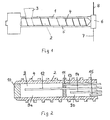
- FIGS. 1 and 2 Exemplary embodiments explained in more detail.
- the extruder has an extruder housing 1 in which a screw 2 is rotatably driven.
- the extruder is equipped with an additional heater, not shown provided, which is housed in the extruder housing.
- a funnel 3 is used for filling of the granules, semolina or pellets from the thermoplastic to be processed.
- the Material introduced into the hopper 3 is fed into the gap 5 by the screw flights 4 transported between the extruder housing 1 and the extruder screw 2 - in the Figure - to the right - where it is melted and homogenized.
- At the A crosshead 6 is provided at the outlet end of the extruder, with the help of which an electrical conductor 7 a plastic layer 8 is applied.
- FIG. 2 shows a section through the extruder screw 2.
- the Extruder screw 2 has a cavity or bore 9 at one end 10 is closed. Through a partition 11, the bore 9 is in two areas 9a and 9b separately.
- a conduit 12 is liquid-tight through the partition 11 passed and ends before the end 10 of the bore 9.
- a second conduit 13 is also passed liquid-tight through the partition 11.
- Temperature control medium - usually water - introduced into the area 9a, which there ensures a uniform temperature on the surface of the screw 2.
- the conduit 13 leads the temperature control medium back to the temperature control unit.
- the conduit 14 is also connected to a temperature control device, not shown connected and also guides a temperature control medium - usually water - into into area 9b.
- the conduit 15 leads the temperature control medium back to Temperature control unit.
- the surface of the extruder screw 2 is different due to the temperature control media tempered, namely the surface temperature in the area 9a is significantly higher than in area 9b.
- the mode of operation of the extruder or Snail be made clear.
- To produce the insulation of an electrical conductor is a mixture of 80 parts of LDPE with a density of about 0.92 g / ccm as granules and 20 parts of polyethylene copolymer, e.g. B. ethylene-butyl acrylate together as granules with 2 parts of dicumyl peroxide or tert. Butyl cumyl peroxide and 0.2 part stabilizer mixed and entered into the hopper 3 of the extruder. The mixture can before Introduce to a temperature of 40 - 60 ° C preheated.
- the surface temperature of the screw 2 in the region 9b is raised to a temperature of set at approx. 50 ° C.
- the melt introduced into the crosshead 6 at the end of the extruder has one Temperature of about 120 ° C.
- the electrical conductor 7 provided with the insulating layer 8 is then in a so-called CV tube introduced where at a temperature above the Decomposition temperature of the peroxide carried out the crosslinking of the insulating layer 8 becomes.
Landscapes
- Physics & Mathematics (AREA)
- Engineering & Computer Science (AREA)
- Mechanical Engineering (AREA)
- Thermal Sciences (AREA)
- Spectroscopy & Molecular Physics (AREA)
- Manufacturing & Machinery (AREA)
- Extrusion Moulding Of Plastics Or The Like (AREA)
- Processing And Handling Of Plastics And Other Materials For Molding In General (AREA)
- Processes Of Treating Macromolecular Substances (AREA)
- Glass Compositions (AREA)
Abstract
Description
Claims (11)
- Verfahren zur Extrusion eines Gemisches aus einem Granulat, Gries oder Pulver, etc. eines ersten Thermoplasten und eines zweiten Thermoplasten, wobei der Schmelzbereich des ersten Thermoplasten vom Schmelzbereich des zweiten Thermoplasten abweicht, mit einem Extruder, der ein beheizbares Gehäuse sowie eine Schnecke aufweist, welche eine Einzugszone, eine Schmelzzone, eine Austragszone sowie eine sich von der Einzugszone bis zur Austragszone erstreckende Bohrung aufweist, in welche ein Temperiermedium einleitbar ist, bei welchem das Temperiermedium eine Erwärmung der Schnecke in der Einzugszone auf eine Temperatur unterhalb des Schmelzbereiches des Thermoplasten mit dem niedrigeren Schmelzbereich sowie eine Temperierung der Schnecke in der Austragszone auf eine Temperatur bewirkt, welche zwischen dem Schmelzbereich des ersten und des zweiten Thermoplasten liegt.
- Verfahren nach Anspruch 1, dadurch gekennzeichnet, daß der erste Thermoplast ein Polyethylen Homopolymer und der zweite Thermoplast ein Copolymer des Ethylens ist.
- Verfahren nach Anspruch 1 oder 2, dadurch gekennzeichnet, daß die Schnecke in der Einzugszone auf eine Temperatur zwischen 20 und 60 °C erwärmt wird.
- Verfahren nach einem der Ansprüche 1 bis 3, dadurch gekennzeichnet, daß die Schnecke im Bereich der Austragszone auf einer Temperatur von 95 bis 110 °C gehalten wird.
- Verfahren nach einem der Ansprüche 1 bis 4, dadurch gekennzeichnet, daß eine Mischung aus 70 - 90 Gew.% Polyethylen Homopolymer und 30 - 10 Gew.% Copolymer des Ethylens im Extruder gemischt, geschmolzen und extrudiert wird.
- Verfahren nach einem der Ansprüche 1 bis 5, dadurch gekennzeichnet, daß ein Copolymer des Ethylens verwendet wird, dessen Comonomeranteil zwischen 8 und 35 % liegt.
- Verfahren nach einem der Ansprüche 1 bis 6, dadurch gekennzeichnet, daß als Copolymer des Ethylens ein Ethylen-Butyl-Acrylat (EBA), ein Ethylen-Ethyl-Acrylat (EEA) oder ein Ethylenmethyl-Acrylat (EMA) jeweils mit einem Acrylatmonomer Gehalt von 8 bis 35 Gew.% eingesetzt wird.
- Verfahren nach einem der Ansprüche 1 bis 7, dadurch gekennzeichnet, daß beide Thermoplaste in Granulatform in den Extruder eingegeben werden.
- Verfahren nach einem der Ansprüche 1 bis 8, dadurch gekennzeichnet, daß die Bohrung der Schnecke in zwei Kammern getrennt ist, wobei sich die erste Kammer von der Einzugszone bis zum ersten Drittel der Schmelzzone und die zweite Kammer sich bis in die Austragszone erstreckt.
- Verfahren nach einem der Ansprüche 1 bis 9, dadurch gekennzeichnet, daß das Temperiermedium für die erste Kammer in einem ersten Temperiergerät und das Temperiermedium für die zweite Kammer in einem zweiten Temperiergerät auf eine vorgebbare Temperatur temperiert werden.
- Verfahren nach einem der Ansprüche 1 bis 10, dadurch gekennzeichnet, daß die Polymermischung einen Peroxidanteil von 1 bis 3 Gew% enthält.
Applications Claiming Priority (2)
| Application Number | Priority Date | Filing Date | Title |
|---|---|---|---|
| DE10252976 | 2002-11-14 | ||
| DE10252976A DE10252976A1 (de) | 2002-11-14 | 2002-11-14 | Verfahren zur Extrusion eines Gemisches |
Publications (2)
| Publication Number | Publication Date |
|---|---|
| EP1419872A1 true EP1419872A1 (de) | 2004-05-19 |
| EP1419872B1 EP1419872B1 (de) | 2006-03-29 |
Family
ID=32115500
Family Applications (1)
| Application Number | Title | Priority Date | Filing Date |
|---|---|---|---|
| EP03292601A Expired - Lifetime EP1419872B1 (de) | 2002-11-14 | 2003-10-17 | Verfahren zur Extrusion eines Gemisches |
Country Status (5)
| Country | Link |
|---|---|
| US (1) | US7150842B2 (de) |
| EP (1) | EP1419872B1 (de) |
| AT (1) | ATE321644T1 (de) |
| CA (1) | CA2439327C (de) |
| DE (2) | DE10252976A1 (de) |
Families Citing this family (2)
| Publication number | Priority date | Publication date | Assignee | Title |
|---|---|---|---|---|
| CN111152451B (zh) * | 2018-11-07 | 2021-08-24 | 精工爱普生株式会社 | 塑化装置、三维造型装置以及注塑成型装置 |
| CN115625877B (zh) * | 2022-09-08 | 2025-09-26 | 安徽赤诚塑胶科技有限公司 | 一种抽粒机用螺旋挤出机 |
Citations (5)
| Publication number | Priority date | Publication date | Assignee | Title |
|---|---|---|---|---|
| GB1145800A (en) * | 1966-01-06 | 1969-03-19 | Dow Chemical Co | Improved extrusion apparatus |
| US3805888A (en) * | 1972-02-17 | 1974-04-23 | Dow Chemical Co | Rotary joint |
| DE2754877B1 (de) * | 1977-12-09 | 1979-02-22 | Felten & Guilleaume Carlswerk | Verfahren und Vorrichtung zum Herstellen eines extrudierten Gegenstandes,insbesondere einer isolierenden Huelle eines elektrischen Kabels |
| JPS61188125A (ja) * | 1985-02-18 | 1986-08-21 | Toshiba Mach Co Ltd | スクリユの温度制御方法 |
| US20020050389A1 (en) * | 2000-04-17 | 2002-05-02 | Franz Danekas | Process for the production of conducting wires coated with cross-linked polyethylene |
Family Cites Families (18)
| Publication number | Priority date | Publication date | Assignee | Title |
|---|---|---|---|---|
| US3331100A (en) * | 1966-01-06 | 1967-07-18 | Dow Chemical Co | Extrusion apparatus |
| GB1565403A (en) * | 1976-03-15 | 1980-04-23 | Alcan Res & Dev | Method of producing a coating on an electrical conductor cable |
| JPS5388883A (en) * | 1977-01-17 | 1978-08-04 | Polyplastics Kk | Supersonic welding method |
| CH612375A5 (de) * | 1977-03-29 | 1979-07-31 | Maillefer Sa | |
| US4355905A (en) * | 1980-03-24 | 1982-10-26 | The Dow Chemical Company | Adjustable plug seal mechanism for heat transfer zone separation in hollow screws for extrusion machines |
| US5256482A (en) * | 1982-06-23 | 1993-10-26 | Sumitomo Electric Industries | Cross-linked polyethylene insulated cables |
| CH649738A5 (fr) * | 1982-12-21 | 1985-06-14 | Maillefer Sa | Extrudeuse a vis pour matieres plastiques. |
| US4462691A (en) * | 1983-01-13 | 1984-07-31 | Uniroyal, Inc. | Mixer/extruder having selectively variable shearing action therein |
| US4528155A (en) * | 1983-07-12 | 1985-07-09 | Alcan Aluminum Corporation | Production of cross-linked polymeric extruded articles |
| GB2166079A (en) * | 1984-10-10 | 1986-04-30 | Bp Chem Int Ltd | Internally heated extruder screw for thermoplastic extrusion process |
| US5273356A (en) * | 1991-06-07 | 1993-12-28 | Farrel Corporation | Rotor zone cooling method and apparatus for rotors in continuous mixers of plastic materials |
| US5719218A (en) * | 1995-06-01 | 1998-02-17 | At Plastics Inc. | Water resistant electrical insulation compositions |
| JPH10109351A (ja) * | 1996-10-03 | 1998-04-28 | Mitsugi Hiruta | スクリュー押出機の温度制御機構 |
| EP0966746B1 (de) * | 1997-03-13 | 2004-12-01 | Pirelli & C. S.p.A. | Kabel mit einer feuerfesten , feuchtigkeitsbeständigen beschichtung |
| US6849217B1 (en) * | 1998-12-24 | 2005-02-01 | Pirelli Cavi E Sistemi S.P.A. | Process for producing self-extinguishing cables with low-level production of fumes, and flame-retardant compositions used therein |
| ES2238043T3 (es) * | 2000-02-21 | 2005-08-16 | Pirelli Energie Cables Et Systemes France | Cable de baja tension no halogeno ignifugo y estanco al agua. |
| US6797200B2 (en) * | 2000-03-30 | 2004-09-28 | Pirelli Cavi E Sistemi S.P.A. | Self-extinguishing cable and fire retardant composition used therein |
| EP1176161A1 (de) * | 2000-07-24 | 2002-01-30 | Nexans | Verfahren zur Herstellung von mit vernetztem Polyethylen überzogenen Leitungsdrähten |
-
2002
- 2002-11-14 DE DE10252976A patent/DE10252976A1/de not_active Withdrawn
-
2003
- 2003-09-02 CA CA002439327A patent/CA2439327C/en not_active Expired - Fee Related
- 2003-09-29 US US10/671,768 patent/US7150842B2/en not_active Expired - Fee Related
- 2003-10-17 EP EP03292601A patent/EP1419872B1/de not_active Expired - Lifetime
- 2003-10-17 AT AT03292601T patent/ATE321644T1/de not_active IP Right Cessation
- 2003-10-17 DE DE50302803T patent/DE50302803D1/de not_active Expired - Lifetime
Patent Citations (5)
| Publication number | Priority date | Publication date | Assignee | Title |
|---|---|---|---|---|
| GB1145800A (en) * | 1966-01-06 | 1969-03-19 | Dow Chemical Co | Improved extrusion apparatus |
| US3805888A (en) * | 1972-02-17 | 1974-04-23 | Dow Chemical Co | Rotary joint |
| DE2754877B1 (de) * | 1977-12-09 | 1979-02-22 | Felten & Guilleaume Carlswerk | Verfahren und Vorrichtung zum Herstellen eines extrudierten Gegenstandes,insbesondere einer isolierenden Huelle eines elektrischen Kabels |
| JPS61188125A (ja) * | 1985-02-18 | 1986-08-21 | Toshiba Mach Co Ltd | スクリユの温度制御方法 |
| US20020050389A1 (en) * | 2000-04-17 | 2002-05-02 | Franz Danekas | Process for the production of conducting wires coated with cross-linked polyethylene |
Non-Patent Citations (1)
| Title |
|---|
| PATENT ABSTRACTS OF JAPAN vol. 011, no. 010 (M - 552) 10 January 1987 (1987-01-10) * |
Also Published As
| Publication number | Publication date |
|---|---|
| ATE321644T1 (de) | 2006-04-15 |
| EP1419872B1 (de) | 2006-03-29 |
| CA2439327A1 (en) | 2004-05-14 |
| DE50302803D1 (de) | 2006-05-18 |
| US20040094854A1 (en) | 2004-05-20 |
| CA2439327C (en) | 2006-12-19 |
| US7150842B2 (en) | 2006-12-19 |
| DE10252976A1 (de) | 2004-05-27 |
Similar Documents
| Publication | Publication Date | Title |
|---|---|---|
| EP1558437B1 (de) | Extrudieren von peroxidischen vernetzbaren formteilen aus kunststoff | |
| DE69216133T2 (de) | Dünnwandiges Rohr aus ultrahochmolekularem Polyethylen, Verfahren und Vorrichtung zu seiner Herstellung | |
| EP0995567B1 (de) | Verfahren zur Herstellung von gefüllten, modifizierten und mit Fasern verstärkten Thermoplasten und Doppel-Schnecken-Extruder zur Durchführung des Verfahrens | |
| DE2642927A1 (de) | Verfahren zur herstellung von stranggepressten produkten | |
| DE2401383C2 (de) | Schneckenextruder | |
| DE3586876T2 (de) | Flexibler schlauch aus thermoplastischem harz mit zaehem fliessverhalten. | |
| EP3592527A1 (de) | Entgasen beim extrudieren von stoffen, vorzugsweise von kunststoffen | |
| DE2622591A1 (de) | Vorrichtung und verfahren zum herstellen einer thermoplastischen masse | |
| WO1996006720A1 (en) | Filler reinforced thermoplastic composites having biaxially oriented components | |
| DE202019103239U1 (de) | Extruder zur Herstellung von extrudierten Kunststoffprodukten | |
| DE10356423B4 (de) | Extruder mit Materialeintrag durch das Gehäuse | |
| DE69400866T2 (de) | Extrudieren von thermisch vernetzbaren Materialien | |
| DE69202884T2 (de) | Verfahren und Vorrichtung zum Herstellen von Rohren aus thermoplastischen, mit Fasern steuerbarer Ausrichtung verstärkten Werkstoffen. | |
| WO2019115002A1 (de) | Extrudieren von stoffen, vorzugsweise von kunststoffen | |
| DE4230793C2 (de) | Verfahren und Anlage zur Herstellung von Schreibstiften | |
| DE69612938T2 (de) | Verfahren zur Herstellung von mit Silan modifizierten Polyolefinen und Extruder dafür | |
| EP1419872B1 (de) | Verfahren zur Extrusion eines Gemisches | |
| EP0031868A2 (de) | Verfahren zur Herstellung von Schrumpfartikeln, Vorrichtung zur Durchführung des Verfahrens und so erhaltene Artikel | |
| DE2911124A1 (de) | Drehkupplung fuer eine extruderform | |
| EP2384879A1 (de) | Verfahren und Vorrichtung zum Umformen von Metallen und Kunststoffen, sowie rohr- oder schlauchförmiges Produkt | |
| DE4111739A1 (de) | Verfahren und vorrichtung zur kontinuierlichen herstellung von schmelzklebstoffen | |
| DE2529260C2 (de) | ||
| DE1915892A1 (de) | Verfahren und Vorrichtung zum Umhuellen strangfoermigen Gutes mit vernetzten thermoplastischen Kunststoffen | |
| DE1729196A1 (de) | Verfahren und Vorrichtung zum Herstellen von mit einem Fuellmaterial versehenen Stangen oder Rohren | |
| DE2433702A1 (de) | Entlueftungsextruder und verfahren zum entfernen von fluechtigem material, das mit viscosen fluessigkeiten in beruehrung steht |
Legal Events
| Date | Code | Title | Description |
|---|---|---|---|
| PUAI | Public reference made under article 153(3) epc to a published international application that has entered the european phase |
Free format text: ORIGINAL CODE: 0009012 |
|
| 17P | Request for examination filed |
Effective date: 20040322 |
|
| AK | Designated contracting states |
Kind code of ref document: A1 Designated state(s): AT BE BG CH CY CZ DE DK EE ES FI FR GB GR HU IE IT LI LU MC NL PT RO SE SI SK TR |
|
| AX | Request for extension of the european patent |
Extension state: AL LT LV MK |
|
| 17Q | First examination report despatched |
Effective date: 20040618 |
|
| AKX | Designation fees paid |
Designated state(s): AT BE BG CH CY CZ DE DK EE ES FI FR GB GR HU IE IT LI LU MC NL PT RO SE SI SK TR |
|
| GRAP | Despatch of communication of intention to grant a patent |
Free format text: ORIGINAL CODE: EPIDOSNIGR1 |
|
| GRAS | Grant fee paid |
Free format text: ORIGINAL CODE: EPIDOSNIGR3 |
|
| GRAA | (expected) grant |
Free format text: ORIGINAL CODE: 0009210 |
|
| AK | Designated contracting states |
Kind code of ref document: B1 Designated state(s): AT BE BG CH CY CZ DE DK EE ES FI FR GB GR HU IE IT LI LU MC NL PT RO SE SI SK TR |
|
| PG25 | Lapsed in a contracting state [announced via postgrant information from national office to epo] |
Ref country code: SI Free format text: LAPSE BECAUSE OF FAILURE TO SUBMIT A TRANSLATION OF THE DESCRIPTION OR TO PAY THE FEE WITHIN THE PRESCRIBED TIME-LIMIT Effective date: 20060329 Ref country code: IT Free format text: LAPSE BECAUSE OF FAILURE TO SUBMIT A TRANSLATION OF THE DESCRIPTION OR TO PAY THE FEE WITHIN THE PRESCRIBED TIME-LIMIT;WARNING: LAPSES OF ITALIAN PATENTS WITH EFFECTIVE DATE BEFORE 2007 MAY HAVE OCCURRED AT ANY TIME BEFORE 2007. THE CORRECT EFFECTIVE DATE MAY BE DIFFERENT FROM THE ONE RECORDED. Effective date: 20060329 Ref country code: IE Free format text: LAPSE BECAUSE OF FAILURE TO SUBMIT A TRANSLATION OF THE DESCRIPTION OR TO PAY THE FEE WITHIN THE PRESCRIBED TIME-LIMIT Effective date: 20060329 Ref country code: SK Free format text: LAPSE BECAUSE OF FAILURE TO SUBMIT A TRANSLATION OF THE DESCRIPTION OR TO PAY THE FEE WITHIN THE PRESCRIBED TIME-LIMIT Effective date: 20060329 Ref country code: RO Free format text: LAPSE BECAUSE OF FAILURE TO SUBMIT A TRANSLATION OF THE DESCRIPTION OR TO PAY THE FEE WITHIN THE PRESCRIBED TIME-LIMIT Effective date: 20060329 Ref country code: NL Free format text: LAPSE BECAUSE OF FAILURE TO SUBMIT A TRANSLATION OF THE DESCRIPTION OR TO PAY THE FEE WITHIN THE PRESCRIBED TIME-LIMIT Effective date: 20060329 Ref country code: GB Free format text: LAPSE BECAUSE OF FAILURE TO SUBMIT A TRANSLATION OF THE DESCRIPTION OR TO PAY THE FEE WITHIN THE PRESCRIBED TIME-LIMIT Effective date: 20060329 |
|
| REG | Reference to a national code |
Ref country code: GB Ref legal event code: FG4D Free format text: NOT ENGLISH |
|
| REG | Reference to a national code |
Ref country code: CH Ref legal event code: EP |
|
| REG | Reference to a national code |
Ref country code: IE Ref legal event code: FG4D Free format text: LANGUAGE OF EP DOCUMENT: GERMAN |
|
| REF | Corresponds to: |
Ref document number: 50302803 Country of ref document: DE Date of ref document: 20060518 Kind code of ref document: P |
|
| PG25 | Lapsed in a contracting state [announced via postgrant information from national office to epo] |
Ref country code: BG Free format text: LAPSE BECAUSE OF FAILURE TO SUBMIT A TRANSLATION OF THE DESCRIPTION OR TO PAY THE FEE WITHIN THE PRESCRIBED TIME-LIMIT Effective date: 20060629 Ref country code: SE Free format text: LAPSE BECAUSE OF FAILURE TO SUBMIT A TRANSLATION OF THE DESCRIPTION OR TO PAY THE FEE WITHIN THE PRESCRIBED TIME-LIMIT Effective date: 20060629 Ref country code: DK Free format text: LAPSE BECAUSE OF FAILURE TO SUBMIT A TRANSLATION OF THE DESCRIPTION OR TO PAY THE FEE WITHIN THE PRESCRIBED TIME-LIMIT Effective date: 20060629 |
|
| PG25 | Lapsed in a contracting state [announced via postgrant information from national office to epo] |
Ref country code: ES Free format text: LAPSE BECAUSE OF FAILURE TO SUBMIT A TRANSLATION OF THE DESCRIPTION OR TO PAY THE FEE WITHIN THE PRESCRIBED TIME-LIMIT Effective date: 20060710 |
|
| PG25 | Lapsed in a contracting state [announced via postgrant information from national office to epo] |
Ref country code: PT Free format text: LAPSE BECAUSE OF FAILURE TO SUBMIT A TRANSLATION OF THE DESCRIPTION OR TO PAY THE FEE WITHIN THE PRESCRIBED TIME-LIMIT Effective date: 20060829 |
|
| NLV1 | Nl: lapsed or annulled due to failure to fulfill the requirements of art. 29p and 29m of the patents act | ||
| GBV | Gb: ep patent (uk) treated as always having been void in accordance with gb section 77(7)/1977 [no translation filed] |
Effective date: 20060329 |
|
| PG25 | Lapsed in a contracting state [announced via postgrant information from national office to epo] |
Ref country code: MC Free format text: LAPSE BECAUSE OF NON-PAYMENT OF DUE FEES Effective date: 20061031 |
|
| REG | Reference to a national code |
Ref country code: IE Ref legal event code: FD4D |
|
| PLBE | No opposition filed within time limit |
Free format text: ORIGINAL CODE: 0009261 |
|
| STAA | Information on the status of an ep patent application or granted ep patent |
Free format text: STATUS: NO OPPOSITION FILED WITHIN TIME LIMIT |
|
| 26N | No opposition filed |
Effective date: 20070102 |
|
| EN | Fr: translation not filed | ||
| PG25 | Lapsed in a contracting state [announced via postgrant information from national office to epo] |
Ref country code: AT Free format text: LAPSE BECAUSE OF NON-PAYMENT OF DUE FEES Effective date: 20061017 |
|
| PG25 | Lapsed in a contracting state [announced via postgrant information from national office to epo] |
Ref country code: FR Free format text: LAPSE BECAUSE OF FAILURE TO SUBMIT A TRANSLATION OF THE DESCRIPTION OR TO PAY THE FEE WITHIN THE PRESCRIBED TIME-LIMIT Effective date: 20070309 Ref country code: CZ Free format text: LAPSE BECAUSE OF FAILURE TO SUBMIT A TRANSLATION OF THE DESCRIPTION OR TO PAY THE FEE WITHIN THE PRESCRIBED TIME-LIMIT Effective date: 20060329 Ref country code: GR Free format text: LAPSE BECAUSE OF FAILURE TO SUBMIT A TRANSLATION OF THE DESCRIPTION OR TO PAY THE FEE WITHIN THE PRESCRIBED TIME-LIMIT Effective date: 20060630 |
|
| PG25 | Lapsed in a contracting state [announced via postgrant information from national office to epo] |
Ref country code: FI Free format text: LAPSE BECAUSE OF FAILURE TO SUBMIT A TRANSLATION OF THE DESCRIPTION OR TO PAY THE FEE WITHIN THE PRESCRIBED TIME-LIMIT Effective date: 20060329 Ref country code: EE Free format text: LAPSE BECAUSE OF FAILURE TO SUBMIT A TRANSLATION OF THE DESCRIPTION OR TO PAY THE FEE WITHIN THE PRESCRIBED TIME-LIMIT Effective date: 20060329 |
|
| PG25 | Lapsed in a contracting state [announced via postgrant information from national office to epo] |
Ref country code: HU Free format text: LAPSE BECAUSE OF FAILURE TO SUBMIT A TRANSLATION OF THE DESCRIPTION OR TO PAY THE FEE WITHIN THE PRESCRIBED TIME-LIMIT Effective date: 20060930 Ref country code: LU Free format text: LAPSE BECAUSE OF NON-PAYMENT OF DUE FEES Effective date: 20061017 Ref country code: TR Free format text: LAPSE BECAUSE OF FAILURE TO SUBMIT A TRANSLATION OF THE DESCRIPTION OR TO PAY THE FEE WITHIN THE PRESCRIBED TIME-LIMIT Effective date: 20060329 |
|
| PG25 | Lapsed in a contracting state [announced via postgrant information from national office to epo] |
Ref country code: CY Free format text: LAPSE BECAUSE OF FAILURE TO SUBMIT A TRANSLATION OF THE DESCRIPTION OR TO PAY THE FEE WITHIN THE PRESCRIBED TIME-LIMIT Effective date: 20060329 Ref country code: FR Free format text: LAPSE BECAUSE OF FAILURE TO SUBMIT A TRANSLATION OF THE DESCRIPTION OR TO PAY THE FEE WITHIN THE PRESCRIBED TIME-LIMIT Effective date: 20060329 |
|
| PGFP | Annual fee paid to national office [announced via postgrant information from national office to epo] |
Ref country code: DE Payment date: 20101022 Year of fee payment: 8 |
|
| PGFP | Annual fee paid to national office [announced via postgrant information from national office to epo] |
Ref country code: IT Payment date: 20101025 Year of fee payment: 8 |
|
| PGFP | Annual fee paid to national office [announced via postgrant information from national office to epo] |
Ref country code: CH Payment date: 20111024 Year of fee payment: 9 Ref country code: BE Payment date: 20111013 Year of fee payment: 9 |
|
| BERE | Be: lapsed |
Owner name: *NEXANS Effective date: 20121031 |
|
| REG | Reference to a national code |
Ref country code: CH Ref legal event code: PL |
|
| PG25 | Lapsed in a contracting state [announced via postgrant information from national office to epo] |
Ref country code: LI Free format text: LAPSE BECAUSE OF NON-PAYMENT OF DUE FEES Effective date: 20121031 Ref country code: CH Free format text: LAPSE BECAUSE OF NON-PAYMENT OF DUE FEES Effective date: 20121031 Ref country code: BE Free format text: LAPSE BECAUSE OF NON-PAYMENT OF DUE FEES Effective date: 20121031 Ref country code: DE Free format text: LAPSE BECAUSE OF NON-PAYMENT OF DUE FEES Effective date: 20130501 |
|
| REG | Reference to a national code |
Ref country code: DE Ref legal event code: R119 Ref document number: 50302803 Country of ref document: DE Effective date: 20130501 |
|
| PG25 | Lapsed in a contracting state [announced via postgrant information from national office to epo] |
Ref country code: IT Free format text: LAPSE BECAUSE OF NON-PAYMENT OF DUE FEES Effective date: 20121017 |