EP1411368A1 - Ultraschalldiagnostisches Gerät und Verfahren - Google Patents
Ultraschalldiagnostisches Gerät und Verfahren Download PDFInfo
- Publication number
- EP1411368A1 EP1411368A1 EP20030023279 EP03023279A EP1411368A1 EP 1411368 A1 EP1411368 A1 EP 1411368A1 EP 20030023279 EP20030023279 EP 20030023279 EP 03023279 A EP03023279 A EP 03023279A EP 1411368 A1 EP1411368 A1 EP 1411368A1
- Authority
- EP
- European Patent Office
- Prior art keywords
- signal
- frequency component
- power
- ultrasound
- electric signal
- Prior art date
- Legal status (The legal status is an assumption and is not a legal conclusion. Google has not performed a legal analysis and makes no representation as to the accuracy of the status listed.)
- Withdrawn
Links
Images



Classifications
-
- G—PHYSICS
- G01—MEASURING; TESTING
- G01S—RADIO DIRECTION-FINDING; RADIO NAVIGATION; DETERMINING DISTANCE OR VELOCITY BY USE OF RADIO WAVES; LOCATING OR PRESENCE-DETECTING BY USE OF THE REFLECTION OR RERADIATION OF RADIO WAVES; ANALOGOUS ARRANGEMENTS USING OTHER WAVES
- G01S7/00—Details of systems according to groups G01S13/00, G01S15/00, G01S17/00
- G01S7/52—Details of systems according to groups G01S13/00, G01S15/00, G01S17/00 of systems according to group G01S15/00
- G01S7/52017—Details of systems according to groups G01S13/00, G01S15/00, G01S17/00 of systems according to group G01S15/00 particularly adapted to short-range imaging
- G01S7/52023—Details of receivers
- G01S7/52036—Details of receivers using analysis of echo signal for target characterisation
- G01S7/52038—Details of receivers using analysis of echo signal for target characterisation involving non-linear properties of the propagation medium or of the reflective target
-
- G—PHYSICS
- G01—MEASURING; TESTING
- G01S—RADIO DIRECTION-FINDING; RADIO NAVIGATION; DETERMINING DISTANCE OR VELOCITY BY USE OF RADIO WAVES; LOCATING OR PRESENCE-DETECTING BY USE OF THE REFLECTION OR RERADIATION OF RADIO WAVES; ANALOGOUS ARRANGEMENTS USING OTHER WAVES
- G01S7/00—Details of systems according to groups G01S13/00, G01S15/00, G01S17/00
- G01S7/52—Details of systems according to groups G01S13/00, G01S15/00, G01S17/00 of systems according to group G01S15/00
- G01S7/52017—Details of systems according to groups G01S13/00, G01S15/00, G01S17/00 of systems according to group G01S15/00 particularly adapted to short-range imaging
- G01S7/52077—Details of systems according to groups G01S13/00, G01S15/00, G01S17/00 of systems according to group G01S15/00 particularly adapted to short-range imaging with means for elimination of unwanted signals, e.g. noise or interference
-
- G—PHYSICS
- G01—MEASURING; TESTING
- G01N—INVESTIGATING OR ANALYSING MATERIALS BY DETERMINING THEIR CHEMICAL OR PHYSICAL PROPERTIES
- G01N2291/00—Indexing codes associated with group G01N29/00
- G01N2291/02—Indexing codes associated with the analysed material
- G01N2291/024—Mixtures
- G01N2291/02491—Materials with nonlinear acoustic properties
-
- G—PHYSICS
- G01—MEASURING; TESTING
- G01S—RADIO DIRECTION-FINDING; RADIO NAVIGATION; DETERMINING DISTANCE OR VELOCITY BY USE OF RADIO WAVES; LOCATING OR PRESENCE-DETECTING BY USE OF THE REFLECTION OR RERADIATION OF RADIO WAVES; ANALOGOUS ARRANGEMENTS USING OTHER WAVES
- G01S7/00—Details of systems according to groups G01S13/00, G01S15/00, G01S17/00
- G01S7/52—Details of systems according to groups G01S13/00, G01S15/00, G01S17/00 of systems according to group G01S15/00
- G01S7/52017—Details of systems according to groups G01S13/00, G01S15/00, G01S17/00 of systems according to group G01S15/00 particularly adapted to short-range imaging
- G01S7/52046—Techniques for image enhancement involving transmitter or receiver
- G01S7/52047—Techniques for image enhancement involving transmitter or receiver for elimination of side lobes or of grating lobes; for increasing resolving power
Definitions
- the present invention relates to an ultrasonic diagnostic apparatus, and especially relates to technology for reducing an artifact (a virtual image) contained in an ultrasound image.
- the ultrasonic diagnostic apparatus which enables to observe an object to be tested in a noninvasive and real time manner, has been an irreplaceable existence in a medical field.
- the ultrasonic diagnostic apparatus is an apparatus that sends an ultrasonic pulse generated by a probe (a search unit) to the object, and visualizes condition in the object into an image according to an ultrasonic echo reflected.
- a probe a search unit
- the ultrasonic diagnostic apparatus sends an ultrasonic pulse generated by a probe (a search unit) to the object, and visualizes condition in the object into an image according to an ultrasonic echo reflected.
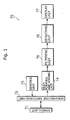
- Fig. 1 is a block diagram that shows a functional configuration of the conventional ultrasonic diagnostic apparatus 70.
- the conventional ultrasonic diagnostic apparatus 70 is composed of a search unit 71, a send/receive switching unit 72, a sending unit 73, a beam forming and adding unit 74, a filtering unit 75, a detecting unit 76 and a display unit 77.
- the search unit 71 is an apparatus that sends an ultrasonic pulse to an object to be examined, and receives an ultrasonic (hereinafter referred to as an "ultrasonic echo") reflected from the object.
- an ultrasonic hereinafter referred to as an "ultrasonic echo”
- the search unit 71 receives a pulse signal (hereinafter referred to as a "transmission pulse signal”) to generate the ultrasonic pulse from the sending unit 73, and generates the ultrasonic pulse based on this.
- the search unit 71 when the search unit 71 receives the ultrasonic echo, the search unit 71 converts the ultrasonic echo reflected from the object into an electric signal (hereinafter referred to as a "received echo signal"), and outputs it to the send/receive switching unit 72.
- a received echo signal an electric signal
- the send/receive switching unit 72 connects the search unit 71 with the spending unit 73.
- the send/receive switching unit 72 switches the search unit 71 to connect with the sending unit 73.
- the sending unit 73 generates the transmission pulse signal, and outputs it to the send/receive switching unit 72.
- the beam forming and adding unit 74 executes focusing and all necessary beam formation and addition to the received echo signal that is received from the search unit 71 via the send/receive switching unit 72, and outputs it to the filtering unit 75.
- the filtering unit 75 executes a filtering process to the received echo signal output from the beam forming and adding unit 74.
- the detecting unit 76 executes envelope detection to the received echo signal, which has been processed through the filtering process and output from the filtering process 75, and outputs the received echo signal after the detection process (hereinafter referred to as a "received detection signal") to the display unit 77.
- the display unit 77 generates an ultrasonic image based on the received detection signal output from the detecting unit 76.
- the transmission pulse signal is generated in the sending unit 73.
- the ultrasonic pulse generated based on this transmission pulse signal is sent to the object from the search unit 71.
- the ultrasonic pulse sent to the object is reflected at a sound impedance boundary within the object, and comes back to the search unit 71 with time delay caused according to a reflection depth after the transmission has been started.
- the search unit 71 converts the received ultrasonic echo into the received electric echo signal, and outputs it to the beam forming and adding unit 74.
- the beam form and adding unit 74 corrects the difference in the receiving time when each of the oscillators composing the search unit 71 receives the ultrasonic echo, and executes focusing on the received echo signal.
- a filtering process by a band path filter is executed for efficiently extracting the received echo signal in the harmonics frequency, which is a central frequency or twice of the central frequency in the filtering unit 75.
- the received echo signal that has been through the filtering unit 75 is multiplexed by using a Hilbert conversion filter in detecting unit 76. Then, after that, by applying the envelope detection to it, it is converted into the received detection signal which shows luminance for generating an ultrasonic image, and the like.
- the display unit 77 generates the ultrasonic image based on the received detection signal, and displays it on a display apparatus, or the like.
- an ultrasonic pulse having desired directivity for example, a feature to have a stronger acoustic pressure in a front direction
- desired directivity for example, a feature to have a stronger acoustic pressure in a front direction
- the ultrasonic pulse actually sent contains a plural number of side lobes sent in an undesired direction (for example, 45 degrees in both right and left directions) in addition to the main lobe sent in a desired direction (in the front direction).
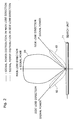
- Fig. 2 is a diagram that shows overview of a plural number of side lobes 82 and 83, which are generated at both sides of a main lobe 81 and sent in undesired directions (i.e. in right and left oblique directions. Hereinafter it is referred to as a "side lobe direction"). Because of these side lobes, the side lobe of the ultrasonic pulse is sent to an object located in the side lobe direction.
- the ultrasonic diagnostic apparatus 70 When the ultrasonic diagnostic apparatus 70 receives the ultrasonic echo, it receives the ultrasonic echo reflected from the object located in the side lobe direction at the same time it also receives the main lobe of the ultrasonic pulse reflected from the object that can reflect the ultrasound to be displayed as the ultrasound image. As a result of it, the ultrasonic echo reflected from the object located in the side lobe direction generated an artifact (a virtual image), and causes a problem to induce misdiagnosis through the ultrasound image containing the artifact (Please see the above reference book).
- an artifact a virtual image
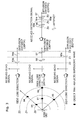
- Fig. 3 is a pattern diagram to show a process that the artifact (a virtual image) generated by the above side lobes 82 and 83 are displayed as the ultrasound image.
- the artifact a virtual image
- this ultrasonic pulse contains the side lobe.
- objects 93 ⁇ 95 located in both right and left side lobe directions, which are not desired to be displayed as the ultrasound image and from which the ultrasound may be reflected, these objects reflect the side lobe so that the received echo signals 93a ⁇ 95a are generated.
- the signals 93a ⁇ 95a through the above side lobe remain even in the received detection signal, and these appear as the artifact.
- the present invention aims at providing an ultrasonic diagnostic apparatus and an ultrasonic diagnostic method for preventing any wrong diagnosis due to an artifact (a virtual image) caused by a side lobe.
- the ultrasonic diagnostic apparatus may be an ultrasonic diagnostic apparatus that generates and displays an ultrasonic image of an object to be examined based on reflection of ultrasound having a main lobe and a side lobe, comprising: an ultrasonic sending/receiving unit operable to generate the ultrasound, receive the ultrasound reflected from the object, and convert the ultrasound into an electric signal; a first calculating unit operable to extract a fundamental wave frequency component from the converted electric signal and calculate power of the signal; a second calculating unit operable to extract a harmonics frequency component from the converted electric signal and calculate power of the signal; a power ratio calculating unit operable to calculate a ratio of the calculated power of the signal of the fundamental frequency component to the calculated power of the signal of the harmonics frequency component; an output controlling unit operable to control and output the electric signal of the fundamental wave frequency component based on a value of the calculated ratio; and an image display unit operable to generate and display an ultrasonic image based on the output electric signal.
- the ultrasonic diagnostic apparatus related to the present invention is an ultrasonic diagnostic apparatus that generates and displays a ultrasonic image of an object to be examined based on reflection of ultrasound having a main lobe and a side lobe, comprising: an ultrasound sending/receiving unit operable to generate the ultrasound, receive the ultrasound reflected from the object, and convert the ultrasound into an electric signal; a first calculating unit operable to extract a fundamental wave frequency component from the converted electric signal and calculate power of the signal; a second calculating unit operable to extract a harmonics frequency component from the converted electric signal and calculate power of the signal; a power ratio calculating unit operable to calculate a ratio of the calculated power of the signal of the fundamental frequency component to the calculated power of the signal of the harmonics frequency component; an output controlling unit operable to control and output the electric signal of the harmonics frequency component based on a value of the calculated ratio; and an image display unit operable to generate and display an ultrasonic image based on the output electric signal.
- the present invention may be embodied as a method having characteristic and structural means of the above ultrasonic diagnostic apparatus as steps, and may also be embodied as a program containing all of these steps. Then, the program is not only be stored in a ROM and the like that are contained in the ultrasonic diagnostic apparatus, but it may also be distributed through a recording media such as a CD-ROM or a transmission media such as a communication network.
- the ultrasonic diagnostic apparatus decides whether the received detection signal is a signal to generate the artifact or not, by using a difference between the transmission power in the main lobe direction and the transmission power in the side lobe direction within the ultrasonic pulse sent from the search unit and a difference in degree of the nonlinear diffusion distortion phenomenon contained in the object to be examined. Based on this result, the output level of the received detection signal is suppressed, and the above artifact is reduced, of which practical value is high.
- the main lobe direction has a wide spread in a transmission direction, even lateral resolving power can be improved by appropriately setting the power ratio threshold value used in the present invention.
- Fig. 4 is an outlook view of the ultrasonic diagnostic apparatus 10 according to the present embodiment.
- An apparatus 10 is an ultrasonic diagnostic apparatus, which does not just generate an ultrasonic image, but also reduces an artifact (a virtual image) generated by a side lobe and is capable of providing more accurate diagnosis.
- the ultrasonic diagnostic apparatus 10 is mainly composed of a display unit 10a, a main unit 10b and a probe 10c.
- the display unit 10a is a display apparatus equipped with a liquid crystal display (LCD), a cathode-ray tube (CRT), or the like, which displays an ultrasound image and all necessary information obtained through an ultrasonic echo method and the like, and includes a touch panel and the like that accept an input from an operator.
- LCD liquid crystal display
- CRT cathode-ray tube
- the main unit 10b includes the following elements: a send/receive circuit that controls transmission/reception of an ultrasound in the probe 10c; a signal/image processing circuit containing a digital signal processor (DSP) and a random access memory (RAM) and the like for processing various types of images and signals; an LCD display containing a group of switches and a mouse and a touch panel for receiving the operator's operation; and so on.
- a send/receive circuit that controls transmission/reception of an ultrasound in the probe 10c
- a signal/image processing circuit containing a digital signal processor (DSP) and a random access memory (RAM) and the like for processing various types of images and signals
- DSP digital signal processor
- RAM random access memory
- the probe 10c is a search unit containing an ultrasonic oscillator, an acoustic lens and the like for receiving and sending the ultrasound.
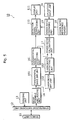
- Fig. 5 is a block diagram that shows a functional configuration of the ultrasonic diagnostic apparatus 10 according to the present embodiment.
- this apparatus 10 includes the following elements: a search unit 11; a send/receive switching unit 12; a sending unit 13; a beam forming and adding unit 14; a fundamental wave BPF (band path filtering) unit 151; a harmonics BPF unit 152; a harmonics detecting unit 162; a power ratio calculating unit 17; a power ratio reference memory 18; a power ratio comparing unit 19; an operation input unit 20; a detection signal suppressing unit 110; and a display unit 111.
- a search unit 11 includes the following elements: a search unit 11; a send/receive switching unit 12; a sending unit 13; a beam forming and adding unit 14; a fundamental wave BPF (band path filtering) unit 151; a harmonics BPF unit 152; a harmonics detecting unit 162; a power ratio calculating unit 17; a power ratio reference memory 18
- the search unit 11 is a unit that generates the ultrasonic pulse and receives the ultrasonic echo reflected from the object (equivalent to the probe 10c in the above Fig. 4). When the ultrasonic pulse is sent, this search unit 11 generates the ultrasonic pulse based on the transmission pulse signal received from the sending unit 13. On the other hand, when the ultrasonic echo is received, the search unit 11 converts the ultrasonic echo reflected from the object into a received echo signal, and outputs this received echo signal to the send/receive switching unit 12.
- the send/receive switching unit 12 When the ultrasonic pulse is sent, the send/receive switching unit 12 connects the search unit 11 with the sending unit 13. When the ultrasonic pulse is received, the send/receive switching unit 12 switches the search unit 11 to connect with the beam forming and adding unit 14.
- the sending unit 13 When the ultrasonic pulse is sent, the sending unit 13 generates a transmission pulse signal, and outputs it to the send/receive switching unit 12.
- the beam forming and adding unit 14 executes focusing for the received echo signal that is received from the search unit 11 via the send/receive switching unit 12, and applies the necessary beam formation and addition.
- the fundamental wave BPF unit 151 executes a filtering process to the received echo signal output from the beam forming and adding unit 14 for extracting a signal component of central frequency corresponding to the fundamental wave of the ultrasonic pulse.
- the harmonics BPF unit 152 executes a filtering process to the received echo signal output from the beam forming and adding unit 14 for extracting a signal component of harmonics frequency composing non-linear distortion occurred when the fundamental wave of the ultrasonic pulse diffuses in the object.
- the fundamental wave detecting unit 161 executes detection to the signal component of the central frequency of the received echo signal output from the fundamental wave BPF unit 151.
- the harmonics detecting unit 162 executes detection to the signal component of the harmonics frequency of the received echo signal output from the harmonics BPF unit 152.
- the power ratio calculating unit 17 calculates a power ratio in the received detection signal respectively output from the fundamental wave detecting unit 161 and the harmonics detecting unit 162 (for example, a maximum amplitude value of the received detection signal of the harmonics/a maximum amplitude value of the received detection signal of the fundamental wave).
- the power ratio reference memory 18 stores a "power ratio threshold value" set per diffusion distance (or may be called as a "depth") in the object.
- the power ratio threshold value is a standard value used for deciding whether the received detection signal is based on the main lobe or based on the side lobe. When the power ratio is less than this value, the received detection signal is decided to be the received detection signal based on the side lobe.
- the diffusion distance and the power ratio threshold value are corresponded and memorized. For example, when the spread distance (depth) is "5cm”, the power ratio threshold value is "0.3”. When the spread distance (depth) is "10cm”, the power ratio threshold value is "0.35". This power ratio threshold value may be changed by a user via the operation input unit 20.
- the power ratio comparing unit 19 compares a "power ratio”, which is an output of the power ratio calculating unit 17, with its corresponding "power ratio threshold value” by each diffusion distance (depth), which is stored in the power ratio reference memory 18.
- the power ratio comparing unit 19 notifies its result (i.e. "it is an artifact", “it is not an artifact” and the like.) to the detection signal suppressing unit 110.
- the power ratio is "0.1" in the case of the diffusion distance (depth) is "5 cm”
- its corresponding power ratio threshold value is "0.3”
- the power ratio comparing unit 19 decides it is an artifact based on the side lobe.
- the detection signal suppressing unit 110 controls the output of the fundamental wave detecting unit 161 based on the notice received from the power ratio comparing unit 19. For example, when the detection signal suppressing unit 110 receives a notice that "it is a side lobe" from the power ratio comparing unit 19, it controls the received detection signal of the fundamental wave. For example, the detection signal suppressing unit 110 reduces it to 20 percent when outputting it, or does not output it at all.
- the display unit 111 generates an ultrasonic image based on the echo signal, which is an output of the detection signal suppressing unit 110, and displays it.
- the sending unit 13 At first, for sending the ultrasonic pulse to the object, the sending unit 13 generates a transmission pulse signal, and sends it to the search unit 11. In addition, the search unit 11 generates an ultrasonic pulse based on this transmission pulse signal, and sends it to the object.
- the ultrasonic pulse that is sent from the search unit 11 contains a main lobe and a side lobe. Due to this, the ultrasonic pulse (side lobe) is also sent to an object located in the side lobe direction. Therefore, when the ultrasonic diagnostic apparatus 10 receives the ultrasonic echo, it does not receive only the ultrasonic echo reflected from an object desired to be displayed as a diagnostic image located in the main lobe direction, but also it receives the ultrasonic echo reflected from the object located in the side lobe direction. As a result of it, the ultrasonic pulse from the side lobe direction is displayed as an artifact (a virtual image).
- the first point is a difference between the transmission power in the main lobe direction and the transmission power in the side lobe direction within the transmitted ultrasonic pulse. That is to say, as clarified from the above Fig. 2, the transmission power in the main lobe direction is bigger than the transmission power in the side lobe direction.
- the second point is a phenomenon of nonlinear diffusion distortion occurred when the ultrasonic pulse goes through the object. This phenomenon is a phenomenon that a wave form of the ultrasonic pulse is gradually distorted as the transmitted ultrasonic pulse diffuses in the object. According to diffusion distance (depth), the ultrasonic pulse has more harmonics frequency components in the transmitted frequency (the fundamental frequency), which is N times (twice, three times, or the like) as much as the one in a regular transmitted frequency (the fundamental wave frequency).
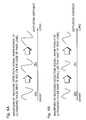
- Fig. 6 is a pattern diagram showing the phenomenon of nonlinear diffusion distortion occurred when the ultrasonic pulse diffuses in the object.
- Fig. 6A is an example of a wave form of the received echo signal wave in the event that the power of the ultrasonic pulse sent is big (i.e. in the event of the main lobe).
- Fig. 6B is an example of the received echo signal wave form for a case the power of the ultrasonic pulse sent is small (i.e. in the event of the side lobe).
- the wave form of the received echo signal becomes more saw-toothed.
- this phenomenon of nonlinear diffusion distortion is closely related to power strength, either small or big, of the transmission ultrasonic pulse.
- the nonlinear diffusion distortion occurs in shorter diffusion distance (depth) compared with a case when the power is small.
- big harmonics occur in shorter diffusion distance (depth).
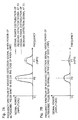
- Fig. 7 is a diagram that typically shows the frequency spectrum of the received detection signal in the nonlinear diffusion distortion phenomenon described in the above Fig. 6.
- Fig. 6A is an example of the frequency spectrum of the received detection signal for a case the power of the transmission ultrasonic pulse is big (i.e. in the event of the main lobe).
- Fig. 6B is an example of the frequency spectrum of the received detection signal for a case the power of the transmission ultrasonic pulse is small (i.e. in the event of the side lobe).
- Fig. 7A shows signal power distribution of the received echo signal when the diffusion distance is at Z0 and Z1 for a case the power of the transmission ultrasonic pulse is big.
- Fig. 7B shows signal power distribution of the received detection signal when the diffusion distance is at Z0 and Z1 for a case the power of the transmission ultrasonic pulse is small. In this case, the signal power of the harmonics frequency does not substantially get bigger even if the diffusion distance is longer.
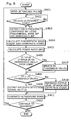
- Fig. 8 is a flow chart that shows a flow of actions of the ultrasonic diagnostic apparatus 10.
- the ultrasonic pulse is sent to the object (S401)
- the ultrasonic pulse is reflected at a sound impedance boundary within the object, and it comes back to the search unit 11 with some time delay occurred according to the reflection depth after transmission has started (S402).
- the ultrasonic echo received by this search unit 11 is received in a way that reflection waves from the main lobe direction and the side lobe direction are superimposed each other.
- the ultrasonic echo received by the search unit 11 is converted into the received echo signal and sent to the beam forming and adding unit 14.
- the beam forming and adding unit 14 corrects the difference in the reaching time spent by the received echo signal between oscillators that form the search unit 11, and execute focusing on the received echo signal.
- the fundamental wave frequency component is extracted and its signal power is calculated by using the fundamental wave BPF unit 151 and the fundamental wave detecting unit 161 (S403, S404).
- the harmonics frequency component is extracted and its signal power is calculated by using the harmonics BPF unit 152 and the harmonics detecting unit 162 (S403, S404).
- the power ratio calculating unit 17 calculates a ratio Rp of each signal power calculated by the fundamental wave detecting unit 161 and the harmonics detecting unit 162 (S405).
- the power ratio comparing unit 19 compares the power ratio Rp calculated by the power ratio calculating unit 17 with the power ratio threshold value Rs memorized by each diffusion distance (depth), which is stored in the power ratio reference memory 18, and make a notification based on its comparison result to the detection signal suppressing unit 110.
- the detection signal suppressing unit 110 suppresses a signal level of the received detection signal output from the fundamental wave detecting unit 161 (S410) (for example, it suppresses it to 20 percent). If not, it keeps the same signal level of the received detection signal output from the fundamental wave detecting unit 161 (S409).
- the display unit 111 generates an ultrasonic image based the received detection signal output from the detection signal suppressing unit 110, and displays it (S411). These processes mentioned above are continued until the diagnosis using the ultrasonic diagnostic apparatus is completed (S401 ⁇ S412).
- the received detection signal which is input to the detection signal suppressing unit 110, is regarded as the received echo signal output from the fundamental wave detecting unit 161.
- the received detection signal output from the harmonics detecting unit 162 shall be used as its input.
- the ultrasonic diagnostic apparatus 10 related to the present embodiment, detection and suppression of the received echo signal generated by the side lobe, which is a cause of the artifact contained in the ultrasonic echo, are conducted by calculating and comparing the power ratios of "harmonics power/fundamental wave power" in the received detection signal. Therefore, it is possible to generate a clear ultrasonic image, which has fewer artifacts, as the ultrasonic image displayed on the display unit 111, and prevent misdiagnosis.
- an ultrasonic diagnostic apparatus is an ultrasonic diagnostic apparatus that can reduce an artifact by suppressing a level of the received detection signal generated by the side lobe in the ultrasonic pulse.
- this ultrasonic diagnostic apparatus is especially different from the ultra diagnostic apparatus according to the firs embodiment with respect to a point that it uses a dynamic band path filter as a band path filter for extracting a fundamental wave frequency component or a harmonics frequency component.
- Fig. 9 is a block diagram that shows a functional configuration of an ultrasonic diagnostic apparatus 40 according to the present embodiment.
- the ultrasonic diagnostic apparatus 40 includes the following elements: a search unit 41; a send/receive switching unit 42; a sending unit 43; a beam forming and adding unit 44; a fundamental wave DBPF (a dynamic band path filter) unit 451; a DBPF (a dynamic band path filter) unit 452; a fundamental wave detecting unit 461; a harmonics detecting unit 462; a power ratio calculating unit 47; a power ratio reference memory 48; a power ratio comparing unit 49; a detection signal suppressing unit 410; and a display unit 411.
- the configuration of the ultrasonic diagnostic apparatus according to the second embodiment is almost the same as the one of the first embodiment, the following explanation focuses on components, which are different. Because the search unit 41, the send/receive switching unit 42, the sending unit 43, the beam forming and adding unit 44, the fundamental wave detecting unit 461, the harmonics detecting unit 462, the power ratio calculating unit 47, the power ratio reference memory 48, the power ratio comparing unit 49, the detection signal suppressing unit 410 and the display unit 411 in Fig.
- the search unit 11 the send/receive switching unit 12, the sending unit 13, the beam forming and adding unit 14, the fundamental wave detecting unit 161, the harmonics detecting unit 162, the power ratio calculating unit 17, the power ratio reference memory 18, the power ratio comparing unit 19, the detection signal suppressing unit 110 and the display unit 111 in the ultrasonic diagnostic apparatus 10 according to the aforementioned first embodiment, their explanation is omitted here.
- the fundamental wave DBPF unit 451 and the harmonics DBPF unit 452 have a filtering feature of which band path width dynamically moves to a lower frequency band width, as the receiving depth gets deeper.
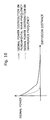
- a reason why the BPF having such feature is used is because it has a characteristic that the signal power is remarkably attenuated as the frequency gets higher, which is as shown in Fig. 10, though the power of the transmitted ultrasonic pulse is attenuated according to diffusion distance (depth).
- Fig. 11 shows an example of the frequency feature of this dynamic band path filter.
- the dynamic band path filter By using the dynamic band path filter, it becomes possible to control the band path bandwidth to be changed according to the diffusion distance (depth) in a dynamic way. Therefore, it is possible to obtain the received detection signal in a good S/N ratio, and eventually possible to generated the ultrasonic image that is unlikely to cause misdiagnosis.
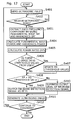
- Fig. 12 is a flow chart showing a flow of actions of the ultrasonic diagnostic apparatus 40. As clarified in Fig. 12, the flow is the same as the flow in Fig. 8 according to the first embodiment except for facts that DBPF is used in the fundamental wave DBPF unit 451 and also DBPF is used in the harmonics DBPF unit 452 (S901).
- the received detection signal that is input to the detection signal suppressing unit 410 is regarded as the received detection signal output from the fundamental wave detection unit 461.
- the received detection signal output from the harmonics detecting unit 462 is used as its input.
- the ultrasonic diagnostic apparatus 40 through calculation and comparison of the power ratios of "harmonics power/fundamental wave power" in the received detection signal, the received echo signal generated by the side lobe, which is a cause of an artifact contained in the ultrasonic echo, is detected and suppressed. Additionally, the band path width is controlled to be changed in a dynamic way according to the diffusion distance (depth), and the artifact is attempted to be reduced by extracting more realistic fundamental wave frequency components and harmonics frequency components. Therefore, it is possible to generate a clearer ultrasonic image as the ultrasonic image displayed in the display unit 111, and thereby misdiagnosis can prevented.
- the explanation has been provided for a case that the artifact is attempted to be reduced by judging whether the echo signal is originated from the side lobe or not based on the ratio between the signal power of the fundamental wave frequency component and the signal power of the harmonics frequency component.
- the invention may be structured in the same way to reduce the artifact by judging whether the echo signal is originated from the side lobe or not.
Landscapes
- Engineering & Computer Science (AREA)
- Physics & Mathematics (AREA)
- Computer Networks & Wireless Communication (AREA)
- General Physics & Mathematics (AREA)
- Radar, Positioning & Navigation (AREA)
- Remote Sensing (AREA)
- Nonlinear Science (AREA)
- Ultra Sonic Daignosis Equipment (AREA)
Applications Claiming Priority (2)
| Application Number | Priority Date | Filing Date | Title |
|---|---|---|---|
| JP2002300957A JP2004135705A (ja) | 2002-10-15 | 2002-10-15 | 超音波診断装置及び超音波診断方法 |
| JP2002300957 | 2002-10-15 |
Publications (1)
| Publication Number | Publication Date |
|---|---|
| EP1411368A1 true EP1411368A1 (de) | 2004-04-21 |
Family
ID=32040791
Family Applications (1)
| Application Number | Title | Priority Date | Filing Date |
|---|---|---|---|
| EP20030023279 Withdrawn EP1411368A1 (de) | 2002-10-15 | 2003-10-15 | Ultraschalldiagnostisches Gerät und Verfahren |
Country Status (3)
| Country | Link |
|---|---|
| US (1) | US6923766B2 (de) |
| EP (1) | EP1411368A1 (de) |
| JP (1) | JP2004135705A (de) |
Cited By (1)
| Publication number | Priority date | Publication date | Assignee | Title |
|---|---|---|---|---|
| EP2871475A1 (de) * | 2013-11-07 | 2015-05-13 | Mitsubishi Hitachi Power Systems, Ltd. | Ultraschallprüfsensor und Ultraschallprüfverfahren |
Families Citing this family (4)
| Publication number | Priority date | Publication date | Assignee | Title |
|---|---|---|---|---|
| US6988410B2 (en) * | 2003-10-24 | 2006-01-24 | General Electric Company | Inspection method and apparatus for determining incipient mechanical failure |
| US7546769B2 (en) * | 2005-12-01 | 2009-06-16 | General Electric Compnay | Ultrasonic inspection system and method |
| JP2013000351A (ja) * | 2011-06-16 | 2013-01-07 | Hitachi Aloka Medical Ltd | 超音波診断装置 |
| KR101858137B1 (ko) * | 2017-03-08 | 2018-05-16 | 대진대학교 산학협력단 | 컴퓨터 시뮬레이션을 이용한 초음파 영상의 부엽 억제 필터 평가 방법 |
Citations (4)
| Publication number | Priority date | Publication date | Assignee | Title |
|---|---|---|---|---|
| US5235985A (en) * | 1992-04-30 | 1993-08-17 | Mcmorrow Gerald J | Automatic bladder scanning apparatus |
| US6132377A (en) * | 1999-03-31 | 2000-10-17 | Acuson Corporation | Medical diagnostic ultrasonic imaging system and method using differential sub-band detection techniques |
| US6181810B1 (en) * | 1998-07-30 | 2001-01-30 | Scimed Life Systems, Inc. | Method and apparatus for spatial and temporal filtering of intravascular ultrasonic image data |
| US6221018B1 (en) * | 1997-07-15 | 2001-04-24 | Acuson Corporation | Medical ultrasonic diagnostic imaging method and apparatus |
Family Cites Families (6)
| Publication number | Priority date | Publication date | Assignee | Title |
|---|---|---|---|---|
| DE4137256A1 (de) | 1991-03-29 | 1992-10-01 | Deutsche Forsch Luft Raumfahrt | Flexibler bandleiter |
| US5526816A (en) * | 1994-09-22 | 1996-06-18 | Bracco Research S.A. | Ultrasonic spectral contrast imaging |
| US5961460A (en) * | 1997-04-11 | 1999-10-05 | Acuson Corporation | Ultrasound imaging enhancement methods and systems |
| US5913823A (en) * | 1997-07-15 | 1999-06-22 | Acuson Corporation | Ultrasound imaging method and system for transmit signal generation for an ultrasonic imaging system capable of harmonic imaging |
| US5833614A (en) * | 1997-07-15 | 1998-11-10 | Acuson Corporation | Ultrasonic imaging method and apparatus for generating pulse width modulated waveforms with reduced harmonic response |
| US5961464A (en) * | 1998-09-16 | 1999-10-05 | Hewlett-Packard Company | Ultrasound contrast agent detection using spectral analysis from acoustic scan lines |
-
2002
- 2002-10-15 JP JP2002300957A patent/JP2004135705A/ja active Pending
-
2003
- 2003-10-14 US US10/682,931 patent/US6923766B2/en not_active Expired - Fee Related
- 2003-10-15 EP EP20030023279 patent/EP1411368A1/de not_active Withdrawn
Patent Citations (4)
| Publication number | Priority date | Publication date | Assignee | Title |
|---|---|---|---|---|
| US5235985A (en) * | 1992-04-30 | 1993-08-17 | Mcmorrow Gerald J | Automatic bladder scanning apparatus |
| US6221018B1 (en) * | 1997-07-15 | 2001-04-24 | Acuson Corporation | Medical ultrasonic diagnostic imaging method and apparatus |
| US6181810B1 (en) * | 1998-07-30 | 2001-01-30 | Scimed Life Systems, Inc. | Method and apparatus for spatial and temporal filtering of intravascular ultrasonic image data |
| US6132377A (en) * | 1999-03-31 | 2000-10-17 | Acuson Corporation | Medical diagnostic ultrasonic imaging system and method using differential sub-band detection techniques |
Cited By (4)
| Publication number | Priority date | Publication date | Assignee | Title |
|---|---|---|---|---|
| EP2871475A1 (de) * | 2013-11-07 | 2015-05-13 | Mitsubishi Hitachi Power Systems, Ltd. | Ultraschallprüfsensor und Ultraschallprüfverfahren |
| CN104634880A (zh) * | 2013-11-07 | 2015-05-20 | 三菱日立电力系统株式会社 | 超声波探伤传感器以及超声波探伤方法 |
| US9435769B2 (en) | 2013-11-07 | 2016-09-06 | Mitsubishi Hitachi Power Systems, Ltd. | Ultrasonic testing sensor and ultrasonic testing method |
| CN104634880B (zh) * | 2013-11-07 | 2017-08-08 | 三菱日立电力系统株式会社 | 超声波探伤传感器以及超声波探伤方法 |
Also Published As
| Publication number | Publication date |
|---|---|
| US6923766B2 (en) | 2005-08-02 |
| US20040077947A1 (en) | 2004-04-22 |
| JP2004135705A (ja) | 2004-05-13 |
Similar Documents
| Publication | Publication Date | Title |
|---|---|---|
| US6508766B2 (en) | Ultrasound diagnostic apparatus | |
| US7044914B2 (en) | Apparatus and method for ultrasonic diagnostic imaging | |
| JP4130114B2 (ja) | 超音波イメージング装置及び超音波信号処理方法 | |
| US6666824B2 (en) | System and method of dynamic automatic sensing of available dynamic range | |
| JP2011254862A (ja) | 超音波診断装置 | |
| WO2015133677A1 (ko) | 초음파 영상의 스페클 저감장치 | |
| US6726630B2 (en) | Ultrasound diagnosis apparatus for imaging with a contrast agent | |
| US6923766B2 (en) | Ultrasonic diagnostic apparatus and ultrasonic diagnostic method | |
| US20100137715A1 (en) | Ultrasonic imaging apparatus and control method for ultrasonic imaging apparatus | |
| US9782146B2 (en) | Ultrasonic diagnostic scanner and method for processing ultrasonic signal | |
| US6190322B1 (en) | Ultrasonic imaging system and method using linear cancellation | |
| KR101124759B1 (ko) | 엔트로피 정보에 기초하여 초음파 영상의 화질을 개선시키는 초음파 시스템 및 방법 | |
| JP3644895B2 (ja) | 超音波診断装置 | |
| JP2007236740A (ja) | 超音波診断装置及びその制御プログラム | |
| JP3078569B2 (ja) | 超音波診断装置 | |
| KR101542807B1 (ko) | 영상 화질 개선 방법 및 이를 이용한 초음파 영상 장치 | |
| CN111012379A (zh) | 用于执行超声成像的方法和系统 | |
| JP3295787B2 (ja) | 超音波診断装置 | |
| JP4664209B2 (ja) | 超音波診断装置およびその撮像を実行する超音波イメージングプログラム | |
| US20260069254A1 (en) | Adaptive ultrasound imaging acquisition | |
| JP2000051211A (ja) | 超音波診断装置 | |
| JP2025051167A (ja) | 超音波画像処理装置 | |
| JP2007175233A (ja) | 超音波診断装置及び超音波診断装置の制御プログラム | |
| JP2025051168A (ja) | 3次元超音波画像処理装置 | |
| JP2850032B2 (ja) | 超音波ドプラ装置 |
Legal Events
| Date | Code | Title | Description |
|---|---|---|---|
| PUAI | Public reference made under article 153(3) epc to a published international application that has entered the european phase |
Free format text: ORIGINAL CODE: 0009012 |
|
| AK | Designated contracting states |
Kind code of ref document: A1 Designated state(s): AT BE BG CH CY CZ DE DK EE ES FI FR GB GR HU IE IT LI LU MC NL PT RO SE SI SK TR |
|
| AX | Request for extension of the european patent |
Extension state: AL LT LV MK |
|
| 17P | Request for examination filed |
Effective date: 20041008 |
|
| AKX | Designation fees paid |
Designated state(s): DE FR GB NL |
|
| STAA | Information on the status of an ep patent application or granted ep patent |
Free format text: STATUS: THE APPLICATION IS DEEMED TO BE WITHDRAWN |
|
| 18D | Application deemed to be withdrawn |
Effective date: 20060503 |